



Abstract
Translation has been a core concern for geographers, particularly in the context of our discipline’s ongoing debate about how to world Geography otherwise. Rather than seeing translation as simply an act of bridging pre-existing differences, this article conceptualizes translation as an act producing differences-in-relation. It traces four “trajectories of translation” that bring geographers’ discussions of translation into new configurations: (1) Topoglossia, foregrounding the linkage between place and language; (2) imbrication, a metaphor for thinking difference-in-relation; (3) relays, an alternative to the metaphor of the bridge; and (4) communities, defined not by self-identity but by their shared practice of translation.
I Introduction
The work of translation is a practice by which the initial discontinuity between the addresser and the addressee is made continuous…. Cultural difference, which prompts translation, is unrepresentable in this sense and can by no means be reduced to either specific difference or spatial distance. But when represented as a conceptual difference or gap, it is no longer an incommensurability. (Sakai, 2006: 75)
Where does translation take place? A partial list might include: It happens “in the field,” where we find ourselves struggling both to explain the concepts we arrive with and to parse the words our interlocutors use; it happens in our “research,” as we comb through secondary sources, seeking the right word to bring our sentences into alignment; it happens in intimate realms, when we speak with friends or family members; it happens in our classrooms, as we move between fluent phrases and uncertain, stuttering explanations; it happens in those moments of discontinuity that spark the question, But what does this mean? In short, the work of translation happens both everywhere and in specific—but different—kinds of where.
For more than three decades, geographers have engaged with the practices and politics of translation. In Anglophone debates over the geographies of translation, much of this work has been undertaken by scholars who work, think, and write primarily in languages other than English. This has produced a curious bifurcation within debates about translation: For those who work and live in multiple languages, these debates about translation are urgent and inescapable. But for those who work and live primarily in English and thus benefit from a form of “linguistic privilege” (Müller, 2021), translation can sometimes be located “elsewhere,” on the boundaries of linguistic difference.
This article builds on that work by tracing what we call “trajectories of translation.” Our choice of trajectory is intentional, reworking Doreen Massey’s frequent invocation of the “multiplicity of trajectories” (Massey, 2000: 225) that constitute relational spatialities. Relational thinking is especially important to translation because it helps us think about linguistic alterity (the ostensible cause of translation) differently: Instead of translation bridging pre-existing forms of difference, translation produces difference-in-relation.
Building on the core insight that translation is an act of world-making (Müller 2021; McFarlane, 2022), this article offers four concepts—topoglossia, imbrication, relays, and communities—to place translation in new configurations. These configurations include engaging languages that have rarely been discussed in geographers’ engagements with translation, curating new citational communities, and building across seemingly disparate and disconnected disciplinary debates. We argue that these trajectories of translation articulate a common practice-in-difference to provide a novel answer to one of our discipline’s fundamental questions: How we make geography in common without reproducing long-standing “otherings.” Aligned with Eleanor Chapman’s (2023) recent call for “a more nuanced engagement with the frictions and disjunctions of the political and ethical labour of translation itself, especially as it occurs in embodied, everyday settings of partial or uneven linguistic fluency” (31), we stress that this project addresses not only to those who negotiate many forms of linguistic difference but especially those scholars—often Anglophone—who may engage with translation as merely the work that “other” scholars do (Oswin, 2020).
We enter this argument as “native speakers” of “English.” Those figures—the “native speaker” and “English”—are crucial parts of life in the United States of America, a country in which place of birth and speaking English are powerfully naturalized as “being American.” While we would both occupy that position, we find it an incomplete description of our linguistic trajectories. Respectively, we grew up in Los Angeles and the DC metro area. Our “native” worlds were woven through with Spanish, Cantonese, Farsi, and more. We spoke a “proper” English shaped by class and education but only one version within worlds of English that defied easy categorization. Multilingualism was part of our lives in diverse ways, whether friends negotiating linguistic boundaries or fragments of our family heritage languages.
At the same time, our multilingual environments were not the formal and institutionalized bilingualism of cities like Montreal, Brussels, or Trieste. Our “native” languages existed alongside the category of “foreign” languages in the American educational system, where the foreign was almost always mapped as outside the nation of our birth. Our experiences with foreign languages were further transformed by 9/11 and the Global War on Terror. Our undergraduate and graduate education in Arabic and Turkish was partly funded by Foreign Language Area Studies grants, thus embedding our encounter with “foreign” languages in a complex set of histories and logics.
However, in the two decades since we first began to learn those languages, Arabic and Turkish have become something different: Research languages, of course, but also languages of friendship, family, collaboration, mistakes, misunderstanding, and more. Our experience provides a reminder that our languages are only partially described by categories such as “English,” “foreign” or “native.” Instead, and as we develop below, we find it much more productive to describe our languages in relation to the places in which they are spoken and between which they travel (or do not).
II Geographies of Translation: Practices, Politics, and Possibilities
Geographers have a long history of engaging with translation. Here, we primarily review Anglophone debates although we note rich discussions of translation in Francophone (e.g., Mekdjian, 2017) and Lusophone contexts (e.g., Husseini De Araújo, 2018; Paiva and De Oliveira, 2021), among many others. Our choice to focus on Anglophone debates is pragmatic, shaped by our own positions in US-based Anglophone institutions, our comfort level with search tools that primarily surface Anglophone scholarship, and our research experiences with two major languages of the “Middle East” (and relative inexperience with other linguistic traditions).
Although translation has long been a concern for Anglophone geographers, it was not until the 1990s that translation emerged as a topic of concern in its own right. Partly, this reflected geographers’ broader interest in questions of language and discourse (e.g., Barnes and Duncan, 1992), and specific engagements with the etymologies and translations of key concepts like landscape (e.g., Cosgrove, 1985; Olwig, 1996). 1 More important, however, were then-emerging discussions of positionality and reflexivity (e.g., Smith, 1996). In contrast to relatively simple approaches that mapped “foreign” languages onto the spaces of “fieldwork” (Gade, 2001), Smith’s work drew on postcolonial interventions to argue for greater exploration of the “differences, tensions and conflicts” of translation “as spaces of conceptual and indeed political opportunities and negotiations” (Smith, 1996: 165).
Amidst a broader critique of “objective” or “neutral” methods, geographers came to redefine the role of translation. Rather than conceptualize it as a technical act of finding “equivalents” between different languages, they emphasized its politics of meaning (Müller, 2007) and its entanglement with interpretive choices (Filep, 2009). Recent discussions of translation continue to refine how we understand the embodied practice of translation and the elusive goal of “fluency” (Gibb et al., 2019; Gibb and Danero Iglesias, 2017; Veeck, 2001). For example, scholars remind us of the time and cultural work involved in learning languages (Drozdzewski, 2018), stress the embodied dimensions of language and translation (Krzywoszynska, 2015), and reflect on multiple forms of positionality and translation (Gawlewicz, 2016). This work shows how translation has been and continues to be part of broader discussions of positionality, reflexivity, and research ethics.
Alongside this methodological reflexivity, a second key field of debate has been the role of translation in producing the geographies of geography. In other words, how has translation—or its absence—shaped the uneven production of geographical knowledge? This emerged especially strongly in the early 2000s as part of wider discussion of what “international” geography could and should look like. 2 Reflecting on the “globalization” of geographical research, Maria-Dolors Garcia-Ramon (2003) critiqued its “partial and uneven” geography, one that made it possible “for those able to speak and write in English [to find] an international audience… but those writing and speaking in languages other than English [found their] access to a wider audience… much more restricted” (2). Garcia-Ramon’s intervention was one of several critiques highlighting the asymmetries of “international” geography (e.g., Bialasiewicz and Minca 2005; Desbiens and Ruddick, 2006; Hancock, 2016; Minca, 2003; Pickles, 2005; Samers and Sidaway, 2000; Sidaway et al., 2004). 3
Many of these English-language critiques were written by scholars writing in second and third languages, a reminder that much of the labor of translation into English is unevenly distributed. Indeed, there is a curious bifurcation in the discussion about translation. Those who write in English as a first language often tend to write about translation in relation to their fieldwork; those who write in English as a second (academic) language often tend to write about translation in relation to the production of geographic knowledge. Obviously, these two approaches are not mutually exclusive, but they signal how scholars’ linguistic trajectories shape their relationships to translation.
The relationship between French and English has been an especially interesting site to consider the role of translation in reproducing the uneven geographies of geography. For example, Francophone scholars have noted the “peripheralized” position of French-language scholarship vis-a-vis the centrality of English (Houssay-Holzschuch and Milhaud, 2013) and the itineraries of “critical” geography between French and English (Calberac, 2019; Mekdjian, 2017). This careful attention to the uneven geographies of translation, in Claire Hancock’s (2016) astute formulation, “opens one’s eyes to the ways in which specific social and political contexts shape, more than we care to acknowledge, the issues we as geographers choose to address, and the ways in which we do it” (Hancock, 2016: 28). Indeed, scholars continue to remind us of the uneven role that translation plays in producing geographic theory and knowledge (e.g., Husseini De Araújo, 2018; Fall, 2012; Korf, 2021; Minca, 2000; Paiva and De Oliveira, 2021; Woon, 2014). Despite ongoing critique of “international” geography’s linguistic hierarchies (e.g., Bański and Ferenc, 2013; Müller, 2021), our discipline’s linguistic landscapes remain profoundly uneven.
While those who “[straddle] different linguistic and institutional spaces” (Fall and Minca, 2013: 545) are well aware of geography’s multilingual character and have written effectively and expansively about the need for a more multilingual geographic praxis, their arguments have been further buttressed by geographers’ recent engagements with decolonial and postcolonial critiques. A critical practice of translation is fundamental to this project. Such a critical practice, Shadia Husseini De Araújo and Mélina Germes (2016) suggest, “kann neuer Raum für alternative Sprachen, Inhalte, Deutungsweisen und wissenschaftliche Praktiken entstehen” (5). 4
We take this criticism to heart. Working primarily in an Anglophone context, we note how easy it is for ourselves, our students, and our colleagues to work in English alone. Such a parochial approach both flattens the considerable diversity within English and, as Annemarie Mol and John Law have recently argued, loses “the verbal richness afforded by moving between languages and working inter-linguistically” (Law and Mol, 2020: 264). In foregrounding new multilingual practices, we are able to “[juxtapose] conditions, framings, ‘your own terms’ and words... [opening] up questions to do with practices and their implicit rules; questions to do with words and the worlds they help to verbalise and form a part of” (Chernysheva et al., 2020: 286).
Indeed, these new multilingual interventions offer a challenge to the dominant representation of “foreign” words in flagship journals like the Annals, the Transactions, and Progress in Human Geography. Foreign words are usually italicized and marked as different; authors are often expected to explain their context and significance to readers who may otherwise be unfamiliar with them. This translational work is important (and one that we have joined in), but it can reproduce an uneven landscape in which English is assumed to be transparently understood and languages other than English require introduction. The labor of this work falls primarily either on researchers who speak/write English as a language other than their first or those (like ourselves) whose research takes place primarily in languages other than English. Interestingly, “smaller” journals such as Terra Brasilis (Davies, 2021; Péaud, 2021; Ribeiro, 2021), ACME (Husseini De Araújo and Germes, 2016; Feliciantonio et al., 2023), the Journal of Latin American Geography (Gaffney et al., 2016), and Geographica Helvetica (e.g., Korf et al., 2022) provide important models for pluralizing geographers’ linguistic practices (see also Müller, 2021: 1458).
Collectively, these critical interventions—translation as part of fieldwork, as uneven infrastructure for knowledge production and theory production, and as possible multilingual praxis—intersect productively with recent critiques of what Tariq Jazeel, drawing on David Slater, calls the “masked universalisms” of our discipline (Jazeel, 2014: 88; Slater, 1992). As geographers positioned around the world theorize and seek to understand global and planetary dynamics including climate change, urbanization, racialization, and revolutionary alternatives, engaging with translation should be a core part of what all geographers do. This is in keeping with a critical practice that seeks to transform deeply embedded geographies of knowledge production and thus “better reflect the ontic differences that mark our heterogeneous world… [and] be open to [multiple] epistemic locations and differences” (Müller, 2021: 1460; Feretti, 2021). In engaging how we work with, across, and within linguistic difference, we are “obliged to come to terms with the situatedness of [our] knowledge production, often learning from one another in ways that highlight Geographyʼs geographies, place-based particularities, and context-contingent worldings” (McFarlane, 2022: 3).
In the spirit of widening our “context of argument and, therefore… intervention” (Scott, 2004: 4), we suggest that our engagements with translation might be pushed even further: Translation provides a common ground for everyone. The risk of “everyone,” of course, is the masked universal that often lurks within. However, we draw in particular on the work of Naoki Sakai to make a different argument: Because translation is simultaneously prompted by difference and builds differences-in-relation, it provides a different ground for defining “everyone.” What holds the “us” together is not its self-identity but its commitment to translating its differences.
Sakai’s expansive scholarship (e.g., Sakai 1997, 2000, 2006, 2009a, 2009b, 2017, 2019) has merited relatively little attention within geography. 5 Three themes are especially pertinent to our discussion. First, Sakai challenges a model of “monolingual communities” (exemplified for him by Roman Jakobson’s (2004) definition of “translation proper”). Those monolingual communities naturalize a “schema of co-figuration” (Sakai, 1997: 3), most often represented by the territorial form of the nation. In the process, the act of translation comes to be represented as a “spatial bridging [between two stable languages] as if the initial discontinuity or difference… had preliminarily been determined to be a geographic distance” (Sakai, 2009b: 167).
Second, Sakai historicizes the practice of translation. He argues that Jakobson’s model of interlingual translation is incomplete not only because it assumes “monolingual communities” but because it fails to examine how that figure of translation emerged in partnership with a mode of government and cultural politics based on the “native” speaker and its “foreigner”: In the eras of premodernity it was impossible to find the legitimacy of government based on an official monolingualism or of a nativist heritage by which the identity of the individual was determined in the last instance by whether or not he or she was a native speaker of the official language. The very idea of the native speaker… was invented in the transitional phases from the premodern eras to the modern era. (Mezzadra and Sakai, 2014: 13)
Inventing the “native” speaker, in other words, was inextricable from inventing the “nation” (Anderson, 1997). In this modern “regime of translation,” monolingual communities came to be spatialized; that linguistic difference was represented as “a border between one language and other… [a spatial] gap or distance that [separated] one group of people from another and [distinguished] one language from another” (Sakai, 2017: 106). Historicizing other regimes of translation helps identify other schemas and spatialities of translation.
Finally, Sakai offers an alternative definition of translation. Instead of defining translation as an act of communication (where the translator works between two ostensibly stable linguistic communities), Sakai defines translation as an act of address in which “it is impossible to assume that one should automatically be able to say what one oneself means and an other able to incept what one wants to say” (Sakai, 1997: 7). Calling this a mode of “heterolingual address,” the community constituted by translation is thus redefined not in terms of a stable linguistic community but as “a nonaggregate community of foreigners” (Sakai, 1997: 9). We weave Sakai’s work through our discussions below.
III Topoglossia; or, place-languages
One of the most stubborn frames for thinking about language and translation in the United States is the “foreign.” Despite critiques, this framing is most visible in American university curriculum, where both undergraduate and graduate requirements often require “foreign” language coursework. Calling languages “foreign” in the United States naturalizes a logic in which English is deemed “native” and everything else is rendered other (see Rafael, 2009 for further discussion). In this section, we offer the concept of topoglossia as an alternative to the binary framing of foreign and native languages. By thinking of languages as topoglossic—linked to and defined in relation to places—we bring geographers’ recent thinking about language into conversation with ongoing discussions of translation.
For Sakai, the idea of “Japanese” language or even a vernacular version of Japanese is an abstract conceptualization that artificially creates a homogeneous imaginary of language and its speakers that exists separate from the actual heterogeneous ways in which language functions (Sakai, 1997). Extending Sakai’s insight, descriptions of both “foreign” and “native” languages (e.g., “French,” “English,” or “Arabic”) can assume the coherence of languages and mask considerable variation within them. This mapping of language can then be transcribed back onto the body of the speaker(s), marking some sort of nationalistic “community” that corresponds to a territory on a map. In this mapping, translation happens at the border between these linguistic territories. Sakai criticizes this conceptualization as historically deficient and complicit in reinforcing methodological nationalism. Instead, he argues that translation and misunderstanding occur in both mono- and multi-lingual contexts.
But if languages are not clearly mapped onto territories of “foreign” and “native,” how might we describe their geographies otherwise? We find Ludwig Wittgenstein’s work a useful complement to Sakai’s discussion. While a full engagement with Wittgenstein’s changing thoughts about language is well beyond the scope of this article, Wittgenstein has influenced thinking on method and knowledge production in geography (e.g., Curry, 1989, 1992, 1996, 2000, 2005), discussions of translation (e.g., Krzywoszynska, 2015), and recent reappraisals of language and political geography (e.g., Medby, 2019). Wittgenstein’s definition of a “language-game” is especially relevant. In its simplest terms, a language-game consists of a “language and the activities into which it is woven” (Wittgenstein, 2009: 7). In this sense, the coherence of languages like “English” or “French” or “Turkish” falls away, along with the practices of translation that bridge them. Instead, both speaking a language and translating becomes “a practice embedded in the customs and agreements of a community…. We acquire the ability to use expressions, to follow the rules for their use, by our training as members of that community” (Grayling, 2001: 95-96). This training happens in and helps to make places.
Inspired by this grounded approach to language, we offer the idea of language as topoglossic. The suffixes -glossic and -glossia are often used to describe diglossic languages such as Arabic with distinct written (usually formal) and spoken (often informal) registers. 6 Our concept of topoglossic uses the prefix topo- to highlight how languages exist in relation to places. We are also inspired by Katz’s (2001) idea of topography as a method of tracing the ways in which processes are rooted in complex and historically situated contexts and simultaneously connected to distant places and scales through translocal relationships. Rather than separate languages into formal or informal registers, a topoglossic view of language asks how languages ground themselves differently in place and link diverse worlds and imaginaries. The topoglossic helps us consider how languages derive their meanings from the places in which they are (and have been) used. Although geographers have often considered how the meaning of words is linked to their material, cultural, and social contexts (e.g., Drozdzewski, 2018; Edwards et al., 2010), it bears repeating that this has implications for how we “map” languages and think about the “conceptual geographies” underpinning how words are “translated into ‘being’” (Woon, 2019: 116).
Viewing language as topoglossic in fieldwork settings complements critiques of the idea of “foreign” fieldwork (Katz, 1994; Nast, 1994; Smith, 1996, 2006, 2016). Like calls to think about domestic fieldwork as containing many of the same tensions of international fieldwork (Gilbert, 1994), thinking about language topoglossically calls attention to the ways that language acquisition, as an exercise in navigating meaning and community that is continually unfolding across time and space, occurs in both mono- and multi-lingual contexts. It follows then that, while markers of fluency can be useful shorthands, ideas of fluency fail to account for the ways in which our usage of language in different contexts shapes how researchers build relationships, collect data, and create analyses (see Tremlett, 2009). Viewing language acquisition in these terms changes the goal from mastering grammar rules and acquiring fluency to an ongoing effort of establishing relations across difference. Translation becomes not a singular event but an ongoing process in fieldwork. As Sakai argues, Translation facilitates conversation between people in different geographical and social loci who would otherwise never converse with one another, but it also provides them with a space where the appropriateness and validity of translation is constantly discussed and disputed. In this space we misunderstand and mistranslate one another, but we also recognize the urgent need to strive to understand and translate one another so that we can discover how we misunderstand and mistranslate. (Sakai, 2000: 798)
In this framing, language use in fieldwork is not a “communication model of equivalence and exchange but rather [is] a form of political labor to create a continuity at the elusive point of discontinuity in the social” (Sakai, 2019: 271). Framed this way, language usage both marks and bridges social and place-based difference. This echoes Pratt’s idea of a contact zone, one where people of different cultural backgrounds negotiate meaning and histories of oppression (Pratt, 1991). However, those negotiations don’t simply happen at the “boundaries” of cultures (or language) but are always present in the places of language.
Language learning and use is thus a story of connecting places. For example, in the Arabic language classroom in the US, each classroom space and its approach to language is shaped by these topoglossic connections. First, the location of these classrooms in the US means that Arabic is often seen as a “foreign language” of which Modern Standard Arabic (MSA) is the foundation. For Cook, like many students in the United States post-9/11, her experience learning Arabic was shaped by a foreign-policy centric vocabulary tied to American geopolitical needs (Al-Saleh, 2018; Daugherty, 2011; Uzum et al., 2021). For example, when first learning MSA in a university classroom, she learned how to say “United Nations” before she learned to ask where the bathroom is. Meanwhile, students and teachers bring their experiences in life, education, and speaking to the same space. Instructors are shaped by where they have utilized different Arabics, where they learned about language instruction, and the histories of those institutions. Some students may have ties to different Arabics through familial relationships in which Arabic is simultaneously intimate and also partially unknown due to an inability to read and write or a limited vocabulary. Other students may only have been exposed to Arabic through tokenized imagery in popular media. However, the focus on MSA as a standardized, formal language often serves to delegitimize any other usage of dialects, which in turn hampers discussions of people’s relationships to other Arabics.
In contrast, the actual use of language during fieldwork had less to do with the simple formal and colloquial registers, but all of the ways in which social context and place are embedded in language. Cook’s own history of learning colloquial Arabic in different places marked her patchwork array of vocabulary and pronunciation. Furthermore, many people who helped shape this language learning had their own linguistic tendencies that reveal ties to places (some of which they never may have been to), such as Hebron. Her use of language, full of awkward word choices and mistakes, allowed for conversation in Arabic but also reinforced her status as an outsider. At the same time, because she volunteered preparing and selling rural food products at markets, she also knew very specific vocabulary tied to rural places and activities, which often marked her as an insider in some ways and opened more in-depth conversations in interviews as she, alongside interviewees and sometimes with a research assistant, played with vocabulary in various Arabic dialects to find the right words to bridge linguistic and social differences between them. In this research experience, she found that this social difference was deeply linked to place, signaled via dialects, vocabularies, and references that shaped and were informed by the differences that people perceived between her and themselves. This experience echoes other discussions of translation and fieldwork (e.g., Watson, 2004; Drozdzewski, 2018).
In these instances, each person’s use of language is a symptom of the places they have lived, and, through conversation, everyone is playing with different words in order to bridge the multiple lines of difference between them. Therefore, even while working within one langue, language simultaneously reflects difference and bridges it, bringing concerns about translation to the forefront of any research context (Crane et al.,. 2009). Rather than think of her experience learning Arabic as learning a “foreign” language—a framing that tends to naturalize the difference between “native” and “foreign” languages—it is more useful to reflect on her experience as learning the languages of place and the places of language. Arabic operates topoglossically, with traces of distant places shaping how language is used in co-production across lines of difference. These connections were essential to understanding the role of place and agricultural knowledge and social context during interviews with interviewees and research assistants. In this context, translation is an act of address—between two people whose lives and language are rooted in two different places; it is the relation between them and their use of language(s) to bridge difference—something that even perfect fluency does not “resolve.”
IV Imbrication; or, relations in difference
Spatial metaphors have been a key part of debates over translation. We learn, for example, about “peripheral” languages and more privileged centers (e.g., Houssay-Holzschuch and Milhaud, 2013). Similarly, the “border” (and linked terms like borderlands and border crossing) helps to spatialize a social practice of moving between two (or more) different languages (e.g., Anzaldua, 1987). An act of translation can also be spatialized as a “bridge” between two different languages or cultures. Within translation studies, however, one of the well-known spatial metaphors is that of the “foreign” and “domestic.” It has been most fully developed in the work of Lawrence Venuti (1991), who maps out the difference between “foreignizing” and “domesticating” translations. 7
Although these various spatial metaphors have different conceptual genealogies and political implications, they collectively help to highlight two linked insights. First, these metaphors force us to think about the socially uneven nature of translation. Who translates what from where is, of course, always an issue of power. In contrast to those who might celebrate a world of frictionless translation, these spatial metaphors ask us to think critically and carefully about asymmetries and aporias. They help locate what Emily Apter calls the untranslatable, “as a deflationary gesture toward the expansion and gargantuan scale of world-literary endeavors” (Apter, 2013: 3). Although his arguments and conclusions depart from Emily Apter’s conclusions, we might similarly consider Tariq Jazeel’s discussion of the “unruly otherness” of a word like swabhawadharmay (Jazeel, 2014: 100). These invocations of the untranslatable help scholars to make visible—through linguistic differences—“the ontic differences that mark our heterogeneous world” (Müller, 2021: 21).
Second, these metaphors make visible one of human geography’s core insights: The mutually reinforcing relationship between social dynamics (e.g., the languages people speak) and spatial relations (both where people use languages and how their uses of language make place). While these metaphors help us understand important dimensions of translation, we find that they share a common form where linguistic difference is typically spatialized as some sort of boundary or border. In this section, we offer an alternative metaphor—that of imbrication—that helps us understand the geographies of linguistic otherness (and thus translation) differently. (Figure 1) Comparing different figures of difference.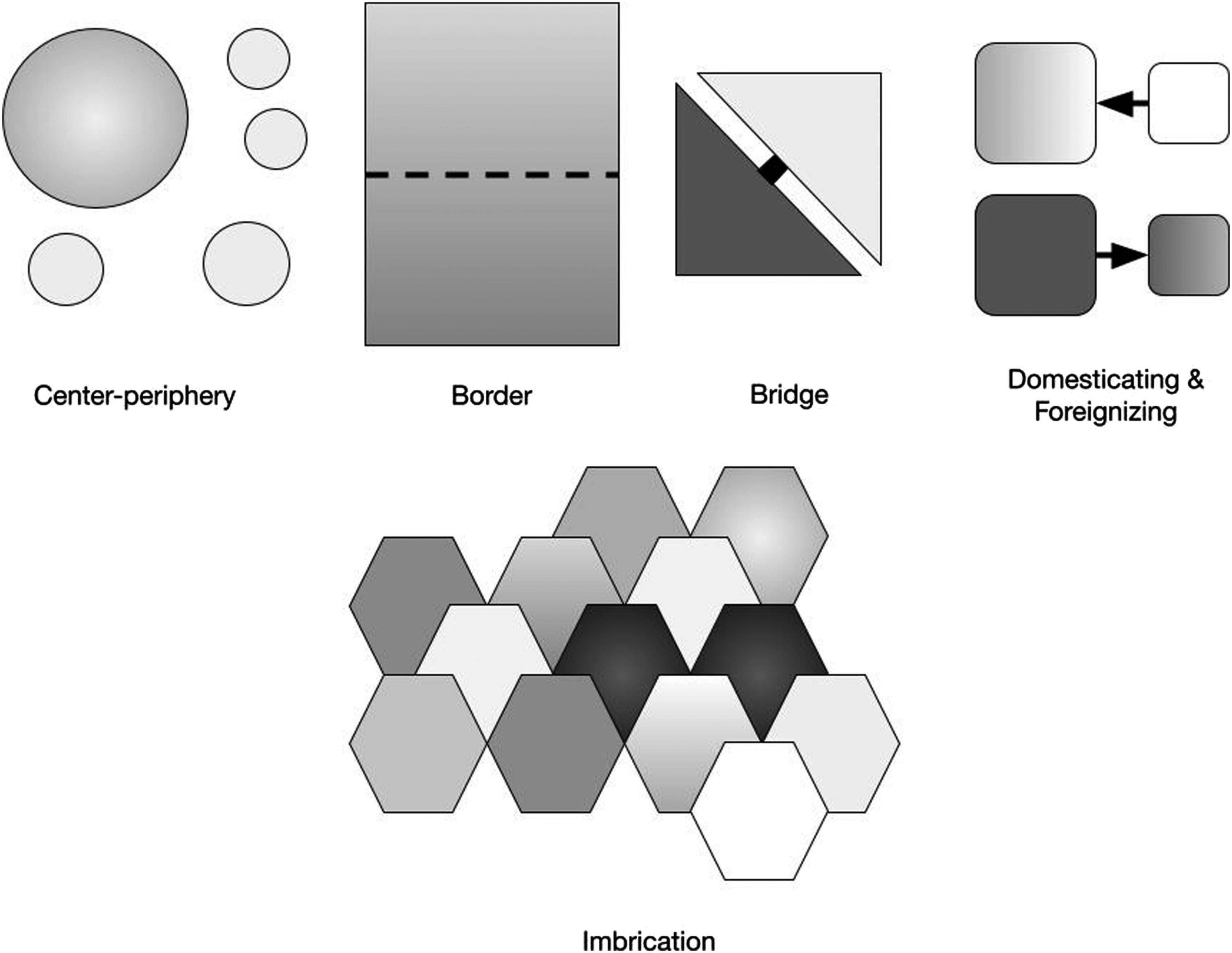
Imbrication—to be imbricate—describes an arrangement of overlapping relations (imbricate, 2023), found in examples like scales, tiled roofs, or flower petals. 8 Our use of imbrication draws on Aamir Mufti’s discussion of cultural difference and contrapuntality in the work of Edward Said. Taking Said’s insight seriously, Mufti (2005) writes, shows that “all ideas of cultural autonomy and autochthony [are] phantasmic in nature” (477–78). Instead, difference and alterity are the product of relational, historically dynamic, and “deeply imbricated lives” (ibid., 478). Although Mufti and Said both focus on cultural traditions, this phrasing can be extended to a discussion of the geographies of language. As we argued in the previous section, languages are not abstract systems that exist within clearly demarcated categories, textbooks, or spatial containers. They are topoglossic, existing in and helping to define the relational places of human life.
In this sense, the metaphor of imbrication helps us conceptualize translation not as the movement between two relatively stable and self-defined linguistic geographies (e.g., centers and their peripheries; boundaries; the foreign and the domestic) but an ongoing act of “radically placing what we do know and relating more respectfully, responsibly, attentively, and quietly to all that we do not know” (Cameron, 2015: 35). Understanding linguistic difference as imbricated means that translation is an act of building multiple relations, a project that can both close down and open up different understandings of political, ethical, and social relationships (Cameron et al., 2015).
Imbrication asks us to shift our attention from assumptions of ontological difference to the “difference-producing… relations” between languages and within them to better understand “the construction of differences in historical process” (Gupta and Ferguson, 1992: 16). This has important consequences for thinking about linguistic difference. As Barbara Cassin puts it in her opening “présentation,” this calls us to “jouer le maintien de la pluralité, en rendant manifestes à chaque fois le sens et l'intérêt des différences, seule manière de faciliter réellement la communication entre les langues et les cultures” (Cassin, 2004: xvii). 9
One word which helps us understand imbricated translations is adab, found in languages that include Arabic, Bengali, Malay, Persian, Swahili, Turkish, Urdu, and Uzbek. Across these languages, the word usually carries a similar set of meanings, including good manners, cultivation, etiquette, refinement, ethical comportment, proper form, and literature. Its relatively stable meaning across time and place—largely in Muslim-majority contexts—could lead us to locate adab in a self-referential and hermetic world of Islam, sealed off from a European, colonial project.
Such a reading, however, misses the way that adab moved across space and time (Gluck, 2009), producing a distinctive “entangled history” (Dressler et al., 2019; Gould 2007; Pernau, 2012). As a genre of writing, adab emerged in the first centuries of the Islamicate world, where it represented, in contrast to divine revelation, a “non-prophetic tradition [that] designated the quintessence of practical wisdom accumulated over the generations” (Salvatore, 2019: 37). Even though adab was distinct from Islamic traditions like fiqh and kalam, it would be wrong to see adab as wholly separate, as instruction in adab came to be part of Sufi networks from North Africa to Central Asia to South Asia. Interwoven with genres like akhlaq (ethics) (Kia, 2014: 282) and nasihat (advice), adab provided “a significant nexus between the cultivation of the self… and general ideas of integration of the body politic” (Salvatore, 2019: 40).
As with so many other words and genres, adab was reconfigured during the 19th century (Hallaq, 2014). Crucially, this transformation played out differently in different languages in different places. In Cairo, Egypt, for example, the translator, writer, and scholar Rifa’a al-Tahtawi’s engagement with adab emerged as the result of his translations of French discourse into Arabic (McLarney, 2016: 27-31). Yet al-Tahtawi’s translations spurred a new engagement with a classical Arabic tradition in order to cultivate “the literary dimension of adab” (Salvatore, 2019: 44). As a concept and genre of writing, adab was thus embedded in multiple overlapping worlds, including French colonialism, the rise of a new Egyptian state, the translation from French into Arabic of concepts like liberté, and a neo-classical Arabic literary renaissance (nahda) that reconfigured Arabic-language Qur’anic and poetic traditions. Neither simply colonial importation nor decolonial resistance, al-Tahtawi’s adab straddled many worlds and temporalities.
Though adab connected worlds of Islam, those worlds did not map neatly onto clearly demarcated containers defined by language, ethnicity, or religion. Rather than represent a discrete tradition or community, adab existed within and helped to constitute a multilingual intermedial world which eluded easy description as either cosmopolitan (i.e., universal) or “local” vernaculars (Orsini, 2015b: 269; Orsini 2015a). Similarly, Mana Kia astutely calls us to grapple with “the aporias of Islamic or Persian adab” (Kia, 2020: 14), generated by its simultaneous status as a “Muslim concept shared across… languages” and a “proper form,” embedded in place-based languages and discursive traditions (ibid., 14). In short, adab was imbricated, its difference produced through shifting relations in and across multiple languages.
In this section, we have argued that there are other metaphors for understanding translation. We offered that of imbrication to highlight a practice of translation grounded in the paradoxes of (dis)continuity and the (in)commensurate, the gap between “difference and identity… that translation straddles” (Auvray-Assayas et al., 2014: 1151). Instead of bridging difference, translation imbricates it, thus helping us understand multiple geographies of meaning, forged in negotiation, pidgins, and bodies that move between (Ghosh, 2008).
V Relays; or worlds through translation
Urban forms are diverse; similarly, the words that name these urban forms are similarly diverse. The puzzle for scholars of urban studies is to make sense of that diversity: What links the bidonville, the shantytown, the desakota or the gecekondu? What connects the jiehebu, the site or the suburb? On the one hand, we could simply see these words and their urban forms as manifestations of a common abstract process of urbanization. On the other hand, we could also insist that these words (and the urban forms they name) need to be understood within their distinct and different contexts.
Obviously, scholars of urban studies are considerably more nuanced in how they think about linguistic differences and the challenge of translation (e.g., Schmid et al., 2018), but our point is the same: The challenge of translation echoes a broader debate within urban studies that positions “difference against abstraction” (Angelo and Goh, 2021: 734). We thus find translation an especially productive point of departure for considering “why and how ideas and practices travel across time and space” (ibid: 741).
In this section, we follow Yimin Zhao’s (2020) recent call for a “translational turn” in urban studies. Engaging with Müller’s (2007: 207–08) discussion of translation as a “search for equivalence,” Zhao argues that rather than locate “linguistic equivalences… at the center of translation” (531), we should “search for new ways of engaging in dialogues, recognising the existence and values of distances between languages” (532). 10 Building on Zhao’s arguments, we offer the relay as one figure for following forms of the urban in translation.
The relay is an apt metaphor for a practice of translation. As a verb, it signals an active act of transmission or passing on. In this sense, our usage follows Eden Kinkaid’s (2019) observation that acts of translation “paradoxically produce the ‘global’... as a kind of relay or collaboration around a shared concept” (566). Parallel to Zhao (2020), Kinkaid draws on Cristina Espinosa’s argument that translations are not acts of equivalence but “cultural and social processes of simultaneous replication, imitation and differentiation resulting from continual confrontations between knowledge formations” (Espinosa, 2017: 467).
As a noun, a relay is a relational project. In sports, for example, a relay is defined by its constituent parts. In this sense, thinking in terms of relays offers an alternative to another metaphor for translation: That of the bridge. Here, we again draw on Sakai’s (2009b: 171-73) critique of “inter-lingual” models of translation (Jakobson, 2004) that locate translation at the border or boundary between two distinct and self-referential languages. Such a model of translation, Sakai notes, misses translation’s paradoxical relationship with discontinuity (which prompts the work of translation) and continuity (through which addresser and addressee articulate a common meaning) (Sakai, 2006: 75). Both as a verb and as a noun, the relay thus helps highlight the acts of translation that constitute worlds-in-difference. These worlds—such as the world of adab discussed above—are defined simultaneously by meanings shared across time and place and by forms of difference requiring relays in the first place.
Relays are situated in both place and time, a quality captured beautifully in Liz Mason-Deese’s preface to Veronica Gago’s Feminist International (Gago, 2020). Their project of translation, Mason-Deese writes, was a practice embedded “in the moments between feminist mobilizations, assemblies, long lunches and ongoing dialogues, at the rhythms of everyday life and of feminist uprising” (Mason-Deese, 2020: x). Thinking of translation as a form of relay also helps to challenge the relative invisibility of translators (Venuti, 2008) and instead insist on their material, embodied, and situated dimensions.
Translation-as-relay bears on contemporary urban studies in two linked ways. First, it reminds us that all theories of the urban are articulated through uneven relays. Henri Lefebvre’s work provides one example. Are Lefebvre’s theories analytically separable from their linguistic and geographical contexts? How do we read its “original” French? Or is there something “universal” about Lefebvre’s work that transcends linguistic difference? Here, we find Nergis Ertürk and Özge Serin’s recent arguments about translating Marx useful. Rejecting paradigms that privilege an “original” German, they examine how texts “‘call’ for translation, and how… the languages of translation respond to… rather than merely exemplify or serve (a universal) Marxism and communism” (Ertürk and Serin, 2016: 4). Rather than “valorize untranslatability” (5) which can “[appear] to stand for a pure difference” (6) they ask us to approach translation as precisely the act that produces the constitutive force of theory.
We know that translation has both helped to produce the force of Lefebvre’s work and helped to produce distinct—albeit overlapping—Francophone and Anglophone versions (Kofman and Lebas, 1996; Kipfer et al., 2013; Merrifield, 2006). Engaging with Lefebvre—in and out of translation—requires both grappling with his intellectual milieu (Brenner and Elden, 2001) and engaging with his work with “care and reflexivity” (Kipfer et al., 2013: 116; Kipfer et al., 2008; Merrifield, 2009). However, it also requires thinking carefully about who translates Lefebvre and how those translations bring different kinds of people and places into relation. That practice, as feminist critiques remind us, is not and has never been even (see, for example, McLean, 2018).
Translation teaches us that theories are not abstract truths but tools, their meanings linked to “our uses of them” (Scheman, 2002: 8). Such an approach pushes us “to cultivate the ground we stand on, rather than dig for the hidden unifying depths presumed to lie beneath its complex topography” (ibid: 10). 11 This echoes Annemarie Mol’s argument that words (and the theories they articulate) “are not spoken in language but in daily life practices” (Mol, 2014: 105). Translation-as-relay moves us away from aspirations to systematicity to a more interesting discussion about how and for whom theories travel between places and remain the same (or as the case may be, be transformed) in that translation (Said, 1983).
Translation-as-relay also speaks to a second aspect of contemporary urban studies: Its broadly Anglophone character, one that parallels geography’s broader linguistic geopolitics (Müller, 2021). While reasons for the hegemony of English are complex, “English comes with the veneer of the global and the metropolitan, owing perhaps perhaps to its success as a global lingua franca” (Müller, 2021: 1445, emphasis in the original). 12 Indeed, and perhaps ironically given Lefebvre’s Francophone scholarship, it is English that tends to define “plane of equivalence” making a range of practices and theories “available for comparison, classification, and evaluation” (Mufti, 2016: 11). In the process, the dominance of English has helped to reorder “linguistic pluralism… into a linguistic hierarchy, privileging certain languages while excluding others from the authorizing recognition of the nation-state” (Rafael, 2016: 106). One core question for urban geographers (and the discipline more broadly) is how to “world” geography otherwise (Müller’s, 2021: 1455–59) and rethink implicit and often invisible politics of language (Chapman, 2023; Ferretti, 2021).
Echoing those arguments, relays take us back to the material practices through which languages (and theories) are constituted, a shift that challenges the ostensible stability of English, French, Turkish, Arabic, or any other language. Indeed, although it is fair to call English a lingua franca, we ought to remember the histories of franca itself, “a Romance borrowing of an Arabic borrowing of a Greek borrowing of a Latin word” (Mallette, 2014: 331). In other words, a lingua franca was a language of movement and communication, “always a foreign language, always someone else’s tongue: from the perspective of local populations, the language of the travelers; from the perspective of the sailors and merchants, it was our language, as spoken by them” (ibid: 334, emphasis in the original). Such a history is aligned with calls for the “worlding” of English (Müller, 2021: 1457–58).
Writing as “native” speakers of English, this challenges any claim “we” have to “our” language. Our languages are always produced through place-based relays of translation. These relays are not solid but, as Amitav Ghosh notes, “more like that of liquids; they mingle and flow not just between groups but often within individuals” (Ghosh, 2020: 286). What would it do to reimagine the language of urban theory as something akin to the language spoken by lascar mariners of the 18th and 19th centuries (Ghosh, 2008), where words acquired their meanings through the uses to which they were put and the relations they made possible? Translation-as-relay requires what Paul Ricoeur's (2004) terns “hospitalité langagière [linguistic hospitality],” an ethic balancing “le plaisir d'habiter la langue de l'autre” with “le plaisir de recevoir chez soi” (Ricoeur, 2004: 20). But it also moves us beyond, reminding us that we are other not only to “la parole de l’étranger” but also to our own (compare Wismann, 2012, cited in Müller, 2021: 1457).
Translation-as-relay helps to muddy the waters of urban theory, echoing a “broader practice of thinking cities/the urban through elsewhere” (Robinson, 2016: 5; Jazeel, 2014; McFarlane, 2010). In struggling with translation, we thus ask “how, in particular locations, we do what we do and say what we say, and how it is that we can be held responsible for what we say and do” (Scheman, 2002: 8). Foregrounding the many relays of translation ought to be one part of “cultivating the conditions… that are conducive to full participation in knowledge production and visioning practices” (Derickson and MacKinnon, 2015: 306).
Because translation is one of “the mediating practices and possible openings that make worlds and historical-geographical subjects anew day by day” (Katz, 2021: 598), its relays ought to be central to developing “more worldly - that is, in-the-world - knowledge practices” (Oswin and Pratt, 2021: 595). When we grope for meaning, struggle at understanding, and risk failure, we nevertheless have an opportunity to “[engage] our differences in solidarity projects” in order to “re-define grounds for collaboration” (Mollet and Faria, 2018: 573). This leads—as we develop in the next section—to a possibility of making and sustaining communities that does not rely on “an ‘other’ as [the] constitutive outside” (Derickson, 2015: 652).
VI Communities; or, translation as praxis for difference
We are always translating; not simply between languages but within them. This argument has important implications for a (primarily) Anglophone and USA-based audience of geographers. Who do we produce knowledge for? And how does our production of knowledge enable multiple forms of community? In this section, we offer translation as a praxis for understanding community as defined by imbricated difference rather than self-identity.
While framing academic geography in terms of a “we” runs the risk of being dangerously totalizing by ignoring the partiality of identity and situated knowledges (Derickson, 2018; Mouffe 2005; Oswin and Pratt, 2021), we argue that translation shifts the “we” from a homogenous totality to a nonaggregate community, defined precisely by difference. Sakai (1997), building on Ranciere (1991), challenges us to think of community not as a homogenous group of people bound by self-identity, but as nonaggregate where their commonness is predicated through their differences with each other. In other words, communities exist because their members commit to negotiating forms of affiliation across difference. Like a language community, geography as a discipline is a large “community” of people who are all utilizing the language of academic geography, engaging in ways that are unique to their context and trying to convey meaning and negotiate social norms across social difference. One example of this would be debates over what concepts and approaches should be considered essential to geographic thought (Hawthorne, 2019; Oswin, 2020). Rather than working to define common characteristics of “we” at the border with “them,” Sakai’s model offers a way of thinking the “we” as constituted through its commitment to always translating its differences. This commitment to translation can serve as the foundation for a community praxis in geography.
Discussions about social difference within geography often critique the ways in which scholars of systematically excluded subject positions (queer, Black, indigenous, Global South) and their work are excluded from the academic mainstream. These important lines of critique (some of which we have discussed earlier in this paper) have traced the legacy of colonialism and racism in geography (e.g., Hawthorne, 2019; Kobayashi, 2014; Livingstone, 1993), called attention to underrepresentation of scholars from the Global South (Craggs, 2019), and developed new directions for decolonial praxis (De Leeuw and Hunt, 2018; Noxolo, 2017; Tuck and Yang, 2012). One theme across many of these bodies of work is the need to work within and across difference beyond simply increasing representation and to think more carefully about how different types of knowledge are (de)valued within our institutional structures (Faria et al., 2019; Roy, 2020). Translation within the context of the nonaggregate community is one way in which we can try to work towards a system of valuation of knowledges across infinite types of difference (including those less commonly discussed such as neurodivergence), complementing calls for changes to how specific bodies and ideas are (de)valued in academia (e.g., Crane et al., 2023).
Meanwhile, calls for simply “expanding geography” fail to actually change how geography works in terms of a community or how it values knowledge. The Dialogues in Human Geography discussion around Oswin’s (2020) piece highlighted that, while inclusion is important, making critical change to geography requires more than simply expanded epistemological frameworks and perspectives. Instead, the grammars of the discipline itself need to be rethought. Thinking from “the margins,” calls for more linguistic diversity (Müller, 2021), or citation politics, while important, do not necessarily challenge whiteness and other systems of oppression within the discipline (Faria and Mollet, 2016; Roy, 2020). For example, Rosenman et al. (2020) argue that meaningful engagement should involve actually “upending previous forms of recognition and valuation” (527) and not just interacting with more diverse scholars. In addition to a plethora of work that has discussed necessary structural changes to how our work is done (Crane et al., 2023; Faria et al., 2019; Mountz et al., 2015; Peake and Kobayashi, 2002), we offer some complementary thoughts on how translation can foster a praxis in geography that creates space for challenging how we value some forms of knowledge production over others.
Evren Savcı (2021) uses translation as a queer methodology to challenge oppressive structures and critique reductive binaries without reinstating them. Although postcolonial critiques of Western hegemony have been essential in identifying injustices in knowledge production, Savcı notes that the focus on Western hegemony reinforces a false dichotomy between, on one side, particularism and the local and, on the other, universalism and imperialism. Building on Sakai’s work, Savcı faults accounts of imperialism—even critical ones—because they can repeat the binaries they set out to disrupt (Savcı, 2021: 150). Savcı’s vision of a “queer commons for all” (150) uses translation to refuse binaries. This extends recent emphases on the unruliness of embodiment, thus “complicat[ing]... simplistic white/other, oppressed/oppressor binaries” (Faria and Mollet, 2016: 89). Translation adds to discussions of reflexivity by highlighting how knowledge is constituted through uneven and partial relays of meaning and value within the academy. Our positions are always relational.
This approach differs from a focus on incommensurability or radical alterity (e.g., Jazeel, 2014) because it re-places linguistic difference and the necessity of translation. While translation continues to take place at the boundary between “our” language and “theirs,” Savcı—building on Sakai—also helps us think about the relays defining a nonaggregate “we.” Such an approach complements Chapman’s (2023) call for a closer look at the relationship between language, place, and power in geography. Emphasizing the place of translation in all knowledge production work highlights the disjunctures inherent in this work and can foster a community praxis based on learning and humility, expanding issues of inclusion beyond ideas of positionality or identity politics.
Reframing knowledge production as learning centered around translation is one way that we can continue to push for different forms of valuation and how we define our academic community. By focusing on how knowledge is not just disseminated but created through interactions across time and space, translation “emphasizes the materialities and spatialities through which knowledge moves and seeks to unpack how they make a difference to learning, whether through hindering, facilitating, amplifying, distorting, contesting, or radically repackaging knowledge” (McFarlane, 2011: 17). Thinking about knowledge production as learning across time and space is central to (McFarlane, 2011) discussion of translation. By reframing academic work as learning via translation, the value placed on who does academic labor (and who is or is not included in knowledge production communities) changes. For example, framing publications as a documentation of a learning and translation process puts greater emphasis on the role of other people in the writing process beyond the single author.
While experts are framed as those who know, learners start from a place of acknowledging that there is more to learn. Framing knowledge production as learning via translation displaces any single academic or school of thought as a lone producer of knowledge and in doing so complements efforts to think more broadly about who is part of the knowledge production process. This complements recent calls to have more “humility” (Koch, 2020) or “epistemological flexibility” (Shannon et al., 2021). By viewing our work as translation, we view our work not as the final say, but “as an always already misuse of words, an impropriety and inadequacy that underpins all systems of representation” (de Lima Costa and Alvarez, 2014: 562). This complements feminist calls for reflexivity and situated knowledge, articulated not only by one’s positionality but by the modes and mechanisms of knowledge production itself.
We are all always learning through translation; this helps to expand the “we” of “we geographers.” This complements calls to think about the role that people already play in research who are seen as peripheral, such as research assistants (Fetaly and Fluri, 2019) and the friends and colleagues to whom we vent or use as sounding boards (Kohl and McCutcheon, 2015). It also supports calls like Derickson and MacKinnon (2015) that argue that knowledge production should not be the end goal if it has no political application for communities (also Shannon et al., 2021). This type of engagement requires a particular flexibility in working with different actors, including a need to account for epistemological differences and creative engagement, which requires institutional change for supporting this work (Shannon et al., 2021).
By framing geography as a nonaggregate community engaged in translation, we call attention to the fact that knowledge production, at its core, is better described as learning in community. This framing by itself will not address the structural issues of racism and colonial legacies in American academia. However, it can complement such work by similarly challenging the seeming infallibility of expert knowledge and established canons. Furthermore, by focusing on translation in the ways that we have traced here, it emphasizes that the responsibility to do this translation work is not simply for those who already feel the need to translate their ideas to be legible or relevant, but also—and especially—to those who have benefited from assuming that their knowledge is always relevant and translatable (cf. Oswin, 2020). Translation as community praxis calls attention to how we work relationally in a continuous process of learning, and that this comes with a responsibility to recognize the multiplicities and disjunctures inherent in this work.
VII Conclusion: For more trajectories of translation
In its simplest sense, translation is most commonly understood as a movement between different languages. As geographers and others have demonstrated, these acts of translation have a rich and complex history, politics, and geography. Here, however, we sought to craft a slightly different argument: Everyone engages in translation everywhere. Translation is not simply a part of “foreign fieldwork,” nor is it the sole responsibility of those work in English as a second or third language. Thinking in terms of “trajectories of translation” provides one possible model for placing translation as a common disciplinary practice.
In some respects, this shift is in line with arguments that feminist scholars in particular have been making for almost four decades. As Donna Haraway (1991) imagined a project of situated knowledges: [S]cience becomes the paradigmatic model not of closure, but of that which is contestable and contested. Science becomes the myth not of what escapes human agency and responsibility above the fray, but rather of accountability and responsibility for translations and solidarities linking the cacophonous visions and visionary voices that characterize the knowledges of the subjugated. (196)
Her project—and our project—was (and is) one not of “self-identity” but “critical positioning” (193). Because translation produces difference-in-relation, it can and should be fundamental to this project. In sketching out four trajectories of translation, we sought not to define a single model but to open up many possible relations of translation, thereby expanding the core insight that translation is an act of world-making (Müller 2021; McFarlane, 2022).
When we think of languages as topoglossic, we are reminded that languages never fit neatly within the containers of the territorial nation and its linked frameworks of “native” and “foreign.” Words—and the meanings that are forged in their translation—both mark and stitch differences across social class and between places. These language-games are both defined by and help to reproduce the places they play out. Because places don’t necessarily map neatly onto demarcated territories, we offered the metaphor of imbrication as one possibility for thinking about the relations-in-difference that translation creates. The story of adab, for example, is a story of something common but also existing in the gap between “difference and identity… that translation straddles” (Auvray-Assayas et al., 2014: 1151).
Although our discipline’s concerns are expansive and wide-ranging, debates over theorizations of the “urban” have been especially vigorous in the past decade. In particular, scholars have debated the relationship between the “particular” and the “universal,” glossed by Angelo and Goh (2021) as “difference against abstraction” (734). Building on recent discussions of translation, we suggest that following the relays of translation—contingent, embedded, embodied, partial, and ongoing—provides one way for considering how urbanness (as both an object of study and a mode of living) comes to constitute the world. Alongside the negotiation between difference and abstraction, urban geographers have also been explicitly concerned with who, how, and from where the field is defined. Their concern with the uneven communities formed through practices of knowing and learning is one that we share. When we place translation as fundamental to those practices, we highlight the ongoing relational work that underpins our work. This work is multiple, sometimes in solidarity and sometimes discrepant or disjunctive. These communities can take many forms, including those with which we labor, in which we work, and those forged through our citational practices.
We—we critical geographers!—need a common project, but any deployment of the “we” risks eliding the differences between “us” and reinstating the binaries between “us” and “them” that we set out to critique. Emerging from our discipline’s urgent and ongoing conversations, our trajectories have sought to articulate new theoretical, disciplinary, and linguistic constellations. This is, we hope, both a “pratique disruptive” (Mekdjian, 2017: 11) and one of provisional possibility; less as a final statement of a problem we have solved and more as an invitation to the ongoing work of building the worlds of which we want to be a part (Jazeel, 2017).
Footnotes
Acknowledgements
The idea for this paper was sparked a paper presented by Cook at a session organized by Hammond in April 2018. It has been a shared conversation since then. We are grateful for many friends, family members, students, teachers, interlocutors, and colleagues with whom we translate, even when the practice is tense and messy. Tom Perreault suggested the Karl Zimmerer reference. The paper was improved immensely by generous reviewer feedback.
Declaration of conflicting interests
The author(s) declared no potential conflicts of interest with respect to the research, authorship, and/or publication of this article.
Funding
The author(s) received no financial support for the research, authorship, and/or publication of this article.
