



Abstract
Regional economic resilience (RER) remains the state-of-the-art concept in economic geography to investigate regional development in times of disturbance. We seek to contribute to a transformative notion of RER, which unfolds in light of global environmental change. In our review of conceptual and empirical RER applications, we reveal three unresolved issues: a focus on firms rather than diverse actors, trivial reflections on social–ecological interdependencies, and the need for more fluid understandings of socio-spatial relations. Based on these insights from neighboring geographical disciplines, we provide concrete propositions for theoretical enhancement to make RER fit for purpose.
Keywords
I Introduction
Alongside other academic disciplines in the social sciences, resilience became a key concept for economic geographers to explore how regions respond to and recover from major shocks and disturbances. This trend is expected to continue in light of the high frequencies and intensities of global crisis events in the 21st century, rooted in ongoing geopolitical conflict, pandemics, climate change, and biodiversity loss. Already in 1973, Holling (1973: 21), a key figure in resilience theory, presented the concept as crucial to accommodating shifts in perspectives ‘for it does not require a precise capacity to predict the future, but only a qualitative capacity to devise systems that can absorb and accommodate future events in whatever unexpected form they may take’. Almost half a century later, while facing the COVID-19 pandemic and consequent ‘deepest social and economic crisis since World War II…’ (Dixson-Declève et al., 2021: 2), the human capacity to devise more sustainable and resilient social–ecological systems assumes new and urgent attention. Imminent pressing questions about post-COVID recovery and other grand societal challenges urge for novel theoretical, empirical, and practical advances.
Resilience has found remarkable resonance in economic geography and regional research, particularly in the aftermath of the 2008 global financial crisis and consecutive economic recessions. Regional economic resilience (RER) thus became a prominent conceptual framework and analytical tool to guide research and policy in deciphering regional economic system behaviour in the face of sudden shocks. Scholars have put forth different types of RER, including an ecological, engineering, and adaptive interpretation of the concept. The idea of a fourth transformative notion of RER is still in its infancy but evokes growing interest, especially in light of grand societal challenges and the possibility of crisis-induced radical system reconfigurations (Asheim and Herstad, 2021; Giovannini et al., 2020; Martin and Sunley, 2020; Sutton and Arku, 2022; Trippl et al., 2023). Nevertheless, the concept remains highly contested (Gallie, 1956) due to continuous disagreement about how to use RER properly and considerable conceptual modification over time. Accordingly, there is no such thing as a ‘coherent theory’ or ‘single agreed approach’ to measure RER (Martin and Sunley, 2020: 14). Instead, scholars speak of a ‘stretched’, unclear, and ‘fuzzy’ concept with different meanings (Fröhlich and Hassink, 2018: 1). A substantial body of the literature and theorization makes operationalizing this increasingly abstract concept difficult.
On the one hand, RER’s contested and fuzzy nature results in a conceptual deadlock that threatens to undermine both conceptual relevance and empirical useability. This theoretical impasse in RER is typified by diverging epistemological communities, deviating research approaches, and inconsistent research results. On the other hand, the resulting fuzziness and diversity of meanings attributed to such an extended concept can also be seen as a lever to resolve this deadlock through dialogue and conceptual synthesis (Lagendijk, 2003). Accordingly, scholars have repeatedly emphasized the conceptual broker capacity of resilience, which helps to ‘bridge between disciplines’ and serves as a ‘mobilizing metaphor’ (Béné et al., 2014; Martin, 2021; Meerow and Newell, 2019). In this paper, we opt for this second line of argument and embrace the lack of coherence in RER theory and practice. We thereby sympathize with recent efforts in economic geography to foster interdisciplinary pluralism and wish to explore novel research avenues for theoretical and explanatory innovation in RER employing deliberate critical, interrogative, and explorative conceptual scrutiny (Martin, 2021).
In the following article, we thus explore to what extent and in which ways RER can be enriched by insights from neighbouring geographic disciplines, including critical human geography and the global environmental change literature. This aims to inspire future research to consolidate unexplored disciplinary linkages emerging in regional economies and to integrate additional conceptual parameters to understand RER better. We first begin to reflect on the conceptual genealogy of RER and provide a brief overview of the current state of the art in economic geography. After navigating the complex labyrinth of definitions, perspectives, and frameworks related to RER, we uncover some of the evident conceptual shortcomings in the context of contemporary social and environmental challenges. We identify three gateways to direct future research endeavours into RER: Firstly, the need for more nuanced perspectives on multiple actors and the role of human agency; secondly, ways to better account for the role of the natural environment and the biophysical limits to growth; thirdly, means to account for complex socio-spatial relations and their influence on regional economies. Finally, we propose conceptual ways forward to better incorporate social, ecological, and spatial forces of change in future RER studies.
II Regional economic resilience (RER) – a brief overview
Despite resilience circulating in various academic disciplines for quite a while, it was only in the aftermath of the 2008 global financial crisis and subsequent periods of economic recession when the concept gained renewed interest in economic geography. Earlier research had presented the essence of the concept as the ‘reduced consequences from failures’ based on distinctive economic production functions that helped cushion against economic losses over a certain period (Rose and Liao, 2005: 79). Subsequent conceptual fine-tuning efforts presented resilience as a guiding metaphor for regional planning and policy but foresaw several challenges when applying the concept to regional economies, due to inevitably large spatial and temporal variation (Pendall et al., 2008). The generic idea of resilience, that a system recovers and returns to pre-shock levels, inspired economic geographers to try and understand what factors influenced regional economic trajectories during crisis events. Numerous empirical inquiries conducted spatial econometric mapping research and suggested that unequally distributed regional impacts of the recession were dependent on different regional industry factors and labour market conditions (Cuadrado-Roura and Maroto, 2016; Di Caro, 2017; Faggian et al., 2018; Kitsos et al., 2019). It became evident that regional economies display distinctive patterns of resilient behaviour, and some showed to be more vulnerable than others. Most of these studies adopted the so-called ‘engineering’ and ‘ecological’ perspectives of RER, which are based on equilibrist views of the regional economy. The engineering perspective looks at the speed of regional recovery by which regional economic performance returns to a baseline, usually set to pre-crisis growth rates and employment levels. The ecological perspective captures the regional ability to absorb and resist disruption (Davoudi et al., 2012). In the latter interpretation, shocks may push regional economies into another state of equilibrium. A given recession may, for example, affect the regional employment growth paths permanently, and there is no return to pre-crisis levels (Fingleton et al., 2012). In both perspectives, resilience is measured in terms of resistance and recovery in a predefined period and, thereby, relatively easy to operationalize quantitatively (Evenhuis, 2017). Especially in the regional sciences, spatial mathematical modelling approaches were thus well suited to compare regional industry performance after economic crisis events and thereby derive possible determinants of RER.
While agreeing that certain industrial factors may benefit some regions in economic hardship, evolutionary economic geography (EEG) scholars rejected these equilibrist economic views. They criticized the ‘narrow explanatory frame’ (Pike et al., 2010: 9) and postulated regional economic development as a ‘historical and contingent process’ (Martin and Sunley, 2020: 5), which makes the specification of single and multiple equilibria impossible. Sutton and Arku (2022) summarize these arguments in that equilibrist approaches could not account for uncertainty and change and were insufficient to explain the unevenness of RER. In fostering an alternative, non-equilibrist approach, EEG scholars thus derived new insight from complex adaptive system thinking and theorized on RER as a multi-dimensional concept. In addition to the possibility of regional resistance and recovery from disturbance, RER was further thought of in terms of reorientation and renewal (Martin, 2012). A cornerstone study in this context, conducted by Simmie and Martin (2010), presented a comparative analysis of the long-term evolutionary economic development of Swansea and Cambridge, UK. The authors pointed to the role of adaptive capacities, which led them to ‘…think that the firms, organizations, and institutions that comprise regional economies are continually changing and adapting to their economic environments’ (Simmie and Martin, 2010: 41). This laid the foundation for ‘adaptive resilience’, where RER is not just a specific outcome but a process characterized by the regional abilities to self-organize and adapt to shocks (Boschma, 2015; Pendall et al., 2010; Sensier et al., 2016). This process was seen as complex and highly non-linear in opposition to previous equilibrist conceptions of RER. Regional responses to crisis were neither easily predictable nor determined by a linear cause-and-effect relationship between the shock and its regional economic effects. In the adaptive notion of resilience, regional economic behaviour would depend, amongst other factors, on pre-existing economic structures and multi-scalar governance settings, which would influence if and how regions could develop new growth paths (Boschma, 2015; Bristow and Healy, 2018; Christopherson et al., 2010; Martin, 2012). Figure 1 displays Martin’s and Sunley’s (2020) frequently used RER model, which illustrates how several elements, factors, and dimensions are believed to shape the performance of regional economic systems experiencing shocks over time. Here, risk is interpreted as the vulnerability of firms and workers to a shock; shock refers to the origins and nature of disturbance; resistance refers to the initial impact of the shock on regional economies; reorientation refers to the ability of firms, workers, and institutions to adjust and adapt to shocks; and finally, recoverability refers to both the extent and nature of regional recovery from shock (Martin and Sunley, 2020). Conceptual model of regional economic resilience (Martin and Sunley, 2020: 8).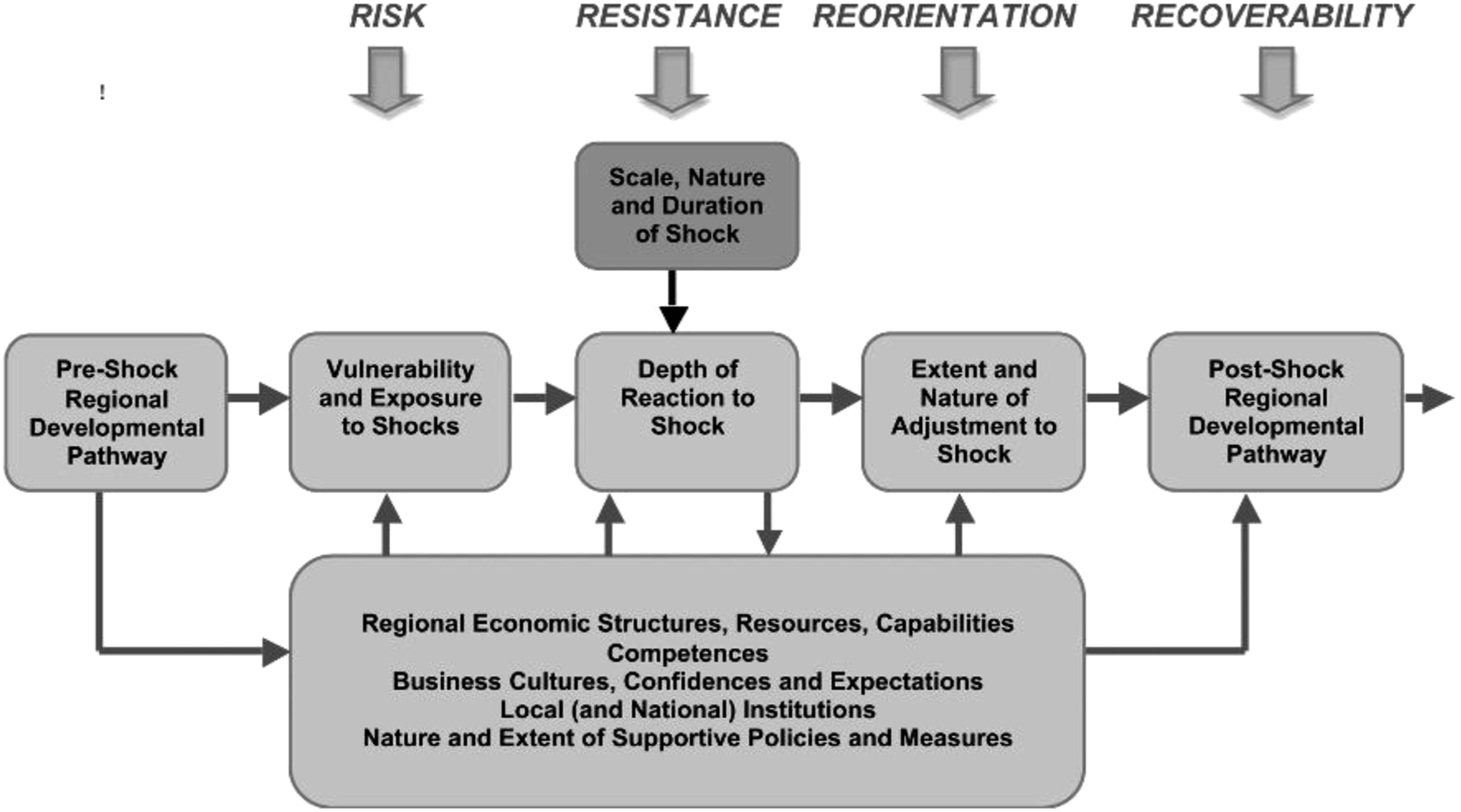
III Actors, environment, and space – unresolved issues in RER
Several works have shown that different conceptual entry points to operationalize and measure RER coexist (Davoudi et al., 2012; Hassink, 2010; Tóth, 2015). Subsequently, extensive dispute on the processual nature of regional economic development theorized on single, multiple, and non-equilibrist economic systems, which resulted in three distinctive types of RER (Christopherson et al., 2010; Pike et al., 2010; Simmie and Martin, 2010). The first archetype understanding of resilience refers to the so-called engineering perspective and translates into the idea that a regional economy eventually returns to pre-crisis growth levels. The second conceptual interpretation manifests as ecological resilience and builds on the idea of regional economies shifting between multiple economic equilibria, depending on the intensity of a given disruption. A third definition of the concept is coined as adaptive resilience and primarily relates to evolutionary understandings of economic development. The available literature on the three perspectives of RER displays elaborate theorization and a comprehensive conceptual foundation (Martin, 2012, 2018; Martin et al., 2016; Martin and Sunley, 2015, 2020; Simmie and Martin, 2010). A contemporary definition of RER in EEG that arguably includes the multifaceted understanding in economic geography has been proposed by as follows the capacity of a regional or local economy to withstand or recover from market, competitive and environmental shocks to its developmental growth path, if necessary by undergoing adaptive changes to its economic structures and its social and institutional arrangements, so as to maintain or restore its previous developmental path, or transit to a new sustainable path characterized by a more productive and equitable use of its physical, human and environmental resources (Martin and Sunley, 2020: 7).
Here, the possibility for a new type of sustainable regional economic path development after a disruption is proposed as part of RER. Therein, and similar to the idea of crisis as an opportunity, regions may also have the ability to reconfigure and entirely change structures (Gong et al., 2020; Martin and Sunley, 2020; Sutton and Arku, 2022; Trippl et al., 2023). The question however remains to what extent these reconfigurations enable desirable outcomes, and how change can be conceptualized. To our understanding, this links RER to one of the most intriguing questions in economic geography, whether these new sustainable paths contribute to tackling grand societal or place-specific challenges (Tödtling et al., 2022; Trippl et al., 2023). In previous accounts of RER, the role of slow-burn structural changes and sustainable development remain missing, and we argue that this fourth transformative interpretation of RER thus requires significant reconceptualizing compared to previous conceptual parameters. In the following, we therefore proceed to pinpoint to some of the unresolved conceptual ambiguities and blind spots of RER, which manifest in light of pressing social and environmental challenges. We then build on these unresolved issues to pave the way forward and augment the conceptual backbone through a more nuanced view of multi-actor perspectives, social–ecological interdependencies, and socio-spatial relations in RER.
1 Actors
Unresolved issue: The roles of different actors
One of the core questions in the literature is resilience for whom (Cote and Nightingale, 2012; Cretney, 2014; Keck and Sakdapolrak, 2013; Meerow and Newell, 2019). In RER, we observe a pertinent firm-centrism, where firms are considered crucial economic actors, while comparatively little attention is paid to other actor groups. Such critique of firm-centrism in RER is not new. Pike et al. (2010) argued that we must distinguish between social agents and their relationships and how they respond, cope, and shape development paths. Nevertheless, these multiple agents stemming from different governance levels remain under-explored in the context of RER. Instead, many empirical studies view the industry as ‘adequately synonymous with the region’s economic prospects’ (Sweeney et al., 2020: 127). This reduces the regional economy to an agglomerate of firms and industry structures. We oppose such a narrow view of the regional economy and propose to better account for diverse actor groups who collectively shape development in times of shocks and crises.
Much of the conceptual groundwork has associated resilience with industry and firm behaviour and their respective abilities to respond to shocks. Accordingly, Simmie and Martin (2010: 28) explain resilience as the ability of a ‘region’s or locality’s firms to adapt to changes and shocks in competitive, market, technological, policy and related conditions’. Martin (2018: 852) later postulates on RER: ‘…what matters during such disruptions is the “fitness” of individual firms, as that shapes their ability or otherwise to resist and recover from the disruption’. The author continues to elaborate on the agency of firms and describes their ability to restructure and reorganize, relocate and upgrade technologies (Martin, 2018). Correspondingly, subsequent studies on specialization patterns and productivity levels adopted this firm-centric view of RER (see Cuadrado-Roura and Maroto, 2016; Pudelko et al., 2018). Breathnach et al. (2015) investigated trends in employment levels of state-aided firms across Irish regions after the 2008 recession and suggested the importance of sectoral mix. Research from the UK on different-sized firms identified two types of firm responses: niche markets and diversification and spin-offs (Hervas-Oliver et al., 2011). Bishop (2019) studied the role of firm-birth rates and promoted diverse knowledge stocks as crucial to regional economic growth and resilience. Treado and Giarratani (2008) conducted surveys with steel-supplier firms across Pittsburgh and highlighted, amongst others, the importance of cluster networks and linkages consisting of firm partnerships and local technological knowledge transfer. Many researchers thus zoomed into the abilities of firm actors to cope and respond to economic disturbance and found that strong inter-firm relations and ties enable knowledge and technology transfers. In this context, the firm is frequently portrayed as a rational and strategic agent whose success rates are then used as an indicator to measure RER. However, while this is believed to result in positive benefits for regional economic performance, other actors are seldom considered in the analysis.
Conceptually speaking, regional economic adaptation in light of shock is interpreted in terms of ‘individual industries, firms, and workers…’ (Martin and Sunley, 2015: 20). This postulates workers as economic agents, amongst others. Diodato and Wetering’s (2015) study examined how quickly workers can be re-absorbed into the labour market after being laid off due to economic disruptions. They argue that workers and firms are intertwined, but the shock and recovery of these respective groups may not necessarily mirror the other (Diodato and Weterings, 2015). Lester and Nguyen (2016) proposed that the fabric of the labour force influences RER, suggesting that the spread of immigrant labour forces in the US contributed to RER during the Great Recession. In most instances, however, the ability of workers to influence regional resilience remains unexplored. The worker’s role is mainly based on the idea that ‘workers are key forms of adjustment by which employers seek to reduce costs and the scale of production in response to major falls in output demand’ (Fingleton et al., 2012: 110). Some of the potential consequences for workers include long-term unemployment, living on benefits, migration to other localities, and reintegration into the labour market in neighbouring regions (Fingleton et al., 2012). However, little is known about the experiences of workers and their respective agencies to contribute to RER.
In addition to workers, some RER scholars point to the role of government agencies (Evenhuis, 2017; Ezcurra and Rios, 2019). The state is seen as instrumental in providing fiscal and administrative frameworks to enact regional development policies, which can ensure coordination between actors at sectoral, territorial, and governance levels (Giannakis and Bruggeman, 2017). In many instances, however, the role of government is reduced to a functioning governing apparatus, which exerts its influence by supporting or hindering firm-led regional economic growth. In this context, Asheim and Herstad (2021) object that it is frequently orthodox economic thinking, which informs a reductionist view of the government. In this line of thought, the role of governments is to correct market failures.
To date, the agency of different actor groups, including community groups, NGOs, and research institutions, and their respective influence to shape RER is missing. The resilience for whom question in these discussions accordingly remains predominantly firm-centred. Hence, we can only echo previous literature reviews on the subject matter in that there is a need to better understand the role of workers, the social perceptions of disturbances, and varying degrees of participation in driving RER (Tóth, 2015).
Way forward: Shifting from firm-centeredness to multi-actor perspectives
We now find scholars in evolutionary economic geography and especially the regional path development literature, who postulate the need to incorporate non-firm actors, including, for example, research and policy organizations and civil society actors, into the analyses of regional innovation and development processes (Bristow and Healy, 2014; Gong et al., 2022; Sutton and Arku, 2022; Trippl et al., 2020, 2023). Building on insights from transition studies, Tödtling and Trippl (2018: 11) note that ‘new paths often emerge in niches outside the dominant regime’. This implies that changes may not only necessarily originate from conventional actor groups like incumbent firms but can also be led by young, small firms and, notably, non-firm actors. We thus propose that multiple actors and actor groups with diverging interests and capacities steer regions during a crisis and shape RER. Firms can contribute to economic resilience through investment in the local economy, creating jobs, and developing a diverse economic base. Government agencies can influence economic resilience by developing and implementing policies and programs that support economic well-being. Local development practitioners and business associations may facilitate information flows and collaboration by connecting different actors (Sutton et al., 2022). Workers, community groups, and individuals can support local businesses, participate in community development initiatives, and advocate for policies that promote economic stability (Grenzdörffer, 2021). Universities can facilitate regional innovation and strengthen the regional skill and knowledge foundation. The resulting actor constellations are furthermore characterized by asymmetrical power dynamics, are likely to experience unevenly distributed impacts, and display different abilities to respond to shocks. To overcome firm-centrism, we thus argue that RER needs to better account for these differences between various actor groups. Moreover, we call for further consideration concerning the relations and interactions between these actors, which likewise shape RER.
The proposed multi-actor perspectives then have several research implications: First, to carefully evaluate the unit of analysis in RER; second, to rigorously study their diverse agendas, goals, and objectives; and third, to better understand how these actors relate and interact during crisis events. If we look at the ongoing contestations about climate change and COVID-19, different actors likely have diverging concerns, burdens, interests, and opinions, which then matter in the responses articulated, endorsed, and implemented. In certain regions and industries, firms may play the most decisive role in shaping RER. In other instances, government agencies may pursue drastic health or environmental policy interventions to combat crisis events, which could occur at the cost of regional economic performance. In contrast, other actor groups, like workers, may be forced to migrate. Accordingly, some industry actors may have more capacities and instruments at their disposal to leverage and solicit their interests in times of disturbance than others. Whilst these discussions are likely to be context-dependent, reflecting on – and comparing – the uneven distribution of impacts and responses across different actor groups promises to reveal the distinct agencies and capacities of different groups to better understand their relative significance in shaping RER. This raises the question of who is included and excluded on the regional development agenda, how different actors relate to each other, and what potential forms of interaction and communication channels they utilize. We may then uncover whose interests are conflicting, where interests and resources converge, and how degrees of actor connectedness influence RER (Hu and Hassink, 2017).
Some research has already begun dismantling the role of multiple actors and agencies in shaping RER (Bristow and Healy, 2014). Kakderi and Tasopoulou (2017) interviewed representatives from local governance institutions, firms, regional development agencies, and civic groups in the context of austerity measures and the economic downturn in Greece. They suggested bringing institutions and organizations at all levels together may facilitate cooperation and collaboration among local stakeholders, public sectors, private initiatives, and citizens, ultimately contributing to RER (Kakderi and Tasopoulou, 2017). Hu and Hassink (2017) interviewed state-owned enterprises, firms, and government authorities in Chinese coal mining regions. The authors likewise confirmed the critical role of numerous actors at multiple spatial levels with heterogeneous actions and interests that contribute to long-term RER (Hu and Hassink, 2017).
Multi-actor approaches accordingly go hand in hand with agency-centred research, which advances notions of individual and collective agency and shines a light on the different problem framings, visions, and strategies at play (Westley et al., 2013). Here, we may consult several Scandinavian examples. David (2018) studies pharmaceutical companies in Sweden and highlights the ability of individual firms to mobilize resources and to form regional organizational coalitions with other actors, including universities, regional government, philanthropic organizations, and key affiliates. The author reiterates that collective agency depends on the ability to align interests and coalesce agendas (David, 2018). Evidence from Finland points to the central role of actors’ intentional and purposeful actions inside and outside the region to transform and create new economic activity (Kurikka and Grillitsch, 2021). Empirical insights from Norway’s tourism industries illustrate how different types of change and reproductive agency are needed to create new economic development paths and ensure that these are sufficiently institutionalized (Bækkelund, 2021). Kanger et al. (2020) use the example of the Estonian energy system transformation to illustrate that we need to better account for what hinders change, as certain industry actors and policymakers block change due to fears of political and economic repercussions. Altogether, these studies underline the importance of different actor groups and relations for regional economies, which not only puts emphasis on participation in regional decision-making processes but also suggests how agencies play into RER.
Thus, we suggest RER as an analytical tool investigating how regional economies materialize through heterogeneous actor landscapes and different agencies. These unique economic actor landscapes are neither temporally static nor territorially bounded but manifest within a highly dynamic regional economic process of navigating shocks and crises. This process is further co-determined by asymmetrical power relations, which broaden the conceptual scope beyond firms and industries and postulate decision-making processes at the centre of analysis. Subsequently, RER becomes a process of alignment and divergence amongst and between different actors relevant to the region. Future research may then help uncover what types of landscapes are more conducive for RER (e.g. effective regional decision-making processes) and reflect on the multi-scalar factors that constrain or aid actor responses and, thus, the region’s overall economic resilience.
2 Environment
Unresolved issue: Natural environment and chronic crisis
The second unresolved issue concerns the natural environment in RER and builds on the lack of reflections on human–environment relations, natural resources, and the role of environmental variability. Up to date, chronic ‘slow burn’ trends, like climate change, biodiversity loss, and environmental variability, have been dismissed as out of scope. Martin (2018: 844) argues that resilience should be restricted to analyzing reactions to and impacts of specific events and ‘unless the notion is restricted to actually occurring sudden shocks, the concept would have little distinctive or incisive meaning’. Pendall et al. (2008) adds that analyzing regional resilience facing slow-burn crises would require long-term, even a century of observation. Emphasis is instead placed on sudden, exogenous shock events, which have been articulated as the best starting point to examine RER (Pudelko et al., 2018). Although we agree with Martin and Sunley (2015) in that shocks should not be equated with slow-burn crisis events, we contest that these chronic ‘slow-burn’ trends and the ability to anticipate future shocks need to be urgently considered in RER, especially when speaking about desirable transformative economic development paths.
The missing linkages between evolutionary economic geography and the environment have been exposed in imminent pleas for environmental economic geography (Hayter, 2008; Patchell and Hayter, 2013). Despite early efforts proposing resilience theory as an integrative effort, where ecological and economic systems are deeply interlinked (Holling, 2001), RER has been advocated and constructed with significant efforts to maintain a distinctly ‘economic’ character. The parallels between ecological systems and the economy have been discussed extensively. However, due to the equilibrist understanding of resilience in ecological systems, the conclusion was that natural ecosystems are ‘quite different from a regional economy’ (Martin, 2012: 3). This, in return, has inspired many to add ‘precision and clarity’ to a succinct economic interpretation of the concept (Martin, 2012). Accordingly, the interdependence of social, economic, and ecological systems, which arguably lies at the heart of resilience theory, perished alongside conceptual evolution in economic geography. We contend that this conceptual divergence has inevitably separated RER from the advances in neighbouring disciplines and overarching efforts to analyze social–ecological resilience in the context of global environmental change. We thus reiterate that RER builds on the problematic assumption that human and environmental systems can be treated independently (Folke et al., 2002).
Adger (2000) argued that different understandings of ecological and socio-economic forms of resilience exist but are directly related. He provided two explanations for why relying on a narrow range of natural resources can destabilize regional economies. Firstly, he explains, global market dynamics may cause fluctuations in demand and undermine resilience. Research from Brazil illustrated this in the context of mining-dependent municipalities, which were more vulnerable to falling iron ore prices than other regions (Silva et al., 2021). Similarly, Hu and Hassink (2017) studied coal-exhausted cities in China and pinpointed to the role of chronic crisis. The nature of disruption here is the exhaustion of coal resources, which led to regional economic diversification towards tourism. However, Tan et al. (2020) found that metal and petroleum cities in China performed the most resilient while declining coal and forestry industry revenues are portrayed as low ranking due to abundant oil reserves. In both studies, natural resource availability influences RER but is missing in the conceptual foundation.
Secondly, Adger (2000) emphasizes the role of environmental variability in shaping resilience and refers to extreme weather events, which ultimately cause economic disruption. Some earlier RER studies have examined the disrupting potential of extreme weather events. Rose and Liao (2005) investigated the Portland Metropolitan Water System in the aftermath of a major earthquake. Xiao and Drucker (2013) analysed the 1993 US Midwest flood and indicated the importance of economic diversity in the face of natural disasters. Further analyses of snowstorms in China point to the direct and indirect economic losses due to power disruptions (Hu et al., 2014). These studies have in common that they investigate how natural resource consumption (e.g. energy and water) is interrupted by environmental change, which in turn causes economic disturbance. Accordingly, the linkages between RER and the biophysical environment primarily rely on the idea that hazards hamper economic growth. However, there is minimal evidence on the nature of environmental variability and healthy ecosystems’ buffering and absorbing capacities (Ifejika-Speranza, 2013; Tompkins and Adger, 2004). For example, Adger’s (2000) research on livelihoods in Vietnam provides a case study that illustrates how mangrove deforestation to diversify the economy towards aquaculture came at the cost of local ecosystems and communities over time. Mangrove deforestation resulted in higher exposure to inundation and coastal flooding; thus, economic diversification indirectly contributed to the erosion of longer term regional economic resilience and increased regional vulnerability to sudden environmental shocks. In this instance, the environmental implications (unintended consequences) associated with regional economic diversification showcased non-linear feedback and unforeseen consequences, both of which remain absent in empirical and conceptual work on RER. In the current conceptual framing, regions specializing in timber production may be considered economically resilient due to an abundance of forest resources available. The consequent exposure to potential soil degradation, water cycle disruptions, and loss of biodiversity, which altogether may undermine social well-being and economic productivity in the event of environmental shock, is not considered. Similarly, a region hosting highly polluting regional industries on a small island state may be classified as highly resilient, despite the evident vulnerabilities to rising sea levels or other chronic slow-burn pressures materializing in sudden shocks in the near future.
Currently, studies on natural hazards are rare in the RER literature, and the few existing studies illustrate how natural hazards hamper regional economic activity. However, these sudden environmental shocks have not had considerable implications for how RER is theorized in light of grand societal challenges like climate change and biodiversity loss. Moreover, the current conceptual foundation of RER mostly views the biosphere and regional economy as independent systems, neglecting that regional economic development can both aggravate and reduce the effects of slow-burn pressures that materialize in sudden shock and disturbance. In other words, the relatedness of ecological and socio-economic forms of resilience found limited resonance in RER, which opens new conceptual avenues to consider.
Way forward: Integrating the social and natural environment
For a long time, ecologists pretended as if humans did not exist and economists as if nature did not exist (Folke et al., 2016). The conceptual genealogy of RER likewise showed that the concept seceded from its origins in the natural sciences and produced a fragmented view of ecological and economic systems. While low levels of RER were related to depleting resources and the economic impacts of natural hazards, the value of ecosystems and human–environment relations were insufficiently reflected upon. We thus reiterate the fact that human and environmental systems cannot be treated independently and propose to account for social–ecological systems in RER. This means that long-term, protracted slow-burn crisis is integral, especially when speaking about transformative RER, and we therefore propose to better account for social–ecological thresholds and feedbacks.
Social–ecological resilience has been advocated to overcome the social and ecological dichotomy and builds on the unfolding relations and processes in the Anthropocene (Folke, 2006; Folke et al., 2016, 2021). Regional economies are likewise embedded in this Anthropocene, where natural ecosystems provide the essential ingredients for all forms of value extraction. The Millennium Ecosystem Assessment report (2005) outlined these ecosystem services, including provisioning (e.g. food, water, and timber), regulating (e.g. climate, floods, and disease), supporting (e.g. soil formation, and photosynthesis), and cultural services (e.g. recreational, aesthetic, and spiritual). At the same time, however, this dependence on ecosystems is endangered by certain regional economic activities, namely, highly polluting-, resource-intense-, and environmentally degrading modes of production. Consequently, economic growth is limited by inherent physical constraints on non-renewable resources, like land, water, or metals, which were articulated roughly half a century ago (Meadows et al., 1972). Surpassing these planetary thresholds results in climate change, interferences with the nitrogen cycle, and increasing biodiversity loss, ultimately threatening to undermine human security (Rockström et al., 2009).
A threshold can be defined as the ‘exogenous or endogenous limit beyond which system performance deteriorates to a level whereby it is impossible, very costly, or unacceptable to cross or to recover from to achieve a desired level of system performance’ (Grafton et al., 2019: 909). Translating this into RER means that despite short-term signs of regional economic recovery, certain regions may situate on a downward spiral towards exceeding certain resource or pollution-related thresholds that increase the propensity for future shock and disturbance. On the contrary, regional economies may develop with respect to certain ecological thresholds, contributing to longer term economic resilience in light of environmental variability. Reaching or averting social-ecological thresholds and tipping points are thus processes and evolve with respect to certain outcomes. The processual nature refers to aligning regional industrial development with certain environmental targets frequently based on biophysical thresholds. In contrast, the outcome refers to the consequent susceptibility and buffering capacities to sustain economic activity in the face of environmental variability.
Embedding ecological thresholds into regional development trajectories enables RER scholars to begin accounting for the complex dynamism between economic and ecological systems. Positioning regional economic systems in complex-social ecological ones entails that different systems may display different levels of resilience, which interact and show vital signs of interdependence (Liu et al., 2007). These system interactions can be captured through feedbacks, which Berkes et al. (2003: 5) explain may ‘reinforce (positive feedback) or modify (negative feedback)’ subsequent system behaviour. Consequently, economic systems interact with ecosystems and enhance or lessen the overall RER levels and vice versa. These interactions, or social–ecological feedback mechanisms, are often difficult to detect as they materialize across space and time. They may, for example, materialize across space when waste material is shipped off into the global south or through pollution effects that compromise downstream production. Here, we may speak of the hidden costs of RER. However, negative feedbacks in RER can also materialize in local human–environment interactions. Regional industries, for example, may adopt new strategies in the event of a crisis to extract raw materials. While increasing regional economic growth at first sight, this, in return, lessens the productivity of local ecosystems to provide cultural services. Consequently, this may reduce the recreational spaces available to the tourism sector, ultimately reducing the overall levels of RER. Such examples of trade-offs illustrate how RER can be conceptualized as an interplay between socio-economic practice and the biophysical environment, where feedbacks result in unintended or unanticipated consequences.
Finally, we suggest extending the conceptual framework of RER to integrate slow-burning pressures. Here, the destabilizing feedbacks potentially caused by regional economic activities reverberate through feedbacks across temporal scales. The idea of temporal feedback is similar in that resilience can occur at the expense of resilience in a later period (Carpenter et al., 2001). The example of regions with excessive emission rates was used to illustrate how regional economic behaviour contributes to future extreme weather events, threatening to intensify future exposure to disturbance. While evolutionary economic research studying the uneven levels of RER stresses the importance of historical development paths (Boschma, 2015; Boschma and Martin, 2007), we also propose considering potential future development path disturbances and shocks. In anticipation of economic disruption related to the reaching of afore-listed biophysical thresholds, negative social–ecological feedbacks over time thus indicate that protracted slow-burn crises are both potential sources and outcomes of RER. Put differently, the anatomy of shocks, disturbances, and crises in regional economies is not solely born from natural events but materializes as unintended temporal feedback. In that view, RER occurs in response to sudden and unexpected shocks, which are temporal feedbacks characteristic to past and ongoing development trajectories that predetermine the intensity and frequency of disturbance.
3 Socio-spatial Relations
Unresolved issue: Cross-boundary interaction
Another unresolved conceptual debate in RER concerns the ‘making of the region’. It is our understanding that boundary-transcending practices and flows are increasingly considered a positive determinant of RER without sufficient critical reflection and analysis on the shifting and redistributing tendencies of regional economic growth in and after shock events. This is, of course, closely related to the aforementioned environmental externalities and trade-offs. Here however, we question the degree to which potential mechanisms of displacement and deferral of crisis tendencies have been considered in RER, which includes the continuous reproduction of vulnerabilities across socio-spatial relations (Etzold and Sakdapolrak, 2016; Jessop et al., 2008). Moreover, we propose to advance an understanding of RER, which systematically integrates interregional externalities across space through flows, networks, and relations of capital, resources, and people.
The ‘conventional’ earlier understandings of the region in RER focused on a self-contained and fixed spatial unit, which found numerous empirical applications, particularly in comparatively wealthy European contexts (Breathnach et al., 2015; Cowell, 2013; Cuadrado-Roura and Maroto, 2016; Faggian et al., 2018; Li et al., 2019). Here, space was frequently defined in absolute terms, determined by geo-location data availability and predefined administrative boundaries. The region is presented as ‘an action container that bumps up against other regions but is on its own course’ (Christopherson et al., 2010: 4). These container approaches have been criticized for providing incomplete explanations of regional development processes. Martin (2018: 850) explains, ‘they [spatially fixed container approaches] are not really about development at all, but rather about comparative statistics…before and after shocks, there is no real history’. Accordingly, evolutionary geographers postulated that place-based and context-dependent factors shape regional economic development processes (Bristow, 2010; Hassink, 2010). The relationship and connectivity between firms and regional labour markets thereby propose a somewhat relational and network-based understanding of space in RER. On the empirical side of things, there is a rich body of literature dealing with intra- and inter-regional types of interconnectivities and how these spur economic growth to recover from disturbances. Crespo et al. (2014) propose local knowledge networks and their contributions to regional economic growth as critical factors for RER. Diodato and Weterings (2015: 731) look at labour flows and find that ‘better connected regions and more related sectors can re-absorb shocks more quickly than isolated sectors in remote regions’. Other studies looking at transport accessibility, or access to knowledge and information, likewise propose that linkages and cooperation contribute to RER (Capello et al., 2014; Giannakis and Papadas, 2021). In addition to spatially fixed determinants of RER, inter-regional dynamics are thus seen as relevant indicators, with many studies suggesting that inter-regional connectedness benefits RER. Nevertheless, we find limited theorization on the potential shifting of economic burdens between and across regions, especially at larger spatial resolution.
The literature on value chains in the aftermath of the financial crisis has suggested that rather than hiring new workers in the region, firms in a recession may pursue aggressive outsourcing and offshoring tactics to developing nations (Cattaneo et al., 2010). Similarly, seemingly desirable low-carbon transitions and decarbonization strategies aiming to build resilience in light of energy supply-related shocks across Europe have shown to produce negative externalities, including waste flows and unemployment in other sectors and places (Sovacool et al., 2019). Grabner (2021) provides illustrative examples of externalities in urbanization economies that drive urban and rural discrepancies. Accordingly, certain changes in industry and trade patterns may produce injustices and vulnerabilities in other regions or sectors, which display the highly relational nature of RER processes. An additional research strand in RER is thus needed to study ‘the complex interconnections that exist between regional economies and the wider world, emphasizing that regional economic resilience does not occur in isolation’ (Bristow and Healy, 2020: 4). This necessitates further conceptual elaboration on the different types and dynamics of socio-spatial relations typifying RER processes, closely aligned to the theoretical foundation of the afore-described incomplete actor and environmental parameters in RER.
Way forward: Polymorphous socio-spatial relations
Consequently, we find different contingencies of place in RER, which call for both small-scale analyses on localized activities on the one hand and social interactions across space and scale on the other. Yet, the economic geography literature remains divided on the matter, and the conceptual backbone to capture what the regional economy is and where its boundaries lie remains to be determined. In an attempt to further define regional economies, Martin and Sunley (2015: 11) proposed ‘a myriad of spatially distributed and often discontinuous networks of interacting heterogeneous economic agents (…) and they typically possess fuzzy boundaries and complicated dynamics’. While these conceptual propositions illustrate the boundary issue in RER, the description illustrates the missing conceptual guidance other than it being ‘complicated' and messy. We propose to conceptualize RER through dynamic socio-spatial relations.
The succession of distinct debates on socio-spatial turns, namely, territory, place, scale, and networks (Jessop et al., 2008), with closely intertwined theoretical and empirical implications, may help to better conceptualize how different types of socio-spatiality crystallize in the making of RER. We propose to view the region beyond a spatially dualistic configuration of interacting inside and outside forces but as a polymorphic entity. Jessop et al.’s (2008) frequently cited model of territory (T), place (P), scale (S), and networks (N) (TPSN) lays a solid foundation to construct a more heterogeneous understanding of the ‘regional’ in RER. On the one hand, these socio-spatial lenses may help to consolidate the conceptual foundation to tackle contemporary research trends in RER that are highly mobile and dynamic phenomena, including, for example, the migration of workers and remittances (Bristow and Healy, 2020; Peth and Sakdapolrak, 2020), booming global industries like tourism (Bellini et al., 2017), and the role of tele connectedness and digitization (Katz and Jung 2022). On the other hand, this may help advance the RER debate, where we find continuous disagreements between predefined spatially explicit large-scale studies of RER and evolutionary interpretations of the region. This resonates with the idea of a conceptual middle road, where space has territorial anchorage while being relationally mobile and fluid (Jones, 2009). The framework already found numerous fruitful applications. Shelton et al. (2014) examine various spatial patterns of social media tweets during Hurricane Sandy, highlighting the complex and polymorphous nature that typifies crisis experiences. The authors further expose the relationship between material and closely related digital manifestations and complex spatialities (Shelton et al., 2014). Gailing et al. (2020) employ the TPSN framework to study regional energy transitions in Germany and present the framework as a valuable tool to deconstruct multiple dimensions of space to understand change better. Finally, Brinks and Ibert (2020) studied the COVID-19 pandemic and found that multiple interactions and overlapping spatial dimensions strengthen empirical observation to comprehend the evolution of crisis. Altogether, these research efforts have not explicitly looked into RER but demonstrate promising research leads to fortify the dynamic flows and interactions that characterize fuzzy and complicated regional boundaries and, thereby, RER.
IV Discussion and conclusions
Overview of the identified blind spots in the RER concept and possible ways forward.
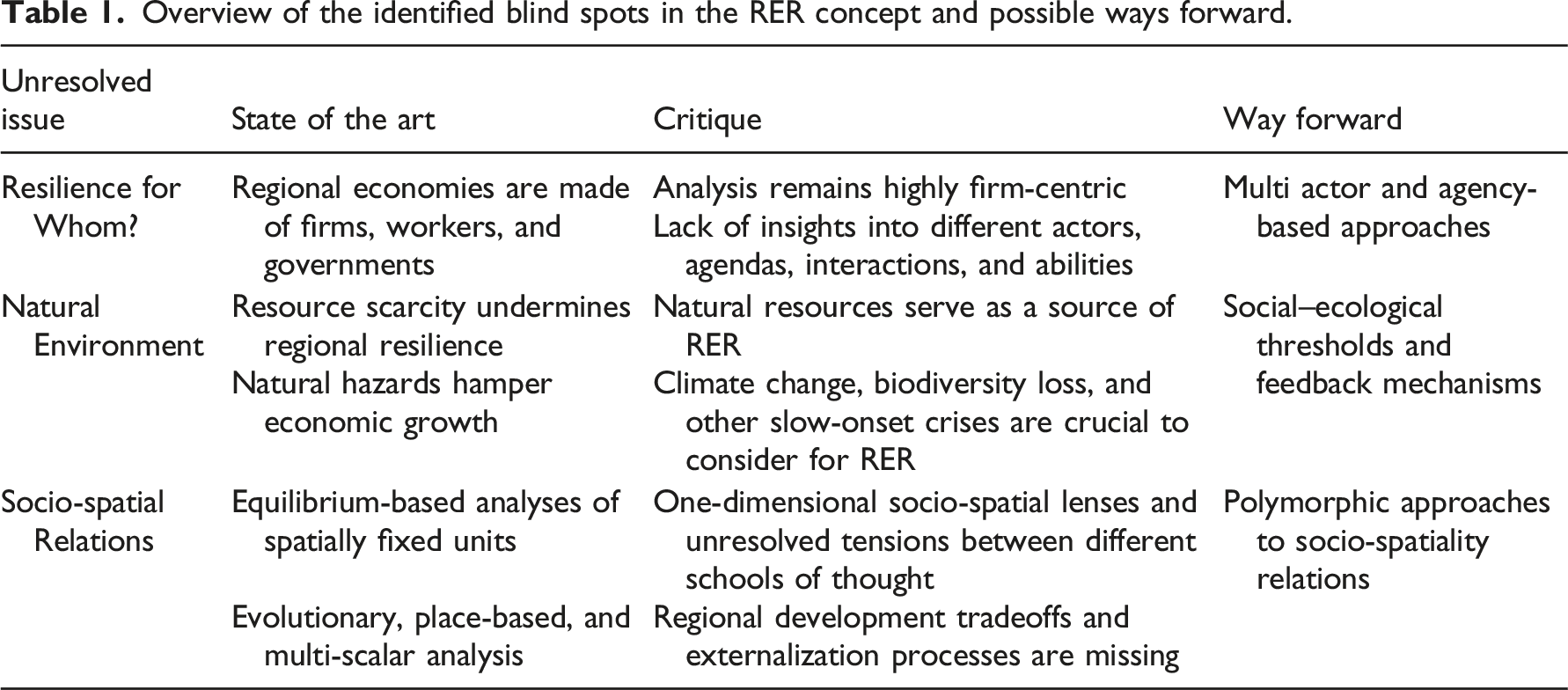
In our conceptual synthesis, we first explored the state of the art in RER in economic geography and showed how different communities advanced the theoretical and empirical backbone of the concept. This conceptual genealogy revealed differing academic manifestations of RER and how it is best operationalized. Despite fruitful insights for leveraging regional economic performance during economic shocks, RER remains fragmented and far from congruent. Building on some of the arguments raised by evolutionary economic geographers more than a decade ago (Bristow, 2010; Christopherson et al., 2010; Hassink, 2010; Pike et al., 2010), we thus revealed critical unresolved issues in RER. We demonstrated how RER is often reduced to short-term responses of regionally based firms to economic recessions, whilst other actors and environmentally harmful practices are neglected in the analysis. In many accounts, regional propensity for future crisis events and the externalization of economic development cost remains obscured. Our take on the biophysical limits to growth and associated environmental trade-offs in regional economic activities provided some leverage to rethink RER in light of ecological thresholds and social–ecological feedback. Moreover, similar to Gailing et al. (2020: 1127), we proposed viewing regions as ‘arenas of collective actors or organizations’ and suggest to foster a dynamic polymorphous understanding of socio-spatial relations in RER. These conceptual anchor points may guide further research to critically analyze regional economies embedded in larger social–ecological systems.
Finally, our propositions aimed for conceptual enhancement to develop RER, given that practical development of resilience indicators ran ahead of conceptual thinking and many RER indices remain unproven (Sensier et al., 2016). This undertaking will furthermore require alternative methods to better capture the role of actors, the natural environment, and multiple socio-spatial dimensions of change. Our conceptual propositions, however, rightfully feed those critics concerned about the measurability and, thus, the usefulness of the concept. This may also partially be why some critical scholars have abandoned the concept or remained critical the least (Fougère and Meriläinen, 2021; MacKinnon and Derickson, 2013). We, however, believe these unresolved issues highlight how and why RER continues to open important spaces for deliberation and can potentially facilitate another ‘turn for resilience’ (Brown, 2014). This corresponds to what Olsson (2020) describes as a new mode of resilience thinking embedded in new economic rationalities towards ecological and social sustainability. Similar ambitions have been voiced in calls for a ‘new generation of resilience practice’ that synthesizes from across disciplines and helps navigate more sustainable futures in the Anthroposphere (Enfors-Kautsky et al., 2021: 38). Whilst our conceptual gateways are neither exhaustive nor fully elaborated upon, we believe that the three ways forward help strengthen the foundation for building bridges among different social, ecological, and economic resilience schools, which are seemingly scattered across human geography.
Footnotes
Acknowledgements
We would like to express our sincere gratitude to Prof. Alex Hughes and the three anonymous reviewers for their insightful feedback. Their contributions have been instrumental in shaping this work, and we are deeply thankful for their time and efforts.
Declaration of conflicting interests
The author(s) declared no potential conflicts of interest with respect to the research, authorship, and/or publication of this article.
Funding
The author(s) received no financial support for the research, authorship, and/or publication of this article.
