



Abstract
This paper reviews the progress of geographical research on the gambling industry and presents a framework to comprehend the role of space in gambling consumption and harm. It covers two themes: the casino’s place in urban governance and the agency of gamblers, and how space impacts gambling consumption and harm. The paper introduces a conceptual framework of orientation, affective atmosphere, and intimacy to better comprehend how gambling practices can increase or decrease risk. Finally, the paper suggests that this framework can help to better understand online sports gambling consumption and harm in the context of market growth.
I Introduction
In the past 20 years, geographers have shown interest in gambling, as seen in this journal through various studies that address the liberalisation of financial systems globally (Wójcik, 2013), economic engagement of Indigenous peoples (Coombes, Johnson and Howitt, 2012), and state deregulation of adult entertainment that causes moral panic (Hubbard, Matthews, Scoular and Agustin, 2008). Despite these studies, no progress report exists that provides an overview of the geographical literature on the gambling industry. To fill this gap, this paper aims to introduce a relational conceptual framework and future research propositions for human geography inquiry on the harms of the online sports gambling industry, the fastest growing segment.
The global gambling market is rapidly expanding and is estimated to be worth over US$747 billion in 2022 (Global Industry Analysts, 2022). The increasing presence of gambling in everyday life is due to various factors such as liberalising changes in laws and regulations, the power of the market and the gambling industry’s lobbying and marketing efforts, technological advancements like smartphones and sports betting applications, and social normalisation (Markham and Young, 2015; Young and Markham, 2017). As states have become more dependent on gambling tax revenues, the socio-material constitution of gambling practices is constantly changing (Peck, 2017; Young, 2010). However, gambling is associated with significant economic, health, and social harms, including addiction, financial hardship, and domestic violence (Langham et al., 2016; Johnstone and Regan, 2020). Therefore, gambling harm is a contemporary social issue that human geographers should be interested in.
The global online sports gambling market is estimated to be worth US$155 billion by 2024 (Grand View Research, 2022). Mobile smartphones and sports betting apps, as well as targeted marketing, have normalised sports gambling practices (Gordon et al., 2015; Deans et al., 2017). The United States online sports gambling industry is predicted to spend $587 million on local TV advertising by 2024, up from $10.7 million in early 2019 (Nielsen Research, 2021). Australian research consistently finds gambling advertising during sports is common (Gordon and Chapman, 2014), with children exposed to four times as many online sports gambling ads per hour during sports programming than in non-sports programming (O’Brien and Iqbal, 2019). Among Victorian high school students, exposure to marketing is statistically associated with an increased likelihood of gambling (Thomas et al., 2018). Nyemcsok et al. (2021) illustrates how for many Australian high school students, gambling is taken-for-granted as part of sport.
The gambling industry is not a singular entity, but rather a multifaceted sector that involves complex systems of production, distribution, and retail (Gandullia and Leporatti, 2018). Geographers have explored the role of neoliberal capitalism, deregulation, liberalised policy environments, and urban development in promoting casino gambling as an economic driver (Brenner and Theodore, 2002; Peck, 2017; Rogers and Gibson, 2021; Wilson, 2003; Young et al., 2009). Additionally, they have examined the spatial implications of gambling harm, including the clustering of electronic gambling machines in lower socio-economic areas and the role of space in masking harm (Doran and Young 2010; Markham et al., 2014; Markham et al., 2017; Young et al., 2010; Young 2011; Adams and Wiles 2017; Hughes and Valentine 2011; Kingma 2008; Waitt et al., 2020). However, there are further opportunities for geographers to contribute to critical gambling studies by exploring the relational gambling geographies.
First, our paper reviews existing geographical literature on two themes: (i) the role of gambling in the neoliberal state apparatus, and (ii) the role of space in gambling consumption and harm. With the rise of smartphones, we identify opportunities for geographers to explore the more-than-human achievement of online sports gambling consumption and harm through a focus on relational geographies. We propose a conceptual framework that emphasises orientation, affective atmosphere, and intimacy to deepen our understanding of this sub-disciplinary theme. Finally, we offer research propositions and questions to guide future research on the relational geographies of gambling consumption and harm.
II The role of gambling in the reproduction of the neoliberal state apparatus
Geographers have used a cultural political economy approach to understand the growth of commercial gambling industries since the 1990s. This approach considers how social, economic, and political processes of commercial gambling are co-constituted with space and how cultural factors, such as discourse and symbolism, also contribute to the production of gambling spaces. Three main areas of research have emerged from this approach, which are crucial for developing a critical approach to gambling research: the ‘casinofication’ of cities, the socio-spatial distribution of gambling harm, and the agency of gamblers (Brenner and Theodore, 2002; Peck, 2017; Bullock, 2015). By examining these areas, geographers aim to understand how gambling industries contribute to the production of the neoliberal state.
1 The role of casino gambling as a tool of the state in urban development and dispossession
Since the 1990s, commercial gambling has become a key component of urban revitalisation strategies. The neoliberal state has facilitated this by promoting the legalising and marketisation of the gambling industry as part of its project to promote the entrepreneurial city (Harvey, 1989; Peck, 2017). The commodification of chance through state-sanctioned gambling has also been linked to a shift towards a service-based economy and the promotion of leisure and the night-time economy (Peck, 2017; Young, 2010).
A cultural political economy perspective reveals how state regulation concentrates global capital in gambling into specific locations. Capital investment in casinos to boost economic growth happens at a city scale, for example, Manchester, UK (Hannigan, 2007), or a national scale, for example, Singapore, Macau, or Las Vegas (Bullock, 2015; Sheng and Gu, 2018; Luke, 2010). This perspective also includes discourse and psychoanalysis (Bullock, 2015). A cultural political economy view on neoliberalism explains how the ‘entrepreneurial city’ aims to rival Las Vegas’s economic growth through a process called ‘casinopolitanism’ (Brenner and Theodore, 2002). Bringing gambling to the city involves entrepreneurialism to attract international capital and tourism through place promotion and casino building. Overall, cities’ proliferation of gambling venues is driven by neoliberal policies that prioritise marketisation and deregulation, commodifying gambling and growing the gambling industry.
2 The socio-spatial distribution of electronic gambling machine (EGM) harm
Geographers adopting a cultural political economy approach have examined the socio-spatial distribution of casinos and electronic gaming machines (EGMs) in lower income suburbs, which has been exacerbated by credit and resulted in gambling harm. This research focuses on the uneven spatial distribution of EGMs and the association between the density of EGMs and low-income suburbs, documented in several countries including Australia (Marshall, 1999; Marshall and Baker, 2001; Young et al., 2012), Aotearoa/New Zealand (Wheeler et al., 2006), Canada (Robitaille and Herjean, 2008), Czech Republic (Fiedor et al., 2017), and the United Kingdom (Macdonald et al., 2018). The identification of this relationship resulted in some states legislating regional EGM capping policies based on the level of social disadvantage.
A cultural political economy approach reveals that the gambling industry not only creates the material and social conditions for profitable gambling but also shapes the uneven spatial distribution of gambling harm. This is seen in low-income suburbs, where EGMs are concentrated due to low real estate prices and weak planning regulations, alongside classed, gendered, and faith-based attitudes towards gambling (Bullock, 2014; Marshall and Baker, 2000, 2001; Wheeler et al., 2006). The industry also uses discursive mechanisms, such as the notion of ‘responsible gambling’, to diffuse public concerns over the harmful effects of EGMs (Bullock, 2015).
The literature establishes a link between gambling venues in low-income suburbs and increased gambling participation and associated harms (Young et al., 2012). Venue effects, including proximity and size, are important factors in gambling risks. Gambling risks increase when venues are located near places that ae part of everyday routines such as supermarkets, shopping or community centres, and with large venues that attract more people who gamble on EGMs than smaller hotels, clubs, or pubs (Baker and Marshall, 2005; Doran and Young, 2010; Young et al., 2012).
To effectively regulate the gambling industry, validated conceptual models of the supply-side are necessary. Doran and Young (2010) propose a cost-effective spatial model of gambling venue catchments and EGM harms by combining venue access and measures of social disadvantage to create a ‘gambling vulnerability surface’. Conventionally, mapping gambling venue catchments for decision-making relied on GIS and costly surveys of residents (Doran et al., 2007). To complement GIS-based techniques, Doran and Young (2010) suggest a predictive gravity model that uses measures of venue access (like retail floor space, seating capacity, and car parking) and small area census data for social disadvantage to identify EGM venue catchments and gambling harm.
Finally, this research highlights the contradictory position of the state, which relies on gambling revenues while also being responsible for regulating license decisions based on the socio-economic characteristics of suburbs and managing social harm. To address this paradox, Young and Markham (2017) argue that the state should aim to minimise rather than maximise harm within a small portion of the low-income population that is further marginalised through medical discourses like ‘pathological gambler’. These discourses individualise the issue and obscure the political and economic relations that produce gambling industry spaces, framing it instead as a psychological problem of predisposed individuals (Young, 2013). In summary, the socio-spatial distribution of gambling harm highlights the uneven distribution of the costs and benefits of gambling, with lower socio-economic neighbourhoods often experiencing higher levels of gambling-related harm. This distribution can be understood as a product of neoliberal policies that have led to the privatisation of gambling and the fragmentation of urban space, which create pockets of deprivation and inequality.
3 The cultural political economy of gambling consumption and the agency of gamblers
The cultural political economy of gambling consumption focuses on the production of values and identities and tends to emphasise the immaterial aspects of capitalism. This work examines how normative discourses influence gamblers and commercial gambling in English- and Chinese-speaking markets and how the industry has shifted its approach to sustain consumer expenditure in casinos through urban and national strategies (O'Regan et al., 2019; Zhang and Yeoh, 2016). For instance, O'Regan et al., (2019) describe how the industry in Macau reimagined gambling for the Chinese market as a pilgrimage, where festive sociality and spiritual rituals create a community of ‘collective joy’ that conceals harm.
In English-speaking markets, gambling consumption is no longer seen as a criminal or amoral activity, but is instead associated with media representations that present it as a harmless consumer spectacle of the ‘good life’ through channels such as online social media (Zhang and Yeoh, 2016). As part of the adult entertainment economy, gambling consumers are considered part of the mainstream leisure and tourism urban economy, alongside bars, sports, cinemas, and restaurants. Las Vegas has set the standard for this type of consumption, and cities have tried to emulate it as part of large-scale urban development projects since the 1970s. As a result, casinos have become integral to civic boosterism and place promotion strategies of municipal authorities (Hall and Hamon, 1996 on West Point Casino, Hobart, Tasmania).
A cultural political economy approach does not blame people who gamble for being vulnerable to marketing (Young and Markham, 2017). Instead, this approach recognises that gambling behaviour is influenced by broader social, political, and economic factors that shape the spaces where gambling occurs. While it is important to understand the psychological aspects of addiction, it is equally important to consider the societal factors that enable gambling harms to happen.
Young and Markham (2017) introduce the concept of ‘coercive commodities’ to argue that the profitability of the gambling industry is a political and economic project that promotes involuntary and ‘akratic’ consumption, which is the self-reflection on the contradictions of consumption of a product despite knowing that it is not in their best interests. According to this cultural political economy approach, gambling is not solely about pre-existing personal psychological traits, but equally about the social, political, and economic conditions that produce spaces that allow individual dispositions to be expressed. The production of ‘coercive commodities’ helps capitalists to preserve and expand their monopoly surplus while maximising expenditure through engineered design of EGMs (Dixon et al., 2006), smartphones and apps (Fransson et al., 2018; Gainsbury et al., 2016; Lopez-Gonzalez et al., 2018), and design of casinos and pubs (Adams and Wiles, 2017; Kingma, 2008; Hing and Haw, 2010; Nicoll, 2011). Such technological and design-generated akrasia includes bright colours and lighting, luxurious décor, and a lack of windows and clocks (Nicoll, 2011). Schull (2012) terms the way gambling technology enables ongoing capitalist moments of exchange through the press of an EGM button as ‘addiction by design’. Understanding the psychological processes that underpin addiction is critical, but it is equally important to consider the social processes that produce spaces that enable possibilities for gambling harms to occur.
This includes invoking physical and psychological comfort and by facilitating a distorted sense of place and time that encourages lingering within a casino or ‘pokie’ lounge. The contingent circumstances of a ‘Las Vegas’ styled space by the gambling industry illustrates the political economy of coercive commodity production in which akratic consumers have an awareness of their diminished agency (Young and Markham, 2017). The paradox of akratic consumption is reconciled if understood through how the risks of a game of chance are framed within liberal discourses of individual freedoms and citizenship that operate to conceal the oppressive social relations of production.
Overall, gambling consumption and the agency of gamblers are important in producing the neoliberal state. Gamblers are often depicted as rational actors who make informed choices, but this individualistic approach ignores the broader socio-economic and political context in which gambling takes place. The agency of gamblers is constrained by the structural factors that shape their choices, such as economic inequality, social norms, and the availability of gambling opportunities. By examining the agency of gamblers, human geographers can shed light on the complex and dynamic relationship between neoliberalism, gambling, and the state.
III The role of space in gambling consumption and harm
This section explores three approaches that aim to expand the role of space in understanding gambling consumption and harm. The first approach, championed by Young et al., 2013, links the role of space in gambling harm to cultural political economy processes. Second, Valentine and Hughes (2011) build on the work of Davidson and Bondi (2004) to see gambling harms as situated, emotional, and embodied. Finally, Waitt et al. (2020) draw on Deleuze and Guattari’s (1987) assemblage thinking to examine the social and spatial hierarchies and norms that mask gambling risks. All three approaches contribute to the larger disciplinary goal of re-materialising culture in human geography and understanding how space shapes gambling consumption and harm.
1 A cultural political economy approach to the role of space in gambling consumption and harm
Young et al., 2013 demonstrate a cultural political economy approach to the role of space in gambling consumption and harm, using Lasseters Hotel Casino in Alice Springs, Northern Territory, Australia, as a case study. They reveal how this casino is a synthesis of the imperative for capital accumulation and desire for Aboriginal community and sociality, resulting in a paradoxical space of economic exploitation and social inclusion for the Arrente people of Mparntwe. Three social processes contribute to this paradoxical space. First, sharing cash for gambling among the Arrente people has social rather than exchange value, allowing them to re-establish kin relationships. Second, the casino space sustains, produces, and is produced by an ideology of alea, which for white Australians, operates subconsciously to mask exploitative economic exchange. Finally, the casino offers a relatively safe space in a town where Aboriginal people are stigmatised, with formal and informal rules that govern individual behaviours in welcoming ways.
2 An emotional geography approach to the role of space in gambling consumption and harm
Valentine and Hughes (2011, 2012) explore the role of space in internet gambling consumption and harm by examining how people navigate the boundary between the social/familial and the personal. Their starting point is the affective structures of the family, which are not fixed obligations but a product of social and material relations that constitute the familial home as a refuge from global capital and globalisation. However, the Internet has introduced the potential for gambling anywhere, at any time, including in the familial home, creating a new space of risk for those who gamble in ways that disrupt their personal life, such as concealing internet gambling from family members. Valentine and Hughes (2012) examine how this practice ruptures the taken-for-granted norms of domestic life and explore the implications of gambling consumption and harm in the space of the family home and beyond.
Valentine and Hughes (2012) found that Internet gamblers who kept their activities hidden changed the dynamics of the familial home, creating private spaces for gambling despite being physically close to others. The disclosure of Internet gambling highlighted the importance of the ‘family’ as a key social unit. For participants, the greatest harm was the emotional impact of not having time to show their abilities as a good parent/partner by providing appropriate social opportunities instead of just financial ones. The harm felt by significant others included despair, loss of trust, disappointment, and anger. However, Valentine and Hughes (2012) also found that most significant others remained committed to providing financial, emotional, and instrumental support rather than severing familial relationships. Their work emphasises the significance of intimate spaces and emotional connections in understanding the consumption and harm associated with gambling.
3 A more-than-human approach to the role of space in gambling consumption and harm
The third strand takes a more-than-human approach and is part of a discussion in health (Duff, 2010, 2011, 2016) and disability geography (Hall and Wilton, 2017). More-than-human approaches prioritise the connections and relationships between entities over the entities themselves. This work redefines health and disability as emerging through more-than-human connections, such as with technology, plants, animals, weather, and terrain. Adams and Wiles (2017) and Waitt et al. (2020) use these ideas to investigate how space influences gambling consumption and harm. They examine how socio-material relations in everyday life affect bodily capacities and produce illness/health, well-being, and disability.
Adams and Wiles (2017) examine the anonymous EGM annex of pubs, casinos, and hotels as the main enabling space for generating gambling-related harms using assemblage thinking. This approach considers EGMs and humans as intricately woven together in ways that co-constitute spaces, subjectivities, and gambling harms/practices. Adams and Wiles (2017) employ Deleuze and Guattari’s notion of ‘desiring machine’ to augment understanding of gambling harm. The focus is on the sensations of expressive and content forces that come together as a provisional arrangement, working arrangement or territory, intensifying a sense of self and place-based belonging by building territories or working arrangements. The joyful sensation of gambling enhances the habit-forming or addictive capacities that operate in all of us, leading to gambling harm.
Waitt et al. (2020) use assemblage thinking to explore the role of smartphone sports betting applications in gambling harms and demonstrate how the concept of ‘home’ territory helps explain the spatial and emergent nature of gambling practices. They highlight the affective intensities of gambling and how they create provisional ‘home’ territories based on desires for comfort and safety. Waitt et al. (2020) show how the affective intensities of sports betting applications, in the presence of male friends, function to reterritorialise pubs and clubs as places for men-who-gamble along narrow understandings of Australian-classed sporting masculinity. The reterritorialising force of gambling is felt as pride, which may increase risk-taking practices.
Waitt et al. (2020) found that the affective intensities of sports betting applications in the presence of family or significant others created a sense of guilt and deterritorialised domestic spaces. Participants experienced a sense of loss of being in their proper place. Gambling without a ‘home’ territory had paradoxical outcomes, impacting where, when and whether to gamble. Some participants spoke of diminished affective gambling capacities in the company of significant others and family, while others spoke of concealment through experimenting with gambling routines to carve out private spaces in the familial home.
IV Towards a relational geography of gambling consumption and harm through orientation, affective atmospheres, and intimacy
Since the 1990s, a cultural political economy approach has been used to study gambling consumption and harm as a socio-spatial phenomenon. This approach has provided important conceptual tools for critical gambling studies, including rethinking harm. Livingstone et al. (2018) have highlighted the value of the cultural political economy approach for understanding gambling harm. To advance gambling geographies, we suggest bringing together insights from literature that draws on relational thinking and focuses on the material, situated, lived, and sensory aspects of the gambling body.
Recent scholarship recognises that relational thinking is crucial for geographical research on gambling harm. Scholars such as Valentine and Hughes (2012), Adams and Wiles (2017), and Waitt et al. (2020) emphasise the importance of considering how people experience online sports betting and the emerging qualities of self, family, friendships, and space. Gordon and Reith (2019) advocate for relational thinking in critical gambling studies, challenging fixed identities of gamblers and focusing on the emotional, embodied, and recursive relationships between identity and space. In this approach, gambling practices are inseparable from social contexts like pubs, clubs, or the familial home, where the emotions and affective forces of embodied gambling practices shape both the sense of self and the world.
A relational geography approach suggests gambling harm is not caused by fixed factors but rather emerges from the interplay between bodies, social conditions, and material interactions. To support this view, a conceptual framework for the relational geography of gambling harm is proposed, using concepts such as orientation, affective atmospheres, and intimacy Figure 1. This framework is intended to enhance our understanding of how gambling practices and experiences are situated and emergent (Ahmed, 2004; Anderson, 2009; Valentine, 2008).
In relation to the first of these, we turn to Ahmed’s (2006) conceptualisation of orientation – people’s lifeline, or sense of self or belonging, that may be understood through the familiarity of repetition that orients us in space. Importantly, there is a politics at work when attention turns to the rhythmic qualities of orientation. Repetitive rhythmic practices may be understood as orienting gambling practices that allow some people to bet together while excluding others. Our second dimension, affective atmosphere, is conceptualised as the situated felt dimension of the socio-material configurations of gambling routines that diminish or enhance bodily capacities to act and sense (Anderson, 2009). Here, there is need to consider embodied histories to understand how some relational configurations of affective atmospheres surrounding gambling may be enabling for some, while alienating for others. In relation to our third dimension, we consider how gambling practice makes, remakes, and undoes intimacy as a socio-material relational process (Valentine, 2008). The idea and experience of intimate family and friendship is understood as made, remade, and unmade by the ongoing shuffling of socio-material relations Figure 1 A relational framework for geographical research on gambling consumption and harm.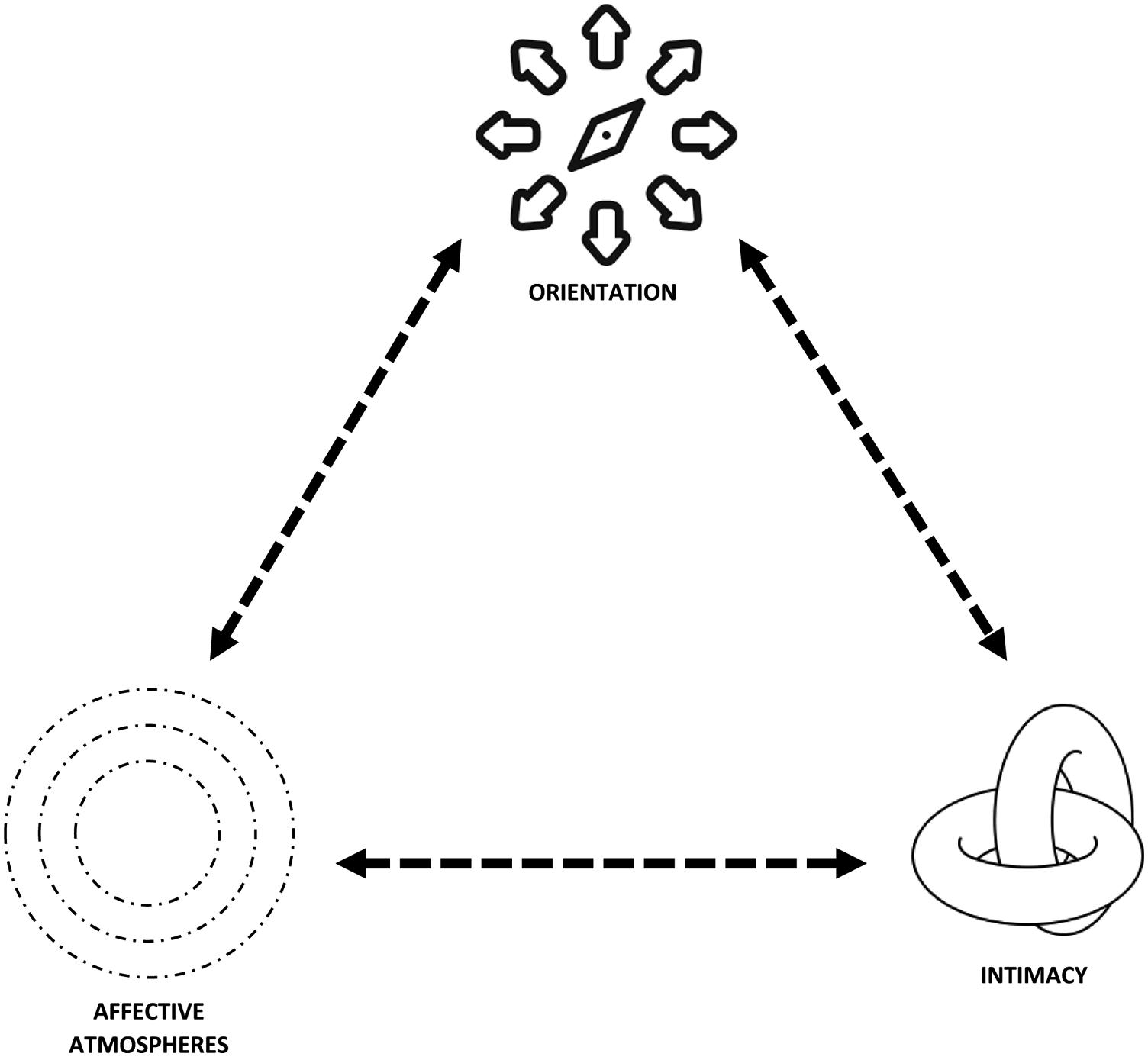
1 Orientation
We believe that in order to better understand how gambling affects people and causes harm, we need to study the experience of space. By looking at the work of Ahmed (2006, 2010a), we can explore how the way we perceive and interact with space can influence our emotions and actions. Building on the work of Merleau-Ponty, Ahmed (2010a) suggests that our sense of orientation in space is tied to our familiarity with certain everyday routines and social expectations based on factors like gender, class, age, and ability. This sense of familiarity can create feelings of comfort and safety conceived as a lifeline or ‘home’ territory and shapes our sense of identity in a specific context. However, moments of disorientation can challenge our sense of self and social relations, leading to either negative or positive responses. Ahmed (2006) points to a politics of emotions surrounding moments of disorientation that turn our world upside down. On the one hand, sensations of disorientation may result in a crisis and diminished sense of self in the world. On the other hand, moments of disorientation may result in defensive responses that reconfigure previous relations to the world, or in creative responses that allow new directions and aspirations. By examining these experiences, we can better understand the role of space in gambling consumption and harm.
We argue that repetitive online sports gambling routines that comprise everyday life allude to a kind of orientation in the world and generation of ‘home’ territories. Thinking through the concept of orientation there are no pre-existing gambling spaces or subjects, rather, emotions of everyday gambling routines (such as belonging and ostracism, love and hate, happiness and sadness, or pride and shame) that facilitate the co-constitution of subjectivities, communities, home territories and practices. In this vein, the repeated routine that helps co-constitute gambling spaces and subjectivities may be conceived as having a comforting, sheltering, and bordering effect that mediates the stigma and shame that prevails around gambling.
For example, the way online sports gambling generates positive feeling aligned with ‘home’ territories orients bodies towards sporting masculinity and keeping gambling friends within reach. For example, as Gordon et al. (2015) and Deans et al. (2016) make explicit how habitual sports gambling routines strengthened belonging to friendship circles and online communities. Thomas et al.,’s (2012) content analysis of the impulse marketing strategies in the sector illustrate how in-game betting is marketed to magnify the pleasures that consumers experience and excite emotions that enable bodies to connect with others such as love and joy. These emotions orient bodies in certain directions to forge ‘home’ territories and consumer collectives, while ruling out other orientations.
Equally, moments of disorientation include setbacks (for example, losing a bet) or turning points (for example, the acknowledgement of gambling addiction). Disorientation triggers sensations of insecurity, loss, crisis, and chaos. The heightened reflexivity of moments of (dis)orientation, or, living without the protective feeling of home, is conceived for some as shattering one’s sense of confidence and existence derived from gambling while for others it may offer possibilities of new directions and hope by experimenting with new gambling routines, technologies, networks, or forums.
To better understand how gambling consumption and cravings can lead to continuous returns to familiar ‘home’ territories, we build on Ahmed’s (2010b) concept of the ‘happy object’. The idea of seeking happiness is heavily promoted by the gambling industry, particularly through online sports betting marketing (Peck, 2017). This marketing takes many forms, such as advertisements, sponsorships, and direct messages, aimed at attracting new customers and retaining existing ones (Guillou-Landreat et al., 2021). To entice people to gamble, the industry offers rewards such as financial credits, bonus bets, or cash back deals. These inducements create a sense of happiness and excitement associated with the familiar practices of gambling, which can be especially appealing to young people (Hing et al., 2018). By examining this phenomenon, we can better understand the role of the ‘happy object’ in the context of gambling and how it shapes our experiences of space and place.
For example, the proliferation of sports betting advertising on both traditional and digital media, which promises happiness but conceals the risks, has raised concerns among the public. These concerns are supported by research. Hing et al.,’s (2018) study that showed how marketing strategies offer incentives to vulnerable gamblers can lead to more frequent, larger, and riskier bets. Consumer researchers have also found that the online sports gambling industry relies on building friendship networks among men to provide emotional and social support as part of a shared community (Gordon and Chapman, 2014). These marketing tactics use shared experiences and values to create a convivial ‘home’ territory for friendship ties among men. Such marketing strategies promote the idea that gambling is an everyday, risk-free activity where smart people have the knowledge to overcome the odds. (McMullan and Miller, 2008; Binde, 2014; Deans et al., 2016; Hing et al., 2013; Sproston et al., 2015.)
Ahmed’s (2010b) ‘happy object’ is helpful to understand the positive emotions and affects about online sports betting gambling that are directed towards collective consumption through clubs and pubs conceived as ‘home’ territories and how these forces connect to sporting masculinity norms and cravings. Ahmed’s (2010b) notion of happy object refers not only to material artefacts (smartphones) but also to values, social norms, personal practices, styles, and ambitions. Taking our lead from Ahmed (2010b) ‘problem gambling’ is not solely about predetermined genetic or psychological make-up, geographical contexts, social structures, or cultural scripts. Rather, the continuous return to gambling spaces is about a cultural system in which the desire for male-to-male heterosexual bonds is routed through cravings involving ‘happy objects’ including masculinity as a personal practice, places, friendship circles, gambling applications, and winning. Online sports gambling harm then is understood in terms of ‘home’ territories and how the desire for male-to-male heterosexual bonds conjoins with genetic factors to shape how some men continuously show up together and help create betting spaces.
For Ahmed, if objects become understood as a means towards happiness which is not yet present then certain things acquire value as good. In Ahmed’s (2008, 11) words: Happiness does not reside in objects; it is promised through proximity to certain objects … The promise of happiness directs life in some ways but not others. To share in the happiness of others is how we come to share a certain direction. We could even say that groups cohere around a shared orientation toward some things as being good, treating some things and not others as the cause of happiness. The fan club or hobby group make explicit what is implicit about social life: that we tend to like those who like the things we like.
Following Ahmed (2008), people do not find happiness in gambling itself. Instead, they find happiness in the bonds of sporting masculinity, social connections, and winning. These are known as happy objects, not because they bring happiness directly but because they promise happiness in exchange for loyalty. In this way, gambling provides happiness through the promise of the good life by creating a sense of community and belonging. This is achieved through continuous returns to familiar places, such as pubs and clubs, which serve as ‘home’ territories. By doing so, friendships become closer, and a sense of self is affirmed. Even in situations of unhappiness, happy objects still accumulate positive value, as Ahmed (2010b, 33) notes. This means that even when gambling results in losses, people find solace in the promise of future affirmations of their sense of self and friendships through future wagers.
In summary, the sports betting app and smartphone are conceived as happy objects because they help bring friends together. The focus is on the bonds of friendship, and certain objects such as the sports betting app, smartphone, alcohol, sports streaming, and venues become important in strengthening these bonds. Online sports gambling becomes a ritual or routine that helps people feel happier, and it creates a social order by guiding people to reach for certain objects. According to Ahmed (2010b), online sports gambling harms can be seen as a cost of being sociable. Those people who do not share an orientation towards gambling as pleasure or ‘good’ are positioned as killjoys.
2 Affective atmospheres
Affect is a force felt in human bodily encounters. We all feel affect in inherent ways, for example, sensing the vibe in a pub, club, or hotel upon crossing the threshold. To help conceptualise the spatial imperative of affect, McCormack (2008, 413) articulates the idea of ‘affective atmosphere’. For McCormack (2008, 413), affective atmosphere is ‘something distributed yet palpable, a quality of environmental immersion that registers in and through sensing bodies while also remaining diffuse, in the air, ethereal’. In effect, affective atmospheres concern the situated social and spatial organising process through how affect circulates, intensifies, and dissipates between bodies then coalesces into emotions (Anderson, 2009). With affective atmosphere it becomes possible to explore aspects of individual and collective embodied belongings, or not, as ongoing relational process through the interplay of multiple affective flows that connect and disconnect. The circulation of affect is always in relation to learnt ideas attached to certain bodies and places alongside the immanent affective force of material worlds (see Saldanha, 2007; Bissell, 2010; Clement and Waitt, 2018; Waitt et al. (2020)). Saldanha (2007) elaborates on the cultural politics of ‘affective atmospheres' by highlighting how the embodied effects of affect produce felt difference along racialised lines of who does, or does not belong.
The notion of affective atmospheres is valuable to reimagine the pervasive structuralist perspective in gambling geographies of the individual, the collective and the social. First, taking our lead from the notion of affective atmosphere, the social becomes a process that operates through the affective capacity of the body to connect and disconnect. Rather than conceptualising friendship circles as sums of individuals, the notion of affective atmospheres encourages us to interpret such collectives as a composition of affective flows in reverberation with orientating and disorientating moments. Men-who-gamble together are thus to be understood as relational affective becomings themselves, and not able to be categorised as comprised of objects nor subjects. Instead, the orientation of affective atmospheres matters in the proliferation of men-who-gamble together by how bodies take shape through how affect is understood to travel between them.
Second, the notion of affective atmosphere points to the importance of what Thrift (2004) termed the ‘engineering of affect’. That is, how ongoing gambling practices are reproduced through knowledge held by the gambling industry of what makes gamblers happy. Previous research has pointed to the importance of the discourses circulated within gambling marketing campaigns (Reith, 2018) alongside the research into technologies and material design to demarcate, designate, and optimise return to and expenditure within commercial gambling spaces (Dixon et al., 2006; Kingma, 2008; Griffiths, 2010; Hing and Haw, 2010; Nicoll, 2011; Schull, 2012; Gainsbury et al., 2016; Fransson et al., 2018; Lopez-Gonzalez et al., 2018.) Yet, missing in this literature is an understanding of why certain bodies plug into these atmospheres which stimulate bodies, and not others. With affective atmospheres, it becomes possible to comprehend bodies as derived from how affects that create the effect of difference not only circulate between bodies but stick and accumulate.
Through the lens of affective atmospheres, gendered and classed difference are felt and brought to the fore through how affects combine from past and present impressions and interpretations of things and ideas, into emotions that can be named as either good, or bad, through language. This approach offers a way to understand individual gambling experiences by focusing on bodies, emotions, and differences, challenging how cultural economy approaches think about gambling harm in dualistic rather than relational terms. To think about affective atmospheres is to consider embodied histories, and tracing affective trajectories that stimulate some bodies and not others. There is an emotional politics to gambling spaces in how the affective atmospheres may constitute a sense of finding and loosing oneself. As such, we argue that research on affective atmospheres can form an important focus for a relational approach to geographic research on gambling.
3 Intimacy
Intimacy refers to the feeling, or atmosphere, of closeness and openness between bodies (Moss and Donovan, 2018). The orientation of experiences and the resonances created by ‘home’ territories and certain affective atmospheres are invariably linked with a sense of intimacy, thereby linking the strands of our conceptual framework. Intimacy has taken different trajectories within geography (Valentine, 2008). Early writings focussed on ‘geographies of sexuality’. In this strand, intimacy was theorised in relation to taken-for-granted discourses of heteronormativity (Bell and Valentine, 1995). In this context, queer scholars troubled the alignment between intimacy, sexuality, and social reproduction (Bell, 1991). More recently, embodied theorisation of intimacy within the field of ‘emotional geographies’ created opportunity to explore what Valentine and Hughes (2011, 243) termed the ‘interiority of family life’. Specific attention is given in the relational geographical literature to how intimacy is felt through shared domestic activities that make and remake the notion of home (Blunt and Dowling, 2006; Waitt and Gorman-Murray, 2011) and through the body in service work (Jayne and Leung, 2014; Holmes, 2015). Following Jamieson (1998), this strand conceives of intimacy as an embodied practice that mediates multiple interpersonal relationships to and with another/others. Intimacy is manifested through three interpersonal relationships: emotional intimacy, intimate knowledge, and caring practices.
Oswin and Olund (2010) and Valentine and Hughes (2012) underscore the need for geographers to theorise intimacy relationally to help trouble the scale of intimacy to the body or domestic relationships. Assumptions of physical proximity continue to inform many discussions of ‘intimate relations’, whereby the relational dimensions of feeling and being close to another/others focusses attention on domestic spaces. In doing so, Valentine (2008, 2015) argues: ‘By focusing only on relationships in the domestic, we miss out on the complex web of intimate relationships that span different spaces and scales.’ For example, studies of diasporic families (Pratt, 1997) and couples who ‘live apart together’ illustrate that distance does not necessarily end intimacy (Holmes, 2004; McKee et al., 2000; Levin, 2004). Furthermore, the Internet allows not only intimate familial relations to be practiced over increasingly distant scales but offers possibilities for exploring and embracing different intimacies (Binnie, 2000; Bonner-Thompson, 2017; Nash and Gorman-Murray, 2019).
For example, the intimate ties that bind people-who-gamble together are commodified by the gambling industry through creation of betting applications for friendship circles (for example, ‘bet with mates’). In turn, these online gambling platforms become the objects that secure the friendship intimacy. This friendship intimacy does not necessarily rely on physical propinquity. Online gambling platforms configure an intimacy by knowing (for example, the exchange of information about players, form, and injuries), loving (for example, knowing of others’ sports betting likes and dislikes), and caring for each other online (for example, by sharing in tips, celebrating wins, and commiserating losses) (Gordon et al., 2015; Waitt et al. (2020)). The bonds of gambling friendship circles are strengthened through an intimacy with knowledge of others preferred odds and sports that operate within a shared gambling horizon. People who sports gamble together online thus bring knowledge of betting preferences into routines and habits. Thus, people-who-gamble together reproduce friendship circles through sharing intimate stories about each other’s gambling likes alongside odds, wins, and losses.
V Conclusion
The way that gambling harms people is affected by the spaces in which they gamble. New approaches to understanding gambling harm have never been more important in the context of the burgeoning marketing and profits derived from online sports gambling. However, with a few notable exceptions, research in geography currently tends to under-theorise the importance of gambling experiences. To evaluate the centrality of space in gambling harm we advance an innovative relational geographical approach. Our aim here is not to proffer a ‘major theory’ (Katz, 1996) of gambling harm. Instead, informed by the three reviewed relational gambling geographies, our purpose is to underscore and build on these contributions to gambling studies through discussion of the related concepts of orientation, affective atmospheres, and intimacy (Valentine and Hughes, 2012; Adams and Wiles, 2017; Waitt et al. (2020)). These relational concepts are complementary in their attention to emplacement, embodiment, materiality, emotion, and affect. Interweaving these relational concepts allows us to better understand how gambling comes to be felt as ‘good’ or ‘bad’. The following emphasises the significance of a relational approach for future research that investigates the social harms of online sports gambling practices. This involves analysing the spatial aspects of organising, placing, winning, and losing bets as they are experienced and perceived.
First, our relational understanding of gambling practices challenges common assumptions about social harms and risks, as well as the concept of a ‘problem gambler’. We believe that it is important to take a relational approach that considers factors such as orientation, affective atmospheres, and intimacy to fully understand the impact of online sports gambling. This means moving away from traditional approaches that focus solely on psychological traits, regulations, and capitalist exchange relations, and, in addition, considering how people’s experiences and embodiment shape their gambling behaviours.
Second, we suggest that future studies should explore the emotional experiences of online sports betting and the effects on social relationships. We call for future studies that embrace the productive ambiguity of affective atmospheres which encompass the orientating and disorientating experience of commercial online sports betting. The pressure to conform to traditional masculine ideals in the market has reinforced bonds of mateship between men, while also entrenching gender and class differences. The pleasure of online sports gambling routines can mask the harmful effects of gambling by intensifying these bonds of mateship and creating a sense of belonging. Future research should examine how the emotional experiences of online sports gambling influence our perceptions of intimacy, home, and social relationships. This requires identifying the objects and emotions that motivate people to gamble and exploring the disorientation that some individuals experience when their gambling behaviour does not align with the norm. To reduce gambling harm, researchers should consider how the creative potential of disorientation can be harnessed. This approach should extend beyond traditional gambling venues to consider how online sports gambling can be embedded in workplaces, schools, and homes.
Third, a relational approach to gambling research can help us to supplement dominant methods such as surveys and interviews with a broader range of interdisciplinary methods. To better understand the emotional and affective flows of affective atmospheres, we can use methods such as autobiography, ethnography, visual and video methods guided by rhizoanalysis (Waitt et al. (2020)). These methods can supplement cognitive neuroscience approaches such as electroencephalogram (EEG), functional magnetic resonance imaging (fMRI), and eye tracking which offer insights into the neurobiological responses to the gambling setting, interpersonal interactions, and marketing materials (Balconi and Angioletti, 2022).
Fourth, adopting a relational perspective to online sports gambling could help inform more holistic policy and programmes beyond those that currently focus on targeting individuals and their behaviours. Gambling policies commonly offer a singular concept of harmful gambling behaviour by ‘problem’ individuals, subject to universal laws, and resulting in standardised approaches for harm reduction policy and practice. Calling attention to the relational dynamics that shape gambling and gamblers can make way for imagining political action that focuses not only on individual and pathologised behaviours but acknowledges the emotional and affective press of gambling capital, including venues, marketing, products, and technologies.
Finally, responsible gambling and reducing gambling harm is often based in neoliberalism thinking on the idea that it's up to the individual to control their gambling habits. However, our relational approach aims to understand the bigger picture and takes into account how people’s experiences, knowledge, and social connections affect their ability to gamble responsibly. Our relational approach underscores the differential affective bodily capacities for individuals to effect change along the lines deemed responsible that relate to the right gestures, previous experiences, sporting knowledge, and having money to bet. Furthermore, a relational approach allows thinking holistically about gambling responsibly involves not just individuals, but also the socio-material relations configured by governments, institutions, and gambling companies, We can work together to reduce gambling harm by employing the related conceptual lenses of orientation, affect, and intimacy to better understand the emotions and affects generated by the ongoing coming together of these socio-material relationships. We encourage other researchers to join us in this field and help us better understand online sports gambling harm.
Footnotes
Acknowledgements
We thank the reviewers of their constructive comments on earlier drafts of this manuscript. Funding for this project was provided by the Australian Research Council Discovery Project, ARC DP190101405 - In it to win it: an interdisciplinary investigation of sports betting.
Declaration of conflicting interests
The author(s) declared no potential conflicts of interest with respect to the research, authorship, and/or publication of this article.
Funding
The author(s) disclosed receipt of the following financial support for the research, authorship, and/or publication of this article: This work was supported by Australian Research Council (ARC DP190101405).
