



Abstract
Despite theoretical developments in conceptualising alterity, what counts as ‘alternative’ in unconventional systems of food provision remains contested. This paper argues that the literature has reached an impasse. I argue that overly ‘alternative’ readings conceptualise Alternative Food Networks (AFNs) as a more embedded form of economic exchange, while neoliberal readings represent them as a case of marketisation. This paper systematically reviews AFNs literature and contends that a deeper engagement with Polanyian geographies enables a more nuanced approach to evaluating alternatives and their socio-political significance. Analytically and normatively, ‘alternatives’ need not be radically ‘other’, nor seen as having been co-opted by the neoliberal order.
I Introduction
‘Alternative’, as an analytical term in Alternative Food Networks (AFN) literature, has been widely criticised for being constructed in opposition to the ‘conventional’, establishing a dualism in which ‘alternative’ (associated with ‘the local’) becomes the site of social embeddedness, economic diversity, and close and meaningful relationships. Thus, ‘conventional’ (associated with the ‘global’) is depicted through the presence of corporations, markets, homogenisation and distant relations (Hinrichs, 2003; Maye et al., 2007; Maye and Kirwan, 2010; Wilson, 2013). Qualifying alternatives in association with other terminologies such as quality, embeddedness, and localness has made the concept less clear, and has even emptied it of meaning (Holloway et al., 2007a; Maye et al., 2007). Moreover, this dualism has contributed a perception of the alternative as a single social phenomenon, instead of focusing on the dynamics of building alternatives in which different trajectories can emerge.
Despite the criticisms, the term alternative holds analytical value as it grasps the relationality between the process of building alternatives and the maintenance of the hegemonic neoliberal food system. Moreover, the term highlights the power dimension better than other terms such as diversity or sustainability, as its opposition denotes an ongoing struggle with an ‘other’ (Jonas, 2010). However, I argue that the conceptualisation of alterity has reached a ‘theoretical impasse’ in the analysis of AFNs, based on residual dualism.
Alternative Food Networks emerge in response to different problems associated with the conventional-industrialised food system. They engage in new forms of food production and distribution, thus creating more sustainable, territorially embedded, quality-oriented alternatives. Alternative Food Networks as an umbrella term groups together different food initiatives from newer expressions such as Civic Food Networks (Renting et al., 2012) and cities food charters (Hardman and Larkham, 2014), to the more traditional farmers markets.
Alternative Food Networks have developed through a wide range of business models that generally engage in shorter or direct modes of exchange, circumventing retail-led chains. The re-localisation of relations of production, distribution, and consumption has become of strategic importance as food producers can add and capture more value by supporting production systems that diverge from intensification. Along these lines, AFNs as an alternative economic strategy can be defined by their ability to reconfigure chains, to redistribute value toward primary producers, and to engage with production systems moving beyond ‘cost-effective’ rationales and aiming for more progressive relations with nature and others.
However, integrating normative goals into production practices and business strategies is resisted by the hegemonic actors and structures of the current food system, who act to subvert initial goals or co-opt them for profit. In addition to this empirical complexity, the conceptual analysis of alterity in the literature of AFNs tends to separate the different dimensions of their object of study, creating a divide between socio-cultural factors, agency, and strategic action and that of political-economic concerns and structuration. In failing to adequately integrate these dimensions, the analysis of alterity tends to overrepresent the influence of certain elements over others, thus creating opposing representations of what these initiatives are, what they do, and their potential for transformation. Therefore, I argue for the need to overcome the present dualism and to move towards a dialectic-relational approach which is explored through the work of the late Karl Polanyi.
This paper traces the theoretical evolution of the concept of alterity in AFNs and shows how economic geography’s work on embeddedness on the one hand, and neoliberalism on the other, have created a theoretical deadlock in the analysis of economic alternatives. This review identifies three chronological periods of development. During the first phase (the 1990s–early 2000s), the embeddedness approach based on Granovetter’s (1985) re-interpretation of Polanyi’s (2001) concept was the most relevant framework for conceptualising alterity, highlighting the role of interpersonal ties, trust and regard in economic exchange, which became valued as alternative, rather than questioning the effects of these relations.
This period was followed by a phase of critique (mid 2000s−2010) regarding the concept of alterity and the practice of AFNs, which conceptually drew on political economy perspectives and geography’s literature on neoliberalism (Brenner and Theodore, 2002; Jessop, 2000; McCarthy and Prudham, 2004; Tickell and Peck, 2002). In this phase, the relationship between the conventional and the alternative was further problematised, interrogating the power relations, rent extraction and dynamics of co-optation and conventionalisation. In this phase, AFNs became conceptualised as neoliberal constructs characterised as engaging in commodification, and extending market relations and neoliberal forms of governance (Allen and Guthman, 2006; Alkon, 2008; Allen, 2010; Alkon and Mares, 2012; Agyeman and Mcentee, 2014; Dupuis et al., 2006; Guthman, 2007, 2008; Tilzey, 2017).
In the third phase of development (2010 to date), research has shifted away from economic alterity towards addressing the hybridity, complexity and diversity of AFNs (Maye and Kirwan, 2010). However, conceptualising alterity remains a central challenge, as it allows for the evaluation of emerging food initiatives and their overall socio-political significance.
This article aims to move beyond this theoretical impasse by employing Karl Polanyi’s dialectical relationality between processes of marketisation and societal embeddedness. In The Great Transformation (2001), Karl Polanyi identified a process of marketisation in which the self-regulating market is established, and through which the motives and logic of the market are extended to the social and natural realms. Marketisation would prompt a countermovement in which society would organise to protect itself by re-embedding the economy in its political and social dimension, thus subordinating the market.
Research into alternatives must be attentive to the dynamics that Polanyi identified in this ‘double movement’. Evaluating these initiatives through a Polanyian approach that situates them as part of a broader conjuncture with specific economic, political, and ideological supports contributes to conceptualising the ‘actually existing alternatives’ (cf. Peck et al., 2018). Often, these will be partly based on private forms of property, will engage in market dynamics, and actors would at least need to earn a profit to be economically sustainable. A deeper engagement with Polanyian geographies (Peck, 2013a, 2013b) entails a processual and conjunctural analysis of the emergence, plurality, and hybridity of alternative economic forms. In doing so, it conceptualises the socio-economic diversity of AFNs and recognises more nuances regarding their transformative potential.
The remainder of the paper is structured as follows: the second section traces the theoretical evolution of the concept of alterity in AFNs literature, reviewing the main theoretical approaches employed. The third section illustrates the theoretical impasse in the analysis of local food initiatives, showing opposing representations of the main categories employed for conceptualising and evaluating these initiatives. The fourth section employs Polanyi’s work to transform theoretical dualisms into dialectical relationality. It concludes by arguing that overcoming the current theoretical deadlock is necessary for a better understanding of the diversity of AFNs and their overall socio-political significance.
II Theoretical progress: Conceptualising alterity
Research on AFNs began in the late 1990s, and since then it has developed into an extensive and diverse body of academic literature. This section reviews the main theoretical frameworks mobilised for analysing the alterity of AFNs, mainly in the UK and US contexts. The literature identifies two distinct models of AFNs developing in Europe and the United States (DuPuis and Goodman, 2005; Dupuis et al., 2006). In Europe, AFNs were considered as a paradigm shift in rural development, through which producers and rural territories could capture more ‘value’, while in the US they developed connected to ‘values’ of sustainability and social justice. Although this distinction is no longer useful, as in Europe the socio-political significance of AFNs has moved beyond a rural development approach, it has marked the evolution of the studies of AFNs.
1 The over-territorialisation of alterity (late 1990s–early 2000s)
Initially, when Alternative Food Networks (AFNs) emerged in Europe and the UK, they were praised as a rural development tool, especially for those areas and producers that were struggling to compete in the global market. During this period, AFNs were considered part of a ‘quality turn’ in agro-food production (Murdoch et al., 2000; Watts et al., 2005). Quality became a mean of by-passing the competitive, margin-based ‘race to the bottom’ (Marsden, 1998), instead allowing producers to add value to their products and to access specific niche markets. Academic research focussed on the multiple constructions of quality, for which convention theory became a useful approach for conceptualising economic exchange beyond price considerations.
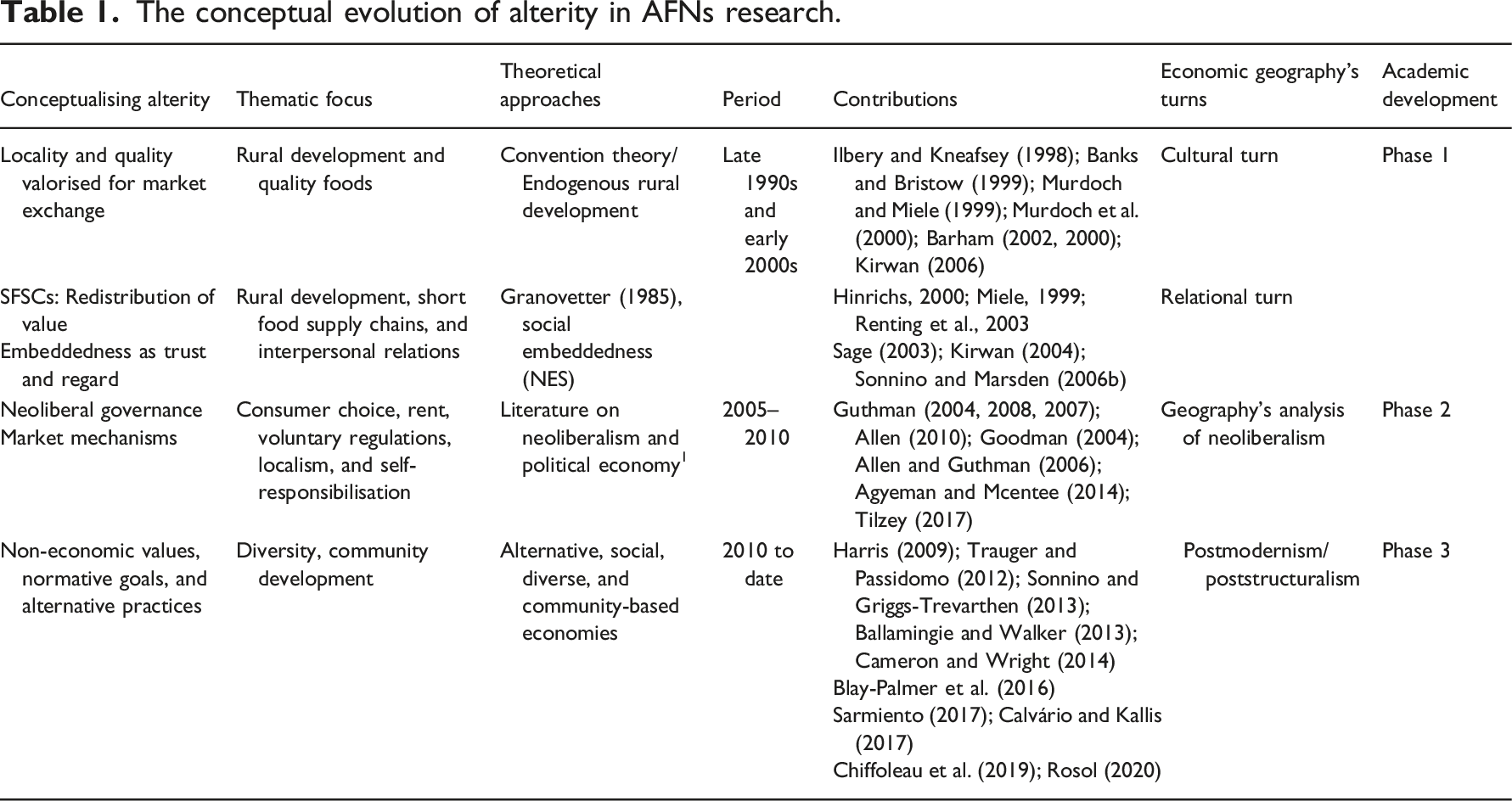
The conceptual evolution of alterity in AFNs research.
The reconfiguration of food supply chains reduced both the social and spatial extension of networks, reducing the number of intermediaries between producer and consumer and creating more localised food economies (Renting et al., 2003). The focus was placed on the social relations that emerged from within the networks, and especially those between consumers and producers. Social and spatial distance was employed to build a typology of SFSCs: face-to-face, spatially proximate and spatially extended (Marsden et al., 2000; Renting et al., 2003).
Embeddedness as a conceptual framework was borrowed from New Economic Sociology (NES) and was popularised by economic geography in the analysis of regional development (see e.g. Hadjimichalis, 2006; Harrison, 2006; Lovering, 1999). For economic geography, the collaboration with NES brought pluralism to the field (Peck, 2005). However, economic sociology as a sub-discipline developed primarily through Granovetter’s reinterpretation (1985) of Polanyi’s original concept of embeddedness (1944), which focuses on the role of networks and interpersonal ties in economic action, 2 thus departing from Polanyi’s moral critique of the market.
The focus of the embeddedness approach on personal relations and networks was useful for analysing AFNs, which were defined by their ability to re-socialise and re-spatialise food networks (Renting et al., 2003). Embeddedness became probably the single most common framework for analysing AFNs and local food initiatives in the 2000s (see e.g. Alkon 2008; Barham 2002; Chiffoleau 2009; Hinrichs 2000; Kirwan 2004; Murdoch et al., 2000; Sage, 2003; winter 2003).
Alterity and embeddedness as socio-spatial proximity became entangled in two senses: first, alterity was based on the ability of shorter chains to redistribute value in favour of primary producers and to capture it in their localities (Sonnino and Marsden, 2006b; Whatmore et al., 2003; ). Second, alterity was understood through the closer relations in the economic exchange of food, which were imbued with trust and regard, and were conceptualised as non-economic attributes of economic relations.
However, little attention was paid to the mechanisms employed to redistribute and capture value (Guthman, 2007). In fact, besides consumer–producer relations, other dimensions of the alternative food economic strategies were largely overlooked. Instead, the focus on closer relations based on face-to-face interactions facilitated by spatial proximity became the predominant form of conceptualising alterity. This usage of embeddedness constitutes a second form of territorialising the concept, becoming ‘over-territorialised’ as localised social relationships were understood as the spatial logic of embeddedness (Hess, 2004).
In summary, for this first phase of conceptualising AFNs, it is possible to identify three meanings of alterity (see Table 1 below): (i) as quality-oriented (small scale, artisan, traditional products); (ii) as short chains, short-circuiting longer conventional chains and redistributing value towards primary producers; and (iii) as embeddedness, pointing to its emphasis on socio-spatial proximity and the emergence of more meaningful and trusted forms of exchange.
During this phase of research, AFNs were analysed with a focus on the distinctive, internal characteristics of the network, which was constructed in opposition to the conventional system of food production. Although in the early 2000s authors began scrutinising the progressive content of localisation (see Holloway and Kneafsey, 2000; Hinrichs, 2003; Winter 2003), this phase can still be characterised as being more descriptive and favouring empirical research rather than theoretical development (Maye and Kirwan, 2010).
2 The critique: AFNs and neoliberalism (2005–2010)
By the mid-2000s, it had been established that AFNs did not simply exist in opposition to the conventional (Holloway et al., 2007a) and were not neatly separated from the mainstream, but rather they constitute hybrid spaces (Ilbery and Maye, 2005; Mount, 2012). The local scale was also problematised, as it was widely acknowledged that initial scholarship had tended to uncritically assume positive characteristics of the local scale (Born and Purcell, 2006).
One line of critique that moved away from observations of conventionalisation and co-optation noted that AFNs were not only constrained and subverted by hegemonic capitalist structures (Allen, 2010), but that their essence was neoliberal (Phase two). This critique conceptually draws on political economy perspectives and geographical literature on neoliberalism (Brenner and Theodore, 2002; Jessop, 2000; McCarthy and Prudham, 2004; Tickell and Peck, 2002). Definitions of neoliberalism in economic geography highlight the withdrawal of the state, moving from government to private forms of governance, and the normalisation of extending market logic to the satisfaction of human needs. Consequently, AFNs were characterised by their dependence on market mechanisms, engaging in commodification, and extending market relations and neoliberal forms of governance (Allen and Guthman, 2006; Alkon, 2008; Allen, 2010; Alkon and Mares, 2012; Agyeman and Mcentee, 2014; Dupuis et al., 2006; Guthman, 2007, 2008; Tilzey, 2017).
In this way, AFNs are considered part of a neoliberal roll-out (Tickell and Peck, 2002) or ‘creative phase’ of neoliberalism, in which mechanisms must be created to support and compensate for establishing the logic of markets. For Guthman (2007), the emergence of AFNs in the 1990s not only coincides with a neoliberal roll-out, but AFNs themselves constitute flanking mechanisms; kinder and gentler forms of marketisation. Authors have focussed on private and voluntary forms of neoliberal regulation, self-responsibilisation, consumer choice and localism of food alternatives (Allen and Guthman, 2006; Agyeman and Mcentee, 2014; Guthman, 2007, 2008; Tilzey, 2017).
Various authors also employed rent theory to contest alterity in the economic strategies of alternative food initiatives, showing that they were based on creating scarcity and extracting rent (Goodman, 2004; Guthman, 2004). Rent is created through valorisation in the market, which allows producers to access premium prices that are not related to an increase in production costs (Guthman, 2004). In some cases, rents can become quasi-monopoly rents, created by specific regulations such as label schemes (Goodman, 2004).
The neoliberal literature was crucial for the theoretical development of AFNs as it emphasised political and economic factors which had previously been overlooked. However, in a way, it fails to build on the previous academic development that focussed on the socio-cultural dimensions of local food and alternative food networks.
3 From alterity to diversity (2010 to date)
This phase is characterised by the influence of post-structuralist approaches in the analysis of AFNs and particularly relevant is Gibson-Graham (2008, 2006) work on ‘politics of possibilities’ and their ‘diverse economies’ approach and the dialogue it established with alternative and social economies (Amin et al., 2002; Hudson, 2009; Lee, 2006; Leyshon et al., 2003). This research project has contributed to the understanding of alterity and the economic forms otherwise ‘hidden by mainstream capitalism’ (Jonas, 2010).
Post-structuralist approaches have been influential in the analysis of AFNs since the early 2000s, inspired by actor-network theory (ANT) (see Stassart and Whatmore, 2003; Holloway et al., 2007; Murdoch, 2016), 3 . They brought relationality to the strong dualism present in the literature and contributed to the diversity, hybridity, and complexity that characterises this phase. Post-structuralism conceptualised AFNs as constituted by an array of relationships, rationales and social values (Sarmiento, 2017). However, Gibson-Graham’s work explicitly addresses some shortcomings from the previous phases and became influential for analysing alterity.
On one hand, Gibson-Graham’s (2006) method for ‘reading for difference’, responded to the neoliberal reading of AFNs, which had been criticised for omitting AFNs diversity and reducing them to a case of neoliberalisation (Kloppenburg and Hassanein, 2006, see also Local food: embedded economic alternatives or a neoliberal construct?). Harris (2009) showed that this reading was discursively reproducing the dominance of neoliberalism which affected AFNs’ practices and possibilities.
On the other hand, Gibson-Graham’s (2008) diverse economies project de-centre capitalist economic forms by valuing the diverse forms of enterprise, labour, property, transactions and finance. This turned to the analysis of the multiple economic forms entangled in the production, distribution and consumption of food, overcoming previous binary thinking and the narrow scope of interpersonal producer–consumer ties offered by the embeddedness approach (Chiffoleau, 2009).
Their work inspired researchers to analyse the possibilities of AFNs for enacting the economy differently. Research in this phase examines the diverse economic relations, the ethical underpinnings and the possibilities of these food initiatives to contribute to sustainability and community development (see e.g. Ballamingie and Walker, 2013; Blay-Palmer et al., 2016; Cameron and Wright, 2014; Calvário and Kallis, 2017; ; Dixon, 2011; Little et al., 2010; Laforge et al., 2017; Trauger and Passidomo, 2012). More recently, the analysis of alternative economic models and practices have increased in importance for conceptualising AFNs (Chiffoleau et al., 2019; Rosol, 2020).
Although the ‘diverse economies’ approach enhanced the analysis of alternative economies, they also differ in important ways. The diverse economies’ strategy of decentring capitalism avoids addressing how alternative food initiatives are shaped by the continuous struggle with the hegemonic economic forms that develop across multiple places and scales. This line of thinking acknowledges the existence of numerous alternative systems, but omits a relational understanding of the process of producing alternatives: [‘alternatives’] give this perceived mainstream more credence than it deserves. Perhaps more appropriate than food ‘alternatives’ would be the term food ‘diversity’ in order to recognise the multiplicity of ways that food is produced, distributed and consumed, some of which will involve corporatisation but others which will involve diverse forms of labour, markets, enterprises, property and finance (Cameron and Wright 2014: 4).
Alterity and diversity are entangled and may overlap, as diverse economies may seek to overcome and replace unjust hegemonic relations, while alternatives are diverse, context-dependent, and – above all – geographically specific. However, they are not interchangeable, as alternatives are constituted in relation to an ‘other’ that the alternative seeks to oppose, replace, or challenge (Jonas 2010: 4). The dialectic relationality proposed in this paper does not imply succumbing to capitalocentrism, but rather focusing on how particular structures and political conjunctures can influence the scope and content of AFNs while also investigating the possibilities of these initiatives for articulating social change.
The evolution of conceptual approaches presented in this section shows how the understanding of alterity in AFNs has moved from an alternative paradigm for rural development in the EU to an alternative to neoliberal and capitalist social relations. This section has reviewed the main theoretical frameworks employed in conceptualising alterity and pointed to several weaknesses that have hindered its conceptual development. The first phase of development, grounded in the cultural turn in economic geography (see Table 1 above), highlighted the social and cultural constitution of economies, but overlooked political and economic factors. The second phase moved in the opposite direction, but also tended to separate the domains of the socio-cultural and the political-economic, creating a deadlock in conceptualising alterity. The diversity approach moves away from the relational thinking of alternatives completely.
III Local food: Embedded economic alternatives or a neoliberal construct?
Whether AFNs are in essence neoliberal, or if they have the potential to constitute an alternative to neoliberal hegemony in food and farming, is an interpretative and evaluative question. However, different conceptualisations of alterity have theoretical implications for how alternative initiatives are represented and evaluated. This section analyses two oppositional readings of local food: the embedded and the neoliberal.
Opposite readings of local food initiatives.

1 Local food as embedded economic alternatives
Research into alternative and local food initiatives that employ the embeddedness approach has uncritically privileged Granovetter’s interpretation of the concept, without reflecting on the theoretical implications of departing from Polanyi’s conceptualisation of embeddedness. Granovetter’s concept is narrower in scope, as it focuses on the role of networks as social ties in economic action (relational embeddedness), while in Polanyi’s usage, embeddedness concerns the subordination of the economy to political, moral, and social relations (societal embeddedness). The first theoretical implication of this selectivity is the importance given to networks and social ties, which has exaggerated the role of spatial proximity in conceptualising alterity, while overlooking normative forms of embeddedness in these networks.
Under this approach, localisation becomes an important component of alterity, as it allows stronger interpersonal relations to flourish, embedding economic exchange in trust, care and regard. These closer relationships allow proponents to consider economic exchange through shorter chains to have additional, non-commercial benefits that are not present in conventional commodity exchange (see Hinrichs, 2000; Kirwan, 2004, 2006; Lee, 2000; Sage, 2003; Whatmore et al., 2003). Although these characteristics are considered to imbue AFNs with a new morality, there is little attention paid to other normative values which may be more relevant to achieving progressive goals.
Nevertheless, entangling spatial and social proximity has tended to assume the embedded character of these networks, rather than interrogating it. For example, Sage considered the social embeddedness to be established ‘by its scale of production and by its generally localised distribution through short food supply chains’ (Sage 2003: 50). A priori assuming embeddedness overlooks the actual economic practices and market exchange in AFNs. As Krippner (2001) noted, the problem with Granovetter’s social embeddedness is that it ends up separating the market from society, thus avoiding the sociological analysis of markets themselves, and evidencing residual economism in economic sociology (cf. Winter 2003).
For example, Hinrichs (2000) employs Block’s (1990) continuum of embeddedness and marketness, which are conceptually constructed as two opposite forms of coordination in which embeddedness is separated from instrumental reasoning and market relations (Sayer, 2000a). Although Hinrichs acknowledges that direct marketing initiatives have high levels of embeddedness and instrumentalism, the continuum fails to consider the social construction of markets, since social factors only appear when one moves away from the high marketness pole (cf. Krippner, 2001).
In another example, Sonnino and Marsden (2006a) distinguish a ‘horizontal’ dimension of embeddedness (which involves the interpenetration of societal and cultural domains) and a ‘vertical’ dimension (referring to the larger society, economy, and polity of which they are part). Although Sonnino and Marsden (2006a) try to overcome the site-based ontology present in AFNs, their conceptualisation still fails to integrate these dimensions. Furthermore, they attribute social and cultural dimensions to the local scale, while politics and governance reside at other scales. By separating these realms, the local appears as a site of overly benign economic relations (cf. Sayer, 2000a).
Overstating socio-spatial proximity in defining alterity is unconsciously infused with a romanticism towards the local and the rural. As McCarthy notes, ‘characteristics often cited as making economies and commodities ‘alternative’ overlap with those frequently cited as defining ‘rural’ places and products: more face-to-face interactions, less physical and social distance between production and consumption, a thorough embedding of the economic in a social context’ (2006: 804).
The geographical imagination of the local and the rural has led many to see it ontologically as the site for alternatives to capitalism. Imaginations of agrarian pre-capitalist communities have centred their moral economies and social ties against the demoralising effects of markets (Sayer, 2000b). This romanticisation is present in descriptions of embeddedness as a place-based characteristic: ‘Good food is associated with particular spaces: the regions, localities and fields where animals graze, vegetables are grown, or materials otherwise transformed (e.g. smoking, baking and cooking) establish its embedded character’ (Sage, 2003: 51). Place-based embeddedness has privileged the analysis of alterity at a local scale while overlooking that the production of alternatives, even local alternatives, develops across different scales and is performed as a scalar-strategic politics of opposition (see Fuller and Jonas, 2003). Focussing exclusively on the ‘localness’ of food relations in place obscures their significance by framing them as small or isolated (see Marsden and Franklin, 2013b; Sarmiento, 2017)
Other authors have followed Polanyi’s moral critiques of deregulated markets, addressing how different values can shape market relations through the use of certifications and standards in agricultural products (Barham, 2002; Mutersbaugh, 2005; Raynolds, 2000). These authors have analysed how embedding the market in new value systems through voluntary labels and the construction of certification standards (such as fair-trade and organic products) can re-shape economic practices and social relations, providing the basis for new norms of production and consumption (Mutersbaugh, 2005). However, constructing ethical markets through the valuation of environmental protection or fairness can have a contradictory character, as values are integrated into the logic of profit. Contrary to Polanyi’s idea of subordinating the market, this process fosters marketisation, expanding structures of accumulation and supporting it through a moral justification, thus working as an ideological device for neoliberalism (Bracking, 2019; Greco, 2015).
In summary, the embeddedness approach has privileged socio-spatial proximity in the analysis of AFNs and alterity. This conceptual selectivity has tended to separate rather than integrate the sociocultural dimension in the constitution of economic forms; it overlooks political-economic factors and processes that occur on other scales that influence the production of alternatives.
2 Local food as a neoliberal economic strategy
Research on AFNs based on the literature of neoliberalism points to several features of AFNs that can be associated with neoliberalism as a political project. This includes, for example, AFNs’ dependence on consumer choice, their development through private and voluntary forms of regulation, their creation of property rights through labels, their engagement in valuation and commodification, and their extraction of economic rent (Agyeman and Mcentee, 2014; Allen and Guthman, 2006; Goodman, 2004; Guthman, 2007, 2008; Tilzey, 2017). However, this body of work largely overlooks the diversity of local food strategies and the role of strategic action, and consequentially overstates the role of markets and the neoliberal nature of these initiatives.
Most representations of AFNs in this line of research tend to emphasise how these initiatives develop through market mechanisms and the role played by the local scale as a strategy for enacting change. For example, according to Allen (2004), food localism and short supply chains, as an answer to the globalisation of the food system, appear to embrace devolution and market-based ‘value-added’ solutions. Similarly, Tilzey argues that Alternative Food Networks (AFNs) address the problems of the neoliberal food system ‘through their advocacy of the localization and ecological ‘embedding’ of the market’ (2017: 226).
These representations of alternative food initiatives based on ethical consumption, market mechanisms and localisation tend to diminish their transformative potential. As discussed in the previous section, AFNs have indeed developed through market mechanisms by creating niche markets for local and quality products. They have also turned to the market to integrate social and environmental practices into their price formation, reflecting the ‘real costs' of food (Buller and Morris, 2004). However, the focus on market mechanisms and valuation overlooks other economic practices and dynamics in alternative food strategies.
Valuation practices are based on the possibility of imputing value to things that do not have value in a capitalist way, but which are perceived as if they did by creating economic arrangements that give them a price or exchange value (Greco, 2015; Andreucci et al., 2017). Valuation and marketisation are certainly present in processes of food certification and the creation of alternative food markets, for example, by attributing value to cultural aspects of the product such as place of origin (PGI and PDO labels) and other more generic forms of local branding that aim to obtain rent rather than produce value.
For example, Guthman (2007) analyses how different voluntary labels, in which producers adhere to certain standards, work to capture and distribute value. Guthman argues that they offer little protection, as competition tends to erase their monopolistic edge. However, her argument focuses on the neoliberal form of governance that these market mechanisms produce, employing McCarthy and Prudham’s definition of neoliberal governance as ‘increasingly voluntarist, neo-corporatist regulatory frameworks involving non-binding standards and rules, public-private cooperation, self-regulation and greater participation from citizen coalitions’ (2004: 276). Guthman argues that these labels not only shift regulation to private actors, but also create privatisation through property rights which can become the basis for monopoly rents. Voluntary labels protect by creating scarcity, commodifying ethical behaviours, and hence devolving regulatory control to the consumer.
Although the argument based on neoliberal governance concerning these labels is compelling, it is necessary to keep in mind that labels are just one strategy for local and alternative food. Even when producers employ labels, they can play a limited role in their economic strategies. Following Watts et al. (2005), who make a distinction between alternative food products and alternative food networks which focus on the distribution channels, Guthman (2007) analyses the commodities but not the alternative food networks, in which value can also be captured through alliances between producers, such as cooperatives and direct selling.
The overlooking of actors’ coordination and relationships through networks is more obvious in Allen and Guthman’s (2006) analysis of the Farm to School (FTS) programmes in the US. Farm to School initiatives use school public procurement to support community-based food systems by acquiring fresh food from local farms with a relevant educational programme. Employing a similar neoliberal rubric, Allen and Guthman (2006) analyse how FTS initiatives develop in a neoliberal context, moving away from previous state-supported school meals programmes (which were based on entitlements and public funding) to a more localised, privatised and entrepreneurial programme.
However, in these programmes, farmers are required to organise and engage in collective forms of provisioning to facilitate the logistics while cutting out market intermediaries. Hence, diverse economic practices emerge to make the model work for producing in more sustainable ways, without passing costs on to consumers. The article superficially mentions this diversity:
Farm to School programs employ a wide variety of procurement practices, from establishing direct contracts with farms (including a CSA-box model) to arranging gleaning and delivery by a third party to the use of farm and farmers market foragers (who take orders and arrange deliveries), to the use of traditional distributors (2006: 408).
However, Allen and Guthman overlook forms of civic engagement and collective action. They do not analyse the role of these forms of procurement, orfarmers’ partnerships with other community organisations, nor the role played by non-profit organisations.
Rather than critiquing the neoliberal view of civil society as a collective of individuals, they appear to embrace it as their own: ‘FTS programs must work within the contemporary context of neoliberalisation, in which solving social problems is seen as the domain of individuals and the market’ (2006: 402). Their article creates a parallel between previous state-led school programmes and current entrepreneurial and market-led FTS. In this way, they create a dichotomy between the state and the market which, respectively, are attributed with the role of organising the economy, ignoring more mixed forms of economic coordination and the role of networks and civil society institutions in coordinating the economy.
The FTS programmes may exhibit neoliberal features as they have developed within a neoliberal context in which public spending has been reduced; however, Allen and Guthman tend to evaluate several aspects of the programme as contributing to neoliberalism. This is the case with volunteer work and localism. Volunteerism is seen as a case of labour flexibilisation that can be used to justify cuts in state services. However, volunteerism could also be evidence of citizen engagement, and is crucial for enacting social economies.
Similarly, localism is equated with devolution, in which there is a displacement of governance from higher levels to the local, and in which the state cedes responsibility. However, localism is not intrinsically neoliberal (see Kloppenburg and Hassanein, 2006). To render localisms neoliberal, they must be entangled with processes of privatisation of public resources and spaces, but this is not a necessary relation. In this way, not every form of political organisation or contestation that emerges from the local scale can be interpreted as devolution, as many initiatives try to build autonomy from both the state and the market.
The literature on neoliberalism has contributed to analysing the different forms in which market logics penetrate other aspects of life. However, reducing civil society to consumers enacting individualised purchasing decisions completely omits the role of collective action in creating protection from the markets, which themselves are reified as an unfettered, all-encompassing, destructive force rather than being socially and politically produced. In summary, this conceptualisation tends to exaggerate the role of markets in alternative and local food strategies, ignoring the diversity of economic relations and the ability of participants to engage in strategic action.
IV Towards a dialectical relationality of alternatives: A Polanyian approach
Both readings of local food are correct insofar as these initiatives can be neoliberal and embedded, or even hybrids containing neoliberal and alternative elements simultaneously. What ‘believers’ and ‘sceptics’ of alterity (Jonas, 2013; Fickey and Hanrahan, 2014) miss is that local food is not an end-product that can be analysed in isolation: rather these initiatives are part of a social process developing from ‘within’ a neoliberal food system. More specifically, they are formed and evolve in relation to the hegemonic practices that aim to maintain the status quo. Analysing AFNs as part of an ongoing struggle requires bringing together the different dimensions that constitute them, even when they are in tension.
The Polanyian approach presented in this section can be characterised by three interconnected features: (i) the dialectical relationality between the hegemonic and the alternative, and more specifically Polanyian the process of marketisation of alternatives and civil society’s efforts to coordinate alternative modes of food distribution; (ii) a historical-conjunctural perspective that engages in the analysis of the concrete moral, political, and ideological relations that shape the emergence of AFNs, their specific forms, and their scope for transformation; and (iii) an integrative approach in which the roles of the market, state, and civil society are not analysed in isolation, but as co-constituting each other. In this way, their transformative potential is analysed in relation to state policies and regulations, market dynamics, and the organisation of civil society.
Polanyi’s ‘double movement’ conceptualises the struggle between society and the market. On the one hand, the market tends to destroy society by replacing its motives and logics with that of profit but, on the other hand, society reacts, defending itself by subordinating the market (Burawoy, 2003). The struggle is defined as a clash between two organising principles in society: those of liberalism and social protection, each with its own values, practices, institutions, and support from social forces (see Polanyi, 2001: 138–139).
In the Great Transformation (2001), Polanyi analyses the change from one moral economic order to another by employing the heuristics of embeddedness and dis-embeddedness which underlie the concept of the double movement. Polanyi identifies how the moral and political consensus in the 19th century become contested, ending a minimum wage for the poor based on the price of bread, and enabling the full establishment of a ‘self-regulated’ labour market (Polanyi, 2001: 82).
In the market economy, economic motives become dominant ‘at the expense of wider social motives such as honour, pride, solidarity, civil obligation, moral duty or simply a sense of common decency’ (Jessop and Sum, 2019: 156). For Polanyi, the ethical impoverishment of society is an effect of the commodification of the social and natural realm, as they come to be valued under a profit-making rationale, subsuming other logics present in economic decisions. Therefore, the role of values and civil society is pivotal in the project of re-embedding the economy, because society works with socioeconomic motives that transcend the profit maximisation rationale (Beckert and Streeck, 2014).
Through the concept of embeddedness, Polanyi develops a moral economy that is both scientific (descriptive) and normative (evaluative), as it researches the moral foundations of economic order, but also their normative effects. In this way, researching alternatives needs to move beyond stating their moral constitution to evaluating the extent to which they limit the market for achieving more progressive social, economic and ecological relations.
The historical perspective employed by Polanyi shows how the process of marketisation was culturally, politically and ideologically possible. It is conceptualised as a political project and an ideological construction that allowed for the dis-embedding the economy from the social sphere. A historical-conjunctural perspective on building food alternatives is attentive to the concrete particularities and complexities of the conjuncture in which the process of transformation unfolds, setting limits for possible new settlements. Thinking conjuncturally (Clarke, 2014; Hall, 1979, 1980) unveils the main contradictions, the coalition of social forces, and the discursive and ideological strategies in these processes of transitions.
Researching alternatives needs to be attentive to the dynamics of the double movement, considering not only oppositional movements that aim to counteract the neoliberal process, but also the continuous efforts to extend or consolidate market-disciplinary regulatory restructuring (Brenner, Peck and Theodore, 2010: 330). Polanyi’s relationality is dialectical insofar as the elements in relation are not fully separate or discrete: each internalises the other without being reducible to it (Harvey, 1996). Hence, a relational analysis of the process of building alternatives involves analysing the institutional, ideological and political changes that are extending the process of marketisation to food alternatives in relation to the efforts of these projects to re-embed the economy to the various norms, values and relations, hence subordinating the market.
The emergence of alternatives from within a neoliberal hegemony will necessarily contain some elements of neoliberalism, in that they develop from the current food system. As with neoliberalism, the ‘alternatives’, rather than existing in a general form, exist in hybrid or composite structures (Tickell and Peck, 2002). Polanyi acknowledges this variegated and hybrid character of socio-economies, and engaging with Polanyi’s concepts analytically entails developing a project ‘of exploring the variety of ‘real’ markets and their complex articulations (or hybrids) with other modes of socioeconomic organization’ (Peck, 2013a: 1542).
Recognising hybridity as the complex articulation of neoliberal and alternative elements implies that it is not possible to either assume or discard the potential for the transformation of economic strategies based, for example, on the existence of non-economic values or market relations. A Polanyian analysis would analyse the presence of market relations together with that of the values, norms and social relations that emerge from civil society and have the power to limit the market (see Elson, 1992).
The process of marketisation is never complete and totalising: that is why Polanyi identifies the self-regulated market as a utopia. The analysis of AFNs should recognise the diverse forms of socio-economic organisation and their differential transformative potential. For example, some initiatives will develop solely as market opportunities; others, while still employing market mechanisms, engage in cooperation and partnerships among actors to create more planned and coordinated forms of market exchange to ameliorate the negative effects of competition. Other initiatives base their strategies on accessing resources such as land, labour and infrastructure outside market relations to reduce the costs of their products and hence limit the role of the market.
In concrete terms, a dialectical-relational approach to alternative food strategies would consider the unfavourable context through which they develop, which is characterised by the absence of state support for small-scale farmers who employ alternative production methods, in addition to the dominant ideological and political support for market-based solutions. The marketisation of alternatives is propelled by hegemonic institutions and practices found in agri-environmental schemes, food safety regulations and rural development programmes that actively favour some food projects over others.
Those ‘alternative’ food strategies, based on processes of commodification (ethical values, culture and territories) and in which local food becomes a market opportunity for obtaining better prices, map on to hegemonic political and economic structures and are more likely to be sustained and reproduced over time. However, other local food strategies, based on deeper values of social justice, fairness, democracy and food sovereignty, are marginalised.
In conclusion, a dialectical relational approach such as the one presented in Polanyi’s work allows the current dualism in AFN literature to be overcome: first, by conceptualising alterity as a contested and undetermined category that cannot be readily assumed. Second, the process of building alterity recognises that different outcomes may emerge from these newly formed initiatives in which some might offer radical change, mild reform, or nothing alternative at all, as they might aim only to survive in the context of neoliberalism. Third, integrating cultural, political, economic and ideological dimensions that constitute the object/process of analysis allows for a more nuanced approach to avoiding one-sided representations.
V Conclusion
The paper has reviewed the main theoretical contributions employed in analysing alterity in the literature on AFNs by pointing to their major shortcomings, with a special focus on the literature on embeddedness and neoliberalism, both of which are widely influential in economic geography.
The embeddedness approach to AFNs has privileged socio-spatial relations of proximity to conceptually develop the transformative potential of AFNs and local food: although proximity is a relevant characteristic, several problems arise from this conceptualisation. Firstly, it tends to describe rather than to interrogate alterity, overlooking the normative dimension – values and goals – that make social practices ‘alternative’. Secondly, it tends to focus more on interpersonal relations at the local scale than other factors developing at different spatialities. This is problematic insofar as it tends to overrepresent alterity defined as closer social ties by ignoring structural constraints. Finally, entangling alterity with spatial proximity conceals important differences among alternative food initiatives.
The neoliberal critique, on the other hand, tends to focus on the role of the market for enacting these alternatives, separating it from cultural and political forms of regulation, while at the same time overlooking strategic action in an ahistorical manner. The neoliberal reading focusses too much on the presence of market relations and consumers choice, thus dismissing the role that civil society plays in governing these initiatives.
The ‘theoretical impasse’ presented in this paper reflects the persistence of dualisms in academic work on AFNs. I have shown that neither the neoliberal nor the embedded reading adequately integrates economic and non-economic dimensions, and even agential and structural factors, thus creating exaggerated representations of the presence or lack of alternative characteristics. In this paper, the impasse is illustrated regarding the role given to non-economic values in producing alternatives that are either taken for granted as producing more progressive economic forms, or as being completely commodified through market relations. Similarly, the presence of market relations is regarded as embedded in closer and meaningful relations, or as an all-encompassing mechanism doing away with tradition, community and solidarity (Berndt and Boeckler, 2009).
This paper has proposed engaging with a Polanyian approach to transform this dualism in a dialectic-relationality. The point of employing Polanyi’s work was to show that a deeper engagement between economic geography and a Polanyian strand of economic sociology could advance the research agenda concerning AFNs and other emerging and alternative economic processes more broadly, which until now has engaged in a narrower understanding of embeddedness. A Polanyian economic geography would bring together the analysis of the economy with that of the state and civil society.
More specifically, this paper has recognised the importance of a dialectic-relational approach that highlights the processual and dynamic nature of building alternatives, which are understood as only partially constituted through an ongoing struggle with hegemonic structures and practices. This dialectical relationality could have been pursued through other conceptual encounters such as neo-Gramscian approaches, conjunctural analysis (Hall, 1979), Cultural Political Economy (Sum and Jessop, 2013) or the relational comparison approach (Hart, 2018), to name a few. However, the relevance of the Polanyian double-movement for this field is due to the distorting conceptualisation of alterity that has developed through exaggerating the roles of marketisation and social embeddedness.
A research agenda that follows this processual and conjunctural understanding of AFNs would focus on the emergence and consolidation of diverse alternative food initiatives while being attentive to the contradictions that shape their project and how they seek to contest, challenge or even just modify what has become conventional. It would analyse the concrete practices of the alternative and the hegemonic: the meaning-making practices, discursive strategies, governance mechanisms, economic practices, and political and ideological work in a relational manner. Methodologically, this would involve analysing the particularities of place-based processes in connection to the macro-scale processes of social transformation unfolding in multiple and complex spatialities.
Finally, I argue for the relevance of a normative analysis which interrogates the role of values in guiding economic practices and the normative effect in terms of the advancement of social justice goals. Hopefully, moving beyond the ‘impasse’ and a binary understanding of the process of building alternatives would allow for a more open-ended, nuanced and plural understanding of AFNs and their transformative potential.
Footnotes
Acknowledgements
I thank the anonymous reviewers for their constructive comments and the editor for providing guidance throughout the reviewing process. I am especially grateful of Aurora Fredriksen and Martin Hess for their valuable comments on previous drafts of this article.
Declaration of conflicting interests
The author(s) declared no potential conflicts of interest with respect to the research, authorship, and/or publication of this article.
Funding
The author(s) received no financial support for the research, authorship, and/or publication of this article.
