



Abstract
This article argues that the global value chains framework has a problematic approach to examining the impact of value chains on workforce development systems (WDSs), given how it is based on market relations and a firm-centric view. The paper develops an alternative approach to examine value chains’ impact on WDSs as territorially and institutionally regulated, and as part of broader dynamics of accumulation and uneven development. A research agenda is suggested, which emphasizes the “dark side” of value chains’ impact on WDSs. This article contributes to the economic geography literature concerned with value chains, including the Global Production Networks approach.
Keywords
I Introduction
Global value chains (GVCs) and global production networks (GPNs) frameworks have been widely adopted to investigate the organization of global industries and their relation to regional development. While early GVC scholars focused on inter-firms’ relations to examine these processes, recent GVC and GPN studies have directed more attention to other actors—including workers—and their relation to production networks (Bair and Werner, 2015; Smith et al., 2018). Studies related to labor control regimes, labor organization, class struggles, and social upgrading and downgrading have become recurrent topics within the GVC and GPN literature (Werner, 2019). One topic that remains largely absent in this literature is the bidirectional relationship between production networks and workforce development systems (Machacek and Hess, 2019).
Scholars predominantly from the GVC literature have developed an approach to workforce development systems, which examines how firms’ upgrading in production networks positively impact skill formation, shaping training programs and initiatives to their skills needs (see De Vries et al., 2016; Fernandez-Stark and Bamber, 2018; Psilos and Gereffi, 2011). In this article, it is argued that GVC mainstream approach has two major limitations. First, it decontextualizes how skills are formed, retained, and defined by hierarchical power relations and governance structures at multiple scales. Second, it focuses on the positive impact of firms on skills development, disregarding how production networks foster uneven training practices in workforce development systems based on class, race, gender, and migrant status. Such limitations, it is revealed, are due to how the GVC approach is based on a firm-centric perspective and market relations, that is, on the supply and the demand of skills as self-regulated by market relations.
To address the limitations of the GVC-based approach, this article draws upon literature from labor geography, critical pedagogy, GPNs, and variegated capitalism from a geographical, political economy perspective 1 . Regarding labor geography, focus is given to existing discussions around the contradictory nature of capitalism, labor control regimes and their relationship to training. Critical pedagogy is used to theorize the relationship between education, gender, and class. The GPN literature allows this research to theorize the power relations between firms and non-firm actors and their impact on training through processes of strategic coupling and upgrading. Finally, the variegated capitalism literature enables this article to approach workforce development systems as part of broader models of development and national skill formation systems. These combined literature allow this article to theorize the notion of regional training systems (RTSs) and examine the impact of production networks on skill formation as territorially embedded and institutionally regulated via local forms of labor market governance, and as part of broader patterns of dynamics of accumulation and uneven development. Even though scholars often place GPN and GVC studies within the same body of literature, this article addresses them as distinctive, given that it engages with the GPN literature to critique mainstream GVC approach to workforce development systems (see Bair and Werner, 2015).
This article contributes to the GPN literature and answers recent calls by economic geographers that have pointed out not only the need to break with firm-centric analysis by “bringing labor in” but also the need to give greater attention to issues of “disarticulations”, i.e., the uneven outcomes frequently fostered by GPNs in regions, what many scholars have termed the “dark side” of GPNs (Bair and Werner, 2015; Murphy, 2019; Phelps et al., 2018; Werner, 2016). The remainder of the article is organized as follows. In section two, I critically analyze mainstream GVC approach to workforce development systems. In section three, I theorize the concept of regional training systems (RTSs), develop an alternative approach to examine the impact of production networks on RTSs, and expand upon issues related to corporate power and uneven development. Section four is the conclusion of the article.
II Global value chains, global production networks, labor, and workforce development systems
In this section, I examine how the mainstream GVC approach to workforce development systems is problematically based on a firm-centric perspective and market relations. I describe the need for an alternative approach that considers not only the broader hierarchical power relations and governance structures at multiple scales through which production networks shape workforce development systems but also issues related to uneven development.
In the last decades, production processes and organization have transformed, becoming fragmented and distributed across the world. Several frameworks, such as global commodity chains (GCC), global value chains (GVCs), and global production networks (GPNs), emerged to comprehend these changes through the metaphor of a chain and of networks (Naz and Bögenhold, 2020). Initial studies within the GCC and GVC literature were concerned with inter-firms’ relations/coordination (or corporate governance), issues of firm upgrading 2 , and forms of value capture, enhancement, and creation (Gereffi, 1994; Gereffi and Fernandez-Stark, 2011). This focus on firms and narrow approach prompted economic geographers from the University of Manchester and the National University of Singapore to develop a relational approach that could give more attention to questions of power, space, and scale. It resulted in the GPN 1.0 framework, which later evolved to the GPN 2.0 3 (see ; Coe and Yeung, 2015; Henderson et al., 2002). Under the GPN framework, scholars incorporated the territorial dimension into their analyses and gave greater attention to the mutual influence of firms and regions, incorporating a broader set of actors (Coe and Yeung, 2015; Scholvin, 2020). Similarly, GVC scholars have recently attempted to overcome these shortcomings, enlarging their analytical approach (Naz and Bögenhold, 2020).
In the GPN and GVC literature, one topic that has gained attention is the impact production networks have on labor. Most scholars have focused on whether production networks advance processes of social upgrading and downgrading (labor as an object) and the role of workers in such processes (labor as an agent) (Bair and Werner, 2015; Coe, 2015; Smith et al., 2018). This paper seeks to contribute to concerns with how production networks impact skills and workforce development systems, a topic still overlooked in the literature (Machacek and Hess, 2019).
Within the GPN literature, the impact of production networks on workforce development systems has received limited attention, although some scarce studies have explored the negative impact of firms on skill formation (see Kleibert, 2015; Noronha and D’Cruz, 2020; Werner, 2016). For example, Werner (2016) examined how firms’ upgrading can involve gendered training practices related to gendered narratives of skills. Noronha and D'Cruz (2020) discussed how skills development has not resulted in higher-paying jobs in the IT value chain in India; and how upgrading can foster deskilling processes (Noronha and D’Cruz, 2020). Kleibert (2015) analyzed the relevance of industry-academia links to embed offshore service firms in Manila and existing issues of corporate capture.
In contrast, scholars within mainstream GVC literature have significantly addressed the impact of production networks on skills and workforce development. Scholars have focused on the positive impact of production networks on skill formation, specifically how firms’ upgrading advances skill development in regions (see De Vries et al., 2016; Fernandez-Stark and Bamber, 2018; Gereffi and Fernandez-Stark, 2011; Psilos and Gereffi, 2011). In this regard, scholars at the Duke University Center on Globalization, Governance and Competitiveness (Duke CGGC) were among the first to examine the connection between GVCs and workforce development systems systematically. This group organized the book “Skills for Upgrading: Workforce Development and Global Value Chains in Developing Countries” (Gereffi et al., 2011). In this book, GVC scholars developed an approach that could serve as a policy tool to instruct developing countries and development practitioners to understand the role of skill development in GVCs and in upgrading processes (see Fernandez-Stark et al., 2011; Psilos and Gereffi, 2011). Therefore, descriptive accounts of how production networks impact skills and workforce development systems prevailed over in-depth theorizations on the topic; a problem not exclusive to studies from the Duke CGGC but a general feature of the GVC literature (see, for example, Chin and Liu, 2014; De Vries et al., 2016; Fernandez-Stark and Bamber, 2018).
The Duke CGGC approach describes how firms in value chains evolve through different stages of upgrading and how different skills, workforce development programs, and initiatives are required at each stage (see Chin and Liu, 2014; Christian et al., 2011; De Vries et al., 2016; Fernandez-Stark and Bamber, 2018; Fernandez-Stark et al., 2011; Gereffi and Fernandez-Stark, 2011). By understanding upgrading and skill trajectories, GVC scholars claim that governments can predict future skill demands and better prepare to develop workforce development initiatives to support upgrading to higher-value activities (see Chin and Liu, 2014; De Vries et al., 2016; Fernandez-Stark and Bamber, 2018; Gereffi and Fernandez-Stark, 2011). For example, Fernandez-Stark et al. (2011) analyzed how Chilean firms inserted at the entrylevel of the chain of the global fruit and vegetable industry (e.g., growers) are marked by an unskilled labor force, which does not require formal training. However, when firms upgrade to packing, storage or processing, they then require a skilled labor force with formal education and training, and related workforce development initiatives and programs. Figure 1 summarizes the GVC approach to workforce development. Workforce Development Scheme developed in the Global value chains literature. Source: Fernandez-Stark and Bamber (2018); Gereffi and Fernandez-Stark (2011).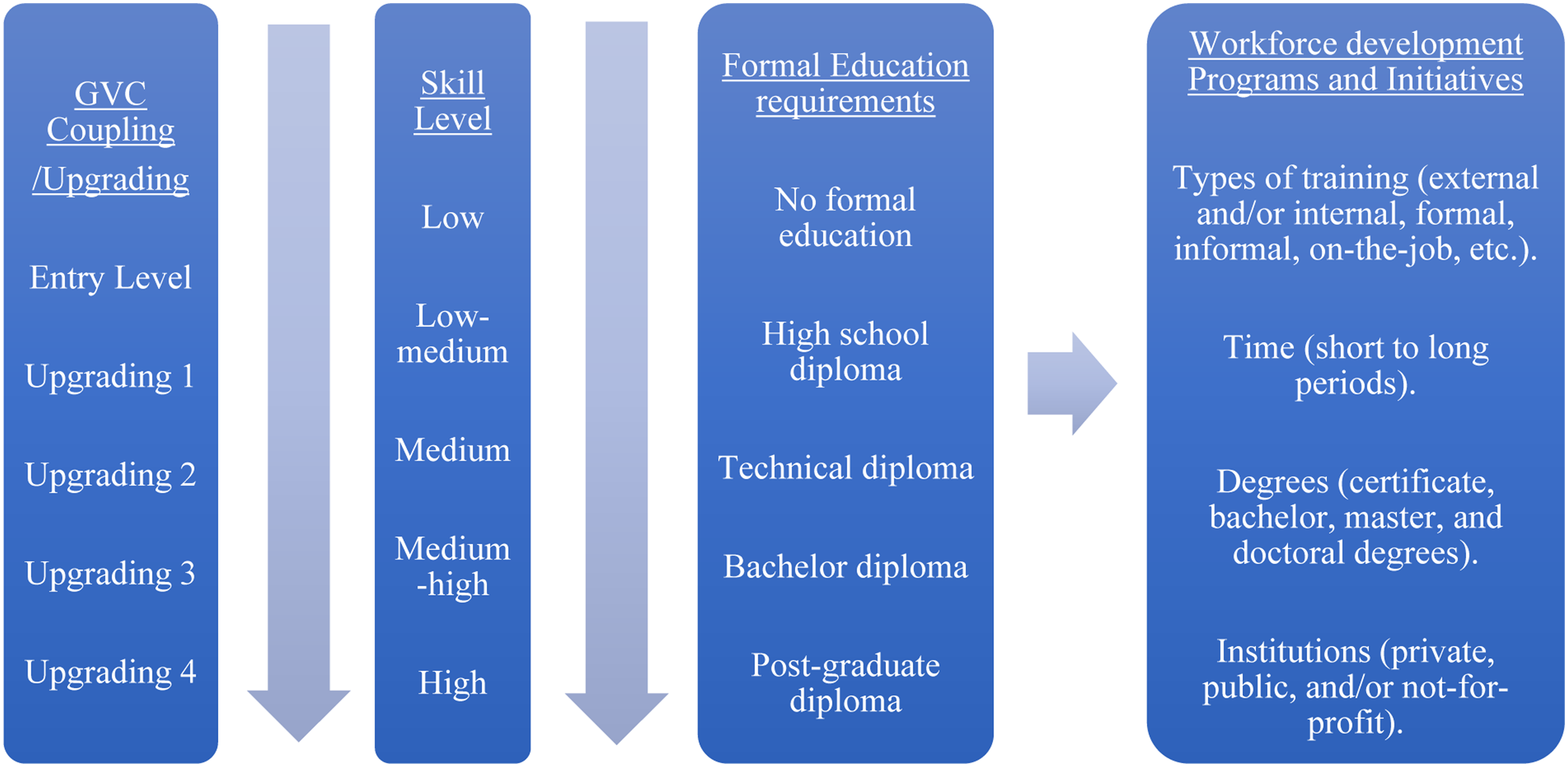
Although the mainstream GVC approach is important, I argue it is problematic for three main reasons. First, the GVC approach to workforce development systems is based on a firm-centric approach. While in the last decade GVC scholars have given more attention to institutions and other actors, mainstream GVC literature still focuses on firms’ relations, overlooking other non-firm actors and broader social, political, and economic conjunctures (Coe and Yeung, 2015; Horner and Alford, 2019). This is the case here, where mainstream GVC literature pays attention only to the realm of firms, mostly addressing workforce development when such initiatives are explicitly related to processes of upgrading, or when provided by firms such as buyers and suppliers, and when related to MNCs’ in-house-training and workforce development strategies (see Chin and Liu, 2014; De Vries et al., 2016; Fernandez-Stark and Bamber, 2018; Gereffi and Fernandez-Stark, 2011).
Second, inspired by human capital theory, the GVC approach offers a narrow view of labor as a simple commodity and of the labor market as self-regulated solely by market relations. Therefore, skills are a result of firms’ demands and naturally self-regulated via workforce development systems according to their demand in the labor market. The demand and supply of skills take place in an institutional vacuum, absent of broader power relations, and detached from any extra-market process (see for example Chin and Liu, 2014; De Vries et al., 2016; Fernandez-Stark and Bamber, 2018; Gereffi and Fernandez-Stark, 2011; Psilos and Gereffi, 2011). However, skills and labor supply are independent of demand, being a product of extra-market processes such as demographic, socio-economic processes, institutional rules of human reproductive activity, and the sphere of reproduction (Peck, 1996; Storper and Walker, 1989; Werner, 2016). Therefore, the market is incapable of reaching equilibrium between the supply and demand of skills solely via wage mechanisms. Consequently, capitalists are required to influence skill formation by directing place-based initiatives according to their skill needs and agenda (Coe and Kelly, 2002; Jonas, 1996; Rikowski, 2004; Slaughter and Rhoades, 2010).
Grounded in human capital theory and a firm-centric perspective, the GVC approach decontextualizes how skills and workforce development initiatives are socially formed, retained, and defined beyond market mechanisms through hierarchical power relations, often via local forms of labor market governance in which actions/strategies of influential non-firm actors are important (see Bair and Werner, 2015; Coe, 2015; Gutelius, 2016; Werner, 2016). This approach also neglects how the impact of value chains on skill formation involves not only the sphere of production (e.g., the skill needs of firms in value chains) but also the sphere of reproduction (see Bair and Werner, 2015; Coe, 2015; Fitzgerald et al., 2013; Gutelius, 2016; Selwyn, 2016; Werner, 2016). As some scholars have discussed, workforce development is not a mechanism of equal opportunity but often advances social inequality based on attributes such as class, race, gender, ethnicity, and immigrant status (Bair and Werner, 2015; Coe, 2015; Fitzgerald et al., 2013; Gutelius, 2016; Werner, 2016).
Third, the GVC approach neglects the negative impact of production networks on workforce development systems and its relation to uneven development. The Duke CGGC approach equalizes skills development with social upgrading and labor empowerment. For example, Fernandez-Stark and Bamber (2018) claim that “[…] skills development takes a central role […] empowering workers through knowledge development to access higher-paying jobs with better working conditions.” (Fernandez-Stark and Bamber, 2018: 70). Global Value Chains studies often stress the positive impact of production networks by demonstrating its importance for upgrading human capital and firms’ production, for territorial embeddedness, and for attracting foreign direct investors (Kleibert, 2015). However, there are studies within the GPN literature showing that production networks impact skills and foster workforce development initiatives in negative ways (e.g., advancing issues around inequality, exclusion, labor segmentation, and the gendering of skills) through processes of upgrading and strategic coupling (see Kleibert, 2015; Noronha and D’Cruz, 2020; Teixeira, 2019; Werner, 2016).
Primarily focusing on the positive impact of production networks on regions is a general feature of the GVC and GPN literature. As many scholars have claimed, the “dark side” of the impact production networks have on regions is underexplored (Murphy, 2019; Phelps et al., 2018; Yeung, 2021). This has prompted more research into disarticulations, that is, to examine the exclusionary development outcomes fostered by production networks (Murphy, 2019; Werner, 2016). As Murphy (2019) stated, there is a need to go beyond the GVC/GPN firm-centric approach, which privileges firms at the expense of understanding the role of non-firm actors and factors (e.g., regional contexts and political economy). In this context, GVC studies of workforce development fit this profile, where its mainstream approach has not considered how it relates to uneven development practices and broader actors and contexts.
These issues point to the need for an alternative approach (and thus, research agenda) to examine the impact of production networks on skills and workforce development systems. Such an approach needs to go beyond current firm-centric analyses based on market relations as well as to consider issues related to uneven development. Therefore, this article elaborates an approach more sensitive to these issues in the next section and proposes a research agenda. First, workforce development systems will be conceptualized as regional training systems (RTSs). Second, I will develop a broader and more nuanced approach to examining the impact of production networks on skills development in terms of uneven development. To do so, this article engages with four bodies of literature/studies: Local labor control regime studies, which are adopted to conceptualize RTSs as socially and institutional regulated, and part of broader dynamics of accumulation and uneven development; GPN literature, which provides an analytical framework, through the concepts of strategic coupling and upgrading, to understand the power relations involved in the impact of value chains on training; critical pedagogy, which gives an in-depth understanding of the relationship between education, gender, and class; and variegated capitalism, which allows this approach to capture how RTSs vary and are part of broader models of development and national skill formation systems. Figure 2 introduces the major theoretical elements of the approach proposed in this article as well as their related bodies of literature. It also presents its suggested research agenda, where three topics are stressed according to their relationship to uneven development. Approach and research agenda proposed to examine the impact of Global Production Networks on Regional Trainings Systems. Source: Author.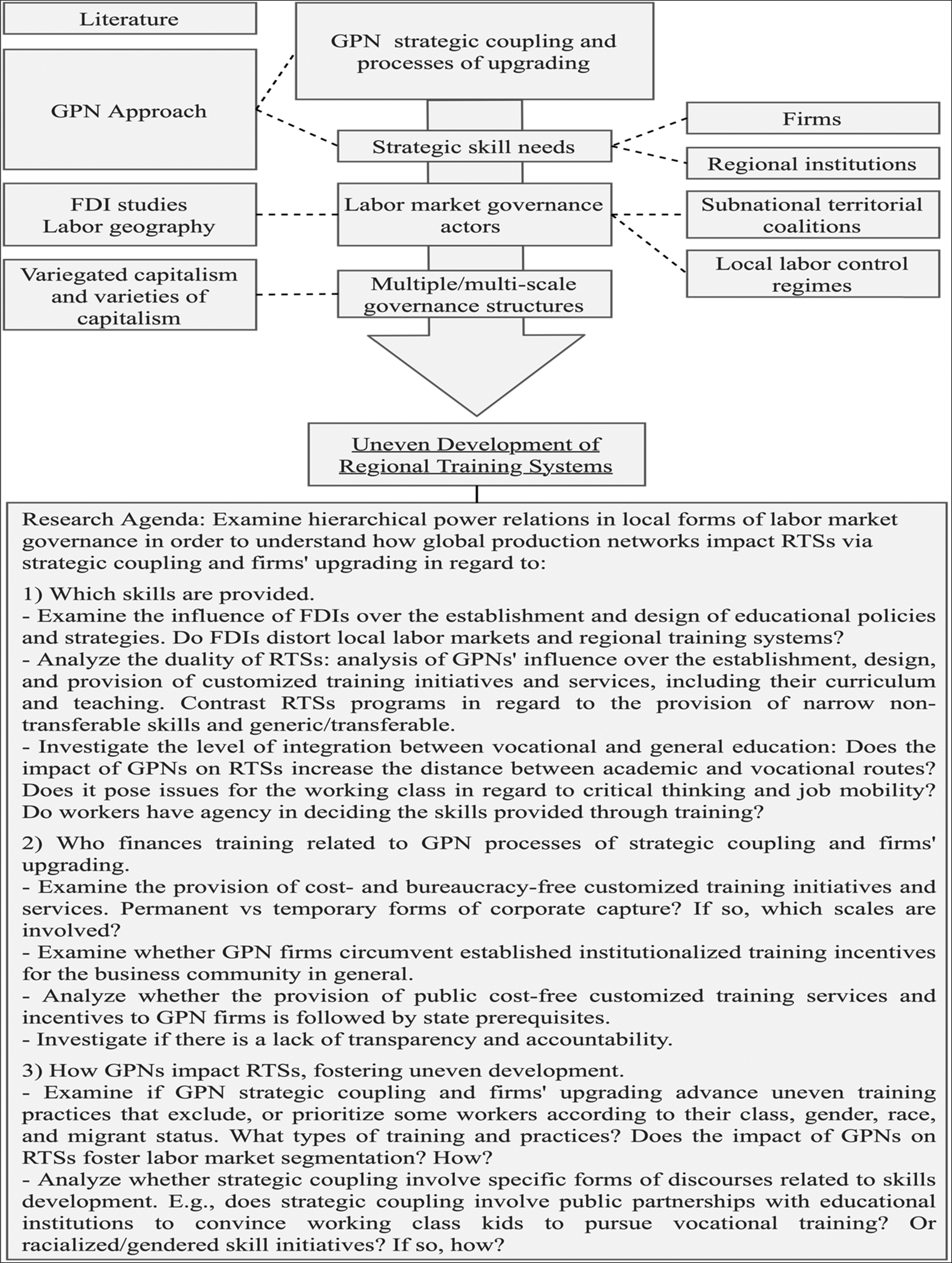
III Theorizing regional training systems and value chains’ impact on skills
In contrast to the GVC approach, this article does not conceptualize RTSs as a simple outcome of self-regulated market relations. Instead, they are considered a process that is a part of broader dynamics of accumulation and uneven development, and as territorially embedded and institutionally regulated via local forms of labor market governance (Jonas, 1996; Martin, 2010; Peck, 1996).
Recently, GPN scholars have increasingly engaged with labor regime studies to examine how production networks affect such regimes (Anner, 2015; Baglioni, 2018; Pattenden, 2016; Smith et al., 2018). For such studies, capitalism is naturally contradictory because capital and labor interact based on an intrinsic antagonistic relationship: Capitalists want to increase surplus value by maximizing productivity while minimizing cost (e.g., reducing workers’ remuneration). In response to a relentless drive to accumulate, workers (as individuals and a collective body) comply with or resist their working conditions (Baglioni, 2018; Pattenden, 2016). In the context of unequal exchange, capitalists develop multidimensional strategies of labor control (within and outside firms) to ensure stability and accumulation (Baglioni, 2018; Jonas, 1996; Pattenden, 2016; Smith et al., 2018).
At the regional level, to maintain workers satisfaction and limit local struggles and instabilities, capitalists must develop place-based labor control regimes, which expand their influence to the locality by fostering local labor market reciprocities between production, consumption and reproduction (Jonas, 1996). Local labor control regimes can be defined as historical, cultural, and spatial processes that (1) smooth the transition of labor from the labor market to the site of production, (2) reproduce productive labor, (3) coordinate conditions of pay and consumption, (4) and facilitate conditions of accumulation (Jonas 1996). Therefore, local labor control regimes encourage the participation of workers in production and influence the conditions under which labor power is produced and integrated into the labor process (Jonas, 1996; see also Baglioni, 2018).
Adopting this perspective, this article approaches RTSs as a mechanism to reproduce productive labor and smooth the transition of labor from labor markets to production sites. RTSs, therefore, can be described as institutional assemblages composed of national, sectoral, and place-based informal and formal educational and training practices, initiatives and programs, policies, strategies, and discourses. They operate to recruit, commodify, discipline and socially produce employable and exploitable desired workers according to the skill needs of employers (i.e., labor power attributes such as technical skills and personality traits within a worker as defined by Rikowski (2000, 2004). These dynamics do not consider workers as universal individuals detached from their gender, race, ethnicity, and class—as the GVC approach assumes—but built upon such features, enhancing labor market segmentation and uneven development (Yeung, 2002).
To advance these dynamics, businesses become involved with local actors to advance discourses related to skills, and their training needs and agenda by influencing educational institutions, the state, not-for-profit institutions, and unions (Kleibert, 2015). As stated before, markets fail to reach skill supply/demand equilibrium via wages (providing the “right skills” to capital) due to skills being a product of extra-market conditions or due to the short-term demand for certain skills. Due to this, RTSs must be socially and institutionally regulated via local forms of labor market governance (Baglioni, 2018; Jonas, 1996; Peck, 1996). Under the labor control regimes perspective, the impact of production networks on RTSs is not solely the result of market supply and demand of skills. It is also the result of broader dynamics related to the contradictory nature of capitalism and uneven hierarchical power relations and discourses. To explore the ways through which production networks impact RTSs via local forms of labor market governance, this article focuses on two main processes: Strategic coupling and upgrading.
Strategic coupling refers to the “dynamic processes through which actors in cities and/or regions coordinate, mediate, and arbitrage strategic interests between local actors and their counterparts in the global economy” 4 (Yeung, 2009: 213). This article approaches the impact of production networks on RTSs through Dawley et al. (2019:853) conceptualization of strategic coupling, which approaches the “[…] dynamics of strategic coupling from a host perspective […]”. According to Dawley et al. (2019), strategic coupling should be approached as strategic, requiring intentional actions from GPN actors and regional institutions; involving territorial coalitions of actors; and an interplay between horizontal firm networks and vertical structures of governance that connect the subnational, national and global scales.
First, according to Kleibert (2015), firms in GPNs engage with local, territorial coalitions to shape RTSs based on their strategic needs. Skills are based upon their recognition of problems related to state educational systems/policies and education-labor market mismatches within the regions into which they are being plugged. Firms in GPNs also shape RTSs based on their strategic need to reduce internal training costs by externalizing training to public institutions and retaining a large pool of skilled workers, which impede a talent war and an escalation of wages (Kleibert, 2015). Moreover, as the value of a commodity is based on the socially necessary labor time taken to produce it (Marx, 1867), schooling and training play a crucial role in GPNs’ competitive strategies, given that changes in skills and productivity allow firms to minimize costs with internal training 5 , to produce commodities at a lower value, and sell them at a lower-than-average price of the market (see Rikowski, 2000). Schooling and training can also positively impact the quality of the commodities produced by workers, making firms even more competitive (Rikowski, 2004; Slaughter and Rhoades, 2010).
These strategic skill needs and the consequent impact on RTSs are also related to processes of economic upgrading (Barrientos et al., 2016). While processes of strategic coupling often require the commodification of workers with new sets of skills, economic upgrading requires new skills based upon how firms are able to move from lower- to higher-value activities (Barrientos et al., 2010). For example, process upgrading can be marked by automation and a reduction of skilled workers and training programs; product upgrading often requires more skilled workers; functional upgrading (activities with higher value-added) requires skilled workers with new sets of capabilities; finally, chain upgrading, which involves moving to new industries or product markets, also requires new sets of skills (Barrientos et al., 2010).
Regional institutions 6 also have strategic needs and interests. State managers view GPN firms’ impact on RTSs as an opportunity to make their regions more attractive to foster strategic coupling due to a skilled workforce or by developing and employing their local workforce in opposition to firms hiring out-of-state workers (Teixeira, 2019). Moreover, educational institutions also have their own strategic needs and seek to advance initiatives via local forms of labor market governance that can maximize their profits/success and keep their programs/initiatives functioning, for example, by receiving information regarding the skill needs of firms, which can be used to develop their training programs and initiatives (Teixeira, 2019).
Second, as Dawley et al. (2019) stated, the impact of strategic coupling on regions should also be understood as involving territorial coalitions of actors. This article suggests approaching the impact of GPN firms on RTSs based upon the concept of subnational territorial coalitions. The concept of subnational territorial coalitions explores how governance actors 7 act as coordinators, or mediators, on behalf of inward investors with local actors (Phelps and Wood, 2006). Key local actors interact to visualize their region and its relation to the world, to produce and transmit ideas about regional development, to establish growth coalitions, and to foster related initiatives (Dawley et al., 2019; Phelps and Wood, 2006; see also Lovering, 2011). Jonathan Davies (2011) adds that such interactions are contradictory and hierarchical. The interests of local fractions of capital are often in opposition to other actors’ interests, especially via state intervention (Davies, 2011; see Phelps, 2000). Therefore, territorial coalitions are responsible for creating strategic couplings by fostering initiatives according to the strategic needs of firms (Dawley et al., 2019) without losing sight of their interests.
The impact of GPN firms on RTSs can be examined as an outcome of the interplay between firms and regional institutions instead of a self-regulated labor market, as the GVC approach claims. At the regional level, this can shed light on the dynamics through which the material and ideological skill and training needs/interests of production networks are transmitted to local institutions through processes of strategic coupling and firms’ upgrading. At the firm level, it explores the interplay between GPN firms and institutions at multiple scales or the ways that firms interact with the state, educational institutions, not-for-profit organizations, and unions to establish industry-academe linkages and shape RTSs. In this regard, Kleibert (2015) examines how the impact of GPNs on RTSs happens through different forms such as influencing curriculum development of educational institutions’ programs, engaging with educational institutions through ambassador programs, and by facilitating continuum education towards specific skills (e.g., incentives like scholarships; Kleibert, 2015). Teixeira (2019) discusses that GPN firms also establish linkages with the state in order to receive cost-free customized training or tax incentives.
Third, as Dawley et al. (2019) observe, the impact of GPNs on regions via strategic coupling is characterized by the interplay of horizontal firm networks and vertical structures of governance at multiple scales. In regard to horizontal firm networks, the impact of GPNs on RTSs is influenced by firms’ types of corporate governance, and the sectoral specialization of firms because these result in different types of skill needs and routes of skills development. GPNs are characterized by several activities along the chain that require a mix of low-skilled and labor-intensive activities with higher-skilled activities, which are more technology- and knowledge-intensive (Barrientos et al., 2010). Hierarchical corporate governance arrangements can confine plants in certain regions to lower value-added tasks within the wider value chain (Dawley et al., 2019). Firms at the lower-end of the chain often employ a less skilled workforce, and therefore, can influence RTSs to develop lower-end routes of skills development (Kleibert, 2015). For example, offshore service firms in the Philippines are located in the lower-end of the chain (call centers), locking in its RTS to a lower-end skill route production for routine job tasks (Kleibert, 2015).
Concerning the vertical multi-scale structures of governance, Dawley et al. (2019) discuss the multiple scales through which governance structures operate to advance strategic coupling processes. This article also emphasizes considering RTSs and the impact of production networks as part of multiple forms of governance structures. Through the variegated capitalism rubric, scholars have examined how under capitalism and inside national states, industrial expansion occurs through uneven development that is reinforced by unequal distribution of resources and linkages to the outside world (Peck and Theodore, 2007; Zhang and Peck, 2016; see also Brenner, 2003). Uneven development results in varying regional models of development within national states. Schröder and Voelzkow (2016) add that subnational variances stem not only from their national structure (unitary/federalist) but also from the interplay between national, sectoral, and regional forms of governance. According to the authors, firms competing in the world market search for regional economies that offer an optimal regulation to their activities, which varies according to each sector. Consequently, regions with specific industrial clusters have sought to offer an optimal regulation of their sectors in order to attract and develop firms. Their models of development are often structured around such needs. Thus, it is not uncommon for regions to deviate from their national governance when national regulation challenges their sectors (Schröder and Voelzkow, 2016).
Under the variegated capitalism perspective, this article examines the impact of production networks on RTSs according to how processes of “optimization” of RTSs are part of broader regional models of development and national skill formation systems 8 . To compete in the world market, shaping RTSs to attend to the interests of firms is crucial, which can lead to divergent training practices within RTSs. Deviations happen especially when national skill formation systems are unable to attend to sectoral skills needs of firms in specialized regions, requiring the development of deviant regional training practices, initiatives, and agendas. For example, while the USA skill formation system is marked by a general education system that delivers generic educational qualifications (see Emmenegger and Seitzl, 2018), the state of South Carolina has established a deviant RTS based on its regional model of development (accumulation via the attraction of manufacturing FDIs) where customized and vocational training programs and initiatives are strong components (Teixeira, 2019). Therefore, it is recommended to approach RTSs and the impact of production networks as being shaped by broader multi-scale governance structures and actors.
To conclude, the present article seeks to break with the GVC mainstream firm-centric approach to workforce development systems based on market relations. First, RTSs are conceptualized as part of broader dynamics of accumulation and uneven development, that is, as a crucial mechanism of local labor control regimes, whose goal is to reproduce productive labor and smooth their transition from labor markets to the sites of production. Second, it is suggested that RTSs are required to be socially and institutionally regulated via local forms of labor market governance due to the ways in which labor markets are incapable of effectively regulating the supply and demand of skills. To examine the impact of production networks on RTSs, I suggest an analytical focus on two processes, strategic coupling and upgrading, and an approach that considers three main features within such dynamics: the strategic needs of GPN actors and regional institutions; the local labor market governance of regions as territorial coalitions; and the multi-scale interplay between firms’ horizontal networks and regions’ multiple forms of governance structures.
Therefore, in contrast to the GVC approach, this approach considers how skills are socially formed by broader hierarchical power relations and governance structures at multiple scales through which production networks shape RTSs (see Fitzgerald et al., 2013). Moreover, such an approach acknowledges how production networks foster uneven training practices in workforce development systems related to features such as gender, race, ethnicity, and class. In this regard, in the next three subsections, this article expands upon the proposed approach by discussing how focus should be placed on issues related to corporate power and uneven development. To do so, in the following three subsections, this article builds upon FDI studies and the varieties of capitalism (VOC) approach to skill formation systems, which will be adapted to the regional level and in relation to the impact of production networks on RTSs (see Emmenegger and Seitzl, 2018; Busemeyer and Trampusch, 2012).
1 The impact of GPNs on regional educational strategies and skills provision
In the last decades, educational institutions and state educational agendas have been tied to regional economic development strategies, becoming increasingly integrated (Baltodano, 2012; Beder et al., 2009; Lakes and Carter, 2009). According to the VOC literature, one key aspect of the uneven power relations among actors in local forms of labor market governance is to shape which skills should be provided in RTSs (see Busemeyer and Trampusch, 2012; Emmenegger and Seitzl, 2018). This article suggests that studies examine how GPN firms—in the context of processes of strategic coupling and upgrading—influence the establishment and design of state educational/vocational policies and strategies and the provision of skills (e.g., programs, courses, and training initiatives). Research should go beyond describing how upgrading and strategic coupling shape RTSs by demanding certain skills, focusing on the hierarchical power relations in local forms of labor market governance. Specifically, studies should pay attention to whether the influence of GPNs on RTSs results in corporate capture (Phelps, 2008), a process by which firms exercise control over local forms of governance, advancing their interests and distorting local public skills agendas and strategies (see Dawley, 2007; Pavlínek, 2018; Phelps, 2000, 2008; Phelps and Fuller, 2001). This article proposes addressing such distortions according to the degree of duality of RTSs.
While states and workers are interested in having transferable skills, single global firms are interested in influencing RTSs to provide narrow skills, attending mostly to their needs and reducing training time and costs. Educational institutions thus encounter this twofold interest (Holborow, 2012); to maximize their profits/success and maintain their programs/initiatives’ functioning, they must attend to the interests of fractions of capital and single global firms by offering highly customized curriculums and courses around their interests as well as to the interests of the local business community through generic types of training based on industry assessments.
Generic and customized skill provision is established according to how educational institutions access labor market needs, the power of firms and workers’ representatives to represent their needs, and the form of the state/governance in which it takes place (Emmenegger and Seitzl, 2018; Rutherford, 2006). Representation of firms’ interests to the state and governance actors is unavoidably uneven; thus major FDIs have more opportunities than local business communities to advance training strategies (Phelps et al., 2005; Rutherford, 2006). Such a specificity results in some RTSs being characterized as dual training systems, which refer to how regions develop general workforce development training practices (occupational skills) in conjunction with firm-specific skills 9 training practices (see Emmenegger and Seitzl, 2018; Phelps et al., 2005; Thelen and Busemeyer, 2012). Currently, there is a neoliberal tendency towards building customized 10 training programs in partnership with firms. These are built not only as part of incentives packages to foster strategic coupling but also as permanent programs for firms embedded in certain regions to support upgrading (see Andrade et al., 2005; Long, 2009). In this regard, studies of how GPNs impact RTSs should pay attention to whether GPN firms broaden the degree of duality, distorting regional skills agendas and strategies in relation to local business communities.
However, firm-specific training has significant implications not only for local business communities, who can face skill gaps and poaching but also for workers. Attention, therefore, has also to be given to the conflict of interests around training between GPN firms and the working class in local forms of labor market governance. Firms are interested not only in having educational institutions providing narrow firm-specific skills—given that they increase productivity and production quality and decrease costs—but also in fewer general skills because they broaden workers’ outside opportunities and push firms to pay higher salaries. Workers, however, are interested in firm-specific and generic skills training, which have wider transferability across firms and industries and sectoral mobility (Emmenegger et al., 2018; Smits, 2007). For example, firm-specific training prioritizes the needs of firms and results in limited mobility for workers, who undergo wage losses when switching industries due to non-transferable skills (Beder et al., 2009; Müller and Schweri, 2015; Nylund, 2012; Smits, 2007).
Additionally, studies should examine whether GPNs' impact on training strategies and initiatives broadens the distance between academic and vocational routes. Vocational training focuses on the mismatch between what employers need and what students learn, considering critical thinking irrelevant. Nonetheless, this type of knowledge is important for individuals in subordinated positions and raises the question of who has the power to determine what relevant knowledge is (Beder et al., 2009; Nylund, 2012). In general, customized training provides skills that are narrow and detached from general academic education, and overall, does not provide the opportunity for continuum education from vocational training certification to academic education (Smits, 2007).
2 Who finances training?
According to VOC scholars, labor market governance is also marked by power relations that seek to influence and determine who will finance training. Although these decisions are heavily decided at the national level (see Emmenegger and Seitzl, 2018), at the regional level, fractions of capital and global firms are interested in influencing state and educational institutions to establish, shape, and receive cost- and bureaucracy-free customized training programs and initiatives (Dawley, 2007; Markusen and Nesse, 2007). Therefore, attention should also be given to how firms inserted in GPNs influence state managers and educational institutions. This involves examining the emergence and functioning of existing customized training programs and other practices such as the cost-free provision of instructors, training grants, reimbursement of companies’ costs for workers’ training, travel funding to get training in other plants, and the free use of institutional apparatuses of educational institutions for employers to have their employees trained.
This article proposes examining the impact of GPNs on RTSs according to two types of customized training initiatives: Temporary 11 and permanent (Teixeira, 2019). Temporary customized training programs refer to how states provide customized training initiatives to strategically couple their regions with global firms. In general, this happens when regions bargain incentive packages with firms to foster structural coupling via FDIs. This is momentary and exists until states train the number of workers established in the negotiations with firms. In contrast, permanent customized training denotes how firms, state managers, and educational institutions foster customized training programs and initiatives intended to last as long as companies and educational institutions are mutually interested (Teixeira, 2019). Permanent customized training programs and initiatives serve as assets to advance strategic coupling and to support territorial embeddedness and upgrading via skills provision (see Andrade et al., 2005; Dawley, 2007; Pavlínek, 2018; Phelps, 2000, 2008; Phelps and Fuller, 2001; Teixeira, 2019).
Attention to how firms in GPNs impact and receive cost- and bureaucracy-free customized training should also be expanded to two other processes: How firms circumvent national and regional juridical forms and whether the provision of state training subsidies and incentives fosters social upgrading. Capitalism demands the existence of a juridical form based on the principle of universality of law and equality of subjects. However, this fosters the false ideology that all individuals are equals, such as capitalists and the working class, with the same rights under the law (Clarke, 1991; Hirsch, 2010; Poulantzas, 2000). Regions, by law, equalize firms by providing institutionalized plans of incentives/subsidies according to the amount of the firms’ investment and the specification of the jobs they will potentially generate. However, global firms often circumvent institutionalized plans by receiving training incentives/subsidies above the established parameters, to which the local business community has no access (see Phelps et al., 2005). In this way, it is suggested that an approach to how GPNs impact RTSs should also focus on how GPN firms influence the state and educational institutions via labor market forms of governance to receive more training incentives and subsidies than their regional institutionalized training incentive plans.
Regarding social upgrading, it is well known that firms are open to opportunism, for example, they can inflate the number of jobs and benefits they bring to regions (Alfaro and Chauvin, 2016; Phelps, 2008; Weber, 2002). As the provision of state subsidies and incentives often involves an expected return from firms (e.g., creation of jobs), there is a need to analyze whether the provision of public cost-free customized training services and incentives to firms are accompanied by state prerequisites. Does the state demand GPN firms hire locals, provide competitive wages, have career plans, be gender, race, and ethnically inclusive, and offer benefits for workers in exchange for the cost- and bureaucracy-free training incentives they receive? If so, what are the levels of transparency and accountability in relation to such initiatives?
3 How the skill demand of GPNs fosters segmentation and inequalities through regional training systems
The GVC approach to workforce development decontextualizes skills and workforce development initiatives and neglects the negative impact of production networks on RTSs (Fitzgerald et al., 2013; Gutelius, 2016; Selwyn, 2016). Therefore, the present approach suggests directing attention to how processes of strategic coupling and firms’ upgrading foster uneven training practices marked by issues around class, gender, race, immigration status, and ethnicity, and thus, different forms of labor segmentation. This article adopts a relational conception of class according to three factors: (1) ownership of the means of production, (2) authority, and (3) skills and expertise (Wright, 1997). In relation to authority, labor positions with higher remuneration and power over other workers are tied to the interests of the capitalist class. Regarding skills and expertise, labor can have higher salaries and more autonomy over their work and co-workers, resulting in closer proximity to the capitalist class. This means that positions with greater authority, skills, and expertise are more prone to be influenced by capitalist interests (Nylund, 2012; Wright, 1997).
Neo-Marxist theorists engaged with critical pedagogy literature have contributed significantly to understanding the role of education in our society, specifically concerning how schools encourage working-class students into working-class jobs (see Bowles and Gintis, 1976; Giroux, 1980; Reay, 2018; Willis, 1977). Criticizing the prevailing US view of human capital theory, which claims that success is based on educational merit (e.g., degrees, years of education), these theorists have revealed how working-class people receive a less and poorer quality education. In general, they also occupy the least remunerative and lowest status positions normally geared towards basic and vocational preparation (Bowles and Gintis, 1976; Giroux, 1980; Levin, 1987; Willis, 1977). Advancing the argument by Bowles and Gintis (1976), labor market segmentation studies have demonstrated how production and education are characterized by patterns of segmentation and territorial segregation based on income, race, gender, ethnicity, migrants, and disabilities (see Bair and Werner, 2015; Coe 2015; Fitzgerald et al., 2013; Jonas, 1996; Peck, 1996; Smith et al., 2018). For example, Estévez-Abe (2012) reveals how the dual apprenticeship training model of the German collective skill formation system has obstacles for women due to risks of becoming unemployed after family-induced breaks in their career, potential loss of skill investment if they decide to leave the workforce (Estévez-Abe, 2012; Streeck, 2012). Several GPN studies have also exposed how GPNs can foster patterns of labor segmentation. For example, Smith et al. (2018) examined how the process of strategic coupling of Moldovan clothing firms into the garment GPN led production to be based on low-wage female workers to produce more competitive products.
Such labor market segmentation analyses point to the need to explore whether the impact of GPNs on RTSs via local forms of labor market governance and internal training results in unequal training practices, advancing labor market segmentation and uneven development (see Fitzgerald et al., 2013; Selwyn, 2016; Werner, 2016). While some of the studies outlined above have been criticized for their functionalist account (e.g., Bowles and Gintis, 1976; Levin, 1987), in this article, labor is approached as an active agent (see Coe, 2015). Following such a perspective, studies regarding the impact of GPNs on RTSs should also pay particular attention to how RTSs may support actions by labor to reshape power relations in GPNs. For example, Underhill et al. (2020) discuss how unions and community groups have developed place-based informal educational and training initiatives in Australian horticultural GPNs to instruct migrant workers about employment conditions and their rights.
Strategic coupling and firms’ upgrading often require the formation of an employable and exploitable workforce (Selwyn, 2016). Do the skill needs, productive labor process, and workforce development strategies of firms in GPNs foster training initiatives and practices at RTSs that exclude some workers due to their gender, race, or class? Are the skill needs and consequent training initiatives of GPN firms an opportunity for workers to move up the job chain via the acquisition of new skills? Or do processes of strategic coupling and upgrading result in regions providing training initiatives that advance unequal class relations and labor segmentation? What are the discourses and practices around such training dynamics? And how do workers and their representatives respond to training inequalities or use training initiatives to overcome, for example, poor employment conditions?
For example, Teixeira (2019) analyzes the strategic coupling of the aerospace production network in Charleston, South Carolina, USA, and its impact on Charleston’s RTS. The author explored the strategic needs of aerospace firms and regional institutions, Charleston’s territorial coalition, and South Carolina’s model of development in order to examine the impact of the Boeing production network on Charleston RTS. According to the author, Charleston’s territorial coalition has sought to convince high schoolers in low-income working-class neighborhoods to pursue vocational STEM careers. This initiative seeks to attend to the strategic needs of aerospace firms for low-cost and skilled workers, which is also part of its broader model of development (i.e., accumulation via structural coupling with manufacturing fractions of capital). Teixeira (2019) further reveals how the impact of firms—within the aerospace production network—on Charleston’s RTS resulted in a deviant form of training system when compared to its national skill formation, focused much more on vocational and cost-free public customized training initiatives and apprenticeships. Moreover, such public cost-free customized training initiatives lack state accountability and transparency, serving as channels of precarious types of work (Teixeira, 2019).
To conclude, education and training are characterized by uneven training practices that advance patterns of segmentation and territorial segregation. It suggested that studies regarding how GPNs impact RTSs should also address whether processes of strategic coupling and firms’ upgrading advance unequal class relations, inequality, gendering, and racialization of skills, and uneven training practices that excludes certain workers based on their class, race, gender, ethnicity or migrants’ status, aggravating labor segmentation.
IV Conclusion
As argued, the GVC perspective on how production networks impact workforce development systems is problematic. First, the GVC approach is based on a firm-centric approach to skills and disregards how the impact of production networks goes beyond firms, involving other actors and broader social, political, and economic conjunctures (Coe and Yeung, 2015; Horner and Alford, 2019). Its firm-centric analysis is a well-criticized aspect of GVC studies, where workforce development has mostly been addressed when initiatives are narrowly related to processes of upgrading and MNCs’ workforce development strategies and in-house training. Second, the GVC approach, inspired by human capital theory, is based on market relations as if the labor market were self-regulated solely by mechanisms of supply and demand. Arguing against such a view, it was discussed that GVC scholars disregard how workforce development systems are institutionally regulated and socially constructed via hierarchical power relations at multiple scales (Fitzgerald et al., 2013; Selwyn, 2016). Third, the GVC approach, due to its analytical limitations, is unable to consider how the impact of GVCs on workforce development systems fosters uneven training practices based on class, race, gender, and migrant status (Bair and Werner, 2015; Coe, 2015; Fitzgerald et al., 2013; Gutelius, 2016).
To address the perceived deficiencies of the GVC-based approach, this article engaged with literature from labor geography, critical pedagogy, variegated capitalism, and GPN studies, which can be placed under a geographical, political economy perspective. Regional training systems were conceptualized as a process that is a part of broader dynamics of accumulation and uneven development, or more specifically, as a crucial mechanism of local labor control regimes, a topic well developed within labor geography. As part of local labor control regimes, RTSs are a crucial mechanism to reproduce productive labor and to smooth the transition of labor from labor markets to the sites of production via dynamics of recruiting, commodifying, disciplining, and developing workers according to the skill needs of capitalists (Jonas, 1996; Peck, 1996). Moreover, as labor markets fail to reach skill supply/demand equilibrium via wages, this article discussed how RTSs are required to be territorially embedded and institutionally regulated via local forms of labor market governance (Baglioni, 2018; Jonas, 1996; Peck, 1996). Critical pedagogy enabled this article to demonstrate how such dynamics of recruiting, commodifying, disciplining, and developing workers are often built upon workers’ gender, race, ethnicity, and class, and therefore, advance uneven development (Bowles and Gintis, 1976; Giroux, 1980; Reay, 2018; Willis, 1977). Finally, engaging with the GPN literature, an approach was established, which gave analytical attention to strategic coupling and upgrading, and considered three main features within such dynamics: the strategic needs of GPN actors and regional institutions; the local labor market governance of regions as territorial coalitions (marked by hierarchical power relations); and the multi-scale interplay between firms’ horizontal networks and regions’ multiple forms of governance structures. By doing so, the proposed approach considers how skills are socially formed, retained, and defined by broader hierarchical power relations and governance structures at multiple scales through which production networks shape RTSs (see Fitzgerald et al., 2013). In this aspect, the variegated capitalism literature was useful to reveal how RTSs vary and are also shaped by broader models of development and their own national skill formation systems.
To explore the uneven impact of GPNs on RTSs, the article proposed an agenda that explores the hierarchical power relations in local forms of labor market governance with regard to three major dynamics: (1) the impact of GPNs on (and possible distortion of) RTSs’ educational policies, training strategies, and provision of skills; (2) the impact of GPNs on the establishment, design, and provision of cost- and bureaucracy-free training initiatives/services, on workers, and around issues related to transparency and accountability; (3) and how GPNs foster uneven training practices related to issues around class, gender, race, and immigration status.
By developing such an approach, this article theoretically contributes to economic geography research in general and the GPN literature. Concerning economic geography, this article contributes to broader discussions within the field, which seek to better understand the “[…] the social and developmental dynamics of contemporary capitalism at the global-local nexus.” (Bair, 2005:154). It does so by examining how corporate globalization shapes the decisions of local non-firm actors in relation to regional training systems, fostering processes of uneven development. Regarding the GPN literature, first, GPN scholars have not substantially advanced research that examines the impact of production networks on workforce development systems. Studies are scarce and primarily concerned with internal training practices (Kleibert, 2015; see Werner, 2016). Therefore, this article encourages more theoretical and empirical studies within the GVC and GPN literature with the goal of transcending existing firm-centric analyses based on market relations and skills mismatches, and training initiatives’ needs. Second, this article contributes to recent calls from GPN scholars regarding the need for more theoretical studies exploring the “dark side” of GPNs (Murphy, 2019; Phelps et al., 2018; Werner, 2016). As claimed, GVC studies have focused on the positive impact of production networks on workforce development systems. Therefore, by giving attention to issues of power and uneven development, this article contributes theoretically to the GPN literature by advancing studies on the exclusionary and uneven outcomes frequently fostered by GPNs, especially regarding their impact on RTSs. This article has begun to direct our attention to these issues and calls for more theoretical and empirical research.
Footnotes
Acknowledgments
I would like to thank Tod Rutherford for his comments on earlier drafts of this work. I am also grateful to Diana Morales and Laura Sariego-Kluge for their insights on the revisions. I also thank the editor and anonymous reviewers for their generous comments and suggestions, which helped to sharpen the argument. All errors and interpretations remain my own.
Declaration of conflicting interests
The author(s) declared no potential conflicts of interest with respect to the research, authorship, and/or publication of this article.
Funding
The author(s) received no financial support for the research, authorship, and/or publication of this article.
