



Abstract
In this study, I argue that attending to decolonial dimensions can add depth to studies of volume and capitalism more broadly. Bringing Black and Indigenous studies into conversation with the volume literature, I analyze several forms of dimension at work in the production of volume as a relational space that can incorporate, and exceed, 3D Cartesian grids. These are illustrated through an examination of the handling of shipping containers, an influential embodiment of gridded space that, given shipping’s dependence upon racialized labor and colonial extraction, are a key site for understanding how efforts to standardize and secure volume are entangled with global injustice.
This article brings the geographical literature on volume into conversation with work in Black studies and Indigenous studies in order to analyze an aspect of volume that has received less attention to date: the role of dimension. The Cartesian grid is widely accepted as perhaps the most dominant method for conceiving of spatial dimensions, such as when describing space as 2D or 3D. It is also factors in to colonial and anti-Black violence, from damaging constructions of Black and Brown people as less than human (da Silva, 2007; Wynter, 1994) to the colonial imposition of gridded space, such as land parcels or urban grids, as a means of erasing indigenous people and lands (Scott, 1998; Sharp, 2009). Yet the grid is far from the only method of producing space, and often Cartesian and other forms, practices, and varying conceptions of dimension exist alongside on another, both within dominant conceptions of space and within communities that have long resisted such conceptions (Chua, 2018; Chua et al., 2018; Cowen, 2014; Khalili, 2020). I thus call for more extensive consideration of the varied conceptions, practices, and forms of dimensionality at work in the reproduction of volumetric space. Given the dominant role of Cartesianism past and present, I argue that attending to decolonial dimensions adds necessary depth and resonance to studies of volume and capitalism more broadly.
The standardized spaces of shipping containers are one embodiment of a Cartesian grid. They therefore provide an important link between Cartesian dimensions and global injustice. As a project to rationalize and strategically depoliticize global capitalism (Cowen, 2014), logistics is one influential area where Cartesian grids have played a powerful role in the production of volumetric space in ways that have particularly destructive consequences for Black and Indigenous people (Figure 1). Yet even as it reinforces Cartesianism, logistics is also a site for innovating new dimensions for the spaces of global trade, and non-Cartesian spaces are not necessarily more egalitarian or just. I thus illustrate the potential of attending to dimensionality's varied implications through two examples of methods for planning the movement of shipping containers, to show how both Cartesian and non-Cartesian conceptions of dimension often coexist even in dominant practices. This extends the geographical literature on volume more concretely into the study of logistical technical practices, incorporating literature that sees volume as being relational and elemental (see especially Barry and Gambino, 2020) and space as a medium (Steinberg, 2013), while also being attuned to ongoing efforts to structure volumetric spaces in ways that further settler colonial and anti-Black violence (on shipping and ports, see Chua, 2018; De Lara, 2018). I thereby seek to enable greater engagement with dimension beyond the quantifiable and perpendicular while also, through the focus on logistics, engaging with the possibilities for decolonial dimensionalities in ways that are more than metaphorical. Workers tending to containers stowed on board the Edith Maersk container ship. Because the container size is standardized, the stacks of containers in effect form a Cartesian grid. Source: Maersk Line and Wikimedia: https://commons.wikimedia.org/wiki/File:Container_stack_on_Edith_Maersk_(7098374635).jpg. License: Creative Commons Attribution-Share Alike 2.0 Generic: https://creativecommons.org/licenses/by-sa/2.0/deed.en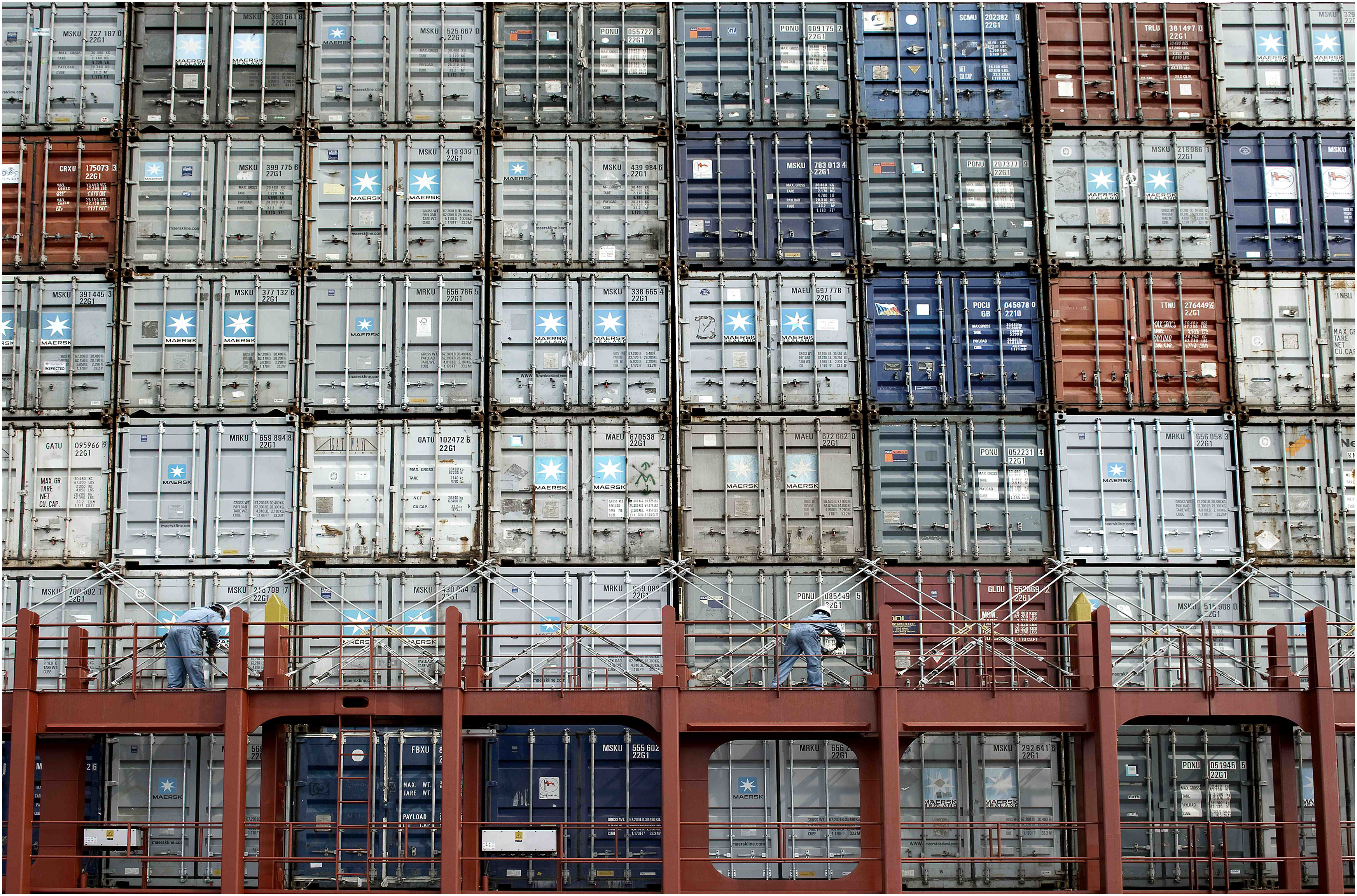
Existing studies of volume (Billé, 2019; Elden, 2013), depth (Peters, 2020; Steinberg and Peters, 2015) and verticality (Adey, 2010; Adey et al., 2013; Graham, 2016), incorporate a variety of empirical examples, including detailed examinations of cases such as underwater geographies (Peters, 2020; Squire, 2017), the subterranean (Graham, 2016; Melo Zurita and Munro, 2019), and security and military intervention by air (Adey et al., 2013; Campbell, 2019). These studies thereby have done considerable work in terms of reintroducing empirical depth to geography. Yet Cartesian coordinates and Euclidean space inform researchers’ intuitive conception of space, the present author included, such that researchers tend to automatically describe space with reference to a Cartesian grid. For example, this occurs when when space is called 3D or three-dimensional, where the number of dimensions is equal to the number of axes of a Cartesian grid (Leng, 2016; Stover and Weisstein, n.d.). This tendency towards the 3D is countered in more recent literature on volume, including approaches to elemental and relational volume, which explicitly rethink volume in order to incorporate the relatively freer flow of relations in the elemental. Even so, the 3D is such an influential notion that it surfaces even in texts that aim to situate or push past Cartesianism. Between structure and turbulence, here I contend that one way to move beyond the 3D is to more concertedly engage with what I’m calling dimension, or how space is conceived, practiced, and given form, and the effects of this (produced) systematicity on the ways that volume is relationally produced. Such efforts would benefit most expressly from further incorporation of the work of scholars who study the violence of Cartesianism in the everyday, particularly in Black studies, Indigenous studies, and the related decolonial literature that focuses on the lives and thought of people who identify as Black, Indigenous and/or People of Color, and who have developed practices for resisting rigid dimensionalities. Engaging with dimension allows researchers to more deeply and expansively attend to the reproduction of Cartesian forms and conceptions of space, while also further situating volumetric politics in relation to the legacies of enslavement and colonialism that are present within the ongoing and often violent efforts to systematize space under capitalism.
In what follows, I begin by examining the work of authors in the volume literature who point the way towards an analysis of dimensionality (Elden, 2013, 2021; Peters and Turner, 2018; Steinberg, 2013; Steinberg and Peters, 2015). I then move to the more recent work that has emphasized aspects of the elemental, including the agency of nonhumans, as well as the relationality of space. Here I bring these sources into conversation with a selection of authors from the vast and active literatures in Black Studies and Indigenous studies who, I argue, study space volumetrically but do so in ways that are attentive to dimensions of settler colonialism and white supremacy that have remained under-emphasized in the volume literature so far. Studying decolonial dimensions can help to deepen the volume literature’s engagement with politics in a critical, geopolitical sense, thereby more fully accounting for the ways that volumes may be produced as striated and uneven spaces–spaces that are made to be rigidly structured even if they need not necessarily be so. Studies of decolonial dimensions can also work in concert with the literature on relational space, for example through approaches to unevenness as a produced outcome of the multiple relations and perspectives that constitute any particular volume.
After considering the decolonial dimensions of volume, in the ensuing sections I work to illustrate the benefits of attending to dimensions by examining the alternative notions of dimension at work in two examples from container shipping: stowage planning and empty container repositioning. Container shipping is a vastly influential yet still largely invisible aspect of the reproduction and management of volumes of people, goods, and materials worldwide. It is an important arena for studying volume because one central goal of shipping is the physical displacement of large amounts of goods: moving volume is the industry’s literal goal. Although the focus of much logistics is still on the horizontal distribution of goods across the globe, the size of container ships and the sheer number of containers handled means that container logistics must reckon with more-than-horizontal volume at every move (Peters, 2020). Shipping is also a key site for the reproduction of settler colonial and anti-Black violence, as it is run by a highly racialized workforce operating in drastically restrictive conditions with little recourse. In addition, as an industry, shipping is central to the extraction of natural resources and reproduction of highly imbalanced trade relationships between countries and regions (Chua, 2018; Khalili, 2020).
The rationalization of logistics is one important avenue that serves to perpetuate such relations, among other reasons because it forecloses many openings for other practices and modes of thought (Cowen, 2014). Therefore, undoing the colonial and anti-Black reproduction of capitalist logistics requires engaging more explicitly with the ways this reproduction is presently systematized and unequally structured. This in turn requires incorporating the decolonial dimensions of existing logistical practices, the alternative modes that are present within the dominant logistical forms, modes that logistical professionals attempt to excise in their efforts to make logistics a fully efficient, rationalized, and technocratic space.
I Situated volume and decolonial depth
The geographical literature on volume has engaged with Cartesianism since its earliest days. Yet even so the volume literature has a somewhat uneven relationship to the concept of dimension more broadly, and Cartesianism in particular. The latter lurks implicitly in many texts, but has only sporadically been analyzed explicitly. In its initial incarnations, the volume literature sought to address the prevailing horizontalism in many fields by adding a third, vertical dimension. This helpfully complicates the traditional, two-dimensional view-from-above epitomized by modernist maps and charts (Castro-Gómez, 2005; Cosgrove, 2003; Haraway, 1988: 581; Mignolo, 2011). It also draws heavily on Cartesian coordinates, named for René Descartes, that identify a unique point in space with reference to its distance from one or more perpendicular axes. Many authors have thus engaged the volumetric by speaking of adding a “vertical axis” and opposing it to a “horizontal axis” and refer to volume as an aspect of “our three-dimensional world” (e.g., Graham, 2016: 13).
There are many benefits to such a 3D approach of adding a vertical axis to the horizontal. One benefit is that it is especially relevant to numerous cases, such as the high-rise skyscrapers that Graham (2016) analyzes where the 3D is an integral aspect of the perspectives of many of those involved. Yet Cartesianism is only one of innumerable ways to conceive of dimension, ways that also provide useful approaches to studying volume. Non-Cartesian dimensions have been taken up explicitly in mathematics, for example, in the study of fractals (e.g., Mandelbrot, 1983; Mandelbrot and Hudson, 2004) and network theory (e.g., Daqing et al., 2011). In geography, the notion of dimension is approached most directly in the geographical literature on topology and alternative mathematics (e.g., Elden, 2011; Lata and Minca, 2016; Martin and Secor, 2014; O’Sullivan et al., 2017). Yet such topological approaches are engaged with less extensively in the literature on volume perhaps because, as Graham and Hewitt (2013: 73) note, in places topological studies tend to privilege the horizontal and the surface layer even when discussing voluminous spaces. Graham and Hewitt thus helpfully call for a “fully volumetric” approach that avoids the tendency to horizontalize, and instead more concertedly “addresses the ways in which horizontal and vertical extensions, imaginaries, materialities, and lived practices intersect and mutually construct each other” (2013: 74).
Much of the recent literature has taken up the latter part of Graham and Hewitt’s call, incorporating materialities and practices while also, partly as a result, beginning to question the benefits of framing volume primarily in terms of the horizontal and vertical (e.g., Campbell, 2019) or above and below (e.g., Ballestero, 2019). I foresee dimensionality as being in kinship with such approaches since analysis of dimensionality may provide a transit between land, sea, and sky, a mode of finding affinities between different but related processes of “containerization,” in the sense of imposed Cartesianism. This is of relevance to relational approaches that attend to how volumetric space is itself situated, drawing on a number of scholars including Massey, whose conceptualization of place as collections of ways of delineating and conceiving space, or a “constellation of trajectories” (2005: 151–158) opens up avenues for studying places in ways that eschew a Cartesian grid. In a related vein, Stuart Elden, one scholar who has explicitly analyzed conceptions of dimension, notably encourages volume researchers to engage in “thinking angles,” and warns that “thinking merely straight up and down may blind us to different angles of approach, and the function of the oblique” (2013: 49). Elden also notes that Virilio “forces us to think of volume, in all its dimensions…and with all its orientations” (2013: 47). This approach involves “an entanglement of scales and materialities” (Billé, 2019, para. 2), and it has also been explored through both Elden’s work on terrain, where he notes that “terrain is itself a process” (Elden, 2021: 8), as well as Steinberg and Peters’s notion of the voluminous (Battaglia, 2020; Peters et al., 2018; Steinberg and Peters, 2015).
Additionally, Kimberley Peters and Jennifer Turner (2018) explicitly attend to Euclidean conceptions of volume, and they argue that studying Euclidean notions of space remain relevant because such notions continue to be employed in practice (see also Peters and Turner, 2015; Turner and Peters, 2016, 2017).
Peters and Turner also go beyond an additive view of dimension in their discussion of the notion of capacity, which is based in part on non-Euclidean elements such as a director’s judgment and institutional resources. In a similar vein, Weiqiang Lin points to non-Cartesian approaches to dimension in his study of air traffic management, including a safety regime that expresses “dimensions – as measured in required spacing between moving objects – in the negative, figuring them not as products of active observation, but compensations for what airspace planners cannot know” (2018: 42). As Lin shows, in such a regime the dimensions are understood to be relational in the sense that the space between planes is being actively created as the planes move apart, and destroyed when the planes move closer together, rather than being described relative to a fixed axis. Thus the planes are the originators of the space, rather than being merely located within it.
In addition to studies of air, work under the land and at sea has sought to push past the Cartesian grid. Gavin Bridge draws on Elden to examine the implications of subterranean depth in ways that are relevant to logistics, arguing for the study of volume as property, including “volume framed as a question of anticipating and securing flow” (2013: 57). Metaphors taken from fluid dynamics are an additional example, including turbulence (see Chua et al., 2018; Crampton, 2019); churning (Steinberg and Peters, 2015); the eddy (Richardson, 2019), spiral (Sur, 2019), and gyre (DeLoughrey, 2019). Studies that incorporate methodology, such as Helmreich’s (2008) examination of immersion and Campbell’s (2019) adaptation of Foucault’s milieu to work on verticality (see also Elden, 2021), also explicitly explore the “the role of ‘immersive’ methodologies in generating different perspectives” (Squire, 2017). Related research has also innovatively examined the implications of studying depth at sea (Peters, 2020; Steinberg, 2013; Steinberg and Peters, 2015). Of particular relevance to my examination of container shipping, Philip Steinberg and Kimberley Peters (2015) argue against thinking of volume solely in terms of horizontal strata or layers, and of conceiving of ocean in terms of land. Instead Peters shows how the shipping industry focuses “not just on movements ‘across’ the water, but through it” (Peters, 2020: 10, emphasis in original).
In addressing the horizontalism of topological studies, these relational approaches to volume nonetheless risk losing some of the dimensional specificity, as well as the alternative methods for conceiving of the shape of space, that are brought forward through engagement with topology. There is also a need to attend more thoroughly to the violence of dimension, both sublimated and explicit. Doing so requires attending to the expansive and intricate conceptions of space in fields like Black studies (such as Harney and Moten, 2013, 2021; King, 2019; Robinson, 2005; Sharpe, 2016; Wynter, 1994, 2007) and Indigenous studies, as well as related work in decolonial studies (such as Byrd, 2011; Escobar, 2008; King, 2019; Mignolo, 2011; Simpson, 2017). There are clear crossovers between these and the volume literature, in terms of the emphasis on how political relations are embodied and effected through volumetric materials such as bodies, land, and water. Yet in these related fields scholars also examine the social, geographical, and economic situatedness of volumetric beings in relation to race, gender, and indigeneity. They thereby add further texture to flatness in ways that are highly relevant for volumetric approaches.
1 Decolonial dimensions: Black studies and Indigenous studies
Several recent studies have examined the relationships between Black studies and Indigenous studies, emphasizing the need to avoid eliding the two while also finding ways to use them in concert. In the US, Jodi Byrd has noted scholar’s tendency to focus on racialization over and above settler colonialism (2011: xxvi), while Tiffany Lethabo King works to think Black diaspora studies’ innovations with respect to “oceanic and water metaphors” together with Native studies’ rethinking of land (2019: 4). Such work can contribute additional dimensions to analyses of volume that, as yet, remain understudied in the literature. Engaging with the volumetric aspects of Black studies and Indigenous studies also provides an opportunity to apply volume to the study of logistics, and specifically shipping containers, who embody both standardized Cartesian volume and the violences of global racial capitalism. Containers thus provide a unique site to work further with concerns across these literatures, given that containers’ embodied Cartesianism enfolds, but without collapsing, the foundational and ongoing violence of capitalism through colonialism both settler and circulatory (Bhambra, 2009, 2014) with the horrors of enslavement (Mount, 2015; Robinson, 2005; Williams, 2014).
Colonialism and enslavement, and the ongoing resistance to both, provide different but related challenges to the apparent regularity of capitalism and its accompanying Cartesianism. For scholars of Indigenous studies, resistance to settler colonialism is conceived in numerous ways, many of which involve a sense of what might be called deep positionality—positionality as rooted not in a cartesian point in gridded space, but rather as being enveloped in overlapping life worlds. Indeed, as Jodi Byrd notes, referring to indigenous peoples, “We remember what happened the last time the world was flat” (2011: xiv). Byrd turns to the conception of transit to emphasize the role of positionality in a globe that is increasingly presented as being flat or smooth, conceiving of transit as “to be in motion, to exist liminally in the ungrievable spaces of suspicion and unintelligibility…to be made to move” (2011: xv), arguing that indigenous scholars “can offer crucial new ways of conceptualizing an after to empire that does not reside within the obliteration of indigenous lives, resources, and lands” (2011: 228–229). Leanne Betasamosake Simpson is one such scholar who has explored the ongoing presence of the deep resonances of her own position. By examining what she and her community are already doing in the everyday, how different forms of life are already-existing and thriving, Simpson provides an interesting counterpoint to Byrd’s focus on how US empire serves to collapse volume into flatness. As such, Simpson’s notion of resurgence involves specifically the continual presence and constant return of the past, including “returning to ourselves, a reengagement with the things we have left behind, a reemergence, an unfolding from the inside out” (2017: 17).
The concept of resurgence especially deserves further elaboration for the purposes of attending to the many differing dimensions of logistical capitalism. Simpson doesn’t seek to move beyond existing dimensions, but instead begins with an alternative vantage point on what is and, as Simpson emphasizes, has always been. Simpson thus examines alternative realities within existing reality, which is of relevance to logistics' simultaneous reliance on both Cartesian space and a preponderance of other dimensionalities. Resurgence is a fitting practice to help with reconceiving dimension, for Simpson enumerates a notion of time and space that draws on the linearity implied in verticality and notions of levels, but adds to this an engagement with circularity that locates ideas and experience in the community, past and present. For Simpson, circularity includes practices for which the past is ever-present as a social and material aspect of daily life. For example, she notes that “no matter what we were doing together, those [Indigenous Nishnaabeg] Elders always carried their Ancestors with them. They were in constant communication with them as they went about their daily lives” (2017: 18). Wherever they are, community and time are both immanent aspects of the spaces the elders inhabit.
Simpson approaches the past as an aspect of space that is continually folding into the present, just as the community is folded into the individual. The past has never fully passed, in terms of a rigid line, but recurs, is continually circling back onto itself. Simpson’s work thus incorporates a Cartesian element in the sense that the past is past. However her work also consistently pushes beyond, and comes from elsewhere than, a Cartesian grid: for Simpson, the past is also part of contemporary space and life. Simpson’s notion differs from a vortex or site of turbulence in the sense that it does not suggest turmoil or collapsing of the past into the present. Rather, non-dominant lifeworlds are ever-present in ways that have complex spatialities: the past and the present are not the same, nor are they a complete jumble, yet they do exist together. The form this jumble takes differs widely than those found in logistics or elsewhere, given that Simpson writes specifically of practices to resist settler colonialism of the sort that is bolstered through logistics. However, the texture of Simpson’s account also invites a rethinking of existing alternatives within dominant practices as well, to understand both additional possible points of resistance and the variety of existing volumetric practices, including how and why they may be mobilized to resist or bolster dominant forms of violence.
Resurgence can be thought of as having specific, if multifaceted types of dimensionality: a revisiting, a circular enfolding, that is neither fully chaotic nor fully linear. As such, resurgence connects both with the volume literature and with work in Black studies that thinks dimension differently. In Black studies, much of the work of rethinking dimension focuses on the ocean, as do the fluid-focused approaches to volume. However, there are marked differences between the two given that, unlike the volume literature, scholars in Black studies have engaged extensively with oceanic volume's relationships to ongoing legacies of Atlantic enslavement (Gilroy, 1992; King, 2019; Sharpe, 2016; Williams, 2014). Tiffany Lethabo King attends to the role of the oceanic in Black studies as one aspect of her examination of the “suture” between Black studies and, in King’s terms, Native studies (2019: 4). Among work on the oceanic in Black studies, King’s notion of the shoal is particularly relevant to the container, for the shoal is a liminal space between land and water, and the container, which carries goods made on land over water, speaks to a related, but different form of liminality. As in Simpson’s work, King is exploring the often invisible, yet nonetheless already-existing, spatial and epistemological complexity that is especially relevant to the study of dimension. Thus King notes that shoals are “sedimentations of sand, rock, or coral” that “were often imperceptible until they sank a vessel,” citing Michael LeVan to characterize shoals as “spaces of contact, friction, and interaction” (King, 2019: 3; LeVan, 2012).
Although the epigraph to the introduction of King’s book also points out that shoals are “not deep” (King, 2019: 1), shoals are also anything but horizontal or superficial. Instead of a linear border between land and sea, a shoal is the volumetric interface between the two, one whose spaces are better understood in relation to deep and often violently suppressed histories and geographies rather than any fixed, quantifiable axis. King’s work thus has much to contribute to efforts to conceptualize volume on land and sea. Yet King is also making an epistemological argument: By thinking in terms of shoals, King is focused on the shoal as a place to bring together Black studies, with its focus on oceans and enslavement, and Indigenous studies, which examines the role of land in settler colonialism. King’s epistemological intervention is of particular relevance to the volume literature and notions of dimensionality. For the shoal is not just an interface that sees the mixing of different levels along a vertical axis, but rather it is a place where measurable or linear dimensions have no fixed meaning or effects. It is a space of both material and epistemological crumpling and dispersal, one where dimensions themselves come to move and coexist. Such instances of existing together, past and present, water and land, can be understood through a notions of dimensionality even as they inspire scholars to rethink what dimensions are and, in political terms, what dimensions are for. In what follows, I seek to demonstrate the benefits of attending to dimension by examining two cases from container ship routing, including how both Cartesian and non-Cartesian approaches to dimension are mobilized in the service of logistical capitalism. This adds an additional perspective to dominant modes of creating volume while also pointing to possible sites for decolonial intervention.
II Container stowage planning: Folded axes and accordion dimensions
Amid the many maritime processes that are relevant for the study of volume (Peters, 2020: 5), container shipping is a particularly salient field because of the sheer amount of goods that larger container ships hold, and the complex practices that manage those goods. Such practices have long employed the notion of a Cartesian grid—see for example, Orenstein on palletization (2019: 62 and Figure 1.18). Indeed, a grid is central to the very notion of standardized containers that can be stacked in such a way that they form a voluminous grid of the containers themselves. Stowage planning is a central practice for composing this grid, as it focuses on how to stack containers, including deciding which containers to load onto a ship, where each container must go, and in which order they must be handled. In the process, both the ship’s and container’s volume must be taken into account, while the order of loading must allow them to be unloaded as readily as possible at their destination (Monaco et al., 2014; Mulder and Dekker, 2016).
1 Folded axes
Stowage planning is relevant for thinking about dimension in both Cartesian and modified Cartesian forms. In addition to the gridded stacks of containers, most stowage planning models involve applying one or more grids to the ship’s hold and then allocating containers to specific cells of that grid. Yet stowage planning also shows how the use of the grid can be combined with different kinds of practices and conceptions of dimension, as planning can also be thought of in another way: as a folding of axes. This folding comes from the order in which the containers are loaded. Usually the containers that are going to be unloaded first, actually need to be loaded last onto the ship, so that they are on top. As such, decisions about the vertical placement of containers are intricately connected to the ship’s planned route, and ideally cargo would be stowed first and foremost according to route (Manaadiar, 2016; Mulder and Dekker, 2016).
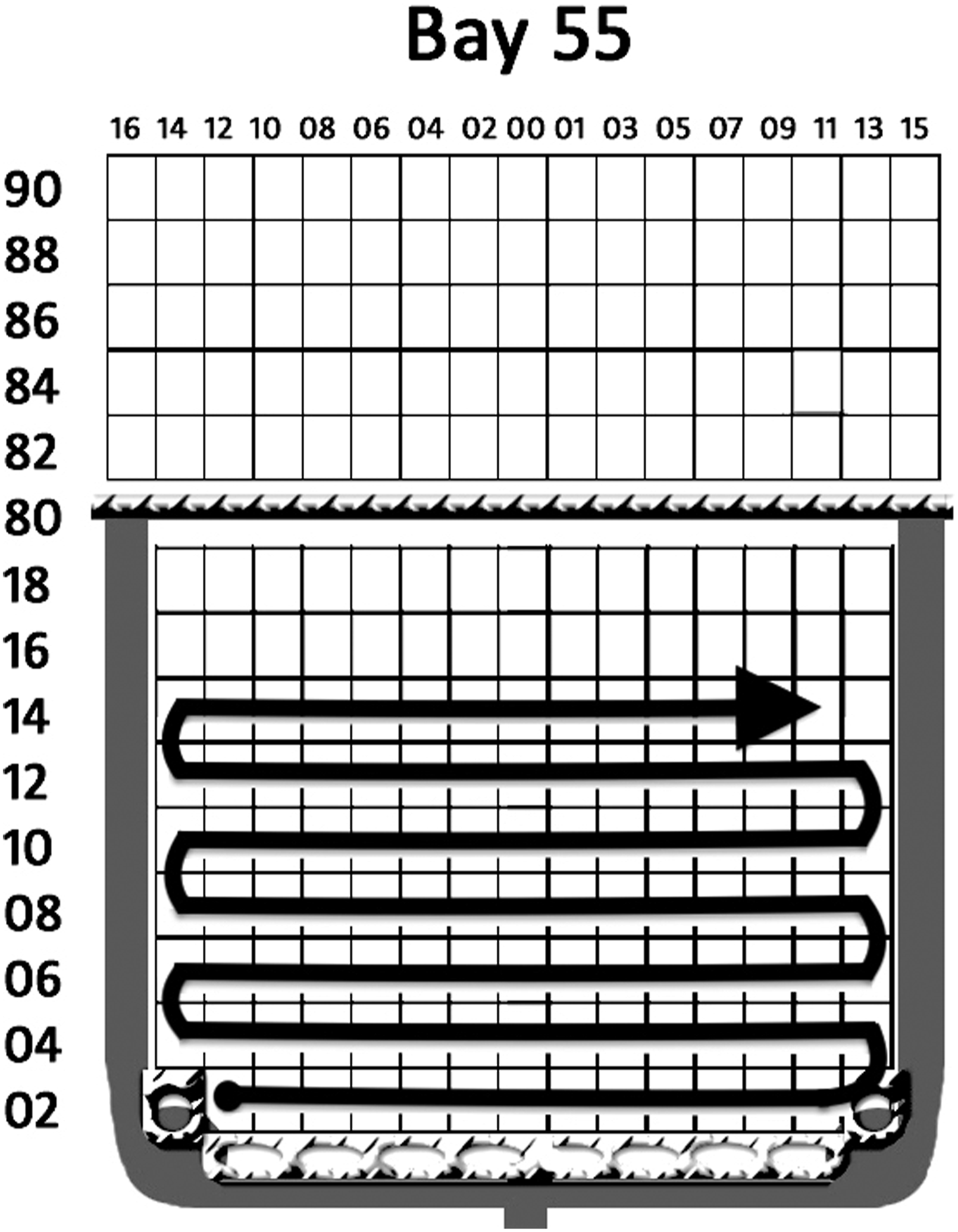
Because last-in-first-out is the ideal rule, the containers' route order forms an s-shape that begins at the bottom (cargo for last destination), and snakes towards the top of the ship’s hold (cargo for first destination). This means that the horizontal route and vertical depth of the ship’s hold are intertwined through the stowage planning process, such that one cannot be considered without the other. As the route is folded into the hold through the ordering of containers according to the stowage plan, it exhibits a different form of dimensionality, one that can be seen by thinking of the folded route in a slightly different way: as a line that is used to fill the ship’s hold, a type of space-filling curve (Bader, 2012: v) or snaking two-dimensional line (representing the lineup of containers in reverse order, according to the ship’s route) that fills the three-dimensional hold of the ship (Figure 2). An example of a space-filling curve, showing six iterations that increase in complexity. Each successive iteration has a higher dimension, more completely filling the plane than the one before it. Source, Wikimedia: https://commons.wikimedia.org/wiki/File:Peano_first_six.gif. Creator, Zbigniew Fiedorowicz. Licensed under Creative Commons Attribution-Share Alike 3.0 Unported: https://creativecommons.org/licenses/by-sa/3.0/deed.en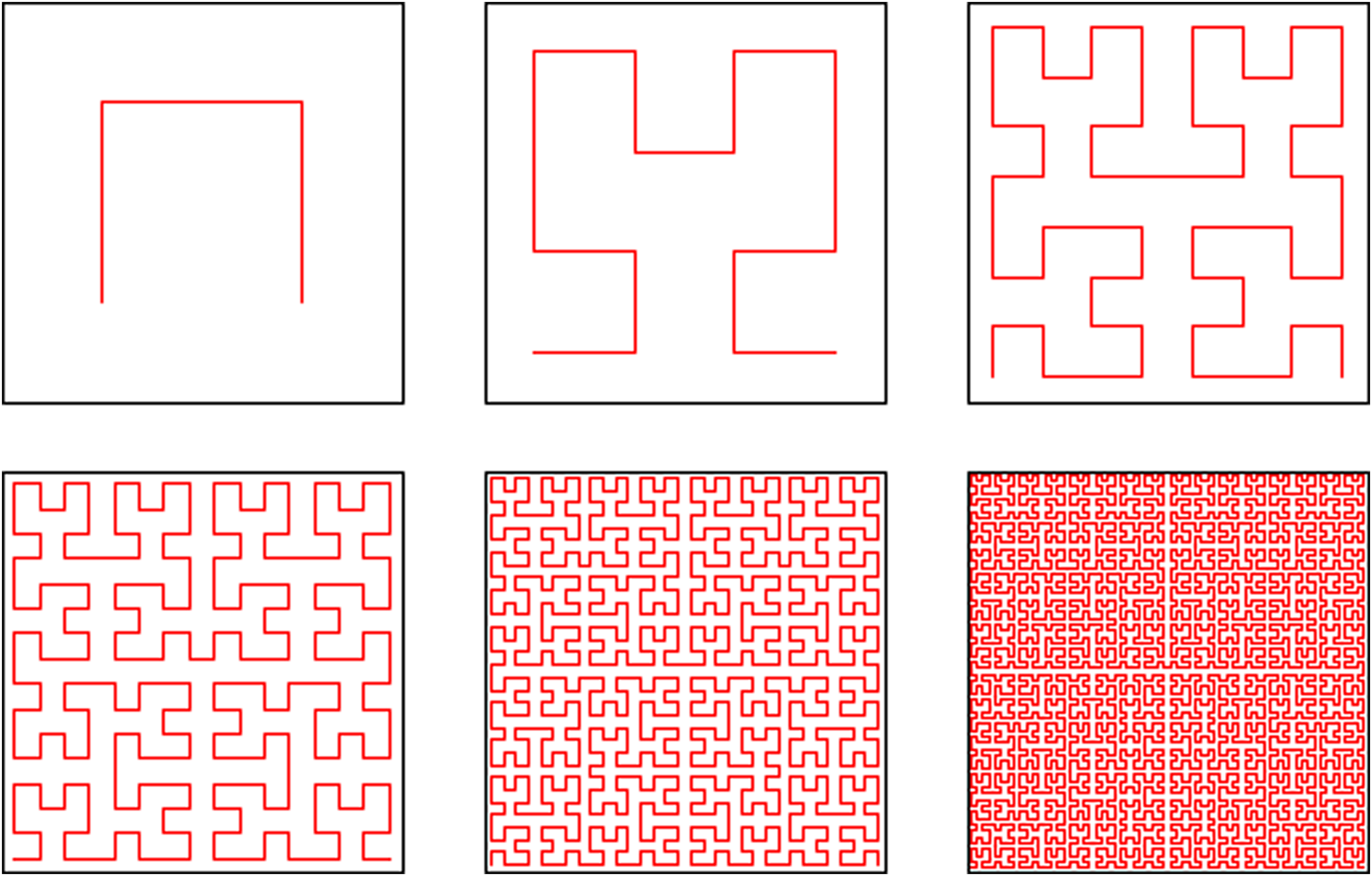
In fractal geometry, there are methods for calculating the dimension of this curve, which puts its value somewhere between 1 and 2. A higher dimension indicates that the curve is 'curvier' or 'squigglier,' filling more of the square and leaving fewer pockets of empty space. A lower dimension suggests that it is straighter, leaving more empty space uncovered by the line. The dimensions of a space-filling curve are not strictly Euclidean, given that Euclidean space includes geometry that are positive integers, whole numbers rather than fractions. Furthermore, it is not necessary to calculate the dimension of a volume quantitatively in order to qualitatively explore the different potential dimensions of a particular example—in this case to consider how densely wound the route is inside the ship and what kinds of places and times are loaded into the ship and ordered through the stowage process (Figures 3 and 4). Paying attention to the dimensions of these processes allows for more careful attention to the multiplicity of ways that volume is conceived and made salient. This photograph shows the container vessel MSC Leanne in Colon Harbor, Panama, its deck laden with stacks of white containers. Those stacks can be compared to the sample stowage diagram in Figure 4. Source: Wikimedia: https://commons.wikimedia.org/wiki/File:Container_Vessel,_Port,_Panama.jpg. Licensed under Creative Commons Attribution-Share Alike 4.0 International: https://creativecommons.org/licenses/by-sa/4.0/deed.en. This figure shows a cross section of a ship, viewed from the stern (rear). Each square in the grid represents one container aboard a ship, with both above and below deck represented. The arrow (added by the author) indicates one idealized order in which containers could be loaded to fill this cross section, starting in the lower left bottom corner and proceeding accordion-style towards the top right corner. This process could be repeated for additional cross sections as needed to fill the ship. Source: Wikimedia: https://commons.wikimedia.org/wiki/File:Bay-row-tier.jpg#%7B%7Bint%3Afiledesc%7D%7D. Licensed under Creative Commons Attribution-Share Alike 4.0 International: https://creativecommons.org/licenses/by-sa/4.0/deed.en.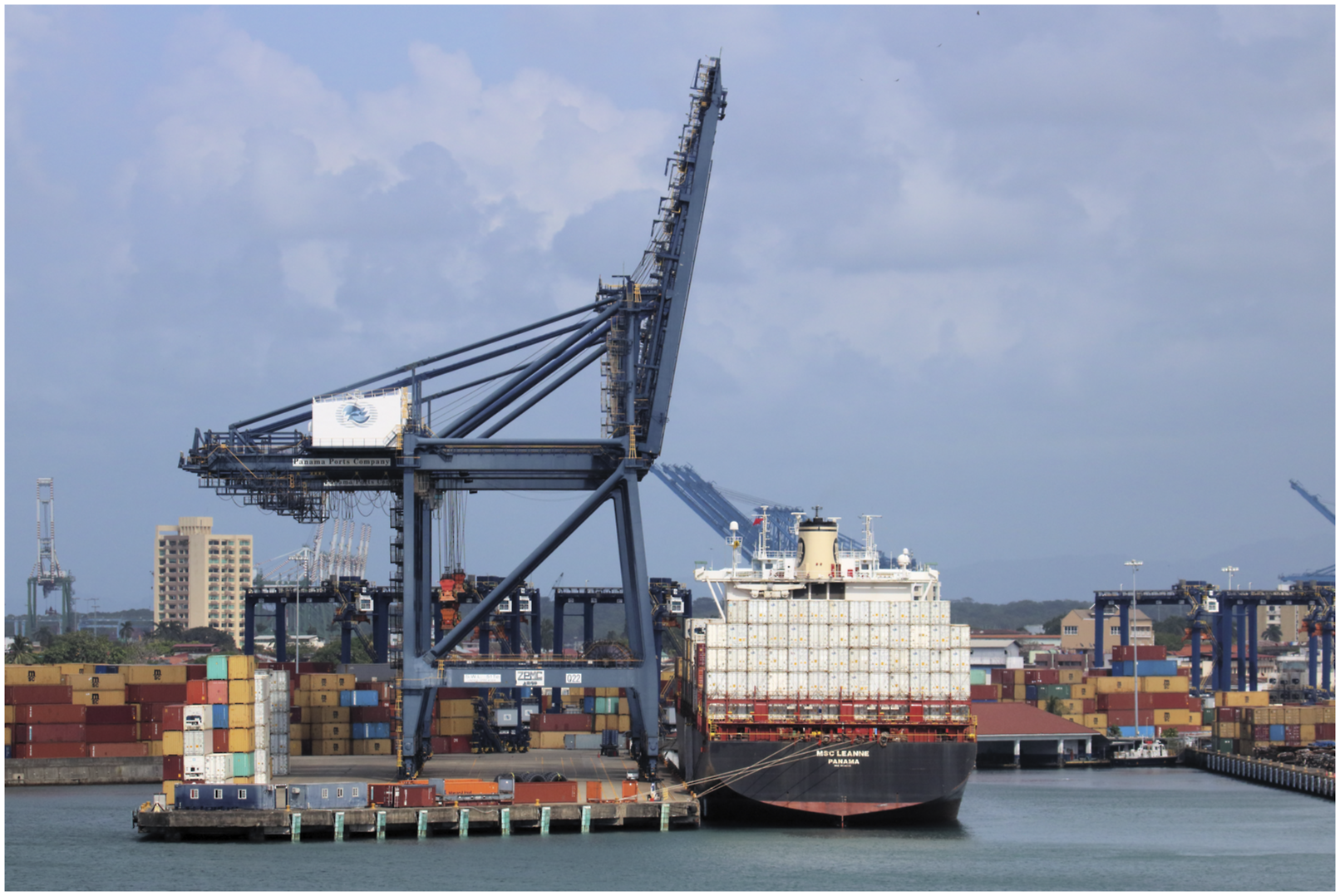
The line-filling-plane is indicative of one way to conceive of the dimensionality of the large container ships that are a crux of global racial capitalism. Yet there are additional dimensions to the stowage plan, as the ship’s route also has far more dimensions than a line of containers might suggest. The factors that help determine stowage plans in practice are so numerous and specific to specific ports, ships, and types of containers that Setyo Nugroho, an expert in marine transport, notes: “The knowledge for creating a stowage plan is imprecise, subjective and changing over time” (2004: 1). To engage with these other kinds of dimensions, it helps to draw on the work in fields not bound as rigidly by Cartesian and Euclidean conceptions of space. This brings us back to Simpson’s account of resurgence, discussed in the previous section, where the past is folded into the present recursively throughout daily life, not a memory but an aspect of an elsewhere that is nonetheless immanent to the here and now.
Working in a different context, and to opposing ends, stowage planners who load containers into a ship’s hold draw on multiplicitous factors in their handling of volume. These factors may include political events, strikes, trade agreements, weather disasters, and piracy. These and more are taken into account when formulating stowage plans. Planners thus have conceptions of the ship’s hold that are multidimensional in a way that resonates, albeit in a quite different context, with resurgence because it involves enfolding temporal and social relationships into the now. Although often presented as an occupation that revolves around dominant forms of knowledge such as computer modeling, much logistical labor draws on the erased lifeworlds related to shipping, including artisanal and tacit knowledge, to address past and present particularities in stowing cargo aboard a ship. For example, a ship’s hatches are the horizontal doors between the above deck and below deck areas of the ship, and hatches complicate stowage plans. Containers may be stowed on top of the hatches, but hatches will also need to be opened to reach the below deck areas of the ship, so the specifics of a particular route, in combination with a ship’s hatch placement, affect the stowage planning process (e.g., Ambrosino et al., 2015; Tierney et al., 2014). Shifting is the process of moving containers on the top of a stack in order to access those below them, the need for which can arise for various reasons even if the stowage plan is done correctly. Both hatches and shifting also depend on the weight of the stored cargo, and this adds further texture to the volumetric space of the stowage plans. This weight can be conceived of in terms of verticality, but it also means that containers below and above decks, or containers on the bottom versus the top rows, are in qualitatively different, or weightier, space. Thus, verticality is not the only consideration, as the particularities of both individual ships and their routes are ever-present in the planning process. Additional dimensions may be found in the ways containers are stacked in a particular port, as well as the unloading or loading happening elsewhere in the port, including which cranes are used where, and which berthing or storage lots are available. As a result, many spaces must be entangled together in order for the plan to be useful. Parts of the layout of every intermediate port along the route are also folded into the ship, and are done so in ways that are more difficult to describe than a single space-filling curve of the route would allow. Lastly, ship routing decisions are not just based upon horizontal distance, but rather incorporate any number of factors that influence which places become ports, as well as which ports become destinations for large container ships. These are shaped by the ways that colonial legacies influence trade dependencies as well as political, economic, and geographical factors (Khalili, 2020).
Once all of these factors are taken into account, the entanglement of the many different dimensions, near and far, past and present, becomes evident, as does their presence both in terms of the planners’ spatial imaginaries and as material factors of the space to be planned. This is not in any way to suggest that the stowage planners’ engagement with resurgence is as rich or necessarily reflexive as is Simpson’s conception and practice. Yet it does give evidence of dimensional heterogeneity even in dominant spatial practices and conceptions of volume. A particular container might be both up, down, left, right, out, and in, all at once, and to varying degrees, depending on which dimension of the space—the port, hold, route, etc.—is most present to the planner in the moment. The ship’s volume therefore can at once be seen as a Cartesian, planar space, and as a space that involves a folded knot of axes that stretch far beyond the individual ship or grid, making immanent a variety of histories and geographies that are actively erased from many stowage planning models. The folded dimensions of the ship’s hold are more than idle concerns because they point to the persistence of other knowledges, including artisanal knowledge of ships, tacit planning and container maneuvering practices, and informal information sharing rarely noted in rationalist accounts of shipping. Their continued use shows how lifeworlds are also present even in the “core” of capitalism and how, given the role of shipping in resource extraction and the related expropriation of indigenous communities, alternative lifeworlds may also selectively be mobilized for exclusion and disappropriation as well as against it.
III Empty container repositioning: Fungible volume beyond 3D
The dimensions of container stacking thus lead to other ships, other ports, and complex geopolitical relations becoming folded within the ship. Yet containers themselves are dynamic, creating space as much as they contain it, serving as a grid on the move. In the present section I turn to the movement of empty containers, drawing on King’s efforts to think with both Black studies and Indigenous studies, to understand additional aspects of the decolonial dimensions of volume. Whereas the previous section focused on curved lines, examining a folded grid of sorts, albeit one with far more dimensions than x, y, and z, this section focuses on dimensions that exceed linear axes altogether.
Empty container repositioning is the need to collect empty containers at the end of their journey and return them to a port where they can be loaded again to start their next trip. Repositioning is socially and environmentally costly, given the labor and fuel used to move ships that appear full, since they have a complete load of containers but who, aside from those containers and the workers on board, are essentially empty. Repositioning is also an important part of logistical planning since, as Crainic et al. note: “every commercial (profitable) movement of a loaded container almost automatically generates a nonprofitable empty container movement” (1993: 103–104). Empty repositioning costs an estimated 6.75 billion US dollars each year as of 2005, and as such is framed as a problem in logistics (Veenstra, 2005: 65, 75). Particularly in long-distance repositioning, the need to reposition stems from global trade imbalances (Theofanis and Boile, 2009: 57–58; Veenstra, 2005: 68). In a situation of equal trade where goods were flowing in two directions, repositioning would not be necessary: a ship that was full of goods in one direction, would simply load up with something else for the return journey. In contrast, where there is a trade imbalance, material flows in one direction but nothing flows back in return. This forces agents to return the containers empty to the starting point, in order to begin the trade cycle again. As such, the very need for empty repositioning on a regional or global level stems in part from the fact that goods flow primarily from the global South to the global North, which then offers little in return.
Even though their existence is assumed to be largely outside the purview of logistical planners, trade injustices are a sublimated aspect of repositioning practices. As in stowage planning, repositioning does take politics into account, although such considerations are often buried under the umbrella of cost. Laleh Khalili notes that a number of factors influence where carriers send containers, including “geopolitical realignments, corporate alliances, and shifting calculations about ship sizes, route expediencies and maritime power plays” (2020: 40). In repositioning these geopolitics of trade are formally incorporated primarily through adjustments to shipping fees, including charges such as a “war fee” and “piracy fee,” as well as by shaping scheduling decisions. The focus on fees and scheduling serves to reduce the dimensionality of global trade injustice into a problem of network design and allocation, one that depicts empty containers as a natural consequence of the supposedly inevitable state of global trade.
Yet even within this technocratic approach to repositioning, multiple dimensionalities abound. Notably, in many repositioning models, “empty” volume and “full” volume are effectively different kinds of volume, each with their own, albeit related, dimensions. Empty and full containers respectively have their own type of planning and handling, with its own motivations, management, costs, and characteristic movements. Carriers thus conceive of full containers and empty containers as different objects: the former as an asset and the latter as a problem (e.g., Lee and Meng, 2015).
The transformation of a container’s volume, upon unloading, from an asset to a problem relates to three differences in the ways that empty and full containers are conceptualized. First, the parties in charge differ when it comes to selecting a destination for empty versus full containers, with the former determined by the one who needs goods to be shipped and the latter by the shipping company that ships them (Song and Dong, 2015: 171). Second, the reason for selecting a particular destination differs. Whereas for full containers the destination is often paramount, empty containers are more readily interchangeable than filled ones, so they tend to go wherever the route is cheapest. Third, the ultimate goal of shipping empty containers, for the carriers, is to move them as little as possible before they are filled again, whereas for full ones movement to the specific destination is paramount. Considered in concert, all three aspects indicate that the empty and full container movements carve out diverging, but integrated aspects of logistical space. Emptiness thus has its own distinct dimensions, albeit ones that are intertwined with full space even as they are differentiated from it.
In addition to these intertwined empty and full dimensions, looking at container volume in relation to the Earth provides an additional perspective on logistical space, one that goes far beyond what might be conceived in terms of a 3D frame. To understand the relationships between empty and full containers, and how these stretch beyond Cartesianism, it helps to turn to Tiffany Lethabo King’s notion of the Black shoal as well as her work that spatializes Black fungibility (King, 2016, 2019). For the very existence of full containers is predicated upon trade injustices, and thus the enforced mutability of Black and Brown people, bodies, land, and sea. Shipping containers are a prime example of an attempt to violently shoe-horn earthly materials into a standardized spatial grid, given logistics’ role as a political economic project dependent upon colonial legacies. Containers also require, and further entrench, unjust social relations, and particularly the labor of racialized workers in, and/or with ties to, the global South. Empty container space thus enfolds the unjust relations and materials of global racial capitalism, and as such the volume of a shipping container goes far beyond what is visible in a stack of containers or what can be mapped in terms of a Cartesian grid. In addition to the material enfolding of goods into the container, the production of empty containers is also an epistemological process, as it involves the varied excision of ideas related to Black and Indigenous people’s conceptions, practices, and experiences of doing distribution otherwise—that is, it precludes epistemologies that explicitly foster the flourishing of Blackness and Indigeneity.
By attempting to look from the sutures between Black and Indigenous studies, it is possible to see how the intertwined, yet incommensurable, character of empty and full container space is produced as a spatialized aspect of capitalism. It is the outcome of an interwovenness, a shoaling of empty and full, land and water, and consisting of both. Attending to these sutures makes it possible to specify the forms the intertwining takes, while also examining the differing conceptions and treatments of the varied materials in the container, including air, that comprise the empty and full dimensions. This brings us to an additional facet, Black fungibility, which is the subject of ongoing debate in Black studies (Hartman, 1997; King, 2019; Marshall, 2012; Snorton, 2017). As King conceives it, Black fungibility includes the ways that Blackness becomes “a constituting feature of the spatial imagination of the conquistador/settler rather than just another human laborer exploited as a mere technology to produce space” (King, 2016: 1023). Yet Black fungibility also serves as “a space of alterity and possibility,” an opening that nonetheless is not in any sense ‘pure’ flexibility, a “shifting space that cannot be reduced to water” (King, 2019: 24–25). In an earlier work on fungibility, King uses the work of Saidiya Hartman, noting that: “the fungibility of the commodity makes the captive body an abstract and empty vessel vulnerable to the projection of others’ feelings, ideas, desires, and values” (Hartman, 1997: 21; King, 2016: 1025) and that fungibility is also the “capacity of Blackness for unfettered exchangeability and transformation within and beyond the form of the commodity” (King, 2016: 1023).
The fungibility that is relevant to empty containers is in many ways different from Black fungibility. Yet container fungibility is taken from the capitalist notion that commodities are fully interchangeable, which carries with it the ongoing legacies of the horrors of the large-scale enforced movement and enslavement of Black people. As such the relations between the two forms of fungibility are far from accidental. To the extent that Black fungibility is seen as a projection of white conceptions onto Black bodies, in the logistical literature on repositioning, the empty container serves as one unnamed repository for Blackness. Emptiness serves as a stand-in for the flattened, sublimated, and excised labor of Black and Brown people who do the hard work of extracting and producing the goods that fill containers and make the containers go, but which is conceived in dominant practice not as the richness of Black lifeworlds, but as “empty” space. Indeed, terms very similar to those common in many racist stereotypes are used to speak of emptiness in the repositioning literature. Logistics planners routinely refer to empty containers as “inefficient,” “costly,” and “overly fertile,” in the sense of rapidly self-multiplying. Black fungibility reappears then in the emptiness created through the selective incorporation of, and simultaneous excision of, the lives, politics, and ideas of the majority of the world’s people with respect to the potential benefits of global trade.
Yet as King emphasizes, Black fungibility also includes the spatialized capacity for those implicated in that emptiness to exceed what is projected and molded into them. Thus some of the frustrations with empty container volume that are expressed by logistical planners and operational experts are frustrations at the continued agentive qualities of the emptiness, an agency that is nonhuman, in the sense of the material obduracy of the container, but also indicative of the numerous people who come into contact with containers and shape their emptiness and level of movement. Indeed, emptiness is not a problem for all carriers, and particularly not for smaller scale carriers who might use containers as storage, or temporarily “adopt” them informally for short-term informal shipments, namely the kinds of exchanges that purposefully elude models and tracking. Empty containers are also routinely used for smuggling people as well as goods, in which case a partially full container that is being repositioned might masquerade as an empty one, which would be reflected in subtle changes to how it is moved. The politics of smuggling and informal flows are too complex to explore in the present text, but what is most relevant is the seepage, the excess of Black fungibility and the role of Black people—both as laborers and beyond labor, as King notes—in constituting but also transforming, repurposing, escaping from, imposed emptiness. The co-presence of empty and full dimensions in the container is also a mixing of ways of conceiving and making space that goes beyond the conceptions of logistical planners, which tend to focus on the Cartesian grid even as they modify it. The shoals of the container are not fully comparable to the shoals of which King writes, but the two are interwoven in ways that can only be appreciated by analyzing their non-Cartesian material and epistemological dimensions (see e.g., King, 2019, ch. 5).
IV Conclusion: Emptiness as presence
Attending to the decolonial dimensions of logistics makes it possible to see both the far-reaching violence of standardized, Cartesian space as well as how alternative conceptions of dimension can inform and emphasize other ways of seeing and working with volume. Looking at ships’ routes makes it possible to see the resurgence of political and historical concerns embodied in those routes. Such concerns are folded in to the space of logistics, despite being officially banished from, or at least downplayed within, the rational computerized plan for stowing a ship’s containers—a sort of modified or “squiggly” Cartesianism of the line-filling plane. Examining empty repositioning moves beyond even a modified Cartesianism, showing instead the shoaling of land and sea, empty and full dimensions, visible emptimess and sublimated fungibilities, within containers whose apparent “emptiness” is anything but empty. Instead, dominant spaces and modes of resistance, Cartesian conceptions and a myriad of other possibilities, are thoroughly and intricately intertwined, melding, fusing, dissolving and precipitating. Attending to such decolonial dimensions provides perspectives for doing volume both with, in the sense of situating and resisting, and beyond Cartesianism.
Under global racial capitalism, the only “rational” choice for many people is to work in arduous conditions, burrowing holes and tunnels through the Earth, extracting and undertaking the transformative processes like cleaving, excision, freezing, and melting that are involved in coalescing the goods that fill containers, as well as the materials of containers themselves, the corrugated steel that makes it possible for a grid of containers to physically stand. As part of this world, the very discussion of dimensions of Blackness and Indigeneity in relation to Capitalism’s core processes has been produced as something that, in mainstream logistical circles, is conceived of as an irrelevant outside, simply an inefficiency. All of these relationships and their social and material manifestations are crammed, folded, crumpled, wrapped, and sealed into and through containers. Dimensionality is helpful for thinking about how this happens, for finding resonances within and between varied instances, for accounting for the sheer complexity of these dimensions, and also for attending to the stark injustices of the world they help to reproduce. As such a volumetric approach to capitalism must also conceive of volume and dimension in a multiplicity of ways both with and beyond the grid. These ways are not visible to all. They are made hypervisible to some and invisible to others. At times, they may even manifest as currents of air that are strong enough to sink ships.
Footnotes
Declaration of conflicting interests
The author(s) declared no potential conflicts of interest with respect to the research, authorship, and/or publication of this article.
Funding
The author(s) disclosed receipt of the following financial support for the research, authorship, and/or publication of this article: This research was funded by a 2017 Erasmus University Research Fellowship awarded to the author for the project Data Streams and Cargo Flows: The Labor Consequences of the Datafication of Logistics.

.jpg)


