




Abstract
Social network analysis has become a popular methodology in human geography. This article develops three propositions – connectivity, contextuality, and reflexivity – for relational analysis to overcome the dualism between universalist network science on the one hand and idiosyncratic network stories on the other. Building on a detailed meta-analysis of over 300 network studies published between 1990 and 2018, we offer a sympathetic critique of the actual use of network methods in human geography. To unleash further potential of network research, we propose several research strategies for more inclusive relational analysis, including informed pre-specification, triangulation, and communicative validation.
Keywords
I Introduction
In human geography, relational thinking and formal network analysis have developed almost independently of each other. Formal network geometry was already established in the 1960s as a methodological approach to design optimal infrastructure networks and calculate the shortest routes in logistics and transport (Haggett and Chorley, 1969). However, in the 1980s, formal relational analysis lost significance as human geographers shifted perspective toward conceptual relational thinking, which placed social actors and economic action above the characteristics of physical space. It was not until the end of the 1990s that formal analysis of social networks was once again introduced into the field, mainly as an import from economic sociology (Grabher, 2006). Here, scholars conceived social structure as network structure (Crossley, 2020; Emirbayer and Goodwin, 1994) and called for the use of relational methods to advance relational thinking. Coincidently, an analysis of journal publications in the field of economic geography illustrated that in the 20 years, between 1990 and 2010, articles on ‘networks’ had become disproportionately popular (Glückler, 2013). However, and much against the expectations of Smith (1980), the number of articles that addressed ‘network theory’ and ‘network analysis’ continued to remain very low until the turn of the first decade of the 21st century.
Over the last decade, social network analysis has become more widely used in empirical studies of human geography. On the one hand, digital technology has eased the collection and storage of social data, making big data ever more accessible for research. On the other hand, network scientists have continued to broaden the pool of methods by developing new measures, analytical procedures, and software packages to make network analysis usable for empirical researchers (see, for instance, the 2016 special issue in Journal of Economic Geography). The proliferation of data, methods, and tools, however, has not only enriched research practice, but it also raises questions about the limits of network analysis, its appropriate use, and the validity of findings obtained from it.
We have seen relational thinking flourishing as a diverse field of theoretical advance that has evolved along various lines of thought, including, among others, actor–network theory, cultural geographies of economies, practice theory, social network theory, and relational economic geography. Relational thinking refers to an understanding of social phenomena as being constituted by social interactions that are situated in a structure of relations and contextual meaning. Relational geography has evolved around the nexus between social networks and space and the interdependent association between them. Despite the variation of conceptual approaches to relational thinking in human geography (M Jones, 2009), the common denominator is an underlying belief that social structure and the qualities of social relations matter in explanations of the geographies of societal phenomena. Ettlinger (2003), for instance, has emphasized the interdependency between the role of space in forming social relations and, inversely, the role of social networks in shaping economic geographies. Consequently, human geographers have looked at the mutuality of space and networks from different perspectives (Glückler, 2013): One stream of research has examined how geography affects the formation and change of networks. Locational proximity (Boschma, 2005) and local externalities of regional clusters have been shown to drive specialization and divisions of labor (Turkina et al., 2016), exchanges of information and the creation of innovation (Bathelt et al., 2004; Owen-Smith and Powell, 2004; Storper and Venables, 2004), as well as the creation of new network linkages (Glückler, 2007) within and between local and global scales. Apart from the impact of permanent proximity, research on temporary proximity (Torre and Rallet, 2005) has shown how gatherings at physical places conduce the configuring of new or the rewiring of existing fields and networks (Asheim, 2002; Bathelt et al., 2014; Crossley and Ozturk, 2019; Panitz and Glückler, 2017; Power and Jansson, 2008). Conversely, another stream of research has examined how social networks actually shape places and space (Crossley, 2020). Here, the social embeddedness and dynamics of networks (Coe, 2000; Hess, 2004) has been conceived as driving change in regional economies, for example, by means of inclusive institutions and their corresponding relational infrastructure (Storper et al., 2015).
In the light of human geographers’ growing interest in phenomena as complex as creativity, knowledge, innovation, resilience, governance, and institutions, we argue that theorizing and analyzing social networks requires a solid understanding of the actors, the relations, and the context in which actors weave and rewire their relations. Now, with the rising prominence of network analysis in human geography, we are interested in exploring how relational analysis can enhance relational geography. Our concern resonates with current calls for better methods in geography (Bathelt and Li, 2020). Although the foundations of relational thinking and its association with network analysis have been widely discussed (Grabher, 2006; A Jones, 2014; M Jones, 2009; Malpas, 2012), we do not yet know if relational analysis in human geography has contributed to building relational theories in geography. Hence, rather than discussing the theory of relational geography, we focus on social networks as relational analysis. By relational analysis, we refer to those methods that observe social relations or interactions by using existing or collecting original data in small or large numbers, including participant observation, interviews, surveys, as well as formal and qualitative analytical techniques such as ethnography, hermeneutics, or social network analysis.
In this article, we revisit the use of network analysis in almost three decades of research in human geography and make propositions on how relational analysis may unleash its full potential to enable and support relational thinking and relational theory. Concretely, we propose to place social network analysis within more comprehensive research designs that include qualitative and formal methods and that work together to meet essential criteria of relational research. Social network analysis is sensitive to the quality of relational information, to missing data in the sample, and to the choice of measures and analytical procedures. Therefore, more inclusive methodologies help to capture meaningful data on social structure, to grasp the contextuality of their constitution, and to respect limits to the generalizability of the observed phenomenon. Although the call for mixing methods is not new to the world, the meta-analysis of network studies presented in this article documents its rare use.
In what follows, we aim to assess how methods of social network analysis have been actually used in human geography and to what extent these uses have realized the potential for relational thinking in geography. To assess this potential, we first conceptualize three criteria to be met by a relational methodology (section 2) before we conduct a detailed meta-analysis of over 300 articles in the major journals of human geography that have used methods of social network analysis in the period between 1990 and 2018. Based on this meta-analysis, we illustrate that network research in human geography has been characterized by the analysis of often nonsocial relations between nonsocial actors, by a biased view on nodes rather than the networks as a whole, and by problems of construct validity and meaning ascription in single-method research designs (section 3). Building on this experience, we offer a sympathetic reflection and elaborate on research strategies for more inclusive relational analysis in section 4, which reconciles the tension between relational form (structure) and relational content (meaning). Section 5 draws some conclusions regarding the potential and limits of relational analysis.
II Relational Thinking: Connectivity, Contextuality, Reflexivity
Despite the popularity of relational thinking in our field, debate about appropriate methodologies, ways to capture empirical observations in their relational and spatial context, and if methods meet the requirements of a relational perspective have been very silent to date. Therefore, we first discuss key characteristics of relational thinking and infer three criteria for relational analysis to meet the requirements for relational theory building. Concretely, we suggest that empirical projects of relational geography should to overcome the fallacies of categorialism, formalism, and neutralism to unleash the full potential of relational analysis.
1 Beyond Categorialism: Connectivity and Relational Thinking
Specialization and exchange, the differentiation of social roles, and social divisions of labor characterize social and economic life. Organizations and the people who work there pursue different goals, take on different tasks, and relate to other organizations through exchanges in information, capital, and other resources and through relations, such as cooperation, rivalry, or power relations. The multitude of actors and the relationships that exist between them are the building blocks of social networks. Some traditional approaches have focused on networks and relations without realizing the full value of the potential of connectivity. Two conventional research designs can be highlighted as examples:
Monadic Networks
One traditional research design treats networks as a unitary entity. Typically, it draws a random sample of networks (typically: corporations and organizations) and collects information only from its representative manager who, then, characterizes the respective network as a whole. Sturgeon (2003), for example, built on interviews with managers from lead firms to interpret the organizational networks of the Silicon Valley as a modular production network. Although such research designs have merits for collecting substantive information on the organizations themselves, they fail on capturing the actual patterns of relationships, interdependencies, and interactions with the environment (Foray and Steinmueller, 2003; Grindley et al., 1994). The heterogeneity of relations within the network thus remains opaque.
Atomistic Relations
A second research design typically draws random samples of particular relationships to analyze associations with either antecedent or outcome variables. Such designs have been appropriate, for instance, to examine the extent of cooperation within an industry, assess the effect of client referrals on the locational structure and geographical expansion of professional service firms (Glückler, 2006), or examine ‘the nature and geography of knowledge linkages’ (Calignano et al., 2018: 1493). Although the focus on dyadic ties can be valuable in many research contexts, such treatment of relations does not take into account the topological structure in the overall network of relations. Instead, the surveyed relations are random samples of isolated relationships – a case of dyadic atomism (Granovetter, 1992) – which do not permit any knowledge about the connectivity of the network as a whole.
In both research designs, the empirical observation of networks remains either on the level of the network as a monadic unit or on the level of isolated dyadic relations. Coleman criticized this approach as ‘fragmented psychology’ (Coleman, 1958): how, for example, could the spread of information be investigated if the ways of spreading, that is, the communication relations between the actors, were not taken into account? It is a fundamental critique of the practice of traditional research designs to investigate relational phenomena with random samples and to exclude connectivity as the actual core of the phenomenon. Instead, an analysis of interaction, communication, role expectations, and control is inevitable to understand the economic opportunities and consequences of individuals and firms (Abbott, 1998; Freeman, 2004).
A social network consists of a specific number of relationships with the additional characteristic that the structure of these relationships as a whole can be used to interpret the actions of the individual (Mitchell, 1969). The consequences of this assumption are fundamental: the locations, positions, and roles of actors in a network influence the actor’s opportunities and constraints. Such thinking has converged across the board of the social sciences to what is called relational thinking (Bathelt and Glückler, 2003; Emirbayer, 1997; Ettlinger, 2001; Fourcade, 2007; A Jones, 2014; Yeung, 2005). The common understanding of these approaches is expressed rather radically in the ‘anti-categorical imperative’ (Emirbayer and Goodwin, 1994). It is the normative assumption that social phenomena as identity, power, status, competitive advantage, entrepreneurial spirit, social capital, or knowledge are not inherent ontological attributes of actors, but expressions and consequences of the history of interactions and relations in a network. The relational perspective is suitable to understand individual and collective opportunities for action as a condition and consequence of the specific structure of social relations. Such a theoretical view requires an analytical turn toward analyzing connectivity in social relations. Methods of network analysis offer numerous measures to analyze the aspects of connectivity at three different scales: the level of nodes (individuals, organizations), subgroups (e.g. departments, families, clusters), and of the network as a whole (e.g. positions, roles, centralization). Recent research has started to examine the interdependencies across multiple levels, such as the effects of interorganizational relations on the formation of interpersonal ties, and vice versa (Lazega and Snijders, 2016). Proposition 1: Studying networks requires a relational perspective that focuses on the relationships between actors and the connectivity of the overall network in addition to the substantive properties of actors. Networks and individuals can no longer be examined as part of random samples but should be examined in their specific connectivity.
2 Beyond Formalism: The Contingent Relation Between Structure and Meaning
Recent discussions both within and between the social and natural sciences point to the limits of formalism and the implicit hope for universal structural explanations of the social world (Borgatti et al., 2009; Erikson, 2013; Hidalgo, 2016). The fact that natural scientists have discovered social networks as a research object has led to the confrontation of quite distinct research motivations. While natural scientists seek to demonstrate universal and nonrandom properties across different networks, social researchers seek to find the structural particularity in each empirical network to analyze their differential effect on varying social outcomes (Borgatti et al., 2009). In natural science, molecules with the same composition and structure of atoms generally have the same properties, whereas the same structure of social relations may lead to different types of behaviors and also different endogenous dynamics of network formation. In its extremes, research interests range between the search for universal network rules, on the one hand, and for comprehensive network narratives, on the other. Erikson (2013) addresses these poles as relationalism versus formalism. By doing so, she argues that not all empirical network research has also been ‘relational’ because relationalism refers to an epistemological position rather than only the operational quantification of links in a network.
In contrast to the so-called substantionalists (Emirbayer, 1997) and formalists (Erikson, 2013), a relational perspective comprises an understanding of context and meaning to account for the contingency of network structure. It acknowledges that social actors are inseparable from the transactional contexts within which they are embedded (Emirbayer, 1997; Granovetter, 1985). Whereas universal phenomena can be studied with statistics, contextual phenomena require network analysis, and evolutionary phenomena require historical analysis (Abbott, 1998).
Newman et al. (2001) show that in some cases, random networks offer accurate predictions of empirically observed networks, whereas in other cases, for example, interlocking directorships, they fail to account for the observed patterns of connectivity. By observing such discrepancies, they suggest to use random models only as baselines (Barabasi, 2016) to identify specific empirical features. A comparison between observed and modeled networks helps assess the magnitude of a fit or misfit, yet it does not offer any explanation of the social processes leading to an observed network-specific structure. In other words, it remains a contextless analysis.
In contrast to relational determinism, the formal structure of a social network is contingent on the meaning of the social relations and, conversely, has contingent social effects on the actors involved in a network (Borgatti et al., 2009). Cultural frames and embedded meanings are crucial for understanding how certain relationships are formed and what kinds of structures emerge from them (Murphy, 2018). Even identical locations in a formal network may yield different actions and opportunities. Thus, the brokerage advantage of a central location in the network can be interpreted both for tertius gaudens strategies (Burt, 1992), that is, for the opportunistic privatization of broker advantages, and for tertius iungens strategies (Obstfeld, 2005), that is, for establishing new links between so far disconnected positions to enable collective advantage. Hence, it is not possible to determine a universal social outcome to a specific structural position a priori.
A second example shows that the same location of an organization in an industry network can be associated with very different outcomes: Close and dense relationships in a mature and stagnating market environment were found disadvantageous, whereas they proved advantageous in the context of emergent markets (Rowley et al., 2000). Likewise, the same structural features of a network, such as tie strength or structural holes, can both help or hinder the creative process toward innovation, depending on the stage of the idea journey (Perry-Smith and Mannucci, 2017). What is more, the effect of a network structure on innovation is contingent upon the cultural frame that actors choose to activate parts of the network features (Perry-Smith and Mannucci, 2017).
A third example refers to the difficulty of locating power in formal positions of network analysis: Power is only effective in relational exchange with other actors and is therefore constitutionally anchored in the network (Emerson, 1962). Yet despite all their efforts, power dependence researchers have not succeeded in solving the localization problem (Willer, 1989), that is, in assigning actual power relations to the positions of a network. Thus, powerful actors are not found exclusively in central positions, where they can actually be expected, but also in peripheral regions with little networking. Ultimately, the limits of social network analysis lie in the fact that it cannot explain the underlying macro-cultural discourses (Lawrence and Phillips, 2004), institutional contexts (Martin, 2000), and cognitive frames (Perry-Smith and Mannucci, 2017) that together affect how the structure of a network is associated with social outcomes. Obvious examples of extra-network forces that affect the formation of network relations are changes in regulation, for example, antitrust and tax legislation on industry-bank co-ownership (Höpner and Krempel, 2004), and changes in technology, for example, the rewiring of global trade relations in the course of the digitization of the photo industry (Panitz and Glückler, 2017). As Mizruchi (1994) puts it in a nutshell: Network theory can explain why, given that a person’s friends are political liberals, the person is likely to hold liberal positions as well. […] But the network approach cannot explain why particular groups of people hold liberal views in the first place. (Mizruchi 1994: 336) Proposition 2: Networks are not only formal links between social actors, but they generate meaning and, inversely, are structured by meanings that inform social behavior. Because connectivity and social meaning co-evolve, network research needs to be sensitive to the contextuality of networks and their contingent effects on social outcomes.
3 Beyond Neutralism: On the Performativity of Network Research
The Heisenberg uncertainty principle suggests that observing a system may actually transform the system (Borgatti et al. 2009). If this is true for physics, it is even more obvious for a social world characterized by double hermeneutic (Giddens, 1984): When beliefs and theories about a social phenomenon become known, people use this knowledge to reflect and eventually change their behavior. The theories with which we believe to discern social reality may actually convert reality in a way to gradually conform to the theory (Berndt and Boeckler, 2009). Performativity research pursues the question of how (scientific) models do not describe or explain reality, but how they produce reality themselves (Callon, 1998). The case of the stock option pricing model that gradually transformed the pricing practice at the Chicago stock exchange is a fascinating empirical illustration of the performative effect of theory on economic life (MacKenzie and Millo 2003). The emergence of online social networks and the proliferation of network algorithms that recommend users who else to connect with are a popular illustration of the performativity of network methods (Healy, 2015). In professional contexts, organizational network software offers tools for managers to assess their network on their own and to draw lessons for their strategic network action: ‘welcome to your personal network action plan’ (Cross 2009). In academic network research, network methods become performative in two ways.
First, primary data collection implies the interaction between the researcher and the actors in the field. Interview and survey questions raise the awareness of respondents about their relations; make them remember and reassess colleagues, superiors, and customers; and they sensitize respondents to the meaning of distinct types of relations and the notion of networks in the many contexts of a workplace, a competitive market, an organizational field, a governance situation, and so on. The more interactive the research process is between researchers and respondents, the more influential can conversations and feedback become for future actions in the network. Network research thus already contributes network practices during the process and without its findings. Such high levels of intervention in the field require researchers to comply with strong ethical guidelines and to avoid any harmful consequences for the participants, for example, if management implements changes based on the research findings to the disadvantage of some participants (Borgatti and Molina, 2003).
Second, Social network analysis (SNA) is a ‘non-neutral analytic device’ (Scott, 2015) in that its concepts and findings may affect individual and collective strategies of rewiring existing networks. An empirically extremely robust finding from network research is, for example, the connection between broker positions in networks and positive employee evaluations, bonus payments, and above-average salary development of managers in their peer group (Burt, 2004). Without scientific research, this association would remain unknown and could not be used as a source of the strategic behavior of the actors in the network. Due to publications and training, these concepts increasingly penetrate the minds of managers who learn that opportunistic network strategies (e.g. structural holes) boost individual career opportunities. Interestingly, research shows that the individual benefits of brokerage disappear when everyone seeks a brokerage position and establishes or breaks off their relationships accordingly (Buskens and Rijt, 2008). The CEO of a large corporation that we surveyed in our own research recognized the problem of privatizing network benefits at the management level, and so they started to give new thought to how they could encourage their employees to a more collective commitment and to the creation of opportunities for third parties (Obstfeld, 2005). Proposition 3: Network analysis inherently transforms the reality of social relations. It interferes with and thus affects the social world during primary data collection, and it creates theories and concepts that affect the way actors think about goals and strategies to evaluate and rewire their networks accordingly. Hence, network research needs to be sensitive to the empirical context, to reflect its observations in the light of actor knowledge, to respect research ethics in the field, and to recognize the potential performative effect of its findings.
In summary, according to our assessment of the challenges in the field, we posit three requirements for appropriate designs of relational analysis. Network research has to be, first, relational, that is, to capture the connectivity of social relations and social phenomena; second, contextual, that is, to grasp the meaning of interactions and relations as well as their contingency in a particular spatiotemporal context; and, third, reflexive, that is, to understand, sensitize, and responsibly mediate the performative interference of research with the social world. To what extent, however, does extant research practice meet these requirements? And what are potential techniques or elements to accomplish relational, contextual, and reflexive designs in practice? To explore the breadth of research practices in human geography, we present a comprehensive meta-analysis of published research in the next section.
III A Meta-Analysis of Network Studies in Human Geography
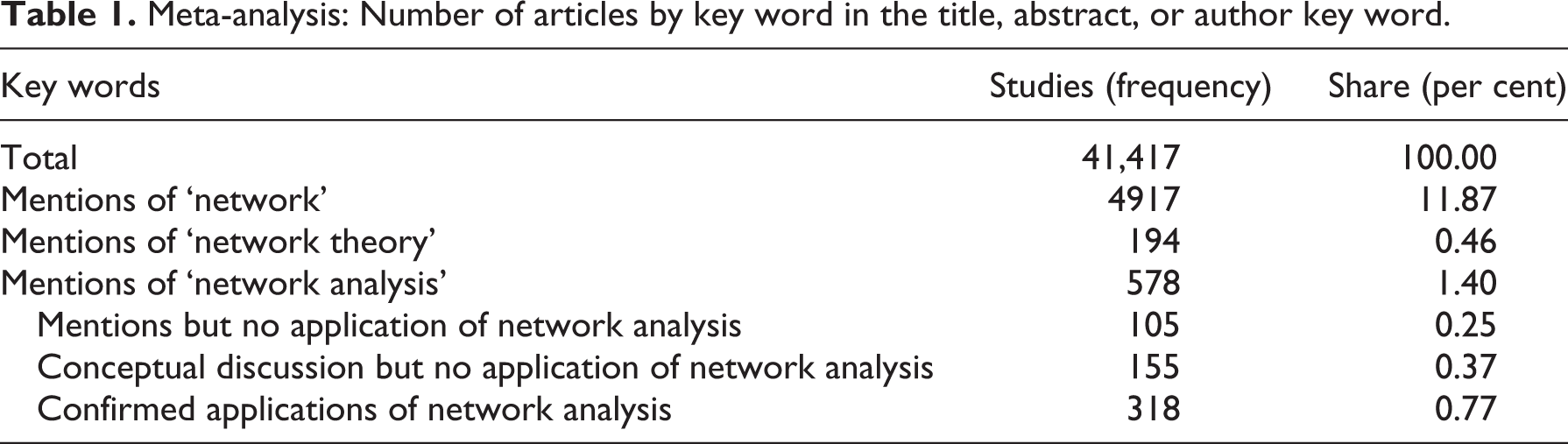
We used the Scopus database to screen a selection of 28 journals 1 in the field of human geography for those publications that made use of network methods in their research. The analysis started with a total of 41,417 articles published between 1990 and 2018 (Table 1). Using the statistics program R, we systematically screened all articles for the presence of a defined set of key words 2 in titles, abstracts, and author-provided key words. Altogether, 4917 papers (11.9 per cent) mentioned the term ‘network’ more generally, of which 194 articles referred to concepts of networks (‘network theory’) and another 578 mentioned techniques from the broader set of network methods (‘network analysis’). Because of our interest in the ways in which researchers in human geography have used network methods, we consider the 578 articles in the category ‘mentions of network analysis’ in Table 1 for further analysis. We used MaxQDA (VERBI Software, 2019), a software for qualitative content analysis, to integrate all full texts into one data corpus and to analyze the articles for the appearance of predefined key words covering most of the contemporary techniques and measures in network analysis.
Meta-analysis: Number of articles by key word in the title, abstract, or author key word.
Once the text corpus was established, the meta-analysis proceeded in three steps. First, we defined a code-tree including four elements of a research design: (i) data, that is, type of nodes, types of ties, and level of analysis; (ii) data collection, that is, primary qualitative (e.g. interviews), primary quantitative (e.g. survey) and secondary (e.g. a database), and the size of the network studied; (iii) network measures and methods (e.g. centrality, blockmodeling); and (iv) type of design, that is, single versus mixed methods and single versus multiple observations of the same types of ties and nodes.
Second, we submitted these codes to an automatic coding process of all 578 full texts in MaxQDA and checked whether an article mentioned or discussed network analysis or really applied network methods to original empirical research. By reviewing the codings, we identified three groups of articles. Group 1 includes 105 articles that mentioned network analytical concepts without using them for own empirical research. Typically, these papers acknowledge network analysis as a methodological opportunity (Wójcik, 2013) or refer to some of its concepts such as connectivity (Roe, 2006; Salet, 2008). Group 2 includes 155 articles that conceptually discuss or elaborate on network analysis as a methodology without applying it to empirical analysis. Good examples are developments, critiques, or propositions of new network analytical methods, such as the comparison of certain measures (Broekel et al., 2014; Mamun et al., 2013). Other examples include theoretical reviews and discussions of network approaches (Glückler and Doreian, 2016; Grabher, 2006; Hodgetts, 2018; Schwanen, 2017; Smith, 2014). Group 3 includes those 318 articles for which we confirmed truly empirical applications of network analysis, including simulations based on empirical data, modeling, qualitative and quantitative explorations, and so on.
Third, the meta-analytical codings were the starting point for a more detailed manual analysis, in which we reviewed the codings in the empirical applications to confirm their validity. In many instances, when reading the context of the articles, we either removed, recoded, or further detailed the codings. After having validated the codings, we analyzed this body of literature and computed descriptive statistics on how researchers in human geography have used network methods in empirical research applications. Despite the small share of only 1.4 per cent in all research published in the 28 journals, network analysis has been used in the most diverse contexts, scales, and in relation to the most diverse objects. Its applications range from small-N qualitative network ethnographies to large-N big data networks comprising millions of nodes. For the purpose of an overview of the variety of uses, we compare the data sources, types of nodes, and types of ties, as well as the particular use of methods in these studies.
1 Types of Nodes, Types of Ties, and Levels of Analysis
Human geographers have studied a wide variety of network nodes, including airports, bus stops, cities, regions, countries, firms, industries, technologies, artists, inventors, authors, travelers, commuters, social media users, and so on. 3 These different types of nodes can be classified into four categories (Table 2): individuals (11 per cent), organizations (38 per cent), territories (47 per cent), and other nonacting nodal categories (4 per cent). This distribution illustrates the tendency of studies on geography to apply network analysis to nonsocial nodes to examine linkages between aggregate territorial units or other artifacts. While the common practice of aggregating individuals and organizations into places and places into regions reduces complexity and serves the ‘spatialization’ of social networks, at the same time, this operation converts social relations between social actors into hyperrelations between nonsocial nodes.
Types of nodes analyzed in network studies within human geography.
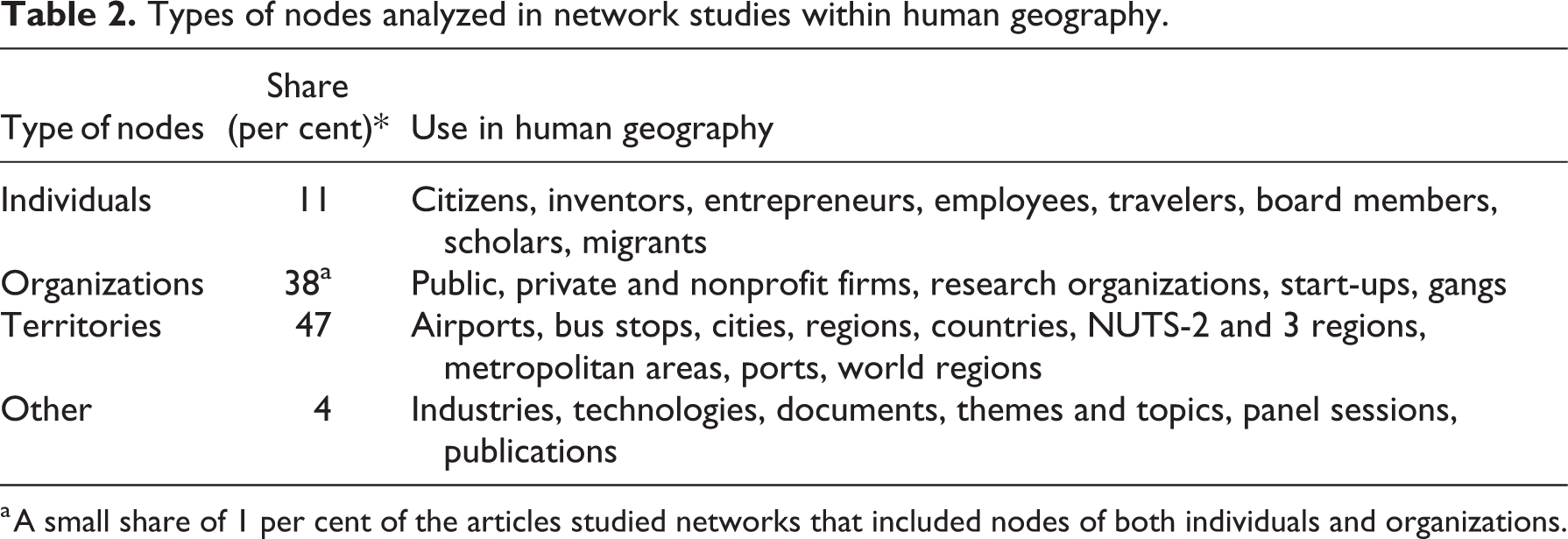
a A small share of 1 per cent of the articles studied networks that included nodes of both individuals and organizations.
Similarly, human geographers have looked at a vast variety of different types of ties or relations between the research subjects. Building on Borgatti et al. (2009), we distinguish between four fundamental types of ties 4 : similarities, relations, interactions, and flows (Table 3). This distinction is crucial because each type of tie implies a different logic as to what a connection actually means and what its potential effects on the network structure may be. Being similar according to a certain characteristic, for example, does not imply mutual contact, acquaintance, or even awareness between people. Hence, similarities can hardly be interpreted as any meaningful expression of social relations or interactions. In contrast, a social relation of kinship, mentorship, or collegiality does imply not only mutual awareness but often reflects deeper relations of, for instance, affection, solidarity, or trust. The type of tie also makes a difference for what actually happens on those links. In the case of interactions, which represent a third type of ties, actors exchange meaningful symbols, affection, or information or they engage in collaboration, conflict, play, learning, co-creation, or other activities. In contrast to this interaction, the final type of tie refers to flows, that is, transactions of content, resources, or commodities. While all these types of ties look identical when mapped on a network graph, they require differential theorization and imply differential inferences on the conditionality of and impact on network structure.
Types of ties analyzed in network studies within human geography.
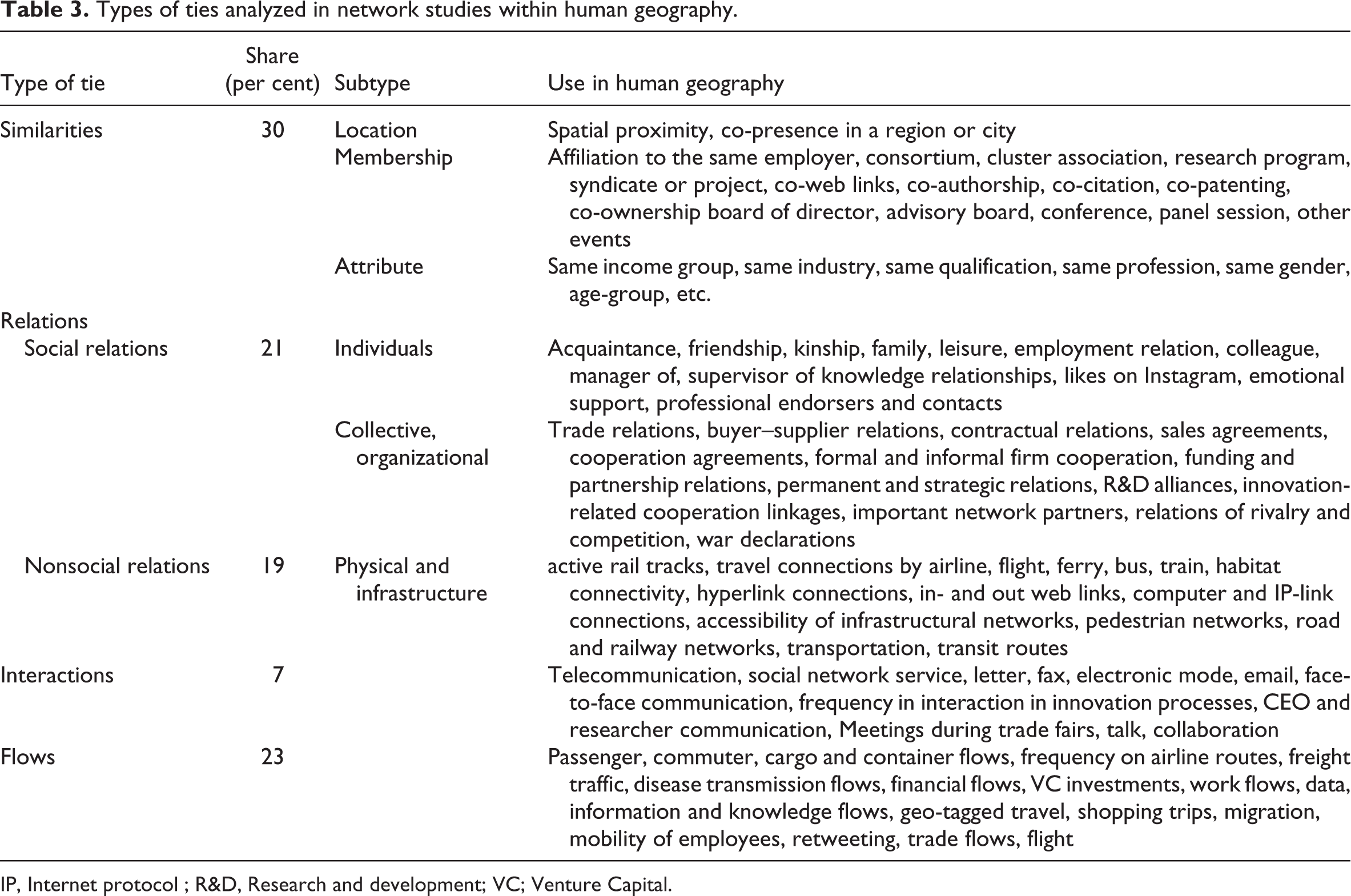
IP, Internet protocol ; R&D, Research and development; VC; Venture Capital.
It is a shortcoming in some contemporary network research to disregard the logical differences between distinct types of ties and to make unjustified assumptions and inferences. Examples from innovation studies and global city research, so far two major fields of application of network analysis, illustrate the problem of sometimes unsubstantiated meaning ascription. First, in innovation studies, scholars sometimes observe co-membership of people in the same project, yet they interpret this similarity as a case of interaction although it is not evident that any information was ever exchanged. Sometimes, research consortia can grow very large, where only a small group of participants actually engages in interactions. A second example is found in studies on global city networks. Whereas the observations are either similarities, for example, the co-occurrence of corporate subsidiaries between cities, or flows of people, for example, passengers traveling between the cities, scholars often tend to overload the meaning of these types of ties by ascribing higher order social relations (power, dominance, hierarchy). Smith (2014) offers a succinct critique of this research practice by pointing to the conceptual incongruence between the measurement of similarities and their interpretation as ‘command and control’ structures. In addition, these studies face a multilevel problem by attributing these meanings to higher order types of nodes (from individuals or corporate branches to cities or to countries). The validity of such an upscaling of meaning to aggregate higher order levels would require empirical analysis and theoretical justification in their own right. These meaning ascriptions are cases of unjustified correspondence between the referent and the reference, to frame it in semiotic terms, where author-constructed relations of similarity are assumed to represent the meaning of real social interaction.
A similar problem of multiple meaning ascription to the same observation becomes apparent in innovation network studies. Co-occurrences of applicants or inventors in patent statistics, for instance, have been interpreted as social relations of co-ownership (Belderbos et al., 2014) and as flows of information between individual inventors (Breschi and Lissoni, 2009) as well as between collective organizations (Jaffe and Trajtenberg, 2002). All these interpretations are surfing on the same initial observations, yet their meanings are diverse, which ultimately affects the logic of theorizing the nature of the network. So far, the meta-analysis conveys that a substantial number of network studies in human geography have focused on nonsocial relations. Almost a third of all studies looked at similarities, such as spatial proximity or co-membership in specific categories, 19 per cent on nonsocial relations, for example, between websites or road infrastructure, and another 23 per cent looked at flows of information, finance, or commodities mostly between nonsocial actors such as cities or regions. Less than a third of all studies actually studied truly social relations (21 per cent) and social interactions (7 per cent).
One fundamental advantage of network analysis is that it allows for bridging the micro–macro divide between individual agency and social structure. This is facilitated by analyzing data on three different levels: the node level of individual or collective agency, the intermediate level of subgroups such as cohesive communities or clusters of equivalent relations, and the macro-level of the network as a whole. Our meta-analysis suggests that research in human geography is still constrained in describing the node level of networks or their relative amount or distribution within the studied network population (e.g. network density or centralization); 40 per cent of all studies make terminological reference to the analysis of the location of nodes in networks and most of these studies on the measure of centrality (Table 4); 32 per cent of studies refer to analytical descriptions on the network level that account for the amounts of ties in comparison to the number of nodes (e.g. density) rather than real structural properties. Recently, however, the literature has emphasized that the huge potential of using the structural information of the entire network to gain more complex insights into the logic of connectivity between nodes, such as divisions of labor or core-periphery structures, has been largely left unexhausted (Glückler and Doreian, 2016). Fruitful techniques of network-level studies such as positional analysis (blockmodels) or the analysis of small-world structures (modularity) have been applied only recently in human geography (Etxabe and Valdaliso, 2016; Glückler and Panitz, 2016; Henderson and Alderson, 2016; Prota, 2016; Tomasello et al., 2016).
Level of analysis.a
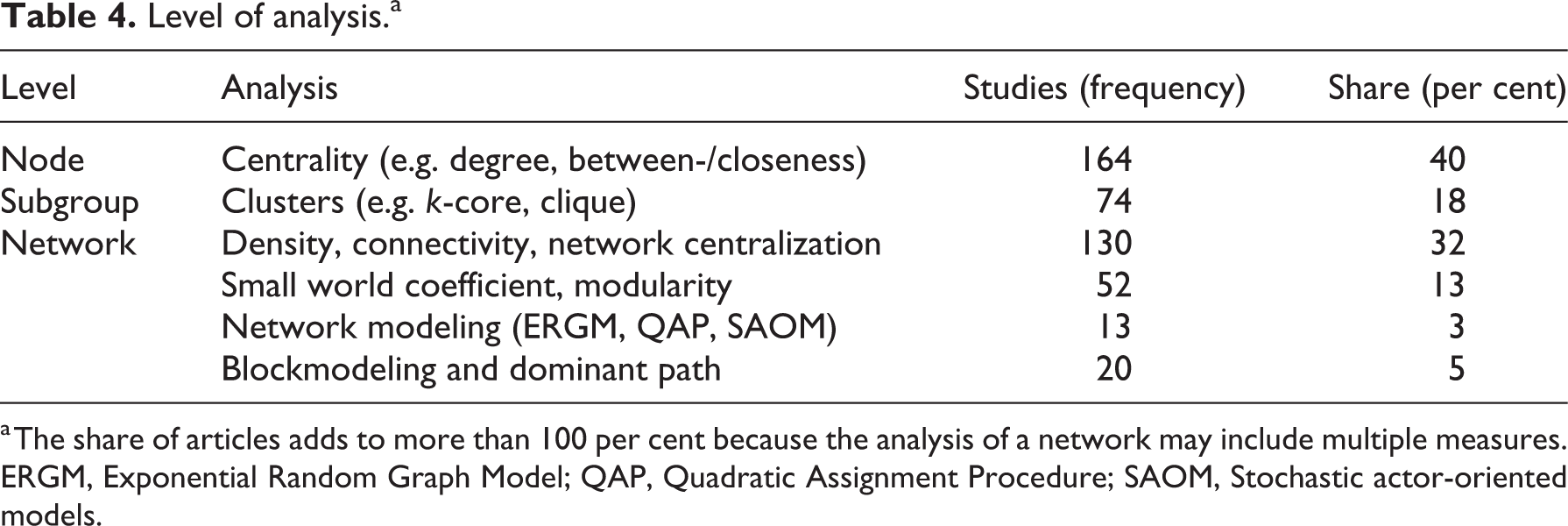
a The share of articles adds to more than 100 per cent because the analysis of a network may include multiple measures.
ERGM, Exponential Random Graph Model; QAP, Quadratic Assignment Procedure; SAOM, Stochastic actor-oriented models.
Overall, network research in human geography has tended toward the analysis of nonsocial linkages between nonsocial nodes with a smaller share of work really looking at proper social networks of social interactions and social relations. Moreover, the majority of studies have concentrated on the node-level while missing out potential insights into the structure of subgroups and the network as a whole. The true potential of network analysis to support relational thinking in building theories of social networks still has to be unleashed.
2 Methods of Data Collection
The quality of coverage of a phenomenon as well as the validity of the meaning of the observations depends on data and the methods of data collection. According to our meta-analysis, secondary data collection has been prevalent in most network research in human geography. This form of empirical research offers the advantage of gathering information on large networks and reduces the problem of missing data (Ter Wal and Boschma, 2009). Four in five studies (84 per cent) drew on existing databases, for example, patent or publication databases, official documents, or interaction data from social media platforms. Network sizes vary between 3 and 1,000,000 nodes with a mean network size of 8039 nodes (Figure 1). Studies using secondary data to construct networks of smaller size often focused on aggregated relationships and connections between territories, such as world regions or countries. Large networks, on the other hand, are often constructed from similarities between individuals or organizations based on secondary data, such as co-publications (Van Meeteren et al., 2016), co-patenting (Graf and Henning, 2009), board memberships (Carroll, 2009) or comments, likes and re-tweets of entries in social network platforms (Boy and Uitermark, 2017). However, they come with some limitations. Large-N secondary networks (LNSNs) face problems of meaning and construct validity: to what extent do the stylized data represent the constructs of interest? For instance, do similarity relations of co-patenting validly represent the co-creation and sharing of knowledge between the involved actors? An extreme case of how LNSNs are likely to misrepresent the ‘true’ social networks are social media data (Ruths and Pfeffer, 2014): a population bias toward younger generations, opacity of data procession by the platforms, the inclusion of nonhuman actors, such as bots or spammers, and unknown criteria for limitations in access to these data altogether pose problems to interpret the network data as real social relations. This example also points to the problem of data procession: to what extent do multiple conversions, for example, symmetrization and dichotomization, distort the meaning of the original observations? Moreover, how does a quantitative secondary study control for the institutional and geographical context of a social network? Finally, another limitation to validity is the lack of reflexivity pointed out earlier. Collecting relational data without the conscience of the observed actors is exempt from conversation and engagement between the researchers and researched. Overall, while LNSN are good at capturing connectivity and gaining good coverage of a population, they are at risk of falling short on authenticity and internal validity. Hence, secondary relational data require careful validation with respect to construct validity
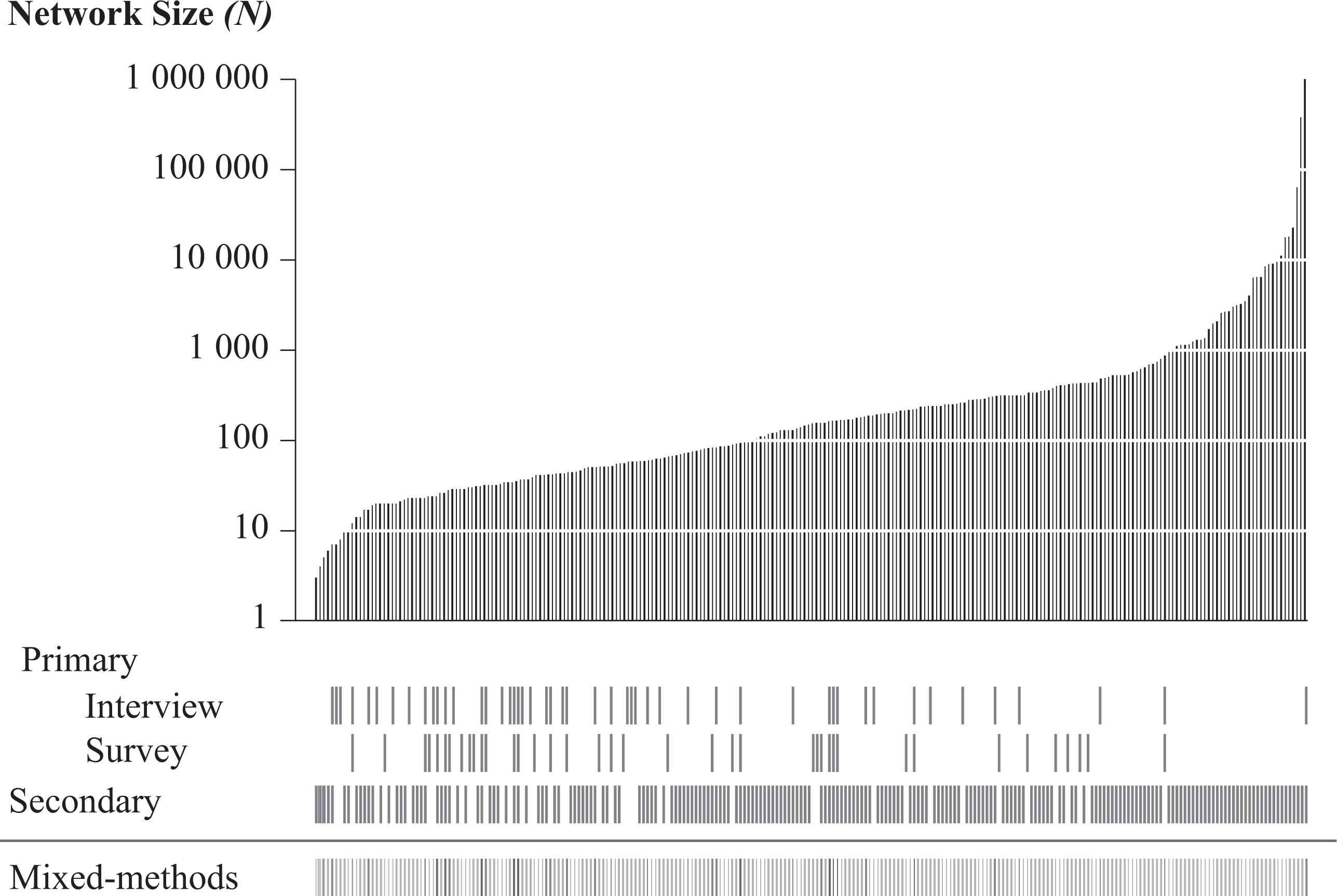
Methods of data collection and size of networks.
In turn, primary network research enables one to identify and accurately understand social relations in close interaction with the field. The aim of primary data collection is to identify the qualities of relationships considered to be constitutive for a social network. It allows the observation of informal relationships such as giving advice (Lazega et al., 2012) or sharing expertise (Reagans and McEvily, 2003; Reagans et al., 2005) and thus detaches itself from the stylized facts of co-occurrences in patents, projects, and locations. This procedure automatically forces the researcher to immerse himself in the field. It opens up the possibility to raise the authenticity of the representation of a social network. However, the downside of primary data collection, no matter if conducted through interviews, participant observation, or surveys, is the level of nonresponse and incomplete coverage of the network population. Accordingly, our meta-analysis illustrates that small-N primary networks (SNPNs) include smaller networks with an average network size of N = 174 in the case of network surveys with average response rates of 69 per cent. This is more than 45 times smaller than the average network size of secondary network studies. In the case of interview-based data collection, the average network size was difficult to correctly assess because often the size of the studied population was often left unmentioned. Critical questions arise: to what extent can primary data collection capture large empirical networks? To what extent can interviews and surveys achieve a full network census? To what extent can network ethnographies account for the effects of a network structure? SNPNs are conducive to creating authentic and meaningful representations of a context, yet run the risk of scoring low on connectivity and external validity.
Issues of internal and external validity become apparent in many studies that rely exclusively on a single-method research design. Latent problems associated with this research practice are an incorrect representation of constructs (thin data, construct validity), incomplete data coverage (missing data), inappropriate procedures, and unjustified interpretation of findings.
IV Combining Methods for Meaningful Relational Analysis
There are many and often conceptually overlapping criteria to assess the quality of empirical research. Essentially, an empirical piece of research should meet both the standards of internal and if intended, external validity (De Vaus, 2001). To be internally valid, the design needs to define valid constructs that measure what they mean to measure (construct validity), collect and represent meaningful (authenticity) and relatively complete observations (coverage), employ rigorous and proper procedures for analysis (rigor, reliability), and come to valid interpretations of the findings. To be externally valid, the analysis needs to be representative of a larger population (representativeness), which in the case of social networks is a fundamental problem due to the violation of statistical independence between the observations (Abbott, 1998; Sayer, 1992; Wasserman and Faust, 1994). Following the arguments of relational geography, a belief in the contextual nature of social networks contradicts the possibility of generic generalizations (Bathelt and Glückler, 2018; Ettlinger, 2001; Mische, 2011; Mische and White, 1998; Pachucki and Breiger, 2010). Instead of generalizing universal regularities, a relational theory aims to decontextualize abstract principles from its context of study and to potentially transfer them to other cases by means of translating these principles into their contexts. Such a technique corresponds with the critical realist distinction between necessary and contingent conditions, where most social mechanisms and processes are held to depend on contingent relations (Archer et al., 1998; Sayer, 2000).
To systematically trade-off the limitations of ‘meaning’ in large-N studies with the limitations of ‘structure’ and of data coverage in small-N studies, it seems more appropriate to combine different techniques in mixed-methods designs. Mixed-methods approaches offer the opportunity to trade-off the advantages of connectivity, contextuality, and reflexivity as discussed in the sections above. The combination of quantitative and qualitative methods, in particular, has the potential to complement knowledge about relational form, that is, connectivity, and relational content, that is, meaning and context (Crossley, 2010). Following from our previous comparison of the strengths and weaknesses of large-N quantitative and small-N qualitative network studies, qualitative methods are appropriate for reconstructing and understanding the meanings that actors ascribe to their actions and social relations. Interpretative methods are particularly suitable for network research to reveal the contextuality of goals, interests, attitudes, action orientations, practices and significant effects in addition to quantitative methods of social network analysis and to use them to interpret the formal structure. Many of the concepts used today in formal network analysis actually originated from qualitative research, for example, the concepts of density, cliques, or clusters (Domínguez and Hollstein, 2014).
Qualitative research is also useful in the absence of historical data to reconstruct and theorize the dynamics of social processes. Assuming that history and experience matters, the lack of knowledge about that history will not allow us to assess its impact on the presence. This is true for any method, and of course also for social network analysis. The only alternative to historical data is to build theory about mechanisms that constitute the processes, which are consistent with an observed outcome. In this case, we can identify these mechanisms in a current structure and draw inferences on past processes. Theoretical approaches such as path-dependency (Martin and Sunley, 2006) or imprinting (Marquis and Ticsik, 2013) are promising frameworks to inform the rising field of dynamic and evolutionary network analysis. Within our meta-analysis, only 24 per cent of all articles (77) included a time dimension of the studied networks. Of them, over 90 per cent draw on secondary data. This reflects the empirical limitations for theory building based on historical data as such information is quite rare and often traces only the quantitative aspects of relationships. An obvious example is organizational membership. Although we might know when a person has become a member, we do not know about the person’s actual activities. Often people are officially a part of an organization without any active role. Such activity levels change over time and thus change the quality of the relationships. It is here where mixed methods using qualitative and quantitative methods are especially valuable to capture the quality and the history of relationships.
Despite its potential, the use of mixed-methods has been an exception rather than a rule in network research within human geography over the last decades. Combining qualitative and quantitative network analysis in mixed-method designs is still an emerging field (Crossley, 2010; Crossley and Edwards, 2016; Domínguez and Hollstein, 2014; Edwards, 2010; Glückler et al., 2020; González Canché, 2019; Nooraie et al., 2018). Recent approaches range from network ethnographies (Berthod et al., 2017), cultural network approaches (Edelmann, 2018), and the use of participant observation in formal network analysis (Conti and Doreian, 2010) to the ‘quantitization’ of qualitative content (Williams and Shepherd, 2017). In the meta-analysis, only a small share of studies used multiple methods to analyze networks (Table 5). These mixed-methods studies collected data from diverse primary sources, including interviews, mental maps, activity diaries, and questionnaires, and also from diverse secondary sources such as private and official databases, online social networks, documents, e-mails, or websites. Predominant rationales for the mixing methods were to explore a phenomenon from different angles, to validate observations, or to interpret an empirical finding in the light of a theory (Table 6).
Sources of relational data in 318 network applications in human geography (1990–2018).
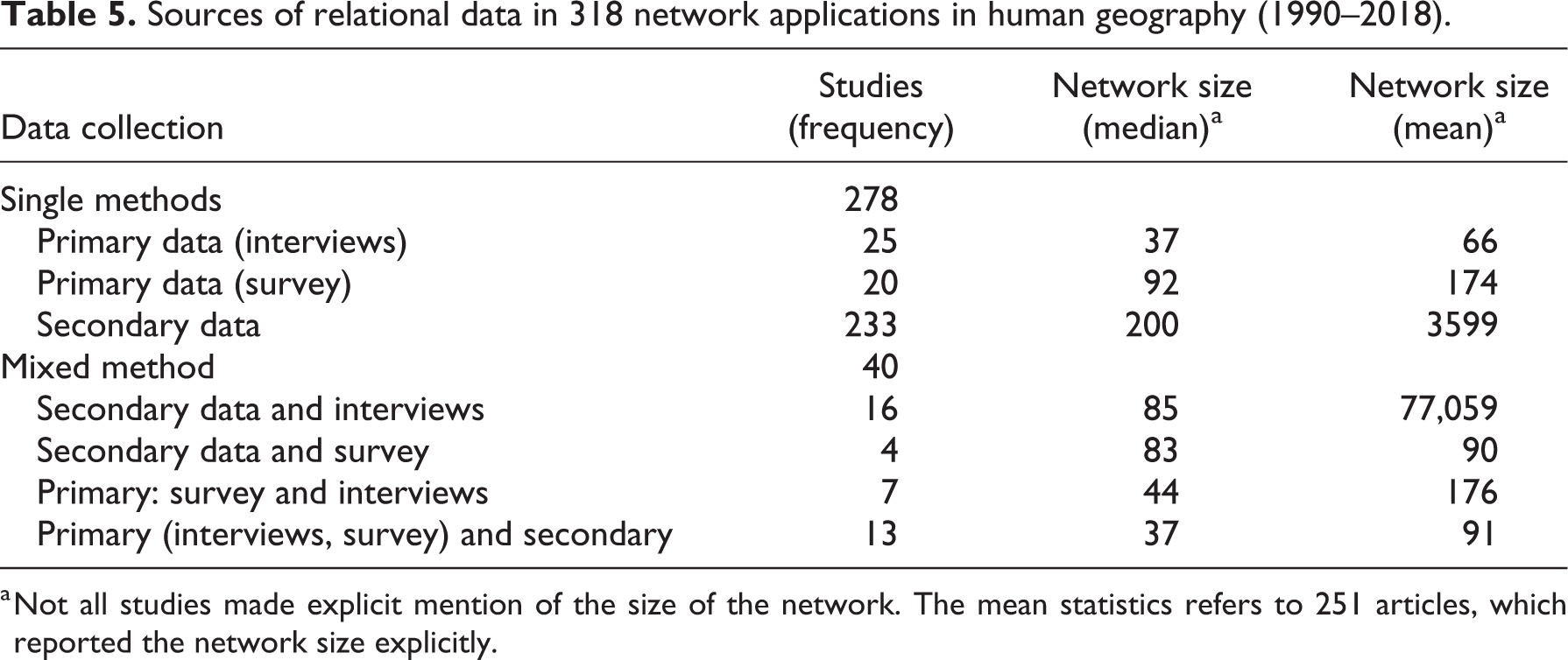
a Not all studies made explicit mention of the size of the network. The mean statistics refers to 251 articles, which reported the network size explicitly.
Aims of mixing methods.
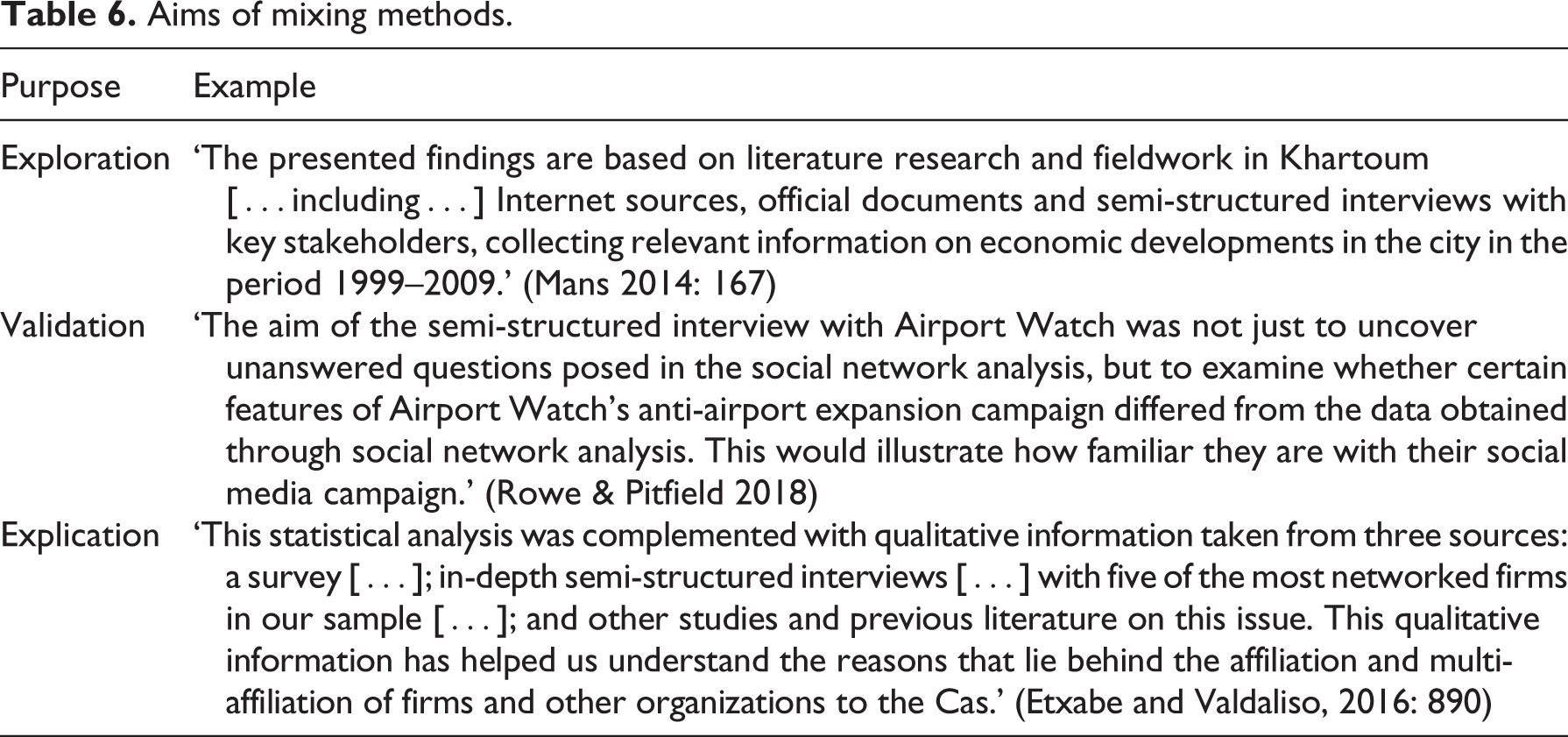
However, many multiple-method studies actually fail to combine the strengths of mixing methods as they use them in isolation from each other. For example, a comparative analysis of two regional cases each with different methods is not a mixed approach that contributes to cross-validation because it applies different methods to different observations in different contexts. At one end, we observed cases in which the main source of data collection were secondary databases, and only one interview was used to qualify the approach as mixed methods. Fortunately, at the opposite end, we also found articles that used mixed methods to conduct multiple triangulations: ‘Mitigation strategies included triangulation of data through physical observation, pilot interviews to test and refine the questionnaire, use of skilled translators, audio recording of interviews (with consent) and use of independent translators to transcribe interviews’ (Chaudhury et al., 2017).
There are three general designs of mixing methods in social network research (Edwards, 2010): First, in a sequential design, either qualitative research or quantitative SNA is used as a starting point to then validate findings with subsequent use of complementary research techniques. Second, in a bifocal approach (Coviello, 2005), scholars rely on qualitative methods during data collection to capture the differential meanings of social relations, whereas they mix quantitative and qualitative methods only at the stage of data analysis. Third, qualitative and quantitative methods are used at both the stage of data collection and the stage of analysis to attain the full benefits from triangulation, a strategy adopted, for instance, in the ‘Situative Organizational Network Analysis’ approach (Glückler et al., 2020). Whereas this typology refers to different types of sequencing and mixing of qualitative and quantitative methods, we would like to highlight three strategies for trading-off the tension between structure and meaning and for ensuring internal validity and potential transferability of research findings on meaningful social structure. All these strategies involve the use of various methods either in parallel or sequential ways of mixing.
(i) Informed prespecification: In line with relational thinking in human geography, this strategy aims at actively integrating the already existing substantive understanding of a particular research context into the specification of a formal network model (Brusco et al., 2011; Doreian et al., 2005). Both the contextual conditions and the researcher’s knowledge about this context are crucial to capture the specific social meaning of a particular network. Sometimes scholars have spent many years researching a community, region, or industry and have adopted a deep and intimate understanding of manifest and latent processes. Such prior contextual knowledge then permits the researcher to theoretically justify more formal analysis of network structure and even allow for the formulation of empirically grounded hypotheses and meaningful models (Glückler and Panitz, 2016; Prota, 2016).
(ii) Triangulation: Triangulation denotes ‘the combination of methodologies in the study of the same phenomenon’ (Denzin, 1978: 291) in a way that potentially compensates for the blind angles of individual methods and thus strengthens the rigor of the research process. The advantage of triangulation is that the overlapping of different methods compensates for the limits of single techniques and controls for method-dependent variations in the observation of a phenomenon. Ideally, then, triangulation facilitates the confirmation of the same finding through different observational or analytical techniques. Contradictory results obtained through different methods, on the other hand, offer the opportunity of searching for more context-specific explanations or pose new and original research questions (Jick, 1979). Triangulation can take many forms and involve parallel as well as sequential mixes of methods. A sequential approach may be helpful to first explore the variety and meanings of interactions and relations in a particular context and then select and devise appropriate items and categories for the systematic collection of relational data in a second step. The classic study on the paradox of embeddedness (Uzzi, 1997) is one example of this strategy, where ethnographic interviews served to grasp the meanings of interfirm collaborations, whereas a standardized secondary data set served to assess the impact of the structure of these collaborations on firm survival.
(iii) Communicative validation: A third strategy to enforce the internal validity of social network research is communicative or member validation (Guba and Lincoln, 1989; Seale, 1999). This strategy has two advantages. First, it exposes the researcher’s interpretations and conclusions to the views of the observed network actors. By engaging in conversation, both researchers and the researched individuals get the opportunity to question, challenge, and eventually reinterpret the meanings of the findings. Second, by reporting to and engaging with the network actors, the researchers can live-up to their ethical responsibility (Tubaro, 2019). Communicative validation should be a reflexive process avoiding unequal, exploitative, or nonserious conversation. The reflexivity of this process ‘refers to the constant backward and forward confirmation between the researcher and the participants under study in regard to re/constructions of constructions of the participants’ (Cho and Trent, 2006: 332). Only by engaging with the researched can network researchers become aware of and responsibly intervene in the intended and unintended performative effects of any research findings on the future relational behavior of people in their particular context.
When examining the body of literature covered in the meta-analysis for use of these validation strategies, we found only two articles referring to ‘pre-specification’ to support the validity of their constructs and models, 16 that referred to ‘validation’ and 15 that referred to ‘triangulation.’ A closer review of these articles suggested that several of these papers only referred to these strategies in a discussion rather than actually implementing them empirically. The number of studies reduced even further by employing a strict understanding of triangulation as a form of cross-validating constructs and phenomena through the use of independent methods for multiple observations of the same issue. However, taking into account that pre-specification, triangulation, and communicative validation may also be employed without explicitly referring to these terms, we acknowledge that it is difficult to screen the entire literature for a conclusive assessment. Instead, in Table 7 we got back to all articles in our sample that reported the use of multiple methods and checked for multiple or repeat observations as a means of cross-validation. Whereas the vast majority of 278 articles (87 per cent) had used single-method designs without between-method triangulation, the remaining 13 per cent of articles focused on repeated observations of the same nodes (5 per cent) or the same type of tie (5 per cent) or both (3 per cent). Although examples of this ambitious triangulation practice are still rare, it is here, where we expect valuable potential for future empirical network research. Apart from a good understanding of the research context, careful selection of the measures and rigorous procedures, between-method validation techniques promise to help reconcile the conceptual tension between structure and meaning in future relational analysis.
Types of triangulation designs of node and tie observations.
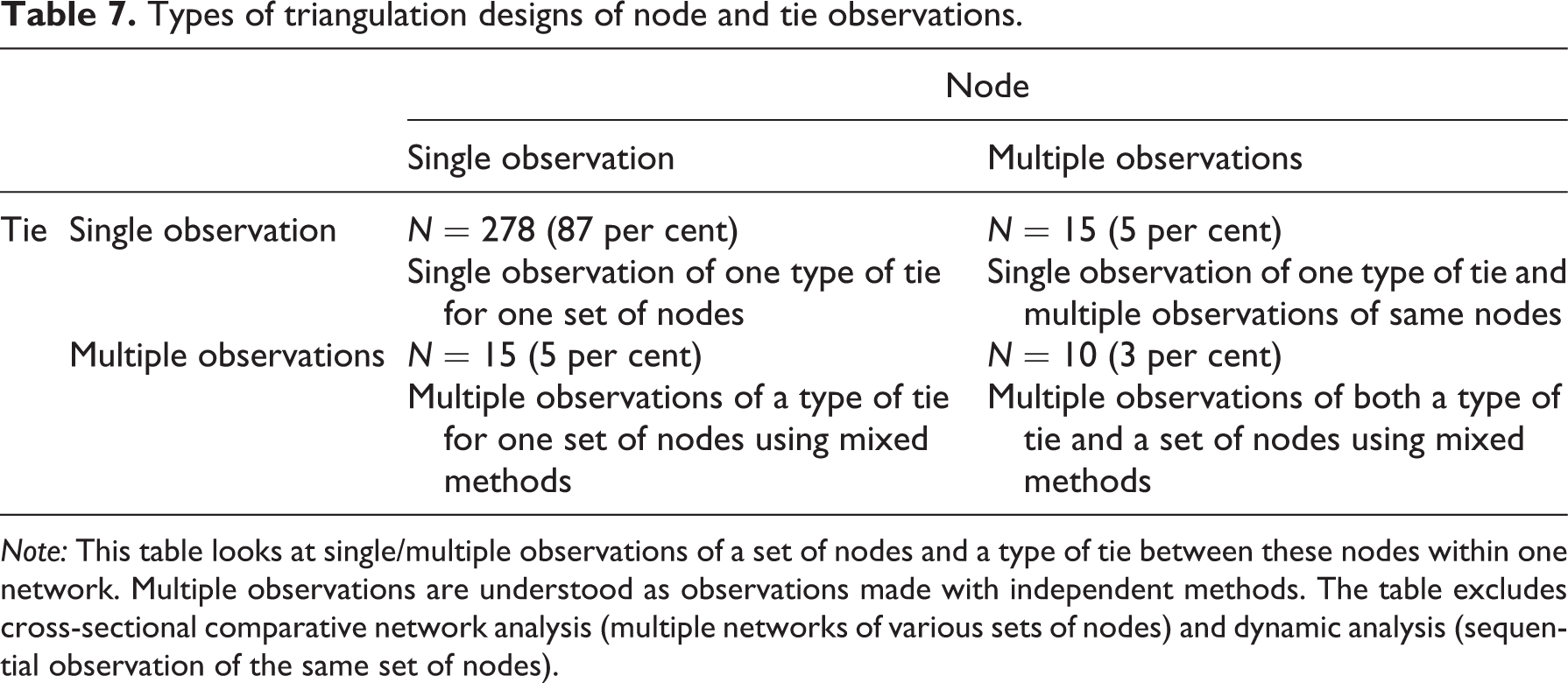
Note: This table looks at single/multiple observations of a set of nodes and a type of tie between these nodes within one network. Multiple observations are understood as observations made with independent methods. The table excludes cross-sectional comparative network analysis (multiple networks of various sets of nodes) and dynamic analysis (sequential observation of the same set of nodes).
Conclusion
We have assessed three challenges for relational analysis in our field. First, we have found network research to be rather method-driven and often limited to descriptions of network characteristics. Borrowing from Werlen’s (1993) critique of the quantitative revolution in the human geography of the 1970s, one could say that social network analysis has so far been an only half-way revolution, in which the development of theory has clearly lagged behind the innovation of technical methods. However, for network analysis to enhance relational thinking, it should be used to design alternative explanations of social phenomena and to develop middle-range network theories.
Second, relational analysis is situated in a tense relation between formalism and relationalism on the one hand (Erikson, 2013) and between the universality and contextuality of structural principles on the other (Hidalgo, 2016). While network science is interested in the universal principles of network characteristics and, hence, deliberately compares apples with oranges, social network researchers are confronted with the problem of context-specific connections of meaning and therefore contingent social effects of otherwise identical network characteristics. Relational analysis only realizes the full value for relational theory if it succeeds to capture the topological characteristics of networks as well as their contexts of meaning (Pachucki and Breiger, 2010). This requires both a constructive exchange with relational approaches outside formal network analysis and in-depth field access, which is not limited to the processing of secondary data but seeks a qualitative understanding of the subject through mixed-method approaches.
Third, relational studies in geography have mostly contributed to node-related theorizing: how do people gain prestige, how do they get into central positions? What are the advantages (disadvantages) associated with central (peripheral) positions and which positions lead to what yield of social capital? In innovation research, in particular, node-based network theories such as structural holes or structural folds have been established. In contrast, network-related questions are still in their infancy. They relate to the underlying structural logic of the whole network and examine the constitutive significance of the overall structure, its evolutionary dynamics, and its collective antecedents and effects. Although methods such as blockmodel analysis or the analysis of dominant paths have been developed since the 1970s, theory-informed research on the internal structural logic of the division of labor in organizations, markets, and industries; on center-periphery structures in local and global production systems; or on the analysis of technological development paths is still rare.
Finally, and regarding the very research practice, the non-neutral position of network researchers combined with the performative effect of their research on the field requires reflexivity and ethical responsibility. Responsible social network research should comply with legitimate ethical guidelines (Borgatti and Molina, 2005) and include responsible strategies for sharing and disseminating research findings into any research design (Tubaro, 2019). Here, it is crucial to account for the meta-politics in network studies and big data analysis, including big data networks, and their tendency to overemphasize the constructive, functional, and beneficial opportunities while neglecting their constraints and negative impacts (Kitchin, 2013; Scott, 2015).
It is also important to recognize the a priori limits of network research. If social networks describe the structure of meaningful social relationships, then network research, like any other perspective, must also encounter limits in its descriptive and explanatory power. For example, people do not learn exclusively through interaction and social relationships, but also through noninteractive processes, that is, through distant observation and imitation, trial and error, or the consumption of media content (Glückler, 2013; Malmberg and Maskell, 2002). Accordingly, we cannot explain information, innovation, and learning processes solely by analyzing relationship structures. On the one hand, this insight implies that social network research cannot claim a universal explanation. On the other hand, it evidences that a relational perspective cannot be reduced exclusively to the formal analysis of social relationships but remains open to methodological pluralism because it should ultimately be a theoretical project.
Footnotes
Declaration of conflicting interests
The author(s) declared no potential conflicts of interest with respect to the research, authorship, and/or publication of this article.
Funding
The author(s) received no financial support for the research, authorship, and/or publication of this article.
