




Abstract
Geography studies the world. Our knowledge of the world, however, comes mostly from Anglophone sources. This makes Geography in urgent need of worlding – of including multiple voices and languages from around the world. Introducing the notion of linguistic privilege, the article establishes language as an important dimension of epistemic struggle, alongside gender, race, class and others. Its analysis finds the greatest linguistic privilege in the most influential positions in knowledge production – editors of handbooks and journals and authors of progress reports. Three strategies of worlding should challenge this: making gatekeepers multilingual, promoting multiple Englishes and valorising ex-centric knowledge.
I Introduction
In late 2004, I received the reviews for the first paper I had submitted to an English-language academic journal: Reviewer 1 I have tried to make sense of this paper but have to admit that that task has broadly defeated me. There are three problems. First, the standard of English is not very good. Second, the author uses a lot of statistical terminology, including descriptions of statistical tests, which are less than transparent and which I am not sure are necessary. Third, too much is attempted in the paper and as a result nothing is explained properly.… Reviewer 2 Overall, this is a poorly written paper and written more as a report than a contribution to a serious academic journal. The paper is not produced in a professional way – no paragraphs, text ending in the centre of pages as sections come to an end. The paper reads like a very rushed effort and the results have not been fully digested by the researcher.…
I had written in English, a foreign language I had learnt in school. That had not deterred me. I was passionate and confident about my English and positive about speaking to a larger, international community of researchers in a language that was not my own – until I received the reviews above. Let me be clear: I think the reviewers were right about rejecting the article. But they rejected it for the wrong reasons: my ignorance of Anglo-American academic conventions of knowledge production.
This article takes issue with the broader challenge that transpires through this vignette; the challenge of moving from a situation of linguistic privilege to worlding Geography. By worlding I mean opening up Geography, as a discipline with capital G, to those multiple unsung and untold places and voices that hide beyond the reach and grasp of current Geography and its privileged medium of English as a language. It implies bringing those worlds, those global anywheres and the voices seeking to represent, evoke and speak for and with them into the conversation, yet without pressing them into premoulded logics and debates. The endeavour of worlding inscribes itself in the clarion call to decolonise geographical knowledge (e.g. Jazeel, 2016; Naylor et al., 2018; Radcliffe, 2017; Sultana, 2019) and to theorise from the Global Souths (de Sousa Santos, 2014; Grosfoguel and Hernández, 2012; Mbembe, 2000; Roy, 2009), the Global Easts (Chen, 2010; Müller, 2020; Tlostanova, 2018; Wang, 2014) and other multiple anywheres (Miraftab, 2016; Robinson, 2016).
What makes this worlding difficult is the linguistic privilege that accrues from the dominance of English in geographical knowledge production. Linguistic privilege describes the advantages from the command of a certain hegemonic language, in this case English. It is complicit in a geopolitics of knowledge (Dussel, 1977; Grosfoguel and Cervantes-Rodríguez, 2002) that makes knowledge produced from certain locations, mostly in Anglo-America, ostensibly more universal, and therefore more valuable, than that produced in others. There is thus a geography to Geography (Gregory and Castree, 2012: xxv) in that not all knowledge in the world is created equal.
Linguistic privilege should worry us, and not just because many geographers like to think of their discipline as open, cosmopolitan and pluralist. After all, ‘the limits of my language mean the limits of my world’, 1 as Wittgenstein (1922: 56) would have it. Linguistic privilege, by contrast, reduces the diversity of thought that we can learn of and from. What is more, it puts native (and near-native) and non-native speakers on unequal footing, not just with respect to the odds of getting published, but, even more so, with respect to getting read, cited and – that most prized thing of all – making a difference in academic debates.
This article conceptualises language and linguistic privilege as an important element of epistemic struggle and assesses the extent of linguistic privilege in geographical knowledge production. The first part shows that language, and the attendant question of linguistic privilege, is a central category of difference – alongside race, class, ethnicity, gender and others. Language has manifold implications for knowledge production that are crucial not only, but particularly for a Geography with a decolonial thrust: Who can speak and who can be heard? From where in the world can we speak with authority and from where less so?
The second part examines the extent to which linguistic privilege is present in essential gatekeeping positions in the production of geographical knowledge in reputable Anglophone journals, in handbooks or companions that represent different subfields of our discipline and in the progress reports in Progress in Human Geography that summarise the state-of-the-art of debates. The third part explores three ways of worlding Geography that are aware of linguistic difference and seek to redress linguistic privilege. It proposes to promote and monitor linguistic diversity among editors, editorial board members and invited authors. It suggests to work towards English as a multilingua franca or Englishes in the plural. Finally, it calls attention to the need for engaging with multiple knowledges by citing and reading authors from global anywheres.
The three parts mirror the three contributions that the article makes to current debates on knowledge production and decoloniality in Geography. First, it introduces language as an important category of difference that has not received much attention, although linguistic privilege creates uneven epistemic landscapes. Second, it provides unprecedented data on the extent to which linguistic privilege is present in geographical knowledge production and how it has evolved over time. Third, it suggests ways of tackling linguistic difference for the decolonial project to move forward.
II How Linguistic Privilege Shapes Knowledge Production
1 The Geopolitics and Body Politics of Knowledge Production
How we can write and what we can write depends on where we write from. This insight, a key refrain of feminist, critical race and post- and decolonial scholarship (Anzaldúa, 1987; Haraway, 1988; Lugones, 2010; Mohanty, 2003; Pulido, 2002; Quijano, 1992; Tlostanova, 2015), has become a crucial tool of a critical interrogation of the construction of geographical knowledge and canon. Geographical knowledge is not neutral – it is gendered, racialised, sexualised and classed. There is a geopolitics of knowledge where different locations in the larger planetary force field of political and economic relations have uneven chances to participate in knowledge creation (Dussel, 1977; Grosfoguel and Cervantes-Rodríguez, 2002). But there is also a body politics of knowledge, since through our bodies we are positioned in an affective force field of love, hate, disgust and so on that shapes our knowing of the world (Ahmed, 2012; Anzaldúa, 1987; Fanon, 1952; hooks, 1984). All of us therefore inhabit different positions in knowledge production; positions that make it easier or harder for our voices to resonate.
Gender, race, ethnicity and several other categories of difference create structural inequalities at all stages of higher education and research, from getting into university, to graduating, moving on to a doctor of philosophy (PhD) and then securing a postdoctoral position and, eventually, tenure. Access to university, and to elite universities in particular, is more difficult, for students from minority ethnic and racial backgrounds (Bhopal, 2017; Faria et al., 2019). Even when these students get into university, their chances of obtaining outstanding marks are lower than those of majority background students. What is more, these students are often faced with the epistemic violence of a curriculum that reflects a white, male, colonial history of their disciplines and the world at large (Bhambra et al., 2018; Heleta, 2016; Sultana, 2019).
Similar structural inequalities are at work in academic knowledge production. Chances of becoming a scholar will depend on one’s class, ethnicity, gender and so on. Getting a PhD at an Anglophone institution, often the entry ticket to Anglophone academic knowledge production, will require substantial sums of money, language competence and a significant degree of acculturation with Anglophone norms and conventions. Thus, the racial and gender make-up of geography faculty is skewed towards white men, with white women the main beneficiaries of recent ‘diversity’ programmes. There is still a long way to go towards racial and gender justice (Faria et al., 2019; Schurr et al., 2020).
Even where minority faculty have been hired, their research is often considered less valid and valuable than that of their majority colleagues and they sometimes carry a higher teaching and administrative load (Bhopal and Chapman, 2019). What is more, having been recruited as a scholar is no guarantee of being listened to. Sultana (2018) points out that the principle of free speech is unequally applied to serve dominant groups, while silencing those who would speak out against oppression and marginalisation.
Knowledge production is thus intensely political. It creates inclusions and exclusions, encourages to speak up and condemns to remain silent. This realisation has taken centre stage in the recent urge to decentre knowledge production in Geography, seeking to veer away from the dominance of a few countries in the Global North and of a white-male model of knowledge production. Whether couched as a decolonial imperative (Asher, 2013; Jazeel, 2017; Radcliffe, 2017), as theorising from the Global Souths or Easts (Müller, 2020; Parnell and Robinson, 2012; Roy, 2009), as opening up to ‘other geographies’ (Oswin, 2020) or as contesting Anglophone hegemony (García Ramon et al., 2006, and many others; see Minca, 2013; Paasi, 2005) – these projects share a welcome move to redress epistemic privilege. 2 Yet, such decentring cannot take place without reforming the modes of knowledge production and addressing how these create privileges and disadvantages, centres and margins.
2 The Blind Spot of Language and Linguistic Privilege
Sie können sich nicht vertreten, sie müssen vertreten werden. Ihr Vertreter muß zugleich als ihr Herr, als eine Autorität über ihnen erscheinen. (Marx, 1869: 89)
[They cannot represent themselves; they must be represented. Their representative must appear as their Master, as an authority over them]
Language is a central vector in unequal knowledge production. Yet geographers have had very little to say about it in comparison to other categories of inequality, such as race, class, gender, coloniality and ethnicity. That writing (and reading) presupposes a shared language, indeed, a whole publishing infrastructure, has been treated more as a fait accompli than as a fraught achievement. As a predominantly qualitative discipline nowadays, Geography should be particularly mindful of the challenge inherent in the qualitative social sciences and humanities 3 : that the weight of an argument often resides in the power to weave a persuasive narrative, which, as any good story, relies on shared narrative conventions, a shared cultural repertoire and the occasional eloquent turn of phrase to grip the audience.
A large part of this blind spot with regards to language is, of course, intrinsic to the constitution of Anglophone Geography. It will, by definition, not feature non-Anglophone voices, except those able to express themselves in English. 4 In one of the rare publications on the topic of linguistic privilege by an Anglophone geographer, Peake (2011: 764) aptly observes that this ‘privilege often goes unremarked upon’ (but see Helms et al., 2005). This should have us worry. After all, those who cannot write and represent themselves in English will be written about and represented by others, who will be instituted as their Masters – as the quote above from Marx’s Eighteenth Brumaire drives home. Linguistic privilege allows speaking with authority – for oneself and for others.
Linguistic privilege describes a situation where one gains social or economic advantages due to one’s socialisation in one particular language culture. 5 Using the term ‘privilege’ denotes the advantages accruing from language as something naturalised, often invisible and little remarked; advantages that do not result from ill will or even animus. As such, privilege describes the benefits flowing from a structural position rather than from individual actions (cf. the debate on white privilege Lipsitz, 1995; Pulido, 2000). 6 Linguistic privilege flows from more than simple language competence in terms of grammar and vocabulary. It refers to mastering the conventions of language as social practice in particular contexts, ranging from style, tone, register and narrative structure to social customs and, most importantly, cultural repertoires (Canagarajah, 2002). Linguistic privilege can exist for any hegemonic language in a multilingual context. In academic knowledge production, the global dominance of English has created linguistic privilege for English speakers, whereby the mastery of English, of the right kind of English, procures an intellectual and economic advantage.
Linguistic privilege creates deep economic fault lines. Bridging some of those requires time and money – scarce resources everywhere, but particularly in the Global Souths and Easts. The use of English confers an economic advantage on native speakers, as language researchers have demonstrated (Gazzola and Grin, 2013; Grin, 2004; van Parijs, 2011). In addition to struggling to be heard, non-native speakers incur multiple economic costs: paying for private English language lessons and language editing (between US$500 and US$1000 per article manuscript, since you ask), cobbling together money to spend your sabbatical in the UK or in the US to improve your language skills, having to decide whether to first write an article in your native language and then translate it or vice versa and having to decide whether to hire the language editor before the first submission or after acceptance of a manuscript. These are questions of little relevance to English native speakers but that vex many non-native speakers.
What is more, non-native speakers spend considerably more time on producing presentable prose. The time for acquiring facility in academic English is measured in years, full-time, not in months. It is time in which non-native scholars don’t read literature, don’t do field research, don’t go to conferences and don’t write and publish. In other words, it is time lost in terms of measurable output. Language learning also means embracing something that academic writing often does not tolerate: imperfection (Germes and Husseini de Araújo, 2016; Houssay-Holzschuch and Milhaud, 2013; Müller, 2007). Similar to social mobility that allows moving up the social ladder, linguistic privilege can therefore be acquired, given time and money, but only up to a degree. 7 This means that it exists on a sliding scale, beyond a facile binary of native/non-native speaker, depending on one’s acculturation and aptitude in language use.
More fundamentally, competence in English increasingly makes and breaks academic careers not just inside but also outside the Anglophone sphere. For many colleagues around the world today, publications in English is what their universities and funders require – for hiring, tenure, promotions and grant awards (by way of example, see Beigel, 2014, for the case of Argentina; Funk, 2017, for Russia; Hassink et al., 2019, for China; Mather, 2007, for South Africa; Minca, 2013, for the Netherlands; Ventsel and Struchkova, 2016, for Eastern Europe). As governments and universities embrace international rankings and bibliometric indicators as measures of performance in what has been called ‘academic capitalism’ (Paasi, 2005), the publication space in English-language journals – which feature disproportionately in indices such as those of Clarivate (formerly Thomson Reuters) and Scopus – becomes more and more prized. For many academics worldwide, publishing in English is no longer a choice, it is a necessity.
In this academic capitalism, a publication is not just an intellectual contribution to an academic discussion, but a unit of valorisation of academics’ labour – a commodity (Paasi, 2005). This valorisation is closely connected to the power of the Anglo-American publishing industry and its marketisation of knowledge for the purposes of profit and reinforced by the spread of rankings and indices, often set up, or at least endorsed, by these very publishers to entrench their market power. We are thus in a situation where international university rankings define that a good academic is whoever performs well in rankings that entrench English as the medium of communication (Jöns and Hoyler, 2013; Minca, 2013).
Yet, the political economy of publishing in English, powerful as it may be, provides only a partial explanation of the attraction of Anglophone academia. There is a whole imaginary of Anglophone academia that works at the affective level, making writing and publishing in English an object of academic desire and, conversely, devaluing research in other languages. Academics are not just forced to publish in English; many actively desire it. There is a prestige associated with writing in English, which imbues one’s work with a cosmopolitan air. Whereas other languages carry the whiff of the provincial, English comes with a veneer of the global and the metropolitan, owing perhaps to its success as a global lingua franca. This affective aura gives Anglophone research a universal appeal (Jazeel, 2016; Mufti, 2016: chapter 3), almost as though writing in English made a better, more desirable scholar.
3 The Paradox of the Decolonial Agenda
Colonial discourse and postcolonial studies have not been good with languages. (Spivak et al., 2006: 829)
The absence of debate with regards to language and linguistic privilege in Geography is curious, not just because it is so integral to the key practice constituting the academic profession: to writing. But it is also curious, concerning even, because it is such a central precondition to expressing difference and enunciating ex-centric academic subject positions in the decolonial project. As the epigraph by Spivak insinuates, postcolonial and decolonial research may have inherited the language imperialism of colonial powers that suppressed multilingualism in favour of the dominant colonial language. Mary Louise Pratt (2012) analyses how in the US monolingualism is not just an innocent outcome of history but a dogma, where speaking languages other than English suggests a lack of loyalty, even a threat to national security, as it might imply some sort of duplicity.
It is ironic that this situation of dogmatic monolingualism masks a history (and present) of multilingualism that is germane to any empire and to colonialism. Pratt (2012: 24) writes: ‘Colonialism produces a multilingualism structured in relations of domination and subjugation.…Settler colonialism, the kind that took place in the Américas (sic!), produces societies that are multilingual force-fields of conflict, collaboration, entanglement, coercion, resistance, proximity, and distance, in which multiple social orders coexist, with new institutions repeatedly layered on, and interacting with, prior ones’. Yet, monolingualism hampers a meaningful engagement with the ‘colonial present’ of Geography – those multiple geometries of colonial power and knowledge that structure our lives to the present day (Gregory, 2004; also Stoler, 2016). It also misses the multiple ways in which other languages are inscribed in spaces and places we study (Jazeel, 2016).
The mastery of English language culture is therefore the little remarked sine qua non of the decolonial project. Let us consider what Ramón Grosfoguel (2007: 212) describes as the three main tenets of decolonial thought: (1) expanding the canon of thought beyond the West, (2) dialogue between diverse critical epistemic/ethical/political projects, (3) taking seriously the insights of critical thinkers from outside the Global North and their racial, ethnic and sexual spaces and bodies. None of this can happen without shared sites of knowledge production, much less without a shared language. The very idea of having a canon requires that it be intelligible to the majority; the very idea of dialogue necessitates a shared language; and understanding the insights of others means being able to communicate them in an understandable language.
Where the calls for a decolonial agenda have been heard (and cited), scholars have written in, or at least been translated into, English – not in Māori, español, português, Gĩkũyũ, русский, српскi or 中文 (de Sousa Santos, 2014; Kušić et al., 2019; Mignolo and Escobar, 2013; Ngũgĩ wa Thiong’o, 1993; Pérez, 1999; Tlostanova, 2018; Tuhiwai Smith, 2013; Wang, 2011). Being recognised as an authoritative speaker is the key precondition for being listened to, and for making a difference eventually, however small. Yet, it is exactly that authority that is at risk, as one moves from one’s native language into English. Thus, one journal editor, commenting on non-Anglophone authors’ prose, suggested that ‘these people simply cannot write’ (Ventsel and Struchkova, 2016: 121). Academics without Anglophone linguistic privilege are thus barbarians in the ancient sense of the term, where βάρβαρος (bárbaros) in ancient Greek referred to those who did not speak Greek and were ignorant of Greek customs.
By adopting English as a language, and Anglophone knowledge production more broadly, the decolonial project therefore faces a paradox: its articulation in English risks perpetuating the very hierarchies it seeks to subvert. Linguistic privilege works against a multiplication of voices in Geography and calls for the ethical, epistemological and economic imperative of worlding Geography. It is thus important to assess the scope of linguistic privilege in knowledge production in Geography so as to better redress it.
III Methodology: Assessing Linguistic Privilege
To assess linguistic privilege in Geography’s knowledge production, I developed the research design in Figure 1. It includes three key sites of knowledge production in Geography:
– journals (presenting the latest advances in research), 8
– handbooks and companions (defining current knowledge in the field of Geography or a subfield),
progress reports in Progress in Human Geography (surveying the state-of-the-art of a subfield).
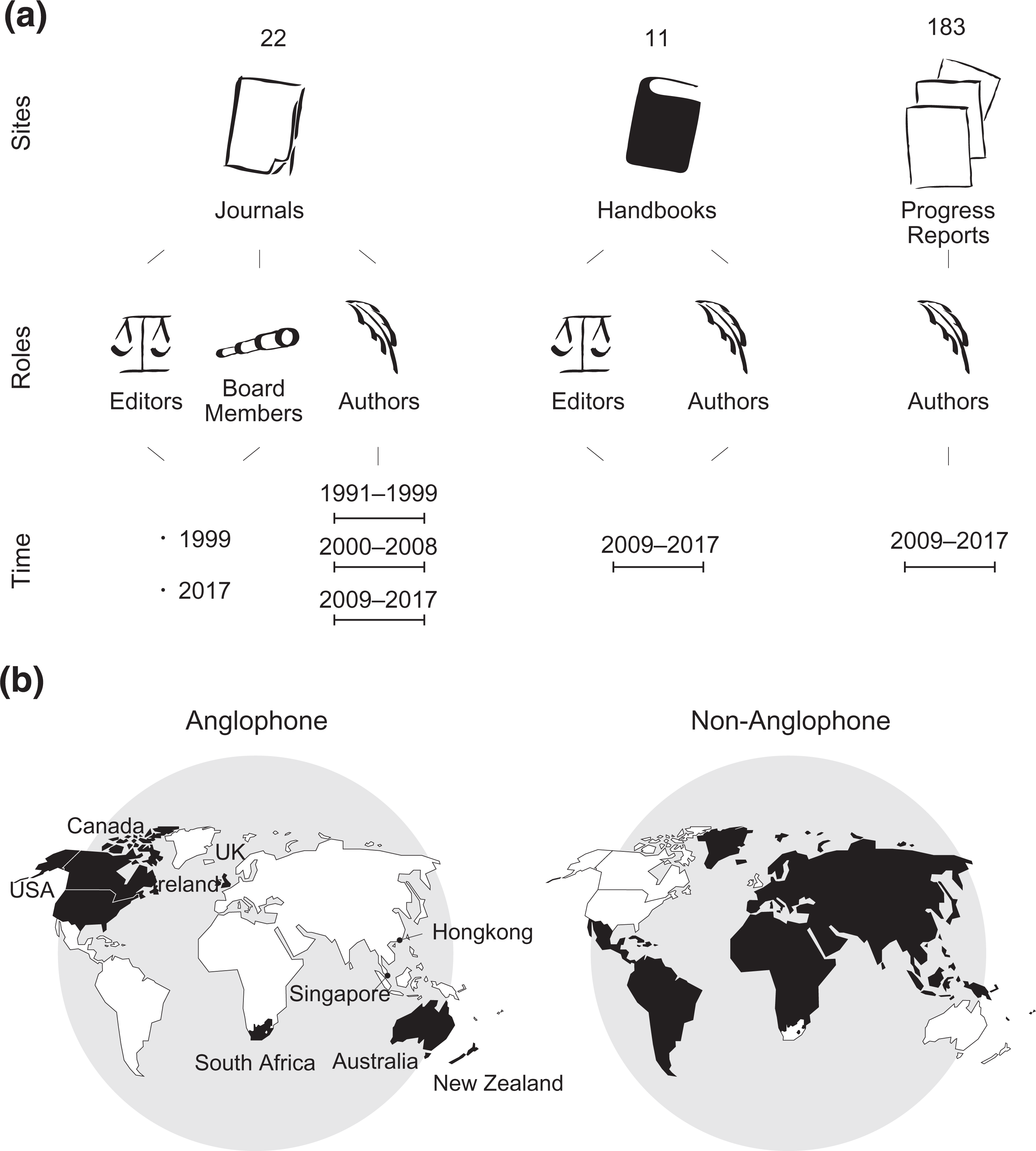
Research design to assess linguistic privilege. (a) Journals, handbooks and progress reports are the three major sites for which three roles were analysed: editors, editorial board members and authors. (b) Linguistic privilege was measured using country affiliation as a proxy, distinguishing between Anglophone and non-Anglophone countries.
The research design distinguished two key roles in these sites of geographical knowledge: author and gatekeeper. Authors are the producers of content (hence represented with a quill in Figure 1a), reflecting also their epistemic location. Yet, it is gatekeepers who decide which authors can write about what topic in what way and in what forum. There are two types of gatekeepers: editors, as the principal gatekeepers decide on whether to send submissions out for review, select reviewers and eventually accept or reject papers (hence represented with a scale). They can also invite contributions, which is particularly the case for handbooks and progress reports. Editors represent certain scholarly traditions and have a certain scholarly network, which makes them more open to some scholarly traditions and styles of writing a paper than to others – a phenomenon known as the homosocial effect (Metz et al., 2016). The members of the editorial board also fulfil a gatekeeping role, although more of an indirect one. For one thing, they serve as a business card of sorts for a journal, sending messages about what kind of articles might be welcome. For another, the editorial board represents the ‘eyes and ears’ of a journal (hence represented with a telescope), identifying prospective authors and reviewers and, as a sounding board, helping develop a journal in certain thematic directions more than in others.
While journal articles present a diffuse picture of the state-of-the-art, handbooks and progress reports have the express aim of consolidating the state of knowledge in the discipline or a sub-field. In their inclusions and exclusions, they are canon-forming, not least because they serve as a first port of call for researchers who seek their bearings in a new field. Handbooks and progress reports are curated by invitation, giving editors much greater leeway in determining their composition and making them amenable to actively intervening in the production of knowledge.
The research design allowed longitudinal comparison to track changes over time. It adopted a snapshot approach for editors and board members, comparing the composition of editors and boards in 1999 with that in 2017. Awareness around Anglophone hegemony in Geography started to develop in the early 2000s (e.g. García-Ramon, 2003; Minca, 2000; Ramírez, 2000; Short et al., 2001), so the choice of 1999 reflects a state before these debates will have had any influence on the composition of gatekeepers and authors. As awareness of language issues has grown since the 2000s, the choice of 2017 (the most recent year for which data were available) reflects a state where we might expect to see reactions to that debate, for example, in greater linguistic diversity among gatekeepers and authors.
The research design adopts a different temporal approach for authors, delimiting three 8-year periods to smooth out annual fluctuation. The first period starts in 1991 as the year in which the dissolution of the Eastern bloc ushered in a new period of academic globalisation. It runs up to 1999 to match the first snapshot of gatekeepers. The ensuing two periods (2000–2008, 2009–2017) were also delimited as 8-year periods to facilitate like-with-like comparison with the first period. The last period ends in 2017, to match the second snapshot of gatekeepers. For handbooks and progress reports, resources allowed data collection only for the period from 2009 to 2017, excluding longitudinal comparison for these two sites. 9
The country affiliation of editors, board members and authors was used as a proxy for linguistic privilege. A country was classified as Anglophone if English was predominant or at least equal to other languages in secondary school and university instruction (see Figure 1b). Thus, if a person was affiliated with an institution in an Anglophone country, this person counted towards the Anglophone group reflecting linguistic privilege. The higher the share of persons from Anglophone countries, the higher the linguistic privilege. The country affiliation is a common proxy used in other studies that examined Anglophone dominance in academic journals. Thus, Gutiérrez and López-Nieva (2001) analysed the composition of authors and editorial boards of 19 geography journals based on country affiliation, and Bański and Ferenc (2013) examined the six top-ranking journals by impact factor. In comparison to these studies, the present one features both a much wider selection of sites (not just journals but also handbooks and progress reports) and a longitudinal analysis.
This research design comes with at least four limitations for assessing linguistic privilege. First, the proxy of country affiliation is unable to account for mobility across countries and languages. Persons may have been socialised in a country whose language is different from that of the country they are working in now. Sampling suggested that the overall number of people who have moved into a country with a different dominant language is low. Moreover, there are about as many people who have left the Anglophone language area as have joined it, thus statistically cancelling each other out. Still, these mobile persons are of particular interest for the goal of worlding Geography, as they are often able to switch codes. I will return to them later, in the section on worlding.
The proxy is also unable to account for language diversity within a country, the second limitation. This makes invisible differential linguistic privilege in countries where multiple official languages are used (such as Belgium, Canada or Switzerland) or where there is one dominant language and several subaltern ones. That latter situation is of particular relevance in postcolonial and settler colonial contexts where the dominance of English and other colonial languages often marginalises Indigenous languages (Tuck and Yang, 2012). Third, the proxy is an imperfect measure of linguistic privilege because linguistic privilege is also influenced by race, class, ethnicity and other categories that are not captured in the research design. This is important because a shift away from Anglophone countries might simply mean a shift towards non-Anglophone European countries, thus leaving the dominance of the Global North intact. The research design would therefore ideally have included various categories of epistemic location. However, this would have required contacting each of the more than 25,000 persons in the sample directly, as these data are not available otherwise. Fourth and last, the research design is unable to capture the role of reviewers, who also have an important gatekeeping role by providing evaluations of manuscripts (see Berg, 2001). Here, again, the lack of data collection on reviewers’ epistemic location prohibits more detailed analysis.
IV Linguistic Privilege in Geographical Knowledge Production
1 Defining the State-of-the-Art: Journals
Knowledge production in Geography journals is dominated by two countries: the UK and the US. Geography as a discipline, however, has become less Anglophone over the past three decades when considering the affiliations of authors of journal articles. Figure 2 shows how the share of authors from different countries has changed from 1991 to 2017. We see a strongly shrinking share of the UK and the US (indicated by their centrifugal movement) for the latest period from 2009 to 2017. Both countries together have lost about 15 per cent of their shares in authorship, while a whole number of other, mostly Western European, countries have started increasing their shares in authorship.
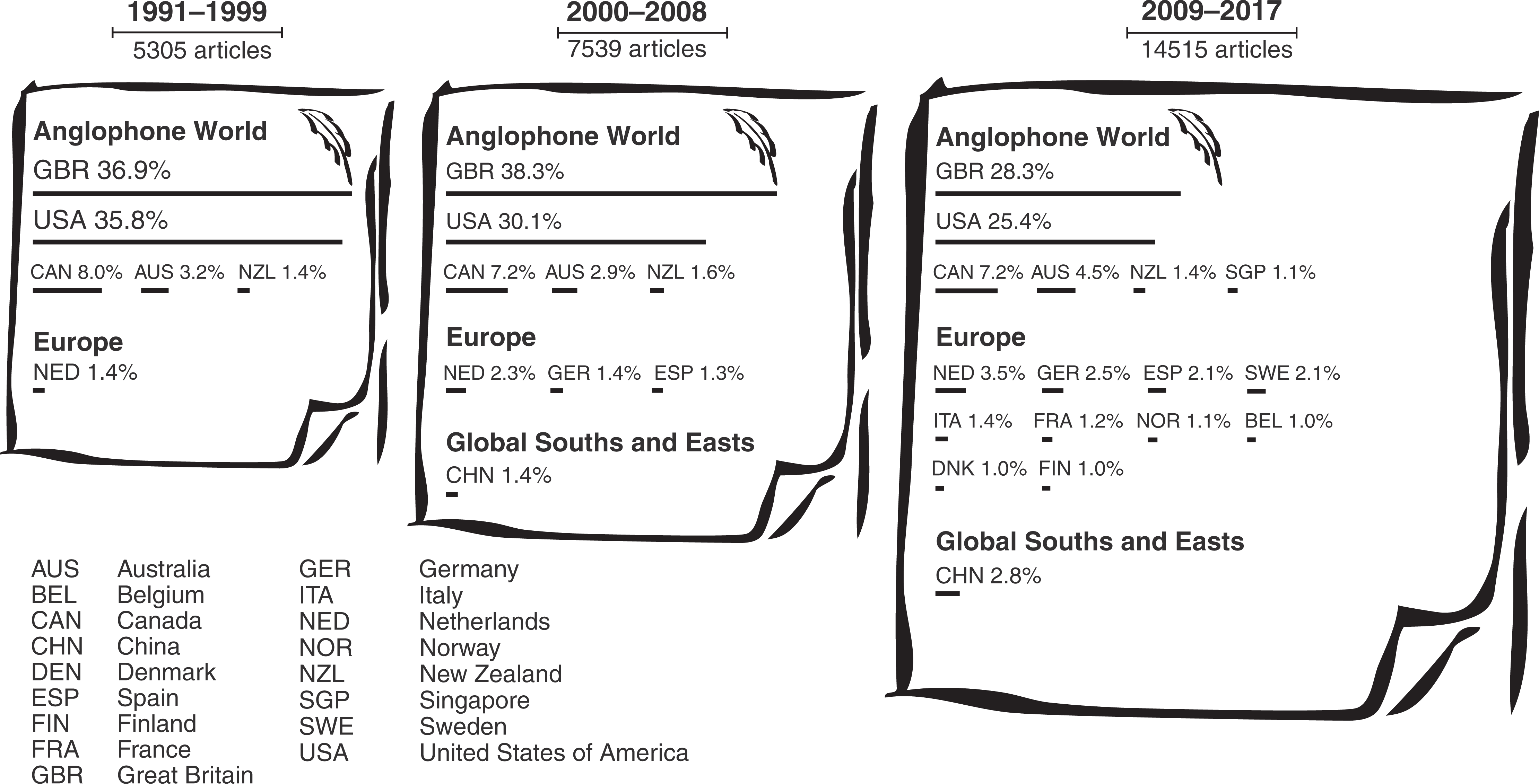
The shifting weight of countries in Anglophone geographical knowledge production (share of country affiliations in journal articles, 1991–2017; all countries with a minimum share of 1 per cent are displayed): The countries contributing at least 1 per cent of geographical knowledge production have become more diverse. The UK and US remain dominant (but have lost weight), whereas several continental European countries have gained weight. The Global Souths and Easts are absent, except for China. The number of articles in the 22 journals of the sample almost tripled between 1991–1999 and 2009–2017.
Figure 2 also drives home that Geography as a discipline, as represented through these English-language journals, is not so much Euro-American (Comaroff and Comaroff, 2011) or Western (Timár, 2004) as Anglo-American (Simonsen, 2004): the UK, the US and Canada still produce more than 60 per cent of the total articles in journals. None of the other countries reach even a 5 per cent share in authorship. Of all countries, China posted the strongest growth from 1991 to 2017, moving from 0.3 per cent to 2.8 per cent of authorships.
When considering editorships, the UK leads over the US by a significant margin, although the situation is the reverse in terms of members of editorial boards (see Table 1). Among non-Anglophone countries, it is smaller European countries such as the Netherlands, Switzerland and Norway that have the next highest proportion of editors, with Germany also relatively strong. The strong showing of the Netherlands might be due to the profound neoliberalisation of the university system (Minca, 2013), which may have made it more competitive in Anglophone knowledge production but also more conformist. By contrast, the shares of several larger European countries such as Italy, Spain and France are relatively small. This is likely due to the presence of relatively strong links between academics in these three countries, often using French, not English, as a shared language of communication, but also due to French and Spanish continuing to function as important languages for the former colonies.
Journals: Top 10 Anglophone and non-Anglophone countries across roles, 2017.
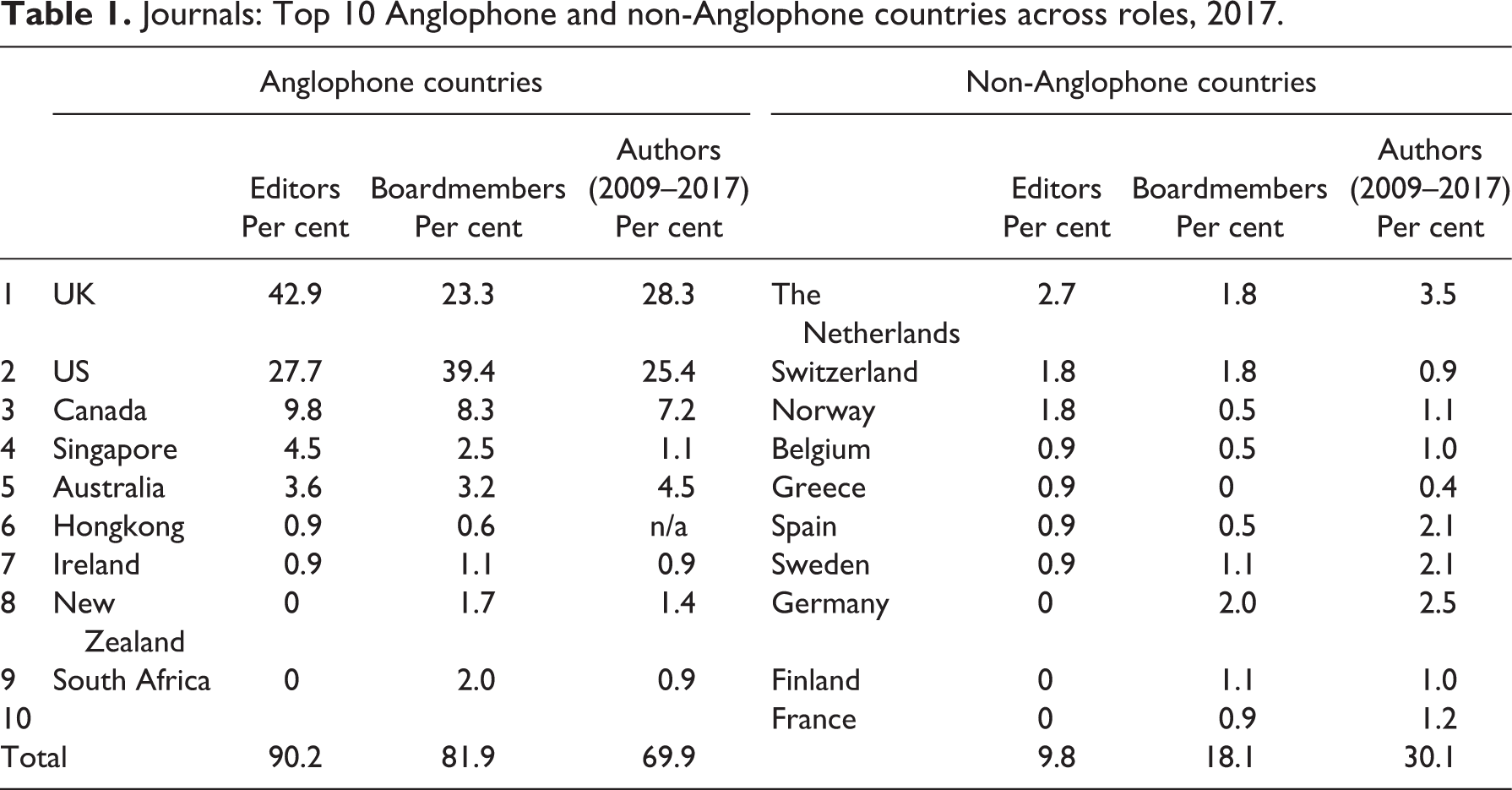
There are only two countries from the Global South – South Africa and India – sending more than just a handful of editorial board members (although a blanket attribution of South Africa to the Global South is debatable). Both countries were part of the British empire and English plays an important role in higher education, which likely explains their position. In terms of authors, the strongest countries of the South are India (63 authors in the period from 2009 to 2017), Brazil (64) and Mexico (60). In the Asian East, China (406), Japan (68) and Korea (59) stand out, whereas in Eastern Europe, the Czech Republic (55) and Poland (51) lead by a clear margin (see also Petrovici, 2015; Trubina et al., 2020).
Disaggregating the data to the 22 journals (Table 2) shows that 5 of the 22 journals have fewer than 10 per cent non-Anglophone board members. Progress in Human Geography is the only journal with more than 50 per cent non-Anglophone board members, although European Urban and Regional Studies (47 per cent) comes close. Society journals such as those of the American Association of Geographers (Annals of the AAG, The Professional Geographer) and the Royal Geographical Society (RGS; Transactions) tend to have boards that are more Anglophone than average (although Geographical Journal, also a journal of the RGS, does not). These journals have to navigate a double bind of being at once international but also a privileged forum for their respective national constituencies. By contrast, European Urban and Regional Studies, a journal dealing specifically with Europe, has a great diversity of board members, though mostly drawn from Western European countries.
Shares of editors, board members and authors from non-Anglophone countries, 2017, and change since 1999 (see also Imhof and Müller, 2020).
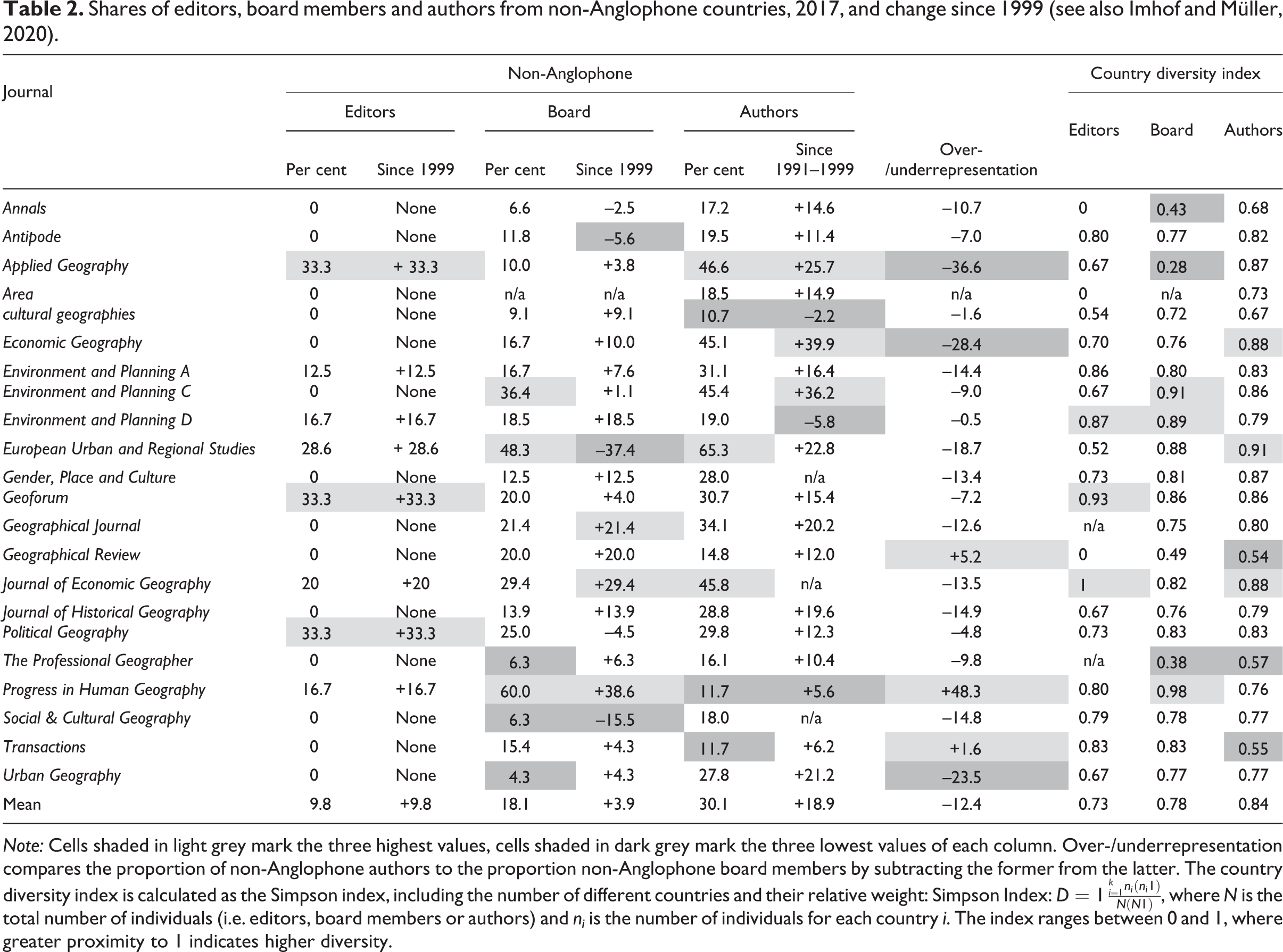
Note: Cells shaded in light grey mark the three highest values, cells shaded in dark grey mark the three lowest values of each column. Over-/underrepresentation compares the proportion of non-Anglophone authors to the proportion non-Anglophone board members by subtracting the former from the latter. The country diversity index is calculated as the Simpson index, including the number of different countries and their relative weight: Simpson Index:
While the boards of most journals have on average become somewhat less Anglophone since 1999, there are nevertheless six journals, about one-quarter of the sample, that have become more Anglophone over that period. This is the case for the Annals (−3 per cent), Antipode (−6 per cent) and Political Geography (−5 per cent) and, most strikingly, for Social & Cultural Geography (−15 per cent) and European Urban and Regional Studies (−37 per cent).
There is also much variance in how non-Anglophone an authorship journals attract. Only one journal attracts more non-Anglophone than Anglophone authors (European Urban and Regional Studies), while four others come close to 50 per cent (Applied Geography (47 per cent), Economic Geography (45 per cent), Environment and Planning C (45 per cent), Journal of Economic Geography (46 per cent)). Other journals, however, hover at about only 10 per cent, much below the average of 30 per cent of the sample (cultural geographies (11 per cent), Progress in Human Geography (12 per cent), Transactions (12 per cent)). Progress in Human Geography is the only journal where the editors and the editorial board are significantly less Anglophone than the average, but authorship is significantly more Anglophone. As before, there is a strong underrepresentation of non-Anglophone scholars in the editorial boards, compared to their share among authors. This underrepresentation is most pronounced for Applied Geography, Economic Geography and Urban Geography, where the average author is facing a significantly more Anglophone board.
When examining the overall diversity of countries represented in all three roles (not distinguishing between Anglophone and non-Anglophone countries) by using the country diversity index in Table 2, Geoforum and Journal of Economic Geography lead in the country diversity of editors, Environment and Planning C and Progress in Human Geography in the country diversity of their boards and European Urban and Regional Studies, Economic Geography and Journal of Economic Geography in the country diversity of their authors. Environment and Planning A, Geoforum and Journal of Economic Geography, however, are the only three journals that show a consistent diversity of countries across all three indicators (at least 0.8 on each indicator).
2 Forming the Canon: Handbooks and Progress Reports
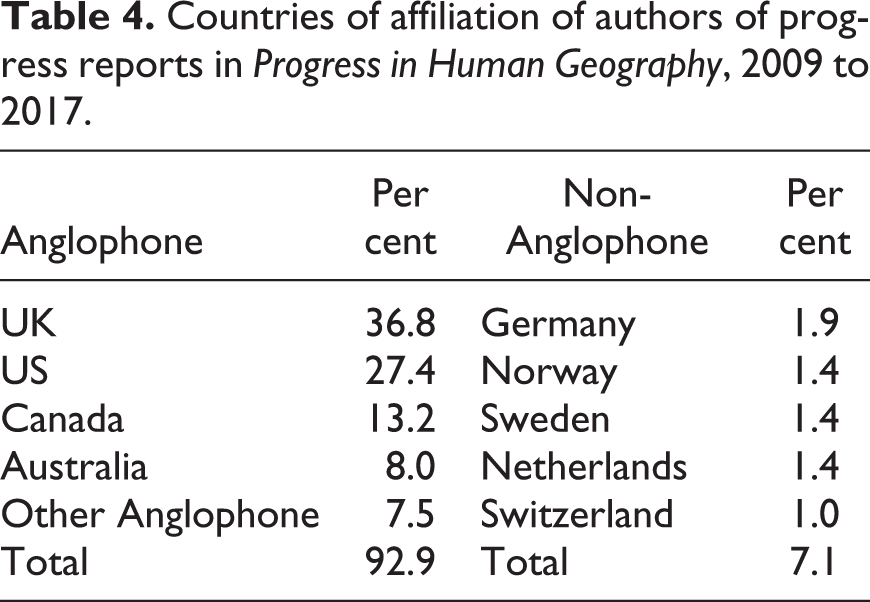
While journal publications represent the most recent scholarship, often in scattered form, handbooks and progress reports have a somewhat different function: their primary mission is to consolidate the state-of-the-art in particular fields. Handbooks and progress reports show considerably higher presence of linguistic privilege than journals. There is just a handful of scholars from Western European and East Asian countries among the authors of handbooks and progress reports (Tables 3 and 4), but not a single one from the Global South (with the exception of the ambiguous case of South Africa). In general, handbooks with at least one non-Anglophone editor tend to have a more non-Anglophone set of authors (see Table 3). Several handbooks do not have a single non-Anglophone author, such as the SAGE Handbook of Economic Geography, SAGE Handbook of Qualitative Geography and, ironically for worlding knowledge production, the SAGE Handbook of Geographical Knowledge.
Share of editors and authors from non-Anglophone countries in geographical handbooks published between 2009 and 2017.
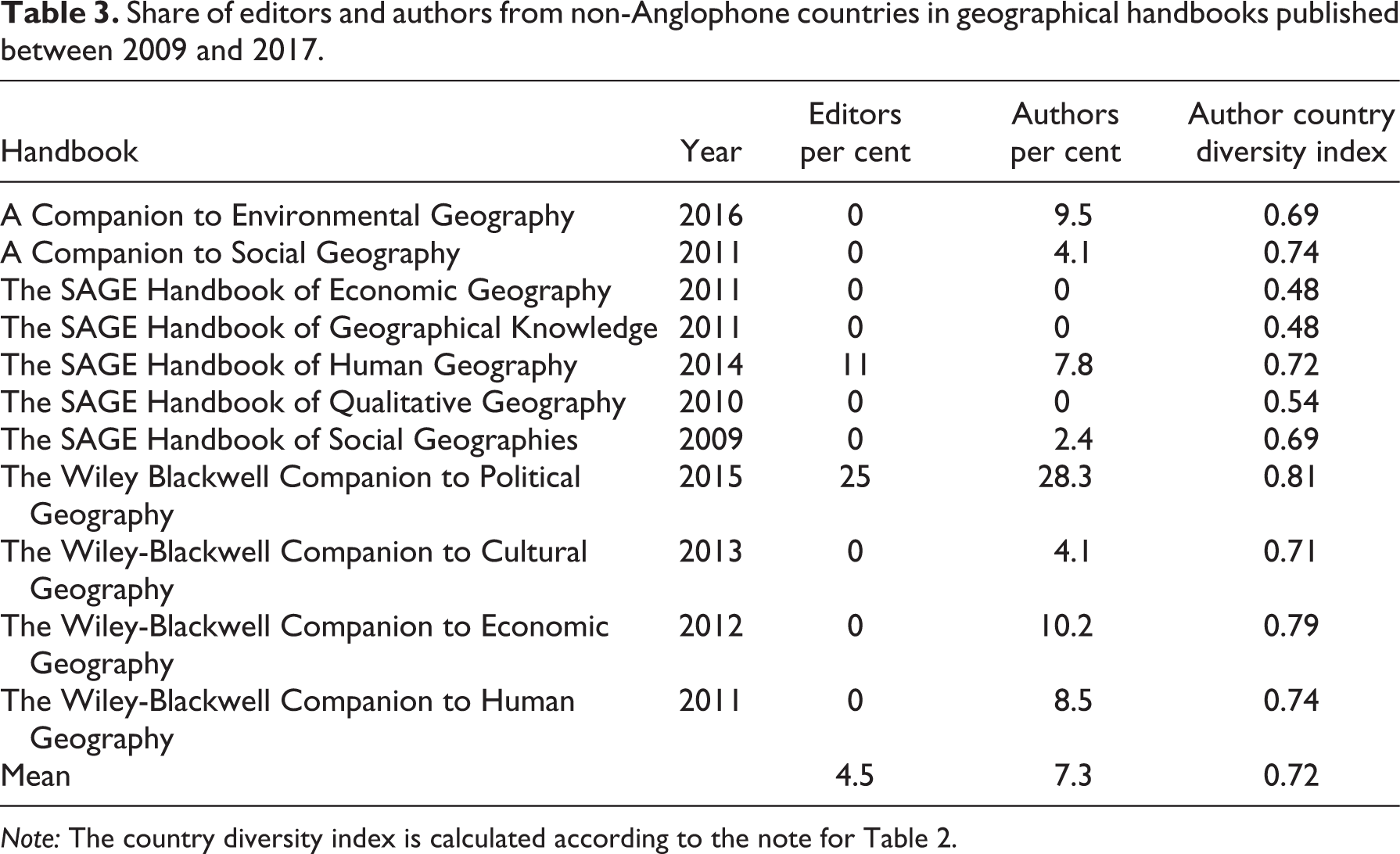
Note: The country diversity index is calculated according to the note for Table 2.
Countries of affiliation of authors of progress reports in Progress in Human Geography, 2009 to 2017.
3 Dynamics Across Sites of Knowledge Production
Overall, the three sites – journals, handbooks and progress reports – reveal a strong presence of linguistic privilege, as shown in Figure 3. The influence of Anglophone scholars in geographical knowledge production is disproportionally strong compared to the share of Anglophone countries in the world population (ca. 7 per cent). The most influential roles in the sites of knowledge production – editors of handbooks and journals, and authors of handbooks and progress reports – are those with the highest linguistic privilege. A stunning 95 per cent of handbook editors are from Anglophone countries, as are 93 per cent of handbook and progress report authors. As handbooks and progress reports are the sites where the canon is produced and enshrined, this situation should be of grave concern, as it produces a severely lopsided canon.
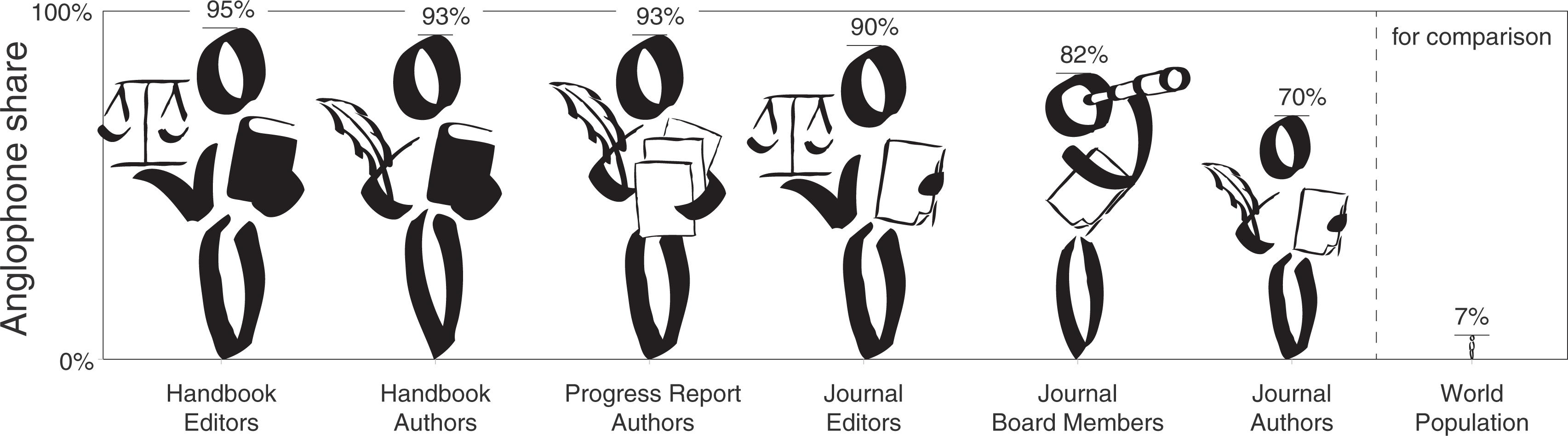
Extent of linguistic privilege in geographical knowledge production (share of individuals affiliated with institutions in Anglophone countries in different roles, 2017). The greater the importance of a role for the production of knowledge, the more it is dominated by Anglophone countries. The share of gatekeepers and authors from Anglophone countries much exceeds the share of those countries in the world population, resulting in a starkly uneven production of geographical knowledge.
Journal editors and board members are only slightly less Anglophone, with 90 per cent of editors based in Anglophone countries and 82 per cent of editorial board members. By contrast, only 70 per cent of journal authors are from Anglophone countries. This results in an imbalance, where gatekeepers of journals are more Anglophone than authors. This imbalance could lead authors to conform to Anglophone expectations of knowledge production so as to have their articles accepted by gatekeepers, resulting in a loss of diverse knowledges.
The analysis suggests that theory-building and qualitative research remain a prerogative of the Anglophone world (cf. Simonsen, 2004), whereas more empirically oriented and more quantitative journals are doing better in attracting a somewhat less Anglophone authorship. While the longitudinal analysis (Table 2) shows that the share of non-Anglophone authors has increased since 1999, therefore giving cautious hopes for worlding the discipline, this increase is much less pronounced for editors and board members. Finally, most of this better representation of non-Anglophone scholarship is due to scholars from Western European countries entering the game. By contrast, scholars from the Global Souths and Easts are almost completely absent.
V Ways Forward: Three Worldings
The foregoing analysis has revealed the degree to which knowledge production is Anglocentric. They reproduce and entrench linguistic privilege rather than challenge it. Geography is therefore in urgent need of creating the preconditions necessary for a worlding of scholarship that would give hearing to scholarship traditions from different languages in a move towards ex-centric knowledge production. I take the concept of worlding to refer to opening up of knowledge production to the world, decentring them from the Anglosphere and the West more broadly and bringing in all those places unheard from. Worlding means interrogating the epistemological privilege of the Anglosphere and, in so doing, reworking the access to the production of knowledge. It comes with embracing the multiple worlds that are off-centre, in the margins, out of the spotlight or simply not representable and intelligible with the dominant paradigms most of us operate with.
Worlding Geography is therefore also, and perhaps even primarily, a political project. It ties into the postcolonial and decolonial endeavours of decentring, provincialising and envisioning ‘a world in which many worlds fit’ (see also Jazeel, 2016; Naylor et al., 2018; Radcliffe and Radhuber, 2020: 3). In that sense, one can contrast worlding to globalisation – the ever-widening embrace of the same relations of production and regulation, creating centres and peripheries and aiming at building one world, rather than many. More broadly, it seeks to make resonate the more-than-human – the world – in its diverse shapes beyond human sociality (Bawaka Country et al., 2016; Militz et al., 2020; Stewart, 2007).
The concept of worlding originates with German philosopher Martin Heidegger. He uses the German term ‘welten’, a neologism, in the formulation ‘Welt weltet’ (‘world worlds’) (Heidegger, 2012: 30). This tautological expression reminds us that the world reveals itself. Worlding is therefore not something we do, as though graciously inviting the world in to dine at our table. This would circumscribe the radical thrust of worlding by adding a little more diversity to our dinner party while leaving the house intact. Worlding is rather better understood as opening up to the world’s alterity and its inherent potential to reveal itself to us. It is therefore ‘a process of opening up possibilities’ (Espinet, 2011: 48) – possibilities might entail that our house is not left standing after the world has passed through.
This potential of worlding to recreate worlds is reflected in its usage in Geography. Barnes and Gregory (1997), tracing their notion of worlding back to Haraway (1988), emphasise the situatedness of knowledge, cautioning against putting the West at the centre and directing our attention to the fact that novel knowledges emerge at the margins (hooks, 1984). Ong (2011), drawing on Spivak (1999: 200), underscores the political aspect of worlding as ‘ambitious practices that creatively imagine and shape alternative social visions and configurations – that is, “worlds”’ (Ong 2011: 12). 10 In the spirit of this political verve of at once situating and decentring, let me suggest three ways of worlding Geography as a discipline, explained in the following section and summarised in Figure 4.
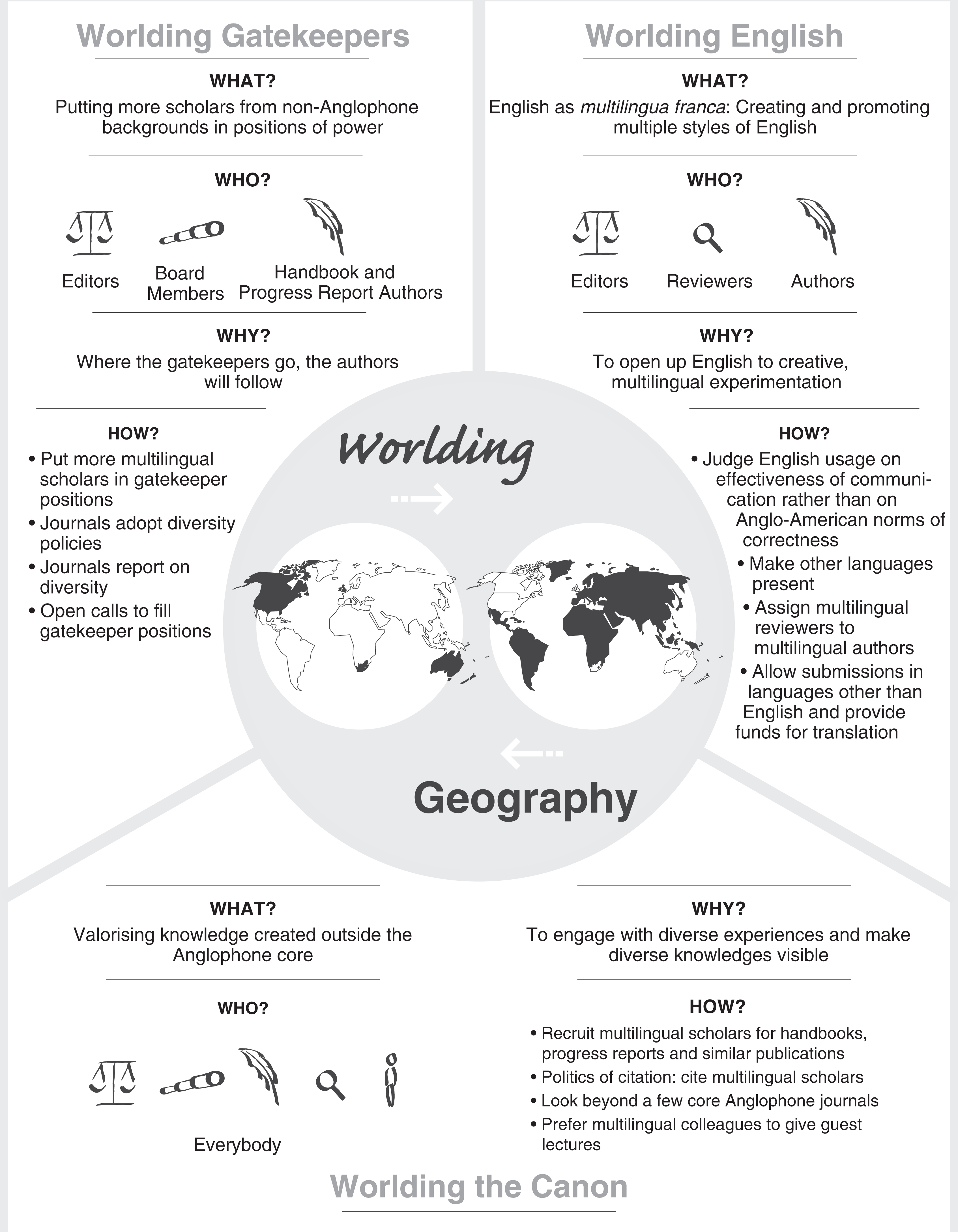
Three paths of worlding Geography: worlding gatekeepers, worlding Englishes and worlding the canon.
1 Worlding Gatekeepers
The degree of linguistic privilege transpiring in Figure 3 flags one of the key issues of current knowledge production practices in Geography: scholars from outside the Anglophone world have to play in a game in which they have very little say on the rules. In other words, it is mostly gatekeepers from Anglophone institutions who decide on what and who gets published and who is cited. At the same time, fewer and fewer authors have an Anglophone affiliation. It is likely that where the gatekeepers go, the authors will follow. Strongly Anglophone gatekeepers will produce an Anglophone author body, and less Anglophone gatekeepers will produce a less Anglophone author body and therefore work towards worlding the discipline.
Putting scholars with non-Anglophone or multilingual backgrounds in gatekeeping positions – as journal editors and board members, as handbook editors and authors and as progress report authors – is therefore an important move in worlding Geography. Fortunately, it is also not a particularly difficult move. Adding new members to an editorial board and recruiting authors for progress reports and handbooks is a matter of hours. That 30 per cent of authors in journals are from non-Anglophone countries demonstrates that competent multilingual scholars who write in English do exist and that their number is growing. Some journals (such as Social & Cultural Geography, 2018) have specified a preference for candidates from outside Anglo-America in recent searches for editors. Others explicitly problematise the fraught politics of geographical knowledge production and urge ‘processes of unknowing so that we might know differently’ (Kraftl et al., 2018; Oswin, 2018: 615).
Journals should adopt policies to anchor the project of worlding more transparently. Such policies would, at the very least, include annual reporting on aspects such as the country of affiliation, primary language, gender and race of editors, board members and reviewers. It should also set explicit targets for the diversification of gatekeepers in terms of epistemic location, for example, by using percentage thresholds or diversity indices (as in Table 2). To encourage a process of worlding, the gatekeepers of journals should be consistently less Anglophone than the authors (currently the inverse is the case). Finally, Geography would do well to become more open and transparent in recruiting people who enter gatekeeping positions, whether as editors, board members or authors. This reduces the risk of pre-selecting gatekeepers through existing networks, thus reproducing rather than transforming existing modes of knowledge production.
Scholars who have been immersed in two or more languages are of particular importance for worlding. These in-between scholars are often well-versed in code-switching, juggling the languages, expectations and norms of different academic traditions (Aalbers and Rossi, 2007). They may have migrated to a country with a different language tradition or they may come from a different language group within a country, such as Indigenous or ethnic minority scholars. Whichever is the case, in-between scholars are uniquely positioned to bring the potential of the world to bear on Anglophone scholarship. They are better able to identify colleagues and bodies of knowledge from other languages and help articulate them to world Anglophone scholarship.
2 Worlding English
“Entre les langues” c’est encore une langue. C’est une langue à trouver et qui n’est ni l’une ni l’autre. (Wismann, 2012: 13)
[‘“Betweeen languages” is yet another language. It is a language to discover that is neither the one nor the other.’]
The strategy of worlding gatekeepers must be accompanied by a worlding of English, that is, greater flexibility in English usage – not just as a language but as an institution with its own norms, expectations and vernaculars. The problem is not so much that English is used, but how it is used. Worlding English involves reversing the view, whereby authority over English resides only with native speakers and non-native speakers are considered as deficient. This is what is already happening de facto the world over and what disciplines such as ‘English as Lingua Franca’ and ‘World Englishes’, both subfields of sociolinguistics, have documented in recent years: ‘that American and British norms [of language use] are becoming increasingly irrelevant globally, given that their speakers are in such a small minority of the world’s English users’ (Jenkins, 2017; see also Mair, 2003). They are becoming less dominant only, however, where there is a majority of non-native speakers participating in the conversation.
At the same time, non-native speakers can start to appreciate their own linguistic resources, particularly knowing and bringing to bear several languages in the research process, therefore creating a situation of thinking between multiple languages (Wismann, 2012). Viewed this way, worlding English not just makes publishing in English more welcoming and accessible for non-native speakers, but it also chips away at linguistic privilege attached to native speakers. As a consequence, non-native speakers do not need to submit as norm-takers and imitators at the receiving end but can appropriate and reinvent English creatively (see, e.g. Steyaert and Janssens, 2013). This is much like Nigerian novelist Chinua Achebe (1975: 103) envisioned it: ‘I feel that the English language will be able to carry the weight of my African experience…But it will have to be a new English, still in communion with its ancestral home but altered to suit its new African surroundings’.
Worlding English therefore puts English up for grabs in the search for the best way of adequately (re-)presenting research without inscribing it into pre-existing schemas. We may take heart from experiments such as Gloria Anzaldúa’s, mixing different variations of English and Spanish in her Borderlands/La Frontera to create what she calls, approvingly, a ‘bastard’ language: The switching of “codes” in this book from English to Castillian Spanish to the North Mexican dialect to Tex-Mex to a sprinkling of Nahuatl to a mixture of all of these, reflects my language, a new language – the language of the Borderlands. There, at the juncture of cultures, languages cross-pollinate and are revitalized; they die and are born, (Anzaldúa, 1987: Preface)
Anzaldúa’s reflections point us towards an emancipatory use of English not so much as lingua franca, but as a multilingua franca: a shared language that carries the traces of multiple other languages (Makoni and Pennycook, 2012). English as multilingua franca in this sense is indeed a free (franca) language, free from the shackles of Anglo-American convention. Luckily, Geography has recently experienced some such experimentation with multilingual English that can serve as an important signpost for other authors (e.g. Daigle, 2016; Halvorsen, 2019; Smirnova, 2019).
At a practical level, moving towards a multilingua franca would entail that manuscripts by non-native speakers are reviewed by at least one other non-native speaker and it would allow submissions and reviewing in other languages than English, with translation of the final accepted manuscript into English. Antipode’s translation fund, for example, commissions translation from influential work outside the English-speaking world to ‘break…down some of the barriers between language communities’ (Antipode, 2020). Outside geography, the new journal Decolonial Subversions pledges that submissions are reviewed by at least one non-Western reviewer. For journals, the adoption of a language policy, such as done by the International Journal of Urban and Regional Research ( n.d. ), would be a major step towards at least acknowledging the diversity of English usage and the presence of multilingualism.
Finally, the project of worlding English is interlaced with the structures of the political economy of publishing (Merrett, 2006). Anglophone academic publishing, dominated as it is by private corporations, has an ambiguous role in this worlding endeavour. On the one hand, there is an economic incentive to bring multilingual editors, authors and readers into the circuits of academic capitalism, so as to tap into new markets for subscriptions. On the other hand, there is little incentive to move towards multilingual scholarship. Translations are costly and do not generate economic returns for the publisher. That is why most innovations in multilingual publishing can be found in continental Europe, with journals such as Via Tourism Review (which publishes in seven languages and translates all articles to at least two other languages) or Geographica Helvetica (the Swiss journal of Geography, which accepts articles in French, English, Italian and German). Both journals are open access and, no surprise, funded by universities and scholarly associations.
3 Worlding the Canon
Neither worlding gatekeepers nor worlding English will go far without the third critical component: taking as the basis and starting point for our research those multiple voices that emanate from different parts of the world. This is what I call worlding the canon. Worlding the canon is a matter of ‘educating ourselves into the mindset of planetarity…. developing literacies that enable us to read the planet’s many and discontinuous textual fabrics’ (Jazeel, 2017: 341) – but not only. It is also, perhaps even more, an issue of acknowledging and valuing these textual fabrics, these texts from multiple parts of the worlds in multiple languages that, taken together, form the fabric of a much wider, often invisible canon of the discipline.
Worlding the canon comes with a responsibility for every author in Geography: that of striving to give adequate hearing to scholarship outside the Anglophone core. Such hearing is currently sorely lacking. In addition to the absence of non-Anglophone scholars in the canon, another reason for this absence is the so-called ‘Matthew effect’ (Merton, 1968). It refers to the phenomenon that citations for an argument or discovery tend to go to better known researchers, even if less well-known researchers have made a similar argument or discovery. The Matthew effect therefore works against all those outside the Anglophone core as an additional obstacle: they need to be not simply just as good but better than their Anglophone peers to get the same recognition. Putting the expectation on every author to seek out and cite contributions from non-Anglophone scholars is therefore a necessary component of worlding the canon. It means engaging in a conscious and conscientious ‘politics of citation’ (Ahmed, 2017: 15–16; Mott and Cockayne, 2017). Citation ascribes value to certain texts and ideas. Worlding Geography makes sure these are the texts and ideas of those who tend to be less well heard. For this article, for example, I set myself a goal that at least half of the references would come from authors based or originating from outside the Anglophone world – a goal I attained, but not after some conscious searching and reading.
Worlding the canon also means casting our drag net of where we look for relevant scholarship beyond the core of Anglophone journals that is represented in our sample. It is present in the myriad outlets beyond the Anglophone core, such as Articulo, sub/urban, Geographica Helvetica, Geografie or Revista Latino-Americana de Geografia e Gênero, among many hundreds of others (see Batterbury, 2015, for one of many lists of respectable open-access journals in Geography). All have websites, many publish in English, many are open access – so there is no excuse for not citing them and for not publishing in them. By virtue of having to bridge different language traditions, many of these journals, though being much less known in the world than the 22 leading Anglophone journals of our sample, might indeed be doing much better in worlding Geography. 11
VI Conclusion
Language is also a place of struggle. (hooks, 1989: 28)
Geography is a discipline proud to claim that the world is its oyster. ‘Come to study Geography, you come to study the world’, as the late Ron Johnston (Johnston and Haggett, 2020) would have it. It is ironic, then, that its lack of attention to language should have resulted in modes of knowledge production that keep that very world safely at bay. But language is also a place of struggle; a place much too long neglected by geographers. Linguistic privilege pervades our discipline and it results in a highly uneven distribution of power to shape what counts as knowledge. The most influential positions in knowledge production, as editors, board members and authors of important review pieces, are also the most anglocentric. This tends to create a situation where the gatekeepers and producers of knowledge are Anglophone, whereas the consumers are increasingly multilingual.
What is at stake is who, what and how we can know in the world – no more and no less. The dominance of linguistic privileges marginalises the largest part of that world – all those that do not have English as a principal language. And Geography is left all the poorer for it. The risk is, to put it bluntly, that we will not recognise nor be able to reflect the ontic differences that mark our heterogeneous world if we do not allow for our key sites of knowledge production to be open to epistemic locations and differences. In the pressure to conform to anglocentric expectations of scholarship, we may lose the diversity of concepts, themes, styles and epistemic locations that should be the hallmark of any discipline, a fortiori of one attuned to the spatial differentiation of knowing. In other words, we might simply fail to ask questions that are interesting and relevant to much of the world. What is more, we may end up being ill-positioned as a discipline to address increasingly global challenges – from climate change to pandemics, from populism to poverty, from coloniality to racism – if we continue in these parochial ways.
The imperative of worlding Geography, of making present and speaking with those other voices in other places and other languages, looms large. This worlding refers indeed to the entire world, in particular the Global Souths and Easts – for the undoing of Anglophone linguistic privilege should not simply result in other Western European languages and countries becoming more dominant. I have proposed three interlocking ways of worlding Geography through reworking its modes of knowledge production: worlding gatekeepers, worlding English and worlding the canon. We need to work towards more multilingual gatekeeping, a more creative usage of English and a more equitable representation of non-Anglophone voices in the canon.
All geographers, no matter where in the world they work or what language they speak, need to carry this task of worlding Geography. After all, the politics of citation that values diverse knowledges can be wielded by every author. But there is a particular responsibility for Anglophone geographers that comes with linguistic privilege and the large size and power of the Anglophone system of knowledge production. This is all the more true for those in positions of influence as editors, board members and reviewers, who need to take questions of linguistic difference (more) seriously for the worlding of Geography.
Working towards decolonising the discipline and theorising from anywhere and multiple epistemic locations, as geographers increasingly do, therefore needs to put the question of language and linguistic privilege on the agenda. This is a task for all geographers committed to undoing hegemonic ways of knowing and creating space for other knowledges, whether coming from feminist, critical race, postcolonial, decolonial, Indigenous, Marxist, more-than-human or other theoretical orientations. If we are serious about decolonising the discipline, this must happen not only from the metropolitan centres of Los Angeles, London and New York – but just as much from Maputo, Montevideo, Teheran and Vilnius.
Footnotes
Acknowledgements
I am grateful to the reviewers for their careful reading and rereading of this article. Sven Daniel Wolfe, Mathis Stock, Etienne Piguet, Chris Steyaert, Julia Nentwich and Carolin Schurr gave useful inputs to this article. It is the final one in a tetralogy devoted to revising and revisioning the geopolitics and body politics of geographical knowledge. The previous articles are: ‘Who makes geographical knowledge? The gender of geography’s gatekeepers’ (Schurr et al., 2020), ‘How international are geography journals? Not international enough’ (Imhof and Müller, 2020) and ‘A part of the world or apart from the world? The postsocialist global East in the geopolitics of knowledge’ (Trubina et al., 2020).
Authors’ note
Martin Müller is also affiliated with Ural Federal University, Russia.
Declaration of conflicting interests
The author(s) declared no potential conflicts of interest with respect to the research, authorship, and/or publication of this article.
Funding
The author(s) received no financial support for the research, authorship, and/or publication of this article.

Notes
Author’s biography
Martin Müller is an urban and political geographer working on the geopolitics of knowledge and on cities in the global world. Using the concept of the ‘Global East’, he seeks to think global theory beyond the binaries of North and South. He is interested in global urban types, such as mega-events and cultural flagships.