




Abstract
This paper argues that human geography has neglected the issue of ‘missing people’. Following an introduction, the paper uses four thematics, ‘mapping, searching, feeling and moving’, in order to explore a range of responses to missing absence and missing experience. It argues that attention to the voices of returned adult missing people would help establish new emotional geographies of embodied absence which would complement, and in places challenge, ‘left behind’ knowledges of absence. It is also argued that ‘peopling’ missing research would enable sensitive reconstructions of missing mobilities which both (1) challenge operational categorizations and cartographies of missing people as disembodied units, and (2) contribute to conceptual reassessments of disruptive human mobilities.
I Introduction
Missing people 1 often have a surprisingly significant presence in our lives. When in 1979 Etan Patz, a six-year-old boy, disappeared on a short walk from his home in lower Manhattan to catch a bus to school, his parents’ efforts to find him led eventually to missing children’s photographs appearing on milk cartons, shopping bags and buses across the United States (http://www.missingkids.com). When a British girl, Madeleine McCann, disappeared from a Portuguese holiday resort in 2007, interest in her fate prompted intense media coverage around the globe and the unprecedented intervention of the British Prime Minister in requesting the UK police to renew their investigation into her disappearance in 2012. Such disappearances are, of course, specific examples among the hundreds of thousands of such cases reported to police and other agencies each year, and a child’s absence understandably provokes more interest and intervention than an adult’s. In the UK there were over 300,000 reported cases of missing persons in 2010–2011 (NPIA, 2011); in the United States the figure is more than three times that, equivalent to over 2,300 people reported missing every day (Krajicek, 2005). In the overwhelming majority of such cases, those reported missing will simply return, make contact with family or friends or be located unharmed. Cases such as those of Etan Patz and Madeleine McCann, who have not yet been found, are the exception.
Despite the scale of the missing ‘problem’ and its occasional prominence within popular and political discourse, academic analysis of ‘the missing’ remains in its infancy, and this is particularly true for adult missing people, the focus of this paper. There is a small number of policy-oriented studies that have developed typologies of missing people (see Newiss, 1999) and considered the use of profiling techniques to inform the search process (Shalev et al., 2009). There have also been attempts to develop a broader agenda around the politics of institutional responses to the missing, most notably by Edkins (2011), whose recent analysis includes consideration of how displaced people were traced in Europe following the Second World War and also processes of forensic identification in the aftermath of 9/11, among other concerns. In building on this limited academic work, this paper argues that bringing a geographical sensibility to the issue of missing people has the potential to enrich and extend conceptual thinking in this field, as well as making an important contribution to the knowledge base required for practical and policy interventions. Missing people constitute a highly geographical phenomenon, precisely because it is all about people who absent themselves or engage in absence-making 2 via an (often temporary) removal from their everyday places and spaces. As we show below, analysis of this issue complements but differs from substantive research on geographies of homeless people and people with mental health problems, while also cross-cutting with broader concepts such as absence, emotionality and mobility which are evident within and beyond the discipline.
This contextual introduction seeks to establish the category of ‘the missing’ as constituted by multi-scalar peopled absence, an absence that is thoroughly relationally defined, and productive of particular kinds of responses and politics which also differ globally. Our core argument is that geographers have largely ignored missing people, and current research knowledges on missing people are primarily constituted from located or ‘left behind’ perspectives and in the context of operational relevance. In what follows, we elaborate these claims, and argue for a more distinctive place for ‘the missing’ in human geography.
At one level, geographical inquiry into missing people involves critical reflection on processes of mapping the missing carried out by state agencies and, following a general introduction to the problem of defining missing people, in section III we examine these ‘cartographies of absence’. The uneven contours of disappearance highlight the challenges of understanding the processes which produce these maps, in terms of both the complex causes of ‘missing’ and the underlying behavioural geographies of those who disappear. Responding to reports of missing is usually the responsibility of state (particularly the police) and non-state agencies that deploy their resources to search different types of environment (both real and virtual) in attempts to locate missing and mobile bodies. Drawing on and developing existing geographical interest in the practices of searching, Section IV considers how agencies mine databases, explore landscapes and develop investigative methodologies in their attempts to find missing people. Throughout sections II to IV we critically examine how missing people are currently understood as faceless ‘types’ that cover distance in predictable blocks of time; and we argue that geographers could have a distinctive role in helping to ‘people’ these research efforts, thereby animating the emotional geographies of missing experience addressed in section V. In section VI we argue for an understanding of missing people as mobile subjects who force a reconsideration of the limits of an ambition to ‘map’ human life, linking to discussions around a ‘new mobilities’ paradigm (Cresswell, 2010). We conclude by pointing to the opportunities for research here which have received almost no attention from human geographers.
These concerns are summarized below via four thematics – mapping, searching, feeling and moving – as they relate to the phenomena of missing adult people (and not missing children, objects or animals). It is important to begin by offering a broader understanding of the political and sociocultural processes shaping understandings of collective and individual forms of missing experience.
II Making sense of ‘the missing’
1 Definitional complexities
Missing Person: ‘anyone whose whereabouts is unknown whatever the circumstances of disappearance. They will be considered missing until located and their well-being or otherwise established’. (ACPO, 2005: 8)
What does it mean to be ‘missing’ or a ‘missing person’? There are technical definitions, such as those advanced above from the Association of Chief Police Officers for England and Wales (ACPO), arising in cases when an individual may be reported missing to the police by a friend or relative. There are also more expansive ways of considering what is at stake for any emergent research agenda. A missing person has to be noticed as not inhabiting their rightful place in order to be termed ‘missing’. This missingness may be attributed: someone may be reported or noticed as missing, but not experience their own missingness or absence. Missing is immediately a problematic term, then, and one used mostly by ‘the left behind’. Missing is indelibly relational – gone missing, being missed – it is always in relation. This relationality will itself have a geography: missing, being missed and missingness mean different things in different places. ‘The missing’ are sometimes referred to as a unified category, but this may be too limiting: compare, for example, ‘the disappeared’ of Argentina or the people ‘lost’ in 9/11 with Sophie Tain, who ‘walked out’ of her back door in Aberdeen, UK, on 15 February 2009 and was gone for just 36 hours. These are kinds of missingness that are differently configured; there are collective and individual forms of missing absence, the scale of missingness is different, and how people are missed and then accounted for is different.
Missing is thus not only a problematic term and category when utilized to signify peopled absence – because it is often attributed but not experienced as such, and may be differentiated between places – but also in terms of how it begins to unfold different responses to reported absence. A ‘missing person’ is an official, categorical label fixed through the reporting of a noticed or unexpected absence by someone to national or state police or similar agencies like ACPO above, the type of organizations which states within the UN usually task with the day-to-day responsibility of tracing absence and locating missing people (e.g. UN resolution A/HRC/RES/7/28 in 2008). Human absence thus generally involves and implies search (technical, physical and emotional), alongside the recognition and continuation of attributed states of absence in a variety of registers. Police officers and their human resources, database and operational capacities are often impelled and enabled to search, or they are so impelled in some places, like the UK. In other places, unexpected human absence may be primarily associated with disappearance, state unresponsiveness, orchestration or refusals (see also a range of references in Edkins, 2011).
What might usually follow a reported absence under the heading of ‘searching’ is discussed further below, but practices here often differ from the dense architectures and ‘algorithmic security practices of the state’ (Amoore, 2009: 63) that are the result of uncertain fears about other forms of mobility like migration. Searching for missing people can be a more messy practice, characterized by confusions about categories, risk status, pre-emptive calculus and appropriate response, especially in global contexts, where systemic state tracing services and capacities may differ or not exist. Emotional and affective search by family and friends may also accompany more official and technical reporting, tracing, reconstruction, and attempts to locate and end missing situations. Responses to missing people are related to diverse kinds of in-fillings of absence, then, and these responses resonate with different kinds of power, a point elaborated further below. Search work can be done by international organizations, the state and other national agencies, and immediate social networks. Missing is an ‘active category’ in this regard: a range of people and techniques are involved in defining it and seeking its explanation and closure via a range of practices. Missing might thus be best deemed ‘a situation’ rather than a state-of-being or an act or a person (this term was first suggested by UK social worker Malcolm Payne in 1995), a contextual label for what happens during/for and in unexpected human absence.
2 The political and cultural contexts of missing
If, as is suggested above, being missing is partly tied to relational states of recognition, this state also needs to be acknowledged as bound up with powers of visibility and legibility. As Edkins (2011: 7) argues, any ‘politics of the missing could be deemed incomplete without some consideration of the invisible person, the person who doesn’t even begin to count’. In the very definitional work demanded by the term and concept of the missing person, we have to question who is present and who can be missed as not being. Because we know that power in different forms (postcolonial, patriarchal, heteronormative and racist) may render particular people and groups literally invisible (so brilliantly observed in Pratt’s 2005 work on missing women in Vancouver 3 ), so we must acknowledge that any ‘geography of missing people’ is a particular kind of political project before it has even begun (see also James et al., 2008). In this regard, Edkins (2011: 5) argues that the ‘unmissed’ are people ‘who are not present to a Western imagination in the first place’. In foregrounding a politics of missing people as infused with an attempt to ‘render visible that which has no right to be seen’ (p. 7), she prompts a fundamental problematic about being missing as always partial, cast in the shadow of unacknowledged ‘ungrievable lives’ (Butler, 2009: 1). Those who are illegally resident with a nation-state, for example, can also easily become the ‘missing missing’ or the ‘doubly missing’ to whom Edkins (2011) and others (e.g. Pratt, 2005) refer; and that term particularly applies to trafficked peoples who are led into unregulated and barely traceable labour arrangements. In what little research exists on adult missing people, it is noted (in an Australian context and likely repeated elsewhere, as in Pratt’s work on Vancouver) that ‘certain sub-groups in the population would seem more likely to be unreported. These include homeless people, people from culturally and linguistically diverse backgrounds, indigenous Australians and gay, lesbian, bisexual, transgender, gender questioning, and same sex attraction people’ (James et al., 2008: xii). Any attempt to outline a geography of missing people, then, may already be compromised by different kinds of power that render some ‘others’ absent from its very constitution. The unreported missing are an important reminder that absence is a political ascription, and that recognition of diverse powers of erasure is fundamental to a project which seeks to understand missing geographies.
We might also elaborate more generic understandings of missingness as culturally specific, or culturally constituted, experienced and signified. Below, a mother discusses her missing son:
I hear a sound at night. I wake up. I look through the window and there is nothing. I do not have him alive, and I do not have him dead. (quoted in The Guardian, 17 July 2011)
The quotation above comes from a recent online newspaper article on the suffering of Chechen families who hold particular beliefs about missing people. The missing are said to be particularly ‘present’ in Chechen culture, which values the significance of dreams about the absent that, the report claims, are commonly taken as an indication of the missing still being a living presence on Earth. Human rights activists estimate that up to 5,000 people remain missing after ‘disappearing’ in the second Chechen war of 1999–2000. The horror of hope which in-fills this mass Chechen absence is culturally particular because of the cause of mass disappearance, the politics of uncertain knowledge surrounding the disappeared, and the shared cultural meanings of dream-life. Missing, prompted by this intervention, signifies a term, a state we can associate with certain emotional registers of loss, a yearning space. There may be cultural specificity to how this missingness is constituted with reference to dreams, ritual, memorialization and political action around these elements (see Mellibovsky, 1997, for writing on the mothers of the Plazo de Mayo in Argentina); and hence different people in different places will emotionally search for those missing in different ways, with different political consequences.
3 Collective and individual missing
A scale issue begins to emerge in the context of events and situations that have prompted noticeable missing situations involving many people, as in the Chechen or Argentine examples. Indeed, Edkins (2011) considers the category of missing people through the vehicles of terrorist attack, systematized disappearance associated with Second World War camps and particular political regimes on a global stage. These are big, collective missing events, and yet what marks her account are thought-provoking assertions on the necessity of a politics of individual personhood. She argues that missingness involves a particular person: ‘missing people’ or ‘missing persons’ are phrases we recognize, but often the personal is subsumed, or somehow amalgamated, especially in identification scenarios. Edkins demands more here: ‘A focus on missing persons demands a focus on the specific, the particular’ (Edkins, 2011: 12). For Edkins, this is important, especially with respect to the mass disappearances that she discusses, which can often be constituted through numbers of dead, and anonymous bureaucracies (relatedly, see also Hyndeman, 2008, and Tyner, 2009, on the dehumanizing effects of quantitative ‘body counts’ in the wake of disasters and conflicts). In unusual collective missing events such as these, impromptu tracing agencies can appear, as well as technologies and systems of accountability in which the missing person is somehow denied, as their status (or intention or innocence) is sought before their deaths or otherwise are confirmed to families. Biopolitical and objectifying systems of identification can figure as state/s try to locate and account for multiple missing persons. Biometric technologies ‘as infallible and unchallengeable verifiers of the truth about a person’ (Amoore, 2006: 343) are thus enrolled in this kind of accounting for the missing dead on the basis of what they are and not who they are (Edkins, 2011: 7).
Edkins (2011: 7) calls for a new kind of ‘politics of the person as missing’, a call advanced in direct reference to the inadequate state responses to mass disappearance during events like the London bomb attacks and 9/11. She raises the problem that, when faced with mass disappearance, the state first attempts to maintain ‘system order’ because the state is threatened when it is not able to know and locate its citizens. What occurs when the state suddenly fails in its usual person accounting systems is that it tries to rectify this lack with emergency identification systems, which inevitably also fail to respond in ways that make relatives (in particular) feel that their person as missed is important. More generically, she argues that every missing person counts, reminding us that ‘the missing’ are indeed people, or a person, who is missing. Edkins thus offers a timely reminder that research and writing about absence is not (just) about spectral ghosts, city ruins, abstract and memorialized absence, processes of dataveillance (Amour and Goede, 2005) or an administrative problem. This absence is about someone who used to be there and currently is not, but also someone who sometimes returns.
4 Knowing missing people
In light of such calls for a politics of specificity we might ask the question: who are missing people and how do we know them? While the majority of missing persons incidents relate to children, for which there is an extensive evidence base (Biehal and Wade, 2004; Hammer et al., 2002), there is a lack of substantial international research on adult missing persons (but see Biehal et al., 2003; Newis, 1999, 2004, 2005; Payne, 1995). State and charitable agencies routinely produce a range of missing persons statistics about numbers and trends on international and national scales (e.g. NPIA, 2011), but these statistics are acknowledged to be based on multiple and unstable data recording and reporting systems. Fractured contemporary knowledges about missing people are tied up with histories of data capture and institutionalized tracing services, mechanisms connected to historical global conflicts (e.g. The British and International Red Cross), intra-ethnic tensions and civil wars (e.g. International Commission for Missing People), human rights violations and exploitation (e.g. the UK’s Serious Organized Crime Agency) and disaster identification (e.g. Interpol). In these myriad contexts of international institutional knowledge accumulation about missing people, they are categorically and technically constituted (numerically and forensically), primarily within a discourse of rights and victimhood, as opposed to (just) biometric securities. The International Committee of the Red Cross, for example, was instrumental in creating the impetus for the International Convention for the Protection of All Persons from Enforced Disappearances adopted by the UN General Assembly in December 2006. International humanitarian law and human rights law require parties in a conflict to take measures to ensure that people do not go missing. If they do, the parties are required to take all possible measures to ensure that their fate is known and their families informed. Here ‘victims’ of ‘missing situations’ are deemed as those left behind, and political efforts have been targeted towards producing legislation that affirms the rights of any victim to know the truth about the circumstances of an enforced disappearance and the fate of the disappeared person, and the right of freedom to seek, receive and impart information to this end. Global concern for missing people, then, is predominantly cast as responsive to war, conflict, trafficking, terrorisms and disasters, and framed largely within rights-to-know legislation for those reporting absence (e.g. Serious Organized Crime Agency, http://www.soca.gov.uk).
Research into domestic (national) cases of missing people is sparse internationally, and particularly lacking in relation to missing adults (James et al., 2008). By way of brief comparison: the UK has one of the highest rates of reported cases of missing persons, and in 2010–2011 there were 327,000 incidents (NPIA, 2011). Such data is notoriously difficult to interpret, given that it hinges on a non-standard range of reporting and recording practices even within national police forces. Of these, up to 80% of missing people return within 24 hours, but 2000 people (about 1%) remain outstanding a year after going missing and about 20 people a week are found dead after being reported missing (NPIA, 2011; see also Tarling and Burrows, 2004). Missing incidents do not directly equate with missing individuals, as some people are reported missing more than once. In the UK, roughly equal numbers of men and women go missing, but almost two-thirds of reports relate to children (18 or under) and the age group that is most frequently reported missing is 15–17-year-olds (NPIA, 2011). The less numerous adult missing are barely known, under-reported and under-researched, and addressing this lack is the target purpose of this paper.
III Mapping the missing
1 Cartographies of absence
We now reference UK national data on missing people to argue that particular kinds of cartographies of absence are emergent in this field, and that these constitute rather shaky attempts to inform a practical governance of missing mobility. Curiously, the UK evidence suggests that the governance of missing people within domestic borders is actually almost non-existent or at least only reactive to peopled absence, especially in non-criminal cases (a trend repeated elsewhere: see James et al., 2008). In particular, and as Amoore (2006: 338) argues, this may help to illustrate that in reference to ‘risk profiling as a means of governing the movement of people, there are moments of dissent and multiple instances of tension that reveal the contingent and incomplete nature of the programmes’. Reflecting on mapping the missing, then, may assist in understanding how analysis of peopled absence can question broader assumptions about the seemingly pervasive nature of technical capture and securitization of mobilities of and in everyday life. Equally, the cartographies referenced below confirm that the geographies of missing people that are currently being produced are primarily of operational relevance to search agents, and do not relate to or emerge from critical human geography perspectives (but see http://www.geographiesofmissingpeople.org.uk).
Maps of missing people produced by operational agencies with the responsibility for
finding missing people (the police, charities, mountain rescue teams) draw on the
unstable factual data held by such agencies. These organizations play a key role in
gathering data on missing people as part of a wider remit of providing support to the
relatives of these reported missing and providing search services (see Figure 1). A UK map of missing people reports per police force for 2010–2011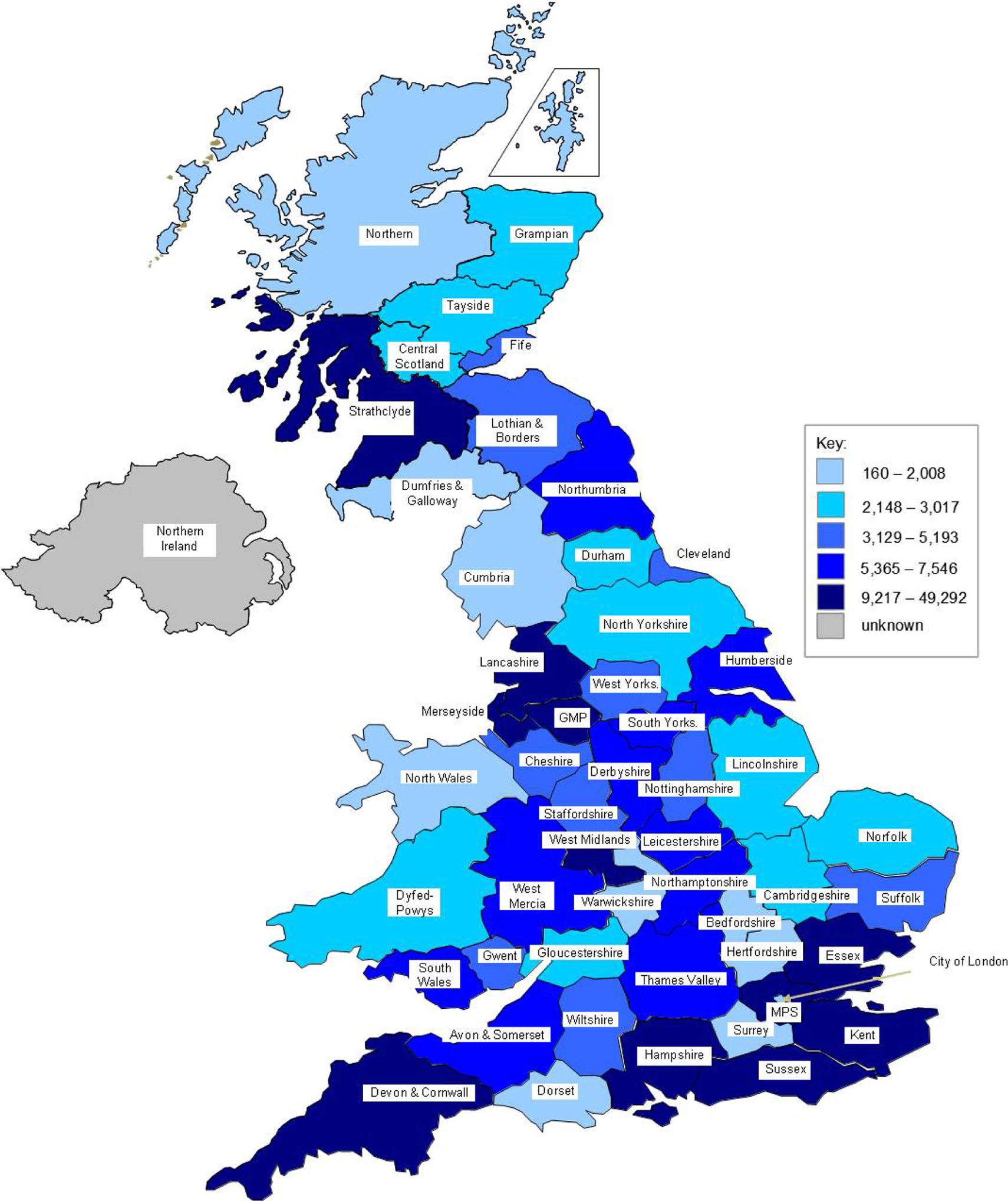
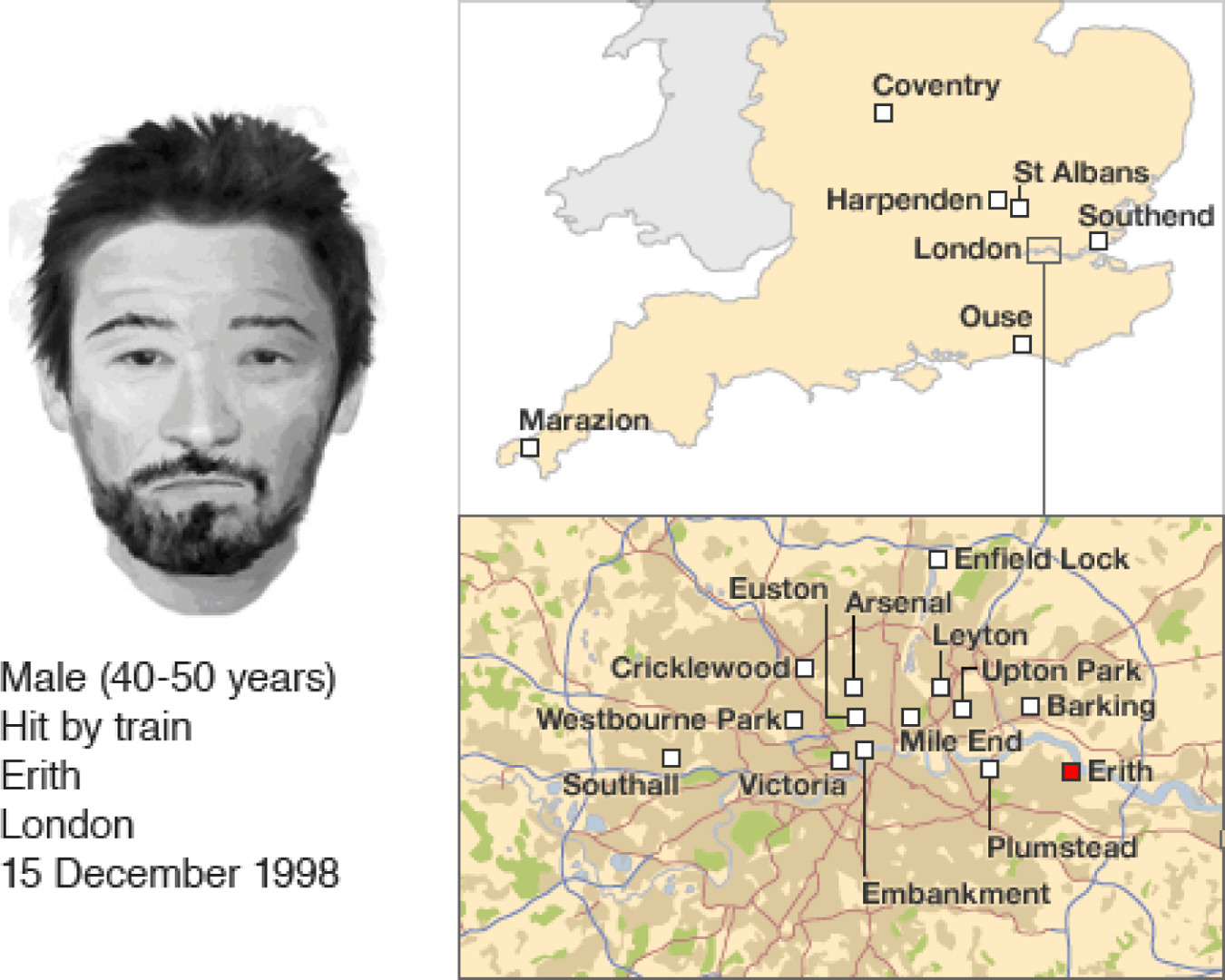
The unidentified dead
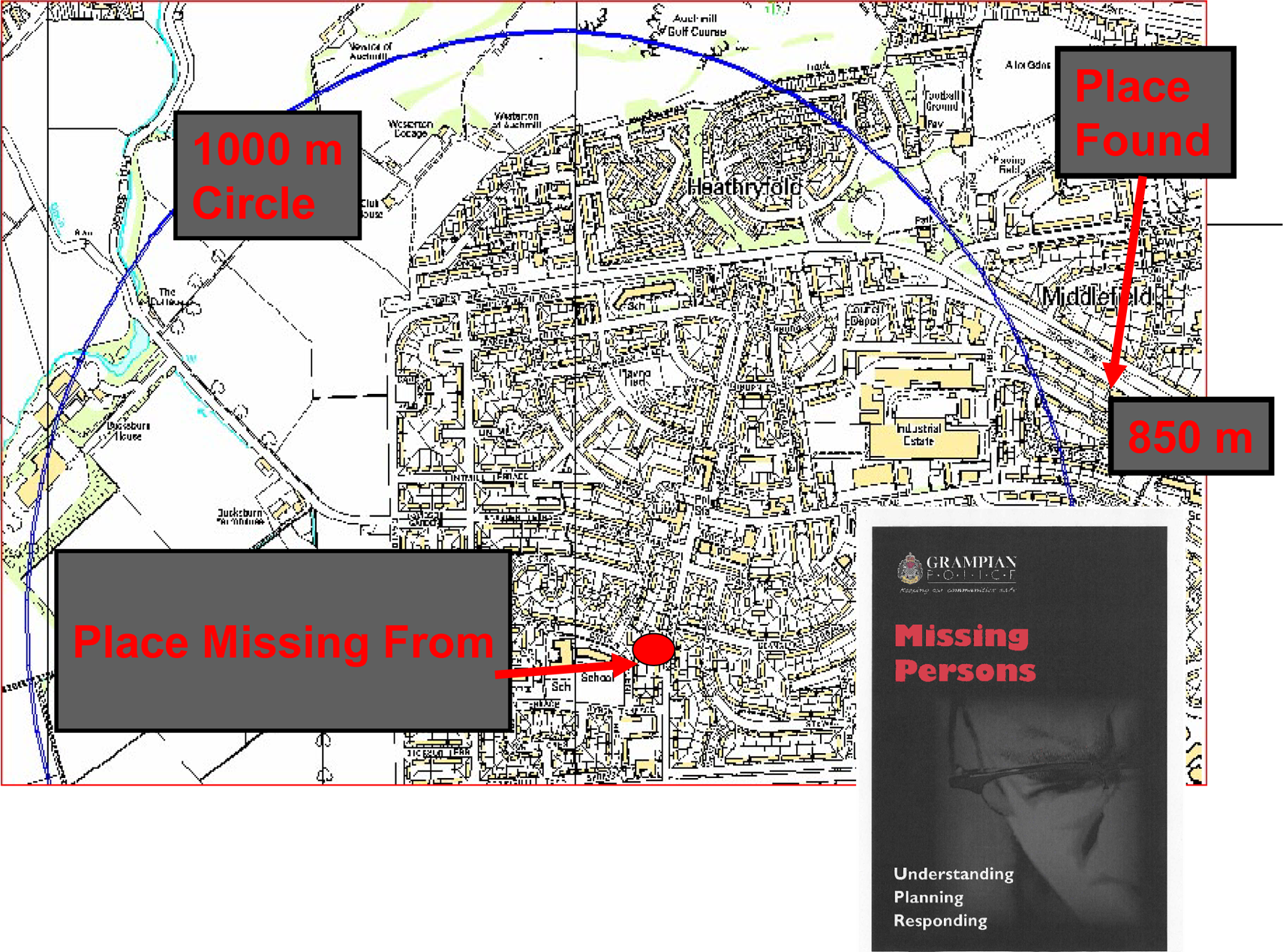
Predictive spatial behaviour data mapping produced by Grampian Police (copyright: Grampian Police)
These maps and images, and the limited data on national missing people profiles (NPIA, 2011) reported earlier, suggest that a substantial social geography of missing people might still be excavated; one differentiated by age, gender, ethnicity, geographic location and other variables. Informally, police, NGOs and academics agree that more needs to be done to ‘map the missing’ and particularly to ‘flesh out’ absent journeys in ways currently obscured by these conventional cartographies of recorded cases. The challenges of trying to make sense of what lies beyond the surface contours of missing maps are considerable. As James et al. (2008: 2) observe, there is an ‘exceedingly complex web of behaviours and responses that surround the phenomenon of missing persons’. In an attempt to capture this complexity, they provide the following overview of possible reasons for disappearance:
While it is not a crime to go missing, there may be factors relating to the criminal justice system, either underpinning the motives of the missing person, or relating to the outcome of the missing person investigation. On the other hand, the explanation may be totally removed from any criminal dimension and could include social problems associated with mental health issues, alcohol use, child psychological abuse, child neglect or parental rejection of a child. It could be combination of both criminal activities and social problems, for instance domestic violence, child sexual abuse, child physical abuse or illicit drug use … The incident may relate to child abduction by an estranged parent or stranger. It could involve an older person with Alzheimer’s disease or dementia. It may be a homicide or a suicide or be the result of an accident … The list is seemingly endless. (James et al., 2008: 2)
This typology of possible ‘causes’ (see also Biehal et al., 2003, for a ‘continuum’ of missing people and their motivations 4 ) points to the complexity of drivers for this kind of ‘crisis mobility’, 5 but the focus is on why rather than about where and how, and what the absence might mean, across a number of different registers.
2 Missing behavioural geographies
Where police research has begun to speculate on the behavioural geographies of missing people that actively produce the national incident maps above, different spatial typologies have been developed. These typologies distantly acknowledge wider social ‘drivers’ for missing crisis, such as discussed above by James et al. (2008), but operate more directly via demographic and diagnostic variables to produce authoritative patterns of missing mobility.
Here cartographies of missing journeys are predictive and relate to categories of missing people. For example, based on previous evidence, a three-year-old child missing for three hours would usually be located within 850m of the home in a non-abduction case (see Figure 3). This figure is based on both case file data and assumptions about a child having limited abilities to traverse a range of environments without adult intervention or drawing adult attention, and because they would have no financial resources to increase their mobility via public transportation (Gibb and Woolnough, 2007). On the basis of this evidence, a police search officer might literally draw an 850m circumference from the point at which the child went missing in order to delimit spatially the physical search.
More broadly, this representational work serves to locate types of missing people in likely spatial scenarios, based on police data about usual distance travelled in time, for gender, age, risk and other factors (like potential suicide risk, or particular diagnosis like schizophrenia or access to a car; see also Shalev et al., 2009). These spatial behaviour profiles helpfully guide police in their search strategy, although it is a more tricky exercise in adult cases because adults have more capacity than children to be mobile and in different ways. Woolnough and Gibb (2007) have produced useable typologies issued across the UK to all sorts of search-and-rescue agents and agencies. This material constitutes the only specifically spatial guidance to locate missing people that exists, although there are different software packages available for spatial interpretation and work-ups (see also search-and-rescue guidance: Koester, 2008; Perkins et al., 2003, 2004; Thomas and Hulme, 1997). That this ‘quantitative’ and ‘predictive geography’ constitutes the only evidence to represent missing people’s journeys to the police and others is both curious and partial.
Concern expressed elsewhere about the consequences of ‘dataveillance-driven risk management for vulnerable groups’ (Amoore and Goede, 2005: 151) is not clearly identified as an issue in these types of informational resources on missing mobilities (but see below), yet they clearly involve diagnostic risk ascriptions and predicative patterning which serve to pathologize missing mobilities in particular ways. The social consequences remain under-researched (but see Newiss, 2004), especially as:
ACPO (2005: 8) states that the police should adopt a problem-solving approach when dealing with missing persons reports … [and] … this approach should include gathering intelligence about missing persons’ activities and their associates, as this is proven to reduce the incidence of missing and offending behaviour. (cited in Shalev et al., 2009: 124)
These ‘approaches’ are likely to be more orientated toward enabling ‘protection, prevention and provision’ (Home Office, 2010, 2011) than security, although preventing unaccountable mobility is clearly an ambition in spatial behaviour profiling and associated risk analysis.
The geography of missing people in production in places like the UK is based, then, on poorly measured incidence, unstable data recording and reporting, emergent spatial behaviour profiling around ‘categories’ (rather than persons) and discourses of risk and prevention in the context of operational agents and their purpose. That this is a representational and operationally significant geography, entirely without reference to any experience of being missing or voices of people who have been reported as missing, is of concern and a matter we address more expansively below, partly in reference to Edkins’ (2011) call for a politics of specificity in missing person inquiries. These queries and tensions will also be reflected in different ways with respect to different national systems of tracking and tracing non-criminal missing people.
IV Searching: seeking presence for missing and mobile subjects
Complementing a basic critique of cartographies of absence is a call to think more carefully about different modalities of searching for missing people, and not always in the context of data-rich immigration scenarios and (literal) border crossings. Indeed, against a background of claims that the ever more sophisticated assemblages of surveillance threaten to make ‘the disappearance of disappearance’ (Haggerty and Ericson, 2000: 619), it is important to underline that all societies still operate an ‘imperfect panopticism’ (Hannah, 1997) so that significant challenges in searching for mobile subjects remain and involve a complex interplay between different knowledges, technologies and human activities.
1 Geographies of search
Two significant, although very different, approaches provide some insights into what searching for mobile subjects looks like in late-modern societies. First, and as already referenced above, there is a growing body of work that takes as its starting point the post-9/11 ‘war on terror’, and it has focused interest in the search (by security services) for the ‘suspicious body’ in order to pre-empt terrorist attacks. This search involves the deployment of complex technologies that use algorithmic calculations to mine databases for information on everything from credit card transactions and travel data to supermarket purchases (Amoore and de Goede, 2008). Such ‘dataveillance in the war on terror’ (Amoore and de Goede, 2005) has arisen from beliefs among security professionals that it is possible to identify a suspicious body in advance and thus legitimize pre-emptive action by restricting an individual’s mobility. In this process ‘search’ is focused on the ‘digital footprint’, those traces of data ‘that cannot help but be left behind by everyday consumption and travel activity’ that are used to diagnose a ‘subject’s proclivity ahead of time’ to threaten the security of the state (Hall and Mendel, 2012). Such pre-emptive searching has unsurprisingly drawn much critical commentary. Amoore (2009) argues that, as the state drives ‘to target, track and trace people and objects’, it is drawing military practices into everyday life and the exclusions and resentments generated by such pre-emption may make us less rather than more secure. These kind of critiques impact our understanding of missing people; but, although missing people do cross borders, they also occupy a range of other spaces in their absence (not often reflected upon in critical comment on securitizing mobilities) and occasionally for periods of time not being traced by the right ‘surveillant assemblage’ or falling through information gaps. Understanding more about how and whether missing people, even unintentionally, evade dataveillance and ‘capta shadows’ (Dodge and Kitchin, 2005: 854) is important when considering mechanisms and limits of surveillant tracking.
Whatever technologies of tracking are available with regards to missing people (e.g. via spaces like the UK Police National Database, CCTV footage, identification codes, applications of forensic process and technique) in order to seek their spatial fixity (and note Dodge and Kitchin’s comments about fine-grained ‘spatial capta’: 2005: 869), searching for missing people is always a contingent process, inescapably related to the specificities of reporting mechanisms and details, risk assessments, available resources, officer decision-making and family liaison. In particular kinds of searching, comparative data-base analysis may form only part of the tracing work (relating relevant police incidents across the UK, reported licence plates, mobile phone data and bank card use, although the latter is harder for police to access for ‘routine’ missing persons reports than is popularly imagined). Although these technologies and data spaces are important, it is also the agency of search officers themselves that is of interest, in different ways to Amoore’s (2011) networked ‘real-time decision making’ at the border, and the construction of professional-personal geographical imaginations about likely time-space pathways of missing people.
In this regard, we draw on a second very different approach to both conceptualizing and researching search, as revealed in the work of Yarwood (2010, 2012). Here the focus is not the ‘suspicious’ or threatening body, but the ‘lost’ or ‘missing’ person who comes to the attention of the emergency services and, in particular, Mountain Rescue Teams (MRTs). In terms of actually attending to relational dynamics of absence as-it-happens, and to how responses actually arise, the actor-network perspective articulated in Yarwood’s (2010: 258) assessment of emergency search services and MRTs is helpful in emphasizing how absence is practically populated by attempts to ‘combine knowledge, technology, environment and people into particular assemblages’. Yarwood explores how different embodied practices (walking, search techniques and fitness), non-human actors (such as search dogs), knowledges (of local environments and navigation skills), technologies (communications equipment and vehicles) and agencies (police, MRTs and ambulance services) are all enrolled into hybrid networks in order to execute the search process. As Yarwood observes, MRTs are increasingly being used to search for ‘missing people’ (someone involved in a crisis mobility or as reported as absent by others) rather than merely ‘lost’ people in the hills (a person temporarily disorientated and wishing to be found) for a variety of resource-led and organizational reasons. Being enrolled by the police to search for missing people has ‘contributed to a significant re-mapping of the terrain (literally and metaphorically) of Mountain Rescue’, as their searches now increasingly include lowland and urban areas (p. 267). His ‘moments in a Mountain Rescue call-out’ (Figure 4) clearly indicate the ‘assemblage’ that he aims to lay bare.
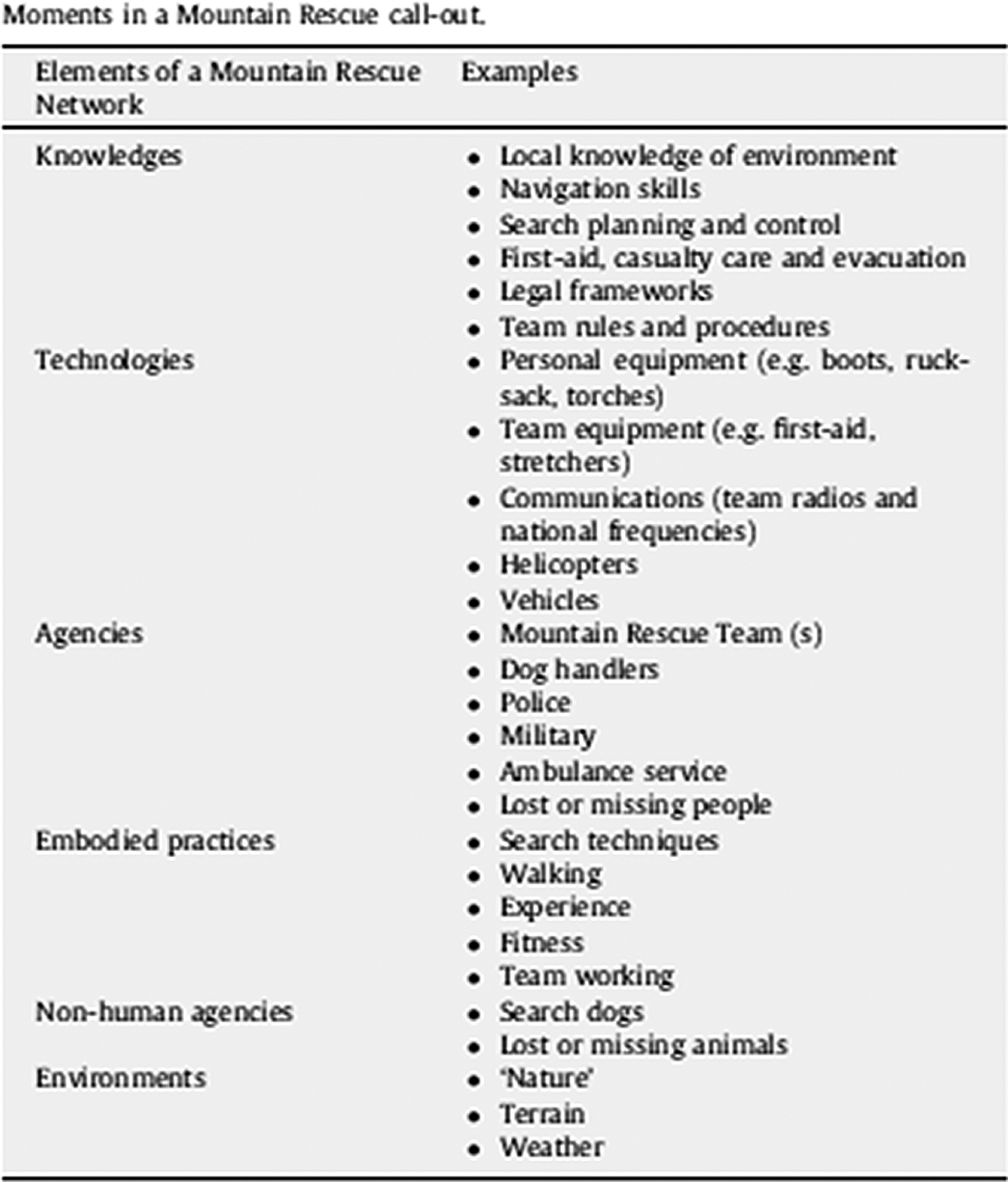
‘Moments in a Mountain Rescue call-out’
Yarwood’s subsequent description of ‘the shout’ (the request to MRTs to find a person or group) and an actual search and rescue on Dartmoor animates this assemblage, and relates these moments in the context of a short ‘story’ of a search event. The visceral nature of ‘emergency’ is clear as injury, natural environment, being lost and oncoming night are relationally constructed through the narrative. Yarwood argues that MRTs are increasingly being asked physically to search for ‘despondents’ (people reported as missing and who may be in crisis), a category he signals as assigned to people who may themselves not ‘shout’ to be found (Yarwood, 2010: 264). How police use MRTs is locally dependent but increasingly under national scrutiny, and Yarwood’s work hints at the physical limits of (police) searcher mobility, since he notes police reluctance to send officers into ‘natural’ or bad weather environments when looking for the missing: thus often the point when MRTs are deployed.
While it is instructive to understand how search ‘happens’ (as above) and build sensitive geographical knowledges around it with respect to policing cultures, resources and ‘real-time’ spaces, such foci should also do more than animate particular policing geographies (cf.. Fyfe, 1991; Herbert, 1997; Yarwood, 2007). We need more specifically to understand the intersections of technical/personal/professional (spatial) knowledges and imaginations and how these intersections structure responses to reported absence, particularly in relation to how these responses co-ordinate with or contradict any family mappings (with which we are concerned but have not outlined fully here 6 ). Some ‘types’ of spatial knowledge (such as those held/imagined by family members) may be considered ‘outside’ the usual informational parameters of search, for example, or be missed by particular data-capture processes. Examining how multiple actors report, discuss, imagine and act on possible geographies of absence may be of critical use, and even serve to alter search ‘assemblages’ in practice. Understanding the role and limitations of (types of) information which are routinely used and collected by the police in order to target the deployment of limited search resources in missing-person cases would thus be helpful.
2 The policing of search
A focus on the role of the police in searching for missing persons also suggests that we need to develop a nuanced understanding of the spatiality of police work more generally. To date, most police research by geographers and others has focused on observing the ‘doing of police work’, using ethnography to reconstruct the time-space choreography of police work and participative ‘ride alongs’ with officers to make sense of the territoriality of policing (Fyfe, 1992; Herbert, 1997). What perhaps remains hidden in these accounts is how police work is also a textual as well as a practical activity. Police officers draw upon texts to inform and shape their work (e.g. policy documents) and also construct texts in the form of ‘case files’ to document activity and assemble information, thereby establishing a series of interpretations, classifications and inferences about an event, the aim being to build a narrative that ‘ties people, places, objects, and phenomena together’ (Innes, 2002: 682) which is often captured in text.
In the case of missing-person investigations, these texts or case files are the product of (and produce) an ‘investigative methodology’ (Innes, 2002: 672) which introduces procedures, routines and conventions that missing-person investigations partially share with those deployed in criminal inquiries. A risk assessment is carried out; the homes of the absent and close relatives are searched; interviews are carried out with the immediate family and those who last saw the missing person; databases at local hospitals are checked; CCTV evidence is gathered (if available); the last known route of the absent is retraced and house-to-house inquiries along that route are carried out, among other elements. All of this is noted and written down. The methodology here is critical to a ‘case constructionism’ (Innes, 2002: 672): a gathering of disparate evidence to fashion that narrative of ‘what happened’ up to the moment of disappearance so as to inform the process of search. This narrative is not neutral: it constrains and directs; it is orientated by a sense of audience and their expectations and interests; and underpins a reading of people and landscapes that shapes an understanding of the cartographies of absence and the geographies of search. We know little about this narrative construction, its spatiality, and its place in research on assemblages of data and search. Attention here, then, might throw more light on the very human constructions and manipulations of missing data (or data on missing people) which will implicate what kind of absence is being articulated and where search happens, how and for how long.
3 The ethics of searching
The search for ‘suspicious’ and ‘missing’ bodies and persons clearly raises important questions about a more general ethics of tracking. These have been most clearly addressed in the work on the mining of transaction data and how resultant pre-emptive security decisions contribute to what Amoore and de Goede (2008: 128) contend is ‘a barely visible form of violence in the war on terror’, implicating how the security apparatus selects, identifies and misidentifies its targets. In the context of missing people, the ethics of tracking are complex but different. While most democratic states might have some reference to ‘rights to go missing’ (UN resolution 7/28 in 2008), those involved in searching, particularly the police, typically have a statutory responsibility to protect life and prevent harm. The decision to search will therefore in some circumstances be entangled in contradictory pressures whereby ‘the right of an individual to go missing has to be balanced with the need to treat his/her relatives and friends compassionately’ (Newiss, 1999: 9), as they seek ‘professional’ help in finding someone who is missing. Relatedly, some charitable agencies who work with the police explicitly risk stating ‘that no adult has the “right” to go missing without notification to law enforcement’ (http://www.lostnmissing.com).
What is also apparent, and reflecting Edkins’ (2011) reminder, is that only some missing people are recognized as such and only some are even considered in systems and practices of search and tracking. One key ethical question thus becomes who is not the subject of search and why? Who not only has the right to be missing, but also the right to be found? Our own partial account of research interest and research gaps in reference to the practice of searching has rested primarily on police or statutory searching services, forces and operations, and there are of course other agents/agencies whose powers are constituted at different spatial scales and exist for different purposes (e.g. ranging from the global in scope, such as The International Commission on Missing Persons, to locally based and often unregulated commercial services from private investigators and private forensic services to voluntary agencies). Here any ethics of search and question of rights will be situationally configured. We return to these questions below, but end this section arguing that any ‘knowledge’ of missing people has to confront and question not only representational cartographies, but also different modalities of searching and their politics.
In the following two sections, we move from a critical description and questioning of how missing people are defined, mapped and searched for, to offer initial thoughts on a dual agenda for geographical research that calls for a more direct engagement with the lived emotional and embodied experience of going missing and being missed as part of a responsive politics of specificity (cf. Edkins, 2011); and, second, to suggest that geographers would be well placed to comment on the where of missing people, as part of analyses that question a more general politics of mobility (Cresswell, 2010).
V Feeling: going missing and being missed
Missing situations are clearly ones involving emotions and affect, often in quite profound and traumatizing ways, and yet there are no explicitly emotional geographies (Davidson et al., 2005) of missing experience (but see Pratt, 2005). Beyond human geography there is a literature about family grief around missing persons and we draw on this below, but our initial call is for a recognition of missing experience from the perspective of returned missing people. In light of the fact that 99% of reported missing cases result in return (in various time frames; Tarling and Burrows, 2004), it is surprising that very few examples of research which engage this group of people exist (the best-known example is a UK study premised on 114 postal questionnaire returns from the database of the UK charity Missing People: Behial et al., 2003). We do not know of any research that has substantially diversified beyond questionnaire surveys or operational reporting (e.g. analysis of the so-called ‘cancellation forms’ completed by police officers after a missing person is found: Woolnough, 2011). While this is a methodological point, it also relates to how missing people are predominantly researched as categories and units and not as fleshy, emotive and embodied people occupying a crisis-led mobility. There is currently no research that has engaged with the voices of missing people and their feelings about their absence, or tried to access memories of missing events or ‘journeys’ (but see http://www.geographiesofmissingpeople.org.uk for emerging work).
There has been substantial research in the area of mental health and homeless geographies where emotive embodiment and lived landscapes of particular kinds of crisis mobilities have been discussed (Cloke et al., 2010; Knowles, 2000; Parr, 1999, 2008; Parr and Philo, 1995), and a focus on missing people may have resonances here, although be differently configured. Indeed, we could argue for a research agenda that is partly dedicated to understanding more about the overlaps and discontinuities with homelessness research and what Cloke et al. (2010: 65) call the ‘strange maps’ of urban homelessness. Homeless people may sometimes be missing, but missing people may not be homeless, and thinking through what this intersection means not only in terms of landscapes of service provision and regulation, but also for the ways of encountering ‘affective worlds’ may be helpful. Cloke et al.’s (2010) conceptualizations of ‘the homeless city’ (comprised of ‘assemblages of places’, ‘cartographies of homelessness’ and different homeless ‘performativities’) offer a context through which to think what it is to be missing in these same places, and often for short(er) amounts of time. The particularity of the crisis-led mobilities that missing people occupy and embody potentially renders them ‘in-authentic’ emotional subjects for research purposes, precisely because they may not sediment their ‘alternative’ spatialities in the ways that homeless people might: their ‘flesh and stone’ relations with city spaces are differently configured in corporeal and affectual terms. Unlike people who are homeless, who can often access shared collective experiences and identities (and emotive ‘structures of meaning’) on the street or in a hostel, being missing is usually highly individualized and short in duration, and may involve active attempts to ‘hide’ or ‘escape’ from others.
It may be that turning to research on mental illness and different kinds of ‘mad’ ‘transits’ (Knowles, 2000: 84) in the city may provide different kinds of resources for understanding being missing, and encourage sensitivity to ‘moving and motions through’, rather than occupying, space. Knowles raises questions about how some disenfranchised people with mental health issues can live constantly mobile lives which are (violently) punctuated by uncertainties, and she asks ‘what kinds of “being-in-the-world” are formed by having no place’ (p. 97). These questions may be different for people reported as missing, precisely because they may be temporarily dislocated and mobile, as a result of having vacated their ‘normal’ places and places of being and attachment. Gibb and Woolnough (2007) suggest, however, that 80% of missing people have clinically significant mental health problems, and the potential exists for some of slipping into lives ‘violently punctuated’ by patterns of missing mobility (significant proportions of missing people incidents are repeat cases: NPIA, 2011). For some people in mental health crisis, going missing is not just a case of covering distance (Shalev et al., 2009), but relates to isolated and individualized journeys in which a variety of scenarios may unfold. Surrounding these possibilities are wider issues about how best to conceptualize such forms of mobility, and these we address in our final section below, but for the moment we argue that the missing have only ever been encountered on particular terrains in operational research, and as a result we have little insight into their emotional states and lives and geographies.
In developing an agenda for emotional geographies of missingness – not only via an empirical engagement with versions of the crisis mobilities highlighted above – we might also advocate drawing on existing literatures that deal with absence in order to understand not only being missing, but also being missed. In the context of work on death and grief (Maddrell, 2009; Maddrell and Sidaway, 2010; Rose, 2009; Young and Light, 2012), there is currently rich comment on the relations surrounding end-of-life and some of this work has uncannily brought grief-worlds to light. Maddrell’s (2009: 677) moving commentary on the liminal spaces of grief, for example, serves to highlight how grief involves the animation of the absent dead in various ways. There is reference here to special spaces of grief which are conceived of as ‘sacred [and which] can bridge absence–presence for the grieving and be a place of “encounter” with the deceased’ (e.g. roadside memorials or benches). We might thus be prompted to think about families of missing people who do not necessarily have such spaces, and who are only left with uncertain traces of the missing (Morrissey and Davis, 2007), which then reverberate through their previously inhabited geographies. Families of long(er)-term missing people may inhabit particular kinds of emotional liminalities, captured in the phrase ‘ambiguous loss’ and located somewhere between grief, memory and hope (Betz and Thorngren, 2006; Boss, 1999, 2002, 2006, 2007). Inspired by Madrell’s work in particular, we might seek to understand the importance of spaces of uncertain grief as involving a kind of waiting that cannot straightforwardly be ended. Here, continual, unresolved and missing absence might be conceived as (spatial) forms of waiting (see also Hogben, 2006), and assist a broader reconceptualization of unlocated absence, something currently provoking ever more intense scrutiny by the state (as the sections above indicate), but not well understood in terms of relational emotional experience. We have already stated that many missing people are missing for relatively short periods of time, but understanding the longer-term emotional legacies of absence in the context of family and other social relations is also important.
An emotional geography of missingness and missing people would thus involve theorizing around spatialized dimensions to going missing and being missed. Loss, fear, grief, suicidal states and lived crisis are all (unstable) modalities of emotion with affective constitution and resonance which could be critically assessed as drivers and contexts for missing mobility and its impacts. This project could also be understood as a means to address a silence on missing emotions and experience, itself a conceptual and substantive absence. Such a project could be seen as a contemporary complement to more historically orientated research in ‘spectrology’ and spectral geographies (Adey and Maddern, 2008; Maddern, 2008), work which highlights the haunting and haunted aspects of place, and weaves collective stories of loss and lost histories through different materialities of memory in order to ‘re-presence’ absences.
Likewise, it might chime with ‘vitalist’ work on landscapes, dwelling, walking and ecologies that also engage with the concept of absence. As Wylie (2007) argues:
such writing works creatively and critically at a threshold of presence/absence [and] all the traces of presence of those now absent are worked in such a way so as to show, synchronously, the absence of presence, the presence of absence, and so in the final analysis the threshold assumes the status of an enlarged, uncannier zone of indiscernability and dislocation, disrupting all distinctions. (Wylie, 2007: 279)
Refusing a straightforward binary of absence/presence, this abstract passage nonetheless reminds us of the disruptive potential of encountering ‘what and who is missing’ in critical and theoretical terms. What spectral and landscape studies are broadly seeking to do in this context is to ‘witness’ (not simply reproduce, reveal or represent) ‘absent geographies’. The uncertainties of the present/absent nexus are clear from the complex writings of those who engage it. Adding missing people and their memories of lived absence and absence-making would be to enliven and animate these grief-stricken and ghostly writings, and more specifically would help address any critique of human geography as producing only ‘left behind’ knowledges.
VI Moving: missing mobilities
That geographers and others might have neglected the missing, their absent geographies and their voices, is perhaps related to Hoskins and Maddern’s claim (2011: 153, using Scheller and Urry, 2006) ‘that social science has largely been static and “a-mobile” where stability is taken as the norm, as fundamental, and mobility an atypically dysfunctional force threatening the authenticity of place and rootedness’. Moreover, missing people have engaged in a curious form of mobility – what might be called ‘stuttered’ ‘crisis’ mobilities: ‘journeys’ that are often short in duration (Tarling and Burrows, 2004), and as a result are seemingly ‘meaningless’ beyond the complex acts of leaving and arriving (if this occurs). These journeys are undertaken for a range of barely understood reasons, perhaps also contributing to a sense of an inauthentic mobile population and thus further accounting for its neglect. We would urge reconsideration here, not only because these short journeys are the cause of huge psychological disruption for missing people themselves, their families and friends, but also because they can require huge amount of police resources. In addition, attending to these unusual mobilities might enable a ‘move beyond “movement versus stasis” antagonisms by focusing on the actual content of movement as it is experienced and undertaken’ (Hoskins and Maddern, 2011: 153). In this, we might need to engage with various kinds of travel, displacements and uncomfortable dwellings. Given that we cannot accompany people actually going missing, we are reliant on listening to fractured memories of (crisis) mobility in order to access something of the practice of absent journeying (and there are a number of methodological resources available to us here).
In paying attention to the ‘doing’ of absence and becoming absent, we are challenged to move beyond accounts of ‘the left behind’ as suggested above, and also narrations of straightforward relationships with space and place: we must become more attuned to different kinds of emotional, affectual and material ‘thresholds’ and moments in journeying; and different ways of understanding what these might be. Bissel (2009), in his paper on commuter bodies, argues that:
researchers interested in these ‘non-representational’ dimensions of mobilities have sought to emphasize the multiplicity of ways in which the bodies perceive, make sense of and experience a variety of mobilities; not just through reflective, cognate means, but also through these more habitual and sensory modalities that are implicated before reflexive thought kicks in. (Bissel, 2009: 427)
Getting people (who are often vulnerable) to talk about practising unusual mobilities (in material, affectual and kinaesthetic registers) is challenging, but (notwithstanding the conceptual contradications here) this may assist our flawed understandings of doing absence in ways that speak to those trying to animate lost and mobile geographies.
How might we conceive of the figure of the mobile missing person within this new research agenda? It may be helpful to look further at mobility research. Cresswell (2010: 18) critiques a 'new mobilities paradigm', pointing to how particular mobilities have broadly traceable histories and geographies, particularly those that emerge as ‘pervading constellations’, meaning identifiable patterns of movement, representations of movement and ways of practising movement that make sense together. In offering an argument about the importance of looking backwards as well as forwards in trying to understand mobility as not always ‘new’, he highlights the ‘recent’ invention of the subject position ‘hobo’, while also discussing medieval versions of ‘the vagabond’, and the anxieties that were produced around these particular forms of travel. These historical figures often occupied longer journeys (over time if not space) than some missing people who are the subject of search in places like the UK (this point obviously does not apply to everywhere), but there are lines of connection between these figures who inhabit unusual mobilities: ‘unusual’ in that direction, destination, assured arrivals and departures may be fuzzy in each of these cases. Beyond simply noting that these forms of mobility may be understood as threatening, concerning or subversive, they have all been subject to forces of spatial regulation (via by-laws, local policing cultures and search efforts). People who disappear (or who appear to disappear) are also still ‘directed’ by infrastructural forces (bus routes, timetables, walkways), just as hobos were often channelled by train-lines and vagabonds by pathways, local travel knowledges and so on. People who go missing are not absolutely beyond patterning, in other words, and they do not (mostly) occupy intentionally dissident mobilities. Understanding these patterns only through points of departures and arrival (data which generates the spatial behaviour profiles above), however, constitutes a very partial geographical knowledge. Looking to historical precedents for defining absent mobility itself is also one other possible endeavour, but perhaps in the context of informing contemporary knowledges.
In terms of searching for the missing, the claim that ‘architectural understandings of time-space regulation are increasingly redundant in the face of new informational and computational landscape’ (reported in Cresswell, 2010: 28) is perhaps relevant, although contentious. In drawing on Virilio’s (2006) notion of ‘dromology’ (the ‘science of speed’), there is a suggestion here that any suspect mobilities (constituted primarily through references to immigration and terrorism) can be disabled via technologies (including ‘gait analysis’, the science of walking styles, at airports). The crisis mobilities of missing people may help to challenge this assumption in various ways, by these individuals leaving phones behind, or not using cash points, and not going through biometric border-zones. Missing people may also move through environments not routinely under surveillance (the countryside, back-street pubs and streets, floors of ‘friends’). It may be that in trying to understand more about ‘topological and topographical’ (Cresswell, 2010: 29) frictions in mobilities (and in analyses of them) missing people may actually help us. Examining more about missing journeys, and what is embodied and mobilized through, in and around can thus assist in building what Cresswell (2010) calls a ‘fine-tuned’ politics of mobility, which questions assumptions about our abilities completely to map movement through time, space and place (see also Cresswell, 2006a, 2006b; Cresswell and Merriman, 2011; and compare Amoore, 2006, above).
VII Conclusion
Missing absence poses significant political, ethical and practical challenges in terms of developing a research agenda in this field. In the first instance, Edkins’ (2011) call for a politics of specificity with regard to missing persons is on one level largely a response to bureaucratic failings in a range of global mass identification and tracing scenarios which do little to make families of the missing feel as though their person matters. On another level, this is a more complex argument about the politics of recognition: a recognition of a missing-person-as-such, ‘for who they are and not just what they are’. Edkins (2011: 194) maintains that ‘the person-as-such is not generalisable’ – itself a comment on a contemporary politics that instrumentalizes the individual (partly through the systems of capture referenced earlier). In light of this argument, we advocate developing a critical-social geographical research agenda that moves away from just and only knowing missing people through categorical and operational knowledges (the spatial behaviour profiles, incidence maps, risk assessments and ‘drivers for absence’ data). Instead, we argue for a taking seriously of missing experience, missing voices, missing mobilities, absence-making and ambiguous loss (Boss, 1999).
This orientation requires a close engagement with difference and diversity if we are properly to understand the ‘who’ of missing populations (in terms of their varied social-demographic characteristics and their different vulnerabilities) and the ‘why’ of missing in terms of understanding its multiple causes (from escaping particular ‘regimes’, neighbourhoods, family environments or financial problems to drifting-out-of-contact through lifestyle choices, or coercion in the form of abduction, sexual exploitation or trafficking: see also Biehal et al., 2003). This broad agenda needs to incorporate the unmissed missing, and those who are noticed as absent but who remain unreported, or who are deliberately erased and who do not seem to matter, perhaps because of skin colour, sexuality, gender or particular kinds of politics.
Here, there may be an opportunity for geographers to produce nuanced accounting not only for the demographics and orientations of those who are absent, but also to attend to the kinds of spatial politics that their absence produces and is produced by. The actions of the mothers of the Plaza de Mayo in Argentina – and the gulfs of interpretation that remain around the unstable politics of grief and recognition that this motherly witness of disappearance has produced – is a case in point (see also multiple references in Edkins, 2011: Chapter 7). What this example shows is that missing absence can be politicized via different ‘publics’ in some parts of the world, where questions of scale are also vital (from the politics of the grieving body of the mother, to the parading of mourning in Plaza de Mayo to a fundamental questioning of Argentine nationhood in reference to histories of ‘the disappeared’). In places like the UK, missing absence is largely a private and ostensibly unpolitical affair, despite the emerging family rights agenda advanced by Missing People Charity (see also http://www.missingpeople.org.uk/missing-people/missing-rights). This is not only because the form of absence is different (obviously it is not ‘arranged’ by the state), it is also because there is no analysis of the broader geographies of inequalities that may structure missing crisis. A radical research agenda might question this lack, and focus on the role of place, poverty, class, austerity-effects, debt burden and so on, in so-called ‘drivers for absence’. There is, then, a materialist analysis of missing absence to be completed: in asking ‘why?’ people are missing, we need to be cautious not to exercise an ethic of ‘specificity’ in ways that serve only to individualize and pathologize missing actors, as this simply limits the conversations that we may have about their crises.
Conducting any research in this field is, of course, challenging at a practical level, but in the ‘doing of social geography’ (Pain, 2010) in relation to missing people there are also significant opportunities to forge useful partnerships and collaborative research relationships. By their very definition, missing people are acutely hard-to-reach research subjects, and so accessing this ‘group’ means working closely with organizations (such as the police and charitable groups that support families of missing people) that hold different kinds of knowledge and agendas. Much of this knowledge is, of course, partial, incomplete and confidential. ‘Official’ data held mainly by police agencies is collected and stored in a variety of different forms which frustrate attempts at comparative analysis over time and across space, and there are ‘hidden’ missing populations whose absence is not reported to or recorded by the police or other agencies. Nevertheless, by developing collaborative, mutually beneficial research relationships with the range of different agencies that respond to missing situations, there are opportunities to develop our understanding in this field, using both quantitative and qualitative methodologies, in ways which are ethically robust and practically important. With regard to the latter, we have briefly illustrated the spatial behaviour profiling that informs practices of searching by the police and other agencies. There are opportunities for improving how such organizations provide an effective search-response via evidence-informed practice that has reference to voices of those returned and family search strategies (not fully detailed above). Detailed reconstruction of missing-person cases could, for example, yield important insights into the value of different types of spatial knowledge in the search process, although a critical human geography might be cautious about this kind of production of knowledge for agents of the state. In terms of the ethics of research practice in this field, it is vital to engage with how research will sensitively work with vulnerable people who have been reported as missing in emancipatory and/or participatory ways. Learning from their experiences will help geographers co-produce knowledges which are not simply ‘left behind’.
In closing, we note that nearly 30 years ago the geographer Torsten Hagerstrand (1984) urged researchers to reflect on questions of ‘presence’ and ‘absence’. The focus of his argument was epistemological (prompted by a concern at how conventional disciplines ‘cut out pieces from the real world’, p. 374), but his subsequent development of these ideas via time geography explored the interplay between ‘presence’ and ‘absence’ through a focus on reconstructing individual, embodied journeys in time and space. As we have argued in this paper, in developing a critical-social geography of missing people, it is vital that we re-engage with the complexities of such journeys and further address the emotional and practical challenges that the presence of absence and the absence of presence brings. It is time for us to recognize missing geographies.
Footnotes
Acknowledgements
Three referees reports and the comments of two editors have been very useful, and we hope our reading of them has improved the paper. We also thank Chris Philo for a supportive and critical reading of the final version.
Funding
This paper is written by members of a current research team who are now funded by the ESRC (RES-062-23-2492) to investigate `geographies of missing people'.