




Abstract
The so-called ‘incest laws’ of Lev. 18 and 20 present an interesting problem. These chapters appear to contain two lists of the same prohibitions. Scholars have assumed that either ch. 20 uses ch. 18 as its source or that the chapters are independent of each other. I argue, instead, that ch. 18 uses and revises ch. 20 through a process called ‘revision through introduction’ (S. Milstein). This argument attempts to explain why Lev. 18 and 20 seem to be nearly identical in terms of the issues they address, why they are structured differently, and why they are separated by unrelated material in Lev. 19. In the redaction process of P and H, Lev. 18 appears to be placed before Lev. 20 to influence how it is understood. The effect is to smooth the ideological tension between P and H and create the appearance of literary cohesion in Leviticus.
A curious feature of the Hebrew Bible is that it systematically prohibits a wide range of sexual activities. 1 The majority of these prohibitions are found in Lev. 18 and 20, and this paper explores why these chapters contain, essentially, two lists of the same prohibitions. This repetition has proven to be a peculiar problem and the nature of the relationship between the two chapters continues to be debated. 2 This article proposes a new solution to this problem. I argue that Lev. 18 was composed—with Lev. 20 as its source—to act as a bridge between P and H in Leviticus, smoothing the tension between their unique views and creating the appearance of literary cohesion. 3 In Leviticus, the traditional understanding is that Lev. 1–16 is P and Lev. 17–26 is H, though I will interrogate this view below. 4 Further, while scholars see H material in places like Lev. 5–6 and 11–12 (i.e., in the ‘P block’), the present discussion focuses on the two main blocks of P and H material in Leviticus. 5
I begin by reviewing the relationship between Lev. 18 and 20 (section I). Next, I argue that Lev. 18 reworks and shapes how Lev. 20 is understood through a process Milstein calls ‘revision-through-introduction’ (section II). 6 Interpreting Lev. 18 in this way largely accounts for the differences between the prohibitions in Lev. 18 and 20. Then, I discuss the meaning of לגלות ערוה “to uncover nakedness” and suggest that the term broadly prohibits acts that would sexually humiliate someone (section III). 7 This interpretation helps make sense of the intersection of sex-related terms in chs. 18 and 20. Subsequently, I undertake a closer examination of several prohibitions to illustrate the payoff to this argument (section IV). Finally, I highlight several potential pieces of evidence that may further reinforce this reading and then draw conclusions (section V).
I. The Relationship Between Leviticus 18 and 20
Scholars have understood the relationship between Lev. 18 and 20 in two basic ways: either ch. 20 is a reworking of earlier material from ch. 18 or both are independent traditions. Both views have strengths, but they ultimately leave important questions unanswered. The primary argument in favor of ch. 20’s dependency on ch. 18 is the shared linguistic and stylistic content of the prohibitions—scholars argue that ch. 20 seems to expand the content of ch. 18 with lengthier formulations. 8 Further, both chapters contain lists of sexual prohibitions that are framed by exhortations to keep all of Yhwh’s statutes and not to be like the people of the land (18.2–5, 24–30 and 20.7–8, 22–26). Scholars in favor of this view suggest that ch. 20 seems to presuppose Lev. 17–19. 9 If ch. 18 arranges the prohibitions by the degree of kinship (close kin, close kin’s kin, and two people who are close kin to each other), 10 then one could reason that ch. 20 rearranges the contents of ch. 18 according to the penalty for each group of offenses (death, excommunication, infertility). 11 Another piece of evidence for this view is that the author of ch. 20 makes the euphemism לגלות ערוה “to uncover nakedness” clearer in several instances by adding epexegetical phrases like ישׁכב את־אשׁת אביו “he lies with his father’s wife.” 12 In that instance, Lev. 20.11 is understood to make the euphemism in 18.8 explicit. But if this were the case, we might expect the author(s) of ch. 20 to add a similar epexegetical phrase to their reworking of other prohibitions, like 20.19. 13 Further, if Lev. 20 was written with ch. 18 as its source, why would it reduce the number of family members who are off limits? 14 This view answers some questions but also leaves important ones unresolved.
The other view suggests that we are dealing with independent traditions. 15 A strength of this view is that there are a considerable number of differences between the texts. The penalties are different, the chapters contain different forms of address (second person vs. third person), ch. 18 contains additional kin who are not necessarily prohibited in ch. 20, and some prohibitions have marked differences. For example, the prohibitions concerning menstruating women in 18.19 and 20.18 are fairly different; the only shared lexical items are אשׁה ‘woman’, ערוה ‘nakedness’, and גלה “to uncover.” Further, it is not always clear why a range of terms are used to prohibit sexual activity: לגלות ערוה “to uncover nakedness”, שׁכב ‘to lie’, לקח ‘to take, marry’, etc. For some scholars, the fact that the penalties are very different and that the laws change from second person to third person suggests differences that cannot be reconciled. 16
Both views solve some of the apparent problems but are not entirely satisfactory. Despite having distinct organizational structures, penalties, and various other details, both passages share the same essential goal: prohibiting sexual misconduct that might pollute the people and the land. Further, both passages share many terms, phrases, and constructions. Because of their striking similarities, it seems clear to me that there is a literary relationship. Yet, the view that ch. 20 relies on ch. 18 does not fully account for the differences we see.
II. Revision Through Introduction
I follow others in seeing a literary relationship between chs. 18 and 20, but instead I see ch. 18 as a reworking of ch. 20. 17 I suggest that this happened through a process called ‘revision through introduction’. 18 Milstein observes that literary production in the ANE was typically an anonymous, cooperative effort; literary texts were not ‘fixed entities that were bound to a single perspective’, but could be modified to serve new contexts or needs. 19 Milstein gives numerous Mesopotamian examples of revision-through-introduction, and these examples are particularly helpful for biblical studies, in part because clay tablets survive a lot longer than parchment, leather, or papyrus. And thus, more clues about the compositional process are preserved. For example, the OB version of Gilgamesh casts him as the aggressive, ruthless king of Uruk who embarks on heroic adventures after he meets Enkidu. However, the MB version from Ugarit and the later SB version feature an introduction that cast Gilgamesh as a pensive sage, and these small additions transform the aggressive king into an introspective wise man. 20 This phenomenon is also evident in other genres. 21 The Laws of Hammurabi, for example, are attested with a prologue and epilogue but also as an independent collection of laws. The use of framing material in certain cases, according to Westbrook, allowed the collection to be “applied to a new purpose, that of the royal apologia.” 22
While text production and scribal activity in Israel and Mesopotamia were not exactly the same, revision-through-introduction provides a mechanically plausible process for redactional activity in the HB. Milstein suggests that ‘revision … did not seem to require a complete overhaul of the received work. Because the addition was at the front, the logic of the older work could be recast through a new lens’. 23 I suggest that Lev. 18 acts as a revision-through-introduction to ch. 20 in order to create the appearance of cohesion between P and H in Leviticus. Lev. 18 does this by addressing the same topics as ch. 20 but with a position that mediates between P and H’s views. However, there may be two problems with my argument here. One is that the conventional delineation of P and H in Leviticus (primarily Lev. 1–16 and 17–26, respectively) implies that Lev. 18 is not located at the beginning of the main H block in Leviticus, and so it would not be the introduction to H. The other is that much recent scholarship sees H as a later, supplemental text that revises and/or expands P; if this is the case, why would the author(s) of H add material that mediates between P and H’s views? 24
Concerning the first issue, a growing number of scholars see consistency and coherence in Lev. 1–17, especially between Lev. 16–17, instead of the traditional view that chs. 1–16 are P and 17–26 are H. 25 For example, L. Feldman’s literary and legal analysis highlights the internal consistency of Lev. 16–17 and its connection to 1–15, and her study concludes that there is little evidence that indicates Lev. 17 should be considered part of H. 26 If Lev. 17 is part of the main P block, then Lev. 18 could have been added to the very beginning of H (understood here as Lev. 19–26), creating a seam that ties both sections together. In fact, K. Graf—who proposed isolating this unit several decades before A. Klostermann coined the term ‘Heiligkeitsgesetz’ 27 —suggested only that Lev. 18–26 was an independent legal corpus. 28
Likewise, M. Douglas’ literary study of Leviticus suggests dividing the book into three parts, mirroring the three sections of the tabernacle. She describes Lev. 1–17 as a circular walk through the first room of the tabernacle—a ‘court of sacrifice’ bringing the reader back to the entrance. Chapter 17 echoes ch. 1 with its instructions that all slaughtered animals be brought to the tabernacle. 29 Since Lev. 1–17 is primarily concerned with the sacrificial system, Lev. 18–20 and onward has a fundamentally different concern and marks a turning point in Leviticus; these chapters prohibit wicked acts that would require Yhwh to expel the Israelites from the land. 30 Thus, like Feldman and others, Douglas’s study of Leviticus also sees an important turning point and literary seam between Lev. 17 and 18.
Concerning the second issue—where H is seen as a later, supplemental text—I suggest that Lev. 18 is a post-H addition to Leviticus. There are other post-H additions to Leviticus, like Lev. 27 and possibly material in Lev. 23. 31 Some ascribe these types of additions to P, others suggest they may be the Pentateuchal redactor, and still others do not even identify the author of the additions. 32 In any case, these additions seem more concerned with harmonizing certain issues than they do with advancing a particular ideology. Stackert suggests that this later compiler ‘blunts and even undermines the distinctive views of P+H, just as he does for the other Torah sources’. 33
Understanding Lev. 18 as a revision-through-introduction allows the chapter to ‘wield influence’ as the reader moves from ch. 18, through ch. 19, and to the end of ch. 20. 34 In influencing how ch. 20 is perceived, ch. 18 takes an intermediate position between P and H that makes Leviticus—as a literary work—feel more cohesive. 35 To illustrate this, I will discuss what לגלות ערוה “to uncover nakedness” means and then examine several prohibitions in more detail, in an effort to show how this reading explains many of the puzzling differences between the two chapters.
III. Understanding לגלות ערוה: Shame or Humiliation
Most scholars understand לגלות ערוה as a euphemism meaning ‘to have intercourse’. 36 This assumption seems to follow a common tendency to collapse Lev. 18 and 20 together and to understand terms like שׁכב ‘to lie’, לקח ‘to take, marry’, and קרב ‘to approach (sexually)’ as synonymous terms that also mean ‘to have intercourse’. 37 Recently, I. Dershowitz has argued that ‘sexual penetration’ is a more apt translation of לגלות ערוה, suggesting that the action has a singular directionality—‘when X uncovers the nakedness of Y, it does not follow that X’s own nakedness is revealed’. 38 In other words, Dershowitz implies that only Y is affected when X “uncovers the nakedness of Y.” However, a number of the prohibitions (18.9, 10, 16; 20.11, 20, 21) indicate that “uncovering the nakedness of Y” can affect X and other parties. 39 For example, 18.10 prohibits לגלות ערוה “uncovering the nakedness” of one’s granddaughter, because that would “uncover one’s own nakedness”—literally, ‘they are your nakedness’ (כי ערותך הנה). Similarly, in 18.16, a man who uncovers the nakedness of his brother’s wife has uncovered the nakedness of his brother (ערות אחיך הוא). In both of these examples, “uncovering the nakedness of Y” ends up uncovering the nakedness of other parties. Thus, to uncover the nakedness (לגלות ערוה) of someone cannot mean that they alone are sexually penetrated, as Dershowitz claims. As I will argue in a moment, to uncover the nakedness (לגלות ערוה) of someone is to cause them sexual shame or humiliation, which can affect other parties (e.g. in 18.16, humiliating the brother’s wife causes humiliation to the brother).
A further problem for scholars is that Lev. 18.7 prohibits ‘uncovering the nakedness of your father and your mother’ (ערות אביך וערות אמך לא תגלה). Many interpreters have gone to great lengths to avoid this reading; instead, they opt for readings with an alleged ‘circumstantial waw’, reflected in translations like ‘you shall not uncover the nakedness of your father which is the nakedness of your mother’. 40 But I am not sure we can assume that ערות אביך (“nakedness of your father”) means anything different than ערות אמך, (“nakedness of your mother”), especially when they are both objects of the same verb. This line of reasoning wants to take לגלות ערוה to mean ‘violating sexual jurisdiction’ whenever it concerns men, but ‘intercourse’ whenever it concerns women, which is inconsistent. 41
B. Rainey’s recent article on this phrase helpfully notes several instances where there are no sexual overtones to לגלות ערוה, but only social shame or humiliation. 42 For example, Exod. 20.26 says, ‘You shall not go up the steps on my altar in order that your nakedness (ערותך) might not be exposed (תגלה) upon it’. Similarly, 2 Sam. 10.4–5 and Isa. 20.4–5 describe the shame associated with forcibly exposing a man’s pelvic region, which seems to have been a way to humiliate defeated armies. Thus, Rainey concludes that לגלות ערוה refers to ‘scandalous, socially unacceptable, or socially shameful exposure’. 43 Alter also notes that all uses of ערוה “nakedness” suggest ‘either vulnerability … or shamefulness’. 44 The phrase can certainly reference sexual intercourse but need not be limited to that. 45
I find Rainey’s interpretation of the term convincing, and I understand לגלות ערוה to prohibit a variety of ways one could sexually humiliate their kin or others (intercourse, voyeurism, inappropriate touching, lewd comments, etc.). 46 It need not refer to sexual jurisdiction when men are concerned but intercourse when women are concerned. It will become clear shortly why it might be desirable for ch. 18 to use this broad term לגלות ערוה “to humiliate” instead of prohibiting intercourse with specific terms, as ch. 20 does. Further, understanding לגלות ערוה in this manner makes the verses in ch. 20 with multiple sex-terms more transparent: Lying with (שׁכב) a family member causes shame or humiliation (לגלות ערוה). The advantage of understanding לגלות ערוה as “to humiliate” is that this helps explain why Leviticus has two chapters that seemingly cover the same topics yet have distinct differences.
IV. Reconciling P and H
In Leviticus, P and H offer priestly approaches to cultic life, but these approaches are not the same. In Lev. 18, the prohibitions from Lev. 20 are reformulated to serve as a link between P (1–17) and H (19–26). This reformulation mediates between the two text blocks and creates a greater sense of cohesion between chapters that have fundamental differences. For example, in Lev. 20, the prohibited activities are portrayed as sins; the offender bears the responsibility and consequence for their actions. 47 In Lev. 18, the prohibitions are portrayed as both sins and impurities—what J. Klawans calls ‘moral impurity’ as opposed to ‘ritual impurity’. 48 Ritual purity is what concerns much of Lev. 1–17, especially chs. 11–15. The solution for ritual impurity is purification rites, while the solution for sin is ‘punishment, atonement, or, best of all, by refraining from committing morally impure acts in the first place’. 49 Thus, the prohibitions in Lev. 18—especially vv. 20–30—use the language of impurity or pollution (טמא “to be unclean, defile”) but they do not indicate that the offender bears the guilt. Rather, 18.28–29 warns that the land may vomit out the Israelites and the offender will be cut off from their people. The prohibitions in Lev. 18 stand in between sin and ritual impurity. There is no immediate threat of punishment or bearing one’s own guilt, as in Lev. 20, but the moral impurities risk eventually contaminating the land. If the land becomes contaminated, it can only be ‘reset’ or ‘cleansed’ when the offending inhabitants are driven out, as was the case with its previous inhabitants (18.24–29). 50
By standing between P and H, Lev. 18 creates the impression of coherence by addressing the same topics as Lev. 20, but with a position that mediates between P and H. We see this in at least four ways: Lev. 18 (a) broadens the scope of the prohibition (not just intercourse), (b) expands the list of kin who are off limits, (c) removes the death penalty for civil crimes, and (d) removes the penalty for sex with a menstruating woman.
(a) Broadening the Prohibitions
Lev. 18 revises Lev. 20 by broadly prohibiting a range of inappropriate actions. If לגלות ערוה meant ‘to have intercourse’, as many read it, then Lev. 20.20 should have no need to also include the more explicit verb שׁכב ‘to have sex or lie down’. 51 But if the term means ‘humiliate’, then we might understand humiliation as a consequence of the improper sexual activity indicated by שׁכב “to have sex, lie down.” 52 Lev. 18 uses this broader terminology (לגלות ערוה “to humiliate”) throughout the chapter to prohibit improper sexual activity of any kind. The following examples support the argument that לגלות ערוה “to humiliate” is a term that refers to more than intercourse alone.
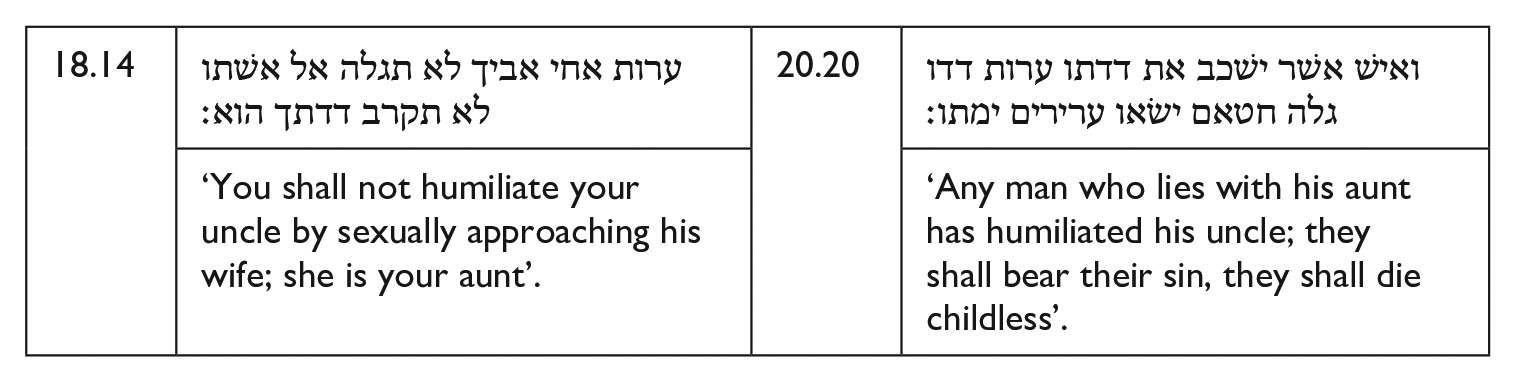
If לגלות ערוה means ‘humiliate’, then it is apparent why 20.20 uses both terms—a man would have humiliated his uncle if he had sex (שׁכב) with his aunt (i.e., his uncle’s wife). Lev. 18.14 can be understood to revise 20.20 because it prohibits humiliating one’s uncle in any way, including approaching his wife sexually. In ch. 20, לגלות ערוה “to humiliate” is explanatory, while in 18.14 it prohibits a wide range of inappropriate actions. Throughout Lev. 20, לגלות ערוה is best understood as explanatory—it indicates who is shamed. 53 Except for a few instances, Lev. 18 uses לגלות ערוה by itself to prohibit humiliating others in any way (intercourse, voyeurism, inappropriate comments, etc.). 54
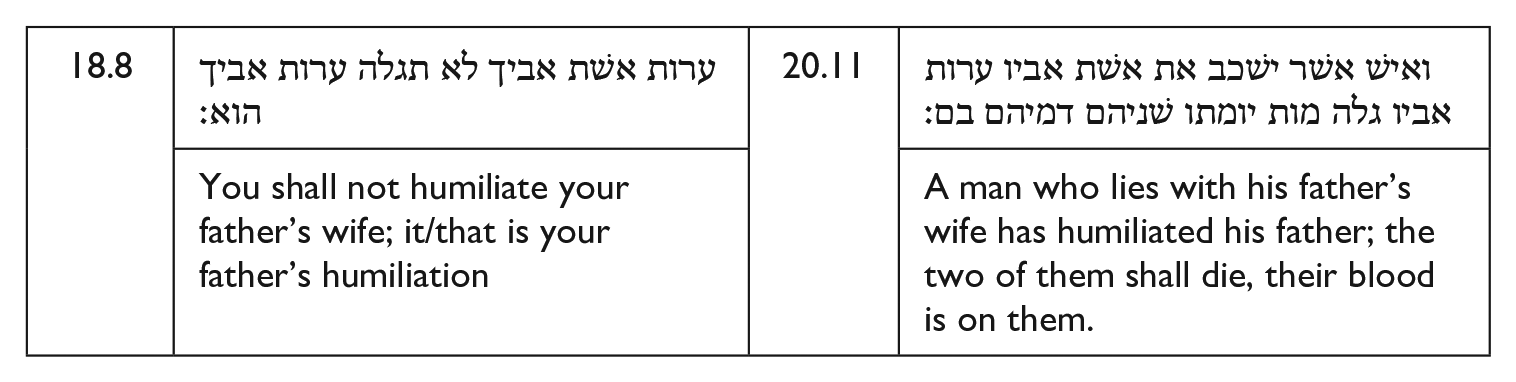
In 20.11, a man may not lie sexually (שׁכב) with his father’s wife because that would humiliate the father (לגלות ערוה). Lev. 18.18 revises the prohibition by suggesting that humiliating the father’s wife in any way—not just intercourse—would humiliate the father. If we follow J. Milgrom and understand לגלות ערוה “to humiliate” to apply only to women without husbands, then the prohibitions concerning the ‘wife of X’ in 18.8 could only apply after their husbands were dead. But this would mean that the text does not necessarily prohibit married kin whose husbands are still alive—a scenario that seems very unlikely. By using לגלות ערוה “to humiliate” instead of more specific terms, Lev. 18 revises Lev. 20 by prohibiting any action that would humiliate kin.
(b) Expanding the list of kin
Lev. 18 revises Lev. 20 by expanding the list of kin who are off limits. At the beginning of these prohibitions, Lev. 18.6 forbids humiliating (לגלות ערוה) any kin whatsoever (כל־שׁאר־בשׂרו). Such a blanket prohibition is not found in Lev. 20. The passage continues by expanding and specifying who is considered kin, and the opening line in 18.6 forms an ideological guide for the laws that follow. 55

Lev. 20.11 (text in previous section) only prohibits the father’s wife, which might not necessarily include the man’s mother if the father’s wife is a stepmother. 56 However, 18.7 and 8 (text in previous section) specify that this includes the father, mother, and father’s wife. I take 18.7–8 as prohibitions against humiliating one’s parents in any way. As discussed in section IV, the termלגלות ערוה broadly prohibits humiliating kin, and these prohibitions apply in the same way to both parents. The additional phrase אמך הוא ‘she is your mother’ in 18.7 adds emphasis, almost as if to say ‘she’s your mother for crying out loud! Why would you think of violating her?’ 57
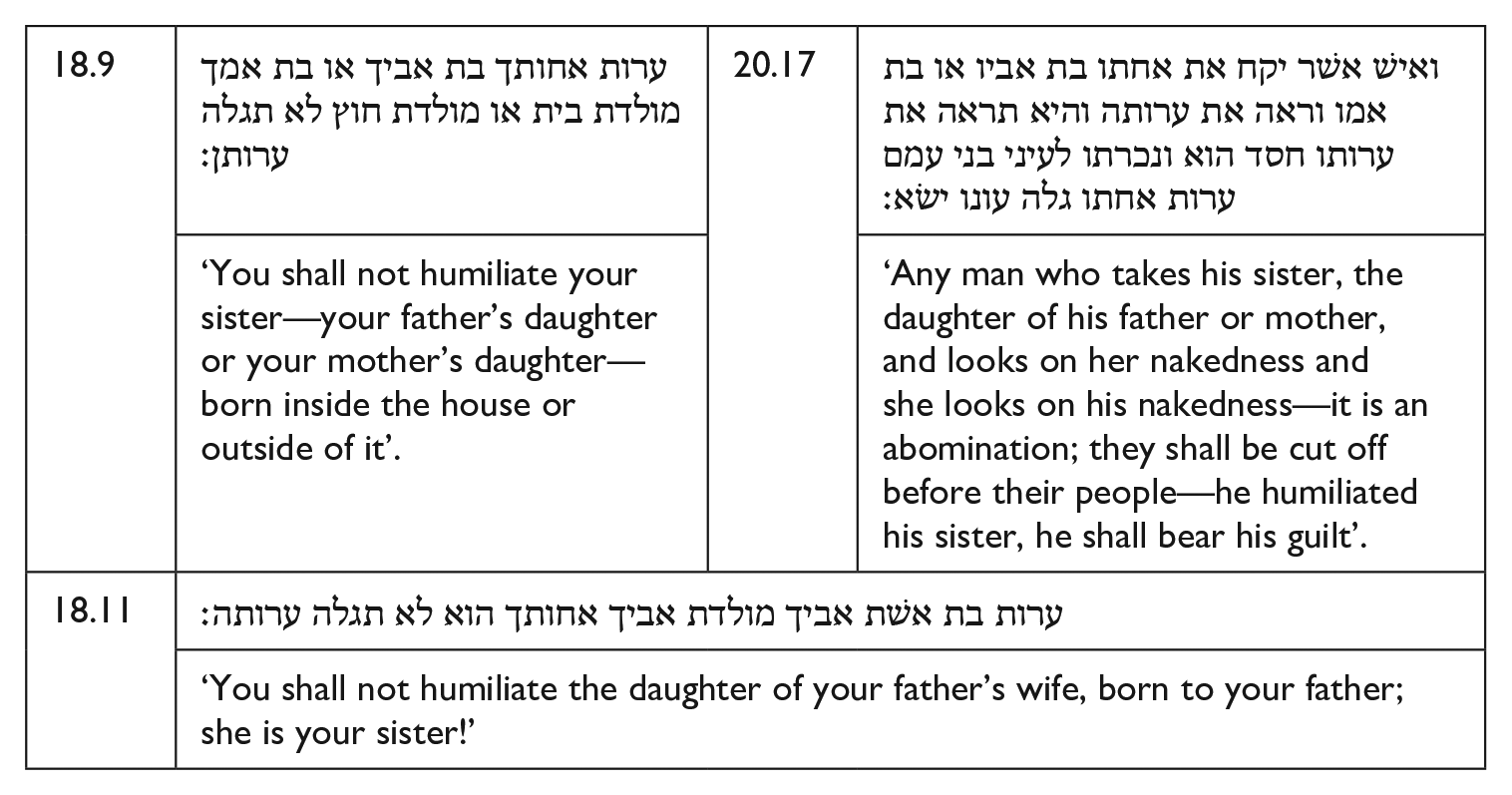
Many scholars have found Lev. 18.9 and 11 to be redundant, assuming that they describe the same situation. But if ch. 18 is expanding the list of kin who are off limits, then we can see how these verses might describe different situations. M. McClenney-Sadler notes that the terms מולדת בית ‘born (in the) house’ and מולדת חוץ ‘born outside (the house)’ in 18.9 describe the legal status of the sister—a sister one grows up with (מולדת בית “born (in the house”)) or an illegitimate or adopted child (מולדת חוץ “born outside”), but who is still one’s sister nonetheless. 58 The prohibition in 20.17 technically might not apply to a stepsister, so 18.11 closes further loopholes, specifying that even a step-sister with a different mother but raised by your father is off limits (בת־אשׁת אביך מולדת אביך “the daughter of your father’s wife, begotten by your father”). If Rainey is correct about לגלות ערוה referring to the social shame associated with indecent exposure, then it would make sense for Lev. 18 to expand the prohibitions and close potential loopholes.
Lev. 20 also contains no prohibition against sexual contact with one’s granddaughter; Lev. 18.10 broadens the prohibitions by including her. This revision-through-introduction precisely delineates all the off-limit kin, even the ones that ch. 20 leaves out. 59 Knohl observes that the language of P is uniform, precise and measured, while H is more free, exhortative, and less concerned with precision. 60 If this is the case, then Lev. 18 takes a mediating position between P and H by adding precision to H’s topic.
(c) Removing the death penalty for civil crimes
In addition to these specific issues, ch. 18’s revision-through-introduction shapes ch. 20 in broader ways. Chapter 18 removes the death penalty, and instead applies the same blanket penalty to all the prohibitions: that the land will spit out the Israelites if they become unclean by violating the prohibitions (18.24–28). Since the rest of P does not require the death penalty for civil offenses, ch. 18’s revision-through-introduction brings these prohibitions closer to the rest of P. 61 The death penalty is not absent from P; rather, P simply requires the death penalty for things related to cultic purity—Aaron and his sons cannot let their hair or clothes hang loose (10.6–7), they are prohibited from drinking wine or strong drink while inside the tent of meeting (10.8–10), the Israelites must avoid defiling the sanctuary (15.30–32), etc. P is primarily concerned with maintaining cultic order while H challenges its subjects to demonstrate their unique status as Yhwh’s people by distinguishing themselves from their neighbors and their customs (20.22–24, 26). H offers a concrete way to do this in Lev. 20 by prohibiting and severely punishing sexual taboos. Thus, Lev. 18 takes a middle stance by acknowledging that these actions result in serious impurity (aligning with H), while removing the death penalty, which is not required for civil crimes (aligning with P). 62
(d) Reconciling menstruation laws
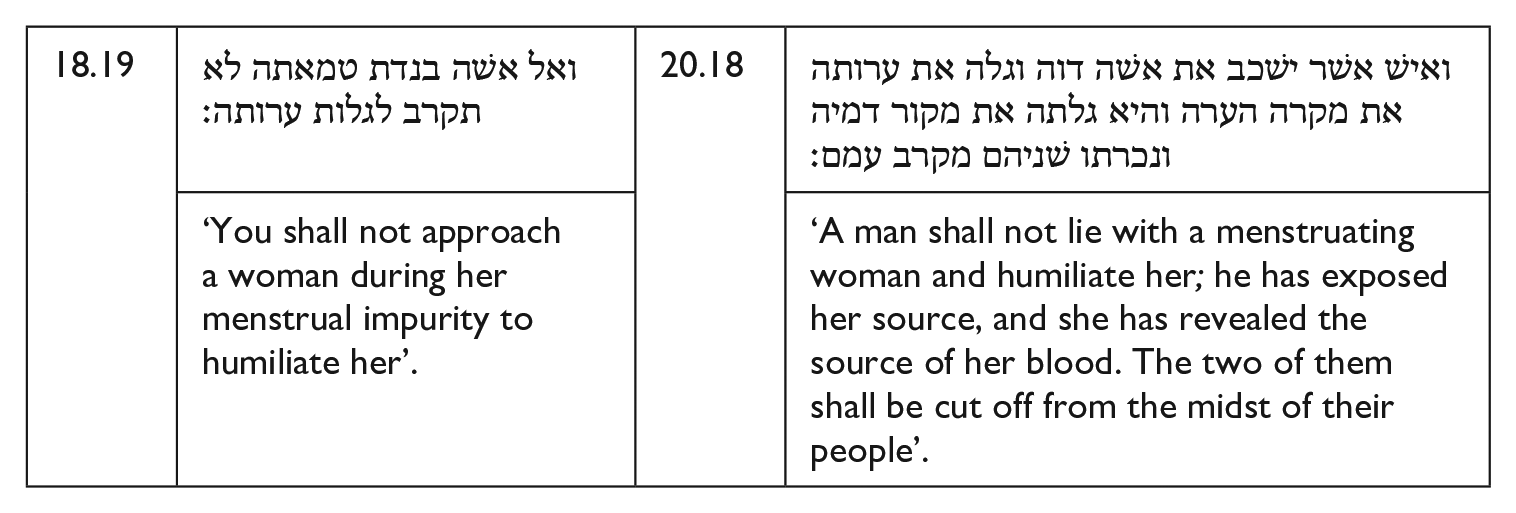
Finally, chs. 18 and 20 differ in their prohibition against sex with a menstruating woman. 63 Lev. 18.19 revises 20.18 by removing the associated penalty, as in the previous section. In 20.18, the penalty for sex with a menstruant is that both parties shall be cut off from their people. In 18.19, it is merely prohibited. This revision-through-introduction brings this issue into line with the rest of P, which does not prohibit sex with a menstruating woman. Lev. 15.24 simply notes that sex during menstruation leaves a man ceremonially unclean for seven days. Thus, the prohibition in 18.19 is consistent with P’s view. If we render לגלות ערוה as ‘to humiliate’, then we might take 20.18 to say, ‘If a man has sex with a menstruating woman, he has humiliated her, he has exposed her fountain …’ Again, לגלות ערוה is explanatory as I argued above. This reading is supported by Targum Onqelos to Lev. 20.18, which glosses MT’s use of מקור ‘fountain’ with both קלנה ‘her shame’ and סאבת דמהא ‘uncleanness of her blood’. In taking a middle position, Lev. 18 has no penalty (aligning with P in Lev. 15.19–33), but still prohibits sex during menstruation (aligning with H).
V. Conclusion
In a small-scale society, the social aspects of shame would have been an efficient way to maintain social and cultic order from the perspective of those who seek to maintain group norms. 64 Thus, taking לגלות ערוה to mean ‘shame’ or ‘humiliation’ attempts to be sensitive to its use with other euphemisms in Lev. 20 but also to its use by itself in Lev. 18. This analysis of Lev. 18 and 20 has illustrated that revision-through-introduction offers a compelling explanation for the major differences and striking similarities between these chapters. This paper has also focused on the way that Lev. 18 uses the term לגלות ערוה to affect how the reader perceives Lev. 20. Lev. 18 creates the appearance of coherence between P and H in Leviticus by addressing the content of Lev. 20 with a position that stands between P and H.
I have advanced this argument on the basis of several kinds of evidence, but there are additional features in both chapters that warrant further investigation in the future. For example, the discussion of Molek (מלך) and various types of non-Yahwistic divination in 20.2–6 is greatly truncated in 18.21. 65 This is probably because P is more concerned with regulating the practice of the cult than it is with prohibiting various non-Yahwistic, divinatory practices. Terms like נחשׁ ‘practice divination’, ענן ‘practice soothsaying’, האבת ‘mediums’, הידענים ‘wizards’, and שׂרט ‘cut (flesh)’ are only present in H (19.26; 20.4–6, 27; 21.5). Similarly, the phrase אישׁ אישׁ ‘any person’ is used in Leviticus nine times (15.2; 17.3, 8; 18.6; 20.2, 9; 22.4, 18; 24.15); its use is grammatically correct in every instance except 18.6. The phrase is consistently the subject of a 3rd m. sg. verb, but in Lev. 18.6 it has the appearance of being the subject of תקרבו לא ‘you shall not approach’ (2nd m. pl.), despite lacking agreement in person and number. 66 This awkward, ungrammatical verse may be a sign of editing—the author of Lev. 18 may have inserted the term into the verse because of its use elsewhere in P and H. Finally, the laws in Lev. 18 are expressed in the second person, while Lev. 20 uses the third person. For some, this switch between persons has constituted proof for the priority of Lev. 18: Ch. 20 has transformed ch. 18 into an ‘admonitory sermon’. 67 However, in the ANE, casuistic law tends to precede more direct formulations (i.e., apodictic) that are not constrained by a specific case. 68 Thus, it would be more likely that the case laws of Lev. 20 preceded the direct formulations of Lev. 18. While certainly not conclusive, the accumulation of these potential pieces of evidence is striking and encourages further investigation.
I have argued that revision-through-introduction is a likely mechanism for textual change, given the textual evidence that we do have from the ANE. If I am correct in my reading, and Lev. 18 was written to revise the prohibitions in Lev. 20, then one might ask why the structure of the passage was altered? It might suffice to revise Lev. 20 by merely expanding the list of prohibited kin and removing the harsher punishments. That is possible, but the revision of ch. 20 is arguably more effective if ch. 18 also rearranges the laws. This heightens the effect of reading ch. 18 before ch. 20. Although the order is altered, some of Lev. 18’s prohibitions do not revise Lev. 20 in any substantial way; instead, they remain strikingly similar. 69 Yet, as Milstein suggests, ‘Even the most radical acts of revision, however, did not seem to require a complete overhaul of the received work’. 70
Footnotes
Acknowledgements
I would like to thank Bruce Wells and this journal’s anonymous reviewers for helpful feedback on this manuscript. Any remaining errors remain my own. I would also like to thank Allen Jones for his insights and advice over the years, his teaching and biblical scholarship has inspired my own.
Declaration of conflicting interests
The author declared no potential conflicts of interest with respect to the research, authorship, and/or publication of this article.
Funding
The author received no financial support for the research, authorship, and/or publication of this article.
Ethical Considerations
Ethical approval was not required
Consent to participate
Not applicable
Consent for publication
Not applicable
1.
In this essay, the following abbreviations are used: CH (Code of Hammurabi), P (Priestly text), H (Holiness Code), HB (Hebrew Bible), ANE (Ancient Near East), OB (Old Babylonian), MB (Middle Babylonian), SB (Standard Babylonian), MT (Masoretic Text), HL (Hittite Laws), MAL (Middle Assyrian Laws).
2.
For example, see Welch (2022); Töyräänvuori (2020); Nihan (2007: 430–80); Carmichael (1997); McClenny-Sadler (2007); Embry (2011);  .
.
3.
This article limits the discussion of P and H to Leviticus, though there is certainly P and (to a lesser extent) H material outside of Leviticus. In part, because Lev. 17–26 seems to exhibit ‘structural, linguistic, and thematic consistencies’ in its effort to revise and expand P material (and certainly the legal material of D and the CC), Rhyder (2019a: 723). One criterion for finding H material is often the emphasis on a personal or ethical dimension to holiness, a view that is considered absent from the priestly worldview. However, Trevaskis (2011) argues that an ethical view of holiness is implicit in P’s ritual texts. Further, Trevaskis hypothesizes that P uses these texts to encourage lay holiness among the Israelites. On the issue of lay holiness, which is commonly considered a concern of H and not P, Gane (2015: 199) further suggests that if the priests were concerned with preserving their own authority, they would not have ‘diluted it by having Lev. 1–7 address laity as well as priests’. On this issue, : 497–501) cautions against methodological approaches that assume that specific words can be understood as uniquely P or H; she observes that these concepts or words may have been ‘broadly diffused when the texts where composed’, suggesting that the common words are shared cultural ideas but not necessarily evidence of literary connections.
4.
Warner (2015: 155–74) and Arnold (2017: 483–500) explore possible H texts in Genesis. For examples of H outside of Lev. 17–26, Milgrom (2000: 1337–44) sees the following passages as indisputably H: Exod. 12.49; 27.20–21; 29.38–46; 31.12–17; 35.1–3; Lev. 3.16b–17; 6.12–18aα; 7.22–29a; 9.17b; 10.10–11; 11.43–45; Num. 3.11–13; 8.1–4, 14, 15b–19; 9.14; 15. He further suggests that the following passages are likely H: Exod. 6.2–8; 12.17–20, 43–50; Num. 3.40–51; 5.1–3; 9.9–14; 10.10; 15; 19.10b–13; 28.2b; 29.39; 33.50–56; and 35.1–36.13. Some have even endorsed the view H’s influence on Ezekiel indicates that Ezekiel wrote with H in front of him. Thus, : 650) argues that Ezek. 20 is especially connected to Lev. 18 and 20, since words like שׁבתתי ‘my sabbaths’ are shared between the two texts. See n. 3 for a discussion suggesting that this type of ‘shared’ language may not indicate literary connections but only shared culture.
5.
See n. 4 for examples of potential H material outside of Lev. 17–26.
6.
I style the term ‘revision-through-introduction’ throughout in an effort to avoid syntactically confusing sentences.
7.
All translations are my own.
8.
This reflects the text critical principle lectio brevior potior (the shorter reading is preferrable). In some cases, ch. 20’s formulations are indeed longer, but there are also several prohibitions in ch. 18 for which ch. 20 lacks a counterpart (e.g. 18.6, 7, 10, 11, 18). For arguments in favor of ch. 20’s dependence on ch. 18, see Gerstenberger (1996: 248, 288–89), Levine (2003: 21), Hartley (1992: 331–32), and Watts (2023: 513–15). Nihan (2007: 452–56) tries to account for the chapters’ notable similarities and differences by essentially combining both of these approaches. He suggests that their similarities arise from the fact that Lev. 20 freely used ch. 18 as its source. Their differences are due to the fact that Lev. 18 rigidly followed an earlier document. For : 60–62), the prohibitions of Lev. 18 and 20 are primarily a list of ways the men of Canaan had violated humans and animals, rather than a coherent collection of prohibitions. I suspect there is also an assumption that later material is more likely to be secondary than earlier material (i.e. ch. 20 follows ch. 18 in the text and is more likely to have reworked it).
10.
McClenney-Sadler (2007: 87). : 19–45) argues that the structure and content of Lev. 18 and HLs §187-200 are sufficiently similar that they must share a legal and textual tradition. However, in this author’s view, the similarities and structure are not as closely aligned as Welch suggests; only about half of the prohibitions are common to both collections, and the structure of shared prohibitions is significantly different. A more likely reason for the similarities is that the adoption of incest prohibitions would inevitably result in similarities, given the relatively small number of possible incestuous relationships.
11.
Stewart (2020: 33); : 1743).
13.
14.
Lev. 18 is explicit in prohibiting the violation of one’s father (18.7), one’s mother (18.7; Lev. 20.11 only prohibits the father’s wife, which may be a stepmother), granddaughters (18.10, 17), half-sister (18.11), and a woman and her sister (18.18). Lev. 20 is silent on these matters.
15.
For arguments in favor of independent traditions, see Noth (1965: 146–47), Milgrom (2000: 1766-68), and Feinstein (2014: 167-69). A form of this view is argued by : 147–48), who suggests that the material in Lev. 18 and 20 is duplicated because it records judgments on similar incidents; for him, the twin judgments on similar incidents are included because they preserve distinct ways a judge had approached similar scenarios.
16.
For example, see Schenker (2003: 180–84) and : 332).
17.
I say ‘literary relationship’ because I want to focus more on the effect that 18 has in its current position than on issues of redaction, dating, etc.
18.
Others have noted this phenomenon, but Milstein’s analysis is the most systematic and compelling study of texts that exhibit this feature.
21.
22.
Westbrook (2009: 5–7).
24.
Stackert (2011b: 242–43) sees H as a ‘revision and completion of P’, but not the Pentateuchal redactor/compiler. For arguments in favor of H as a Pentateuchal redactor and a review of the literature, see : 548–59).
25.
Feldman (2020: 191–93) shows that chs. 16 and 17 have a close literary relationship and that the previous assumption that P consisted of chs. 1–16 and H consisted of 17–26 ultimately rests on a Procrustean bed. See also : 64–69).
26.
Feldman (2020: 191–192). Similarly, : 223–31) shows that the laws about slaughter and blood in Lev. 17 continue ‘the same narrative context as the earlier P account’.
27.
It should be noted that the term ‘Holiness Code’ (Lev. 17–26) is in reference to the numerous exhortations to be ‘holy’ (קדשׁ) because Yhwh is holy; however, these exhortations are not present in H until ch. 19.
28.
Graf (1866: 75–83). It was A. Kayser, eight years later, who built on Graf’s insights and suggested that Lev. 17 be included with Lev. 18–26 as an independent legal corpus. On this, see : 3–4).
31.
On Lev. 23, see Achenbach (2003: 93–108). : 31–44) notes that Lev. 27, the material at the end of Num. 27, and Exod. 30–31 all seem to be Priestly additions that follow a previous layer’s ending.
32.
For example, Feldman (2020: 4–5) sees post-H additions to P in the festival calendars of Num 28–29. Similarly, Stackert (2011b: 242) takes וינפשׁ in Exod. 31.17 as an addition by the Pentateuchal compiler, who uses this verb to ‘to harmonize the differing notions of Sabbath in the Torah sources’. In the context of Leviticus, : 148–150) takes Lev. 10 as a later, post-P supplement to Lev. 8–9 because of its reliance on the genealogy in Exod. 6.14–27, which he attributes to the Pentateuchal redactor.
35.
Some scholars understand Leviticus to be a scroll division and not necessarily a coherent literary work. For example, see Stackert (2015: 177–78) and : 147).
36.
For example, see Levine (1989: 119). See an overview in Rainey (2020) and .
39.
40.
For example, this approach is found in the ESV, NIV, NASB, and NRSV. See also Melcher (1996: 94). : 136) found the juxtaposition of father and mother in 18.7 to be so strange that he suggested that ‘father’ is an addition.
41.
It is worth noting that HL §189 prohibits sexual contact between a father and son, which suggests that this is a relevant issue for the authors of these texts.
42.
43.
Rainey (2020: 3). : 186–187) demonstrates that representations of nudity in the ANE (both textually and visually) tend to portray female nudity as seductive (e.g., The Myth of Enlil and Ninlil) and male nudity as shameful (e.g., defeated enemies in Assyrian reliefs)
45.
: 1535) suggests that לגלות ערוה is only applicable to unmarried women, women who have never been married or who are no longer married. For Milgrom, this explains why 18.20 and 20.10 have laws prohibiting adultery while other laws prohibit לגלות ערוה—they have two different situations in view. It is important in understanding Milgrom to note that he takes “adultery” to mean cohabitation with a married woman, while לגלות ערוה only applies to unmarried women. But this is less convincing in light of numerous women who clearly seem to be married. For example, in 20.11 the woman is called אשׁת אביו “wife of his father;” in 20.11, as opposed to these prohibitions in 18.7–8, the woman is described only in terms of her marital status.
46.
In chs. 18 and 20, we don’t have לגלות ערוה used with the neighbor’s wife, another man, or an animal because those are different situations—they break a different kind of social barrier.
47.
In 20.9, 11, 12, 13, 16, and 27, the offenders’ blood (דם) is ‘on them’ (בם). This seems to be an alternative way of describing sin as a burden that must be born. However, the actions in 20.17, 19, and 20 are explicitly described as a ‘sin’ (חטא) or ‘iniquity’ (עון) that must be born (נשׂא) by the offender. This follows : 16–18) observation that sin is most commonly conceived of as a burden in the HB. The use of עון ‘iniquity’ in 18.25 is in reference to the land’s iniquity and not the Israelites’. The only use of the root טמא in Lev. 20 is concerned with Molech offerings (20.3) and unclean animals (20.25)—the concept is not applied to sexual offenses.
50.
The text suggests both that Yhwh drives out the offending inhabitants (18.24) and that the land vomits (קיא) them out (18.25, 28).
51.
So also, Lev. 20.11, 12, and 18.
52.
Not all improper sexual activity in Lev. 20 is designated with both שׁכב and לגלות ערוה. For instance, 20.10 concerns adultery (נאף) with a neighbor’s wife and is therefore a violation of property rights rather than a taboo concerning incest.
53.
Other texts make it clear that sexual transgressions can affect both the party involved and people with authority over them (i.e., father, husband). Lev. 21.9 indicates that a priest’s daughter has profaned (חלל) her father if she profanes herself through harlotry.
54.
The exceptions are 18.17–19. Lev. 18.17–18 seems to prohibit sexual relationships with related people in order to cause shame. Lev. 18.17 prohibits marrying someone’s granddaughter in order to humiliate the woman in view. Obviously, the text does not prohibit marrying someone’s granddaughter in general—every woman is someone’s granddaughter. Lev. 18.18 prohibits taking a woman’s sister as a rival wife (צרר) in order to humiliate the original woman while she is alive (בחייה). The verse does not necessarily prohibit marrying a woman’s sister after the original woman is dead, only taking her as a rival while the original sister is alive. Finally, Lev. 18.19 prohibits sexually approaching (קרב) a menstruating woman to humiliate her.
55.
Hartley (1992: 286); : 78).
56.
That this may be a potential loophole in 20.11 may be confirmed by MAL §46, which allows a woman to marry one of her husband’s sons in the event of her husband’s death; in this situation, the text seems to indicate that she is a second wife, and thus the sons are her stepsons and not her own biological children.
57.
58.
McClenny-Sadler (2007: 82–83). Abraham ibn Ezra also suggests that ‘מולדת חוץ’ is an illegitimate or adopted child.
59.
Notably, a man’s daughter is not on either list. Much has been made of the ‘missing daughter’ from the list of prohibited kin in chs. 18 and 20. Some have argued that one’s daughter was obviously off-limits, and the thought was perhaps so repulsive that it went without saying. That the daughter was off limits has been argued more extensively with kinship diagrams by Rattray (1987: 542), who further suggests that Lev. 21.2–3 delineates those who are considered ‘near kin’ (שׁאר בשׂרו)—this includes the daughter (בת). It should be noted that the daughter is explicitly prohibited in HL §189. Conversely, argues that the daughter was left off the list intentionally, as a polemic against the actions of David and the patriarchs.
62.
This is arguably why Lev. 18 ignores 20.9, which requires the death penalty for cursing (קלל) one’s parents.
63.
Stewart (2020: 37) suggests that the act exposed her ‘wellspring’ or ‘creative capacity’ which he sees as a feature shared with the divinity and thus off limits to men. : 196–198) suggests that sex during menstruation may have been something associated with the Canaanites and thus a potential reason the Israelites could be driven out of the land.
65.
66.
In the LXX of Lev. 18.6, the verb (προσελευσεται “to approach”) matches its subject (ανθρωπος “man”) in person, gender, and number (3rd, masc. sg.).
69.
For example, the prohibitions concerning sex with an animal (18.23; 20.15, 16) and sex between two males (18.22; 20.13) seem to mean the same thing. Two recent articles (Töyräänvuori, 2020; Wells, 2020) take the prohibitions in 18.22 and 20.13 to mean the same thing.