




Abstract
The book of Nahum gives only one, albeit enigmatic, clue for a biography of ‘Nahum’. I dare not present a biography but will instead try to draw a few lines which might point toward Nahum’s role. Noteworthy is the presence of a large number of Assyrian loanwords as well as the imagery of curses in the Assyrian Loyalty Oaths in Nahum’s text. Where and how did the writer become acquainted with them? I elaborate on the ideas of Parpola and Sano who made it clear that a selection of the elite of conquered areas were educated at the court of Assyria and made familiar with the Assyrian language, scribal tradition, and diplomacy. They were then sent back to their country of origin to act as pro-Assyrian deputies. There are known cases where these persons, however, turned against the Assyrian regime once back in their homeland. This role fits ‘Nahum’.
1. Indications in the book regarding the life of Nahum
The purpose of this article is not to present an analysis of the redactional stages of the book of Nahum or to discuss particular exegetical problems in this book. My intention is quite different. My question is: What do we know about the person of Nahum and his biography? This might seem to be an impossible question to answer. Within the Hebrew text of Nahum there are hardly any clues to his life.
The heading of the book does not connect the prophet to the reigns of a king of Israel or Judah.
Nah. 1:1 presents him as הָאֶלְקֹשִׁי, ‘the Elkoshite’. Does this refer to the prophet’s home town, the region where he came from, a religious group, or something else? 1
The references to world history are clear: the Assyrian conquest of the Egyptian capital city נֹּא אָמוֹן, ‘ Thebes’
2
, can be dated to 663
This evidence and the paucity of it, might be seen as a warning to ponder no further on the question of the biography of ‘Nahum’. I would, however, like to present some circumstantial evidence. This implies that I am not looking for a person, but for a profile. Reading the book of Nahum in its ancient Near Eastern context, I find examples of three categories that link the book to Mesopotamian scribal culture: loanwords, phrases from the loyalty-oaths, and pictures of Assyrian warfare.
The ancient Near Eastern context of the book of Nahum is characterized by the fact that in the seventh century
2. A book larded with Assyrianisms
Other scholars have already hinted at the presence of a substantial number of Assyrian loanwords in the book of Nahum. 9 I found the following loanwords: 10
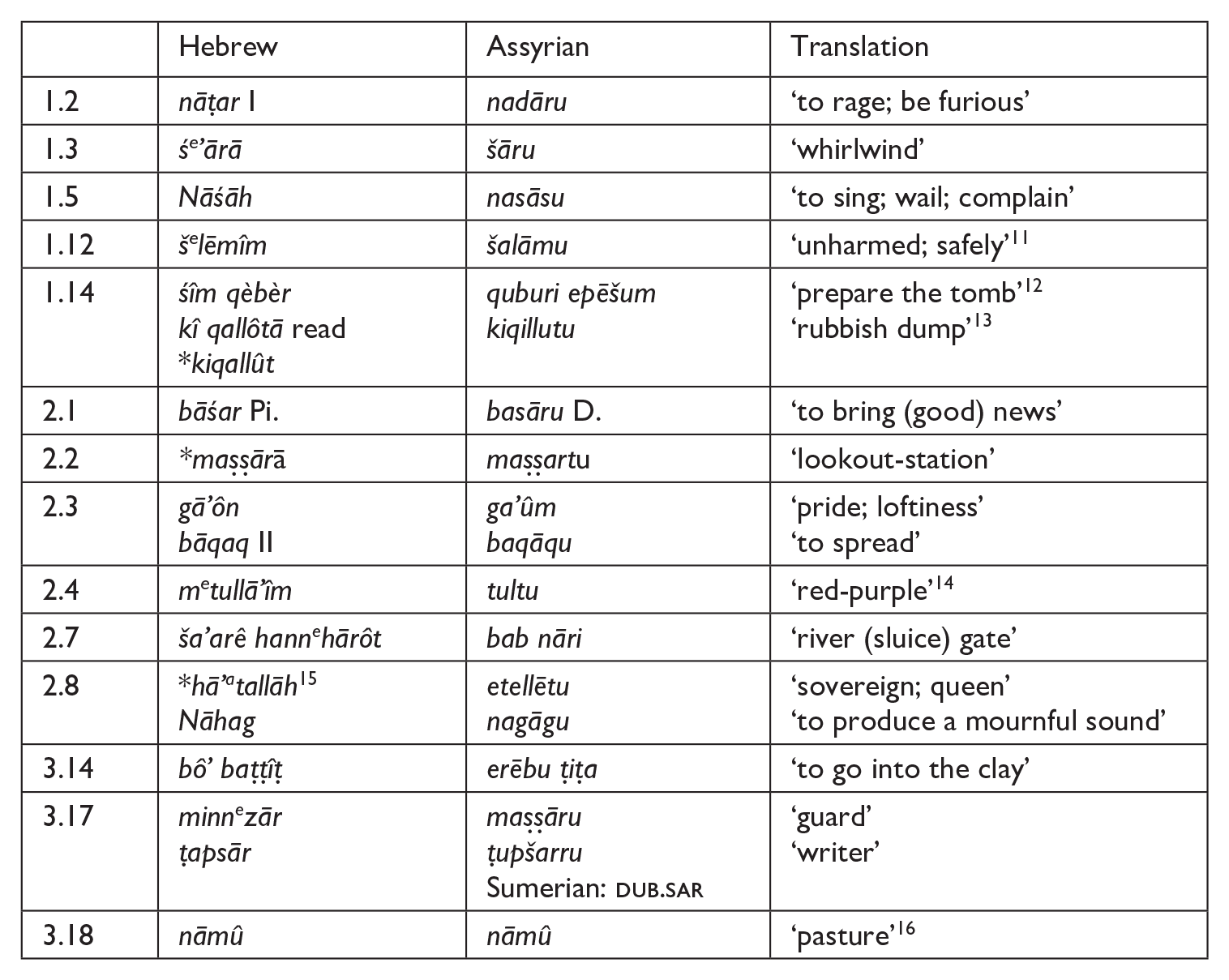
The transfer of words from one language to another is a perennial phenomenon. Loanwords can be categorized in two ways: importation and substitution. This distinction, first formulated by Haugen, is still valid and can be used to understand not only contemporary loanwords, but also patterns from languages and cultures in the past. 17 Importation refers to words from another language that identify entities for which no word exists in the receiving language: Akkadian ekallu from Sumerian é.gal, ‘palace; temple’; 18 English ‘potato’ from Quechua papa. Substitution refers to the process by which an existing word in the receiving language is replaced with a word from the other language: pièce-de-résistance substituting English ‘masterwork’. The phenomenon of substitution is sometimes an indication that the speaker wants to identify with the cultural values of the donor language and sometimes a residue of having lived for quite some time among people speaking the other language. The amount of words based on substitution is often indicative of the origin of a speaker or a writer. 19
Assyrian loanwords are present throughout the Hebrew Bible. 20 The share of Assyrian loanwords in the book of Nahum is, however, far above the average. It is also remarkable that these Assyrian loanwords are found throughout the book of Nahum. 21 The majority of these should be classified as examples of substitution and place the author of the book of Nahum into an Assyrian context. The author might have lived in an Assyrian-speaking environment or was mimicking the language of those in power. The share of Assyrian loanwords is not proof for a date in the age of the Assyrian empire, but should be seen as a strong hint. 22
3. Echoes from Near Eastern loyalty oaths and vassal-treaties
Not long after the publication by Wiseman of the ‘vassal treaties of Esarhaddon’ 23 , biblical scholars started to make comparisons between the curses in that text—for breaking the loyalty oath—and passages from the Hebrew Bible. These comparisons also included other Neo-Assyrian loyalty oaths and vassal treaties as well as the Aramaic treaty from Sefire between Mattiel, king of Arpad, and Bargayah, king of the enigmatic kingdom KTK. 24 The comparisons focused on Deut. 28 and on prophecies of doom. 25
With regard to the book of Nahum, I have spotted a dozen parallels with these kinds of ancient Near Eastern texts. I will refer here to only three examples from the three chapters of the book. 26
Your name will no longer be perpetuated.
May Zarpanitu, who grants name and seed, destroy your name and your seed from the land. 27
his off[spring] shall have no name. 28
In Nahum, the masculine ‘you’-character is threatened with a discontinuation of name and offspring, a curse that is directed against the trespassers of the loyalty of Esarhaddon. 29
The voice of your messenger will no longer be heard.
Nor may the sound of the lyre be heard in Arpad and among its people. 30
This curse has, to my knowledge, no counterpart in the neo-Assyrian texts, but could have been part of the general set of ancient Near Eastern curses.
Look, the troops in your midst are like women
Ashurnirari If Mati’-ilu sins against this treaty with Aššur-nerari, king of Assyria, may Mati’-ilu become a prostitute, his soldiers women. 31
It should be noted that the treaty-curses are not the only genre with similarities to the book of Nahum. Parallels between the book of Nahum and other Assyrian genres can also be found. I will mention two of them:
the feminine ‘you-character’ is promised:
But now, I will break his yoke that is on you
And your shackles, I will tear apart!
The image is clear: The feminine ‘you-character’ is compared with a bovine enduring the rigours of plowing.
32
Both in Assyrian inscriptions and in the Hebrew Bible the imagery of the yoke was used to characterize the unequal relationship between a superior and a subordinate power: between the Assyrian monarch and a marginal vassal-state or between God and Israel.
33
The Hebrew expression ‘to break the bond’ refers to a change in such a relationship where the lesser power shakes off their subordination.
34
An Assyrian counterpart is found in a Neo-Assyrian fragment of the epic of Atrachasis: …] X i ni-iš-bi-ir ni-ra …] let us break (his) yoke
35
From the context it becomes clear that in this fragment the breaking of the yoke refers to an act of liberation of the lower gods—the Igigi—from the ruling sky-gods—the Anunnaki. In Nah. 2:8, the forthcoming downfall of Nineveh is depicted in a mourning ritual. When the queen is sent naked into exile: … her handmaids are moaning like the sound of doves, Beating on their breasts.
In several Mesopotamian texts the expression ‘to moan constantly like a dove’—variously phrased—indicates a ritual complaining sound of mourning. 36 I read this parallel as an indication that the author of the book of Nahum was familiar with the Neo-Assyrian turn of phrase.
The choice of this kind of language seems to be deliberate in the book of Nahum. In addition to some general phrases, the author used elements of the treaty-ideology of the Assyrians to depict their own downfall, implying that the Assyrians are to be construed as trespassers because they are exploiting Judah and Israel. 37
4. The language of the sculptures
In the palaces of the Neo-Assyrian kings, the walls were decorated with sculptures depicting the conquests of rebellious lands by the king of Assur. They present a ‘message produced in the artifact mode’. 38 They also present the view of the palace regarding the deeds and doings of the Neo-Assyrian king and hence communicate his power over other kingdoms. 39 They are not so much impartial pictures of the past, but displays with a warning: Here you see what will happen to a disloyal vassal.
Many of these scenes have echoes in the prophecies in the book of Nahum and various scholars have indicated that this similarity is not accidental. 40 In the description of the fate of Nineveh, the prophet makes use of the Assyrian imagery. This language and these images are, however, given a completely different address. No longer will the rebellious kings fall prey to these acts, but the Assyrian king himself will. 41 I will briefly discuss two examples.
Much of the book of Nahum, especially the descriptions of the fall of Nineveh, can be read against the background of the wall relief from the South-West Palace at Nineveh depicting the siege of the Judaean city of Lachish by king Sennacherib, as has been argued by Jacob Onyumbe Wenyi. 42 . I do not propose a one-to-one match for all scenes. However, the resemblance of the battle scenes on the reliefs and the phrasing of the texts is remarkably and painfully clear. 43 I will give a few examples.
Slab 3, segment III (see Figure 1) contains a gruesome depiction. Judaean captives find their end dying on sharp stakes held by the hands of Assyrian soldiers:
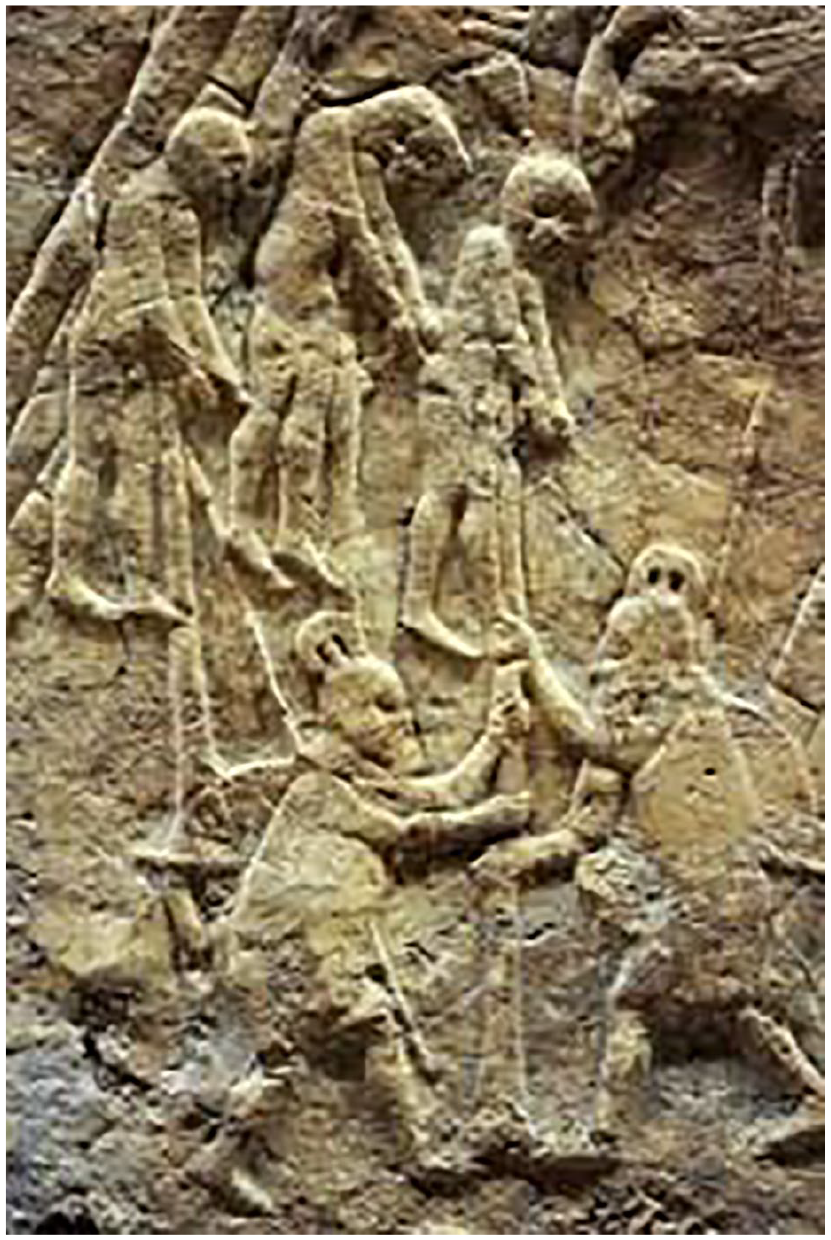
Sennacherib’s Conquest of Lachish, Slab 3. 44
This image can be compared with a passage in the book of Nahum. In the announcement of ordeal after a woe-oracle it is said: A prancing horse, the flash of a sword and a lightning spear, A multitude of pierced piles of corpses, there is no end to the bodies— they stumble over the carrion!
45
Slab 5 contain segment V in which the exile of Judaeans from Lachish is depicted (see Figure 2).
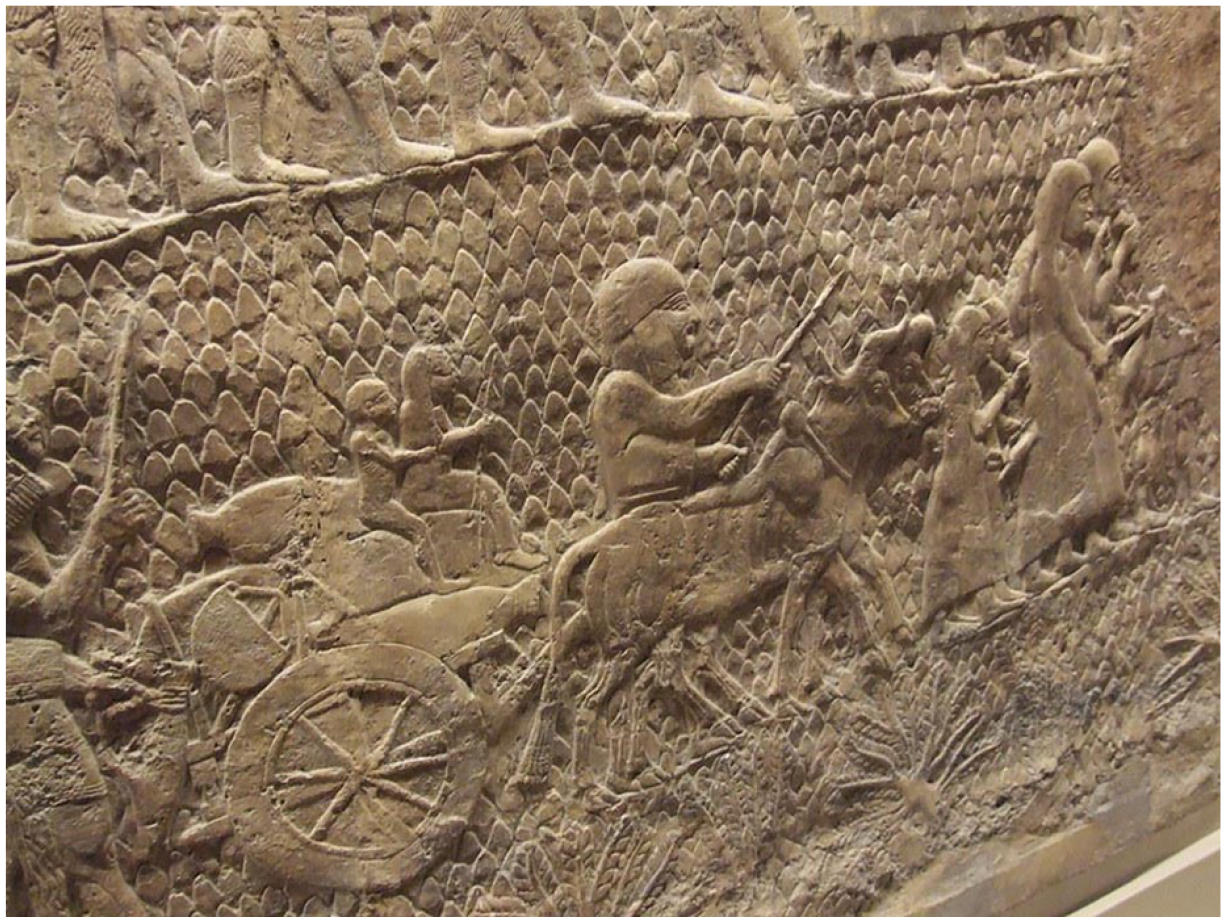
Sennacherib’s Conquest of Lachish, Slab 3. 46
This image too can be compared with a passage in the book of Nahum. The fate of the Assyrian queen will be exile in the same way as so many people were exiled by the Assyrians: 7. A wagon takes the queen into exile, her slave girls moan, while as with a pigeon’s voice. they beat their breasts.
47
A comparable remark can be made about the wall-reliefs depicting the battle of Ashurbanipal against Te’uman, the usurper of the throne in Elam. This battle was fought at Til Tuba in 653
In particular, the wall-reliefs of the palace of the Neo-Assyrian king Ashurbanipal contain dozens of scenes in which the king is depicted as an excellent lion-hunter.
51
In these images, the lion stands for the ‘enemy; everything non-Assyrian’ that should be hunted and exterminated (see, e.g., Figure 3).
52
These images are parallel to Ashurbanipal’s boasting of his achievements as a lion hunter. See, for instance: I, Ashurbanipal, king of the world, king of Assyria, while enjoying myself on foot, seized a fierce lion that was born in the steppe (
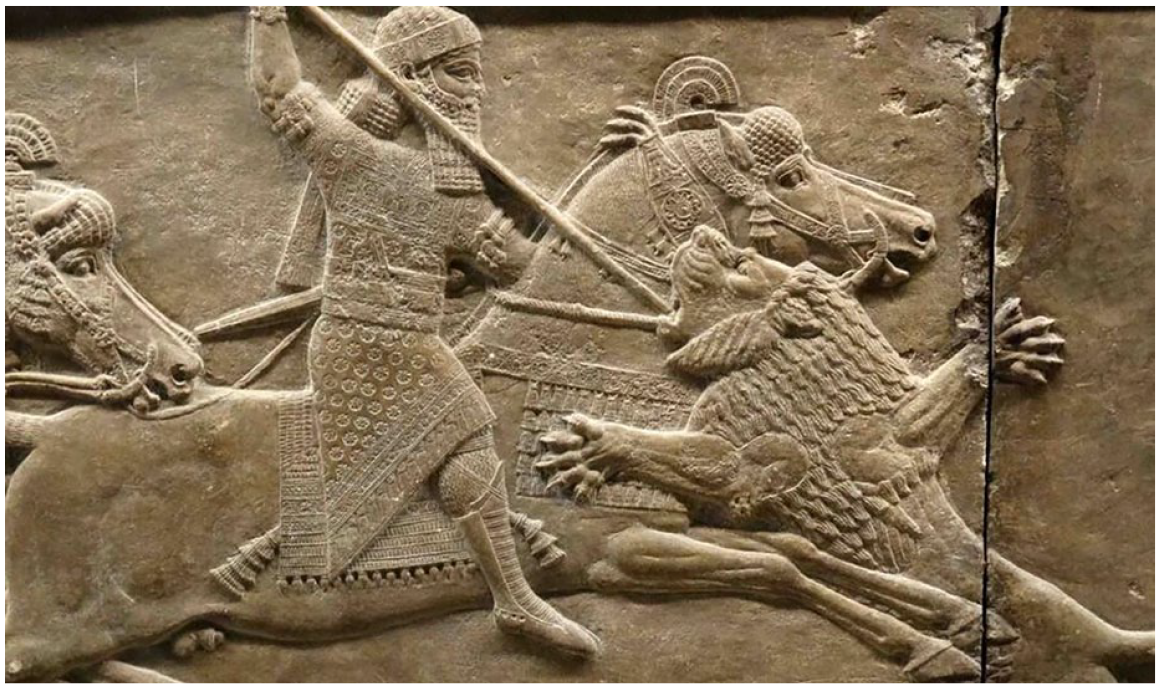
Ashurbanipal as lion-hunter; Gypseous alabaster relief; Nineveh (North Palace of Ashurbanipal); 7th c. (ca. 668–627
The depiction of the fall of Nineveh contains the following unit: Where is the lions’ den? the pasture of the young lions, where the lion went, and the lioness and the lion’s cubs, with no one to startle them? Where is the lion who plundered for his whelps and throttled for his lionesses? He had filled his caves with prey and his dens with robbery. “See, I am against you, —oracle of Yhwh of hosts— and I will destroy her chariot into smoke, and the sword shall devour your young lions; I will cut off your prey from the earth, and the voice of your messengers shall no longer be heard.
55
The text in Nah. 2.12–14 can be read as an inversion of this pictorial language. The various lions are to be identified with Assyrian citizens, merchants, and courtiers. In applying and inverting the boasting self-depiction of the Assyrians in a text that reflects on the impending end of the Assyrian Empire, the counter-image functions as a harsh criticism.
5. Background
How did the author of the book of Nahum become acquainted with this scribal and pictorial culture? On the basis of the presence of various Assyrian loanwords, Van der Woude (1978) construed the book to be a letter written from the (Assyrian) exile. 56 Writing in an Assyrian context, it is conceivable that Assyrian loanwords slipped in. But how and where did this author learn the language of the curses of the loyalty oaths? In Spronk’s view, Nahum is a pseudonym for a person who functioned as a writer at the court of king Manasseh. In view of the function and the assumed written communication with Assyria, this person had to be able to read and write Assyrian. 57 Most probably a copy of the Esarhaddon-treaty was present in Jerusalem, which could have been the source of ‘Nahum’s’ knowledge of various curses.
An intriguing parallel is found in the Aramaic documents from Tell Shiukh Fawqani, a site in the Euphrates valley in Northern Syria. At this site, Aramaic and Neo-Assyrian texts were excavated. The Aramaic texts are full of Assyrian loanwords that hint that the scribes were trained in Assyria and in translating their message into the local vernacular introduced a set of loanwords. In addition, other signs of Assyrian cultural influence were found. 58
How did Nahum become influenced by Neo-Assyrian culture? I would like to build on the assumptions of Van der Woude and Spronk by offering the following—slightly speculative—proposal. In 2003, Parpola formulated the thesis that in Assyria an education was offered to the elite of the exiles. Princes and children of higher officials would have received a thorough education in all things Assyrian, especially politics and literature. 59 Elaborating this idea, Sano argued—with abundant evidence—that the Assyrians recruited talented youngsters from among the exiled elites of conquered lands in order to educate them and to integrate them into the Assyrian world. Quite often, these educated members of local elites were sent back to the region of origin with the aim of defending Assyrian interests in the provinces and the vassal-kingdoms. 60
I will refer to three examples: One that probably refers to integration, one that shows the skills acquired, and one that hints at a return to the country of origin.
Education
In the report on his first campaign, Sennacherib (705–681) remarks on the institution of a certain Bēl-ibni as king over Babylonian territories conquered by the Assyrian king: I appointed over them Bēl-ibni, a son of a rab banî (and) a twig of Šuanna (Babylon) who had grown up like a young puppy in my palace (ki-ma mi-ra-ni s.a-aḫ-ri qé-reb É.GAL-ia ir-bu-ú), [as king of the land of Sumer] and Akkad.
61
The idiomatic expression ‘to grow up like a young puppy’ expresses a complex set of actions. Bēl-ibni was like an adopted child to the Assyrian king. He fostered him and raised him like the other ‘puppies’ in the palace. 62 The character of this education is not specified. Bēl-ibni originated from Babylon. His father was a rab banî. The words can refer to ‘an administrator of temple property’ or to the name of Bēl-ibni’s family. 63 He was a descendant of a noble family. Although not of royal blood, he was important enough to be taken into captivity by the Assyrians. Soon after he was installed as a puppet king, he conspired with Elamites and Chaldeans against Assyria and was replaced by the more loyal son of Sennacherib: Aššur-nādin-šumi. 64
Skills
Of interest is the report on Babylonians who are working in the library at Nineveh. Among them is a certain Kudurru:
m
ku-dúr-ru
m
ku-na-a-a
UDUG.ḪUL.A-MEŠ
ug-dam-me-ru
tè-en-šú-nu
ina IGI msa-si-i Kudurru and Kunaya have completed ‘Evil Demons’. They are at the command of Sasî.
65
I will offer a few interpretative remarks. Kudurru was the son of Šamaš-ibni, a ruler of the Babylonian tribe Bīt-Dakkūri living in the marshlands of Southern Mesopotamia.
66
According to a Babylonian Chronicle: ‘Šamaš-ibni, the Dakkurean, was transported to Assyria and executed in Assyria’ in the third year of the reign of Esarhaddon.
67
Sasî was an important official at the Assyrian court who, however, became involved in conspiracies against king Esarhaddon in 671–670
Return to Home Country
A striking example is the fate of ḫa-za-ilu, ‘Hazael’, king of Arabia. When he came to Nineveh to pay his respect to the new king Esarhaddon (681–669), a surprise befell him. Esarhaddon’s father Sennacherib had taken as booty the statutes of the gods of Hazael. As a result of Hazael’s visit, Esarhaddon made a kind gesture: Hazael, King of Arabia, came with his rich gifts before me in Nineveh, my royal city. He kissed my feet and besought me to return his gods. I had pity on him and, so, Atar-Shamain, Daya, Nuhaya, Ruldayau, Abirillu, Atarquruma, the gods of the Arabs, I refurbished. I inscribed the strength of Ashur, my lord, and my name upon them and gave them back. I placed the lady Tabūa, who was raised in the palace of my father, as ruler over them and returned her to her land with her gods.
72
Esarhaddon not only returned the deities of the Arabs, he also reinstalled Tabūa as queen. She had been taken captive by Sennacherib and raised (tar-bit) at his palace. This means she had received an education in the Assyrian way of life and political worldview and was supposed to act in a pro-Assyrian way after her return to Arabia. 73
6. Who was Nahum?
These three examples indicate that Assyrian rulers took care of the hostages who were members of the royal and elite families from conquered areas. While these people stayed in the Assyrian palace as diplomatic hostages to prevent the annexed provinces and vassal states from being rebellious, they were ‘raised’ (rabû) and trained in—I assume—a variety of skills. Occasionally, they were transported back to their countries of origin in order to defend and secure Assyrian interests.
I offer these pieces of evidence in answering the question ‘who was Nahum?’. Reading the book of Nahum against the background just pictured, an answer can be given to the question of how ‘Nahum’ became acquainted with Assyrian speech-forms and other aspects of Mesopotamian culture. I think it likely that ‘Nahum’—whatever his real name and position in the former Judaean elite was—had been ‘raised like a puppy’ at or around the Assyrian court. His writing skills are at the same level as Kudurru and Kunaya. He had become part of the scribal elite and was versed in diplomacy. After this education he returned to Jerusalem, probably to act as an Assyrian officer tasked with communicating between Assyria and the local rulers. As far as I can see, Nahum is the only prophet known from the Hebrew Bible who fits this profile.
When confronted with the traumatic reality in the vassal kingdom of Judah and the province of Samerina, Nahum found himself forced to change his loyalty. The Assyrian-raised scribe transformed himself into a Hebrew prophet, writing a pamphlet that in the eyes of the Assyrians would read as a subversive text challenging their power position. 74
This behavior has at least two parallels, one ancient and one modern. The example of Bēl-ibni shows that after his installment as king he—contrary to the expectations of the Assyrian king—conspired with Elamites and Chaldeans against Assyria. In other words, the process of Assyrianization was only partial.
The modern example is taken from Dutch history. In the interbellum (1918–1940), students from the former Dutch colony now known as Indonesia received an education in the Netherlands with the aim of raising them as trustworthy civil servants under Dutch rule, which at that point was assumed to be permanent. When they returned to their homeland, they became more and more aware of the local misery that colonialism had brought. They became the kernel of the Merdeka independence movement. 75
I do not claim to have offered here a fully-fledged biography of ‘Nahum’. Details such as his date of birth, the names of his parents, the region where he was born, or the societal level of his family remain lost in the twilight of history as does the day of his dying. I hope my comparative endeavor nevertheless makes this prophet more tangible.
