




Abstract
The Biblical Hebrew word אלהים is plural in form. Semantically and syntactically, however, it can be plural or singular. The stem of this noun can be reconstructed as * ʾilāh-. As already noted by Wellhausen, this looks like a broken plural of *ʾil-, the Proto-Semitic word for ‘god’. This article takes Wellhausen’s observation and uses it to explain the plural morphology of Hebrew אלהים. I argue that *ʾilāh- should be reconstructed with redundant plural suffixes in some parts of the paradigm. This reconstructed paradigm is preserved virtually unchanged in Archaic Biblical Hebrew. The reconstructed paradigm also explains the almost complete replacement of *ʾil- by *ʾilāh- in Aramaic and Arabic and allows us to reassess the reasons for the association between the lexeme ‘god’ and plural number. Consequently, earlier suggestions that see אלהים’s plural number as a reflection of pre-Yahwistic polytheism or as a marker of abstractness are no longer tenable.
Three words into the Hebrew Bible, we encounter a well-known conundrum. The word אלהים (Gen. 1.1) bears the masculine plural (henceforth: m.pl.) ending and is thus morphologically plural. Yet, it is both syntactically and semantically singular: the preceding verb ברא ‘he created’ shows singular agreement and the meaning of the noun is ‘God’, not ‘gods’. This is the norm for Biblical Hebrew (BH) as a whole, where singular ‘god/God’ is expressed by morphologically plural אלהים much more often than by the morphologically singular אלוה. The latter form is mostly restricted to archaic and archaizing poetry, as well as books written in Late Biblical Hebrew (LBH), 1 where it may be a calque of Aramaic. 2
Cognate words for ‘god’ are found in Aramaic אֱלָהּ (Biblical Aramaic), alåh-å (Syriac), 3 etc.; Classical Arabic (CA) ʾilāh-; and Sabaic and Minaic (both Ancient South Arabian: ASA) ʾlh-. 4 These are all compatible with a Proto-West-Semitic or Proto-Central-Semitic reconstruction as *ʾilāh-. Some languages show h only in the plural. Qatabanic (ASA) has ʾlh- ‘gods’ (with plural construct endings and suffixes, e.g., nominative ʾlh-w ‘gods of’) in addition to singular ʾl-. 5 Hadramitic (also ASA) has ʾlh-y ‘gods of’ (no singular attested). And Ugaritic has h in ı͗lh-t ‘goddesses’, the plural of ı͗l-t. 6 Feminines with h like CA ʾilāh-at- also occur in most of the languages which attest the masculine forms with h; I leave them out of the discussion here, as they can easily be explained as derivations from the masculine. 7
Singular and plural forms apparently reflecting *ʾilāh- are thus widely attested. These forms contrast with the Proto-Semitic word for ‘god’, which can be reconstructed securely as *ʾil-. This is clear from reflexes such as Akkadian il-, Ugaritic ı͗l, Sabaic ʾl, BH אל, and Mehri (a Modern South Arabian language: MSAL) ʾāl (Kogan, 2015: 180). What, then, is the origin of *ʾilāh-, and how does it relate to *ʾil-?
An explanation for the additional *-āh- seen in *ʾilāh- was already put forward by Julius Wellhausen (1901: 699–700). Wellhausen’s explanation is based on the different ways of pluralizing nouns attested in Semitic. In languages like Hebrew, Aramaic, and Akkadian, the dominant strategy is to add a dedicated plural suffix to the noun stem, as with sg. סוס: pl. סוסים ‘horse(s)’, sg. פרה: pl. פרות ‘cow(s)’. These are known as ‘external plurals’. Languages such as Arabic, Ge‘ez (Classical Ethiopic), ASA, and MSAL additionally form what are known as ‘internal’ or ‘broken plurals’. These are formed by inserting the radical consonants of the singular stem into a new vowel pattern. This results in a plural form that does not have any special plural endings, although a feminine singular suffix may be added or lost: compare CA sg. malik- : pl. mulūk- ‘king(s)’, sg. kalb- : pl. kilāb- ‘dog(s)’, or Ge‘ez sg. hagar : pl. ʾahgūr ‘city/ies’, sg. nǝgūś : pl. nagaś-t ‘king(s)’. It is thus the stem alone that marks broken plurals as plural. Additionally, some plurals are marked both by the use of a morphologically distinct plural stem and by external plural endings, resulting in a ‘doubly marked plural’; compare BH ‘segolates’ like sg. עבד < *ʿabd- : pl. עבדים < *ʿabad-īma ‘slave(s)’ and other vestigial plural patterns like sg. פסל < *patsl- : pl. פסילים < *patsīl-īma ‘idol(s)’ (on this type, see Ben-David, 1972; Kutscher, 1974: 379).
Broken plurals have left only scanty traces in Hebrew. 8 Accordingly, we may wonder whether they ever occurred in an ancestor of Hebrew at all. The segolate plurals have often been taken as BH’s most significant remnant of the broken plural system, which then must have added a redundant external plural ending (e.g., Huehnergard, 1991: 284; Ratcliffe, 1998: 154–58). But the insertion of *-a- in their plural stem can be explained phonologically, as recently argued by Suchard and Groen (2021): In an early precursor of Proto-Semitic, the *a served to break up an impermissible consonant cluster, as in pre-Proto-Semitic *ʿabd-w-i- ‘slaves (oblique)’ > *ʿabad-w-i- > Proto-Semitic *ʿabad-ī(-na). Having lost the segolate plurals, we are left with a handful of vestigial broken plurals in BH at best (see Note 8).
Broken plurals are reconstructible, however, for older stages of Semitic from which Hebrew descends. While some broken plural patterns are limited to the so-called ‘South Semitic’ languages (i.e., everything but East and Northwest Semitic) and may constitute a post-Proto-Semitic innovation that spread from language to language through borrowing (Ratcliffe, 1998), other kinds of broken plurals have left traces in languages that normally only form external plurals (e.g. Akkadian; Huehnergard, 1987: 181–88). This is most clearly seen in the case of Syriac ḫemr-å ‘donkeys’ and qury-å ‘towns’, which show a change in stem pattern compared to their singular (ḫmår-å, qri-ṯå) and are inflected as singulars (emphatic state ending -å, not plural -ȩ or -åṯå). These features mark them as broken plurals by definition. This classification is supported by the possibility of connecting them formally with cognates in Arabic that are also broken plurals: ḥumur- and quray-, 9 respectively. Since Syriac is by all accounts more closely related to Hebrew than to Arabic (Kogan, 2015: 227–48), it follows that broken plurals also occurred at some point in Hebrew’s prehistory; as in Syriac, they were mostly lost, but may very well have left isolated reflexes here and there.
Wellhausen (1901) notes that the stem *ʾilāh- is shaped like a broken plural pattern attested in a great number of Arabic forms like rigˇāl- ‘men’ (sg. ragˇul-). When broken plurals of this type are formed from nouns with just two radical consonants, h can be added as a third radical: compare sg. šaf-at- : pl. šifāh- ‘lip(s)’ or sg. māʾ- (< *māy-) : pl. miyāh- ‘water(s)’. This pattern may also be attested in Aramaic, with the addition of an external plural ending turning these broken plurals into doubly marked plurals: compare Biblical Aramaic forms like sg. אַבִי ‘my father’ : pl. אֲבָהָתִי ‘my forefathers’ and sg. שֻׁם ‘name of’ : pl. שְׁמָהָת ‘names of’; the plural stems can derive from proto-forms like *ʾibāh-āt- and *simāh-āt-, respectively. This use of *h as the third radical in *CiCāC- broken plurals suggests that *ʾilāh- may originally have been the plural stem of the biconsonantal noun *ʾil-. Wellhausen next proposes that the double plural marking seen in Hebrew ʾĕlōh-īm and (Biblical) Aramaic ʾĕlāh-īn etc. ‘gods’ is original. (Biblical) Aramaic אֱלָהּ and Arabic ʾilāh- (as well as Sabaic and Minaic ʾlh) then reflect back formation (Hock 2022: 223–24), the creation of a new base form modeled after what is normally a derived part of the paradigm: Based on the doubly marked plural *ʾilāh-ū-, 10 speakers created a new singular form *ʾilāh- by analogy with nouns with a singly marked, external plural.
This explanation convincingly accounts for the additional *-āh- as well as the affinity of the *ʾilāh- form with the plural (Kogan, 2015: 180n508) and has been adopted by prominent Semitists such as Carl Brockelmann (1908: 334), John Huehnergard (2005: 191), and Leonid Kogan (2015: 179–80). It leaves some questions unanswered, however. While some connection between the original function of *ʾilāh- as a broken plural stem and the plural morphology of singular אלהים seems likely, Wellhausen’s explanation does not make clear how the Hebrew form would have arisen. Recall that broken plurals do not normally take external plural endings. Furthermore, should the replacement of singular *ʾil- by the supposed back formation *ʾilāh- in Aramaic and Arabic simply be seen as paradigmatic leveling that could have gone either way, or can we find more compelling reasons why these languages in particular jettisoned the Proto-Semitic form of the stem?
In this article, I propose that *ʾilāh- arose as a true broken plural of *ʾil- and underwent a shift in meaning from ‘gods’ to ‘god’. It did not originally take external plural endings in the whole paradigm. Contrary to Wellhausen’s suggestion, it was not doubly marked in the absolute or construct state. As I will argue, however, all broken plurals originally took redundant external plural endings before pronominal suffixes, as can still be seen in the linking vowel of Ge‘ez forms like ʾahgūr-ī-hā ‘her cities’ and similar MSAL forms discussed below. A broken plural stem *ʾilāh- would thus have had double plural marking before pronominal suffixes only, a reconstruction which receives strong confirmation from the attested paradigm of this noun in Archaic Biblical Hebrew. The different developments that the inflection of broken plurals underwent in Hebrew, Aramaic, and Arabic together with the singular meaning of the word then account for the use of morphologically plural אלהים in Hebrew versus morphologically singular forms in the other languages. Based on this morphological reconstruction, we can then consider various possible reasons for the semantic shift from ‘gods’ to ‘god’ with fresh eyes, including the earlier suggestions of a polytheistic background, of an originally abstract meaning of ‘divinity’, and of אלהים as a plural of majesty, and reassess possible parallel developments in Ge‘ez, Phoenician, and Amarna Canaanite.
Divine morphology: reconstructing *ʾilāh-
Formally, Wellhausen’s identification of *ʾilāh- as a broken plural stem is attractive. But where the form is attested without external plural endings, as in Aramaic and Arabic, the meaning is singular ‘god’, not ‘gods’ as expected of a broken plural. This may be why Wellhausen suggests that the stem with *-āh- originally co-occurred with external plural marking, contrasting singular *ʾil- with plural *ʾilāh-ū-.
This double marking, however, is not synchronically attested anywhere. While Ugaritic shows the addition of h in sg. ı͗l-t : pl. ı͗lh-t ‘goddess(es)’, this does not occur with the masculine, sg. ı͗l : pl. ı͗l-m. The same insertion of h seen in ı͗lh-t occurs in sg. a͗m-t : pl. a͗mh-t ‘female slave(s)’, where the plural does not reflect the broken plural pattern CiCāC- but most likely the segolate plural pattern CaCaC-; compare BH אמהת, Syriac amh-åṯå, and similar Aramaic forms, all of which point to Proto-Northwest-Semitic *ʾamah-āt-. Ugaritic ı͗lh-t could similarly represent /ʾilah-āt-/ (note the short first /a/), with an extended plural stem built directly on the singular stem /ʾil-at-/. Huehnergard (2005: 191) notes the alternation between singular ʾl- and plural ʾlh- in Qatabanic, but this should be compared to the same additional h in ʾbh- ‘fathers’ (sg. ʾb-) and ʾḫh- ‘brothers’ (sg. ʾḫ-). Here, too, it seems h was added to biconsonantal singulars in order to form plural stems. Since we know little to nothing about Qatabanic vocalism, this is not a clear attestation of singular *ʾil- contrasting with plural *ʾilāh-ū-. As just argued for the similar Ugaritic forms, these forms may well reflect segolate-like /ʾilah-ū-/, /ʾabah-ū-/, and /ʾaḫah-ū-/ instead (the long case vowel is revealed by the pronominal suffix -s1ww used on duals and external plurals, as in ʾlh-s1ww ‘his gods’, instead of -s1, used elsewhere; Stein, 2011: 1055). Hence, wherever a plural based on the *ʾilāh- stem is securely attested (Hebrew, Aramaic, Arabic, Sabaic), it contrasts with a singular from the same stem, not with *ʾil-.
We should therefore be cautious to dismiss semantically singular *ʾilāh- as a back formation. Based on its established reflexes in Aramaic, Arabic, Sabaic, and Minaic, and with supporting evidence from the rare Hebrew אלוה, it may rather be reconstructed as an inherited form in most or all of these languages. The more common Hebrew form, אלהים, thus stands out due to its plural morphology. 11 But Wellhausen’s identification of *ʾilāh- as a broken plural does provide an opportunity to unite these conflicting paradigms, though in a different way than he imagined.
When BH nouns with the feminine plural (f.pl.) ending ות- occur with pronominal suffixes, these usually take the form they have on m.pl. nouns, for example, בנותיך ‘your daughters’ with the same suffix as בניך ‘your sons’, not the same one as singular בתך ‘your daughter’ or בנך ‘your son’ (i.e., בנותך**). These plural suffixes result from a combination of the pronominal element with the m.pl. construct ending *-ay. 12 Forms like בנותיך ‘your daughters’ thus contain two plural suffixes in a row: *ban-āt-ay-ka. While this form of the construct ending is unique to Hebrew and Aramaic, several other Semitic languages show the same addition of a m.pl. suffix between the feminine suffix and pronominal suffixes, as in Akkadian šarr-āt-ū/ī-šunu ‘their queens’ and Ge‘ez ʾǝmm-āt-ī-hōmū ‘their mothers’. Although this can be understood as a rebracketing of the m.pl. suffix as belonging to the pronominal suffixes when used on plural nouns, it seems unlikely that this non-trivial development would have taken place separately in three or four (see below) different branches of Semitic. This leads Kogan (2015: 109) to reconstruct this feature for Proto-Semitic. The absence of the second plural suffix in Aramaic (e.g., Syriac bn-åṯ-hon ‘their daughters’) and Arabic (ban-āt-u/i-hum ‘their daughters’) can easily be explained on analogy with the construct state before nouns (e.g., BH בנות ‘daughters of’), which does not show an additional m.pl. suffix in any language.
Ge‘ez and MSAL (the latter only with the suffixes ‘our’, ‘your’ [du./pl.], ‘their’) show the same linking vowel preceding pronominal suffixes on broken plurals. Thus, for example, Ge‘ez ʾǝdaw-ī-hōmū ‘their hands’, Mehri ḫǝlawq-i-hǝm ‘their clothes’ are formed with a broken plural stem followed by a linking -ī- or -i- and, finally, the possessive suffix. Kogan implicitly interprets this as an innovation. But this too may be an inherited feature of Proto-Semitic. The use of the masculine suffix as a linking vowel is more broadly attested after the f.pl. suffix, but that is because the external f.pl. occurs in every branch of Semitic, while broken plurals are mostly absent from several families. In no attested language does the additional plural suffix occur on words with the f.pl. suffix but not on broken plurals. 13 In Akkadian, the m.pl. suffixes -ū- and -ī- also precede pronominal suffixes when they are attached to adjectives ending in the typically East Semitic m.pl. suffix -ūt-, as in mīt-ūt-ī-šunu ‘their dead’ (Huehnergard, 2011: 84). And a vestigial use of these linking suffixes may occur in the Aramaic numerals, as in Biblical Aramaic תְּלָֽתֵּהוֹן ‘the three of them’ and Syriac tlåtayhon ‘idem’. It seems that in Proto-Semitic, pronominal suffixes on plural nouns were always preceded by the m.pl. suffix, which was redundantly added if it was not already part of the plural noun itself—even on broken plurals.
If *ʾilāh- was morphologically a broken plural, this means that it, too, would have added m.pl. suffixes before suffixed pronouns: *ʾilāh-ū-ka ‘your god’, *ʾilāh-ū-nā ‘our god’, etc. This contrasts with the lack of an external plural ending in the absolute state *ʾilāh-um and the construct state *ʾilāh-u. It is from this reconstructed paradigm that we can explain the various attested forms in Hebrew, Aramaic, and Arabic.
Levelling in two directions: From the reconstruction to the attested paradigms
The paradigm reconstructed above receives striking confirmation from the attested reflexes of *ʾilāh- in the Archaic Biblical Hebrew (ABH) corpus. These are poetic texts that contain a great number of linguistic archaisms and are commonly taken to reflect an older stage of Hebrew than the Standard or Classical BH found in most of the prose texts of Genesis–Kings (Gianto, 2016; Mandell, 2013), whether this is due to early composition of these texts or for stylistic reasons (e.g., Vern, 2011: 37–38; Young, 1992: 370; 2017: 100–103). ABH is found in most of the poetic sections of the Pentateuch and the Former Prophets as well as Hab. 3 and certain psalms. 14
For singular ‘god’, the absolute state אלוה is attested in these texts a number of times.
15
This contrasts with אלהים, which also occurs. Two out of three instances of אלהים in the archaic texts are syntactically plural: אלהים לא ידעום ‘gods they knew not’ (Deut. 32.17) with a plural resumptive pronoun and יבחר אלהים חדשים ‘they chose new gods’ (Judg. 5.8) with a plural adjective.
16
In Deut. 32.39, ואין אלהים עמדי could mean ‘and there is no god with me’ or ‘and there are no gods with me’. Thus, unambiguously singular אלהים is not attested in the absolute state in ABH at all (Elohistic Psalter excluded).
17
Before suffixes, however, the forms with h all have the m.pl. ending—for example, כי שם יהוה אקרא הבו גדל לאלהינו ‘for I will invoke the name of
Paradigms of ‘(our) god’ in different (pre)stages of Hebrew.
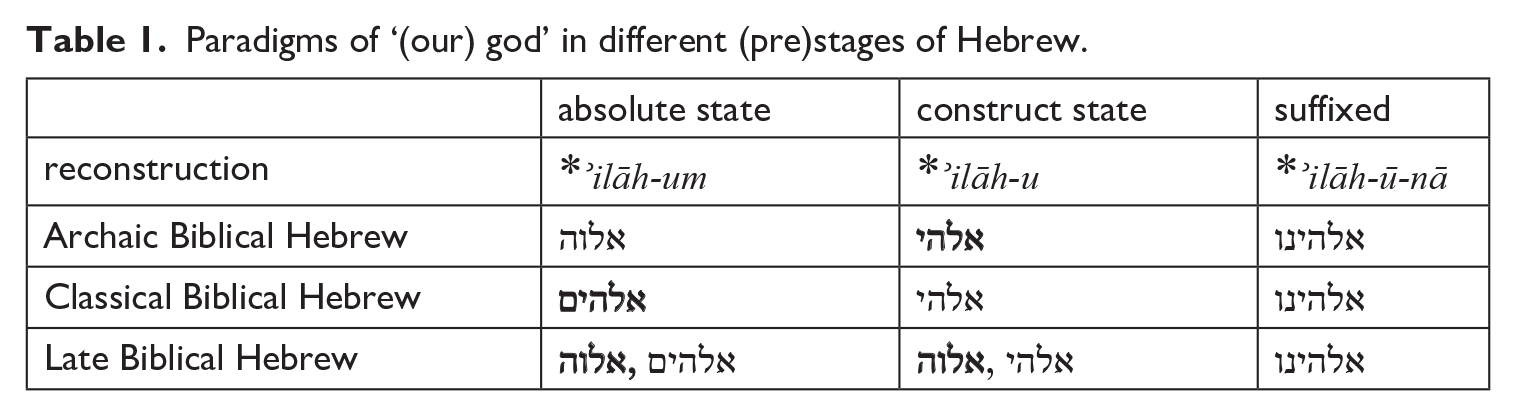
As Table 1 shows, the ABH corpus suggests that plural morphology for singular ‘god’ first spread from the suffixed form of the stem to the construct state. In Classical Biblical Hebrew, the m.pl. ending was added to the absolute state, completely generalizing the external plural form of the stem. In LBH, the morphologically singular form אלוה was reintroduced both in the absolute and the construct state—for example, Dan. 11.38, in both states: ולאלה מעזים על כנו יכבד ולאלוה אשר לא ידעהו אבתיו יכבד ‘and a god of strongholds he will honour in their place, a god his forefathers did not know he will honour’. Presumably this is a calque of Aramaic אֱלָהּ, a form to which we now turn. 21
The use of the m.pl. ending before suffixed pronouns allowed for external plural morphology to be generalized in Hebrew. In Aramaic and Arabic, as we have seen, the redundant plural ending before suffixes was analogically removed and replaced by a short case vowel across the board, as in *ban-āt-ū-nā >> *ban-āt-u-nā ‘our daughters’. By analogy with the absolute state *ʾilāh-um ‘god’ and the construct state *ʾilāh-u ‘god of’, this resulted in suffixed forms like *ʾilāh-u-nā ‘our god’. Given the singular semantics and syntax, nothing about this lexeme looks plural anymore. Hence, *ʾilāh- simply became a regular singular noun in Aramaic and Arabic. Without any distinction in morphology or meaning with more original *ʾil-, *ʾilāh- ousted the Proto-Semitic form and replaced it as the basic word for ‘god’ in these languages. 22 The asymmetric paradigm with redundant plural endings occurring only before suffixes was thus leveled in two separate directions, with the plural endings being extended in Hebrew but being given up in Aramaic and Arabic. 23
Why singular *ʾilāh-?
Formal considerations have led us to reconstruct *ʾilāh- as a word with broken plural morphology that was semantically and syntactically singular. Where does this mismatch come from? The question is similar to the one of why BH uses אלהים as a singular. We have pushed back the stage of the language at which the problem arises, as the plural morphology of אלהים can now be seen as the result of leveling from the stem used with pronominal suffixes. Some of the proposals made to account for singular אלהים, however, may also shed light on the rise of singular *ʾilāh-.
Burnett (2001: 2n4) notes ‘two compelling possibilities’ for understanding singular אלהים. First, there is the idea that אלהים is originally an abstract noun, comparable to, for example, חיים ‘life’, רחמים ‘mercy’, or בתולים ‘virginity’. Together with certain earlier authors (e.g., Brockelmann, 1913: § 29d; Gesenius and Kautzsch, 1910: § 124g), Burnett accepts this explanation, arguing that אלהים is a ‘concretized abstract’, like English deity or godhead. The other possibility, with a similarly long pedigree (e.g., Ember, 1905; Nöldeke, 1888: 476–477; recently Joüon and Muraoka, 2006: § 136d), sees אלהים as a plural of intensity, excellence, or majesty; the original meaning is then roughly equivalent to ‘great god’. An earlier theory, which held plural אלהים to have been a remnant of pre-Yahwistic polytheism, was already thoroughly criticized by Baethgen (1888) and is considered by Burnett to have been discredited.
The use of the m.pl. suffix to form abstracts is particular to Northwest Semitic (Brockelmann, 1913: § 29; Tropper, 2000: § 53.36) and does not occur in other languages. 24 Moreover, our reconstruction of the absolute state as *ʾilāh-um does not contain this m.pl. suffix. In the light of this reconstruction, the abstract plural theory should therefore be rejected. A major drawback of the majestic plural theory, on the other hand, is its vagueness (Burnett, 2001: 3n7): different authors have quite different understandings of what exactly this use of the plural entails. For instance, Joüon and Muraoka (2006: § 136d) see a parallel in אדונים (rare) and בעלים*, both ‘lord’, ‘master’ with morphologically plural forms mostly occurring before pronominal suffixes, while Baethgen (1888: 136) asserts that the frequent use of morphologically singular אדון and בעל disqualifies these parallels. Thus, neither of the leading explanations for the singular use of אלהים can be applied uncritically to the singular use of *ʾilāh-, although the majestic plural theory—which does not depend on the m.pl. suffix being present in the word—has potential, depending on how it is interpreted.
Focusing on the singular use of *ʾilāh- rather than that of אלהים presents a new possibility for how the reanalysis as ‘god’ could have occurred on a morphological basis. Unlike אלהים, whose form is unambiguously plural, the *CiCāC- pattern of *ʾilāh- not only forms broken plurals but also singular nouns, such as *ḥimār- ‘donkey’ and *ðirāʿ- ‘arm’. 25 This would have facilitated the reanalysis of the broken plural *ʾilāh- ‘gods’ as a singular word ‘god’ that just happened to add a m.pl. ending before pronominal suffixes. This reanalysis may have been supported by a process similar to the majestic plural theory of singular אלהים discussed above. Many authors who adhere to this theory adduce the parallel forms with plural morphology before suffixes like אדניך ‘your master’ (e.g., 2 Sam. 9.9–10) and בעליו ‘its owner’ (e.g., Isa. 1.3, parallel to קנהו ‘idem’). The use of בעל ‘owner’ with reference to the owners of animals particularly suggests that “majesty” is not the exact nuance of meaning these plural forms aim to express. More probably, the morphological plural was originally used out of politeness, a common strategy in languages of the world (Helmbrecht, 2005: 433; Schlund, 2014: 287)—for example, French vous, both ‘you (plural)’ and ‘you (polite)’. Referring to the ‘lord’ or ‘master’ politely would be especially important if he stood in such a relationship to the speaker (‘my lord’) or the listener (‘your lord’), explaining the use of the plural with pronominal suffixes in particular. The use with third-person suffixes is then analogical, as is the use in relation to animals, where politeness would not play a role. 26 As other authors have remarked, the social function of a god is similar to that of a lord; see the highly frequent use of ‘lord’ as a divine title and the fact that both a god and a human lord have עבדים ‘slaves’, ‘servants’, ‘worshipers’. If the Hebrew usage of the plural stem for suffixed forms of ‘lord’ had precursors or parallels in earlier stages of Semitic, this would provide another opportunity for forms like *ʾilāh-ū-ka, literally ‘your gods’, to be reanalyzed as a polite way of expressing meanings like ‘your god’ and reinforce the interpretation of *ʾilāh- as a singular.
Ge‘ez, Phoenician, Amarna Canaanite: Parallels or reflexes?
I have argued above that *ʾilāh- has a long history as a morphologically plural word with singular semantics. The inherent plausibility of a word for ‘god’ being morphologically plural receives some support from certain Semitic languages that do not directly attest *ʾilāh-. As we shall see, however, it is difficult to ascertain whether these parallels are truly independent.
In Ge‘ez, we find the word ʾamlāk ‘god’. This is transparently derived from the root mlk ‘to rule’ and formed according to a broken plural pattern. Pronominal suffixes are attached either to the linking vowel -ī-, as with plurals, or to the case vowel, as with singulars: ‘your god (nonaccusative)’ is either ʾamlāk-ī-ka or ʾamlāk-ǝ-ka (Dillmann, 2014: 152). Where its etymology is concerned, Baethgen (1888: 139) is convinced that ʾamlāk was not the original Ethiosemitic word for ‘god’, which makes external influence from a reflex of *ʾilāh- a likely option. Nöldeke (1888: 476–77), on the other hand, avows that the word must be native and pre-Christian. Neither author provides any real arguments (cf. Nöldeke, 1910: 34). Even if Nöldeke is right and the word is an old formation, that does not determine whether morphologically plural ʾamlāk forms an independent parallel to morphologically plural *ʾilāh-; whether ʾamlāk was modeled after inherited *ʾilāh- before replacing it; or whether it was a calque from a language that preserved *ʾilāh-, like Sabaic.
Phoenician presents us with a similar situation, with the difference that the word for ‘god’ is more similar and that Phoenician was spoken even closer geographically to languages that attest *ʾilāh-. The Phoenician word for ‘god’ and ‘goddess’ is normally אלם, as in אלם אדרת אס אלם עשתרת ‘Mighty Goddess Isis, Goddess Astarte’ (KAI 48:2). While early attestations from the Phoenician heartland are absent, morphologically singular אל used as a common noun ‘god’ is not unambiguously attested at all (Burnett, 2001: 25). Interestingly, semantically and syntactically singular אלם is opposed to plural אלנם ‘gods’, which may attest the same plural formation as Akkadian ilān-ū (also cf. Ugaritic ı͗ln-m, with an associated singular ı͗ln). That the final ם of the singular represents the m.pl. suffix is supported by its absence in the construct state אל ‘god of’, the expected way to spell *ʾil-ē < *ʾil-ay, and in suffixed forms like אלי ‘his god’ < *ʾil-ay-hu (Hoftijzer and Jongeling, 1995: 53). Given the absence in Phoenician of *ʾilāh-, one might suspect that this word resulted from loss of *h, but *h is normally preserved in Phoenician nouns such as *kāhin- > כהן ‘priest’ (Friedrich and Röllig, 1999: §17). The most likely remaining scenario is that the plural morphology of *ʾilāh- before suffixes was not only leveled to the rest of the paradigm, as in Classical BH, but analogically affected the originally morphologically singular synonym *ʾil-, making it morphologically plural too. The direct reflex of *ʾilāh- was subsequently lost. While it is convoluted, I find this explanation more likely than that Phoenician introduced plural morphology to the word for ‘god’ completely independently from the inherited situation found in neighboring languages.
Finally, cuneiform texts from Late Bronze Age Canaan (including the Amarna Letters) frequently use the Sumerographical spelling DINGIR.MEŠ to express singular ‘god’ (Burnett, 2001: 7–24; see the discussions in Hartmann, 1973). Here, DINGIR is the logogram for ‘god’ and MEŠ is a sign marking the plural. The occasional spellings with a phonetic complement, DINGIR.MEŠ-nu, confirm that the scribes had the Akkadian plural form ilān-ū in mind. Depending on how we should understand the mixed Akkadian-Canaanite writing in these texts, this could either be a calque of a Canaanite word for ‘god’ that was morphologically plural or a direct representation of such a word. 27 The most common context by far in which this word appears is with reference to the king of Egypt, addressed by his vassals in terms such as LUGAL EN-ia dUTU-ia DINGIR.MEŠ-ia ‘the king, my lord, my sun god, my god’ (Burnett, 2001: 8). Notably, ‘god’ occurs with a pronominal suffix here, as it does in a few other contexts where it means singular ‘god’. Several more attestations show unsuffixed DINGIR.MEŠ taking a singular verb; semantically, however, these are plural (pace Burnett, 2001; thus Hartmann, 1973), like DINGIR.MEŠ-nu šu-lum-ka šu-lum É-ka li-iš-al ‘may the gods inquire concerning your welfare [and] the welfare of your house’. It is unclear what this says about the Canaanite spoken by the scribes. In one case, a singular verb in Akkadian is followed by a Canaanite gloss in the plural: ip-ta-ra-{erased}-aš-ni \ ša-pa-ṭu-ni DINGIR.MEŠ ‘the gods has (sic) judged me: šapaṭū-nī (pl.)’ (Hazor 10:20–22; Horowitz and Oshima 2006, 81). Either way, these examples are not completely parallel to the semantically singular use of a morphologically plural word for ‘god’. The use of DINGIR.MEŠ for ‘god’ with pronominal suffixes, however, sits well with our reconstruction. 28 The intricacies of cuneiform make it impossible to identify the Canaanite word underlying spellings like DINGIR.MEŠ-ia with full confidence, but it may well have been a form like *ʾǝlōh-ay-ya, corresponding to our reconstructed *ʾilāh-ī-ya and Biblical Hebrew אלהַי.
Conclusion
This paper has taken Wellhausen’s (1901) observation that *ʾilāh- resembles a broken plural of *ʾil- in a different direction. Based on evidence from various branches of Semitic, we have reconstructed a paradigm of unsuffixed *ʾilāh- alternating with *ʾilāh-ū- before pronominal suffixes. This word would originally have been a (broken) plural, but was reanalyzed as singular, thus coming to be used with singular semantics and syntax. The attested reflexes of *ʾilāh- could all be derived from this reconstruction, with ABH preserving a mostly unchanged paradigm, an archaism that has not been noted before. It may also underlie the more divergent words for ‘god’ found in Ge‘ez and Phoenician and the spelling DINGIR.MEŠ in cuneiform texts written by Canaanite scribes.
This reconstruction shows that the use of a morphologically plural form for singular ‘god’ is not a uniquely Hebrew (or Ge‘ez, or Phoenician) oddity. Its explanation must be rooted in an earlier stage of Semitic. This insight refutes the Hebrew-specific interpretation of אלהים as a (concretized) abstract noun. It also further disqualifies the school of thought that sees אלהים as a remnant of pre-Yahwistic polytheism, as the word can be reconstructed with singular semantics for a time long before Israelite religion started to move towards monotheism by any account. Specifically, the attestation of *ʾilāh-’s reflexes suggests that the word already existed with plural morphology but singular semantics at the Proto-Central-Semitic or Proto-West-Semitic stage of the family and probably dates back to around the third or late fourth millennium BCE (cf. Huehnergard and Pat-El, 2019). While the majestic plural explanation for אלהים also largely depends on Hebrew-internal data, the modified version put forth here is compatible with earlier forms of Semitic and crosslinguistic tendencies. In conclusion, the most likely scenario is that *ʾilāh- originated as a plural of *ʾil-, but was reanalyzed as singular ‘god’ due to the shape of its unsuffixed stem and the possibility of interpreting suffixed forms like *ʾilāh-ū-ka ‘your gods’ as a polite way of saying ‘your god’.
Footnotes
Acknowledgements
I am very grateful to Holger Gzella, Nili Samet, Ron Hendel, Marijn van Putten, and a number of anonymous reviewers for their helpful comments on earlier drafts of this paper. I also thank Ola Wikander and Jonathan Potter for their encouragement to put this idea in writing and advice on how to do so, respectively, and Imar Koutchoukali for his help navigating the Ancient South Arabian material.
Declaration of conflicting interests
The author declared no potential conflicts of interest with respect to the research, authorship, and/or publication of this article.
Funding
The author disclosed receipt of the following financial support for the research, authorship, and/or publication of this article: Research for this paper was funded by a Research Foundation – Flanders (FWO) Senior Postdoctoral Fellowship, project number 1231920N.
Ethical considerations
not applicable
Consent to participate
not applicable
Consent for publication
not applicable
