



Abstract
This article offers an analysis of Isaiah 51.1–3, 4–6, 7–8. These units contain multiple similarities that emphasize the fundamental tension between the units, primarily regarding the nature of divine tidings and the identity of their beneficiaries. The first part of the article demonstrates the unique content and design of each unit through a literary analysis; however, since the reading process constantly reveals new content, the underlying tension is further intensified in the second part of the article, which leads to the conclusion that the units are deliberately ambiguous and multivalent. The multifaceted content facilitates an understanding of the units, and Deutero-Isaiah as a whole. The article demonstrates that the dynamic literary-rhetorical design and its interpretive consequences reflect the existence of various groups (which serve as the ‘rhetorical situation’ of these units), the prospective connections between these groups, and their potential for social, geographical, and ethnic mobility.
Keywords
Scholars have long debated the object and nature of God’s beneficent action in Deutero-Isaiah. 1 Every interpretation yields a different portrayal of God’s character, and specifically the extent of God’s universality, further deepening the controversies surrounding these chapters. The questions intensify when chapters 40–55 are examined as a separate section of the book, 2 and may take on additional meaning in light of the assumption that these chapters contain a variety of ideologies associated with different groups, an issue which will be addressed below.
This article examines the abovementioned debate through a focused analysis of Isaiah 51.1–8. While the article addresses the ideological plane of the verses—primarily the identity of the divine beneficiaries—its conclusions will be based on a literary and rhetorical examination of the relevant units. 3
The literary analysis suggested in the first part of this article emphasizes the lexical and literary aspects of vv. 1–3, 4–6, and 7–8, which are read as separate and closed literary units. 4 The discrete discussion of each unit is based on the assumption that the individual units have independent meaning. The separation into narrow units follows the approach of form criticism, which assumes that the original oral prophetic units were short. 5 Some of the assumptions of form criticism have been rejected by scholars, 6 and approaches such as redaction criticism or synchronic analysis have shaped our understanding of these texts—especially regarding the expected length and nature of the units. However, as I will demonstrate below, in this case there is an essential gap between the three units. 7 The analysis of vv. 1–8 as one coherent unit does not correlate with the nature of the individual units. 8 A distinction should also be made between these three units and other closed units in Deutero-Isaiah, since lexical similarities are not necessarily evidence of ideological identity, as I will demonstrate below. 9
The first section of this article therefore demonstrates the distinct content (though not necessarily different origin) of each unit, and the manner of its representation through the literary design of the verses. Therefore, the question regarding the purpose of the beneficent divine action will become more acute through this analysis.
The second part of the article will introduce a rhetorical analysis. 10 Since the discussion centers on classic rhetoric alongside dynamic rhetoric, 11 it establishes the multifaceted interpretive and ideological content embedded in the text, which is exposed through the relationship between the text and its recipients.
The integration of the literary and rhetorical facets highlights various layers of meaning in the text, which emerge from the gap between the analysis of the text as a closed literary work and its analysis as an act of communication, 12 between the unit as a whole and the process of reading its components. 13
While the second part of the article seemingly complicates the foundational question presented above, in fact it paves the path toward revealing its essence. In my conclusion, I argue that the literary and rhetorical nature of the verses creates an ongoing dynamic interpretation, which should be considered ideological, as explained below. The nature of each separate unit and the interrelations between all three units offer an exemplary model of the interaction between various units in Deutero-Isaiah, and therefore suggest a methodology for reading these chapters.
1. Verses 1–8
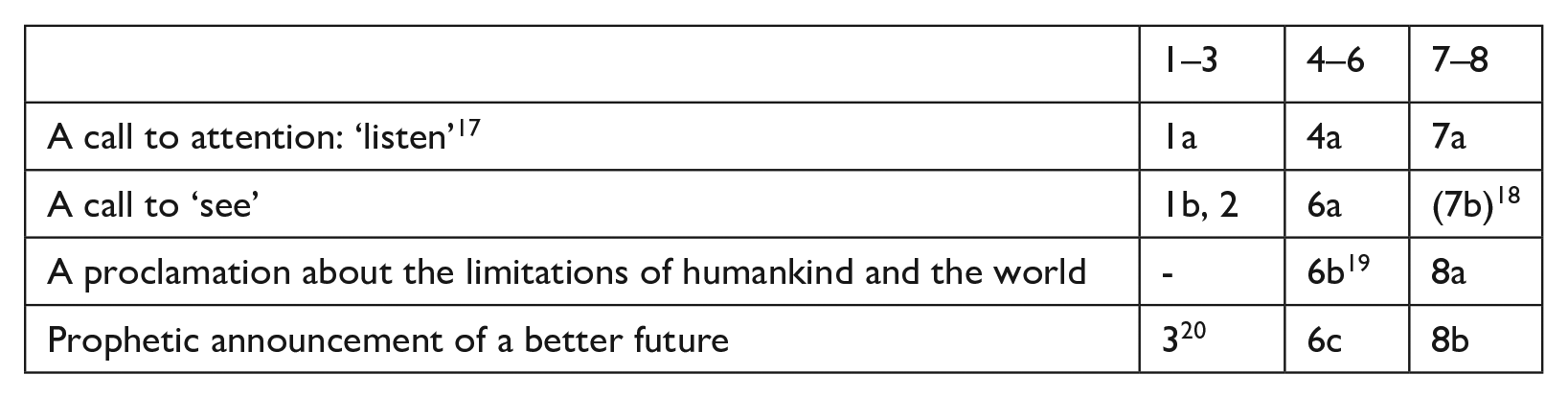
As scholars have previously argued, 14 the text in Isa. 51.1–8 comprises three separate pericopes: 1–3, 4–6, 7–8. 15 Each of the units is initially classified as an exhortation and conforms to the following structure, including a clear opening formula: 16 17 18 19 20
Moreover, each unit independently includes recurring phrases, as shown here: 21 22 23 24 25
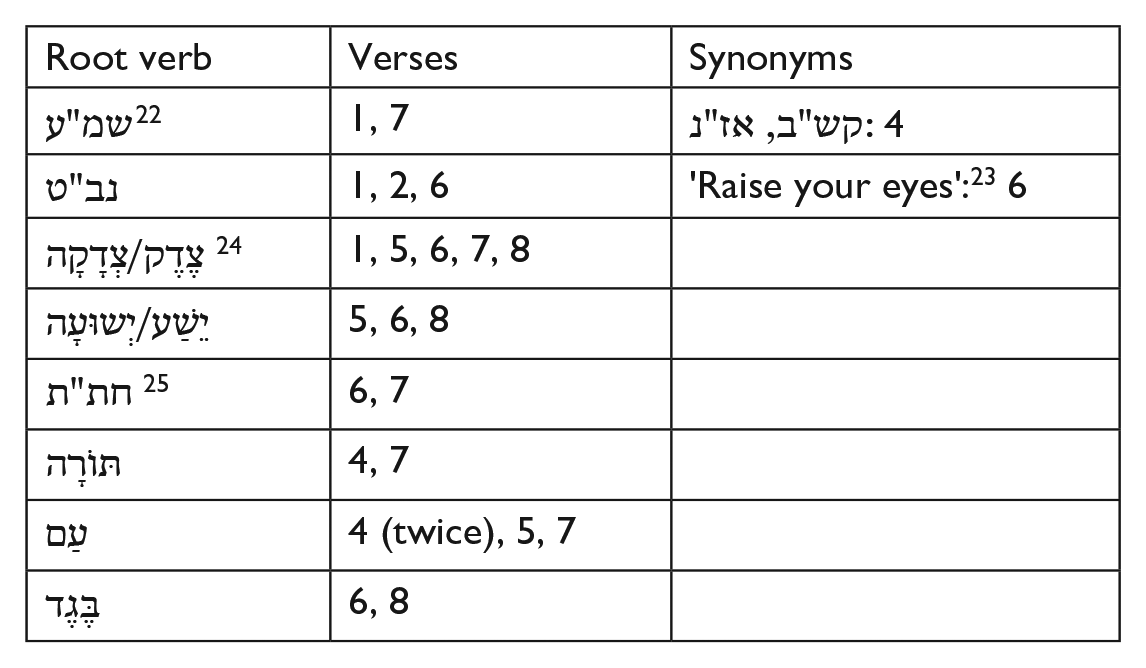
Below, I will present a separate analysis of each of the units: 1–3, 4–6, 7–8. I will demonstrate how each unit utilizes the recurring terms and shared structure in a different manner. 26 In effect, the similarities between the units serve as a foundation for emphasizing the essential differences in terms of content: vv. 1–3 address the particularistic relationship between Israel and their God, and the resulting redemption. Vv. 4–6 portray God’s universality and pronounce the dispersal of God’s תּוֺרָה among the nations. Vv. 7–8 discuss God and the eternal glory of the divine. These three distinct themes and ideologies are often seen as contradictory. 27
The abovementioned commonalities between the three units are the underlying reason for the paratactical sequence of the units, despite the fact that they are not part of one organic unit and do not share a coherent ideology. 28 This is similar to other linguistic and phonological connections between vv. 1–8 and the subsequent verses of ch. 51 (e.g.,וּזְרֹעַי / זְרֹעִי / זְרוֹעַ (5, 9); תְּחוֹלֶלְכֶם / יְיַחֵלוּן / מְחוֹלֶלֶת (2, 5, 9);חָרְבֹתֶיהָ / הַמַּחֲרֶבֶת (3,10); שָׂשׂוֹן וְשִׂמְחָה (3, 11); עַמִּי (4, 16); שָׁמַיִם אֶרֶץ (6, 13, 16); צִיּוֺן (3, 11, 16)). 29
More significantly, the analysis below demonstrates how a variety of literary devices and the diverse use of the recurring phrases support the central and overt content of each unit, particularly regarding the definition of the beneficiaries of divine action. The potential multiplicities will be discussed in the next section from a rhetorical perspective.
1.1 Verses 1–3
1.1.1 Israel
In v. 1, the prophet turns to an unidentified group, characterized as מְבַקְשֵׁי יהוהרֹדְפֵי צֶדֶק . 30
The cumulative content, formulation, and literary devices in the subsequent verses support the identification of the addressees as the exiled Israelites, who have a connection to Zion—or should harbour one. 31 They are the ones in distress at the beginning of the unit, and they are the ultimate object of the redemption described at its end.
First, in this unit the call to ‘see’ references a shared Israelite-historical tradition of Abraham and Sarah, who are defined as the ancestors of the group (see also 41.8). 32 This relationship with the ancestors is described as the foundation of the current relationship between God and the exiled Israelites. 33
Interestingly, this is the only mention of Sarah outside the book of Genesis. 34 The allusion to Sarah, within the current context, clarifies that this is a call specifically to the direct descendants of Abraham and Sarah (as distinguished from Abraham’s other descendants), namely, it is addressed to the people of Israel. 35
Secondly, v. 2b emphasizes that Abraham has the unique status of one who was chosen and blessed by God: For I called him alone; I blessed him and multiplied him. 36 God distinguishes Abraham alone, mirroring the divine choice of Israel from among the nations (2 Sam. 7.23). The words וַאֲבָרְכֵהוּ וְאַרְבֵּהוּ are reminiscent of God’s blessing to Abraham, which was later transferred to his descendants (Gen. 22.17–18; see, e.g., Jer. 33.22). 37
V. 3 reinforces the particularistic angle indicated in the verses, by describing the restoration of Zion in vivid style. 38 The contrast between a desolate Zion and its consolation is expressed through the dual mention of the verb ‘comfort’ (נִחַם), the multiple terms used to describe happiness (תּוֹדָה וְקוֹל זִמְרָה / שָׂשׂוֹן וְשִׂמְחָה), and the recurring contrasts (גַן יהוה / עַרְבָתָהּ עֵדֶן; / מִדְבָּרָהּ) . 39 However, the limited promise regarding rejuvenation of the desolate land becomes a promise of redemption to its previous inhabitants, based on the understanding that Zion represents its dwellers. 40 V. 3 presents the notion that the revival of Zion is good tidings for the exiled Israelites.
Finally, both the Garden of Eden tradition and the power to transform nature usually relate to God’s image as the Creator and are linked to the universalistic character of the divine, 41 whereas here the same themes are associated with Israel. 42 Contrary to myriad biblical verses (e.g., Ezek. 47.1, 8–12; Zech. 14.8; Ps. 36.8–10), transforming the desert of Zion into ‘the Garden of Eden’ has no effect on its surroundings. 43 Accordingly, this action is only intended to benefit Israel.
1.1.2 Justice
The particularistic focus of vv. 1–3 indicates that the justice in v. 1 relates specifically to the redemption of Israel. The justice-pursuing group refers to those who long for redemption and demand its implementation. 44 The promise (3) and the epithet for the addressees (1) represent the state of remaining in exile as one which is unjust and demands correction (e.g., 45.13; 47; 49.14. However, cf. 48.17–19; 56.1). 45
Vv. 1–3 open with the call to heed and conclude with thanksgiving and the sound of song to be voiced by the pursuers of justice. 46 The unit opens with a pursuing group (מְבַקְשֵׁי /רֹדְפֵי) and ends with that which is found in Zion (יִמָּצֵא). These semantic connections between seeking and finding create an inclusio, represent the process which is encapsulated in the unit, and clarify its meaning.
1.2 Verses 4–6
Contrary to v. 1, v. 4 opens with a direct divine communication. 47 Moreover, there is a concatenation in vv. 4–6, discerned through repetitions such as עַמִּי (4a), עַמִּים (4b, 5a); וּמִשְׁפָּטִי (4b),יִשְפֺּטוּ (5a); תֵצֵא (4b), יָצָא (5a); וּזְרֹעַי (5a), זְרֹעִי (5b); צִדְקִי-יִשְׁעִי (5a), וְצִדְקָתִי- וִישׁוּעָתִי (6c); לַשָּׁמַיִם- הָאָרֶץ (6a), שָׁמַיִם- וְהָאָרֶץ (6b). However, a lexical concatenation will not suffice for the unit’s delimitation, especially in light of the reservations presented above regarding lexical repetition in a poetic text such as Deutero-Isaiah. Thus, there is a need for an internal ideological affinity and a link between content and lexical recurrences, as detailed below. 48
1.2.1 The nations
Vv. 4–6 describe a connection between God and all nations, without reference to Israel as intermediaries. 49
The synonymous terms Nations/Coastlands (in the plural) are repeated three times in vv. 4–6. 50 Along with the phrase אוֹר עַמִּים, 51 they emphasize the centrality of the nations and signal the universalistic nature of the verses. 52
Moreover, while vv. 1–3 describe Israel as longing for closeness to God, in 4–6 all nations seek closeness: the coastlands will look to me, and they shall long for my arm. 53 In this context, the assonance between יְיַחֵלוּן (5) and תְּחוֺלֶלְכֶם (2) is noteworthy: the former represents the universalism that characterizes vv. 4–6 while the latter represents the particularism that characterizes vv. 1–3.
In vv. 1–3, the element of contrast between the distinguished ‘one’ and the undistinguished collective is used to emphasize the particularistic divine choice (For I called him alone, 2b); conversely, in vv. 4–6 the contrast between the ‘one’ (עַמִּי, 4a) and the collective (עַמִּים, 4b, 5) is used to highlight the broad divine appeal to the nations.
The broad horizon of these verses is also expressed in contrasts regarding time, ranging from near to distant, as a representation of the entire spectrum—יְקַוּוּ, יְיַחֵלוּן // אַרְגִּיעַ, קָרוֹב, as well as the conjugations of the root יצ“א (תֵצֵא, יָצָא), which represent physical distance (cf. 46.12–13; 56.1 which use similar vocabulary to depict what seems to be Israel’s deliverance).
1.2.2 Isa. 2.2–5
V. 4 concludes with the statement for תּוֺרָה will go forth from me, and my judgment for a light to the peoples instantaneously. 54 A synchronic comparison of v. 4b and Isa. 2.3, which includes lexical similarities, 55 is significant: while in 2.3, God’s Tôrâ emerges from Zion: For out of Zion shall go forth תּוֺרָה, and the word of the Lord from Jerusalem, 56 in 51.4, the תּוֺרָה originates in God himself, and is therefore unbound to a specific location—certainly not Zion.
While this change might serve the rhetorical purpose of drawing the attention of the audience, the absence of a specific geographical location may also allude to a universalistic perception. 57 Correspondingly, God’s name is absent from vv. 4–8, where he addresses the recipients in 1ms, while in vv. 1–3 and 2.2–5 he is referenced by the tetragrammaton, YHWH. 58
The same universalistic emphasis can be discerned in the difference between the use of the term light in 2.5 and 51.4. 59
1.2.3 Heaven and earth
The universalistic representation of God is also expressed in the call to ‘see’ in v. 6. 60 Instead of referencing an Israelite-historical tradition (2a), this verse depicts a universalistic natural element: heaven and earth. 61
The contrasting pair heaven-earth, supported by the semantic parallel raise your eyes / look, may be interpreted as a merismus, representing the whole cosmos. 62 This reinforces the expression of universalism and a broader viewpoint.
The purpose of ‘seeing’ is also presented in a broader context: heaven and earth do not point to the past, but rather to the future, in contrast with the current reality. 63 Whereas the rock and quarry in v. 1 allude to the foundations of Israel that are presented as still relevant and extant in the lives of contemporary Israelites, heaven and earth serve as a basis to define divine perception: heaven and earth are finite, in contrast with the eternal God, who is portrayed as mightier than the greatest natural elements conceivable to humankind. 64 In this context, God’s greatness affirms that his צְדָקָה and יְשׁוּעַה will shine down eternally upon all nations. 65
1.2.4 Justice
The term צֶדֶק appears in vv. 4 and 6 alongside יש“ע. Usually, the term צֶדֶק is understood as referring to salvation when adjacent to the root יש“ע. 66 However, יְשׁוּעָה is generally offered to one in distress, not used as an expression of deliverance from distress (e.g., 46.7). 67 Moreover, the proximity of the two roots in vv. 4–6 seems to indicate that in this particular instance, יש“ע should be interpreted in the context of the parallel legal terms in the verse: תּוֺרָה, צֶדֶק, מִשְׁפָּט. 68 When these terms appear together, they reflect the proper universalistic order, which in this context is led by God (see, e.g., 42.3–4, 21, 45.8, 48.18; cf. Hab. 1.4). 69 Vv. 4–6 do not describe redemption and are undoubtedly not addressed to Israel alone; rather, what they announce is the universal establishment and expansion of God’s law and תּוֺרָה, which can affect the nations (cf. 45.22, 23). 70
1.3 Verses 7–8
1.3.1 God
V. 7 opens once again with a call to listen. The addressees are defined through their relationship with justice, instead of an explicit statement of national identity: Heed me, you who know justice, you people who have my תּוֺרָה in your hearts.
In contrast with vv. 4–6, here the nation that knows the תּוֺרָה of the God of Israel (תּוֹרָתִי) seems to be Israel (see Jer. 31.32). 71 Formulating the termעַם in the singular reinforces this interpretation of the introductory clause, 72 and sheds similar light on the subsequent content. However, contrary to vv. 1–3, no further details or explicit connection to Zion or Israel are mentioned. This ambiguity anchors the assumption that the unit centers on God.
The exclusive first-person formulation of these verses, including all possessive pronouns (תּוֹרָתִי, צִדְקָתִי, ישֽׁוּעָתִי), further reinforces the focus on God (cf., e.g., מְבַקְשֵׁי יהוה, v. 1; תוֹרָה, v. 4).
1.3.2 Justice
The addressees’ epithet is constructed in a chiastic structure: בְלִבָּם / יֹדְעֵי צֶדֶק עַם תּוֹרָתִי . Know parallels hearts, assuming the heart represents thoughts or intellect. 73 Therefore, צֶדֶק should be defined as God’s path and laws, similar to its definition in vv. 4–6. 74 Based on the characteristics of the unit, the terms יְשׁוּעָה and צְדָקָה in v. 8 would be interpreted similarly.
1.3.3 Human reproach
The call to see is absent from vv. 7–8; however, v. 7 includes a sound-play between the roots רא“י and יר“א: 75 אַל תִּירְאוּ חֶרְפַּת אֱנוֹשׁ. 76 Two literary devices enhance this sound-play. First, the ‘reassurance formula’ is divided between the two colas (cf. 47.3 רא“י + חֶרְפָּה). 77 Second, 7b is formulated in a backwards ellipsis structure which omits the preposition mêm (‘from’) in the first cola and adds it in the second: אַל תִּירְאוּ חֶרְפַּת אֱנוֹשׁ / וּמִגִּדֻּפֹתָם אַל תֵּחָתּוּ (cf. 51.12). This division and ellipsis-structure opens the imperative אַל תִּירְאוּ to multiple interpretations: it can mean ‘do not fear’ on the one hand and ‘do not see’ on the other.
8a is perceived as a foundation for 7b: since people are ephemeral, their scorn should not be taken seriously.
The moth and the worm serve a dual function in 8a: 78 first, they are part of the imagery, indicating that humans are mortal, like garments which are consumed by moths (similar to 26.11). This interpretation is based on reading the imagery in 8a alone, 79 and on the option of interpreting בֶּגֶד and צֶּמֶר as collective nouns that denote the material in general and not a specific object (e.g., Hos. 2.7, 11). However, another interpretation might be ‘humans are consumed by moths like garments’ as in 50.9; 51.6. This interpretation is based on understanding the term אֱנוֹשׁ as a collective noun which represents humanity. It is also based on the assumption that 7b and 8a are formulated in a forward ellipsis structure: while humans are mentioned in 7b they are absent from 8a. Thus, the moth and the worm are part of the imagery of the perishable garment, but also part of the interpretation that portrays humans as perishable; together, these underscore the finiteness of humankind.
While vv. 1–3 call attention to past human figures, vv. 4–6 call the reader to look at future-oriented natural elements and vv. 7–8 at current human figures. However, contrary to v. 6, which portrays human mortality in contrast to divine greatness and God’s צֶדֶק, which is directed at all of humankind, here it is the reason to dismiss fleeting human reproach, as a foundation for God’s absolute superiority.
V. 8b describes God’s eternal nature, which stands in contrast to the finiteness of humankind. The emphasis on the contrast between God and humankind is also apparent in the phrase חֶרְפַּת אֱנוֹשׁ (7b). First, it highlights the human source of the reproach (‘the reproach of humankind’). At the same time, the backwards ellipsis structure mentioned above enables a reading of the description as human contemptuousness (‘the contempt of humankind’, see 54.4).
V. 8b does not develop a promise of divine salvation or redemption and instead contents itself with a description of God’s greatness. Moreover, contrary to preceding verses where God’s צֶדֶק becomes apparent through a change of status for Israel or the nations, vv. 7–8 do not link God’s יְשׁוּעָה or צֶדֶק with human recipients.
80
A comparison to the seemingly similar verse, 50.9, emphasizes this distinct character of 51.7–8: It is the Lord YHWH who
All three units include an element of destruction which involves a change in human status. However, while vv. 1–3 describe a local destruction that is the foundation for a renewal of Zion and its inhabitants (3), and in 4–6 the universal destruction demonstrates God’s eternal צֶדֶק among the nations (6), in 7–8 universal destruction emphasizes God’s greatness. 83
1.4 The recipients of God’s action
In light of this analysis, it seems that each unit defines a different recipient for divine action, and the nature and scope of divine action are altered accordingly. The opening question regarding the identity of the recipients of divine action in Deutero-Isaiah and the ideology the units represent is reinforced and even intensified.
If, at times, the tension between various pericopes in chs. 40–55 can be reduced by textual distance or stylistic disparities, here the tension is present in abundance, since the three units appear in textual sequence and, moreover, they are similar in style and language (cf. 48.12–22). 84 Thus, these three units constitute a microcosm of the questions pertaining to the whole cluster of chapters.
Presumably this tension could be resolved based on the assumption that each unit was created by a different author, representing a separate power group, which reflects hope for a separate party in the nation of Israel, or outside of it. 85 However, the tension that exists between the units is further reflected in each separate unit: while each of the units is self-contained, and each defines a seemingly unequivocal beneficiary of divine action, supported by the design of the unit, this clarity is undermined when tracking the reading process.
As demonstrated below, even if each stage of the reading process confirms an unequivocal interpretation, the text encourages a re-reading, which in turn yields a sense of uncertainty. New insights undermine the unequivocalness of the assertions that previously emerged from the text. When read in the other direction, the earlier insights continue to linger and refute the exclusivity of the new assertion. 86 Sometimes, this lack of clarity is also expressed in one specific term or phrase.
2. Dynamism and ambiguity
This section will return to the units 1–3, 4–6, 7–8, and by paying attention to the reading process, offer representative examples of several literary and rhetorical phenomena that characterize these units and enable the existence of multifaceted content in each independent unit.
2.1 The rhetoric of change
V. 4 opens with a petition to the nation: Hear me, my people, and my nation listen to me. 87 In light of this introduction, and in correlation with the reading process, 88 the multifaceted term תּוֺרָה in 4b should also be interpreted from the internal Israelite perspective. The parallel terms in the two colas (e.g., תּוֺרָה // מִשְפָּט in 42.4), the conjunction wāw, and the coordinate rhythm (4+4) support this expectation. 89 Therefore, tracking the reading process, v. 4a–b1 describes a particularistic relationship between Israel and their God, raising expectations of the spreading of the תּוֺרָה within Israel and a similarly particularistic development in the following verses. Nonetheless, in terms of content, 4b2 takes a sharp turn. Vv. 4b2–6 unexpectedly describe a universalistic relationship between God and the nations of the world. 90
From this perspective, the concatenation of the term ‘nation’ emphasizes the various conjugations of the term, both in singular (4a) and plural (4b–5) and reflects the tension between them. Moreover, in 4b2–6, the nations are regarded without consideration for Israel or their mutual relationship, which might have introduced a continuity between the contradictory statements. Vv. 4b2–6 therefore reflect a different view of the nature of God.
The surprise created by delaying the universalistic aspect until 4b2 has a rhetorical effect on the audience. 91 More importantly, it enables an expression of the particularistic relationship alongside the universalistic one. Had the content of the unit been exclusively universalistic, it would not have opened with a call to Israel, who serve no practical function in the unit, 92 apart from validating the particularistic relationship with the divine. 93
A similar argument can be put forth about v. 1, which opens with an unlimited call to unidentified addressees. 94 The epithets are used rhetorically for the purpose of enhancing the attentiveness previously produced by the call to listen. 95 The introduction also emphasizes the universalistic facet of God, which is reinforced by the universalistic meaning of the term צֶדֶק in Deutero-Isaiah (e.g., 41.2; 42.6; 43.9; 45.8, 23). 96 Conversely, the content, vocabulary, and imagery of vv. 1b–3 develop the particularistic connection with Israel alone, as detailed above (similarly, see 46.12–13). 97 Here, we witness the transformation of the universalistic addressees (1a) into Israelites (1b–3).
This phenomenon may be referred to as a ‘rhetoric of change’. A unit begins by developing specific content and ideology, creating a clear expectation for further development of the same theme, but the turning point indicates a transition between two separate perceptions, and marks the development of opposing ideological content. Ultimately, since there is no explicit repeal of the first perception, and given that rhetoric often represents content, the unit includes all the independent contradictory content in one frame, and none of the notions are refuted. 98
2.2 The rhetoric of turning
Another phenomenon is found in vv. 1–3.
The two colons of v. 1 parallel each other:
99
Heed me, you that pursue צֶדֶק, you that seek YHWH. Look to the rock from which you were hewn, and to the quarry from which you were dug.
This parallel correlates with the current stage in the reading process, a point early in the pericope in which no other figure has yet appeared. The parallel is enhanced by the essential connection between ‘seeing’ and ‘hearing’ as two acts of communication. It is further enhanced by the repetition of the preposition אֶל in both colons: in 1a אֵלַי is an explicit reference to God. 100 Accordingly, the same should be the case in 1b. While 1a references God and elaborates on the epithets of the human recipients, 1b completes 1a and elaborates on the description of God’s identity while referencing the recipients by means of the imperative only. If so, both 1a and 1b should be considered a ‘call to attention.’
Based on this parallel, at first glance the rock and quarry in 1b should be perceived as metaphors for God, who was mentioned in 1a (see 44.8; Deut. 32.4, 18). 101 The metaphors describe the just God as powerful, mighty, and eternal. Moreover, both 1a and 1b describe the everlasting relationship between God and the addressees. God’s image and the relationship with the unidentified recipients are reinforced by the two colons.
However, v. 2 retrospectively instills additional meaning into the metaphors. The structure of 1b precisely parallels 2a: Look to / the rock from which you were hewn / and to the quarry from which you were dug.
Look to / Abraham your father / and to Sarah who bore you
Syntactically, the two colons contain two pairs consisting of direct object + adjective, one in the masculine and the other in the feminine. 102 The rhythm of the colons is similar: 3+3//3+2. 103 The preposition כִּי ( 2b) should be understood as introducing the complement clause. Thus, it seems that the rock and quarry metaphors describe the relationship between the addressees and their human roots. Furthermore, the metaphors contribute to the definition of the recipients as the Israelites, as explained above. 1b–2a should be perceived accordingly as God’s word, to which the addressees are called to listen: listen (1a) and therefore look (1b–2a). Abraham and Sarah, symbolized by the rock and quarry, are the foundation for the coming announcement (3). 104 Since Abraham and Sarah’s special status is founded on their connection with God, 105 as explicitly stated in 2b, these two intertwined options do not contradict one another but rather complement each other and make the picture richer and more complex.
When v. 3 is added to the picture, it portrays Sarah as a parallel to Zion, since both are redeemed from their barren state (49.14–23; 54.1–8; cf. Zeph. 2.4). 106 The preposition כִּי ( 2b, 3a) should be understood as a causal participle. The parallel between Sarah and Zion is thematic, not linguistic or syntactic. However, the recurring contrasts in both verse-lines strengthen the connection between them (alone / multiplied; desert / Eden; wilderness / garden of YHWH). This suggestion retrospectively imbues the metaphors of the rock and quarry with yet another meaning created by the accumulated information and the development of the unit. 107 In this case, 1a is the call for attention and 1b–3 are the essential message: Abraham and Sarah are important not only because they are the ancestors of the nation, but also because they are an example of people who were cured of their distress.
This reading exemplifies a phenomenon known as the ‘rhetoric of turning’. 108 At the core of this phenomenon lies the assumption that a meaning which arises at the initial stage of reading is dependent on creating a frame, ‘which can create maximal relevancy among the various data of the text. . . . It is the frame that defines which of the potential meanings of a word will be activated’. 109 However, new information, which is relevant to previous stages in terms of language and content, emerges in subsequent stages of the reading process. It creates new perspectives regarding preceding stages, and retrospectively reframes the verses in patterns that encourage alternative interpretations. 110 Both the sequential and the retrospective interpretations constitute the unit’s content, despite the contradiction. 111 The initial interpretation remains in the recipient’s awareness even as the reading process reveals other possible interpretations; if it should not have been part of the unit’s content—even as an undeveloped possibility—the unit would not have opened with this interpretive option. Furthermore, often the earlier interpretation is reinforced and supported by the later appearance of additional information and new phrases in the unit.
While the rhetoric of turning and the rhetoric of change are two different phenomena (especially regarding the text frame and the direction of effect of each one of them), they are both based on turning points that emphasize and maintain contradictory content within a pericope. 112 The understanding of both phenomena is based on the assumption that the defined content of the unit is not limited to the conclusion of the pericope and the fully developed insights there alone; instead, the content and insights that emerged as possibilities throughout the reading process continue to exist, and these too are included in the overall content of the unit. 113
Vv. 1–3 include another example of this phenomenon. Initially, the term צֶדֶק (1) denotes God’s boundlessly just ways. 114 Since the verse parallels God with צֶדֶק, 115 the use of this term to refer to God seems to emphasize a representative characteristic of God. 116 V. 2 retrospectively infuses צֶדֶק with a specific meaning related to the connection between Abraham and his offspring (Gen. 18.19). 117 However, v. 3 retrospectively imbues the term צֶדֶק in v. 1 with an additional connotation of justice as a reference to the redemption of Israel from exile. 118 The change in the meaning of the term צֶדֶק is part of the transition in the audience’s identity during this pericope.
This phenomenon is also seen in vv. 7–8. Based on the formulation of the verse (thrice 2mp imp.), the object of scorn at the heart of v. 7—and accordingly, of the message—seems to be the human addressees. V. 8a affirms this interpretation by vividly portraying the scorners as fleeting. In this sense, the verses seem similar in content and language to 41.10–13; 43.28; 50.9; 51.12. However, as stated above, in terms of content, v. 8b includes no promise of divine redemption nor any relationship between God and humankind, as expected; it describes only the greatness of the Divine.
119
The terms צֶדֶק and יְשׁוּעָה in vv. 6, 8 mean God’s path and laws, as explained above. These insights demand a reading from v. 8b backwards, which alters the initial interpretation of the verses: according to v. 8b, the scorn in v. 7 addresses potential damage to the perception of God, and divine infinitude is presented as the reason that human scorn will not damage God (see also 44.8).
120
Since humankind’s safety is dependent on God’s status and might, these two interpretive possibilities are interlinked, and can be perceived as two perspectives on the same situation. A similar process, based on a different rhetorical phenomenon, appears in 43.25–28: it seems that the reviling-גִדּוּפִים (28, cf. וּמִגִּדֻּפֹתָם, 51.7) inflicted upon Israel cause damage to the nation alone (24). However, v. 25 reveals that the potential damage is for God’s own sake: I alone am the one who blots out your transgressions
My final example of the rhetoric of turning also integrates the element of ambiguity: v. 6 opens with a call to the addressees to observe heaven and earth.
The plural formulation of v. 6, combined with the universalistic focus of vv. 4–6, leads to the assumption that the demand to look is addressed to the nations. 121 The very fact that the petition appears in plural in vv. 1, 7 indicates that it is directed toward a group, while the fact that in other places the nation is addressed in the singular, e.g., 48.12 (cf. 46.3, 12; 48.1, 14; 49.1), strengthens these arguments. Since the צֶדֶק and יש“ע in v. 5 are directed at the nations, it seems reasonable that theיְשׁוּעָה and צְדָקָה that conclude v. 6, which depend on looking to heaven and earth, addresses the nations (e.g., 42.18). The content of vv. 4b2–5 creates the transition in the unit in general and in the recipients’ identity in particular: those who are called upon to listen (4) are not those who are called upon to look (6). 122
However, the fact that the unit seems to address the Israelites (4a), coupled with the 2mp petition in vv. 4, 6 and the 3mp reference to the nations in vv. 4b2–5 raises the possibility that the demand to look is directed at Israel. The nature of the term עַם as denoting collective or plural, 123 enhances the possibility that the plural imperative שְׂאוּ לַשָּׁמַיִם עֵינֵיכֶם addresses the Israelites. 124 Thus, vv. 4–6 address only one group; the nations are not the recipients of this message, but rather the subject described in the unit.
It appears that the formulation of vv. 4–6 creates an intentional ambiguity regarding the identity of the addressees of the call to look. 125 This ambiguity takes on additional meaning when the unit’s components make it difficult to determine what message underlies the demand to look in these verses. In the biblical tradition in general, and in Deutero-Isaiah in particular, the primal natural elements ‘heaven and earth’ generally represent eternity. 126 Vv. 4–5, which focus on God’s might and universal authority among the nations, seem to instill a similar meaning in the pair appearing in v. 6. In this context, the eternity of heaven and earth may be the foundation for presenting God’s eternal power, as their creator. 127
V. 6b opens with the preposition כִּי, which hints at a connection between 6a and 6b. The latter mentions heaven and earth a second time: for the heavens will vanish like smoke and the earth will wear out like a garment. 128 The vanishing and wearing out of heaven and earth can be perceived as an introduction to the divine revelation that follows, 129 since biblical theophany is generally accompanied by an unnatural display of natural elements (e.g., Judg. 5.4; Mic. 1.4; Ps 96.11–13). However, the nature of this theophany remains unclear at this point in the text. 130
Along with terms from the semantic field of calamity, the second appearance of heaven and earth creates another interpretive possibility. 131 Due to the permanence of heaven and earth, they often appear as regular components of genres such as the Trial Speech or Covenantal Lawsuit. 132 The fact that v. 4 includes a common opening formula for these genres, hear/listen, combined with the unique role of heaven and earth in the verse, may indicate that this unit is a variation on the aforementioned recurring genres. 133 Nonetheless, the verse does not explicitly reveal the identity of the defendant. 134
V. 6c, but צִדְקָתִי will last forever, and צִדְקָתִי will never be abolished, which is a semantic antithetic to 6b, further emphasized by the wāw that opens the colon, 135 indicates that the finiteness of heaven and earth is intended as a contrast to the infinitude of God, whose righteousness will shine down upon all nations eternally, as explained above.
Despite the meaning instilled in the verse by the end of the reading, various interpretive possibilities emerge from the connotation of the pair ‘heaven and earth’ throughout the dynamic reading process; they are based on the multiplicity of meanings contained in the pair itself, the connections with various terms in the verses, and the frames created by the reader during the reading process. These instill the verse with multiple possible meanings which are all valid. Each meaning discloses different insights relating to the identity of the addressees, God’s image, God’s relationship with humankind, and the message of the unit, which includes a broad range of content, from the greatness of God who initiates redemption, to the powerful calamity that will afflict humankind.
2.3 Ambiguity
Ambiguity, in the sense of ‘vagueness’ or ‘multiple meanings’, 136 is present as an independent phenomenon in these verses as well. Contrary to the phenomena addressed above, in these units ambiguity is expressed in specific phrases or conjugations and does not depend on the directional development of the text. 137 For example, contrary to some other pericopes in Deutero-Isaiah such as 41.8; 46.3; 48.1, 12; 49.1; 54.1, the identity of the audience is not made explicit (1a, 4a, 7a). 138 The units may address Israel, groups within the nation, the nations, or groups within the nations who walk the paths of the God of Israel; each of these possibilities involves an entirely different concept of God and a different understanding of the unit’s message. The question of the recipient’s identity is therefore crucial. 139
In addition to the identificatory ambiguity, the ambiguity of the content also directly affects the interpretation of the message embedded in the verses.
First, I will briefly mention the recurring appearance of ‘prophetic past tense:’ נִחַם , וַיָּשֶׂם (3), 140 יָצָא יִשְׁעִי (5), 141 andנִמְלָחוּ (6). 142 This conjugation intensifies the impression created by the prophet’s message. 143 It simultaneously creates ambiguity regarding whether the realization of the prophetic content is anticipated in the future, or alternatively, has already happened. 144
More significantly, the term ‘arm’ appears twice in v. 5 (in singular and plural/dual). 145 ‘Arm’ may be interpreted in various ways, as represented in the varied ancient translations of the verse. 146 Each possibility might be developed and supported through other characteristics of the verses, creating a different meaning, and denoting another beneficiary of God’s action. 147 The abovementioned multiplicities also support the various possibilities: God’s arm is related to retribution and perceived as the executor of divine judgment. 148 Based on this possibility, which is supported by other terms from the semantic field of calamity in the unit, while vv. 4–6 seem to present a universalistic relationship with the nations, its focus may in fact be the ultimate judgment (שפ“ט) of the nations (which are presented in general terms, with no identification of a specific oppressor), with implicit tidings of Israel’s deliverance. 149 The appeal to the nation in 4a hints to the beneficiary of the message, and the nations addressed in the verses are merely a demonstration of the means toward this goal.
However, the term ‘arm’ can also denote salvation (51.9–11). 150 Is the anticipation of God’s arm by the nations (יְיַחֵלוּן/יְקַוּוּ) therefore the beginning of divine salvation for them? 151 If so, vv. 4–6 portray a universalistic God who reaches out to the distressed people of all nations—who consequently turn to God. In light of the adjacency of the semantic field of calamity to terms of hope and anticipation in the unit, another possibility should be considered: the nation anticipates God’s arm, in the salvific sense (זְרֹעִי, 5b), while the nations will experience God’s arm (זְרֹעַי, 5a) in a judicial sense. 152
In other texts, such as Isa. 59.16–17; 63.5, the arm is linked with the battle for justice. 153 Accordingly, the verses, which contain terms from the semantic field of justice, may reflect the distribution of divine justice in the world without preference for one beneficiary over another. Alternatively, the arm may symbolize authority and ruling power. 154 This connotation raises the possibility that God’s glorification is at the heart of these verses, supported by the content of 6c, and by the recurring abovementioned perception of God’s glory in Deutero-Isaiah.
3. Text, recipients, and content
3.1 The recipients
The dynamic reading offered above relies on the connection between the text and its universal audience. 155 The design of the text, which hints at its polyvalence, may cause the recipients to be more attentive and to grapple with alternating interpretations of the verses. 156 Thus, the unit’s design enables—and perhaps even requires—the involvement of the recipients with its content. 157
However, the significance of the design is not limited to rhetoric; as exemplified above, it also affects the content. 158 Tracking the reading process clarifies the diverse contradictory insights presented to the recipients, 159 ranging from calamity to deliverance. On the most fundamental level, it is impossible to determine whether the objects of divine action are the nation or a specific Israelite group—in the land or outside of it—or all nations, or even God.
3.2 Contradictory assertions
These diverse literary and rhetorical phenomena exist in all the building blocks of the text; each block maintains a multiplicity of meanings which prevents an unequivocal interpretation. Thus, while the emotional and intellectual involvement of the recipients enable the deciphering of the entirety of the content in the text, the multiplicity does not occur only because of the recipients’ subjective interpretation; rather, it is immanent to the text itself. 160
Moreover, based on its nature and prevalence, it is plausible to assert that the multiplicity, and the tension it arouses, is meant to be maintained. 161 Therefore, the multiplicity itself may be considered ideological.
The fact that the units (including further pericopes that were not fully analyzed here) use the same terms (e.g., צֶדֶק) to present different content, enhances the simultaneous reading of the various ideas. 162
What is the ideological perspective created by a reading that simultaneously maintains all interpretive possibilities?
The ambiguous identity of the divine beneficiaries justifies projecting God’s multiple characteristics (both universalistic and particularistic) onto the various relationships between the nations, which range from inclusive to exclusive: 163
First, the multiplicity of beneficiaries in the units reflects the existence of these independent ethnic and ideological groups during the time of the Babylonian exile and beyond. 164 However, the fact that the units include various simultaneous beneficiaries reflects not only indecisiveness, and the maintaining of the various beneficiaries side by side as persistant alternative possibilities, but also a fundamental connection between them under divine auspices. 165 References to the various groups, the relationship between them, and the issues embedded in that relationship reflect the reality in which the texts were formed, and therefore are inescapable. 166
More importantly, taking into account not only the diverse beneficiaries but also the constant interpretive dynamism, this multiplicity represents the possibility of transition. As demonstrated above, the literary and rhetorical design of Isa. 51:1–8 deliberately prevents stability; whenever an unequivocal interpretation seems to have been reached, another possible interpretation emerges.
I believe the interpretive dynamism reflects ideological content and is not limited to literary and rhetorical design. 167 Determining the ideological meaning of the design depends on the essential content of the unit: the multiple transitions in status in the verses—such as the multiplication of Abraham and Sarah (2), the restoration of Zion (3), 168 the wearing out of a garment, heaven and earth, and humankind (6, 8)— reflect the potential for change among the recipients of the units.
Thus, the dynamic interpretation in these units may be viewed as a reflection of the very possibility of change in one’s geographical or social situation. 169 This message is especially significant to people in the midst of a seemingly unchangeable situation, such as exile or national destruction (e.g., 49.14; Ezek. 37.11). 170 In this extreme situation, all rhetorical devices, such as those elaborated above, are enlisted for the purpose of restoring hope to the people. 171
Based on the above, I would go one step further: the dynamism may also relate to ethnic identity. Despite the existence of separate ethnic groups, each of which is anchored in a separate cultural and geographical setting, there is room for change and transition, which offers benefit to all human recipients. 172 As demonstrated above, on a literary plane the addressees in the units shift from universal to the Israelites (1–3) and from the nation to the nations (4–6). This suggests a realistic possibility for such change. Clearly this does not negate th existence of the groups, who are part of the rhetorical situation for these units, 173 and reflect the uncertainty regarding the identity of the recipients of divine benefit. However, the design indicates the possibility of a future breach of the boundaries and redefinition of the groups (see 45:14, 23). 174
3.3 Deutero-Isaiah
These conclusions are applicable not only within each of the units 51.1–3, 4–6, 7–8, but also in the interaction between the three contradictory units. Furthermore, they may be relevant to the relationship between the various contradictory pericopes in Deutero-Isaiah. 175 The fact that the same ideological contradictions occur in all textual spheres—the unit, the three units, and other units in Deutero-Isaiah—reinforces its reliability, 176 and justifies the application of the same methodological assumption in all these spheres.
As explained above, Deutero-Isaiah is characterized as ambiguous and multivalent, especially regarding the definition of the objects of God’s beneficent action. 177 This ambiguity also touches upon the nature of God’s universality and the struggle between exclusivity and inclusivity on the human plane. 178 The approach exemplified here with regard to 51.1–8 may also be applied to individual units, such as 44.1–5; 46.12–13; 48.12–17; and 49.1–6. If my fundamental assumption is correct and additional layers of content are distinguishable in these units (i.e., they allude to more than one group as the beneficiary of divine benefit and the concrete identity of the groups is of no significance in this regard), this would confirm that even when there is seemingly an exclusive addressee, 179 and a clear definition of a benefit in each unit, the formulation of the units and their rhetorical and literary devices reflect the existence of a far more complex picture.
This approach also invites consideration of Deutero-Isaiah as a whole, which may be viewed as deliberately comprising a multiplicity of content. 180 This suggests the possibility that changes in ethnic and geographical terms are applicable throughout Deutero-Isaiah.
The dynamic design of Isaiah 51.1–8, which suggests the existence of the phenomena in all Deutero-Isaiah pericopes, is delicate, requiring repeated reading to discern the ideological potential embedded in the verses—which will be stated explicitly in Trito-Isaiah—regarding the relationship between Israel and the nations. 181
