



Abstract
The centrality of individual petition in ritual practice in the Hebrew Bible is rarely recognized. This article draws connections between legislation for the well-being sacrifice (זבח שלמים; Lev. 3; 7.11–36) and individual petitions as presented in biblical narratives and psalms. Hannah’s successful petition for a son (1 Sam. 1.1–2.10) illustrates the petition process and the stakes. Solomon’s dedication of the Temple (1 Kgs. 8) further details the process and authorizes seven types of petitions with equal provision for individuals vs. the nation and for sin-based vs. inexplicable crises. Of these, inexplicable crises faced by individuals are literally the most central. Hannah’s crisis is of this type. The types authorized for individuals are reflected in numerous first-person psalms, which also make frequent use of the terminology of well-being offerings. Individual petition provides for an ongoing oral interaction with a God who is perceived as open to persuasion in a public space where an individual’s social status may also be negotiated.
Keywords
1. Introduction: Well-being offerings (זבחי שלמים) and individual petition
Of the major sacrificial rituals legislated in Leviticus, perhaps the least remarked is זבח השלמים the well-being or ‘peace’ offering (Lev. 3; 7.11–36). Greater scholarly attention has been directed to the burnt-offering (Eberhart, 2004; Van Dam, 1991), and the atonement (אשם) and purification (חטאת) rituals (Greenberg, 2020; Lam, 2020; Noonan, 2021). Even within the Hebrew Bible itself, less is said about the well-being offering (זבח השלמים) than the twice-daily burnt-offering, the reparation offering, or the purification offering. As James Watts (2007, p. 125) notes, ‘except when reveling in the sheer number of (peace) offerings’—for example, 120,000 sheep after the Temple dedication in 1 Kings 8.63—‘the stories and ritual instructions of the Bible grant the ʿōlāh pride of place’, not only in number of mentions but also in heading lists of offerings.
Certainly, narratives do mention the well-being offering (זבח השלמים) on special occasions, such as the inauguration of the Tent of Meeting (Lev. 9.8–21), the dedication of the Temple in Jerusalem (1 Kgs. 8; 2 Chr. 7), and the ordination of priests (Lev. 8.22–32). Yet few ordinary individuals are depicted making such offerings. In this article, I argue for the importance of the well-being offering (זבח שלמים) as the sole public ritual that individuals and groups in the Hebrew Bible may initiate. Voluntary offerings by ordinary people may well have played a central role in sacrificial practice, and they certainly have important implications for our understanding of sacrifice, vows, prayers, psalms, and liturgy in general. Public rituals in which individuals declare their faith—or even challenge its basis—are a form of epideictic rhetoric, discourse that sustains shared cultural values. The fact that well-being offerings are associated with petitions is not often explicitly recognized, even though they include subtypes for vows (נדר) and thanks (תודה)—speech acts that imply a public petitionary process. Voluntary offerings are culturally important because they demonstrate the offerers’ own faithfulness and encourage faithfulness in others. 1 Moreover they give individuals public opportunities to deal with setbacks and negotiate their social status while interacting with a God who is perceived as open to persuasion.
Sacrificial rituals are frequently taken to be the exclusive realm of priests. By analogy to other ancient Near Eastern ritual sites, Israel Knohl (1996) has argued that individuals were excluded from Temple rituals and that priests conducted their work within the Temple precincts strictly in silence. But as he concedes, speech is not explicitly prohibited, and the extent of the affected precinct is uncertain. 2 Recently, the active role of the individual in sacrificial rituals has been highlighted by Liane Feldman (2020a, 2020b) who examines the system laid out in the Priestly Source for use at the Tabernacle in the wilderness. She argues against seeing the cult as the private purview of the priests; rather ‘it is the people who enable the offering of sacrifices in the first place’ (2020b, p. 58). It is the individual who prepares the offerings, such as baking or cooking some grain offerings, before bringing them to the priest. In fact, the individual is the one who determines what kind of offering to bring and when to bring it, though priests presumably determine whether it is acceptable for the occasion.
Which type of sacrifice is made is not decided by the performer of the sacrifice; it is determined by the offerer of the sacrifice, the individual or group who brings the animal to the altar and initiates the process. Indeed, in the case of a sacrifice like the well-being offering, the offerers have an important role at both the beginning and the end of the procedure. Not only must they bring the animal, and likely slaughter it themselves, they also receive portions of the animal’s meat that they are permitted to consume. The consumption is very carefully regulated and if the offerers do not follow those regulations, the entire sacrifice is invalidated. Even temple-based sacrifice is not something confined to an enclosed world of priests; it requires the active participation of nonpriests (Feldman, 2020a, p. 6).
In her analysis of the Priestly Narrative (Lev. 8–17), Feldman (2020b) demonstrates that the Israelite’s agency is central both within the narrative and in the way it is framed. A key part of Feldman’s argument is that the narrative context is essential for appreciating the centrality of Israelites to the sacrificial ritual. She cites the story of Nadav and Abihu (Lev. 10.1–7) to emphasize that the role of the priests is to act in public in the presence of and on behalf of the Israelites, not for their own benefit.
In this article, I expand on Feldman’s analysis by considering two other narratives that illustrate the important role of the individual offerer and that better illuminate the petition process associated with the well-being offering (זבח שלמים): Hannah’s successful petition for a son (1 Sam. 1.1–2.10) and Solomon’s dedication of the Temple (1 Kgs. 8). Hannah’s story illustrates what is at stake for individuals, how they take advantage of opportunities for petition, and how prayer, vow, and sacrifice are connected. The lengthy narrative of Solomon’s dedication of the Temple illustrates the petition process in almost microscopic detail, authorizes seven specific types of petitions, and literally places individual petitions at the center of the Temple practices being inaugurated. Close analysis of the seven petitions authorized by Solomon (1 Kgs. 8.31–51) shows that they address the identities of legitimate offerers as well as valid causes that precipitate petitions.
In addition to legislation and narrative, a third biblical source that sheds considerable light on individual petitions is the book of Psalms. Individual petitions by speakers using first-person pronouns are arguably the most frequent poetic genre, amounting to 56 of the 150 psalms. 3 First-person psalms describe public petition, thanks, and praise by individuals who come to the Temple specifically for that purpose. Elsewhere (Charney, 2015), I have identified several common situations taken by first-person speakers: proclaiming innocence, denouncing opponents, recovering from guilt, and self-persuasion, as well as identifying recurrent rhetorical tactics. In this article, I examine how frequently the psalms use sacrificial terminology, particularly terms related to well-being offerings (זבח שלמים). The situations in first-person psalms not only resemble Hannah’s in 1 Samuel 1, but also correspond well to the seven types of petitions authorized by Solomon in 1 Kgs 8.
The legal, narrative, and poetic sources that I am considering here clearly do not all date from the same period. In fact, considerable debate attends the dating of each one and even their textual unity, as I will note. Nor are these sources linked to the same region of Israel or Judah. So I am not claiming that a specific petitioning process for individuals prevailed at any given period or in any specific region. Rather, I am taking a rhetorical perspective. I claim that the parameters of a process for individual offerings and petitioning can be sketched and point to evidence for consistent elements across historical periods and regions.
The process of sacrifice and petition: 1 Sam. 1.1–2.11
Free-will offerings that occurred outside the calendar of national pilgrimages were important occasions for family groups and individuals. According to Feldman (2020a, p. 7), family visits to shrines included a main offering but also gave family members opportunities to approach the shrine to deliver prayers and vows, as in 1 Sam. 20.28–29, in which Jonathan attempts to excuse David’s absence from Saul’s court by referring to an annual family sacrificial feast in Bethlehem that David wanted to attend.
A key narrative describing an individual taking advantage of such an opportunity is the story of Hannah, who accompanies her husband Elkanah and family on their annual trip to make sacrifices and feast at Shiloh (1 Sam. 1.1–2.11). 4 Hannah takes advantage of being in Shiloh to petition God for a son and vows to dedicate him to God. Hannah is often depicted as a solitary figure. However, it is far more plausible that she acted in public, just as others visiting the shrine would ordinarily do in like circumstances.
The public nature of Hannah’s status underscores what is at stake. Hannah’s childlessness is a personal grievance and a source of humiliation within her family. 5 Her status as a barren wife was also apparent to the society around her, just as Ruth’s and Naomi’s status as unprotected widows was a matter of public interest (Ruth 1.19–21; 4.17). The wretched are vulnerable to public and private slights. Hannah need not have planned to petition God before arriving at Shiloh; her distress may have been exacerbated in a public gathering spot like Shiloh, where Elkanah’s distribution of portions at the feast drew attention to her condition, no matter whether he gave her a single or a double portion (1 Sam 1.5). Events heightened her distress and led her to exploit her opportunity to go to the shrine, pray for a son, and vow to dedicate him to God.
The text does not explicate a normative petitioning process. Rather the usual process of praying and vowing is implied by underscoring what is exceptional about Hannah’s actions. She prays in silence. The strangeness of her silence is emphasized in being repeated three times in 1 Sam. 1.13: she was praying in her heart (מדברת על־לבה), only her lips were moving (רק שפתיה נעות) and her voice could not be heard (קולה לא ישמע). The strangeness of silent prayer is further emphasized by the chastisement of the high priest Eli (vv. 12–14). Eli’s assumption that Hannah was drunk may have been mean-spirited, but his need to hear the prayer and vow may have been real. The transactional system of sacrifices might well have required a priest to record a prayer and any accompanying vow so that they could later be marked off as fulfilled with a sacrifice (in cases of a satisfactory response), thus safe-guarding the vower from accusations of breaking the oath (Deut. 23.21) and ensuring that the priests get their cut of the offering. The emphasis on Hannah’s silence suggests that the norm was to pray and make vows aloud; the absence of comment on the form of her discourse suggests that seemingly spontaneous utterance is acceptable or even usual, but of course does not preclude prepared discourse in prose or poetry.
Taking action on her own behalf bears results: Airing her grievance in public relieves Hannah and cheers her up (v. 18). Hannah’s agency is underscored by the fact that she takes over the timing and preparations of her trip to give thanks and fulfill her vow after the child is born. 6 The text specifies that she does not travel back to Shiloh at the usual time with her family. Instead, she chooses her time, prepares animals to be sacrificed, travels on her own, and declares the vow successfully fulfilled to Eli (vv. 24–28). Then she sings a psalm of thanksgiving (1 Sam. 2.1–11). The dating and composition history of the psalm are not critical to the overall description of the petitioning process provided here. The fulfillment of her petition requires a return visit with an offering and public thanks. Without some kind of oral thanks, the nature of the offering may not be verified. She must also return to carry out her vow of dedicating her son Samuel to God. Her song is not merely a private expression of jubilation; it is a public discharging of her responsibilities and a declaration of her new social and familial status.
Hannah’s story presents a picture of a complete petitioning cycle for an individual, from a state of discontent to a state of satisfaction. Yet it leaves many questions about the process unanswered. Who is eligible to make petitions? What types of crises can individuals address with petitions? Are prayers and vows confined to shrines where sacrificial offerings take place? What happens to individuals whose petitions are not granted? These questions are never fully addressed in the Hebrew Bible, but quite a bit of suggestive information is provided in Solomon’s dedication of the Temple and in first-person psalms.
2. The centrality of individual petition in 1 Kgs. 8
The actions required of an individual petitioner are both articulated and modeled by King Solomon, whose dedication of the Temple (1 Kgs. 8) is an elaborate staging of a prayer petitioning God to accept the Temple as a valid place for sacrificial rituals, a place for God to indwell and to consider the prayers of people who come there or even simply turn in its direction. 7 Whether Solomon’s prayer reached its (near-)final form in the time of King Josiah, as Gary Knoppers (1995) contends 8 or only post-exilically, as Judith Newman (1999), Tomes (1996) and Brettler (1993) maintain, the process that it lays out for petitioning God merits close attention. Not only does Solomon model a detailed sequence of actions surrounding a petition, but the contents of his prayer also specify who may petition and in what situations, with interesting implications for psalms and their relative lack of penitential discourse.
Solomon, as monarch, hosts the inauguration and conducts nearly every part of the ceremony. The ceremony focuses, to be sure, on his own prayer that God accept and dwell in the Temple. But his actions are not to be understood as a unique event or as the sole province of kings. To the contrary, Solomon sets the pattern to be used henceforth, just as Aaron’s inauguration of the Tabernacle set the pattern for the narrower activities surrounding the roles of priests and Israelites in the preparation and disposition of offerings in the wilderness (Feldman, 2020b, p. 108). The centerpiece of the event is Solomon’s exhortation to God to attend to petitions at all times, from near and far, voiced by the nation, by ordinary Israelites, and even by foreign visitors. Solomon’s central role highlights the central role of an individual petitioner, while possibly undermining the role of the priests themselves. 9
The symmetric structure of the ceremony is clearly demonstrated in Gary Knoppers’ close analysis (reproduced in Figure 1). The outer elements are pairs of activities carried out by Solomon and the people. In 1 Kgs. 8.1–3, bodies assemble (Step 1); in 8.66, they disperse (Step 1’). In 8.5, the king and people open by making sacrifices (מזבחים צאן ובקר; Step 2) just as they do in closing (זבחים זבח) in vv. 62–65 (Step 2’). Knoppers notes that attributing the sacrificial activities jointly to the king and the people underscores their solidarity, an important point for establishing the stake of the people across the nation in this central Temple. These two steps undoubtedly took considerable time to complete, but their length is explicitly mentioned only in Step 2’ as two seven-day festivals, where the doubling emphasizes Solomon’s generosity and the magnitude of the celebration—as well as tacitly connecting the ceremony to Sukkot.
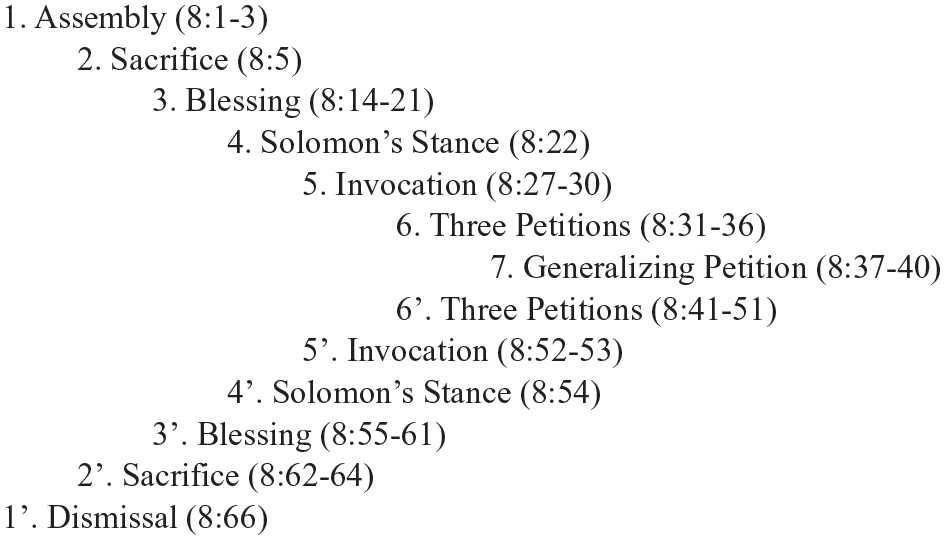
1 Kings 8 Solomon’s Petitionary Process*.
Discourse rather than actions dominates the central portion of the ceremony, Steps 3 through 3′: Solomon takes the stage to address God with paired blessings (3 and 3′), invocations (5 and 5′), and petitions (6, 7, and 6′). The sequence of these elements suggest that petitionary prayers are not made at the same time as sacrificial offerings—perhaps allowing for the priests to conduct their part of the ceremony in silence, as Knohl posits. It is also noteworthy that the petitions, which are explicitly referred to as ‘prayer’ (תפלה), are treated as distinct from blessings, points that may be explored further by scholars of Judaic liturgy.
The petitions in vv. 41–51 are presented symmetrically with a Generalizing Petition (Step 7) flanked by three more specific petitions on each side, grouped together in Steps 6 and 6′ respectively. The details of these petitions are described in more detail below (see Figures 2 and 3). In short, the petitions are the centerpiece of the entire ceremony.
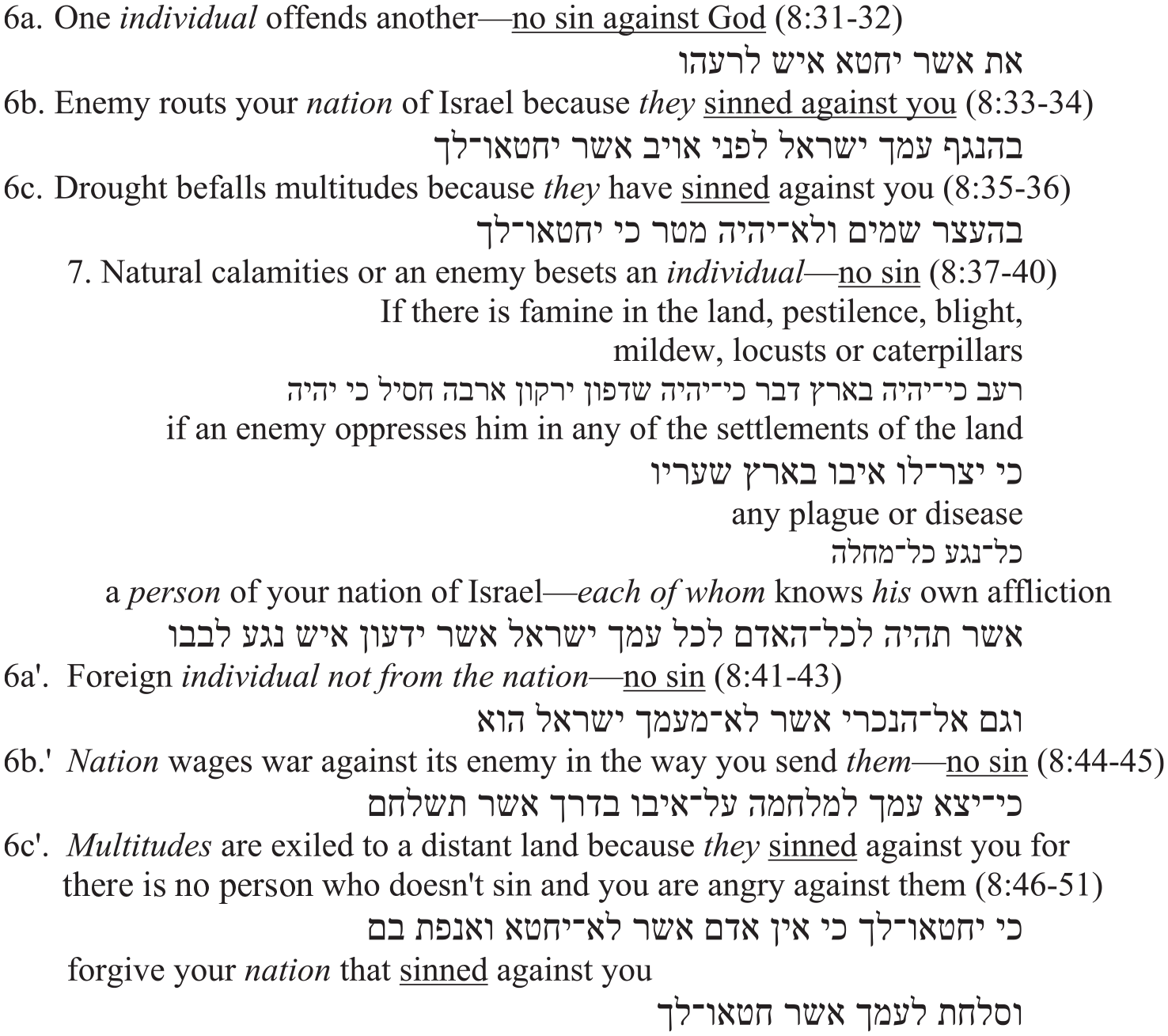
Petitions Indicating Personage (in italics) and Explicability of Crisis (
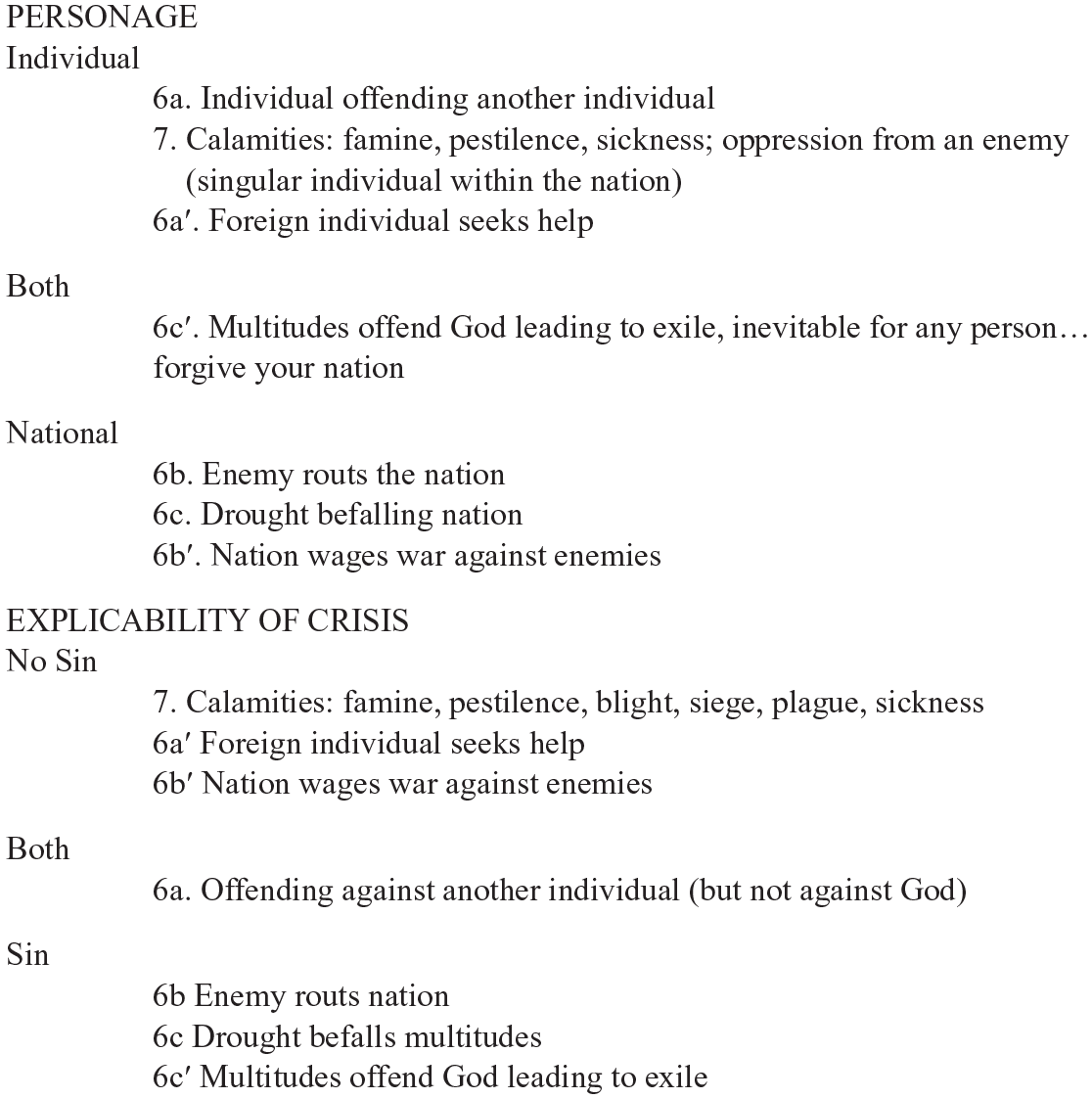
Balance of Petitions by Personage and Explicability of Crisis in 1 Kings 8.31–51.
In addition to their structural centrality, the importance of the petitions (Steps 6, 7, 6′) is supported by their rhetorical amplitude—the amount of textual space that a passage occupies with respect to the unit as a whole. 10 As measured in terms of verses, the central petitions (vv. 31–51) comprise 20 of the 66 verses in the chapter, 30% of the whole. While the time it would take to utter the petitions is fairly brief, Solomon’s speech acts from Step 3 through Step 3′ do take considerable ‘narrative time’—the reader’s/hearer’s subjective experience of time as impacted by the sequence and expression of textual elements (Nelson and Spence, 2020). The elapsing time of the narrative slows down in Steps 3–3′ to spell out Solomon’s every word and movement while pronouncing the blessings (vv. 14–21 and 55–61), changing his stance (v. 22 and v. 54), invoking God by name (vv. 27–30 and 52–53), and articulating the petitions (vv. 31–51). These passages devote microscopic attention to Solomon’s body posture, movements, and gestures—standing, turning, kneeling, directing his eyes, stretching out his hands, and crying out. This level of detail achieves two purposes. Most literally, the detail provides step-by-step instructions to individuals who wish their petitions to be equally successful. Rhetorically, zooming in to the level of individual movements emphasizes the importance of this passage relative to the narrative as a whole, just as the slowing down of narrative time in the story of the binding of Isaac (Gen. 22.1–19) emphasizes the peril to Isaac from the moment Abraham prepares the altar to the revelation of a ram substitute.
Solomon’s seven petitions describe a variety of dire situations befalling Israelites in which calling for divine intervention is deemed appropriate. The situations are described in consistent fashion across the petitions: in each, Solomon addresses God, describes a crisis and its cause, and elaborates the responses of those affected—all of whom appeal directly to God by coming to or turning toward the Temple; Solomon prospectively asks God on their behalf to hear and respond appropriately. As noted above, the central petition in vv. 37–40 (Step 7) covers a general array of crises, while the six flanking petitions (Steps 6 and 6′) are more specific. What has not been noted thus far, however, is that the full set of petitions is itself designed to balance two sets of alternations: who does the offering (personage) and what caused the crisis (explicability). The personage alternation specifies whether the petitioner is an individual person or the nation. The explicability alternation specifies whether the crisis is sin-related or non-sin-related. 11 As shown in Figures 2 and 3, the seven petitions include nearly all the possible combinations of personage and explicability in a carefully balanced sequence. 12
A. The Personage Alternation
The offerer of each petition is described either as an individual—‘a man’ (איש) or ‘a person’ (אדם)—or as a group, usually ‘your [God’s] nation of Israel’, (עמך ישראל). 13 As shown in Figure 3, three petitions refer to individuals, three to the nation, and one to both: (6a) offenses of a man (איש) against his neighbor (v. 31); (7) various calamities threatening sustenance, physical well-being, and household security that affect ‘any person from among the nation’ (לכל־האדם לכל עמך ישראל; v. 38), a man aware of the affliction in his heart (ידעון איש נגע לבבו); and (6a′) visits from a foreign individual not from among the nation (הנכרי אשר לא־מעמך ישראל; v. 41).
While references to the nation occur in Step 7 and 6a′, these phrases seem to be emphasizing the contrast between individuals who are or are not members. Granted, the phrase in (7) is ambiguous: לכל־האדם לכל עמך ישראל (v. 38) may either single out ‘any person from among your nation of Israel’ or provide a choice ‘by any person or by your whole nation of Israel’. I have counted this petition in Figures 2 and 3 as referring to an individual because God is subsequently asked to respond to an individual in v. 39, ‘Render to each man according to his ways as you know his heart to be’.
The nation of Israel is likewise specified in three petitions: (6b) ‘when your nation of Israel is routed by an enemy’ (בהנגף עמך ישראל לפני אויב; v. 33), (6c) situations of drought where the petitioners are ‘your servants and your nation of Israel’ (עבדיך ועמך ישראל; v. 36), and (6b′) ‘when your nation goes out to war’ (כי־יצא עמך למלחמה; v. 44).
Interestingly, both personage terms occur in the remaining petition (6c′) pertaining to those exiled to a distant enemy land, 1 Kgs. 8.46–51. While the occasion is described in the plural ‘when they sin against you’ (כי יחטאו־לך), an aside immediately references individuals who inevitably sin, ‘for there is no person who doesn’t sin’ (כי אין אדם אשר לא־יחטא). Notably, this oblique phrase is the only reference to individuals sinning against God in 1 Kgs. 8. So conceivably this petition applies to individuals or to groups who are captured and carried off as hostages. The references to petitioners are all plural, and God is subsequently asked to ‘pardon your nation’ (וסלחת לעמך) in v. 50. The ambiguity justifies setting this petition apart as referencing both personages.
To sum up, individuals are specified in three petitions, the nation is specified in three petitions and both personages are included in the seventh. Individuals are ranked equally to the nation in terms of balanced numbers; their high status is also indicated spatially. As shown in Figure 2, native and foreign individuals come first in both triads of specific petitions (6a and 6a′) that flank the generalizing petition (7), and the generalizing petition that is both lengthiest and most central focuses on individuals.
B. The Explicability Alternation
The second alternation—the crisis that leads to a petition—distinguishes occasions in which the petitioners have sinned against God (חטאו־לך) from occasions where the petitioners present themselves as blameless and faithful. Here three petitions specify sinning, three omit mention of sinning, and one uses the term—but it does not refer to a sin against God.
All three explicable occasions employ the expression ‘their sinning against you’ (חטאו־לך); these include a war-time rout (6b), the natural calamity of drought (6c), and offenses that lead to exile (6c′). The last case also projects the exiles confessing three types of wrong-doing: ‘we sinned, we acted perversely and we acted wickedly’ (חטאנו והעוינו רשענו; v. 47); Solomon’s prospective plea to God to forgive them also includes ‘all the transgressions they committed against you’ (כל־פשעיהם אשר פשעו־בך; v. 50). The grouping of human transgression on a par with natural occurrences such as drought and the vagaries of war thus makes sense because, as Knoppers (1995, p. 253) emphasizes, sin is remediable, ‘transgression can be overcome’; none are ‘obstacles to divine compassion and action’.
Notably all three cases involve multiple offenders: the sins of an individual are mentioned only as an aside in 6c′. Presumably, petition was not considered appropriate for sinful individuals, so these cases are presumably handled in other ways that are considered further in the conclusion. 14
A crisis that cannot be blamed on sin against God is simply inexplicable. Solomon’s prayer outlines three such crises: (6c) calamities such as famine, pestilence, blight, siege, plague, and sickness—these affect sustenance, physical well-being, and household or national security; (6a′) exigences felt by foreigners who are attracted by God’s global renown; and (6b′) uncertain situations when the nation of Israel wages war. This kind of military crisis is illustrated in 2 Chr. 20.5–12 when King Jehoshaphat assembles the people at the Temple and prays for guidance against the massing troops of Moab and Ammon.
The seventh case (6a)—the first one to be mentioned by Solomon (vv. 31–32)—is significant because the individual described has committed an offense but not against God. Rather the offense concerns a neighbor or friend (יחטא איש לרעהו), presumably another Israelite. These are crises in which one’s life or well-being is at stake where the individual identifies a human culprit or opponent. What is inexplicable is why a just God has allowed such an opponent to prevail over individuals convinced that they are innocent and in the right. Of course, the situation may look completely different from the opponent’s perspective; presumably that individual is also free to petition God and it is up to God to settle the matter.
Inexplicable crises may warrant petitioning God because these are wrongs that lie beyond the jurisdiction of the legal system or are suffered by people who have exhausted other remedies. Plentiful examples of these crises occur in psalms; these will be discussed below.
In sum, Solomon’s prayer authorizes an array of petitions from people in diverse circumstances and locations who are facing some sort of crisis—from gross injustices to life-threatening calamities. The access that he grants is exceedingly generous. While foreigners must come to the Temple to be heard, Israelites may petition God from any location. No hours of operation are specified and no statutes of limitations are imposed; petitions may be brought whenever people feel the need. In an oral society where prayer is expected to be uttered aloud—as Solomon’s is—individuals are empowered to take public action, to appeal to God to judge the merits of their cases (van der Horst, 1994). As emphasized in the aside in v. 38 (אשר ידעון איש נגע לבבו), only the sufferer knows the nature of his or her affliction. Solomon calls on God to hear and respond favorably but gives no guarantee that a response will come soon or that it will be satisfactory.
The ceremony downplays God’s response in another way, by de-centering the actual divine response. First Kings 8.4–11 ties up the loose ends of the story of David recovering the ark and moving it to Jerusalem in 2 Sam. 6.1–19. In 1 Kgs. 8.4, the priests take up the ark, install it into its niche in the Holy of Holies (vv. 6–9), and exit when God’s glory, taking up residence, overpowers them (vv. 10–11). 15 This is the only part of the ceremony that Solomon does not conduct and that has no structural echo. Astonishingly, while God’s acceptance of the Temple as a place of indwelling signifies the success of the dedication as a whole, it is not the centerpiece of the ceremony. In effect, God’s real-time response is not part of the general pattern being established here; it is documented to affirm the validity of the Temple. But logically no response can come to Solomon’s overall petition to God to hear and answer the prayers of all future petitioners. The clear implication is that petitioners are never guaranteed an immediate or even a successful divine response.
3. Authorized petitions in first-person psalms
The two goals of this section are to demonstrate that the types of petitions authorized in Solomon’s prayer correspond to situations faced by the speakers depicted in first-person psalms and to provide evidence that connects these psalms to well-being offerings. The connection between the psalms and sacrificial offerings has long been a matter of debate (Boda, 2006). The Hebrew Bible nowhere spells out when and how psalms were to be used. Guilds of psalmists are described in Chronicles (1 Chr. 6.31–37 and 9.19); superscriptions to some psalms refer to genres of poetry, musical instruments, service leaders, and days of the week when they were sung; these likely allude to processions of Levites before and after the twice-daily burnt offering (עולה) at the Temple. But the superscriptions, the fixing of the order of the psalms, and their division into the five books within the Masoretic Text (MT) psalter likely occurred long after many of the psalms were composed. 16
The focus of recent scholarship on the shape of the psalter has to some extent overshadowed consideration of the occasions for use of specific psalms, which occupied scholars for much of the 20th century. In his recent review, Serge Frolov (2020) rightly calls for ‘abandoning the quest for the Sitz im Leben’ of early form-critics such as Hermann Gunkel, Sigmund Mowinckel, and others, who made strenuous efforts to identify historical moments, moments in the biblical narrative, or periodic occasions on which specific psalms were used in Temple ritual. Frolov, however, goes too far in concluding that the psalms were composed merely for didactic literary purposes and played no part in oral public prayer. Frolov focuses primarily on difficulties and inconsistencies in the superscriptions as cues for performance while glossing over the nature and content of the psalms themselves.
The connection between psalms and individual petitions is easier to support. Certainly the psalms have long been seen as persuasive texts, particularly the psalms with first-person speakers that are often referred to as ‘laments’ and thanksgiving psalms (Gerstenberger 2012; Miller, 1993; Westermann, 1981). Individual speakers in the psalms show loyalty by praising and thanking God; they reinforce God’s values by describing their own positive attitudes and behaviors (in contrast to those of their sinful, arrogant, devious opponents); and they appeal to God to maintain justice by registering complaints and pleading to God to intervene in their troubles. I maintain that psalms were part of a petitionary process for individuals, parts of which involved the thanksgiving (תודה; Lev. 7.11–15) and the votive (נדר) and free-will (נדבה) offerings (Lev. 7.16–17).
The situations described in the psalms arguably correspond to those authorized in Solomon’s prayer. I am not claiming that all psalms fall into these categories, nor do I claim that the categories are clear-cut. I do argue that the frequency of psalms that match each type of petition is suggestive of great social concern for maintaining the loyalty of individuals faced with inexplicable crises; the relative absence of confessional language in the psalms corresponds to the absence of an explicit authorization for penitential petitions from individuals, suggesting the availability of alternative means for dealing with sin-related situations.
Table 1 identifies psalms in which the speaker’s crisis corresponds to each of the seven types of petitions authorized in 1 Kgs. 8. The following sections discuss each type with some examples, but detailed analysis of how the psalms match the petitions is beyond the scope of this article. Considering the distribution of psalms in Table 1 overall, it is apparent that at least one psalm corresponds to each type of petition, except—reasonably enough—for foreign visitors. The majority of psalms correspond to crises involving individuals rather than the nation as a whole. These situations recur across the entire psalter, suggesting a long historical horizon. 17 Table 1 also indicates which psalms mention sin (חטא) or iniquity (עון)—psalms in almost every type of petition include some mention of sin or iniquity, even those involving inexplicable crises in which the speakers claim to be innocent and faithful. This is not altogether surprising to a scholar of rhetoric. Innocence is not assumed, presumably because crises in this culture were often attributed to sinfulness. To make a case for innocence, therefore, speakers often attempt to refute the assumptions (or accusations) of opponents that the calamities are due to sin. Speakers may also plead for past sins to be forgotten, assert that they have avoided sin, or impute sins to their opponents.
Psalms Corresponding to Petitions in 1 Kings 8.31–51*.
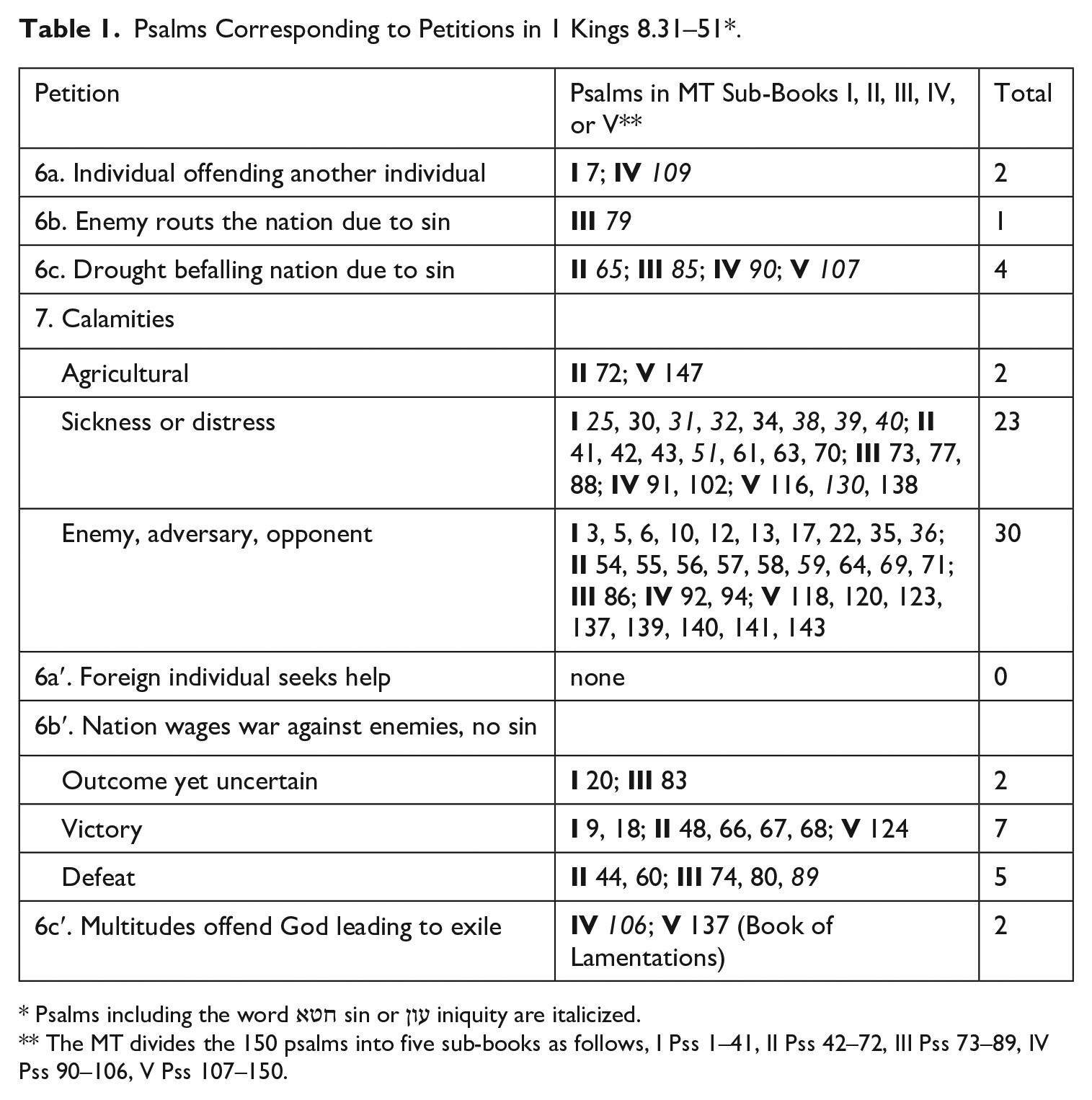
Psalms including the word אטח sin or ןוע iniquity are italicized.
The MT divides the 150 psalms into five sub-books as follows, I Pss 1–41, II Pss 42–72, III Pss 73–89, IV Pss 90–106, V Pss 107–150.
A. Mutually Offending Individuals (Petition 6a)
Of the seven types of petitions that Solomon authorizes, the knottiest is the first (1 Kgs. 8.31–32; Petition 6a in Figures 2 and 3): an inexplicable conflict between two individuals, each of whom curses the other. Presumably, each claims to be in the right, faithful, and innocent of wrongdoing but the available evidence is insufficient to distinguish the merits of the case. Famously, of course, Solomon himself solves just such a conundrum when two mothers both claim the same child in 1 Kgs. 3.16–28. But Solomon’s role in 1 Kgs. 8 is to project forward to times when a wise leader is not available and, as Solomon suggests (v. 32), only God can mete out justice appropriately: “O hear in heaven and take action to judge your servants, condemning him who is in the wrong and bringing down the punishment of his conduct on his head, vindicating him who is in the right by rewarding him according to his righteousness.” The operant phrase, ‘according to his righteousness’ (ולהצדיק צדיק לתת לו כצדקתו), concedes that the blame may not fall all on one side.
This inexplicable, mutual cursing situation is closely reflected by Ps. 7. Commentators agree that the speaker, claiming to have been falsely accused, seeks vindication by proclaiming a conditional self-curse according to which the innocent party will be vindicated in some kind of trial or ordeal (perhaps physical), while the guilty party suffers the wrath of heaven (Bellinger, 1986; Kraus, 1988; Kwakkel, 2006; Raj, 2002). While commentators mainly portray the speaker as confident in asserting innocence, in fact the speaker qualifies every claim in terms that closely echo Solomon’s phrasing in 1 Kgs. 8. The self-curse in Ps. 7.4–6 (אם־עשיתי זאת אם־יש־עול בכפי אם־גמלתי שולמי רע) is conditional, with the uncertainty signaled by repeated “ifs”: “O Lord, my God, if I have done such things, if my hands bear the guilt of wrong-doing, if I have dealt evil to my ally.” The requested terms of vindication are likewise qualified in v. 9: “Vindicate me O
A different kind of uncertainty pervades the situation in Ps. 109, in which a speaker vehemently curses an opponent who has also cursed him. Most commentators interpret the speaker as the only one voicing active cursing; the speaker rails against an opponent for false accusations against him (vv. 3–4) and for harassing the poor and needy (v. 16), perhaps including the speaker himself (Brueggemann, 1985; Cottrill, 2008; Jacobson, 2004; Laney, 1981; Wright, 1994). On this reading, the speaker’s character actually comes across as both vindictive and inconsistent. After engaging in a horrifying series of curses against his opponent, wishing him condemnation by a dishonest judge, an early death, the impoverishment of his family, and merciless hounding by pitiless neighbors, the speaker has the gall to condemn the opponent for ‘loving to curse’ (vv. 17–19)! Other commentators, including myself, identify the long list of curses (vv. 6–19) as a quote from the speaker’s adversary (Alter, 2007; Kitz, 2007; Kraus, 1989). In this reading, the adversary is indeed an eloquent lover of cursing—but also provides a rationale: that it is the speaker who unjustly hounds the poor and needy to death (v. 16). Both readings lead to logical inconsistencies in which neither party comes off unscathed (Charney, 2015). Hildebrandt (2020) suggests that this tension provides a didactic lesson of the paralysis that arises from extreme animosity. Such a confounding stasis is exactly what is envisioned in Solomon’s first petition in 1 Kgs. 8.31–32 (Petition 6a in Figures 2 and 3).
Thus Pss. 7 and 109 illustrate competing claims that lie outside the scope of the available justice system and that the wisest available leader cannot resolve—so only God can determine who is in the right.
B. Military engagements with and without sin (Petitions 6b and 6b′)
War-time petitions are authorized twice in Solomon’s dedicatory prayer: one is an explicable sin-related case and one is inexplicable.
In the explicable case (1 Kgs. 8:33–34; Petition 6b in Figures 2 and 3), the battle has already occurred and Israel has been routed due to its sins. In cases like this, the nation must pray for forgiveness and recovery of good standing. This situation is depicted most clearly in Ps. 79 where an attack on Jerusalem has left the Temple defiled. The speaker, consistently using first-person plural, describes the crisis and pleads with God in Ps. 79.8 to forget “our” earlier iniquities: ‘Do not hold former iniquities against us’ (אל־תזכר־לנו עונת ראשנים), and in v. 9 to ‘save us and forgive our sin’ (חטאתינו והצילנו וכפר על־). This is the only psalm concerning military defeat that expresses a penitential attitude. 18 However David Glatt-Gilad (2022) notes that prophetic narratives increasingly appeal to God to forgive the people’s sins because of threats to God’s reputation in the face of military defeat.
In the case of inexplicable military petitions (1 Kgs. 8.44–45; Petition 6b′ in Figures 2 and 3), Israel is depicted going to battle with the outcome yet unknown. An uncertain outcome is evoked in Ps. 20, in which a speaker calls on God to recognize and reward the merits of a leader, concluding by expressing certainty of a military victory that has not yet occurred. Likewise, Ps. 83 depicts enemy nations plotting, but battle has not yet been engaged; the speaker pleads to God to treat these enemies like other defeated enemies. Seven thanksgiving psalms celebrate military victories (Pss. 9, 18, 48, 66, 67, 68, 124). Good examples are Ps. 18, in which a first-person leader praises and thanks God for enabling him to frighten, pursue, and conquer foes who appeared overwhelming in strength, and Ps. 48, which celebrates the destruction of an enemy fleet. 19 The other possible outcome of a military engagement, of course, is defeat. The fact that a prayer is needed at all admits that God might let down the side even though the people have not sinned. Six psalms protest to God over defeat in war (Pss 44, 60, 74, 79, 80, 89), but only Ps. 79 attributes the defeat to sin. 20 The others make no mention of a cause of defeat, with the speakers expressing amazement at God’s anger or silence and petitioning for vindication. However, Ps. 44 makes a forceful and explicit case for the people’s innocence and faithfulness despite defeat, challenging God’s commitment to upholding the covenant (Berlin 2005; Charney, 2015, pp. 65-70; Kessler, 2001; Rom-Shiloni, 2008).
C. General Calamities (Petition 7)
The generalizing petition in Petition 7 specifies three types of crises: natural agricultural calamities; sickness and plague; and crises due to human malice or oppression. Table 2 identifies uses in first-person psalms of the same crisis terms as in 1 Kgs 8:37 as well as terms related to physical or psychological suffering.
Terms of Crisis and Suffering in First-Person Psalms.
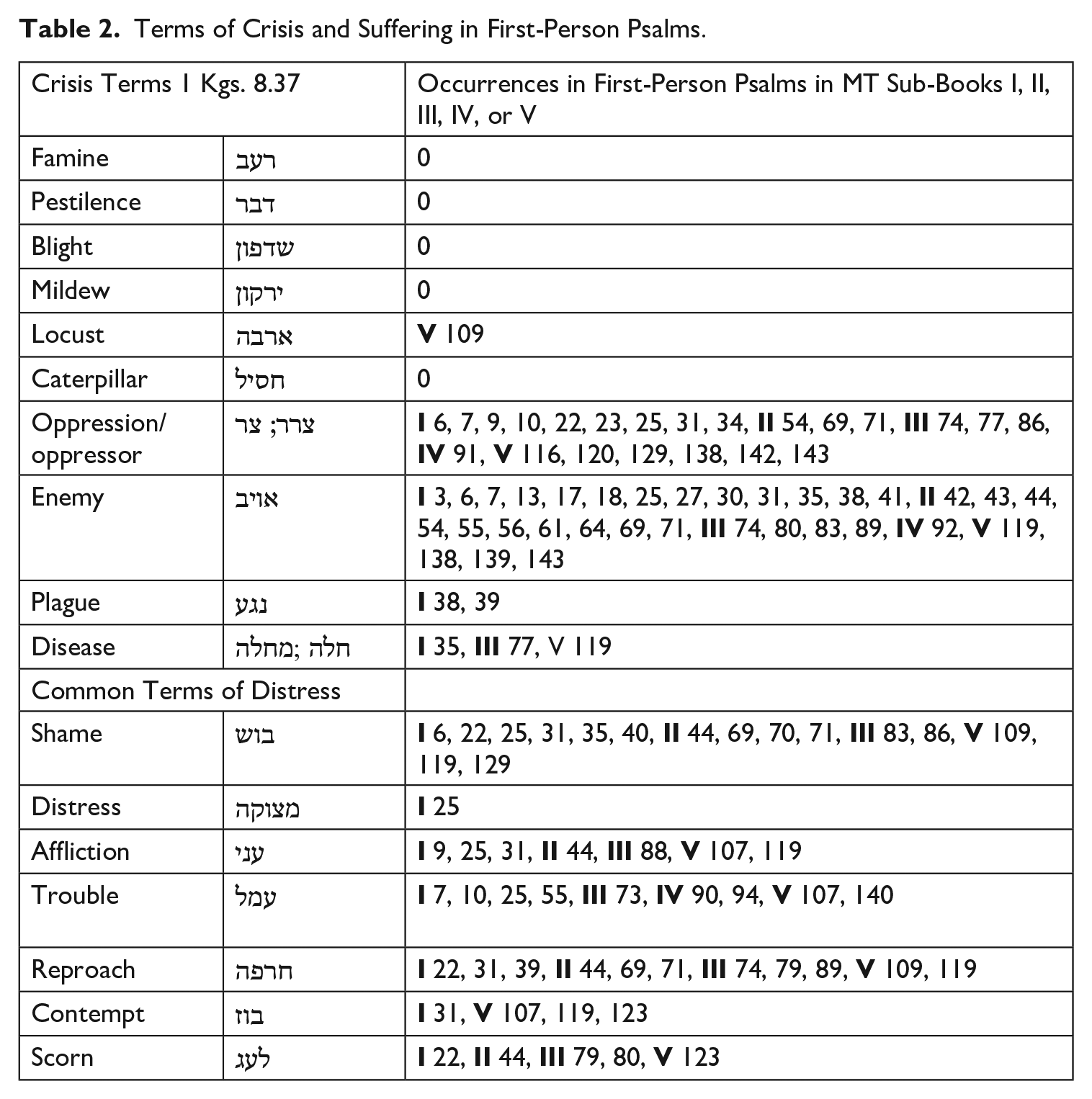
No petitionary psalms contain explicit protests against famine, pestilence, blight, mildew, locusts or caterpillars, though two thanksgiving psalms celebrate God for bringing rain and agricultural bounty (Pss. 72 and 147). The absence of psalms does not mean that no such blights occurred; rather, it suggests that other forms of discourse were used to address them.
Speakers in no fewer than 23 psalms describe physical or psychological suffering (see Table 2). These psalms are replete with vivid descriptions of physical wasting, distress, weakening of faith due to temptation, or exasperation with the prosperity of the wicked. The exact terms for sickness that appear in 1 Kgs. 8.37, ‘any plague and any disease’ (כל־נגע כל־מחלה), rarely occur: נגע appears in the petitionary Pss. 38.12 and 39.11; the hymn Ps. 91 depicts God’s protection of the faithful from נגע and דבר, as well as other ills; the use of מחלה in Ps. 35.13 describes what the speaker did when the opponent was ill. However, Solomon’s language in 1 Kgs. 8.37–40 is expansive, alluding to any and all afflictions. Of the 23 psalms, eight allude to sin in passing but only Ps. 51 is ‘penitential’ in focusing on sin and asking to be purged of it. The relative scarcity of penitence accounts for the tone of bewilderment and sometimes challenge in these psalms for inexplicable suffering. Sickness was often attributed to offending God, so public protestations of innocence are a way to regain social status. As William S. Morrow (2006, pp. 53-54) has noted, “a primary goal of the complaint psalms was to rehabilitate the individual to the larger group (who also worship YHWH) by affirming the undeserved suffering of the petitioner, an affirmation that is intended to arrest both his social exclusion and also the justification of group violence against him.”
In an even larger set of psalms, speakers blame their troubles on adversaries, troubles that may or may not include bodily suffering. The situations in these 30 psalms are depicted exclusively from the speaker’s perspective; speakers cast themselves in the best possible light, underscoring their own commitment to remaining reverent, truthful, compassionate, modest, and faithful, even while they suffer at the hands of opponents who are depicted as arrogant, lying, vicious, greedy, and faithless. Petitions provide individuals with an institutional means to protest their situations at the same time that they are identifying with the values and commitments of the community. That making such petitions requires courage is supported by Philo. In advocating for frankness in prayer [Her. 20], Philo writes, ‘But the man of worth has such courage of speech that he is bold not only to speak and cry aloud, but actually to make an outcry of reproach, wrung from him by real conviction, and expressing true emotion’ (qtd in Dowd, 1983, p. 247).
D. Foreign Individuals (Petition 6a)
Not surprisingly perhaps, no psalms correspond to the situation of a foreigner asking for help from God. The situation may well have occurred without the involvement of psalmists or without their seeing the need to preserve the texts.
E. Drought Due to Sin (Petition 6c′)
Only one psalm, Ps. 85, refers to forgiving the nation’s sin and resolving a crisis. The speaker petitions God in v. 3 to ‘forgive your people’s iniquity’ (נשאת עון עמך) and ‘pardon all their sins’ (כסית כל־חטאתם). The nature of the crisis is not described explicitly as drought; however, God’s relenting is described in agricultural terms in 85.13: ‘The
F. The Connection of Psalms to Sacrificial Rites
As shown in Table 1, a large proportion of psalms—nearly half—directly address situations related to the seven petitions authorized in 1 Kgs. 8. The distribution of psalms among these petitions suggests that the primary concern is for an individual facing an inexplicable crisis—the concern of 55 psalms. In contrast, few psalms address agricultural crises or crises provoked by sin, though a sizeable number address inexplicable military defeats.
Individuals in petitionary psalms defend their actions, relieve their sense of anguish, and adjust their relations to the community. The primary audience for the petition of an individual speaker is God, but a secondary audience is the public, just as it is for Solomon. Given that trouble in daily life was taken as a sign of divine displeasure, neighbors of someone in crisis might desert or even denounce them. As Morrow (2006, p. 53-54) notes, petitioning helps the speaker respond and regain a respectable standing by affirming that the suffering is undeserved. Many of the petitionary psalms end with promises to praise God in public, often mentioning offering thanks before assemblies at the Temple itself.
While some commentators take these occasions to be worship services with a leader and a congregation, there is little evidence that public prayer took this form until late in the Second Temple period, possibly growing out of public recitations of the Shema and readings from the Torah. While the shape of that kind of service or alternatives are necessarily speculative, it is plausible that coming to the Temple or another shrine to make sacrificial offerings would provide natural occasions for individuals such as Hannah to offer psalms—whether of their own composition or more likely from guilds of psalmists.
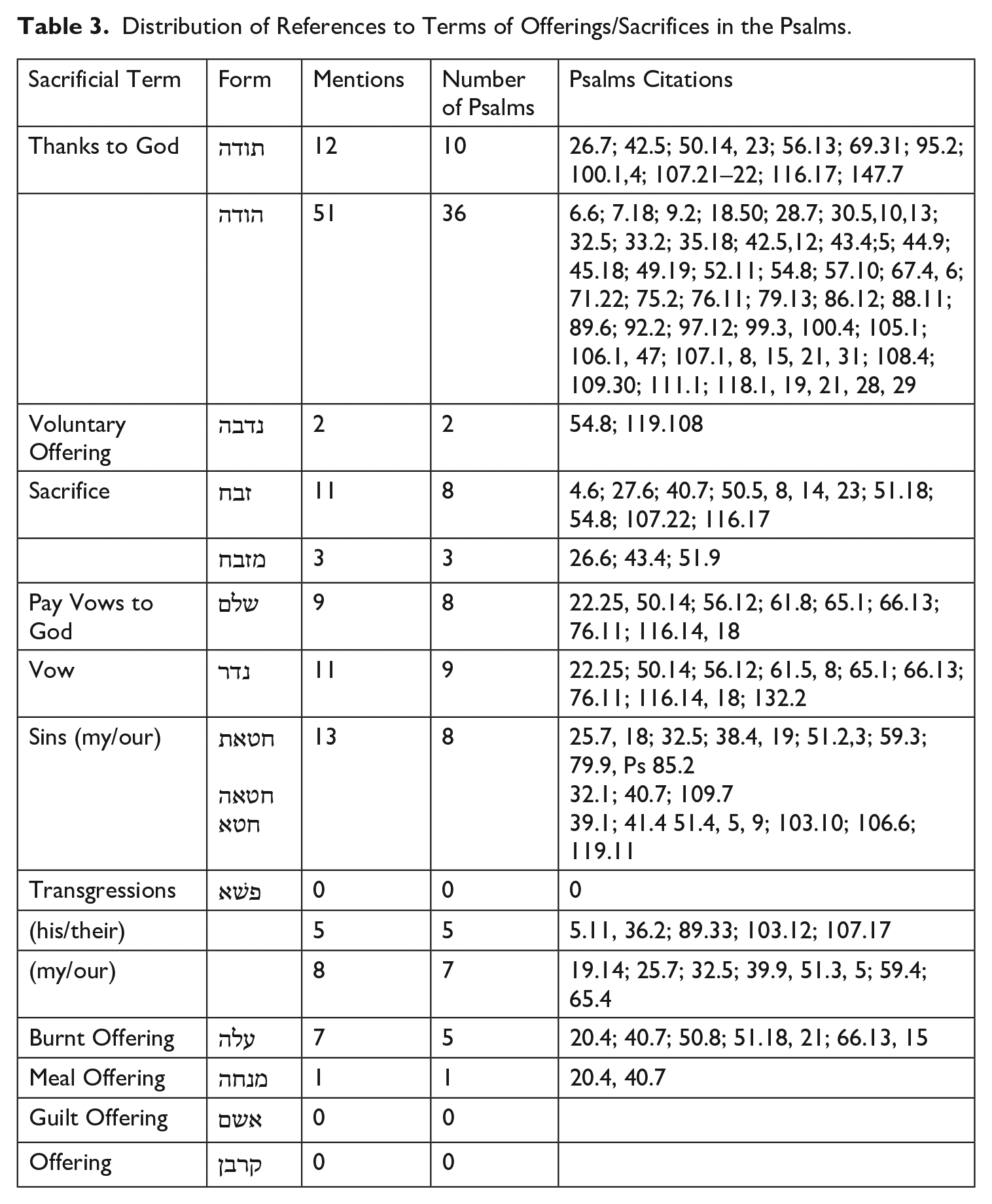
Additional evidence of the connection of the psalms to the sacrificial system comes from the frequency of terms closely related to sacrifices and in particular sub-types of the well-being offering (זבח שלמים). These include the thanksgiving (תודה; Lev. 7.11–15) and the votive (נדר) and free-will (נדבה) offerings (Lev. 7.16–17). As shown in Table 2, the psalms refer frequently to sacrifices, with the overwhelming majority of these relating to thanksgiving and other types of well-being offerings. It is quite possible that the psalms served performatively, as utterances that fulfill a social action as they are said, such as taking an oath of office or saying wedding vows. Ps. 116.17–19 describes making a sacrifice (תודה), paying vows, raising a cup of salvation, and declaring praises aloud in public in the vicinity of the Temple. Hearing or reciting such a psalm need not have been simultaneous with the sacrificial act. In Hannah’s case, the thanksgiving psalm follows the sacrifice. It might well have accompanied the feast afterward and cups might well have been raised literally. In Solomon’s case, the petition is central, following some sacrifices and blessings and preceding another set of blessings and sacrifices.
While the terms for sins and transgressions are not infrequent, these references often accompany pleas to God to overlook past failings, not to forgive current ones. Notably only one psalm, Ps. 51, centers on an individual confessing and asking for forgiveness (Holt, 2017). So it is possible that petition is available to those who have completed the process for expiating a sin but are still suffering from unexplained calamities. Speakers in numerous first-person psalms cite repeated unanswered calls (Pss. 22.2; 77.2; 88.10) and plead with God not to remain mute (Ps. 28), not to remain hidden (Pss. 13.1; 27.9; 69.17), not to cast off individuals (Pss. 43; 77; 88.14) or the nation (Pss. 44; 60; 74).
4. The discourse of expiation, atonement, and penitence
This section explores the question of what petitions, if any, are appropriate to individuals in need of expiation or purification. A prior question concerns what kinds of discourse, if any, are required for any sacrificial situation. The legislation for the first-fruits offering (Deut. 26.1–11), for example, spells out some details but not others. 21 Household leaders were obliged to select and reserve the first fruits, decide when to bring them to the sacrificial site, prepare for the journey, and finally enact the exchange with the priests. The handing over of the offering constituted the key moment, presumably involving self-identification, presenting the goods, and watching as the priests inspect and approve them. The details of the transfer are not spelled out explicitly; we can only speculate about what took place. The transfer involved a verbal exchange including a formulaic declaration (Deut. 26.3) as well as what might be called a hymn (vv. 5–10) in which the speaker identifies himself directly as a descendent of Abraham. In Philo’s description of the event, the householder need not pronounce the hymn himself: ‘if he does not remember it, he listens to it with all attention while the priest recites it’ [De Spec leg 2.215 -22, qtd in Schwartz, 2015, p. 140].
Clearly, coming to expiate a sin or resolve a state of impurity is also a deliberate act that takes forethought and planning. The legislation for offerings (Lev. 4) suggests that bringing the appropriate offering and laying hands on it is sufficient without any specific discourse. But sin and guilt offerings, as well as other purification rites, must have required a certain amount of discourse—at the very least a declaration of the nature of the transgression, a determination of whether it was inadvertent or not, and clarification of the status of the individual, and his or her financial means so that the priest could ascertain that the offering was adequate. 22
The expected discourse is known for at least one situation of public import: when a homicide victim is found in the area outside one or more municipalities (Deut. 21.1–9). The town elders gather with priests to perform a sacrificial ceremony, after which they declare their status with a stipulated declaration: ‘Our hands did not shed this blood nor did our eyes see it done. Forgive, O L
Distribution of References to Terms of Offerings/Sacrifices in the Psalms.
It is worth speculating on why discourse concerning sin and expiation is so scarce, not only in the form of petitionary psalms but throughout the Hebrew Bible until late in the Second Temple period. The simplest possibility is that the discourse surrounding expiation of sin was simply not preserved. In primarily oral societies, few texts are committed to writing, let alone being recopied frequently enough to survive. 23 Formulae for expiation of various sins may have been repeated so frequently that officiants would feel no need to record them—especially if, as in the first-fruits ceremony, the officiant could pronounce it on behalf of the sinner.
Alternatively, the penitential discourse might have seemed inappropriate to record precisely because it was not meant to be highly crafted as was the case with the poetry of the psalms. Perhaps sinners were required display personal accountability by describing their sins in their own words, expressing contrition, and/or promising to avoid further sin. Whether spontaneous or not, such speeches may have been halting and inarticulate—features that convey shame, anxiety, and sincerity far better than an eloquent poem. Recording and preserving this kind of discourse would have defeated the whole purpose.
Psalms like Ps. 51 may also be scarce because individuals expiating a sin were expected to display humble acceptance of the justness of the punishment. Petition opens the door to self-interested self-representations of one’s worthiness and perhaps even efforts to rationalize away a sinful deed. Petition also opens the door to challenging God’s fairness. In clear cases of sin, people with natural or borrowed eloquence should not gain an edge. Thus, petition—especially in poetry—may have been reserved for situations where the facts are indeterminate, the petitioners claim innocence, and only God can judge the merits of the case and the worthiness of the petitioner. These are the situations posited in first-person petitions related to free-will offerings.
5. Conclusion
Apart from legislation concerning sacrificial offerings, little is said explicitly in the Hebrew Bible about the connection between sacrifices and prayers from individuals. However, close examination of three sources supports the claim that individual petition was a central activity in the Temple and other shrines. The inauguration of the Temple by Solomon in 1 Kgs. 8 puts petitioning literally at the center of the ceremony and authorizes seven types of petitions for crises: military clashes; agricultural blights and droughts; illness, distress, and personal setbacks; and confrontations with opponents. The authorization gives individual crises and national crises nearly equal weight—three clear petitions for each and one mixed case as shown in the Personage breakdown in Figure 3. The narrative of the ceremony focuses on Solomon himself modeling the role of an individual petitioner with appropriate movements and discourse.
Psalms are the second key source of evidence to the centrality of individual petition. Nearly all the situations that Solomon describes for authorized petitions correspond to situations faced by speakers in one or more petitionary or thanksgiving psalms (with the exception of visits from foreign individuals). Psalms describing inexplicable crises faced by individuals are by far the most frequent, particularly cases of illness or personal distress and cases of victimization by opponents, cases covered by the generalizing petition (Petition 7 in Figures 2 and 3). The connection of psalms to sacrificial rites—especially the subtypes of the well-being offering (זבח שלמים)—is supported by the frequent appearance of terms relating to sacrifice and descriptions of coming to the Temple to give thanks and repay vows.
Finally, the narrative of Hannah’s petition to have a son in 1 Sam. 1.1–2.11 illustrates the opportunities individuals likely had to make petitions in public at a shrine and the agency afforded even to women to take charge of planning the visit, bringing and presenting the sacrificial animal, and using discourse to discharge a vow and give thanks. Her story suggests that individuals have the option to use spontaneous speech as well as composed poetry, oral declarations as well as silent prayers and vows. The exceptionality of Hannah’s original silence however underscores that petitions are normally an oral public event.
From a rhetorical perspective, the importance of individual petition can be understood as a key means of shaping individual and cultural character. In The New Rhetoric, Chaïm Perelman and Lucille Olbrechts-Tyteca (1969, 54-55) note that communal values need constant rehearsal and reinforcement. As they put it, ‘the one who by speaking wishes to strengthen established values may be likened to the guardian of dikes under constant assault by the ocean. As Morrow (2006) and Brueggemann (1986) emphasize, first-person psalms do challenge God by portraying failure to intervene as fostering injustice. However, framing inexplicable complaints as psalms puts speakers in the position of subscribing to the community’s values: they are worthy of response because they practice faithfulness, humility, compassion and truth-telling; they praise God for upholding the covenant, exercising justice, and showing mercy, and they denounce opponents for lying, arrogance, cruelty, and godlessness.
As Carol Newsom (2004, pp. 206-7) has observed, the speaker of a thanksgiving or petitionary psalm acts as ‘a moral agent in his own story: although he may be vulnerable, he cries out and is answered’, testifying in public to what happened and thereby ‘building up the larger community of worshippers’. 24 Public prayer contributes to an individual’s sense of place in the system, encourages them to take an active moral role, and strengthens communal identification (Kim, 2021).
In cases like Hannah’s petition, interpreting the divine response is straightforward: either she becomes pregnant and bears a child or she doesn’t. Petitions for healing or rescue may also have discernable outcomes: The crisis either abates or it doesn’t. If it doesn’t, individuals may continue petitioning, perhaps making efforts to increase the petition’s persuasiveness. The same option might apply to individuals who expiated their sins but see no improvement in their condition; an originally sin-related crisis becomes inexplicable and the lack of response itself becomes a grievance. At that point, the petitioners’ very persistence becomes a sign of their faithfulness and worthiness for rescue. As Andreas Schuele (2010, p. 329) suggests, it is useful to conceptualize a ‘lament process that could unfold over an extended period of time’ (original emphasis).
It is worth noting that Hannah is portrayed as singing the thanksgiving psalm herself without any description of how the psalm was composed. From a literary perspective, the contrast of this eloquence to her previous strangled silence underscores the effectiveness of the petitioning process. Whether or not this particular psalm text was interpolated later, Hannah was expected to give public thanks. The insertion of finely wrought poetry suggests that such texts were accessible to individuals, if not required. James Kugel (2017, p. 134) speculates that the authors of the psalms ‘had in all probability been commissioned to write what they wrote’ to accompany the offering of sacrifices, whether at local shrines or in Jerusalem. In his view, social elites had the wherewithal to commission psalms tailored to their situations, while ordinary Israelites made do with previously written or adapted psalms. Yet the frequency with which speakers in the psalms denounce material gain, arrogance, and oppressive power suggest otherwise. In an oral society with skilled poets and singers readily available at public shrines, adapting a psalm to specific circumstances may not have been an onerous task available only to the wealthy. The book of Psalms may well represent only a fraction of the total number that were actually composed and performed over the centuries. 25
Whether prose or poetry, petitions are meant to increase their speakers’ adherence to communal values as well. Onlookers—who are sometimes addressed directly—can include family members, townsfolk, and even opponents. 26 Each of these hearers may experience a range of responses: identification, compassion, indifference, skepticism, and even hostility. Each one engages in some weighing of cultural values against lived experience and timely circumstances. Ultimately individual petitions help to turn ordinary people’s passions and frustrations away from disloyalty and apostasy and toward persistent faithfulness. 27
Footnotes
1.
As Laurent Pernot describes, epideictic speeches are important not only because they illustrate what to praise and how to praise but also because they ‘express the moral foundation for praise’.
2.
Recently, Matthew Susnow has presented evidence that important rituals involving individuals and their status took place at the thresholds of ANE temples; these activities he notes have been ignored relative to cultic rituals in the cella.
3.
4.
5.
7.
For recent scholarship supporting a 10th century Temple, see Garfinkel and Mumcuoglu (2019).  , p. 199) argues that it was Jotham and his son Ahaz who nationalized the Jerusalem Temple by building a new gate and altar in the 8th century that ‘changed the function of the Temple of YHWH from a royal chapel that had been used by members of the royal palace to the temple of the kingdom, open to the general public’.
8.
Knoppers’ (1995) claim for the integrity of the literary unit is supported by Kamp (2016) and largely accepted by .
9.
This aspect of the text’s compositional history is discussed by Talstra (1993). has recently analyzed where prayers in the unit are directed, whether to God or to the Temple itself.
10.
In The New Rhetoric: A Treatise on Argumentation, trans. John Wilkinson and Purcell Weaver (Notre Dame: University of Notre Dame Press, 1969), Chaïm Perelman and Lucille Olbrechts-Tyteca note that ‘the length of each part of [a] speech will usually be in proportion to the importance [a speaker] would like to see it occupy in the minds of hearers’. I take amplitude into account in analyzing psalm texts in Charney (2015) and describe methods of gauging amplitude in Charney (2018). The role of amplitude in the Hebrew Bible is also noted by who shows that the seventh and tenth plagues are allotted extra space not only in Exodus but also in Ps. 68.42–51 and Ps. 105.27–36.
11.
12.
Hoppe (2017, ) provides a similar but less detailed analysis.
13.
14.
15.
16.
For a recent discussion of the sub-collections within the psalter, see de Claissé-Walford (2023). For a discussion of the composition of the psalms, see Gillingham (2014, ).
17.
Given that the Book of Psalms contains written versions of orally composed texts that were likely improvised, elaborated, imitated, and refined over centuries, it is impossible to date any individual psalm with certainty. Gillingham (2016) is inclined to rely on thematic elements to associate psalms with pre-exilic, exilic, and post-exilic periods. notes that sub-collections within the psalter contain psalms written by different groups in different sites and likely at different times. However she subscribes to the view that the Masoretic Text’s division of the psalms into five books reflect succesive periods of Israelite history.
19.
It is worth noting that non-petitionary psalms praise God for bringing victory, such as the hymn in Ps. 68. I am confining my discussion here to first-person petitionary psalms.
20.
21.
As Miriam Broide notes on the subject of prophetic intercession, ‘ANE evidence shows that even ritual texts meant to provide explicit instructions to religious practitioners sometimes omit steps or prescribed utterances, presumably because their audiences were expected to fill in the gaps’.
22.
Hogewood (2006) gives a fuller account of Second Temple confessional texts. See also .
23.
24.
25.
Following Ruth Finnegan’s (1977) nuanced view of “oral composition”. See also Person, (1998).