




Abstract
Through the lens of comparative legal history, this study re-examines the story of the Wise Woman of Tekoa (2 Sam. 14.2–24) as a narrativized legal petition—an ancient Near Eastern epistolary sub-genre known from cuneiform and alphabetic inscriptions. This brief juridical parable offers a unique account of justice and adjudication largely independent of its ideological depiction in the Pentateuchal law codes, making it a critical text in the study of biblical law. In particular, it evokes two distinct forms of judicial wisdom in the context of legal self-help and royal adjudication. By comparing and contrasting this parable with other texts dealing with similar themes, I outline the diverse ways biblical writers explained the intersections of law, wisdom, and justice.
Introduction
In recent years, numerous scholars have tried to define the relationship between wisdom and law in ancient Israel and Judah. 1 This has proven no easy task, in part because “wisdom” and “law” are extremely uncertain categories in the ancient sources. Previous discussions have tended to focus on the relationship between biblical law, and here almost paradigmatically the Torah, and its relationship to so-called wisdom literature. 2 The aim of this study is not to rehash this debate but rather to approach the convergence of wisdom and law as conceptual domains in the literary traditions of ancient Israel and Judah. To this end, I offer an examination of the narrative known as The Wise Woman from Tekoa (2 Sam. 14), a story about a fictitious legal petition presented to King David, which is saturated with allusions to (royal) justice and wisdom (חכמה). I argue that the law-related wisdom in this story emerges from two distinct but related domains: (i) the semi-divine wisdom of David derives from judicial motifs characteristic of the royal ideology of ancient Near Eastern kings; and (ii) the woman’s wisdom is related to the phenomenon of the legal petition, characterised by adept rhetorical strategies of persuasion (Dobbs-Allsopp, 1994; Parker, 1997; Schipper, 2009: 62; Westbrook, 1988: 30–35; Zahavi-Ely, 2012: 44). I then compare the depiction of judicial wisdom in this story with other narrative (1 Kgs 3), prophetic (Ezek. 28; Zech. 12.8), and Pentateuchal texts (Deut. 4.4–5) that also reflect on the relationship between these motifs. By situating these texts in the context of ancient Near Eastern royal ideology, I demonstrate how 2 Sam. 14 preserves memories of a legal tradition centred on the king as the earthly re-presentation of God in the execution of justice, while anticipating new theological aspirations to redefine the foundation of Israel’s law in a post-monarchic world.
The story of the Wise Woman of Tekoa is a brief episode found in 2 Sam. 14, which is part of the larger story of Absalom’s rebellion against his father David (2 Sam. 13–20). It belongs to a group of texts scholars have previously called “juridical parables” or “petitionary narratives” in Samuel-Kings, 3 which constitute short moralizing stories that make use of legal motifs, concepts and practises to enhance their reports of royal judgements. 4 Women often fulfil the role of petitioners or claimants in these stories, granted extraordinary access to present their cases before the king as an arbiter of justice. 5 In some of these narratives, women are depicted as paragons of wisdom, leading some to argue that the “Wise Woman” was a social role open to females in the monarchic or even the pre-monarchic periods. 6 The historical possibilities are intriguing, but the textual evidence is frustratingly lacking. Therefore, I will focus on the roles these named and unnamed characters played as typified agents in the social world implied by the narrative: a widowed woman’s legal petition for royal justice—albeit a fictitious one.
The narrative in 2 Sam. 14 is a particularly rich source of information on the relationship between law and wisdom because it is a dramatic fiction that invites readers to reflect on David’s dilemma based on their background knowledge of ancient Near Eastern legal culture—as reflected in the southern Levant. 7 The concept of wisdom ties the depiction of the unnamed Tekoite and King David to the legal cultures of Syria and Mesopotamia as well, which are the primary comparanda used in this study. Although 2 Sam. 14 and the other petitionary narratives carry their own ideological associations, they offer an alternative vision of Israelite/Judahite law to its presentation in the legal collections of the Pentateuch. These alternative perspectives should caution scholars against adopting a monolithic view of “biblical law”, especially as a homogenous category defined largely against the backdrop of “cuneiform law”.
Law as Narrative
The petitionary narratives are not dispassionate accounts of law but rather stories designed to persuade the reader of a particular point of view. They are pieces of ancient literature that may preserve aspects of Judahite law but function primarily in the service of broader ideological and narrative aims. Extracting information about the legal traditions of ancient Judah from these texts, therefore, demands a hermeneutical approach that can address the complex relationship between law and narrative—or law as narrative—in Samuel-Kings. To this end, I follow recent interpreters who argue that these texts do not constitute a genre in a formalist sense, as they exhibit about as many differences as they do similarities. 8 In fact, some scholars (Coats, 1981; Niditch, 1993: 67–87; Schipper, 2009: 2) challenge classifying the parable as a genre of biblical prose at all, preferring to say that biblical authors relied on a variety of literary genres in the construction of parables. It is more productive, therefore, to examine how these texts use particular modes of communication in the construction of their narratives, rather than trying to assess how they do or do not conform to hypothetical or idealised forms (i.e. genres). These texts are similar in that they all present a legal or ethical quandary to a king of Israel or Judah; the diegetic voice of the narrator largely fades into the background, and direct speech propels the scene; they make extensive use of motifs and ideas known from royal judicial ideology; and anonymity is a conspicuous literary element in most of them—even the king himself is occasionally unnamed. These features bespeak the moralizing and mimetic function of these stories, which comment on certain characters in the narratives and on the legal institutions that these characters represent. 9
Wisdom and Royal Justice
I will begin with the motif of wisdom as it relates to the judicial roles and responsibilities of Near Eastern kings. After ordering the death of his brother Amnon for the rape of their sister Tamar, Absalom lived in self-imposed exile at Geshur (2 Sam. 13.38). David’s general Joab convinces a “wise woman” (אשה חכמה) from the town of Tekoa to petition the king with a legal case. This wise woman is a foil to the “very wise man” (איש חכם מאד), Jonadab, who had instigated David’s family crisis in the first place (2 Sam. 13.3). The case she presents the king is as a thinly-veiled analogy to the current situation between David and Absalom, designed to convince the king to pardon his son. 10 Appearing before David, the woman presents herself as a widow (אשה אלמנה אני), and recounts how her two sons had fought in the field, one striking and killing the other, which resulted in the woman’s clan (her משפחה) imposing blood vengeance—that is, death—on the surviving son. The issue of fratricide is an allegory for the immediate narrative context of Absalom’s murder of Amnon, where David must choose between the dispassionate application of the law and the amnesty both he and the woman desire. On the level of allegory, both the woman’s clan and the woman herself potentially represent David—depending on his decision either to impose blood vengeance or to grant amnesty and preserve the life of the remaining son.
As far as the comparative cuneiform evidence suggests, royal justice was almost exclusively an appellate mechanism, invoked by litigants who felt wronged by lower adjudicating authorities. In the Old Babylonian period, this legal status was characterised by the “wronged man or woman” (the ḫablu or ḫabiltu) or in the Neo-Assyrian period by litigants who invoked the “word of the king” (abat or amat šarri) in perceived cases of injustice. Biblical scholars have identified similar types of appeals—deemed “extrajudicial petitions” (Dobbs-Allsopp, 1994; Westbrook, 1988: 35) or “petitions to a higher authority” (Parker, 1997: 13–15)—that offer legal recourse in cases of official abuse of the legal system. 11 In theory, a wronged litigant could seek legal help from the king himself; in practise, however, this usually took the form of a royally designated official who offered a new verdict as a proxy for the king’s supreme judicial authority. The author of this story seems to assume a similar appellate role for the king in the judicial apparatus: the woman’s clan has already imposed the verdict of blood vengeance on the surviving son (irrespective of mitigating factors), prompting her to seek the king’s justice. 12
The greatest obstacle to pursuing legal self-help was gaining an audience with the king and his officials, which explains Joab’s first instructions to the Tekoite woman. The woman’s widowhood means she cannot produce another son for her deceased husband, but it also identifies her as an archetypical subject of royal justice. The judicial responsibility of ancient Near Eastern kings to the weakest members of society, typified by the orphan and the widow, stretches back to the earliest cuneiform legal documents with clear lines of continuity from Mesopotamia to the west in the second and first millennia
The case that Joab and the Tekoite woman present to David draws on the traditional stock of royal judicial rhetoric, other petitionary narratives, legal scenarios known from biblical and Near Eastern law, and allegorical elements tied to the immediate narrative of Absalom’s rebellion. Although David is largely oblivious to the ruse the woman presents to him, she nonetheless attributes semi-divine wisdom to him twice: after he renders a verdict in her favour (v. 17) and again when she reveals that Joab had coerced the king to issue a binding judgment in order to “change the situation” (סבב את־פני הדבר) with Absalom (v. 20). In both instances, David’s justice is equated with that of a divine being or a messenger of God:
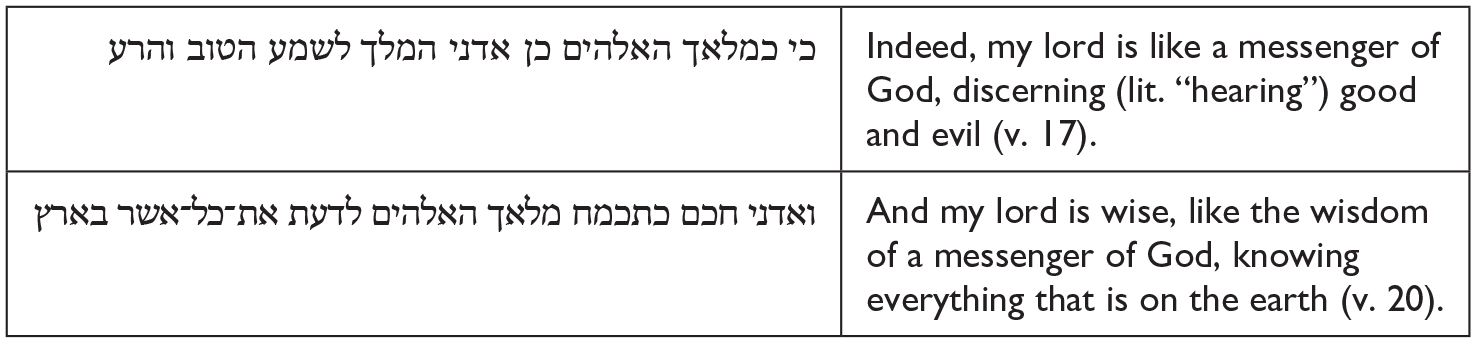
David is compared to a divine messenger elsewhere (1 Sam. 29.9), including in another petitionary narrative (2 Sam. 19.28). His judicial wisdom would only be surpassed by that of his son, Solomon.
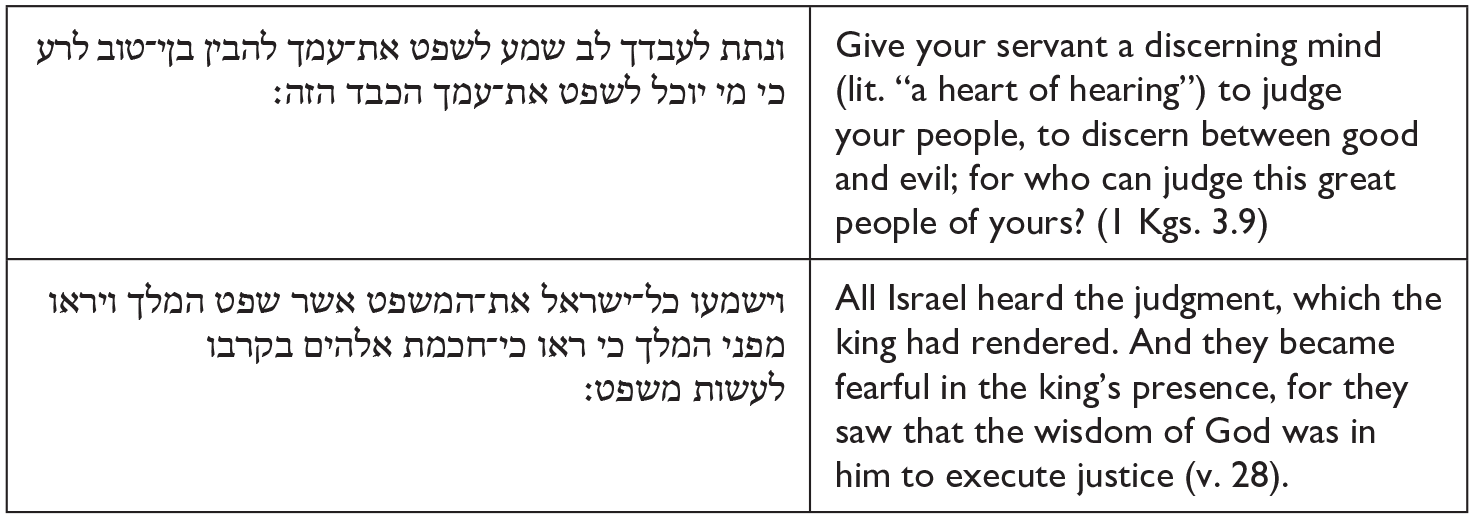
This wisdom enabled these kings to differentiate between right and wrong and affirmed that their decisions were beyond reproach (Ackerman, 1990: 42; Leonard, 1980: 138–39). The Eden narrative repurposes this royal ideology in its ontological vision for the orders of creation (Gen. 3.22), where “knowing good and evil” (לדעת טוב ורע) brings humanity into close proximity with the gods (cf. Gen 1.26–27), equal to them except for their mortality.
But what does it mean to say that Solomon has the wisdom of God, while David has only the wisdom of a האלהים מלאך? Perhaps this is an affirmation that Solomon’s wisdom is unsurpassed, even by his celebrated father. Alternatively, and more plausibly, David’s depiction may reflect this scribe’s hesitation to equate the human king with God—a hesitation not shared by the author of 1 Kgs. 3. This tension over the depiction of David was evidently still ongoing in the postexilic period, as shown by what the BHS identifies as a redactional gloss in Zech. 12.8: 17
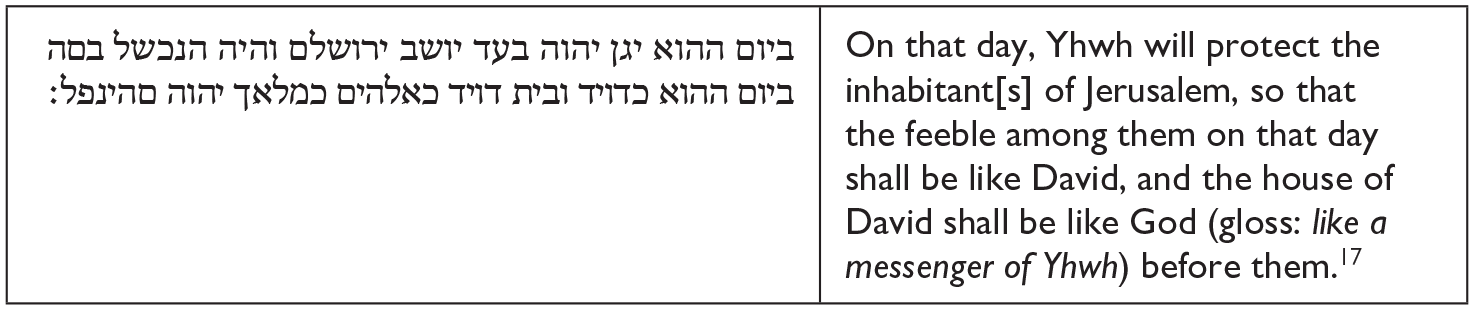
The traditional prestige of David and Solomon may have spared some of these older traditions from elimination or revision by later biblical tradents. Even still, the author of the Rule of the King (Deut. 17.16–17) elliptically critiques Solomon’s pharaonic ambitions (horses, wives, riches), which are depicted positively elsewhere as a divine gift for his altruism (1 Kgs. 3.9–13). The pretentions of foreign kings to divine wisdom, by contrast, were sharply critiqued by postmonarchic writers. This is most evident in Ezekiel’s prophecy against the ruler of Tyre (Ezek. 28.1–10):
1
The word of Yhwh came to me:
2
O Mortal, say to the ruler of Tyre (נגיד צר): Thus says Yhwh, God: “Because your heart is proud and you have said, ‘I am a god (אל אני); I sit in the seat of the gods, in the heart of the seas.’ Yet you are but a mortal and no god (ולא־אל), although you compare your mind with the mind of a god (כלב־אלהים).
3
You are indeed wiser (חכם) than Danēl; no secret is hidden from you;
4
by your wisdom and your understanding (בחכמתך ובתבונתך) you have amassed wealth for yourself and have gathered gold and silver into your treasuries.
5
By your great wisdom (ברב חכמתך) in trade you have increased your wealth, and your heart has become proud in your wealth …
9
Will you still say, ‘I am a god (אלהים אני),’ in the presence of those who kill you, though you are but a mortal and no god, in the hands of those who pierce you?”
Wisdom (חכמה) and understanding (תבונה)—attributes positively associated with Solomon (1 Kgs. 3.12; 5.9)—are derided by the prophet here. In criticizing the ruler of Tyre, the prophet seeks to disabuse this ruler, and perhaps all rulers, of any claim to divine status or divine wisdom (Nevader, 2014). Thus, the authors of 2 Sam. 14 and especially 1 Kgs. 3 offer an alternative and I believe older view that felt less apprehension about attributing some divine features to human kings, especially in their judicial capacities. Yet, comparing David to a מלאך האלהים rather than to God himself seems like a later negotiated allusion to royal ideology in contrast to the more unapologetic depiction of Solomon in 1 Kgs. 3. It reflects the same uncertainty or concerns as those found in Zech. 12.8 and Ezek. 28, perhaps pointing to a postmonarchic date for this composition.
But why did this author evoke such royal judicial ideology, albeit through the mouth of the Tekoite woman? The answer, I believe, lies in the broader narrative of Absalom’s rebellion, where the very legitimacy of David’s kingship is in question. Immediately following the Tekoite woman’s petition, which convinces David to pardon his son, Absalom begins his conspiracy against his father by usurping his judicial prerogatives (2 Sam. 15:1–6). There is precedent in Near Eastern literature and history for sons assuming the judicial prerogatives of their fathers to claim the throne, especially in cases where the former are considered to be ailing. 18 Unlike in those cases, where the king’s infirmity and resulting judicial ineffectuality are cited as the motives for their sons to seize the throne, the reader knows that David’s sense of justice remains intact. While the first affirmation (v. 17) of David’s wisdom may be simple flattery on the woman’s part, the second affirmation (v. 20) seems to be an honest assessment of David at this stage in the narrative. Yet, Absalom nonetheless attempts to usurp his father through his royal obligation to maintain justice, ultimately failing and opening the path of royal succession to Solomon. 19 Through the traditional motif of the king’s divine-like judicial wisdom, 2 Sam. 14 sets the scene for an impatient royal heir who covets the throne his father is not yet ready to abdicate. Though he was initially oblivious to the allegory Joab and the woman presented him, the author communicates that David can still discern justice and is therefore fit for the throne—despite what his son will claim (2 Sam. 15.4–6). 20
Rhetorical Strategies in Legal Petitions and the “Diplomatic” Language of Juridical Parables
David is not the only—or even the primary—wisdom-figure in this story. The story opens with the narrator recounting how Joab fetched a “wise woman” from Tekoa. Scholars have endeavoured to understand how Joab would know of this woman’s wisdom, if she held some traditional position of authority within the town of Tekoa, or if the “wise woman” constituted a social institution open to women during the monarchic or even the premonarchic age. Given her anonymity, this wise woman likely represented some kind of social archetype in the author’s mind, but only as far as it existed in the social world imagined by the narrative—namely in a story about a widow’s legal appeal to the king. I find the evidence too scant to confirm or deny the existence of institutionally based “wisdom” roles for women in ancient Israel and Judah; I can, however, confirm the existence of women who interacted with the king’s justice in much the same way as the Tekoite woman engaged with David.
Inasmuch as this narrative is a literary fiction, it draws on specific rhetorical modes of communication and persuasion known from epigraphic documents containing legal petitions. Two revealing dynamics behind the Tekoite woman’s quoted speech have important implications for understanding her wisdom and the textual genres influencing this text’s author. The dialogue between the woman and David is extremely formal, with the woman addressing David only as king (המלך) or my lord (אדני), never by name, and referring to herself only as his servant (שפחה /אמה). Locating these terms in the diplomatic language of the royal court, Irmtraud Fischer characterised the woman’s speech as a “masterwork of Oriental eloquence.” 21 But the Tekoite woman’s dialogue and word choice is not mere politeness; she also deploys metaphors and parables for rhetorical and strategic emphasis in her attempt to persuade the king of her position. This represents a second and complementary form of wisdom: parabolic or proverbial wisdom.
The introduction to the Book of Proverbs reflects on two distinct components or aspects of wisdom (בינה/חכמה) that come to bear on this narrative: one is judicial or ethical in nature (Prov. 1.3), while the other relates to understanding and interpreting the meaning behind non-literal modes of communicating information (i.e., proverbs, allegories, and riddles [Prov. 1.6]). 22 Most are familiar with proverbs in a compiled collection, as they appear in the Book of Proverbs. But proverbs were disseminated in many formal and informal media, both orally and through writing. Akkadian and West Semitic scribes exchanged proverbs in letters throughout the second millennium (Cohen, 2013: 213–32), a practise that seems to have continued in Mesopotamia during the Neo-Assyrian period as well (Alster, 1989). 23 The woman’s speech mimics and evokes this elevated formal style known from correspondence connected to official adjudication. Her use of proverbial sayings (2 Sam. 14.14) was also at home in these types of epistolary exchanges, where scribes added such literary flourishes to both entertain and influence their recipients, especially other scribes.
To understand how wisdom intersects with law in this story, it is important to recognise that biblical authors relied on a much larger referential framework than the literary tradition preserved in the various manuscript editions of the Hebrew Bible. This is especially true for the many facets of Israelite and Judahite legal traditions, which are almost entirely lost to us today. 24 In this regard, Dobbs-Allsopp (1994) and Westbrook (1988: 30–35) characterised 2 Sam. 14 as an example of what they deemed an “extrajudicial petition,” which were legal appeals addressed to high-ranking officials and even kings in cases of an abuse of power. 25 The epigraphic record provides only one example of a legal petition from the kingdoms of Israel and Judah, in the form of the seventh-century Mes.ad Hashavyahu ostracon. 26
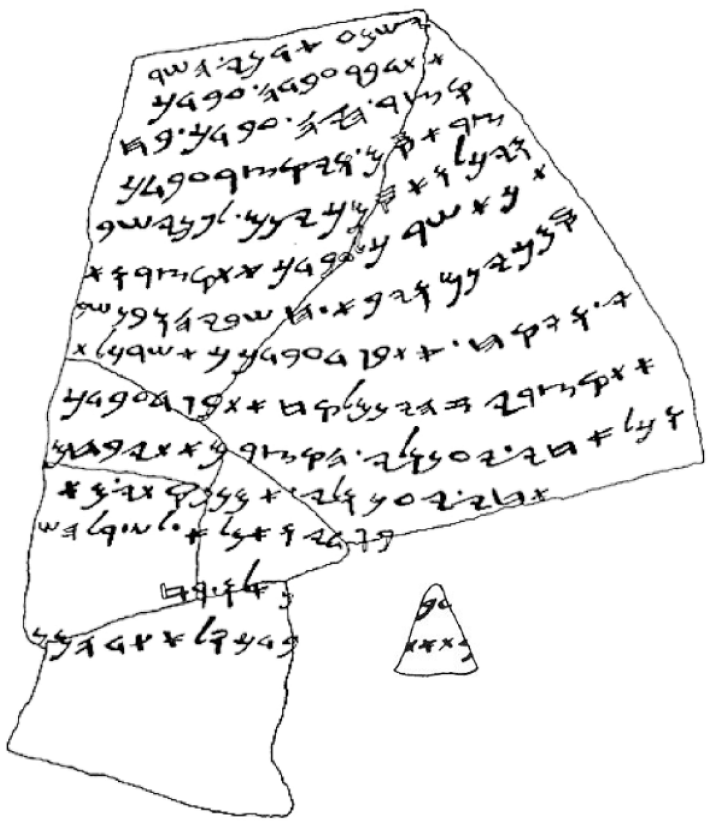
The Meṣad Ḥashavyahu Ostracon (seventh cent.
Let my lord (ʾdny) the governor (hšr), hear the word of his servant (ʿbdh): “Your servant is a reaper (and) your servant was in H.as.ar-Asam. Your servant finished, and he gathered it like every day before stopping. Just as [y]our servant finished harvesting and gathering as always, H.oshaʿyahu the son of Shobay came and took the garment of your servant. Just as I finished this harvest of mine, as always, he took your servant’s garment! And all my companions will testify for me—those who reaped with me in the heat [of the su]n. My companions will testify for me truthfully. I am innocent from any wron[gdoing … ]
27
my garment! Surely it is for the governor to retu[rn the garment of his se[rvant].
28
May you give him (the claimant) compass[ion and ret]urn the [garment of] your servant. Do not be silent (concerning) me.”
29
My interest in this text is not the legal matter, but rather in its rhetorical style and its connection to modes of communicating legal petitions to judicial authorities.
Like 2 Sam. 14, the petitioner’s claim in this inscription is communicated through direct speech characterised by an abundance of formal titles and appellations: the claimant identifies himself only as “my lord” (ʾdny) and the official is exclusively identified as “your servant” (ʿbdk) and “the governor” (hšr). 30 Parker (1997: 14, 18) labelled the unique rhetorical style found in petitionary narratives as a “storytelling ability” or the “narrative art of the petitioner.” Inasmuch as anonymity is a feature of biblical narrative (Reinhartz, 1993), it is equally likely that the author of 2 Sam. 14 was mimicking this particular legal-epistolary style in the account of a legal petition to the king. But this is just one text, so extrapolating broader generalisations from its style is a risky endeavour. Given the paucity of evidence from Israel and Judah, it is therefore helpful to look to the cuneiform record as a comparative source of data on these types of legal petitions.
An eighteenth-century Mari letter from a woman named Šewrum-parat to King Zimri-Lim gives us an early example of an epistolary legal petition: Say to (King) Zimri-lim, thus says Šewrum-parat, your female servant (amatka): Without hearing from you, you sent me here. Now, I am legally wronged (ḫablāku)—wipe away my tears! Sîn-mušallim has legally wronged me! He took my nurse and now she dwells in his house. Now if it had been my lord (bēlīya) who took her, and she dwelt in the house of my lord, my heart would be satisfied. But Sîn-mušallim legally wronged me! Now, since you established light for the entire land (ana mātim kališa nūram taškunu), establish light for me (ayyašim nūram šuknam)! Give me my nurse so that I may pray for you in the presence of Addu and Hebat. Now, do not refuse this woman my lord. Here I am your servant, I belong to you, place your name upon me!
31
Like the biblical narrative, it too concerns the legal appeal of a woman to the king. Following the standard epistolary introduction, we see the same formal language as with the Tekoite woman’s speech and the Mes.ad-Hašavyahu ostracon: the king is addressed only as “my lord” (bēlīya) and the woman refers to herself only as “your servant” (amatka). Like the Tekoite woman, Šewrum-parat reveals her rhetorical ingenuity in this letter. She recalled and repurposed the solar imagery at home in the royal judicial ideology of Mari’s kings (Johnson, 2022), to compel Zimri-Lim to live up to the ambitious standards communicated to his subjects.
Moreover, she mentions three times that a local official had “legally wronged” her, using a verb (ḫabālu) with a specific legal meaning to designate individuals who could make a royal appeal. 32 Most are familiar with this legal archetype through the “wronged man” (awīlum ḫablum), whom Hammurabi invites to come before his law collection to hear his legal case. 33 But this was a much broader phenomenon that defined royal lawgiving in the Old Babylonian period. Though local forms of conflict resolution remained the primary mechanism of adjudication, individuals had the right to appeal to higher forms of institutional law—either to the king or his officials. Royal inscriptions from the early second millennium depict the king’s justice as a form of legal redress (šutēšuru) to those “wronged” (ḫabālu) by lower courts and local officials. These individuals, who had the right to legal self-help, were known as the “wronged man” (ḫablu) or the “wronged woman” (ḫabiltu) (Démare-Lafont, 2000: 53–55; Graetz, 2015: 237–60; Roth, 2002: 38–45). Taking root shortly after the fall of the Ur-III state, 34 this vision of royal justice characterised the aspirational role of Mesopotamian lawgivers like Hammurabi (LH Epilogue, col. xlviii: 3–18; AbB 13 10), Zimri-lim (FM 7 39: 46–59), and numerous other judicial officials (AbB 13 176; AbB 9 238). The king would remain a final appellate court in later periods, when litigants could appeal administrative abuse by invoking the “king’s word” (Faist, 2020: 108–12). In biblical tradition, the “legally wronged person” is best remembered by those whose property was unjustly appropriated by an authority (= גזל) (Judg. 9.25; Isa. 10.2; 61.8; Jer. 22.3; Ezek. 18) and who appealed for higher “justice” (משפט/דין) (Westbrook, 1988: 30–35).
This judicial phenomenon was not some idiosyncratic feature of the Old Babylonian period, but rather a persistent element of royal lawgiving that endured well into the first millennium as well (Garelli, 1989; Maul, 1998: 201–14; Postgate, 1980). In a seventh-century letter sent to King Esarhaddon of Assyria, for example, a man named Mardî similarly appeals an injustice he had suffered at the hands of an unscrupulous governor (pāḫātu) of the province of Barhalza. [To the king (šarru)], my lord (bēlīya). [Thus says] your servant (urdaka) Mardî: “May [Ninurta], Zababa, Nergal, Madanu [and Nabû] bless the strong and righteous [kin]g, my lord [From the begin]ing I have been his servant. My brother tried to make Bel-zeru-ibni kill me, (but) I grasped [the feet of the crown prince (mār šarri)], saved myself from it in darkness and hunger, and fled to the tower [with the crown prince], my [l]ord. Compassion took hold of the king; [at my return], the crown prince sent a messenger with me, [saying], “You are to give him back [the things] that the governor (pāḫātu) of Barhalza owes him.” I constantly prayed to [B]el, Nabû and Šamaš for the king my lord (šarru bēlīya), saying, ‘May the crown prince, my lord, seize the royal throne of his father’s house! I am his servant (uradsu) and his dog (kalbušu), who fears him (pāliḫšu); may I see light under his shadow (ina s.illīšu lāmur nūru)!’ Bel, Nabû and Šamaš heard (this) prayer for you, and they gave the king, my lord, an everlasting kingship (and) a long reign. And like the sun god rises, all the countries are illuminated by your rising (kīma s.ēta Šamši mātāti gabbi ina s.ētīka namrū). But I have been left in darkness (ina libbi et.ūti); no one brings me before the king. My outstanding debts, because of which I appealed to the crown prince, my lord, and (because of which) the king, my lord, sent (his messenger) with me, saying, ‘Give his outstanding debts back to him!’ Now, Seʾ-rapaʿ, the governor (pāḫātu), refuses to give them (back), saying, ‘Appeal to the king!’”
35
Like the other examples of legal petitions, Mardî’s complaint is composed in direct speech with an abundance of formal titles. In deference to Esarhaddon—whom Mardî calls king (šarru), crown prince (mār šarri), and lord (bēlu) in this letter—Mardî identifies himself as the king’s servant (urdu), he who fears him (pāliḫu), and even his dog (kalbu). And like Šewrum-parat almost a millennium earlier, Mardî repurposes the solar imagery known from Neo-Assyrian royal ideology to persuade Esarhaddon to take up his case (Frahm, 2013).
It is in this rhetorical tradition that the Tekoite woman’s speech to David is most at home. Her deferential formality, use of metaphors and parables, and awareness of royal judicial ideology were important components of royal petitions in the ancient Near East—probably well known to this text’s author. While I agree with Westbrook’s and Dobbs-Allsopp’s identification of this text as a legal petition, I reject their claims that such petitions were “extrajudicial” because the king was very much part of his kingdom’s judicial apparatus. 36 The literary nature of this biblical story should caution against reading it as a direct historical account of the judicial activities of Israelite and Judahite kings (contra Bellefontaine, 1987). Nonetheless, a more robust understanding of Israelite, Judahite, and other Near Eastern legal cultures enhances our reading of this text and the social world that the narrative implies.
Conclusion
The petitionary narrative of the Tekoite woman reveals that the intersection of wisdom, law, and justice is not a homogenous phenomenon in biblical tradition. Wisdom, which is an extremely elastic concept in the ancient Near East, exhibits distinctive meanings in different intellectual or cultural contexts. Even within a singular intellectual sphere, such as law, the concept of wisdom is polysemic and depends on a diverse array of attitudes and beliefs tied to the social world imagined in the narrative. This is most evident from the different forms of wisdom alluded to in 2 Sam. 14, tied to the figures to whom the author attributes this characteristic.
On the one hand is the woman’s rhetorical wisdom, characterised by discrete strategies of persuasion, the use of metaphors, and allegorical parables. This type of wisdom was probably largely oral in nature, though our access to it comes through the quotation of direct speech in letters and narratives like 2 Sam. 14. The woman’s wisdom is also tied to the imagined judicial apparatus of the narrative (an appeal to royal justice), which she manipulates to her advantage much like Šewrum-Parat did in the letter sent to King Zimri-Lim. Both these women recalled and repurposed the ambitious claims of royal judicial ideology—protecting the widow and orphan and giving justice to the legally wronged—to compel their sovereigns to settle a case in their favour. This wisdom was both learned and improvisational, recalling traditional or familiar motifs, sayings, metaphors, and ideas but repurposing them in the creation of a compelling story or petition.
On the other hand is the king’s wisdom: divine-like and derived from millennia-old motifs circulating in royal judicial ideology. The Hebrew Bible preserves little memory of this ideological tradition, 37 which engendered varying degrees of apprehension among the biblical authors who did engage with it (Ezek. 28.1–10; Zech. 12.8). The story of the woman from Tekoa occupies a middle ground between attributing divine qualities to the king (1 Kgs. 3; Ps. 72; Zech. 12.8) and rejecting pretensions to divine kingship altogether (Ezek. 28). Whereas the woman’s wisdom was utilised in the service of the immediate episode of 2 Sam. 14, David’s royal wisdom related to the unfolding story about Absalom’s rebellion. By design, royal justice was meant to convey continuity in the office of kingship between the death of one king and the accession of another. This made it a potent ideological tool for restless royal heirs, both in history and in literature. These ideas appear in texts that may well postdate the end of the Judahite monarchy, but they nonetheless rely on motifs that likely emerged from it. This is evident because biblical authors also developed other ways to speak about the intersections of law and justice that left this entire king-based model behind.
The law collections of the Pentateuch present the foundation of Israel’s legal order without the king as an intermediary, which scholars have increasingly come to view as an innerbiblical historical development (Otto, 2005; Schmid, 2021). This development, I believe, can also be seen in the changing conception of judicial wisdom. In a postmonarchic text like Deut. 4.5–8 (Krüger, 2013: 49; Markl, 2020: 287; Otto, 2012: 588–92), for example, the statutes of Yhwh and the Israelites’ ability to access this divine law make them a “wise and understanding people” (עם־חכם ונבון)—reusing the wisdom motifs at home in royal ideology. According to this view, however, judicial wisdom no longer reflects the intellect of the lawgiver (human or divine) but the intellect of those who obey the law. Moreover, the Israelites distinguish themselves from all other nations (העמים) by adhering to these righteous laws of God, which they receive without mediation because of God’s “proximity” (קרבים) to them (v. 7). This stands in direct contrast to their demands for a king (Deut. 17.14; 1 Sam. 8.5, 20), which is depicted as Israel’s rejection of their divine sovereign and a turn to conformity with “all the (other) nations” (ככל־הגוים).
The intersections of law, wisdom, and justice are as diverse as the compositional and redactional hands that drafted the many books of the Hebrew Bible. They reflect older ideas that had circulated in the Near East for millennia as well as the new theological directions devised by biblical authors. A text like 2 Sam. 14 and the other petitionary narratives offer important alternative viewpoints about the legal cultures of ancient Israel and Judah to those espoused in the Pentateuch. 2 Sam. 14 has a foot in both worlds, preserving certain assumptions about a legal tradition centred on the king as the earthly re-presentation of God in the execution of justice, but already exhibiting a level of uncertainty about these royal motifs among the intellectual currents redefining the foundation of Israel’s law in a postmonarchic world.
Footnotes
Acknowledgements
Thanks to the colleagues and peers who commented on previous versions of this paper, which were presented at the 24th Congress of the International Organization for the Study of the Old Testament on August 9th 2022 in Zurich, Switzerland and at the League of European Research Universities’ Theology and Religious Studies Thematic Group conference on August 22nd in Lund, Sweden. I would also like to thank the members of the University of Zurich’s Divine Law research group: Konrad Schmid, Anna Angelini, Peter Altmann, Matthias Hopf, and Lida Panov for their helpful comments.
Funding
The author disclosed receipt of the following financial support for the research, authorship, and/or publication of this article: This project has received funding from the European Research Council (ERC) under the European Union’s Horizon 2020 research and innovation programme grant agreement No 833222.
1.
Important works include Fitzpatrick-McKinley (1999), Jackson (2006), and Otto (2022). This was also the focus of a recent conference held at the University of Lausanne (Kwon and Bledsoe, 2023).
2.
Kynes (2019) offers a sophisticated critique of the use of the term “wisdom literature” as a heuristic category for biblical literature, though others consider that his “obituary” for the genre is somewhat overstated (Sneed, 2020).
3.
These stories include: The Poor Man and the Ewe (2 Sam. 12.1–15), The Wise Woman of Tekoa (2 Sam. 14), The Wise Woman of Abel Beth-Maʿacah (2 Sam. 20.14–22), Solomon’s Judgment (1 Kgs. 3.16–28), The Escaped Captive (1 Kgs 20.35–43), Naboth’s Vineyard (1 Kgs 21; 2 Kgs 9.21–26), and The Cannibal Mothers (2 Kgs. 6.24–33). As a slightly adumbrated form, I would also add Mephibosheth’s appeal to David (2 Sam. 19.25–31) to this list. There is a great deal of uncertainty regarding the dates of these texts, and 2 Sam. 14 in particular. Numerous scholars date 2 Sam. 14 and large portions of the books of Samuel to the exilic or Persian periods (Dietrich, 2013: 45; Knauf, 2013: 165; Van Seters, 2009: 119-120). Even those scholars who date portions of Samuel-Kings to the monarchic period believe that 2 Sam. 14 represents a later (exilic or Persian) addition (McCarter, 1984: 348; Veijola, 1975: 47; Vermeylen, 2000: 344).
4.
On “juridical parables,” see Coats, 1981; Lyke, 1997: 1; Simon, 1967: 220; Yee, 1981. Rejecting the categories of parable or fable, Parker (1997: 33) and  : 8) prefer to call these texts “petitionary narratives.” In addition to these biblical texts, Schipper (2009: 61) suggests including the Egyptian myth, Horus and Seth, where the goddess Isis similarly disguises herself as a widow and presents an allegorical legal petition about inheritance to Seth.
6.
Abigail is “a woman of great discernment” (אשה טובת שכל Sam. 25.2), while the women from Tekoa and Abel Beth-Maacah are both called “wise women” (אשה חכמה Sam. 14.2; 20.16). On the sociological potentials of these titles, see Camp, 1981; Hoftijzer, 1970: 444; Panitz-Cohen and Yahalom-Mack, 2019; Schroer, 1992: 112; Shapira, 2010: 34. Some have alternatively viewed the “wisdom” of these women as referring to their modes of communicating according to the culturally-conditioned rules of politeness (Fischer, 2003a: 52–56; Fischer 2003b: 23) or their rhetorical skills to coerce powerful men (Willey, 1992: 128; Zahavi-Ely, 2012: 52–53). argued that the “wisdom” is better attributed to Joab than to the Tekoite woman—a view that has elicited mostly negative appraisals.
7.
On the notion of a “dramatic fiction,” see Schökel, 1986: 229.
8.
Coats (1981: 378–81) argued that the common feature connecting these stories, “is not genre but rather function. Each sets up a point of judgment or some other kind of truism.” In agreement with Coats’ assessment, : 2–22) added that the term parable (usually used to translate the Hebrew word משל) describes the function of a story rather than its genre. Describing any short narrative that makes a comparison, these types of stories “invoke elements that recall and use particular modes of speech to provide their parable with a particular rhetorical orientation” (p. 8). Schipper believes 2 Sam. 14 makes use of the “petitionary narrative” genre, though it is probably more accurate to simply say that it emulates the rhetoric of a legal petition—narrative or otherwise.
9.
Reinhartz, 1993: 117–41. This literary explanation stands in contrast to other scholars who see the anonymity of the woman from Tekoa as a narrative exigency, required in 2 Sam. 14 simply to trick David (Zahavi-Ely, 2012: 46–47).
10.
On the literary and sociological significance of the woman’s “wisdom” (חכמה), see Nicol, 1982. However, see ardent criticism of Nicol’s interpretation.
11.
Westbrook (1988; followed by Dobbs-Allsopp, 1994) focused too narrowly on the Hebrew verb גזל (= “to rob/steal/appropriate”), and thus, associated this judicial procedure only with the misappropriation of property by unscrupulous officials. : 13) offered a broader understanding of this form of adjudication: “Under such circumstances [an abuse of judicial power], those who had been wronged addressed a petition to a higher authority. During the monarchies, the final such authority was the king … Often, the justice or legality of an action or legal decision was not at issue at all—the complainant was simply appealing for relief from adverse circumstances.”
12.
Dobbs-Allsopp, 1994: 51; Parker, 1997: 18–34; Schipper, 2009, 62. This stands in contrast to : 119) assertion that this story and others like it (e.g., 2 Sam. 12.1–4; 1 Kgs. 3.16–28; 20.35–43) were “pure fictions” that have no implications for the position of the king in the judicial organisation of Israel and Judah.
13.
The earliest references to the king’s legal responsibilities towards the orphan and the widow appear in the ED IIIb inscriptions of Urukagina, in his so-called reforms: “Urukagina instituted their liberty, he cause this declaration to be sealed by Ningirsu, that he would not deliver the widow (nu-ma-kuš2) and the orphan (nu-sig2) to the rich man” (RIME 1, E1/9.9.1, xii: 23–28). Adopting this motif from the rulers of Lagaš, the Ur-III King Ur-Namma used this in the creation of the first Mesopotamian law collection (LU A iv 162–164, C ii 30–32), which influenced the scribes who composed the Laws of Hammurabi (LH Epilogue, xlvii: 59–70 [Lineation follows Roth, 1997]). At some point, the motif made its way westward to Ugarit (KTU 3 1.16, vi: 45–54 [Kirta]), though the precise mechanisms of diffusion are not exactly clear. The use of the motif in monarchic (Exod. 22.22) and (post)exilic biblical texts (Mal. 3.5) could derive from a Levantine royal tradition or direct influence from Neo-Assyrian, Neo-Babylonian, or Persian royal ideology. For further information on this motif, see Fensham, 1962: 129–39; Westbrook, 2010: 1–13.
14.
The Old Babylonian disputation poem, The Tamarisk and The Date-Palm (IM 53946), addresses the purposes for which the gods created humanity and the king: “In the far-off days, in the far-away years, when [the gods] ached with pain, they established the people. The gods had toiled instead of mankind … To bring justice to the people (ana šutēšur mātim), they named a judge as king, Gušūr-nišī (= mythological first king of Kiš)—to govern the [people] of Kiš, the black-headed race, the numerous folk” (ll. 1–5). For more in-depth commentaries on this text, see George, 2020: 75–91; Lambert, 1996: 155–157. If the gods created humanity to alleviate their toil, they created kingship to bring justice to them. In biblical tradition, the judicial function of the king is listed as a key feature—alongside leadership in war—in Israel’s request to Samuel to place a king over them (1 Sam. 8.20).
15.
Démare-Lafont, 2000: 53–55; Graetz, 2015: 237–60; Roth, 2002: 38–45.
16.
The administrative abuse of the משפחה, as : 422) observed, was not the imposition of blood vengeance but rather their conflict of interest over the inheritance of the widow’s estate should her surviving heir (היורש) be executed (2 Sam. 14:7). This concern serves as an allegory for the uncertainty over royal succession with Absalom in exile.
17.
Some scholars do not see evidence for a redactional gloss here and prefer to read כאלהים in apposition with כמלאך יהוה(Hamori, 2008: 108, 123). But reading מלאך יהוה and אלהיםin apposition creates a new problem: do these two terms really designate the same entity? Given that the only other text that places מלאךand אלהיםin parallel (Hos. 12:4–5) is probably also a gloss (Hamori, 2008: 111), a synchronic reading of Zech. 12.8b seems unlikely.
18.
King Samsu-iluna (r. 1750–1712
19.
The exercise of justice was an important act that legitimised royal succession in the ancient Near East. Royal accessions were often accompanied by some sort of judicial decree, and a wide array of legal-symbolic rites could occur on such occasions (Johnson, 2022: 26–30, 43, n. 93). Aside from 2 Sam. 15.2–6, the only trace of this in biblical tradition comes from Ps. 72.1: “give the king your justice, O God, and your righteousness to the son of the king” (אלהים משפטיך למלך תן וצדקתך לבן־מלך). Connecting royal justice to the office of kingship, rather than an individual king, ensured greater continuity during the ever-tumultuous period of succession. Impatient sons who wish to rush this transferral of power (as seen with Samsu-iluna, Yas.s.ib, and Absalom), could create significant political instability.
20.
McKenzie, 2000: 128. Some may disagree with this assertion, but I believe that 2 Sam. 14 is an important transition in the Absalom story (2 Sam. 13–18). Before this episode, Absalom is both morally righteous and willing to take the initiative with Amnon when David does not. After 2 Sam. 14, however, Absalom is not the defender of his family but the instigator of a political conspiracy (קשר), which begins under the false pretence that David can no longer judge his people (2 Sam. 15.2–6)—in contradiction with the righteous judgement he just delivered in 2 Sam. 14 (Cf. Shepherd, 2023: 158).
21.
Fischer, 2003a: 31; : 52–56.
22.
23.
For example, see SAA 10 207, rev. 10–13.
24.
Some scholars take the absence of legal records in Israel/Palestine as proof that the legal traditions of Israel and Judah were always oral in nature (Miller, 2022). Most legal practises were probably carried out orally, but this does not discount the fact that a fairly substantial number of legal documents may have been produced in Israel and Judah (Jer. 32).
25.
Dobbs-Allsopp, 1994: 51. : 30–35) proposed that 2 Sam. 14 and other texts like it (2 Sam. 12; Gen. 21.25; Ps. 6) dealt primarily with the unjust seizure of property, occasionally signified by the verb גזל (“tear away, seize, rob”). Westbrook’s narrow concentration on the appropriation of property overshadowed his more meaningful observation that legal petitions to kings often responded to a wide variety of perceived judicial abuses by lower adjudicatory authorities.
26.
For epigraphic and philological studies on the ostracon, see Amusin and Heltzer, 1964; Cross 1962: 34–36; Lemaire, 1971; Naveh, 1960, 1964; Pardee, 1978; Talmon, 1964; Young, 1990. For form-critical analyses of this letter, see Dobbs-Allsopp, 1994; Parker, 1997: 15–18; Suzuki, 1982; Westbrook, 1998: 30–35.
27.
The text in the lacuna either concerns the initial “taking” (lqh.) of the garment (Dobbs-Allsopp 1994: 52) or the sender’s plea that the governor “return” (šwb) it (Ah.ituv 2008: 159; : 44).
28.
On reading ʾm lʾ as an asseverative particle (= “surely”), see Dobbs-Allsopp, 1994: 52, contra Sasson, 1978.
29.
In contrast to those who equate lʾ tdhmn with the hapax legomenon נדהם (= “to be astounded” [Jer. 14:9]) (Ahituv 2008: 163), this verb is probably a case of metaplasm and a by-form of the more common דמם (“to be silent”) (Joüon and Muraoka, 2011: §84). I read this construction as a Qal stative verb with a pseudo-dative object suffix (Joüon and Muraoka, 2011: §125ba), which is a rare construction but best suits the context: the petitioner asks the governor not to remain silent regarding his case (i.e., render a verdict).
30.
Lemaire (1971: 75) was the first to draw a parallel between the ostracon and 2 Sam. 14, though : 62, n. 1) more clearly connected it to a legal form (a lawsuit).
31.
ARM 10 92 (= LAPO 18 1211). For discussion of this Mari letter, see Durand, 1985: 415–16; Lion, 2001: 182; Sasson, 2011: 207–208. Anbar also compared the Mes.ad H.ašavyahu ostracon with letters from the Mari archives, and I thank the anonymous JSOT reviewer for bringing this article to my attention. Anbar compared the role of the שר in this letter to that of Mari’s šāpitum (= “governor”), who were both “responsable[s] auprès du roi” in legal and administrative matters (2001: 51).
32.
33.
LH Epilogue xlviii: 3–19 (Oelsner, 2022: 266).
34.
See RIME 4 E/4.12.1.
35.
SAA 16 29, obv.
36.
According to Dobbs-Allsopp (1994: 51), “clearly, what is at stake is not a question of legality, in which case recourse would have been to a court of law. Rather, the matter requires an extrajudicial act by the king.” Dobbs-Allsopp offers no justification as to why the king’s court should be considered “extrajudicial.” There is abundant comparative evidence from around the Near East for the intervention of kings in the legal affairs of their subjects (Démare-Lafont, 1998: 161–81; Faist, 2020, 108–12; Garelli, 1989; Maul, 1998: 201–14; Postgate, 1974; 1980). See the numerous letters in Luukko and Van Buylaere, 2002: nos. 29–75.