




Abstract
Recent interpretations of the Sabbath rest concept in the Hebrew Bible tend to highlight its humanitarian aspect. However, in this paper, I aim to nuance this claim by attending to a rarely discussed Sabbath text in Nehemiah 13. I will argue that the Sabbath rest motif in Nehemiah is less concerned about the humanitarian aspect than the temple’s maintenance while at the same time fulfilling the imperial tax obligation. The Sabbath rest motif supports Nehemiah’s demand for the temple’s communal funding through tithes and offerings. To support this argument, I begin by reviewing the discussion about the Achaemenid imperial rule over the Jerusalem temple and its tax obligation. Scholars differ on how significant the Jerusalem temple was for the imperial administration, but some sort of obligation to the empire is generally accepted. After that, I analyze how the Sabbath concept is manifested in Neh. 13.15–22 in relation to its literary contexts. Along with clearing the temple storeroom, maintaining temple resources, and restricting exogamy, the Sabbath concept facilitates the temple’s maintenance and the meeting of the imperial tax obligation.
In this paper, I show that the Sabbath motif supports Nehemiah’s demand for the temple’s communal funding through tithes and offerings. To demonstrate this, I begin by reviewing scholarly discussion about the Achaemenid imperial rule over the Jerusalem temple and its tax obligation. Scholars differ on how politically and economically significant the Jerusalem temple was for the imperial administration, but that there was some sort of tax obligation to the empire is generally accepted. I then continue by discussing the Jerusalem temple’s possible source of income and the role of the Sabbath. Finally, I analyze how the Sabbath concept is manifested in Neh. 13.15–22 in relation to its literary contexts. Along with clearing the temple storeroom, ensuring adequate temple resources, and restricting exogamy, the Sabbath concept facilitates the maintenance of the temple and the meeting of the imperial tax obligation.
Some scholars underscore the humanitarian aspect of the Sabbath issue in Neh. 13.15–22. In his analysis of the Nehemiah Memoir’s composition, Jacob L. Wright highlights that the earliest textual layer concerns exploitation of labour on the Sabbath by the Yehud nobles (v. 15a). 1 In his interpretation of the final composition, which now includes the Sabbath-trading issue (vv. 15–16), Wright joins H.G.M. Williamson in contending that Nehemiah took issue with “an unfair commercial disadvantage” which the Judean traders complained about. Namely, that “gentiles living in the province could legitimately trade on that day.” 2 In revisiting this interpretation, I begin by locating the (Jerusalem) community assumed by Neh. 13.15–22 within the historical context assumed by the text (the Achaemenid period). 3 I then situate Neh. 13.15–22 within its literary contexts and intertexts.
The Jerusalem Temple and the Achaemenid Empire
Scholars have debated Jerusalem’s significance during the Achaemenid imperial administration. The first argument for its significance notes its physical location on the Persian route to Egypt and its provisioning function for the Persian garrison. 4 However, this is doubtful, especially as a more comfortable pathway along the Mediterranean coast was available. 5 The second argument supporting Jerusalem’s significance is its administrative function for the province that maintained the region’s stability in the face of potential insurrection and/or collected taxes for Persia. 6 However, recent archaeological excavations have uncovered a monumental edifice in Ramat Rachel, located about five kilometers south of Jerusalem, which suggests a gubernatorial complex. 7 Third, as part of its administrative function, Jerusalem is argued to have had a “treasury and foundry [which] were at the core of the temple administration in its function as a fiscal instrument.” 8 But the Ezra-Nehemiah tradition(s) itself seems to disagree with this idea. Ezra 7.20 refers to the “royal treasury” as a funding source to rebuild the temple, and Neh. 5 never mentions Jerusalem when it discusses the “king’s tax” and the “bread of the governor.” 9 In addition, the comparison with Babylonian temples is far from straightforward. Unlike Jerusalem, they were not destroyed, and they owned lands from which they received taxes and payments. 10 Finally, around nineteen local storage places are identified in Persepolis’s administrative texts, but no temples are associated with any of them. 11 Hence, it is difficult to sustain Jerusalem’s significance within the Achaemenid Empire.
If Jerusalem was not that significant for the empire, did it receive a tax exemption as portrayed by the Biblical tradition? It is difficult to reconstruct an empire-wide policy regarding temples, as the significance of them varied in the eyes of the empire.
12
An Achaemenid historian, Amelie Kuhrt, aptly summarizes as follows:
Persian kings did not simply let everyone do what they wished. In Egypt and Babylonia, they were careful to appear as active upholders of local cults in order to ensure control of the wealthy sanctuaries and the adherence of their staff. In smaller centres, such as Jerusalem and Magnesia-on-the-Meander, they granted some privileges to the temples, because they acknowledged the support their gods had given the Persians…Conversely, the shrines of people who had rebelled could be, and were, destroyed (the Apollo sanctuary at Didyma, Herodotus 6.19; the Athena temple in Athens, Herodotus 8.53).
13
The privileges to which Kuhrt refers are unclear, but presumably they were minimal. Even in Babylonia, there is strong evidence the Persian rulers “stopped paying the royal tithes that their Neo-Babylonian predecessors had paid.” 14 Furthermore, Babylonian records also suggest that the temple lands and holdings at Ur were administered by the same officials who oversaw the government land and waterways and were charged with paying the same kind of tax as the royal fiefs. The temples, in general, were also expected to support public works.
This should hardly be surprising, as Herbert R. Marbury argues that they were, after all, a “profitable source of income for the crown.”
15
As in the case of Ur, the production system was closely monitored to ensure that the flow of wealth to the empire was not interrupted.
16
Moreover, the flow of wealth to the empire probably existed in multiple forms. Herodotus’s record suggests that “peoples upon whom no regular tax was imposed made a contribution in the form of gifts.”
17
Pierre Briant, a French Iranologist, sees Herodotus’s verbal usage as suggesting that these people “taxed themselves,” which indicates a voluntary contribution but nevertheless one that was expected.
18
He states that:
Whether in the form of “gifts” or “tribute [tax],” all peoples who acknowledged Persian supremacy were required to pay contributions in kind or in precious metal to the central authority, not to mention the military contingents or oarsmen they had to furnish in compliance with any royal requisition.
19
Thus, “there is no reason to think that the temple in Jerusalem was not taxed by the Persians.” 20 Instead, it would seem more likely that Persian interest in the hill country was geared more toward extracting taxes and tributes than developing the region, the latter requiring considerable resources (such as a marketplace, a trading system, or some other productive enterprises). 21 There are also other indications to suggest local cults were more often subjected to the empire’s levies and taxes than they were granted imperial financing. 22
The Ezra-Nehemiah traditions themselves seem to have conflicting ideas about the financial situation of Jerusalem. Although Ezra records a donation which was generous and Ezra 7.20 suggests it was unlimited, Nehemiah suggests the opposite. At the same time, the populace experienced a severe financial challenge (see especially in Neh. 5 and 13). While the absence of a royal patron, and therefore financial backing, likely contributed to this challenge, it was undoubtedly also worsened by the taxation and tribute levied by Persian imperial policy. 23
From the discussion above, a few points may be observed. First, the Jerusalem temple’s significance is minimal, and it did not serve as a fiscal center. Second, the empire expected wealth to flow from its subjugated territories, temples included, whether in the form of gifts or taxes.
Temple Income, Imperial Taxes, and Sabbath
Above, I mentioned that the Jerusalem temple is unlike Babylonian temples, which owned land. A reading of Lev. 27 might suggest that the temple can acquire lands through particular kinds of dedications. 24 However, there are difficulties with reading Lev. 27 that way. The amount of land acquired through such a practice is difficult to determine, and even Neh. 10 suggests it was not adequate to fulfill the temple’s financial needs. 25 Furthermore, Lev. 27.21 indicates that instead of the land belonging to the temple, it belonged to the private holding of the priests. 26 Then, the conveyance of the land title to Yahweh through such a dedication more precisely entailed a disposition of property to a priest and probably his household. 27 Hence, the Jerusalem temple was not a “de facto owner… of the land,” or at least not one which could lease out the land and generate income. 28
In light of this, how would the temple generate resources to pay for the taxes suggested in the previous section? An Elephantine papyrus suggests that the temple received collective donations. 29 The evidence of this papyrus seems particularly helpful because the Judean temple in Elephantine was also landless, like the Jerusalem temple. Further information is available from the Ketef Jericho document. Though this document comes from a later period, it lists payments of shekels along with the donors’ names, which appear to be for a poll tax. 30 These two documents indicate that the Jerusalem temple, therefore, most likely relied on the contribution of its populace, as did its counterpart in Elephantine in the Persian period and even later. 31
Nevertheless, in addition to the Temple’s lack of legal jurisdiction over the land, there was also no indication the Achaemenid Empire had granted a license for the Jerusalem temple to exact contributions from the people for the temple’s maintenance. 32 Thus, the populace had to be persuaded to donate to the temple. 33 One of the most important ways to do this was by claiming YHWH as the supreme proprietor of the land “to whom dues were properly owed and whose payment would issue in divine blessing for the community.” 34 It was, in practical terms, less a tax than an (unofficial) donation or offering in exchange for an expectation of a blessing of fertility. 35 The absence of official power required that the temple resort to the moral power of religious legitimation. 36 In doing so, the temple appealed to the divine authority both to maintain social power and acquire supplies. 37
Another important point to remember is that the contribution expected from the populace “consisted of the same products that the empire demanded from local temples” as a tribute. 38 Articulating it in this way obscured the boundary between imperial taxes and contributions to the temple. These supplies were not only used by the temple for maintenance costs but also to fulfill the imperial tax obligation. Marbury aptly summarizes this economic phenomenon at the Jerusalem temple as follows: “the cult gazed both inwardly and outwardly. Its inward gaze directed the behavior of its adherents to give financial support to the temple. Its outward gaze attempted to conserve both the temple and גולה wealth to meet the temple’s imperial tax burden.” 39
For the segue to our discussion on the Sabbath reform in Neh. 13, Julia Rhyder’s analysis of the role of the Sabbath and collective donations is helpful. Focusing her analysis on the so-called Holiness source (H), Rhyder contends that Lev. 21–22 envisioned the concept of the sanctity of YHWH, and in turn of the community, as interconnected with the preservation of the sanctuary where YHWH resides among the people. 40 Lev. 22.2 then suggests that such preservation (not profanation) includes handling collective donations to the temple responsibly. 41 With this in mind, she and other scholars suggest that H also positions Sabbath observance and revering the sanctuary as the framework of all the laws, establishing two crucial elements in the Israelites’ concept of sanctity: temporal and spatial sanctity. 42 However, Rhyder takes the argument further by arguing that the Sabbath in H consisted of two elements: not only refraining from labor but also paying homage to YHWH at the sanctuary through offerings. 43 Lev. 23.37–38, especially, required the people to offer regular donations on the Sabbath in addition to those on annual festivals. 44
This does not necessarily mean that all Israelites were required to be physically present in the temple every Sabbath. Lev. 24.8, for instance, indicated that the showbread requirement does not need the presence of all Israelites, merely that it should be provided on behalf of the people.
45
Rhyder states:
the expectation seems to be that, so long as the Israelites ensure that the priesthood has the resources to present the appropriate gifts to YHWH, and remain committed to showing loyalty to the shrine by ceasing labor while the offerings are presented, the sanctity of the Sabbath can be preserved.
46
For Rhyder, Sabbath serves at least two functions: it reminds the people that the deity expects them to fulfill their responsibility to meet the temple’s need for regular offerings, and it also affirms the social power of the temple priests as ritual agents. 47
Rhyder further argues that this role of the Sabbath makes sense in the Persian period of Jerusalem, “a time when the ritual cult was in its fledging stages and when the priesthood was seeking ways to affirm its relevance for community.” 48 At the same time, it reflects a time when the temple needed to secure communal support in the absence of a royal patron. 49 Thus, the renewed commitment (or requirement) to give regular Sabbath donations dovetailed with the temple’s effort to maintain its practice as well as fulfilling the imperial fiscal expectations. With these discussions in mind, I now turn to Nehemiah 13 to understand how Sabbath functions in what is referred to as Nehemiah’s reform.
Nehemiah, Sabbath, and Temple Funding
Although the Sabbath is mentioned briefly in a few other chapters in Nehemiah, the motif is most extensively represented in Neh. 13.15–22. This passage tells of Nehemiah’s displeasure at the labor and trading activities occurring on the Sabbath (vv. 15–16). He notes winepress treading, the transportation of goods, as well as the presence of non-Judean traders. The passage also recounts the measures Nehemiah took to deal with such issues. After expressing his discontent to specific people (Judean nobles, vv. 17–18), he ordered the city’s gates closed and the guards to intimidate the traders and drive them away (vv. 19-22). The following section first attempts to understand this passage in its literary context.
The passage that pertains to vv. 15–22, although it is somewhat fluid, runs from v. 4 to v. 31, and I consider vv. 1–3 more appropriately to be a part of the previous chapter or passage for two reasons. First, vv. 4–31 seem to be perfectly structured, with the word “remember” marking the end of every section (vv. 14, 22, 29, 31): temple storeroom, Sabbath, intermarriage, and offerings. However, vv. 1–3 lack this word. Second, while vv. 15–22 and vv. 23–29 begin with the phrase “those days,” vv. 1–3 uses the phrase “that day,” which I suggest instead links it to Neh. 12.44, which uses the same phrase. This boundary, however, is fluid for two reasons, the first of which relates to the word “remember.” The word appears four times in other chapters of Nehemiah. In Neh. 1.8 and 4.14, the word refers to remembering YHWH and his word that was given to Moses, while Neh. 5.19 and 6.14 refer to remembering Nehemiah and his enemies for their actions. However, the fourfold repetition of “remember” in Neh. 13 refers exclusively to Nehemiah and his enemies. This absence of the formula invoking the remembrance of YHWH and his word that was given to Moses seems to be remedied by the reports that “they read from the book of Moses” (v. 1) and “the people heard the law” (v. 3). Second, there is also a view that v. 1 (“no Ammonite or Moabite should ever enter the assembly of God”) explains Nehemiah’s hostile attitude toward Tobiah the Ammonite and Sanballat the Horonite. 50 Furthermore, v. 3 can also form an inclusio with v. 30 by means of the construction of “all from/from all,” as follows:

Thus, vv. 1–3 can be read as a bridge text, as it supports both the narrative of Neh. 12 and Neh. 13. For the purpose of this paper, the discussion above indicates that vv. 4-31 can be analyzed separately while still considering vv. 1–3 as a bridge and an inclusio.
Temple Storeroom Issue
After the bridge/inclusio, Neh. 13 begins the discussion with issues centered on the temple storerooms. The first issue is Tobiah’s occupation of the temple storeroom permitted by Eliashib the priest. It is tempting to read Nehemiah’s displeasure with this situation solely in relation to identity or ethnic nationalism. But Eliashib’s situation of being קרוב seems to indicate that he and Tobiah entered into some sort of patron-client relationship that is likely ratified with a formal mechanism, like an oath. 51 The priest gives Tobiah a room in exchange for Tobiah’s economic influence. 52 He might be either a vendor or a broker for Eliashib’s commercial interest. 53 The relationship between the cultic and economic aspects is underscored in the passage by two juxtapositions. 54 First, the gift of a room for Tobiah stands in contrast to the gifts and supplies for the temple and priests that were being set aside (v. 5). So too, the end of this section (vv. 8–9) also juxtaposes the furnishings of the house of Tobiah (כלי בית טוביה) with the furnishings of the house of God (כלי בית האלהים). Gen. 31 suggests how the furnishings of the house of X (X כלי בית) represent more than cultic spheres but also economic spheres tightly connected with the socioeconomic aspect of בית in the ancient Near East. In short, Nehemiah attempted to (re)establish the socioeconomic system of the house of YHWH as independent from another socioeconomic system, namely the house of Tobiah. Thus, both juxtapositions suggest how “cultic provision and economic provision are intertwined.” 55 Furthermore, it is after the second issue below is mentioned that the word “remember” appears. This fact seems to suggest that Tobiah’s affair cannot be considered solely from the perspective of identity but should also be understood from the perspective of the cultic and economic spheres.
The second issue is likewise centered on the temple storerooms (vv. 10–13). Nehemiah discovered that the Levites and the singers went back to work in their fields, for they had not been given their portions. Notice that Nehemiah’s assessment of this situation is that the abandonment of the house of God was the cause. This is in contrast to Neh. 10, a text in which the people pledged not to “abandon (עזב) the house of god.” Here, “abandonment” (עזב) has an economic connotation. The same word is used in Neh. 5.7 when the nobles and prefects are asked to drop the debt charges. 56 It refers to a response to a certain financial agreement.
A few conclusions can be drawn from this situation. First, this section indicates that the temple was not properly financed and required a mechanism to remedy the “abandonment” and secure a steady stream of income. 57 Not surprisingly, as discussed above, v. 13 suggests that this mechanism is the people’s tithes and offerings. Second, the juxtaposition with Neh. 5.7 shows Nehemiah’s economic mindset. He expected financial agreements that focused on the nobles and prefects to be abandoned and the financial agreement to the temple to be met. 58 Third, this passage suggests that the contributions brought by the people to the storerooms function partly to allow the Levites and the singers not to engage in agricultural labor. It is difficult to grasp fully whether their portions were not given because there were no resources available at all or the available resources were used to meet the imperial tax obligation. Either way, this passage depicts the temple experiencing financial hardship, which can only be resolved by the people’s contribution.
Vv. 4–14 close the section with the “remember” formula that refers to Nehemiah’s “good deeds” for the house of God and its service. This part is important because the first time he wanted to be remembered in Neh. 13 was for his deeds on behalf of the temple. As I will show below, this “remember” formula sets the tone for the following instances of “remember” in the chapter.
Marriage Issue
Among the other issues, the marriage issue is probably the one scholars comment on most often, especially because such an issue also appears in Ezra. Many scholars read the issue from the perspective of religious self-conception or ethnicity. 59 Nevertheless, it should be noted that the discussion of religious conception and the construction of ethnicity are not unrelated to the discussion of economic spheres. 60 Harold Washington, for instance, argues that economic and corporate survival play a significant part in stimulating the hostile attitude toward the foreignness of נכריה. 61 How so? He writes that “this emphasis in Prov. 1-9 and Ezra-Nehemiah on avoiding women outside the community addresses a concrete threat to the real property holdings of the Judaean collective, because within the patrilineal land tenure system women were capable of inheriting and disposing of property.” 62 In addition to the case of Zelophehad’s daughters in Num. 27 and 36, the Aramaic archives of Elephantine also shed light on the matter. The case of a Judean woman named Mibtahiah and the case of an Egyptian woman named Tamut who married a Judean man indicate that women in the Persian period had the right to possess, inherit, and even bequeath property. 63
But beyond the community’s interest in its own inheritance, what was at stake for the temple? The loss of inheritance is tied to the people’s communal contributions to the temple. Marbury contends that in addition to intermarriage’s capacity to alienate the land, it can also result in the loss of loyalty and any “guarantee that the [new] landholder would be an adherent of the temple, or that the laws governing the tithe would be followed.” 64 Such a concern is also reflected in passages like Exod. 34.15–16 and Deut. 7.3–5, which argue that intermarriage may lead the Judean temple’s adherents to become active participants in other communities. 65 In turn, such participation may lead to “the duty to finance the common expenditure.” 66 In short, their financial contributions would be directed elsewhere.
The internal evidence within Ezra-Nehemiah itself seems to support this economic reading of the marriage issue. Ezra 9.2 represents the issue of holy seed with the root ערב, which is usually translated as “mixed.” This root also has economic connotations of “taking in pledge” and “becoming a surety.” It seems the defilement of the holy seed includes “the idea of ‘mixing’ property with undesirable persons.” 67 Neh. 5 furthermore indicates that women did have property when it explicitly mentions the “wives” along with those who cry out, “we are having to pledge our fields, our vineyards, and our houses.” 68 Finally, within Neh. 13, Nehemiah’s rhetoric in relation to the marriage issue includes driving away one of Eliashib’s grandsons who married Sanballat’s daughter (v. 28). The root ברח (to flee) used in this verse is also used to describe the withdrawal of Levites and singers to their fields due to the lack of resources in the temple (meaning they could not be paid). The roots seem to mirror each other in highlighting the distance created between the subject and the temple resources. This coupling is also corroborated by referencing Sanballat as being from Horon, a region in Moab. 69 It links the affair of Tobiah and Sanballat with the Deuteronomic hostility to Ammonites and Moabites quoted in vv. 1–3. As Tobiah’s occupancy of the storeroom distances the Levites and singers from the temple resources, Nehemiah distances Sanballat through his son-in-law. Thus, the marriage issue in Neh. 13 centers and depends on economic issues.
Offerings Issue: A Summary of Nehemiah 13?
Compared to the three other sections, this section is unique, in at least three ways. First, this section begins with no temporal conjunctions (ולפני מזה in v. 4; בימים ההמה in v. 15; and גם בימים ההם in v. 23). There is only a ו available, which can be translated in a myriad of ways. Only a few versions translate it with “and” or “then”, while most modern translators translate it with either “so” or “thus,” a culminating conjunction that also introduces a conclusion. This is in keeping with some commentators who see vv. 30–31 as a summary or conclusion of Nehemiah’s reform in chapter 13. 70 However, these commentators do not pursue the further implication of reading the section as the conclusion.
Second, this section’s “remember” formula is concise and occurs with no additional comment. It simply says: “remember me, O my God, for goodness.” Nevertheless, the word טובה (goodness) is important here. Throughout the book, the wordplay on good/evil has a significant role. 71 It indicates Nehemiah’s worldview, which revolves around a dichotomous view of reality: good (friend) and evil (enemy). 72 The series of “remember” formulae in Neh. 13 is particularly effective at conveying this dichotomy. To begin with, the three other discussions focus on the word רע (evil). Nehemiah considers that people were doing evil: Eliashib on behalf of Tobiah by providing him a room in the temple (v. 7), Judean nobles for profaning the Sabbath by trading (v. 17), and other Judeans for marrying the “foreign” women (v. 27). Taking vv. 30–31 as the conclusion, the “remember” formula in this final section concludes Nehemiah’s expressions of moral superiority over those people. Interestingly, this טובה (goodness) of Nehemiah seems to be a pun on Tobiah, whose name means “YHWH is my good.” 73
The “remember” formula in this section can also be compared to a similar formula in Neh. 5. The passage closes with “remember me for goodness, O my God, for all that I have done for this people.” Here, Nehemiah’s goodness is tied to what he claims he has “done for the people.” In light of this, the formula in v. 31 seems to be tied to the formula of v. 14, “remember me, O my God, concerning this, and do not wipe out my ‘lovingkindness’ that I showed for the house of my God and for its service.” Nehemiah asks to be remembered based on his deeds on behalf of the temple. Even in v. 14, the word used is חסד, comparable to God’s חסד in Neh. 1.5; 9.17, 32; 13.22. With the “remember” formula in v. 14, which discusses the restoration of temple storerooms, the formulas in v. 31 seem to create an inclusio that suggests the main theme of this passage: Nehemiah wants to be remembered for his goodness and specifically for those actions that focused on securing economic resources for the temple.
Moreover, this inclusio is continued by two other “remember” formulas and their relation to the word גם (also). The second “remember” formula appears after Nehemiah broached the Sabbath issue: “remember this also (גם) for me, O my God, and spare me according to your great lovingkindness.” Notice that Nehemiah wanted his treatment of the Sabbath issue to also be remembered for his own benefit. In addition, he appeals to God’s greater חסד (lovingkindness) in comparison to his חסד (lovingkindness). The third “remember” formula appears after Nehemiah addressed the marriage issue: “remember them, O my God, because they have defiled the priesthood, the priestly covenant, and the Levites.” Note that after associating his חסד with God’s חסד with the first two “remember” formula, the third formula contrasts their חסד with the defilement of the temple system conducted by those intermarried people. While גם does not appear within the third formula, it appears in the opening of this section: “in those days also (גם) I saw Jews who had married women of Ashdod, Ammon, and Moab.” The גם is likely to have been placed early in the section because the “remember” formula in this section is not addressed to Nehemiah but to others. But in addition to the “in those days” conjunction, the גם still connects this section with the previous Sabbath section. This גם also indicates that Nehemiah wanted his treatment of the marriage issue to be remembered for his own benefit. Thus, these two instances of גם create the aforementioned inclusio, suggesting that both Sabbath and marriage issues were included in Nehemiah’s bid to be known for his goodness: for providing economic resources to support the temple.
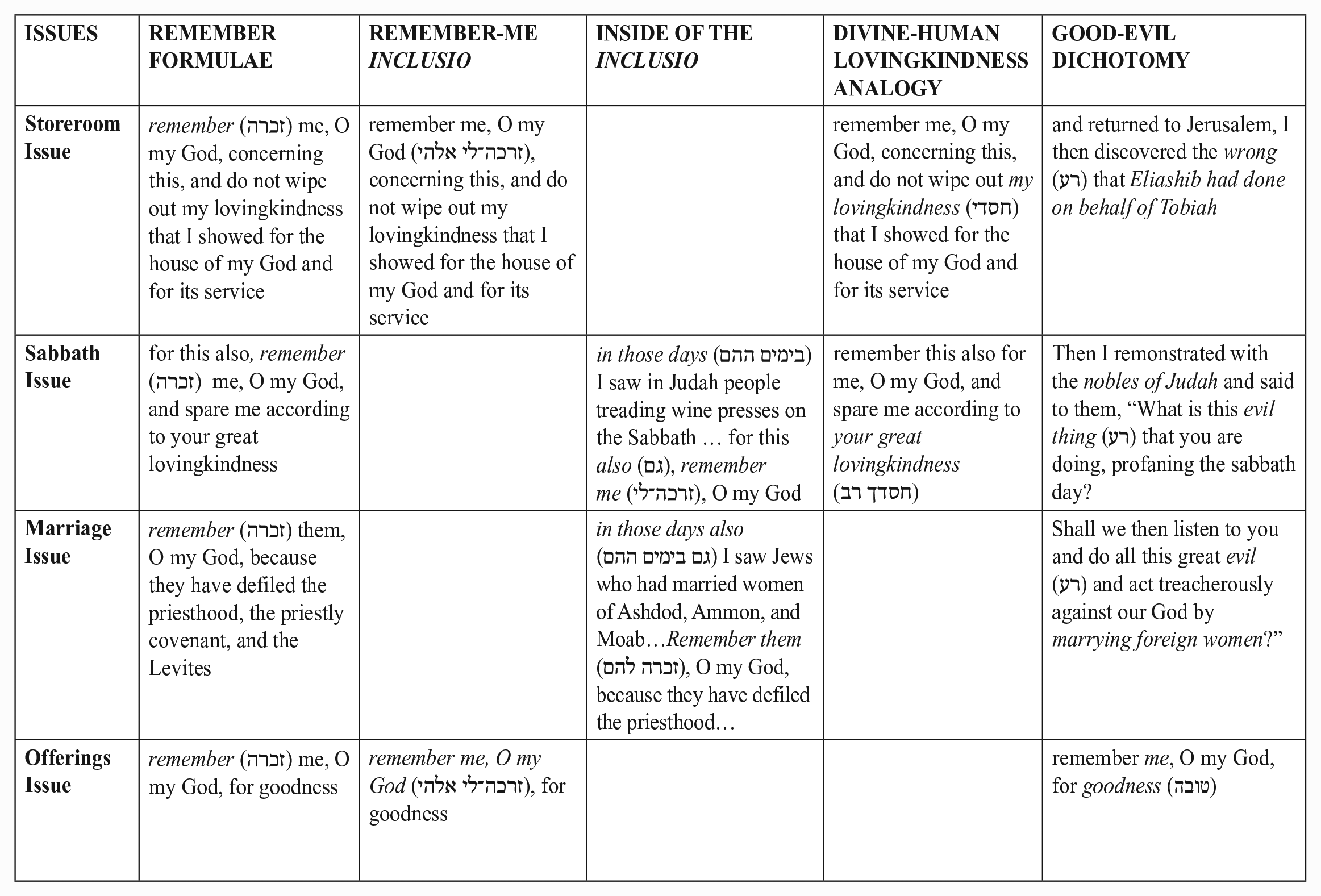
The third unique aspect of vv. 30–31 is that no issue is described in the narratives or even explicitly mentioned. But that is not surprising if one considers that this section is the concluding part. Taking the section as a conclusion allows the action taken here to be closely related to the issues in the previous sections. Note that I speak of a singular “action.” Most of the modern translators translate this section with three verbs (such as cleansed, established, and provided), whereas the Hebrew text only shows two (טהר and עמד, both in the Hiphil stem). Rather than reading these two verbs separately, they are closely connected.
The verb עמד in the Hiphil stem that speaks about establishing priestly affairs also appears in the people’s pledge in Neh. 10. 74 The passage starts by proclaiming a commitment to the Torah (vv. 28–39), discussing intermarriage (v. 30), Sabbath (v. 31), and offerings (vv. 32–39a) and concludes with a commitment not to “abandon the house of god” (v. 39b). The discussion of the offerings starts with the verb עמד in the Hiphil stem. Unfortunately, the discussion of intermarriage, Sabbath, and offerings found at the heart of the passage is usually overlooked. These topics are perceived as being at a similar level, as mere commitments, and their interconnection is not discussed. 75 Even if they are distinguished, the first two are considered “of a more moral character,” whereas the latter concerns the temple. 76 The interconnection of these commitments would be more obvious if read with the concluding statement: “we will not abandon” the temple, especially as I mentioned the economic connotations of “abandoning (עזב)” above. The commitment to bring offerings and other additional contributions to the temple is indeed “so that the temple was not neglected.” 77 But it is important to note that while the commitment of offerings is presented in the positive constructions, the commitments of marriage and Sabbath are presented in negative constructions, in parallel with the concluding statement. The abandonment of the temple seems to be closely related to the issues of intermarriage and Sabbath keeping. Thus, it is not an exaggeration to suggest that although the offerings should be brought so that the temple is not neglected, the intermarriage and Sabbath trading should be abandoned, as they were the reasons for the abandonment of the temple in the first place. The commitment to not abandon the temple economically through bringing offerings seems to require abandoning the economic practices entailed by intermarriage and Sabbath trading. The establishment (עמד) of priestly affairs requires the negation of the previous verbs (נתן and לקה), which refers to intermarriage and Sabbath trading.
If this analysis is read back into Neh. 13, the verb עמד requires the previous verb: טהר. In Neh. 13.30, the condition required is the cleansing (טהר) of foreignness (נכר), which, together with the particle “all from” (מכל), also functions as an inclusio with vv. 1–3. This נכר seems to be the reason priestly affairs cannot be established (עמד) in the first place. Hence, it must be cleansed (טהר). The foreignness here focuses less on identity in the modern sense than on the socioeconomic system. As Reinhard Achenbach notes:
The nåkhrî is exempt from the local law and does not even share the privileges of the gerim…persons who originally belong under the guidance of another distinct legal system. This is the reason why it is forbidden to sell an Israelite young woman debt-slave, who was designated for her master, to a nåkhrî (Exod 21:8), because he is a person from outside the scope of the Israelite law.
78
Thus, to speak of נכר is to speak of a different socioeconomic system. Note that even though the Persians were “foreign” by modern standards, they were not referred to as נכר. Why? Likely because Ezra-Nehemiah saw themselves as belonging (vertically) to the same system, as compared with other peoples subjugated by the Persians, who belonged (horizontally) to different systems.
If this is correct, then it is appropriate to see the parallel between the conditions required in Neh. 13.30 (cleansed from נכר) with the ones in Neh. 10.30–31, that neither intermarriage nor economic activities with those who belong to a different socioeconomic system were permitted. Reading this back into Neh. 13, along with the two appearances of גם discussed above, the Sabbath and marriage issues reflect the required conditions for Nehemiah’s system to be established (עמד). Nehemiah’s system of focusing economic resources (offerings, first-fruits, and tithes) on the temple required fewer or no foreign socioeconomic transactions with Tobiah the Ammonite, Tyrians, Sanballat the Horonite, and Ashdodites. Thus, reading the final section of Neh. 13 as a conclusion means that both Sabbath and marriage issues function to endorse Nehemiah’s interest in flooding the temple with economic resources.
Sabbath Issue
In the discussions above, I have attempted to demonstrate that Neh. 13 as a whole is concerned with securing the flow of economic resources to the temple. This stability requires eliminating economic interaction with people from different socioeconomic systems so that the resources might be focused on the temple. This section discusses whether the presentation of the Sabbath issue (vv. 15–22) fits with this notion.
The passage begins with Nehemiah’s observation of people treading winepresses and bringing goods (grain, wines, grapes, figs) to Jerusalem on the Sabbath. These agricultural products have multiple roles or functions. First, the end of v. 15 suggests that they were on one hand, merely “provisions” (ציד). On the other hand, these products could also be used to fulfill the tax requirements as payments in kind. Furthermore, throughout Ezra-Nehemiah, grain and wine are described as offerings to the temple (vv. 5, 9, 12; also 10.33, 39, and Ezra 6.9; 7.17). Finally, these products were the means of exchange to pay for imported goods. 79 These multiple functions indicate that various parties have interests in these products: ordinary people, the imperial administration, the priesthood, and those who deal with imported goods.
The following verses give us hints about those who dealt with imported goods. Verse 16 introduces a new group of people, namely, the Tyrians. Like Tobiah in relation to the storeroom issue and Sanballat and the Ashdodites in relation to the intermarriage issue, the Tyrians were the foreign elements in the Sabbath issue. 80 As mentioned above, it was these three “foreign” aspects to which the concluding statement of Neh. 13 refers: “Thus I cleansed them from everything foreign.” Accounts of Judeans trading with the Tyrians also appear in Ezek. 27. Scholars like Margaret Odell contend that this text suggests that certain Israelite farmers had agricultural surpluses to be exchanged in a market economy. 81 However, the text does not explicitly refer to any peasants or farmers. It seems more appropriate to regard the text as suggesting a market exchange between minor potentates to acquire preciosities that will add “prestige value” to their social status. 82 Thus, the fourth party interested in the agricultural products in v. 15 was the upper class in Judah.
This idea seems to align with Neh. 13 for two reasons. First, v. 16 suggests that the Tyrians brought fish and other merchandise to sell. These products were by no means for ordinary people. They were for elite consumption, products meant not for survival but “as some sort of symbolic carrier of social status.” 83 Second, Nehemiah’s remonstration in vv. 15–16 was not addressed to the ordinary people but to the Judean nobles. They were the ones who benefitted from the imported goods, “but their cost in exported foodstuffs cut deeply into the sustenance of the peasant majority.” 84 Such a cost can already be seen in the people who were treading winepresses and bringing the goods, people who were certainly not the nobles but rather those who worked for them (v. 15). This seemingly humanitarian concern, however, was most likely secondary, if not completely absent.
Neh. 13 contains a Sabbath issue that is unique. In no other place in the Hebrew Bible can we find a concern about transporting goods on the Sabbath other than in this passage and Jer. 17.19–27. The relation between Neh. 13 and Jer. 17 may shed light on the heart of Nehemiah’s concern regarding the Sabbath. Jer. 17 also consists of a prophetic warning regarding God’s wrath against Sabbath’s profanation, to which Nehemiah seems to refer in his remonstration toward the nobles in vv. 17–18. Furthermore, the city’s gates have an important role as a site of Sabbath struggle both in Neh. 13 and Jer. 17.
Similar to Neh. 13, in Jer. 17.9, we find a stationing of the guard at the city’s gates to watch over the bringing in of goods on the Sabbath. Jer. 17 ties the bringing of goods through the city gates on the Sabbath to profaning the Sabbath and keeping the Sabbath holy by avoiding such behaviour. But while Neh. 13 only contains caution regarding divine wrath that awaits the profanation of the Sabbath, Jer. 17 also mentions the divine blessing arising when the Sabbath is not profaned but instead kept holy. In the former case, God promises to “kindle a fire in its gates [which] shall devour the palaces of Jerusalem and shall not be quenched” (v. 27). On the other hand, in the latter case, successive Davidic kings will enter the gates and sit on the throne while “burnt offerings and sacrifices, grain offerings and frankincense, and … thank offerings” are brought to the house of YHWH (vv. 25–26). It is interesting to note that unlike the bringing of goods, the bringing of various offerings through the city gates does not seem to be an issue. It seems that Jer. 17 is more concerned about the destination of the carried goods: if they are coming to the temple as offerings, there is no issue. But should the destination not be the temple, the transportation of these goods is considered a profanation of the Sabbath.
Reading this concept back into Neh. 13, the Tyrians’ presence in Jerusalem indicates that if the imported goods were not directed to the temple, they would be intended for the market. If this is correct, Nehemiah’s primary concern was not that the upper class pressed the lower class into service on the Sabbath but rather the interrupting of the flow of offerings due to the exchange with the Tyrians—hence, his remonstration against the Judean nobles who benefitted from this trade. This reading fits with the storerooms and intermarriage issues mentioned in Neh. 13 and with the concluding statement. The engagement with the foreigners, in this case trading with the Tyrians, prevented people from focusing their offerings on the temple. Securing such an engagement was crucial for Nehemiah in order to ensure an uninterrupted flow of resources to the temple.
Nehemiah’s minimal, if not complete, lack of concern for people working on the Sabbath can also be seen in v. 19. He commanded some of his retinue to guard the city gates to keep the traders away from Jerusalem, although later in v. 22, Nehemiah seems to abandon references to guards and refer instead to Levites. This enlisting of Levites to guard the city gates is entirely absent in the earlier traditions of the Hebrew Bible. The Levites most likely served as a symbol for the sanctity of the Sabbath that spreads throughout the city. However, guarding the gates is still a job, a duty. A similar phenomenon appears in the parallel between 2 Kgs 11.4–12 and 2 Chron. 23.1–11. The former records certain military personnel assigned by Jehoiada, the priest, to guard both the house of YHWH and the soon-to-be king Joash on the Sabbath. Interestingly, the parallel account in Chronicles mentions the Levites rather than military personnel serving as guards. Nehemiah and Chronicles seem to suggest that certain work on the Sabbath, if conducted for the temple’s sake, was not considered a profanation. Indeed, such work might have even been deemed as protecting the holiness of the Sabbath. The Levites, in both cases, seem to be the parade example of working for the temple on the Sabbath. This reading agrees with Nehemiah’s concern about the interrupted flow of offerings to the temple. Engaging in labor on the Sabbath was not an issue for him as long as it was done for the benefit of the temple.
Nehemiah the Social Reformer(?): An Epilogue
I mentioned above that scholars like Wright and Williamson understand the Sabbath in Neh. 13 “positively” by claiming that Nehemiah was displeased both with putting pressure on people to work on the Sabbath and with what he perceived as an unfair commercial situation. 85 In both cases, he voices displeasure on behalf of the people. Such a reading seems heavily influenced by the so-called humanitarian reform in Neh. 5. As both chapters share extensive stylistic and conceptual elements, both are seen as expressing a similar message: portraying Nehemiah as an ideal leader. 86 Wright does acknowledge a propagandistic aspect of Neh. 5. 87 But I am more concerned with how such propaganda was generated at the expense of others. First, where did Nehemiah’s lavish food come from? Archaeological findings suggest that administrative centers along the coast of the Levant in the Achaemenid period had their needs supplied by the surrounding agricultural settlements. 88 Such a distribution might not appear on the taxation records because they were considered gifts. 89
Second, in addition to the foodstuffs themselves, Nehemiah’s lavish banquet required workers to prepare, cook, and serve the meals. Where did they come from? When Nehemiah expresses concern about the burden of heavy labor, it is unlikely he was referring to those who worked to prepare and serve the banquets. 90 The passage itself supports this. Whereas the people expressed concerns about their daughters and sons (v. 5), Nehemiah’s “debt reform” seems to be concerned only with the properties, not the people (v. 11). The labor supply was crucial for the needs of the upper class “in maintaining the life to which they had become accustomed.” 91 The lavish banquet is one example of such a life.
Third, the “debt reform” itself is by no means comprehensive. Roland Boer writes:
All very admirable, but before we are persuaded by Nehemiah’s sense of justice, benevolence and frugality, note that he insists that only the interest and security for defaulted debts (property but not people) be returned, not that the debts themselves should be forgiven…In short, the intervention with the nobles and officials is hardly revolutionary, opting, as he does, for a trickle-down social justice; as long as the nobles do the right thing, then the economic and social system will keep going.
92
The socioeconomic system mentioned includes a supply of offerings that were supposed to flow uninterruptedly from the people to the temple. 93
Thus, the discussion of Neh. 13.15–22 within its literary context, both in the chapter of Neh. 13 as well as beyond the chapter (Neh. 5, 10, Jer. 17, 2 Kgs 11, and 2 Chron. 23), seems to indicate that the primary concern of Nehemiah was not a complete reform of social justice. He was more interested in securing the flow of resources to the temple, both for the purpose of temple maintenance and to pay the imperial taxes. The concern for the lower class, unfortunately, was minimal—if not entirely absent.
Footnotes
Acknowledgements
This article has been improved by helpful and valuable comments from a few individuals whom I want to deeply thank: Herbert Marbury, Peter Altmann, Mark McEntire and Roger Nam who shared a pre-publication draft of his book with me. Furthermore, I am grateful to Serena McMillan and Melanie Bockmann for their editorial assistance. Earlier versions of this article were presented at the EABS and IOSOT meetings. I am grateful for the comments and suggestions given during those sessions. Any shortcomings that may remain, however, are my sole responsibility.
2
Wright (2004: 223). Williamson (1985: 395);  : 298) also shares this interpretation.
4
: 61–63). Its location was strategically important for the Achaemenid Empire’s stores of food and goods to supply the garrison’s needs. Hence, rebuilding the temple cult in Jerusalem, a city that then served as an imperial administrative base, was closely related to this provisioning for the Persian army.
6
Trotter (2001: 289); Blenkinsopp (1987: 420). Joseph Blenkinsopp compares Ezra’s mission in Judah with Udjahorresnet’s mission in Sais. : 635), however, rightly questions the suggestion, as neither Darius‘ royal decree for Udjahorresnet nor such a legal initative of Artaxerxes I are attested. Janzen argues that Artaxerxes I is less concerned with such a reform than the need to remove some hostile officials and replace them with his allies.
7
Lipschits, et al. (2012: 59-60, 71-73). The evidence includes many stamped jar handles for tax purposes and pollen samples that suggest imported exotic trees from across the empire. The only comparable complex is in Samaria, which served as a governor’s residence.
8
Schaper (1995: 536); Meyers and Meyers (1987); Carroll (1994: 41–43). For discussion of how the empire required the indigenous leaders to collect and forward the requisite local tribute see Meyers and Meyers (1987: 37-38, 390); Schaper (1995: 539); Briant (1982, 292–296); Kuhrt (1995: 2:690); Cataldo (2009: 50); : 55). Schaper and Meyers and Meyers also compare such a function with other temples in the ancient world, especially in Babylon. In addition, the reference יוצר in Zech. 11.13 at first blush seems to corroborate this reconstruction.
9
Bedford (2007: 18); Altmann (2014: 222). For the discussion of Nehemiah’s title as a “governor,” see .
10
Bedford (2001: 226–227); : 84–90).
11
Koch (1989); : 17).
13
Kuhrt (1995: 2:699, emphasis is original). TAD 14.7.13-14 also suggests that “all the temples of the Gods of Egypt were overthrown” by Cambyses, .
14
Some Babylonian evidence shows some temples no longer received their royal contribution and some others were charged with paying the same kind of tax as the royal fiefs. See Altmann (2014: 228); Dandamaev, et al. (1984, 57–58); Janzen (2000: 631). In addition, temples are generally expected to support public works, : 150).
16
Marbury (2003: 134); Dandamaev (1992: 19–20); Nam (Forthcoming). It was also not unusual for the imperial tax burden to cause a difficult economic situation for the temples. For instance, the debt of Eanna’s temple arose due to an expectation that it would supply spices for Abanu’s royal estate, : 73).
20
Grabbe (2001: 110). Briant (2002: 444-45) also suggests that the word בירה, which the standard biblical Hebrew lexicon typically translates as “fortress,” may instead refer to an “estate.” This possible meaning is extracted from the Elamite version of the Behistun Inscription, which indicates that the Elamite word irmatam refers to an estate and is equivalent to the Akkadian word birtu. This Akkadian word, in turn, is an equivalent of the Hebrew בירה; also : 165).
22
Rhyder (2018: 120); : 362–66).
23
Rhyder (2018: 121); Bedford (2015: 9); Nihan (2013); : 259); Nam (Forthcoming).
25
Bedford (2007: 6n9); See .
28
Weinberg (1992: 104, 29); : 4).
30
Lemaire (2007: 59); see : 166) for different interpretations.
31
Knowles (2006: 75); :(201).
32
Bedford (2001: 342; : 10).
42
Rhyder (2018: 325); aligned with Milgrom (2000: 169); Nihan (2007: 478); : 751–52).
47
Rhyder (2019: 739-40). See also concept of Sabbath as a regime of truth that establishes the means of regulation and subject-making.
49
Rhyder (2019: 740), “This reading echoes analysis of the strategies used by the Jerusalem temple in the Persian period to shore up its economic position. Bedford analyzes how the Jerusalem temple, in the absence of the official authority to extract taxes or tithes from the Judean population, was forced to rely on a funding model based on voluntary donations; these had to be solicited by convincing the population of their obligations towards the cultic center.”
50
53
Blenkinsopp (1988: 354); followed by : 195n15).
59
The example of scholars who hold to the former concept are Fensham (1982: 124); Blenkinsopp (1988: 176), while those favouring the latter are Willi-Plein (2007: 177–92); ; Nam (Forthcoming). In addition to underscoring the role of language, Nam also discusses briefly the economic aspect of the intermarriage.
60
Alles (2017); .
63
Eskenazi (1992: 25–43); Porten (1968: 190–263); : 63–71).
64
Marbury (2003: 221-222); also follows this argument, “Rejection of exogenous marriages was directly linked to concern for inheritance for property rights. The reasons for this connection arise from the need for adherents to the Yahweh temple in Jerusalem to finance its activities now that this second temple, unlike the first one, did not function as the royal chapel endowed with royal support. If Judean men married exogenously, then upon their deaths the families might lose their own distinctiveness and their property would fall into the hands of those whose commitment to the Yahweh temple in Jerusalem might be compromised” (242).
70
Becking (2018: 330); Myers (1965: 218–19); : 401).
71
Laird (2016: 205–206); : 146).
74
79
Chaney (2017: 207); Altmann (2016: 294; : 112).
83
Altmann (2016: 295); Edelman (2006b, 210); : 38).
85
Wright (2004: 223); .
87
For the reading of Nehemiah’s lavish banquet as imitatio regis, see Wright (2004: 178-179; : 349–51).
88
Fried (2018: 824); : 830).
89
Fried (2018: 825); Lipschits (2015); archaeological evidence suggests a pattern of gift bringing similar to that at Susa and Persepolis, not only at satrapal courts but also at the provincial capitals, .