




Abstract
Scholars and translators have traditionally regarded the conclusion of the Nazirite law—“After that the Nazirite may drink wine” (Num. 6.20)—as signalling the completion of the naziriteship, the Nazirite henceforth being permitted to drink wine. Should the clause be read as prescriptive, however, with the Nazirite being required to drink wine to complete his vow? In line with the contextual-grammatical approach prevalent today, this article offers a clear criterion for examining the verbs concluding the various laws in the Priestly code—including that in the Nazirite law. To narrow the discussion, it focuses on precepts whose conclusion opens with ואחר despite possibly not differing from other Priestly laws. While in three places, the injunction is permissive, in the majority of cases, the acts are mandatory.
Keywords
Introduction
The Nazirite law concludes with the words: ‘After that the Nazirite may drink wine’ (Num. 6.20). Scholars and translators have traditionally regarded this as signalling the completion of the naziriteship, the Nazirite henceforth being permitted to drink wine. 1 Is this interpretation correct, however, or should the clause be read as prescriptive, the Nazirite being required to drink wine to complete his vow? 2 Numerous scholars have addressed this question without elaborating on or deciding it. Noth remarks, ‘The return to the drinking of wine which, at the end (v. 20b), is expressly allowed or, rather, enjoined, signifies, after the cutting of the hair, the definitive conclusion of the period of “consecration.”’ 3 In Licht’s opinion, ‘this is a commandment … some think it is allowed—that he may drink if he wishes.’ 4 Seeking to harmonize the two approaches, some scholars suggest that the latter part of the law describes a family banquet at which the attendees consumed offerings and drink wine. 5 On this reading, the notation of these two items indicates that the legislator attributes a ritual aspect of some sort to them rather than regarding imbibing wine (and eating sacrifices) as a binding ordinance.
The question of whether the Nazirite is allowed or required to drink wine is a practical and not purely theoretical issue, with the act defining the end of his vow. It also touches on substantive actions that form part of numerous other laws. Must or may the person who sets the Azazel-goat free re-enter the camp after washing his clothes and body (Lev. 16.26)? Likewise, must or may the unwitting murderer return home after the death of the high priest (Num. 35.28)?
The phrase ‘(and) after that’ which occurs in these three examples implies that the following sentence constitutes the conclusion of the ordinance. 6 These clauses are characterized by a verbal form that differs from that employed in the law itself— ישתה ,יבוא ,ישוב vs. ושתה ,ובא ,ושב. In some precepts, the concluding statement is followed by a general closing formula: ‘This is the ritual in cases of jealousy’ (Num. 5.29); ‘Such is the obligation of a nazirite’ (Num. 6.21). While this style is typical of the Priestly code, it does not appear in all of the laws in the latter. 7 On many occasions, the final section employs a divergent verbal form. The law of the burnt offering (Lev. 1.3–9), for example, is marked by a lengthy series of verbs all bearing the same form – וסמך ,ושחט ,והקריבו ,וזרקו ,והפשיט ,ונתח ,ונתנו ,וערכו ,וערכו (vv. 4–8), the final verb being ירחץ rather than ורחץ (v. 9). 8 Paran argues that this grammatical feature serves as a stylistic-literary device signalling the conclusion of the law. 9
Does this change from vav reversive to simple future determine the final clause as permissive in contrast to the earlier prescriptive forms? A clear answer to this question has yet to be given. The laws themselves are unclear. In some, the verb appears to be prescriptive: ‘Last, the burnt offering shall be slaughtered’ (Lev. 14.9); ‘after that the priest shall enter to examine the house’ (Lev. 14.36). In others, it may be understood as permissive: ‘and after that he may re-enter the camp’ (Lev. 16.28); ‘afterward he may eat of the sacred donations, for they are his food’ (Lev. 22.7).
Many scholars regard the biblical legal code as ideological-educational rather than as positive-law oriented. 10 Untroubled by the fact that the precepts are formulated obscurely, these scholars thus have no interest in exploring this issue. Herein, I wish to challenge this premise: although some statutes were indubitably not meant to be implemented, this is not true of the biblical law code in general. It—or at least most of its contents—must be examined as a set of practical ordinances. 11
The first section of this article explores the verbal form in the final clause of the Nazirite law: ואחר ישתה הנזיר יין (Num. 6.20), focusing on the law itself and its affinities with the neighbouring law of the sotah. In line with the contextual-grammatical approach prevalent today in analyzing biblical verbs, I shall offer a clear criterion for understanding the verbs concluding the various laws in the Priestly code—including that in the Nazirite law. 12 To narrow the discussion, I shall confine my attention to precepts whose conclusion opens with ואחר despite possibly not differing from other Priestly laws—as in the case of the burnt offering noted above.
Shaving and drinking wine as active signs of the termination of the naziriteship
Widely practiced during the biblical period, naziriteship is exemplified by various scriptural figures. 13 When the Angel of the Lord reveals himself to Samson’s mother—Samson being the only person explicitly identified as a Nazirite in the biblical text—he tells her: ‘… let no razor touch his head, for the boy is to be a nazirite to God from the womb on’ (Judg. 13.5). Although Samuel is not expressly said to be a Nazirite, Hannah makes a similar oath: ‘I will dedicate him to the LORD for all the days of his life; and no razor shall ever touch his head’ (1 Sam. 1.11). The parallelism between the two men is also highlighted by the statements ‘Now be careful not to drink wine or other intoxicant, or to eat anything unclean’ (Judg. 13.4), and ‘I have drunk no wine or other strong drink’ (1 Sam. 1.15).
Two other groups are also forbidden wine. Jonadab b. Rechab commands his descendants: ‘“You shall never drink wine, either you or your children”’ (Jer. 35.6), and Amos declares in God’s name: ‘And I raised up prophets from among your sons and nazirites from among your young men … But you made the nazirites drink wine’ (Amos 2.11–12). 14
As may be demonstrated, the central feature of the naziriteship is an injunction not imposed on any other member of society—namely, not shaving or drinking wine. 15 Rather than being initiated by the Nazirite himself, this abstinence is prescribed for him: ‘An angel of the LORD appeared to the woman and said to her … “let no razor touch his head”’ (Judg. 13.3, 5); ‘And she [Hannah] made this vow … “I will dedicate him to the LORD for all the days of his life; and no razor shall ever touch his head”’ (1 Sam. 1.11); ‘“You [Rechabites] shall never drink wine, either you or your children”’ (Jer. 35.6); ‘And I raised up … nazirites from among your young men … But you made the nazirites drink wine’ (Amos 2.11–12). The abnegation is lifelong, beginning ‘from the womb on’ (Judg. 13.5, 7), ‘since I was in my mother’s womb’ (Judg. 16.17) and continuing ‘to the day of his death’ (Judg. 13.7), ‘all the days of his life!’ (1 Sam. 1.11); ‘for ever [never]’ (Jer. 35.6). 16 These fixed elements of the naziriteship have long been noted and discussed. 17
The minute a Nazirite violates his vow, he is disqualified. Samson tells Delilah, ‘“If my hair were cut, my strength would leave me and I should become as weak as an ordinary man”’ (Judg. 17.16). Amos and Jeremiah describe the same case with respect to drinking wine, the former drawing a parallel between ‘you made the nazirites drink wine’ and ‘[you] ordered the prophets not to prophesy’ (Amos 2.12). Just as silencing a prophet precludes prophecy, so forcing wine on a Nazirite annuls his naziriteship. Seeking as it were to nullify the Rechabites’ status, Jeremiah acts like Amos’ addressees, commanding them, ‘“Have some wine”’ (Jer. 35.5).
Drawing on his knowledge of the naziriteship, the Priestly legislator of the Nazirite law (Num. 6.1–21) adduces two prohibitions: first, ‘he shall abstain from wine and any other intoxicant’ (v. 3) and second, ‘no razor shall touch his head’ (v. 5). 18 To these he adds another: ‘he shall not go in where there is a dead person. Even if his father or mother, or his brother or sister should die, he must not defile himself for them’ (vv. 6–7). 19 The fact that early Nazirites could either shave or not drink wine suggests: a) that these two prohibitions carried the same weight and b) that a Nazirite only stopped being one if he violated both. 20 Defilement by contact with the dead—to which ordinary people were likewise liable—is a passive occurrence that happens ‘suddenly’ (v. 9) rather than an active deed the Nazirite initiates of his own accord to release himself from his vow. In light of these two premises, we may thus conclude that the final statement, ‘After that the Nazirite may drink wine’ (v. 20), is prescriptive rather than permissive.
‘If a person dies suddenly near’ (v. 9) the Nazirite, however, he becomes defiled and must renew his naziriteship, following the required ritual. Here, while he must shave ‘his head’ (ibid), he is not required to drink wine. Shaving thus appears to be the central feature of the naziriteship, automatically annulling the Nazirite’s status even if he does not drink wine. The final clause relating to the latter act thus appears to be permissive rather than prescriptive.
The parallelism between the Nazirite and sotah yields an ambiguous conclusion. 21 On the one hand, both laws describe identical rites:
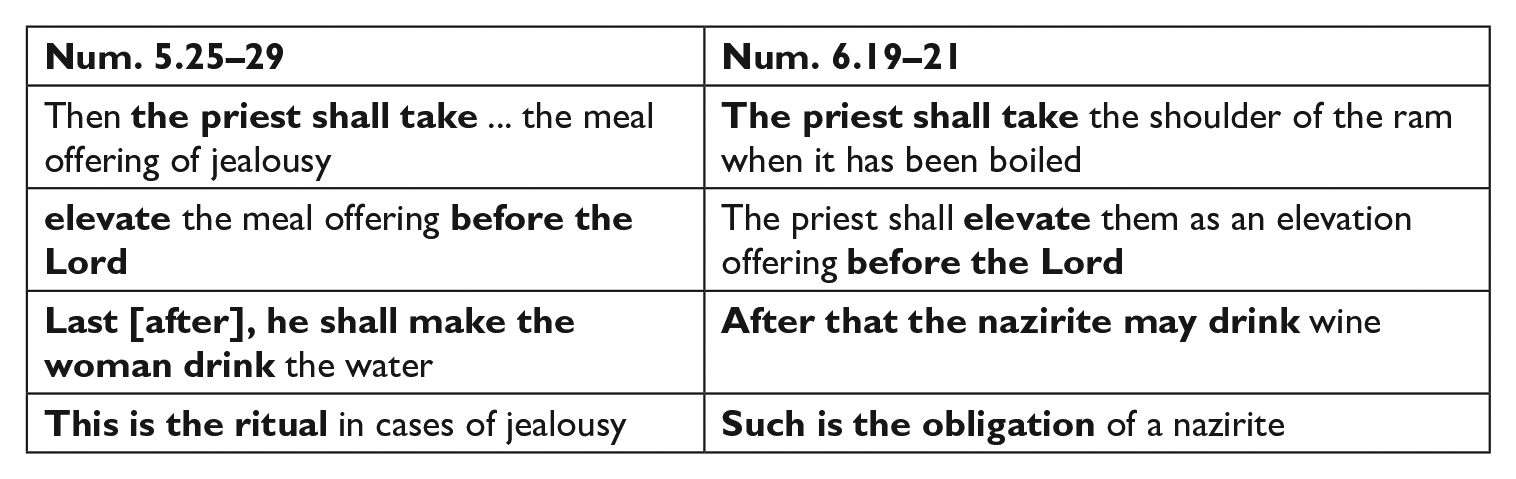
Just as making the sotah drink forms a mandatory part of that rite, so too does the Nazirite’s abstinence from wine. While the sotah is not forbidden to drink water—the act clearly forming an integral part of the priest’s duties—the Nazirite must not drink. It is thus not clear whether he is merely allowed to or is required to drink once his naziriteship is complete.
Analysis of the verbs in the Priestly code
Let us now examine the verbs that occur in the final clause of the Nazirite law and others on Priestly stylistic-literary grounds rather than in light of factors related to specific legal components and their parallels, such as those adduced to this point.
Rendtorff identified the existence of a ritual literary form marked by a schematic structure composed of a series of short verbal sentences indicating process and procedure. 22 This Priestly genre, he contends, occurs in the first chapters of Leviticus and several chapters of Numbers and Exodus 12. 23 Following Rendtorff, Koch demonstrated the presence of this schematic structure in other parts of the Priestly literature. 24 More recently, Cohen expanded the scope of these texts, naming them ‘Priestly Instructions’. 25 Examination of these reveals a systematic Priestly ‘style’. As we saw above in relation to the law of burnt offerings (Lev. 1.3–9), the ordinances are marked by formulaic opening and closing sentences. Following Paran, we also observed that the injunction consists of a lengthy series of verbs bearing the same grammatical form, the final verb deviating from this pattern and thereby indicating the end of the statute. Paran adduces several literary-stylistic features characteristic of these instructions— including the ‘rounding out’ of the number of actions into a typological figure.
This writing style appears to have been designed as a mnemonic for remembering the order of the ritual—a valuable aid in the framework of the training of young priests. 26 The grammatical deviation signals the conclusion of the instruction rather than any change in the nature of the action. In some cases, the verbs throughout the law take the same form as the final root, for no good reason: יקח ‘shall take’ (Lev. 14.6); יתן ‘shall be put’ (Lev. 14.17, 18); יַקצִע ‘shall be scraped’ (Lev. 14.41). These clearly do not differ in nature from those declined as vav reversives. 27
Examination of the Priestly laws in which one of the actions delineated opens with ואחר evinces that each concludes the list of preceding acts, all of which relate to a specific executor—priest or Israelite. In some exceptional cases, the action forms part of, rather than ends, a series of actions. In general, this circumstance is required by the order of actions established by the legislator—e.g. the law of the leper when he purifies himself (Lev. 14.8) or the house with an eruptive plague (Lev. 14.36). On other occasions—the leper on the eighth day, for example (Lev. 14.19)—no reason is evident. Whether sealing the series or not, the verb ‘rounds out’ the number of actions taken into a typological number—most frequently a multiple of five. 28 This suggests that the action forms part of those that compose the ordinance, partaking of the same nature: if they are permissive, it is too; if they are prescriptive, it is too.
Before examining the relevant injunctions and drawing attention to the typological numbers they employ, we must note two stylistic features of the Priestly source that affect the way in which the verbs are counted:
a) ‘Circular inclusion’: repetition of the object of the sentence without any syntactical or thematic aspect. For example: וצִפית אתו זהב טהור מבית ומחוץ
b) Repeated use of the roots כפ”ר and טה”ר.
30
ורחץ במים
The beautiful captive (Deut. 21.10–14)
The only non-Priestly injunction that contains a concluding statement that opens with the word ואחר is the law of the beautiful captive.
32
This consists of ten actions, shared between the two actors: The captor: 1) וראית ‘and you see’; (v. 11); 2) וחשקת ‘you desire’ (v. 11); 3) ולקחת ‘would take’ (v. 11); 4) והבאת ‘you shall take’ (v. 12); 5)
The cleansing of the leper (Lev. 14.2–8)
This unit, which deals with the day on which the leper is cleansed, is delineated by an inclusio that opens with
The leper on the eighth day (Lev. 14.10–20)
This pericope is separated from the previous unit (vv. 2–8) by two verses that delineate three actions the leper must perform ‘on the seventh day’ (v. 9): 1) יגלח ‘shall shave’ (v. 9); 2) וכבס ‘shall wash’ (v. 9); 3) ורחץ ‘shall bathe’ (v. 9). The passage addressing the eighth day adduces 17 actions that must be taken thereon, the leper performing one (יקח ‘he shall take’ [v. 10]) and the priest 16: 1) והעמיד ‘shall present’ (v. 11); 2) ולקח ‘shall take’ (v. 12); 3) והקריב ‘shall offer’ (v. 12); 4) והניף ‘shall elevate’ (v. 12); 5) ושחט ‘shall slaughter’ (v. 13); 6) ולקח ‘shall take’ (v. 14); 7) ונתן ‘shall put’ (v. 14); 8) ולקח ‘shall take’ (v. 15); 9) ויצק ‘shall pour’ (v. 15); 10) וטבל ‘shall dip’ (v. 16); 11) והזה ‘shall sprinkle’ (v. 16); 12) יתן ‘shall put’ (v. 17); 13) יתן ‘shall put’ (v. 18); 14) ועשה ‘shall offer’ (v. 19); 15)
Eruptive plague in a house in Canaan (Lev. 14.33–57)
This unit consists of an opening (vv. 33–34), ending (vv. 54–57) and three central units. The first deals with the phenomenon before it has been diagnosed as an eruptive plague:
The priest performs twenty actions, divided typologically between the sections comprising the unit: Five in the first (vv. 35–48): 1) וצוה ‘shall order’ (v. 36); 2)
The ritual of atonement on Yom Kippur (Lev. 16.1–34)
In this rite, the high priest ‘purges the innermost Shrine; he shall purge the Tent of Meeting and the altar; and he shall make expiation for the priests and for all the people of the congregation’ (v. 33). The opening and closing verses evince that the ritual is performed once a year on the Day of Atonement: ‘… not to come at will into the Shrine’ (vv. 1–2); ‘In the seventh month, on the tenth day of the month … on this day atonement shall be made for you … once a year’ (vv. 29–30, 34). As befitting the holiest day of the year, fifty actions are performed thereon, the majority by Aaron (as High Priest), the others by two further figures (priests/unidentified personages) who assist him. The verses are divided between the three actors: Aaron (vv. 3–21, 23–25), the person who sets the Azazel-goat free (vv. 22, 26), and the person who burns the bull of sin offering and goat of sin offering (vv. 27–28). 34
In total, Aaron performs forty actions: Five on entering the Shrine: 1) יבא ‘shall enter’ (v. 3); 2) ורחץ ‘shall bathe’ (v. 4); 3) ולבשם ‘shall put on’ (v. 4); 35 4) יקח ‘shall take’ (v. 5); 5) והקריב ‘shall offer’ (v. 6). Five in casting the lot for the goats: 1) ולקח ‘shall take’ (v. 7); 2) והעמיד ‘shall place’ (v. 7); 3) ונתן ‘shall place’ (v. 8); 4) והקריב ‘shall bring forward’ (v. 9); 5) ועשהו ‘shall offer’ (v. 9). Thirty during the rest of the day: 1) והקריב ‘shall offer’ (v. 11); 2) ושחט ‘shall slaughter’ (v. 11); 3) ולקח ‘shall take’ (v. 12); 4) והביא ‘shall bring’ (v. 12); 5) ונתן ‘shall put’ (v. 13); 6) ולקח ‘shall take’ (v. 14); 7) והִזה ‘shall sprinkle’ (v. 14); 8) יַזה ‘shall sprinkle’ (v. 14); 9) ושחט ‘shall slaughter’ (v. 15); 10) והביא ‘shall bring’ (v. 15); 11) ועשה ‘shall do’ (v. 15); 12) והִזה ‘shall sprinkle’ (v. 15); 13) יעשה ‘shall do’ (v. 16); 14) ויצא ‘shall go out’ (v. 18); 15) ולקח ‘shall take’ (v. 18); 16) ונתן ‘shall apply’ (v. 18); 17) והִזה ‘shall sprinkle’ (v. 19); 18) והקריב ‘shall bring forward’ (v. 20); 19) וסמך ‘shall lay’ (v. 21); 20) והתודה ‘shall confess’ (v. 21); 21) ונתן ‘shall put’ (v. 21); 22) ושִלח ‘shall set free’ (via a designated individual) (v. 21); 23) ובא ‘shall enter’ (v. 23); 24) ופשט ‘shall take off’ (v. 23); 25) והניחם ‘shall leave’ (v. 23); 26) ורחץ ‘shall bathe’ (v. 24); 27) ולבש ‘shall put on’ (v. 24); 28) ויצא ‘shall come out’ (v. 24); 29) ועשה ‘shall offer’ (v. 24); 30) יקטיר ‘shall turn to smoke’ (v. 25).
The sending of the goat to Azazel includes five actions, the first of which is performed by the goat itself: 1) ונשא ‘shall carry’ (v. 22); 2) ושִלח ‘shall set free’ (v. 22); 3) יכבס ‘shall wash’ (v. 26); 4) ורחץ ‘shall bathe’ (v. 26); 5)
The defiled priest’s non-consumption of the sacred donations (Lev. 22.3–7)
The full legal unit (Lev. 22.1–16) of which this forms a part consists of an opening (vv. 1–2), closing (vv. 15–16), and a series of articles addressing eating in general and the sacred donations in particular. 37 The first clauses (vv. 3–7), which deal with the defiled priest who consumes the sacred donations, conclude with the statement: ‘Afterward he may eat of the sacred donations, for they are his food’ (v. 7). The verb רחץ ‘bathe’ in v. 6 shows that the verb יאכל ‘eat’ here is permissive rather than prescriptive, consumption being sanctioned if the priest first washes and purifies himself: ‘… he shall not eat of the sacred donations unless he has washed his body in water’ (v. 6). The complete unit contains five cases in which it is permitted to eat, all formulated in the same fashion (יאכל [תאכל] ‘shall eat’) and occurring in the matter under discussion and four further cases (11 [x 2]), 13, 14). The negative in this unit, by contrast—לא יאכל ‘shall not eat’—is prescriptive, appearing seven times in relation to seven cases (4, 6, 8, 10 [x 2], 12, 13).
The law of the sotah (Num. 5.11–31)
This law consists of an opening clause (vv. 11–14), a closing clause (vv. 29–31) and several articles (vv. 15–28). Analysis of the articles reveals that they contain numerous repetitions and doublets—the priest’s bringing of the woman before God (vv. 16, 18), her swearing of an oath (vv. 19, 21), her drinking the water (vv. 24, 27), the description of the water as ‘sacral’ (v. 17)/ ‘bitter’ (מרים: vv. 18, 19, 23, 24, 27)/‘that induces the spell’ (מאררים: vv. 18, 19, 22, 24, 27), the placing (giving) of the dust in the water (v. 17) in parallel to the curse said to be rubbed off into it (v. 23), the definition of the meal offering as the ‘meal offering of jealousy’ (v. 15) in parallel with the ‘meal offering of remembrance which recalls wrongdoing’ (v. 15), and the waving of the offering and sacrifice ‘on the altar (אל המזבח)’ (v. 25) vs. its scooping out and offering of a token part to be turned into smoke on the altar (המזבחה) (v. 26). 38
These features evince that the section is composed of several strata. It is thus impossible to adduce a sequence of verbs.
39
Whatever division is adopted, however, all the actions attributed to the priest are mandatory, including the final one—
The Nazirite on the day he completes his vow (Num. 6.13–21)
The concluding unit of the Nazirite law opens and closes with the same statement:
The Levites’ purification in the Tent of Meeting (Num. 8.5–22)
While the Levites’ purification and consecration for service in the Tent of Meeting is depicted as a singular rite rather than as a law, the writing style resembles that of the Priestly law code. 40 The pericope consists of two parts. In the first (vv. 5–19), God commands Moses to take the Levites and purify them (vv. 5–15), this being followed by an explanation of why this group was selected (vv. 16–19). The second details how Moses, Aaron and the Israelites obeyed the injunction. 41
The prescription (vv. 5–15) delineates 10 actions Moses must perform: 1) קח ‘take’ (v. 6); 2) הַזֵה ‘sprinkle’ (v. 7); 3) תִקח ‘take’ (v. 8); 4) והקרבת ‘bring forward’ (v. 9); 5) והִקהלת ‘assemble’ (v. 9); 6) והקרבת ‘bring forward’ (v. 10); 7) ועשה ‘offer’ (v. 12); 8) והעמדת ‘place in attendance’ (v. 13); 9) והנפת ‘elevate’ (v. 13); 10) והִבדלת ‘set apart, (v. 14).
42
The Levites are commanded to perform five actions: 1) והעבירו, ‘go over’ (v. 7); 2) וכִבסו ‘wash’ (v. 7); 3) ולקחו ‘take’ (v. 8); 4) יִסמכו ‘lay hands on’ (v. 12); 5)
Preparation of the ashes of the red heifer (Num. 19.1–10)
This unit opens with the words זאת
The seventeen actions it details are divided between the five players as follows:
Three are performed by the people: 1) ויקחו ‘shall bring’ (v. 2); 2) ונתתם ‘shall give’ (v. 3); 3) ושחט ‘shall slaughter’ (v. 3).
45
Three are performed by Eleazar: 1) והוציא ‘shall take out’ (v. 3); 2) ולקח ‘shall take’ (v. 4); 3) והִזה ‘shall sprinkle’ (v. 4). Three are performed by the person who burnt the heifer: 1) ושרף ‘shall burn’ (v. 5); 2) יכבס ‘shall wash’ (v. 8); 3) ורחץ ‘shall bathe’ (v. 8). Three are performed by the person who gathered the ashes: 1) ואסף ‘shall gather up’ (v. 9); 2) והניח ‘shall deposit’ (v. 9); 3) וכִבס ‘shall wash’ (v. 10). Five are performed by the priest responsible for the rite: 1) ולקח ‘shall take’ (v. 6); 2) והשליך ‘shall throw’ (v. 6); 3) וכבס ‘shall wash’ (v. 7); 4) ורחץ ‘shall bathe’ (v. 7); 5) All the actions are prescriptive—entry into the camp obviously being obligatory.
The men returning from a military campaign (Num. 31.13–24)
Numbers 31, which describes the war against Midian, consists of three units: the hostilities (vv. 1–12), the instructions to those who return (vv. 13–24), and the treatment of the booty (vv. 25–54). The middle pericope is composed of two sub-units: vv. 13–20 relate the five orders Moses gives to the commanders—specific to this incident: 1) הִרגו ‘slay’ (v. 17); 2) החיו ‘spare’ (v. 18); 3) חנו ‘camp’ (v. 19); 4) תתחטאו ‘cleanse yourselves’ (v. 19); 5) תתחטאו ‘cleanse’ (v. 20). Verses 21–24 adduce the five requirements Eleazar imposes on the commanders. Rather than being peculiar to these circumstances, these serve as חֻקת התורה ‘the ritual law’ for all those returning from war: 1) תעבירו ‘pass through (fire)’ (v. 23); 2) יתחטא ‘cleanse’ (v. 23); 3) תעבירו ‘pass through (water)’ (v. 23); 4) וכִבסתם ‘cleanse yourselves’ (v. 24); 5) ואחר תבֹאו אל המחנה ‘after that you shall enter the camp’ (v. 24). All the actions are prescriptive, including the last.
The person who slays another unintentionally (Num. 35.9–28)
Dealing with the cities of refuge and their environs, Numbers 35 is composed of three units: the granting of the cities to the Levites (vv. 1–8), their establishment (vv. 9–28), and the legal principles governing murder (vv. 29–34). The middle pericope specifies fifteen actions.
Five relate to the community: 1) והִקריתם ‘shall provide yourselves with’ (v. 11); 2) תִתֵנו ‘shall assign’ (v. 13); 3) ושפטו ‘shall judge’ (v. 24); 4) והצילו ‘shall protect’ (v. 25); 5) והֵשיבו ‘shall restore’ (v. 25). Three pertain to the blood avenger: 1) ימית ‘shall put to death’ (v. 19); 2) ימית ‘shall put to death’ (v. 21); 3) ורצח ‘shall kill’ (v. 27). Seven refer to the murderer, four of which appear to be attributed to him passively: 1) מות יומת ‘shall surely be put to death’ (v. 16); 2) מות יומת ‘shall surely be put to death’ (v. 17); 3) מות יומת ‘shall surely be put to death’ (v. 18); 4) מות יומת ‘shall surely be put to death’ (v. 21) and three of which he performs actively: 1) ונס ‘shall flee’ (v. 11); 2) וישב ‘shall restore’ (v. 25); 3)
The five actions ascribed to the community are prescriptive. Is this true for the other ten, however? While the precise nature of the first two attributed to the blood avenger (ימית ‘put to death’ x 2) is difficult to determine, the final verb ורצח ‘kills’ is certainly not mandatory, the final clause stating ‘there is no bloodguilt on his account’ (v. 27). The four passive acts (מות יומת ‘shall surely be put to death’) are also clearly not obligatory. Likewise, while the murderer gains protection if he performs the two final actions (וישב ונס, ‘flees, restore’), they are not prescriptive. In this light, his return home after the High Priest’s death is also an option rather than an obligation.
Conclusion
All the laws ending with ואחר form part of the Priestly code, the only exception being the beautiful captive (Deut. 21.10–14). Analysis of the typological verbs in each case reveals that in the majority, the final action is mandatory:
The leper must enter the camp on the day of his purification (Lev. 14.8) 46
The priest must slaughter the burnt offering on the eighth day to purify the leper (Lev. 14.19)
The priest must go to see the eruptive plague in a house (Lev. 14.36)
The person who sets the goat free and the person who burns the bull and goat of sin offerings must enter the camp (Lev. 16.26, 28)
The priest must make the woman drink the water of bitterness (Num. 5.26)
The Nazirite must drink wine when his naziriteship is complete (Num. 6.20)
The Levites must serve in the Tent of Meeting (Num. 8.15)
The priest who prepares the ashes of the red heifer must enter the camp (Num. 19.7)
Men returning from a military campaign must re-enter the camp (Num. 31.24)
In three cases, by contrast, the injunction is merely permissive:
A person who captures a woman may come into her (Deut. 21.13)
A defiled priest may eat the sacred donations following his purification (Lev. 22.7)
An unintentional murderer may return home when the High Priest dies (Num. 35.28)
The findings point to three guiding principles in the Priestly code:
a) The fact that the Levites must serve in the Tent of Meeting and the priest slaughters the burnt offering/goes to see the eruptive plague/makes the woman drink the water of bitterness demonstrates that the members of these two groups are dedicated to serving the community and are obligated to perform the tasks laid upon them.
b) The fact that a defiled person (the one who frees the goat, the one who burns the bull and goat of sin offerings, the leper, the priest who prepares the ashes of the red heifer, and the men returning from a military campaign) must re-enter the camp after being purified and the Nazirite must drink wine when his naziriteship is completed demonstrates that a person who loses one of his basic rights (even if relinquishing it voluntarily) must seek to exercise it again as soon as possible. 47 This principle explains why the Nazirite who is ‘suddenly’ defiled by a dead relative (Num. 6.9) and must therefore renew his vow is not required to drink wine: like re-entering the camp, this is an independent requirement of regaining one’s status and rights—rather than part of the process in which a person completes his naziriteship or becomes clean again. 48 A Nazirite’s right to drink wine is not restored to him if he becomes defiled, with the requirement to realize the right being irrelevant in this case.
The sole exception to this rule is the unwitting murderer, who is not required to return home after the High Priest’s death. Although the precise reason for this abnormality is difficult to determine, it may derive from the fact that he takes a fundamental right—of life—from another. The person who intentionally takes a life is killed, thereby depriving him of his own right to life. The unwitting murderer loses a lesser right—his regular lifestyle. When the High Priest dies, he may return home and resume his normal life—but is not bound to do so. This may symbolically reflect the fact that the taking of life is an irreparable act. 49
c) The fact that the priest is not required to eat of the sacred donations nor the captor to go into a beautiful woman evinces that a person may forfeit a right to which he is entitled. In these cases, the right is ‘supplemental’ rather than basic. 50
Analysis of the laws and in particular the verbs in the final clauses yields two further significant insights:
a) The number of verbs in each law is typological. This system appears to have been designed as an oral mnemonic to aid in remembering the actions to be taken.
b) The laws are written in a singular style that is very clear and unambiguous. Analysis of the verbs rests on contextual grammatical principles rather than on the conventional rules accepted by later Hebrew grammarians.
These two circumstances indicate that the biblical legislation—or at least the Priestly code—was written to be applied in practice.
Footnotes
Acknowledgements
This article was prepared with the help of the Research and Evaluation Authority, Oranim Academic College of Education.

1.
Levine (1993: 226); Davies (1995: 57, 65); Wenham (2008: 100); ‘after that the nazirite may drink wine / is free to drink wine’ (RV/RSV/NEB/JPS/NJSP). Cf. ‘Thenceforth the Nazirite is permitted to drink wine’ (m. Naz. 6.9).
2.
b. Sotah 3a places other biblical laws in the same category: ‘“And he warned his wife” (Num. 5.14), the issuing of the warning is optional, this is the statement of Rabbi Yishmael. Rabbi Akiva says: It is mandatory; ‘For her may he become impure’ (Lev. 21.3), for a priest to participate in the burial of his sister, despite the fact that he will contract ritual impurity, is optional, this is the statement of Rabbi Yishmael. Rabbi Akiva says: It is mandatory; ‘Of them may you take your bondmen forever’ (Lev. 25: .46), keeping one’s Canaanite slave forever, is optional, this is the statement of Rabbi Yishmael. Rabbi Akiva says: It is mandatory.’ Another midrash, which fuelled a well-known early medieval controversy, states: ‘“To the stranger shall you give interest, but to your brother shall you not give interest” (Deut. 23.21): “to the stranger shall you give interest”—a positive commandment; “but to your brother shall you not give interest”—a negative commandment’ (Sifre Deut. 263).
3.
Noth (1968: 57).
4.
Licht (1985: 93–94).
5.
Thompson (1970: 177). Cf. Gray (1920: 69–70); Marsh (1953: 2:173); Sturdy (1976: 53).
6.
אחר is a preposition signifying ‘afterwards’ (cf. ‘Afterward the clans of the Canaanites spread out’ [Gen. 10.18]) or ‘finally’ (cf. ‘Last, she bore him a daughter’ [Gen. 30.21]).
7.
It also occurs in the Holiness code and Ezekiel: ‘After he has become clean, seven days shall be counted off for him’ (Ezek. 44.26). Outside the Priestly code, it is only employed once—in the precept of the beautiful captive: ‘after that you may come to her and thus become her husband, and she shall be your wife’ (Deut. 21.3).
8.
Paran (1989: 182). As he evinces, each of these sentences opens with a verbal predicate in the vav reversive, the transition from singular to plural being dictated by the actor’s identity—the priests, Aaron’s sons, etc.
9.
Paran (1989: 179–237).
10.
See, for example, Finkelstein (1961); Fitzpatrick-McKinley (1999: 111–45); Schwartz (1999: 12–16). For an exhaustive list of the injunctions that embody this principle despite differing in nature and precise purpose, see Malul (2006: 10 n. 10).
11.
For a similar approach, see Driver and Miles (1952: 41, 45); Speiser (1953: 866). Cf. Roi, (2019: 297–302). The question of whether they were in fact practiced requires a different type of discussion, beyond the present brief.
12.
This approach primarily addresses verbal tenses. The identification of the difficulties in understanding biblical verbal forms and tenses in line with defined grammatical rules has revolutionized the study of verbs, with contemporary scholars now giving significant weight to contextual factors – discourse, syntax, the verbs occurring in a sentence, etc.: see Joosten (2012); Cook (2012).
13.
Gray (1900: 204); Weisman (1967: 207); Roi (forthcoming).
14.
נזיר also refers to the elite (‘Her elect were purer than snow’ [Lam. 4.7]), leadership (‘On the brow of the elect of his brothers’ [Gen. 49.26; cf. Deut. 33.16]), and (the grapes from) ‘untrimmed vines’ (Lev. 25.5).
15.
Samson’s mother is also forbidden to eat ‘anything unclean’ (Judg. 13.4, 7, 14). Samson himself is not affected by this prohibition, however. The command to refrain from drinking wine likewise applies to her and not him: see Davies (1995: 61).
16.
These Nazirites and those described in the law (Num. 6.1–21), are differentiated by a temporal factor, the latter making a commitment for a designated period rather than for life: see Cartledge (1992: 20).
17.
See, for example, Moore (1895: 318–19); Gray (1990: 204–10).
18.
For the view that the Nazirite law forms part of the Priestly legislation, see, for example, Gray (1990: 202); Cartledge (1989: 413); Knohl (1995: 160). For the argument that it is a late addition, see, for example, Binns (1927: xxvii); Noth (1968: 55).
19.
For the relationship between the Nazirite law and early naziriteship, see Budd (1984: 69–71); Davies (1995: 58–60). Scholars frequently contend that while biblical vows—often related to illness, war, journeying, childlessness, etc.—are conditional, the Nazirite vow is unconditional. The text gives no indication of the motivation behind the vow. For the relationship between the Nazirite vow and other biblical vows, see Cartledge (1992: 18–21; 1989).
20.
See Gray (1920: 64, 69). Levine (1993: 229–35) maintains that the prohibition against shaving constitutes the principal element; cf. Cartledge (1992: 20); Davies (1995: 60).
21.
For the parallelism between them, see Carmichael (2012: 26–43).
22.
Rendtorff (1963).
23.
Rendtorff (1963: 1–22, 56–66).
24.
Koch (1959: 5–6).
25.
Cohen (1973).
26.
Paran (1989: 187–88, 200) remarks that the conclusion frequently appears in the seventh or tenth statement, these being easy to remember; cf. Noth (1965: 20); Haran (1978: 143 n. 13); Rendtorff (1963: 22); Koch (1959: 99). The legal collections containing ten laws, such as the Decalogue (Deut. 4.13; 10.4) and the Little Book of the Covenant (Exod. 34.28), may well have served the same purpose.
27.
Paran (1989: 183 n. 26) notes that, like vav reversives, the simple future can indicate regularity: cf. ואד יעלה מן הארץ ‘but a flow would well up from the ground’ (Gen. 2.6);צדק ילין בה ‘where righteousness dwelt’ (Isa. 1.21); cf. Driver (1892: 120).
28.
The Priestly law appears to regard the number five (or ten) as embodying perfection. In its multiples, it occurs in diverse contexts—the Tabernacle (50 cloths, loops, clasps, bars), courtyard (breadth, length, and height), sacred vessels (Ark, table, menorah, golden altar, copper altar), materials (gold, blue, purple, crimson, fine linen), High Priestly family (Aaron, Nadab, Abihu, Eleazar, Ithamar); the ransom of the Levites and firstborn (five shekels), jubilee (50 years), etc.
29.
The first to observe this was Driver (1956: 130), with many following in his wake: McEvenue (1971: 43–44, 108); Cholewinski (1976: 84, 111); Paran (1989: 49–97).
30.
For the meaning of these, see Licht (1985: 125); Milgrom (1991: 255–56, 842, 856, 1079–84); Levine (1993: 274).
31.
See Milgrom (1991: 944); Budd (1996: 221)—contra Noth (1965: 112), who maintains that when the days of discharge were complete, the woman waited seven days to be clean, not being commanded to take any other action.
32.
Carmichael (1974: 57–60, 138–41) regards the D features in this law as a development of the laws of the Book of the Covenant (M[ishpatim]). Driver (1960: 244) points to the difficulty in attributing the statute to the Deuteronomic code in light of the command to slaughter all the Canaanite women (Deut. 20.16)—or at the very least not intermarry with them (Deut. 7.3)—while any others captured may be taken (Deut. 20.14).
33.
This unit is followed by a secondary one dealing with the poor leper on the eighth day (vv. 21–32) delineated by an inclusio that opens with ואם דל הוא
34.
For a complete analysis of the chapter, see Milgrom (1991: 1059–65).
35.
The high-priestly vestments are also described by five verbs, four relating to garments—1) ילבש ‘shall wear’ (v. 4); 2) יהיו ‘shall be’ (v. 4); 3) יחגֹר ‘shall gird himself’ (v. 4); 4) יצנֹף ‘shall wear’ (v. 4)—and the fifth to the priest who wears them: 5) ולבשם ‘shall put them on’ (v. 4).
36.
Although the sending out of the camp and the burning are not directly attributed to one individual, both are clearly performed by the same person. In the Samaritan Pentateuch, the verb ושרף ‘burn’ is in the singular (BHS, 187).
37.
For a full analysis of the chapter, see Milgrom (2000: 1890–92).
38.
For a review of the opinions regarding these doublets, see Roi (2017: 164–65).
39.
For the various divisions proposed, see Jeon (2007: 181–85).
40.
The unit that closes the chapter (vv. 23–26), which notes the Levitical age of service, also creates the impression that rather than constituting a one-off rite Moses is required to perform, every Levite must undergo the procedure before beginning his service.
41.
For a complete analysis of the chapter see Licht (1985: 121–24).
42.
The words וטהרת … והנפת ‘once you have cleansed them and designated them as an elevation offering’ in 15b are a summary in circular inclusio style rather than additional actions Moses must perform—and therefore not counted.
43.
According to Noth (1968: 139–41), the unit ends in 10a. Licht (1991: 180) argues for v. 9, Levine (1993: 457) that it also covers the purification process, thus ending in v. 13.
44.
As Licht (1991: 186–87) observes, another priest is necessary because the High Priest cannot be defiled (Lev. 21.11).
45.
The ordinance is formulated in a way that makes it difficult to precisely identify who performs which task. The לפניו ‘in his presence’ in v. 3 indicates that Eleazar did not slaughter the heifer, the לעיניו ‘in his sight’ in v. 5, similarly evincing that he did not burn it.
46.
This principle is also adduced in the story of Miriam’s leprosy, which contains an ad hoc law pertaining to a specific case: ‘But the Lord said to Moses …’ (Num. 12.14). This delineates three actions: 1) תִכלם ‘shall bear shame’ (v. 14); 2) תִסגר ‘shall be shut out’ (v. 14); 3) ואחר תֵאסף ‘then she shall be re-admitted’ (v. 14). Just as Miriam must be removed from the camp, so must she be let back in.
47.
The re-exercise of one’s basic rights may signal that the conditions that deprived him of them have been removed: cf. Licht (1985: 93–94) (in relation to the Nazirite).
48.
Levine’s (1993: 229–35) argument that the prohibition against shaving constitutes the central aspect of the naziriteship is thus correct.
49.
According to Budd (1984: 384), ‘The high priest is representative of the community at large, and his death expiates the blood shed accidentally.’ While this symbolic atonement enables the murderer to return to his homeland, it does not restore the right of life to the victim.
50.
Following this principle, cf. the story of the Gadites and Reubenites, which includes an ad hoc legal condition for a specific occasion: ‘Moses said to them, “If you do this …”’ (Num. 32.20–23). Moses lists three actions: 1) ועבר ‘who crosses’ (v. 21); 2) ונכבשה ‘is subdued’ (v. 22); 3) ואחר תשֻבו ‘and then you return’ (v. 22). The fulfilment of a condition is definitely a ‘supplemental’ right rather than an obligation. Just as the two tribes did not have to cross the Jordan as shock-troops, they are not required to return to Transjordan even if they do so.