




Abstract
The first speech of Eliphaz is the epitome of the scholarly consensus that the authors of the book of Job constructed their arguments through intertextual dialogues with various other texts in the Hebrew Bible. In this article, I argue that Job 4–5 contains three allusions (Job 4.9, 4.19, and 5.6–7a) to Gen. 2.4b–3.24 that not only provide the fundamental framework of Eliphaz’s argument for the efficacy of the deed-consequence nexus but are also vital in understanding its thrust. The literary placement of these allusions reveals that they are drawn to underpin Eliphaz’s rhetorical questions and personal observations theologically. This reflects that during the time of the book of Job’s composition (the postexilic era), Gen. 2.4b–3.24 played an important role in the debate on the deed-consequence nexus. Finally, whereas many have tried to resolve the problem of thematic inconsistencies in Job 4–5 by reorganizing the text, I propose that tracing and interpreting these allusions is the key to solving this puzzle.
Keywords
1 Introduction
In recent years, several scholars have noticed the intertextual relationship between the book of Job and the other parts of the Hebrew Bible, especially Deutero-Isaiah and various psalms (Fishbane, 1971; Mettinger, 1993; Balentine, 2002; Greenstein, 2004; Schmid, 2007; Rea, 2010; Kynes, 2012; Witte, 2013; Dell and Kynes, 2013; and Kwon, 2016). They have proposed various linguistic and thematic connections that have shown that the authors of the book of Job were not only well aware of ancient Israel’s religious texts but also deliberately and creatively used them to communicate to their readers beyond the surface meaning of their texts. Obviously, it is impossible to trace all the textual materials that may have been available and used by the authors of the book of Job. However, some extant texts—primarily in the Hebrew Bible—are believed to have played a crucial role in the formation of the book of Job.
Two notable examples reflect the awareness of the authors of the book of Job of various other texts in the Hebrew Bible, namely, the dialogue with Gen. 1.1–2.4a and Ps. 8.5. As for the relationship between the book of Job and the P creation account, it was Michael Fishbane who first argued for the reversal of the Priestly cosmology in Job 3.3–13 (1971). Many others have adopted Fishbane’s argument and have further shown that the authors of Job 3 were not only aware of Gen. 1.1–2.4a but also allude to it ironically (e.g., Habel, 1985: pp. 101–102; Janzen, 1985: p. 62; Perdue, 1986: p. 303; and Pettys, 2002: p. 92). Similarly, many scholars have argued for an intertextual relationship between Job 7.17–18 and Ps. 8.5. The intertextual reference in Job 7.17–18 to Ps. 8.5—linguistically marked by ‘What is a man’ and ‘visit/care’—is ridiculing humanity’s special relationship with God as celebrated by the optimistic psalmist (see Kynes, 2012: pp. 65–79).
It is clear that the fundamental concern in the book of Job is the efficacy of the deed-consequence nexus. Scholars have noticed several passages in the book of Job that reflect its knowledge of various other texts in the Hebrew Bible that promote deed-consequence theology, especially in the book of Deuteronomy (Schmid, 2007; Witte, 2013). It is striking, however, that the depth and breadth of the intertextual relationship between the book of Job and Gen. 2.4b–3.24—a text closely linked to the deed-consequence theology in Job 4–5 as I demonstrate in this article—has not yet been fully explored.
A few have observed references in the book of Job to the non-P creation account (Oeming, 2013; Habel, 1985: pp. 127&129; Meier, 1989; Perdue, 1991: pp. 117–120; Balentine, 2006: pp. 114–116 and Shepherd 2008: pp. 81-97.). Noteworthy among them is Manfred Oeming (2013), who discusses the relationship between the book of Job and Gen. 2–3 based on the usage of the term אדם. He focuses on three texts, Job 15.7, 20.4, and 31.33, and views them as references to the historical Adam. Oeming concludes that the debate between Job and his friends revolves around the themes of the ‘prelapsarian’ and the ‘postlapsarian’ Adam. Job’s friends view him as a ‘postlapsarian’ Adam and declare to him that his status is far from that of the original Adam. In turn, Job maintains that he is better than Adam, as he, Job, lived an upright life despite ‘the knowledge of the “postlapsarian Adam”’ (p. 28).
Oeming’s argument assumes that the authors of the book of Job referred to the figure of ‘Adam’ based upon an intertextual reading of אדם—a term widely used in the Hebrew Bible. I aim to contribute to Oeming’s argument by demonstrating that indeed the authors of the book of Job probably did construct their arguments through an intertextual dialogue with Gen. 2–3. Focusing on Job 4–5, I intend to further investigate whether the claims for direct dependence can also be justified by further analysis that may indicate more concretely that the authors of the book of Job indeed had Gen. 2.4b–3.24 as the intertext in mind (3.1, 3.2, and 3.3). Furthermore, I examine whether and how these intertextual references can help us in interpreting the book of Job’s overall stance on the deed-consequence nexus. To this end, I include a few observations on how the other voices in the book of Job perceive the nexus between the deed and consequence. Also, I consider the meaning and implication of Job 4–5’s intertextual dialogue with Gen. 2.4b–3.24, briefly discussing how the issue of the deed-consequence nexus was interpreted in the postexilic era (4.1 and 4.2).
From a synchronic perspective, one can already assume a relationship between Job 4–5 and Gen. 2.4b–3.24 due to shared themes and language about the creation of man in, for instance, Gen. 2.7 and Job 4.19. Whether these references are deliberately drawn and how Adam’s creation from dust relates to the deed-consequence theology can only be answered through a detailed analysis. To answer these questions, I dedicate the major portion (section 3) of this article to the analysis of linguistic and thematic correspondences of selected verses within these texts.
In addition, I argue that Job 4–5, which is infamous for its self-contradicting thematic thrusts, can be interpreted as a thematically consistent argument. The issue of sudden thematic shifts in Job 4–5 has perplexed commentators for a long time. One example of the challenges these pose is found in Job 4.7–11 wherein Eliphaz advocates for the doctrine of retributive justice. In Job 4.17–21, however, the very possibility that human beings can be justified before God is met with skepticism. J. Gerald Janzen asks, ‘How can one entertain such diverse views at one and the same time?’ (1985: p. 75). These conceptual tensions have even led some to argue for the removal of the vision (Job 4.12–21) from Eliphaz’s speech (see Brown, 2015: pp. 12–19). Alternatively, in section 4.2, I argue that Eliphaz presents a cogent case—constructed through a network of intertextual links between Job 4–5 and Gen. 2.4b–3.24—for the deed-consequence nexus that fits the situation that he faces, namely Job’s miseries and his claim that his suffering is unmerited. I attempt to demonstrate that an intertextual reading of Job 4–5 in light of Gen. 2.4b–3.24 presents a viable solution to the apparently conflicting themes in Job 4–5.
This article first addresses the question of how the claims for the intertextual references between Job 4–5 and Gen. 2.4b–3.24 can be justified (1), explores how such a dependence contributes to the meaning of Job 4–5 and what implications can be drawn about Gen. 2.4b–3.24’s reception history in the Persian period (2), what insight these references offer in resolving the ostensible thematic tensions in Job 4–5, and what implications there might be for how Eliphaz harmonizes the tensions between the tradition and lived experience (3).
2 Methodological Considerations
The term ‘intertextuality’ was coined in 1966 by Julia Kristeva, a Bulgarian-French literary critic. Kristeva’s notion of intertextuality is often described by citing the following statement: ‘Any text is constructed as a mosaic of quotations; any text is the absorption and transformation of another’ (1980: p. 66). According to this, intertextuality is not a function of particular texts but a phenomenon that constitutes the existence of every text (Irwin, 2004: p. 228). Therefore, because each text is constructed by absorption and transformation of other texts—which in turn also absorb and transform other texts during the process of their production and so on—there is an infinite number of intertexts in every text. Thus, for Kristeva, an author is not a ‘creator ex nihilo’ (Mayordomo, 2011: p. 259) but a reader of texts—including his or her own text. She states, ‘The one who writes is the same as the one who reads. Since his interlocutor is a text, he himself is no more than a text rereading itself’ (Kristeva, 1980: p. 86; also see Barthes, 1977). Thus an author is but an ‘intersection [point] for a multitude of voices’ (Mayordomo, 2011: p. 259).
Kristeva’s term gained wide popularity. Among those who have embraced it are those who consider the historical relationship between different texts—a practice that predates Kristeva’s notion of intertextuality (see Still and Worton, 1990: pp. 2–16). The primary focus of scholars interested in this sort of intertextuality is to discern whether the proposed relationship between the given texts was intended to be as such by the author. Hence, they are also referred to as author-oriented intertextualists.
In the field of Old Testament studies, some scholars have emphasized the disparity between reader-oriented and author-oriented intertextuality (Carr, 2012 and Yoon, 2012). Others have opted for terms such as ‘inner-biblical exegesis’ and ‘influence’ against intertextuality when referring to author-oriented intertextuality (Fishbane, 1985 and Sommer, 1998). Yet some have attempted to practice both forms of intertextuality simultaneously, which is also my approach to intertextuality (Schultz, 1999: pp. 232–239; Strazicich, 2007: pp. 2–20; and Kynes, 2012: pp. 21–27). In my opinion, the polarity between author-oriented and reader-oriented intertextuality is theoretical. Whereas my interest in this article is to demonstrate a deliberate usage of Gen. 2.4b–3.24 in Job 4–5, I propound that every author-oriented intertextual analysis begins with a reader who recognizes linguistic and/or thematic similarities between two or more texts. The issue of intentional borrowing is addressed only at a later stage. For instance, from a reader’s point of view, one can easily recognize an explicit overtone in Job 4.9 (breath of God) and 4.19 (house of clay, dust) to Adam’s creation. In this article, I discuss a few references between Job 4–5 and Gen. 2.4b–3.24, without presuming any of the diachronic relationships between them which have been proposed by other readers of these two texts. The questions related to the diachronic links between these texts can only be answered by applying certain parameters that allow for an evaluation of such a relationship.
Intertextuality has been used as a term to cover various kinds of relationships between texts such as citation, quotation, allusion, echo, and trace (Stead, 2009: pp. 20–22; also see Sommer, 1998: pp. 10–18; and Kynes, 2012: pp. 31–33). In this article, I am interested in the form of intertextual referencing that is known as ‘allusion.’ An ‘allusion’ can be defined as ‘a brief, indirect, and deliberate reference’ (Wetzsteon, 2012: pp. 42–43). It consists of one or more verbal parallels—drawn with an intention to evoke a certain context/situation in the minds of the readers to achieve a specific goal (Nogalski, 1996: p. 109).
Several commentators (see sections 3.1, 3.2, and 3.3) have noticed that the following verses from Job 4–5 and Gen. 2.4b–3.24 share considerable and meaningful linguistic and thematic similarities: (1) Job 4.9 and Gen. 2.7 (2) Job 4.19; Gen. 2.7a and Gen. 3.19b (3) Job 5.6–7a and Gen. 3.17–19. While most have cited these as cross-references in passing, only a few have analyzed their impact on the meaning of Job 4–5. In what follows, I begin more modestly by asking whether these similarities qualify as allusions based upon the following considerations.
According to the definition stated above, allusions are (a) brief, (b) indirect, and (c) deliberate. To evaluate (b) and (c), I examine the shared word(s) in their literary context for evidence that the authors of Job 4–5 made conscious decisions in using these particular words. These indicators may include the evidence for further correspondence—thematic or linguistic—between the literary contexts of these verses and some level of agreement between these texts on the meaning of the shared word(s) (Schultz, 1999: pp. 227–228).
An author alludes for the specific purpose(s) of performing a specific function(s) in the target text. It may be helpful to understand ‘purpose’ as relating to the author. Thus, here I explore the reasons the authors of Job 4–5 chose to allude to Gen. 2.4b–3.24 at the given point in their text. 1 On the other hand, ‘function’ is the role an allusion plays in the target text, and it requires the reader to participate in the intertextual dialogue to arrive at an enriched understanding. In general, various functions of allusions have been observed, such as irony, parody, and the like. I follow a deductive approach here, being guided by my intertextual analysis to discern the function(s) of the allusions between Gen. 2.4b–3.24 and Job 4–5. Inevitably, at some points, our discussion of the purpose and function may slightly overlap; however, the aim is to interpret these allusions from different dimensions using these two aspects as our vantage point.
3 Allusions in Job 4–5 to Gen. 2.4b–3.24
In this section, I examine the evidence that (1) Job 4.9 and Gen. 2.7, (2) Job 4.19; Gen. 2.7a and Gen. 3.19b, and (3) Job 5.6–7a and Gen. 3.17–19 should be considered allusions through an analysis of their literary context individually. Then, I pay attention to any discernible purpose for their inclusion. Finally, I discuss the function of these allusions in Job 4–5.
3.1 Job 4.9 and Gen. 2.7
Genesis 2.7 and Job 4.9 share the word נשמה (‘breath’). Leo Perdue argues that this connection is intentionally drawn (1991: p. 113; also see Gray, 2010: p. 153). At this stage, these linguistic similarities do not appear to be significant. However, the contrasting function that God’s breath plays in these passages is intriguing and invites further investigation.

I begin the analysis with a few linguistic and syntactical observations regarding the role of נשמה in Gen. 2.7 and Job 4.9. In Job 4.9, נשמה is in a construct state to אלוה, so the phrase is translated as ‘breath of Eloah.’ In comparison, in Gen. 2.7, נשמה is not directly linked to God. Grammatically, ‘breath’ here is connected to ‘life’ as נשמה and חיים are in a construct state and translated as ‘breath of life.’ Thus, the evidence from the syntactic point of view appears to be weak. However, considering the usage of the verb נפח (to exhale) in Gen. 2.7 may be instructive. The subject of יהוה אלה ,נפחים, absent in the ellipses (Bandstra, 2008: p. 125), performs the action of exhaling the ‘breath of life.’ Consequently, Adam, who is the beneficiary, receives God’s life-giving breath. Hence, in Gen. 2.7, despite initial appearances, נשמת היים as a phrase appears to be closely related to יהוה אלהים—both syntactically and conceptually.
Even if one concurs that there is a certain linguistic and syntactic agreement, the question of whether the meaning of נשמה in Job 4.9 relates to Gen. 2.7 remains open. In the Hebrew Bible, there are twelve instances in which נשמה is mentioned in relation to God—either explicitly (Job 4.9; 32.8; 33.4; 37.10; Isa. 30.33) or God is assumed from the context of the verses in which it occurs (Gen. 2.7, 7.22; 2 Sam. 22.16; Job 27.3, 34.14; Ps. 18.16; Isa. 42.5) (Mitchell, 1961: pp. 178–185). These instances show that, except for Job 32.8 and Job 37.10, the breath of God has two functions. First, in most cases, the breath of God is believed to be a necessary condition for living creatures, especially for human beings, to be alive (Gen. 2.7; 7.22; Job 27.3, 33.4, 34.14; Isa. 42.5). Second, the breath of God is a destroying force (2 Sam. 22.16; Job 4.9; Ps. 18.16; Isa. 30.33). Evidently, the authors of the book of Job reflect the knowledge of both negative and positive connotations attached to the expression.
Job 4.9 belongs to known textual traditions that adopt the expression ‘breath of God’ as an instrument of destruction. Of course, here we have to reckon with the possibility that the authors of Job 4.9 could also have had the other texts of the Hebrew Bible that use this expression in view. On the other hand, the following few observations may indicate that the authors of Job 4.9 deliberately employed—although with entirely different meaning—the widely used motif of God’s breath as a life-giving entity. Arguing in favor of reading Job 4.9 against the Hebrew Bible’s creation matrix, Willem A. M. Beuken has pointed out that the terms נשמה and רוח when used in relation to God invoke a creation-theological context (Gen. 7.22; Isa. 42.5, 57.16; Ezek. 37.5–6, 37.14; Ps. 104.29–30; Job 27.3, 32.8, 33.4, 37.10; Qoh. 12.7). Significantly, this creation background is in view even in the texts where these terms are used to report God’s destructive power (Ps. 18.16 [18.15 ET]; Isa. 40.7; Hos. 13.15) (Beuken, 2007: p. 305). It is noteworthy that Job 33.4 clearly relates the breath of God to human life as it shows the authors were probably aware of the narrative of the creation of man as presented in Gen. 2.7. The difficulty with this argument is that the speeches of Elihu (Job 32–37) are a later addition to the dialogue section of the book of Job (Dhorme, 1967: pp. xcviii–cx; Gray, 2010: pp. 66–67; Schmid, 2015: pp. 11–12), and therefore they cannot be accepted as evidence to support the case for the connection between Job 4.9 and Gen. 2.7. Helpful in this regard is that Job 33.4 is not the only instance in the book in which the breath of God is depicted in this manner: another example, i.e., Job 27.3, explicitly recalls the creation imagery similar to that represented in Gen. 2.7. These references strongly suggest that the authors of the book of Job were aware of the notion of God’s breath as a life-giving instrument.
It is also relevant to point out that none of the verses that depict ‘breath of God’ as a force of destruction use the expression to portray the annihilation of a human being—except Job 4.9. Either they use it in a cosmological context (2 Sam 22.16 and Ps. 18.16) or for depicting the destruction of a place (Isa. 30.33). In contrast, the verses that present God’s breath as a life-giving entity always mention it in relation to living beings—specifically humankind. It points to the possibility that the authors of the book of Job skillfully twisted the positive relationship between the breath of God and humanity by associating it with an already known tradition that interpreted this expression as a negative concept. If so, the intent will have been to create a sense of irony, a practice that can also be observed in various other parts of the book (see Dell, 1991: pp. 185–194).
Eliphaz transitions to a new section of his disputation—introduced with the formula זְכָר־נָ֗א (Remember now!)—in which he invites Job into an intellectual engagement (Job 4.7), suggesting that Job may have neglected some crucial aspects in his attempt to rationalize his suffering. Eliphaz goes on to put forth his central thesis, that is, ‘Think: what innocent ever disappeared? And where have the upright been destroyed?’ (Job 4.7; Greenstein, 2019: p. 20). This rhetorical question is grounded in a general observation by Eliphaz: ‘Whenever I have seen plowers of suffering, and sowers of travail—it is they who reap it’ (Job 4.8; Greenstein, 2019: p. 20). However, the instrument or the entity that brings about the judgment is unclear until one reads Job 4.9, wherein Eliphaz reveals that it is God himself who brings retribution on the wicked by destroying them with his breath. The placement of the allusion to Gen. 2.7 in Job 4.9 reveals that Gen. 2.7 is used to clarify and theologically support the staggering claims that Eliphaz makes in Job 4.7 and Job 4.8 based on his personal experience (see below). If alluding to Gen. 2.7 is assumed to add credibility to Eliphaz’s argument, this reflects that the tradition may have held an important place in shaping the theological thought of the postexilic era. However, because the authors give this text a negative twist in Job 4.9, it is evident that it was not considered to be unquestionable.
Turning our focus to Job 4.8, it is significant to note that Eliphaz also employs metaphors from the agricultural world to describe the fate of the wicked in support of his thesis of retributive justice. Hence, interaction on a thematic level is evident between Job 4.8 and Gen. 2.15, as both of these texts use language related to the agricultural world.
Interpreting Job 4.9 as an allusion to Gen. 2.7 and considering the thematic interplay between Job 4.8 and Gen. 2.15, we see that the authors skillfully conjoin the two above-mentioned central motifs related to Adam. Thus, when human beings act against God’s creation by plowing evil (Job 4.8) in the ‘good creation’ of God (Gen. 2.9, 2.15), the warm and life-giving breath of God (Gen. 2.7) also reverses its function and acts as a destructive force (Job 4.9).
3.2 Job 4.19, Gen. 2.7a, and Gen. 3.19b
Several commentators view the expression ‘those who dwell in the clay house’ in Job 4.19 as a metaphorical reference to the human body (Fullerton, 1930: p. 353; Habel, 1985: p. 129; Hartley, 1988: p. 114; Balentine, 2006: p. 112; Gray, 2010: p. 156; and Greenstein, 2019: p. 17). This echoes the traditions of man’s creation from dust. In addition, the explicit mention of human beings as having their foundation in the dust (Job 4.19) is viewed by some scholars as a conspicuous link to the creation tradition in Gen. 2. Noteworthy among them are Fullerton (1930: p. 353) and Habel (1985: p. 129), who note עפר in Job 4.19 to be linguistically connected to both Gen. 2.7 and Gen. 3.19. While Fullerton explicitly mentions that there exists no direct allusion between Job 4.19 and Gen. 3.19, Habel cites Gen. 3.19 as a cross-reference in his commentary on Job 4.19, leaving the question of any direct relationship between the two texts open.
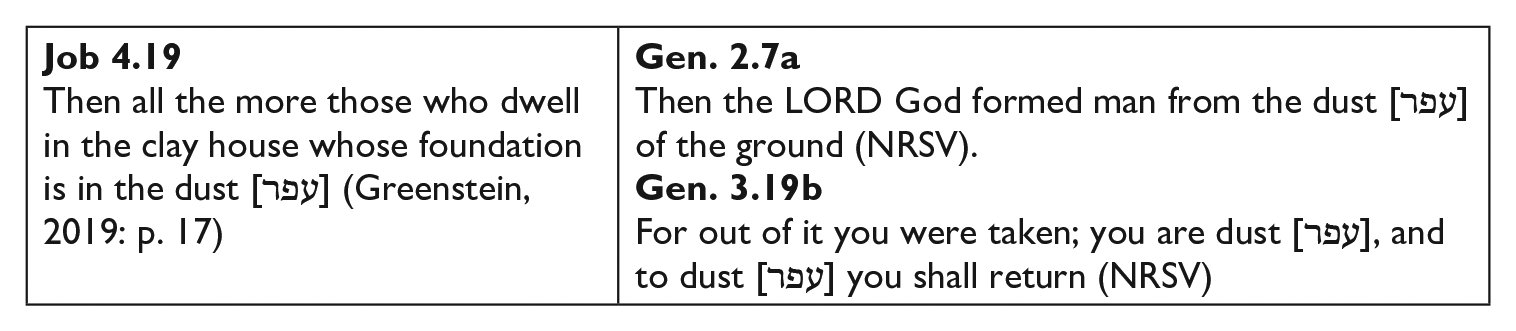
The evidence from a linguistic point of view is based upon the reading of עפר in the three texts. In addition to the literal meaning of עפר, in other words, loose soil (HALOT II: pp. 861–862), it is also used metaphorically as an expression for an innumerable group of people, worthlessness, devastation, and humiliation (Wätcher, 2001: pp. 261–262). Thus, it carries both literal and metaphorical meanings in the Hebrew Bible.
In Gen. 2.7a, עפר is used in its literal sense, in other words, the soil. However, the figurative sense of the word that implies the perishability of the human body cannot be ignored. In Gen. 3.19b, the word is used twice, first, in a literal sense and then in a metaphorical way—reminding human beings of their impermanence—which also has a literal sense attached to it. As for Job 4.19, it belongs to the tradition of texts in the Hebrew Bible that emphasize humanity’s creation from dust as a sign of their weakness (see Ps. 103.14; Ps.104.27; Qoh. 3.20). Therefore, in addition to the linguistic similarities, a certain level of thematic correspondence between Gen. 2.7a, Gen. 3.19b, and Job 4.19 can be observed, that is, man’s creation from dust entails a notion of his perishability—an aspect particularly stressed in Gen. 3.19b and Job 4.19.
Another piece of evidence for a deliberate reference to Gen. 2.7 is the expression ‘the house of clay’ in Job 4.19. The reference to the human beings as ‘those who dwell in the clay house’ recalls the account of the creation of man from dust. The difficulty in arguing for such a connection is that these texts use different Hebrew words to narrate the formation of Adam: Gen. 2.7a uses עפר (dust), which is a different word from חמר (clay) used in Job 4.19. However, as both חמר and עפר have been used elsewhere in the Hebrew Bible in relation to human beings and their creation (e.g., Job 10.9; Isa. 29.16, 45.9, 64.7 [ET 64.8]), ‘clay’ may also have been used in the creation context in Job 4.19 (Sarna, 1989: p. 17).
Although there are a few indications that corroborate the claim for a relationship between Gen. 2.7a, Gen. 3.19b, and Job 4.19, the notion of a twofold reference in Job 4.19 to Gen. 2.7a and 3.19b seems speculative. On the other hand, assuming that such sophisticated literary artistry was beyond the authors of the book of Job may not be safe. Decisive, in this case, is a similar instance of a double intertextual reference to Gen. 2.7 and Gen. 3.24 in Job 10.9: ‘Remember that you fashioned me like clay; and will you turn me to dust again?’ (NRSV). Considering the use of the verb שוב in addition to עפר in both Job 10.9 and Gen. 3.19, the linguistic interrelation between these texts is very strong. This shows that the authors of the book of Job were not only aware of Gen. 2.7a and Gen. 3.19b but also conflated them in a twofold intertextual reference in a text other than Job 4.19. These observations lead to the conclusion that the reference in Job 4.19 to Gen. 2.7a and 3.19b is intentional and therefore can be interpreted as an allusion.
Eliphaz intensifies his pessimistic stance on anthropology by juxtaposing human beings with celestial beings. According to Eliphaz, heavenly beings cannot escape God’s acute judgment, and even they are prone to commit errors (Job 4.18). Eliphaz then turns to the fate of humanity in Job 4.19, wherein he alludes to Gen. 2.7a and Gen. 3.19b to substantiate his claim for the moral deficit of human beings. The creation of man from clay and their return to dust is viewed as some sort of evidence for humanity’s wickedness. Whether Gen. 2.4b–3.24 supports such a thesis is another question.
As is evident from the above-noted observations, Gen. 2.7 on its own does not corroborate Eliphaz’s pessimistic theology. This is likely why the allusion to Gen. 2.7a is combined with Gen. 3.19b in Job 4.19, as noted above. By alluding to Gen. 2.7a and 3.19b simultaneously, the authors succeed partially in eliminating the positive associations of Gen. 2.7; however, their claim in Job 4.17–19 that human beings are morally corrupt because they are made from perishable material is still unjustified.
Another striking aspect of Eliphaz’s argument is that its scope is universal, as the notion of creation from clay implies. The universal nature of his thesis is also implied in the choice of passages from Gen. 2.4b–3.24 as intertexts. If one reckons with this line of argument, it means that no human being can be morally upright. The allusions in Job 4.19 to Gen. 2.7a and 3.19b thus serve to polemicize against the notion of the suffering of the righteous. The authors again recall the creation imagery to draw attention to insights on human suffering that may have been otherwise ignored.
3.3 Job 5.6–7a and Gen. 3.17–19
Finally, the following linguistic relationship is observed between Job 5.6–7a and Gen. 3.17–19.
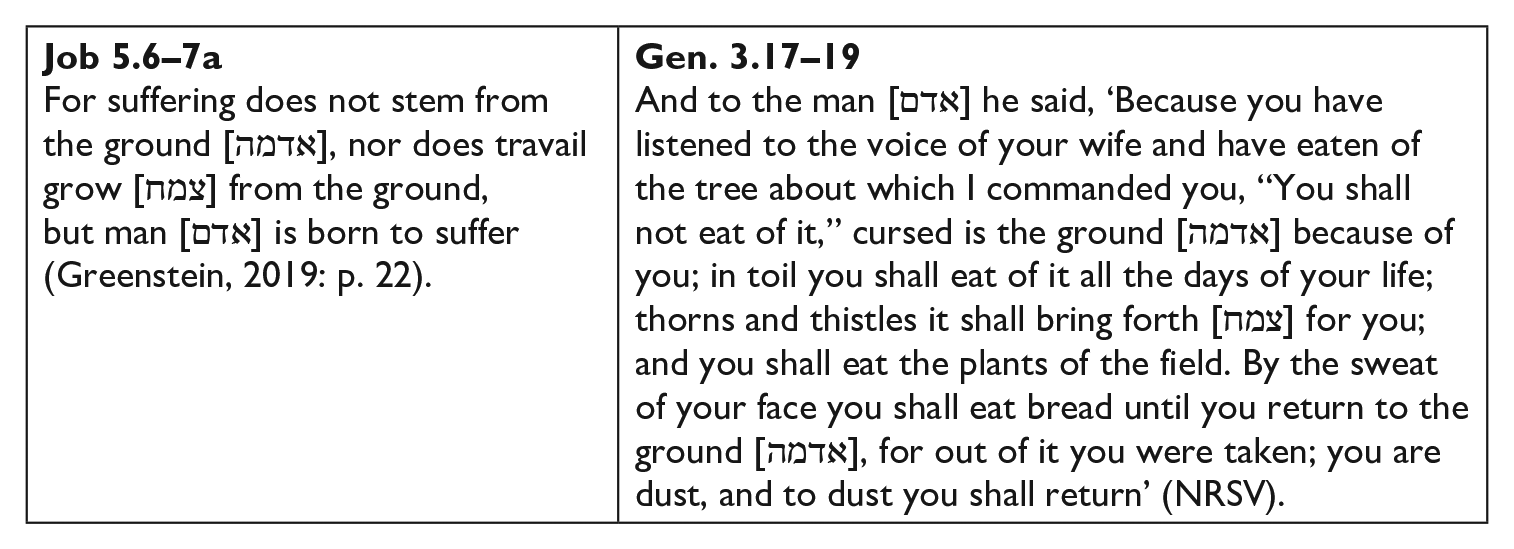
Though some have explored this connection (Perdue, 1991: pp. 119–120 and Balentine, 2006: pp. 114–116; Kynes, 2020: pp. 633–634), others have mentioned it without attending to the details (Habel, 1985: pp. 131–132; Clines, 1989: p. 141; Gray, 2010: p. 159; and Oeming, 2013: pp. 22–23). The amount of shared vocabulary between these texts is suggestive. The difficulty, however, is that the linguistic parallels between these texts, that is צמח ,אדם, and אדמה, appear frequently in the Hebrew Bible.
The question is whether there are clues that may show that the authors of the book of Job incorporated these terms deliberately. All of these vocabulary words occur frequently—with צמח appearing less (thirty-three times) (Ringgren, 2003: pp. 410–411) than אדם (five hundred and fifty-four) (Oeming, 2013: p. 21) and אדמה (two hundred and twenty-one) (Plöger, 1974: p. 89). Moreover, due to their diverse usage, the words acquired multiple meanings over time, especially אדם and אדמה. Nevertheless, this does not mean that Eliphaz did not allude to Gen. 3.17–19 by means of such widely used terms.
The following few observations are significant for this discussion. First, although צמח is predominantly used to refer to plant life in the Hebrew Bible, both Gen. 3.18–19 and Job 5.6 employ it uniquely to refer to the hardships of human beings. The curse on Adam in Gen. 3.17–19 suggests that the ground will produce (צמח) ‘thorns and thistles’ that entail physical suffering for humankind. Remarkably, Eliphaz also employs the term in the context of the pain that human beings experience. Noteworthy here is that Gen. 3.18 and Job 5.6 are the only texts in the Hebrew Bible that employ צמח metaphorically in the context of afflictions of humanity in general.
Second, אדמה does not appear in the book of Job as frequently as it does in the other sections of the Hebrew Bible. In the book of Job, only two instances are noted—Job 5.6 and Job 31.38. Why did the authors of Job 5.6 opt for אדמה as opposed to ארץ, a term that occurs far more frequently in the rest of the book? The usage of אדמה in Job 5.6 reflects a conscious choice and is compelling evidence that these two texts qualify as allusions.
Third, it has been noted that the language of the non-P creation account contains multiple wordplays (Stratton, 1995: pp. 163–167). One of these is the conspicuous wordplay between אדם and אדמה: Adam is taken from adamah (Gen. 2.7, 3.19), and he will also return to adamah (Gen. 3.19). In Job 5.6–7a, a similar wordplay is created by the placement of אדמה closer to אדם. This further strengthens the argument for viewing אדמה and אדם in Job 5.6–7a as an allusion to Gen. 3.17–19. Again, suggestive in Job 5.6 is the choice of אדמה over ארץ, as it shows that the authors of the book of Job may have employed these terms to echo the Adam–adamah wordplay in Gen. 2–3.
To illustrate the point made in Job 5.1, Eliphaz includes a proverbial saying in Job 5.2, which is followed by an anecdote in which Eliphaz narrates his encounter with a ‘foolish man’ (Job 5.3–5). An important aspect of Eliphaz’s short story relevant here is that his story assumes the law of retributive justice. Thus, the miseries of a ‘foolish man’ result from his own behavior—a notion that contradicts Eliphaz’s argument in Job 5.6–7a.
Although the theological principle that Eliphaz lays out in Job 5.2 is supposed to be validated by his anecdote (Job 5.3–5), his argument still lacks theological substance and therefore appears to be unconvincing. The allusion in Job 5.6–7a to Gen. 3.17–19 should fill this gap in his argument by undergirding his thesis theologically (Balentine, 2006: pp. 115–116). According to Eliphaz’s line of argument, the strict equation of the deed and consequence can be clarified by recalling Gen. 3.17–19, where disobedience to God brought destruction for the first couple. However, for the authors of the book of Job, Gen. 3.17–19 is more than a mere example, as the implications of Adam’s disobedience are far-reaching—the life experienced on earth contains pain and hardships for all of humanity (see below).
Eliphaz also echoes this pessimistic and universal tone of Gen. 3.17–19 in Job 5.7a (also Job 4.20–21). For him, Adam’s act of disobedience has consequences for the whole of humanity. This is not to suggest that God judges Adam’s children for Adam’s sins, as there is no indication of such a doctrine in Job 4–5. Admittedly, an element of such a theology can be seen in Job 5.4 where Eliphaz states that the children of a wicked man do not prosper (Job 5.4). However, the children of a wicked man are generally unfortunate because they face the consequences of the rebellion of their parents against God not because God judges them for the sins of their forefathers.
When Eliphaz’s line of argument is combined with his allusion to Gen. 3.17–19 in Job 5.6–7a, it implies that human beings experience suffering because they are born in a cursed world—regardless of whether they sin. Humanity in general is in an unfavorable relationship with God because of disobedience. The offspring of Adam are born under the bondage of hardship and are far removed from the presence of God. Thus, because Job is a human being, his suffering is neither unexpected nor unmerited.
4 Significance
How does tracing these allusions help in understanding Eliphaz’s theology of humanity’s creation? How is his theological stance on the notion of the deed-consequence nexus related to the overall message of the book of Job, and what is the significance of Job 4–5 when understood against the background of its historical setting? In addition to pursuing these questions in this section, I will show that a closer look at the allusions in Job 4–5 to the non-P creation account demonstrates they indeed help resolve the observed thematic tensions.
4.1 The Meaning and Implications of the Intertextual Reading of Job 4–5 and Gen. 2.4b–3.24
It has been noted in sections 3.1 and 3.2 that the authors of Job 4–5 recall the imagery of the creation of man (Job 4.9, 4.19). In both of these allusions, they reject the compassionate God of Gen. 2 and twist the text to emphasize the inadequacy of human beings. Undoubtedly, they are not unique in believing in humanity’s creation from dust. In this regard, they adhere to a widely known tradition in the Hebrew Bible. However, slight but significant variations are seen between their interpretation and its reception in other places in the Hebrew Bible (for instance, Pss. 103.14, 104.27; Qoh. 3.20). Noteworthy in this respect is that although Gen. 2.7 does not suggest by any means that the substance of Adam’s body implied his moral corruption, for the authors of Job 4–5, it does seem to offer ‘some kind of evidence for their [humans] lack of moral reliability’ (Clines, 1989: p. 134). Interpreting Gen. 2.4b–3.24 from this particular angle enables the authors to advocate for the moral deficit of the whole human race. Surprising yet commendable is their artistry through which they manage to derive negative meaning out of Gen. 2 to support their view.
Such interpretation of humanity’s creation has serious implications for the image of God. First, humanity is drastically lowered in rank in Job 4.19–21, even to the point where human lives seem to be worthless as ‘they perish forever without anyone regarding it’ (Job 4.20a; NRSV). This imposes an image of a condescending deity on God who is presented as more of a moral inspector than as an affectionate figure. Second, a moral defect is hinted at in God’s crafting of humans (Perdue, 1991: p. 118). It seems that, for Eliphaz, the issue of humanity’s damaged relationship to God is not a later development, as Gen. 3 reflects. Rather, the choice of material that constitutes a human being was flawed. Finally, God is presented as a deity who is paranoid and reactive and imposes a constant mistrust on his creation (Seow, 2013: p. 389). Furthermore, God sets high moral standards for human beings that are not achievable due to their limitedness (Habel, 1985: p. 129). However, this is not meant to provoke Job to rebel against God. After all, God is the sustainer of humanity (Job 5.10–16) and desires good for Job (Job 5.19–26). Thus, instead of whining, Job must turn to God (Job 5.8).
For Eliphaz, Job is always in need of discipline and reproof (Job 5.17–18) because he as a human being is distant from God (Gen. 3.17–19). It is evident from Gen. 3 that the banishment of Adam and Eve from the Garden of Eden naturally entails severe hardships (Levin, 2013: p. 58). The authors of Job read this so-called Fall narrative in a similar fashion by presenting it as an explanation for the suffering of Job and of the rest of humanity in general. The allusion to Gen. 3.17–19 in Job 5.6–7a accentuates the damaged relationship between God and human beings. The formation of Job from perishable material and the distance between him and God explains the inevitability of Job’s sin and suffering and God’s punishment as a pedagogical tactic. Thus, through these allusions, Eliphaz relegates the issue of Job’s piety to the margins. However, that does not render the deed-consequence nexus inapplicable in Job’s situation; it only implies that there may be other aspects to reality than what is known to Job.
4.2 Reading Job 4–5 Intertextually: A Case for Its Thematic Coherence
The argument of Eliphaz oscillates between the notions of suffering as a result of one’s wickedness and suffering as a universal phenomenon that has nothing to do with one’s behavior. This leads to thematic inconsistencies within Job 4–5 that can be briefly summarized as follows. Eliphaz’s anecdote and his theological principles do not cohere: if human suffering is an outcome of sin (Job 5.3–5), why is it experienced universally? (Job 5.6–7a). Furthermore, Rowley notes, ‘[5.7] appears to contradict verse 6. For here it would seem that Eliphaz says trouble comes naturally and inevitably to man, whereas verse 6 says the opposite’ (1970: p. 60). Some have solved this tension by revocalizing pual יוּלָּד to hiphil יוֹלִד, which changes ‘born’ to ‘beget,’ in Job 5.7a (Hartley, 1988: p. 116n10; Cotter, 1992: p. 202; Clines, 1989: p. 116; and Dhorme, 1967: p. 61). However, if this suggestion is accepted, לעמל becomes a challenge because it oddly translates as ‘man begets to suffer.’ Dhorme solves this problem by noting that ל acts here as a marker of the accusative case instead of a preposition (1967: p. 61). However, even if this emendation is accepted in Job 5.7a, it does not mean that Job 4–5 becomes a consistent unit conceptually. There is another similar thematic tension (see section 1): Eliphaz’s theology of retributive justice (Job 4.7–11) contradicts his thesis of humanity’s inability to be right with God (Job 4.17–21).
The foregoing discussion of allusions in Job 4–5 to Gen. 2.4b–3.24 offers a resolution of the conflicting trajectories in Eliphaz’s speech. Through allusions to the non-P creation narrative, the authors attempt to decipher the enigma of ‘righteous’ suffering as follows: God despite being the benevolent creator (Gen. 2.7) must actively punish the wicked (Job 4.9); the creation of human beings from dust and their damnation to dust following their disobedience (Gen. 2.7, 3.19) marks their fragility and moral inadequacy (Job 4.19); and the curse and expulsion of Adam from the Garden of Eden (Gen. 3.17–19) mean that every human being is born in an adversarial relationship to God, resulting in the suffering experienced universally (Job 5.6–7a). Therefore, no human being is above reproach; hence, Job’s claim of unwarranted suffering is false. This scrupulously formulated argument reveals that contrary to what one may observe on the surface level, the deed-consequence equilibrium cannot be disrupted. Edouard Dhorme similarly concludes Eliphaz’s argument, ‘Thus we have here the thesis of a traditionalist theologian [Eliphaz]: there is no man without sin, and there is no sin that goes unpunished but punishment is a chastisement that God sends to recall man to the good and thus to happiness’ (Dhorme, 1967: xxxvii).
4.3 The Deed-Consequence Nexus: Job 4–5 in Light of the Broader Context of the Book of Job
The book of Job is known for its ambiguous stance on various critical issues, including the connection between deed and consequence (see Schmid, 2007). One should not approach the book expecting a clear-cut ‘yes’ or ‘no’ answer to theological questions. Actually, the book of Job can be best explained as a text that successfully escapes such binaries and invites its readers to consider that there might be more to reality than what is observable. For instance, the speeches of God (Job 38–41) strongly emphasize the limits of Job’s knowledge and reveal to Job that his wisdom is inadequate for deciphering the mysteries of God’s rule.
This evasive attitude of the book of Job as a whole is also reflected in Eliphaz’s thesis regarding the efficacy of the deed-consequence nexus in Job 4–5. Avoiding a straightforward answer, Eliphaz addresses the conflict between tradition and Job’s lived experience on a more abstract level: whereas Job’s suffering may be personal, its construal is only possible when theorized while keeping the larger theological perspective in view. Thus, instead of outright rejection or acceptance of Job’s individual innocence or the efficacy of the deed-consequence nexus, Eliphaz points out there are other factors than individual sin that may be responsible for suffering, namely the inherent insufficiency to be morally upright and human beings’ predetermined destiny to die and suffer. Yet, God is not to be blamed for these harsh realities, because the allusions to Gen. 2.4b–3.24 show that these are the consequences of human disobedience. The key, according to Eliphaz, in reconciling the human condition to the theology of deed and consequence is that Job must move beyond his individual context and look for the missing pieces of the puzzle while keeping the broader theological picture in view. This viewpoint is seen even more explicitly in Eliphaz’s second speech in which he accuses Job of arguing from a fairly limited perspective (Job 15.7–8).
The opinion that Job has a limited view of reality is also seen in the other voices in the book of Job. Bildad subtly protests against Job’s narrow-mindedness and his reluctance to consider other perspectives (Job 18.2–4; also, Job 8.8–10). He assures Job that God rewards the upright (8.20–22) and punishes the wicked (18.5–21). In a similar vein, Zophar criticizes Job for trusting so steadfastly in his own doctrine (Job 11.4) and failing to realize that there are aspects of God’s rule and his dealing with human beings that cannot be fully perceived (Job 11.5–9). Like Bildad, he strongly argues for the theology of the deed and consequence nexus (20.4–29).
Another important voice is heard with the entrance of Elihu, Job’s fourth friend. Celebrating God’s just rule over the universe, Elihu, like the other three friends, also reminds Job of his limited vision of reality (Job 37.14–24). He lays particular emphasis, even to the level of absurdity, on God’s justice as already argued by the other friends (Habel, 1985: p. 53). However, no matter how ‘orthodox’ Elihu’s defense may sound, it cannot be considered the final voice in the book. The theophany in Job 38–41 that is yet to come serves as the final blow to Job’s self-confidence in his intellectual capabilities. God shows Job that his wisdom is inadequate for apprehending the complexities of the cosmos (Berlejung, 2015: p. 283). In this respect, God’s statements offer no new, ground-breaking insight but only accentuate the motif of the limitedness of human beings’ knowledge. On the other hand, unlike the arguments of the friends who develop this motif to advocate for the efficacy of the deed-consequence nexus, God does not expose the finiteness of human beings only to later offer a defense of the deed-consequence nexus. In fact, surprising as it may be, the speeches of God do not explicitly discuss the link between one’s deed and its consequence.
The narrative framework of the book of Job, which, most probably, was composed independently of the dialogue sections (Hartley, 1988: pp. 21–24), presents somewhat different views of the deed-consequence nexus than its poetic sections do. The opening of the book of Job challenges the traditional beliefs when the exchange of dialogue between God and Satan (Job 1.6–12 and Job 2.1–6) reveals that Job does not experience suffering because of his wickedness but is merely a passive victim of the contest between the supernatural forces. However, in the epilogue, the restoration of Job (Job 42.10–17) occurs only after his faithful confession in Job 2.10. Therefore, in the narrative framework, the deed-consequence nexus is not completely rejected or accepted but presented ambivalently (see Schmid, 2007).
Through this brief survey, it is clear that the different voices in the book of Job argue, in one form or another, for the inability of the human intellect to fully comprehend God’s wisdom. Moreover, that this shortcoming of the human beings also has a direct relation to how the theology of the deed-consequence nexus relates to Job’s situation. Occasionally, Job’s friends return to the motif of humanity’s intellectual inadequacy only to conclude that no matter what may appear on the surface level, Job’s suffering stems from his sinful behavior. On the other hand, God leaves the question of Job’s sin aside and stresses that he is but a finite human being. More particularly, Eliphaz in Job 4–5 demonstrates that the theology of the deed and consequence is in play in the world; however, Job’s piety or wickedness is of secondary importance to the debate on its efficacy. Hence, one should not simply reject or accept it based on the human condition but rather construe it in a more sophisticated manner.
These intriguing interpretations of the justice of God and human suffering and the creative reception of Gen. 2.4b–3.24 in Job 4–5 invite a discussion about the historical setting in which such a wide variety of opinions flourished. Interestingly, the book of Job presents an overt criticism of the doctrine of retribution that is suggestive of a period of crisis in which a mechanical understanding of the deed-consequence nexus crumbled. In this regard, the evidence for its composition in the postexilic era (see footnote no. 1) corroborates that it is a product of an era in which such doctrinal beliefs were contested and critically evaluated. From this angle, the various voices in the book might reflect debates that explore the reasons the exiles suffered under Persian rule (see Albertz, 1990). When the allusions to Gen. 2.4b–3.24 in the first speech of Eliphaz are understood against this postexilic background, it suggests that the exiled communities’ suffering did not have a direct relation to their sinful behavior. Instead, there were other theological explanations for their plight that explicated why these communities continued to live in exile—even though their generation was not directly responsible for bringing about such a catastrophe.
In the opening statement of his article, Eibert Tigchelaar states, ‘The narrative of Adam and Eve in the Garden of Eden receives no attention in the Hebrew Bible outside of Gen 2–3’ (1999: p. 37). Similarly, Michaela Bauks has also pointed out that this text ‘was not very important or influential in the Second Temple Period’ (2011: p. 155). It may be true that the other parts of the Hebrew Bible do not draw overt references to Gen. 2–3, but the notion that the non-P creation account plays no significant role in the Second Temple period seems to be an overstatement. Terje Stordalen has shown through a detailed analysis that the tradition of Gen. 2.4b–3.24 is represented in several other texts of the Hebrew Bible (2000: 305–454). In a similar vein, the allusions in Job 4–5 to Gen. 2.4b–3.24 discussed in this article denote that the non-P creation account was not only known to and used by the authors of the book of Job but also played an influential role in the debate on the efficacy of deed-consequence theology. Even more significant is the fact that, as discussed in section 3, the tradition seems to have acquired a certain level of credibility in the Persian period.
5 Conclusion
I conclude this article with the following:
The authors of the book of Job used several words that also occur in the non-P creation account, that is, נשמה ,עפר ,צמח ,אדמה, and אדם, in Job 4.9, Job 4.19, and Job 5.6–7a. Although these terms are frequently used in the Hebrew Bible, various features indicate a deliberate usage of these terms and thus support the case for interpreting them as allusions. Moreover, the pattern of allusions in Job 4.9, 4.19, and 5.6–7a to Gen. 2.7 and 3.18–19 which has been noticed is significant because it shows the authors repeatedly and critically engaged with the same verses in Gen. 2.4b–3.24.
The analysis of the purpose and function of these allusions shows that they are motivated by the need for an appeal to a textual and theological tradition of humanity’s origins and its suffering. This implies that at the time of the book of Job’s composition, Gen. 2.4b–3.24 was a well-known and influential tradition. The study of the literary placement of these allusions in the literary structure of Eliphaz’s speech demonstrates that the texts from Gen. 2.4b–3.34 are used for validating the wisdom sayings and personal claims. Job 4.7 is a rhetorical question, validated by a general observation (Job 4.8) and grounded in the theological tradition of Gen. 2.7 (Job 4.9). Similarly, Job 5.1 is a question followed by wisdom sayings (Job 5.2) and personal observations (Job 5.3–5) that are validated by an allusion to Gen. 3.17–19 (Job 5.6–7a). Finally, the allusion to Gen. 2.7 and Gen. 3.19 in Job 4.19 is used to validate the rhetorical question in Job 4.17.
These allusions are incorporated to offer a theological justification of the argument. The allusion in Job 4.9 to Gen. 2.7 strengthens the view that God is an impartial deity who is not driven by kindness and love but by an unceasing obsession to repay the wicked. Likewise, Job 4.19 builds upon the language of Adam’s creation and conjoins this language with ‘dust’ from Gen. 3.19 to argue for humanity’s impermanence and insignificance. Finally, the allusion in Job 5.6–7a to Gen. 3.17–19 aims to formulate a theology of human suffering in light of Adam’s fate.
I have argued that interpreting these texts as a compendium of allusions offers meaningful insights that help resolve the major conceptual conundrums in Job 4–5.
The nature of Eliphaz’s theology of the deed-consequence nexus aligns with the overall attitude of the book of Job, namely, that there is more to reality than what human intellect can construe. Various other voices in the book emphasize this motif to ultimately draw their conclusions about the efficacy of the deed-consequence nexus. Eliphaz in Job 4–5 attempts to widen Job’s theological horizons by recalling the creation and curse narrative with the aim of directing Job toward the broader perspective of reality.
Contrary to the scholarly opinion that the biblical literature produced in the Persian period does not reflect the knowledge of Gen. 2–3, the evaluation of the reception of Gen. 2.4b–3.24 in Job 4–5 demonstrates that it was well-known and influential during the composition of Job 4–5.
The study of allusions in Job 4–5 to Gen. 2.4b–3.24 also offers insights regarding the issue of the deed-consequence nexus in the postexilic era. Through these allusions, it is revealed that, according to Job 4–5, whereas there exists a connection between deed and consequence, other important factors besides individual disobedience may have contributed to the suffering of the exiles. So the continuation of the exile under the Persian rule is no reason to reject the theology of the deed-consequence nexus.
In Job 4–5, Adam is referenced to explain the suffering and the hardships of human life in general. According to the authors of Job 4–5, although all human beings are sinful, they do not experience suffering simply because they inherit Adam’s sin—as the later theological developments suggest—but because they are created from such perishable material as clay. Thus, whereas the authors demonstrate a remarkable, concrete view of Adam, there seems to be no indication that they thought in terms of theological categories such as a ‘prelapsarian’ or a ‘postlapsarian’ Adam.
Footnotes
Acknowledgements
This article is based on my thesis titled ‘Humanity’s Creation, Alienation from God, and Suffering in the First Speech of Eliphaz: An Intertextual Study on Job 4–5’s Usage of Genesis 1–3’ completed in 2020 at Evangelische Theologische Faculteit, Leuven, Belgium. I thank Prof. Dr. Koert van Bekkum for supervising my master’s thesis and offering feedback for this article.
I would also like to acknowledge and thank my doctoral supervisor Prof. Dr. Annette Schellenberg for commenting on an earlier draft of this paper. Also, my conversations with her on intertextuality between Job and the Priestly source were extremely helpful to me while I wrote this article.
