




Abstract
Child rights belong to all children under the age of 18. However, the recognition of infants as rights holders still challenges many practices in child welfare. This article focuses on infants’ rights in alternative care and explores them through the views of the practitioners who are involved in developing – and advocating – rights-based alternative care in Finland. Based on 15 interviews with foster carers, social workers and other practitioners, the study analyses motivation, advocacy practices and the present state of infants’ rights in care. The findings demonstrate that motivations for advocating for infants’ rights in care are driven by the recognition of shortcomings in practice related to the standardisation of legal norms and othering infants in care regarding their needs for development, theoretical and legal learning as well as personal history. Advocacy is embodied, institutional and structural and mainly takes place through role-modelling. The study suggests age-aware expertise and related organisational arrangements to acknowledge infants as rights-holders in mainstream practice.
Plain language summary
Although child rights belong to all children under the age of 18, the recognition of infants as rights holders is problematic for many practices in child welfare. The studies in this area frequently describe infants in care as being ‘invisible’ and highlight that their rights, as defined by the Convention on the Rights of the Child (CRC), are not well recognised. In this article, the focus is on a group of child welfare practitioners who aim to develop and advocate practices to support infants’ rights in Finland. Based on interviews with 15 foster carers and social workers, the study analyses their motivation, advocacy practices and the present state of infants’ rights in care. The findings highlight a variety of shortcomings in infants’ rights. The shortcomings motivate practitioners to change practices regarding infants’ contacts with parents and placement changes in particular. The forms of advocacy vary from embodied and institutional advocacy to structural advocacy to change legislation. The study suggests that age-aware expertise is needed to acknowledge infants as rights-holders in mainstream child welfare.
Introduction
Taking babies and infants into public care is one of the most difficult decisions child welfare authorities have to make (e.g., Ruiken, 2024; Ward et al., 2006). Child welfare removals are consequential for children of any age and even more so for very young children. The decisions to separate infants from their birth parents are made with the anticipation that the children’s wellbeing and safety would be better supported in alternative care than in their birth parents’ care. Therefore, the experience of alternative care for infants is not unimportant.
Family-based care is instructed by the United Nations (2010) Guidelines for the Alternative Care of Children to be the preferable form of alternative care for young children, especially those under the age of three. Family-based care is provided by foster carers and in some jurisdictions by adoptive families as well. Infants have the same rights guaranteed by the Convention on the Rights of the Child (CRC) as children of any age. Nevertheless, studies frequently describe infants in care as being ‘invisible’ and highlight that their rights are not well recognised (Bilson and Bywaters, 2020; Križ et al., 2022; Magruder and Berrick, 2023; Ward et al., 2006). Adequate changes are needed to promote their rights in care. One should, indeed, ‘advocate advocacy’ for the rights of infants in care.
Advocacy in social work in general is a means of overcoming powerlessness, focusing on the rights of service-users by making their voices heard and enabling their participation (Scourfield, 2021). In the case of very young children, the notion of ‘voice’ is complex as it does not fit into the standard of word-based institutional practices and therefore infants have even fewer opportunities to participate in child protection than older children (e.g., Gal and Duramy, 2015; Križ and Petersen, 2023; Lundy, 2008; Törrönen et al., 2023). The role of adults as advocates for introducing changes is thus inevitable, and their skills, values and practices become important in the advocacy for infants’ rights. One group of practitioners advocating for infants’ rights in care exists in Finland and provides the impetus for this study. That group of practitioners, described in more detail later in the article, develops rights-based practices with infants, from birth to two years old, who are in alternative care. The aim of this study is to learn what motivates these practitioners to advocate rights-based practices. The motives are approached here as personal standpoints on the rights of children, which are a mixture of professional and personal experiences and knowledge (Lefevre, 2015; White, 2007), studied by interviewing people involved in that advocacy group. While exploring the motives for rights-based practice, the study will also delve into the present state of the rights of infants in alternative care as seen from the point of view of advocacy. As a result, the study will provide insights into the seminal but less studied rights-based practice in alternative care with infants. First, the framework for studying infants and their rights will be presented, followed by the description of the research design.
Infants’ rights in alternative care
Although all children below the age of 18 belong to the category of children whose rights are recognised and promoted by the CRC, in 2005 the Committee on the Rights of the Child published a separate comment about implementing child rights in early childhood (General Comment No. 7). The Committee realised that very little information had been offered about early childhood in the States parties’ reports, and this realisation directed the Committee to publish the comment. The Committee noted that respect for young children’s agency is frequently overlooked or rejected as inappropriate on the grounds of age and immaturity. Nevertheless, even young children, as individuals as well as groups, should be treated as rights-holders and respected as persons in their own right. The Committee pointed out that early childhood is a critical period for realising children’s rights due to several reasons. These include young children experiencing the most rapid period of growth and change during the human lifespan; young children forming strong emotional attachments to their parents or other caregivers; and children’s earlier years being the foundation for their physical and mental health, emotional security, cultural and personal identity, and development of competencies (General Comment No. 7, 2005: 3).
Those reasons underline the uniqueness and importance of the early years and, inevitably, parental and public responsibilities to promote children’s development and wellbeing. If young children need special protection as a result of abuse and neglect, ‘the Committee urges State parties to incorporate the particular situation of young children into all legislation, policies and interventions to promote physical and psychological recovery and social reintegration within an environment that promotes dignity and self-respect’ (General Comment No. 7, 2005: 18). The Committee stated that if alternative care is needed, early placement in family-based or family-like care is more likely to produce positive outcomes for young children than institutional care. It further elaborated that: States parties are encouraged to invest in and support forms of alternative care that can ensure security, continuity of care and affection, and the opportunity for young children to form long-term attachments based on mutual trust and respect, for example through fostering, adoption and support for members of extended families. (General Comment No. 7, 2005: 17)
Nevertheless, still in the 2020s, it is reported that the rights of young children are not thoroughly recognised in alternative care. The Nordic welfare states, for example, support families with young children through universal benefits and services and are orientated to child welfare from a child-centric perspective (Pösö et al., 2014), but infant removals and their rights are in some ways an unspoken anomaly in the Nordic child welfare systems. This conclusion was drawn in a study analysing public policy, practice guidelines, research and statistical information of infant removals (infants under two years) in four Nordic countries (Denmark, Finland, Norway and Sweden) (Hestbӕk et al., 2020). Although there were some differences across the countries regarding the prevalence of infant removals and legal and policy guidelines, in general the study reported scant policy and research interest in the rights of infants. Finland, the context of this article, stood out as a country in which the lowest number of infants was removed into public care by care order decisions, but this was not the case if other forms of removals (e.g., emergency removals) were also considered (Hestbӕk et al., 2020).
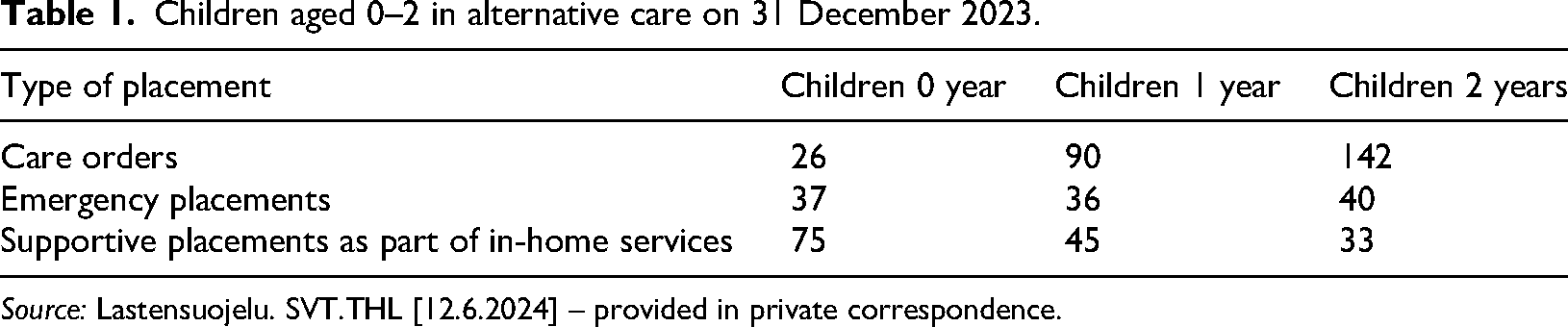
Furthermore, while there are a variety of services for families with infants in Finland, child removals and alternative care, as such, have not been strongly present in the agenda of policy and research (Flykt et al., 2020). The low number of children under the age of two in care could possibly explain the lack of attention. Table 1 demonstrates the numbers of children between the ages of nought to two in alternative care, including all removal types on one day in 2023: children who have been taken into care by a care order decision restricting parents’ rights and responsibilities; children who have encountered immediate danger and who have been taken into (short-term) emergency placements; and children who are voluntarily placed in supportive placements, for example, in family rehabilitation centres or mother–child units (often together with their parent/s). Adoption is not a removal option provided by the Child Welfare Act in Finland and is therefore not included in the table. When looking at the most intrusive placement type – care orders – the number of children under the age of two was 258 in 2023, about two percent of all children in care. The use of care orders has remained stable since the year 2000; during that period, each year, 0.2% of all children in the nought to two age group have been taken into care (Sotkanet, 2024). It is, however, common that before the care order decision, other types of removals have been implemented, suggesting that infants have experienced a variety of changes in the caregiving environments before they are taken into care (Flykt et al., 2020).
Children aged 0–2 in alternative care on 31 December 2023.
Source: Lastensuojelu. SVT.THL [12.6.2024] – provided in private correspondence.
As Table 1 demonstrates, the group of infants in alternative care is small in number, suggesting that practitioners may not meet infants in alternative care frequently. As a consequence of the small number of infants and the limited policy and research interest, the focus of this article is not a mainstream topic of child welfare in Finland. Nevertheless, as every infant is entitled to the recognition of their rights in alternative care, rights-aware practice is essential for their path in the child welfare system.
Advocacy for alternative care for infants
Advocacy in social work is about empowering the rights of those who are vulnerable, powerless and lack control (Scourfield, 2021). It may include practitioners, managers and service-users. The forms and skills required in advocacy vary in different historical and social contexts. Nevertheless, each individual as a practitioner makes a personal choice regarding the ways and extent in which advocacy is incorporated in practice in their specific institutional context (e.g., McCallum and Prilleltensky, 1996). Advocacy for children’s rights challenges adult-focused practices, skills, methods and ethics, and the inclusion of children as service-users with their own rights and agency has been seen as requiring changes on many levels (Delgado et al., 2023; Kennan et al., 2018; Križ et al., 2022; Toros, 2021). When advocating for children’s rights, the very notion of ‘family’ may also need to be redefined as care-giving relations in alternative care do not follow the conventional biology-based family definition (e.g., Boddy et al., 2023).
Regarding practice acknowledging children’s rights, it not only matters what practitioners do but who they are. This refers to the person inside the practitioner and how that person relates to the task at hand (Lefevre, 2015: 3). Consequently, personal approaches to such issues as ontology, epistemology, theoretical base, values and beliefs, ethics and codes of conduct, personal qualities and capabilities, skills and techniques as well as the professional practice context are important (Lefevre, 2015: 90–95). When working in child welfare, it matters how practitioners see, for example, their own view on children and childhood and their professional role and obligations as well as the theoretical knowledge that informs their orientations towards children and services. According to Jennifer White (2007), practice (or ‘praxis’ in her terminology) that is ethical, self-aware, responsive and accountable involves the reciprocal integration of knowing, doing and being. In her view (White, 2007; see also Lefevre, 2015), ‘knowing’ consists of knowledge, which is complex, diverse and contextual. A variety of skills and competences, such as interpreting meanings, acting and self-reflecting, articulating and justifying, collaborating and deliberating with others and critical thinking among others, are embedded in ‘doing’. ‘Being’, on the other hand, addresses the embodiment of values and virtues as well as ways of being in the world. Self-awareness, relationality, collaboration, curiosity, situationality and accountability are features that belong to the concept of ‘being’. In the child welfare context, knowing, doing and being in their diverse manifestations suggest that there is no fixed way to know, do and be in practice.
The focus of this article is at the juncture of knowing, doing and being that makes some child welfare practitioners advocate rights-based practice with infants. The infants’ rights in care as seen by advocacy practitioners are studied empirically. The focus is on one particular project and group of practitioners, created by the non-governmental organisation (NGO), Pesäpuu, which carries out a variety of non-statutory activities in child welfare nationally in Finland. The project ‘Little Tigers’ aims to empower infants in care by enhancing their rights and participation as well as developing practices that function accordingly. It is supported by a grant provided by the Funding Centre for Social Welfare and Health Organizations for 2023–25. There are 2.5 developers paid by the project, working with practitioners from statutory services of child welfare and several other NGOs in different parts of Finland, including social workers, psychologists, foster carers, therapists, legal experts and managers of services, among others; 50 members in total. These practitioners participate in the activities as part of their ordinary work without any extra remuneration from the project. The mode of developing rights-based practices includes the view that infants should be included as active agents in child welfare and that they should also have an impact on the development of practice. The inclusion of infants in developing practices is unusual and reinforces the specific character of this project. As the project involves practitioners who stand out from the mainstream approach to infants in care in Finland, and as similar projects are well-known in literature, it is important to learn about their views on infant rights and their motivation for rights-based alternative care.
Methods
The study rests on the qualitative paradigm and, accordingly, on situated and subjective knowledge (Braun and Clarke, 2021: 5). The data consist of 15 interviews with child welfare practitioners who had joined the development project ‘Little Tigers’ to promote the rights of infants in care. The interviewees include foster carers (6), social workers (5) and developers involved in developing practices in child welfare (4). Both the foster carers and the majority of the social workers work directly with infants, but some social workers mainly work only with foster carers to support them in their daily practice. The foster carers interviewed provide either long-term, short-term and/or emergency care. Four interviewees in their roles as developers approach infants’ rights more as ‘group rights’ as their contact with individual infants is more indirect. The majority of interviewees have several years’ experience of child welfare, and infants have only been one group of children with whom they have worked. The interviews, lasting between one hour and one-and-a-half hours, were carried out in autumn 2023 in different parts of Finland either over Microsoft Teams (7) or face-to-face (8), following the wishes of the interviewees. The face-to-face interviews took place in the child welfare agencies or foster homes.
The interviewees were recruited from the project participants after a research permit was granted by the NGO in charge of the project, including the acceptance of the plans for data protection and ethics of the study. 1 The recruitment was based on an invitation shared in the group by email after the author of this article attended the project meeting to explain the study. The interviewees were in line with the overall profile of the project participants with one exception: the members in managerial or therapeutic positions did not join the interviews. However, as so many practitioners in close contact with infants volunteered to join the study, the group of interviewees could be seen as being relevant for the purpose of this study.
The semi-structured interview scheme started with questions about the interviewees’ present tasks regarding infants in care and the role of rights-based practice in their own approach to child welfare. The themes that followed were about the interviewees’ views on infants, infant rights in care and the personally important knowledge base guiding practice, ethics, values, skills, methods and the organisational contexts of their practice. The interviews were voice-recorded and transcribed in Finnish (with selected excerpts translated into English for presentation in the Findings below). The transcribed data form 326 pages.
Thematic analysis in its more reflective than technical form (Braun and Clarke, 2021) has been used for the analysis of the data. The analysis focuses on the interviewees’ views on what infants’ rights are in care (‘knowing’), what motivates them to promote infants’ rights (‘being’) and what is done to promote infants’ rights (‘doing’). The sections of the interviews addressing ‘knowing’, ‘being’ and ‘doing’ were first separated from the main data corpus and coded inductively; the codes were grouped into themes (e.g., patterns resting on a shared idea, meaning or concept; Braun and Clarke, 2021: 8). As the interview contents were quite similar, the same codes (e.g., ‘shortcomings of rights’ or ‘being attuned’) were repeated across interviews. Due to the small number of informants and related confidentiality issues and the similarities across the interviews, the analysis does not separate the different groups of informants. It will, however, be remarked upon in the Findings below if relevant to the topic or interview extract whether the speaker is a foster carer, social worker or developer. The themes included in ‘knowing’, ‘being’ and ‘doing’ are described in the following section, which will be followed by their more interpretative reading in the Discussion section.
Findings
Infants’ rights in care (knowing)
When talking about the rights that infants have in care, the rights of protection, safety and participation were frequently mentioned by the interviewees. They remarked that infants should be free from neglect and abandonment, and should have support to grow up safely. They should also be active participants in their care arrangements even though they do not possess the verbal tools to participate. The interviews underscored that the recognition of infants’ rights rests on adults’ awareness and willingness to be sensitive to, and interpret, the messages infants share in interactions. In addition to those formally worded rights, the participants addressed a variety of rights in their own words reflecting their experiences of being with infants every day as follows: infants should have the right to be at the centre of attention and admiration in any social interaction or bureaucratic decision; they should have the right to have documented memories of their infant years and to be treated as a baby who is growing up instead of ‘a placed child’; and they should have the right to smooth transitions from one placement to another if needed, with those transitions supported in an infant-friendly way.
The overwhelming theme that arose on how to address infants’ rights in care was, however, to talk about the shortcomings of rights: infants’ rights were said to have been overshadowed by their parents’ rights and organisational practices. Several interviewees noted that when an infant is taken into care, it means that their rights have not been acknowledged by their birth family. Nevertheless, even public care may be organised so that infants’ individual rights are not considered. Some used forceful language to state that for some children, their rights are damaged rather than protected in public care. Two shortcomings were frequently remarked upon in the interviews: one about the contact with parents, said to be overruled by parents’ interests; the other one about the legal and organisational set-up of infants’ placements in care.
Legally, contact between children and their parents (and other close ones) should be supported in alternative care, and only harmful contacts may be restricted by a formal decision (Child Welfare Act 417/2007). Consequently, infants meet their parents frequently, as highlighted in the interviews. As there may be long distances between the foster home and parents’ home (occasionally supervised meeting places), travel is needed. It is often the infant and their foster carer who travels; the term, ‘travelling babies’ was often used in the interviews. The first extract describes a situation in which the infant meets their parents, now separated, living far away from their foster home. In everyday life, this means that the child spends much of their time in care sitting in a car travelling to meet the parents: Regarding contact, I wonder why a child has to sit in a car for three-and-a-half hours to attend a meeting with their parent for two hours. I understand that it is an opportunity to build a relationship but I think it is quite tough for this child, for example, to sit in a car for three-and-a-half hours on Wednesday every second week and then again on Friday for two hours to meet the other parent. I think it is quite a long time to just sit in the car. It happened that the other parent had just moved so that there have to be these two long journeys to different destinations. (Interview 9)
The second interview extract informs about a child whose contact with their parents and other relatives includes frequent visits, even overnight. The interviewee, a foster carer, expresses the view that the frequency of those visits does not follow the common guidance given to any families about infants’ time spent away from their primary caregiver: Permanence and peace of some kind are important but children who are in care are not considered in the same way as other children of the same age. Take sleepovers as an example. The general recommendation is that the baby could be away from the primary carer for as many nights as they have years. When the baby is in alternative care, it is considered to be alright to spend three nights away from the foster home in a week. But the developmental needs do not change when you are in care. Why would they think that a baby in care would not need that peace and permanence of contact that other babies need? (Interview 13)
The critical views about contact and how it is organised included concerns about favouring parents’ wishes for contact instead of infants’ needs for tranquility in everyday life. The target of the criticism was legislation and the ways in which it is implemented. The recognition of parents’ rights in legislation and related decisions was also key to the other major shortcomings of infants’ rights repeatedly addressed in the interviews: that is, how little attention is given to infants’ rights in general in alternative care arrangements and organisational set-ups. The Child Welfare Act defines placements as only temporary with family reunification as the main target and stipulates that in-home support services should be prioritised over placements in care; this results in frequent placements and transitions back to parents’ care. In the interviews, placement in foster care was described as ‘a parking place’ used by the authorities while they wait for the parents to change and take care of their child again. The transitions between birth parents and foster homes often happen without any opportunity to support infants in transition; there is no time to let the infant gradually familiarise themself with the new caregiving place or to guarantee that familiar items and toys with familiar smells and textures are taken along to the next place. In several local contexts, the infant will not return to the previous foster home after an unsuccessful unification with their birth parents. The metaphor of a parcel (see also Andenaes, 2012) is used in the following extract: Babies are not like parcels which can just be moved around. They react to changes, some more than others. I’ll give you one concrete example. I picked up a newborn from the hospital, it was an emergency case. They met once a week with the parents and I was in another room during their meetings just in case the parents needed help. Then the meetings stopped after a while – after a month or two – as the parents did not have the energy to meet with the baby. The baby lived with us without seeing any parent until the mother announced that she wanted to go to a mother–child home and the baby should join her just that very second. We did not have any time to prepare the baby. The baby left from here with a stranger – who happened to be their mother – to a new place. They stayed there for four months and then the baby came to us as an emergency placement as the mother was in such a poor state. After a while, the mother was better and wanted to have the baby with her again, and then the baby left again in a hurry. I am so critical about the ways children are moved like parcels. (Interview 9)
In this extract, the infant returns to the previous foster home, which is not common practice. Some foster carers reported that they sometimes meet infants they have fostered previously when they meet other foster carers in their local contexts. For a foster carer, this is a sign that the decision to unite the infant with their parents has been unsuccessful and that the infant has encountered a new caregiving environment with new people – again.
Motivation to promote infants’ rights (being)
The interviewees had joined the ‘Little Tigers’ project based on their own interest and, in general, they described the project as a welcome opportunity to discuss and refine their practice with infants. Although they all worked in child welfare organisations, they recounted there was not enough infant-specific knowledge and awareness in their everyday surroundings. Some had smaller teams in their organisations or partners in child psychiatry, for example, to discuss the specific issues regarding infants in care. The rights-focused practice is not, however, common, and they indeed viewed their rights-focused practice to be outside the mainstream practice with infants.
The motivation to promote infants’ rights in care can be divided into three themes. Firstly, many interviewees described their personal attitudes about infants as being important and noted that they were emotionally drawn to infants and their care. Such personal standpoints have a long history: some interviewees described how they had grown up in large caring families which had taught them to value childhood, whereas some shared less supportive childhood experiences. Almost all interviewees had worked in other childcare practices before entering child welfare services. This personal standpoint also included a variety of values attached to infants and practice with infants: the uniqueness of each child, the vulnerability and dependency of infants, and the importance of the early years were often mentioned as values guiding their interest in infants’ rights.
Secondly, the motivation was based on a critical awareness of shortcomings in children’s rights in care, as described in the previous section, and an interest in promoting changes to support children’s wellbeing. It emerged from the interview data that if children’s rights are neglected, children’s wellbeing may be at risk. The implications of poor practice are described in the extract below, which follows on from a description of the hesitation of the child welfare authorities to separate a child from their mother: When the child came to us, there were signs of depression in them. I thought that the baby was at their upper limit for coping, they were so depressed and had these moments of withdrawing from contact. When the mother did not respond to the baby’s eye contact or sounds, the baby turned away and, in a way, left the place with their eyes closed. (Interview 3)
Thirdly, the interviewees described how their personal motivation and experiences of shortcomings were supported by their reading of theories of child development and/or children’s rights. Attachment theory was often mentioned as informative about infants’ needs. After becoming familiar with the CRC and the idea that every child is a rights-holder, even the Constitution of Finland was a motivator to develop rights-based practice with infants, as one interviewee put it. Reading and theoretical learning were personal exercises inspired by participants’ interest in learning more. Some stated that they had read everything they could find about infants. Only very few remembered relevant learning during their professional education.
Promoting infants’ rights in practice (doing)
‘Being attuned’ to infants’ rights is a core feature of practices promoting infants’ rights. ‘Being attuned’ means that the focus is on infants, and their needs, rhythms, characteristics and relations are given the primary attention in practice. Some participants used the term ‘baby spectacles’ to highlight that one should see the world and child welfare practices through the infants’ eyes, that is, from their position – and act accordingly.
Foster carers in particular described being attuned to many details. It is a mundane, often embodied awareness of the infants’ wishes – whether the infant likes to be held upright or whether the infant wants to sleep close to the carer’s body – and materialising those wishes. Breathing together in the same rhythm is one example of close bodily tuning; the term ‘conscious presence’ was often expressed in the interviews. ‘Being attuned’ helps to interpret the messages infants share about their wishes. It is not, however, always easy to interpret these messages if the infant has just arrived or the infant is not responsive. On an institutional level, practices can also be attuned towards infants as highlighted by the next extract in which the interviewee speaks about placing the infant at the centre of attention: This participation does not only mean working with the baby but it is also about how we see the baby when we work with adults. And how adults speak about the baby and to the baby. If we, for example, draw a map of social relations, it is essential to look at the map from the point of view of the baby. It may be that someone who is close to the mother is not so close to the baby. The map might look different to the baby. (Interview 10)
For social workers and developers, ‘being attuned’ also means other activities: creating awareness of children’s rights among child welfare practitioners; developing methods and tools for practices to acknowledge infants’ needs and rights; and influencing organisational mindsets to see existing practices and rhythms through ‘baby spectacles’. ‘Baby spectacles’ would require the authorities to reflect on institutional practices in general, and transitions in and out of placements in particular, through the needs and rights of infants. There were some quite mundane suggestions for organisational improvements: for example, that social workers’ holidays or absences from work should not prolong the actual placement as weeks and months matter in a child’s time. Likewise, some concrete suggestions were raised about storing personal information (e.g., photographs, drawings, anecdotes of everyday life) in the client-information systems to document infants’ early years. Furthermore, some interviewees mentioned changes in legislation as important conditions for the better promotion of infants’ rights. In their view, legal changes were needed to put infants’ rights before those of the parents.
‘Being attuned’ was said to require a greater understanding of the importance of infants’ rights than detailed skills or methods: understanding is based on the recognition of the human value and dignity of each infant. Although all practitioners working with infants can be assumed to be similarly attuned to infants, it was a view shared by many interviewees that interprofessional and interagency cooperation could sometimes be challenging. In their view, the issues regarding infants in care were not well known among all practitioners. Several participants reported that it was difficult to get the developmental features of infants properly assessed as sometimes healthcare specialists only referred to the trauma caused by the placement and thus did not examine the child thoroughly. The next extract illustrates these concerns, as raised by a foster carer: We have at the moment a little boy who has started showing some signs of special needs. I wonder whether the needs are related to the fact that he is placed in care or whether they are of a neuropsychological nature. I have been thinking of this issue for some months now. I wonder how to get a better understanding of his needs. He is so young after all. But I will not consult the child clinic as they are not familiar with children in care, and they would not take him seriously as he is so young. But I think it would be so good to provide him appropriate support as early as possible. It could, however, also be the contacts with his parents causing all this; he is always poorer after the meetings with his parents. (Interview 4)
Similarly, some child welfare authorities were also described as using the trauma of separation as the reason for infants’ behaviour, ignoring the concerns of those who were close to the child regarding the developmental delays or the harms caused by the contacts with parents. The interviewees expressed concerns that sometimes this may create obstacles in obtaining help and support for the infants.
Discussion
As demonstrated above, advocacy for infants’ rights in alternative care is a mixture of personal commitment to the rights and values of individual infants and infants as a unique group of children, practice-informed critical awareness of the shortcomings in infants’ rights in the present Finnish child welfare context, and child-sensitive embodied and institutional practices with infants. The mixture comprises ‘knowing', ‘being' and ‘doing' in a complex way, with criticism of the mainstream practices as the shared motivation for advocacy.
The criticism of the mainstream practices by those interviewed for this study focused on the lack of recognition of the rights of infants by pointing out primarily how child welfare legislation is implemented by child welfare authorities. The norms about family reunification, the maintenance of contact during the placement and the temporary nature of care orders were mentioned as the norms that may cause authorities to make decisions without considering their impact on the specific needs of infants and, consequently, to ignore the child’s best interests and rights. The core of the criticism is interpreted here as being about the standardisation of the legal norms and othering of infants in care.
The standardisation of the legal norms was most evident in the participants’ accounts of contact maintenance. The frequency of weekly or so contact, reported by the interviewees, is not a norm or recommendation found in legislation or national guidelines for child welfare; nevertheless, this frequency appeared to be a routine decision in the informants’ views. The importance of contact is clearly stated in the Child Welfare Act (Section 54) as the child’s right to meet their parents and other close people, stressing that the child must be guaranteed human relations that are important, continuous and safe for their development. The Act does not specify the frequency of contact but obliges public authorities to support and promote contact between the child and their parents and other persons close to the child to serve the child’s best interests. The Handbook for Child Welfare, which provides guidance nationally about how legislation could be implemented, underscores that it is important to assess the frequency and nature of contact in each individual case and make agreements with the parties accordingly (Terveyden ja hyvinvoinnin laitos, 2024). In contrast to the Act and guidelines, the findings of this study suggest that there seems to be a routine in practice to define the frequency of contact as weekly or so. In general, routine decisions often facilitate the difficulties in assessing individual care to meet the institutional norms in frontline practice (Lipsky, 1980), and they may develop into standards that are treated as being as essential as legal norms (Ponnert and Johansson, 2018). This standard of the frequency of contact, problematic as it was, was seen by the interviewees as a lack of courage among the social workers making contact decisions: if parents wish to meet the child frequently, social workers follow their wish in order to avoid disagreements and possible appeals, which the parents have a right to submit. Disagreements with parents are often viewed as signs of failure of ‘good social work’ by Finnish social workers (Enroos et al., 2022). Courage would inevitably be needed as the harmful nature of contact is much debated, and the signs to ascertain its harms in children are contested in child welfare (Ainsworth and Hansen, 2017); even attachment theory as a foundation for decisions is contested in some contexts (White et al., 2020).
Othering, on the other hand, means that infants in care are treated as being different from their peers at the same developmental stage. Othering takes two forms in the findings of this study. First, when decisions are made about the frequency of contact, family reunification and readmissions in care, the developmental needs for stability of relations and tranquility of everyday life, shared by any infant at that age, are not acknowledged. Instead, the standardised interpretations of the legal norms of ‘maintenance of contact’ and support for family reunification become more essential than the stability of everyday life and caring relations. Secondly, contrasting to some extent with the first form of othering, the signs of discomfort, developmental delays or abnormalities may be treated as signs of separation from parents, suggesting that the position of being in care provides a framework within which to interpret the symptoms. This form of othering may exclude infants from services (e.g., structural othering in/for services – c.f., Jacob et al., 2021). Due to these forms of othering, some developmental needs of the infants in care may not be fully acknowledged and supported during their early childhood in care, which is in contrast to the guidelines by the Committee on the Rights of the Child (2005: General Comment No. 7), for example.
Regarding the promotion of the rights of infants, advocacy in this study is embodied, institutional and structural. In contrast to advocacy in the sense of resistance (c.f., Dalrymple, 2003), it resembles the model of advocacy termed ‘role modelling’ by Scourfield (2021: 122–123): role modelling good practice, the willingness to share knowledge and, generally, being open and approachable. Embodied advocacy is about practice with infants in their daily life, respecting the individuality of each infant in their ways of sleeping, breathing and interacting with others, and doing it in such a way that the child’s needs and rhythm determine their care – that is, creating child-sensitive alternative care day by day. Embodied advocacy also highlights that infants’ own rhythms of sleep and need for tranquility should be acknowledged when organising visits or changes in placement. Furthermore, institutional advocacy is about developing tools and methods for practitioners to become more sensitive to infants’ needs and rights or influencing organisational practices so that placement policies, for example, recognise infants’ needs to avoid unnecessary changes of placements, or information systems include personal material for the child as memories of their early months or years. Structural advocacy, mentioned in passing in this data, aims to introduce changes in child welfare legislation to strengthen the focus on infants when child welfare decisions are made. While structural advocacy is built on creating awareness about infants’ rights in care among policy- and decision-makers, embodied and institutional advocacy are close to mundane practice with infants.
From the point of the view of the motivation for advocacy, the notion of ‘being attuned’ towards children and their rights is rooted in one’s own childhood and family experiences, experiences of the child welfare shortcomings and theoretical knowledge. It is, however, noteworthy that although those motives have caused these participants to be active in promoting infants’ rights, they are not exceptional. Every adult has experienced childhood, and every practitioner in child welfare is likely to have experienced problems in child welfare and to have learnt something about the theories of child development and children’s rights. Therefore, one could assume that mainstream child welfare practice and all practitioners are ‘attuned towards infants’ rights’ and have ‘baby spectacles’, although this was not shown to be the case in this study.
The lack of an infant-tuned mindset in mainstream practice is likely to reflect the relational and institutional complexity of family bonds, children’s and parents’ rights, and the legal and bureaucratic norms and resources in which child welfare operates. Some of the imperatives guiding child welfare are in competition, yet decisions need to be made (Berrick, 2018). In order to promote infants’ rights in the midst of competing imperatives, it is essential that infant-sensitive practice is embedded in the overall way in which child welfare operates. Consequently, infant-sensitive practice might require age-aware expertise and organisation of tasks in child welfare. The rights in early childhood may not otherwise receive the attention they need as was noted in 2005 by the Committee on the Rights of the Child in its general comment.
In terms of the limitations of this study, as the data are small and selective, being as they are from a group of the project participants, the findings do not give any representative view on infants’ rights in care and the practices to support them. The critical remarks expressed by the interviewees may therefore not describe all child welfare in Finland and, in addition, there could be other types of critical remarks if the number of interviewees had been greater and they had been recruited differently. However, the interviewees came from different parts of Finland, which suggests that the findings are not only local. Although the data are limited to Finland, it is likely that some tendencies in the shortcomings and challenges to implement children’s rights in alternative care could also be shared elsewhere, as the invisibility of infants’ rights has been acknowledged in cross-country analyses of child welfare (e.g., Križ et al., 2022). As there were no interviewees in managerial positions, the findings do not cast light on managing practices with infants. Service-user perspectives are also missing. A more in-depth interview scheme could have helped explore the personal motivational factors in more detail. The similarities across the interviews may come from the interviewees’ participation in the same project. Nevertheless, the similarities should not be treated as failures of the data but as shared features of the advocacy explored in this study.
Conclusion
This study has demonstrated that motivations for advocating infants’ rights are driven by the recognition of shortcomings in practice, especially those related to the standardisation of legal norms and othering of infants in care, theoretical and legal learning as well as personal history. While the study suggests strengthening age-aware expertise and related organisational arrangements to acknowledge infants as rights-holders in mainstream practice, it also speaks to the mundane, even embodied elements of advocacy as key to the promotion of the rights of infants in care.
Footnotes

Funding
The author(s) received no financial support for the research, authorship, and/or publication of this article.
Declaration of conflicting interests
The author(s) declared no potential conflicts of interest with respect to the research, authorship, and/or publication of this article.