




Abstract
Direct-to-consumer genetic testing (DTC-GT), provided by commercial DNA companies, is now widely used across the world to learn more about family history and origins. What has not been explored at any length is the use and impacts of this technology by those who have adoption or out-of-home care (OOHC) experience. The purpose of this scoping review was to explore the use and outcomes of DTC-GT for adults from these communities, in preparation for an Australian research study. Eleven peer-reviewed articles and nine grey literature documents, written in English and published between 2000 and 2023, were located and thematically analysed. Findings suggest that DTC-GT testing can provide more information about health and heritage and offer the opportunity for connection with biological family members, whilst also raising personal challenges to do with adoption or OOHC status. DTC-GT also raises questions about the impacts of the public sharing of information, the ownership and future uses of genetic material and the support needs of the users of this technology.
Plain language summary
Genetic testing, provided by commercial DNA companies, is now widely used across the world to learn more about family history and origins. What has not been explored at any length is the use and impacts of this technology for those who have adoption or out-of-home care (OOHC) experience. This review of the literature was conducted to understand the reasons, the outcomes and impacts of using direct-to-consumer genetic testing (DTC-GT) and data platforms by those with adoption or out-of-home care experience and to prepare for an Australian research study exploring the use and outcomes of commercially available genetic testing for adults from these communities. Twenty documents, written in English and published between 2000 and 2023, were located and analysed. Findings suggest that genetic testing can provide more information about health and heritage and offer the opportunity for connection with biological family members. The review also highlighted that for those with adoption or OOHC experience, information can impact personal identity and a sense of belonging and prompt a re-emergence of grief. In addition, the review suggested that DTC-GT raises dilemmas about the ownership of genetic material, the public sharing and future uses of genetic information, highlighting the need for increased regulation and support for consumers.
Introduction
In recent decades, the landscape of information acquisition and family tracing has undergone a revolutionary transformation with the advent of direct-to-consumer genetic testing (DTC-GT) services (Majumder et al., 2021). Literature suggests that a growing number in the general population are interested in DTC-GT, and Guerrini and colleagues (2022) have estimated that by 2021 over 38 million user profiles were stored in one commercial DNA company’s database alone. For a fee, an individual can provide a saliva swab to a company that analyses their DNA and returns one or more reports about ancestry, health and other biological traits. If the consumer then decides to place their results on a publicly accessible platform, the DTC-GT company databases can enable connection with others who share some of the same DNA and who have also uploaded their genetic information. This begs the question: Does this technology provide new opportunities for those who were adopted 1 or who have experienced out-of-home care (OOHC) 2 (Senate Community Affairs Reference Committee [SCARC], 2004)?
There are many adults in Australian society who currently live with the impacts of adoption, reflecting the number of adoptions that have occurred during and since a peak adoption period between 1950 and 1975 (Australian Institute of Health and Welfare [AIHW], 2023; SCARC, 2012). Still more individuals have experienced OOHC (SCARC, 2004). The significance of obtaining information through records, 3 organisational archives and other forms of investigation, 4 for developing a sense of identity, improving wellbeing and finding the location of family members by those affected by adoption or OOHC is documented in a suite of Australian reports 5 as well as in international literature (Brodzinsky et al., 1992; Corder, 2012; Golding, 2016; Wilson and Golding, 2016). DTC-GT technologies hold both promise and pitfalls for these individuals who might seek new information and family connection.
The purpose of the scoping review
In 2021, the Legal and Social Issues Committee of the Victoria Parliament, reporting on Victoria’s implementation of the recommendations from the National Forced Adoption Inquiry 2012, proposed the use of DTC-GT for family searching by members of the adoption community (Parliament of Victoria, 2021: Recommendation 35). In response to this report and in the absence of published Australian research in the area, this scoping review aimed to examine the literature for reasons for using DTC-GT and to explore the outcomes and impacts of using this technology for those with adoption or OOHC experience. This will be in preparation for an Australian research study in this area. A scoping review was chosen in preference to a systematic review as the authors aimed not only to map the current available research, but also to interrogate the grey literature for commentary that has not been peer-reviewed or is difficult to locate and to identify gaps in knowledge.
Methodology
The review follows the steps outlined by Arksey and O’Malley (2005) which provide a structured framework for the collection and interrogation of the available literature. This included searching for studies that focused on the use of DTC-GT by adoption and OOHC communities; completing data extraction to explore emerging themes both within and across studies; and collating, summarising and reporting the results. Two authors performed study selection and data abstraction independently and discrepancies were resolved through discussion. Peer-reviewed papers were identified from four databases (Web of Science, Scopus, SocINDEX and Ebsco), using the search terms outlined in Figure 1, in association with Covidence software.
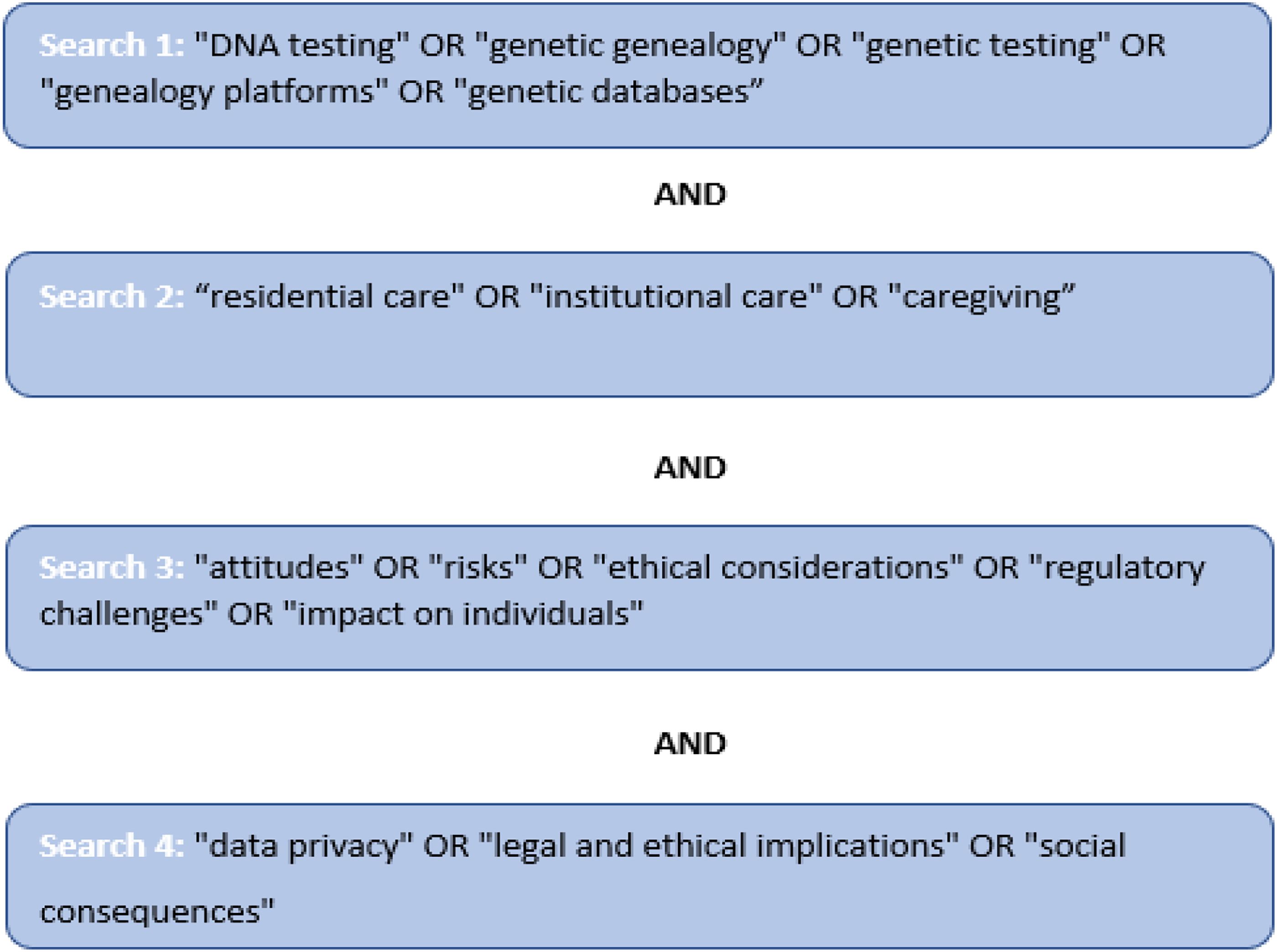
Search terms.
Titles and abstracts were initially screened for studies published in English between 2000 and 2023, and selected articles were then read in detail (see Figure 2). The selected timeframe was chosen to align the review with contemporary practices and experiences. Articles that were not in English, were published outside the designated timeframe, were focused on DNA testing for children (under 18 years of age) or were not concerned with DTC-GT and the adoption or OOHC communities were excluded. A grey literature search was also carried out in Google Scholar, using the same inclusion and exclusion criteria. Non-peer-reviewed articles and other relevant material such as personal reflections and opinion pieces were sought out.
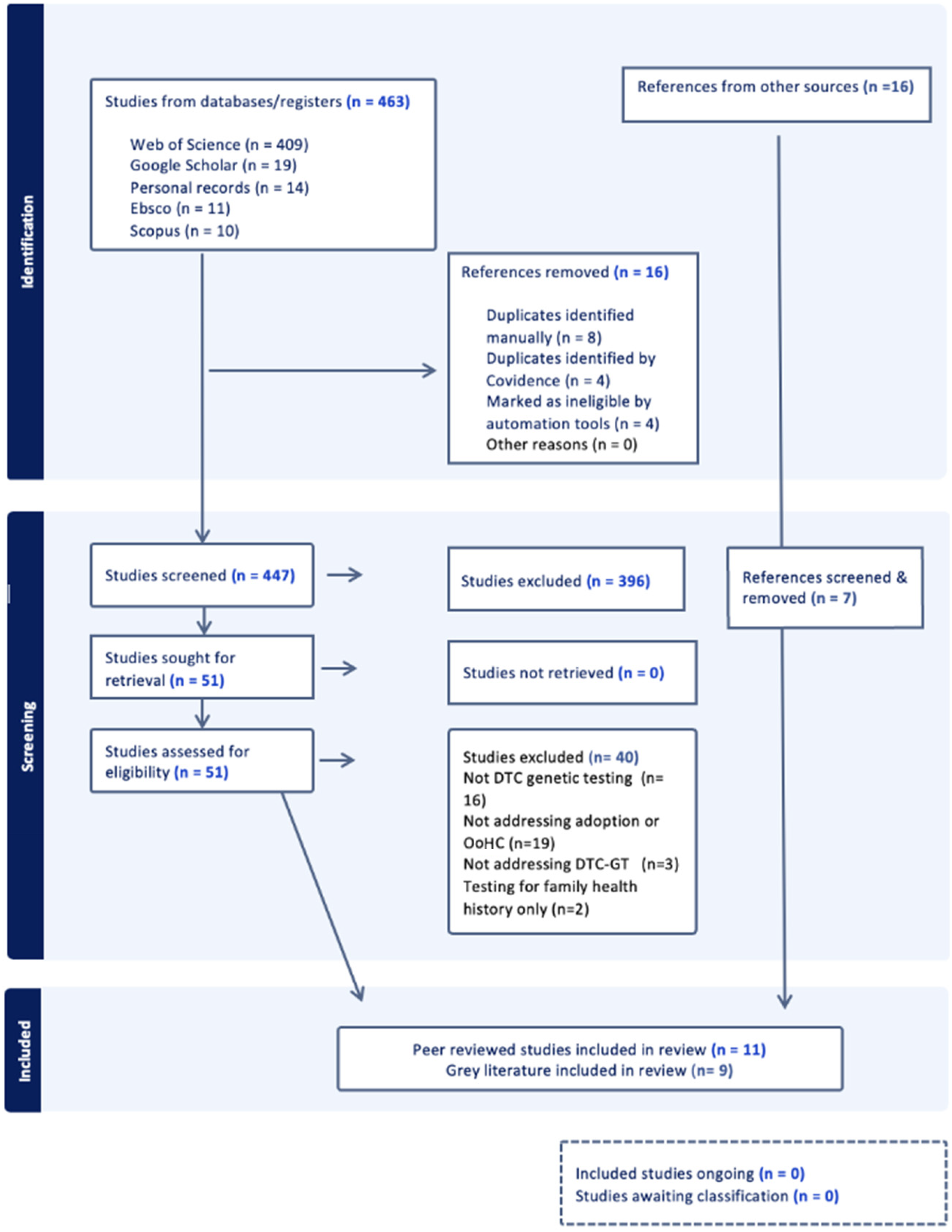
PRISMA flowchart.
A thematic analysis of article content followed Braun and Clarke’s approach, which begins with familiarisation with the data or content, generation of initial codes, the development and review of themes, and defining and naming themes, and concludes by communicating the findings (Braun and Clarke 2006; Braun et al., 2019).
Findings
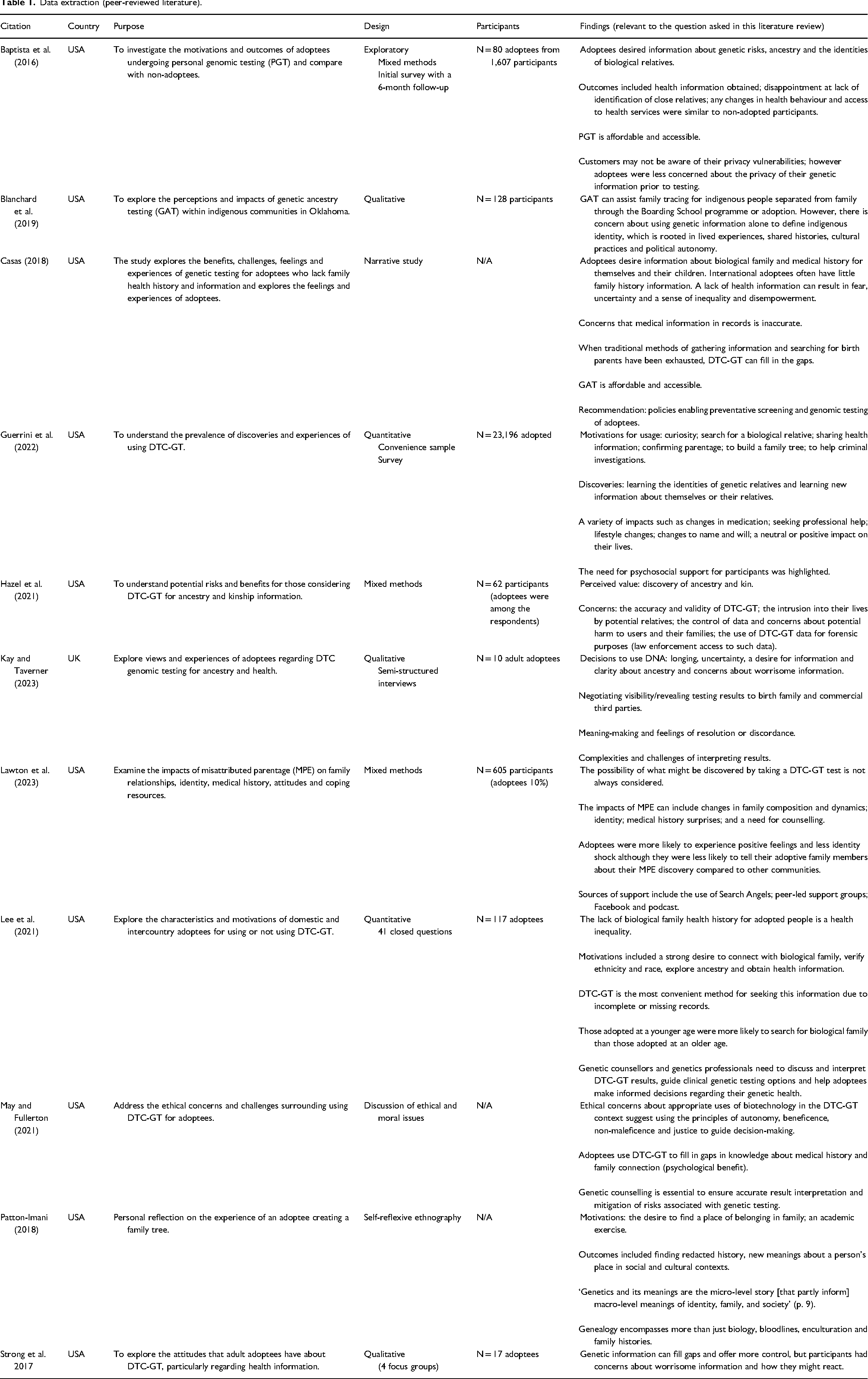
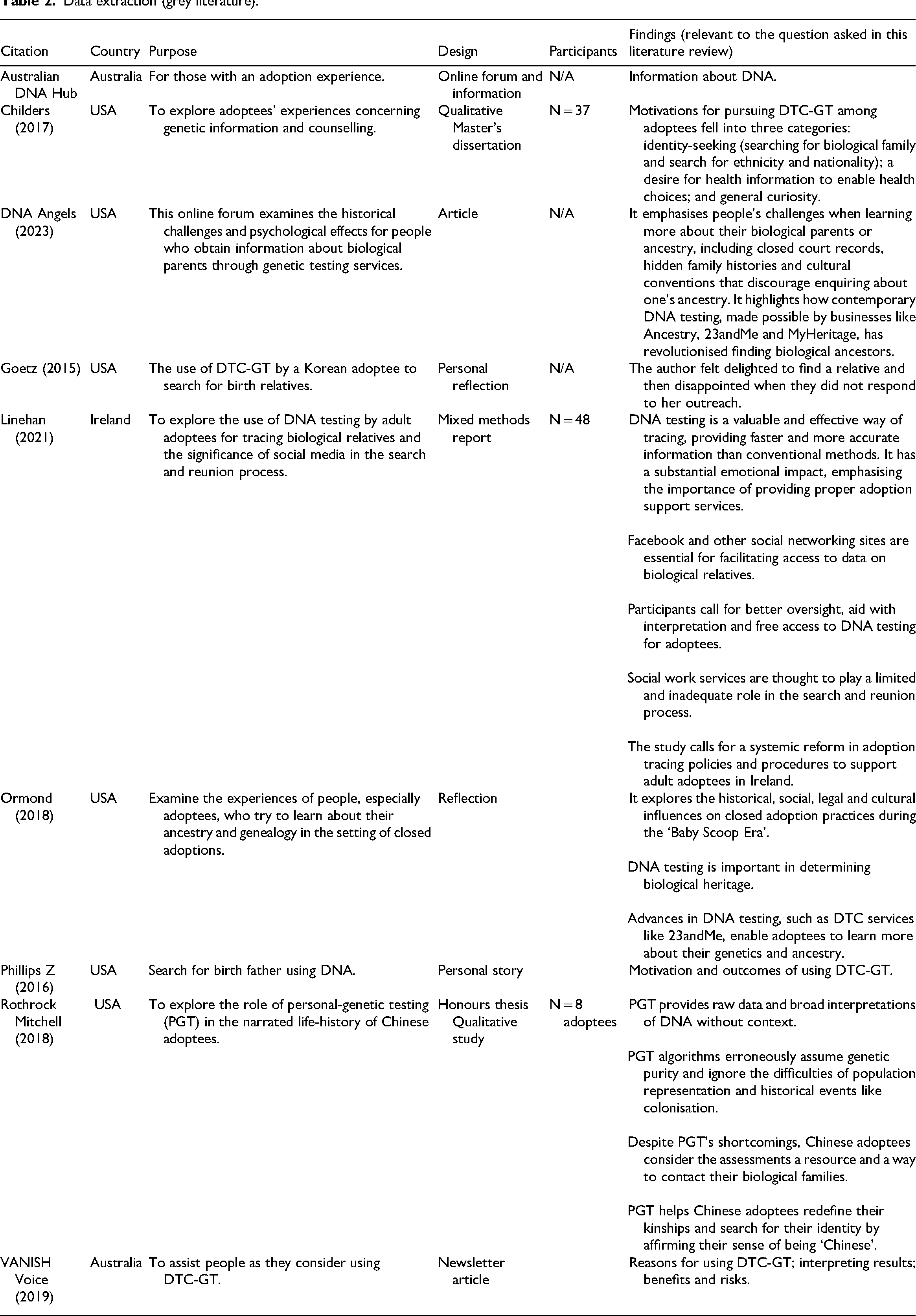
After applying the search criteria previously outlined, 11 peer-reviewed studies and nine grey literature papers met the inclusion criteria. The key content is recorded in standardised data extraction tables (See Tables 1 and 2) as recommended by Arksey and O’Malley (2005) and Tricco and colleagues (2018).
Data extraction (peer-reviewed literature).
Data extraction (grey literature).
Ten of the peer-reviewed studies were conducted in the USA and one in the UK. All were concerned with the experiences of adopted people, and three sought a mixed sample of adopted and non-adopted participants, while only Blanchard and colleagues (2019) referred specifically to the OOHC experience in the form of the Boarding School programme in Canada. Two articles were personal reflections and one focused primarily on the ethical and moral issues associated with DTC-GT. Sample sizes and methodologies varied (see Table 1).
The grey literature included six articles from the USA, two from Australia and one from Ireland. These comprise two dissertations; a report; two personal reflections; two articles and one online forum. All were focused on the adoptee population, and none referred to those with an OOHC experience (see Table 2).
Key themes and categories to emerge from the review
Five primary themes and several subthemes were identified.
Motivations for using DTC-GT
The decision to use genetic testing can be motivated by various factors: curiosity and a desire for health information for oneself and one’s children (Baptista et al., 2016; Childers, 2017); a longing to learn about origins (Guerrini et al., 2022; Ormond, 2018); a wish to locate relatives (Baptista et al., 2016; Childers, 2017; Lee et al., 2021; Kay and Taverner, 2023); and a desire to fill gaps in identity, particularly if there is incomplete or missing information or suspected inaccuracies in records (Casas, 2018; Goetz, 2015; Lee et al., 2021). However, some adopted people were reluctant to use genetic testing for fear of what they might find and how they might react (Strong et al., 2017).
Interestingly the significance of age or gender and the use of this technology did not appear in this search.
Outcomes and impacts for consumers using DTC-GT
The reviewed studies report both positive and negative outcomes of using DTC-GT, which can influence decisions about lifestyle and medical treatment (Baptista et al., 2016; Guerrini et al., 2022).
DTC-GT can potentially provide information about family members. Guerrini and colleagues (2022) found that 46% of respondents in their study learned the identity of at least one genetic relative. Contact with biological children or siblings was frequently attempted and often successful, while contact with birth parents and grandparents was less common, potentially due to age-related factors including death. Consumer disappointment occurred when close family connections were not found or an outreach was not successful (Lawton et al., 2023), and frustration was experienced when geographical distance between parties hindered contact (Kay and Taverner, 2023). Hazel and colleagues (2021) identified concerns about the potential intrusion of newly found relatives into the lives of their study respondents, and the ongoing nature of new kin connections past the initial reunion was explored by Baptista and colleagues (2016), who found that 71% of adoptees and 60% of non-adoptees in their study did not regret their decision. New information means that consumers face the decision to disclose content to other family members and/or place it on the public platform of a DNA company website. In a study about misattributed parentage for adoptees and non-adoptees, Lawton and colleagues (2023) reported subsequent strained or changed relationships between individuals and their adoptive or foster parents following the revelations of genetic testing.
Obtaining new information or confirming what is already known can be personally empowering and provide a sense of completion and identity (Baptista et al., 2016; Kay and Taverner, 2023; Lawton et al., 2023; Phillips Z, 2016), while discovering family secrets or unknown truths can lead to emotional distress and challenge a sense of belonging (Lee et al., 2021; Rothrock Mitchell, 2018). For some, the issue of identity is not Who am I? but rather Whose am I? (Linehan, 2021; Theunissen, 2021). Patton-Imani (2018) has emphasised that genetic information alone does not constitute identities, which are deeply rooted in lived experiences and cultural views and practices. Indeed, Blanchard and colleagues (2019) have commented that for indigenous people in particular there is concern that genetic information alone should not define indigenous identity, which relies on shared histories, cultural practices and political autonomy.
The literature further highlights a consumer need for information about test validity and how to interpret DNA findings, as well as ongoing support to manage the short- and longer-term emotional and psychological impacts (Casas, 2018; Childers, 2017; Guerrini et al., 2022; Lee et al., 2021; May and Fullerton, 2021). Who should deliver this support is an area of contention. Linehan (2021) notes that some consumers see the social work profession as having a beneficial role in mediation and reunion processes, while others feel they have no place in the DNA space, due to their perceived negative historical involvement in arranging adoptions. Volunteers, such as those on the Facebook group, ‘Aussie and UK Angels’, assist and support the search for family (DNA Angels, 2023), and there are now DTC-GT platforms, such as DNA Detectives (DNA Angels, 2023) and the Australian DNA Hub (n.d.), that offer specialist services in this area. Lawton and colleagues (2023) note that consumer support groups can also be of value. In Australia, services such as VANISH, 6 ARMS 7 and Jigsaw 8 offer information, support and help with searching for those who have experienced adoption, while Open Place 9 offers a support service for Forgotten Australians (who experienced OOHC or institutional care as children in the 20th century).
Legal and ethical considerations
The legal and ethical implications and challenges associated with DTC-GT emerged as a significant and contested theme in the literature. Studies note that DTC-GT services are not required to adhere to the same regulations as accredited medical genetic testing services, and the validity of results can be questioned. Studies also question the clarity of the contracts consumers are entering into and their right to privacy (Hazel et al., 2021; Kay and Taverner, 2023; Wenzel, 2023). Although a study by Wallace and colleagues (2015) did not meet the inclusion criteria for this review, it is of note here that they found that some DTC-GT consumer contracts only contained statements of implied consent, while other companies required consumers to obtain consent from living family members before disclosing their information. However, Baptista and colleagues (2016) noted that adoptees were less concerned about the privacy of their genetic information prior to testing than the general population.
Questions about who owns consumer DNA data and their use beyond the initial purpose for which they were collected were also asked, and concerns were expressed around companies selling genetic datasets and metadata to third parties, such as pharmaceutical companies, or using them in law enforcement, political contexts or research, without consumer consent (Lee et al., 2021). Studies did not address the emotional and social impacts for relatives of being found, in particular, the availability of previously private information on public DNA platforms. The literature called for further legal safeguards around DTC-GT (Linehan, 2021).
DTC-GT and other information sources
Concerns about the accuracy of information contained in records and the lack of sought information have been cited as reasons for using DTC-GT (Casas, 2018; Linehan, 2021). Facebook and other social networking sites are often used in association with DTC-GT, particularly for locating biological relatives (Linehan, 2021). Where misinformation is found, Linehan (2021) recommends the amendment of records based on DNA data. Indeed, Wenzel (2023) suggests that both ‘genetic’ and ‘social’ parents should be included on birth certificates, and this option is now available for adoptees in two states in Australia (New South Wales and Victoria) (VANISH News Bulletin, 2023: 3). However, Majumder and colleagues (2021) posit that corrections to medical history records might be seen as falsifying such documents – and consumers may also choose to keep their DTC-GT information out of electronic health records due to concerns about the accuracy and validity of third-party interpretation services.
The need for reform and further research
The reviewed literature identifies the need for consumers to have information about the potential impacts of using DTC-GT, support to interpret DNA findings and access to ongoing counselling to manage the short- and longer-term emotional and psychological impacts of what they discover (Casas, 2018; Childers, 2017; Guerrini et al., 2022; Lee et al., 2021; May and Fullerton, 2021). Who should provide this support and what their accreditation might entail are areas of contention and are yet to be addressed in the field (Baptista et al., 2016; Casas, 2018; Childers, 2017; Lee et al., 2021; May and Fullerton, 2021). A noted side issue is the impact of record content and DNA findings for those who offer support to consumers.
Discussion
DTC-GT is a phenomenon that has gained momentum over recent decades and become a booming industry, changing the way personal information is accessed and managed (Global Industry Analysts, 2023). Findings from this scoping review suggest that those with adoption or OOHC experience who decide to use DTC-GT services should be somewhat guarded and realistic in their expectations and hopes. For some, DTC-GT findings can confirm what is already known while for others, unexpected information is obtained, family secrets are disclosed and the content of records is shown to be inaccurate. Consumers may think they are ‘going to … find long-lost relatives. And that may not be the case’ (Goetz, 2015). Just as prior research chronicles the various impacts of obtaining adoption or care records (Casas, 2018; Goodwatch, 2003), DTC-GT findings can also be confronting (Baptista et al., 2016). Passmore and Feeney (2009) note that where adoptees have had unsuccessful searches or reunions, a double loss can be felt. This experience may be similar with DNA testing outcomes.
The use of DTC-GT feeds into a human preoccupation with knowing who we are and where we come from, and it can be argued that it is another tier in western culture’s tendency to equate biological connections with identity and belonging (Homans, 2006). Leighton (2012) believes that the DTC-GT paradigm can serve to hinder rather than help the situation of adoptees and others who do not have information about their biological family, as it implies it might only be possible to be confident in one’s identity if biological family is known. However, it is important to note that this criticism largely comes from a philosophical position and is not based on the lived experiences of those who encounter ‘a discontinuity between their genealogical heritage and their upbringing’ (Passmore, 2004: 166). While DTC-GT is another tool available to address gaps in knowledge, the meaning and importance of genealogy and heredity vary between individuals and are influenced by culture and community (Feast and Philpot, 2003).
Legal transparency, consumer autonomy and privacy emerge as significant issues in this review, and there are calls for further safeguards and regulation (May, 2018). In the short term, it is desirable for companies to improve their contracts and privacy policies, increase website transparency and develop an industry code of conduct. In the longer term, the appointment of industry-specific regulators may be required (Phillips A, 2016). There is therefore a need for educational initiatives assisting consumers to understand the meaning of test results, legal and contractual implications, and the potential outcome and impacts of using this technology so they can make more informed decisions about whether to use such services. The literature also calls for the establishment of effective and meaningful support for DTC-GT consumers at each stage of the DNA testing process.
Limitations of the review
Only articles in English were selected and variations exist between the sampled populations, sample sizes and methods for obtaining data. It is also noteworthy that material focused on the adoptee population, with little reference to those with OOHC experience. These factors limit the generalisability of the findings to broader adoption and OOHC populations.
Conclusions and directions for future research
This scoping review of the literature was conducted with a view to understanding the reasons, outcomes and impacts of using DTC-GT services and data platforms for those with adoption or OOHC experience, while preparing for an Australian research study exploring the application of this technology and the outcomes for adults from these communities. Twenty documents, written in English and published over a 23-year period, were located and analysed. Findings suggest that there are no easy answers about the efficacy of using DTC-GT for these consumer groups.
While DNA testing websites can provide information for the user and potentially make connections to family members who have also uploaded their DNA results to consumer databases/websites, there is a definite gap in knowledge about implications for those who have experienced care. Future research can extend our understanding about the impact on wellbeing for all members of the broader adoption and OOHC communities and explore whether age and gender are factors in their motivation to search and respond to outreaches from relatives. Whether reunions occurring through DTC-GT have similar outcomes over time to those achieved through other methods, such as accessing records or using social media, deserves further consideration, as does the needs of practitioners and policymakers as they seek to assist service users. The review also highlights the need for further analysis of the contracts that service users are entering into when using DTC-GT, in addition to a mapping of the connections between genetic genealogy platforms and the companies that provide DTC-GT.
Footnotes
Acknowledgements
The authors would like to thank Ashley Barnwell, Nicola Laurent, Cate O’Neill, Kirsten Wright and Olivia Kowalishin.
Declaration of conflicting interests
The author(s) declared no potential conflicts of interest with respect to the research, authorship, and/or publication of this article.
Funding
The author(s) disclosed receipt of the following financial support for the research, authorship, and/or publication of this article: This work was supported by the Melbourne Social Equity Institute Interdisciplinary Seed Funding (University of Melbourne) 2022.
