




Abstract
Research shows that outsourcing family foster care through independent foster care agencies (IFAs) has become common in several countries, such as the UK and Sweden. In Sweden, a majority of local authorities use IFAs. However, knowledge is limited regarding the experiences of professionals who use these services. Social workers, managers and administrative support staff in five public child welfare authorities were interviewed, and their attitudes towards using IFAs and the rationale for their use were thematically analysed. In short, three main themes were identified: (1) A reluctance towards IFA use due to quality, cost and contracting concerns; (2) Use of IFAs due to in-house organisational failures and the availability of IFAs; and (3) Finding competence and resources. The findings indicate that social work professionals tend to prefer in-house foster care and are reluctant to use IFAs as their use is complicated by market regulations and ‘information asymmetry’. However, as previously shown, IFAs may resolve recruitment issues and in some cases also provide the competence and resources needed in complex cases. This article discusses these findings in relation to the concepts of New Public Management and analyses the foster care market as a quasi-market.
Plain Language Summary
It has become common in several countries to use companies or non-profit organisations to recruit and support foster carers, so it is necessary to understand why and how those working within foster carer services experience this process. Social workers, their managers and other staff working with foster care within five different local authorities were interviewed. The interviews were written out. The researcher read the transcriptions several times and looked for commonalities and differences in statements related to the research questions. These were marked and then ordered into smaller codes, which were in turn sorted into more general themes. Those interviewed were often reluctant to use companies and non-profits to recruit and support foster carers because they could not be sure that they would deliver a good service, and they thought it was expensive and complicated to organise. Participants also often believed the use of companies and non-profit organisations for these purposes was caused by problems within their own organisations and that the companies and non-profits could sometimes provide services and foster carers that their own organisation could not. In some cases, the participants thought the use of the companies or non-profits was a positive way of finding the right competence and resources for children in care. The social work professionals included in this study appeared to prefer to find and support foster carers themselves and to avoid turning to companies and non-profits in most cases because of the problems with quality and costs they experienced. Still, many have found it useful or necessary to use them to solve problems with recruiting foster carers and to provide extra support for children or foster carers in some cases.
Keywords
Introduction
Traditionally, child welfare authorities contract laymen to provide family foster care. This way of organising foster care has been challenged in recent decades, and traditional foster care has been supplemented through outsourced foster care. Child welfare services may contract both for-profit and non-profit organisations to recruit and support foster carers (Sallnäs and Wiklund, 2018; Sellick, 2007). These organisations have been referred to as independent foster care agencies (IFAs) (e.g., Sellick, 2002). The use of IFAs has become a widespread practice in the UK (Baginsky et al., 2017; Sellick, 2007, 2011b) and many other Western European countries as well as Australia and the USA (e.g., Begg, 2011; Fridell Lif, 2023; Government of South Australia, 2022; Sellick, 1999; Steen and Smith, 2012). Recent data suggest that there are hundreds of registered IFAs in Sweden alone (Swedish Competition Authority, 2017). Measuring the market share of private providers is complex (Lundström et al., 2018), but a recent study suggests that IFAs provide, on average, approximately one fourth of Swedish foster placements (Fridell Lif, 2023). This shows that IFA-provided foster care is a widespread phenomenon, which has a potential impact on many children in care.
Foster care provided by an IFA is sometimes referred to as enhanced foster care (e.g., National Board of Health and Welfare [NBHW], 2017; Vårdanalys, 2016) and has been promoted as a way to reduce costs while still reaching goals such as recruitment targets (Pålsson et al., 2022; Sellick, 2011a; Steen and Smith 2012) and the retention of foster carers as well as permanency and innovation (Steen and Smith, 2012). Enhanced foster care may include elevated support for foster carers, such as social workers with higher levels of education and lower caseloads, as well as ancillary services for children (Kessler et al., 2008; Vårdanalys, 2016).
With the introduction of IFAs, foster care has become a service bought and sold in a mix of private and public actors in the era of New Public Management (NPM). The aim of NPM is a more effective welfare system with better services at a lower cost through limited public welfare provision and market solutions in the welfare sector (e.g., Christensen and Lægreid, 2011). NPM provides a theoretical justification for IFA use, but the perspectives of social workers and managers who are responsible for decision-making and reviews of foster care services warrant further investigation.
Previous research suggests that issues concerning the recruitment of foster carers (e.g., Oslo Economics, 2020; Pålsson et al., 2022; Sellick, 2007), policies pushing for the outsourcing of foster care and a sudden increase in the need for foster families may increase the use of IFAs (Sellick, 2007). A recent study shows that local authorities in Sweden use IFAs to provide between 0–100% of foster care services. Structural factors seem to provide a limited understanding of local differences in IFA use, except for the fact that small municipalities appear to rely on IFAs more frequently (Fridell Lif, 2023). Previous data indicate that from the child welfare authority’s perspective, there is considerable variation between IFAs in terms of quality (Vårdanalys, 2016). These unexplained differences in IFA use and experiences of varying quality justify a more in-depth inquiry to understand IFA use in the different local contexts.
As there is still little knowledge regarding the demand aspect of IFAs, this article aims to begin to fill this gap by describing and qualitatively analysing attitudes towards IFA use and the rationale for their use from the perspective of social work professionals – the primary decision-makers in the municipalities. To reach these aims, the following research questions are addressed:
What are the social work professionals’ experiences and views of IFA use? How do they describe their rationale for using IFAs and in what circumstances are they preferred?
To enhance the understanding of IFA use, the paper discusses the findings in relation to the concepts of NPM as part of a broader study in which different perspectives of independent foster care are explored. 1
Foster Care In A Market – Some Analytical Concepts
This article focuses on the social work professionals’ perspectives on independent foster care. To analyse the use of IFA care in the wider context of quasi-markets, the findings will be discussed in relation to analytical reasoning in studies about NPM. From the perspective of NPM, public welfare has been heavily criticised as being inefficient and overinvolved in its provision, inflexible and a system that fails to cut costs (e.g., Hood, 1991). As a solution to these problems, especially in times of austerity, NPM promotes the logic of the market, with competition and the goal of profits hypothetically leading to efficient, innovative and high-quality services (Christensen and Lægreid, 2011).
In traditional markets, for-profit market actors are expected to act rationally in their own interest, and consumers choose services depending on price and quality. Thus, the market will in theory be regulated in relation to supply and demand. With the introduction of private providers in welfare services, however, the funding remains mainly public and demand is limited to the public agencies, while the providers are a mix of for-profit, non-profit and public organisations competing in the same market. This means that economic theories of how markets work do not readily apply. Due to these peculiarities, the markets have been referred to as ‘quasi-markets’ (see Le Grand, 1991). Problems of private welfare provision have been identified. With marketisation, social services have to adapt to market regulations (e.g., framework agreements, the requirement to choose the cheapest alternative, choosing an IFA rather than a particular foster carer) (e.g., Christensen and Lægreid, 2011; Evans and Harris, 2004). These market rules may compete with the values of public services such as ensuring equity and the ability to uphold legal rights. Additionally, it has been called into question whether outsourcing actually results in economic efficiency (Christensen and Lægreid, 2011; Hood, 1991).
Apart from the general complications of the quasi-market, there are additional market-related questions to do with the specific nature of foster care; it is both hard to define what good foster care is and to confirm whether good foster care is being delivered (Evans and Harris, 2004). Services where the provider knows more than the customer and the customer has a limited ability to oversee the services have been called ‘credence services’ (Darby and Karni 1973), and the resulting issue is called ‘information asymmetry’ (Akerlof, 1970; see also Sallnäs and Wiklund, 2021). Further, difficulties concerning measuring outcomes and avoiding companies that do not live up to expectations also limit the possibility of the quasi-market to use the strengths of an open market (Forkby and Höjer, 2018).
Previous Research
IFA use is part of the larger context of the private provision of personal social services. The privatisation of welfare services has generally occurred later in Sweden compared with the UK, Australia and the US. However, the transition from a basically fully public system to the current situation of a large share of privately provided welfare services has been rapid (e.g., Sallnäs and Wiklund, 2018). Previous research addressing privatisation in Swedish child welfare services demonstrates, for instance, that in residential care, private actors now own the majority of homes (e.g., Meagher et al., 2016; Sallnäs and Wiklund, 2018). As in the UK, private companies also contract and hire out consultant social workers to the local authorities, including child welfare agencies (e.g., Shanks, 2023). Regarding IFAs, in Sweden as in the UK, they are to a large extent for-profit companies (Sellick, 2007; Sallnäs and Wiklund, 2018; Wiklund, 2011). This suggests that even though private provision is a more recent development in child welfare services in Sweden, its current use is similar to that of the UK in other ways.
IFAs have been contracted to provide foster care in several countries over the last few decades (e.g., Barber, 2002; Begg, 2011; Sallnäs and Wiklund, 2018; Sellick, 2007, 2011a, 2011b). Previous research suggests that private provision through the use of IFAs is used to resolve recruitment issues for local authorities (e.g., Oslo Economics, 2020; Pålsson et al., 2022; Sellick and Howell, 2004; Steen and Smith, 2012). Attempts to compare IFA care and public foster care show varying results as regards permanency, innovative services and the retention of foster carers (Steen and Smith, 2012), and the quality varies between providers (Vårdanalys, 2016). It would seem that IFAs might be used as an alternative to residential care (Vårdanalys, 2016). It also appears that IFA care may be more expensive for local authorities than in-house provision (Pålsson et al., 2022; Sellick, 2011a; Steen and Smith, 2012). This could potentially be a consequence of IFAs providing enhanced foster care (e.g., providing comprehensive programmes including ancillary services for children in care – see Kessler et al., 2008; Vårdanalys, 2016). Recent research on IFAs focuses on the IFAs as organisations and compares the different organisational forms of public, non-profit and for-profit organisations as well as the impact different contracting strategies have on service provision and shows disparities in service provision (e.g., services for children) between organisations across the public/private divide (e.g., McBeath and Meezan, 2009; McBeath et al., 2014). As a whole, these results indicate that navigating the foster care market is a complex task with no clear evidence regarding which type of organisation provides superior foster care and with varying quality among providers. In light of these results, there is a need for a more in-depth understanding of IFA use on the part of the primary decision-makers in the local authorities navigating the foster care market.
Child Welfare In Sweden
The Swedish child welfare system is, in an international comparison, family-oriented rather than focused on child protection. Family preservation and in-home care are therefore favoured (Cocozza and Hort, 2011; Heimer et al., 2018; Svensson and Höjer, 2016) and care is, to a large extent, voluntary rather than the result of a care order (e.g., NBHW, 2022; Svensson and Höjer, 2016). Family foster care makes up 71% of out-of-home care [OOHC] (e.g., NBHW, 2022). The reliance on voluntary care and family foster care may be counterintuitive as the majority of the OOHC population are adolescents, this kind of care is often justified as being due to children’s behavioural issues and the system also includes young offenders (e.g., Cocozza and Hort, 2011; Karlsson et al., 2021). However, the foster care population is diverse, and reasons for placements also include neglect and abuse, honour-related violence and trauma (e.g., Karlsson et al., 2021).
Swedish foster care is decentralised and non-professional. The responsibility for child welfare services regarding assessment and intervention, including foster care (Social Services Act, 2001; Svensson and Höjer, 2016), lies mainly with the 290 municipalities. Foster carers are legally defined as volunteers, while in some countries there are also professional foster carers (Reimer, 2021). As a consequence, local authorities need to recruit non-professional foster carers for a diverse OOHC population.
Many welfare services, including IFA care, are procured from private providers (Sallnäs and Wiklund, 2018), making foster care in Sweden a quasi-market with a welfare mix of public and private provision that is potentially influenced by market logics. One example is the regulation of procurement of goods and services of significant value, such as IFA services (e.g., framework agreements, in which general agreements with providers with set pricing and services are agreed on after competitive tendering, and spot purchasing, where pricing and services are agreed on for a particular child) (NBHW, 2017). Accordingly, local authorities need to adhere to this law rather than choose a provider based on social workers’ experiences or other preferences (see Shanks, 2023). However, spot purchasing is still common in personal social services (Sallnäs and Wiklund, 2018).
Data And Method
The local child welfare authorities’ characteristics.
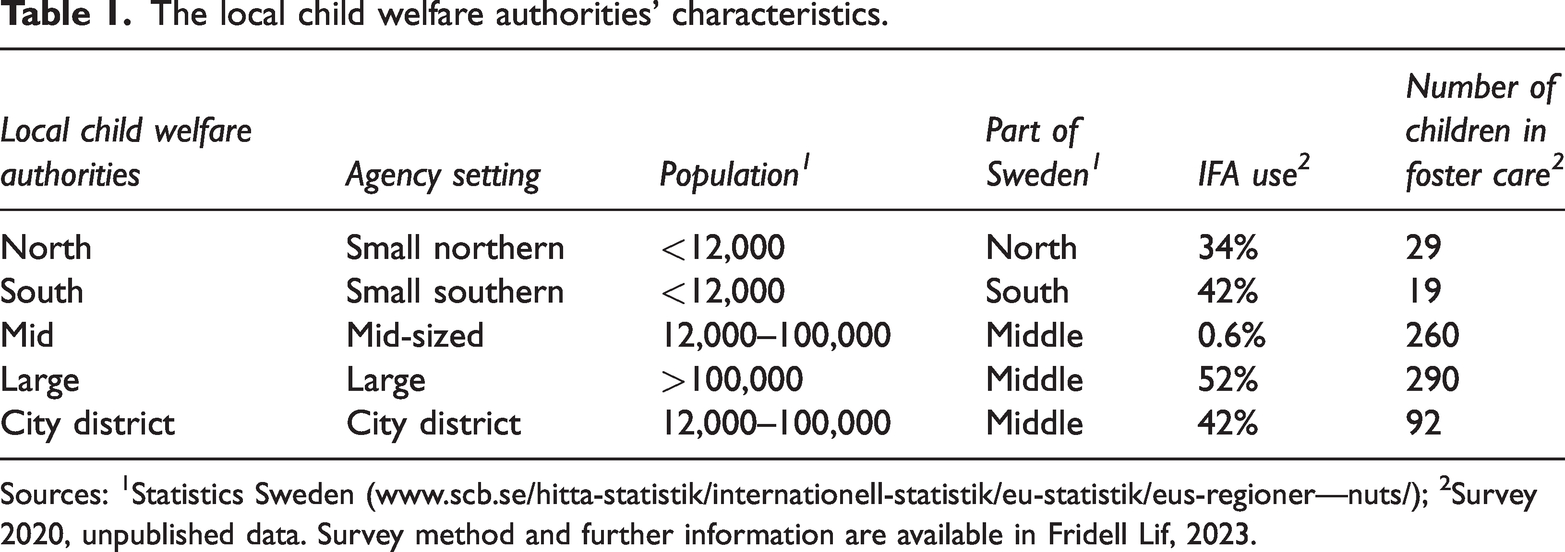
Sources: 1Statistics Sweden (www.scb.se/hitta-statistik/internationell-statistik/eu-statistik/eus-regioner—nuts/); 2Survey 2020, unpublished data. Survey method and further information are available in Fridell Lif, 2023.
Within the local child welfare authorities, managers and social workers responsible for foster care as well as related administration (i.e., procurement specialists, coordinators) were invited to participate. Due to health considerations during the Covid-19 pandemic, most interviews were conducted over Zoom. In total, the study included 21 interviews with 57 participants (including 16 managers, 37 social workers and two procurement managers, one organisation developer and one coordinator). The number of interviewees per local authority depended on the degree of specialisation. In the small southern municipality, unlike the other local authorities, there were no social workers specialising in foster care, so in this case, all social workers in the child welfare unit were interviewed. In the other municipalities, there were social workers who worked mainly or only with foster care, and only they were included in the study.
Participants were primarily interviewed together with their closest colleagues (between two and seven participants), but five interviews with managers and one with a coordinator were one-to-one. Interview guides were adapted depending on the role of the interviewee(s) (see Kvale and Brinkmann, 2014); social workers have more direct contact with foster carers and IFAs while managers are expected to have a more managerial role with less direct involvement. Participants were asked about their experience of IFAs in general and in relation to changes and differences as compared to in-house care, the positive and negative sides to in-house and IFA foster care, how they would manage without IFA care and what justifies IFA care. Follow-up questions were used. An open-ended question asking whether there was anything participants wished to add at the end of the interview also gave rich data related to the aim of this study. The one-to-one interviews were characterised by a question–response structure, while the pair and group interviews tended to be a discussion between the participants on each topic in the interview guide. The author sought to interpret statements during interviews to enable interviewees to validate or correct them (see Kvale and Brinkmann, 2014).
The interviews were transcribed by the author. 2 Subsequently, the data were analysed using thematic analysis in five steps to describe them in a coherent manner (Braun and Clarke, 2006, 2020). For the purpose of this article, the focus of the analysis was directed towards statements regarding the rationale for and experiences of the use of IFAs. To develop a reflexive stance, the author discussed the method and preliminary results with colleagues and kept a research journal during the process (Berger, 2015). Firstly, the transcripts were read to enable the author to familiarise herself with the material. Only manifest data were analysed (Elo and Kyngäs, 2008), including only speech. During the transcription and reading processes, preliminary codes were noted. Secondly, the transcripts were imported into NVivo software to enable structured coding and thematisation. Thirdly, data-driven coding was performed (Braun and Clarke, 2021; Gibbs, 2018). Data related to the research questions were coded using the preliminary codes from the transcription and reading phases (e.g., statements on the necessity of IFA use, statements concerning IFA target groups, statements on when IFA care was considered, etc.). New codes were also added if a reread of the transcripts showed that additional codes might be relevant (i.e., complex cases). Fourthly, the codes were analysed together as a whole and organised into themes. A preliminary version of this paper, including themes, was reviewed by departmental peers in a seminar. Consequently, findings were reread and themes subsequently adjusted for clarification and further illustration, and these findings are presented below.
Regarding ethical considerations, the ethical agency waived the application as the study was not considered ethically sensitive or risky for participants, and the participants were adults who were not in a vulnerable position. A limitation in the recruitment process may have been that the request to participate in the study came from management. To ensure their informed consent, information about the study was sent to the participants beforehand. The participants were reminded during the interviews that participation was voluntary and that they could decline further participation at any time before the publication of the findings. Many participants voiced their appreciation of being able to take part in the study and said that they found the subject important.
Findings
This study analyses social work professionals’ experiences and views of IFA use in the Swedish child welfare system and the rationale for said use. The study participants’ descriptions of their rationale for using IFAs are mainly described below in the first theme, ‘Reluctance towards using IFAs due to concerns regarding quality, costs and contracting’, while the reasons why this form of foster care is used in spite of this reluctance are explained in the second and third themes: ‘Use of IFAs due to organisational failures and the availability of IFAs’ and ‘Finding competence and resources – IFA use to match the needs of children and families’. All local authorities contributed to all of the themes. However, the interviewees in the small municipalities emphasised IFA use to a larger extent as a solution to difficulties recruiting, while the respondents in the middle-sized municipality tended to talk about IFA use more in terms of a solution for accessing care for children with complex needs and who lived far from the municipality.
Reluctance Towards Using Ifas Due To Concerns Regarding Quality, Costs And Contracting
Respondents spoke about using IFAs in what might be described as a reluctant manner and generally preferred to use foster care contracted directly by the local child welfare authority. In line with previous findings (cf., Vårdanalys, 2016), they described IFAs as having an uneven quality, as being expensive and noted that using them was associated with contractual issues. The difficulties that made respondents reluctant to use IFAs will be addressed below.
According to the social work professionals, different IFAs provide a substantially different quality of services. Social work professionals reported that they had many good experiences of well-matched foster carers and good support (i.e., availability, knowledge about children’s needs, practical tasks) from IFAs but that quality is highly inconsistent. For example, when asked whether there was anything they wished to add at the end of the interview, a social worker in a small southern local authority expressed their experience of such inconsistency: I think these IFAs vary so much, it depends on which company you’re talking about. It has so much to do with, partly to do with which company we’re talking about but sometimes even who works at the company.
The social worker was asked if they could give an example of this: Yes, well it’s about everything from involvement to how far they consider not only the foster home but also the entire situation and that they want to ensure that the child fares well as well. How I as a supervising social worker felt that they were just trying to sell me anything … So it’s everything from the recruitment phase to how I experience their involvement and how they do it.
Others also discussed the quality as being dependent on the company and the individual consultant. The differences were exemplified in how IFAs match children with foster carers and share information. A manager described the quality of the foster care arranged through IFAs in the following way: There are IFAs that are fantastic, that have a higher level of quality than our own [care providers]. But there are also those that leave an awful lot to be desired, that have made a business out of it all, so I feel that that has deteriorated things and led to a decrease in quality. Because you don’t always discover the shortcomings before a child has been placed in care. (Manager, South)
As evaluation of the services was considered difficult and social workers rely on information from the IFAs, some social workers were concerned that IFAs would prioritise financial incentives and withhold negative information that could impact placements.
Another quality issue repeatedly mentioned was that IFAs were apt to suggesting foster carers that the social work professionals had previously investigated and deemed unfit. Managers in the mid-region municipality mentioned this issue and were asked what the problems with such suggested foster carers might be, and the following examples were given: ‘A criminal record and well, not really able to reflect or mentalise, really … No emotional accessibility which is pretty important for a foster home.’
Further, in addition to the uneven quality of support for carers as well as by the foster carers, many social workers and managers described the financial incentives of avoiding IFA care as it was considered expensive. Therefore, IFA use was discouraged or even ran explicitly counter to local policy. A manager in the northern local authority responded to whether they wished to add anything regarding foster care, changes or regarding IFAs by addressing the costs of IFA care and also putting these in relation to quality: I think it’s unfortunate that the IFAs do not have the same quality of care as they are expected to have … It might be, it’s a matter of millions per year for one child, so that’s an awful lot of taxpayers’ money … Well, we could work with this in another way and not be in the hands of companies that actually want to earn money, that’s what it’s all about.
The contracting regulations and framework agreements were also perceived as making the foster care market more complicated. For example, IFAs on a framework agreement might be able to provide the required foster care, in which case spot purchasing was necessary. In other cases, the local authorities had to use the provider offering the lowest price, and exceptions were only allowed if these IFAs had declined to provide care or were not able to provide the required care. According to the respondents, the problem with these rules was that the cheapest alternatives might be less serious or may provide fewer ancillary services. However, the procurement agreements and the use varied. For example, one manager spoke about their procurement procedure in the following way: … you have your procurement list … But at the same time it has a shelf-life, so it’s like this: we say, nope, we don’t give a toss that X is at the top of our list, because we know what it was like last time, we didn’t think … So, then we call Y instead, regardless of them being number two on the list. Right. So that’s what we do, really, you check … It’s decided through a list. Then, as I said we have those that we always call first, where we’re always satisfied. (Manager, South)
In the context of a discussion between managers regarding the procurement agreements and how they tried to use these agreements to obtain a higher quality of service, the difficulties involved were mentioned. According to the managers, quality was hard to achieve through the use of framework agreements as companies may not understand what they need to provide or offer services at too low a price in order to win the bid: … when you enter into a procurement procedure and want to become a provider, I think you perhaps quote a low price because you know that then you may win the bid and then that’ll be good for business … And then you might not really know what it takes … you don’t have foster homes that really understand what it entails. And then it collapses. Or you can’t offer anything when we need the service which means that we have to go outside the agreement anyway before we find a placement. (Manager, North)
In sum, the reluctance to use IFAs could be related to three market specific issues: high costs, inconsistent quality and procurement issues. The uneven quality could, in turn, be understood partly in terms of information asymmetry (Akerlof, 1970), where the IFAs know more about the services than the local authorities. The uneven quality was not consistently ascribed to any specific type of IFA and trusted for-profit and non-profit IFAs varied across interviews. The reluctance is also expressed in relation to costs and the trouble to arrange effective contracts.
Use of IFAs due to in-house organisational failures and the availability of IFAs
In spite of the strong desire to avoid IFA use, all the local authorities in this study used IFAs. However, the reasons behind the need for IFAs appeared to be related to the limited resources of the child welfare authorities. In general, the larger ones had more specialised resources to recruit and support foster carers. Regardless, foster carers were described as a scarce resource that is hard to both recruit and retain and that might be obtained using IFAs. Examples of organisational limitations that justify IFA use will be described below.
Firstly, social work professionals from all local child welfare authorities described recruitment issues as a reason for using IFAs. This was emphasised more strongly in the smaller municipalities. After excluding the possibility of in-house recruitment, IFAs appear to be the solution. For example, the mid-sized local authorities with very low use of IFAs used them for general recruitment purposes: ‘Sometimes we’ve been looking and looking for something for certain kids and just not found anything, then we turn to the IFAs because we have to find a foster home for them’ (Manager, Mid).
Secondly, the issue of recruitment is accentuated as regards urgent and short-term placements. For the large local authority and the city district, the use of IFAs was in general described as partly being a consequence of a lack of available short-term foster families. IFAs were initially used for short-term placements, but if the placement needed to be extended for a longer period of time, the IFA short-term foster placements were often suggested for long-term placements: When we receive a referral for a foster placement nowadays, the referral often states that it is the foster home in question that needs to be looked at as a foster home. And then it is often supported by an IFA, i.e., as a company. (Manager, Large)
Thirdly, social work professionals viewed the competition with the IFAs for foster carers as a reason for them needing to use IFAs. The local child welfare authorities were perceived as unable to compete with IFAs and other local child welfare authorities regarding remuneration, which led to IFA use. For example, a foster family might be expected to halve their remuneration to work directly with the local authority. The difference in remuneration was mentioned, for example, by a social worker in the northern municipality as regards differences between IFAs and in-house foster care: ‘That’s quite a lot of money, it really is. The amount that an IFA foster home receives from the IFA versus what we pay, well they are completely different amounts.’
To conclude, the interviewees point to organisational constraints and failures as a reason for using IFAs. The limitations mentioned are resources to recruit and the ability to provide support (e.g., contact with and availability of a social worker). The support issue appears accentuated in cases where there is a need for specialised knowledge as in complex cases. This implies that the lack of resources leaves professionals with few options regarding foster care provision. Even where there were resources allocated to work specifically with foster care recruitment, IFA use was considered necessary to solve the shortage. The specialised support in the larger local authorities did not eliminate this need.
Finding Competence And Resources – Ifa Use To Match The Needs Of Children And Families
Although the need to use IFAs as a solution for organisational failure to recruit and support foster carers in-house was most prominent in the interview data, informants also gave examples of when they deliberately used IFAs because they hoped that they would provide suitable foster care for children in complex cases as a possible alternative to residential care. Examples were children who were substance users, troubled adolescents or children needing protection from parents, relatives or others, including in cases of honour-related violence. Other examples were children suffering from severe trauma, intellectual or physical disabilities. In these cases, the rationale for IFA use was to find the right competence and resources.
In such complex cases, IFA use was primarily justified as a way of providing not only additional support for foster carers, such as special knowledge of safety measures and disabilities, but also due to the availability of and frequent contact with social workers. The complexity of the children’s needs demands both support and remuneration matching the perceived difficulty of the task, which the child welfare authorities struggle to meet according to the interviewees. IFA use might also be justified by the need to provide full-time foster carers as well as extra support for carers. As part of a dialogue following a question regarding their experience of working with IFAs, a social worker gave an example of when they would use one: If there are more, several different complex needs and there is perhaps an expectation that there should be at least one foster parent at home full time or always someone at home. It’s normally like these people have this sort of as their job. And then you choose to work via an IFA more often and in addition you perhaps get a bit more help. (Social worker, Mid)
Interview data suggest that IFAs may also be used as a way to provide safety for children threatened by their parents or others. IFAs were in these cases expected to provide well-supported foster care in locations far from the child’s home as well as additional competence, as in this example of how IFAs may be used in high-risk cases: … there’s a need for protection where there’s a confidentiality marking, and that also includes LSS [the Act on Support and Service for Persons with Certain Functional Impairments]. So, that is a fairly, these are fairly major cases. So there are many different contacts and the foster home really needs a lot of support and lies far away, geographically. (Social worker, City district)
The reason for using IFAs could also be that they could provide extra or specialised support with regard to the need for protection (e.g., knowledge on how to protect children from being found, etc.): I think that in certain cases when we use IFA homes, perhaps we ask for competence regarding protection, that we may place an entire family or a mother and children or just children for protection. Then we think more about competence and maybe then we often use IFA homes. (Manager, Mid)
To contrast the many reasons why IFA use was avoided, some social workers argued that good IFAs could provide higher quality services: I think that the IFA is always accessible, that the IFA functions like a form of support for the care family too. Our supervising social workers, well, they are there but they can’t always answer questions and give support, not like the IFAs, maybe 24/7. (Social worker, North)
In sum, the accounts of the social work professionals indicate that the child welfare population is heterogeneous and due to organisational limitations to meet complex needs, social work professionals may prefer IFA care, but this use also appears to be the result of professional considerations. This indicates that, in some cases, IFAs ideally provide what social work professionals perceive as high-level competence and resources. It also indicates that the foster care population in IFA care might differ from the wider foster care population as regards the complexity of the client’s situation and needs.
Discussion
IFA use has become common in many countries, but knowledge about the reasons why local authorities use this form of foster care is still limited. This study set out to answer two questions. Firstly, the study addressed social work professionals’ views and experiences of using IFAs in Sweden and primarily indicated that the study participants were reluctant towards IFA use. This reluctance to use the services provided by the market was related to costs, quality and contracting. Secondly, social work professionals’ rationale for IFA use and the circumstances under which it is preferred were addressed. Regarding this second question, the analysis resulted in two main themes concerning the reasons behind the IFA use: the reasons for using this form of care were due to organisational failures and the availability of IFAs and, for a smaller group of cases, the rationale for IFA use was also to find competence and resources to match the particularly complex needs of some children with the right families.
The analysis shows that according to both social workers and managers, Swedish child welfare authorities cannot provide enough foster care in-house and struggle to provide care for children and adolescents with complex needs in particular. This is the main rationale for IFA use. Looking only at this aspect, the market has contributed to solve the problems encountered by the public welfare authorities, which is a central argument for the NPM reforms. From this perspective, IFAs work as intended, with the private sector complementing public provision. This is in line with previous research indicating that recruitment is a longstanding issue (Colton et al., 2008; Pålsson et al., 2022) and that IFAs may be used to solve this issue (Sellick and Howell, 2004). But this study shows that the child welfare authorities are ambivalent towards this solution. If the IFAs fulfil the basic premise of the influential NPM, why are the authorities reluctant to use them?
From the perspective of demand, IFAs have several disadvantages that are related to difficulties often associated with quasi-markets. Firstly, as shown in other studies (Vårdanalys, 2016), this study indicates an uneven standard of quality and a preference for in-house foster care. The uncertain quality is related to two features in quasi-markets: information asymmetry and the fact that many IFAs have financial incentives. Regarding information asymmetry, child welfare authorities purchase IFA care, which is a trust-based service, and have to rely on information provided by IFAs to make decisions regarding the start and continuation of care in the IFA-contracted foster homes. As the IFAs are often for-profit, social workers voice distrust towards the IFAs because they think that they may not be receiving important information that could potentially jeopardise profits, such as information that would lead to a placement being terminated (e.g., maltreatment or other issues in the foster family). Nonetheless, based on the information child welfare authorities do receive, they find the quality uneven, and as there are hundreds of IFAs in Sweden alone (Swedish Competition Authority, 2017), finding the right provider can prove a challenge.
Secondly, the perception of high costs is interesting as the child welfare authorities describe a situation where they do not have the resources to provide all the necessary recruitment, care and support that they are obliged to provide. It is not unreasonable, based on the description of their problems, to argue that their in-house costs would also be greater were they to recruit enough foster carers and to provide the round-the-clock support for foster carers that they are currently unable to do. These findings regarding the perception of costs show similarities with findings regarding consultant social workers. Just as with IFAs, the studies on consultants indicate that social workers consider this service as one that imposes high costs (Arnesson et al., 2022; Shanks, 2023). These circumstances raise the question of whether IFA use is cost-effective and, if so, for which target groups (e.g., children who require significant resources to support them). IFA use may be expensive for the child welfare authorities, but from the social workers’ and managers’ descriptions of the needs that the IFAs meet, IFA use could arguably be understood as a consequence of underfunded child welfare provision by the authorities in charge of foster care services.
Thirdly, as regards contracting, the logic of the market appears to be in conflict with the social workers’ professional logic when procurement is focused on procedural rules rather than on the interests of the clients. As procurement is perceived to be determined by administrative procedures, the market logic is prioritised over the use of professional judgement and experience to find the best alternative. This is in line with the findings of Höjer and Forkby (2011) regarding the residential care market, as they show that procurement agreements limit the social work professionals’ discretion to use providers considered best to meet the needs of children and adolescents. As IFAs are evidently being used and there is no indication that the outsourcing of foster care is coming to an end, the findings suggest that the current contracting practice puts competition first. Maybe there is reason to consider whether the contracting process could be altered in order to be child-centred rather than market-centred, prioritising user needs rather than competition?
The upside to IFA use from a child welfare authority’s perspective is that through IFAs, they may find the right competence and resources to match complex needs, which are relevant to a substantial part of the foster care population (Cocozza and Hort, 2011; Karlsson et al., 2021). The social work professionals may then consider IFA use to be justified as in the best interests of the child, family or for the best use of organisational resources, despite the disapproval in the UN guidelines of economic gain as a background for alternative care provision (UN General Assembly, 2010). However, paradoxically, IFA use may not be accepted by management or policy due to the costs discussed above.
To conclude, this study indicates that there has been a paradigm shift in which IFAs fill significant gaps in the organisational capacity of the local authorities studied to meet the needs of children in care and foster carers, in spite of social workers and managers expressing strong misgivings about the care provided regarding quality, cost and contracting concerns. Future studies also need to involve children and other stakeholders on the receiving end of care.
Strengths And Limitations
A strength of this study was the inclusion of heterogeneous local authorities. This helped the exploration of IFA use across settings. The study also included different groups of staff, including perspectives from both grassroots and managerial levels. Further, by way of group interviews, participants developed their responses on the themes in discussion with each other, in contrast to only responding to the author’s questions. By dividing managers and social workers in interviews, power imbalances were addressed. This potentially contributed, for example, to enable managers to express positive views towards IFA use despite budget restrictions limiting their discretion to approve such placements. Likewise, staff members that were not under managerial oversight likely felt freer to express their views. A limitation of the study is the small number of municipalities included, and so there may be further variations of reasons for IFA use that were not observed. Possible biases are that the municipalities taking the time to be part of a research study may have more resources in terms of time or hold stronger views on IFA use than those declining to take part in the study, limiting the generalisability of the findings.
Conclusions
The lack of in-house foster care and the conditions of the foster care market limit social workers’ options, but through the market, social work professionals may procure resources to meet a client’s complex needs that local public foster care services are unable to provide in-house.
This study indicates that the IFA foster care population may differ from the general foster care population in terms of needs and complexity. Moreover, in practice, foster care through IFAs appears to be used as a multi-purpose tool, and a distinction between IFAs as a recruitment tool on the one hand and as a comprehensive service aimed at complex cases on the other may facilitate communication between local authorities and providers. This variation in use also needs to be considered if the services are to be evaluated. Noticeably, and in contrast with what has been described as enhanced foster care (Kessler et al., 2008; Vårdanalys, 2016), there is a focus on support for foster care rather than ancillary services for children in care.
The theoretical issues discussed by Hood (1991) and Christensen and Lægreid (2011) concerning both public and private welfare services are evident in this study, and while organisational problems in public welfare such as the lack of resources are in part solved by the use of the quasi-market, the expected problems with the market solution, such as contract issues and information asymmetry, are also visible. Further research needs to address the limitations of possibilities in these organisations and their solutions. In light of the limitations of the local authorities addressed by the interviewees at both managerial and grassroots levels, the study further indicates a need for research about the organisation of local authorities and how they could develop their services to meet the needs of children and foster carers in complex cases.
The results point to two possible implications with regards to quality and costs. Firstly, further development of standards and auditing may be warranted to address issues with information asymmetry. One possibility could be to enable local authorities to share evaluations of IFAs freely between them in a systematic way and, based on these evaluations, IFAs could be investigated or disqualified in framework agreements if they do not live up to certain standards. Further, such a system could be developed to include reports based on regular interviews or surveys with children, foster carers and birth parents.
Secondly, cost-effectiveness and value for money should be considered in an inclusive sense in both practice and research. As this study indicates that social work professionals consider IFA-supported foster care expensive but also in some cases good and comprehensive, there is a need for an analysis of value for money that considers costs as well as the availability of alternative enhanced services for the children and foster carers who need them, as some municipalities appear to struggle with providing these resources within current budgetary constraints. If interviewees are right about IFAs paying foster carers more, they might also have to consider whether the pay is in line with the foster carers’ efforts and costs as local authorities compete with IFAs and each other over carers. The economic incentives of many IFAs also warrant further discussion, and future studies should address standards and cost efficiency of outsourcing foster care provision, including actual costs and effects of care.
Footnotes
Declaration of conflicting interests
The author(s) declared no potential conflicts of interest with respect to the research, authorship, and/or publication of this article.
Funding
The author(s) disclosed receipt of the following financial support for the research and authorship of this article: Forskningsrådet om Hälsa, Arbetsliv och Välfärd, grant number: 2019-00090.
