




Abstract
Uganda is known for its open-door policies towards refugees, currently hosting over 1.5 million refugees, 60–65% of whom are children. National self-reliance strategies grant refugees who live in urban settings freedom of movement and employment and expect them to be mostly self-sufficient in exchange. Families within the refugee community are fostering unaccompanied refugee children, as this is considered the best solution for them by the Ugandan state and international organisations. We used ethnographic and quantitative methods, including in-depth interviews, questionnaires and participant observation, to assess the living situation of refugee foster families in Kampala. Our sample included 52 foster families who were caring for a total of 289 children. The findings raised four overarching themes: (1) Circumstances and reasoning for fostering unaccompanied children; (2) Formalisation of explicit foster registration; (3) Differences in care and living conditions; and (4) Ambiguous organisational support. Fostering was either direct by family members or friends, or indirect through the intervention of a church or the United Nations High Commissioner for Refugees’ (UNHCR) implementing non-governmental organisations (NGOs) but has never followed national processes to formalise fostering or adoption. Based on the self-reliance policies, refugee foster families in Kampala do not receive adequate support or supervision from any institution, and fostered children remain acutely vulnerable, especially since the economic crises related to Covid-19 and the war in Ukraine. We argue that the lack of recognition and financial and emotional support for foster families hinders community-based solutions. These conditions, coupled with the lack of proper supervision and control, encourage less altruistic fostering and more abusive and exploitative treatment of unaccompanied children.
Plain Language Summary
Uganda, currently hosting over 1.5 million refugees, is known for its open-door refugee policies. Refugee children who arrive without their birth parents or become separated from them while in Uganda, are usually fostered by members of the refugee community. Fostering is arranged either directly, often within the extended family or family acquaintances, or indirectly, with the help of non-governmental organisations (NGOs), communal institutions or churches. Using mixed method tools including in-depth interviews, questionnaires and participant observations, we found that people who fostered children directly were more likely to do so because of cultural or familial obligations, while indirect fostering was usually a result of moral choice. The economic crises in Uganda that followed the Covid-19 pandemic and the war in Ukraine, together with a lack of supervision and support of the authorities and NGOs, worsened the situation of many of these children and families. Fostering is never officialised legally in Uganda, so these crises have increased cases of instability, abandonment and discrimination within their families. There was also much less willingness of families to accept additional children, especially for indirect fostering. We argue that the lack of recognition and financial and emotional support for foster families hinders communal initiatives to foster and care for children and can encourage more abusive and exploitative treatment of unaccompanied refugee children.
Introduction
Uganda stands out globally for its open-door policy toward refugees (Hovil, 2016). Today, the country hosts over 1.5 million refugees, primarily from South Sudan, Somalia, the Democratic Republic of the Congo (DRC), Burundi, and Rwanda, along with many internally displaced people (United Nations High Commissioner for Refugees [UNHCR], 2017). An estimated 60–65% of these refugees are children fleeing ongoing armed conflict, political and ethnic violence, and food insecurity (UNHCR, 2018). Many children are separated from their parents before or in the process of fleeing their home country and arrive in Uganda without their birth family (Odello, 2007: 779).
Uganda has ratified, signed and developed many international and national treaties, goals and laws which prioritise the education and protection of children in the country. 1 Despite these progressive international treaties and national laws, there are significant gaps in Uganda’s domestic adoption policies and practices, especially when it comes to extending rights to asylum-seeking and refugee children (Orchard, 2010). Restrictive immigration policies, inconsistent laws and stringent host country documentation requirements often prevent the fulfillment of educational rights in an inclusive manner (Bhabha, 2009; Fuchs, 2007). In Uganda, all schools, including state schools, require registration fees, preventing poor and refugee families from sending their children to school (Wamala, 2013) or causing high dropout levels (Egwalu, 2017).
A new refugee policy entered into force in Uganda in 2009, aiming to integrate refugee service structures into national systems and promote self-reliance (Betts, 2021; Krause, 2013). Additionally, during the last decade, the UNHCR has moved away from the encampment approach and has begun to encourage the participation of refugees in national welfare, health and educational systems, and their integration into the labour market. Therefore, refugees increasingly choose urban living instead of settlement in camps in search of better employment and education opportunities. In Uganda, an estimated 100,000 refugees currently live in Kampala (Kalyango Sebba and Zanker, 2022).
The Ugandan government is aware that not all urban refugees are self-reliant, but rely on the constant support of UNHCR and its implementing partners to support refugees and fill the gaps in services created by the self-reliance policy (Betts, 2021; Herbert and Idris, 2018). The de facto policy leaves refugees heavily reliant on wholly erratic and often inadequate donations (Bonfiglio, 2010; Russell, 2011). This situation has been exacerbated in recent years as economic crises related to Covid-19 and the war in Ukraine have dramatically reduced UNHCR and non-governmental organisation (NGO) funds, depriving both urban and settlement refugee populations (Hovil and Capici, 2020; Kalyango Sebba and Zanker, 2022; Lozet and Easton-Calabria, 2020; Okiror, 2020).
Although Uganda has been praised for its generosity towards refugees, there have been several critiques regarding refugee policy in the country, the most prominent of which is the gap between the government’s expectations of refugee independence and the refugees’ capacity to be self-reliant (Pincock et al., 2021). In Uganda, as in other developing regions, long-term refugees face numerous survival challenges in an impoverished and often inhospitable environment with few opportunities to develop (Mukandayisenga, 2016).
Therefore, refugees are forced to rely heavily on each other and support members of their specific group, building resilient communities and communal networks, including refugee self-help groups and community organisations, which support vulnerable members, including children (Balakian, 2020).
Unaccompanied refugee children (URC) experience an increased sense of threat and vulnerability compared to other refugee minors who arrive with their families (Betancourt and Khan, 2008). In 2022, UNHCR reported the arrival of 33,000 unaccompanied asylum-seeking children in Uganda, reaching an estimated number of 81,000 in the country. However, this figure may be inaccurate because child migration usually occurs under the authorities’ radar, leading to insufficient documentation and follow-up, especially of unaccompanied children like those fostered in refugee families (UNHCR, 2022). An unaccompanied child is defined as a person under the age of 18 who is ‘separated from both parents and is not being cared for by an adult who, by law or custom, has responsibility for doing so’ (UNHCR, 2022). Separated children are defined as: … those separated from both parents, or from their previous legal or customary primary caregiver, but not necessarily from other relatives. These may, therefore, include children accompanied by other adult family members. (Uganda Child Protection Sub Working Group, 2018: 2)
The state and international organisations attempt to change the situation of unaccompanied children who become separated from their families by moving them to alternative, temporary foster families that become responsible for their wellbeing and finance instead of the state (Egwalu, 2017).
Therefore, once in Uganda, URC will generally be informally fostered by the adults they crossed the border with, connected kin or members of their extended community through churches or refugee networks. Guardians of URC become responsible for their emotional and practical support as well as a sense of security in times of instability, playing a key role in fostering resilient and strong children with potential for positive futures (Munford and Sanders, 2016; Warren-Adamson, 2001). While there is extensive research on the negative aspects of foster care experiences for children, including exploitation and neglect (Cheney, 2013; Chirwa, 2002), studies have also shown that children are more likely to experience their foster families as caring and stable environments when the foster carers receive sufficient support and are fully committed (Munford and Sanders, 2016). The state and organisations often favour the opinions of outside professionals about the best interests of foster children, disregarding foster carers, and presenting them as detached and in conflict with their foster children (Balakian, 2022; Humphris and Sigona, 2019). Clark-Kazak writes that the expansive and fluid notion of family among Congolese refugees in Uganda is ‘at odds with the nuclear family focus of much refugee policy and programming’ (Clark-Kazak, 2011: 101). The UNHCR’s and host governments’ lack of recognition of non-nuclear families and complex recreations of households affected by conflict puts an extra burden on these families to prove their family ties or attempt to fit within international norms of family structures. Kinship relationships shaped by economic insecurity, civil wars and refugee camps are particularly precarious and need inherent flexibility in meeting the material and emotional needs of parents and carers as well as those they care for, including foster children and other vulnerable members of their extended families (Hunter, 2010; van Blerk et al., 2021). Nonetheless, foster carers are significant, although frequently ignored, actors in the fields of development, humanitarian aid and human rights (Hrdy, 2009; Pincock et al., 2021).
Fostering In Africa And Uganda
There are substantial differences between the legal interpretation of ‘fostering’ and the standard fostering practices in Africa. From a judicial perspective, fostering occurs only after a long and complex legal process during which the foster family is evaluated. Each country has its fostering procedures, but the welfare system is highly involved in all countries, even when these procedures are privatised. However, children are being fostered de facto, albeit informally, in various parts of the Global South, and this practice remains very common in various African countries (Hashim and Thorsen, 2011; Madhavan and Landau, 2011; Razy and Rodet, 2016). Formal adoption occurs but is much rarer, as it is a highly bureaucratic and complicated procedure, and foster care is the informal path chosen by many families (Alber, 2018; Clark-Kazak, 2011, Gibbons, 2013).
The protection of children in Uganda is enshrined within the Constitution (Republic of Uganda, 2005), specifically Article 34, and the Children Act, Chapter 59 (Republic of Uganda, 2000). Article 20 of the Children Act mandates: ‘when a child is temporarily or permanently deprived of his or her family environment, s/he must be accorded an enabling environment for his/her development’ (UNICEF, 1989). The UNCRC implies that when a child loses their parents, a substitute form of care must be accorded to the child. The Ugandan government encourages communities to take orphaned children into their homes and care for them (Musisi and Ochen, 2017).
The Uganda Bureau of Statistics (2016) has estimated that 8% (1.51 million) of all children in Uganda below 18 years (including refugees) are orphans, declining from 13% (2.77 million) in 2002. Culturally in Uganda, when birth parents die or cannot raise their children, such children are raised by extended family members, who provide informal, traditional foster care coordinated within the existing family system. Despite growing poverty and the AIDS and Covid-19 pandemics, more than 90% of the children who lose their parents are absorbed into traditional extended family networks, as the majority have an extended social family (Roby, 2015; Sserwanja et al., 2021). The number of households that have taken in foster children has grown from 25% of all households to 30% in Uganda (Uganda Bureau of Statistics, 2016).
Children generally enter foster care due to orphanhood or parental neglect and abuse (Devries, Child, et al., 2014). According to the Children Act, Chapter 59 (Republic of Uganda, 2000), child fostering can be formal or informal. Legal fostering arrangements are usually made through police, social care workers or the local government. Theoretically, foster care by unrelated foster carers must be authorised by a competent administrative body, judiciary or statutory body, under the supervision of welfare and probation personnel. However, the government of Uganda lacks child rights law enforcement and is unequipped to provide high-quality support or supervision to foster families because of its socioeconomic situation, and perhaps the reduction in social accountability and obligations (Musisi and Ochen, 2017).
The most common kind of informal foster care is made by the extended family system and local community. The process usually involves a relative, friend or community member caring for a child on an ongoing or indefinite basis without the intervention of any statutory body. The Uganda National Alternative Care Framework is supposed to support children who are not in a caring environment, including fostering and shorter-term institutional care (Ministry of Gender, Labour and Social Development, 2011). According to the Uganda Operational Manual for Youth and Probation and Social Welfare Officers, Article 43 (Ministry of Gender, Labour and Social Development, 2011), a child without a parent or guardian may be fostered by a relative without a formal agreement. Anyone agreeing to take care of the child should apply to the District Probation and Social Welfare Officer. If a non-relative decides to foster a child, they must apply for a permit from the Probation and Social Welfare Officer and comply with three-and-a-half years of being monitored (Musisi and Ochen, 2017).
Refugees arrive in Uganda as much smaller, sometimes nuclear, families, and therefore UCRs are rarely able to rely on the same social systems that support local orphaned children (Mendenhall et al., 2015). This mixed method study aims to: (a) establish the changing conditions and challenges facing refugee foster families through interviews with families; and (b) understand the role of NGOs, the Ugandan government and refugee communities in the fostering process. In this study, we attempt to look beyond the accompanied–unaccompanied dichotomy and at the divisions of responsibility and guardianship over refugee foster children in Kampala and Ugandan adoption and fostering policy.
Methodology
Setting
Data collection for this study took place in Kampala, Uganda, between 2021 and 2022, while one of the authors served as a director of a NGO-run Safe Space Centre for Vulnerable Refugees (hereafter called ‘the centre’), and the other conducted a broader study of education of refugee children in Kampala. A range of different, particularly vulnerable subsets of refugees attend the centre, including foster families. This allowed us initial contact with foster families of different nationalities and ample opportunities to conduct informal meetings and learn about their experiences and daily challenges. Through this initial contact, we identified 11 foster families with whom we conducted our initial private interviews and house visits. Using the snowball purposeful sampling technique (Jacobsen and Landau, 2003), other families who did not attend the centre were introduced to us upon our request and were included in the study. Communication with UNHCR and organisations that implement its projects and policies in Uganda was also facilitated through the centre’s work, which includes accompanying and supporting refugee families to deal with different organisations.
Research Design
The materials drawn upon for this article originate from two main data sources: qualitative and quantitative. We used a combination of participant observations, semi-structured interviews and questionnaires to assess the situation of urban refugee foster families and understand their challenges and needs (Court, 2013). All in all, the sample consisted of 11 semi-structured interviews, 52 questionnaires and countless informal conversations and participant observations of the foster families at the centre. Potential research participants were given information about the study and asked to give their informed consent to use the information they provided anonymously, in keeping with the ethics committee guidelines.
The questionnaire contained closed and open-ended questions and gathered information on the background characteristics of the foster families (sex, age, nationality, year arriving in Uganda, refugee status, number of birth and foster children, etc.), as well as their country of origin, socio-economic situation and the conditions in which the children were living (schooling status, number of meals a day, sleeping conditions, etc.). It also included questions focusing on the circumstances of children’s separation from their birth parents and how they came to be fostered. Finally, the questionnaire focused on families’ reasoning for fostering, the carers’ decisions regarding officialising their fostering, and the levels of support they received from organisations. The questionnaires were completed with the support of research assistants from within the community to ensure that there were no language or writing barriers.
Subsequently, 52 foster carers, including the 11 interviewed, completed questionnaires (see Table 1 for demographic features of the foster families interviewed) (Tracy, 2010), which were later triangulated with the qualitative data.
Details of the foster families interviewed.
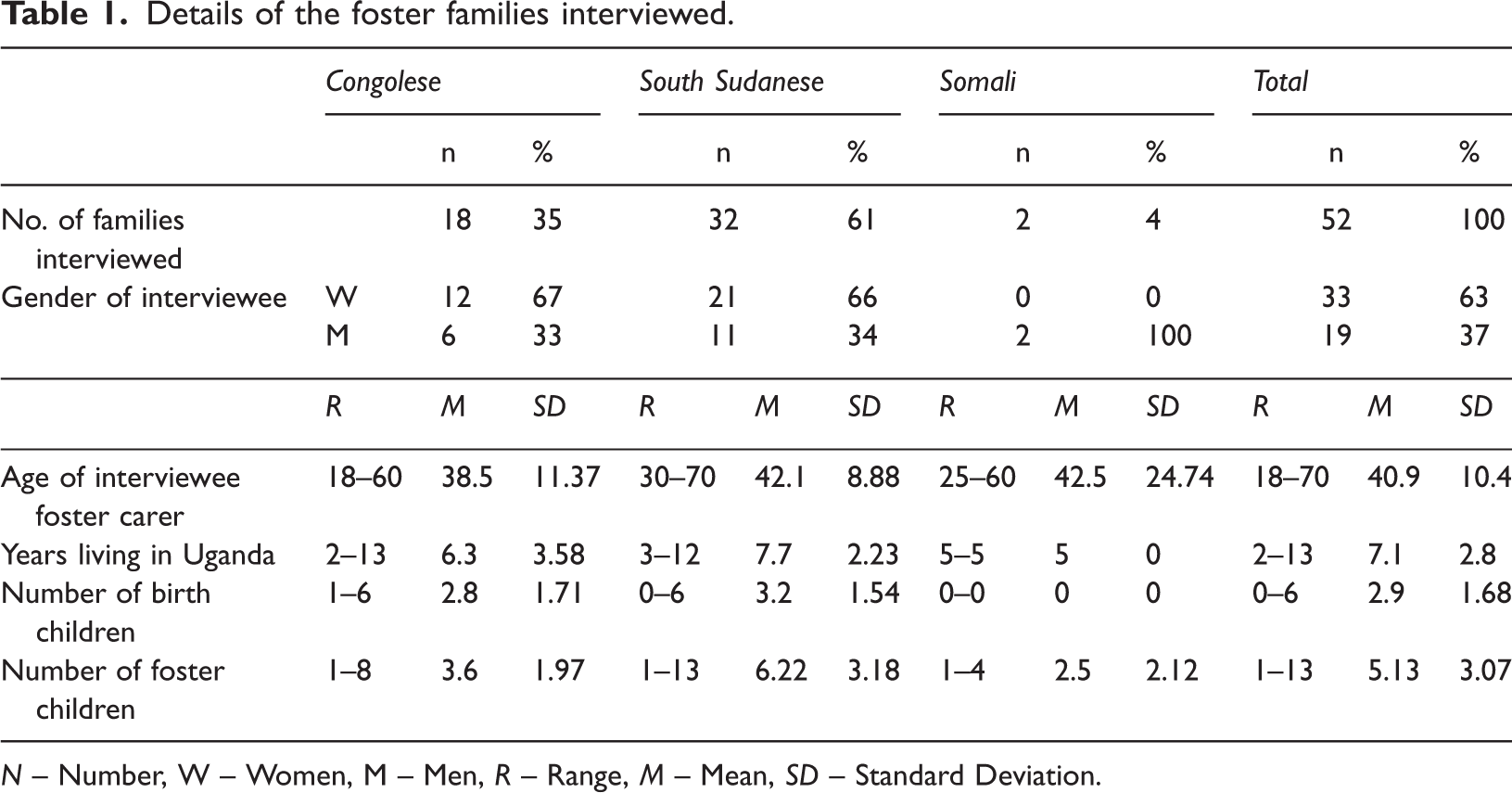
N – Number, W – Women, M – Men, R – Range, M – Mean, SD – Standard Deviation.
In addition to the questionnaires, we conducted individual semi-structured interviews with nine foster carers to record their views, ideas and behaviour regarding state and international authorities and their interactions with them. We also interviewed staff from two local authorities about their interactions with the foster families and their perceptions of the situation. We first conducted participant observations through unplanned, informal interviews in the form of spontaneous conversations arising from participant observation opportunities. Participant observations were spread across 2021–22 at the centre and during visits with foster families to different NGO headquarters and offices. Their purpose was to explore the interactions between foster families and the organisations that support them. The subsequent conversations with the carers were useful to understand the subject matter, which is complicated or sensitive because of its non-standardised character (Fielding and Thomas, 2008). We then used the findings from our observations to inform and review relevant national and international laws and other sources of written materials. We formed questions for formal semi-structured interviews based on the review of written materials and these observations. These consisted of open questions to explore a wide variety of topics, and provided informants with time and space to present and develop their ideas, as well as to verify and better understand issues raised through participant observation. Elicitation of these interviews informed our questionnaires, which were distributed to other foster refugee families to trace patterns, and ensure consistency among foster carer experiences and challenges.
Analysis
Quantitative data from questionnaires were entered into Microsoft Excel to assist with the generation of descriptive statistics. Taking a phenomenological approach, which seeks to understand the nature of things by investigating the everyday experiences of human beings (Wilson, 2015), we used qualitative data to understand the critical issues in the research participants’ ‘lived experiences’ (Şeker and Sirkeci, 2015). Qualitative data, including observations, informal discussions and interviews, were analysed using conventional thematic analysis (Hsieh and Shannon, 2005) to identify the main recurring themes evident in the findings. Interviews were audio-recorded and later transcribed, compiled and anonymised.
The analysis consisted of a descriptive and classification process of the data. In the first step, we read the interview transcriptions several times and created a list of codes and basic demographic details. Following Strauss and Corbin’s (1990: 61) manual open coding method, which is ‘the process of breaking down, examining, comparing, conceptualising, and categorizing data’, we included defining codes that would help assess and compare case studies. Later, the authors decided together how these codes interrelate and the primary and most significant findings of the study. The new connections between categories were identified and developed into core concepts relating to the research question (Strauss and Corbin, 1990: 116). The findings raised four overarching themes:
Circumstances and reasoning for fostering unaccompanied children; Formalisation of explicit foster registration; Differences in care and living conditions; Ambiguous organisational support.
In all stages of data collection and analysis, we considered that refugee populations are not homogenous and vary on many levels; therefore, we included as many quotations as possible to allow different voices and actors to be directly introduced through this work.
Ethics And Study Limitations
We received research permits from The AIDS Support Organization (TASO) and Kampala Capital City Authority (KCCA), and applied the 1999 ethical guidelines of the Association of Social Anthropologists of the UK and Commonwealth. Special attention was given to the protection of informants; names of places and people have been changed unless requested otherwise. All participants received an oral explanation of the purpose of the research and gave consent. All interviewees were kept anonymous, and voice recordings were erased immediately after transcription. No personal names of any children were included in the interviews to reduce the risk of case discussion.
There are biases related to studying vulnerable populations such as refugees, who are dependent on the goodwill and support of different actors, as they are often afraid to speak openly about injustices or bad experiences involving any of these actors. Additionally, scholars have noticed the exaggeration of certain suffering and victimisation narratives. This is especially true in cases where the researchers are foreigners and associated with a humanitarian organisation, due to existing donor–beneficiary and foreigner–local power relations (Bjorkhaug, 2017). Both authors of this paper are foreigners in Uganda, and therefore we tried to mitigate biases by working closely with different refugee community members, seeking their advice and perspectives, and thoroughly triangulating all information through various sources. Questionnaires and house visits were done by community members and leaders who were trained by us, and only the in-depth interviews, with previously acquainted individuals, were conducted by the authors. Despite our limitations and biases, being outsiders provided an opportunity to voice critiques on behalf of the communities that are dependent on organisations funded by Western donors, without them facing ramifications. Thus, we felt it was imperative when conducting this study to ensure that we promoted their rights on the one hand and preserved confidentiality on the other (Mackenzie et al., 2007). Unfortunately, despite numerous attempts, like researchers before us (Egwalu, 2017), we were unable to interview officials at the Office of the Prime Minister (OPM) in charge of refugees in Uganda or staff in NGOs about the situation of fostered refugee children in Kampala.
Findings
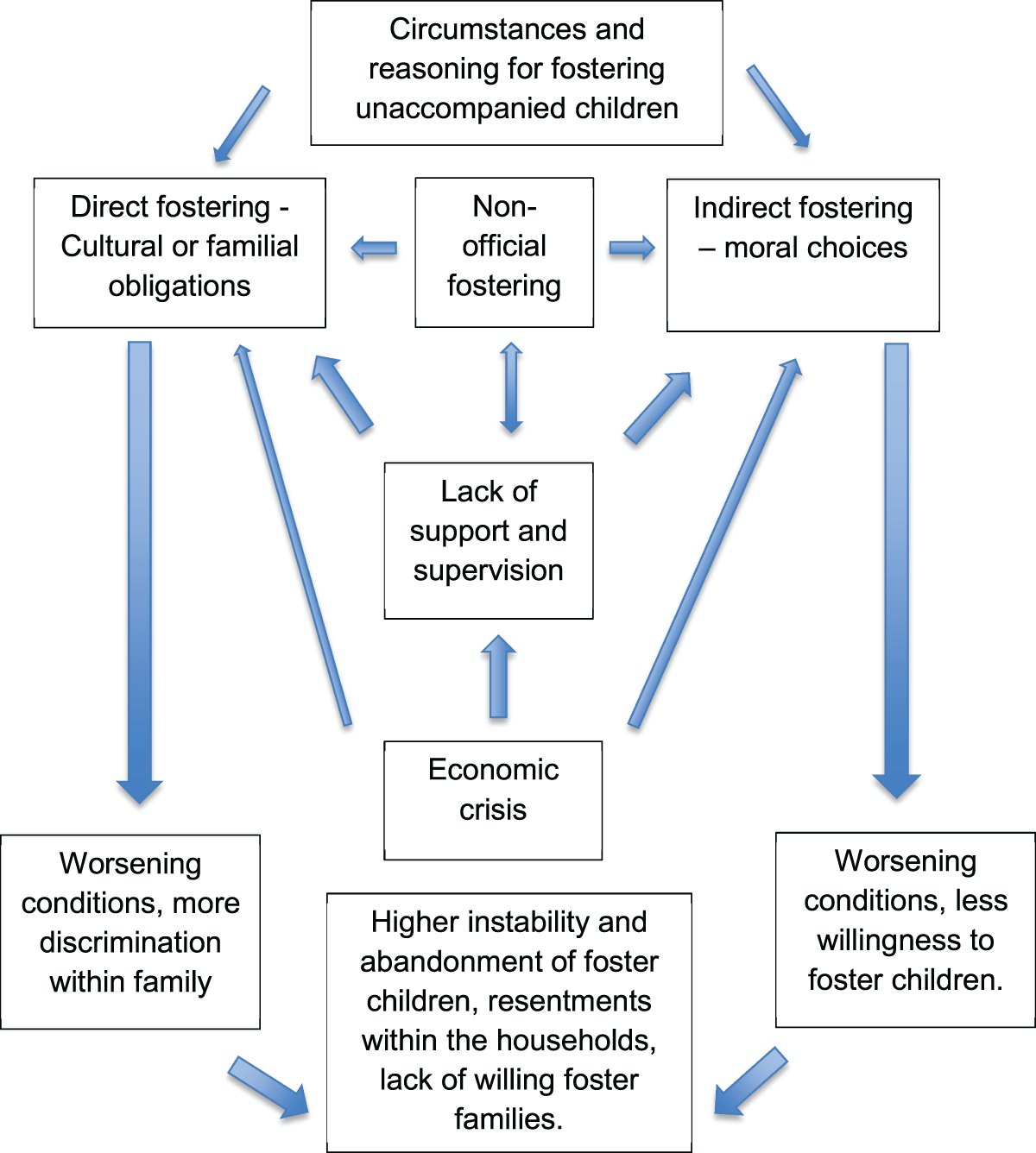
Drawing on both qualitative and quantitative data, the situation and needs of refugee foster families in Kampala were categorised and explored within four interrelated key domains, which are affected by external pressures, especially the deteriorating economic situation in Uganda. These interrelations are summarised in Figure 1, and will be further explained in the next sections.
Circumstances and reasoning for fostering unaccompanied children.
According to the questionnaires and interviews, most foster carers took the children into their care directly, without the involvement of organisations. These children were often close family, like grandchildren or nieces/nephews, who lost their parents due to war or sickness. In five cases, the parents died, and the older siblings took care of the younger ones. In other cases, the children were distant relatives or children of neighbours, either from their places of origin or in Uganda. Most of the families (27) came with all their foster children from their countries of origin. Eight families arrived with some of the children they fostered, and additional children were sent to them after they were already in Uganda. Non-direct fostering of non-family members was mainly done through the intervention of UNHCR, NGO partners, or refugee-led organisations related to local churches. We identified four church-run organisations; each had 10–40 unaccompanied children, who they divided between their churchgoer families who agreed to foster them.
In the case of refugees from South Sudan, many foster children arrive from polygamist families where the father passed away. These South Sudanese widows are very vulnerable and usually unable to care for the children. They leave the children with the first wife, who is socially responsible for maintaining all offspring. Therefore, many South Sudanese foster mothers we interviewed were single mothers with a few children of their own and up to 13 children who were not genetically related to them. In other cases, young women or men who were leaving South Sudan during wartime were expected to take other people’s children who were in danger or unable to receive an education, and their parents could not afford to travel. Children often stayed with those they migrated with but in some cases, children were transferred to more established relatives after their arrival.
The reasoning most carer fostering family members gave for their acceptance of extra children was having no choice. They were the closest family relatives, the only ones who could care for these children, which was culturally expected of them. These were some of the justifications they gave in the questionnaires: Because in our culture: family is family, and you can’t leave your own family to be killed when you can help by rescuing them. I was the only person who could afford to take care of them during the war in South Sudan and even now in Uganda. I had to [take them in] because their parents were killed, and they were afraid to be taken by rebels.
Carers whose foster children were not direct family members gave different answers, stating that it was their own choice based on moral or emotional decisions. Some of the typical responses were: I was a street woman before, living in Kampala with my children. I know the feeling of no one loving me. I felt sorry for them due to the violence they lived through.
The motivations of relative and non-relative foster families were different, as the latter often went through similar difficulties themselves and felt empathy towards the children in this predicament, while the former felt a cultural and familial obligation.
Formalisation Of Explicit Foster Registration
According to Ugandan laws, new arrivals enter as asylum seekers and begin a standard Refugee Status Determination (RSD) process with the OPM, receiving an asylum seeker document and, later, a refugee ID. When registered as refugees, they receive a Family Attestation document where they can add all the people whom they consider to be related to them and they would like to have on the same file regarding their possible resettlement process or any other bureaucratic issue. Most families (n = 33), especially those arriving in Uganda with the children, had had them registered on their family attestation files. Eight families had not registered the children as part of the family. Six other families had only some children registered, depending on how recently the parents had been registered and given a refugee ID by the OPM.
None of the children were adopted legally or were in the process of adoption, and none of the carers showed any knowledge of the official process of adopting children, or the official process of fostering required by the Ugandan government. They also did not have any contact with the Ministry of Gender, Labour and Social Development or had made any other attempt to make fostering official, except for registering the children on their family file with OPM. Most families (41) stated in questionnaires that they did not think the UNHCR was aware that they had foster children in their families.
However, the foster carers told us that people who were officially resettled by the UNHCR in a third country together with their foster children found out that having their children registered in the family attestation is not enough, and were separated from them by officials in the new countries upon arrival or had to go through a very long process. This problem has been noted in Ugandan fostering practice when formal adoption does not occur, and families are forced to separate after immigration (Devries et al., 2013; Devries, Kyegombe et al., 2014; Sserwanja et al., 2021).
Differences In Care And Living Conditions
All families complained about the economic challenges of caring for extra children, especially the need to pay school fees and medical bills and feed extra mouths. Only 37 (12.8%) of the children were reported as going to school during the first semester of 2022. Most families said their foster children received one or two meals a day, with two families testifying that they did not even manage to eat once a day. In an interview with a community leader, he described the situation of foster children he met in the South Sudanese community: Most of the foster children are sleeping on the ground, and some of them sleep in the sitting room. They don’t have mattresses. And then also, you’ll find that they’re eating once a day.
He also commented on discrimination and unequal workloads between birth and foster children in families. According to him, foster children often eat after the rest of the family and bathe last, if enough water is left. He explains that their position prohibits them from expressing any protest.
The foster carers we interviewed confirmed that these children do not receive the same treatment as their birth children, and suffer from it emotionally. Due to the challenges that I face, I have no income. I can’t provide them with everything they want because I have my biological children. The children know that if I send them [to work], they have to do things because they don’t have a choice. Even though I send them, they will not complain because they know they don’t have a voice; they don’t have any parent who can say, ‘You don’t have to do this.’
This has a direct impact on the foster children’s abilities to play or do anything besides earning their keep. In a conversation with a foster child, he commented: It is very hard for me to play because when I start playing, they will know, and they will give me work to do, whether I will go and fetch water, or they will send me to go and buy something in the street or something like that.
Some carers acknowledged that they were trying to divide their resources evenly between their birth and foster children, but recognised the price that their birth children were paying by sharing the minimal resources available with others: Your own children, you are paying for their school fees. But when you have more children, you have to divide this small money. And when they are chasing them from school, even your children will be affected because you cannot pay all the school fees for your own children and leave the others [out of school]. So, it is half, half. When they chase, they chase all of them together. So, it affects them, and sometimes they start complaining.
Ambiguous Organisational Support
As with their Ugandan counterparts, refugee children’s fostering responsibility falls under the Ministry of Gender, Labour and Social Development jurisdiction. Additionally, refugees need to report to the OPM about all family structure changes, and refugee-dedicated NGOs handle fostering and child protection cases within refugee communities. The UNHCR, through its implementing NGO partners, oversees child protection cases, including foster children in Uganda.
Although there are many foster families in Kampala, our observations revealed that there was only one group, currently consisting of 14 foster families, which was listed by the implementing NGOs, considered as the ‘Foster Families Group’. Some of these families had foster children who they directly accepted, but some of these children who needed short- or long-term fostering were handed over to them by these same organisations. These minors had occasionally arrived in Uganda unaccompanied, but usually were children who had families before and were separated because of the death or sickness of their parents or were sent away from other foster families. Some were found in a police station, left in the offices of NGOs, found in the street, or identified by the national authorities. Since the economic crisis started, there has been an increase in the number of children abandoned by their parents. This drastic step often follows unsuccessful appeals to NGOs for economic support, protection from threats faced by the family, medical intervention, or to follow up on their resettlement cases that had not progressed. Some of these children arrived at the NGOs suffering severe malnutrition and with nothing but the clothes they were wearing, indicating that they were living under harsh conditions.
Prior to the current economic crisis, NGOs would arrange care for children by setting up six-month renewable fostering agreements with foster families. However, since 2020, the implementing NGO in charge of fostering has stopped providing these agreements, although the families repeatedly request them. The organisations often promise to support the children passed on to the families, but this very rarely happens. One of the foster mothers said in an interview: When they come with the children, they tell you that you’re taking these children only for three days … After two weeks, they come back with something like two clothes. Then they promise to bring food or other things. Sometimes they tell you, ‘OK. Since you have these children, we’ll help you with the rent.’ ‘We will bring food; we’ll bring a mattress.’ But they don’t. They don’t bring it.
According to these testimonies, until the end of 2021, these families were invited to periodic meetings with the implementing NGOs, sometimes in the presence of the UNHCR. During these meetings, the families were mainly asked to discuss their needs and offer projects that would financially help them raise these extra children. However, these meetings were initiated many years ago, and they have not yielded tangible results. According to the families involved, they believed the NGOs have used the information and photos taken during these meetings in their reports and fundraising efforts. According to sources in the UNHCR, some funds were raised for these families, but they have not reached the intended beneficiaries. It remains unclear how much money was received by the implementing NGOs to support these families and what happened to these funds.
At the end of 2021, the situation deteriorated further after the families were promised support and were asked to prepare budgets for their individual small businesses. After months of work preparing budgets and waiting for answers, the NGO informed them that there was no money and that the project was cancelled. Soon afterward, they promised to provide the families with special food rations for Christmas. When the families came to the next meeting expecting to receive some food, the organisations claimed that they had not promised food and did not refund them for the transport to the meeting, as was the custom. Families reported that NGOs also failed to provide support for school fees.
Families stated that the organisations concerned do not publicly admit their lack of support for foster families. According to our interviews, this claim exacerbates immense tensions between foster families and the rest of the refugee community and sometimes even between spouses in the same family, because the community believes that foster families receive income from the organisations to keep the foster child, which the foster carers are seen as hiding and misusing, rather than sharing it with the rest of the family and community. The foster families felt that the implementing NGOs addressed them with hostility, aggression and threats. Foster families claimed that they were warned not to use the foster children to seek personal donations from other organisations.
A foster carer reported in an interview that a few months earlier, she told a UNHCR officer that she received five children from the implementing NGO without help, and was reprimanded for sharing this information with a UNHCR officer. Another woman said that she was investigated and threatened because she received support from another, much smaller, organisation that paid hospital bills for her foster children rather than using the refugee health system, which was not an option at the time because of severe budget cuts. Another foster family claimed that the treatment of a disabled foster child was postponed for six months because the NGO did not sign approval for them to start the treatment, even though the family did not ask for any financial support.
Foster carers who asked organisations if they would help with food or school fees for foster children claimed that they had received ‘degrading’ answers: [They said] ‘If you are tired of taking care of those children, just bring them back.’ [Or] ‘Fostering children is not a business you can gain money from.’ You become their enemy … Sometimes, we keep quiet because we’re in their country, and you just stop talking. Because I remember when we were trying to talk about other organisations, we were threatened and accused of many things. So, we just keep quiet also, for our security. You never know. You can say that you’re becoming strong and fighting for other people, but you don’t know what will happen. Because when I was trying to fight for other people, it became a problem for me.
Foster families claimed that they were frequently threatened that if they complain their foster children will be taken away, some of whom have lived with them for more than 10 years. Additionally, the implementing NGO recently started interviewing foster children; the families claimed that this was to try to find problems in how families treat the children. The interviews are not necessarily problematic, but the foster carers complained that during some of these interviews, NGO workers intentionally created conflicts between the children and their foster carers.
The growing tensions between foster families and the organisations and the deteriorating economic situation discouraged families from continuing to foster. From a group of 30 foster families working with the NGOs in Kampala in 2015, there were only 14 families at the time of our study, and only five of them, all headed by single mothers, were still accepting new foster children in mid-2022. Since September 2022, after several attempts of the foster carer group to initiate an open conversation with the organisations, none of the families agreed to receive more children, and it was unclear where new foster children were being sent. All the foster carers involved in this group were reported as being very discontented. Some had threatened to return the children they currently cared for until there was an actual agreement with the implementing NGOs about proper support.
According to the interview and questionnaires that we gave to foster families who were not part of the 14 families considered by the NGOs as the Foster Families Group, none of them had received or been offered any assistance intended for their foster children from any of these organisations. In cases where non-direct fostering was undertaken through the agency of a church-run organisation, there were occasional organised food collections from the churchgoers, which were then divided as food rations between the foster families. These initiatives were also drastically reduced during the economic crisis. Other foster families received food and clothes donations for their foster children from friends and neighbours.
In summary, the deteriorating economic situation in Kampala is affecting foster families directly, through the lack of available resources, and indirectly, through diminishing economic support. The crisis appears to be affecting families differently, depending on whether they are fostering children ‘directly’ or ‘indirectly’. Families that were fostering children directly, out of obligation, confessed worsening conditions and increased discrimination around foster children. Families that were fostering children indirectly expressed high levels of disappointment from the lack of recognition and support from the organisations. Although in both cases fostering was unofficial and therefore less binding, in the case of direct fostering, the cultural and familial ties were more likely to prevent child abandonment but might allow children to be sent between different kin. However, these children might be at higher risk of being abused and exploited due to the growing frustration of the fostering family.
Discussion
This paper aimed to understand the living conditions of Kampala foster families and their challenges. For centuries, fostering has been practised within kinship in some African countries as an integral part of the cultural norm (Kasedde et al., 2014). Grant and Yeatman (2012) note that the origins and goals of fostering differ across African regions. Evidence from West Africa suggests that fostering is predominantly used as a mechanism for families to strengthen social connections and kinship ties and provide economic, social and physical relief to either the birth parents or the foster families (e.g., Akresh, 2009; Alber, 2010). Fostering in African countries does not necessarily involve a child moving into the fostering family’s home but can take the form of ‘patronage’, which includes some form of financial support and material arrangements (Amollo et al., 2022). Fostering is considered to be a mutual arrangement, as children are expected to support their foster carers in the future. At least in some cases, this was shaped within the child–parent commitment framework and should be understood as a form of extended familial connection (Levy, 2019).
By becoming refugees, people are often forced to break off many of their extended family ties. This shift in social structure forces refugees to rely mainly on their nuclear families, new communities and external aid, and less on their extended families (Mendenhall et al., 2015). However, family connections can be maintained internationally. During this research, we met children sent from South Sudan or the DRC to stay with relatives living as refugees in Uganda. The hope was that these children could enjoy the better education systems and safety Uganda offers or be included in their foster family’s resettlement case and get a chance to move to a Western country and support their families back home in the future. Some of the birth parents of these children were sending sporadic funding towards their livelihood and education.
Foster care is increasingly seen as a ‘better’ substitute for institutional care, especially in light of the increasing uncertainty about the efficacy of conventional institutions and care homes (Amollo et al., 2022; Grant and Yeatman, 2012). Indeed, many cases of child trafficking for international adoptions and orphanage tourism, as well as severe cases of institutional abuse, have been exposed in Uganda in recent years (Chae, 2013; Mukasa and Cheney, 2017), as in other parts of the world (Biehal and Parry, 2010; Lyneham and Facchini, 2019). Furthermore, many children’s rights advocates perceive intercountry adoption as a last resort because children suffer when taken away from their environment and the broader community. In extreme cases, because of a lack of regulation, children can become victims of trafficking, becoming an ‘export product’ for the West (Cheney, 2013: 251). Children’s rights advocates argue that poverty, in the case of Uganda, cannot be seen as a ground for international adoption. Instead, they suggest that interventions that promote access to traditional mechanisms of support, such as the kin- and community-based efforts that target poverty reduction and expand social protection to vulnerable families, should be encouraged (Mukasa and Cheney, 2017; Roby, 2015). For URCs in Uganda, kinship-based care by the child’s extended family or close family friends is considered the best option, while fostering by families of the hosting communities is discouraged (Uganda Child Protection Sub Working Group, 2018). Our study provides further evidence that many families do foster due to empathy and moral reasons, which would suggest that this is a viable option that has the most potential to safeguard these children, while keeping them within their community.
URCs in Uganda are often fostered by their kin or members of their ethnic group, but only some of the children are registered in the family attestation of their foster families. Government policies regarding registration and documentation have changed over the years, but being registered as an asylum seeker or refugee is a vital step forward, enabling children to attend school and receive medical treatment in local clinics. Unregistered children are denied access and benefits to certain facilities, while children and young people entering and living in shelters are registered and can therefore access basic services (Clark-Kazak, 2009). Registration does not always work in favour of people who migrate in an unregulated manner, since it involves monitoring by the security forces in the host country. Nevertheless, since migration policies are usually more protective concerning minors, children’s registration often provides some form of protection rather than aiding deportation or imprisonment (Descilo et al., 2010; Ensor and Gozdziak, 2016). Despite the growing importance of formal adoption, none of the families we spoke to had gone through the process of formally fostering or adopting the foster children. This is essentially the same situation as with the general population of Uganda, perhaps due to the heavy presence of extended family systems that embrace unofficially fostered orphans and other vulnerable children (Mukasa and Cheney, 2017). Another explanation might be that carers may not be aware of the procedures or, if they are, do not see the benefits of this highly bureaucratic process (Cheney, 2010). Additionally, the recent lack of written agreements between the implementing NGOs and foster families is especially problematic, as it leaves foster carers vulnerable, without any document to explain why they have these children; especially because, in most cases, these children are unrelated to them. Furthermore, Sserwanja and colleagues (2021) argue that the lack of personal documentation for refugee children living in Uganda also makes them more susceptible to violence and exploitation. As seen in our results, the lack of formality can cause instability and abandonment of foster children.
We estimate that hundreds of foster families and thousands of foster children are currently in Kampala, while, as mentioned in the results, only 14 families are considered by UNHCR and the NGOs to be part of their foster family programmes. Neither the families that are part of NGO foster programmes nor informal foster families receive adequate support or supervision, leaving the children acutely vulnerable. The families we spoke to were struggling to maintain children without assistance, and the lack of official supervision meant that the children were easily exploited. In many cases, birth children were suffering from the need to share limited resources with foster children who sometimes outnumbered them, as in the case of a South Sudanese parent who had one birth child and 10 foster children. Egwalu (2017), who studied fostering families in Kisenyi, Kampala, argues that foster families of URC should be catered to as a particularly vulnerable group. They should receive financial support to provide for their non-birth children to achieve educational success (Egwalu, 2017: 23). Our study confirms that most refugee foster children do not receive formal education.
Due to these difficulties, foster families sometimes renounce their fostering responsibilities, and the children must be rehomed by the community or NGOs. Some children are moved from one family to another, as often as multiple times a year. They must adjust to different rules, habits and even religions. Therefore, being unaccompanied or accompanied is not a dichotomy but often an ongoing process in which refugee children move from one family to the other, willingly or unwillingly, and are accompanied only for short periods. Researchers notice that foster care instability causes further behavioural, mental and physical health issues (Foster, 2020; Kasedde et al., 2014). Previous research in Uganda and other similar contexts across Africa shows that unaccompanied refugee young people often create new relationships with guardians that always come with a set of expectations and responsibilities that they are often willing to carry out in order to become a part of a familial structure (Clark-Kazak, 2014; Levy, 2019). At the same time, some forms of guardianship are imposed on the children or come with over-monitoring, social rejection and opportunism on the part of the potential guardians. Becoming accompanied does not always mean the end of negotiation for survival, which challenges the assumption that children and young people are unaccompanied only when they are without birth parents or foster carers. In many ways, the liminality of being fostered and constantly oscillating between being accompanied and unaccompanied fills the children’s lives with continuous struggles and disappointments as they navigate familial dynamics and relationships to find acceptance and belonging (Levy, 2019).
It is culturally accepted in Uganda that birth and foster children must contribute to household chores according to their age and abilities (Imoh, 2019). However, foster children in Uganda were found to withdraw from school to work at home, do heavy labour which is not age-appropriate, have no leisure time, and are sexually harassed, married off at an early age or denied any inheritances (Musisi and Ochen, 2017). This study confirms that foster children in families – especially those living in acute poverty or who were culturally forced to foster – worked more and received significantly less care and rights than birth children. Some foster families discriminated against their non-birth children, and many failed to adhere to the established government fostering standards and procedures as mandated by the Children Act, Chapter 59 (Republic of Uganda, 2000). Although the state has made significant efforts to develop legal frameworks to protect children from all forms of rights violations, children in both formal and informal foster care homes continued to face considerable abuse of their rights, both subtle and overt. The participants in this research have shed light on the problems related to these arrangements. Fostering can deprive children of their autonomy and forces them to depend on strangers’ authority, often exposing them to exploitation. This can intensify struggles and feelings of isolation and estrangement (Levy, 2019). Nevertheless, alternative frameworks of belonging, such as fostering, are remarkable and reveal the importance of existing community-based coping mechanisms.
Refugee communities in Kampala show astounding resilience and the ability to sustain themselves. However, it is important not to idealise the concept of ‘community’, as it can perpetuate traditional hierarchical and exploitative relationships (Ager and Metzier, 2017; Ager et al., 2010; Omata, 2013). Support among members of a specific group is often seen as a positive sign of community resilience, allowing communities to survive in times of stress and crisis. However, it forces community members to seek support from and depend on others, within the constraints and expectations imposed by the community (Doron, 2005: 184). Moreover, in times of economic crises, such as the current situation, these systems, based on private donations and internal sharing, do not have the financial capacity to support the most vulnerable groups. Community-based organisations and social ties are vital sources of support for their members and provide children and their families with support and opportunities, but at the same time, these ties come with hefty prices, and this is particularly true for fostering families. Foster carers in this study, many of them single mothers, expressed frustration over their lack of choice regarding caring for additional children and the effect on the quality of life of their own families.
Implications For Policy And Practice
In 2018, the Uganda Child Protection Sub Working Group (CPSWG) observed that foster care relies on the goodwill of volunteer foster carers. The increase in children in need, coupled with the pressures occasioned by the lack of resources, has caused fostering fatigue. The CPSWG has suggested several policies that determine that foster families are not entitled to extra assistance or financial support. This measure is intended to discourage fostering that is driven by non-altruistic motives. The group also suggests that potential foster families should be assessed to avoid adding children to unsuitable families, and that families should receive regular supervision and monitoring visits from the authorities throughout the fostering period (Uganda Child Protection Sub Working Group, 2018: 4).
This study confirms that the recommendations by the CPSWG for Uganda’s welfare office have not improved the situation for refugee foster families and may have caused them to deteriorate. Recommendations limiting the number of children per family seem to have been largely ignored, and there appears to be no evaluation of the fostering carers’ economic state or vulnerability before children are added to the family. These recommendations allowed policy-makers and NGOs to justify policies that relieved them from the responsibility of aiding refugee foster families. Fostering fatigue continues to be a problem, and foster families are exposed to numerous risks and challenges. Foster carers also reported feeling criticised and humiliated by the organisations that are supposed to support them. By receiving children from the UNHCR’s implementing NGOs, foster carers are becoming service providers but are not sufficiently compensated for their efforts. They are expected to provide for their foster children without discrimination, without any support, by virtue of ‘goodwill’. We argue that, although there may have been good intentions underlying these recommendations, they may have inadvertently caused more harm than good. The Foster Families Group is now reported as being unwilling to receive new children, and some of the children who had stable foster homes are now moving between families. The situation of other children, who are not part of the implementing NGOs’ Foster Families Group, is not regularly assessed. Still, our study suggests that their living conditions are deteriorating during this ongoing economic crisis, and if the situation continues, most of them will not be able to complete the missing years of education.
Egwalu (2017) finds that, due to the lack of assistance for urban refugees, URCs and foster children in urban areas of Uganda are often invisible to humanitarian assistance policy-makers and responsible bodies, such as the UNHCR and Ugandan government. Due to a lack of supervision, support and overprotection of organisations causes unaccompanied children and their families to experience increased danger and vulnerability. We argue that by denying support from refugee foster families, especially in times of economic crisis, organisations are making community-based solutions impossible. Together with the lack of proper supervision and control, these policies inadvertently encourage less altruistic fostering and more abusive and illegal treatment of unaccompanied children.
Recommendations
The number of refugee foster children in Kampala is currently unknown, as children are ‘invisibilised’ by being left unquantified and thus left outside the ‘bureaucratic capture’, which leaves no one accountable for their fates (Humphris and Sigona, 2019: 1503). These children should be identified, and their life circumstances and the condition of their foster families should be assessed. Foster families should receive economic support according to their needs, regardless of whether they foster children directly or through an organisation. This should help them care for the additional children without depriving the rest of the family. Funds should be allocated for these families, which can be received through business plans (which will help them sustain themselves independently) or as direct help with foster children’s expenses, including school fees. Support must be given while retaining complete transparency to avoid corruption, rumours and conflicts.
Non-material support, including counselling, is also lacking and necessary. Family efforts should be recognised and encouraged. Foster families should be treated as partners to the organisations and should receive all available information about the circumstances of the children they receive and how long they are obliged to care for them, as well as their realistic options for receiving any support. Threats, humiliations and disrespectful interactions towards foster families should cease, and communications should be respectful and appreciative of the contribution of these families. Furthermore, the fluidity of the accompanied–unaccompanied nexus should be recognised and considered in national policies (Lelliott, 2022). Children’s conditions should be continually monitored to maintain those who live in supportive foster families. Permanent fostering or adoption should be formalised with a simplified bureaucratic procedure that refugee families can follow. These steps will promote long-term investment in foster children to create a sense of stability and trust, and can potentially increase families’ willingness to invest in long-term endeavours such as the education and wellbeing of these children.
Footnotes
Acknowledgements
We dedicate this manuscript to foster carers and other refugee leaders who dedicate their lives to helping others. We thank Nina Poletti for her help with this manuscript and all our informants and interviewees.
Declaration Of Conflicting Interests
The author(s) declared no potential conflicts of interest with respect to the research, authorship, and/or publication of this article.
Funding
The author(s) received no financial support for the research, authorship, and/or publication of this article.
