




Abstract

It is the obligation of every person born in a safer room to open the door when someone in danger knocks (Nayeri, 2017)
This quote nicely illustrates what the humanitarian response should be when adults, children and young people fleeing war and armed conflict arrive at their destination country. Sadly, in a time where conflicts are on the rise (ACLED Conflict Index, 2024), the British government’s slogan ‘Stop the boats’ (Home Office, 2024) seems to be in stark contrast to this sentiment.
According to the Armed Conflict Location & Event Data Project (ACLED; Raleigh, Kishi and Linke, 2023), roughly 17% of people have been exposed to armed conflict in 2024 with the severity in 50 countries rated as turbulent, high or extreme. These 50 countries – among them Syria, Palestine, Israel, Russia and the Ukraine to name a few – account for 97% of all conflicts recorded within the past 12 months.
One of the many consequences of war and armed conflict is the displacement of adults and children due to a violation of basic (Maslow, 1943) physiological and safety needs. These adverse experiences may include lack of food, water and shelter, and experiences of (or in some cases witnessing of) destruction, death of a loved one, torture, combat, imprisonment, or persecution for religious, political or ethnic reasons (Giacco, Laxhman and Priebe, 2018).
In addition to pre-migration stressors, people fleeing from armed conflict or war encounter further risks during their journey to safety. For instance, in a qualitative study with parents who were seeking asylum in Sweden, one of the participants reported that her children had witnessed several people drown during the dangerous crossing of the Mediterranean Sea (Hedstrom et al., 2021). Other risk factors, according to a systematic review, include procedures in the destination country such as detention and prolonged stays in refugee camps (Scharpf et al., 2021).
Alone in England (Department for Education, 2023), unaccompanied asylum seekers and refugees make up 8.7% of the total population of children looked after (n = 7,290 children), a rise of 29% since 2022. Unsurprisingly, given their adverse experiences, these children and young people have a high prevalence of mental health problems with 22.7% of child and adolescent refugees and asylum seekers suffering from Post-traumatic Stress Disorder (PTSD), 15.8% having an anxiety disorder diagnosis and 13.8% a diagnosis of depression (Blackmore et al., 2020).
A qualitative study published in Adoption & Fostering interviewed carers in the South West of England about their experiences of fostering unaccompanied asylum seekers. The foster carers highlighted that the needs of these children and young people differed considerably from those of other children in foster care. In addition to cultural needs (i.e., religion, food), these included the adjustment to life in a foreign country, assistance with the asylum-seeking process and support with communication and advocacy. The foster carers often felt ill-equipped for this task and highlighted the need for specialised training and support from local authorities (Sidery, 2019).
Living in the destination country with a parent and having a warm relationship with them are both protective factors for young people. By definition, unaccompanied minors have been separated from their parents – an additional risk factor for mental health problems (Scharpf et al., 2021). Warm foster carer behaviours may however buffer against some of the negative effects of adversity on mental health. At least, this has been demonstrated in a study with adoptive parents, where warm parental behaviours (i.e., letting the child know they really cared about them) had a protective effect on the development of depression and anxiety symptoms (Anthony, Paine and Shelton, 2019).
As Scharpf and colleagues (2021) identify in their systematic review, reducing risk could be achieved by a reduction of daily stressors and acculturation stress for these young people and the forging of friendships with peers (Hoare, 2022). Rachel Hoare, the Director of the Trinity Centre for Forced Migration Studies in Dublin, recently published some recommendations on how parents can support this. Explaining to their children that it is important to be kind and inclusive and to stand up to racism are part of these recommendations. This in turn would increase the children’s resilience and decrease daily stressors. Findings from the studies above have been integrated into Bronfenbrenner’s ecological system’s framework (Bronfenbrenner, 1978) and are illustrated below (Figure 1).
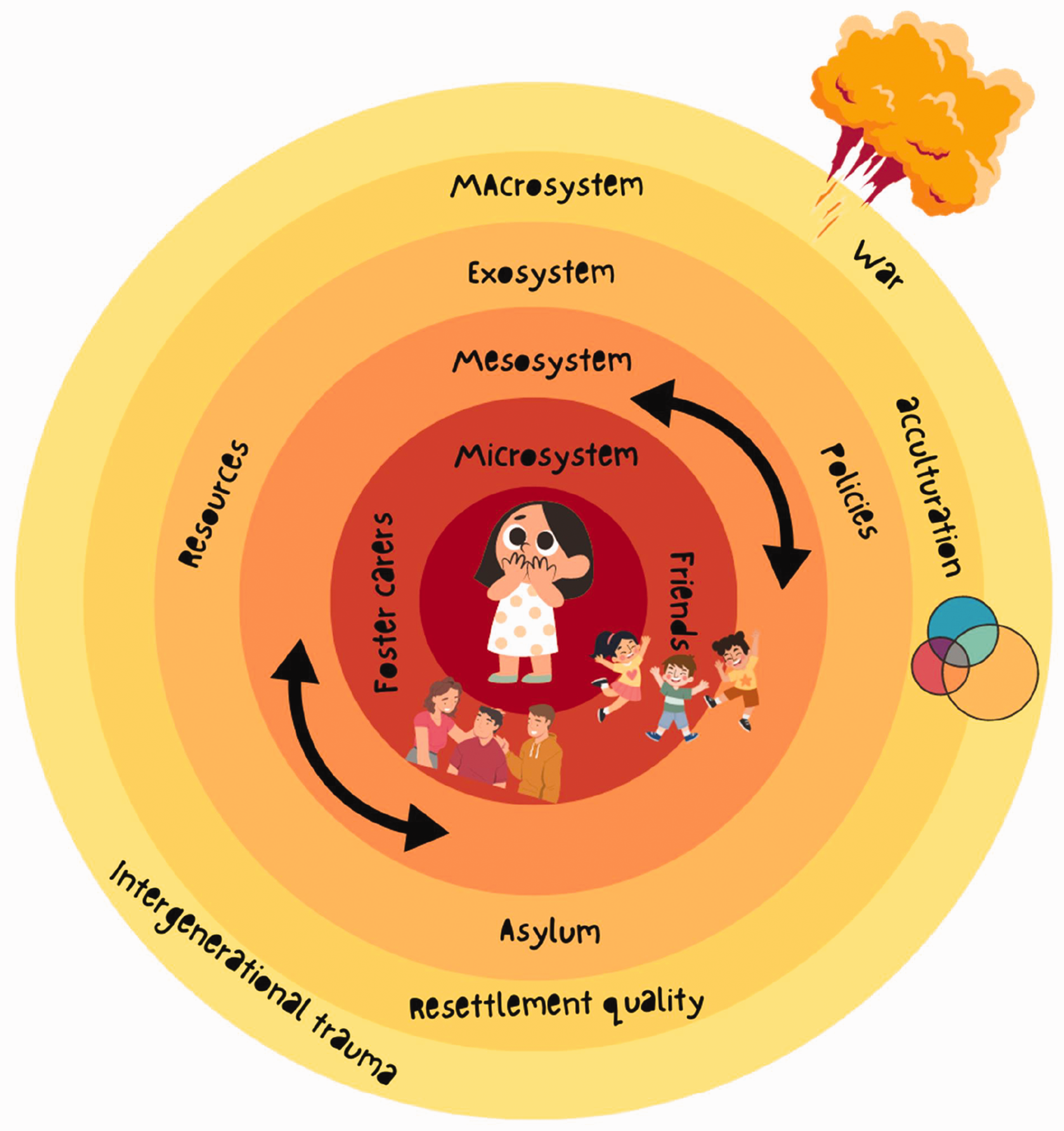
Risk and protective factors experienced by unaccompanied minors.
In line with the opening quote by Dina Nayeri, foster carers open their door to provide a safe space for unaccompanied children and young people. They do, however, require adequate training and support to care for this vulnerable group. Given these training needs, some resources have been collated below:
The UK Trauma Council provides a selection of evidence-based resources on their website: https://uktraumacouncil.org/resources/childhood-trauma-migration-asylum
The ‘Lives On Hold: Our Stories Told’ Project (LOHST) is an interdisciplinary participatory research project with young asylum seekers. Their co-produced videos are available here: https://vimeo.com/770709142; https://vimeo.com/803878765
CoramBAAF published the pamphlet series Caring for Unaccompanied Asylum-seeking Children and Young People (updated 2020). Available at: corambaaf.org.uk/books/caring-unaccompanied-asylum-seeking-children-and-young-people-full-series
The Fostering Network have gathered a collection of resources on fostering unaccompanied children seeking asylum in the UK. Available at: www.thefosteringnetwork.org.uk/fostering-unaccompanied-children-seeking-asylum-UK