




Abstract
Whilst it has been suggested that fostering involves being both a parent and a professional, little is known about how foster carers manage these roles. This study aimed to develop an explanatory theory and model of the processes involved in fostering looked after children and the relationship between the roles of parent and professional. Ten foster carers offering intended long-term placements to looked after children and five social care professionals who provide support to foster carers were interviewed. Data were analysed using grounded theory. A preliminary model was developed which suggested that the relationship between the two roles changed over time. Many described initially identifying with the parental role before experiencing challenges that necessitated also taking a professional one. Over time, these separate roles appeared to blend and become interconnected, such that foster carers became ‘professional–parents’. These findings extend our understanding of the complexity of the foster carer role and may link to existing role theories. They may also have important clinical implications for the support and training of foster carers, particularly in the early stages of the fostering journey. Further research, including the use of more diverse samples, is needed to extend these findings.
Introduction
Looked after children
Recent figures suggest that there are 80,850 looked after children (LAC) in England; more than a 30% increase over the last decade (Department for Education [DfE], 2021). The majority (79%) of them are under a care order (a court order places them in the care of a local authority), whilst some (15%) are under a voluntary agreement under section 20 of the Children Act 1989 (a local authority provides accommodation where there is agreement/consent from the parent) and the remaining (6%) are under a placement order (a local authority places a child for adoption). Most LAC in the UK (approximately 66%) enter the care system due to experiences of abuse or neglect, although other reasons, including ‘family dysfunction’, parental illness/disability or seeking asylum, also occur (Baginsky, Gorin and Sands, 2017; DfE, 2021). It is well documented that the early adversity that many LAC experience can have harmful effects on their development and lead to poor educational, emotional, behavioural and social outcomes (Baldwin et al., 2019; Ford et al., 2007; Jones et al., 2011; Oakley, Miscampbell and Gregorian, 2018; Wilkinson and Bowyer, 2017). Given the high level of need, providing LAC with appropriate care has become a significant priority (National Institute for Health and Care Excellence [NICE], 2015; National Society for the Prevention of Cruelty to Children [NSPCC], 2021).
Foster care
Whilst placement types can vary, 71% of LAC in the UK are currently in foster care (DfE, 2021). Three–quarters of these children are placed with a carer who is not a relative or friend (DfE, 2021). The types of foster care placements can also vary significantly; many foster carers in the UK care for LAC on an intended long-term basis (i.e., for several years, sometimes until the children become adults), whilst others may only offer more ‘short-term’ arrangements, as well as ‘emergency’, ‘respite’ or specific-needs placements (e.g., for mothers and babies). In recent years, there has been an increasing emphasis placed on long-term fostering given that permanence and stability can help to mitigate some of the negative outcomes associated with early adversity (Baldwin et al., 2019; Beckett, 2011). As a result, we have seen an increase in UK spending on fostering services (Narey and Owers, 2018) and research into long-term foster care (Biehal, 2014; Blythe, Wilkes and Halcomb, 2014; Schofield, 2002).
Despite the recognised need, there is often a shortage of available and appropriate placements for LAC. Recent data suggest that the number of children needing placement outweighs the number of fostering households and carers (Ofsted, 2021). Furthermore, difficulties with placement breakdown and carer retention are common, with many studies citing the management of complex behaviour and lack of support offered in the role as influencing decisions to continue fostering (Randle et al., 2017; Rock et al., 2013). Many foster carers caring for LAC on a long-term basis also report high stress, strain and compassion fatigue (Adams, Hassett and Lumsden, 2018; Hannah and Woolgar, 2018), which may impact their ability to care for LAC and continue in their role.
The foster carer role
Foster carers as ‘parents’
Traditionally, the foster carer role has been understood as providing care to LAC within a nurturing family environment (Schofield, 2003). In the UK, they have often been encouraged, and have attempted, to bring children up as their own, engaging in caring responsibilities similar to those associated with typical parenting. It has been suggested that by embedding LAC into the family for extended periods of time, long-term foster care can help to facilitate attachment development and enable a sense of belonging, which can promote positive long-term outcomes (Biehal, 2014). Thus, it has been argued that ‘much of the “work” of fostering is carried out in and through the family’ (Kirton, 2007: 13). This has led many to suggest that the ability to act as a parent to LAC is central to the foster carer role, with many carers strongly identifying with this parental identity (Blythe et al., 2013; De Wilde et al., 2019; Farmer and Lippold, 2016; Schofield et al., 2013; Warde, 2008).
Foster carers as ‘professionals’
Conceptualisations of the foster carer role have shifted over the years. It has been suggested that due to changes in UK fostering services, it has transitioned from being seen as more of a ‘voluntary activity’ associated with ‘ordinary’ tasks, to being a role that ‘can only be carried out successfully in the context of a fully professionalised service’ (Wilson and Evetts, 2006: 39). These changes include foster carers needing to manage increasing levels of complex behaviour and presentations, to work more inclusively and closely with birth families and social workers, and to participate in more formal tasks such as care planning, record keeping and attending meetings, as well as being subjected to greater monitoring and regulation. It has been argued that this has resulted in a trend towards ‘professionalisation’ in foster care (Kirton, 2007; Wilson and Evetts, 2006).
Whilst it has been recognised that such moves towards ‘professionalisation’ in foster care have been prompted ‘from above’, they have also been requested ‘from below’ (Evetts, 2003; Wilson and Evetts, 2006). Some carers in the UK and their representative networks and bodies have called for greater professional status due to regularly feeling under-recognised, excluded and overlooked by professionals (Kirton, Beecham and Ogilvie, 2007; The Fostering Network, 2016). It has thus been argued that foster carers should be acknowledged as a critical part of the child’s ‘workforce’ (Baginsky, Gorin and Sands, 2017; The Fostering Network, 2017). This is in line with social pedagogic approaches to fostering, which have begun to be introduced in the UK and emphasise foster carers being at the heart of the child’s care team (McDermid et al., 2016; Petrie, 2007).
Not all foster carers welcome the move towards ‘professionalisation’, however, and some struggle to identify themselves as professionals (Blythe et al., 2013; Warde, 2008). Furthermore, there are divergent beliefs and expectations about the role between different stakeholders in the UK. Whilst some research suggests that both social workers and policy makers view the foster carer role as a professional ‘job’ (Hollin and Larkin, 2011), other literature, including the most recent national fostering stocktake for England (Narey and Owers, 2018), clearly emphasises that foster carers are not professionals, although it is recognised that they should be treated with the same respect. Despite hoping to alleviate tensions within fostering, attempts to formalise the role may have inadvertently contributed to greater confusion.
It is helpful for this discussion to consider how the concepts of ‘professional’ and ‘professionalisation’, which have been discussed/debated at length, often critically, within sociological literature (e.g., Evetts, 1999; 2003; MacDonald, 1995; Wilensky, 1964), might inform perceptions regarding the foster carer role. For instance, early models that were often based on the study of disciplines such as medicine and law emphasised that the work of professionals is of ‘special value’ and involves the presence of particular traits or characteristics, such as specialist skill, distinct training, qualifying examinations, licensed-based practice and recognised qualifications. The process of ‘professionalisation’ has been argued to involve the acquirement of these characteristics (Wilensky, 1964). When only some but not all of the criteria are met, such as is often perceived within nursing, social work and teaching, terms such as ‘semi-profession/al’ have been coined. In this light, it is perhaps understandable as to why some reject or do not invariably support the idea that being a foster carer is a truly professional role.
Dual role and identity
It has been argued that a ‘delicate balance’ is needed, so that any professional aspect of the foster carer role does not compromise its crucial parental and familial aspects (Kirton, 2007). The idea of foster carers possessing a ‘dual’ role and identity has therefore received considerable attention (Blythe, Wilkes and Halcomb, 2014; Farmer and Lippold, 2016). Whilst many studies have emphasised that some long-term foster carers primarily identify as parents (Blythe et al., 2013; De Wilde et al., 2019; Warde, 2008), others have illustrated how foster carers might also identify as professionals. For instance, one study that thematically analysed data from 40 UK foster carer interviews found that out of 18 foster carers who primarily saw their role as parental, 16 also embraced and accepted the professional aspect of their work (Schofield et al., 2013). Although differences between fostering systems exist between countries, similar results have been found beyond the context of the UK. For example, one narrative study of four foster carers in the Netherlands highlighted that foster carers felt they needed to be affectionate and emotionally invested ‘mothers’, whilst also maintaining ‘professional’ physical and emotional distance (Wubs, Batstra and Grietens, 2018).
Role theory
Concepts from traditional role and identity theories may be particularly relevant to foster carers. Role theory concerns how people learn about and behave within social roles (Biddle, 1979). It presumes that people hold certain expectations about behaviour (Biddle, 1986). As social roles provide meaning to people’s lives, they can be connected to the construction of identity (Stryker and Serpe, 1982). In line with symbolic interactionism, the role and identities that people ‘perform’ may evolve, as they are shaped through interaction and negotiation with others (Goffman, 1959; Serpe and Stryker, 2011).
For foster carers, the roles of parent and professional are likely to be associated with a particular set of expectations which may be understood differently between different contexts and stakeholders. Problems may arise when there is a lack of ‘consensus’ between them (Biddle, 1986). Such conditions may therefore result in ‘role ambiguity’ (Biddle, 1986). Indeed, research has revealed that some foster carers experience ambiguity in relation to their role which can result in feelings of powerlessness and anxiety (Pickin, Brunsden and Hill, 2011; Schofield et al., 2013).
Furthermore, given the need to manage multiple roles, foster carers may experience ‘role conflict’ (Biddle, 1986; Kahn et al., 1964). Schofield and colleagues’ study found that whilst some foster carers firmly identified themselves in one role (and resisted the other), others could embrace both and ‘move flexibly between them’ (2013: 53). The authors suggested that whilst the former group may have experienced ‘role conflict’ and created inflexible boundaries between roles to cope with this, the latter group may have experienced ‘role enrichment’ such that the two roles positively influenced each other.
Rationale for the current study
Given the importance placed on foster care in the UK and the unique overlap between ‘home’ and ‘work’, more research is needed to understand the foster carer role. Whilst some carers might relate to both the parental and professional roles and appear to be able to ‘move between’ them, it is not clear how they might be doing this. Further qualitative research which moves beyond thematic and narrative descriptions of the role and, instead, aims to develop a theoretical explanation of the processes that may be involved in long-term fostering is needed. Specifically, it would be helpful to understand how the roles of parent and professional are managed and to explore the relationships and interactions between them. Given that the foster carer role may be dynamic and influenced by the wider social care context, the inclusion of social care professionals’ perspectives might also allow for a more comprehensive understanding.
Such research would enable tailored support to be given to prospective, new and experienced foster carers in relation to how they negotiate and manage the parent and professional roles. Supporting foster carers may lead to more effective care and thus improved outcomes for LAC.
Research questions
This study aimed to develop an explanatory theory and model of the processes involved in fostering and caring for LAC and the relationships between the roles of parent and professional. The main research questions were therefore:
How, and through what processes, are the roles of parent and professional managed? What individual, relational and systemic factors and processes influence these roles? What is the relationship between the roles of parent and professional and how do these roles interact?
Method
Design
Grounded theory (Urquhart, 2013) was used as the methodology for this study. This approach is deemed helpful when little is known about the phenomena under consideration, when these phenomena involve a process and when the research aims to develop a new explanatory theory (Birks and Mills, 2015; Payne, 2016). The research was based within a critical realist stance which suggests that an objective reality exists but that this is ‘open, fluid and shaped by how people interpret (construct meaning in) it’ (Timonen, Foley and Conlon, 2018: 3). Grounded theory has been argued to be highly compatible with critical realist tenets and particularly well suited to social care research (Oliver, 2011).
Participants
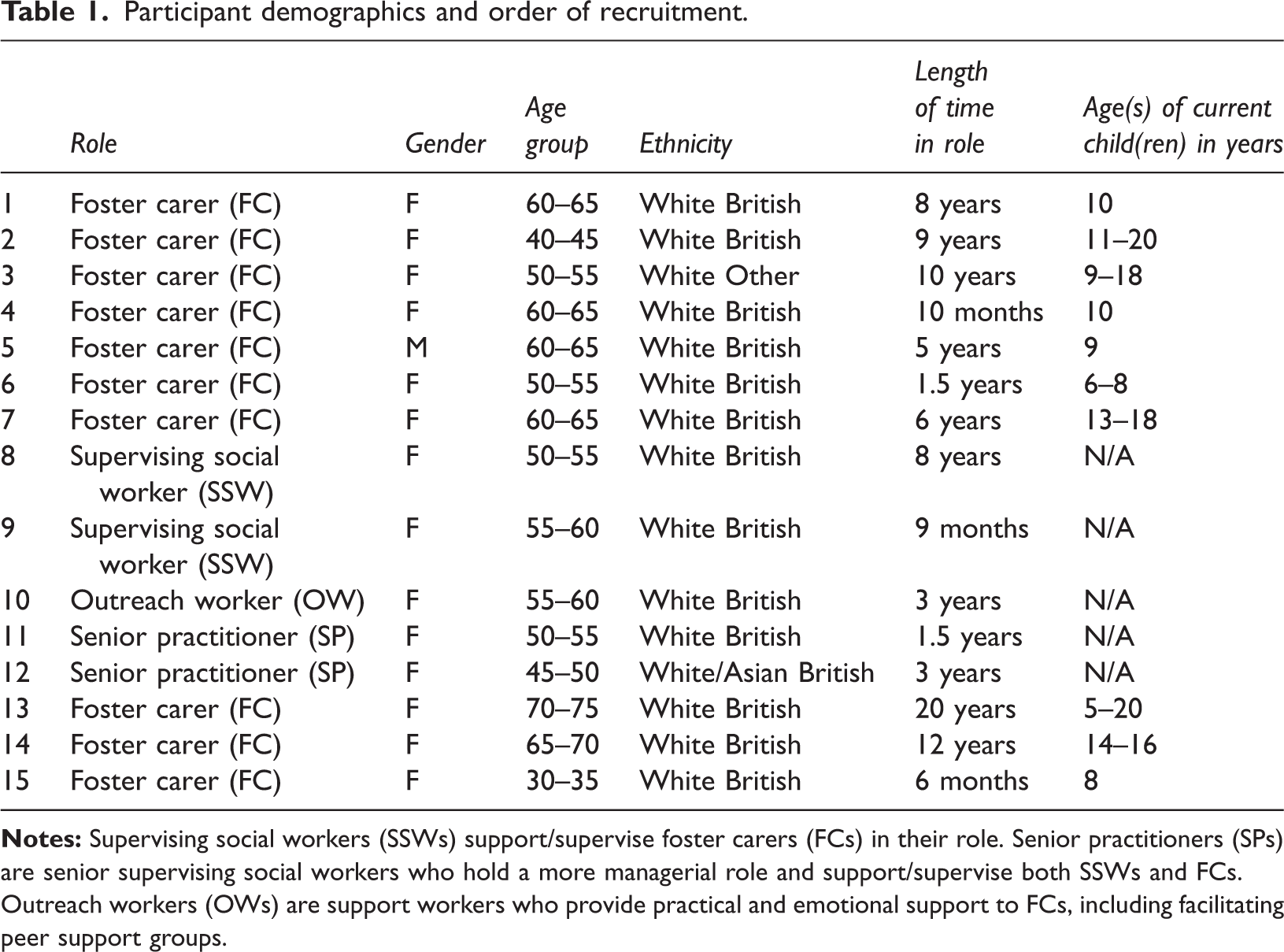
Fifteen participants, which included 10 foster carers and five social care professionals, were recruited for the study. Table 1 presents their demographic information and the order of recruitment.
Participant demographics and order of recruitment.
Recruitment and sampling
All participants came from one local authority (LA) in England. Initially, part purposive and part opportunistic sampling was used for recruitment. The LA’s fostering team manager and the chair of the local foster carer panel were contacted, and they publicised the project to foster carers via their monthly newsletter.
Later, in line with grounded theory methodology, theoretical sampling was undertaken, which involved selecting additional participants based on what had emerged in earlier interviews. This included interviewing supervising social workers as our initial coding of foster carer interviews suggested they may have an influence on the foster carer role. Senior practitioners and outreach workers were also included in order to densify the categories relating to the influence of professional support on the foster carer role. In addition, foster carers with less and more experience than those who had already participated were added to elaborate on the emerging theory, which suggested that the foster carer role may develop with experience and change over time. Theoretical sampling was facilitated by circulating information on the study by email to social care professionals within the LA. Team managers also shared details with eligible carers. Interested participants then contacted the researcher to discuss participation.
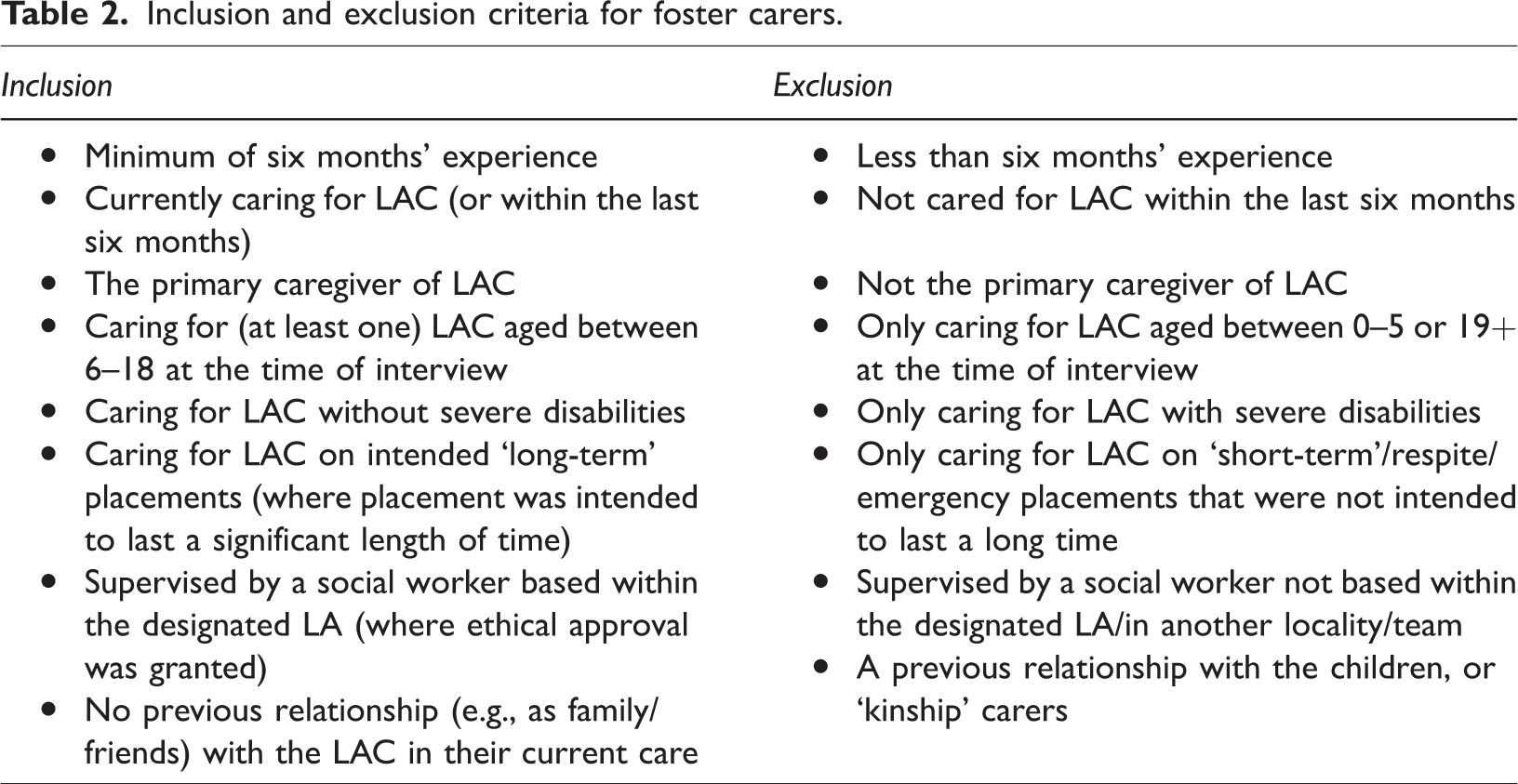
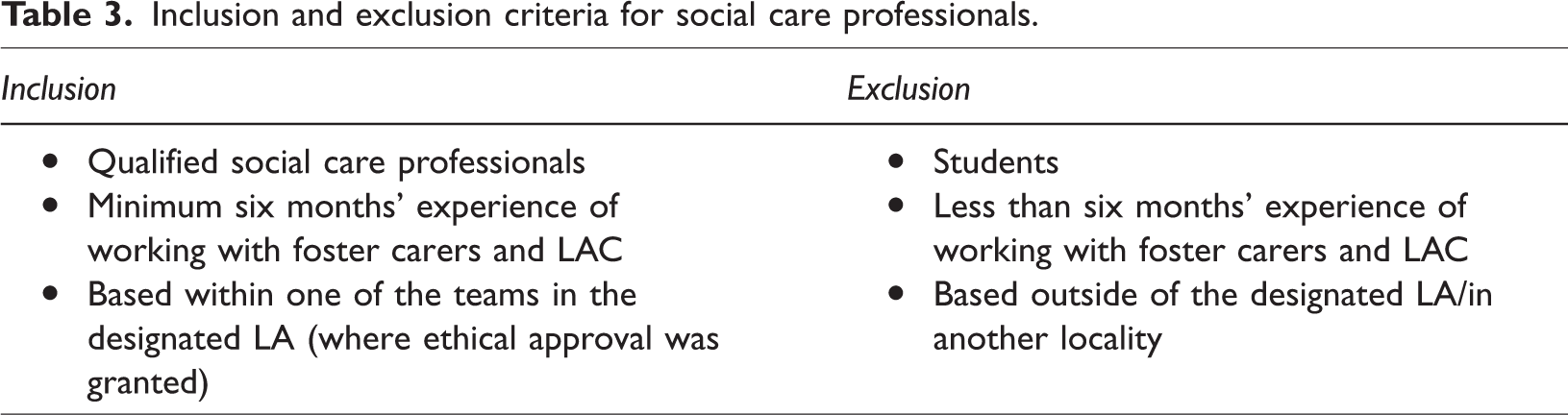
To be included in the study, foster carers were required to have fostered for at least six months to ensure sufficient experience. They were also required to have been caring for a LAC aged between six and 18 on an intended long-term placement. This was loosely defined as one that had been identified as intended to last for at least several years as part of a permanency plan, although it was recognised that, for various reasons, this can be hard to predict. The rationale for this age group and placement type was that fostering much younger children or in temporary and short-term contexts may involve significantly different tasks and experiences. This age range also reflects a large proportion of the LAC in the UK care system (DfE, 2021). Full inclusion and exclusion criteria are presented in Tables 2 and 3.
Inclusion and exclusion criteria for foster carers.
Inclusion and exclusion criteria for social care professionals.
Ethical considerations
Approval was obtained by the Salomons Institute for Applied Psychology (Canterbury Christ Church University) Ethics Committee and the LA’s research governance department. Potential ethical issues, including safeguarding, risk and confidentiality, were carefully considered. Information sheets were sent to participants in advance to enable them to give informed consent. This was formally gained through a consent form which was checked verbally at the beginning of each interview. Participants were debriefed after the interviews and invited to discuss their experiences or concerns.
Procedure
Following consultation with an independent foster carer, a semi-structured interview schedule was constructed. It began with orientating questions, followed by open-ended ones to allow for exploration of the participants’ role experiences. Questions were flexible and guided by the participants’ responses. If the foster carer was caring for several LAC of different ages, abilities and for different timeframes, they were asked to focus their responses on their experiences with those that met the inclusion criteria. Whilst the core questions remained constant, the schedule was later modified in accordance with theoretical sampling to reflect the emerging themes. Interviews took place between March 2020 and February 2021. Due to Covid-19 restrictions, they were held via telephone or video call and lasted between 30 to 90 minutes.
Data analysis
Analysis was based on the methods of Glaserian grounded theory (Glaser, 1992) as described by Urquhart (2013). This flexible, inductive approach emphasises ‘emergence’, with more abstract theoretical analysis occurring in the later stages. As with all grounded theory methodologies, data collection and analysis were a simultaneous and iterative process.
Following each interview, open coding was conducted, which involved ‘fracturing’ open the data line by line (Payne, 2016; Urquhart, 2013). In vivo codes were used where possible to preserve meaning and authenticity, provide analytic insights and prevent the premature closure of developing concepts (Urquhart, 2013). This line-by-line coding was completed for the first eight interviews. Open codes were then refined into focused codes which helped to synthesise and refine the data to capture the codes that were relevant to the research questions (Birks and Mills, 2015). Focused coding was used for the further interviews. As codes were developed, areas for further exploration were highlighted and explored through theoretical sampling. Selective coding was then conducted, which involved organising focused codes into initial conceptual categories and subcategories. A process of constant comparison took place throughout the analysis, which involved comparing instances of data against previous codes. Theoretical coding involved developing theoretical ideas about connections and the nature of relationships between categories. Memos (Glaser, 1978) and diagrams (Urquhart, 2013) were used to capture observations as well as to elaborate increasingly abstract theoretical hypotheses about category relationships. Interviews took place until theoretical sufficiency (Dey, 1999) was achieved, that is, when no new codes relating to the research question were suggested by the data.
Quality assurance
Several qualitative study guidelines were followed to ensure quality and credibility (Mays and Pope, 2000; Williams and Morrow, 2009; Yardley, 2000). In line with the critical realist stance, the researcher’s beliefs and experiences were viewed as having an influence on the research process. To promote reflexivity, the researcher completed a bracketing interview prior to the study and kept a research diary throughout. Particular consideration was given to how the researcher may have influenced data collection and the possible power differentials between researcher and participants (Karnieli-Miller, Strier and Pessach, 2009). Research supervision was used to consider biases and ‘blind spots’ and how these may have influenced the analysis and interpretation of data.
Data collection and analysis were clearly recorded which supported the integrity of the research, enabling one project supervisor to independently code sections of data. Minor discrepancies and category labels were discussed with both supervisors until a consensus was reached. This supported the development of a ‘useful’ model that ensured categories were consistent with the data and not forced and that the theory explained the phenomena under investigation (Payne, 2016).
Results
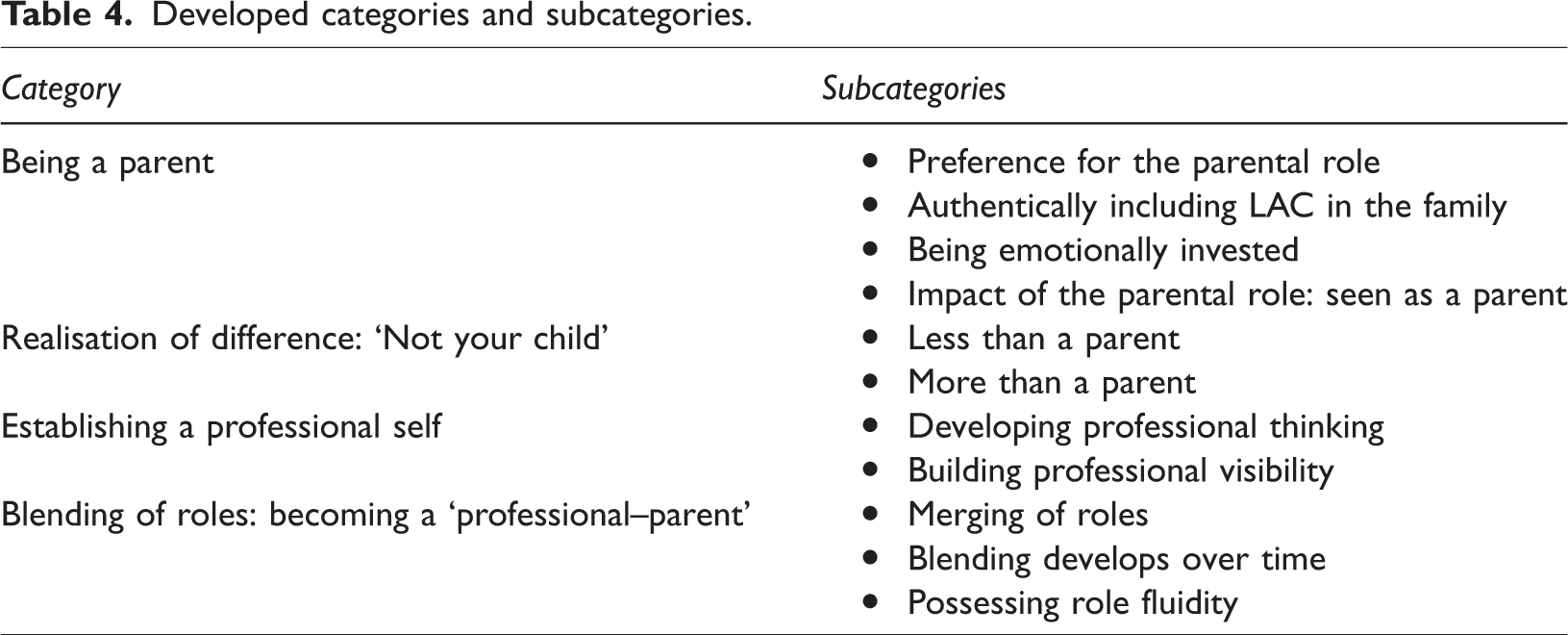
The analysis produced 137 focused codes which created 11 subcategories under four main categories (see Table 4). Figure 1 presents the findings in a preliminary model which depicts a process and journey that foster carers go through in relation to their roles as parents and professionals. It depicts this journey as occurring over time, involving several stages and being influenced by a number of internal and external factors.
Developed categories and subcategories.
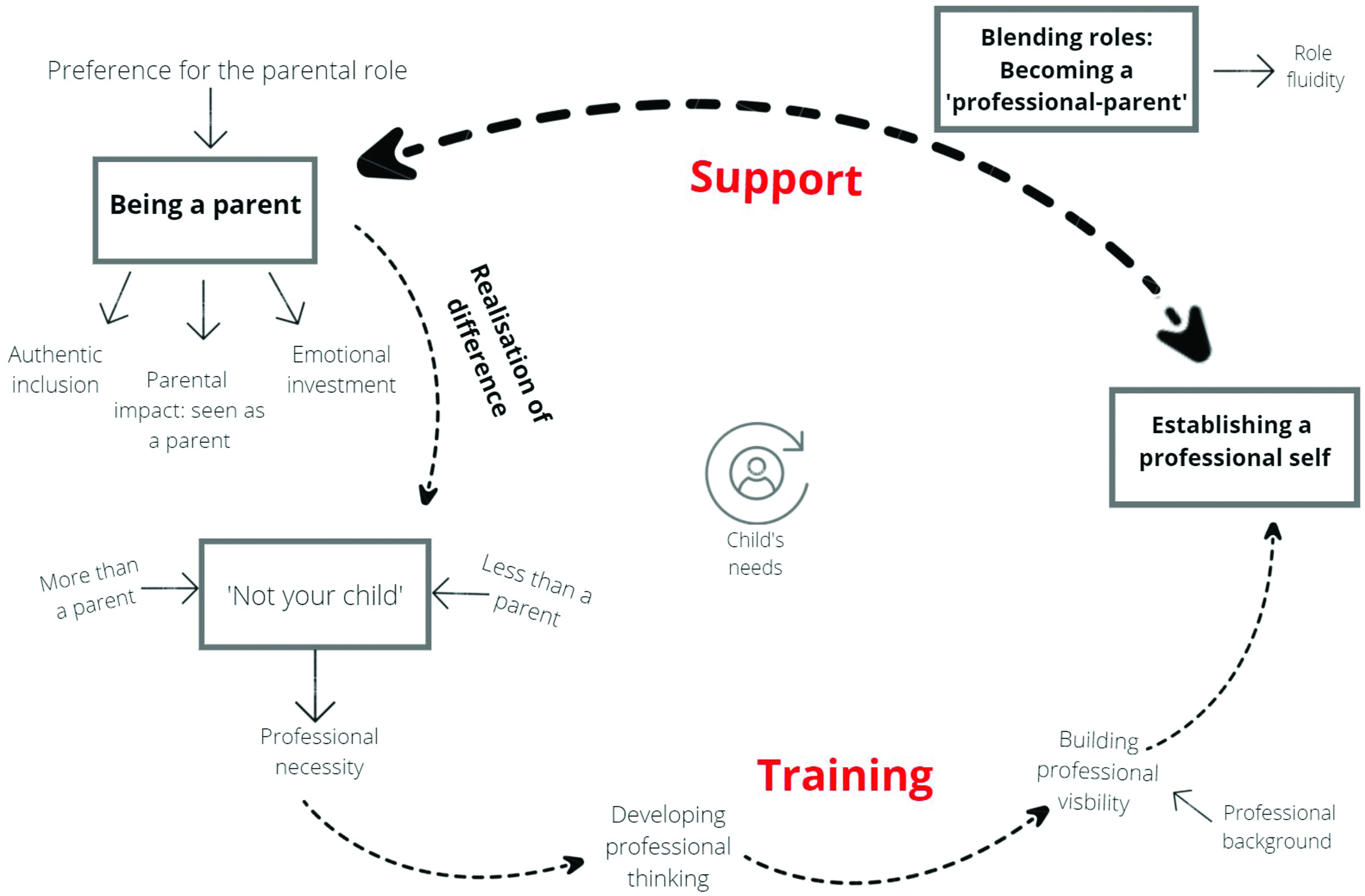
A preliminary theoretical model representing the journey to becoming a ‘professional–parent’.
Overview of the model
The model highlights how foster carers closely identified with the parental role which involved being emotionally invested and authentically including LAC in the family. New carers appeared to work primarily within this framework although they recognised that separate professional aspects may be required. But, over time, they became repeatedly exposed to experiences which challenged the idea of just being a parent. The need to be both more and less than a parent led to a ‘realisation of difference’, i.e., that caring for LAC was not the same as caring for children of their own. This prompted recognition of the need to be a professional as well, although many felt overlooked in this respect as they tended to be only seen and treated as a parent. They therefore engaged in activities that developed their professional thinking, such as training. This helped them to behave and establish themselves professionally and thus gain visibility, especially for those who had no previous relevant professional experience.
The narratives of the carers suggested that over time a process of blending occurred between the parental aspects of the role and increasing professional knowledge. This resulted in carers becoming a ‘professional–parent’ with both roles interconnected rather than experienced as separate. Both informal support from peers and formal support via supervision from social workers were mentioned as helping this process. So, with experience, foster carers were able to develop fluidity in being able to emphasise different aspects of the roles when needed.
The experiences and perceptions that underpin this model will now be analysed in greater detail. The four categories that emerged from the analysis and the subcategories relevant to each (presented in italics) will be discussed, along with selected quotations.
Being a parent
All of the foster carers showed a preference for the parental role, often closely identifying with and acting within its ambit as their primary task, with one commenting: ‘So the parent is always there … that is our main thing, for us … this is what we do … we are parents to the children’ (FC, P14).
There was a sense that many of them had initially perceived their responsibility as parenting and relied on their own experience to support LAC. One new carer emphasised her position: ‘… I know I will probably become more professional … but at the moment, where it is very new to us … it’s more the parenting side at the moment …’ (FC, P13).
But whatever the carers’ personal preferences, they were encouraged by social care professionals in the LA to prioritise the parental role: ‘My expectation of my carers is that they would treat them the same way as they would treat their own children’ (SP, P11).
Both carers and professionals identified that authentically including LAC in the family was a key part of this. As one foster carer explained: ‘… they have to feel completely embedded in the family … you have to ensure that they feel they are a real part of the family and this is where they belong …’ (FC, P7).
It appeared that foster carers became emotionally invested in the children they looked after, experiencing parental emotions such as love, acceptance, pride, worry, a desire to protect, guilt and inadequacy, as well as pain when rejected and a sense of loss when children move on. The outreach worker commented on foster carers experiencing ‘… that parental feeling of almost feeling that I’ve got to do everything that I can to protect this child’ (OW, P10).
The impact of the parenting role was perceived as highly significant, with some LAC developing a strong sense of belonging. As the outreach worker also commented: ‘These children don’t have that [sense of belonging] … that is the biggest thing I would say with foster caring. So that the child feels loved, feels wanted, feels part of something …’ (OW, P10). One social worker gave an example of how a child viewed his foster carers as parent figures, stating: He even used to talk to them about them helping him buy his first car … to him they were his parents. (SSW, P8) You live in a family home, so you are trying to treat them like your kid but they don’t want to be your kid … [you are] just sort of caring from a distance, ’cause you can’t parent her. (FC, P4)
Realisation of difference: ‘Not your child’
Foster carers identified several experiences that contributed towards a realisation that caring for LAC was different from bringing up their own children. The idea of simply ‘being a parent’ was therefore challenged. Although this realisation did not come as a complete surprise, it seemed that along the fostering journey, it became increasingly apparent that they needed to be something different.
The carers described times where they were less than a parent. They were expected to care for LAC in the absence of parental authority and autonomy which was experienced as limiting and frustrating: ‘On one hand you are the parent, you are looking after this child, but you are only looking after them to a certain extent … you can’t go beyond that’ (FC, P14).
Many referred to needing to ask permission for simple things, with their decisions often being overruled by social workers: As a parent … you’d … come to a decision, about what, yeah, ‘They can do that’, but then with LAC you’ve got to ask the social worker and they’ll come in with reasons why they can’t … (FC, P1) I guess it can be quite confusing in some ways … they don’t have parental responsibility, but they are doing everything for that child while they are placed with them … [you’re encouraged to] treat them as your own … but actually [you’re often told] ‘No, you can’t do that in this situation’. (SP, P12)
A further complication was that carers had to acknowledge the contribution and rights of LAC’s birth families. They explained that despite parental intentions, they accepted that they could and would not wish to replace them: ‘We’ve grown to accept that obviously … the birth family will always be number one to the children’ (FC, P5).
The foster carers also described having to engage in tasks that went beyond typical parenting. Examples of being more than a parent involved record-keeping, managing and supervising birth family contact, attending meetings, training, liaising with professionals and following safeguarding principles: ‘… when you become a parent naturally, you don’t have lots of training and you don’t have to keep filling out forms or go to lots of different meetings’ (FC, P14).
They described a heightened sense of responsibility and accountability in their role: … they are not my children … you’ve got that in the back of your mind if anything happened … it’s like wrapping them up in cotton wool, although you can’t do that, it is something I want to do. (FC, P6) They [foster carers] are accountable to parents … to social care … to so many different people … (SP, P11)
It was not surprising, therefore, that the carers worried about getting things wrong and the implications this might have: You can’t relax … you’ve got to think of every last thing that you say and do so you are on eggshells all the time … you don’t want to put a foot wrong, and you don’t want to get in trouble … (FC, P4) It’s like an Amazon delivery … Loving that piece of furniture is great. But if you haven’t got a clue of how to put it together and what tools to use to put it together, you’re doomed. (FC, P2)
Establishing a professional self
There was a sense that foster carers’ views were often overlooked when discussing LAC’s needs: ‘It depends on the social worker’s approach to them … Because sometimes I think that they can be overlooked. And they can be almost treated like they are not professionals’ (SSW, P8).
It seemed that despite simply recognising the need to be professional, foster carers had to work hard to establish themselves so they could be taken seriously. Attending training helped them advance their theoretical understanding of issues like trauma and attachment and developing professional thinking made them better able to respond to LAC’s behaviour: I did every course I could … I understand so much more now. I understand why these children behave like they do … (FC, P7) I more analyse it now … right, I could do this and maybe I’ll get this response, or I could do that and I could get that response. (FC, P3) Sometimes you have to go against and you have to stand up to social workers because you don’t believe they are making the right decisions, you want something different for this child. (FC, P7) Oh, you know, I ditched my slippers, put on shoes with high heels when I next saw her. (FC, P2) I needed to be able to speak their language and show them that I wasn’t just a parent in trouble, that there was a problem here, these are the words I am using to explain it … once I started to do that … people started to realise there was a problem here. (FC, P7)
It was also suggested that when foster carers were able to understand and advocate for LAC’s needs, it often led to improved outcomes for the child(ren): So she has managed to speak up in a meeting, and say, ‘Look this is really not working’ … we need the carers to be able to understand the child’s behaviour and to be able to explain that … to get the right support for the child … (SSW, P9) I don’t feel intimidated by meetings … it might be because I was a teacher beforehand and that helped … because I expected it to be a professional thing and therefore it was. (FC, P13)
Blending the roles: Becoming a ‘professional–parent’
Unlike new foster carers, who appeared to approach the task of fostering as involving two separate roles but with an emphasis on the parent one, experienced carers came to see the parent and professional roles as being entirely connected and residing within one task. They described a merging of roles: ‘… they work together … there isn’t a “Left is professional” and “Right is parent”, and you swing from one to the other, it all … it just merges’ (FC, P3).
But they also articulated the complexity of their position; whilst they needed to be both parental and professional, they were also neither parents nor professionals in the traditional sense. Instead, they saw themselves as being something different. They described a synthesis of these two roles which involved them becoming a ‘professional–parent’: I don’t see myself as a professional … Oh no, actually, do you know what, I don’t see myself as professional in so much that I don’t see my role in anyway like a social worker. I actually think of myself as a ‘professional–parent’. (FC, P7) Yeah … you’re not doing it separately, it’s got to work its way into your sort of natural parenting … so our natural parenting now is mostly more professional than previously … (FC, P5) … the professional side[s] of things grow and then … they kind of mingle together and then they carry on growing … (OW, P10) I know I wasn’t a ‘professional–parent’ when I was parenting my own children and I wasn’t a ‘professional–parent’ when I first started this, but I think I am now. And I think that, over the last two years, I would feel confident in saying I am a ‘professional–parent’. (FC, P7) It takes them a while for them to build up this professional persona … to get them to a place where they see it’s not just about the parenting … for the two of them to actually come together. (SP, P11) … I think a part of my role is being a sounding board … being that person who helps them to think … why is he doing that … Think about what the behaviour represents for that young person. Bringing my professional knowledge to the situation, so they can take it on. (SP, P11) … the loving role comes first. Then they need to learn the professional side. And I suppose that’s why with new carers we need to really be holding them a bit more and supporting them more, to enable them to do that. (SSW, P9) We did respite initially … And it did introduce us to the idea of being a parent but there is also a professional side to it ’cause we had to write things in a log … (FC, P15) … [It was helpful] [l]istening to other foster carers [about] their experience … how they’re able to use both sides of the parenting and the professional side. (FC, P1) … [Foster carers should be enabled to come together to] [s]upport each other and come up with ideas, voice their experiences, provide each other with tips and tools … so that carers that are in this difficult situation are able to go away and try some different ideas and integrate that into the parenting. (OW, P10) … So I guess, yeah, it is [about being] a ‘professional–parent’ … I hadn’t thought about it like that before now … I just do it! (FC, P13) It’s a very slow process and you don’t actually realise it is happening … it happens over time, and it is not always conscious. (FC, P14) I think sometimes in school meetings … then the professional comes in … when you see your carer and you’re like, ok she is taking that hat off and now she’s got this hat on … (SP, P11) So, they have to know when to draw back and then put themselves back in that role again … toing and froing … it’s about knowing when that professional has to kick in more or when it has to come in less. (SP, P11) They [the LAC] actually find it quite hard to see their foster carer in their secondary professional role because they have been parenting them all this time … it reminds them then that they are looked after … it suddenly makes the child think, ‘Oh, well, they are getting paid to look after me’ … (SP, P11) I think it makes them more at ease … Because … I will say to them, ‘I do understand that you’re doing that because of, you know’ … Once he knew that I knew what I was talking about, about the anxiety … if you can explain it to them so they can understand it, then they get that eureka moment … (FC, P3)
Discussion
The model presented above, which depicts the journey of becoming a ‘professional–parent’, offers a theoretical explanation of the foster carer role in the context of long-term fostering and how the relationships between the roles of ‘parent’ and ‘professional’ may change over time.
Links to theory and research
The finding that foster carers strongly identified with the parental role is consistent with previous research (Blythe et al., 2013; Schofield et al., 2013; Warde, 2008). However, this study noted that the forces that shaped this view involved both internal preferences to be a parent and external expectations from social workers to treat LAC as if they were their own. Role theory suggests that having ‘consensus’ between role expectations can support those enacting it (Biddle, 1986).
Similar to previous research, the roles of parent and professional were found to be highly interrelated (De Wilde et al., 2019; Schofield et al., 2013; Wubs, Batstra and Grietens, 2018). However, this study suggests that this relationship may not be static; it evolves over time. It seemed that whilst new carers may experience the roles as distinct, primarily acting within a parental role whilst holding a peripheral professional one, more experienced foster carers develop a new blended role in which both roles become merged into one. This is similar to the situation found for those who were described as able to ‘move flexibly between’ the two roles in Schofield and colleagues’ study (2013: 53). The explanatory model developed in this study therefore extends our understanding about how foster carers may manage these roles over time.
The evidence from the interviews suggested that repeated experiences of foster carers being required to be both ‘more than’ and ‘less than’ a parent contributed to their realisation that they also needed to take on more of a professional role. It seemed that this ‘professional necessity’ was largely imposed upon them, rather than being internally desired, as a consequence of the complex task that was being asked of them as well as the need to increase their professional visibility. Such findings are consistent with arguments relating to the ‘professionalisation’ of foster care and the growing demand for highly skilled carers (Kirton, 2007; Wilson and Evetts, 2006).
Despite the apparent imposition of the professional role, the carers emphasised that the process of professional development, for example through training and learning about issues like trauma, enabled them to be more effective in their role, such as responding more effectively to children’s difficult behaviour, echoing similar findings in evaluations of the impact of foster carer training (Lotty, Dunn-Galvin and Bantry-White, 2020; Lotty, Bantry-White and Dunn-Galvin, 2020). Furthermore, learning to speak the same ‘language’ as professionals helped to ensure that carers’ concerns were taken seriously. Repeated experiences of being listened to enabled them to feel more confident in their role and better able to advocate for LAC. Research suggests that an acknowledgement of the complexity, importance and expertise of the foster carer role can help carers manage their role and provide better care to LAC (Murray, Tarren-Sweeney and France, 2011; Schofield et al., 2013). The findings from this study therefore highlight the importance of professional development in helping foster carers to feel more acknowledged and empowered in their role, as well as contributing to improved outcomes for LAC. It may be that this process is successful when it is implemented and emphasised alongside, rather than instead of, an already established parental role and developed in such a way that it comes to nurture, rather than displace or disrupt, the hybrid aspects of the foster carer role. In this sense, it is arguable that whilst the professional development process is a key part of the foster carer journey, it may not necessarily equate to true ‘professionalisation’ of the task.
The development of a blended role may have enabled experienced foster carers to overcome and resolve role conflict that may be present at earlier stages of the fostering journey (Biddle, 1986; Kahn et al., 1964). Consistent with Hall’s (1972) model of coping with this, foster carers may have internally accommodated their difficulties by adjusting their attitudes and behaviour towards also needing to be professional in order to meet the demands of their complex role. It is also possible that through the ongoing process of blending, the roles come to enrich and complement one another, as suggested in role accumulation and enrichment theory (Kulik, Shilo-Levin and Liberman, 2015; Schofield et al., 2013; Sieber, 1974).
Given that experienced foster carers came to see themselves as developing a new blended role as a ‘professional–parent’, theories of role acquisition may also be relevant. Birenbaum (1984) argued that when old roles become redundant and demands for new ways of behaving emerge, a process of ‘re-keying’ must happen to align to the new role proffered. When new roles are acquired gradually but regarded as permanent or long-term, a process of ‘integration’ is most likely to occur. This may help to explain how, over time, the roles of parent and professional become merged and integrated in order to create an entirely new role, following the realisation that long-term carers could not just be parents to LAC.
Finally, it is important to note that support from other foster carers and social care professionals was seen to facilitate this blending. This type of help has been consistently reported to improve foster carer well-being, retention and placement stability (Blythe, Wilkes and Halcomb, 2014; Samrai, Beinart and Harper, 2011). It may be that support groups enable foster carers to learn from each other, either explicitly and consciously or implicitly and unconsciously, about how to enact their role and resolve potential conflicts. The dynamic nature of the parent and professional roles is therefore congruent with symbolic interactionism where roles are seen to evolve through interactions with others (Goffman, 1959; Serpe and Stryker, 2011).
Clinical implications
It may be helpful to offer new foster carers additional supervision/input to facilitate later blending between the parental and professional parts of their role. This idea is supported by research that suggests allocating more resources to foster carers in the early stages supports later independence and professionalism (Maclay, Bunce and Purves, 2006). Specific support around role development might bring greater awareness to the complex processes involved in the task. Conversations that alert carers to the possibility of role conflict could also enhance foster carer well-being and may help to reduce experiences of compassion fatigue (Geoffrion, Morselli and Guay, 2016) which are known to be common among UK carers (Hannah and Woolgar, 2018). Furthermore, UK policy and guidance on foster carer support and supervision (NICE, 2015; DfE, 2011) could be updated to reflect the specific needs of foster carers at different stages of their journey.
It is important to recognise, however, that foster carers may be reluctant to share difficulties with professionals, particularly if they already feel scrutinised or under pressure to appear competent. Enabling access to, and emphasising the importance of, peer support groups or ‘buddy’ systems would be an important priority for fostering services.
Providing specialised and tailored training on trauma-informed care (Fratto, 2016) may also provide carers with a theoretical framework from which to blend the parent and professional roles. Co-producing and co-delivering training with experienced foster carers may help to increase relatability and collaboration (Octoman and McLean, 2014). Providing foster carers with psychological support for their emotional well-being, and/or the management of LAC’s behaviour could be another contribution that may help them to cope with the complexity and demands of their role and provide better care to LAC.
Sharing and discussing the findings of this study within UK foster and social care networks may help to develop a shared understanding of the foster carer role, at least in the context of long-term placements, and to establish expectations between different stakeholders. The findings may also validate foster carers’ experiences of taking on a role that has historically been poorly defined and acknowledged, thus helping them to feel recognised and valued. Whilst the model does not necessarily imply true ‘professionalisation’ of the foster carer role, it does emphasise the importance of focusing on the processes involved in professional development, in terms of the positive impact this might have not only on the foster carers themselves but also on LAC. By drawing on the principles of social pedagogic practice (McDermid et al., 2016; Petrie, 2007), where foster carers are positioned as central figures within the care team, fostering services might help to promote systemic shifts in the way that the foster carer role is perceived.
Strengths and limitations
Unlike previous studies, the strength of this research is the inclusion of separate participant groups through theoretical sampling, namely foster carers and social care professionals, and the subsequent gathering of different perspectives that enabled a broader exploration of the foster carer role, with particular insights into how it might be shaped and supported by others. However, as theoretical sampling was not possible throughout the whole study, it may be more appropriate to consider this study an ‘abbreviated’ grounded theory.
As some later foster carers were identified by the social care team, a weakness of the study was that this could have introduced selection bias. Social workers could have identified those who had specific or profound experiences or would be more likely to participate in the study. Potential power relations between foster carers and social workers (McGregor, Devaney and Moran, 2021) could have also influenced recruitment and participation.
Although qualitative research does not aim to generalise findings, it is worth highlighting the homogeneity of the sample in this study, which comprised of mostly White British females. Whilst this reflects the typical profile of UK foster carers (Ofsted, 2021), the findings may not be applicable to those outside of this demographic. It is also important to highlight factors such as culture, gender and class, which were little explored in this study but are likely to influence experiences and perceptions of the parent and professional roles.
Furthermore, findings may not apply to those beyond UK fostering settings, given that care systems are organised differently between countries, along with differences in legal contexts and the extent to which fostering is viewed as a voluntary or professional task. It is also important to underscore that even within the UK, experiences of the long-term foster carer role may differ between fostering services and agencies, such as private and local authority providers, due to differences in the organisational culture and the emphasis placed on training (Wilson and Evetts, 2006).
Although this study intended to explore the role of long-term foster carers, it is acknowledged that there was not an objective way of defining placement length in the recruitment criteria. It is also recognised that, in reality, long-term foster care arrangements frequently change or ‘break down’ and can take many forms and involve different types of care, for instance spells of respite care, factors which are likely to impact on the role that foster carers take.
Finally, as this study was conducted within the context of the Covid-19 pandemic and related lockdowns, different and atypical experiences relating to foster carers’ roles may have been captured. Whilst the researcher attempted to address this during the interviews, caution should be taken when considering the relevance of the results beyond this context.
Future research
It would be important for further research to build on this study by including more diverse samples in terms of ethnicity, gender and type of fostering service in order to explore the experiences of a wider range of carers. Inclusion of additional perspectives, such as those of children’s social workers, mental health professionals and LAC themselves, may provide further insight into the explanatory processes described in the model. Given the variability within foster caring, it could also be interesting to study if and how experiences differ across placement types, such as short- as opposed to long-term arrangements, as well as whether differences in roles arise when caring for LAC of different ages or with differing abilities and needs.
Other research designs, including longitudinal studies that track foster carers’ experiences over time, might further investigate the fostering journey and illuminate how support from social workers and other foster carers influences the blending of parent and professional roles. It would be interesting to explore how this might affect experiences of role conflict, accumulation or acquisition, and the impact on carer well-being. This may provide further evidence for the usefulness of support spaces and their prioritisation in fostering services.
Conclusion
This study sought to develop a theoretical explanation of the processes involved in long-term fostering and the relationship between the roles of parent and professional. The preliminary theory and model depicted the journey of becoming a ‘professional–parent’. Whilst parental aspects of the role were emphasised, foster carers appeared to develop as professionals in order to gain visibility and advocate for LAC’s needs. Over time, the roles became merged; the blending process was supported by training and external support from social workers and other carers. The findings build on previous research and are consistent with several theories of role conflict and acquisition. The results extend our understanding of the foster carer role in the UK and suggest important implications for the support of foster carers and thus the care of looked after children.
Footnotes
Declaration of conflicting interests
The author(s) declared no potential conflicts of interest with respect to the research, authorship, and/or publication of this article.
Funding
The author(s) received no financial support for the research, authorship, and/or publication of this article.