




Abstract
Training programmes for the carers of adopted and looked after children have mixed efficacy, and the beneficial effects of their specific components are unclear. This article seeks to address this deficiency by assessing the impact of a parenting training programme distinguished by the inclusion of immersive videos. Eleven adoptive parents, seven foster carers and four special guardians participated. A mixed methods approach comprising questionnaires and interviews was utilised with data collected before, during and after training. Overall satisfaction with the training and trainers was high, and participants reported increased understanding and greater empathy regarding children’s early-life trauma and neglect (ELTN), plus enhanced competence and confidence in addressing any associated behavioural challenges. Qualitative analysis revealed differences in trainees’ responses according to the extent of their carer experience, with those relatively new to the work appreciating open-ended discussion and more experienced carers preferring discourse and role play that focused on the issues important to them. All participants valued the immersive videos, especially one that gave a toddler’s visual point of view in an environment where he was alternately shouted at and neglected. The study concluded that training programmes that include immersive videos can improve parenting knowledge and skills and that future research should examine their impact on child outcomes.
Introduction
The number of children in the care system in England is increasing. In the last decade, it has grown by a quarter to just over 80,000 (Department for Education [DfE], 2020). Although these children’s reasons for entry into care reflect a range of adverse life experiences, as a group they are at greater risk of poorer educational, social and emotional outcomes than their non-looked after peers (DfE, 2018a). It is therefore imperative that optimal ways to support these children and their care providers are developed. Despite considerable progress in this area, training programmes for adoptive parents and foster carers have shown mixed results (Schoemaker et al., 2020; Solomon, Niec and Schoonover, 2017), and it is unclear which components are beneficial and why. The current study aimed to remedy this by evaluating a training programme for adoptive parents, foster carers and special guardians in order to establish the aspects of training that are beneficial. In particular, it focused on the novel use of immersive video technology. To attain the necessary in-depth data on outcomes and process, a mixed methods approach comprising questionnaires and interviews was utilised with information collected before, during and after training.
Children in care
In England, only 5% of children looked after at any one time are aged under one, while 14% are aged one to four, 18% five to nine, 39% 10 to 15 and 24% 16 years or over (DfE, 2020). In 2020, the most common reason for their entry into care was abuse or neglect (65%), followed by ‘family dysfunction’ (14%) and the ‘family being in acute stress’ (8%).
Such adverse life experiences inevitably contribute to educational, social and emotional difficulties. For example, children in care are less likely than non-looked after children to reach the expected educational standard for literacy and mathematics at ages seven, 11 and 16 years (DfE, 2018a). Poorer outcomes are also evident in adulthood. Recent research by the DfE showed that 39% of care leavers aged 19 to 21 years were not in education, employment or training (DfE, 2020) compared to 12% of young people who were not in care (DfE, 2018b).
However, the most pressing challenges for care providers are the children’s social and emotional needs. These include, but are not limited to, difficulties forming and maintaining secure attachments as well as higher rates of psychiatric, emotional and conduct disorders than their peers who are not in care (Ford et al., 2007; Vasileva and Petermann, 2018). Supporting and addressing these difficulties can be highly challenging for carers, so it is not surprising that social and emotional difficulties tend to be the focus of training programmes and interventions.
Training programmes
In England, the majority of looked after children (72%) are accommodated in foster placements, a situation that has remained relatively stable over the past decade (DfE, 2020). Of these foster placements, 14% are with relatives or friends, typically by way of special guardianship or kinship foster care arrangements. The percentage of looked after children in adoptive placements is much lower at 3% and has been steadily decreasing.
Many different training programmes and interventions for foster carers, sometimes including adoptive parents, have been designed. However, evaluations have yielded mixed results regarding their levels of efficacy for parent and child outcomes (Harris-Waller, Granger and Hussain, 2018). Two meta-analyses have examined the effectiveness of interventions specifically aimed at foster parents as opposed to those that may be helpful for foster parents but were not necessarily evaluated in a foster care sample (e.g., Van Andel et al., 2012). The first of these was by Solomon, Niec and Schoonover (2017), who conducted a meta-analysis of 16 such intervention programmes. Overall, they found that the programmes were effective at improving foster carers’ parenting skills and knowledge with a moderate mean effect size. Interventions were also effective in reducing child behavioural problems, with foster parents in the training groups reporting fewer challenges than those in the randomised control groups; a small, but significant mean effect size was found. Similarly, Schoemaker and colleagues (2020) conducted a series of eight meta-analyses on 53 studies and found small to large positive effects for intervention programmes on four parent outcomes, namely: sensitive parenting; dysfunctional discipline; parenting knowledge and attitudes; and parenting stress. There were also positive effects for child outcomes in terms of reducing behavioural problems but not for attachment security or placement disruption.
It is therefore important that research examines which specific aspects of parenting training programmes are effective and which contribute to the targeted outcome. Kemmis-Riggs, Dickes and McAloon (2018) attempted this in their systematic review of foster care and kinship care interventions; they measured the impact of specific components within each intervention for both children and their carers and found that effective components depended upon the desired outcome. For example, interventions which successfully improved parent–child relationships focused on developing empathic, sensitive and attuned parental responses to children’s needs, while those effective in reducing behavioural problems included consistent discipline and positive reinforcement, trauma psychoeducation and problem-solving. Consequently, it became clear that future interventions need to help carers understand early-life trauma and neglect (ELTN) and the impact that they can have, as well as to increase carers’ confidence and competence at dealing with their consequent behavioural manifestations.
The format of training delivery is also important. While learning through traditional pedagogical methods can be beneficial, there are arguably other effective methods that can be incorporated. For example, Kemmis-Riggs, Dickes and McAloon (2018) found that carer interventions that included role play were highly effective. Recent technological advances can also be capitalised upon, such as the immersive videos and virtual reality (VR) experiences discussed in this present article.
Immersive video technology
Immersive video technology was developed over 50 years ago. In 1965, Sutherland demonstrated the Ultimate Display, which provided the illusion of a surrounding virtual environment by way of a wearable display (Sutherland, 1965). Unfortunately, while this initially aroused great interest, the technology was too limited and expensive to become mainstream. However, recent technological advances have enabled more sophisticated experiences to be delivered using lightweight and affordable headsets.
Immersive video technology surrounds the users in the projected environment, giving the impression that they are inside that world and part of it. In educational settings, this technology has been found to improve students’ motivation, their engagement with the learning materials and their achievement of learning outcomes (Jensen and Konradsen, 2018; Pellas, Dengel and Christopoulos, 2020). From a practical perspective, it also provides the opportunity to explore situations that may not be possible in real life, for example due to their hazardous nature. Systematic reviews and meta-analyses have determined that this technology is also increasingly important in training and practice for medical practitioners, where it can facilitate treatment planning and enhance procedure safety (Alaker, Wynn and Arulampalam, 2016; Joda et al., 2019; Mazur et al., 2018; Ros, Weaver and Neuwirth, 2020).
Recently, this technology has begun to be used in social work training. A systematic review conducted by Huttar and BrintzenhofeSzoc (2020) determined that it can provide students with exposure to scenarios they may encounter in their work and enable them to practise responding in a ‘safe space’. Thus, they can hone their skills in preparation for direct experience. Importantly, students have been receptive to the technology, suggesting that it could be a useful tool in carer training programmes. It could be used to provide insight into the neglect and abuse experienced by the majority of children in care and to examine different ways of approaching associated behavioural manifestations. However, to date, such technology has been little utilised in this field.
The current study
The Cornerstone Partnership is a UK social enterprise with a mission to improve the lives of children and families who are touched by the care system. Its remit is multifaceted but includes working directly with parents and carers of children in care. It has developed and run a two-day Restorative Parenting/Caring programme, which educates attendees about parenting methods as well as introducing them to theory about attachment. In the winter of 2017, the Partnership incorporated immersive reality videos into this programme, pioneering the world’s first VR experience for fostering and adoption services. The aims were twofold. The first was to accelerate carer/parent understanding of the early-life trauma experienced by many children in or from the care system, including the impact of this on children’s behaviour. Enhanced knowledge about the child’s perspectives is pivotal to understanding her or his behaviour and therefore in managing it successfully (Kelly and Salmon, 2014). The second was to improve carer/parent and child relationships, thus increasing family well-being and placement stability (Leathers et al., 2019) and enhancing the life chances of the children. The prevention of placement breakdown is also important as children with higher numbers of placements and transitions are at greater risk of developing emotional and behavioural problems (Newton, Litrownik and Landsverk, 2000). The Cornerstone Partnership’s use of immersive video is outlined and evaluated by Alma Economics (2019).
The current study evaluates the Cornerstone Partnership’s Restorative Parenting programme, with particular emphasis on the immersive video component. Data were collected from adoptive parents, foster carers and special guardians using questionnaires that were completed before, during and after training. This enabled a preliminary examination of any change in understanding and response to behaviour, as well as the impact of the immersive videos. In addition to questionnaires, interviews were conducted with a sub-sample of participants in order to gain richer data and consider the longer-term impact of the training. The questionnaires and interview schedules were designed to collect information pertaining to the following four research questions:
What is the effect of the Restorative Parenting training? Specifically, are there changes in attendees’ understanding of ELTN, including its impact on children’s behaviour, attendees’ competence and confidence in dealing with any associated behavioural challenges and empathy for children who have experienced it? What is the specific impact of the immersive video? Does it change attendees’ self-perception of understanding ELTN and their intentions to modify their behaviour? Does it increase their empathy for children who have experienced it? Does participating in the Restorative Parenting training programme change attendees’ self-efficacy in terms of emotion and affection, empathy and understanding, learning and knowledge? What is the trainees’ perception of the training and how could it be improved?
Method
Participants
In February and March 2018, the Cornerstone Partnership ran two two-day Restorative Parenting training courses, and all attendees were invited to take part in an evaluation of the programme. Of the 28 attendees, 25 consented, 22 of whom had attended both days. The sample included 11 adoptive parents, seven foster carers and four special guardians; their demographic details are provided in Table 1. Six of the participants also completed follow-up interviews conducted around a month after the training. This included three adoptive parents (two female), two foster carers (both female) and one (female) special guardian.
Participant demographics.
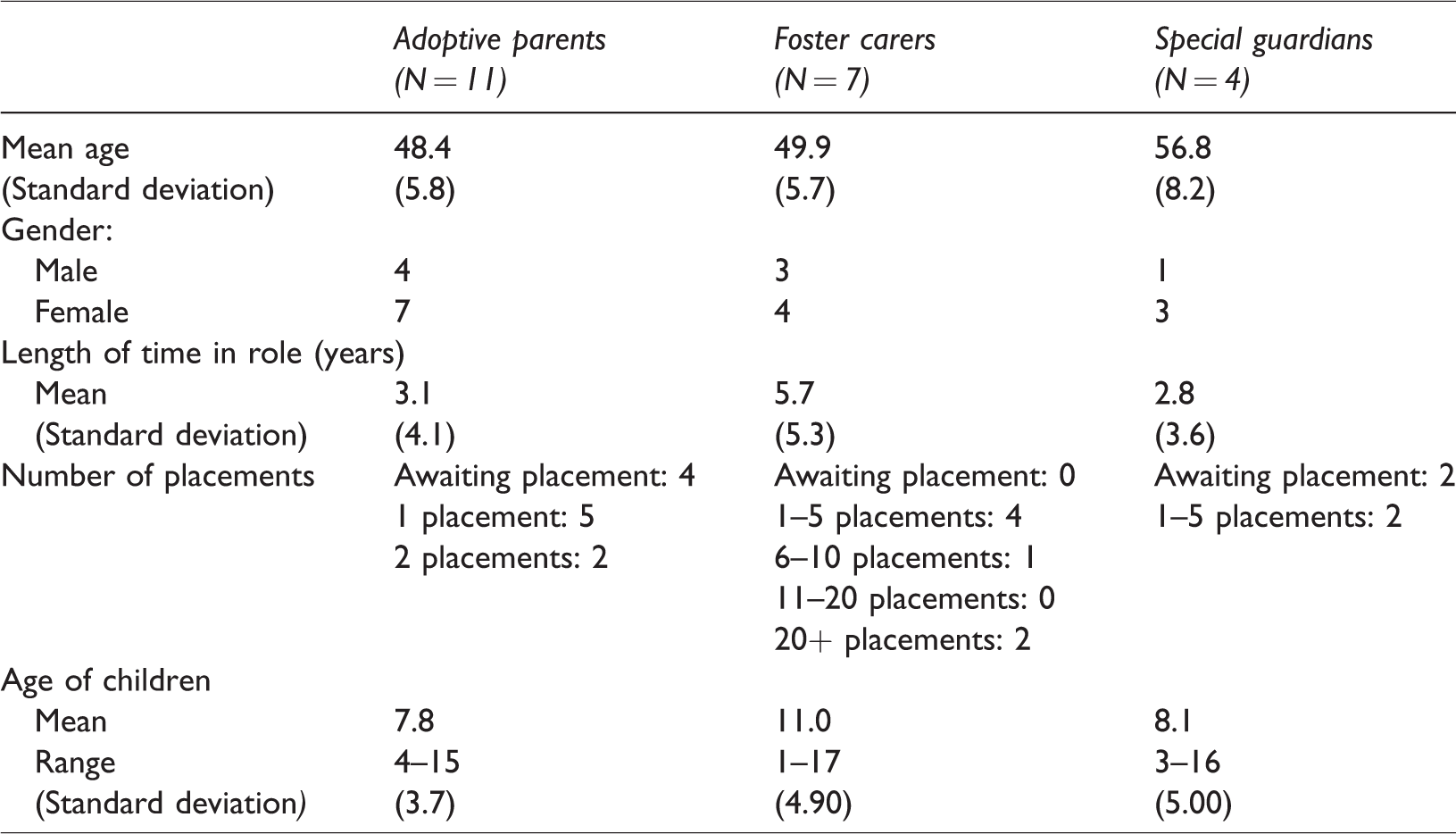
The study was conducted in accordance with the British Psychological Society guidelines for ethical practice, and ethical approval was obtained from the University of Roehampton.
The training programme
The two-day training programme comprised four broad modalities:
facilitator presentations covering issues such as PACE (playfulness, acceptance, curiosity and empathy) parenting and related questions; trainee discussions concerning the issues addressed, personal experiences and perceptions; role play by trainers and trainees, usually focused on a child and carer scenario; three immersive video clips. Two were viewed on day one, the first relating to the pre-natal experience and the second depicting a toddler’s experience. The third was shown on day two and depicted PACE and non-PACE parenting. Each video was short, lasting less than five minutes, and was filmed in 360° to provide a full immersive experience. They were viewed using an Oculus VR headset. One foster carer and one special guardian did not watch the pre-natal video clip as they felt it would be too distressing; consequently, they did not complete the corresponding questionnaire.
Evaluation materials and procedure
On day one of the training, participants began by completing a demographics questionnaire to obtain information about them as well as the benefits they anticipated to receive from the training. On both days, participants completed questionnaires before, during and after the training. These questionnaires are detailed below.
Tool to measure parenting self-efficacy
At the beginning of day one and the end of day two, training participants completed three subscales of the Tool to Measure Parenting Self-Efficacy (TOPSE) measure (Kendall and Bloomfield, 2005), namely those on emotion and affection; empathy and understanding; and learning and knowledge. Each subscale contains six items rated on an 11-point Likert scale ranging from 0 (Completely disagree) to 10 (Completely agree). The measure was specially designed by the authors to assess the effectiveness of parenting programmes on parenting self-efficacy and the changes that followed. In the current study, the measure was used to determine whether the impact of the training could be generalised beyond the measures specific to the evaluation. However, four adopters did not complete this measure as they were awaiting placement and consequently did not feel able to do so and one other did not complete this measure on day two due to time constraints. Thus, the analyses were conducted on data for six out of the 11 adopters, but for all seven foster carers and four special guardians. For the sample as a whole, the internal consistency was strong for the subscales of empathy and understanding (pre-training α = .76 and post-training α = .79) and learning and knowledge (pre-training α = .87 and post-training α = .84). Internal consistency was weaker for emotion and affection pre-training (α = .31) but acceptable for post-training (α = .65).
Self-perception ratings related to ELTN
At the beginning of day one and at the end of day two of the training, participants were asked to rate their current understanding of its impact on children’s behaviour, their competence and confidence in dealing with behavioural challenges associated with it and their empathy for children who have experienced it. Participants assessed each item on a 10-point Likert scale ranging from 1 (Could be better) to 10 (Excellent). This measure permitted examination of the extent to which the specific programme aims were met. One adopter did not complete this measure on day two due to their time constraints, thus for this measure, N = 10.
Immersive video questionnaire
Immediately after watching each immersive video, trainees completed the corresponding questionnaire. First, they outlined their feelings about the video clip they had just viewed. Then they rated the extent to which it increased their understanding of the ELTN that children may have experienced and how childhood experiences affect their current and later behaviour. Further questions asked how far the training had increased their intention to modify their own behaviour when interacting with children affected by ELTN and whether their empathy for the children had changed. Participants responded on a 7-point Likert scale ranging from 1 (Not at all) to 7 (A great deal). For each of these four items, trainees also had the opportunity to provide written comments about the ways in which the immersive video clips affected each aspect.
Post-training feedback questionnaire
At the end of days one and two, trainees provided feedback on the quality of the training. They rated the training overall, the therapist facilitator and the adopter/foster carer facilitator on a 5-point Likert scale ranging from 1 (Poor) to 5 (Excellent). They also indicated how useful it was to have an adopter/foster carer co-facilitate the event on a 5-point scale from 1 (Not at all useful) to 5 (Extremely useful). Finally, each day, trainees listed three things that they felt more confident about as a result of their participation.
Follow-up interviews
Six individual semi-structured interviews were conducted by Skype or telephone a month later. The schedule was structured to allow participants to freely report their experiences of the training and then to comment on the key domains (role plays, discussions and the immersive videos). Follow-up questions were used to facilitate the participants’ responses and to explore the reason for their feelings. The interviews lasted for approximately 45 minutes and were audio-recorded and transcribed by the interviewer.
Data analysis
The quantitative questionnaire data were analysed through a series of repeated measures analysis of variance (ANOVA) tests comparing different time points (e.g., pre- and post-training) and the three different groups: adoptive parents, foster carers and special guardians.
In order to understand the participants’ experiences and to describe them in a coherent manner, the transcribed interviews were analysed using thematic analysis, drawing on Braun and Clarke’s (2006) six phases and on Miles, Huberman and Saldana’s (2013) approach to data displays. This enabled an additional, qualitative analysis of the whole data set and the identification of dominant themes.
Results
Overview
The results below first detail the quantitative component of the responses. The analysis is organised around the four research questions detailed above, which seek to identify the trainees’ perceptions of the effects and impact of the Restorative Parenting training and the immersive video, as well as to ascertain their overall views on the training. These quantitative findings are followed by a qualitative analysis of the trainees’ perceptions of their training, with an in-depth focus on its novel immersive video component.
Quantitative analysis
Research question 1: What is the effect of the Restorative Parenting training in terms of the programme’s aims?
Prior to the training, attendees considered themselves to be moderate on all five factors, with mean scores ranging from 3 to 7. However, after training, self-perception was greater, with mean scores ranging from 7 to 8 (Figure 1).
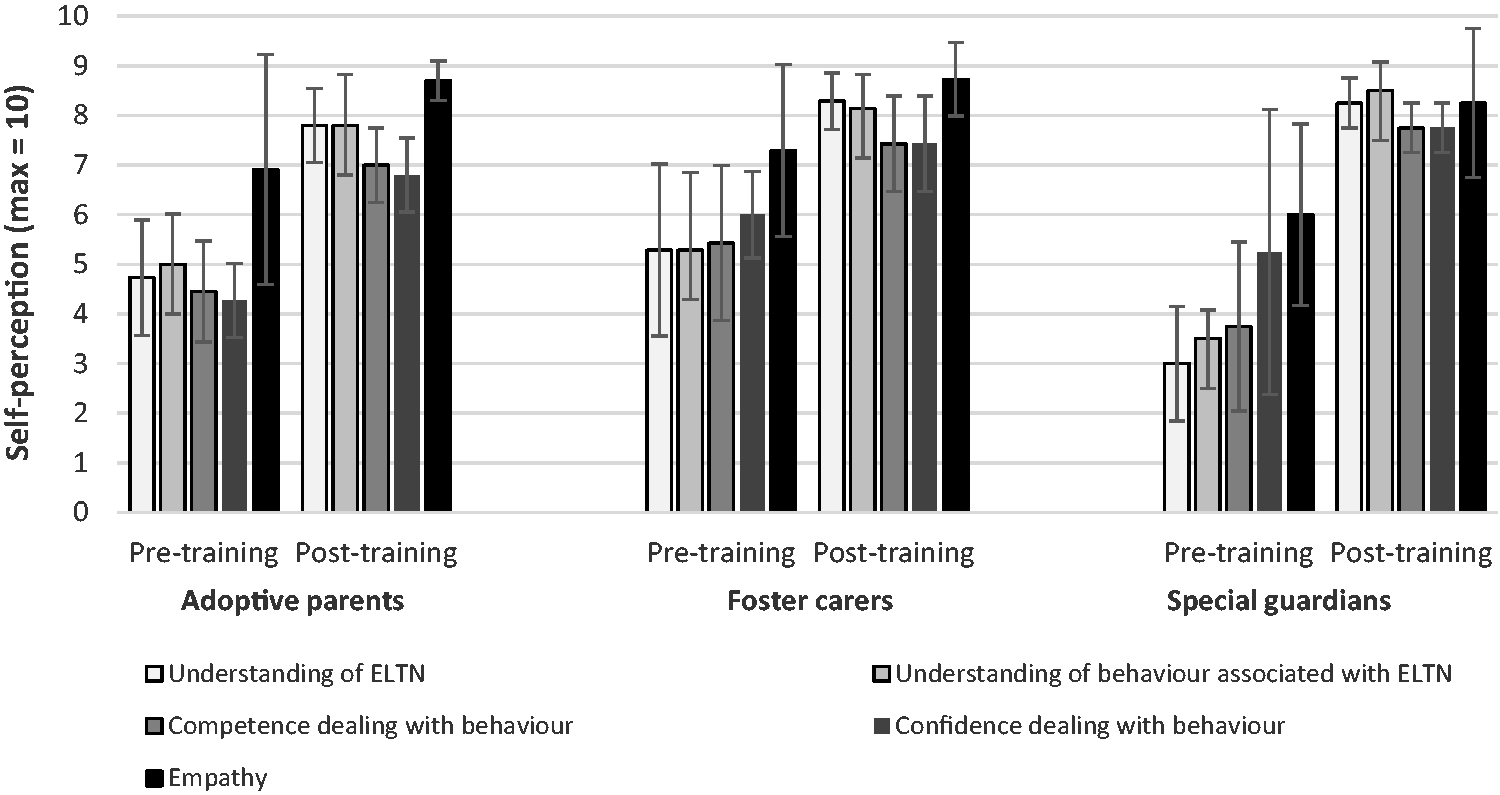
Trainees’ self-perception of ELTN. Error bars show +/− 2 standard error.
For all five variables there was a significant main effect of time, with higher self-perception scores post-training relative to pre-training. The specific details are: understanding of ELTN: F(1,18) = 94.76, p < .001, ηp2 = .84; understanding of behaviour associated with ELTN: F(1,18) = 94.76, p < .001, ηp2 = .84; competence at dealing with behaviour associated with ELTN: F(1,18) = 39.49, p < .001, ηp2 = .69; confidence in dealing with behaviour associated with ELTN: F(1,18) = 322.52, p < .001, ηp2 = .56; empathy for children who have experienced ELTN: F(1,18) = 12.47, p = .002, ηp2 = .41. These results suggest that the training had positive impacts.
There was also a significant effect of group for confidence at dealing with behaviour associated with ELTN, F(2,18) = 5.19, p = .017, ηp2 = .37, with adopters reporting less confidence than foster carers, p = .011, but neither group differing from special guardians, both p > .40. There was no significant effect of group for any of the other four variables, all F < 2, all p ≥ .190, indicating that the impact of training did not differ by participant group.
There were no statistically significant time × group interactions for any of the five variables. However, for understanding the behaviour associated with ELTN, the interaction did approach significance: F(2,18) = 3.41, p = .055, ηp2 = .26. While pre-training, adoptive parents had significantly higher self-perception scores than special guardians, p = .013, there were no group differences post-training, all p > .55. For the other four variables, all F < 3, p > .085.
These findings are illustrated in Figure 1.
Research question 2: What is the specific role of the immersive video in terms of the programme’s aims?
Attendees rated the extent to which the immersive video clips had changed (increased) five aspects intrinsic to the programme on a scale from 1 (Not at all) to 7 (A great deal). The mean scores ranged from 4 to 6, indicating that the immersive video clips did have an impact.
For an understanding of ELTN, the effect of clip was approaching significance, F(2,34) = 3.01, p = .063, ηp2 = .15, which was driven by higher scores for clip 2 relative to clip 3, p = .018, ηp2 = .29). There was no significant main effect of group, F(2,17) = 2.32, p = .129, nor a clip × group interaction, F(4,18) = 0.21, p = .154.
For an understanding of the effect of ELTN on children’s behaviour, there was not a significant main effect of clip, F(2,34) = 32.00, p = .151. However, there was a significant main effect of group, F(2,17) = 4.40 p = .029, ηp2 = .34, due to the higher ratings of the foster carers relative to adoptive parents, p = .039. There was no clip × group interaction, F(4,18) = 1.24, p = .311.
For the intention to modify behaviour there was no significant main effect of clip, F(2,34) = 3.36, p = .12, nor of group, F(2,17) = 2.67, p = .098. However, there was a significant clip × group interaction, F(4,18) = 4.80, p = .004, ηp2 = .36. For the pre-natal video there was a significant difference between the groups, F(2,19) = 6.74, p = .007, with adopters giving lower scores than foster carers, p = .034, and special guardians, p = .022, who did not differ, p = .82. However, for the toddler and parenting videos there were no group differences, p > .200. Furthermore, for adopters there was a significant effect of clip, F(2,20) = 22.88, p < .001, ηp2 = .70, with clip 1 receiving lower scores than clip 2, p < .001, and clip 3, p = .001, which did not differ, p = .724. For foster carers and special guardians there was not a significant main effect of clip, p > .40.
For empathy there was no significant main effect of clip, F(2,34) = 2.08, p = .14), nor group, F(2,17) = .44, p = .653, nor a clip × group interaction, F(4,18) = .81, p = .531.
These results are illustrated in Figure 2.
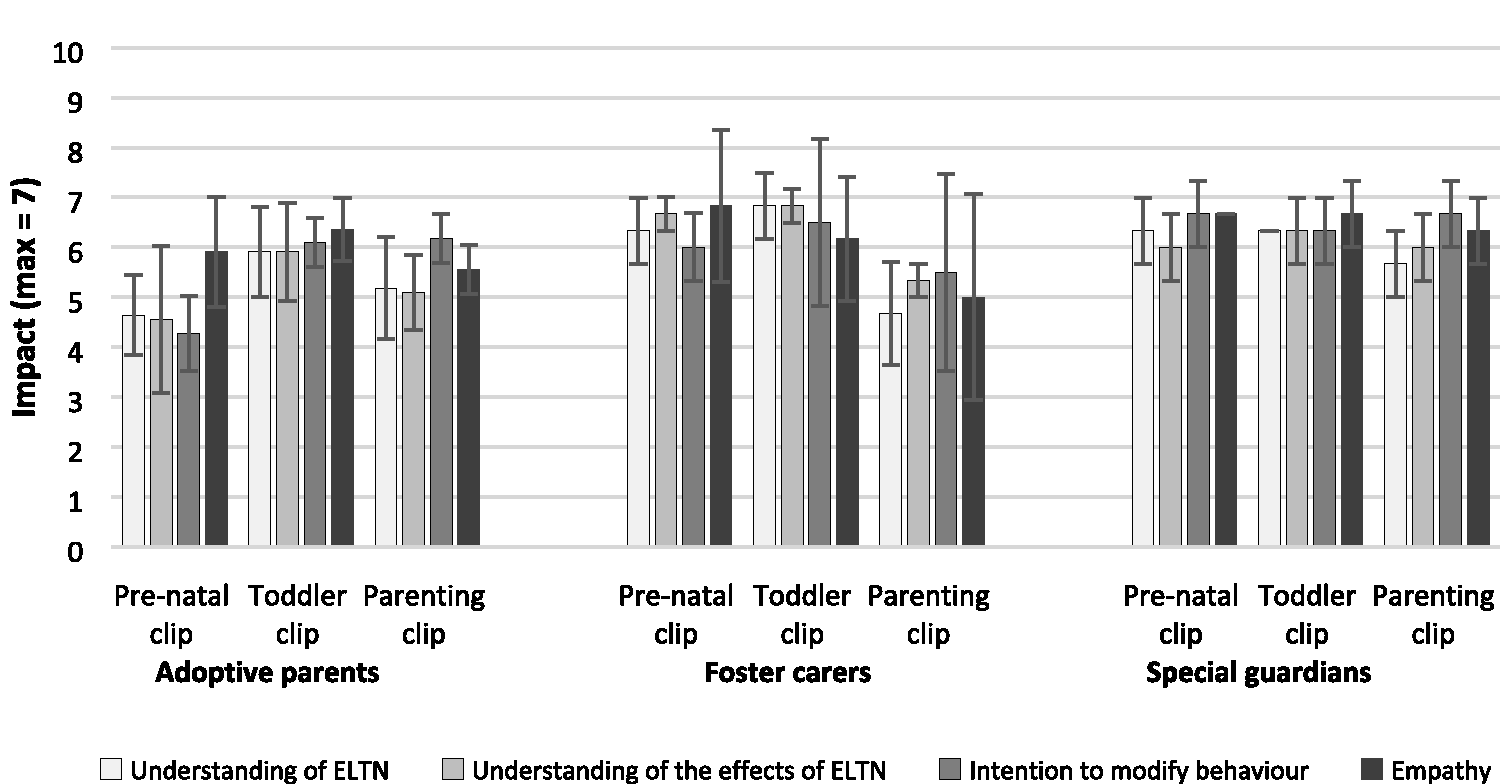
Impact of the immersive video clips. Error bars show +/− 2 standard error.
Research question 3: Does the impact of the Restorative Parenting training programme extend beyond the specific programme’s aims?
At the start of the training, attendees considered their self-efficacy to be moderate, with mean scores on all TOPSE items ranging from 32 to 44. The post-training scores were moderate to high, ranging from 33 to 50.
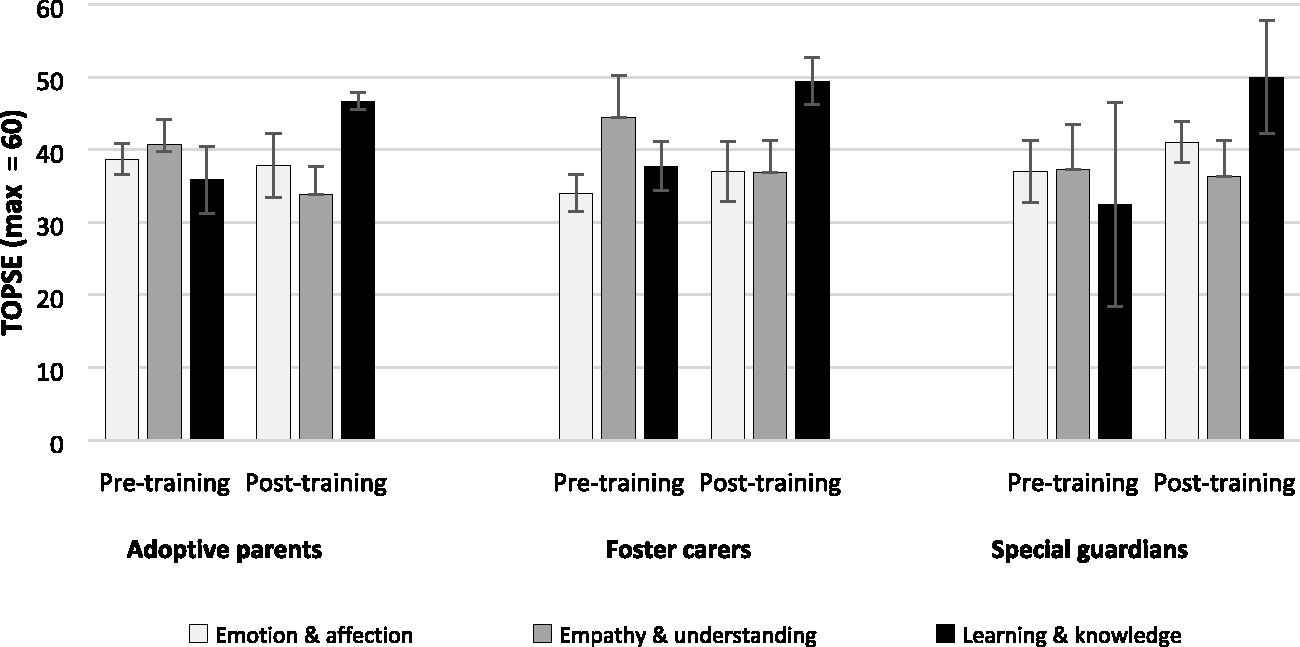
Trainees’ self-perception of self-efficacy. Error bars show +/− 2 standard error.
For emotion and affection, there was no main effect of time, with no change between pre- and post-training, F(1,14) = 2.10, p = .17. There was no significant main effect of group, F(2,14) = 1.30, p = .305, nor a time × group interaction, F(2,14) = 1.61, p = .235. For empathy and understanding, there was a significant main effect of time, with scores decreasing between pre- and post-training, F(1,14) = 7.09, p = .019, = .37. There was not a significant main effect of group, F(2,14) = 1.06, p = .373, nor a time × group interaction, F(2,14) = 1.00, p = .392. For learning and knowledge, there was also a significant main effect of time, and scores increased between pre- and post-training, F(1,14) = 82.85, p < .001, = .86. There was no significant main effect of group, F(2,14) = 0.21, p = .817, nor a time × group interaction, F(2,14) = 2.14, p = .155.
These results are illustrated in Figure 3.
Research question 4: What is the trainees’ perception of the training?
Satisfaction was high for all three groups with regards to the training overall: Day 1, M = 4.45, SD = 0.51; Day 2, M = 4.29, SD = 0.90. There was also high satisfaction in terms of the therapist facilitator (Day 1, M = 4.55, SD = 0.51; Day 2, M = 4.60, SD = 0.68) and the adoptive parent/foster carer therapist facilitator (Day 1, M = 4.50, SD = 0.51; Day 2, M = 4.55, SD = 0.69). In addition, trainees considered it beneficial for an adoptive parent/foster carer to co-facilitate the event (Day 1, M = 4.55, SD = 0.51; Day 2, M = 4.29, SD = 0.78).
Qualitative analysis
Thematic analysis of the interview material delineated three theme domains, namely: the trainers, the trainees and the training content. Details of these are given below, followed by an analysis of the ways in which participants experienced the innovative immersive video component.
The trainers
Participants generally experienced the input of the trainers positively; their knowledge was seen as authentic and based in real-world experience. Moreover, they were able to draw from this and share vivid examples of the principles they were seeking to communicate. Participants’ reflections indicated something of the balance that trainers need to tread between being supportive and keeping an appropriate focus on training and not meandering into less pertinent discussion. Trainer role plays were generally perceived as excellent, except where they were seen to lack specificity.
The trainees
The training experience was shaped by the trainees’ level of experience and their perception of their specific training needs. Those who were less experienced and less specific about their needs were more satisfied with the training than those who were long-standing practitioners and who were clear about their needs. This raises the question of whether trainee groups should be relatively homogeneous, at least as far as levels of trainee experience are concerned, but the findings suggest that this might not be quite as straightforward as it first appears. The results indicate an asymmetry of preference with relatively less experienced trainees appreciating the presence and input of more experienced ones, while those with more experience wished to pursue specific rather than general issues. However, overall, participants experienced other trainees as supportive, with only isolated examples of disruption.
Active participation
Active participation included role plays and group discussions. Trainee role play was understood to provide a safe opportunity for participants to practise the principles to which they had been introduced, though it was noted that more direction and therapist intervention would have strengthened its relevance and effectiveness. The discussions were perceived positively, particularly by participants who were new to the work. Those with more experience saw themselves as contributing to rather than benefiting from extensive, unstructured exchanges.
Immersive video
Participants identified different issues concerning the three immersive videos depicting the pre-natal environment (IV1), a toddler’s perspective on parents who behaved in an unpredictable and hostile manner (IV2) and a third-person perspective on a child of approximately eight years old interacting with her mother after a difficult day at school (IV3). This contained one scene in which the mother behaved consistently with PACE and another in which she did not.
IV1 raised credibility issues for several participants, although they acknowledged that it showed the impact of the pre-natal experience. IV2 left the deepest impression on participants, with some reporting that they felt anger towards both parents and social workers. IV3 was seen as providing a good example of PACE, but the lack of the child’s visual point of view and what was perceived as ‘an unrealistic portrayal’ of parenting behaviour resulted in it having less impact than IV2.
Summary
The components (‘Trainers’ and ‘Trainees’) and the active components (‘Active participation’ and ‘Immersive video’) were experienced as having a positive, supportive and empowering outcome for participants, but some stated that greater detail on specific strategies, especially concerning behaviour management, would have been helpful. Further opinions on the immersive videos are detailed below.
Further analysis of the immersive video
The participants’ reflections on the immersive videos were further analysed to explore general issues affecting their efficacy, as well as the value of the specific features of each one. Factors associated with increased impact and the extent of its depth were investigated.
Immersive video obstacles
The participants referred to aspects of the immersive videos that inhibited their potential impact. These fell into two categories: technical and practical issues concerning the process of viewing the videos and specific content issues which differed for each one of the three clips.
Technical and practical issues
Four of the six participants said that technical and practical issues limited the videos’ positive impact. This was due to factors such as the video not playing correctly and having to wait in turn to see a brief video clip.
Immersive video content concerns. 1
Concerns with the video content were particularly focused on videos one and three. Four participants felt that IV1, which attempted to replicate the pre-natal experience, was unconvincing in its portrayal of the consciousness and grasp of language of the foetus: Oh, the first one where I was in the womb I didn’t … get – no not that I didn’t understand it but … I didn’t connect with it. (Participant 1) I just felt that the, um, the, the PACE … the PACE parented one was very good, but the non-PACE one, I think it … it had made just [it] a little bit ridiculous … which I thought undermined it slightly. (Participant 2)
The child’s point of view
The comments above are reinforced by a further example on IV3 regarding how not only the presence or absence of the child’s point of view but also the angle of the camera affect the impact of the video. As Participant 2 explained, if the angle of the camera does not match the child’s line of vision, the person viewing it is a mere onlooker, unable to see and thereby experience the scene from the child’s perspective: In that one [IV3] you weren’t in the position, you weren’t in the first-person position of the child … in that you were an onlooker … you were seeing the child and the parent in the room which to me undermined some of the value of it. (Participant 2) Um, I think, um … like I said, I think it’s just being in that … child, child’s eye rather than just viewing it from, um, an external perspective you know, looking down on the whole three of them, but actually being that child probably was useful. (Participant 5) I thought that that was, um, yeah, it felt very confrontational and as a person who … I think I would imagine most adults are very rarely in a situation where there is somebody directly yelling at you, um, and for that to be done at an angle whereby they’re bigger and higher than you and that sense of threat I thought was very effectively conveyed, so I thought it was very good at kind of putting you in the perspective of the child. (Participant 4) Yes, I actually liked it because you, you[’re] kind of in a virtual world [that] we’re able to experience, you know, in whichever way you’re able to experience it, what children are going through. And it also reinforces the message for me that the trainers were trying to get us to understand. Which is, you know, at the end of the day for me is really important … So, yeah, I really feel like it was very useful. (Participant 1)
Increased empathy
The concept of entering the child’s world is linked to that of empathy, which entails a more specific and explicit reference to concern regarding what the other is feeling. Participants referred to their emotional connection with how it would feel to be the child in the situation portrayed in the videos, as this example demonstrates: The VR, yes, that was, I mean like I said to you, I think that was very useful, uh [sighs] … it just gives you … even [though it’s only short] … it just gives you a little bit of experience about what … what a child might feel like. (Participant 6) … I think putting it into the VR made it more visceral, it makes it more immediate for you and you start some of the reactions that the child will have felt. I don’t know how … any other way you’d be able to put yourself in that position because somebody [just] telling you that the father yells would never give you that same feeling. (Participant 4)
Change in parenting
Some participants, even in the short time span of the research, described changes that they had made in their parenting as a consequence of the training and the immersive video component. Reference was made to the way in which these changes had raised awareness of their current parenting practice: … like, for example, you see a kid doing something that they kind of should be corrected for but maybe they deny doing it even though you’ve seen them do it, so it kind of made me aware of the sort of the values that I … I do probably bring in. Like sort of, um, I’ve a very conventional parenting approach but I … I just found it fascinating the way, like, it would be so easy to just get fixated on you know, ‘You shouldn’t lie, that’s bad I saw you do it’, you know, sort of getting fixated on the lie, I liked how they kind of, um, they brought it, they brought it back and brought it into what was going on for the child and, and the kind of child’s anxieties of, you know, seeing themselves as a bad person and the shame attached to that. (Participant 5) Yeah, the virtual reality stuff, yeah, when you’re walking that journey of that unborn [baby] or the toddler. Yeah, I thought that was really impactful, um, the reason being obviously as an adult you kind of see from your perspective and try to understand where they’re coming from, but the VR kind of makes you, like, walk their journey a little bit more. (Participant 1)
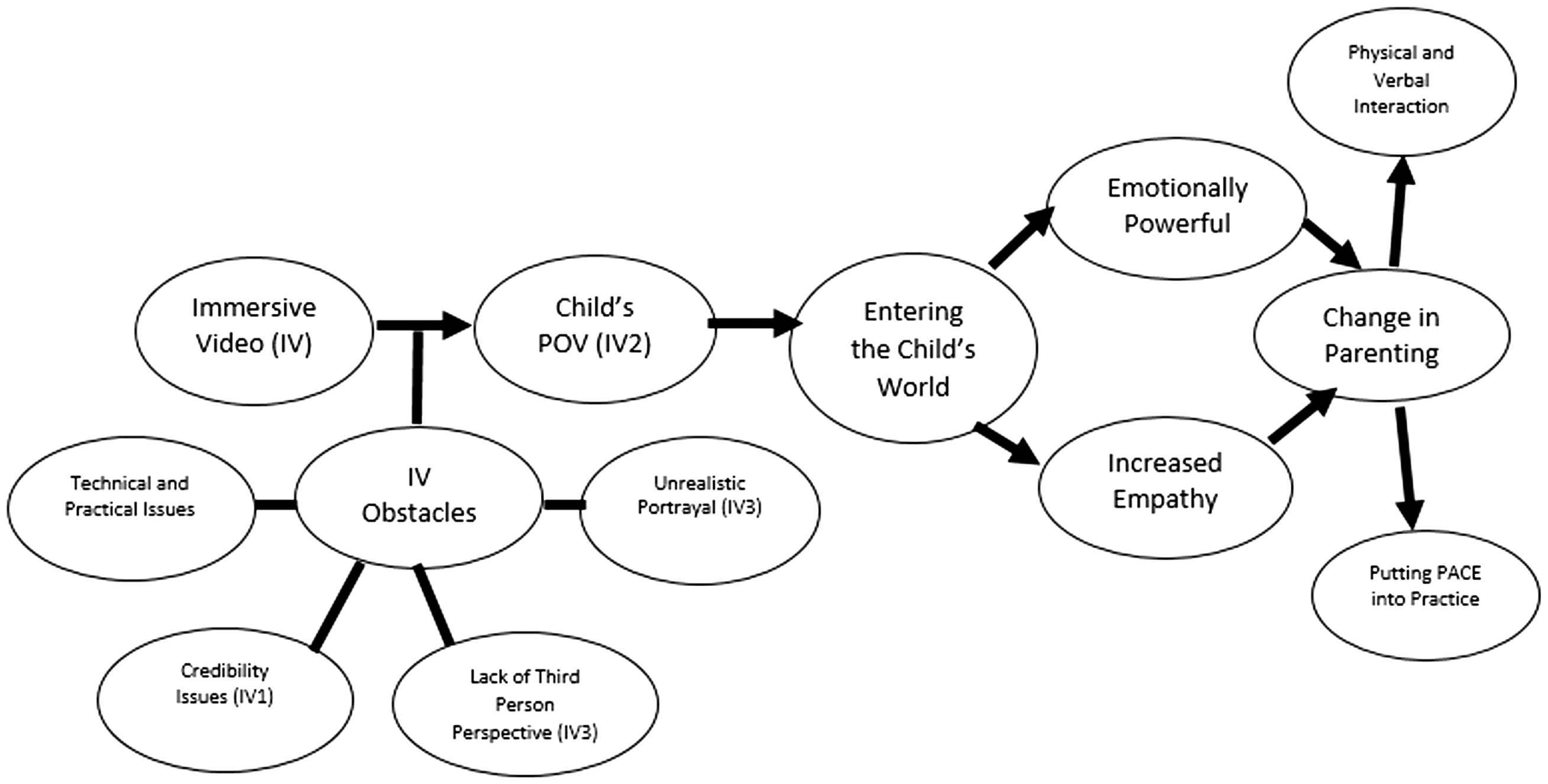
Relationship between factors identified in the experience of the immersive videos (IV).
Summary of findings
The quantitative results suggest that the participants’ overall perceptions of their training and its impact on their subsequent confidence, competence and empathy were positive for all three groups (adoptive parents, foster carers and special guardians). Qualitative analysis indicated some of the components that played an important part in this, including the trainers’ depth of experience and their use of specific active techniques, such as role play.
One interpretation of the quantitative findings from the TOPSE questionnaire is that the increased knowledge that was reported by trainees partly comprised an increased awareness that aspects of their ‘Empathy and understanding’ and ‘Emotion and affection’ could be developed. In this way, a lower post-training score for ‘Empathy and understanding’ may indicate an increased acknowledgement of their potential to develop this important parental attribute.
The somewhat equivocal quantitative results in terms of the impact of immersive video clips are also partly clarified by the qualitative information. This identified both the potential of the immersive video – for example, enabling an understanding of the child’s point of view – as well as obstacles that detract from or limit its impact.
Discussion
Over 80,000 children are in the care system in England, and the majority reside in foster care (DfE, 2020). At present, we have little knowledge of the optimal ways that technology can be incorporated into interventions to support families with children in and from the care system. This study makes an important contribution by examining the first use of immersive videos in a training programme for foster carers, adoptive parents and special guardians. The quantitative questionnaire data indicated that the training, and the immersive videos in particular, increased understanding of ELTN, including the impact on children’s behaviour. This style of training also instils competence and confidence in addressing associated behavioural challenges and increases empathy for children who have experienced ELTN. The qualitative data indicated that the immersive videos were especially powerful when filmed from the child’s point of view, as this facilitated a deeper understanding of their experiences and enabled trainees to relate emotionally to the situations portrayed.
Study findings
At the beginning and end of the training, participants rated their understanding of ELTN, its impact on children’s behaviour, their competence and confidence at addressing associated behavioural challenges and their ability to empathise with children. There were significant increases on all five measures, demonstrating the positive impact of the training. This was echoed in the interview material, especially regarding trainees’ increased empathy and behaviour modification. These findings are in line with previous research reporting that such programmes can have positive effects on parenting skills and knowledge (Schoemaker et al., 2020; Solomon, Niec and Schoonover, 2017).
Interestingly, such positive outcomes were not fully mirrored in the data from the TOPSE measure. While ‘Learning and knowledge’ increased between pre- and post-training, this was not evident for ‘Emotion and affection’ or ‘Empathy and understanding’. This may be because the impact of the training was limited to the evaluation of specific outcomes. However, it is pertinent to consider the lower completion rates for this measure (four adopters did not consider it applicable to themselves) and the low internal consistency of the ‘Emotion and affection’ subscale pre-training. Thus, data for this measure should be interpreted with caution.
With regards to the immersive videos, the findings show that they were considered beneficial. Participants rated each video clip positively with respect to the extent to which it had increased their understanding of ELTN, its effect on children’s behaviour, their empathy and their intention to modify their parenting behaviour. Thus, immersive video technology can be considered a useful educational tool that helps participants achieve the learning outcomes of training sessions (Pellas, Dengel and Christopoulos, 2020). However, differences in the perception of the video clips are important. For example, for the understanding of ELTN, the toddler video (IV2) was more impactful than the parenting video (IV3). For participants’ intention to modify their behaviour, the adopters rated the pre-natal video (IV1) more negatively than the toddler and parenting videos and lower than the foster carers and special guardians’ ratings of the same video.
The trainee interviews provided further evidence by showing that both the content and style of the videos influenced their impact. Participants queried the credibility of the pre-natal video and questioned the point of the video that simply offered an onlooker’s point of view of an interaction between a mother and a child (IV3). However, the videos were markedly beneficial when they were used to convey the child’s point of view, as this enabled trainees to consider how it would feel to be the child in that situation and to relate emotionally to experiences of parental neglect and abuse. This finding has important implications for other sectors that use immersive video technology in training for people who work with children.
Study implications
The inclusion of immersive reality in this parenting training programme had a positive impact on the foster carers, adoptive parents and special guardians involved. It would therefore be pertinent for future training programmes to consider utilising this technological resource. However, practical, technical and academic aspects should be considered. To avoid frustration for the participants, administrators should ensure that the instructions for using and sharing the technology (e.g., headsets) are clear and that the videos are integrated fully into the training sessions. In addition, the content is likely to have the greatest impact when it is scientifically well-informed and authentic, so participants can trust and relate to it. If the video does not portray the subject’s viewpoint, there may be few advantages in viewing it with an immersive video headset rather than using conventional equipment.
From a practical perspective, immersive video technology provides the opportunity to explore situations which may not be possible in real life. More specifically, this technology enables a consideration and evaluation of new scenarios and the honing of skills in preparation for lived experience.
Future directions
Immersive videos and VR have been used by other professionals for many years, and systematic reviews and meta-analyses have confirmed their increasing importance in training and practice for a range of professionals, such as social workers (Huttar and BrintzenhofeSzoc, 2020) and medical practitioners (Alaker, Wynn and Arulampalam, 2016; Joda et al., 2019; Mazur et al., 2018; Ros, Weaver and Neuwirth, 2020). However, this study is the first to examine the impact of including immersive videos in parenting training programmes for carers of children in the care system and so, while a range of benefits were reported by the trainees, these need to be confirmed by further research. More specifically, research should continue to determine the core elements required for training programmes for parents/carers of children with ELTN, taking into consideration the complexity of challenges that such children may face. In addition, it will be important to explore the wider use of sensory, cognitive and affective video including video interaction guidance, as per the National Institute for Health and Care Excellence (NICE) guidelines, to support parents/carers in further understanding the function of their child’s behaviour as opposed to seeing her or his behaviour as a ‘problem’. Finally, given the growing proportion of children in foster care living with relatives or friends (DfE, 2020), video training programmes should be explored for them.
While the current study reported increases in parenting skills and knowledge, the consequences of this for the children in their care were not explored. Future longitudinal research could examine outcomes in terms of children’s behavioural difficulties and attachment security, as well as their placement stability.
Conclusion
Embedding immersive videos within parenting training programmes can increase adoptive parents, foster carers and special guardians’ understanding of ELTN and their impact on children’s behaviour. This approach can also improve their competence and confidence in addressing associated behavioural challenges and help to develop their empathy. Thus, immersive video technology shows promise for enhancing the quality of life for children in and from the care system, but more research examining child outcomes is required to confirm this.
Footnotes
Afterword
Since the completion of this study, VR in social care has developed and is being used in 45 organisations including local authorities, regional adoption agencies, virtual schools and the NHS.
Acknowledgements
We are grateful to the adoptive parents, foster carers and special guardians who took part in this research and to the Cornerstone Partnership for providing us with this opportunity.
Declaration of conflicting interests
The author(s) declared no potential conflicts of interest with respect to the research, authorship, and/or publication of this article.
Funding
The author(s) disclosed receipt of the following financial support for the research, authorship, and/or publication of this article: The project was solely funded by the School of Psychology at the University of Roehampton.