




Abstract
There is limited research into the experiences of adopted individuals in adulthood despite the fact that adoption is a lifelong process. One key element of adoption is the processing and integration of one’s adoptive identity. This becomes increasingly salient in adulthood and especially so when becoming a parent as it leads to a re-examination of the individual’s adoptive narrative. However, this phenomenon is not well researched and lacks a theoretical framework. This study employed a classic grounded theory (CGT) methodology to develop a theory that explains how adopted individuals readjust their adoptive identity when they become parents. Twelve interviews were conducted with adoptees who had become parents and analysed using CGT. From this data, the theory of Creating a New Narrative emerged to chart the process and explain how adopted individuals readjust their adoptive identity in parenthood. It involves parents revisiting their adoption narrative and being empowered to reclaim their identity, rescript their family concept and parenting values and expand their repertoire for navigating hypervigilance regarding rejection. All of these elements are influenced by the level of openness and acceptance parents have experienced in relation to their adoptive status. The model thus provides a new theoretical framework that integrates the various research findings in this area.
Introduction
Despite growing awareness that adoption is a lifelong process, support services tend to focus on the needs of children and adolescents. This raises concerns regarding the level of support offered in adulthood, due to the limited services available and sparse research (Melero and Sánchez-Sandoval, 2017; Sánchez-Sandoval et al., 2020). One important aspect of adoption is developing one’s identity, a process that is influenced by significant life events. However, there are no current theories to explain or predict how this process occurs. The current study aims to fill this gap by presenting a classic grounded theory that explains how adopted individuals readjust their adoptive identity in parenthood.
The system of adoption
Adoption narratives are shaped by the social and cultural contexts of the wider society, especially the extent to which they operate systems of open or closed adoption (Grotevant et al., 2000; Koskinen and Böök, 2019). In open adoption systems, contact can be initiated and maintained between birth parents and adoptees. In closed adoption systems, there is no contact at any point as adoption is perceived as a time-specific event rather than a lifelong process (Demick and Warner, 1988; Rosenberg and Groze, 1997). Adoptees are unable to access birth records and other associated documents, which can have a negative impact on the individual throughout their lifespan (Department of Children, Equality, Disability, Integration and Youth, 2021). This is the system that operates in Ireland (Kearney, 2012).
The benefits of open communication
Open and frequent communication regarding one’s adoptive status has been shown to have a positive influence on the overall adoption narrative developed (Passmore, Feeney and Foulstone, 2007; Skinner-Drawz et al., 2011). The initial goal in open communication is relaying the adoptive status to the child. The discovery of adoptive status after the age of three is associated with lower life satisfaction and increased distress (Baden et al., 2019). The specific event of finding out is often recalled as a traumatic experience (Baden et al., 2019) that creates a sense of mistrust between the adopted individual and adoptive parents (Passmore, Feeney and Foulstone, 2007). Further, secrecy within the administrative systems, such as the blocking of access to birth information, prevents a fuller integration of identity (Rosenberg and Groze, 1997). However, there are considerable differences in individual responses. For example, Henze-Pedersen (2019) found that some adopted individuals experience ‘closedness’ in a different way: a positive influence on their identity, which reduces the level of unanswered questions and provides a sense of closure. This highlights the different pathways to identity development and the significance of whether information about adoption is sought or rejected.
Adoptive identity during parenthood
Grotevant and colleagues (2000) conceptualise adoptive identity as comprising three components:
the cognitive and emotional component, consisting of the level of preoccupation with adoptive identity; the family context, particularly the level of openness and physical similarity with one’s adoptive family; interactions within wider contexts.
The family, social and cultural contexts influence one another as feelings of belonging are reduced when adopted individuals do not resemble their adoptive parents. This is further compounded by the wider community making reference to this difference, including micro-invalidations such as terminology that describes parents as either ‘real’ or ‘not real’ (Baden et al., 2019). This triggers reminders regarding the absence of someone in whom adoptees can see their own traits.
This thinking is also reflected in the non-linear model posed by Penny, Borders and Portnoy (2007), which highlights how adoptive identity may be re-examined and readjusted on numerous occasions, particularly following significant life events such as parenthood. This allows a fuller integration of identity as the new event is processed in relation to the overall meaning of adoption (Grotevant, 1997; Penny, Borders and Portnoy, 2007). Significant to this is the finding that parenthood is commonly associated with initiating the tracing process (Brodzinsky, Schechter and Henig, 1992; Carlsten, 2007; Hampton, 1997; Howe and Feast, 2000; Koskinen and Böök, 2019; Lutz, 2011; O’Kelly, 2018; Vaccaro, 2012).
Adjustment to parenthood
The Family Life Cycle model developed by McGoldrick, Carter and Garcia-Preto (2011) presents a traditional framework of the adjustment to parenthood. It describes the main tasks of adjustment in relation to tasks as a couple, within the extended family system and in relation to the wider community. However, it does not capture variance in other family structures, such as single parenthood, or the range of experiences that parenting might trigger. A broader understanding of the experience of parenthood among adopted individuals is needed, therefore, as generalisations from traditional models can lead to the perception that outlying cases are maladaptive or exceptional (McGoldrick, Carter and Garcia-Preto, 2011).
Adjustment to parenthood as an adopted individual
While there is no current theory to capture the experiences of adopted individuals’ adjustment to parenthood, several research studies have highlighted a number of themes related to this transition. These were identified in an electronic search conducted by the first author (ME) in April 2021 which explored the following databases: PsychINFO, Web of Science Core Collection, Scopus and EBSCOhost. Search engines including Google Scholar and ProQuest Central were also investigated for relevant articles. The search terms included: ‘adoptee’, ‘parenting’, ‘identity’, ‘adoptee parent’, ‘adjustment’, ‘revisiting’, ‘exploring’, ‘birth parent’, ‘searching’, ‘shifting perception’, ‘values’, ‘creating’, ‘appreciating loss’, ‘gratitude’, ‘openness’, ‘secrecy’, ‘acceptance’, ‘exclusion’, ‘motivation’ and ‘re-evaluation’.
Re-examining the adoption narrative
Parenthood is a time when adopted individuals re-examine their adoptive history, including their view of their birth mother and family relationships (Despax and Bouteyre, 2019). These reflections commence in pregnancy when adopted individuals reflect on their adoptive parents’ experiences of infertility and the unknowns regarding their medical history (Deans, 2001). The emergence of previously unanswered questions can precipitate a process of heightened curiosity (Koskinen and Böök, 2019; O’Kelly, 2018). This provides additional challenges to identity which will further be influenced by subsequent attempts to seek answers (Conrick, 2020; Greco, Rosnati and Ferrari, 2015; Pinkerton, 2010). In this way, parenthood provides an opportunity for the individual to re-evaluate their adoption history (Gatzke, 2015; Pinkerton, 2010).
Defining parental values
Within this exploration, the view of how one wishes to parent becomes salient, as parents reflect on their own experiences. They seek to provide their children with opportunities that were not afforded to them, such as more open communication (Conrick, 2020; Gatzke, 2015; Price, 2016; Vaccaro, 2012). Parents who were adopted may become overprotective due to hypervigilance about feelings of loss; this requires them to learn to separate their own experiences from those of their children (Hampton, 1997; Horowitz, 2011; Lutz, 2011; Phillips, 2009; Pinkerton, 2010).
The first genetic connection
The birth of their first child often presents adopted individuals with their first experience of a biological connection, which is usually a source of gratitude and an increased sense of belonging (Conrick, 2020; Hampton, 1997; O’Kelly, 2018; Phillips, 2009). Conversely, a sense of loss is experienced when this physical connection is not present (Brodzinsky, Schechter and Henig, 1992; Price, 2016).
This genetic relationship can elicit greater feelings of loss regarding unanswered questions, due to the awareness that the next generation may be influenced by these (Conrick, 2020; Price, 2016). Hence, for some, this is a motivator to trace birth parents (Prakash, 2014).
Redefining familial relationships
Research studies show that the impact of parenthood on the adoptee’s relationship with their adoptive parents takes many forms. They chart a mixture of effects, such as increased emotional distance and anger (Brodzinsky, Schechter and Henig, 1992; Conrick, 2020; Hampton, 1997; Horowitz, 2011; Phillips, 2009), greater emotional closeness (Sherr, Roberts and Croome, 2018) or no change (O’Kelly, 2018). An increase in empathy towards the birth mother is frequently noted (Conrick, 2020; Hampton, 1997). However, this may depend on the way in which parenthood occurs, as those becoming parents through adoption describe increased empathy towards their adoptive as opposed to their birth mother (Price, 2016).
Methodology
Design
This study was conducted by way of an inductive approach using the classic grounded theory methodology to build a theory from the emerging data. Within this methodology, researchers position themselves as objective observers, generating a theory from the data through constant comparison, memo-writing and concurrent data collection, and analysis (Birks and Mills, 2015: 11–14). This enables the researcher to avoid preconceived ideas and to stay focused on the emerging patterns in the data.
Recruitment
A purposive sample of participants who had knowledge and experience of the issues was recruited via post-adoption support groups, social media and word of mouth. Inclusion criteria required them to be adopted, English speaking, aged over 18 and with at least one child under the age of 18. Ethical approval was obtained from the School of Psychology Research Ethics Committee at the National University of Ireland, Galway.
Participants
The participants comprised eight parents who were adopted from the ages of one week to almost nine months old. There were seven mothers and one father, ranging in age from 32 to 46 years at the time of interview. They had 13 children aged between four months and 23 years. All had been adopted through domestic adoption in Ireland under a closed system. Five had tried to trace their birth parents with varying degrees of success, two had no such plans and one had been informed of the identity of one birth parent as an adult.
Procedure
All interviews were conducted remotely on Skype. They were recorded on a password-protected computer for transcription and saved as an encrypted file. At the open-coding stage, interviews were unstructured, consisting of an open-ended question designed to encourage a ‘spill’ of information (e.g., ‘Can you tell me about your experiences of adjusting to parenthood?’). The researcher then further explored issues that the participants mentioned (e.g., ‘What was that like for you?’, ‘Can you tell me more about that?’). At the selective-coding stage, interviews were semi-structured in order to fully saturate all categories. Full transcripts were compiled for the first two participants’ interviews. However, as the analysis progressed, field notes were developed for all other participants instead to keep the researchers’ focus on a conceptual level of analysis (Glaser, 1998: 110–111).
Data analysis
Eight participants were interviewed, four of them for a second time for the purposes of theoretical sampling. This produced 12 interviews in total. The analysis involved two stages: substantive coding (open and selective coding) and theoretical coding. Two key procedures – constant comparison and memo-writing – were applied throughout. The details are presented in Figure 1.
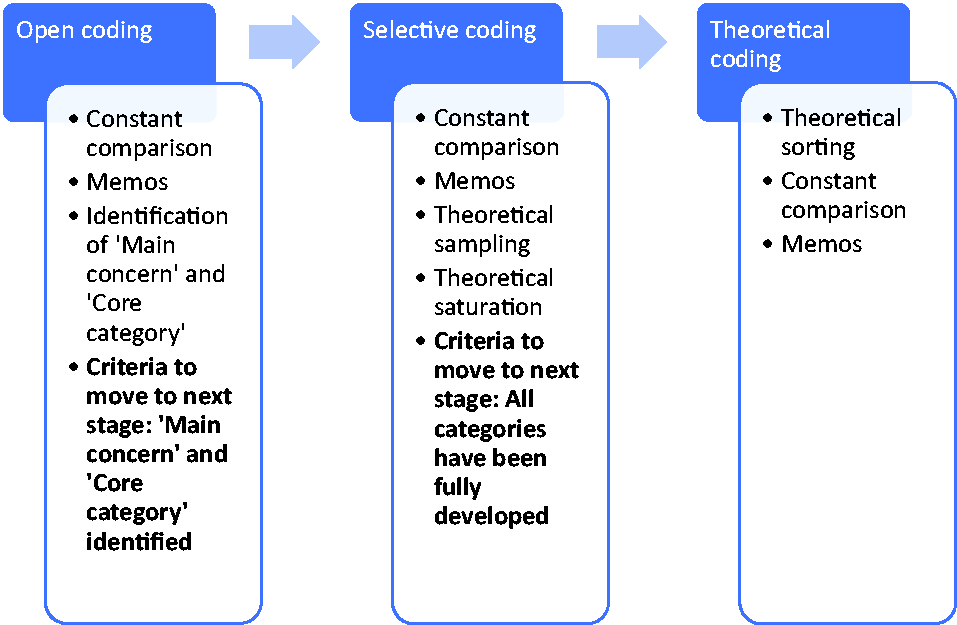
Overview of steps in data analysis.
Constant comparison
Constant comparison is a method of continually comparing different sets of emerging codes and categories and their indicators (Glaser, 1978: 49). This was applied at each stage of analysis to achieve theoretical saturation. Codes were constantly compared to build up categories which were then compared to one another. For example, through constant comparison of all data pertaining to the code ‘Drive to protect’, the category of ‘Clarifying values’ was developed. This category was then compared to other categories (e.g., ‘Amending the vision’ and ‘Gratitude’) and became a sub-category of the category ‘Rescripting’.
Memos
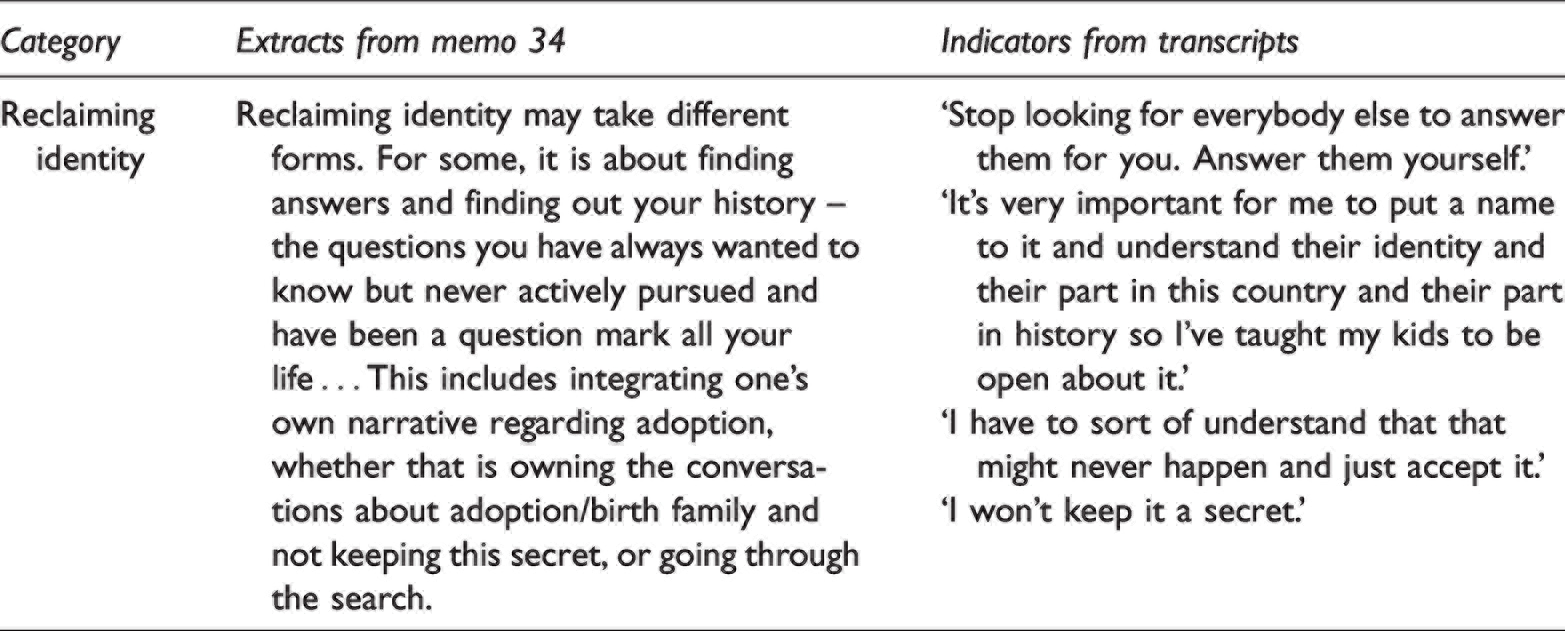
Memos were written from the onset of data collection and continued throughout the analysis. These are the theoretical ideas that occur to the researcher as field notes are developed, coded and compared. They are a key component of the classic grounded theory methodology and form the basis of the theory at the memo-sorting stage of coding. Table 1 demonstrates an example of this process.
Example of a memo.
Substantive coding
Substantive coding involves two stages: open and selective coding. Open coding ascribes codes line-by-line to the field notes and groups together extracts covering similar issues. For example, the following extracts were grouped: ‘I was able to understand possibly what emotions that my natural mother would’ve had to go through’; ‘realising how hard it must have been for them’; and ‘it struck a chord with me how difficult it must have been for the person who had me to give me up’. These were allocated to the code of ‘Empathising’.
Through the application of the two analytic tools described previously – constant comparison and memo-writing – a core category and main concern were identified to best encapsulate the data. Participants’ main concern was identified as ‘Breaking the cycle’ which was resolved by ‘Creating a new narrative’ (i.e., their core category). Once the main concern and core category had been identified, the analysis moved on to selective coding.
At the selective coding stage, only data that related to the main concern and core category (that of ‘Creating a new narrative’) was included in the analysis. A review of existing codes and categories, along with their properties and dimensions as revealed in previous transcripts/field notes, was conducted to identify categories that related to the core category. Categories and codes which did not fit were removed, allowing the researcher to concentrate on the emergence of the theory and to identify the additional information required to fill any gaps.
Theoretical sampling
Theoretical sampling was then applied to explore further properties of emerging categories to achieve theoretical saturation. Four participants were re-interviewed for this purpose. An example concerned the exploration of additional ways in which the adoptees’ perceptions of their birth mothers had changed: Some participants describe a change in how they viewed their birth mother, such as increased empathy. Was this something that happened for you or are there other ways that this changed for you?
This facilitated an exploration of further properties of the category of ‘Shifting perceptions’. Theoretical saturation was achieved when participants described concepts that had already been captured within the properties and dimensions of existing categories.
Theoretical coding
The final stage of analysis involved theoretical coding, in which the core category and all sub-categories were integrated into a coherent theory (Glaser, 1978: 72). To achieve this, all 76 memos were printed and prepared for sorting by hand to establish the relationships between the core category and all its sub-categories. These relationships form the basis of the theory that best explained the variance in the data and was conceptually coherent (Holton and Walsh, 2016: 109). Thus, the emerging theory, Creating a New Narrative, provides a multivariant explanation of how adopted individuals readjust their adoptive identity during parenthood.
Results: Theory of Creating a New Narrative
Creating a New Narrative is a basic social psychological process that describes how adopted individuals reshape their adoptive identity after becoming parents and how this influences their future parenting. It explains how parents create a new narrative to break the cycle of what has gone before and, in order to do so, undergo a two-stage process: ‘Revisiting’ and ‘Empowering the self’.
Revisiting consists of two stages: ‘Shifting perceptions’ and ‘Appreciating loss’. These are linear stages which result in an enhanced motivation for parents to do the best for their children, while also sparking a renewed curiosity regarding their own adoptive history. This facilitates the stage of ‘Empowering the self’ which comprises of three further steps: ‘Rescripting’, ‘Reclaiming identity’ and ‘Expanding the repertoire’. All of these steps have a reciprocal relationship in that they influence one another, as demonstrated in Figure 2. Creating a New Narrative is therefore an evolving process that continues as parents rescript, reclaim their identity and expand their repertoire.
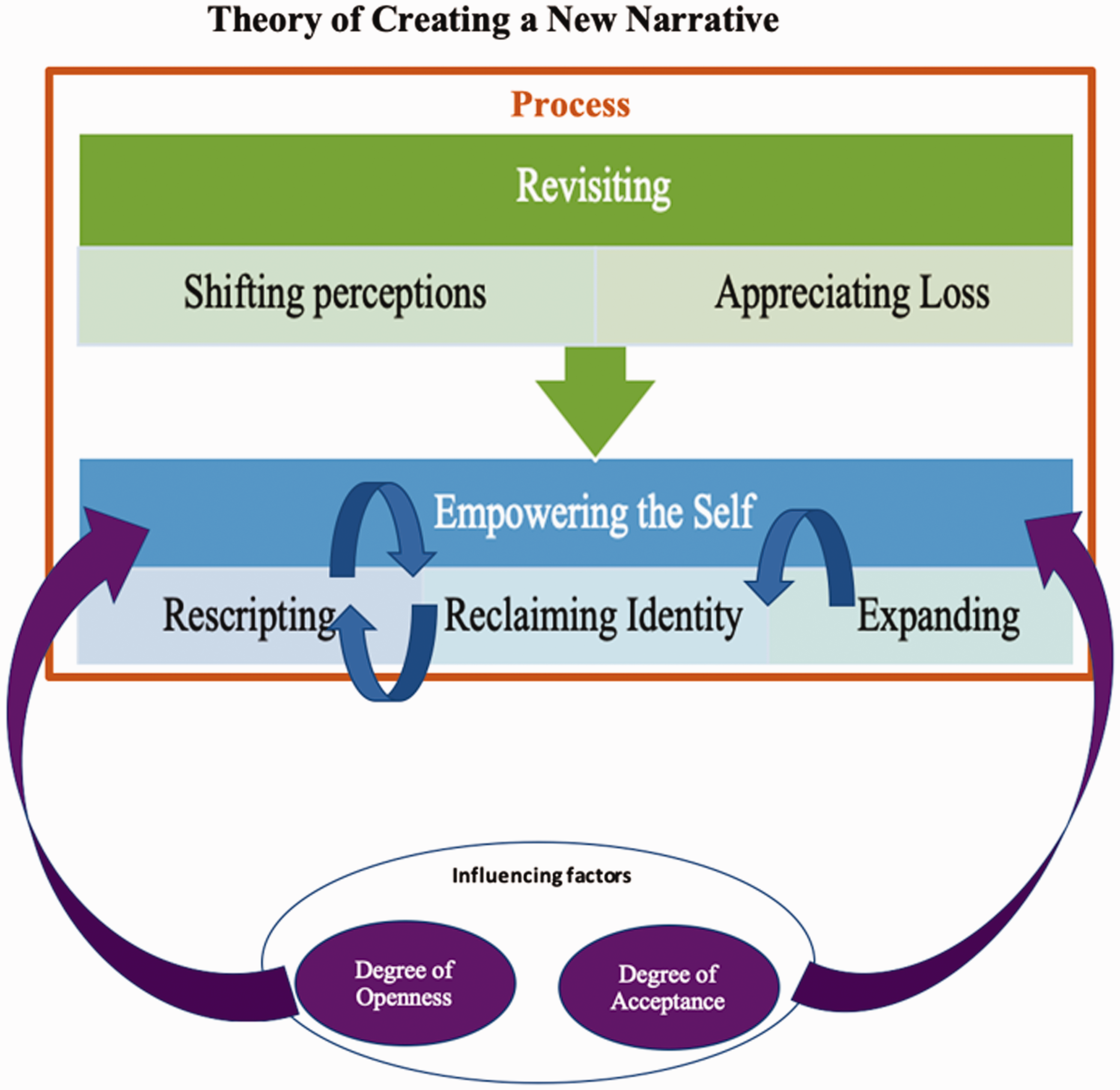
Theory of Creating a New Narrative.
The strategies within ‘Empowering the self’ are influenced by the ‘Degree of openness’ and ‘Degree of acceptance’. These can affect the stages in different ways, for example, by influencing how parents appraise their adoption history. They also determine the number of concerns parents process, as some may have already initiated the process and so have fewer steps to work through.
By combining these elements, the theory captures diverse experiences of the readjustment of adoptive identity and the fluid nature of the process of Creating a New Narrative whereby parents move in and out of stages from different directions or re-enter them. This is demonstrated in Figure 2.
The elements of this dynamic will now be discussed in more detail.
Stage 1: Revisiting
‘Revisiting’ is a stage of reflection whereby parents revisit the past through the lens of their new perspective as a parent. It ignites a heightened curiosity regarding their adoption history, while simultaneously sparking the desire for things to be different for the next generation. There are two components in the revisiting stage: ‘Shifting perceptions’ and ‘Appreciating loss’.
Shifting perceptions
Following the birth of their child, parents begin to reflect on their own birth and the separation from their birth mother. The arrival of their baby presents a tangible reminder of the circumstances surrounding their own birth. Indeed, during our interviews, one mother described the birth of her first child as ‘a physical representation of the baby that I was when I was given up for adoption’ (Participant 8).
Through the lens of this new perspective, they can now better relate to the emotional impact that this separation would have had on their birth mother as they imagine the pain of parting with their newborn baby. The shift leads to parents revising their views of their birth mother.
This is influenced by the parent’s perception of the level of choice the birth mother had when placing them for adoption. Those who see the birth mother as having had a degree of choice experience increased anger, while those who perceive her as having had little freedom show increased empathy and admiration. With increased empathy and sympathy comes the realisation of the pain the birth mother would have experienced. This can heal feelings of rejection, as one mother described after giving birth: It struck a chord with me how difficult it must have been for the person who had me to give me up, because you just have this instant, unconditional love for your child. (Participant 4)
Depending on the responses elicited, parents may also reconstruct their perception of adoption as less or more of a rejection than previously imagined.
Appreciating loss
Reflections on loss lead to an increased sense of gratitude that this separation will not be repeated for the next generation. Parents also appreciate the sacrifice of the birth mother in placing them for adoption as they reflect on being unable to imagine ever having a different family from their adoptive family. This can be reconceptualised as an act of love on the part of the birth mother, as one participant described: ‘She didn’t do it for herself, she was looking after me’ (Participant 9).
Another element of loss raised is their adoptive parents’ experience of infertility. Parents feel gratitude for the opportunity to have had a biologically related child, which is coupled with the awe of experiencing their first genetic connection. This may be their first experience of having their physical traits reflected back in another person, as one mother explained: ‘being adopted has a compounding effect when you become a parent … I think it’s a different love … It’s a burn inside of me’ (Participant 6).
The strong bond fuelled by gratitude and an appreciation of loss further motivates parents to create a new narrative for their children. Coupled with a revisiting of their adoption history, parents enter the stage of ‘Empowering the self’.
Stage 2: Empowering the self
‘Empowering the self’ is the second stage of the Creating a New Narrative theory. It is the behavioural manifestation of how parents re-integrate their adoptive identity and ‘action’ their parenting in accordance with their identified values.
Rescripting
The first task in this is ‘Rescripting’, which consists of two tasks: ‘Clarifying values’ and ‘Redefining the family concept’.
Clarifying values
While recalling their early life experiences, parents reflect on missed opportunities from their childhood due to their adoption and experiences of being parented. This influences the values they wish to implement in their own parenting. Empathising and reflecting, in the previous stage, help them to realise what they want to do differently.
Redefining the family concept
Parents’ concept of ‘family’ becomes redefined as they experience a biological connection with their baby. Parenthood can also increase the desire to search for birth parents. After tracing, parents may further re-examine their concept of family. Even if this does not come to fruition as easily as envisioned, it can still enhance one’s appreciation of current relationships and an acceptance of those that have not developed as hoped. Regardless, parents still seek a definition of what it means to be a family, with some coming to realise that while shared traits are important, relationships are not solely based on physical attributes and can include shared values, interests and personality traits. One father reflected on the importance of the nurturing environment: You can be born over here and raised over there … you’re gonna be like the people that raise you and nurture you and bring you up and instil values in you. (Participant 2)
Reclaiming identity
Following ‘Rescripting’ comes the task of ‘Reclaiming identity’. This encapsulates an embracing of curiosity and identity integration as part of taking back ownership of the adoption narrative. In order to do this, parents engage in three strategies: ‘Enacting’, ‘Searching’ and ‘Integrating’.
Enacting
‘Enacting’ is the behavioural expression of the values that parents have identified. It includes proactive and responsive steps to ensure that their children are afforded the opportunities that they missed or proved difficult for them. Some of these are implemented early on, perhaps in utero (e.g., reducing exposure to stress), while others are ongoing as children mature (e.g., modelling open communication).
In enacting these values, parents must maintain a balance between striving to break the cycle and overcorrecting. This requires them to start differentiating their own experiences from those of their child; for this, self-reflection is needed in order to implement their goals while promoting their child’s independence. One parent described the difficulty of asking others for support with childminding due to the fear that their child ‘would feel abandoned because I probably felt abandoned’ (Participant 8).
Searching
‘Searching’ reflects a shift from passive wondering to active curiosity, culminating in the parent’s decision on whether to seek further information on their adoption history. If active searching is pursued, parents have to navigate complex legal and administrative systems to acquire further information and then to renegotiate relationships if contact with birth parents does materialise.
Integrating
Parents are next faced with the task of integrating both the decision of whether or not to search and any information acquired in the process into their evolving adoption narrative. For those who have decided not to search, the decision may provide resolution through the realisation that they are satisfied with their current level of information. Those who have actively searched have to integrate newly acquired information with the rest of their identity. This may necessitate further redefining of the family concept and integrating their adoptive history with their many other identities.
Expanding the repertoire
In amending their view of adoption, parents inevitably reflect on the influence that a history of rejection has had on their interpersonal relationships. This leads them to experience hypervigilance to cues of rejection. In order to break this cycle and create a new pattern with their children, they utilise the following four strategies:
identifying when feelings of rejection have been triggered; reframing this rejection in context (e.g., as a reflection of the child’s developmental stage); responding internally (e.g., self-soothing or challenging automatic thoughts); responding externally (e.g., the compassionate, developmentally appropriate response received by the child).
Influencing factors
Variations in the process of Creating a New Narrative are explained by two factors: ‘Degree of openness’ and ‘Degree of acceptance’. These influence the strategies parents utilise in order to create a new narrative. They can influence the stage of ‘Empowering the self’ at any point and can complicate or simplify the process, depending on the circumstances.
Degree of openness
The ‘Degree of openness’ refers to how open and supportive the environments surrounding parents have been, historically and currently, regarding adoption. This applies to the levels of the adoptive family and the wider community. It has three dimensions: ‘Frames of adoption’, ‘Early integration’ and ‘Open discussions’.
Frames of adoption
When adoptive parents frame adoption as a positive event, such as emphasising that the adopted individual was chosen and special, it supports a positive narrative regarding adoption and can negate some of the associated feelings of rejection. This is further enhanced if adoptive parents incorporate the birth mother positively into the narrative, as it supports the integration of identity.
Early integration
Knowledge of adoptive status from an early age facilitates integration throughout the lifespan. Having always known, to the extent that a specific event could not be recalled, means that adoption has been normalised as another part of one’s identity. By contrast, being old enough to recall being informed of one’s adoptive status signals ‘a breach of trust’ (Participant 9) that impacts their relationships going forward. This leads to hypervigilance to rejection and re-definition of the family concept.
Open discussions
The presence of frequent, open conversations regarding adoption helps to initiate the process of reclaiming one’s identity, as it signifies fewer unanswered questions. At a systemic level, the withholding of information creates feelings of powerlessness which limit the ability to reclaim one’s identity. Difficulties in locating documents, tracing relatives, being given misinformation or feeling guilty about how adoptive parents might react can block the searching process which can further impair identity integration.
Degree of acceptance
The ‘Degree of acceptance’ refers to how inclusive the environments surrounding parents have been, both at a familial and systemic level. This consists of two elements: ‘Shared traits’ and ‘Denial of identity’.
Shared traits
Sharing traits with members of the adoptive family enhances one’s identity. This may reduce the impact of the unmet need of biological connections and provide a sense of where one fits in. Physical similarities with adoptive family members also increase a sense of identity and belonging, as the wider community are more likely to perceive them as biologically related.
On the other hand, exclusionary comments from others reduce a sense of belonging in the adoptive family. This negatively impacts the integration of identity and definition of one’s family concept. Further, additional experiences of rejection of this kind heighten hypervigilance about rejection.
Denial of identity
Societal shame also acts as a barrier for reclaiming and integrating identity, when parents are denied information by others (e.g., birth parents maintaining secrecy or declining to make contact, or agency policies denying access to records). This creates further rejection and requires additional steps for one’s identity to be successfully integrated and reclaimed. The theory of Creating a New Narrative therefore provides a multivariant theory, capturing the varying ways that the adoptive identity evolves for individual parents.
Discussion
The findings of this study led to the emergence of several novel hypotheses, which are discussed below in light of the existing literature.
Overview of findings
Hypothesis 1: The birth of one’s child provides the motivation for parents to embark on the process of creating a new narrative. This hypothesis is supported by the evidence. The revisiting of one’s adoptive history upon becoming a parent is well-established (Brodzinsky, Schechter and Henig, 1992; Gatzke, 2015; Hampton, 1997; Pérez, Sala and Ortega, 2016). Several studies report that parenthood elicits a re-invigorated interest in the adoptive history (Conrick, 2020; Greco, Rosnati and Ferrari, 2015; Groncki, 2010; Hampton, 1997; Horowitz, 2011; Lutz, 2011; Moyer and Juang, 2011; Pérez, Sala and Ortega, 2016; Phillips, 2009; Pinkerton, 2010; Vaccaro, 2012), which is subsequently given new meaning (Despax and Bouteyre, 2019; Gatzke, 2015; Pinkerton, 2010).
Hypothesis 2: The changed perception of one’s birth mother leads to a renewed interest in one’s adoptive history. This hypothesis is partially supported by the literature. The new perception of the birth mother upon becoming a parent is well documented in the research (Despax and Bouteyre, 2019; Field and Pond, 2018). However, this view may not be generalisable to those who become parents through adoption. Indeed, the different ways of becoming a parent may affect whom adopted individuals who become parents relate to the most (i.e., their adoptive or birth parents). Additional factors may influence this pathway.
Hypothesis 3: An appreciation of loss and gratitude for one’s child motivates parents to provide their children with better opportunities than they experienced. This hypothesis is neither supported nor refuted in the literature as it is a novel finding. While the experience of sharing a genetic connection for the first time has been described as a source of gratitude (Conrick, 2020; Hampton, 1997; O’Kelly, 2018; Phillips, 2009), this has not been linked to motivating parents to provide their children with specific positive experiences. However, there is some research to suggest that sharing this genetic connection also leads parents to reflect on the impact of gaps in their history on the next generation (Conrick, 2020; Price, 2016) and motivates them to search for their birth parents (Brodzinsky, Schechter and Henig, 1992; Price, 2016). There is no current research exploring the impact of an appreciation of loss on adopted individuals’ parenting style.
Hypothesis 4: Adopted individuals engage in a ‘rescripting’ of parenting values and the family concept. This hypothesis is partially supported in the literature. Parenting values reflect parents’ own ‘missed experiences’ (Conrick, 2020; Gatzke, 2015; Koskinen and Böök, 2019; Moyer and Juang, 2011; O’Kelly, 2018; Price, 2016; Vaccaro, 2012). While the theory of Creating a New Narrative incorporates these reflections, Price (2016) notes that the realisation of parenting values occurs in the context of enacting them and may not be consciously identified by the parent. Further research is needed to explore the outcomes these changed perceptions have on redefining one’s concept of family (Conrick, 2020; Hampton, 1997; O’Kelly, 2018; Price, 2016; Sherr, Roberts and Croome, 2018).
Hypothesis 5: Parents reclaim their identity by exploring the decision to search, integrating their identity and enacting their parenting values. This hypothesis has some support within the literature but requires further investigation. The emergence of a critical juncture, whereby parents must decide between leaving questions unexplored or embracing curiosity through active searching is supported by Greco, Rosnati and Ferrari (2015) and Pinkerton (2010).
The necessity for parents to separate their own experiences from those of their children in order to reduce overprotective practice also has some support within the literature (O’Kelly, 2018; Phillips, 2009). The theory of Creating a New Narrative adds to this existing knowledge by conceptualising this process on a continuum, from implementing one’s parenting values appropriately to over-implementing.
As individuals have multiple identities, integrating one’s adoptive identity as one constituent among others has not been described within the literature. It may be that this reflects a focus in research on parents who are still in the early stages of parenthood and who may not yet have worked towards this step.
Hypothesis 6: Parents enact strategies to reduce the feeling of rejection in their parent–child relationships. As this is a novel finding, the hypothesis was neither supported nor refuted by the literature. There is no existing research regarding the parenting styles of adopted individuals or the parent–child relationship as the research focus resides on the transition to parenthood and adoptive identity after becoming a parent (Despax and Bouteyre, 2019). Therefore, this behaviour has not been captured in the research. The task of ‘Expanding the repertoire’ focuses on this dynamic in our theoretical model.
Hypothesis 7: Parents who have experienced more open communication are less likely to search for their birth parents and require less reintegrating of their adoptive narrative. This hypothesis is supported by the literature. Powell and Afifi (2005), for instance, reported an association between higher levels of uncertainty and loss and the desire to search for one’s birth parents. In addition, early integration in the form of having known about adoptive status from an early age has been found to have a positive influence on identity integration (Price, 2016). This fits well with the hypothesis that unanswered questions increase the need to reclaim identity.
Hypothesis 8: A lower level of acceptance within one’s adoptive family is associated with a less positive adoption narrative. This hypothesis is partially supported by Price (2016) who describes how negative comments from others regarding one’s resemblance to the adoptive family have a negative impact on identity within this family. This has two possible effects: the potential to alter the family concept by reducing (Juffer, 2006) or increasing (Grotevant et al., 2000) adopted individuals’ sense of belonging in the adoptive family, depending on whether shared traits are identified. However, findings are tentative due to the dearth of research on the impact of acceptance within the wider community on adoptive identity.
Criteria for judging classic grounded theory
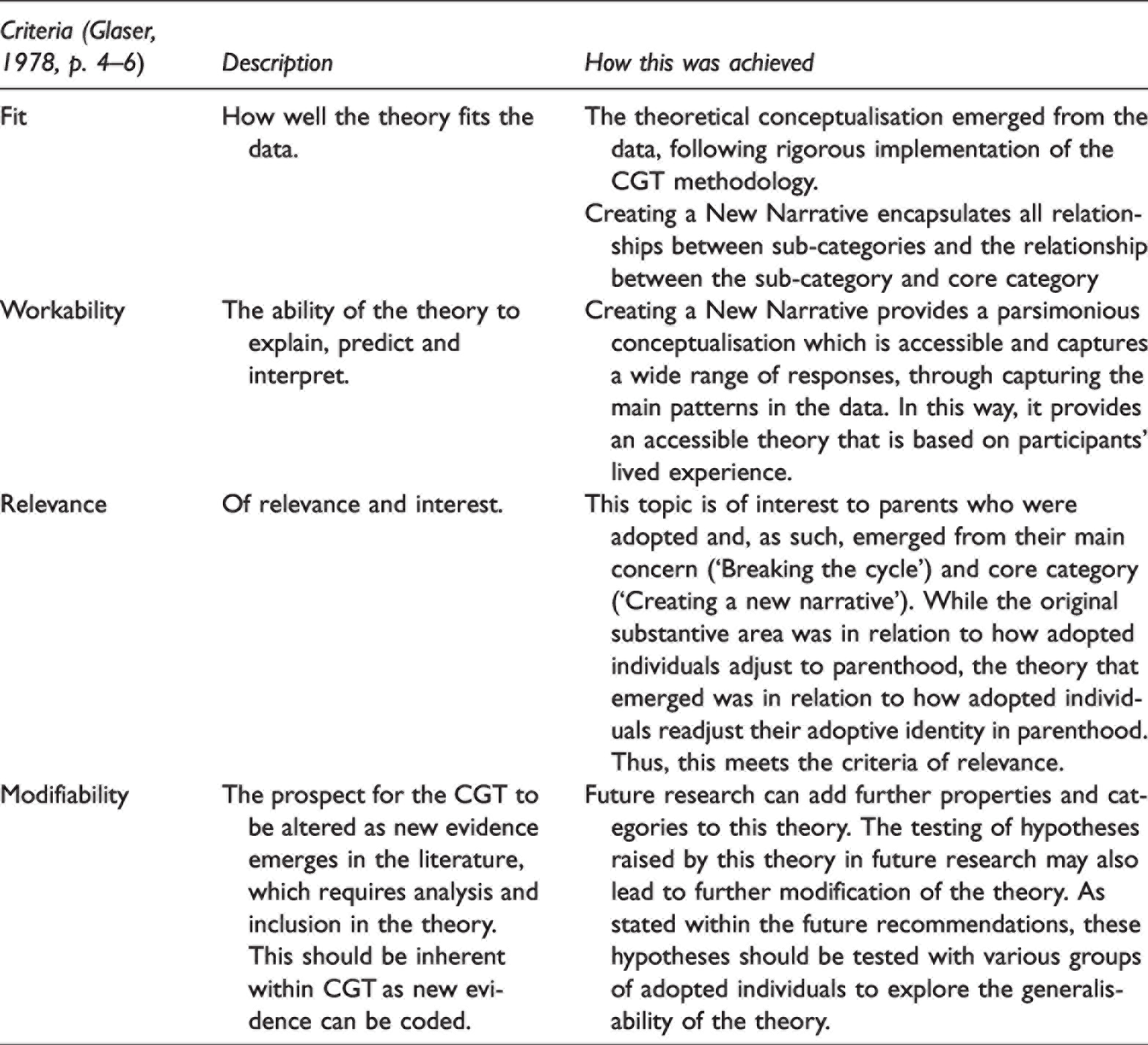
There are specific criteria by which a classic grounded theory is judged: fit, workability, relevance and modifiability (Glaser, 1978: 4–6). Table 2 demonstrates how the theory of Creating a New Narrative meets these criteria.
Criteria for judging a classic grounded theory (CGT).
Limitations and recommendations for future research
While this study provides a multivariant theory that is largely supported by the relevant literature, it has not been tested on a heterogenous group, so its wider applicability can only be surmised.
In addition, due to the limited number of studies on adopted individuals in parenthood, there is no evidence to support or refute some of the hypotheses emerging from the theory. Future research needs that have been identified include explorations of: whether a change in perception of one’s birth mother leads to a renewed interest in one’s adoptive history for those becoming a parent either biologically or through adoption; how adopted individuals redefine their family concept in parenthood; whether an appreciation of loss motivates parents to provide optimal opportunities for their children; how the adoptive identity is integrated with other facets of an individual’s identity; whether parents enact strategies to reduce feelings of rejection in the parent–child relationship; and the impact of limited acceptance in the wider community on a person’s adoption narrative.
In addition, throughout the literature, adopted individuals tend to be grouped together and compared against those who were not adopted. This may preclude key aspects of a multifaceted understanding of adoption, particularly as there is such heterogeneity within adoptive experiences and influential variables. These are highlighted in the theory of Creating a New Narrative through the inclusion of: perceptions of the birth mother’s level of choice in adoption; level of openness within the adoptive family and wider society; presence or absence of shared traits in the adoptive family; and the social and cultural contexts in which the individual resides. Future research could explore these variables further.
The homogeneity of the participant group also limits our understanding of how further variation may occur among participants whose experiences differ from those captured by the study. This includes open adoptions, adoption into families of a different ethnic group and adoptions at an older age. More attention might also be paid to fathers. Interestingly, in this study, the experiences of the mothers and the father were similar; greater differences were found between those parents who searched for their birth families compared with those who did not.
Theoretical and clinical implications
The theory of Creating a New Narrative provides an explanatory model for understanding the variety of ways in which adopted individuals readjust their adoptive identity in response to becoming parents. A key message for those supporting adopted individuals is to understand the varied ways in which this process occurs. This includes remaining open-minded that the same process and the same steps may not occur for every individual.
Moreover, an appreciation of the factors that influence the desire to search for birth families may help those working in tracing services to better support adopted individuals. The research also provides recommendations for adoptive parents to cultivate openness regarding the adoption narrative. Finally, the importance of the cultural and social factors that influence how new parents adjust their adoptive identity is highlighted. This includes increased openness within systems and access to information and documents to negate the impact that withholding information has on reclaiming identity for the adopted individual and, consequently, the next generation.
Conclusion
Creating a New Narrative is a multivariant theory that provides an enhanced understanding of the readjustment of adoptive identity as a new parent. This includes an insight into adoptive identity, parenting practices, parent–child interactions and variables that may influence the decision on whether to trace birth parents.
Footnotes
Declaration of conflicting interests
The author(s) declared no potential conflicts of interest with respect to the research, authorship, and/or publication of this article.
Funding
The author(s) received no financial support for the research, authorship, and/or publication of this article.