




Abstract
Although an understanding of the lived experience of foster care relationships can provide valuable information to guide social work practice and policy, few such studies have been carried out. This article presents findings from a qualitative investigation exploring experiences of relationships between foster carers and the young people in their care. Eight care-experienced young people and nine foster carers participated in interviews and focus groups. Interpretative Phenomenological Analysis (IPA) was used to explore their experiences. The insider’s perspective was further amplified through engaging peer researchers with experience of fostering relationships – one a young person who had been in care, the other a long-term carer. Two overarching themes were identified. Firstly, participants made sense of fostering relationships through comparisons with birth family ones, particularly in relation to the impact of care systems, continuing biological family relationships and foster care language. Secondly, previous experiences created barriers to forming positive fostering relationships, but when these were overcome the experience could be life changing. The implications of these findings for social care policy regarding foster carer support, training and matching guidelines are discussed.
Keywords
Introduction
In the UK, foster care is the main way of looking after children in care with 70% of the 104,000 looked after population living either with strangers (54%) or relatives or friends (16%). As 85% of the 70,000 or so placements are classified as long-stay, long-term foster care is clearly a lived reality for most young people in the care system (Department for Education and National Department for Statistics, 2020).
There have been several marked changes in the nature and role of foster care in recent years. One that is especially significant is the increasing professionalisation of the service (Kirton, 2007); another is the amendment made in 2015 to the Children Act 1989 which recognised long-term foster care as a legitimate option for children unable to return to their birth families and deemed ‘unsuitable for adoption’ (Masson, 2015). Given these changes, it seems essential to understand what it is like to be a young person in foster care or a carer responsible for a child’s welfare. Given the histories of maltreatment, family dysfunction and absent parenting among looked after children, the relationships they form with their carers has been found to be a major influence on future developmental outcomes and a source of recovery from previous adversity (Hill, 2009; Withington, et al., 2017).
It follows that if foster care policy and practice are not felt to reflect the lives of young people and carers, it is likely to be poorly received and less effective. One way of ensuring optimal outcomes is to consider the voices of care-experienced young people and their carers in order to understand the nature of these potentially life-changing relationships (Goldfarb, et al., 2019). This article contributes to this knowledge by exploring such lived experiences.
The quality of care and lived experience in fostering relationships
Studies of children in care have repeatedly shown how young people’s experiences of being looked after outside their birth family are strongly influenced by the quality of relationships with their caregivers, specifically the feelings of support and warmth provided (e.g. Taussig, Clyman and Landsverk, 2001). Good relationships, in turn, have an influence on the subsequent placement stability (Withington, et al., 2017) and young people’s self-esteem (Farineau, et al., 2013) and emotional and behavioural developments (Southerland, et al., 2009). Recent studies have explored these effects more deeply and conceptualised relationship quality in terms of foster carers' responsiveness, sensitivity and acceptance. The first of these has been shown to be positively associated with improvements to markers of HPA axis functioning (Szenczy, et al., 2020), while the other two predict affective and cognitive outcomes (Ackerman and Dozier, 2005; Raby, et al., 2019).
However, despite the plethora of fostering research, the lived experiences of those involved tend to have been neglected. Only a small number of studies have directly addressed questions regarding the nature of fostering relationships and what ‘good’ fostering relationships look like from the perspectives of young people and their carers (e.g. Christiansen, et al., 2013; Gardner, 2004a, 2004b). While it is possible to measure objectively some aspects of relationship quality, such as carer sensitivity or acceptance, a consideration of lived experience enables an understanding of the meaning of such components in the context of an individual’s wider relational experiences. For example, while it is evident that fostering relationships are important, the majority of young people do not perceive their carers as parents or having a parental role (Barth, 1990; Festinger, 1983). This suggests that for many, it may be an oversimplification to assume that models used to conceptualise birth parenting can be interchangeably applied to foster families (Smith, Cameron and Reimer, 2017).
Several research studies have shown considerable ambiguity and variation in how young people perceive foster relationships and examined how these relate to their conceptualisations of ‘family’. For example, in one Australian study, when children in care were asked about their family, they would frequently ask ‘which family?’ was being referred to (Gardner, 1996). A follow-up of the children involved found that the primary determinant of whether children considered their foster carers to be members of their family was their perceived closeness of the relationship (Gardner, 2004b). Other studies have found that care-experienced young people sometimes describe their perception of family in terms of ‘hopes and imaginings' rather than real life experiences, thus mirroring the views of children living with birth families (Heptinstall, Bhopal and Brannen, 2001; Samuels, 2008, 51). ‘Family’ has been described by young people across these studies as a place of belonging, unconditional love, acceptance, understanding and support where parents act as the head of the family with a special responsibility for ‘looking after’ children and providing care and protection. For these young people, family was seen as a way of being or interacting rather than as a structure pre-determined by cultural or biological connections (Boddy, 2019).
Studies in the USA have reported similarly ambiguous findings about young people’s experiences of foster relationships. One reported that young people showed high levels of security but desired greater levels of closeness with their carers (Fox, Berrick and Frasch, 2008). Yet, as Chapman, Wall and Barth (2004) found, although the young people reported high levels of closeness and relatedness with their carers, they ultimately expressed a desire and expectation to return to their birth families.
Foster carers also appear to feel ambiguity in how they experience fostering relationships. Several studies have referred to the complexity of carers’ role, highlighting potential dichotomies between whether they are perceived as professionals, parents or a hybrid of the two (Colton, Roberts and Williams, 2008; Southerland, et al., 2009). Research has even reported different outcomes in terms of child and carer well-being depending on whether the foster carers identified as parents or professionals (Blythe, Wilkes and Halcomb, 2014; Southerland, et al., 2009). However, these studies perhaps introduce a false binary between ‘professional’ and ‘parental’ caring when there may be many other manifestations of the fostering role, for example, ‘auntie’, ‘grandmother’, ‘older sibling’ or ‘mentor’ (Butler and Charles, 1999). Further complexity is added by Wells and colleagues’ (2004) identification of five role types used by female US foster carers: strategic, struggle, satisfaction, rejection and other. While the ‘strategic’ model of fostering aligns most closely with ideas of foster carers as professionals, none of these perceptions place them as purely professional or purely parental.
The prevalence of a single-perspective approach poses a particular challenge for developing an understanding of fostering relationships. Relationships develop in the space between individuals and, therefore, are incomplete when examined exclusively from one side. One of the few studies to incorporate both perspectives comprised interviews with 37 children (aged 6–12) in long-term foster placements in Norway, along with their carers, birth parents and social workers (Christiansen, et al., 2013). Participants described foster care as providing a secure family-like environment for children who simultaneously felt a sense of belonging to birth families, summarised as an experience of ‘cautious belonging’. Both young people and foster carers expressed ambivalence regarding their fostering relationships, with such feelings more quickly and openly explored by young people. This study further emphasises the complexity of fostering relationships and highlights differences in how ambiguity is experienced and presented by young people and carers. The mixed findings emphasise that foster care experiences are not homogenous and are dependent on many different individual, temporal and sociocultural factors.
Most of the studies discussed so far were conducted in the USA or Western Europe rather than the UK. However, superficially similar or geographically proximate countries may vary in terms of foster care policy, practice, cultural perceptions of family and family–state interactions (Hantrais, 2009), hence the need for research that captures the lived experiences of fostering relationships in the UK.
Design and method
This study explores the research question ‘How do foster carers and care-experienced young people in the UK understand and experience fostering relationships?’. It builds on present understandings of situations by considering the potentially diverse perspectives of both foster carers and care-experienced young people as a single group with a set of shared relational experiences. A focus on lived experiences facilitated a move beyond simplistic labels categorising fostering relationships as ‘parental’ or ‘professional’ to one that provides a more holistic picture of how participants understand these relationships.
As it was a cross-sectional, participatory, qualitative, phenomenological investigation into life experiences, an Interpretative Phenomenological Analysis (IPA) approach was used. The design was also iterative, allowing for the data collection schedules to respond to emergent themes as the research progressed and facilitate authentic personal accounts rather than replicating researcher preconceptions. Two peer researchers, one a care-experienced young person and one a foster carer, were involved in the study development, data collection and interpretation in order to facilitate a participatory, empowering and inclusive experience for participants (Kelly, et al., 2020).
Ethical approval was given by the University College London Research Ethics Board (no. 14653/002) and research governance approval was provided by Kent County Council (no. RGA2020_03). All names were pseudonymised with participants selecting their own identifier to allow imparting of sociocultural information anonymously (Allen and Wiles, 2016).
Recruitment
Foster carers and care-experienced young people were recruited by opportunity sampling through advertisements circulated through the partner local authority, UK charities and organisations. After contacting the research team, candidates were screened according to pre-determined inclusion criteria.
For the children, these comprised:
aged between 16 and 26 years old; experience of foster care lasting a total of at least six months overall (in one or more placements); sufficient fluency in English to engage in the research; capacity to provide informed consent to take part in research study.
For the foster carers, they were:
registered foster carer currently offering long-term foster placements; sufficient fluency in English to engage in the research.
Participants
Data were collected from 17 participants: eight care-experienced young people (4 females and 4 males, aged 17–26) and nine foster carers (6 female and 3 male). They were based across England in a mix of rural and urban locations. All of them identified as White British or declined to provide details, making the study sample unrepresentative of the wider UK foster care community. No young people self-identified as unaccompanied asylum seekers and only one of them was living in ‘kinship care’, despite 16% of all UK children in care living in such placements. Two carers described caring for unaccompanied asylum seekers, but no foster carers identified as kinship carers. There was diversity among care-experienced participants in terms of length and type of care experiences and among foster carers regarding fostering history, family constitution and employment.
Data collection and processing
Data collection took place in 2020, before and during the COVID-19 pandemic. It was conducted in two ways: a group activity-based workshop and one-to-one semi-structured interviews. Peer researchers, one a young person who had been in care and the other a long-term carer, were involved in the design of the schedules for the workshops and interviews and the care-experienced peer researcher co-delivered the workshop with the primary researcher. The peer researchers identified the activity-based workshops as especially beneficial for engaging the young people in the research process in addition to interviews. They reduced the risk of researcher-researched power differentials which is important as many looked after children have experienced considerable ‘professional gaze’ in their interactions with welfare services (Holland, 2009).
The activity workshop, attended by four young people, focused on fostering relationships and included a series of games, small group discussions, individual work and creative tasks led by a researcher and a care-experienced peer researcher. Group discussions were audio-recorded and any paper materials produced were collected and photographed to aid further analysis.
Individual interviews were conducted by telephone with six young people and nine foster carers, and two others were undertaken with workshop attendees who requested an opportunity to elaborate on what they had said in the group discussions. Interviews were audio-recorded and transcribed verbatim with the primary researcher keeping reflective field notes throughout.
Analysis
Given that the focus of the research was on lived experiences, the data were analysed through IPA which is concerned with ‘exploring experience on its own terms’ and so aligned with the aims of the study. The analysis followed a variation of the six-step process outlined by Smith and colleagues (2009): extensive familiarisation with the data; detailed notetaking; identification of emerging themes within a case; making connections across emergent themes within a case; moving on to new cases and identifying divergent and convergent patterns across cases. Visual data were initially annotated manually in analytic stages 1–2, alongside transcriptions of the workshop activities corresponding to their production and were then incorporated into stages 3–6 of the analysis. To ensure that the emerging themes felt resonant and that interpretations were evidenced in the data, peer researchers were consulted during stages 3–6 having independently reviewed the transcripts and visual data. The analysis was further complemented by the first author’s reflective field notes which captured aspects of the ‘waiting field’ and allowing engagement in researcher reflexivity (Mannay and Morgan, 2015).
Findings
Two overarching superordinate and five subordinate themes were derived from the data as depicted in Figure 1.
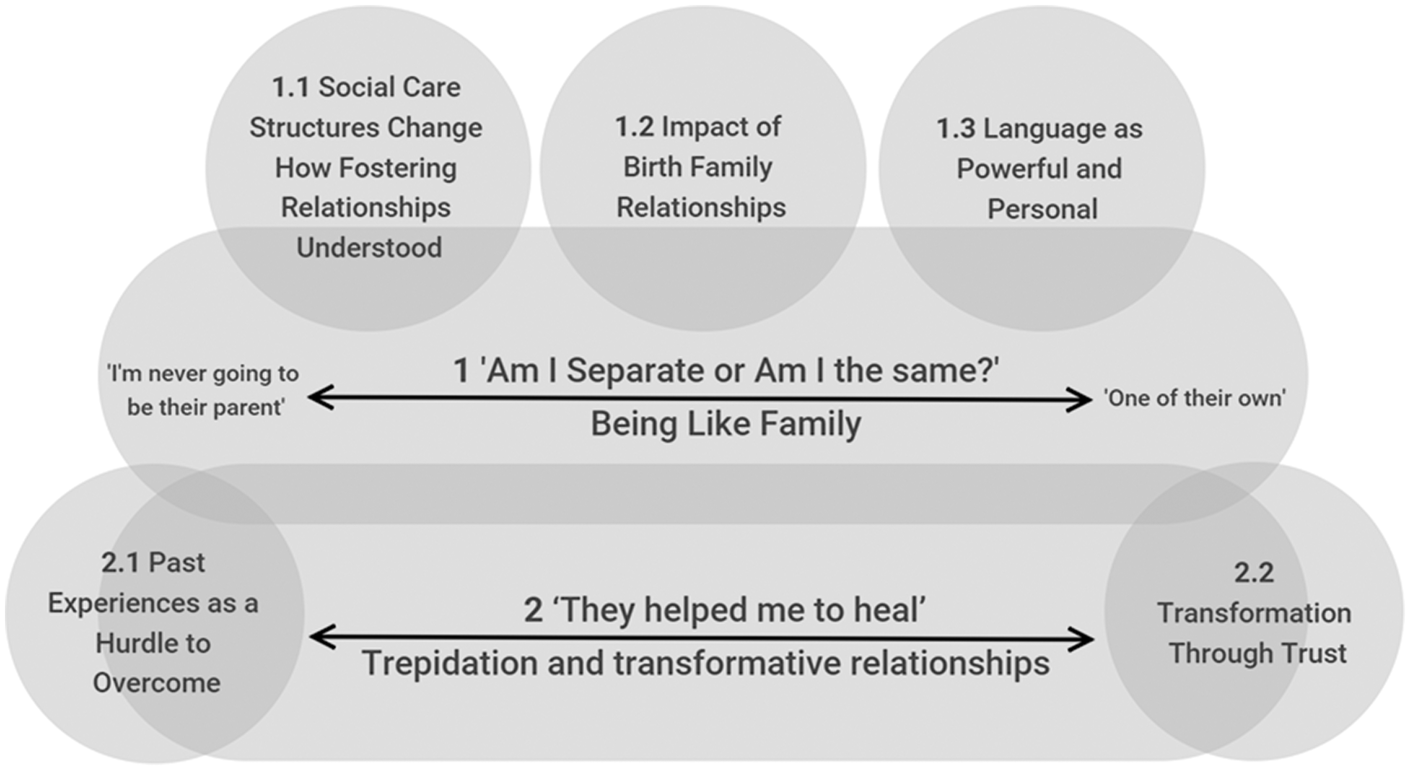
Thematic map.
Each theme is described below using supporting evidence from the study. All names are pseudonyms and the letters YP and FC brackets after quotations indicate whether the participant was a care-experienced young person or a foster carer.
Theme 1: ‘Am I separate or am I the same?’: Being like family
While the young people’s and carers’ experiences of fostering relationships varied, all were marked by a pervasive comparison with relationships between parents and biological children, with being ‘one of their own’ as a frame of reference for describing the situation.
Participants' experiences could be seen to fall along a spectrum. At one end, some fostering relationships were described as identical to participants’ experiences or imagined conceptions of birth child–parent relationships. Stefan (YP), describing his relationship with his foster carers, said, ‘I weren’t treated like I were any different, they just saw me as one of their own.’ Others spoke about their placement as a place where ‘they treat me as if I’m one of their own, one of their children, not just a foster child’ (Pete, YP). These feelings were shared by some carers: for example, ‘I see them as […] my children who will then have children of their own who will call me grandma’ (Jo, FC). Foster carers often spoke of going to great lengths to treat the young people in their care identically to their own children. As John (FC) explained, ‘I would do that for my daughter, so, I do the same.’ The ultimate goal for some was for children in their care to ‘realise that they are part of the family’ (Louise, FC).
However, at the other end of the spectrum, some fostering relationships were described as non-parental and non-familial, closer to ‘an outsider’ relationship' (Kayla, YP). Several carers explained: ‘the truth is, I’m different things, but I’m not their parent’ (William, FC). Young people also experienced a gap between their fostering relationships and those they would expect between carers and their own children. This at times could be very painful, as Alex (YP) explained, ‘It was quite clear from the beginning that I was different.’ Similarly, Kayla (YP) said that she ‘did have some very nice foster carers […] but it still wasn’t family’. This non-parental style of relationship was nevertheless sometimes described as ‘very positive’ (Kayla, YP) or ‘quite affirming’ because ‘your parent has a responsibility to look after you […] I’m choosing to do that’ (William, FC).
While some participants experienced fostering relationships that were firmly at each end of the spectrum, the majority described situations that fell in between the extremes. Some referred to ‘a very particular relationship’ (William, FC) not captured by simple labels such as ‘professional’ or ‘parental’: I see it as sort of like being a parent, like I am for my own child, but also a huge responsibility because you’re parenting, quite often, a child that either belongs to the government or has another set of parents. (Chloe, FC) …that was really hard because I was like ‘Oh, she’s one of my girls, she’s one of my kids now’ and then all that happened. And you’re like, ‘Oh my goodness, maybe it’s all a lie. Maybe I know nothing about you at all.’ (Aleks, FC)
‘You can’t do that’: social care structures change how fostering relationships are understood
Many participants described how the care context of fostering itself shaped the nature of the relationships that developed. Many carers spoke about feeling ‘on guard’ (John, FC) due to the high levels of monitoring from social services, leading some to behave in ways that were more ‘professional rather than just being humane’ (George, FC). This led to them second guessing themselves in developing relationships with young people: ‘You’re always thinking will social services agree with that… Am I going to get told off?’ (Chloe, FC). In turn, some experienced a knock-on effect that reduced their willingness and ability to treat the young people as one of their own: If one of my kids was having a cry, I want to put my arm around him. But you can’t do that until they put their arm around you because you could get yourself in trouble. (John, FC) … it made me feel like the relationship had changed because I felt like I couldn’t talk about stuff I wanted to for fear of the system and not wanting to get lost in it. (Jade, YP) I already knew that you had to sort of get these things approved with social services before you can get the money […] and she said, ‘No, I don’t care about whether this gets funded or not by social services, you’ve not got any clothes so I’m taking you shopping.’. […] that action straight away made me feel quite comfortable and wanted and cared for. (Leigh, YP)
‘The stand-in parent’: impact of birth family relationships
Some participants described fostering relationships as interlinked with and influenced by relationships between young people and their biological families. Several carers reported being very aware that ‘most of the children we look after have their own parents’ (William, FC). Some felt that this directly influenced the extent to which they could treat young people as ‘their own’. One described feeling like ‘the stand-in parent’ (Louise, FC). Others explained how developing family-like relationships could lead to situations where young people ‘struggled with [their] dual identity’ (Bella, FC) and feelings of torn loyalties. This was corroborated by young people like Leigh (YP) who explained how developing positive, familial fostering relationships ‘was really stirring a lot of conflicting feelings where I wasn’t really wanting to admit that my dad wasn’t really much of a dad’.
The building of relationships between foster carers and birth families was sometimes seen as critical to strengthening fostering relationships. For example, Louise (FC) described, ‘The reason that the [fostering] relationship started to build was that we would have meetings with Mum, and [the child] would see clearly from the onset my respect that I have for his mother.’ For young people like Stefan (YP), this foundation of respect was also felt to be important; as he explained, ‘I want to acknowledge the time we had, even though it were bad, we still had good times and I don’t want to minimise those memories.’
In contrast, the situation for some young people was quite different. Kayla (YP), for example, recounted, ‘I never had a relationship with my parents anyway, we were very distant.’ For them, there was little discussion of interactions between birth family and fostering relationships in a ‘live’ sense. However, there were often echoes of difficult, distant or abusive relationships in their accounts of forming new relationships with carers (see Theme 2).
Lastly, both young people and foster carers acknowledged that it was possible for relationships with birth family to sit alongside fostering relationships without diminishing them. Pete (YP) explained, ‘I have my mum and dad and I have my other mum and dad’ and Bella (FC) described how young people in care ‘can thrive knowing that they can love two families; they can enjoy a normal existence but still have connections to their roots’.
‘I can’t stand that word’: language as powerful and personal
Throughout the discussions about developing fostering relationships, the importance of and diversity in the use of language was evident. Participants often described not being able to ‘stand’ the use of certain words frequently used in care contexts (John, FC). As Stefan (YP) explained, ‘The “foster” thing made me sound… there were just something around it that I didn’t like.’ Some carers disliked the ‘stigma’ attached to professional language around fostering relationships (Nathalie) or found it ‘derogatory’ (John). Negative feelings about words such as ‘foster carer’, ‘looked after child’ and ‘supervised’ seemed related to how this language distanced fostering relationships from those of a normal family. Nevertheless, some young people like Alex and Pete referred to their carers as ‘mum and dad’, reflecting the familial nature of their relationships.
But as with the rules mentioned earlier, other participants found the distancing language of foster care helpful to protect themselves from the unpredictable and painful changes common in fostering relationships. As Chloe (FC) explained, ‘I don’t feel I can proclaim that name [mum] because one day she might say to me that I’m not and that will hurt me.’ Stefan (YP) expressed how language choice helped manage issues of loyalty: ‘your [birth] family is your identity’ and for this reason ‘even though I’ve been with them longer than I’ve been with my mum I’d never be able to call them […] Mum and Dad’.
Theme 2: ‘They helped me to heal’: Trepidation and transformative relationships
Participants’ experiences elucidated an overwhelming tension between a perception of fostering relationships as potentially transformative and recollections of past experiences that elicited feelings of fear, resistance and vulnerability in getting too close to people.
‘I didn’t want to accept it’: past experiences as a hurdle to overcome
Carers often acknowledged the challenging pasts of the young people. George (FC), for instance, described children entering his care as ‘actually a bit bruised and battered, psychologically, emotionally’. Particularly significant in this were the difficulties the young people described relating to relationships with parental figures. As Nathalie (FC) reflected, ‘they’re so used to people not caring.’
These previous experiences were felt by many participants to be a barrier to developing new, supportive fostering relationships. As Leigh (YP) explained: I was just waiting for it to go wrong because that’s the way I’d been treated my whole life. It was like that I was told that I didn’t deserve this […] I get this family and it’s, well, something’s going to go wrong at some point. … scared because […] they want to be in control. Instead of ‘I’m going to be rejected again,’ ‘I’m going to break it down and be rejected before they try to do it.’
‘I didn’t expect to be who I am today’: transformation through trust
Despite the hurdles participants described in forming trusting fostering relationships, it was clear that as relationships developed, they often experienced reparative and life-changing benefits. John (FC) explained that: … these kids didn’t trust anybody, not anybody. You start to see and build that trust between you […] if you build on it then the relationship goes from strength to strength. … it’s changed me to how I am today because they were able to build my trust […] I really think they helped to heal me and to accept that help and care.
It was evident that trusting fostering relationships could affect many areas of young people’s lives. Carers explained how such relationships could allow young people to achieve ‘things that you never thought they were capable of’ (Aleks, FC) and ‘see that life is actually worth living’ (Nathalie, FC). One foster carer (Bella), who was still in touch with adults she had previously cared for, reported seeing her ‘own parenting skills reflected in’ their nurture of their own children. Young people expressed how trusting fostering relationships had allowed them to feel ‘like we had a purpose’ (Pete), given them ‘a helping hand towards wherever you want to go’ (Alex).
Trusting fostering relationships, for some young people, also facilitated self-actualisation. As Stefan (YP) explained, ‘It takes that person to believe that you can become more.’ This deeply contrasted with experiences of mistrust and distant fostering relationships which could catalyse negative cycles of change. As Alex (YP) summarised: If you don’t feel like you can tell your foster carer something and they would support you […] you just start hiding things and, you know, you become untrustworthy in yourself.
Discussion
This study sought to examine the lived experiences of fostering relationships of nine foster carers and eight care-experienced young people. Qualitative analysis of interview and workshop data revealed two superordinate and five subordinate themes, capturing the complex process of negotiation that characterises the development of fostering relationships. Findings showed that participants’ experiences were extremely diverse; however, a constant feature was comparison between fostering and birth family relationships. The negotiation of these was experienced as interlinked with the impacts of social care structures, birth family relationships and the use of language and labels. The experiences of many participants indicated that acute feelings of vulnerability, mistrust and uncertainty must be overcome if close, trusting fostering relationships that facilitate personal and interpersonal change are to develop.
The finding that care-experienced young people and foster carers are highly sensitive to the extent to which their relationships align with those in birth families mirrors research exploring how foster carers characterise their role (e.g. Southerland, et al., 2009). However, this study also suggests that typifying foster carers as either ‘professional’ or ‘parental’ is an oversimplification, given that most fostering relationships appear to inhabit a space between these descriptors. Most carers participating in this research did not consider themselves the ‘parents’ of the young people in their care, but rather described a very ‘particular’ relationship not adequately captured by the label ‘professional’. A growing body of foster care literature has focused on the ‘professionalisation’ of the service away from a purely altruistic ‘volunteerism’ (e.g. Kirton, 2007). However, this study supports previous work indicating that many carers consider their professional role to be only part of their relationship with the children (De Wilde, et al., 2019). This is demonstrated by the prevalence of carers who went beyond the professional social care arrangements that limited their relationships with their children. The findings also indicate that even systems that move beyond volunteer–professional or parent–professional dichotomies, such as Wells and colleagues’ (2004) five-role model, may still be insufficient. One reason for this is that such models often fail to account for the contribution of young people as negotiators of fostering relationships (Boddy, 2019). Hence, models for understanding fostering relationships that consider a range of actors’ views, including those of young people and foster carers in addition to birth relatives and social care systems, may provide more balanced and nuanced insights into real-life fostering experiences.
This and many previous studies have captured the challenges that young people with histories of inconsistent, adverse or abusive caregiving environments face in responding to new families, even when they may be warm and benign (e.g. Munro and Hardy, 2006). They are often torn between the developmental necessity of forming bonds and deep mistrust or ‘fright without solution’ concerning parental figures (Fearnley and Howe, 2003; Rustin, 2006). A finding strongly evidenced in this study is that for many foster carers, young people’s experiences are mirrored in their own lack of stability and continuity from frequent placement endings, support worker changes and uncertainty in placement planning (Schofield, et al., 2000). As Pickin, Brunsden and Hill (2011) highlight, foster carers are encouraged to form strong attachments and bonds with young people only for them to be broken by factors outside their control. This resonates with the vulnerability and uncertainty felt by many foster carers contributing to the present study. These factors, along with contradictory messages regarding foster carer responsibilities, fit with this study’s finding that both young people and foster carers’ previous negative experiences can exacerbate difficulties in creating new, trusting fostering relationships. This provides support for transactional models of fostering relationships where it is necessary to consider the experiences of both young people and foster carers, and explore how these affect interactions and relationship building (Fearnley and Howe, 2003). Such models consider the respective histories of all actors in fostering relationships, their connections and roles in relation to one another and how such roles are dynamically interlinked, perhaps drawing on systemic approaches. On the basis of this, models for support utilising systemic therapeutic approaches may be particularly relevant and meaningful for developing fostering relationships.
The present study’s findings also demonstrate that forming trusting fostering relationships is not simply a dance between two individuals but rather a negotiation between the living present and the ‘ghosts’ of the past (Fraiberg, Adelson and Shapiro, 1975). They also show the impact of prototypes from young people’s early relationships and the effects of contemporary experiences on foster carers’ models of fostering relationships. This may explain why several studies have found that the quality of current fostering relationships rather than their history of maltreatment determines various measures of young people’s psychological well-being while in care (Joseph, et al., 2014). It may be important to know not only whether maltreatment has occurred but also how it has been overcome or is kept alive in the formation of new fostering relationships. The implications of this are important for supporting foster carers to interact with young people who have challenging relational histories. As in psychotherapeutic work with young people in foster care, it may be necessary to challenge existing defences as these are often highly ingrained and while they may have proved protective for young people historically, they may not be adaptive in new fostering relationships (Kenrick, 2006). Furthermore, foster carers need support in recognising, naming and unpicking the influences of their own experiences on their interactions with the young people in their care to allow ‘unfriendly and unbidden spirits’ to be banished from new fostering relationships (Fraiberg, Adelson and Shapiro, 1975: 387). Training and support of foster carers may need to specifically focus on how they can be mindful of the influence of their own experiences in fostering relationships. One candidate for this may be mentalization-informed training approaches, such as Reflective Fostering (Redfern, et al., 2018).
In this study, many participants reported experiences of forming trusting, close fostering relationships that frequently facilitated deep changes in young people’s lives. This finding aligns with the suggestion that foster care can provide an important opportunity for transformative change in the lives of young people in care (Hill, 2009). Empirical evidence has demonstrated that young people, even as adolescents, are able to form new, secure attachments to carers (Joseph, et al., 2014). Previous work has highlighted the power of such positive fostering or adoptive parental relationships to facilitate personal change, growth and potential ‘catch-up’ in terms of psychological well-being and development for young people entering care (Farineau, Stevenson Wojciak and McWey, 2013; Fisher, 2015; Luke and Coyne, 2008). This study builds on this work by showing how trust-building can be developed so that relationships grow from strength to strength and lead to positive personal changes in young people.
Strengths and weaknesses of the study
A strength of this study is its representation of experiences of both foster carers and care-experienced young people to get ‘both sides of the story’. The iterative and qualitative form methodology facilitated the building of a rich picture of the experience of developing fostering relationships, beyond existing labels or categories. The involvement of peer researchers improved the acceptability of data collection and allowed for checking the resonance of emergent themes, contributing to the usefulness and credibility of the primary researchers’ interpretations (Kelly, et al., 2020).
However, a limitation is the lack of diversity in participants’ identified ethnicities. Cultural background and the degree of ‘cultural matching’ in foster placements are known to influence experiences of foster care (Brown, et al., 2009). This study was unable to examine such effects. In addition, no unaccompanied asylum seekers or kinship carers took part. A further limitation is that by pursuing a thematic approach, some of the idiographic experiences of fostering relationships may not be captured by the proposed model. It is important to note that experiences of foster care are not homogeneous and a thematic approach may sometimes do insufficient justice to the unique and individual experiences of participants (Stapley, O’Keefe and Midgley, 2021).
Conclusions
Foster carers and care-experienced young people experience essential and unavoidable negotiations in developing fostering relationships. Being a part of such a relationship means facing questions of separateness or sameness, influenced by factors that include social care frameworks, relationships between young people and birth families and the language surrounding the situation. Young people and foster carers face a conflict between vulnerably opening themselves up to fostering relationships or mistrusting and rejecting these opportunities based on the shadows of previous experiences. This study highlights multiple paths through which foster carers and the young people in their care navigate these tensions in a transactional manner and the ‘in between’ spaces these fostering relationships may inhabit that evade easy definition by pre-existing labels. It emphasises the need for models of support based upon transactional models of fostering relationships that consider the dynamically interlinked contributions of a range of actors, including carers, young people, birth family members and social care systems.
A question that this study raises is how mismatches between young people’s and foster carers’ expectations, needs and hopes about the nature of their fostering relationships can be overcome. It was evident from participants’ experiences that navigating fostering relationships could be painful. Therefore, it is important to investigate how individuals can best be supported to negotiate these developing connections. Furthermore, while fostering relationships were frequently compared to those in birth families, the findings suggest there was no ‘one size fits all’ relationship that was viewed as universally preferable. It is important that in social work support, primacy is not placed on one model of fostering relationships as a gold standard, but rather that an individualised understanding of a particular relationship is developed to fashion effective support. Furthermore, children’s social care workers should consider the diverse experiences and expectations of fostering relationships, as outlined in this study, to inform practices in the context of placement matching and planning.
Footnotes
Declaration of conflicting interests
The author(s) declared no potential conflicts of interest with respect to the research, authorship, and/or publication of this article.
Funding
The author(s) received no external financial support for the research, authorship, and/or publication of this article.