




Abstract
Knowledge regarding the needs of parents whose children are placed in out-of-home care is still limited and studies focusing on interventions targeting this group are scarce. This article explores birth parents’ views on their needs and perceptions of support delivered by two different interventions: one offering support to individuals and the other providing a parental group. The methodology comprised a thematic analysis of 14 qualitative interviews. Parents’ expressed needs revolved around five issues: participation and influence in the relations with child welfare services; their emotional needs; their social needs; their relationship with their child; and practical and financial arrangements. The results revealed that the two interventions had overlapping as well as specific supportive functions and that these met some of the identified needs. Both programmes provided an opportunity for parents to speak openly about their grief and experiences of stigma and to receive help to cope with it, thus functioning as empowering and stigma-relieving practices that provide emotional support. The intervention that offered individual support contributed to a reduction in parents’ feelings of powerlessness when negotiating with child welfare services and functioned as an equalising practice by facilitating participation and influence. The parental group succeeded in reducing parents’ social isolation, providing social support and functioning as a normalising practice. However, neither intervention was explicitly perceived as helpful for improving parent–child relationships or practical and financial arrangements. The study highlights how the parents benefitted from receiving different types of support and contributes to knowledge about a group that has been neglected in practice and research.
Introduction
Children in out-of-home care are undoubtedly among the most vulnerable in society. Nevertheless, the parents of these children may also be described in the same way. Previous literature suggests that they more often than the general population live in poor conditions, experience violent relationships, have mental health issues and use alcohol and drugs (Hiilamo and Saarikallio-Torp, 2011). Indeed, many are single mothers with sole custody (Hiilamo and Saarikallio-Torp, 2011; Schofield, et al., 2011), a group that historically has been viewed unsympathetically by the wider society (Höjer, 2012). Having their children placed in out-of-home care often increases their vulnerability, specifically by highlighting the stigma of being a non-resident parent (Schofield, et al., 2011). While there is some knowledge regarding the needs and wishes of this group, there is a noticeable lack of research regarding support interventions targeting them.
When a child is placed in out-of-home care, the welfare services in many countries are obliged to provide the birth parents with adequate support (Ellingsen, 2007; Morgan, et al., 2019; Schofield, et al., 2011). However, despite these legal requirements, such support is not always forthcoming. Specific interventions for this group are uncommon and relationships between parents and child welfare services are often fraught with conflict. Previous studies portray a dichotomous perception whereby parents are depicted as undeserving and blameworthy while their children are seen as vulnerable and in need of help. This leads to a situation whereby parents' ability to receive support may be negatively affected (Höjer, 2011). It also contributes to parents’ experiences of powerlessness and stigma associated with having one’s children placed in out-of-home care (Morgan, et al., 2019; Schofield, et al., 2011).
In Sweden, parents of children in out-of-home care have received more scrutiny in recent years and local support services have been developed. In this article, we discuss two such interventions – one giving individual support and one providing a support group. We seek to explore the parents’ perceptions of the assistance they have received and how the different supportive functions of the two interventions correspond with their needs.
Birth parents’ need for support and previous studies on interventions
Research focusing on birth parents’ experiences of contact with child welfare services suggests that these are often negative and that some of their needs and wishes remain unmet (Douglas and Walsh, 2009). In many cases, they express feelings of powerlessness as well as a lack of information regarding what is happening to their child and how to make sense of the placement processes. Furthermore, many explain that they have not been heard or treated with respect and that their emotional reactions have been ignored or misinterpreted (Höjer, 2011; Morgan, et al., 2019; Schofield, et al., 2011; Slettebø, 2011; Spånberger Weitz, 2016). Dumbrill (2006) has shown that parents may perceive the power exercised by social services in different ways, either as a means for social workers to control the parents through imposing ‘power over’ them, or as a means to help them improve their situation by using ‘power with’ them.
The research literature on parents’ needs indicates that birth parents want different types of support at different stages of the care process. Prior to the removal of their children, they express the need for practical support, such as housing, home help or parenting education (Fargas Malet, et al., 2010; Spånberger Weitz, 2016). During the process of placing the children, their needs are more for emotional support, advocacy and information (Memarnia, et al., 2015). In the care episodes, the needs for help with contact visits become more salient, highlighting the importance of managing the relationships between children and birth parents on an individual case-by-case level (Fargas Malet, et al., 2010; Spånberger Weitz, 2016). At this stage, parents also wish for help in understanding the expectations of child welfare services and what must change if parents are to regain custody (Spånberger Weitz, 2016). Once their children have returned home, practical needs, such as respite, advice and housing, re-emerge (Fargas Malet, et al., 2010).
There is limited information about ‘what works’ in terms of interventions targeting parents of children in care as there is a dearth of evaluative research. However, some studies have sought to fill this gap. Several have examined individual support to birth parents, such as Morgan and colleagues (2019) and Syrstad and Slettebø (2020), who investigated parents’ experiences of individual counselling. They found that parents valued a non-judgemental relationship with professionals and the sense of being understood and acknowledged, both with regards to their personal feelings and as parents.
In relation to group interventions, Salveron, Lewig and Arney (2009) systematically reviewed the literature covering such provision for birth parents with children absent in care. They found six studies that either described the content of the interventions or explored parents’ perceptions of them. The results again showed that parents valued a neutral supportive environment, opportunities for parental influence and practitioners who were non-judgemental and accepting. The same study also evaluated a playgroup that acted as a venue for contact between parents and children. The results of this further confirmed the importance of a non-judgemental environment and of opportunities for parental influence (Salveron, Lewig and Arney, 2009). Some years later, Angel (2015) investigated birth parents’ perceptions of a group parenting course and found that it was perceived to increase parents’ confidence and feelings of hope as well as providing them with a sense of community.
All in all, studies regarding supportive interventions for birth parents may be few but the results are consistent: birth parents stress that they benefit from non-judgemental, supportive and flexible environments. However, more research into what parents find helpful after the loss of a child to out-of-home care is warranted. This study extends this previous literature by exploring parents’ voices with regard to two different types of intervention. It represents an opportunity to discuss how different needs are met by different supportive functions, and how some needs remain unmet.
Grief and stigma
During the process of placing a child in care, parents often experience distress and crisis. Several studies that touch upon their emotional reactions have identified a package of grief, powerlessness, trauma and guilt (Höjer, 2011; Morgan, et al., 2019; Schofield, et al., 2011). The grief often may be perceived as illegitimate and socially unacceptable and therefore unspeakable – a ‘disenfranchised grief’ (Schofield, et al., 2011). Höjer (2011) indicates that such crisis reactions tend to be overlooked by social services and that emotional outbursts associated with them are often interpreted as parental incompetence, so producing further evidence to depict parents as inadequate and dysfunctional.
Furthermore, studies frequently describe how the involvement of welfare services in families’ private lives can threaten parental identities and lead to contradictory self-images. Parents need to hold on to a ‘goodparent’ identity and challenge the stigma of being labelled a ‘bad parent’, responses that may lead them to defy descriptions of themselves that question their parental abilities (Höjer, 2011; Schofield, et al., 2011; Spånberger Weitz and Karlsson, 2020). Sykes (2011) shows how this dynamic can lead mothers to resist co-operation with social services, in an attempt to defy the stigmatising label of being a neglectful mother.
The identity threat to birth parents, as well as their experiences of disenfranchised grief, can be related to the social stigma of having failed as a parent (Schofield, et al., 2011; Scholte, et al., 1999). According to Goffman (1963), a stigma is an attribute that, given its social context, is deeply discrediting. It can be visible or concealable, leading to a position where the stigmatised individual is either discredited or discreditable (Chaudoir, Earnshaw and Andel, 2013; Goffman, 1963). Building on research into stigma mechanisms, Chaudoir and colleagues (2013) suggest that the discreditable position (living with a concealable stigma) offers less opportunities for social support and social belonging compared with the discredited one (living with a visible stigma), thus leading to a greater extent of social isolation for those involved. Research into the stigmatising consequences of mental illness has shown that, while concealing the stigma may reduce the exposure to discrimination, it also reduces access to supportive relationships and in-group identification (Chaudoir, Earnshaw and Andel, 2013; Elliot and Doane, 2015). According to Goffman (1963), the supportive relationships of a stigmatised person can be divided into the ‘own’ and the ‘wise’, the ‘own’ being those who share the same stigma and the ‘wise’ being those who, through their association with the stigmatised individual, are sympathetic and accept him or her as a normal person.
Methods
This article is based on data from two previous studies for which the authors were commissioned by local authorities to investigate birth parents’ experiences of support services provided by child welfare departments. Study A focused on parents’ experiences from an individual intervention that was locally developed in one Swedish municipality. Study B initially had a broader perspective, focusing on parents’ experiences of support from child welfare services in three different municipalities, one of which delivered a locally developed group intervention (the other two had no specific interventions targeting this group). The results were published as local reports (Shanks, 2017; Spånberger Weitz, 2016). For the purposes of this article, all the interviews with parents who participated in the interventions have been re-analysed.
The interventions
Both interventions were locally developed by municipal child welfare services. Neither of them was manual based. Rather they were grounded on a theoretical framework of user participation (see Davies, Gray and Webb, 2014), allowing participants to influence the type of support they would receive. Such principles of user participation are well integrated in both national and international social work guidelines and regulations (Nykänen, 2020).
The main aim of the individual intervention was to support the parents for the benefit of their child. Help was given on a one-to-one basis by qualified social workers and therapists who had no connection with the child welfare department. It included counselling, assistance with the documentation on the child’s placement, gaining information regarding rights and obligations, helping to prepare and follow up meetings concerning the child and providing support during these meetings. The intervention was not means tested; the employees did not keep a record and participation was free of charge and voluntary. The input was customised in accordance to the individual needs of each parent, as was the frequency and duration of the contact.
The group-based intervention comprised a series of meetings for six birth parents of children in foster care, directed by a professional group leader. Participation was offered to all parents whose children were presumed to be in long-term out-of-home care, with the exception of those with ongoing substance abuse or who were considered as likely to be violent. The aim of the intervention was to offer support and guidance in the role of being a non-resident parent and to provide an opportunity to share experiences with others. The themes for discussion were agreed at the start of the programme and each session was structured around a specific topic. Meetings were held according to plan every second week for half a year. Subsequently, the parents expressed a wish to continue meeting, so an additional five sessions were organised and further help given for these to continue for as long as participants wished.
Data collection
Data for both studies were gathered through semi-structured qualitative interviews (Edwards and Holland, 2013), ensuring that the parents’ views on specific support interventions were accurately recorded while, at the same time, allowing for flexibility in participants’ accounts of their support experiences (or lack thereof) regarding their contact with child welfare services. This approach was deemed appropriate since both studies aimed to better understand parents’ wishes for and experiences of support.
For study A, eight participants from the individual intervention were interviewed during spring 2017. To recruit participants, the counsellors informed all parents about the study and sought consent. For study B, all six parents who participated in the group intervention were interviewed during 2013. They were contacted through child welfare services following the same procedure as for study A. The length of the interviews in both studies ranged from 40 to 80 minutes and all but one of them were recorded and thereafter transcribed verbatim. One interviewee in study A was uncomfortable with recording and notes were taken instead. Prior to collecting data, a regional ethics committee in Sweden approved both studies, provided that the interviewees took part on the basis of informed consent and that all quotations would be anonymised.
Sample
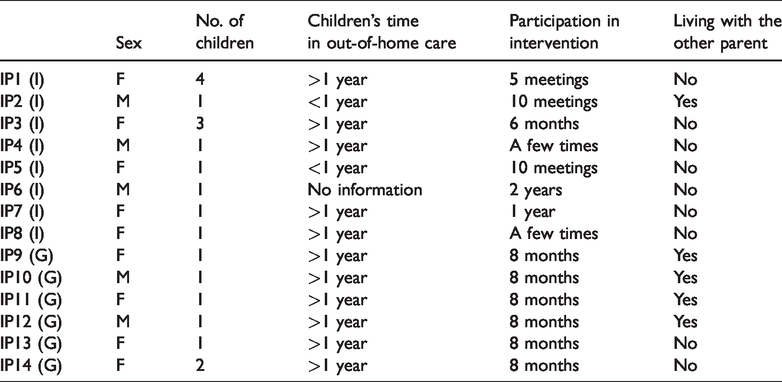
For this article, all 14 interviews with birth parents who participated in the two interventions were re-analysed in order to enable comparisons between the programmes and understand parents’ experiences more deeply. The background characteristics of the participants are presented in Table 1.
Participant characteristics. Individual intervention = (I), Group intervention = (G).
Data analysis
A thematic content analysis was employed, as it is specifically appropriate for examining the perspectives of different individuals and shedding light on similarities and differences (Nowell, et al., 2017). It focused on the parents’ expressed need for support and on their experiences of the help gained from each intervention. As a first step, interview transcripts were re-read and all data related to parents’ wishes and experiences of support were systematically coded and categorised. The researchers then discussed and revised the categories in a search for themes and sub-themes. The two datasets were analysed separately, allowing themes specifically related to each of the interventions to emerge more clearly, and then cross-analysed to obtain a more comprehensive picture of the parents’ needs and experiences.
Findings
Parents’ needs and wishes
Previous studies have explored the needs and wishes of parents whose children have been placed in care. The needs for support, as expressed by the interviewees in this study, largely corresponded with these and mainly concerned five broad aspects: participation and influence in relations with child welfare services; emotional needs; social needs; handling the parent–child relationship; and support with practical and financial arrangements.
More specifically, the parents expressed that they sometimes felt misunderstood or misrepresented, lacked information and needed advocacy. They were denied participation in discussions about their child’s placement and his or her everyday life experience, many highlighting their frustration at being left in the dark about such things as their children’s health or schooling. When it came to emotional needs, many parents expressed the need for support to cope with the crisis of having their children removed. Furthermore, they described difficulties in sharing the grief and their sense of powerlessness with others. As these emotions exacerbate isolation and stigmatisation, they also expressed a need for support to improve their social relations with others and maintain links with their absent child. They also identified a need for support to improve their parenting skills and develop their ways of communicating with their children. Several parents additionally highlighted a lack of financial and practical help before their children were removed, indicating a belief that the separation could have been prevented had appropriate services been available.
In the following sections, we elaborate on the parents’ reflections regarding what they found to be the most important supportive functions in the respective interventions and how these corresponded to their expressed and identified needs.
Individual support
Judging from the interviews regarding the individual intervention, the parents were largely satisfied with the support they received. Their statements highlighted how the intervention increased their opportunities for participation and influence in their relations with child welfare services, and how it provided them with continual emotional support. They described how they received guidance in navigating what they perceived as an impenetrable bureaucracy and valued having someone on – and by – their side, bearing witness in their encounters with child welfare services. They also explained that the professionals were able to relieve some of the stigma and instil some hope in seemingly hopeless situations.
Providing guidance and filling the information gap. As indicated above, many parents reported that child welfare services failed to provide them with adequate information regarding legal proceedings, assessments and the development and health of their absent child. In this respect, the individual support contributed to the parents feeling more equipped by providing guidance on parental rights and obligations and help with reading and understanding official documents. Parents explained how the counsellors provided them with practical help concerning correspondence and appeals to child welfare services, as well as advice on how to focus on pressing questions and achieve their wish to play a larger part in their child’s life: Well, but it [the support] had to do with what we could do, and who decides in what issues, and how it works. But it was more someone who could help us think when we could not [think] by ourselves, kind of. Someone who listened and was neutral because it feels like, in our case it felt like it was the child welfare services against us in a way. (IP2)
Bearing witness. Several parents expressed that another very important feature of the individual support was the counsellors’ presence in meetings with child welfare services. They spoke of an equalisation, in terms of both power and in numbers – from situations where they were alone facing two (or more) professionals to one where they had someone else by – and on – their side: [I] invite her because I need a witness, because when we were without [the individual intervention] they told me a lot of things. Then they blamed me for misunderstanding. But, so therefore, I bring her as a witness. She has to listen too. Because, as I told you, they don’t explain anything. But now I am not alone. There are people that know and hear. (IP5)
Providing hope and relieving stigma. In addition to providing support in parents’ relations with child welfare services, individual counsellors were able to help the parents feel more hopeful about their situation, so offering them emotional as well as practical support. When asked to describe what importance the intervention has had in her life, one parent replied: Great importance. It means a lot to me. I have realised, it is not until now that I have realised that I have the right to be angry, I have the right to cry, I have the right to feel sorry for myself. (IP3)
Judging from the interviews, the parents appreciated receiving support from someone ‘in the know’. The counsellors had knowledge and experience of child welfare cases and were trusted by parents to provide objective information regarding the procedures and – by their presence and/or involvement – to contribute to the proceedings being correct and unbiased. The support was perceived to offer two benefits: to decrease parents’ subordination in relation to child welfare services and strengthen their participation and influence over the processes in which they were engaged; and to give emotional support and relieve the parents' perceived stigma, making the unspeakable speakable, at least in the protected environment of the intervention.
Group support
Parents participating in the group intervention also seemed largely satisfied with what they received. In particular, they spoke positively about the peer support gained from getting to know and share experiences with others in the same situation, thus describing an experience of emotional and social support. They explained how the group provided a safe space where they could share their stigma as well as discuss the everyday joys and struggles of parenthood.
Being heard and understood – the breaking of social isolation. All those taking part in the parental group appreciated the opportunity to rise out of their social isolation by meeting and chatting with others in a similar situation. Some of them specifically related this to the challenging struggle of finding someone in their own community who understood what they were going through: I think this group has been great since you’ve been able to talk with others in the same situation. Because, like, if you’d talk to a friend who has not been through all this, they’d just be like: ‘uh-huh, uh-huh … ’(IP 9)
Allies in a marginalised position. According to the parents, a regular topic in the parental group conversations concerned the shared experience of a perceived injustice between birth parents and foster carers, not least due to the carers receiving payment for their task. Another topic in these conversations concerned parents’ relations with child welfare services, often building on a shared experience of social workers being remiss in handling the worries of their children. The following quotation exemplifies the kind of stories that parents exchanged on these matters: I was told that [name]’s son had found out that they [the foster parents] had received 10,000 [Swedish krona] for fostering their kids. And also that they went on trips abroad every year during the whole time. And who paid for all that if not the child welfare services? (IP12)
Turning deviant into ordinary – relieving the stigma. Throughout the interviews, parents described a reluctance to tell others about their situation. They spoke of hiding the truth regarding the whereabouts of their children and keeping their feelings to themselves. For example, three parents from the group intervention (one couple and one single parent) described that although they knew one another before they met in the group, they were unaware of their mutual situation: Me and [name] knew each other through a mutual friend from when, well at that time my son was staying at his first foster home. But at that point, they didn’t know that he [the child] was in foster care, because I didn’t really want to tell people about that. It was more like, that I told people that he went to stay with his dad, in a finer way. Because you wouldn’t want to sit and talk openly about that, would you? So naturally, they were surprised when they saw me coming in here, being in the same situation as them. (IP14) So, we sit together and we can talk about anything, just sit and talk: have you seen your children recently and… how are they doing? We can talk about anything. (IP9)
Matching the needs?
In this study, as well as in previous research (see Fargas Malet, et al., 2010; Spånberger Weitz, 2016; Syrstad and Slettebø, 2020), parents highlighted the need for various forms of support in their role as non-resident parents. As described earlier, their expressed needs mainly concerned five aspects: participation and influence in their relations with child welfare services; emotional needs; social needs; handling the parent–child relationship; and practical and financial arrangements. Of these needs, the individual intervention clearly addressed the parents’ need for increased participation and influence through its focus on practical guidance and support in negotiations with child welfare services. The group intervention more succinctly addressed the parents’ social needs through the opportunity to share experiences with others in the same situation and reduce social isolation. Both interventions gave the parents emotional support by offering a safe space to reveal and share their feelings of disenfranchised grief and powerlessness, and helped to equalise the power relations between the parents and child welfare services.
However, some needs expressed by the parents were not fully met. Few mentioned help with retaining or improving the relationship with their child or gaining better access to practical and financial help. Given the expressed purposes of the interventions, namely to support the parents for the benefit of the child (individual intervention), or to support them in their non-resident parenthood (group intervention), it is surprising that so few described the interventions as helpful in strengthening their parental skills or improving their relationship with their child. Similarly, the need for practical help and economic support was not mentioned at all, although this may reflect the limited reach and budget of the interventions.
Discussion
In this article, we have explored users’ experiences of two different interventions supporting parents whose children are placed in care: one offering individual support and one providing a structured group.
Parents from both interventions spoke positively about the support they received. Both functioned as empowering practices, though in different ways, providing the parents with the courage to stand up for themselves. Furthermore, they were both perceived as ‘breathing spaces’ in a life otherwise dominated by a stigma that had to be concealed. This became evident when parents described strategies to conceal the fact that their children were placed in out-of-home care while at the same time valuing the opportunities within each intervention to share these experiences with others. In both interventions, the disenfranchised grief significant to this stigma was transformed into legitimate feelings of grief and anger, offering an opportunity to express and share these feelings with others. In this way, both interventions were not only empowering but also stigma relieving. These results echo those of a Norwegian study (Syrstad and Slettebø, 2020) that highlights the empowering and identity-transforming opportunities of being offered a space of belonging and trust, where parents can share and discuss their situation without feeling exposed or condemned. Similar results have been shown in a study on birth parents’ experiences of counselling support after having lost their children to adoption or foster care (Morgan, et al., 2019). In terms of support, these empowering and stigma-relieving functions primarily serve to meet parents’ emotional needs.
In applying Goffman’s concepts of the ‘own’ and the ‘wise’ discussed earlier, it can be seen that the individual support allowed the participants to develop supportive relationships with the ‘wise’ – here in the form of professionals who were perceived as accepting and unprejudiced. In their presence, parents’ grief and anger could finally be expressed and acknowledged as legitimate. The support group provided a space for participants to form supportive relationships with the ‘own’ and establish a common ground for developing group-based coping strategies and a sense of in-group identification (see Chaudoir, Earnshaw and Andel, 2013). However, the benefits of socialising with the ‘own’ are not restricted to the sharing of stigmatising experiences but create an opportunity to (temporarily) let go of this stigma. In the company of their ‘own’, the stigma does not stand out as that significant or deviant as it does in other contexts, allowing the parents to turn their minds away from all the negatives to being ‘just a parent’ among others. This corresponds more clearly to the parents’ social needs.
Parents who had been offered individual support also spoke of the professionals as witnesses standing by their side in their contact with child welfare services, joining them at meetings and supporting them in written communication. They obtained from these professionals what Dumbrill (2006) calls an exercise of ‘power with’ the client, in contrast to the ‘power over’ that parents usually experience from officials. In that way, the individual intervention functioned as an equalising practice, supporting the parents to gain more influence and participation in their relations with child welfare authorities. The parental group, in contrast, offered an opportunity of ‘power together’ through supportive relationships with the ‘own’, although this ‘power together’ did not appear to equalise the power relations between parents and child welfare services to the same extent as the ‘power with’ offered within the individual intervention.
Returning to the five aspects of needs identified earlier, the interventions were perceived as supportive in regard to the parents’ emotional needs (both interventions), their social needs (primarily the group intervention) and their opportunities for increased participation in relation to child welfare services (primarily the individual intervention), while neither of them was explicitly perceived as supportive in regard to the parent–child relationship or to practical and financial arrangements. Thus, it is clear that neither of the interventions offered enough support to meet all the needs of these parents. Nevertheless, an important message is that receiving any support at all appeared to be empowering, which may be related to findings from previous research showing that parents in contact with child welfare services often feel undeserving of support (see Höjer, 2011).
Limitations and suggestions for future research
Since this study is based on parents’ experiences of participation in two small-scale and local interventions, it is not possible to be conclusive about the general effects of individual and/or group interventions for parents of children in care. The study relied on qualitative semi-structured interviews where the parents were encouraged to describe freely how they experienced the interventions, an approach that showed which functions the parents perceived as valuable as well as how these can be understood in relation to their needs and their stigmatised position. However, this approach did not provide the distinctive data necessary for a more comprehensive assessment of which support functions are lacking from the interventions described. An imperative for future research is to undertake large-scale quantitative and qualitative studies that evaluate the effects of different support services for birth parents on a more general level, and which incorporate the full range of birth parents’ needs.
Implications
The study indicates that these locally developed interventions managed to meet some significant needs of birth parents, even if some appeared to remain unmet. Both interventions functioned as empowering and stigma relieving – features that clearly hold a significant value for those concerned. The study also highlights the different benefits of individual versus group-based interventions. Overall, the results endorse social work practice that encourages local initiatives where interventions are (in part) modelled on co-operation with service users. Another important message is that, despite the potential value of these interventions, neither of them can by themselves cover all the support that is required. Rather, a targeted support intervention has to be combined with others to fully meet the needs of each individual.
Stigma research has pointed out that individuals living with a concealable stigma may particularly benefit from meeting others in the same situation. In this study, we have shown that both interventions are stigma relieving, the core element being the opportunity for parents to speak openly with an ally about their feelings and experiences, whether this person is one of the ‘own’, as in the group intervention, or one of the ‘wise’, as in the individual programme. Research on living with concealable stigmas is poorly studied compared to research on living with visible ones and although previous studies have highlighted the stigma of having children in care, they have not much explored the ways this stigma could be mitigated. Given that living with concealable stigmas is common among many social work clients, this study contributes to knowledge about this problem, whether for birth parents of children in out-of-home care or the broader spectrum of social work practice.
Conclusion
Research on the parents of children in out-of-home care is scarce and studies specifically focusing on interventions targeting this group even scarcer. This study contributes to this field of research by demonstrating the empowering, stigma-relieving, equalising and normalising functions of two interventions, as well as the benefit of offering support to a group that often misses out. By exploring parents’ experiences of these targeted interventions, the study provides a clearer picture of which needs are satisfied by which interventions and which remain unmet.
Footnotes
Acknowledgements
We would like to thank our colleagues at FoU Nordväst, Åsa Backlund, Lisbeth Eriksson and Tore Svendsen, who took part in conducting the interviews with parents from the group intervention. Furthermore, we would like to thank all interviewed parents for sharing their experiences with us.
Declaration of conflicting interests
The author(s) declared no potential conflicts of interest with respect to the research, authorship, and/or publication of this article.
Funding
The author(s) disclosed receipt of the following financial support for the research, authorship and/or publication of this article: The Social Services Administration in Stockholm (Socialförvaltningen, Stockholms stad) funded the study covering the individual intervention. The study covering the group intervention was funded by the Swedish Children’s Welfare Foundation (Stiftelsen Allmänna Barnhuset).