




Abstract
The transition to fatherhood can have a significant impact upon men’s emotional health and well-being. As experiences of abuse and neglect in childhood also correlate with increased rates of depression, self-harm and suicide in adulthood, it is likely that the mental health of fathers who spent time in care as children due to maltreatment will be more severely affected by the move to fatherhood. Although research into the experiences of fathers has multiplied in recent years, there remain lacunae and the experiences of many, for example single parents and those who are disabled or have care experience, remain unexplored. This article fills this gap for one such group by exploring the lived experiences of five fathers with care experience whose children remain in their care. They were interviewed about their situation and feelings and the emerging data were analysed using Interpretative Phenomenological Analysis (IPA). Three superordinate themes emerged: ‘Going back to move forward’, ‘Reliving the past’ and ‘Breaking the cycle’, and these encapsulated eight more subordinate themes. Participants described fatherhood as a chance to relive their childhood and feel accepted as part of a family, which enhanced their sense of self from ‘Mad, sad and bad’ to ‘Dad’. The implications for policy and practice for supporting care-experienced fathers are discussed along with directions for future research.
Introduction
In reviews of child care research, there is a noticeable lack of evidence on two important topics. One is fathers and fatherhood (Lamb and Lewis, 2010) and the other is the voice of those who have experienced serious childhood adversity. In particular, there is very little known about fathers who have ‘care experience’, i.e. who have been in local authority care or looked after, to use current parlance, at some stage in their childhood and lived away from their birth families in a residential home or foster care (Coleman, 2001).
The transition to parenthood is potentially an overwhelming time for parents as it leads to high levels of physical and emotional stress, sleep deprivation and changes in family relationships (Martins, 2019). The impact of pregnancy and parenthood on women’s mental health is widely acknowledged (see Fisher, et al., 2012 for review), as is the importance of the mother–child relationship, and it is also known that a higher percentage of children whose mothers have care experience are admitted to local authority care (Broadhurst, et al., 2017). The paternal role, too, has been shown to influence a child’s development but in a different, yet equally important way (see Bretherton, 2010 for review). Recent studies show that fathers are also affected by mental health difficulties following the birth of a child, with prevalence rates of depression between 5% and 10% and of anxiety between 5% and 15% (Leach, et al., 2016; Paulson and Bazemore, 2010). It is clear, therefore, that both mothers and fathers are at risk of emotional and well-being difficulties during the transition to parenthood.
It is well established that adverse childhood experiences impact on mothers’ adjustment to parenthood, causing increased anxiety and difficulties with bonding (Oosterman, et al., 2019). The evidence for fathers who have care experience is less extensive but it is reasonable to hypothesise that their transition to parenthood will have an equally great impact on their mental health. Furthermore, longitudinal studies have shown that physical, sexual and emotional abuse in childhood is associated with increased rates of depression, self-harm and suicide in adulthood (Sachs-Ericsson, et al., 2017; Thompson, Kingree and Lamis, 2018) and the stark fact is that some 60% of children in care have been victims of this either prior to or during their time in care (National Audit Office, 2015). For these reasons, individuals with care experience are likely to be especially vulnerable to poor outcomes in adulthood (Broad, 2005) which could affect the quality of the parent–child attachment (Psouni, 2019) and subsequent cognitive and behavioural development for the children (Ranson and Urichuk, 2008). This increased risk to fathers has been little explored.
Fatherhood, in general, has received more attention in recent years (Kowlessar, Fox and Wittowski, 2015; Kumar, Oliffe and Kelly, 2018) and studies have highlighted how fathers frequently feel unsupported in adjusting to their role and marginalised by welfare services, despite their desire for information (Quinton, Pollock and Golding, 2002; Speak, Cameron and Gilroy, 1997a). They face psychological challenges in adapting to changes in their identity, role and relationships with their partner, relatives and friends (Chin, Daiches and Hall, 2011; Kowlessar, et al., 2015). Young care leavers who become parents face additional challenges as many fear that their childhood experiences will have a negative impact on their parenting (Roberts, 2017), although the research by Weston (2013) found that some explained how becoming a parent gave them a sense of purpose and achievement. But, again, there is less evidence about how men are affected. In order to address this gap, this study seeks to explore the lived experiences of fathers who were placed in care during childhood. In-depth interviews were conducted to explore their experiences and feelings in the hope that increased understanding of their support needs will inform policy and practice, as well as improve outcomes for their children.
Method
Research design
A purposive sampling strategy was employed, producing a non-random sample of participants, selected in accordance with inclusion and exclusion criteria to produce a homogenous sample. Data were collected and analysed using Interpretative Phenomenological Analysis (IPA) (Smith, Flowers and Larkin, 2009).
Data collection
Inclusion criteria specified adult males (age 18+) with at least one biological child. Although it is recognised that the term ‘father’ is broad and can encompass non-biological as well as biological parents, a considerable body of research has highlighted the unique experiences of non-biological parents (Abelsohn, Epstein and Ross, 2013) and so for the purposes of creating a homogenous study sample, this research focused on biological fathers with at least one child. Young fathers (age <18 years) were excluded to eliminate the complex dynamics that affect this population (Tyrer, et al., 2005). It was specified that fathers must be in regular contact with their children with no active involvement from children’s or social services. Fathers experiencing significant mental health difficulties and children with learning difficulties or neurodevelopmental conditions were excluded as these have been shown to pose especial challenges and have distinct effects on the parent–child relationship (Ramchandani and Psychogiou, 2009).
Five fathers were recruited to participate in the study through a third sector charitable organisation providing support for adults with care experience. Recruitment methods included advertisements in the charity newsletter, social media pages and word of mouth. Each interview was guided by a pre-prepared schedule that was developed in line with current research literature. Professionals from the charitable organisation reviewed the schedule to ensure that questions were sensitively phrased and accessible. Two interviews were conducted face to face in locations as close to the participants’ homes as possible. Where this was not possible, telephone discussions were used. This was acceptable because these have been shown to produce data that is comparable in quality to face-to-face interviews (Carr and Worth, 2001) and can ease access to subjects who are difficult to reach (Kirsch and Brandt, 2002). They can also allow interviews to be more relaxed and encourage conversations on sensitive issues (Novick, 2008). The interviews lasted between 46 and 91 minutes (Mean length = 68.2 minutes), were digitally recorded and transcribed verbatim. All transcripts were anonymised, and pseudonyms allocated to protect confidentiality.
Description of participants
Five men completed semi-structured interviews. Their ages ranged from 25 to 66 years (M = 41 years) and reported being UK born with English as their first language. They spent between seven and 14 years in care and had between one and 12 placements, with four being unable to remember the exact number (Table 1). They were between 20 and 24 years old (M = 22 years) when they had their first child and had between one and five children in total. All children resided in the same household as their fathers.
Participant demographics.
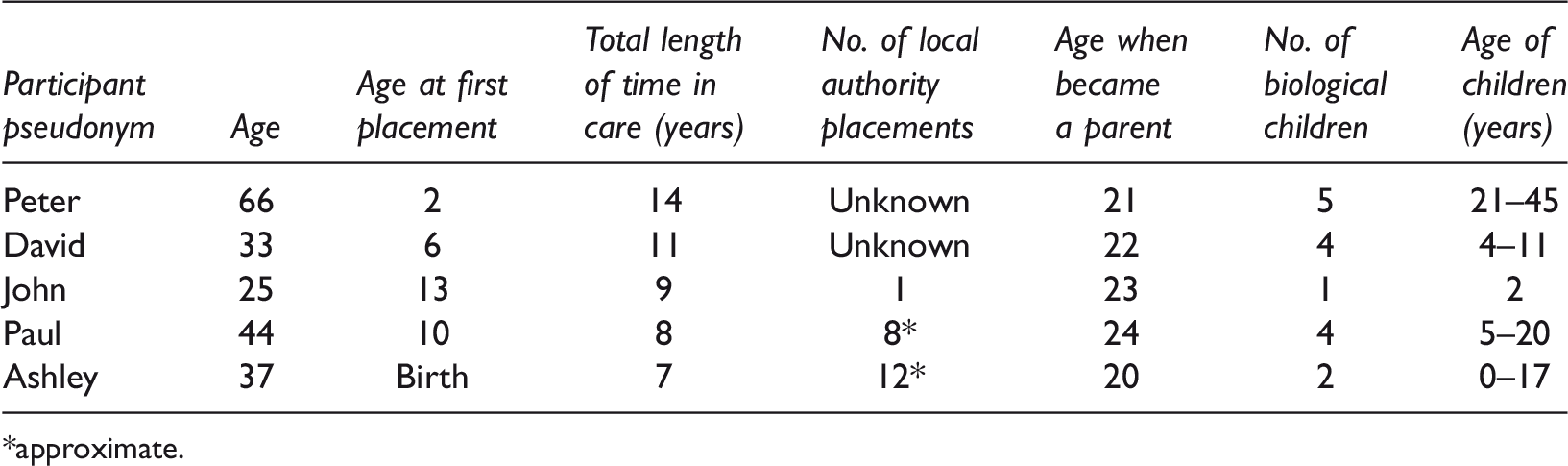
*approximate.
Data analysis
Data were analysed using a framework proposed by Smith, Flowers and Larkin (2009) that comprises four stages: initial reading of transcripts; identification and labelling of themes; identifying thematic clusters; and production of superordinate themes across transcripts (Pietkiewicz and Smith, 2014). Each transcript was coded at three levels – descriptive, linguistic and conceptual – with each level of commentary providing a more in-depth understanding of the data. Following annotation of the transcripts, emergent themes were identified. These were compared across cases to highlight convergence and divergence between accounts and to produce superordinate and subordinate themes (Smith, Flowers and Larkin, 2009).
Validation checks and reflexivity
Given that IPA involves a degree of interpretation by the researcher, attempts were made to enhance the credibility of the analysis (Smith, 2010). To ensure that interpretations were an accurate reflection of the participants’ experiences, a summary of themes was sent to them. An interview extract was also coded by a second, independent researcher and themes discussed to ensure they were grounded in the data.
In addition, the research team conducted bracketing interviews prior to data collection to promote awareness of biases that might affect analysis (Finlay and Gough, 2008) and the principal researcher maintained a reflexive journal throughout (Smith, 2007) to check for any impact of being a childless, female researcher with experience of working with looked-after children.
Ethical considerations
The research was approved by a UK University Ethics Board and was conducted in line with relevant professional codes of conduct, such as the British Psychological Society Code of Ethics and Conduct (British Psychological Society, 2009).
Main findings
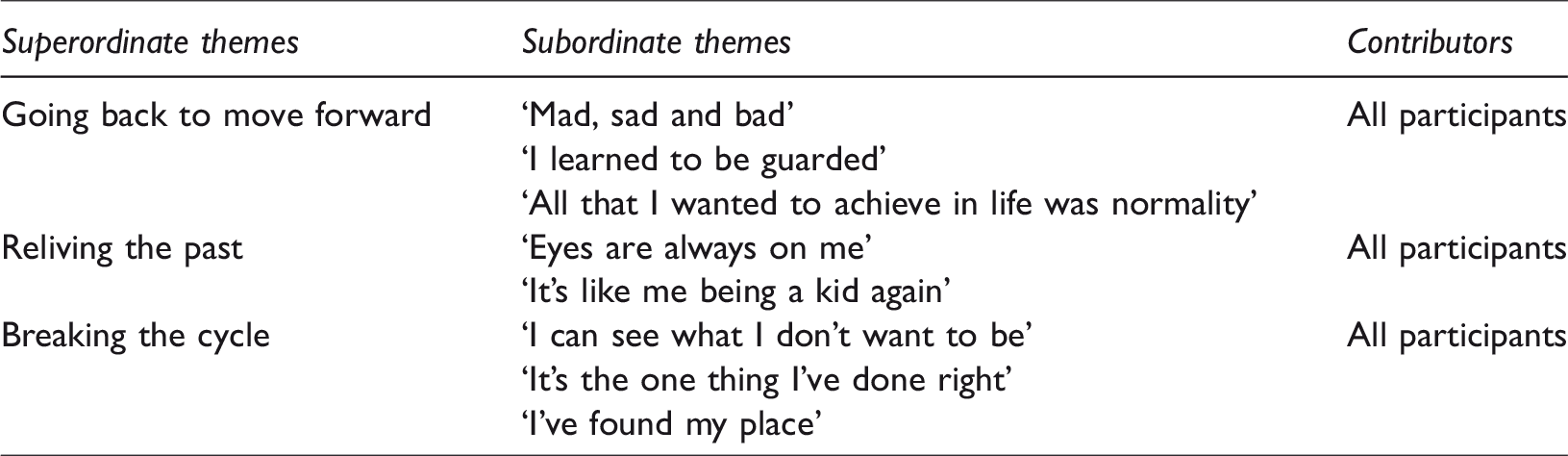
The aim of the study was to qualitatively explore the lived experiences of fathers with care experience. The analysis of the interview data identified three key superordinate themes: ‘Going back to move forward’, ‘Reliving the past’ and ‘Breaking the cycle’. Each superordinate theme comprised subordinate themes that were labelled with verbatim quotes from the narratives (Table 2). Each of these will now be discussed in detail.
Superordinate and subordinate themes.
Going back to move forward
It was common for the fathers to describe their experiences of parenting by recalling their own childhood experiences and the impact of these on their self-identity and relationships. This enabled the views of their parenting to be placed into a broader context. Initially, it appeared important for the men to express their narratives as these often revealed a sense of shame or fear of judgement relating to their past – feelings which they saw as highly relevant to becoming a father: Interviewer: How are you getting on [being a parent of a new born baby]? Ashley: Well, to be honest, it has to go back quite a while.
Mad, sad and bad
Three fathers specifically mentioned the detrimental impact of being in care on their self-identity. Peter, David and Ashley all described having a negative view of themselves; for example, Ashley reported that he believed that he was ‘damaged goods’ whereas Peter described how he was frequently told that he was ‘bad’, which left him feeling hopeless: Every time I ran away, they told me I was bad and the more I did it they told me I was really, really, bad and the label ‘mad, sad and bad’ hung heavy around my neck.
All the men described feeling alone throughout their childhood. David described needing to ‘survive on my own’, whereas Peter likened his experience of being lost and alone to that of a stray animal: I became a sort of feral child, […] like a feral cat, who can live out there and scrounge and get by.
I learned to be guarded
All of the fathers described experiencing inconsistent relationships with adults throughout their early life, resulting in them finding it difficult to trust others. David talked about taking relationships with ‘a pinch of salt’. Similarly, Peter and John reported that their childhood experiences had a negative impact on their ability to trust others: After a while, I think I just made up my mind. I’m not sure whether I can trust this person to stay around. It’s hard to trust when you have been hurt so much in the past. You are so used to bouncing back and moving on that that’s all you ever do, so you don’t let other people in because you don’t wanna get hurt again. I learned to be guarded, I learned to, you know, I’ve got my bubble. I’ve got my world in my head. When she was younger I struggled to attach to her a little bit or I think she struggled to attach to me but I think that was my own kind of insecurity really.
All that I wanted to achieve in life was normality
Ashley, Paul and Peter all reflected on their desire to create a family in order to develop a sense of belonging and normality. They described their care experiences as being ‘solitary’ (Paul) and lonely, in contrast to being part of a family that provided a sense of acceptance and belonging: Your family is your lock around you, you know what I mean, and everyone has their part in that lock and if a part of that lock is missing, then it’s unlocked in a way.
Whereas Paul and Peter had not planned their first children, Ashley expressed a wish to become a father as he felt that having a child was a way of creating a feeling of belonging and not being alone: ‘If I were to be honest, I was looking to belong somewhere.’
The theme ‘Mad, sad and bad’ highlights how these experiences and inconsistent relationships fail to adequately prepare these men for fatherhood, but conversely encourage them towards it in order to experience feelings of belonging.
Reliving the past
The second superordinate theme that emerged was that of ‘Reliving the past’ whereby all participants described how parenthood reminded them of past experiences. This encapsulated two subordinate themes: ‘Eyes are always on me’, which describes reliving the fear and mistrust of their childhood, and ‘It’s like me being a kid again’, which focuses on the positive experiences gained throughout parenthood in contrast with the deprivations felt as children.
Eyes are always on me
All the men agreed that due to their past experiences, they feared judgement from others and had an overwhelming suspicion of professionals. They explained that the stigma of being in care meant that they felt under continual scrutiny from services by virtue of their previous history. This was expressed by David: I’m constantly aware because of my history that eyes are always on me. I’m constantly aware that it only takes half an inch, one mistake, not even that, and life can change very, very dramatically. […] I’m just constantly aware that there’s a potential of the kids being taken away.
Ashley added to David’s and John’s accounts by making clear the link between fears of his children being removed from his care and his own childhood experiences: ‘From being in care you never know when something is going to be taken away from you.’
It is clear from the narratives of David, John and Ashley that not feeling in control presents an intense threat that links to past experiences. They reflected that becoming a parent and having another person to care for placed them in a vulnerable position of feeling out of control. They described managing this through expressing positive aspects of parenting rather than the challenges – for fear of criticism that could result in the removal of their children. Peter told of needing to prove that he was an ‘OK dad’ and reflected that ‘it’s very difficult to prove that you’re innocent’.
The men also feared judgement from others which may have resulted in them going to additional lengths to prove they were good parents. John described feeling a pressure to provide his child with a ‘childhood every child should have’. This was echoed by David and Paul who wanted to shower their children with material possessions such as toys and computer games. In David’s words: You want to see how many toys these kids have, I mean Christ, [name] is eight years old, she has an iPad. It would have been lovely to give her fantastic toys and all of that sort of stuff but what she didn’t get we made up for it in time.
In most of the interviews, the narratives became incoherent and fragmented when participants were discussing difficult experiences. For example, when asked about how many care placements they had lived in, Peter, David, Paul and Ashley were unclear. Their fractured life stories may further affect their self-identity and suggest unresolved trauma. David offered this typically confused and incomplete narrative: The way my childhood memories kinda work are … it’s almost like somebody who’s suffered amnesia but, kinda, flashbacks.
It’s like me being a kid again
Peter and Paul described how having children allowed them to experience the childhood they had not had, providing them with pride and satisfaction: It was an opportunity to have a bit of a childhood myself … to be playful ’cos I didn’t have much play. It’s putting things in place that I didn’t have or that I didn’t experience … It’s like me being a kid again. It’s like me having a childhood, which obviously I didn’t have.
These narratives point to the restorative power of being a parent. The men knew about the importance of play for healthy child development and explained how this had often been missing from their own childhoods. The opportunity to provide these ‘missing’ elements gave them a sense of achievement, which, although common for new fathers, may be more acute for those who have been in care.
Breaking the cycle
The final theme to emerge from the interviews was that of ‘Breaking the cycle’. Participants reported a sequence whereby they had been abused and maltreated by their parents and then neglected by the professionals caring for them. They were therefore keen to parent their children in a different way in order to break this cycle. Within this superordinate theme, there were three subordinate ones: ‘I can see what I don’t want to be’ in terms of parenting, how parenting was ‘the one thing I’ve done right’ and how becoming a father changed their identities, allowing them to feel that ‘I’ve found my place.’
I can see what I don’t want to be
Ashley, Paul, John and Peter all talked about wanting to be different from their own parents and, in some cases, foster carers. Both Ashley and Peter described knowing ‘what I don’t want to be’ (Ashley) in relation to the type of father they emulated and attempted to parent their children by doing ‘the opposite of what I saw’ (Peter). From their accounts, it appeared that they found it difficult to be a father without having had a positive parenting model. Paul seconded Ashley’s and Peter’s narratives by stating that ‘I never really seen what love was.’ This suggests that it is the emotional expression of love that Paul found difficult, as he had no model or template. However, despite not having experienced this himself, he clearly valued it as an important part of his role. He explained that he had framed this in a positive light as parenting ‘from scratch’ had provided him with an additional sense of reassurance and achievement: The influence that I put in my children is from me […] it’s not from anybody else, it’s not mirrored anybody else, it’s just me, which I, I like that.
It’s the one thing I’ve done right
The fathers talked about how they experienced a sense of pride and achievement when raising their children. Ashley reported that when they did well at school, he also felt a feeling of achievement: Seeing them grow from something and knowing that you’ve helped them become that, especially when people go, ‘Aww aren’t your kids lovely’, it’s like you’ve done something good.
David similarly explained how before becoming a father, he had held a negative view of himself but this had become more positive since having children: It’s the one thing I’ve done right. In 33 years of being on this planet, I don’t ever see that I’ve done much right with my life. […] you know being a father, creating a life, it is the be all and end all to me.
I’ve found my place
They further described that being a father has made a positive impact on their lives as they feel accepted by their partners and children. In John’s words: ‘I feel like I’ve found my place in terms of being a dad.’
The transition has also introduced some safety and stability into their previously turbulent lives. To quote Paul: I’ve never had that element in my life or that stability in that sense, so me putting in that foundation when it … to becoming a father and stuff like that, I’ve not looked back. Most people push you away if you get like I was but she [partner] accepted it so […] yeah and the step-kids to be honest. They, they like doted on me […] they accepted me for who I was as well. So, I think that kind of helped too, yeah. David: The one thing I’ve given this world is my kids. Interviewer: And what does that mean to you? David: It means I’m not totally useless. In the grand scheme of things, I guess I do have a purpose.
Discussion
This study set out to explore the lived experiences of fathers who had been in care as children, giving them a voice in a research area that has often been overlooked. It provides the first in-depth insight into the experiences of these men and highlights the unique challenges they are likely to face in their transition to fatherhood in comparison with fathers who have not been in care. Overall, three superordinate themes emerged from interviews with the five participants: ‘Going back to move forward’, ‘Reliving the past’ and ‘Breaking the cycle’.
‘Going back to move forward’ captures how fathers’ experiences of parenting are closely linked to their own recollections of family life. The study shows how they find it necessary to explain their past in order to put their own parenting into context. Incorporated within this superordinate theme were three subordinate ones highlighting how care-experienced fathers held negative views of themselves, a perspective perpetuated by frequently having their trust in others shattered. The subordinate theme ‘I’ve learned to be guarded’ illustrates the impact of care on fathers’ attachment style as they preferred to be self-reliant when they were young rather than depend upon others for safety and comfort. This is symptomatic of an insecure, avoidant attachment style (Fisher, 2017) and supports previous research indicating that children exposed to abusive and neglectful experiences are more likely to be self-reliant within relationships (Bifulco, et al., 2016). When fathers require support with parenting, this style of relating may be dysfunctional as it results in a high degree of shame. This is a significant finding as proneness to shame among new mothers has been shown to restrict help-seeking in the postnatal period (Dunford and Granger, 2017). The impact of shame on men is, therefore, likely to be equally elevated due to their adverse childhood experiences and will contribute to their mental health difficulties as well as reducing willingness to seek support.
The theme ‘Reliving the past’ highlights how fatherhood prompts men who have been in care to re-experience both positive and negative aspects of their childhood. They described how continual disruption to relationships led to a fear that the pattern will be repeated with their own children. Previous research has found that fathers with care experience often feel stereotyped as uncaring and mistrustful of social workers (Pollock, 2001; Tyrer, et al., 2005) but the current study extends this knowledge by highlighting that they may be plagued by the additional fear of having their children taken away. They attempt to manage this anxiety by understating the challenges of parenting, a response that is sometimes perceived as uncaring and guarded. This fear of judgement may also result in the fathers being less likely to seek support and emphasises the dilemma whereby they are keen to demonstrate that they are good parents but are hesitant to reveal problems, confess anxiety or seek support when necessary (Rutman, et al., 2002). This constant fear of being perceived as not coping with the demands of parenting may increase the pressure to be self-reliant and ignore offers of help, both of which can exacerbate feelings of isolation. Again, this is a significant finding as social isolation and the stigma associated with help-seeking are known risk factors for perinatal mental health difficulties (Kawachi and Berkman, 2001; Doherty and Kartalova-O’Doherty, 2010). In combination, therefore, these findings suggest that the risk factors present for all fathers are highly likely to be exaggerated for those with care experience. Clinicians and service providers need to be aware of this as they fashion ways of engaging men who are distrustful of services and unwilling to reveal their difficulties in therapeutic sessions.
Fatherhood also provided opportunities for the men to create experiences absent from their own childhoods. The ability to contribute to the significant developmental stages of their children, such as play, was acknowledged as especially important for them and had a restorative effect. As before, this parental response is pertinent to healthy child development as play enables children to learn about themselves and the world, promoting cognitive and emotional progress (Ginsburg, 2007).
The third superordinate theme ‘Breaking the cycle’ acknowledged participants’ determination to adopt a parenting style that was different from their own experience. This is another aspect likely to have wider benefits as good parenting has been identified as a protective factor against later problems, such as offending (Reeves, et al., 2009). These findings suggest that the protective mechanism of fatherhood for the participants is two-fold. They reported that being a father provided them with a determination to parent their children in a way different from the one they had experienced, resulting in feelings of pride and achievement when their children succeeded. In addition, the feelings of acceptance and belonging gained from being part of a family enhanced their view of themselves. Similar research findings have been widely reported for mothers with care experience (Roberts, 2017; Weston, 2013); this study suggests that the impact of care produces shared concerns for parents regardless of gender.
Implications for practice and policy
This study provides an insight into how men with care experience make sense of fatherhood. Based on current findings, recommendations for effective support at both clinical practice and wider policy level can be made. Initially, it is important to appreciate the clear links between fathers’ own childhoods and their experiences of parenting and that if they are to be valued and understood, it is necessary to take this context into account. Professionals may not be aware of fathers’ histories for a variety of reasons and so the unique needs of care-experienced fathers often go unrecognised. Furthermore, these men may fear judgement from professionals and be reluctant to disclose difficulties. Those working in maternity and social care services need to bear in mind the importance of asking fathers about their early life and allow time for them to tell their stories without judgement. On a wider scale, the findings also highlight the intergenerational impact of care experiences and so have implications for those working in adult mental health services. The challenges faced by care-experienced fathers may need to form an integral part of an individual’s trauma-focused therapy and warrant exploration in any psychological intervention.
Particularly salient in the discussions was how parenthood enhanced fathers’ sense of belonging and how this reduced the isolation arising from continually moving and the behaviour problems and mental health issues associated with this. It seems highly likely that the competence of the fathers was likely to have been influenced by earlier interventions, particularly the quality of leaving care services, which, at best, can promote feelings of inclusion, acceptance and belonging. Important for their present situation, however, might be community projects that provide them with opportunities to share experiences with others, view role models, develop parenting skills and see ways of breaking the cycle. It is known that peer-led support networks can be effective for many groups facing difficulties (Ford et al., 2013).
Finally, the study emphasises how encountering aspects of their childhood that had been lacking was seen by the fathers as a valued contribution to being an effective parent. Given the importance of fathers feeling accepted and being supported to construct their narratives, a range of psychological specialist therapies could be beneficial. These would probably need to incorporate ideas from therapies fashioned for other groups and be customised for this particular category of fathers, for example, by including aspects of play. Similarly, wilderness therapies and community-based programmes used as alternatives to traditional interventions for adolescents may be relevant (Russell, 2007). Horticultural therapy has also been shown to improve social and emotional outcomes in veterans transitioning to civilian life (Wise, 2018) and narrative therapies, specifically Attachment Narrative Therapy (Dallos, 2006), offer further ways of exploring fathers’ own attachment histories and using the information to strengthen relationships with their children.
Limitations and directions for future research
These findings offer an in-depth exploration of the lived experiences of fathers who were in care during their childhood. But despite this strength, there are some limitations. Care-experienced fathers experiencing severe mental health difficulties and those undergoing social care proceedings were excluded from the study. A larger and wider study group would strengthen the clinical recommendations for a population who do not routinely access support services (Yousaf, Grunfield and Hunter, 2015). The sample is also small, unrepresentative and possibly biased, for example in terms of ‘successful’ fathers being more willing to participate. In addition, the evidence comprises retrospective recall that may impose a logic on narratives that was not apparent at the time. But, despite these weaknesses, the in-depth scrutiny and qualitative analysis highlight many issues for further research that might have been missed using other methodologies. Some of these are general, such as the type of services that effectively support care-experienced fathers, while others are specific, such as their ability to provide children with playful experiences. But especially important is understanding the chain of events that enables fathers to ‘break the cycle’.
Conclusion
There are many challenges to becoming a father, such as changed roles and identity, but care-experienced fathers face additional difficulties by virtue of their care history. Despite this, participants describe being a father as a chance to have the childhood they missed and feel a sense of belonging and acceptance as part of a family. Most important to all of the men was the ability to break the cycle of care and graduate from ‘Mad, sad and bad’ to ‘Dad’.
Footnotes
Declaration of conflicting interests
The author(s) declared no potential conflicts of interest with respect to the research, authorship, and/or publication of this article.
Data availability statement
The data that support the findings of this study are available on request from the corresponding author. They are not publicly available due to privacy or ethical restrictions.
Funding
The author(s) received no financial support for the research, authorship, and/or publication of this article.