




Abstract
Shared renting offers affordability opportunities in unaffordable neighborhoods, but uniquely impels existing and prospective tenants to match on both unit and personal characteristics—creating new opportunities for discrimination and segregation. This study investigates how this matching unfolds. Do existing tenants construct “idealized co-tenants” to signal their selection criteria and signal who is and is not welcome to apply? We analyze online rental listings in Los Angeles, California through a mixed-methods research design, leveraging both quantitative deep learning models of listing language and qualitative content analysis of how listers present selection criteria. We find that, relative to whole unit listings, shared unit listings uniquely emphasize personal characteristics, rental rules, and privacy concerns. Although selection criteria describing behaviors—rather than personal traits—dominate, references to several protected classes appear. Listers often operationalize compatibility as similarity, relying on in-group communication strategies and covert insider signaling. This suggests how shared housing may perpetuate socio-spatial segregation by restricting precious affordability opportunities to narrow subpopulations. Policymakers should craft tenant protections addressing the unique relational nature of shared renting to enable more diverse shared households and counteract trends that reinforce inequitable status quos.
Introduction
Fueled by digitalization and socioeconomic shifts, home sharing has rapidly grown in popularity. Once a niche strategy, shared rentals now come in a variety of different formats and contexts, serving ever more diverse populations (Gurran et al., 2024; Heath et al., 2018; Maalsen, 2020). Although few statistics on home sharing’s prevalence exist, recent research suggests that listings for rooms in shared units are both cheaper and available in more neighborhoods than traditional whole unit rentals (Harten and Boeing, 2024; Zhang and Gurran, 2021). The promise of affordable access has attracted the attention of housing scholars, practitioners, and business actors alike (Casier and Revington, 2025; Druta et al., 2021; Gurran et al., 2024; White, 2024). Yet, beyond select qualitative and market studies, we know little about who is actually renting in shared arrangements. Merely counting units or measuring asking rents does not tell us how or for whom sharing offers access to otherwise unaffordable neighborhoods and cities.
Shared renting entails renting a room in a shared unit or even sharing the room itself. Shared renting is different from any other housing tenure in that individual co-tenants share binding spatial, economic, and legal relationships, even when otherwise leading separate lives (Goodall and Stone, 2025). Shared rentals are thus uniquely relational—for better or for worse, co-tenants’ actions affect each other. Hence, shared renting requires navigating complex relationships, and when they are market-mediated it means doing so with strangers. As a result, the search for shared rentals is a complex process in which existing and prospective tenants need to match on both unit and personal characteristics (Harten and Boeing, 2024).
This paper asks: Do existing tenants construct “idealized co-tenants” in shared housing listings’ text, signaling their selection criteria, and suggesting who is welcome to apply—or not? We analyze online rental listings for shared units in Los Angeles, California, through a mixed-methods research design, relying on quantitative deep learning analysis of listing language and qualitative content analysis of how listers present tenant selection criteria. We find: (1) shared listings contain more selection criteria (i.e. explicit or subtle descriptions of the idealized co-tenant, often referencing protected classes) up-front at the listing stage than do whole unit listings; (2) these selection criteria reflect what makes shared housing unique compared with whole units—such as concerns about privacy, social compatibility, and risk management. Understanding how prospective sharers match in this market offers insights into who is most likely to succeed in shared renting and under what conditions. As shared renting is becoming a reality for more people, understanding these dynamics has important implications for sociospatial processes such as segregation and neighborhood change.
This article is organized as follows. The next section reviews the literature on housing searches broadly and the search for shared rentals in particular. Then, we detail our data collection, cleaning, and analysis. Next, we present the results of this analysis. Finally, we consider these findings against the literature and discuss opportunities for further research.
Background
Housing searches shape housing outcomes
Planners and geographers study the housing search because understanding how individuals choose homes is key to understanding socio-spatial processes such as residential segregation 1 and neighborhood change. 2 Over time, individual mobility decisions aggregate into neighborhood change, which then reshapes or perpetuates patterns of residential segregation. Rather than simply a matter of choice shaped by resource constraints and preferences, other housing market actors and the information that homeseekers gather critically shape who ends up where (Krysan and Crowder, 2017).
The effects of housing market discrimination are well-established. Housing market discrimination means fewer viewings, less information, price, and quality differentials—all of which increase the search burden for those discriminated against on the basis of race, ethnicity, gender, sexuality, religion, source of income, etc. (Auspurg et al., 2019; Flage, 2018). The literature distinguishes between taste-based and statistical discrimination where the former locates discrimination in a fear of difference while the latter occurs when belonging to a social group is used to infer other characteristics or behaviors (Bosch et al., 2010; Guryan and Charles, 2013). While the outcome for those affected is the same, the distinction has yielded productive qualitative inquiries into what drives discriminating behavior. In particular, this literature argues that renting is inherently risky (Power and Gillon, 2022; Verstraete and Moris, 2019). From a landlord’s perspective, tenants provide income, but are, at the same time, a potential threat to that income and the rental unit itself. Accordingly, tenant selection is risk assessment: How likely is a prospective tenant to pay and care for the rental unit? As these qualities cannot be observed directly, landlords rely on alternative signals and heuristics. Often, these are grounded in bias (Auspurg et al., 2019).
In addition, the housing search information critically shapes access: All homeseekers have their housing choice sets filtered by their social worlds. Residential histories, social networks, and daily experiences all shape residential mobility decisions (Krysan and Crowder, 2017). With all of these circumscribed by race and class (Krysan, 2008; McPherson et al., 2001), the social structuring of individual housing searches collectively leads to enduring patterns of differential sorting along these lines. Housing market intermediaries such as real estate agents, mortgage brokers, and community groups fuel these dynamics by steering homeseekers to different housing opportunities, thus further shaping housing market information flows to the detriment of underprivileged communities (Korver-Glenn, 2018; Krysan, 2008).
Housing information supply in the era of online platforms
Online platforms have revolutionized how housing information is shared and accessed. Where housing information exchanges traditionally relied on personal relationships, private connections, and physical proximity, online platforms now allow homeseekers, intermediaries, landlords, and sellers to broadcast information through public channels. In theory, this information is available for anyone to see, potentially anywhere in the world. Yet, while the vast majority of people now use the internet during their housing searches (Apartments.com and Google, 2015), not everyone is equally served by digitalization. Instead, online housing information is segregated and unequal, reproducing rather than mitigating traditional information inequalities (Boeing, 2020; Boeing et al., 2021; Hess et al., 2021). As the initial contact happens online, housing market actors now also have the ability to screen, target, and filter in novel ways. Even platform design itself shapes what kind of information is viewed by whom (Meers, 2024a).
Importantly, platforms embed existing biases not only into the distribution of information but also into the information itself. Online rental listings are communication objects mediated by culture—the same social forces that shape the physical world also shape the world online (boyd and Crawford, 2012; Evans and Aceves, 2016; Markham, 2003). Listing texts reflect what listers think about their target demographic(s) even as some of these linguistic cues may be “hidden” (Harten et al., 2021; Hong and Kim, 2024; Pfeiffer and Hu, 2024). In “landlord markets”, analyzing these texts for linguistic cues reveals both the parameters for tenant selection and their drivers (Harten et al., 2021; Meers, 2024b; Wardhaugh and Fuller, 2021). Recent studies have mined rental listing texts for notions of “ideal tenants” as alternatively young and male (Harten, 2021) or “professional” (Meers, 2024b; Nasreen and Ruming, 2022).
The shared housing search
The jump from low-tech localized searches, relying on social ties, to bigger audiences via online platforms has been momentous for shared renting. By expanding information reach and the pool of potential matches, platforms have rendered niche offerings more viable—and boosted shared renting (Maalsen, 2020; Nasreen and Ruming, 2022; Parkinson et al., 2021).
Searching for shared rental housing is complex: co-tenants need to match on personal as much as unit characteristics. This social dimension adds a new layer of uncertainty with risks affecting both the prospective tenant and the lister, who is typically an existing tenant. This informational uncertainty is costly, too, as co-tenants’ actions are essential to the quality of this housing strategy. At its best, shared renting can be a source of (economic) resilience, companionship, and a home life outside traditional heteronormative household structures; at its worst, it poses legal and financial risks as well as the risk of conflict and threats to physical and mental wellbeing (Goodall and Stone, 2025; Heath et al., 2018). Given the affordability pressures in which most shared rentals have emerged (Harten and Boeing, 2024; Zhang and Gurran, 2021), existing tenants not only list rental opportunities, they also hold the power to select.
Existing housing search theories do not capture these dynamics well, but theories of job market matching do. Complex searches with information asymmetry about personal qualities and risks for both parties are the bread and butter of labor market theorists. Spence’s (1973) signaling theory is particularly relevant: When faced with information asymmetry, decision-makers rely on signals which convey credible, observable information about qualities that are critical but cannot be observed directly. The efficacy of a signal depends crucially on the receiver—their interpretation in relation to other signals in a social system as well as their personal characteristics and experiences (Connelly et al., 2024). For instance, studies have shown how qualification requirements in job postings elicit different responses by gender and that applicants adapt their behavior in response to discrimination experiences (Coffman et al., 2024; Pager and Pedulla, 2015).
The descriptive texts in online listings for shared rentals potentially contain such signals. In particular, signals may be exceptionally visible because US courts have ruled that fair housing laws that restrict selection criteria do not apply to people sharing a single living space (U.S. Courts of Appeals, 2012). Mining the descriptive texts of shared rental listings for how listers articulate what kind of selection criteria thus offers a window into matching, and ultimately, into differential access among subpopulations in this market.
Prior research about co-tenant selection gives insight into what signals to expect. As sitting tenants select under uncertainty, they often do so by operationalizing “fit” as likeness. Deng et al. (2026) find that similarity in age, gender, occupation, and birthplace significantly reduces the probability of leaving shared tenancies prematurely. Preferences for age similarity exist—justified by age-related expectations about social activities, lifestyle choices, and economic self-sufficiency (Clark and Tuffin, 2022)—but the evidence on same-gender sharing is mixed (Clark and Tuffin, 2022; Harten, 2021; Ortega-Alcázar and Wilkinson, 2021). In addition, references to race or ethnicity blend with perceptions of “foreignness”: Interviews and audit studies find they matter only insofar as they signal cultural knowledge and language skills (Clark and Tuffin, 2022; Gaddis and Ghoshal, 2015, 2020). Clear preferences also exist for single co-tenants without dependents, related to social availability and the potential for conflict (Clark and Tuffin, 2022; Maalsen and Gurran, 2022). Finally, digital mediation allows for deliberate content curation and shapes communication. This favors cultural insiders, disadvantaging immigrants or older renters who might miss cultural cues (Maalsen and Gurran, 2022; Nasreen and Ruming, 2022; Parkinson et al., 2021). Conversely, decentralized online markets have created new opportunities for fraud, making trust a key concern. Trust is increasingly built through interfacing with social media such that digital footprints become part of the search (Parkinson et al., 2021).
Methods
This study advances the growing literature on shared rental housing by utilizing the descriptive text in online listings to investigate the search process in this submarket. We ask: do existing tenants construct “idealized co-tenants” in shared housing listings’ text, signaling their selection criteria and suggesting who is welcome to apply—or not? We propose two hypotheses: (1) shared listings contain more selection criteria (i.e. explicit or subtle descriptions of the idealized co-tenant, possibly referencing protected classes) up-front at the listing stage than do whole unit listings; (2) shared listings’ selection criteria reflect the unique relationality of shared housing. We test these hypotheses through a mixed-methods research design that employs quantitative analysis of listing language and qualitative analysis of how listers present tenant criteria.
Data collection
We examine rental listings web scraped from Craigslist in Los Angeles County from June 2020 through March 2021. 3 Lore et al. (2024) collected 124,332 listings which include (1) structured fields for the rent or number of bedrooms, (2) geographic information describing the listing’s location, and (3) unstructured freeform text typically describing the unit and rental arrangement. Listers can be existing tenants, landlords, or both. On Craigslist, rental listings appear under either “apts/housing” or “rooms/shared,” for whole units and rooms in shared units, respectively. To facilitate appropriate comparison between listing types, here we only retain whole unit listings advertising 0–1 bedrooms for rent. The resulting dataset covers spaces (private or shared) that one person or couple might be choosing between, yielding a final dataset of 89,006 listings: 48,035 rooms in shared units and 40,971 whole small apartment units for rent (hereafter “whole units”). We supplement the listings with tract level sociodemographic data from the 2020 American Community Survey (ACS) to contextualize their spatial distribution.
Topic labeling
We read a random sample of 50 listings from each listing category to generate text labels (sometimes called codes or topics) through a two-tiered process. First, we use inductive, open coding to create labels that capture common topics in listing texts (Linneberg and Korsgaard, 2019). This yields six general labels describing the (1) unit, (2) location, (3) logistics of renting, (4) personal characteristics of the prospective/current tenant(s), (5) rules regarding tenant behavior, and (6) privacy specifications. Then we use abductive coding to generate 14 selection criteria labels (Thompson, 2022): (1) work, (2) gender, (3) age, (4) similarity to lister, (5) sexual orientation, (6) interactions: respect, cleanliness, friendly, drama, (7) pets, (8) drugs: smoking, alcohol, other drugs, (9) money or financial requirements, (10) restrictions on visitors or other people, (11) daily lifestyle choices, (12) hobbies, (13) parties, and (14) COVID. Figure 1 demonstrates these labels on an example listing.
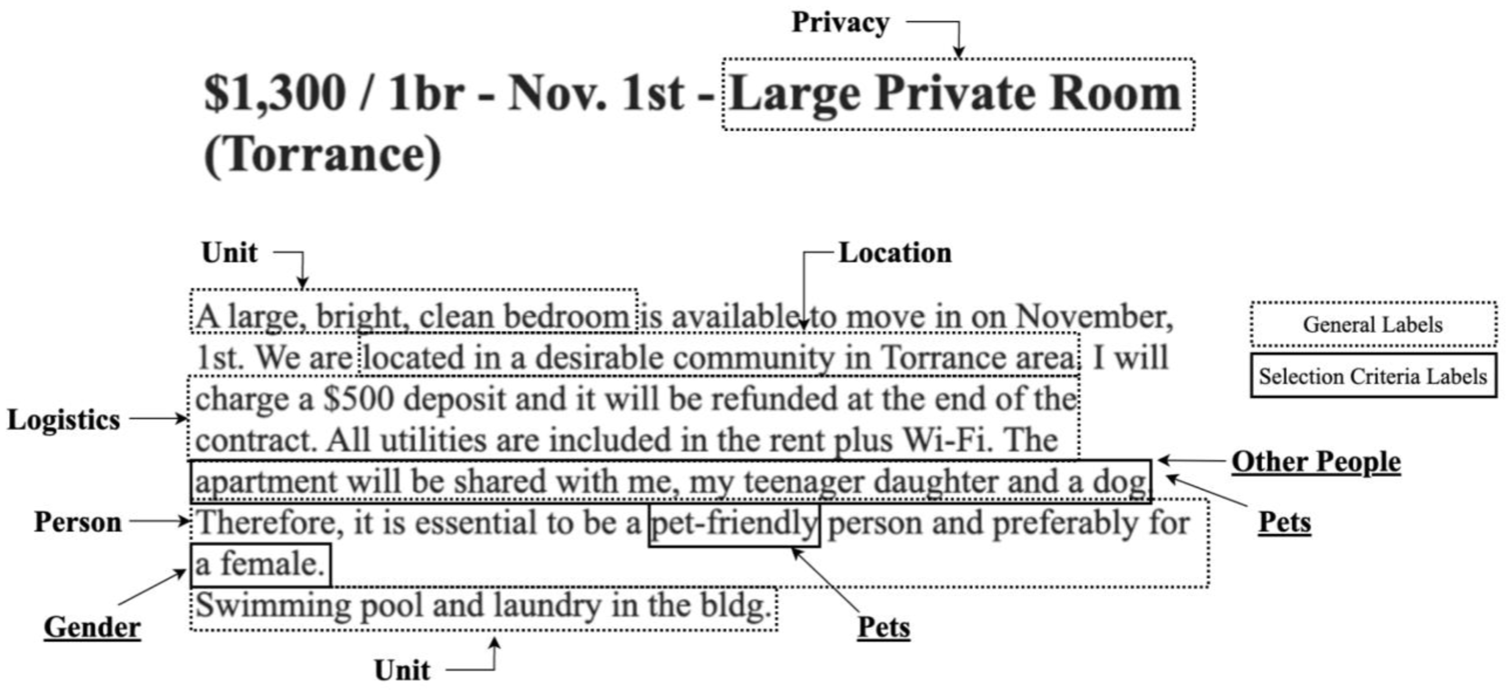
Rental listing, annotated with examples of both general and selection criteria labels.
Our labels partially overlap with protected classes under U.S. Fair Housing Laws (U.S. Department of Justice, Civil Rights Division, 2023). 4 Age, gender, and sexual orientation align directly, but there are discrepancies between the rest which fall under one of three cases. First, some protected classes were either not present or constituted less than 1% of our reading sample. These include race and ethnicity, immigrant status, religion, disability, military/veteran status, and genetic information. Without enough examples from these classes, we could not reliably train our model to identify them in the full set of listings, nor was it possible to create reliable keyword searches. Hence, they were dropped from the final set of labels.
Second, some listing language does not directly overlap with protected classes, but is related in meaning. For example, the label “other people” addresses the number or type of people (e.g. children, spouses, significant others) who are allowed/expected to visit, stay or otherwise participate in the shared household. This label partially overlaps in meaning with the protected class “martial and familial status” but extends to non-married or other ill-defined guests. Other such cases are the labels “work” and “money,” which sometimes overlap with “source of income.” Finally, we generate additional labels, unrelated to protected classes, that consistently appear in the listing texts and represent selection criteria for prospective tenants.
With the codebook (annotated list of labels) established, each researcher independently hand-labeled a randomly selected sample of 5551 sentences. Because the listing descriptions include varied information, labeling by sentences provides a more granular representation of the topics. We use Cohen’s kappa to evaluate the consistency between the labeling outcomes and resolve discrepancies through discussion until full convergence is achieved (Adu, 2019).
We utilize two finetuned Bidirectional Encoder Representations from Transformers (BERT) models, trained and tested by Lore et al. (2024) on these labeled data: one for general labels and one for selection criteria labels. BERT models capture contextual relationships through pre-training on large corpora, allowing the model to “comprehend” variations in language use (Devlin et al., 2018; Peinelt et al., 2020; Qasim et al., 2022). Lore et al. (2024) hold out 30% of the labeled sentences for evaluation to assess these models’ accuracy and report precision, recall, and F1 accuracy. Suggesting low rates of false and missed positives, precision is measured at 81% and 80%, recall at 84% and 77%, and F1 scores at 82% and 78%, respectively.
Some selection criteria language is formulaic. For example, “no smoking” is almost exclusively used to restrict smoking rather than alternatives such as “smokers not allowed” or “don’t smoke.” This makes it easier and more robust to quantify these rules through keyword searching. We thus supplement the BERT models with keyword searches for: smoking (nonsmoking), pets (dogs, cats, animals), drugs (420, 420 friendly [sic]), alcohol (drinking), drama, party (guests), COVID. We check the stems of these words against the stemmed words in the listings for matches and aggregate.
We apply the general label model, the selection criteria model, and the keyword search to all 89,006 listings. For each sentence in every listing, the BERT models provide a score from 0 to 1 for each topic, representing the probability of containing the topic. The keyword search provides a score of 1 for present and 0 otherwise. For the BERT models, Lore et al. (2024) suggest optimal thresholds for each topic to determine presence. From here, we reassemble the listings and provide a binary value for each label denoting whether that topic is present in the listing at least once across all of its sentences.
Analysis
We use these models to test our hypotheses. We calculate what percentage of the listings contain each general and selection criteria label. Then, for each listing, we calculate two additional measures: (1) the total number of general and selection criteria topics present and (2) the percentage of the listing dedicated to each topic. We calculate differences-in-means and conduct Welch’s unequal variances t-tests to determine if whole and shared unit listings significantly differ in how much text is dedicated to each topic. For context, we also compare the affordability and locations of the shared and whole unit listings using the same methods. Next, we conduct in-depth qualitative reading and abductive coding of another sample of 500 shared unit listings. In establishing codes for this analysis, we relied on the literature on the potential benefits and risks of shared renting but still allowed for inductive exploration through iterative coding cycles (Adu, 2019; Thompson, 2022). Unlike the sentence-level approach described above, here we consider the whole text body (listing). This enables us to leverage the full context for qualitative interpretation of our labels, recognizing that more subtle signals in particular may only emerge through in-context human reading. Not only does this allow us to validate our machine-automated labeling, it also lets us engage with what drives the articulation and choice of selection criteria.
Findings
Shared units offer affordable access across LA county
Los Angeles County is the most populous county in the United States. It has a large Latino population, an above average percentage of people with bachelor’s degrees and a below average percentage of younger people aged 20–34. It is also expensive: the county’s median home value is $615,550, compared to the national average of $229,800 (in 2020 inflation-adjusted USD). Nearly half of these homes are single detached units. In our study period, most (92%) of the census tracts within LA County have at least one listing for a shared unit compared to 70%, which have at least one whole unit available for rent. The tracts themselves are comparable, only differing on a few characteristics (p < 0.05): in comparison to tracts with listings for whole small apartment units, shared units are advertised in tracts that are slightly less white, less educated, and contain fewer housing units. We also find shared units are more affordable than whole units; the difference-in-means between asking rents is $853 (p < 000.1).
Shared listings contain more selection criteria
Shared listings contain more selection criteria than whole unit listings. Drawing on our general labels model, we find that the vast majority of both listing types include at least one mention of unit characteristics (92% and 97%, respectively), locations (82% and 92%), and logistics (95% and 98%). However, far more shared unit listings include at least one mention of personal characteristics (71%) than whole unit listings do (4%). Similar differences hold for rules (61% vs 12%) and privacy (78% vs 7%). In other words, most shared listings mention of personal characteristics, rules, and privacy—but very few whole unit listings do.
Figure 2 illustrates this further. It compares the frequency distributions of the percentage of each listing dedicated to each of the six general topics by listing type. While whole and shared unit listings spend somewhat dissimilar fractions of their texts discussing the unit, location, and logistics (Figure 2, top row), they spend drastically different fractions of their texts discussing personal characteristics, rules, and privacy (Figure 2, bottom row). For example, the average whole unit listing dedicates somewhat more of its text (58%) to describing logistics than the average shared unit listing (42%, difference-in-means p < 0.001). Comparable differences hold for the average amount of text describing the unit (54% vs 40%, p < 0.001) and location (38% vs 25%, p < 0.001). Conversely, the average shared unit listing dedicates much more of its text to describing personal characteristics (20% vs 0%, p < 0.001), behavior rules (13% vs 1%, p < 0.001), and privacy (21% vs 2%, p < 0.001). In summary, shared unit listings discuss these latter topics while whole unit listings essentially do not.
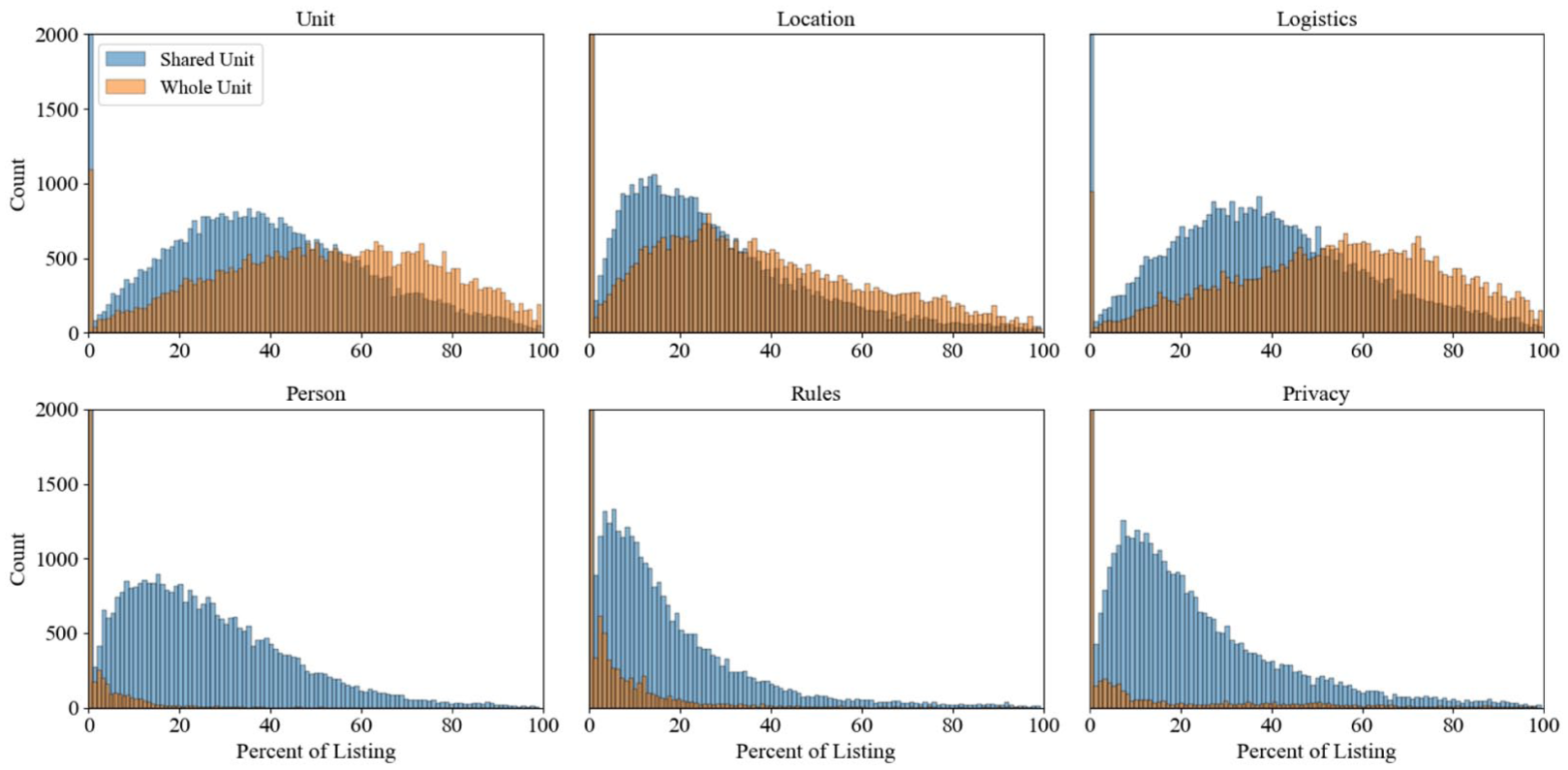
Frequency distributions of the percentage of each listing dedicated to the general topics (unit, location, logistics, person, rules, privacy) by type of listing (shared vs whole unit). Y-axis truncated for visual clarity. Each bin spans 1%.
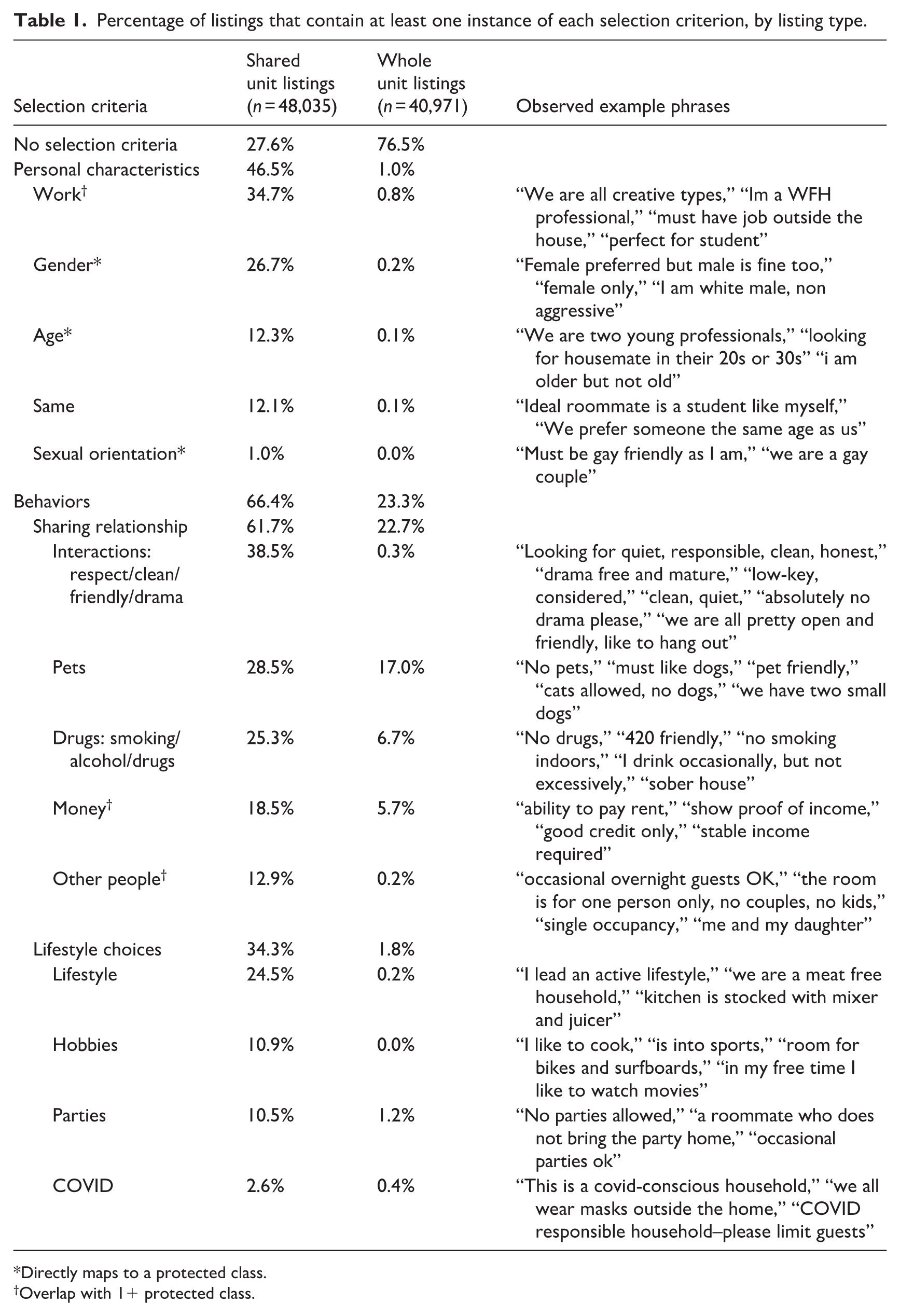
The second model examines selection criteria. Table 1 shows the model’s results as the percentages of listings, by type, that contain at least one instance of each selection criterion. It groups these criteria into three categories: (1) personal characteristics, (2) behavioral characteristics affecting the sharing relationship, and (3) behavioral characteristics describing lifestyle choices. 5 A much higher percentage of shared unit listings mention these selection criteria than whole unit listings. For example, 77% of whole unit listings do not mention any of these selection criteria at all, but 72% of shared unit listings mention at least one criterion and 44% mention three or more. Looking across the table’s rows, we see these stark differences; looking down its columns, we see how the prevalence of selection criteria varies within each listing type.
Percentage of listings that contain at least one instance of each selection criterion, by listing type.
Directly maps to a protected class.
Overlap with 1+ protected class.
First, we consider labels that identify personal characteristics. Overall, personal characteristics appear in almost half of all shared (47%), but only in 1% of whole unit listings. “Source of income” (a protected class) as identified through “work” and “money” has the strongest showing among protected classes in both listing types. 6 For whole units, any of the other protected classes labels are negligible (<1%) and the reported counts are likely noisy due to poor model performance for labels with low occurrences in the training data. Shared unit listings, however, frequently describe “other people” (13%) and the protected classes “gender” (27%) and “age” (12%). Finally, “sexual orientation” (a protected class) is unimportant: only 1% of listings contain related language.
Labels identifying welcome and unwelcome tenant behaviors are more prevalent than personal characteristics in both listing types. For whole unit listings, “pet” features prominently: 17% of listings discuss pets. “Drugs” also appears notably, occurring in 7% of all whole unit listings. For shared unit listings, on the other hand, descriptions of tenant behaviors are present in 66% of listings. The three most common ones are “interactions” (39%), “pets” (29%), and “drugs” (25%), all regarding tenant behavior that directly affects the sharing relationship. Lifestyle choices are also commonly described (25%), while “hobbies” (11%) and “parties” (11%) are relatively less common. Finally, although we collected listings during the COVID-19 pandemic, fewer than 3% of shared and 1% of whole unit listings contain language around pandemic-related behaviors, such as masking.
Signaling reflects the uniqueness of shared renting and its search
Our two models reveal which selection criteria (and how many) listers narrate, but what can we infer about why listers include them the way they do? Given that the majority of whole unit listings do not include any selection criteria and those that do focus on filterable behavior criteria such as rules about pets, we focus on shared rental listings in this section. Our qualitative analysis of shared unit listings shows that listers articulate selection criteria to address (1) the relationality of shared renting and (2) the complexity of the shared rental search (Table 2).
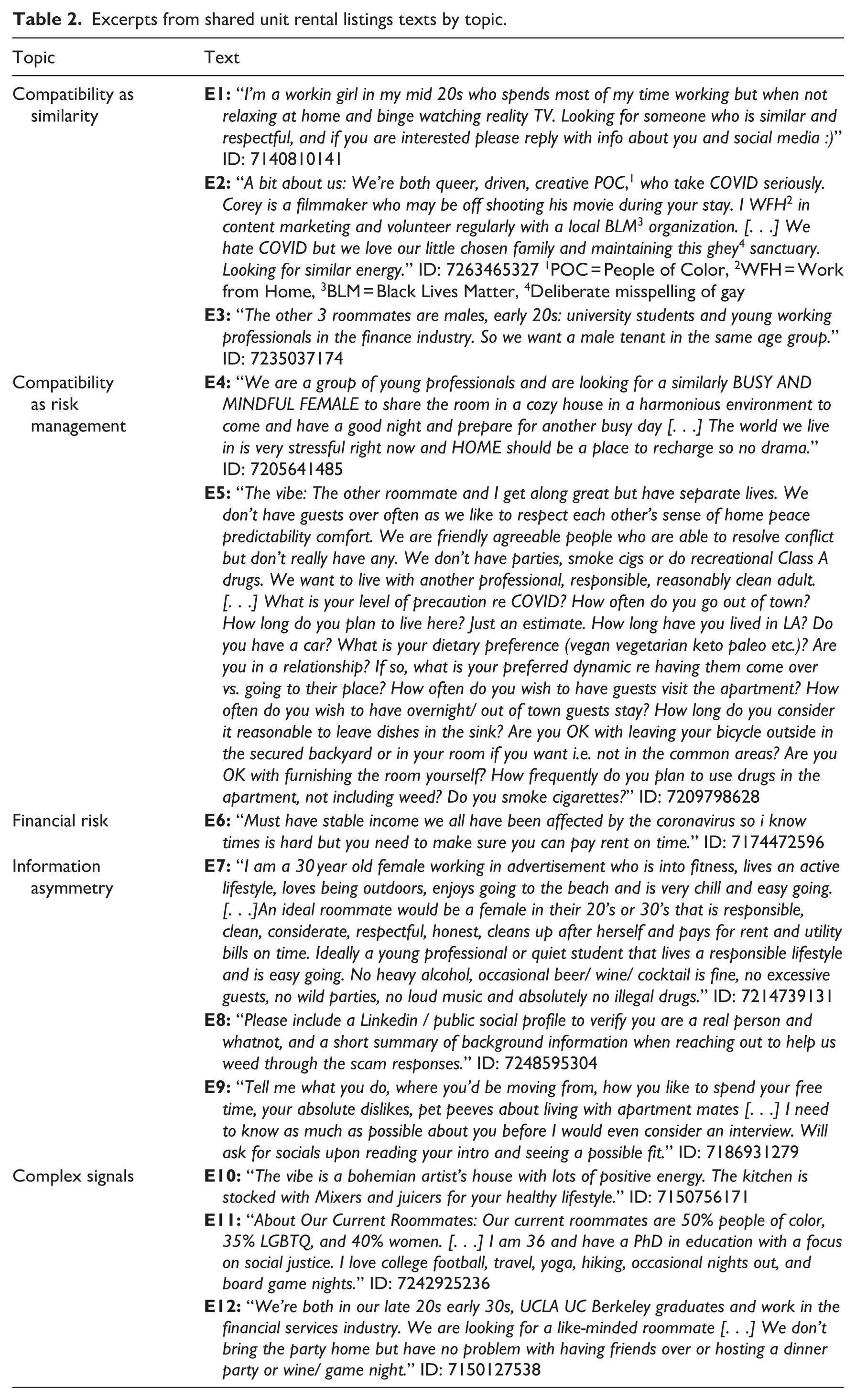
Excerpts from shared unit rental listings texts by topic.
Addressing relationality: Sociable cohabitation and reducing risks
We find that listers employ selection criteria to increase chances of enjoyable cohabitation and/or to reduce the potential for interpersonal tension and financial risks. Compatibility is key. Consider excerpts one and two where listers use the word “similar” (“someone who is similar” [E2], “[l]ooking for similar energy” [E2]) as well as in-group communication (acronyms, slang, emojis) to describe and appeal to the ideal co-tenant (Table 2). Articulating a desire for similarity, listers signal their hope for compatibility through likeness. In the above examples, the dimensions of “similarity” are suggested through describing existing and/or prospective co-tenants. Often, however, listers more explicitly operationalize compatibility as likeness, as excerpt three illustrates (Table 2).
Compatibility is commonly narrated as an end in itself, but we also find it articulated from a risk management perspective as highlighted by excerpts four and five (Table 2). These examples pair language signaling for compatibility (“similarly” [E4], “another” [E5], “if this sounds like you” [E5]) with language about harmony (“a harmonious environment to come and have a good night” [E4], “no drama” [E4], “We are friendly agreeable people who are able to resolve conflict but don’t really have any” [E5], “we like to respect each other’s sense of home peace predictability comfort” [E5]). This pairing communicates a search for compatibility in service of minimizing the potential for interpersonal conflict. The aim to minimize risk is further highlighted in the amount and detail of questions articulated in excerpt five.
Finally, qualitative analysis confirms the prevalence of signals for solvency as suggested by the quantitative analysis of listing language. We find that such signaling aims at minimizing financial risk exposure, as excerpt six illustrates (Table 2).
Addressing complexity: Information asymmetry and trading-off engagement and exclusion
Listers also address the complexity of the shared housing search itself. For one, listers address the bilateral information uncertainty regarding personal qualities by either providing or signaling that they would seek this information. Consider excerpt seven in which the lister describes not just the ideal applicant but also themselves in great detail (Table 2).
Listers frequently ask for detailed information from prospective co-tenants (recall excerpt five) and commonly request access to social media profiles, as in excerpts eight and nine (Table 2). Information gathering to facilitate successful matches can intertwine with concerns for safety. For instance, when a lister requests access to applicants’ social media profiles in order “to verify you are a real person and whatnot” and “to help us weed through the scam responses,” [E9] they lean on social media for triangulation, to filter for fraud.
This last point speaks to the heart of the challenge for listers: They must attract the largest pool of relevant applicants and need to craft listing texts accordingly. They need to market the housing opportunity (engaging language) while simultaneously articulating limits to who will be considered (exclusionary language) in a way that speaks to the ideal co-tenant. We find three communication strategies that reflect this challenge.
Sketching out the ideal co-tenant, listers choose between language that “hardens” or “softens” selection criteria thus communicating their relative importance. Phrases such as “females only” or “absolutely no drugs” leave little room for interpretation. When the same criteria are paired with “prefer,” “like,” “would be nice,” etc., they turn from “must-haves” to “nice-to-haves” and signal a more relaxed approach.
Interestingly, listers often articulate selection criteria that are not verifiable at the selection stage (see E1, E2, E4, E5, E7). For instance, an applicant may say that they do not drink heavily but whether this is actually true may only be revealed after entering into the sharing agreement. These include both desirable behaviors such as cleanliness as well as undesirable ones such as drug consumption. In examples four and seven, the listers even describe preferred character traits such as honesty, even-temperedness, and mindfulness. In particular, as in these examples, listers often articulate (un)desirable co-tenant traits that are unobservable as “deal breakers,” projecting the contours and importance of compatibility as seen by the lister and prompting applicants to self-select accordingly.
Finally, signals are often complex and carry multiple levels of meaning. Language around age and gender offer prime examples. When listers use phrases such as “preferably in their 30s” or “the ideal roommate would be female,” the ideal co-tenant may be in that age range or of that gender, but the selection may be just as much about associated expectations regarding lifestyle choices or behaviors that are informed by prior experiences and/or stereotypes.
Selection criteria often weave together multiple signals that are not easily separable. Complex signals cluster around language that we label “work” and “lifestyle.” While employment may also communicate financial solvency, class belonging, and absence or presence in the shared home, we find that the articulation of lifestyle choices in particular are often used for targeted signaling to cultural insiders. Excerpts 10–12 describe the listers’ habits, hobbies, and visions for socializing within the shared home, among roommates and with outside guests. At the same time, when they reference travel, advanced degrees, wine, and “juicers for your healthy lifestyle” [E10], they also reference markers of class belonging. In addition, detailing the exact composition of current co-tenants by race, sexual identity, and gender [E11] or naming left-leaning institutions of higher education (“UCLA UC Berkeley graduates” [E12]) is an act of positioning, signaling worldviews, political standpoints, and associated value systems.
Discussion
Shared rental housing presents unique opportunities for discrimination and residential segregation as existing tenants themselves become gatekeepers selecting new tenants on personal characteristics and behaviors. While shared units can offer affordable access across the city, we find that existing tenants construct “idealized co-tenants” in listing texts, signaling their selection criteria and who is and is not welcome to apply. Both whole and shared unit listings spend comparable shares of their texts on discussing the unit, location, and logistics, but only shared unit listings frequently discuss personal characteristics, rules of renting, and privacy; whole unit listings essentially do not. Overall, selection criteria articulating (un)desirable tenant behaviors dominate. For whole unit listings, these mostly concern pet ownership, but for shared unit listings, in addition to pets, interactions, drugs, and lifestyle choices are also covered in at least 25% of listings. For either listing type we find virtually no mention of race, ethnicity, immigration status, religion, disability, or veteran status and very few mentions of sexual orientation, all protected classes. For shared unit listings only, descriptors of employment/occupation, proof of income, gender, age, and marital or family status are common.
Our qualitative analysis of how people narrate selection criteria in shared unit listings further reveals that listers articulate selection criteria to address the relationality of shared renting and the complexity of the shared rental search. Listers operationalize compatibility for sociality or risk management as similarity, both via vague references and in-group communication strategies and explicitly, with reference to certain desirable personal characteristics. Signals to mitigate financial risk also feature prominently. In addition, listers address the bilateral information uncertainty around personal qualities by either providing or requesting relevant information, sometimes via social media. Listers aim to attract the largest pool of relevant applicants. This tension between engagement and exclusion is reflected in the language: Listers often modulate selection criteria to signal whether selection on a given criterion is either strict or relaxed. Moreover, to encourage self-selection, listers detail the contours and importance of compatibility, even if these dimensions are unverifiable. Finally, listers use complex signals with layered meaning to target cultural insiders.
We already know that digital searches reflect and reproduce existing spatial patterns of difference and platforms embed existing biases into the distribution of information and the information itself. Here, we consider these dynamics when sitting tenants act as gatekeepers of housing opportunities and fair housing laws do not restrict the language of listings.
The prevalence of selection criteria in shared unit listings indicates a “seller’s market” where listers can afford to be selective. In tight housing markets, selective listers can generally achieve their preferences, meaning the articulated selection criteria likely describe who ultimately occupies shared rental opportunities. Since neighborhood change is largely driven by residential mobility choices, our findings reveal how existing tenants insert their preferences into this sorting process through explicit or implicit exclusionary criteria. We find that listers seek “compatibility” but often simplify this to mere likeness. Although race is rarely explicit in listings, it correlates with many other selection criteria that are present and effectively communicate to prospective tenants their desirability (or lack thereof). If similarity is the main selection criterion, then shared housing stands to provide housing only for people similar to those already in it, suggesting that shared rentals could be viable only for a very narrow demographic and that shared renting may contribute to sociospatial segregation by sorting like with like. This is crucial: the literature shows how discrimination has long shaped housing market segregation, and our findings show planners and policymakers how these listing practices reproduce these historical processes, potentially further marginalizing already vulnerable communities.
Linguistic signals are often complex, which underscores the value of our mixed-methods approach. Quantitative analysis alone gives only a rough estimate of the most relevant criteria through estimates of prevalence. The more nuanced signals, however, emerge only through context and qualitative analysis. As our own analysis shows: some selection criteria are less exclusionary than they might seem if taken at face value (e.g. “females preferred,” compared to counting “female” as an exclusionary criterion about gender) while others may be even more exclusionary in practice (c.f., in-group communication and positioning through complex signals). This is not to say that algorithmic labeling is not reliable but rather that communication through listing texts is intricate, resulting in both under- and overcounting of signals and further highlighting the complexity of matching shared renting introduces through its social, relational dimension.
Our research points to an opportunity for planners and policymakers to support shared renting, potentially making it open and viable for more people. Current policy approaches to affordability through sharing rarely engage with the material and emotional implications of shared renting and who may reasonably access it. If regulators acknowledged the inherently relational nature of shared renting, recognizing that shared “households” often comprise individuals living separate lives while sharing binding legal, economic, and spatial relationships, then they could craft tenant protections that address the unique risk profile of shared renting. More supportive policies could enable increased sharing among more diverse populations, countering the current tendency to choose similar individuals, which perpetuates status quo inequities. Better co-tenant protections would be a step toward increasing affordable options more equitably rather than either benefiting those who can navigate this market on the basis of their privilege or creating situations that put vulnerable populations further at risk.
This study also creates several opportunities for future research. While our models can identify well-defined topics reliably, they may struggle with implicit language. Word choice and context significantly impact meaning, with full understanding often hidden in connotative meaning and semantic complexity. Furthermore, our research is constrained by its geographical (Los Angeles) and temporal (immediate post-COVID) context and examines only one side and one step of the housing search, a complex social process involving multiple actors and stages.
Hence, future research should continue training and refining models to better capture nuance in human language. For instance, while explicit mentions of race and other protected classes are rare, the study could further analyze how coded language and proxy indicators function as subtle gatekeeping mechanisms. Listing languages will further change in tandem with social norms, market conditions, and attitudes and approaches to shared living. For instance, the COVID-19 pandemic introduced new housing-related considerations, with factors like hygiene practices and work-from-home compatibility becoming important dimensions in negotiating shared spaces. On the other hand, Los Angeles has specific cultural and economic characteristics. Selection criteria may vary significantly across different housing markets, urban/suburban contexts, and cultural settings. Comparing shared housing listings across different countries and cultural contexts could illuminate how localized social norms shape acceptable selection criteria.
Further exploring how listers think about advertisement and selection and how applicants interpret and respond to selection criteria will deepen our understanding of the shared renting search process and ultimately of how access in this market is negotiated. Audit studies and field experiments could reveal actual (discriminatory) impacts beyond textual analysis, particularly regarding race and faith, which were rarely explicitly mentioned in listings despite their potential significance in later filtering stages. Relatedly, consider how age appeared less prominently in narrative texts than expected given the literature’s focus on shared rentals as housing for young adults—possibly because certain demographics are assumed based on the information channel. Notably, many listings contained no qualifiers whatsoever, suggesting either a distinction between submarkets (transactional vs social living arrangements) or discomfort with explicitly stating selection preferences, with filtering potentially deferred to later stages. Research engaging with how risk aversion, trust, and cognitive biases influence selection could explain why compatibility often defaults to similarity in roommate matching. Compatibility operationalized as similarity links conceptually to segregation, whereas compatibility as risk management links to discrimination. Our study only focuses on disparate treatment in selection processes, but future work should examine disparate impact in terms of housing market outcomes.
Last but not least, the connection between roommate selection and broader socio-spatial dynamics invites deeper spatial analysis to determine whether shared housing functions as a leading or lagging indicator of neighborhood transformation over time. Examining the relationship between selective roommate criteria and access to opportunity, studying whether more restrictive selection practices correlate with high-opportunity neighborhoods versus less restrictive criteria in lower-opportunity areas, could reveal patterns of spatial inequality in housing access. As shared renting becomes the choice of ever more tenants, policymakers must understand its dynamics for evidence-informed interventions into segregated markets and inequitable neighborhood change.
Footnotes

Funding
The authors disclosed receipt of the following financial support for the research, authorship, and/or publication of this article: Dr. Harten would like to acknowledge funding by the Social Sciences and Humanities Research Council of Canadas’ Canada Research Chairs Program (CRC-RS 2021-00037).
Declaration of conflicting interests
The authors declared no potential conflicts of interest with respect to the research, authorship, and/or publication of this article.