




Abstract
Time structures urban life not only through daily routines but through the abstracting logics of capitalist governance. Once monetised, measured, and bureaucratically sequenced, time becomes a governing instrument that organises space, allocates legitimacy, and privileges productivity. Yet the temporal politics of street experiments remain undertheorised. Drawing on Lefebvre’s concept of abstract space-time, this paper reconceptualises street experiments as sites of spatiotemporal governance where abstraction operates through temporal allocation. We develop a triadic framework of timing, rhythms, and duration to show how structural, symbolic, and direct violence are enacted through the sequencing, stabilisation, and withdrawal of temporal possibilities. Using two Hong Kong cases—a 1-day pedestrianisation on Des Voeux Road Central and the long-term informal appropriation of the Western District Public Cargo Pier—we show how timing confines interventions to administratively sanctioned or crisis-defined windows; how dominant rhythms (commercial circulation, festival activation, platform-driven surges) stabilise certain uses while moralising others as disorder; and how duration governs whether alternative practices sediment or are compressed and terminated. In Central, preventive temporal compression limited the stabilisation of new rhythms. At the Pier, decades of informal coexistence were reorganised under pandemic risk logics amid spatial concentration and intensified attention-driven demand. Rather than opposing “top-down” and “bottom-up” time, the paper shows how bureaucratic, market, and platform temporalities intersect and how municipal governance manages their contradictions within constrained urban space. By foregrounding temporal conflict, the paper extends Lefebvre’s theory of abstraction and positions rhythmanalysis as a method for examining how spatiotemporal orders are stabilised and contested in urban experimentation.
Keywords
Introduction
Street experiments have become a prominent strategy in contemporary urban planning. Through low-cost, short-term interventions, such as pop-up bike lanes or temporary pedestrian zones, cities seek to test new spatial configurations, foster public engagement, and adapt incrementally (Bertolini, 2020; Lydon and Garcia, 2015). Much of the existing literature evaluates these initiatives in spatial terms: how they reshape mobility, generate public life, or alter patterns of street use. Empirical research, particularly in European contexts, has shown how such experiments can reimagine streets as social spaces, especially during exceptional “windows of opportunity” such as the coronavirus pandemic (Bertolini, 2020; Gatarin and Andal, 2024; Smeds and Papa, 2023; Vásquez et al., 2024). Yet this scholarship largely overlooks a crucial dimension: the politics of time. 1
Street experiments are not only spatial interventions but temporal ones. Their timing, rhythms, and duration shape how they unfold, who participates, and what consequences follow. Decisions about when interventions occur, which tempos are authorised, and how long they are permitted to persist allocate urban possibility. In hyper-capitalist and densely built environments such as Hong Kong, where land scarcity, high economic stakes, and intense circulation pressures structure everyday life (Chan, 2024; Villani and Talamini, 2023; Wang et al., 2023; Zhao et al., 2025), these temporal decisions are particularly consequential. Time here does not merely coordinate activity; it conditions whether experimentation is feasible at all.
Recent attempts to classify temporal developments in street experiments (e.g. Zhao et al., 2024) provide useful descriptive accounts but often reduce complexity to generalised “institutional barriers” (e.g. Loorbach et al., 2021; Schreiber, 2025; VanHoose, 2023; Zhao et al., 2025). Such framings risk obscuring a deeper theoretical point: time is socially produced, unevenly experienced, and deeply implicated in relations of power (Standing, 2024). Although scholarship increasingly recognises the politics of urban experimentation (Sierhuis et al., 2024; Verlinghieri et al., 2024) and broader structural constraints (Bertolini, 2025; Beukers and Bertolini, 2023), few studies examine how the temporal design of interventions allocates opportunity, authorises certain uses, and suppresses others. Moreover, temporal dynamics are shaped not only by administrative schedules but also by market cycles and attention-driven digital economies. These overlapping temporal regimes complicate any simple opposition between “top-down” state time and “bottom-up” lived time.
This paper approaches street experiments as sites of spatiotemporal governance. It asks: How do the temporal logics of abstract space, expressed through timing, rhythms, and duration, produce structural, symbolic, and direct violence? What are the consequences of these temporal mechanisms for the suppression or emergence of differential urban space? In Lefebvrian terms, abstract space-time is “inherently violent and geographically expansive” (Brenner and Elden, 2009: 359; see also Wilson, 2014). It refers to the capitalist production of a homogenised and instrumental temporal order in which lived, cyclical, and heterogeneous temporalities are subordinated to linear, quantifiable rhythms associated with accumulation and state administration. This alignment is neither seamless nor stable. Bureaucratic calendars, project cycles, and operational schedules compress or overwrite lived rhythms, generating structural and symbolic violence. At the same time, municipal governance functions as a site where competing temporal imperatives, such as traffic circulation, commercial turnover, safety regulation, and public use, are negotiated. Conflict arises not only between administrative schedules and everyday practices, but also where regulatory time intersects with intensified demand within spatially constrained settings.
Building on this perspective, the paper reconstructs a Lefebvrian account of abstract space-time and develops an analytical framework centred on timing, rhythms, and duration. Together, these lenses reveal temporal allocation as a key mechanism through which abstraction operates in urban experimentation. While temporary urbanism encompasses diverse short-term spatial practices, and tactical urbanism often refers to low-cost, citizen-led interventions, street experiments provide a focused arena in which to examine how temporal governance shapes what endures, what remains provisional, and what is foreclosed.
The empirical analysis examines two contrasting cases in Hong Kong: a planned 1-day car-free experiment on Des Voeux Road Central and the long-term informal appropriation of the Western District Public Cargo Pier. Drawing on interviews, field observations, and documentary materials, the study shows how bureaucratic sequencing, rhythmic collision, and durational manipulation structure both sites. Each case illustrates how structural violence embedded in administrative systems, symbolic violence enacted through homogenising temporal narratives, and direct violence materialised through policing and crisis intervention unfold through time as well as space. Read together, the cases demonstrate how temporal abstraction interacts with spatial limitation, whether a single corridor or a singular waterfront site, to intensify demand and conflict. Street experiments thus emerge not merely as spatial trials but as laboratories of spatiotemporal governance, where abstract time governs not only where experimentation may occur, but when, for how long, and under what conditions it becomes intelligible, legitimate, or (im)possible.
Lefebvrian perspective on the abstraction of space-time
Henri Lefebvre’s work is central to critical urban studies, yet its Anglophone reception has often privileged space over time (Fu, 2025; Unwin, 2000). This imbalance obscures his broader critique of alienation and abstraction as defining features of capitalist modernity (Elden, 2001). In The Production of Space (1991), Lefebvre presents space and time not as neutral containers but as socially produced relations. His account of space is inseparable from a critique of concrete abstraction (Soja, 1996; Wilson, 2013): the historical process through which exchange value, rational planning, and state rationality become embedded in everyday life. Under capitalism, seemingly technical instruments, such as grids, metrics, calendars, and categories, reorganise lived experience in ways that privilege accumulation, coordination, and administrative control.
Lefebvre (1991) articulates this dynamic through the triad of perceived, conceived, and lived space. Perceived space concerns material practices and routines; conceived space comprises representations produced by planners and technocrats; lived space refers to symbolic and experiential dimensions. Abstract space emerges when conceived space comes to dominate this triad. Through mapping, measurement, and planning, space becomes homogenising and instrumental, subordinating lived experience to technocratic logics, what Lefebvre calls the “devastating conquest of the lived by the conceived.” This dominance operates both materially and epistemologically. As Sayer (1982) argues, abstraction becomes problematic when internally related processes are reduced to simplified, externally correlated categories, what he terms “chaotic conceptions.” Wilson (2014) describes the political consequences of this reduction as the “violence of abstraction.”
For Lefebvre, this violence unfolds in multiple registers. It is structural, embedded in property regimes, planning systems, and infrastructures; symbolic, enacted through homogenising representations that erase difference; and direct, materialised in surveillance, policing, and repression (Lefebvre, 2002; Wilson, 2014). Empirical studies illustrate how abstraction integrates territories into global circuits while marginalising place-based practices (Wilson, 2014) or reshapes public–private negotiations through volumetric planning (Herburger, 2025). Abstract space is expansive and historically contingent (Brenner and Elden, 2009), unfolding through what Lefebvre (1991) describes as “spirals of spatial abstraction.” It does not descend upon a harmonious social field but develops through the contradictions of capitalist modernity itself. This perspective aligns with recent calls to foreground broader socio-political constraints in urban experimentation (Bertolini, 2025; Beukers and Bertolini, 2023), a theme taken up in the following section.
Although often discussed in spatial terms, Lefebvre’s later work makes clear that abstraction equally operates through time. Debates that position Marxism as concerned with time and Lefebvre as privileging space (see discussions in Pitts et al., 2020) overlook his insistence, especially in Rhythmanalysis (2004), that capitalist modernity homogenises and quantifies space and time through the same abstracting logic. Within Lefebvrian frameworks (e.g. Brighenti and Kärrholm, 2018; Launay, 2015; Revol, 2019), time itself does not act; what act are historically produced temporal regimes. Clock-based schedules, work discipline (Thompson, 1967), bureaucratic cycles, and administrative routines embed temporal discipline in everyday life (Jones and Warren, 2016). Rhythms—linear, cyclical, imposed—coordinate bodies and expectations. As Brighenti and Kärrholm (2018) note, rhythms “become actual living creatures” (p. 10) only when materialised through repeated practices. Agency therefore lies in the social production of temporal order rather than in time as an abstract entity.
Abstract space and abstract time are inseparable because both rely on measurement, synchronisation, prediction, and control. This resonates with Massey (2004), Harvey (1989), and others who emphasise the interdependence of spatial and temporal processes. Work schedules, circulation flows, deadlines, and planning cycles reorganise everyday life while marginalising heterogeneous or slower rhythms. In mobility systems, this rationality is institutionalised through peak-hour optimisation and throughput metrics that privilege speed over dwelling (Banister, 2018; Urry, 2004). Lefebvre (1991) describes this alignment as the removal of space from “the sphere of lived time” (p. 356), subordinating it to an instrumental temporality oriented toward growth, what he terms “productivism.” Contemporary research demonstrates how such temporal rationalities continue to shape urban governance, from planning discourses of “delay” (Parker and Dobson, 2025) to the commodification of public space (Thompson, 2017) to calls for more time-sensitive and rhythm-aware planning practices (Chang et al., 2025).
Yet abstraction never fully eliminates other rhythms. Bodily and cyclical temporalities persist and sometimes unsettle dominant orders. Rhythmanalysis provides a method for tracing how imposed, linear, and cyclical rhythms interact (Lefebvre, 2004). Everyday practices, such as walking, lingering, and gathering, may interrupt scheduled time and generate moments of what Lefebvre calls “differential space.” These rhythms, however, are politically indeterminate. They may enable appropriation but can also reproduce exclusion or commodification. Moreover, lived temporalities are shaped by market imperatives, attention economies, and uneven power relations. Research on temporary and tactical urbanism shows that interventions may challenge dominant orders (Andres, 2013; Beukers and Bertolini, 2021; Chan, 2024), while remaining embedded in metrics of efficiency, turnover, visibility, and control (Loftus, 2015; Wilson, 2014). Rhythmanalysis therefore serves not as a celebration of immediacy but as a tool for analysing how competing temporal regimes are organised and stabilised.
Abstract space-time presents itself as homogeneous, 2 an empty, transparent “tabula rasa” (Lefebvre, 1991), yet it is internally contradictory (Brenner and Elden, 2009; Wilson, 2013). It equalises space to enable exchange while fragmenting and hierarchising it for accumulation and governance. This “illusion of transparency” (Lefebvre, 1991: 27) naturalises state-led space-time interventions as technical necessity. Studies of urban experimentation illustrate this continual reworking: municipal street experiments recalibrate transport and mobility priorities (VanHoose and Bertolini, 2023); collaborative street projects expose the contested, socially produced nature of space under conditions of austerity and post-political governance (Verlinghieri et al., 2023); pandemic-driven street reallocations rapidly redraw spatial priorities (Zhao et al., 2024). These contradictions open possibilities for “differential” futures (Addie, 2024; Appel et al., 2018). Abstract space retains remnants of prior spatialities, emergent differences, and potentials for “dis-alienation,” activated through a politics of difference and through autogestion—collective self-management grounded in use rather than exchange value—which challenge productivist logics and reassert lived spatial-temporal experience (Lefebvre, 1991; Wilson, 2013). In this sense, abstract space is not fixed but provisional, a moment in an unfolding dialectic always open to transformation.
The purpose of this section is not to rehearse Lefebvre’s corpus but to operationalise his concept of abstract space-time for empirical analysis. By foregrounding abstraction as a spatiotemporal governance process, this reading clarifies how urban life is organised through the production and regulation of temporal order. Lived experience, in this account, is not external to abstraction but constituted within alienated relations. Everyday practices may reproduce, accommodate, or contest dominant orders, yet they are not inherently authentic or emancipatory. The analytical task, therefore, is not to oppose abstract space-time to a pure lived alternative, but to examine how competing temporal regimes are organised, stabilised, and contested within capitalist urbanism. The next section builds on this foundation by specifying how these dynamics become visible in street experiments through their timing, the rhythms they privilege or disrupt, and the durations they allow or curtail.
Temporal politics of street experiments: A Lefebvrian framework of timing, rhythms, and duration
Building on the preceding discussion, this section shows how abstract space-time becomes operational in street experiments. Rather than viewing experiments as merely tactical fixes, we treat them as sites where spatiotemporal governance is enacted and contested: they do not only reconfigure place but organise time, determining when interventions occur, which tempos are authorised, and how long alternatives are permitted to endure. Although tactical urbanism (Lydon and Garcia, 2015; Stevens and Dovey, 2022) is often associated with experimentation (Bertolini, 2020, 2025), de Certeau’s (1984) distinction between tactics and strategies cautions against assuming tactics automatically destabilise dominant orders. Once routinised into municipal toolkits, pilot protocols, or reporting cycles, “tactical” initiatives frequently align with administrative schedules and performance metrics (e.g. Chan, 2024; Jones and Warren, 2016). In practice, even projects framed as “streets for people” may project preferred temporalities rather than letting rhythms emerge from everyday life, making experiments arenas where abstraction attempts Lefebvre’s (1991) “conquest of the lived by the conceived.” To make this visible, we develop a compact triad: timing, rhythms, and duration. These lenses reveal temporal allocation as the operational mechanism of abstract space-time: timing allocates and gates access to intervention; rhythms stabilise and moralise particular tempos; duration determines whether practices sediment or are withdrawn. These modalities interlock, sequencing shapes repetition, repetition conditions sedimentation, and through them abstraction organises urban possibility in time as much as in space.
Timing concerns when interventions are permitted and hence what contexts are tested. Modern planning proceeds through standardised sequences, such as statutory deadlines, project cycles, bureaucratic calendars, and street experiments are typically inserted into these frameworks. Sanctioned trials, especially those modelled on European precedents (Bertolini, 2020), are often scheduled in “safe” windows such as weekends, festivals, or holidays (Andrew et al., 2021; Chan, 2024; Villani and Talamini, 2023). While such timing can limit disruption, it also narrows evaluative conditions: weekday commutes, school schedules, routine commerce, and other everyday rhythms are commonly excluded from assessment (Chang, 2021). Scholarship tends to foreground organisational constraints, such as risk aversion (Schreiber, 2025; Villani and Talamini, 2023), learning capacity (Schreiber, 2025; Zhao et al., 2025), limited budgets (VanHoose et al., 2022), or operational complexity (Chan et al., 2026), but these explanations can occlude the structural effects of temporal allocation itself. Scheduling decisions may stabilise existing spatial hierarchies without explicit prohibition (Sierhuis et al., 2024; VanHoose, 2023; Verlinghieri et al., 2024; Vitale Brovarone et al., 2023). Unsanctioned appropriations are often curtailed by crisis-timed interventions—emergency health regulations, security operations, or supply-chain imperatives—that compress the time required for alternatives to stabilise (Zhao et al., 2024). The pandemic intensified these dynamics: emergency cycle lanes, distancing protocols, and tactical templates circulated rapidly through networks such as C40 (Vásquez et al., 2024), standardising emergency timelines and producing uneven social effects (Beyazit et al., 2023; Chan, 2024; Gera and Hasdell, 2023; Nixon, 2025). Comparative evidence shows that similar spatial measures can yield divergent outcomes depending on sequencing and repetition (e.g. Barcelona’s pedestrianisation and gentrification debates (Nello-Deakin, 2024) versus long-run retail stability in parts of Hong Kong (Murakami et al., 2021)). Thus, timing functions less as neutral logistics than as gatekeeping, allocating which temporal windows count as legitimate experiment and which do not.
Rhythms address how temporal patterns are repeated, normalised, and judged. Lefebvre’s (2004) rhythmanalysis highlights that rhythms organise bodies and social life but are also produced through “dressage”—the training of movement to conform to dominant tempos. Temporary interventions frequently introduce accelerated or spectacular beats—festival markets, activation events, pop-ups—that displace slower neighbourhood tempos (Sun, 2022). In many cities dominant rhythms are structured around traffic flow, peak-hour optimisation, and throughput, so circulation-oriented temporalities are normative long before any experiment (Hubbard and Lilley, 2004; Larkin, 2013). Even sites under construction perform temporal discipline that precedes final use (Schwarze and Jankowski, 2024). The rhetoric of “activation” (Andres, 2025) can therefore participate in symbolic violence by pathologising rhythms labelled “too slow” or “unproductive,” valorising leisure tempos compatible with middle-class consumption while disciplining working-class temporalities (Douglas, 2014). Grassroots or “streets for people” initiatives (Bertolini, 2020) can also project preferred tempos rather than cultivating plural temporalities (Chan, 2024), and funding cycles or reporting requirements often recalibrate community practices toward bureaucratic rhythms (Jones and Warren, 2016). In short, rhythms disclose how structural forces (economic and infrastructural tempos) intersect with symbolic processes (moralising arrhythmia), producing normative expectations that compress or reinterpret poly-rhythmic practices.
Duration draws attention to how long interventions endure and whether new tempos have time to sediment (Andres and Kraftl, 2021). Lefebvre (1991) warns that abstract space-time reproduces itself by limiting the temporal horizon necessary for alternatives to take root. Despite promises of “short-term action for long-term change” (Lydon and Garcia, 2015), many pilots remain durationally constrained: short cycles (VanHoose et al., 2022), provisional permits, fleeting budgets (von Schönfeld, 2024), and evaluation based on incomplete data can foreclose transformation (Nikolaeva, 2024). Optimistic accounts treat duration as a route to scaling and institutional learning (Beukers and Bertolini, 2023; Schreiber, 2025; Zhao and Sun, 2025; Zhao et al., 2025), but empirical work highlights persistent limits: funding ephemerality and uneven legitimacy mean extended presence does not guarantee endurance. Informal appropriations may stabilise through repetition and shared memory (Chang, 2023; Douglas, 2014), yet even long-running uses remain vulnerable to abrupt regulatory shutdown or crisis intervention (Zhao et al., 2024). In this way, duration returns us to timing: administrative sequencing and crisis rationalities define when temporal windows open and when they close, making continuation more often an administrative concession than a product of lived rhythms. Streets are therefore treated less as evolving epochs than as sites periodically reset to maintain institutional coherence (Degen, 2018; Schwanen, 2016).
Abstraction is unavoidable in governance, but it is selective (Sayer, 1982; Schwanen, 2023). By isolating certain rhythms, allocating specific windows, and limiting duration, temporal allocation shapes what becomes administrable and what remains marginal. In Lefebvrian terms, abstraction “kills the possible” by dissolving multiplicity into manageable fragments and substituting the conceived for the lived. The temporal politics of timing, rhythms, and duration thus expose the ambivalence of street experiments: they can open openings and generate publics, but those possibilities are repeatedly reorganised within broader temporal frameworks that stabilise particular orders while constraining others.
Research context and methods
Hong Kong, a Special Administrative Region of China, is a dense and highly transit-oriented city. More than 90% of mechanised travel relies on metro, buses, and minibuses, and walking largely functions as a feeder to public transport rather than as a mode with autonomous spatial value. Streets are therefore designed primarily for circulation efficiency. Within this mobility regime, both citizen-led and state-led street experiments have periodically emerged, seeking to reimagine streets not only as connective corridors but also as spaces of leisure, sociability, and public life. High land values, intense commuter flows, and tightly regulated public environments make Hong Kong a particularly revealing context for examining how temporal governance shapes the possibilities and limits of experimentation.
This study employs reflexive thematic analysis (Braun and Clarke, 2021), informed by Lefebvrian orientation (Schwarze, 2023). The research is theory-guided rather than exploratory: Lefebvre’s concept of abstract space-time, together with its associated forms of structural, symbolic, and direct violence, provides the interpretive framework. Temporality is treated not as a neutral parameter but as a socially produced and politically charged dimension of governance. The aim is not statistical representativeness but theoretically informed insight into how temporal regimes are constructed, institutionalised, and contested in practice. In line with Lefebvre’s (2004) call to “receive data from all the sciences” (p. 22), the analysis draws on multiple sources: semi-structured interviews, policy and regulatory documents, media coverage, administrative calendars, and visual–material records from both sites. Document analysis was used to trace how bureaucratic sequencing, crisis framings, and regulatory scripts assemble and legitimise particular temporal orders. Themes were developed through iterative coding and theoretical reflection, guided by the analytical triad of timing, rhythms, and duration. Rather than searching for idealised alternatives, the analysis focuses on temporal frictions, interruptions, and situated appropriations that reveal how abstract space-time is enacted, negotiated, and occasionally unsettled.
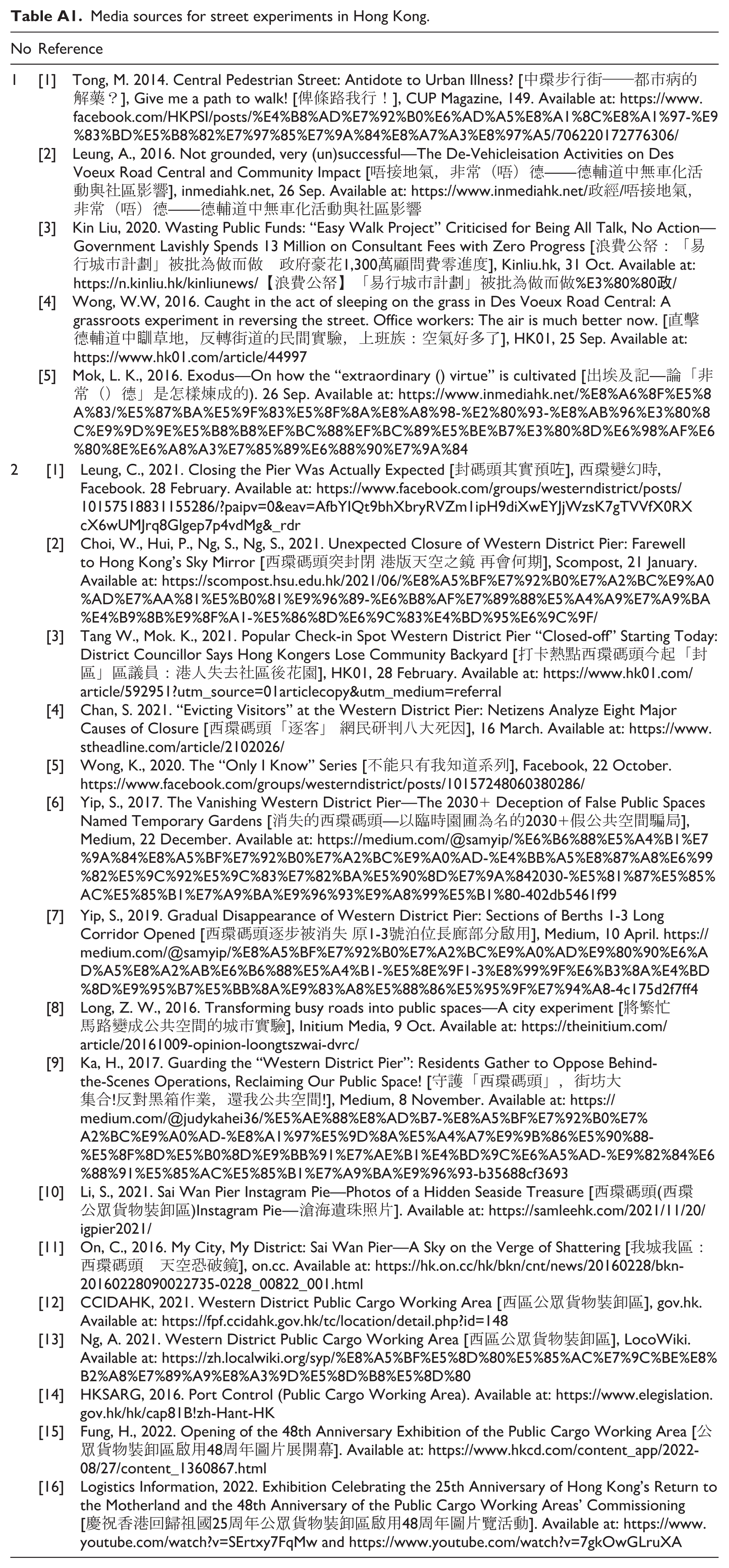
Primary data include interviews with four respondents representing three organisations involved in Hong Kong street-experiment initiatives. Conducted via Microsoft Teams between April and May 2023 (90–120 minutes each), the interviews explored lived experiences, institutional constraints, and decision-making processes shaping experiment design and implementation. Although limited in number, the participants were selected for their direct involvement in organising and evaluating street experiments, providing insight into administrative sequencing and strategic temporal decisions. The study therefore prioritises depth of positional knowledge over saturation. Additional textual and audiovisual materials (coded as M) were collected from local news platforms and video-sharing sites (Appendix A). These materials were analysed not simply as documentation but as sites where temporal narratives are constructed and circulated, shaping public understandings of urgency, disruption, legitimacy, and closure. Only English and Chinese (Cantonese and Mandarin) materials were included.
Figure 1 presents the two case study sites: the 1-day road closure on Des Voeux Road Central (DVRC) and the Western District Public Cargo Working Area. Both are located in the Central-and-Western District, a major business corridor characterised by dense administrative infrastructures, high commuter turnover, and significant development pressure. Long working hours, congested mobility patterns, and strict regulatory oversight intensify temporal pressures, making the district a particularly salient setting for examining how street experiments encounter, reproduce, or unsettle dominant temporal rationalities.
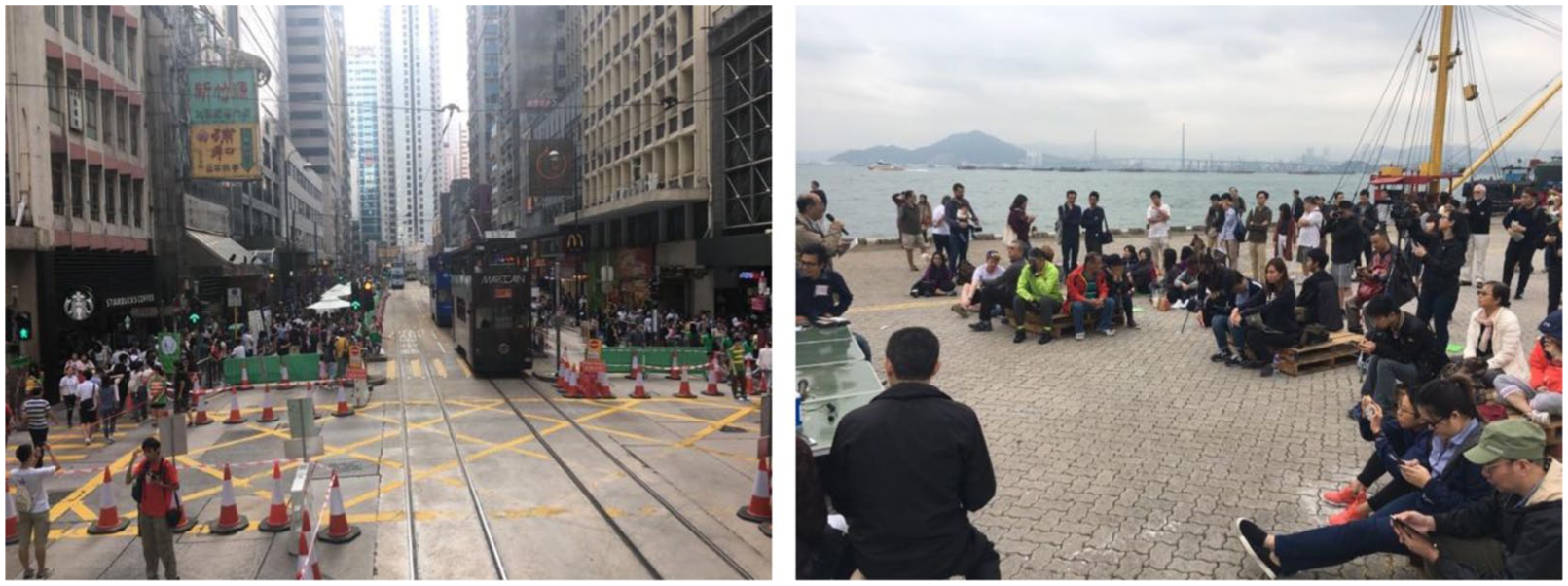
Case studies of two street experiments: 1-day road closure (left) and public cargo pier (right).
The DVRC road closure, held on 25 September 2016 under the “Walk DVRC” initiative, suspended traffic along a 200-m stretch of one of the city’s busiest east–west corridors for 6 hours. Normally serving more than 100,000 vehicles per day, the corridor was temporarily transformed by 47 civil-society groups into a space for sports, reading, exercise, picnics, and performances, attracting approximately 50,000 participants. Framed as a “proof of concept” for pedestrianisation, the event resonated with urban aspirations articulated during the 2014 Occupy Central Movement. Despite strong public support in post-event surveys, concerns over traffic diversion, commercial impact, and interdepartmental coordination confined the initiative to a single, tightly bounded trial. The case illustrates how sanctioned interventions, constrained by narrow temporal windows, struggle to generate enduring rhythmic shifts within entrenched mobility regimes.
The Western District Public Cargo Working Area presents a contrasting trajectory. Opened in 1981 for cargo operations, the pier’s primary activity occurs during late-night and early-morning hours. These temporal gaps were informally appropriated by residents for leisure from the 1990s onward. Despite limited amenities, the site evolved into a popular destination, later dubbed “Instagram Pier,” known for its harbour views and post-rain reflections. During the pandemic (2019–2021), restrictions on indoor gatherings increased its popularity as an open-air venue. This emergent appropriation functioned as a spontaneous form of experimentation under crisis temporality, revealing uses that exceeded formal planning scripts. However, growing visibility and congestion prompted regulatory intervention. In March 2021, the Marine Department prohibited public access, citing pandemic regulations and operational risks. Although framed as temporary, the closure effectively ended more than two decades of coexisting cargo and leisure rhythms.
Taken together, these cases—one officially sanctioned yet durationally compressed, the other informally sustained but ultimately withdrawn—provide a comparative basis for analysing how timing, rhythms, and duration mediate the encounter between lived temporalities and the administrative, economic, and crisis-driven logics of abstract space-time in Hong Kong.
Timing
From a Lefebvrian perspective, timing refers to the sequencing and coordination through which abstract time structures everyday life. Urban interventions unfold within bureaucratic calendars, procedural cycles, and administrative priorities. These schedules do not merely organise activity; they determine when space becomes available and under what conditions it may be transformed. Everyday temporalities, meanwhile, are already shaped by labour routines, market demands, mobility systems, and platform-mediated attention. Timing therefore operates within a layered temporal field, reallocating and reorganising existing rhythms rather than simply replacing them.
This dynamic is visible in the planned street experiment at Des Voeux Road Central. One organiser recalled that the initiative did not fit established administrative categories and therefore struggled to “enter” institutional time: The street experiment was not a protest march . . . we also couldn’t strictly follow the application rules for using public spaces . . . we had to go through the joint approval of temporary traffic arrangements by various government departments. (Organiser, Oct 2016, M1.2)
The street could only be made available for experimental use once its schedule aligned with multiple departmental procedures. These processes did more than ensure safety; they determined when the experiment could exist at all. Ultimately, the event was folded into the district council’s holiday market, an existing temporal framework that preselected both the moment and the terms of intervention. As one politician observed: Although implementing it on holidays is a good strategy, testing it on one day with the least traffic . . . limits the reference value of the results. (Politician, Sep 2016, M1.2)
Experimentation was thus confined to administratively convenient windows within a brief and spatially restricted setting. Weekday congestion, school commutes, and freight cycles were excluded from assessment. The issue is not that these omitted rhythms are more authentic, but that limiting intervention to exceptional moments narrows what can be meaningfully evaluated. The short duration and single corridor concentrated citywide demand into a compressed space-time setting, privileging spectacle over routine use. In this sense, timing operated preventively: by allocating only a safe window, it pre-emptively limited the possibility that alternative rhythms might stabilise.
A related but distinct temporal logic emerged at the Western District Public Cargo Pier. Lefebvre suggests that the state stabilises meaning by producing linear timelines that smooth rupture. This was evident in a government-organised photo exhibition deliberately aligned with the 25th anniversary of Hong Kong’s return to the “motherland” (M2.16). The opening speech presented the pier’s history as a coherent sequence—construction in 1974, post-1997 modernisation, continued logistical contribution—casting the handover as a decisive “milestone.” Discontinuities were erased: colonial-era “unregulated” uses, leisure rhythms of the 2010s, and the gradual decline of cargo activity disappeared from official narration. Even the 2021 closure, justified through health regulations, was absorbed into a storyline of progress and stability. Photographs in the state exhibition reinforced this smoothing, in sharp contrast to the community gallery (M2.10), which highlighted improvised and fragmented everyday uses. By consolidating multiple temporalities into a single authorised timeline, the state rendered closure both timely and necessary.
The pandemic intensified these dynamics though not as a fully calculated strategy. Viral social media circulation drew large numbers of leisure visitors into established cargo hours. As a long-term worker observed: During the daytime, there were more than a hundred visitors . . . they ignore our warnings and continue taking photos. (Resident for 20 years, March 2021, M2.8)
Spatial arrangements remained largely unchanged; what shifted was temporal alignment. Labour was concentrated in early mornings, leisure later in the day. Platform-driven visitation amplified this misalignment within a spatially constrained site, generating conflict rooted in incompatible schedules rather than mere co-presence. These tensions were not framed as competing temporal claims but as behavioural disorder. References to “lack of self-discipline” (M2.2; M2.8) reframed scheduling conflict as personal failure, making regulatory intervention appear foreseeable. One resident remarked that “its closure is only a matter of time” (Resident, Feb 2021, M2.1), reflecting how crisis narratives reconfigured expectations: disruptions accumulated, risks escalated, and intervention seemed inevitable. Although pandemic governance was fluid and experimental, marked by changing regulations and uneven enforcement, the sequencing of disruption and closure aligned with broader discourses of urgency and precaution. In this instance, timing operated retroactively: accumulated practices were reorganised under crisis temporality, and closure appeared reasonable and necessary.
Across both cases, timing functions as a mechanism of power. Structural violence is visible in bureaucratic sequencing that restricts when intervention can occur. Symbolic violence appears in narrative smoothing and the moralisation of temporal conflict, which render certain rhythms illegitimate. Direct violence materialises in crisis-timed enforcement and closure. Whether preventively narrowing experimental windows or retroactively reorganising established practices, timing allocates not only opportunity but legitimacy. Through such temporal allocation, within spatial and institutional constraints, abstract time shapes which forms of urban experimentation appear feasible, appropriate, or inevitable.
Rhythm
Rhythms illuminate how temporal practices repeat, intersect, and sediment into everyday life. For Lefebvre, they emerge from the patterned interaction of bodies, routines, work cycles, spatial arrangements, and institutional structures. Through repetition, rhythms stabilise expectations and coordinate behaviour. Abstraction does not simply disrupt these patterns; it privileges certain tempos and marginalises others. What becomes powerful is not interruption alone, but repetition: how specific rhythms are normalised, moralised, and institutionalised over time. Across the two cases, several intersecting tempos can be distinguished: a circulation tempo oriented toward speed and throughput; a festival tempo centred on activation and spectacle; a platform pulse tempo driven by social media visibility and attention cycles; and a logistical tempo structured around operational schedules and safety requirements. These tempos overlap and compete, shaping which rhythms are stabilised and which are treated as problematic.
At Des Voeux Road Central, conflict first emerged around circulation tempo. Even before the experiment took place, local businesses expressed concern in temporal-economic terms. A pedestrian rest zone, they argued, would slow movement and threaten turnover: “shops on either side of the road need to thrive, because pedestrian traffic can boost the economy” (Experimental investigator, June 2014, M1.1). Speed and predictability were equated with vitality, while slower tempos were framed as inefficiency. The street, in this view, had to keep moving. When the event was incorporated into a holiday market, a festival tempo became dominant. Activities unfolded in tightly scheduled bursts tied to entertainment timetables, followed by the rapid reopening of the road. Participants described the day less as experimentation than as “a holiday market” (M1.2). Spectacle and throughput were prioritised over dwelling. Visitors circulated quickly; lingering was peripheral. Rather than establishing alternative everyday rhythms, the intervention became a brief interruption within an established circulation regime.
Attempts to slow the pace, through parklets, music corners, and informal gathering spaces, created pockets of dwell time but lacked the repetition needed to shift expectations. Improvisation coexisted with friction. Crowded performances narrowed walkways so that “only one person could pass” (M1.4), pushing others into side streets. Shopkeepers, attuned to commercial tempo, complained about noise and spillover. The tension was not only spatial but temporal: habitual circulation confronted experimental slowing. Compression intensified these conflicts. A single corridor, activated for a few hours, concentrated citywide demand into a narrow window. Visitors arrived in rapid, photo-driven pulses that mirrored urban spectacle rather than neighbourhood routine (M1.2). Under such conditions, circulation and festival tempos overshadowed slower patterns before they could stabilise.
The Western District Public Cargo Pier initially operated through a more layered arrangement. Early-morning cargo work, daytime calm, and evening leisure coexisted in a fragile polyrhythm shaped by labour schedules and informal understandings. As one activist observed, “everyone can be a planner and create a space in their own way” (May 2023), capturing the flexibility of this arrangement without implying that it was entirely autonomous or free from constraint.
Pandemic-era visibility altered this balance. Social media circulation introduced a platform pulse tempo with intense weekend surges, rapid movement, drone photography, and image-oriented visitation. Platforms functioned here as infrastructures of the attention economy, converting visibility into accelerated temporal demand. These pulses collided with the existing logistical tempo of cargo operations. A long-term worker described visitors ignoring warnings during cargo hours (M2.8). What had previously been managed through tacit sequencing became spatially congested and temporally compressed. The conflict was not between “authentic” and “inauthentic” rhythms, but between competing temporal demands structured by digital visibility, economic circulation, and operational necessity. As in Central, tension was moralised. References to “lack of self-discipline” (M2.3; M2.4) reframed scheduling incompatibility as behavioural failure. Graffiti, climbing containers, and night gatherings were cast as disorder rather than as signs of incompatible uses. Arrhythmia became pathology, legitimising intervention. Even councillors critical of consultation procedures “understood the reasons for closing the pier” (M2.2; M2.3), citing operational disruption and pandemic risk. Closure appeared pragmatic within a context shaped by congestion, platform visibility, and crisis governance. Authorities did not eliminate rhythm altogether; they stabilised a particular temporal order by privileging logistical and regulatory tempos over platform-amplified leisure rhythms within a spatially constrained site.
After the 2021 closure, a new regime consolidated. Public access remained restricted, while the pier reopened selectively for commercial filming under Marine Department permits (M2.2; M2.12). Informal leisure rhythms gave way to scheduled, revenue-generating uses. The site became “space-time worth paying for” (M2.14), with access governed through booking systems. Earlier rhythms were reorganised within a monetised temporal framework. What had emerged under crisis conditions gradually became routine. Some residents welcomed nearby promenades as safer and more regulated alternatives; others lamented the loss of informality while acknowledging that “Hong Kong indeed needs more of these informal public spaces” (Experiment initiator, May 2023). What began as exceptional became routine; what seemed temporary became expected.
Across both cases, rhythmic struggle reveals how circulation, festival activation, platform pulses, and logistical governance gain dominance through repetition and spatial allocation. This does not mean alternative rhythms disappear. Lingering at Des Voeux Road Central and continued visitation to the pier before fencing demonstrate ongoing plurality. Yet these practices operate within increasingly narrow parameters shaped by compression, visibility, and institutional sequencing. Rhythms persist, but their capacity to stabilise depends on how space and time are allocated, repeated, and regulated within broader political-economic conditions.
Duration
Duration concerns not simply how long practices persist, but whether they accumulate into shared expectations. If timing organises sequences and rhythms structure repetition, duration is what allows those repetitions to stabilise. For Lefebvre, rhythms acquire force only through time: without sufficient duration, they cannot sediment into everyday life. Under abstract space-time, however, duration is rarely neutral. It may be compressed, extended, segmented, or withdrawn, shaping which practices normalise and which remain provisional. In this sense, duration governs the possibility of sedimentation.
At Des Voeux Road Central, duration was predetermined by the district council’s holiday timetable. Folded into an existing festival cycle, the intervention lasted only a few hours—too brief for participants or officials to assess structural change. This brevity shaped what counted as evidence. Conclusions were drawn from compressed and atypical conditions, and the dense atmosphere of the event later served as cautionary reference material in planning debates. As one investigator noted, once proposals enter bureaucratic procedure they are reframed through institutional risk logics: “we must start with smaller, less daunting initiatives” to secure support (May 2023, S1). Another remarked that “evidence carries different weights” (May 2023, S2), underscoring that evaluation reflects administrative priorities rather than neutral criteria.
Organisers likewise acknowledged that the limited timeframe revealed little about traffic displacement or neighbourhood interaction (M1.2). The experiment unfolded within a pre-defined temporal envelope structured by feasibility rather than experiential need. Authorities did not need to reject the initiative outright; by restricting its duration, they prevented new rhythms from stabilising and limited the disturbance of existing routines. As residents observed, “a few hours cannot show anything” (M1.2). Without repetition over time, alternative uses could not normalise. Spatial concentration intensified this compression. A single corridor, briefly pedestrianised, absorbed citywide attention within a narrow window. The combination of limited space and limited time amplified congestion and spectacle, reinforcing perceptions of disruption. The problem was not only short duration but its intensification within a confined and highly visible setting.
Duration in this case also exposed the commodification of time. Within the 1-day event, space-time became a scarce resource allocated through strict timetables and evaluative metrics. Access to time itself was distributed through formal scheduling, visibility, and organisational influence. Groups competed for limited timeslots and space, and local organisers described the pre-application system as exclusionary: “if we don’t have enough influence, we won’t be allocated timeslot and space” (M1.2). Some spontaneous participants were removed from areas reserved under the official schedule. A district councillor later observed that “the organiser’s rush for achievements and insistence on a singular idea seems blind to the complexities” (Oct 2020, M1.3). Rather than enabling gradual learning, the tightly choreographed format turned duration into a measurable and monetisable asset, compressing interaction into a showcase event and limiting the accumulation necessary for new rhythms to sediment.
Duration operated differently at the Western District Public Cargo Pier. Over several decades, the site accumulated layered practices, such as dog walking, fishing, sunset viewing, informal gathering, that coexisted with cargo operations. These repeated uses formed a shared temporal texture shaped by labour schedules and informal negotiation. This long durée reflects what Lefebvre calls lived time: rhythms stabilising through situated repetition rather than formal scheduling.
The pandemic unsettled this accumulated order. Rising online visibility drew waves of visitors into established cargo hours, intensifying spatial congestion and compressing previously negotiated coexistence. A long-term resident remarked: “each time I see drones flying overhead and people climbing onto goods . . . the whole pier has become chaotic, and its closure is only a matter of time” (Feb 2021, M2.1). The phrase “a matter of time” signals a contraction of expectation: closure no longer appeared as one political possibility among others but as an increasingly foreseeable trajectory within a climate shaped by crisis governance and risk calculation. Platform-mediated circulation had already begun to reorient the pier toward rapid turnover and attention accumulation, positioning it within broader attention economies. This acceleration, combined with regulatory logics of liability and escalation, narrowed the temporal horizon within which coexistence appeared viable, recasting disruption as accumulating risk rather than ongoing negotiation.
Complaints about photography during cargo hours, climbing containers, or littering (M2.1; M2.3; M2.4) reflected not only frustration but an internalised reassessment of what was deemed temporally sustainable. In this shift, residents increasingly interpreted events through administrative categories of order and foreseeability. Closure thus emerged less as a singular act of suppression than as the outcome of reorganising competing temporal demands—cargo logistics, platform-driven visitation, and public health regulation—within a constrained site. Yet this reorganisation also exercised symbolic power over anticipation: as intervention became framed as the reasonable response to escalating disorder, alternative futures receded from view. When authorities imposed regulated hours and restricted access, open-ended practices were segmented into monitored time blocks aligned with managerial priorities. Earlier rhythms did not disappear; they were overwritten by a more tightly managed cadence. Acceptance of closure reflected not only altered expectations under conditions of congestion, visibility, and crisis uncertainty, but a shift from contested duration toward regulated predictability.
Across both cases, duration emerges as a key site of governance. It determines whether rhythms sediment into normality or remain episodic. Compression prevents stabilisation; extension enables it; withdrawal reorganises it. Duration is therefore not merely a measure of length but a mechanism of selection. Through the allocation, monetisation, and restructuring of time, abstract space-time shapes which practices endure and how urban futures are imagined.
Discussion and conclusions
This paper has argued that urban street experiments are not only spatial interventions but forms of temporal governance. Decisions about when interventions occur, which tempos are authorised, and how long alternatives are permitted to endure enact and normalise abstract space-time. Structural violence operates through bureaucratic sequencing and legal-economic constraints that narrow the conditions of experimentation. Symbolic violence appears in the moralisation of arrhythmia and the marginalisation of informal or non-commodified temporalities. Direct violence materialises in policing, enclosure, and abrupt closure. Timing, rhythms, and duration therefore function not as descriptive categories but as mechanisms through which power is organised and legitimised.
By foregrounding time, this study contributes to urban experimentation scholarship in two key ways. First, it shifts attention from spatial configuration to temporal structuring: what matters is not only what is built or tested, but how time is allocated, sequenced, and evaluated. Second, it extends Lefebvre’s account of abstraction by showing how abstract space-time is reproduced through routine institutional practices—calendars, schedules, assessment cycles, and crisis protocols—rather than only through grand planning schemes. The transformative potential of street experiments depends as much on temporal horizon and repetition as on spatial design.
Across both cases, timing operated as a gatekeeper of possibility. In Central, experimentation was confined to administratively convenient windows, restricting which everyday rhythms could be meaningfully tested. This preventive compression limited the stabilisation of alternative practices. At the Pier, timing worked differently but with similar consequences: long-standing informal uses were reframed through crisis logics, and closure reasserted institutional scheduling after platform-amplified surges intensified congestion. In both contexts, defining the “right moment” shaped not only what was permitted but how outcomes were interpreted. Temporal allocation became a means of managing tensions between infrastructural stability and market-driven acceleration.
Rhythms, in turn, revealed how certain temporal patterns are normalised while others are displaced or moralised. In Central, a consumption-oriented festival tempo became the authorised rhythm of experimentation, overshadowing slower everyday uses. At the Pier, a negotiated coexistence between cargo work and leisure was unsettled by platform-driven surges embedded in attention economies. These were not purely organic communal rhythms; they were entangled with circuits of visibility and capital. Their collision with logistical schedules produced arrhythmia framed as indiscipline. Such dynamics complicate any romantic opposition between “top-down” and “bottom-up” time. In urban contexts shaped by market volatility and digital mediation, everyday rhythms may reproduce congestion and commodification as readily as they challenge bureaucratic order.
Duration proved decisive because it determined whether rhythms could sediment. In Central, the ultra-short trial prevented alternative uses from stabilising, and evaluation based on compressed conditions reinforced existing mobility norms. At the Pier, decades of informal accumulation were abruptly reorganised, and a brief period of overcrowding was reframed as structural unmanageability. In both cases, temporal compression was inseparable from spatial concentration: limited urban space combined with synchronised demand intensified friction and rendered certain practices untenable. Duration thus functioned as a regulatory instrument, containing instability while preserving systemic order.
Taken together, these findings challenge any simple contrast between state-imposed time and lived time. The cases reveal intersecting temporal regimes—bureaucratic calendars, infrastructural schedules, festival economies, platform-driven attention cycles, and everyday routines—whose tensions must be managed within spatial limits. Municipal intervention appears less as the imposition of abstract time upon lived experience than as an attempt to mediate contradictions inherent in urban capitalism: stability versus dynamism, circulation versus spectacle, safety versus unpredictability.
Although Hong Kong’s density and land scarcity intensify spatiotemporal compression, these dynamics are not unique to its context. The mechanisms summarised in Table 1 are not confined to Hong Kong; similar patterns of temporal allocation, whether preventive, through pre-emptive compression, or retroactive, through crisis-driven reorganisation, operate wherever experimentation is embedded in bureaucratic sequencing, digital visibility, and crisis governance. The framework of timing, rhythms, and duration therefore offers a transferable lens for analysing how abstract space-time is operationalised across diverse urban settings. While street experiments elsewhere may differ in scale and political context, they remain shaped by decisions about sequencing, repetition, and temporal horizon.
Temporal mechanisms of abstraction and their manifestations in the two Hong Kong street-experiment cases.
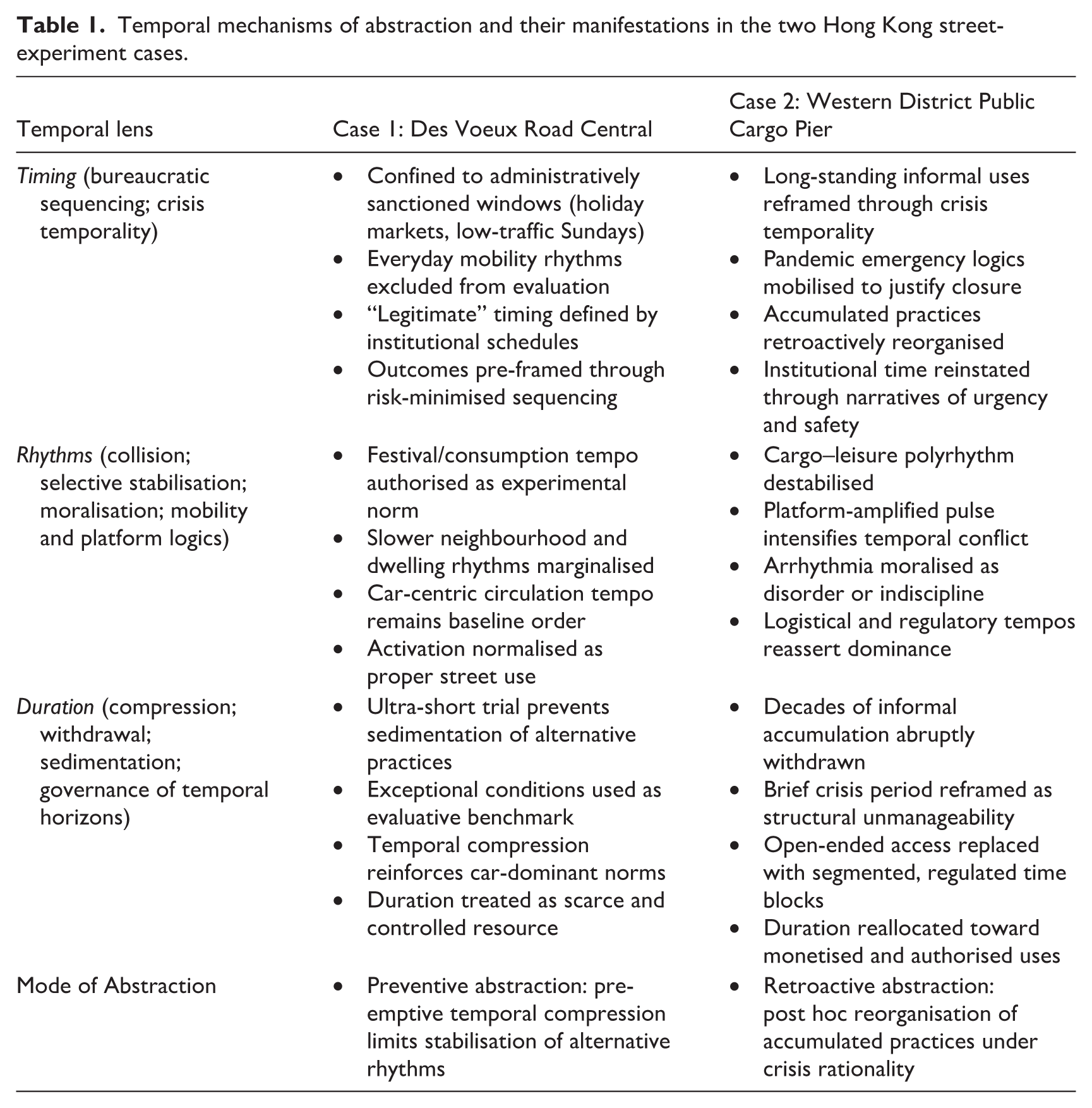
The cases also clarify a broader theoretical point: time itself does not act; socially produced temporal regimes do. Calendars, schedules, rhythmic templates, and durational constraints embed discipline within the built environment. Abstraction operates through allocation and sequencing, stabilising certain rhythms while limiting others before they can sediment. Street experiments thus function as laboratories of spatiotemporal governance, making visible the operational core of abstract space-time. At the same time, abstraction remains incomplete and contested. As Schwanen (2023) suggests, abstraction is an inevitable but ethically consequential act of selection, determining what becomes visible and what is marginalised. Sayer (1982) likewise reminds us that abstraction is methodologically necessary yet politically risky when it obscures internally related processes. A Lefebvrian perspective situates abstraction not only as epistemological reduction but as a material apparatus embedded in capitalist production, a mechanism for regulating and commodifying space-time. It seeks to stabilise contradictions it cannot fully resolve. Beneath its apparent coherence persist incompatible temporalities and spatial claims that interrupt administrative control.
The Hong Kong cases make these dynamics tangible. If street experiments are to challenge rather than reproduce abstract space-time, attention must extend beyond duration to the broader distribution and negotiation of time and space. No temporal order is inherently emancipatory. Plural urban futures depend on how competing rhythms, such as bureaucratic, logistical, commercial, and everyday, are collectively organised within spatial constraints. Agency lies not in time itself but in the socially produced spatiotemporal orders that structure urban life and in the struggles through which those orders are contested and reconfigured.
Footnotes
Appendix A
Media sources for street experiments in Hong Kong.
| No | Reference |
|---|---|
| 1 | [1] Tong, M. 2014. Central Pedestrian Street: Antidote to Urban Illness? [中環步行街──都市病的解藥?], Give me a path to walk! [俾條路我行!], CUP Magazine, 149. Available at: https://www.facebook.com/HKPSI/posts/%E4%B8%AD%E7%92%B0%E6%AD%A5%E8%A1%8C%E8%A1%97-%E9%83%BD%E5%B8%82%E7%97%85%E7%9A%84%E8%A7%A3%E8%97%A5/706220172776306/
[2] Leung, A., 2016. Not grounded, very (un)successful—The De-Vehicleisation Activities on Des Voeux Road Central and Community Impact [唔接地氣,非常(唔)德——德輔道中無車化活動與社區影響], inmediahk.net, 26 Sep. Available at: https://www.inmediahk.net/政經/唔接地氣,非常(唔)德——德輔道中無車化活動與社區影響 [3] Kin Liu, 2020. Wasting Public Funds: “Easy Walk Project” Criticised for Being All Talk, No Action—Government Lavishly Spends 13 Million on Consultant Fees with Zero Progress [浪費公帑:「易行城市計劃」被批為做而做 政府豪花1,300萬顧問費零進度], Kinliu.hk, 31 Oct. Available at: https://n.kinliu.hk/kinliunews/【浪費公帑】「易行城市計劃」被批為做而做%E3%80%80政/ [4] Wong, W.W, 2016. Caught in the act of sleeping on the grass in Des Voeux Road Central: A grassroots experiment in reversing the street. Office workers: The air is much better now. [直擊德輔道中瞓草地,反轉街道的民間實驗,上班族:空氣好多了], HK01, 25 Sep. Available at: https://www.hk01.com/article/44997 [5] Mok, L. K., 2016. Exodus—On how the “extraordinary () virtue” is cultivated [出埃及記—論「非常()德」是怎樣煉成的). 26 Sep. Available at: https://www.inmediahk.net/%E8%A6%8F%E5%8A%83/%E5%87%BA%E5%9F%83%E5%8F%8A%E8%A8%98-%E2%80%93-%E8%AB%96%E3%80%8C%E9%9D%9E%E5%B8%B8%EF%BC%88%EF%BC%89%E5%BE%B7%E3%80%8D%E6%98%AF%E6%80%8E%E6%A8%A3%E7%85%89%E6%88%90%E7%9A%84 |
| 2 | [1] Leung, C., 2021. Closing the Pier Was Actually Expected [封碼頭其實預咗], 西環變幻時, Facebook. 28 February. Available at: https://www.facebook.com/groups/westerndistrict/posts/10157518831155286/?paipv=0&eav=AfbYIQt9bhXbryRVZm1ipH9diXwEYJjWzsK7gTVVfX0RXcX6wUMJrq8Glgep7p4vdMg&_rdr
[2] Choi, W., Hui, P., Ng, S., Ng, S., 2021. Unexpected Closure of Western District Pier: Farewell to Hong Kong’s Sky Mirror [西環碼頭突封閉 港版天空之鏡 再會何期], Scompost, 21 January. Available at: https://scompost.hsu.edu.hk/2021/06/%E8%A5%BF%E7%92%B0%E7%A2%BC%E9%A0%AD%E7%AA%81%E5%B0%81%E9%96%89-%E6%B8%AF%E7%89%88%E5%A4%A9%E7%A9%BA%E4%B9%8B%E9%8F%A1-%E5%86%8D%E6%9C%83%E4%BD%95%E6%9C%9F/ [3] Tang W., Mok. K., 2021. Popular Check-in Spot Western District Pier “Closed-off” Starting Today: District Councillor Says Hong Kongers Lose Community Backyard [打卡熱點西環碼頭今起「封區」區議員:港人失去社區後花園], HK01, 28 February. Available at: https://www.hk01.com/article/592951?utm_source=01articlecopy&utm_medium=referral [4] Chan, S. 2021. “Evicting Visitors” at the Western District Pier: Netizens Analyze Eight Major Causes of Closure [西環碼頭「逐客」 網民研判八大死因], 16 March. Available at: https://www.stheadline.com/article/2102026/ [5] Wong, K., 2020. The “Only I Know” Series [不能只有我知道系列], Facebook, 22 October. https://www.facebook.com/groups/westerndistrict/posts/10157248060380286/ [6] Yip, S., 2017. The Vanishing Western District Pier—The 2030+ Deception of False Public Spaces Named Temporary Gardens [消失的西環碼頭—以臨時園圃為名的2030+假公共空間騙局], Medium, 22 December. Available at: https://medium.com/@samyip/%E6%B6%88%E5%A4%B1%E7%9A%84%E8%A5%BF%E7%92%B0%E7%A2%BC%E9%A0%AD-%E4%BB%A5%E8%87%A8%E6%99%82%E5%9C%92%E5%9C%83%E7%82%BA%E5%90%8D%E7%9A%842030-%E5%81%87%E5%85%AC%E5%85%B1%E7%A9%BA%E9%96%93%E9%A8%99%E5%B1%80-402db5461f99 |
| [7] Yip, S., 2019. Gradual Disappearance of Western District Pier: Sections of Berths 1-3 Long Corridor Opened [西環碼頭逐步被消失 原1-3號泊位長廊部分啟用], Medium, 10 April. https://medium.com/@samyip/%E8%A5%BF%E7%92%B0%E7%A2%BC%E9%A0%AD%E9%80%90%E6%AD%A5%E8%A2%AB%E6%B6%88%E5%A4%B1-%E5%8E%9F1-3%E8%99%9F%E6%B3%8A%E4%BD%8D%E9%95%B7%E5%BB%8A%E9%83%A8%E5%88%86%E5%95%9F%E7%94%A8-4c175d2f7ff4
|

Funding
The author disclosed receipt of the following financial support for the research, authorship, and/or publication of this article: This research has benefited from participation in the seed project (SurveyXperience: A Prototype Tool for Holistic Street Assessment) funded by the Knowledge Exchange and Quality-Related Research Fund in the School of Architecture and Cities at the University of Westminster and the EX-TRA project (Experimenting with City Streets to Transform Urban Mobility) funded by JPI Urban Europe project number 875022/UKRI Economic and Social Research Council award reference ES/W000563/1.
Declaration of conflicting interests
The author declared no potential conflicts of interest with respect to the research, authorship, and/or publication of this article.