




Abstract
It is often assumed that despite contributing towards the ongoing casualisation of work across the global North, in Southern contexts of already-high labour informality the expansion of the global platform economy is conversely helping to formalise people’s work. A process, as it were, of ‘plat-formalisation’. Drawing on original case study material from Uganda’s motorcycle-taxi sector, this article responds to recent calls within the field of critical platform scholarship for more ‘theory from’ the South by carrying out a grounded investigation of the relationship between processes of platformisation and dynamics of in/formalisation. In contrast to prevailing ideas about the formalising properties of digital labour platforms in such settings, it clearly shows that inclusion within the ride-hail platform economy brings moto-taxi riders no closer to formal status in any meaningful way. Despite early collaborative engagement with state actors, Uganda’s ride-hail platforms operate in unilateral, platform-specific ways that undermine prospects for sectoral standardisation, accept zero legal responsibility for the welfare and safety of those labouring/transacting through their apps, and exhibit reluctance to enhance the political legibility of the rider workforce through data-sharing with government. But more than this: by manufacturing what this article terms an ‘aesthetics of formality’, the platformisation of Uganda’s moto-taxis also enables the conduct of commercial activity beneath the surface, culminating in a dynamic that sees the economic value created by (still-)informal workers captured by formal private enterprise. Seen through this particular Southern lens, the conventional logics of plat-formalisation quickly start to come unstuck.
Introduction
Unlike in other continents whereby ride-hailing has been used to disrupt existing public transport models, I believe that for East Africa, ride-hailing companies can actually formalise the market. Rob Sanford, CEO of ride-hailing platform, SafeBoda
1
Across the global North, it has become increasingly recognised that the expansion of the platform economy feeds into a process of labour casualisation that, in countries like the UK and the US, has already been several decades in the making (Stanford, 2017). In places like Uganda, however, something quite different is assumed to be happening. With upwards of 90% of total employment in developing countries located in the informal economy (ILO, 2018), the spread of digital labour platforms has and continues to be widely framed as a boon for workers across the South, constructed not only as a solution to joblessness but as an instrument for ‘upgrading’ existing forms of precarious and informal work to something better (Carmody et al., 2024).
There is a troubling theoretical move at play here. It is not one that simply extends an idea derived from Northern empirical experiences to diverse Southern contexts (i.e. that platform work informalises labour ‘here’, and so it must therefore be doing the same thing ‘over there’) but rather one which imposes a neat theoretical flipside. That because so much labour informality already exists in countries like Uganda, it is inevitable that the reverse is happening: that platforms there are helping to formalise people’s work. This is tantamount to ‘reading the South’ in the negative, approached not as a broad amalgamation of diverse and particular contexts to be studied, understood and ‘theorised from’ on their own terms (Cirolia et al., 2023: 1994), but as the singular, ‘developmentalised’ opposite of whatever is seen to be unfolding in the core Northern sites of theoretical production (Robinson, 2002).
In this article, I use an in-depth case study of moto-taxi work in Uganda’s capital city, Kampala, to critically examine the extent to which digital labour platforms operating in Southern settings of high labour informality are actually helping to formalise the work of those who become digitally included in the platform economy – an assumed process we might think of as ‘plat-formalisation’. 2 Drawing on a combination of methods carried out between November 2020 and February 2022, including in-depth interviews with moto-taxi operators (n = 77) and various industry stakeholders (n = 35), a survey of moto-taxi operators (n = 370) and roughly six months’ worth of in-person observations and ride-alongs, it joins an emerging body of critical work in fleshing out what I call the ‘fallacy of plat-formalisation’. More specifically, the evidence presented here falls broadly in line with conclusions from other recent research that emphasise the tendencies of labour platforms to selectively rather than comprehensively formalise work that is carried out on/through them, with studies from a variety of contexts across the global South highlighting the often partial or limited effects of digital inclusion in this particular respect (Carmody et al., 2024; Chen and Qiu, 2019; Cieslik et al., 2022; Hunt and Samman, 2023; Ray, 2024a). But it also goes further, suggesting that processes of platformisation can also work by creating aesthetics and approximations of formality that effectively conceal both the consolidation of informal labour under ‘new’ gig economy arrangements (Nair, 2022), as well as the operation of extractive commercial activity taking place ‘beneath the surface’. The result is that rather than formalising Ugandan moto-taxi labour in any conventional sense or meaningful way, platforms here have instead come to form the economic infrastructure though which ‘low-value but high-volume’ informal workers are integrated into new kinds of labour-capital relations – albeit with next to no transformation of the existing employment relationship.
In the four sections that follow, I begin by dissecting the origins and conventional logics of the plat-formalisation narrative in more detail, before presenting some brief background notes on context and data. I then use an empirical case study of Kampala’s moto-taxi sector to ground and interrogate these abstract ideas, exploring: first, how the promise of digital ride-hailing has been specifically constructed in the Ugandan capital; second, how the city’s ride-hail platforms relate in practice to those working through their apps; and third, how concrete forms of extraction are enabled by this new platform infrastructure. Finally, I draw on these findings to reflect critically on what the story of Kampala’s digital moto-taxis tells us about how processes of ‘actually existing platformisation’ (van Doorn et al., 2021) can – and do – play out in Southern settings of already-high labour informality.
Formalisation, rewired
Spurred by miserable assessments of its contribution to growth (La Porta and Shleifer, 2014) alongside a whole host of negative, deficit-based value judgements (Nason and Bothello, 2023; Rosaldo, 2021), for years the orthodox policy approach to dealing with economic informality – that is, economic activity existing either fully or partially outside the regulatory framework of the state (Chen et al., 2006) – has been to eliminate it, with formalisation constituting on paper both the ‘preferred trajectory’ (Walker et al., 2022: 235) and prevailing ‘prescription’ (Bromley and Wilson, 2018: 10). Formalisation is about bringing all ‘workers and enterprises into the framework of government regulations’ (Bromley and Wilson, 2018: 10), and has often been discursively associated with a wide range of ‘win-win’ benefits, from broadening the tax base to extending employment benefits and collective bargaining rights to previously insecure, unprotected workers. But it is also an approach that has come increasingly under strain.
Despite great enthusiasm, in practice the results of decades’ worth of formalisation efforts have ‘frequently been disappointing’ (Gallien and van den Boogaard, 2023: 490), with the informal economy not only remaining ‘resilient’ (Bromley and Wilson, 2018: 10) but in many cases continuing to expand (Breman and van der Linden, 2014). The literature abounds with reasons for why this might be, from ill-conceived design and implementation strategies that focus more on imposing the costs of formalisation than delivering the benefits (Unni, 2018), to a general fixation on the technical at the expense of the political (Gallien and van den Boogaard, 2023). This has often included a tendency to overlook the intentions of state regulators and other powerful actors within the economy (Dewey, 2024), whose real interests may actually lie in either protecting (Holland, 2016) or ‘deliberately developing’ (Harriss-White, 2010: 270) systems of informality for their own political and/or economic gain.
Partly as a result of these disappointments, over the past 20 years or so formalisation has found itself gradually decentred from the mainstream development agenda by two alternative prescriptions for economic informality. The first of these is decent work, emerging ‘officially’ in 1999 under the guise of the International Labour Organization’s (ILO) Decent Work Agenda and designed to raise the standards of work without fully formalising it. The second, more recent, prescription is what we might think of as the ‘inclusive markets’ approach, which proposes that the prospects of informal workers can be improved by bringing them into closer relation with global markets and the formal corporate entities within them, who also stand to benefit. So-called ‘bottom of the pyramid’ (BoP) models represent one of the clearest embodiments of inclusive market ideology (Prahalad, 2004), premised on the idea that the ‘creation of new markets around the needs and aspirations of the poor can be both an efficient technical solution to problems of poverty and an engine for corporate profit’ (Cross and Street, 2009: 4).
While critics have highlighted the disadvantaged and precarious terms under which informal workers are often enrolled into ‘inclusive markets’ at the bottom of the pyramid (Dolan and Roll, 2013; Rajak and Dolan, 2024; Roy, 2012), the core point to raise here is that, by emphasising the apparently self-evident benefits of greater economic connectivity without having to get tied up in the difficult business of transforming employment relations or even raising labour standards (as per the Decent Work Agenda), the threshold for what qualifies as the transformation of informal work is lowered. As Meagher (2021: 741) notes, under the inclusive markets approach, the new thrust of development thinking and policy is to ‘“normalize” rather than formalize informal labour’. To what extent has the recent rise of the global platform economy either intensified or ameliorated this downward trajectory?
Plat-formalisation: A first sketch
At the forefront of global changes in the nature of work is the rise of digitally-enabled labour within the so-called platform economy, a fast-expanding online marketplace in which individuals seeking to perform paid tasks for others are able do so via commercial intermediate entities known as digital labour platforms – ‘internet-based information infrastructures’ that facilitate the labour exchange between workers and clients/consumers whilst also determining the ‘underlying transaction rules’ (Chen and Sun, 2023: 10). Generating both ‘remote’ and ‘location-based’ work opportunities, digital labour platforms have become an increasingly ‘durable feature of the global economic landscape’ in recent years (Langley and Leyshon, 2017: 25), whose ‘hold [. . .] on labor and life’ has only strengthened since the COVID-19 pandemic (Neilson, 2024: 1).
There is what Pasquale (2016) calls a mainstream or conventional narrative surrounding the ascent of the global platform economy. In this view, digital labour platforms are praised for bringing jobs to the unemployed or struggling masses through flexible and autonomous work arrangements. Emphasis is placed on their capacity to include, support and connect, constituting a kind of ‘liberation technology’ (Mann and Iazzolino, 2019: 1) that international organisations and corporate actors alike have been keen to promote in developing countries (Choi et al., 2019; PWC, 2016; World Bank, 2019). Indeed, in an African context where the rate of formal job creation is understood to be lagging seriously behind expansions in the labour supply, many governments have welcomed the recent digital turn, offering ‘generous incentives including exemptions from labour regulations and fiscal benefits’ in a bid to ‘attract foreign investment’ in platform infrastructure (Castel-Branco and Dawson, 2023: 110).
One of the core strands of the conventional platform narrative is that, in addition to creating new jobs in developing countries, platformisation is also capable of upgrading the many forms of work that already exist informally (Carmody et al., 2024). According to this view, digital labour platforms are understood ‘to have great economic development potential with poverty- and inequality-reduction impacts’ (Anwar, 2022: 750), and are often framed by powerful development agencies as constituting a ‘technological fix for eliminating some of the structural constraints found in the labour market, particularly in Africa’ (Anwar, 2022: 750). Appeals to reducing poverty, improving livelihoods and upgrading employment also feature heavily in the self-promotional discourses of platform companies themselves, whose ‘glossy promises’, specifically ‘curated for the developmental context of African cities’, portray ‘seamless solutions’ to entrenched socio-economic problems and a slick alternative to the unproductive ‘legacy systems’ of informality (Sitas et al., 2023: 11).
Located within these discussions about employment upgrading, there is also a very particular proposition to have emerged in recent years and around which a degree of consensus appears to have formed. That is: while the rise of platform work is widely understood to have contributed to the informalisation of labour in the global North, across the global South the very opposite is assumed to be happening. That in these ‘developmentalised’ contexts of high labour informality (Robinson, 2002), the expanding platform economy is helping governments and workers ‘leapfrog barriers to formalization’ within the labour market (Kring and Leung, 2021: 1). A process, as it were, of ‘plat-formalisation’.
Just within the last few years, this line of thinking, which appears on the surface at least to bring the formalisation agenda ‘back in’, has gained considerable traction. It has derived credibility from the insights and propositions of an increasing array of academic studies and literature reviews, such as Ayentimi et al. (2023), Daramola and Etim (2022), Fox and Signe (2021) and Weber et al. (2021). And it has been amplified by the bolder claims and recommendations put forward in more policy-oriented work, including that funded or commissioned by high-profile backers of the digital economy (e.g. AUC/OECD, 2021; OECD, 2023; Pathways for Prosperity Commission, 2018).
What is the logic here? A first perspective is that propositions of plat-formalisation emerge from, and are connected to, a body of management and business studies research into ‘institutional voids’, commonly defined as absences or shortcomings in the ‘range of institutions to facilitate the functioning of markets’ (Khanna and Palepu, 2010: 10). According to Heeks et al. (2021), in theory part of what digital labour platforms do in developing countries is help make markets run more efficiently by ‘filling in’ these voids, for example by: improving levels of certification among informal workers; supporting record-keeping and accounting practices; or standardising various processes like market entry and price setting. In doing so, platforms are thought to ‘counteract informal economic activity’ across the South (Weber et al., 2021: 1338), steering informal workers towards formality through combinations of ‘supportive guidance’ (e.g. encouraging compliance with official operating requirements) and ‘control mechanisms’ (e.g. deterring and punishing malfeasance) (Weber et al., 2021: 1336). Fundamentally, it is a reading that connects plat-formalisation with the idea that ‘by enticing formal economic activity, platforms engage in tasks that typically fall to governmental actors’ (Weber et al., 2021: 1339), constituting a kind of outsourcing approach to increasing worker registration and compliance.
In a separate but related reading, digital inclusion is framed as a stepping stone to eventual labour formalisation by helping to ‘make legible’ informal workers and their activities to the state (Gabor and Brooks, 2017). Through registration exercises and tracking operations, platform companies create (and hold) valuable data on informal workforces that can be used by states to know and map these populations, to target them with disciplinary or containment measures, and to bring them more comprehensively into the official tax net (Daramola and Etim, 2022; Lakemann and Lay, 2019). Under this reading, platform companies constitute a vital intermediary between informal workers and the state; not replacing existing government actors, as the institutional void perspective suggests, but instead bridging workers to government-led formalisation processes.
Through the evidence and analysis that follow, I develop a counter-position to the idea that part of what digital labour platforms fundamentally ‘do’ in Southern contexts is counteract labour informality – and in doing so put forward a third, more critical reading of plat-formalisation. That is: rather than simply fill voids or bridge informal workers to different kinds of government-led formalisation processes, part of what platforms also do is convert previously ‘untapped’ informal workers into new sources of low-value but high-volume revenue for formal economic actors seeking fresh markets at the ‘bottom of the pyramid’. In the process, it is not workers’ employment relations that are being transformed here but their economic ones instead.
Context and data
From relatively humble beginnings during the 1960s as an improvised form of ‘border-to-border’ transport in the Uganda-Kenya borderlands (Howe, 2003), today Uganda’s vast moto-taxi (boda boda) sector is widely considered its largest source of urban male employment – and Kampala, the capital, is its epicentre. 3 Though tired tropes of boda work being the sole preserve of youthful, transient and unruly school drop-outs still do the rounds (Clarke, 2021), in reality the industry is home to an increasingly diversified, educated and long-term workforce. Riders today frequently spend more than 10 years working in the sector (Evans et al., 2018), while the average age of all those surveyed as part of this study (see below) was 34. Within the same survey, we picked up more respondents who had completed at least some form of tertiary/higher education (n = 33/9% of sample) than we did those who had never gone to school at all (n = 4/1% of sample).
Prior to the arrival of ride-hail platforms in Kampala, most workers entered the sector and operated within it via a core informal institution known as the ‘stage’ – essentially, a territorially-fixed waiting point where affiliated ‘members’ gather each day to access passengers. The stage has long been important not simply because it helps riders get jobs, with potential customers coming to know the spots at which they can pick up a ride, but also because of the various social roles it performs. In addition to generating solidarity among riders and preventing them from undercutting one another (Doherty, 2017, 2022), through their local embeddedness stages also help to bind small clusters of the workforce to specific neighbourhoods and communities, thus forming a critical part of the city’s ‘social infrastructure’ (McFarlane and Silver, 2017). While the boda stage remains a vital base of moto-taxi operation for many in the capital, part of what the arrival of ride-hailing has done is to effectively allow riders, both old and new, to circumvent this established institution of work and participate in the sector on a far more atomised basis (for more on this dynamic, see Mallett et al., 2024).
As the Ugandan boda sector has grown over the years, fuelled by a sustained phase of jobless growth that has a variety of political, economic and ideological causes (Golooba-Mutebi, 2020; Van Waeyenberge and Bargawi, 2018), it has become politically significant. As a base of potentially huge support and with considerable mobilising capacities (Müller and Doevenspeck, 2023; Muwanga et al., 2020), actors at some of the very highest levels of elite politics, including the President himself, have increasingly sought to capture and control the sector for political gain. Though there are multiple strategies and dynamics at play here (see Mallett, 2024: 122–147), of particular note is the way in which relations of political informality have been used to derail efforts by the formal state to impose new regulations and constraints upon the sector (Goodfellow, 2020), such as taxes, registration drives and spatial exclusion plans (Doherty, 2022; Evans et al., 2018). In Kampala in particular, this has culminated over the years in a status quo of political stranglehold, with formal state actors desperate to find new, innovative ways to make progress on their modernist urban agendas.
To what extent has the recent platformisation of Kampala’s moto-taxis helped them achieve this? In this paper, I attempt to shed light on this question – and on the contested question of plat-formalisation more generally – by drawing on a combination of methods, implemented between late 2020 and early 2022 with the support of a small but invaluable team of Ugandan researchers. 4 This includes a total of 112 in-depth, semi-structured interviews carried out with two broad groups: 77 were with moto-taxi riders working in varied parts of the city and through diverse modes of operation; while the remaining 35 were with what can be thought of as ‘key informants’, such as platform company staff, government officials and city planners, academics and legal experts, and reporters. This second group in particular proved crucial for gaining insights into the concrete features of ‘platform urbanism’ in the Kampalan context, and of the particular ‘place-based interests’ enfolded into its trajectory here (Hodson et al., 2025: 1). These interviews were accompanied by a more structured survey of 370 boda riders, the design of which was directly informed by earlier phases of qualitative research. Focusing on riders’ backgrounds, incomes, working conditions, experiences of platform work and perceptions of urban/sectoral governance, the survey was implemented using a semi-randomised selection strategy that incorporated ideas of ‘venue-based time-space’ sampling (Muhib et al., 2001) – a particularly useful approach for surveying informal and highly mobile populations. Finally, the study draws on almost six months’ of in-person observation and hundreds of moto-taxi trips around the city, key to gaining everyday insights into riders’ working lives as they navigated the potentials and pitfalls of digital boda work (Turner and Nguyen, 2025).
Grounding plat-formalisation: Dispatches from a Ugandan street economy
Against a backdrop of persistently difficult working conditions and repeated yet ineffective municipal efforts to bring a swelling informal workforce under formal state control, over the past decade Kampala’s moto-taxi industry has become the testing ground for a new kind of experiment in sectoral reform. Recasting prior regulatory failure as an opportunity for innovation and problem-solving (Tun et al., 2021), since the mid-2010s a wave of ride-hail platforms have entered the fray, promising to deliver an ‘upgraded’ form of digitised moto-taxi work that would help address not only the specific livelihood struggles of riders, but also wider challenges in the regulation of the workforce as a whole.
In this section, I draw on empirical case study material from Kampala’s bustling moto-taxi sector to start developing a critique of the conventional plat-formalisation narrative, proceeding in three steps. First, I show how the recent introduction of ride-hailing into the sector represents a concrete illustration of the wider proposition that digital labour platforms operating in the South help to counteract economic informality, marking this out as productive terrain from which to build fresh theory, especially given the relative lack of critical scholarly engagement that Kampala’s digital moto-taxis have received to date (Kamalipour and Peimani, 2024) as well as the more general need to ‘decenter “the West” in discussions of platformization’ (Steinberg et al., 2025: 22). 5 In the second step, I examine in closer detail the nature of the (non-)employment relationship between boda boda riders and ride-hail platforms, whilst also sharing relevant insights into what the ‘requirements of inclusion’ involve for those seeking to join the digital workforce. And then third, I discuss the various ways in which, through these new formal-informal linkages, riders are being pro-actively drawn into new circuits of capital and commerce that serve wider economic interests, thereby drawing attention to the ‘dark matter’ (Masiero, 2024) of plat-formalisation that is largely concealed within prevailing mainstream narratives.
‘Formalising under a ride-hailing umbrella’: The view from above
To enter markets and gain ground, digital labour platforms use context-specific legitimation strategies to justify their operations in particular settings (Uzunca et al., 2018; van Doorn et al., 2021). In Kampala’s moto-taxi industry, ride-hail platforms have primarily sought to achieve this by anchoring their presence to three sets of transformative claims or promises: (i) improving the earnings and livelihoods of boda boda riders; (ii) increasing safety and quality standards across the industry, for the benefit of riders and passengers alike; and (iii) providing a slick new framework for extending regulatory control over an informal workforce that had long been considered politically ‘untouchable’ (Mamdani, in Ford, 2019). As Cirolia et al. (2023: 2005) have previously written in these pages, while such platform promises in African cities ‘should not be disregarded’, they do still ‘need to be tested’ – and within that critical vein, it is the third claim in particular that occupies us here.
Although ride-hail companies are often portrayed as existing in conflict with public authorities and municipal regulators (Staab et al., 2022), in Uganda their arrival has been rather more associated with a rhetoric of collaboration and support. As one journalist who had covered the early days of ride-hailing explained to me, because riders had proven so ‘hard to regulate’ over the preceding years due to elite interests in the sector, ‘at the beginning everyone thought [the ride-hailing companies] were going to change things. Many welcomed them, thought they would revolutionise the industry’. This sense of hope and inevitable progress is reflected strongly in the general tone of press coverage at the time, both at home and abroad, with early reports routinely framing the platforms as providing government with ‘an unexpected boost’ for ‘implementing change’ on the capital’s streets (Paulat, 2014).
The regulatory potential that ride-hailing offered was not lost on government actors who, rather than aggressively clamp down on the new mobility platforms, instead decided to actively invite them into the regulatory space during the mid- to late-2010s. Talking candidly about his time in senior management at Uber’s Uganda office, one key informant, David, explained to me that although the global ride-hail giant did not have any initial plans to get involved in Kampala’s moto-taxi industry owing to poor growth forecasts, things changed after the Ministry of Works and Transport (MoWT) ‘requested Uber to step in’ as part of a renewed push to regulate the sector, which the company agreed to do ‘as a goodwill gesture’. 6 This was around 2017. The bigger picture at the time, he said, was that authorities were keen to bring in the apps ‘because of all the politics in the sector’. With the reputation of the industry’s core workers’ associations tarnished by recent episodes of ‘crime’, ‘violence’ and political capture by state security agencies (see also Muwanga et al., 2020: 28–31), the government wanted to ‘avoid unionisation’ by traditional means and instead work with the private sector to begin, in his words, ‘formalising under a ride-hailing umbrella’. Invitations were subsequently extended to what many observers have since referred to as the ‘big three’ ride-hail platforms in Uganda: Uber (rebranded locally as UberBODA), Bolt (operating at the time as Taxify) and SafeBoda (industry pioneer and by far the most successful of the three).
Through their inclusion in what the former Uber manager referred to as a government-led ‘boda boda committee’, comprised of staff from MoWT, the Kampala Capital City Authority (KCCA), the Ministry of Security and the Uganda Revenue Authority (URA) (‘so they would be able to tax down the line – that was part of the whole operation’), it was hoped that private ride-hail operations might provide a useful opportunity for the state to extend control over the capital’s moto-taxi workforce. According to one KCCA official I talked with, staff at the Authority believed ‘registration would be simplified by bringing in the ride-hailing companies’ because city planners had ‘always been disconnected’ from the sector, and had thus been struggling to engage productively. Separately, a member of the National Planning Board described the arrival of ride-hailing as ‘a nice step towards organising’ the industry, whilst an influential consultancy report circulating internally during my time in Kampala (known colloquially as ‘the paratransit study’) made the recommendation that ride-hail companies ‘could provide the data to support spatial organization, and work closely with regulators to improve the Boda Boda industry’ (AFD/Transitec, 2020: 22).
What emerges here is a state-platform relationship geared around what the International Transport Federation (ITF) has described in Uganda as an ‘outsourcing’ logic, with government actors delegating key reform initiatives to the private sector – such as registering riders, tracking their movements and increasing their legal compliance – on the assumed basis that ‘it is easier to work with corporations than with the workers themselves’ (ITF, 2020: 19). Connected to this is the more specific idea that part of what ride-hail platforms are doing in Kampala is opening up a pathway to the formalisation of the city’s moto-taxis. This is evident not just in platform executives’ claims of helping to ‘formalise the market’ (Sanford, in Nalumansi and Kikonyogo, 2023) and ‘bring some structure into an unregulated environment’ (Wright, in Russon, 2019), but in the wider research literature too, with the introduction of employer-like figures, cashless payment systems and efforts to professionalise boda work all presented as evidence of this assumed transition (Gachoka and Winiecki, 2020; Lakemann and Lay, 2019).
‘We don’t want them to be employees’: Inside the gig economy
How have Kampala’s ride-hail platforms sought to steer the sector’s informal workers towards formality, what kinds of employment relationships exist between the two, and to what extent does any of this mark a departure from the long-running status quo of informal moto-taxi labour? A first set of insights emerges when we ask what entering the platform economy as a ‘digital rider’ actually involves.
Despite all platforms here expecting riders to comply with ‘codes of conduct’ that are specific to each company, a picture of real unevenness develops when we consider the question of official operating licenses. In a sector where an estimated 90% of moto-taxi operators do not possess the necessary license (Kwagala et al., 2022) – known as a Class A permit and issued by the URA – from a plat-formalisation perspective we would expect to see Kampala’s moto-taxi platforms helping to ‘fill in’ this particular void, either by specifying licensing as an official joining requirement or by providing riders with ‘supportive guidance’ to navigate the application process (Weber et al., 2021: 1336), whilst also adopting a shared, cross-platform approach on this issue to help ensure sectoral standardisation. However, this is categorically not what has happened.
Across the ‘big three’ platforms, we find three different approaches to handling formal licensing requirements. At Uber, for example, it was decided early on that in order to avoid the kinds of legal tangles and controversies previously experienced in Europe and the United States, any boda rider operating through the Uber app must be fully compliant with existing Ugandan traffic law; a decision that proved neither straightforward nor cheap. Indeed, it soon became a major problem trying to find enough riders who actually held a Class A permit in the first place, with staff at the company quickly learning that the cost of acquiring one put most of the workforce off. ‘It’s the same cost as getting a license for a car’, former manager David explained. ‘This is something we made a bit of noise about with the transport ministry, because the high cost makes getting the license very unappealing for riders’. Perhaps unsurprisingly, simply willing riders to apply for one did not work: [We] tried to encourage riders to get the license [but] scaling is a bit of a problem. Riders are having to go through a process in order to get the license and they see it as a hassle. It takes a day, and because they work hand to mouth they just stick to the street instead.
Management thus decided that the company itself would foot the bill for riders’ permits, meaning that, according to one former legal advisor to the company, Uber was having to spend an average of $150 on each rider it brought onboard once other costs were also factored in. ‘We burned quite a bit of money on that’, David told me.
At the opposite end of the spectrum, some companies have attempted to bypass the need for licensing altogether. SafeBoda, for example, does not officially require its riders to hold a Class A permit upon registration and it does not subsidise their applications. Instead, the company attempts to get round this issue by putting new riders through road safety trainings, which other company executives described as a shrewd way of avoiding the expensive licensing requirement. Conceived initially as week-long courses held at the company’s headquarters, these trainings were later shifted to a purpose-built ‘Academy’ established in 2018 before being, my interviews with SafeBoda riders suggest, dramatically shortened to sometimes as little as one day. Bolt, meanwhile, appeared to adopt neither approach: as Uber’s former manager, David, explained, ‘They would just wait for the trained or licensed riders to come from Uber and SafeBoda’.
There is further patchiness as far as insurance is concerned. Though a formal requirement of commercial boda work – according to law, all riders must hold at least third-party insurance – only a handful of companies either enforce or pay for this. Uber is one such case. In other instances, however, ride-hail platforms either partner with commercial providers selling low-cost insurance packages or have no arrangement in place at all.
Another set of insights into the extent of riders’ supposed transition towards formal status can be found in the nature of labour relations between themselves and the platform companies. Here, we see that across the board all digital riders are classified as gig workers. That is: riders are not brought on as full- or part-time employees of the ride-hail companies, but are instead incorporated into a non-standard employment relation with the platform through which they technically operate, as before within the ‘analogue’ boda economy, on a self-employed basis as independent contractors (Iazzolino, 2023).
Again, there are some notable differences between Kampala’s ride-hail companies in how they present or ‘perform’ (Richardson, 2015) their relationships with riders. For the two big multinationals, Uber and Bolt, careful attention has been paid to downplaying the existence of a formal employment relationship by creating distance between themselves and riders. Despite Uber’s subsidisation of new joiners’ compliance costs, since its early days the company has been keen to minimise its involvement in riders’ working lives. According to their former manager, ‘The license was made compulsory, but apart from that there are very few rules apart from safe riding and following road rules’. He went on: There was no enforcement of number of trips or restrictions around app use. We wanted to avoid anything that would make riders look like they were being classified as workers. At that time [around 2017/2018] there was a lot of talk about the classification of riders. Things happening in London and other cities. Our legal team were being very sensitive about this. So anything that could have made it look like Uber were controlling riders was being avoided.
Bolt took a similar approach. Reflecting on how the company’s strategies had changed since arriving in Uganda, a senior manager called Jimmy explained that whereas previously there were arrangements in place to facilitate riders’ access to both smartphones and motorcycles, this was no longer the case. The same was true for branded reflector jackets, which had likewise been phased out. ‘We want to give drivers as much ownership as possible’, he said; ‘the more liability there is, the less the driver is in control’. Over time the company had learned to avoid ‘offering too much liability because that takes away control from the driver. So we have no dos and don’ts. There are no conditions. There is no contractual agreement. It is purely gig economy’. Jimmy wrapped up by underlining this key point: Bolt’s riders were ‘simply partners. We don’t want them to be employees’.
This shared position of arms-length engagement and projection of minimal ‘liability’ stands in stark contrast to the way SafeBoda has typically approached relations with its self-styled ‘community of riders’. Indeed, the company not only insists that its riders wear bright orange, SafeBoda-branded uniform whilst working through the app, but also goes much further in facilitating their access to work-related products and equipment, such as motorcycle loans, smartphones and financial services – all via corporate links or partnerships with other private sector companies (discussed further below).
While these differences in approach speak to the important point that the platform economy should not be seen as a monolith (Schor et al., 2020), they do not detract from the core issue that, just as under Uber and Bolt, SafeBoda riders gain no new labour protections or entitlements by registering with the platform. According to the company’s official Terms-of-Use (ToU), riders are considered ‘fully independent business people’ over whose actions SafeBoda accepts ‘no responsibility whatsoever’; the company assumes ‘no obligation to intervene in any way in disputes that may arise’ during transactions on the platform, and ‘will not be liable for any damages [. . .] arising out of the use of SafeBoda’, including ‘physical damages, bodily injuries, death, and emotional distress and discomfort’ (SafeBoda, n.d.).
Thus, by positioning themselves as mere marketplaces or intermediaries rather than courier or transport companies, whilst minimising (most of the time) the appearance of a standard employment relationship, Kampala’s moto-taxi platforms side-step not only the legal regulations and licensing requirements that are applicable to traditional transport operators but also the costs and obligations that come with having to provide employee protections and benefits – as has been precisely and repeatedly the case elsewhere, both globally (Brail, 2022) and regionally in Africa (Anwar and Graham, 2021). It is true that this grounded reality of the platformised boda economy is not new. Labour here has always been precariously waged, formally unprotected, insecure; as indeed it has in many contexts and for many people now enfolded into ‘new’ systems of platform work (Stanford, 2017; Tandon and Rathi, 2024). But this is not the point. What matters instead is that while the precarious work performed by Kampala’s digital moto-taxis may not be new, it is not different either.
‘Everyone is looking for profits’: At the bottom of the pyramid
A question thus emerges: what then is different about any of this? Clearly, the platform economy imposes a new kind of digital intermediary, and a corresponding new type of ‘capital-labour relationship’ (Gandini, 2021: 374), upon the moto-taxi labour process in ways that cannot help but alter the dynamics of this work. Under platformisation, individual jobs for riders are allocated in new, algorithmically determined ways that respond to surges in the demand for boda labour. There are also new kinds of disciplinary measures at play as platform companies seek to standardise and ‘professionalise’ riders’ behaviour in accordance with ‘corporate neoliberal subjectivities’ (Ray, 2024b: 794), and new constraints on decision-making as control over price-setting is ceded to the algorithms (Anwar and Graham, 2020) – in ways that, as ride-hail managers explained to me, have been designed to systematically undercut ‘offline’ trip rates. 7
But what is also different about life under the platforms is how digital riders find themselves entangled within the revenue-generating strategies of new sets of wider economic actors. Or as one rider put it: ‘Everyone is looking from where they can benefit from [us]. Everyone is looking for profits’. There are at least four specific ways in which this happens.
First, as has already been extensively documented in the literature on ride-hailing (Heeks et al., 2021; Iazzolino, 2023), through the act of commission-taking platforms tap into the flows of money taking place daily between riders and their customers. Although marginal at the level of each individual trip, as with mobile money systems more broadly, the logic here is that ‘extremely high volume, low value transactions – propelled by billions of “unbanked” people in the world – can become a significant revenue stream’ (Maurer, 2012: 594) for those capable of leveraging them. Many platforms in Kampala first launched with minimal or even 0% commissions in a bid to onboard labour rapidly, only to implement them soon after; often starting as low as 5% but creeping up over time to absorb 10%, 15%, even 20% of riders’ per-trip revenue. The resulting increase in operating costs is a major part of the reason why, according to my survey data (n = 370), while digital riders earn more gross income each week than their analogue counterparts – 12% more on average – their net earnings typically end up lower. Or as one rider put it, ‘In the beginning we thought [the ride-hail company] was aiming to make us increase our income, but currently it’s not the case. Because I am the one paying it now!’
Second, many of Kampala’s moto-taxi platforms operate by selling riders the equipment they need to meet the new corporate standards of professionalism. Indeed, these are not just about learning to behave a certain way or greeting passengers with a friendly smile (Ray, 2024b); they are also about having the right ‘things’.
Table 1 shows what surveyed riders received upon registering with a ride-hail app and how much (on average) the company charged them for it. As far as the ‘big three’ are concerned, we see that riders almost always acquire at least something – most commonly a smartphone, a jacket and/or crash helmets – and at an average cost that ranges from around $70 (Bolt) to $120 (SafeBoda). It is worth noting that these costs do not include an initial registration fee, typically set at a flat rate of UGX 50,000 (approx. $14) and administered by SafeBoda in 91% of surveyed cases, by Uber in 67% of surveyed cases, and by Bolt in 38% of surveyed cases.
‘Inclusion payments’: ride-hail equipment received and paid for by moto-taxi riders.
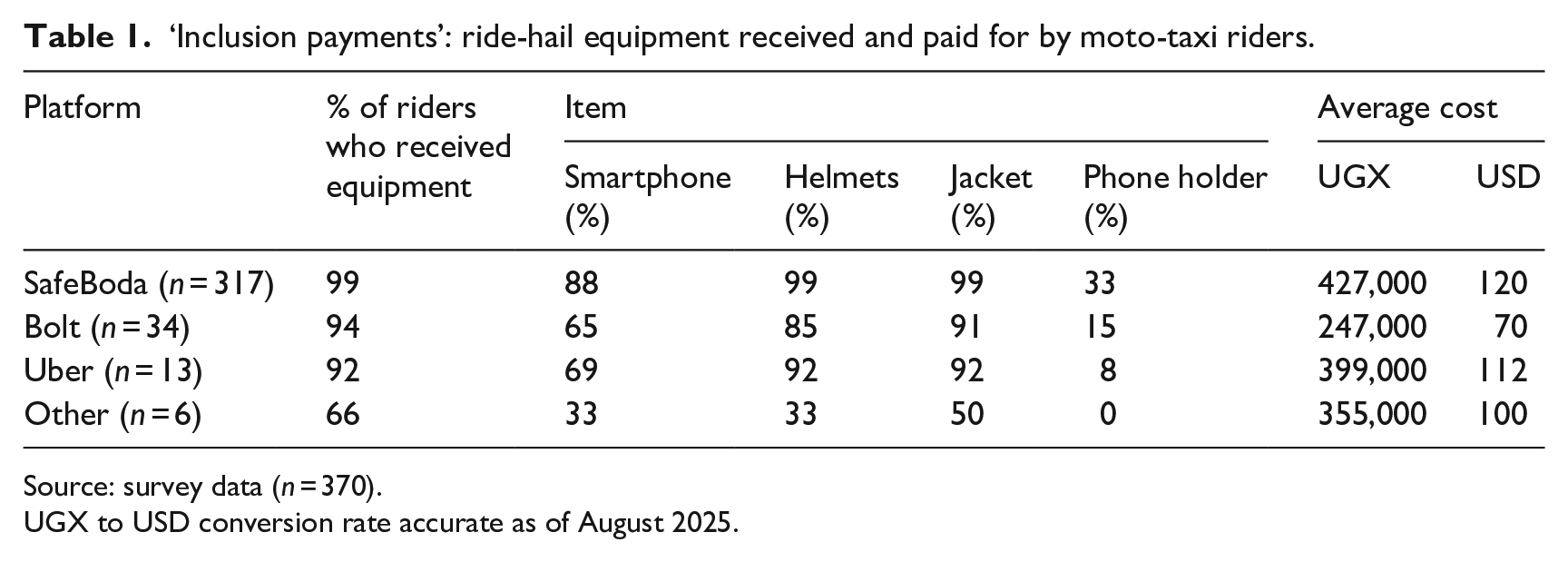
Source: survey data (n = 370).
UGX to USD conversion rate accurate as of August 2025.
A more targeted look at some of the items in SafeBoda’s required inventory helps us to more clearly see how these ‘things’ function as material instruments of economic extraction. Taking smartphones as a first example, we find that 88% of SafeBoda riders within the survey received one upon registration, reflecting a reality that while smartphones are essential for performing app-based moto-taxi work, many riders do not own one to begin with because they cannot afford it. For several years, those signing up with SafeBoda would be provided with the itel P36, an entry-level smartphone model manufactured by Chinese company, Transsion Holdings – also, as it happens, a financial backer of SafeBoda (see Pollio, 2024 for an intriguing account of Transsion’s market-entry work in East Africa). According to the estimates of several riders interviewed, by accessing a P36 through SafeBoda’s registration programme and then paying it off over time through automated pay deductions, they had ended up paying 20%–50% more than the handset’s street value.
Crash helmets offer another, if somewhat more egregious, example. According to a former employee at the company called Daniel, new riders are typically presented with a ride-hailing ‘package’ upon registering with SafeBoda: for UGX 500,000 (approx. $140) they receive all items listed in Table 1, which for many means acquiring these on credit before slowly paying the company back over a period of several months. But while riders frequently assume this entitles them to legal ownership of these things, that impression is false. As the company’s ToU states, although SafeBoda ‘reserve[s] the right to charge the Driver for use of any SafeBoda equipment’, this charge ‘shall not be the purchase price of the equipment and neither shall it comprise any arrangement to mean that the ownership of the equipment has transferred to the Driver’. ‘For the avoidance of doubt’, it continues, ‘the equipment shall at all times remain the property of SafeBoda’ (SafeBoda, n.d.). This is why, when riders go to leave the platform, the company insists they return their crash helmets, whilst also deploying teams of street-level ‘field agents’ to seek out the many who refuse to do so.
There are multiple ways that SafeBoda tries to make money off riders, Daniel told me: The helmet itself is a business. It’s on the side, you can’t see it. The phone is a business. It’s about business besides riders. It’s all about getting commission on things.
Emerging here is another angle on the way in which digital labour platforms seek to extract monetary payments from their workers. While the academic literature tends to focus on the economic ‘rent’ captured ‘from each transaction they orchestrate’ (van Doorn and Badger, 2020: 1475), what this evidence suggests is that platforms may also attempt to generate additional surplus by selling workers the ‘things’ they need to first gain access to the platform economy – through lists of minimum requirements, corporate partnerships with hardware manufacturers, product mark-ups and unanticipated ToU clauses that almost never get read.
Third, once riders have gained access to the platform economy through these initial ‘inclusion payments’, they are then targeted with further sales strategies involving third-party investors and corporate partners. For example, as one of the world’s largest insurers and asset managers, Allianz invests in SafeBoda as a way of securing ‘access to consumers in emerging markets’, linked in turn to a wider corporate strategy to ‘expand in Africa’ through ‘partnerships with insurtechs, MNOs [mobile network operators], and mobility platforms’ (Huynh, in Gaschler, 2021: 16). This includes being able to reach both riders and their passengers alike, with SafeBoda, by visibilising and priming users for sales, in effect helping to ‘lay the groundwork’ for the future development of a boda-centred micro-insurance market (Bernards, 2022: 953). In other cases, platforms team up with credit lenders who are keen to extend the promise of ‘financial inclusion’ to the unbanked masses, whether that be via loans for land purchases and construction work or expensive hire-purchase schemes that allow riders to ‘become their own boss’ through vehicle ownership. Asset financer Asaak, for example, seeks to ‘leverage the rapid digitization [of moto-taxis] happening across the continent’ (Untapped Global, 2021) to gain access to potential hire-purchase clients, using ‘alternative data’ from platforms like Bolt, SafeBoda and Jumia to assess riders’ creditworthiness, establish risk profiles, and ultimately secure a ‘unique foothold’ in this vast ‘untapped African market’ (Republic, 2023).
Linked to this is the fourth way in which Kampala’s moto-taxi platforms help to integrate riders into wider economic relations – through data. On top of the market-expansion interests that drive their funding, digital labour platforms also engage in what some have termed ‘dual value production’ (van Doorn and Badger, 2020), not only extracting a commission on each transaction they orchestrate but also tracking and harvesting data on their users; a strategy that is central to how platforms seek to create, capture and redistribute value from their intermediary position within the exchange process, including through commercial relationships with third-party private enterprises. For example, in addition to the aforementioned partnerships, it was recently revealed that SafeBoda had, via data processing software known as CleverTap, been sharing data with Facebook without users’ consent and regardless of whether they even had a Facebook account (Unwanted Witness, 2020).
It bears mentioning at this point the contrast that exists between the platforms’ efforts to render Kampala’s moto-taxis economically legible to private capital and their much more limited contribution to enhancing riders’ political legibility to state actors. By ‘outsourcing’ registration and data-gathering to the platforms, it was hoped that platformisation would ‘enable the government to keep track of’ Kampala’s riders (ITF, 2020: 19), most of whom have never been officially registered. But crucially, this is an approach to formalisation that hinges on there being enough co-operation on data-sharing; something we know from other contexts does not always materialise easily in practice (Monahan, 2020). Indeed, despite platform executives continuing to claim that their ‘vast amounts of data’ improve ‘traceability’ and ‘security’ (Kafumbe, 2023), actual developments over the years portray a rather different picture. At KCCA, for example, one official I interviewed described positive early interactions – ‘we were moving in sync’ – but went on to describe how longer-term cooperation with the ride-hail companies had never really ‘kicked off’, while a member of the National Planning Board had found in practice that the platforms tended to ‘withhold their data’ when participating in wider reform initiatives. A recent refusal by SafeBoda to share data with government following a direct request by URA provides further indication of where platform priorities lie (Private Sector Foundation Uganda, 2023) – and indeed what some of the limits of an approach to formalisation built around commercial outsourcing, private data ownership and non-binding cooperation agreements might be.
Given the range and depth of extractivist techniques at work here (Mezzadra and Neilson, 2017), a final question perhaps arises: how have riders themselves responded? While there is no space remaining in this article to do such a question the justice it deserves, it is worth highlighting the recent emergence of a new worker-owned ride-hail platform called the Union App which, amongst other things, promises to impose far lower commission rates on riders’ pay. Developed and launched by the United Boda Boda Riders Cooperative Union (Lutaaya, 2025), this alternative platform represents a collective attempt by workers to reclaim some degree of control over the platform labour process, and is yet another example of how worker struggles in the digital age are giving rise to an expanding array of innovative pushback strategies by precarious collectives across the global South (Webster et al., 2021). Only time will tell if it is eventually able to outmanoeuvre the mutating mix of private sector options. In the meantime, Kampala’s platformed moto-taxis will continue to individually challenge and rework the terms of their digital inclusion through a variety of less visible means: by bending and breaking company rules in a bid to moderate low platform pay; by re-incorporating substantial shifts of analogue boda work back into their daily routines; and, finally, by logging-off altogether in a mundane yet powerful act of digital refusal (see Mallett, 2024: 203–225). 8
Concluding: Behind and beyond the aesthetics of formality
In the face of growing talk about the formalising properties of digital labour platforms operating in the South, recent research has begun to highlight the limits of what platformisation actually ‘does’ in such settings. Rather than bringing about a ‘full’ formalisation of work, what these emerging critical accounts suggest is something more akin to a partial or incomplete process, whereby particular dimensions of people’s working lives are becoming regularised through their inclusion in the platform economy. There is increasing discussion of ‘selective formalisation’ (Hunt and Samman, 2023), ‘semi-formalisation’ (Carmody et al., 2024) and of formalisation ‘to some extent’ (Chen and Qiu, 2019) or that is ‘partial at best’ (Ray, 2024a), as newly platformised informal workers become registered (but not protected), ‘taxed’ (but by private rather than public actors) and able to track earnings and working hours (but not to claim sick pay or leave). These are useful Southern correctives to an unhelpfully simplistic conventional narrative, and a key step towards ‘problematising formalisation’ in the age of the digital platform (Cieslik et al., 2022: 10).
And yet, do these theoretical refinements go far enough? The recent and ongoing experiences of Kampala’s boda boda riders suggest there may be more to unpack here, providing as they do valuable grounded insights into the nature of ‘actually existing platformisation’ (van Doorn et al., 2021), as well as a suggestion that ideas of selectivity alone may not be sufficient to capture and explain this shifting in/formality dynamic. In particular, what these experiences show is that the kind of ‘formalisation’ being produced by Kampala’s moto-taxi platforms is not just partial or selective, as the above Southern correctives suggest, but illusory and surface-level too. By playing off particular epistemologies of informality that convey a sense of unstructured chaos and disconnectedness (Nason and Bothello, 2023), platforms and their proponents are able to sell a brand of formalisation trading in processes of standardisation (e.g. of price-setting and payment methods), traceability (e.g. of completed trips and credit repayment progress) and connection with cleverly marketed and ostensibly formal economic actors (albeit ones which paradoxically operate in a largely deregulated space – see Fairwork, 2023).
But although this approach is effective at generating what we might think of as an ‘aesthetic of formality’ at the surface – steering riders towards more consistent helmet use, removing face-to-face haggling over trip prices, amassing data on riders’ identities and movements, imposing corporate codes of conduct (and so on) – in practice the core, underlying features of riders’ informality remain untouched and intact (Dolan and Rajak, 2018). While the creation of new connections between previously ‘untapped/unbanked’ workers and formal enterprise lends an impression that formalisation is underway – a product, perhaps, of the institutional voids reading of plat-formalisation that misleadingly equates economic formality with efficient, ‘frictionless’ markets and normative standards of organisational form (Bothello et al., 2019) – digital riders are ultimately still left to fend for themselves as they remain, as casualised gig workers, outside the protective elements of employment legislation. This is the beating heart of labour informality, and it has been almost completely untouched by nearly a decade’s worth of private-sector-led digital ‘transformation’.
Thus, if part of what platforms are thought to ‘do’ in the global South is ‘counteract informal economic activity’ (Weber et al., 2021: 1338), then this is not what has happened in Kampala’s moto-taxi industry. Platformisation here has generated, to date at least, no discernible impact on either the way in which the Ugandan state relates to boda boda riders or the fundamental nature of their employment status, with ride-hail dynamics simply feeding in yet another layer to the ‘deliberate development’ (or rather, the deliberate maintenance) of informality that has long taken place under the existing political status quo (Harriss-White, 2010). 9 What it has done, however, is succeed in integrating at least some of these informal workers into new kinds of labour-capital relations.
Viewed through this alternative lens, the mode of formalisation enacted by Kampala’s moto-taxi platforms is not one that sees previously informal workers being brought under the protective wing of state labour law (Unni, 2018), but rather one in which low-value but high-volume actors and revenues circulating within the informal economy are rendered both legible and ‘usable’ to global capital (Dolan and Roll, 2013; Meagher, 2021). Subsequently, this is not a process of labour formalisation as it is conventionally understood but a vague approximation that uses aesthetics of formality as cover for extended forms of ‘profit-making and accumulation’ (Gabor and Brooks, 2017: 424) taking place beneath the surface. Whether this practice actually succeeds in making the platforms profitable, however, is another question entirely; these are highly uncertain, speculative endeavours whose ability to one day turn a profit remains as yet unproven.
It has recently been argued that critical platform scholarship must start paying closer attention to the full range of value that platform companies are creating across Southern contexts, beyond that which they are simply trying to capture for themselves in the form of data and revenue (Cirolia et al., 2023, 2024; Hodson et al., 2025; Wei et al. 2024). While it is surely important not to be blindsided by ‘techno-pessimism’ as we approach our subject matter, it matters equally that we are not seduced by the visions and mission statements of an industry not well-known for its modesty (Peck and Phillips, 2020). What Kampala’s digital boda riders help us understand is that corporate declarations of formalisation can not only be thin or selective – helping, for example, some riders to comply with some formal licensing requirements some of the time – but that they can also be accompanied by extractivist designs in which platforms act as a kind of conduit for channelling informal workers towards private capital and revenue-making strategies (rather than towards public authority and labour protections). Seen from this perspective, Southern processes of platformisation do not so much represent a re-centring of the labour formalisation agenda ‘of old’ as they do an attempt to commodify and repurpose the ‘merits of formalization’ (Nguyen et al., 2024: 33) as a new source of corporate value. It is in light of grounded insights such as these that the hard limits of plat-formalisation become clear.
Footnotes
Acknowledgements
Many, many thanks to those in Uganda who gave their time to participate in this research and those who helped me to implement it, including Geofrey Ndhogezi, Hakimu Sseviiri and the rest of the team at Makerere Univeristy’s Urban Action Lab. I am grateful to Claire Mercer, Kate Meagher, Pádraig Carmody and Tom Goodfellow for feedback on earlier iterations of this work (and to Pádraig again for comments on a first draft of this manuscript!), as well as to the anonymous peer reviewers whose thoughtful, constructive comments helped strengthen the finished article. Finally, my thanks to Mark Graham and Katie Nudd at EPA for their handling of the review process.
Data availability
The survey dataset generated during and/or analysed during the current study will soon be available in the UK Data Service’s self-deposit data repository (currently in process). The qualitative dataset generated during and/or analysed during the current study is not publicly available in order to protect the privacy of participants, but some parts of it may be available from the corresponding author upon reasonable request.
Declaration of conflicting interests
The author declared no potential conflicts of interest with respect to the research, authorship, and/or publication of this article.
Funding
The author disclosed receipt of the following financial support for the research, authorship, and/or publication of this article: The author received funding from the UK’s Economic and Social Research Council via the London School of Economics’ Doctoral Training Partnership [grant number: ES/ P0006SS/1], which enabled this study to take place.
Ethical considerations
This research received ethics approval from the London School of Economics, the Research Ethics Committee based at Makerere University’s School of Social Sciences, and the Uganda National Council for Science and Technology on 1 July 2021 [approval no. SS844ES].
Consent to participate
Informed consent was obtained verbally before participation.
Consent for publication
Included as part of informed consent procedure. No identifying information contained within manuscript (all identities have been anonymised).
