




Abstract
This Exchanges commentary adds to recent dialogue in economic geography on how methodological approaches, explanatory goals and political standpoints intersect. Drawing lessons from collaborative projects that have sought to understand the concrete, place-based experiences of labouring in industries amidst capitalist and environmentally induced restructuring, we describe and advocate for a multi-sited ethnographic approach that we call ‘following the labour process’. We highlight three recurring challenges for researchers adopting such an approach to building explanations that purposefully centre labour: (1) developing and maintaining different relationships, (2) making sense of difference and (3) making a difference. Multi-sited following illuminates moral and political aspects of commodity relations, prompting reflection on the ethics of research engagement and knowledge production. While requiring engagement in/across different, interconnected sites, multi-sited ethnographic following can help yield rich empirical insights capable of deepening scholarly explanations, engaging diverse audiences and articulating normative viewpoints.
Keywords
Introduction
This Exchanges commentary continues dialogue in economic geography on how methodological approaches, explanatory goals and political standpoints intersect. We join the discussion as two white, middle-aged male economic geographers employed at an Australian public university. Both of us are from blue-collar backgrounds, raised in industrial cities at opposite ends of the world (Wollongong, Australia and Luton, England) with working mothers who were teachers and fathers who made steel and cars. We work in a region where the forces of multinational capital, a neoliberalising state apparatus and organised labour, are felt vividly. A gritty, unpretentious sense of place prevails. We share concerns for worsening socio-spatial inequalities and hope for more equitable future access to life opportunities. Our contribution here draws from collaborative research projects that have sought to understand the concrete, place-based experiences of labouring in industries gripped by capitalist and environmental-triggered restructuring. Below, we describe and advocate for a multi-sited ethnographic approach to provide such understanding. This approach, we call ‘following the labour process’.
In formal Marxian terms, labour process theory focuses on the conflictual relations between capital and labour, explaining work transformations in relation to broader structures. The aim is to explain how value is extracted from workers and objectified by capital, ultimately in pursuit of profit. For example, within enterprises, tasks are split, workers are controlled, and work is degraded, deskilled, or displaced (Smith and Thompson, 2024). This fans labour-capital conflicts. Our work is in dialogue with this approach (Warren and Gibson, 2023). Yet, multi-sited ethnographic investigations extend what is meant by labour process. Multi-sited ethnography is a form of mobile research practice, embracing a strategy of tracing things ‘around a multitude of places’ (Van Duijn, 2020: 283). We conduct grounded fieldwork ‘following’ labour, in this manner, engaging with workers, in different contexts, over an extended period. It is a methodological commitment to observe and understand what workers in and across workspaces actually do: the systems, processes and material interactions comprising work tasks, and the skills, relationships and collaborations required to do such work. What workers do in performing their roles is consequential for how activity is structured, socially and spatially, how agency is realised and for how places are constituted at the nexus of power relations. The details of labour process in various material spaces, we believe, matter for ensuing economic geographical explanation.
In what follows, we draw on five collaborative projects, conducted over two decades, to illustrate the point. Our initial two collaborations explored evolving relationships between automated technologies, the social dimensions of skill and employment conditions across non-unionised work in surfboard manufacturing and automotive servicing (Warren, 2014; Warren and Gibson, 2011, 2023). Amid a cost and profitability crisis in Australia’s steel industry, a third longitudinal study with workers followed their post-redundancy re-employment experiences. Deploying the feminist concept of ‘social life matters’, we reiterated how workers are tied to place, humanising interpretations of labour immobility (Warren, 2019). In another case of the ‘restructuring present’, a fourth project examined resource- and regulation-compelled transformation in the guitar industry, the uneven effects of global environmental regulation and the underappreciated work towards sustainability transition performed by workers positioned across a dispersed production network (Gibson and Warren, 2016, 2021). Most recently, our focus has been on understanding maritime work at ports, supporting global circulation while facing escalating disruption risks, competition, and operational pressures (Gibson and Warren, 2025; Warren and Gibson, 2024). Such research speaks to the potential for building solidarity across workspaces, roles, divisions and organisations. But we have also had another worker-centred agenda: appreciating and explaining the often-overlooked work that people do, while navigating pressures and wrestling with their own contradictions amidst workplace regimes, community life, and household dynamics.
We believe that multi-sited ethnographic ‘following’ of labour process aligns with Rosenman’s (2024: 2) recent call to infuse explanation in economic geography ‘with a renewed sense of purpose’. The forms of explanation matter. Here, ‘purpose’ means building theoretically informed explanations of how things work that guide future research and can be the basis for ‘opening-up different avenues for intervention and action’ (Massey, 1995: 318). We discuss the multi-sited ethnography of labour process as a strategy to strengthen the field’s public and political relevance.
In this light, below we describe key considerations when undertaking multi-sited ethnographic research aiming to help build explanation that purposefully centres labour. We emphasise: building theory and forms of explanation linking geographical differences, lived experiences and broader structures; enlivening research-led teaching to show students the relevance of economic geography; and intervening in debates via place-based explanations of problems, consequences and normative policy standpoints. After detailing multi-sited ethnographic approaches, we discuss three recurring challenges: (1) building and maintaining different relationships, (2) making sense of difference and (3) making a difference.
Doing economic geography differently through multi-sited ethnographic research
The genesis of multi-sited ethnography is in anthropology. It aims to extend the research process beyond neatly bounded, singular field sites, explaining an increasingly complex world of material flows and interconnections by observing matters up-close and across space. Multi-sited ethnographers can follow a range of different forms: people, objects, metaphors, stories, biographies and conflicts (Marcus, 1995). The tools of multi-sited ethnographic research include participant observation, semi-structured interviews, in situ note-taking, sensory methods, archival analysis and the integration of quantitative datasets. 1
In geography, an analogue is the ‘follow-the-thing’ approach (Cook, 2004). Its origins trace to Harvey’s (1990: 422) call to ‘get beyond the veil, the fetishism of the market’. In the ‘hidden abodes’ of hyper-fragmented capitalist production, workers and the conditions under which commodities are made/exchanged are invisible. ‘Following’ as method and metaphor brings awareness to the ‘powerful, important, disturbing connections’ between Western consumers and the ‘distant strangers’ whose exploited labour power created the things furnishing their lives (Cook, 2004: 642). 2 The goal is conceptual and political: a critical re-examination of the different relationships structuring the global economy, beyond binary framings (production/consumption, supply/demand, value/devalue), foregrounding ethical and moral questions (Cook and Harrison, 2007). Marxist geographers also saw potential for such an approach to support interventions in business-as-usual exploitation and capital accumulation (Castree, 2004).
Scholars adopting the approach have followed things of apparent ‘rubbish value’ (Gregson et al., 2010), policy movements and mutations (Peck and Theodore, 2012), craft practices (DeLyser and Greenstein, 2015), digital data (Akbari, 2020), multinational firms (Brill and Özogul, 2021), and money (Hughes-McLure, 2022). Aspects of multi-sited following have been reworked to ensure ‘the spatial and scalar relations between research sites’ are considered active and impactful (Peck and Theodore, 2012: 27). As the methodology evolves, anthropologists and sociologists are also more fully engaging with the difference geography makes to how connections are made among a ‘plurality of actors, activities and sites of action’ (Islam, 2024: 39). The strategy relies on close engagement with multiple, interconnected field sites, to deepen understandings of complex relationships, processes, meanings, mechanisms and outcomes.
Our mode of following shares such intent, but specifically centres labour. While ‘things’ in many cases initiate our following – surfboards, cars, steel, guitars, etc. – we foreground workers and the often-hidden work that they do. Hence, our approach is to begin primary fieldwork with in situ semi-structured interviews, often held in a place of work, or familiar local space. Such interviews afford early insights and constitute a process of figuring-out and building-up, testing the validity of underlying aims, assumptions and concepts. Only as a clearer view of things emerges, does the research plan evolve.
Early interviews also provide opportunities for building rapport, gaining recommendations on other contacts and negotiating permission to revisit a site for participant observation. Revisiting is especially valuable for building more than one-off or transactional relationships. Once site access is granted, we complete necessary safety inductions and training to enable participant observation with workers across the spaces and divisions of labour within a workplace. Over weeks and months, we learn about the workings of an industry or organisation from its employees, including the wider constellation of relationships significant to how things operate. Such relationships provide directions for enabling subsequent data collection, jumping-off points to follow via other interconnected sites. While a degree of following can be desktop-based, the approach benefits from up-close, first-hand encounters. As Gertler (2004: x) put it, ‘there really is no substitute for being there’. Thus, researchers are required to engage in multi-sited movements of their own: following within workplaces, neighbourhoods, and cities, or equally, across multiple cities, states, or continents, tacking back and forth in non-linear ways. Gradually, in this fashion, we map out the relationships that actors and organisations embody as part of their daily operations.
Multi-sited following thus structures fieldwork to make sense of socio-spatial relations and analysing the consequences of multiscalar processes. Such a methodology is suited to theoretically informed, relational explanations of ‘diverse economic geographical phenomena’ (Yeung, 2024: 1558), from which opportunities also arise to develop normative perspectives – that is, to try and make a difference. The difference made is not, however, solely about exposing sites of labour exploitation and explaining their causation. While our approach is ever-attentive to exploitation (labour as a ‘fictitious commodity’, in Polanyian terms), as feminist geographers argue, exploited or commodified labour is just one part of life’s work needed to reproduce ourselves on a daily and generational basis (Mitchell et al., 2004). Hence, across field sites, we listen to workers about how wider structural forces, personal and community considerations shape their careers, on-the-job circumstances, and life chances, in place. Multi-sited following of labour process draws to light aspects of change and continuity in lived experiences of work (McDowell, 2014), to structural exploitation and human agency, to the emotional toll of wider forces of capitalist restructuring and the entangled, sometimes compromised positions workers find themselves within. Such integrative criticality is, we argue, necessary to explain the effects of uneven power relations and labour’s differentiated experiences.
Reflecting on our collaborative projects, we now highlight three challenges encountered in following labour processes, in this way.
Different relationships: Building and managing connections
Relationships, of different kinds, are at the core of following the labour process across multiple sites. Relationships must be nurtured and managed. There are dilemmas about who to associate with; where to follow; how long to stay in the field; what invitations to accept or decline; how to handle participant expectations and requests; when to trust participants in setting the direction of our following; and how to manage relationships between actors in conflict and competition with one another (Table 1). Encountering strange and disorientating fieldwork locations is also common. The relationships that enable following to succeed are themselves shot through with power relations, political views and ethical considerations. These play a role in shaping the research process, results and explanatory goals.
Guiding questions and moral dilemmas with multi-sited ethnographic following.
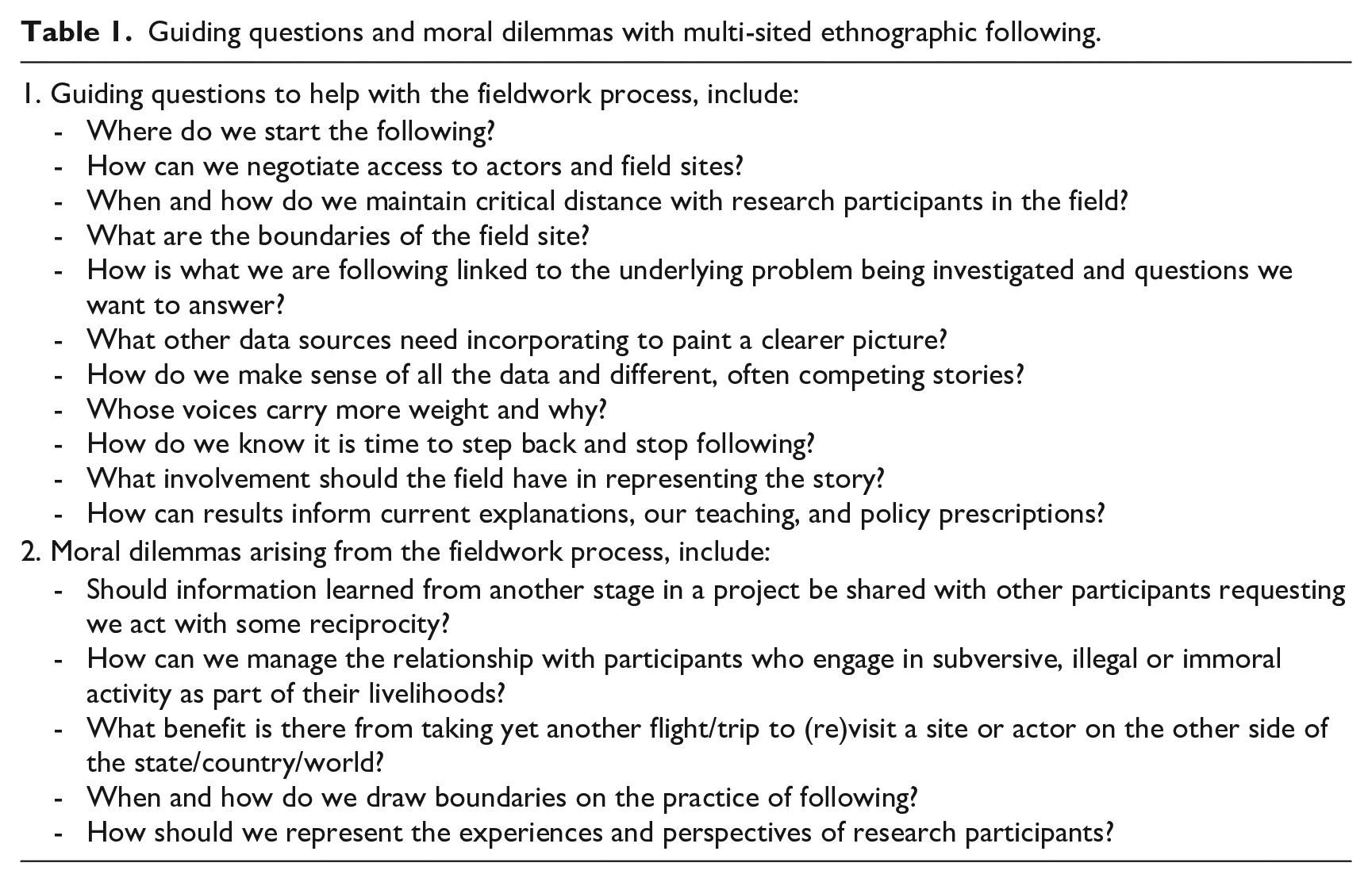
Making connections and gaining entry to a multi-sited and multi-actor ‘field’ is difficult. Recruitment will benefit from a direct approach that snowball samples via the use of contacts, social media, digital platforms (e.g. LinkedIn), emailing, phone calls and ‘turn-ups’ at industry events, community sites, or workplaces. Such a mixed strategy aims to help get ‘a foot in the door’ with an organisation or actor. As the process unfolds, it helps to have a clear sense of what the research is about, even if the following remains open-ended. This is a question recruits often ask. Researchers need to deftly explain the research’s purpose without academic jargon or hubris.
The open-ended nature of multi-sited following can mean navigating different fieldwork directions (Peck, 2024). There are various starting points. In following the labour process of the guitar industry, we went back-and-forth from visiting assembly workers in factories to sawmillers processing timber, from sawmillers back to foresters supplying wood and from foresters back to factories that were experimenting with their own value-added processing. Much of the following was led by participants who interpreted what our research was about and led us through connected parts of a production process via their extensive network. ‘Being there’ frequently enough built trust and delivered opportunities. Happenstance invitations emerged to travel with sawmillers to visit supply sites, or from manufacturers’ procurement specialists to visit their own factories, when crossing paths within sawmills. For most capitalist commodities, production is not linear but spatially fragmented. Likewise, following the labour process need not be neatly chronological but trace connections, relationships, and effects across their messy, networked form.
Another relationship-focused challenge is how to manage connections and informational politics (‘what you know’) with an expanding and diverse research field (‘who you know’). Peck and Theodore (2012: 26) noted how following fast policy movements through elite networked actors demanded ‘a degree of strategic circumspection’. In establishing a project, the need arises to undertake conscious self-reflection, and at times, rethink or suspend initial assumptions. For us, offers to meet or travel with participants can be declined based on the risks of losing independence. Other times, invitations to attend a trade show or industry event with participants are accepted, though with travel always funded independently. Once doors open, the challenge then becomes how to manage ethical dilemmas and relationships with an expanding array of participants. As workers are differently situated and empowered in stretched out networks, they are regularly in conflict and/or competition with one another. Two separate experiences illustrate such dilemmas.
In 2012, Andrew was conducting participant observation in a large integrated steelworks as 1000 full-time jobs (25% of the workforce) were to be slashed as part of a corporate restructure (Warren, 2019). Proposed cuts targeted areas of the plant associated with export slab steel production, amid a glut of cheaper alternatives on world markets and an inflated Australian currency during a mineral resources boom. After interviews with workers in family/household settings, Andrew negotiated access to conduct participant observation in different spaces of the sprawling plant. This phase began by following a crew of works planners and operations staff in a space shielded from the ‘restructuring pain’. After 3 months, a move was negotiated to the slab casting division where forced redundancies were concentrated. Within days, workers at the slab caster demanded information learned from the works planning team regarding operational changes and intentions of some older staff to accept voluntary redundancies that may have saved jobs in the department. It was made clear that research in this part of the works could only continue if information was ‘leaked’. Despite efforts at strategic circumspection, an unwillingness to divulge information meant the situation became untenable. After a week Andrew reluctantly relocated, following the labour process to the rolling mill.
Another case concerned following labour across different stages of value-creation in the guitar industry (Gibson and Warren, 2021). Through fieldwork we learnt about the commercial strategies of several large manufacturers, spanning timber procurement, price-setting behaviour, investments in forestry projects and approaches to regulatory compliance. When we followed the labour process to the sawmills that supplied manufacturers, we were asked to share information on aspects of sourcing, grading, pricing and production levels. Such information was not publicly available but would assist smaller, price-taking businesses to negotiate improved supply contracts and purchasing agreements with manufacturers. We felt a responsibility to respond. Rather than withhold or ‘leak’ information, we brokered meetings and information sharing between actors holding similar environmental values. A more mutually beneficial financial outcome could then be negotiated between distant and differently-sized actors that made a small difference to how forest resources would be managed in the industry.
These events unfolded in the background to the research. While they did not substantially influence results or warrant explanation in ensuing publications, they underscore how multi-sited ethnographic approaches place researchers in situations where different outcomes become possible. Multi-sited following provides first-hand knowledge of competing firms across a dispersed geography, including commercially sensitive information and insights beneficial to the interests of workers within these firms. A balancing act therefore ensues, between relationship building with workers in different roles and levels of seniority and maintaining critical distance.
Amidst such challenges, a multi-sited approach also revealed different kinds of relationships that connect workers within and across firms and stages and spaces of production, enabling further insights to surface on the labour process itself. These span conflict and competition (between labour and capital, and/or between buyers and suppliers) and coordination and collaboration (Warren and Gibson, 2024). Collaborative and conciliatory relationships are often concealed, and frequently devalued, but are meaningful and shape outcomes. The social and technical relations of work involve not only the material production of a thing on the factory floor – the point of value-creation as understood within a conventional frame – but a range of tasks involving social and communicative skills: resolving complaints; maintaining relationships; organising and scheduling work; and sharing insights on trustworthy suppliers (Warren and Gibson, 2023). These aspects often only surface after realising the behind-the-scenes relationships that exist between workers across multiple sites.
Making sense of geographical difference
Multi-sited following engages researchers with spatial variation, the heterogeneity of place and the distinctive geographical forms that difference can take. This creates another challenge: how to make sense of the geographical differences we are told about, observe up-close, and represent in our writing. Working with and making sense of geographical difference invokes another key relationship, between the theory giving research a sense of direction and the empirical details charting where to follow and where sense-making is required.
Economic geography spans different relationships to theory. Some economic geographers place emphasis on causal explanations, where abstraction from empirical details invites the crafting of general laws or rules (Yeung, 2024). Others warn that theory as causal explanation limits capacities to alter the status quo (Gibson-Graham, 2008). On making sense of messy geographical differences, Massey (1995: 316) offers sage advice for focusing on the ‘accumulation of evidence’ and a gradual process of evaluation whereby particular structures and causal powers are viewed as ‘enabling’ rather than ‘determinate of any particular outcome’. For us, a multi-sited approach reveals a worker’s job as one experience within the overall relations of capitalist production; an experience that articulates with other jobs in the labour process but also ‘wider sets of social relations’ that are spatially organised (Massey, 1995: 317). Difference and specificity become ‘questions of the articulation. . . of criss-crossing axes of causality and influence’ (Massey, 1995: 318), including of capital, labour, the state, technology and place in an economy.
Our approach is to try and accumulate insights and scholarly explanation of a problem – such as the relationship between evolving technologies, skills formation and waged employment – by following the labour process. Yet, unexpected insights, variations, commonalities, and contradictions invariably surface. Rather than merely emphasise differences for their own sake, through reflexive, narrative forms of analysis we put variations into conversation with theory and concepts to make sense of conditions and thus add – subtly or substantively – to existing understandings. Multi-sited following will frustrate classic deductive reasoning, eschewing imported, preconceived or rigid categories. Likewise, the strategy is unsuited to a strict method of induction whereby the same general factors (e.g. technological change) are assumed to explain outcomes in different places. Such theorising poorly explains how geographical phenomena influence the processes and mechanisms in question. The result can be a breakdown in the balancing act between constructing a meaningful explanation and its basis in the empirical realities being interpreted and reported.
Making sense of geographical differences echoes the process Burawoy (2021: 33) calls ‘absorbing anomalies and contradictions’. This helps explain why a project’s relationship to theory is so weighty. Without theory an empirical project lacks direction. Without empirical details, theory is baseless. A metaphor we find helpful working across, and making sense of, difference is the notion of a mosaic. In our case, how mosaics comprising different workers, employers, activities, and spaces fit together, requires combining empirical insights with the ‘tacit theories that guide [our] everyday worlds’ and ‘the canonical texts’ informing our theoretical understanding of the issue being investigated (Burawoy, 2021: 33). Through a sense-making process the mosaic comes together and a clearer image emerges. Mosaics can also be built up to illuminate what is going on across interconnected sites and actors, forming a multiscalar explanatory structure. While one empirical outcome will not necessarily provide clear causal insights, mosaics, like pieces of a puzzle, can be accumulated together to reveal the broader picture. Through such an analytical process it is also possible to represent geographical differences, feed back into theoretical understandings and open space for politically oriented, normative contributions.
Integral to our research has been embracing the irregularities, variations and differences that emerge from studying commodity relations via spatialised labour processes (Warren and Gibson, 2021). Interpreting and situating such geographical differences, while analytically challenging, is often conceptually and politically generative. Insights ensue into how general dynamics and multiscalar forces have contrasting and sometimes contradictory outcomes across places and communities, too easily missed without requisite multi-sited exploration, especially if relying entirely upon less embodied methods such as surveys of firms or workers. 3 Examples from four of our five research projects illustrate the point. First, on-the-ground following of the labour process and lived experiences of steelworkers, enabled examination of labour-capital conflict but also a fuller understanding of intra-labour agency and tensions (Warren, 2019). Second, within automotive workshops, multi-sited ethnography revealed gendered struggles over skills amidst technical change (Warren and Gibson, 2023). Third, without multi-sited fieldwork, our research at ports might have singularly concluded that workers are subordinate to global logistics regimes, rather than appreciate how they exert control over ports through collaboration and skill, and that they view ‘their’ ports as maritime places, and refuse to be subsumed within the category of ‘logistics labour’ (Warren and Gibson, 2024). Fourth, without following the labour process of guitar-making, we may have solely emphasised the industry’s deleterious environmental impacts without appreciating how key workers grapple with their own contradictions and are protagonists acting to realise a more ethically grounded future (Gibson and Warren, 2021). Difficulties that ensue from making sense of such difference include the risk of being accused of mere relativism, in contrast with normative explanation or ‘clean’, nuance-free abstraction (Healy, 2017). Another analytical-political lesson from Massey (1995) looms here: the importance of recognising how difference and specificity link to different forms of explanation. The construction and reproduction of capitalist difference, for example, always ‘relies on an understanding of broader structures’ (Massey, 1995: 324). But so too, must we follow and observe workers’ lived experiences of those broader structures on-the-ground, across geographical differences. Doing so is not just to contextualise findings, but to move towards deeper, even if sometimes less clear-cut, explanations truer to a worker-centred perspective.
Making a positive difference
A third challenge is the dilemma of how to try and make a positive difference. To contest the inequity and oppression uncovered in studying people’s experiences of economic restructuring is a political and normative exercise (Katz, 2004). We have tended towards two main avenues.
The first focuses on the research-teaching nexus for learning at public universities. We have sought to infuse our teaching with perspectives, anecdotes, data and analytical skills learned through a following methodology. Likewise, our teaching responsibilities help inspire refinement of our own research practice. We have been responsible for teaching introductory undergraduate units with several hundred students across a diverse cohort, including students in social and physical sciences. The topic areas are familiar to economic geographers: global trade and international divisions of labour; industrial change and urban redevelopment processes; housing markets and financialisation; household consumption; sustainability; and just regional transitions. We highlight current issues before deploying geographical concepts and analytical tools to help students develop understandings of problems and explore ideas for resolving them (i.e. policies/regulations).
Through field-based learning and problem-oriented assessments, students conduct their own following research, focusing on a pervasive commodity (coffee, cocoa or cotton). In classes, we discuss the methodology and its backstory; access trade data; conduct a literature review; map spatial flows; and complete a report explaining the economic geographies of the coffee, cocoa, or cotton trade. Through the semester, we aim to deepen student engagement with decision-relevant inquiry. Students contribute to online information sharing via consumer-facing websites (e.g. ‘Good on You’), compose a group submission to a government inquiry or policy review (in 2024, a review of fast fashion regulation called ‘Seamless’), and reflect on their own consumer behaviours. The ‘following’ methodology has proved invaluable because it connects economic geography with student’s own lives and future possibilities. Dialogue with and feedback from students has also shaped our research approach. We have found a multi-sited following strategy as a useful means through which to build key skills, competencies and values in our students. Another of Massey’s (2005: 11) insights reverberates here: ‘only if we conceive of the future as open can we seriously accept or engage in any genuine notion of politics’. Learning how to ‘follow’ things critically, students increase their confidence in making a positive difference in the world.
The other approach to making a difference is via direct engagement with the politics of decision-making, collective action, and policymaking. From our shared concerns with worsening inequality, we have consistently explored ways to communicate research findings and explanations to wider publics and actors in positions of power: government ministers, policymakers and senior bureaucrats, Senate Committees, Boards of Directors, media organisations, and labour unions.
We finish with an anecdote illustrating the challenges of making a difference in this way, from multi-sited ethnographic research following workers in the surfboard industry. Within interviews, many participants discussed the need for a collective approach. Opportunities arose for intervention beyond the initial empirical research (and the scope of ethics committee approval). Universities increasingly promote such actions, towards ‘impact’. On the suggestion of workers interviewed, after the research was published in the form of a book, that received widespread media attention (Warren and Gibson, 2014), we attended industry events and communicated insights on poor working conditions and lax workplace health and safety (WHS) standards to industry and government actors. Through public presentations, national media engagement, policy prescriptions, and advocacy at industry meetings, we helped key industry figures (prominent surfboard shapers) bring workers together to form the Australian Surf Craft Industry Association (ASCIA). ASCIA aimed to assist with improving working conditions, pay rates, training and WHS. We communicated research results and anecdotes to workshops and workers nationally. Momentum was building and it appeared for a time as though ASCIA would incorporate and succeed in collectivising the workforce.
However, progress stalled when it came to drafting key documents (Code of Practice, Constitution). Differences in views on training approaches, the role of new technologies and the bargaining role of ASCIA, could not be bridged. Despite evidence of the potential material gains from collective action, a strong ethos of creative individualism undermined a nascent unionism. As part of ASCIA, we had also supported efforts to win grant funding for a pilot vocational training programme. The Surf Craft Manufacturing Trade Qualification began at state-run vocational training campuses (TAFE) in south-east Queensland in 2016. It aimed to develop the industry’s skilled labour market, comprising some 3500 employees nationally. Despite strong initial interest, a formal training approach also failed to achieve wide appeal. Most surfboard workshops recruited from local subcultural surfing scenes, exploiting the blurry line between a job and a lifestyle indicative of other creative industries (Gibson, 2003). Systemic issues around the dangerous exploitation of younger workers persisted where they ‘had to be willing to take the vow of poverty’ (Warren and Gibson, 2014: 223) before gaining experience to earn a more liveable wage. Five years spent working to make a difference in the industry met with only modest gains.
What difference can we make?
Nearly two decades ago, Lovering (2006: 228) provocatively claimed that economic geography was losing its ‘empirical substance’, relying on ‘barely more than a sloganistic level’ of primary field research as scholars appeared to ‘know all the answers a priori’. The call was made, and has often been repeated, to source and appeal to deeper evidence. Multi-sited ethnographic following of labour process is, we believe, one positive methodological intervention well suited to provide such evidence. Following the labour process identifies the various actors, in paid and unpaid positions, who rework relationships to drive change for complex economic, ethical and moral reasons. A geographical method of following involves a ‘multi-stranded character’ with a triangulation process suited to integrating ‘different kinds of data’ (Hammersley and Atkinson, 1983: 24). Following labour process, in this manner, invites economic geographers to build explanations of the forces and people shaping the world.
Such empirical insights also form a basis to advocate for ‘positive visions of what the world could be’ (Burawoy, 2021: 36). 4 Making a difference requires more than constructing scholarly accounts that are reliable, revolutionary even, but only read by ourselves. In addition to research articles, we have written books about surfboards and guitars, with non-academic and student audiences in mind, as well as summary reports, policy briefs, submissions to senate inquiries, and op-ed news pieces. An ability to report ‘from the field’ in such efforts, across many connected-up places, is a key reason why we adopt a multi-sited following strategy. For us, following labour processes has been a methodological commitment to take place-based outcomes and lived experiences more seriously, beyond the now well-worn and simplistic counter-critiques of emphasising particularity and specificity for their own sake. Following involves considerable analytical and political work. But such a methodology can put forward robust evidence and help to circulate ideas for how things can be done differently and in ways that explicitly aim to make a difference.
Footnotes
Declaration of conflicting interests
The authors declared no potential conflicts of interest with respect to the research, authorship, and/or publication of this article.
Funding
The authors disclosed receipt of the following financial support for the research, authorship, and/or publication of this article: Research discussed in this paper was funded by Australian Research Council Grants DE180100492 and DP200100633.
