




Abstract
This paper examines how Lisbon transformed from a city widely seen as a crisis-ridden ‘no-go’ zone into an ideal real estate investment destination. This redesignation allowed the city to serve as a ‘spatial fix’ for overaccumulated capital in core Europe in the aftermath of the global financial crisis. While the push for capital to ‘switch’ between sectors and geographies rests on systemic dynamics, this paper explores how the spatial fix is also discursively mediated. Studying real estate industry reports as ‘market devices’ and drawing from interviews with real estate actors and observations at industry events, I demonstrate how industry narratives reinforced the need to shift capital to peripheral markets, and re-framed Lisbon itself into a lower-risk, viable destination for investment. This helped set the conditions for global corporate investors to enter the Lisbon market. This article thus builds on a growing dialogue between critical political economy and performativity, by exploring how narratives both reflect and reproduce core-periphery relations.
Introduction
Since 2011 or 2012 we’ve gone to international fairs to promote real estate. At that time, when we talked about investing in Lisbon, in general, investors ran away. They ran for the hills because, in international terms, the context was, what if Portugal leaves the Euro? Portugal, Greece, Ireland, they were the famous ‘PIIGS’ [. . .] so at that time, Portugal was a place to avoid completely. – Industry representative (my translation)
As the 2008 global financial crisis (GFC) crisis unfolded, Southern European cities with deteriorating economic indicators were seen as ‘no-go’ areas for international investors. The European edition of the yearly Emerging Trends in Real Estate report, which produces a city ranking based on surveys of prominent real estate investors and other actors, ranked Lisbon at number 25 for investment prospects in its 2012 report, with only Dublin and Athens below it (PwC and Urban Land Institute, 2012). By the mid-2010s, however, investors internationally began flocking to Lisbon, buying up cheap properties to hold speculatively or to refurbish and rent out to the growing number of tourists (Barata-Salgueiro et al., 2018). Within a few years, it was not just ‘opportunistic’ investors with a higher-risk appetite interested in Lisbon, but more established institutional and corporate investors interested in large-scale development projects, most of whom had previously only invested in ‘core’ economies (Lima, 2024). In 2019, Emerging Trends in Real Estate promoted Lisbon to the number one spot in its ranking of European investment destinations. The dark side of this apparent success story has been an ever-worsening housing crisis (Silva, 2021).
How does a city of the (semi-)periphery transform from a ‘high-risk’ no-go zone to a prime outlet for global real estate capital? Critical political economy literature argues that overaccumulated capital must find a spatial outlet – a ‘spatial fix’ – to overcome the problem of diminishing returns in other sectors (Harvey, 2007). As such, ‘peripheral’ cities may catch the attention of investors because the latter need an alternative location to invest excess capital; this reinforces uneven geographical development as various locales may in turn fall in or out of favour with investors. Indeed, the post-GFC build-up of capital among institutional investors in the ‘core’ meant a search for returns in more peripheral markets, such as Southern European cities. Such a process does not happen automatically but ‘must be engineered by the institutions and actors that mediate between the supply of capital and the demand for it’ (Weber, 2015: 50). Numerous scholars have examined the role of the state and regulatory frameworks in laying the conditions for capital to flow into the built environment, not least in the literature on financialisation (Aalbers, 2020; Gotham, 2009).
While such considerations are vital, this paper makes the case for adding a performativity lens to examine how industry actors themselves construct viable markets, which are integral to shaping spatial fix dynamics. Performativity approaches inspired by Callon (2008) scrutinise the devices, discourses and actors that make markets, which point to their contingency. While political economy tends to focus more on ‘macro’ dynamics, performativity can aid in elaborating the ‘micro’ practices that construct markets, helping to link global and urban scales. Braun (2016) points to the tendency of political economists to prioritise policy actors and frameworks as the main domain of political analysis, rather than markets themselves, even though markets help to shape the conditions in which social institutions develop. He argues that ‘Markets and market devices matter for political economy, not only as participants in or objects of political struggles over (de-)regulation, but as sites of politics in their own right’ (Braun, 2016: 258).
This paper thus focuses on the real estate industry itself and especially the narratives presented in industry literature, which can be viewed as market devices. I examine how industry actors first framed the need for alternative investment outlets outside the ‘core’, and then turn to four common narratives that served to frame Lisbon in particular as a promising and safe investment location. These narratives served to re-frame the dominant tropes of the period in which Southern European countries were blamed for the GFC-turned-Eurozone crisis due to supposed ‘excessive spending’ and ‘bad habits’ (Hadjimichalis, 2018; Vossole, 2016). I therefore argue that the impetus of capital to flow from core to peripheral areas in the form of a spatial fix is not just a result of material relations but is also discursively constituted. While there have been studies illustrating the narratives and performative elements of the real estate industry (Brill and Durrant, 2021; Robin, 2022), performativity in relation to core-periphery relations and capital switching has been little explored. By studying industry narratives, this paper also sheds light on the conditions under which asset managers and corporate investors invest their substantial capital unevenly.
Lisbon is a compelling case study as a city of the ‘semi-periphery’; despite being a former colonial power, Portugal is so named due to Southern Europe’s late integration into global markets relative to the European core (Rodrigues et al., 2016; Wallerstein, 1979). Portugal entered the European Economic Community in 1986 from a subordinate position, so while it enjoyed an unprecedented influx of capital, the economy also became more centred on non-tradeable sectors such as real estate, and increasingly dependent on outside investment. The devastating impacts of the 2008 GFC were particularly visible in Lisbon, with large portions of devalued property and intensifying poverty and unemployment (UN Human Rights Council, 2017). This also meant vastly reduced foreign investment, which was reflected in international real estate industry literature. One report compared Lisbon to an alcoholic – ‘Lisbon has a bad hangover’ (PwC and Urban Land Institute, 2012: 32), reflecting the moralising language of the time. And yet mere years later, Lisbon experienced a seemingly miraculous transformation, both as an international tourist destination and real estate investment darling. While government reforms in a context of austerity were key in setting the conditions for this (Estevens et al., 2023), Lisbon is also a valuable setting in which to study how international industry actors shape a previous investment backwater into a viable destination for global real estate capital.
This paper is based primarily on a document analysis of 82 real estate industry reports, dated between 2012 and 2020, focused on Lisbon, Portugal or European and international dynamics more widely. Such reports can be understood as devices that help to construct markets (Muniesa et al., 2007; Tischer et al., 2019). I focused on Portugal-specific market reports of the biggest international real estate consultancies (e.g. Savills, Cushman and Wakefield, CBRE), as well as publications such as those from Iberian Property, a key English-language platform geared towards investment in Spain and Portugal, which publishes a monthly magazine showcasing the views of international and locally-based investors and developers. Also key was the European edition of the Emerging Trends in Real Estate report series, published annually by PricewaterhouseCoopers (PwC) and the Urban Land Institute, which is based on interviews and surveys with hundreds of ‘influential leaders’ in the real estate industry, and is widely cited across industry literature, especially for its rankings of European cities. In addition to this document analysis, the paper draws on 15 semi-structured interviews with industry professionals such as brokers, consultants, developers and investors, and observation at 7 industry events held in Lisbon between 2019 and 2022. Documents and interview transcripts were thematically coded to understand dominant narratives around investment dynamics in Europe as well as Lisbon itself as an investment destination.
In the following section, I delve deeper into the explanations of Lisbon’s transformation as a product of urban reforms coupled with the push for capital outlets, and explore the value of a performativity approach to understand how Lisbon’s real estate came to serve as a ‘spatial fix’. I then turn to examining industry narratives, to show how these reflected and shaped the search for alternative spaces for capital accumulation, and then framed Lisbon specifically as an ideal investment location. The concluding section considers the implications of studying spatial fix dynamics through a performativity lens.
Real estate markets from political economy to performativity
There are several angles through which to consider how a city’s real estate may come to serve as a spatial fix for global capital. Critical political economy literature illustrates the build-up of capital —especially institutional—in core economies in the aftermath of the GFC, which can help explain how investors began to look for investment opportunities in peripheral cities. This scholarship has also demonstrated how regulatory frameworks have helped to facilitate the transfer of capital to the built environment. These are vital parts of the puzzle, which I address in this section. However, I also make the case for adding a performativity lens to understand how real estate actors re-framed Lisbon as a viable investment space, helping to link overaccumulated capital with the city.
The spatial fix and real estate financialisation in critical political economy
We can look to critical political economy literature to understand the macroeconomic factors which set the scene for investment into the Southern European periphery. First, the growing financialisation of real estate meant housing emerged as a viable asset class for investors who previously would have been focused on traditional securities such as stocks and bonds (Aalbers, 2016). The rise of intermediary actors such as institutional investors and asset managers in the realm of real estate has led to a deepening interdependence between finance and housing and hence financialisation. These actors have extended into rental and development markets through the use of investment vehicles and financial strategies that make real estate more liquid and tradeable and entrench the role of housing as an asset class (Gabor and Kohl, 2022; Goulding et al., 2023).
Financialisation has played into existing economic hierarchies, especially as asset managers and institutional investors have increasing structural power to direct investment flows in the global economy (Bonizzi and Kaltenbrunner, 2024). In the aftermath of the GFC, these non-bank financial institutions ended up with a massive ‘global portfolio glut’ resulting from a lack of regulation, the decreased ability of states to tax multinational firms and high-net-worth individuals, and the withdrawal of the state from welfare systems which has allowed the rise of pension funds and insurance companies (Gabor and Kohl, 2022). This glut was concentrated, unsurprisingly, in core Europe and North America.
The crisis and response to it thus reinforced uneven development as core actors ended up with extra cash that needed to be invested. In other words, overaccumulated capital needed a ‘spatial fix’. Under Harvey’s (1978, 2007) thesis, capitalist crises of overaccumulation can be delayed or displaced through capital ‘switching’ which can take the form of sectoral switching – from productive sectors of the economy to the built environment – or geographic switching, from one part of the world to another. In the latter case, the search for a ‘spatial fix’ means different regions may be alternately subject to waves of accumulation and devaluation – a key driver of uneven development. Several studies illustrate how excess capital in core areas may be displaced to peripheral areas. Kutz (2016) for example demonstrates how the Eurozone crisis was geographically displaced from the EU onto Morocco’s building industry. Büdenbender and Aalbers (2019) follow how Warsaw’s commercial business district served to absorb globally-mobile capital from core economies, while Pósfai and Nagy (2017) show how core Europe invested its ‘wall of money’ in central and eastern European mortgage markets before the GFC, leading to increasing housing financialisation in countries like Hungary.
While the propensity for capital to search for alternative outlets is a key ‘push factor’, we must still examine the necessary conditions for capital to switch to the built environment. One such condition is the role of the state and regulation, which has been widely explored in the housing financialisation literature. Gotham (2009) illustrates the role of regulation and the agency of political actors in capital switching dynamics in the US subprime mortgage crisis, while Zhang et al. (2021) argue for the centrality of the Chinese state in capital switching to the built environment in the form of suburbanisation. Others have examined the role of the (neoliberal) state in conjunction with private actors in introducing new financial instruments that further link finance and real estate, such as REITs (García-Lamarca, 2021; Waldron, 2018). Alexandri and Janoschka (2018) examine the role of economic restructuring in Spain and Greece leading to ‘accumulation by dispossession’ as swathes of public property were sold to private investors and new legal frameworks were introduced to enable transactions between local actors and international investors. At the same time, they remark on a ‘loss of state sovereignty’ as Southern countries became subject to the power of supranational actors such as the Troika (the European Commission, European Central Bank and International Monetary Fund), which imposed austerity policies and enabled further financialisation.
The case of Lisbon has similarly been examined largely through the lens of government policies that have facilitated the financialisation of real estate and touristification of the city, as the result of systemic pressure from supranational actors (Estevens et al., 2023; Jover and Cocola-Gant, 2023; Lestegás et al., 2018; Mendes and Carmo, 2016; Sequera and Nofre, 2020; Tulumello and Allegretti, 2021). In the GFC aftermath, the government implemented a series of urban reforms resulting from its 2011 Memorandum of Understanding with the Troika, which drastically altered the city’s urban trajectories. These reforms conditioned Portugal’s ‘bailout’ package on a number of measures to encourage investment and liberalise the housing sector, which facilitated investment in rehabilitation projects and short-term rentals, especially in the city centres of Lisbon and Porto. For example, in 2012 the ‘golden visa’ scheme was introduced, providing residence status to those investing 350,000–500,000 euros in Portugal. These investments went overwhelmingly to real estate and channelled an estimated 5 billion euros into the Portuguese property sector between 2012 and 2020 (Drago, 2021: 35). In addition, the New Urban Lease Regime liberalised the rental sector by overhauling controlled rents that had been frozen during the dictatorship (Mendes and Carmo, 2016). This made evictions easier and led to skyrocketing housing costs and a proliferation of short-term rentals, resulting in the displacement of many people from the city centre (Cocola-Gant and Gago, 2019).
The role of the state and supranational actors has been integral in laying the groundwork for global investors to take an interest in Lisbon as an investment locale. The regulatory context provides an important ‘pull’ factor in thinking about how the spatial fix may be enacted. Still, there has been little examination of the role of the real estate industry itself and the use of narratives to construct Lisbon as a viable investment destination. This is where I argue for the utility of a performativity lens to study how market actors reflect and reproduce hierarchical relations.
Real estate markets through a performativity lens
Examining the narratives that underpin markets allows us to understand how Lisbon specifically emerged as a viable investment destination. I take inspiration from cultural economy and social studies of finance scholars, particularly those concerned with questions of performativity (Callon, 2008; MacKenzie, 2006). In this line of scholarship, markets are never ‘given’ but must be made and performed by a constellation of ‘material and technical devices, texts, algorithms, rules and human beings that shape agency and give meaning to action’ (Berndt and Boeckler, 2009: 543). There is a growing subset of literature linking performativity, especially the role of discursive practices, to the making of real estate markets. Sanfelici and Halbert (2016) analyse how stock market narratives shape housing geographies in Brazil, while Searle (2018) emphasises the rhetorical practices of intermediaries such as giving PowerPoint presentations, handing out glossy brochures and sharing exciting stories of lucrative land deals. For land to be treated as a tradeable financial asset, market actors must first ‘conjure the possibility of those rents and devise means of trading in them’ (Searle, 2018: 528). Narratives can also be integral in shaping polices that enhance investor access to the built environment, for example, narratives deployed by public and private actors that shaped the development of a build-to-rent framework in the UK (Brill and Durrant, 2021), or financial viability narratives which allowed developers to essentially co-opt the Irish planning system in favour of their profit motives (Waldron, 2019).
Attention to performativity, and the narratives and actors employed in the making of markets, can therefore aid in understanding how systemic phenomena such as financialisation and capital switching unfold. This is in contrast to some political economy literature which has critiqued such ‘micro-sociological’ approaches as de-linked from wider structural systems and processes (for overviews of this debate, see Birch and Ward, 2024; Braun, 2016; Christophers, 2014a). Weber (2015: 31) for example views capital circulation as an important structuring force in the built environment, though she argues that capital invested in real estate is not innately restless [. . .] capital’s movement throughout the built environment must be facilitated and arguments for its free passage articulated by actors who possess expert knowledge and stature in the field. Financial and property markets and their boom-bubble-bust cycles must be, in a sense, ‘performed’ through historically and locally specific professional practices.
Similarly, Fields (2018) draws on performativity to demonstrate how state and market actors in the US re-framed distressed single-family homes as viable investment opportunities in the post-crisis period. The study of how new technologies or calculative devices aided in the formation of this new asset class, helps explain wider financialisation and accumulation processes (see also Fields, 2022). Christophers (2014b) also links performativity with political economy, examining how one consultancy’s valuation model became hegemonic, helping to set the conditions for continued property-led capital accumulation. The present paper builds on this line of scholarship by examining the discursive dimensions of core-periphery relations.
I employ a performativity lens to examine the narratives within the real estate industry that helped to construct Lisbon real estate as a promising investment, enabling it to serve as a spatial fix. Market devices such as real estate industry reports may reflect material realities, such as the loose availability of capital in core markets, or the relative affordability of Lisbon assets. But market reports communicate these realities as part of broader narratives which themselves shape material flows, making them to some extent ‘performative’. While the motivations of investors for investing in a location are certainly multiple, they are likely influenced by industry discourses such as the ones presented in international market reports. When asked about drivers of recent international investment to Lisbon, one broker cited the city’s high ranking in the widely-cited Emerging Trends in Real Estate report and commented that ‘everybody reads this type of document’ (Interview 4). Further, a prominent investor stated in a public interview that a big reason for their interest in Lisbon was due to the city’s ranking as #1 in this report (Black Onyx, 2019a).
The spatial fix through industry narrative
I turn now to the discursive construction of Lisbon as a viable investment destination through industry reports and spaces. I start from a ‘zoomed out’ perspective, examining how industry reports frame the portfolio glut itself and the need for alternative investment locations, pointing beyond core markets towards more promising returns in peripheral locations, even those recently beset by crisis. These locations are not equal but discussed for their potential merits and risks to suit investors’ needs. I then turn to how Lisbon itself is framed as an ideal investment candidate, to fulfil the spatial fix.
Overaccumulated capital searching for an outlet
Real estate reports from the mid-2010s reflect the portfolio glut that was building up at the time, and the search for more profitable investments outside core markets. The Emerging Trends in Real Estate 2015 Europe report quoted one of its constituents, stating: ‘The wall of money is even bigger than before the crisis. . .This year, it is a given that capital of all kinds will be flowing much more freely in most markets’ (PwC and Urban Land Institute, 2015: 18). In fact, ‘The problem is more that there is too much equity and debt and too few investment opportunities’ (21). Reports helped shape the rush to channel capital toward attractive investments before others took them and prices began to rise again. As one UK fund manager stated: ‘If you have the capital, you should have spent it yesterday’ (PwC and Urban Land Institute, 2015: 21).
In 2015 almost two-thirds of interviewees taking part in the Emerging Trends report stated they thought core (in this case, ‘low-risk’) property in Europe was overpriced in ‘almost all markets’ (PwC and Urban Land Institute, 2015: 3). The fear of a capital growth plateau in core European cities laid the groundwork for investors to start looking beyond core markets. Research by Real Capital Analytics showed ‘the start of a shift by global and European investors in 2013 from “Tier 1” cities like London and Paris to “Tier 2” cities such as Frankfurt and Stockholm’ (PwC and Urban Land Institute, 2014: 16). In 2018 Cushman and Wakefield noted that ‘The unprecedented liquidity found in Europe today is channelling capital, on a larger scale than expected, to more peripheral countries, with very attractive risk/return profiles’ (Cushman and Wakefield, 2018: 31). The combination of core cities overheating and investors willing to take on a little more risk was perfect to garner interest in Europe’s periphery, particularly Southern Europe. Accordingly, industry reports began to signpost to the increasing interest in peripheral markets, especially as economic indicators improved: Both occupiers and investors have been clinging to first-tier cities and prime property like limpets to a rock in times of global turmoil and economic uncertainty but, as this abates, they are becoming more adventurous. Investors are now beginning to peel away from the expensive center and seeking alternatives in more peripheral locations and higher-yielding secondary property. (Savills, 2015b: 50)
International real estate reports thus communicate the build-up of capital from core markets. They both reflect and reinforce the search for alternative outlets for this overaccumulated capital, by showcasing the increasing interest in ‘peripheral’ markets as more potentially profitable investment opportunities.
Peripheries in competition
As investors began to take an interest in peripheral markets, industry reports began to showcase the advantages and disadvantages of the European peripheries in the aftermath of the GFC, which helped to lay the groundwork for Lisbon to emerge as a top investment destination. Madrid and Barcelona were presented as two initial cities worthy of investment in Southern Europe, as Spain was ‘benefiting from the size of its market and on bets that it will be the first in the region to turn around’ (PwC and Urban Land Institute, 2014: 20). A huge factor in the resurgence of Spain was the establishment of the national ‘bad bank’ Sareb, which enabled mass numbers of distressed real estate portfolios to be placed on the market at once, causing a ‘veritable stampede’ of opportunistic investors (PwC and Urban Land Institute, 2014: 8). Such an institution did not exist in Portugal. However, Spain’s very rapid transition from a ‘no-go’ to ‘let’s-all-go’ area, in the words of one report, meant it became rapidly overheated (PwC and Urban Land Institute, 2015: 21).
Savills’ tellingly titled The PIGS are biting back report about the resurgence of Southern European real estate noted that ‘Distressed assets are increasingly limited in Spain so opportunistic buyers are now looking elsewhere to Portugal and Greece’ (Savills, 2017: 2). In the following years, the resurgence of the Catalan independence movement led to a hefty downgrading of Barcelona’s investment prospects (from #11 to #27) in the Emerging Trends 2019 report, which asserted that ‘Lisbon is also benefiting from Barcelona’s fall from grace, with some investors admitting to switching capital from Catalonia to Portugal’ (PwC and Urban Land Institute, 2018: 38). In addition, even though ‘everyone thought Italy was a basket case a short while ago’, the country was thought to be an ‘obvious next target’ for investment, especially for opportunistic funds looking for non-performing real estate portfolios (PwC and Urban Land Institute, 2015: 21). Still, in subsequent years, the concern over Italy’s national government and ‘political turmoil’ meant it was not rated as highly in investment prospects.
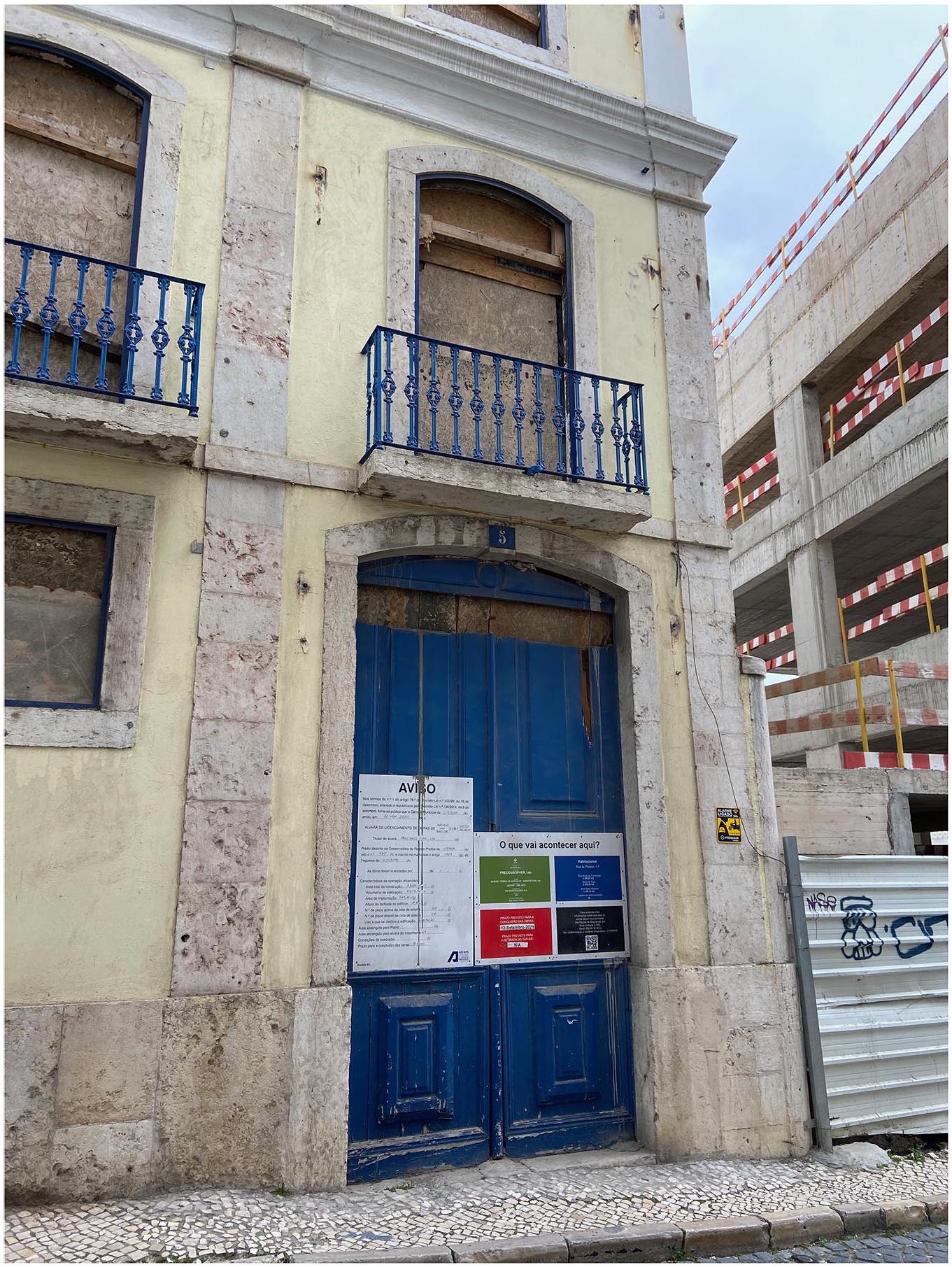
A building marked for partial demolition and rehabilitation in Lisbon’s historic centre. Photo by author.
Hence industry reports pointed to the potential of Portugal and specifically Lisbon as an investment destination within Southern Europe: ‘Portugal is on the up, Spain is bottoming out, Italy is still a conundrum. . .’ (PwC and Urban Land Institute, 2015: 21). Savills noted in 2015 that ‘Lisbon’s prime real estate looks good value by European standards – roughly half the price of that in Madrid, and less than a tenth of London prime prices’ (Savills, 2015b). When Lisbon ascended to Emerging Trends’ top spot in 2019, the report stated that ‘greater wariness and the search for better returns underpin the interest in some of Europe’s smaller markets, like Lisbon’ (PwC and Urban Land Institute, 2018). Adding to the lure of higher returns in ‘second-tier cities’ was ‘the prospect for some small cities to economically outperform as they rise in the global hierarchy, experience regeneration, reconstruction or renaissance’ (Savills, 2015b: 14).
In this way, industry reports reflect the structural power of large-scale investors as they consider which periphery is the least risky for them to invest their excess capital. Market reports hold up certain peripheries as more favourable than others at particular times, and in the late 2010s Lisbon emerged as an especially attractive destination, at least partially by virtue of other European peripheries falling out of favour. The fact of places like Catalonia and Italy being seen as too politically risky, for example, made Lisbon in some ways a more attractive alternative. The push for a capital outlet in peripheral locations is mediated by discursive constructions of certain peripheries as more or less unruly than others.
From crisis to opportunity: Lisbon re-framed
As industry reports illustrated the ‘push factors’ of global capital searching for an outlet in peripheral locations, they also framed Lisbon specifically as an ideal investment destination. In this section I unpack four tropes that emerged frequently in industry reports and spaces, which have helped to re-frame Lisbon as an idyllic city for real estate investment.
An obsolete historic centre filled with investment opportunities (and tax incentives)
Portugal’s crisis-era urban reforms discussed earlier were a major factor in attracting investment to Lisbon. Real estate industry professionals based both in Lisbon and internationally were vital in communicating these reforms to the outside world; they appear in nearly every report written about Portugal in the years following 2012, and are usually credited with reviving the Portuguese property market. In 2014, PwC published a report overviewing these reforms as well as Portugal’s comparatively favourable tax code in a special report referring to Portugal as ‘Europe’s Best Kept Secret’ (PwC, 2014). At the 2019 Portugal Real Estate Summit, the largest industry event in Portugal, a representative of an international brokerage firm told a large audience that the combination of the golden visa and the new rental law constituted the ‘turning point’ for Portugal, allowing for new investment and rehabilitation, and bringing billions of euros into the country (field notes). The focus on these reforms signalled to the rest of Europe and the world that Portugal had turned a corner, and was increasingly ‘investment friendly’.
A corollary to this was that dilapidated downtown buildings began to be presented as opportunities for profitable investment. Narratives of an empty, obsolescent, abandoned historic centre began to proliferate, even if many buildings still had people living in them. One broker at an international firm exemplified this narrative: all the downtown area was pretty much abandoned, obsolete, and the only areas that were actually being used was the ground floor for retail. So a lot of buildings upwards from the ground floor were pretty much empty, vacant, obsolete, old, uh, ready to be demolished, okay, and there was a huge loss of value there. So, what the property owners started to do was use a bit of that property in order to give a reply to the golden visa demand. And that’s how it kickstarted the whole downtown scene. . . (Interview 4)
A representative of a real estate lobbying body spoke about how various tax incentives encouraged investment in rehabilitation: so everyone was very much focused on the renovation works, and it was very good, because our uh. . .main cities, Lisbon and Oporto [were] in ruin, they were empty, and uh, it’s very good, it was a very good. . .moment that we could start renovating these cities. (Interview 8)
These narratives of urban obsolescence make clear for investors the potential profits to be realised from Lisbon’s historic centre. As Weber notes in her study of Chicago, real estate industry professionals were central in labelling buildings as ‘obsolete’, and this labelling had a performative effect, because it established there was a rent gap to be exploited and laid the groundwork for redevelopment. Buildings were deemed ‘obsolete’ ‘not because they were unusable, but because they could not be used as profitably as current or future investors desired’ (Weber, 2015: 72). In Lisbon’s case, what was once a symbol of a country in crisis and decades of disinvestment and abandonment, became re-framed as an investment opportunity. The recognition of Lisbon’s real estate investment potential was therefore conditioned by its status as a semi-peripheral city.
A ‘good student’ who has shown they can follow the rules
Central to Lisbon’s re-framing was the country’s perceived observance of strict austerity measures to improve its macroeconomic indicators. The real estate industry was central in communicating the government’s efforts to reduce debt and in reinforcing the ECB’s narratives of austerity as the painful but necessary answer to crisis. The 2012 Emerging Trends report, which ranked Lisbon incredibly low in terms of investment prospects, highlighted Portugal’s planned drastic measures to meet the conditions of its ‘bailout’: Portuguese prime minister Pedro Passos Coelho has already said he plans to commit the country to the ‘most difficult’ budget in memory over the year, which includes plans to slash state workers’ salaries while the government cuts spending and raises taxes to meet the terms of a €78 billion aid plan from the European Union and the International Monetary Fund. (PwC & Urban Land Institute, 2012: 32)
As Portugal and other Southern European countries’ macroeconomic indicators such as GDP and unemployment improved, austerity measures were widely credited. A 2016 report by JLL states that ‘the scenario began to invert at the end of 2013 as a result of the austerity program that enabled Portugal’s debt to drop significantly’ (JLL, 2016, my emphasis). A 2015 Savills report on European investment echoes such language: . . . the yield gap between the core markets and the peripheral markets of Europe has been closing, reflecting improving investor confidence in the markets of Ireland, Spain, Italy and more recently Portugal, which have gone through the toughest periods of austerity and reforms and now show signs of improving economic performance. (Savills, 2015a: 5)
Industry consultants and professionals thus reproduce dominant narratives of crisis and austerity peddled by the Troika, crediting austerity with ‘reducing deficits’ and improving economic indicators, even though scholars have shown that that this is a dangerous myth (Blyth, 2015). In the case of Portugal, a more likely explanation for the improvement in GDP and other indicators was the massive growth of tourism after the crisis, which contributed over 17% to national GDP in 2019 (Statista, 2022). But these narratives demonstrate how ideas of core and periphery are reproduced, with core countries watching eagerly to see if the ‘unruly’ periphery will follow the rules. And while Greece was severely punished for its apparent violation of said rules, Portugal emerged as ‘the good student’ of the EU (Príncipe, 2018). A keynote presenter at the Portugal Real Estate Summit recognised that years of crisis and austerity were ‘tough on a lot of people. . .but the Portuguese took it on the chin, they said “we got ourselves into this mess, now we have to get ourselves out”’. In the end, the Portuguese people ‘came out stronger’ (field notes). The blame for the crisis is re-affirmed to lie squarely on the shoulders of people in peripheral countries like Portugal, and at the same time the response is moralised into a compliant Portuguese people who have cleaned up their act and are prepared to take full responsibility for their supposed mistakes.
Sure enough, investors have cited this image of a ‘responsible’ Portugal as a prime reason why they chose to invest there. This was the case for Neworld, a partnership between several global investment firms which is developing several large-scale mixed-use projects in Lisbon. When asked in a media interview why they decided to invest in Portugal, the founding partners almost immediately referred to the fact that the 2012 EU money was ‘spent very wisely’, elaborating, ‘[Portugal] utilised the capital that it got from the EU in a very sensible way [. . .] you can see it had good governance’ (Black Onyx, 2019a; 2019b). But industry actors also remind us of the highly conditional nature of current investment flows. As a JLL report notes, ‘Provided those in government maintain their good sense, as well as fiscal stability, there is no reason to doubt that Portugal will continue on the fantastic course it is currently travelling’ (JLL, 2016: 4). This is a reassertion of the country’s peripheral status in Europe. If conditions are not to their liking, global investors and industry actors have disproportionate power to change the narrative on Lisbon and alter the course of the Portuguese economy.
An oasis of safety, sun and stability in an uncertain world
Another important facet in the construction of Lisbon as a promising investment destination was an insistence on Portugal’s apparent stability and safety, as well as it being a sunny, pleasant place to spend time. In industry reports Portugal is routinely presented as a peaceful place with great food and friendly people. This is backed up with myriad rankings; for example, JLL showcased both Portugal’s win as best country for ‘expats’ to live in (according to Internations’ Expat Insider 2018) as well as its ranking as fourth most ‘peaceful’ country on the Global Peace Index 2018 (JLL, 2018). One report states: ‘Portugal has a democratic regime. The population is characterised by a centrist political ideology, which is reflected in a stable political context’ (JLL, 2016: 5). While no source is offered to support such an assertion, the implication is clearly one of a moderate, non-threatening populace who can be trusted not to swing too radically in any political direction, echoing the ‘good student’ reputation. Reports also emphasise Portugal’s position as part of Europe, and as ascribing to various European treaties and communities, such as NATO and the OECD.
This image of a peaceful and politically stable country likely appealed to early individual and small-scale investors who were also drawn in by the golden visa program. Some reports acknowledge that political unrest such as in North Africa led tourists to want ‘safer destinations’ for travel, and Portugal offers a similar Mediterranean ambiance without the same geopolitical uncertainty (JLL, 2016). And for investors from ‘difficult economic and political situations in several countries’ such as Turkey and Brazil, Portugal represents a more neutral, safe place to store wealth, with Lisbon a buzzing, culturally rich (though smaller-scale) urban alternative to Istanbul or Rio de Janeiro (JLL, 2016: 16). Even if it has struggled with the Eurozone crisis, its position as part of Europe is seen as prime real estate that will never lose value. One real estate consultant acknowledged Portugal’s semi-peripheral status while affirming the country’s appeal as part of ‘the developed world’: We have great gastronomy, we are great welcomers, we have fantastic weather, we have 1,000 km of shoreline, so we are pretty much centered within the developed world – although we are not in the center of Europe, we’re peripheral – uh, so the demand will always be there. (Interview 4)
This underlines the discursive construction of Portugal as a semi-periphery. While clearly established as the periphery of Europe, it still shares some qualities seen to be characteristic of ‘core’ countries, such as a ‘democratic’ regime that has pledged allegiance to respected international treaties, a good quality of life (especially if you are arriving from a country with higher wages) and low rates of physical violence. And it is still part of Europe, so for actors with capital coming from ‘truly’ peripheral countries, Portugal represents a happy balance of ‘stable’ European country without the exorbitant prices found in core Europe.
A promising multinational hub for tech entrepreneurs and back-office workers
A final key point of attraction communicated in industry literature is Lisbon’s re-branding as a creative or entrepreneurial tech hub. This has been a deliberate strategy of the Lisbon municipality, which has set up several initiatives to stimulate the ‘creative’ economy. The platform InvestLisboa 1 and the business incubator Startup Lisboa, 2 set up in 2009 and 2012 respectively, are partnerships between the Lisbon municipality and private actors. These have supported the creation of the Beato Creative Hub, a planned 35,000 m2 campus for tech firms and workers which aims to create 3,000 jobs, 3 though its opening has been delayed numerous times (Idealista, 2021). Industry actors have referred to this tech re-brand as key in attracting investment, such as when the commercial director of Stone Capital, a developer established in Portugal by two French brothers, referred to Lisbon as developing into a ‘mini–San Francisco tech hub’ which is attracting ‘digital nomads’ (The Portugal News, 2022). The investor magazine Iberian Property profiled Lisbon’s hosting of the Web Summit, the biggest technology and start-up conference in Europe, for which Lisbon beat out stiff competition from cities such as Berlin and Madrid. The magazine referred to this as the ‘culmination’ of Lisbon’s ‘re-invention’ as an entrepreneurial hub (Iberian Property, 2017: 80).
More broadly, there has been a clear trend of multinational companies opening offices in Lisbon or relocating back-office services there. Along with the tech re-brand, multinationals may be attracted by low taxes and relatively cheap real estate, and an educated workforce with high levels of English, who are accustomed to low wages. Real estate industry reports highlight these advantages: ‘Portugal has become a popular location to locate service centres and business process outsourcing. It is a combination of still relatively cheap labour and real estate, and a great quality of life’ (PwC and Urban Land Institute, 2018: 38). Of course, Portugal’s climate and ‘security’ are also invoked as attractive reasons why workers and companies may want to relocate there (Iberian Property, 2019: 66). As such, multinational firms have been growing their Lisbon presence in recent years, such as BNP Paribas which employs about 7,000 people in Portugal, and moved numerous jobs from France to take advantage of cheaper salaries (Reuters, 2017; Interview 5). One industry representative relished how lucky it was that Google had chosen Lisbon over Dublin and Krakow to open its new operations centre for over 500 employees in 2018, as a result of this successful tech re-brand (Interview 14).
This situation is highlighted in real estate reports as another factor making Lisbon an attractive destination for real estate investment, not only for offices but for the residential sector as well. As one developer stated, commenting on the promise of many new offices that will employ local and imported workers: ‘these people all need to be housed’ (Interview 5). The turn towards the tech economy is also praised as a potential driver of regeneration, such as the case of the Beato Creative Hub, located in the former industrial and rapidly gentrifying parish of Marvila. JLL predicted that the hub would help ‘boost Marvila’s reputation as one of Lisbon’s up-and-coming neighbourhoods’ and that the campus would ‘soon be joined by swathes of high-end apartments aimed at affluent tech workers’ (JLL, 2019b). Indeed, in recent years there has been a building boom in the area, with staggering spikes in property prices outpacing other parishes (Silva, 2021).
Once again, Lisbon’s semi-peripheral positioning is part of what made it an attractive investment destination, as a capital city with some of the lowest wages in Europe, ‘good governance’, and high quality of life indicators. Still, it must be framed as a distinctly promising entrepreneurial hub especially if it is to beat out other semi-peripheral cities re-branding as tech hubs. The arrival of multinationals and a tech-friendly environment are used as selling points for global real estate investors, who know demand will rise from lower-wage workers and ‘digital nomads’ for both office and (high-end) residential space.
Conclusion
This paper has argued that the ability of Lisbon real estate to serve as a spatial fix for overaccumulated capital has depended not only on material relations of uneven development but also on a process of market-making whereby Lisbon was constructed as a safe and pleasant place to invest. Uneven development meant that countries of the European periphery bore the brunt of crisis effects, and were subjected to brutal austerity regimes, of which reforms to encourage real estate investment were a part. As the GFC abated, capital accrued unevenly across the globe, pooling with institutional investors and other actors rooted mainly in Global North core economies, granting them the capital and power to decide where to invest. Market reports alerted investors to the necessity of finding alternative investment options, thus facilitating capital switching to new sectors and geographies. Lisbon’s perceived observance of Troika rules and reputation as a ‘safe’ place (when compared with other semi-peripheries or ‘classic’ peripheries, i.e. colonised countries), allowed it to lower its risk profile in industry circles. Investors who would never have previously considered Lisbon began to take note, looking for promising investments that core real estate could no longer offer on its own.
In its transformation from misbehaving ‘PIIG’ in crisis to trendy promising investment destination, we can trace how Portugal’s status as semi-periphery is mobilised in different ways to first discourage and later encourage investment. Initially, its status as periphery is used as a reason not to invest, due to the unequal impact of crisis and the perceived guilt of peripheral countries for said crisis. Later, its perceived adherence to the ‘rules’ of the EU and efforts to overcome its peripheral status are seen as making it deserving of investment, and Lisbon’s degraded city centre becomes an opportunity for rehabilitation ensuring massive returns, not possible in core European cities. As such, Lisbon’s status as ‘second tier’ is exactly what made it attractive to investors tiring of overpriced core European real estate. This shows how ‘core’ and ‘periphery’, while expressions of historical patterns of uneven development, are also discursively mediated, as real estate industry actors reproduce ideas about Portugal as part of the European periphery which shape investors’ decision making.
Today Lisbon is living through the double-edged sword of unprecedented investment into its real estate. Praise for its miraculous turnaround has shifted to concerns over an ever-deepening housing crisis. And contradicting commentators who previously praised Portugal for having no right-wing ‘populist’ movements (Hockenos, 2019), the far-right party Chega continues to gain prominence with every election. The historic centre is increasingly geared towards tourists and mobile elites, while further afield there appears to be a new building boom of large-scale ‘mid-range’ developments, though there is no indication that such housing will be accessible to local incomes (Lima, 2024). Echoing Weber’s (2015) account of how real estate actors perform property cycles, some investors have begun warning of a housing bubble (Almeida, 2019). This is also a reminder that the spatial fix paradoxically sets the conditions for further crisis (Harvey, 2007; Ward, 2021).
But what is the relationship between systemic forces and performativity? Without deigning to provide an answer to the structure versus agency debate, I would argue that the two are co-constitutive. Material conditions shape the terrain for industry narratives to emerge, these narratives in turn help to shape the urban terrain. A narrative is not automatically performative; ‘if it fails to “muster enough institutional and political support” it may have no performative effects at all’ (Fourcade cited in Braun, 2016: 261). In this case, industry narratives mobilised by powerful investment actors found substantial institutional support in both EU structures and the Portuguese state, which worked to implement austerity directives and set policies to enable real estate investment. These were further communicated by industry actors which led to an explosive interest in Lisbon real estate. But the value of performativity is that it highlights that markets may be otherwise construed (Callon, 2010). Competing narratives that challenge rather than support the desires of global investors must build their own institutional and political support, which is no easy task. But studying the market devices and narratives of powerful actors may help to reveal the fissures of the current system.
Footnotes
Acknowledgements
I am grateful to Richard Goulding, Rowland Atkinson and Callum Ward for their feedback on earlier versions of this paper. Thanks also goes to Miguel Kanai, Jon Silver and Desiree Fields for their guidance during the research process, and finally to three anonymous reviewers for their very constructive comments. Any errors or omissions are my own.
Declaration of conflicting interests
The author declared no potential conflicts of interest with respect to the research, authorship and/or publication of this article.
Funding
The author disclosed receipt of the following financial support for the research, authorship, and/or publication of this article: This research was supported by the UKRI Economic and Social Research Council under grant number ES/P000746/1.
