




Abstract
Coal mining in the UK, once central to its political economy, has been in terminal decline for decades for both political and more recently environmental reasons. Against the grain of this decline, the proposal of a new metallurgical coal mine near Whitehaven (on the north west coast of England) has caused significant controversy. Those supporting the mines development say it is necessary to ‘level up’ from the previous decade of austerity, whereas opponents argue that new coal mining would severely undermine the transition to low carbon energy sources. Through a discourse analysis and open-ended interviews, this paper analyses the contestation of the mine through the environmental planning process, identifying how both the discursive contestation and decision-making practices are shaped by political logics (austerity/levelling up) and ecological logics (climate change). The paper finds that, as states turn towards greater levels of public subsidies as a new form of crisis management, the environmental decision-making processes which can determine the shape of investments have been severely undermined through a decade or more of reduced public investment, policy streamlining and a lack of public expertise. The paper argues that even though states may be turning towards policies subsidising energy projects, they are doing so in a context where there is a lack of state capacity due to a ‘political ecology of austerity’, limiting public capacity to plan for a better future.
Coal mining, and its decline, defined the political economy of the United Kingdom in the 19th and 20th Centuries. Coal fuelled the steam engines of the industrial revolution, powering an emergent fossil capitalism and the dramatic shift from human and animal powered machinery to larger more powerful machines less constrained by these biological limits - with newly manufactured goods then sold across the world on the back of imperial violence (Malm, 2013). The coal mining unions were at the core of the trade union movement, they were pivotal to the General Strike of 1926, and they helped brought down Ted Heath’s government in 1974. The coal these workers produced, as part of a nationalised industry from 1947, powered increasingly electrified homes as well as heavy industry into the 1990s. The turn towards neoliberalism was won at the expense of the miners, with North Sea oil and gas providing new sources of energy as Margaret Thatcher’s government deliberately crushed the mining unions and coal-mining communities with them (Tomaney, 2003; Gibbs, 2021). The last deep pit coal mine closed in the UK in 2015, in what seemed to be the end of an era. In this context, it is all the more surprising that an application for a new deep-pit coal mine would become the nation’s latest fossil-fuel controversy.
The proposal for a new mine, primarily for metallurgical coal, in Whitehaven (North West England) has been fiercely contested in an area shaped by the decline of the 20th Century coal industry. It is backed by private equity firm EMR Capital and proposes to fuel the steel foundries in the UK, Europe and possibly further afield. West Cumbria Mining, the company responsible, claim that the mine will bring 500 jobs and a £165 million investment, whereas opponents point to the increase in carbon emissions the mine will bring and the shift in steel production towards lower carbon methods of production. The decision over the mine was delayed when the UK hosted COP26, where the UK governments representative called for other nations to ‘consign coal to history’ (Chestney, 2021).
This paper addresses the controversy over the mine, within the context of economic decline. The decline is one of the long durée history I have set out, with Whitehaven and the wider region (Cumbria) having once been both a centre of imperial trade (in rum, sugar, tobacco) and extractive and heavy industry (coal, chemicals, nuclear). Through a discourse analysis and open-ended interviews of the planning process for the mine, I show how austerity and ecological logics shape the debates on the mine and the planning practices which decided for the mine to be approved in December 2022.
The analysis shows how austerity has shaped environmental planning practices and decision making, with local authorities having to deliberate over complex international production processes and make major strategic industrial decisions without having the state capacity and resources to consider alternatives. There has been a significant body of research which has analysed how planning and local government in cities has been reshaped by an ‘austerity urbanism’ (Peck, 2012) in the UK and across other nations in the Global North, this paper addresses a gap in the literature on how environmental planning is shaped by a ‘political ecology of austerity’ (Kaika et al., 2021) in which public decision-making capacity is hollowed out, policy ‘streamlined’ and where there is a lack of investment for localities and regions to consider alternatives for land use. The paper shows that reduced state capacity for environmental decisions undermines how investment decisions are directed and shaped, in a period when greater public subsidies are being rolled out for energy projects.
Austerity and levelling up: A decade of false solutions
‘Austerity’ was the overarching response to the financial crisis of 2007/8 in the UK, EU and the USA. The financial crisis was the result of an unchecked real estate boom in which banks lent money to those facing economic difficulties (who then defaulted), debts which were then repackaged in lightly regulated complex financial instruments (such as derivatives). When the real estate bubble burst in the USA, the impacts spread rapidly across other highly financialised, neoliberal states (Jessop, 2009). Governments funded significant bailouts of financial institutions and engaged in a process of ‘quantitative easing’ to recapitalise banks, restore financial liquidity and cheap credit.
Both the bailouts and the initial economic downturn meant that governments took on increased levels of public debt. What followed the bailouts were significant public sector spending cuts, punitive sanctions for welfare recipients, reductions in state investment and programmes of state restructuring which reinforced ‘the hierarchical powers of budget chiefs and audit regimes, inducing instrumentalism, entrepreneurialism, and muscular modes of management at subordinate scales’ (Peck, 2015: 6).
What was cut back from the state through austerity were the ameliorative, market-friendly state practices instituted in neoliberalism’s ‘third-way’, roll-out phase (Peck, 2015; Peck and Tickell, 2002). In the UK, the Coalition government (2010–15) targeted what they saw as the excesses of the previous Labour administration such as its various ‘quangos’. The ‘quangos’ though, were already a sop to neoliberal thinking – public-private partnerships and light touch regulators which took on state functions with little accountability, with many becoming closer to industry than serving the public good (Crouch, 2004). Alongside the targeting of Labour’s fiscal largesse there has also been the targeting of their supposedly out of touch, cosmopolitan liberalism as a prelude to attacks on migrants and minority groups (Bruff and Tansel, 2019). Austerity has driven both these shifts, with ‘with long-run, socially regressive consequences for welfare state provision, the distribution of economic risks and hardships, and the scope of social rights’ (Theodore, 2020: 3).
Importantly for this paper, ‘the power and responsibilities of central government increased in the austerity period at the cost of local government’ (Farnsworth, 2021: 92). Austerity has created intense pressures on cities, who are expected to support economic growth whilst their budgets are cut to the point where they cannot provide the basic services they are legally expected to – what Peck terms ‘austerity urbanism’ (Peck, 2012). At the same time, central government takes on a more interventionist role by introducing new draconian legislation to crack down on political dissent and granting more executive powers to ministers to intervene for whichever political or economic interests are able to capture their attention (Brown, 2019). Rather than achieving any particular fiscal goals (UK public debt has increased), austerity has in fact been central to reconfiguring the state along broadly neoliberal lines whilst staving off counter-hegemonic challenges.
The impacts of austerity in the UK, over a decade on from its institution, have been identified within academic literature. Public sector cuts have led to over 330,000 excess deaths (McCartney et al., 2022) undermined participatory governance and community (Davies and Blanco, 2017), and cuts to welfare have had hit poorer areas hard – particularly former coal mining regions (Beatty and Forthergill, 2013). The three regions of northern England lost £5.2 billion a year in income from welfare cuts alone (Beatty and Forthergill, 2013: 4) with the North West (where the mine is located) the worst hit region in the UK in per capita welfare spending (Beatty and Forthergill, 2013: 17). The uneven impacts of austerity are also more than regional – the costs have fallen particularly on urban areas, and on particularly cities within the competitive world of urban entrepreneurialism. All UK cities have faced cuts, but some have simultaneously been positioned to capture global capital and renewed real estate investment, for example, London and Manchester (Goulding et al., 2023).
The story in more peripheral areas, like Cumbria, is somewhat different. Cumbria has no major city, instead a cluster of small to large towns straddle the coastal area with the inland dominated by the Lake District National Park. Cumbria, and areas like it, have suffered from a double hit of cuts to welfare and public services on the one hand and chronic under-investment (private and public) on the other. Leaving the European Union has further compounded matters, with regions losing out on EU structural funding (e.g. EU Regional Development Fund) which has not been fully replaced by the new domestic funds (e.g. UK Share Prosperity Fund) (Brien, 2022) especially as funds would likely have increased in the latest round (CPMR, 2019).
Alongside welfare, local government has seen some of the most severe funding cuts, which has in turn reshaped the planning system in England. Planning and housing departments have been one of the areas local government has reduced funding most significantly, with budget cuts of up to 50% (Partington, 2019) . This has led to the rise of what Slade et al. (2019) call the ‘austerity planner’, where services are increasingly outsourced to planning consultants. Spending cuts have reduced the size of planning departments and made them more reliant on the fees of applicants and developers (Slade et al., 2019).
Simultaneously, planning was identified as an area for reform. Planning was described as the ‘the last bastion of communism’ by a Coalition government minister as it looked to de-regulate the system (Lord and Tewdwr-Jones, 2014). ‘Austerity planning’ (Haughton and Hincks, 2013) has not just included budget cuts and privatisation, significant planning reform has also occurred on deeply neoliberal premise that rolling back planning regulation and deliberation will unleash the latent market forces. Wilfully disregarding the role that urban planning played in the real estate free for all that caused the financial crisis, the focus of several iterations of planning reform has been deregulation through expanding permitted development rights (Ferm et al., 2021) as well as increase in centralised, executive power (Fearn and Davoudi, 2022).
Research has addressed the impacts of austerity on urban planning practice (Davies and Blanco, 2017; Jenss, 2019; Pendlebury et al., 2020; Slade et al., 2019; Tulumello et al., 2020). Across UK, Europe and the USA, this research shows the crisis and austerity has reshaped planning practices: through privatisation and increased social control (Cappuccini, 2020), restoring the focus on real-estate boom and construction that caused the crisis (Tulumello et al., 2020), with new third sector and private bodies taking on formerly public roles (De Magalhães and Freire Trigo, 2017; Veldpaus and Pendlebury, 2023) effectively creating new ‘quangos’. Other scholars have identified how the crisis led to a new community led focus on the role of planning (Saija et al., 2020), and how planners themselves have had to find new ways of coping with the maelstrom of reform and funding cuts (Schoneboom and Slade, 2020).
Austerity has also been linked to other place-based political shifts. Many of the more peripheral regions hist by public sector cuts voted to leave the EU with a significant majority – 70.1% voted to leave the EU in Copeland where the mine is located (Electoral Commission, 2019). Several studies have linked areas of economic decline, accelerated by austerity, as tending towards voting to leave (Bromley-Davenport et al., 2018; Koltai et al., 2019), with Fetzer (2019) arguing that there is a significant correlation between voting Leave and areas most hit by austerity and declining public investment. The linkage between austerity and the EU referendum was tacitly acknowledged by the Conservatives in their successful 2019 general election campaign: linking the need to ‘Get Brexit Done’ with a promise to ‘Level Up’ the UK and tackle the regional inequalities underlying the Leave vote (Jennings et al., 2021).
The programme of ‘Levelling Up’, however, has yet to deliver significant changes. The government has created a ‘Levelling Up Fund’, however the allocation of this has been highly controversial and driven by electoral calculations rather than a strategic targeting of need and deprivation (Tomaney and Pike, 2020). The Levelling Up Fund is ran by a competitive bid process, meaning many areas have received little to nothing, and the total amount (£6.9 billion) barely begins to account for the loss of funding to local government – which received £15 billion less annually in 2019/20 than it did in 2008/9 (Atkins and Hoddinott, 2022).
The research cited above tends to focus on urban governance and planning. What has received less focus, in the UK and elsewhere, has been how environmental planning has been reshaped by austerity. Research has addressed how austerity has reduced the capacity for collaborative environmental governance (Kirsop-Taylor et al., 2020), and environmental policy within urban contexts (Eckersley and Tobin, 2019), however less research exists on how austerity has reshaped planning practices and decision making on projects with significant environmental impacts, such as fossil fuel and energy sites. The UK has set strong high level decarbonisation targets: ‘clean’ electricity grid by 2035, ‘net zero’ by 2050 and has large technocratic bodies such as the Climate Change Committee which set out various pathways and scenarios to achieve these aims. The development (or not) of proposed technologies and infrastructure though, is something which meets the tense reality of land-use politics in the planning system at local and national levels – and these decisions are and will seemingly continue taking place within a system severely undermined by austerity.
Indeed, some reshaping of planning practice has already taken place through contested sites of environmental planning, in the case of shale gas local resistance led the government to turn towards more executive-led and antagonistic decision-making filling the gap left by reduced local state capacity (Fearn, 2022; Fearn and Davoudi, 2022). This paper builds on this work by examining how austerity has shaped environmental planning by limiting the possibilities and capacities of planning as a public activity – with funding cuts only deepening since the shale sites were contested. And with a turn towards greater uses of public subsidy being used to leverage private investment in new energy technologies, it is important to understand the impacts of austerity and reform on the planning system that will shape those investment decisions.
The paper contributes to better understanding the under-researched ‘political ecology of austerity’, in which austerity globally is related to ‘land grabbing, privatisation of resources, increased extractivism, direct environmental degradation, decline in environmental protection, and urban gentrification’ (Kaika et al., 2021: 4). Scholarship in political ecology highlights how social and political processes are bound up with ecological change (McCarthy, 2019; Moore, 2015) and how race, class and coloniality are central to climate breakdown (Sultana, 2022). The paper follows this political ecology approach, by analysing how politics and ecology are bound together in planning processes, how funding cuts and policy changes for planning are reshaping how decisions with clear, significant ecological implications are made in the UK – even when this appears to run against stated environmental policy for achieving ‘net zero’ emissions by 2050.
I do so through an analysis of the planning process for a metallurgical coal mine near Whitehaven. The analysis shows how austerity/levelling up and ecological logics shape both the discursive contestation of the coal mine, and from this how environmental planning practices are themselves shaped by austerity and ecological concerns. Environmental planning is distinguished (from urban planning) by its focus on environmental issues resulting from development (e.g. air and water quality, pollution and emissions) but also more specifically at local authority levels through policy, plans, planners and specific committees which focus on for example, ‘Minerals and Waste’ as developments which generally have significant environmental impacts.
I draw upon political discourse analysis, which is an interpretative approach that focuses on how ‘discourses structure, maintain, and transform social practices’ through ‘articulatory practice’ (Glynos et al., 2021: 3) where different subjects attempt to fix the meaning of particular discursive ‘elements’. What I focus on here is how two competing discursive formations, those for and against the mine, articulate their positions in connection with wider political (austerity, levelling up) and ecological (climate change) logics, to contest the mine and also the decision-making process. The analysis of the contestation and final decision allows me to identify how environmental decision making is happening in practice – the particular ‘political ecology of austerity’.
The analysis draws on the coding of texts (meeting minutes, supporting planning documents, news media, policy documents, ministerial statements) and videos of the planning inquiry, which were then triangulated with the coding of seven open-ended interviews with those supporting and opposing the mine. From this I mapped out the competing discursive formations, the key points of contestation and the relation between them and political logics of austerity and ecology.
Contesting coal in Cumbria
The proposal by West Cumbria Mining (WCM) for Woodhouse Colliery, near Whitehaven in Cumbria is one that has been fiercely contested and approved at each stage of the planning process. It was passed unanimously by the Council’s’ Development and Control Committee in March 2019, again in October 2019, but this decision was challenged by a judicial review. West Cumbria mining amended their application in response, primarily to remove the production of ‘middlings’ thermal coal. A third meeting approved the mine by a substantial majority of local representatives in 2020.
Cumbria County Council did not formally grant planning permission following the third decision, as the Secretary of State decided whether to call the decision in for a national level planning inquiry, but then in February 2021 said that the Council said they would consider the application once more due to the publication of the latest UK Carbon Budget. The following the month the Secretary of State called the decision in, and the proposal was then subject to a public inquiry led by the central government-based Planning Inspectorate (held in Sept 2021). The Planning Inspectorate has the power to intervene into local planning practices, in plan-making as well as particular development management decisions, often at the request of the Secretary of State when a decision is particularly controversial. The appointed Planning Inspector recommended approval of the mine in December 2022, with the recommendation signed off by the Secretary of State. At the time of writing, the final decision is subject to a legal challenge.
What Woodhouse Colliery will do is something which has changed throughout the planning process. The initial licence granted to the applicants by the UK government was for underground coal gasification. The company then proposed a new coal mine, located on a coastal head and extending out under the Irish Sea, near the site of the former Haig Colliery (closed in 1986 to the loss of 3500 jobs) and on the site of a former chemical plant. As above, the proposal was for a mix of thermal (i.e. for power plants and heating) and metallurgical (for steel production) coal. During the planning process, the market for thermal coal in the UK effectively collapsed and the final proposal was for metallurgical coal only.
Figure 1 depicts the discursive contestation of the mine. On the left (in blue) is the pro-mine formation, articulated by the mining company, EMR Capital, 1 many local politicians, the consultants hired by WCM, Conservative MPs, the National Union of Mineworkers and various industry experts. The anti-mine formation on the right (in red), is articulated by Friends of the Earth, South Lakes Action on Climate Change, local group Keep Cumbrian Coal in the Hole, the Green Party and the national Labour Party, Coal Action Network and a number of leading energy academics. I do not include the decision-making authorities themselves (Cumbria County Council, the Planning Inspectorate and the Secretary of State) as they are formally neutral with regards the outcome – the decision-making process is the ultimate object of analysis.
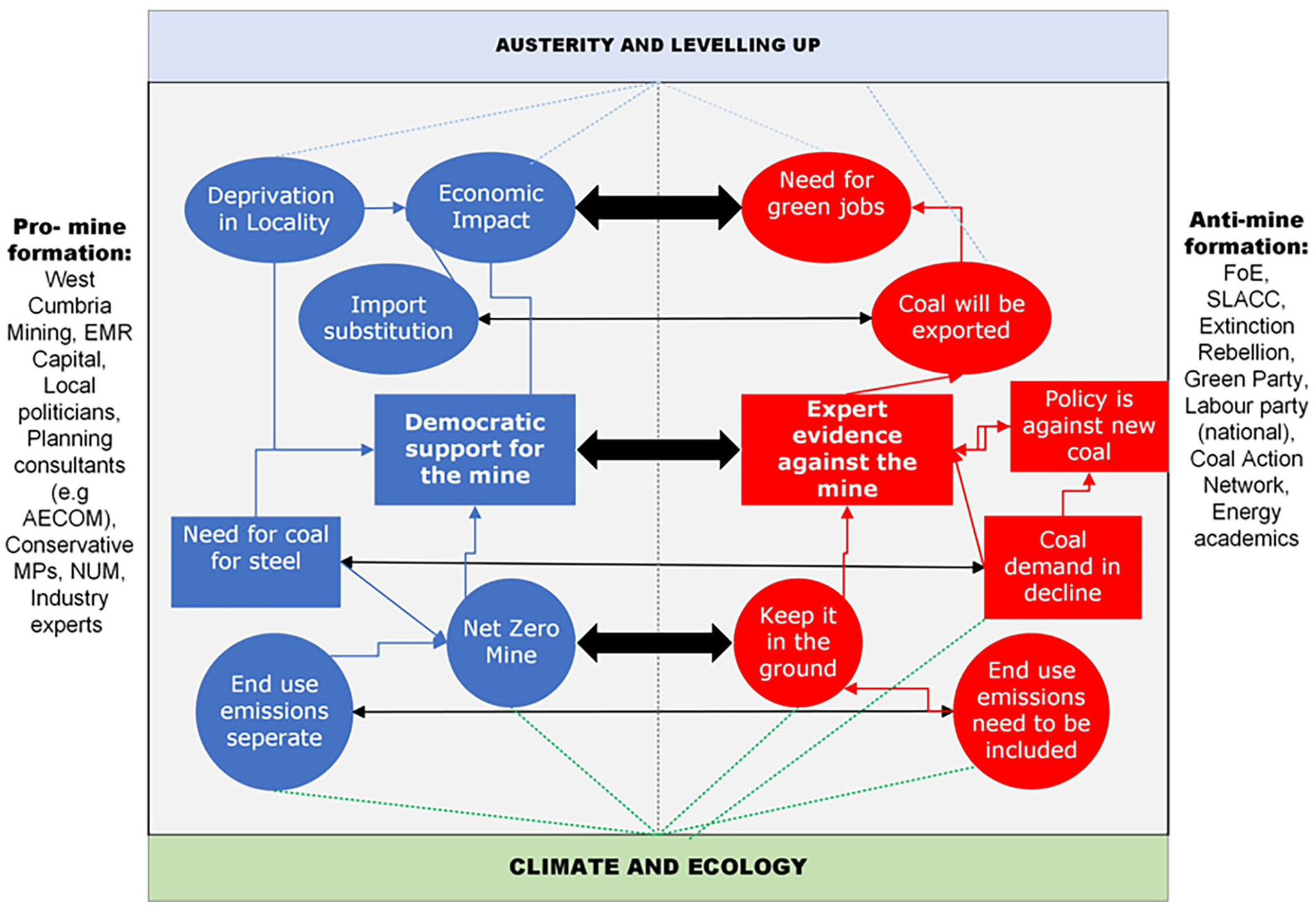
Map of competing discursive formations (authors own): Pro position to let in blue, anti position to right in red. Highlighted are the key points of contestation discussed below, and other discursive elements. The top and bottom bars show how austerity/levelling up connect with the elements of the discourse.
Figure 1 shows the discursive elements in each formation, with the black arrows across showing points of contestation, of which three are highlighted as the most important for determining the decision: the economic impact of the mine versus the need for green jobs, expert evidence versus the democratic support for the mine and the claim of a net zero mine versus the need to keep fossil fuels in the ground, which are analysed further below. The Figure highlights how austerity, levelling up and climate and ecology relate to the elements of each formation, which is discussed in the subsequent section.
Economic impact of the mine versus need for green jobs
The National Planning Policy Framework (Ministry of Housing, Communities and Local Government, 2021: 62) sets out a policy ‘test’ for new coal development:
‘Planning permission should not be granted for the extraction of coal unless:
(a) the proposal is environmentally acceptable, or can be made so by planning conditions or obligations; or
(b) if it is not environmentally acceptable, then it provides national, local or community benefits which clearly outweigh its likely impacts (taking all relevant matters into account, including any residual environmental impacts)’
The ‘test’ has been in place since the first NPPF in 2012 and reflects the UK’s move away from coal mining without fully committing to abandoning extraction entirely. The 2018 and 2021 versions of the NPPF added the bracketed consideration of ‘residual environmental impacts’. Coal for electricity generation is set to end in the UK by October 2024, but that still leaves metallurgical coal (mainly for steel production) and a small amount of thermal coal used for heating homes. I will cover below the question of Woodhouse Colliery being ‘environmentally acceptable’, however given that both Council’s planning officer and national Planning Inspector both concluded the proposals failed the first leg of the test, the decision then hinged on the ‘benefits’ that outweighed the environmental impact.
The pro-formation’s core contention was that the mine would bring jobs and investment into an economically deprived area. WCM claimed that even though the wider district had a reasonably high average income, these figures ‘mask pockets of significant deprivation close to the mine’ (West Cumbria Mining, 2020a: 6). In the first public planning committee meeting on the mine, WCM’s CEO argued that the mine would ‘generate over 500 real jobs, delivering a major boost to the economy at local, county and country levels, helping to reduce the UK balance of trade deficit’ (Cumbria County Council, 2019: 13). A Labour councillor who represents the area around the mine stated that ‘Levels of poverty in our local communities are far too high especially child poverty which I fear will only increase as the Covid pandemic continues to grip us’, arguing that the mine provided ‘hope of well-paid aspirational employment’ (Cumbria County Council, 2020a: 38).
The anti-formation contested the economic value of the mine, as well as arguing instead for the potential for investment and jobs in green industries. SLACC argued that the mine risked becoming a ‘stranded asset’ (Cumbria County Council, 2020b: 69) as environmental policies and green technology reduced the demand for metallurgical coal. Instead, as a Friends of the Earth (FoE) representative argued: Jobs in a dangerous coal mine that threatens our environment are not the way forward. Instead we need sustainable jobs such as retrofitting households to work in an energy-efficient way, where the whole community can benefit. (Cumbria County Council, 2020a: 12)
Interviewees opposing the mine understood that there was need for jobs and investment, but argued that the local community had no preference as to which industry they were in, stating that: it [the mine] could have been a steel recycling plant it, you know, it could have been a, you know, a wind turbine manufacturer. There’s lots of things that could have been and they [the local community] would have been just as supportive.
2
The problem the anti-formation faced was that their demand for greater investment in green industries in the area was effectively a hypothetical one, absent any significant programme of public investment. A senior local politician stated in an interview that they would happily welcome new green investment, but on the table was a coal mine backed by private investment which did not require public money.
3
Both the planning inspector and Secretary of State agreed. The Inspector said in his report that if the mine was not given planning permission: . . ..a significant investment opportunity will be lost in West Cumbria, along with all the associated economic benefits, that would have provided a clear opportunity to “level up” an area of the country that often misses out on private investment (DLUHC, 2022: 44)
And the Secretary of State: that the local area has a compelling need for additional investment and employment opportunity (DLUHC, 2022: 11)
Thus, the relative poverty in the mine’s locality, exacerbated by austerity, provides a justification for the mine with the language of ‘levelling up’ used despite the application for the mine pre-dating the government using the term as a central plank of their policy and the mine having nothing to do with the various funds released under that name. A logic of austerity pervades the decision making, as public officials up to the most senior levels of government accept as given that there has been a lack of investment in the region, as if this were an unavoidable reality. Those opposing the mine find themselves arguing for hypothetical jobs and investment, up against a real and concrete offer backed by global private equity re-investing profits from previous rounds of coal and mineral extraction.
‘Net Zero Mine’ versus ‘Keep it in the Ground’
The focus on jobs and investment though, did not mean that ecological considerations were sidelined. The ecological impact of the new mine was extensively debated, with WCM making several changes to their proposals to adapt it to sustained criticism from the mine’s opponents. I mention above the removal of thermal ‘middlings’ coal from the proposals, but changes were also proposed to the mining process which eventually led to the claim that the proposal was for a ‘net zero mine’. Opponents of the mine claimed that this was simply not possible – the time has come to keep it (coal) in the ground.
A key element in the pro-formation was that the coal produced from the mine would substitute for imported coal, largely from the USA. In the revised environmental statement (facing the prospect of judicial review), WCM’s expert argued that if the: . . .mine does not go ahead, European (including UK) steel makers will most likely indeed almost certainly continue to source their metallurgical coal requirements mainly from the USA. Therefore, regardless of whether or not the WCM mine is operational, the emissions generated by European steel makers will still take place (West Cumbria Mining, 2020b: 8).
The argument then followed that in substituting imports, the WCM mine would reduce at the very least the emissions of transporting the coal from the USA as ‘the USA would not continue to mine the same grade of coal for sale to other countries because there is no proven market for them’ (West Cumbria Mining, 2020b: 21) leading to the ‘outcome is that there would be a corresponding reduction in the extraction of this coal in the USA’ (West Cumbria Mining, 2020b: 21).
The principle of import substitution was contested by the anti-formation. Several expert witnesses were called to argue that there was no clear reason to think that US coal mines would fully decrease their output in line with the production of coal from Woodhouse Colliery, which a representative for SLACC termed the “perfect substitution fallacy” (DLUHC, 2022: 15) arguing that even if 1% of the coal was not substituted there would be a significant increase in greenhouse gas emissions from the mine. A report from an industry expert in the revised environmental statement countered, arguing that: The most likely outcome of product substitution is therefore that there would be a corresponding reduction in the extraction of coal in the USA, which is currently mined for importation into Europe (West Cumbria Mining, 2020b: 30)
This claim was complicated at the public inquiry, however, as SLACC’s representatives arguing that WCM’s evidence showed that: The reality is very different. The reality is that vast majority of WCM’s coal has always been destined for outside the UK; WCM has confirmed in its evidence that its main market is “Europe”, which is defined to include non-European countries such as Turkey, Bosnia and Herzegovina and Serbia, and failing that the possibility of Japan or India have been floated (SLACC, 2021: 2)
WCM maintained that the coal was intended for the UK and EU, to replace US and Russian imports, but as the SLACC representative argued, ‘once the mine is built and the coal is being extracted, the coal can be sold on the world market and there is no mechanism for preventing that’ (SLACC, 2021). WCM maintained exports will be to mainland Europe, emphasising the improvements to the UK’s balance of payments, arguing that ‘This development has attracted significant international inward investment. It will not also serve the UK domestic market but also more widely EU and elsewhere. It is an exemplar of “Global Britain”’ (DLUHC, 2022: 25)
Import substitution was one supporting element of the claim that Woodhouse will be a ‘world leading net zero mine’ (DLUHC, 2022: 25). WCM also claimed that they would achieve ‘net zero’ through a combination of carbon offsets (DLUHC, 2022: 50) and a new methane capture system (DLUHC, 2022) which was included in the designs between the local decisions and the inquiry (more on this below). Of course, even if it is assumed that all these mitigations were put in place for the coal mines on site emissions, the coal itself will still be burned and create GhG emissions. Crucially, WCM argued that the end use emissions from burning the coal were not something that had to be taken into account in granting planning permission for the mine. As a report from consultants AECOM set out (West Cumbria Mining, 2020b), the direct emissions from the mine has precedence in planning practice which is supposed to focus primarily on the impacts of the site itself – the idea being that it is not within the power of WCM to control how steelworks use and process coal. At the time of writing, this principle is being contested in the Supreme Court relating to another fossil fuel extraction site (the ‘Finch’ decision) and the outcome of this decisions could in turn impact the legal challenge to Woodhouse Colliery – which has been delayed until after the Supreme Court ruling.
The ‘net zero mine’ element could sidestep this legal issue though, as the claim from WCM was not only that such emissions shouldn’t be considered, but that even if they were the coal from Woodhouse Colliery would be mined in a lower carbon way than any other mine, leading to the claim that ‘the proposed mine is likely to be much better placed to mitigate GHG emissions than from comparative mining operations around the world’ (DLUHC, 2022: 254) that is, it is better for any steel producer anywhere to use WCM coal from its ‘net zero mine’ (DLUHC, 2022: 25) than any other coal imported or otherwise.
The anti-formation contested the ‘net zero mine’ element. Opponents raised the various problems with the use of carbon offsets generally, in that it is at best still unclear whether such schemes actually reduce emissions in relation to the carbon emissions produced (West et al., 2023), making them ‘an imperfect and unreliable solution’ (DLUHC, 2022: 104) according to Friends of the Earth. More specifically, FoE argued that offsets were inappropriate for coal mine and fossil fuel extraction more generally, as highlighted by the Climate Change Committee (DLUHC, 2022). FoE also questioned the extent to which Carbon Capture and Storage (CCS) in steelmaking can be relied on, arguing that ‘CCS has not yet been successfully used in steelmaking to date, the window in which it could be realistically deployed is closing rapidly’ (DLUHC, 2022: 138). Thus, the anti-formation challenges the possibility of mitigation for a ‘net zero mine’, as an activist argued: I think there’s a bit of smoke and mirrors that’s got it through. The whole, the whole CO2 neutral coal mine fallacy, which is an impressive feats to do the mental gymnastics required to call a coal mine net neutral, especially when the Gold Standard offsetting, even if you believe off setting, even said we’re not gonna touch this with a barge pole.
4
The Inspector and Secretary of State though, largely accepted the import substitution logic and the clams of being a ‘net zero mine’, as the Inspector said: In my view, the likely amount of coal used in steel making would be broadly the same with or without the development of the proposed mine. Consequently, I consider that the proposed development would have a broadly neutral effect on the global release of GHG from coal used in steel making whether or not end use emissions are taken into account (DLUHC, 2022: 278)
There are then, directly competing elements on the impact of the mine on climate change – from zero to significant increases in GhG emissions – with the Inspector and Secretary of State accepting the ‘net zero’ element from the pro formation. So far, the pro-formation has an economic argument between the concrete proposal of jobs and investment into an area suffering from austerity and lack of investment, linked with the ‘net zero mine’ element. In opposition to this, are the demands for greater investment in green jobs, and a substantive critique of the ‘net zero mine’ claim, based on the principle of keeping new fossil fuels, particularly coal, in the ground. The final contestation analysed brings these key elements and discursive chains together.
Expert evidence versus the democratic support for the mine
A significant amount of time, resources and documentation was given to discussing highly technical and complex matters at both the local and national level. WCM drew on multiple reports from private consultants with mining and engineering expertise, whereas the opposing parties tended to draw on academic reports and witnesses specialising in environmental economics and climate change. Cumbria County Council also brought in consultants to review the evidence presented. I will focus here on two important issues which highlight the political contestation between expertise and democracy within the case: the ability of WCM to capture methane from the mine and the future of the steel industry.
Firstly, on methane capture. Methane is a greenhouse gas which contributes significantly to climate change, and one of its main sources are effectively leaks from fossil fuel extraction processes – termed ‘fugitive emissions’. As mentioned above, methane capture was one component of the claim to a ‘carbon neutral’ mine. Methane release accounted for 74% of the mine’s operational emissions in WCM’s assessment, and through the local authority deliberation it was decided that methane capture would be regulated by planning condition, with regular assessments to ensure WCM were minimising methane emissions (Cumbria County Council, 2020b).
What is unusual, and a point of contestation, was that a methane capture system was then proposed in the months before the inquiry, with the final plans provided on the final day. The proposed process claimed to capture 95% or the fugitive methane emissions, however this figure was critiqued as using old and unclear data, with one interviewee claiming that ‘we’ve been contacted by a couple of organizations who’ve done their own research into methane capture, saying the best you can actually get is about 50%, maybe even 60, maybe 55’. 5
Moreover, the timing of the inclusion generated further scepticism, with SLACC’s representative claiming that: The methane capture system appears to have been ‘shoe-horned’ into the application as part of the belated attempt to justify the pivot to being a “net zero” mine. (DLUHC, 2022: 124)
An important feature of the contestation is that the competing expert opinions at play were on the one hand those with industrial knowledge (who proposed the methane capture) and one with more general academic, environmental economics knowledge. The Inspector favoured the former, stating that the more general criticisms of the capture system lacked sufficient specificity, and that ‘no other alternative compelling technical evidence was provided to suggest that the proposed system may be demonstrably incapable of managing the methane emissions’ (DLUHC, 2022).
The same dynamic played out in contesting the future of the steel industry. Despite the legally contested question of whether the downstream emissions even needed to be considered, there was an extensive discussion throughout the planning process on how much metallurgical coal the UK and European steel industries would require, given the emergence of new ‘green’ steel technologies that use significantly less coal or even none at all (replacing coal with hydrogen and/or electricity).
WCM stated plainly that: Other alternative mechanisms of steel production, such as Direct Reduced Iron (DRI), are unlikely to be commercially viable for large-scale steel production for several decades. Furthermore, there are very significant incentives for the steel industry to work towards de-carbonisation, and the availability of WCM coal will not have any material effect on this process due to its insignificant market share. (West Cumbria Mining, 2020b: 11)
Effectively, WCM argues that for the next few decades, there would still be a need for metallurgical coal, and that a new mine opening in Cumbria would not prolong this process – decarbonisation of steel in the UK and Europe would happen dependent on state and industry pressure to do so. This was backed up by an email from steel producers, Acelor Mittal: So in a nutshell, although the low-emissions steelmaking technologies themselves still need to develop, I think it’s fair to say the bigger challenge is the financial one – both of funding the capex for these technologies and for funding the energy infrastructure development. Hence, my starting point – there isn’t a black and white answer to how much longer the steel industry will use coal for. (Cumbria County Council, 2020c)
Interviewees further supported the need for metallurgical coal in steel as part of a green transition: The other thing is that because this is an application for coking coal to make steel. Which is a material that we absolutely have to have for a huge raft of reasons including to build more sustainable power sources like wind turbines, hydro turbines, dams. . .
6
Those opposing the mine argued that in the UK and Europe at least, the next few decades would see a rapid decarbonisation of steel, the Friends of the Earth representative claimed that: . . .this entire argument assumes that the market for WCM’s coal would in fact be the UK and Europe, when, for the reasons outlined above, there is no certainty that there would be any significant market for metallurgical coal in Europe after 2035. WCM’s own evidence indicates that BF-BOF will have been “abolished” in Europe by around 2044. (DLUHC, 2022: 99)
Further, as an opponent of the mine argued in an interview: So there is a different graph which shows what the global demand for coal would be by 2050 if our targets were met and including the EU and the UK illegally binding targets, and that’s way lower than what the planning inspector assumed and what Michael Gove talked about in his ministerial announcement.
7
The anti-mine position was that, following carbon targets and the likely emergence of new greener steel technologies, there would be much less of a need for metallurgical coal which would in turn either lead to the mine becoming a ‘stranded asset’ (Cumbria County Council, 2020b: 69) or that the coal would instead be shipped to east Asia which would therefore undermine the argument on import substitution.
Ultimately, the planning inspector concluded that there would at least be some demand for the coal: . . .the need for coking coal and the extent to which this can be met from this indigenous source or imported supplies in the period that the mine would be operational is a matter for the market. The evidence before the Inquiry points to the fact that BF-BOF steel production is likely to continue in the UK and Europe to around at least 2040 and possibly to 2050 but with the increased use of CCS or CCUS. (DLUHC, 2022: 243)
Thus, the ‘market’ was left to decide the ultimate future of steel and the mine, with the Inspector and Secretary of state convinced that there would at least be 20 or so years’ worth of economic benefits flowing from the need for metallurgical coal for steel. The speculative discussion over the future of steel though, was also more powerfully countered by the democratic support for the mine. As one interviewee pointed out: 15 years is a decent career in this day and age and we can’t see the reason why that should be a political concern. You know, why politics should get involved in jeopardising somebody’s chance of a decent job for 15 years
8
And as the local mayor stated in one of the local planning decision meetings: As well as enjoying my strong support over a long period, the project has the support of the five Conservative MPs in Cumbria and many councillors. It has also enjoyed the support of various Government departments ranging from the Department for International Trade, Department for Business, Energy and Industrial Strategy and the Ministry for the Northern Powerhouse. (Cumbria County Council, 2020a: 31)
And a local politician stated the clear support for the mine in planning and politically: . . .it went through an extremely thorough process and it’s worth pointing out that this planning application eventually went through 4 stages and every single one of those stages, the professionals or elected politicians of all parties who actually had the job of making the decision as opposed to being able to virtue signal about what somebody else should do. All four of those stages, the people who actually had responsibility for the decision approved it.
9
Thus, there were extensive and highly technical deliberations over future of steel production and the ability of the mine to capture carbon – speculative discussions on future technologies and their rates of deployment – but the pro-mine formation could link their speculative analysis to the support of local citizens (see Lewis, 2022) and political representatives in local and national government. It may be the case, as the anti-formation contested, that there would have been similar support for green investment and jobs in the area, but what was on the table was a coal mine which – under the pro-analysis – would make little difference to the overall usage of coal in steel production.
The important analytic point, for this paper, is that is in these more overtly political discussions – over the value of different types of technical expertise and democratic support – where the wider structuring features of austerity and ecology are most intertwined. There is extensive technical deliberation over future coal and steel production impacts, which are significant for global heating and which are heavily reliant on decisions made by national government in turn shaped by international agreements. Equally, there is the need for employment and improving the local and regional economies of Whitehaven and Cumbria which lack investment and have suffered from austerity. Ultimately, there was significant political support for the mine both locally and nationally for its ‘levelling up’ potential, and this support connected with the industry expertise (however dubious opponents argued it to be) fixed the elements of the pro-mine formation.
Austerity and environmental planning practice: An absence of state capacity
Shaping the contestation over Woodhouse Colliery are logics of austerity (and Levelling Up), which dominate the ecological logics advanced by the mine’s opponents. As the analysis sets out above, the economic benefits of the mine are a central element of the pro-formation that was accepted within the planning process, and the mine itself in turn becomes inserted into the process of ‘levelling up’, as the Inspector said the mine is ‘a clear opportunity to “level up” an area of the country that often misses out on private investment’ (DLUHC, 2022: 44).
Concurrent with studies of austerity urbanism, planning is expected to deliver growth and attract investment whist also deliberating over complex environmental and social issues despite a lack of funding (Penny, 2022; Veldpaus and Pendlebury, 2023). In this case, the development is also aligned with Levelling Up despite no connection to the policies within its limited agenda, but in this case the term emphasises the lack of private investment in Cumbria. My analysis shows three features of the ‘political ecology of austerity’ within environmental planning. Environmental planning is of course not fully distinct form urban or transport planning, what I emphasise here are the ecological dimensions of these features.
First, the reductions in direct local and regional capital spending and investment means that decisions on major projects like the mine are made with the absence of alternatives, with the UK having particularly low public investment relative to other similar nations (Odamtten and Smith, 2023). Planning practice is increasingly one of mitigation (through a raft of planning conditions) and signing off the much-needed investment in Cumbria, where citizens have to accept private investments or compete for insufficient Levelling Up Funds which in turn requires institutional capacity to compete for and win. It is hard to really call this process ‘planning’, in that there is not the genuine consideration of alternatives of capital investment, of how to use economic surplus to shape the future and best make use of land use for greater political, economic and ecological outcomes.
The absence of investment and alternatives perpetuates a worrying binary between employment needs and greenhouse gas emissions – that we can sacrifice the latter for the former rather than pursue developments which could contribute to both these public demands. Such a situation reflects the case in urban planning highlighted above (Tulumello et al., 2020), where austerity has at the very least held back more progressive changes to planning which could look to address some of the roots of crises (in this case, ecological) rather than allow for their reproduction. Simply waiting for private investment to come along, rather than actively shaping and directing investments, is unlikely to see the econonic surplus fixed into the capital investments which can pre-figure more socially and ecologically egalitarian futures.
Second, the planning process reflects a hollowing out of public expertise within environmental planning, with private consultants doing much of the general and specialist work for both the local authority and the applicant. The authority and even the Planning Inspectorate itself lacks the in-house expertise to assess the application, or to consider the myriad complexities of the steel industry or the site. Several academics volunteered their expertise as part of the process, but most were dismissed for lacking the specific industry knowledge – though of course those with such knowledge have incentives to support the industry. The rise of out-sourcing and consultant led planning pre-dates austerity (Inch et al., 2023), but the acceleration of the privatisation of planning through austerity blurs public and private interest: half of UK planners are now working in the private sector (Csontos, 2023).
It is important to stress the problem is not that there needs to be more experts. Rather, that austerity has accelerated a change in expertise towards individually hired contractors who can speak and write for or against a particular site. There are questions of conflict of interest (consultants are also called upon to write policy for authorities, see Slade et al., 2019), but more generally this shift damages the already limited accountability and trust in planning by obscuring both public/private interests as well as producing highly questionable claims which can be used to pursue capturing private investment at all costs. As Swyngedouw (2021) argues, continued neoliberalisation (through austerity) undermines the institutions of liberal-democracy, which is what we see in planning in England. Whilst those institutions have significant flaws, the privatised, market-led system of private investment capture replacing it is unlikely to improve on issues of trust and accountability which a major energy transition requires for it to be ‘just’.
Third, the de-regulatory drive of both austerity and ‘levelling up’ is evident in the decision-making process for the WCM mine. The process of ‘streamlining’ policy has created significant ambiguity and vagueness regarding energy and environmental decisions, with the ‘coal test’ explicitly separating the ‘social’, ‘economic’ and ‘environmental’. The test, as interpreted in this case, allows acknowledged environmental harm to be outweighed by economic benefits, as if ecology and economy are independent from each other when even in the deliberations analysed above the two are clearly intertwined discursively as well as materially. Further ambiguity is added by the place of ‘downstream emissions’ in decision-making – a matter currently being considered by the Supreme Court reflecting the tendency towards greater legal determination of vague and ambiguous planning policies.
On a technical level, then, there is a disconnect between the national level policies on climate change and energy and key planning policies – with the government looking to revise some of these policies at the time of writing. The disconnect works both ways ecologically – it can allow some authorities to reject solar farms just as it can lead to them rejecting shale gas sites. These ambiguities, at least for energy, may be cleared up as those investing in green energy exert greater pressure on the government. Even for green energy though, there is a real absence of strategic and spatial planning which sets out how a particular region or locality will decarbonise in line with national and international proposals. Such plan-making takes time and a process to contest the key trade-offs in land use which will bring forth political antagonisms (McClymont, 2011) which are not anticipated through national targets and carbon budgets. Neither ambiguous national level tests, nor top-down impositions, can stand in for the deliberative work required to equitably develop a major energy transition in which we cannot neatly separate ‘environment’ from ‘economy’ (Moore, 2015).
Conclusion
What these three points, and this case study, point to is the implications of austerity and reduced state capacity when confronted with the energy transition and climate breakdown. It is no surprise that many people in Whitehaven support the opportunity for investment and meaningful work as an alternative to casual, low paid precarity. It would also not have been a satisfactory outcome if, on the basis say of testimony from academics at elite universities, the coal mine was rejected and the status quo was maintained. Austerity, as the guiding rationale of this later period of neoliberalisation, is in this sense a structuring condition for how we face the energy transition and climate change – in that it has created measurable increases in poverty and insecurity which compounded previous rounds of de-industrialisation. When campaigning against the Conservative government’s of the 1980s and 90’s pit closures, the mining unions used the phrase ‘Coal not Dole’. 10 In a perverse twist of history, a Conservative government offered Whitehaven an inversion: Coal, or Dole.
What this case study shows, is that austerity has also diminished state capacity for public decision-making. That is not to say that the processes were not followed correctly, or that significant time and resources were not given over to them. Rather, that cuts in public investment and day to day spending, attempts to streamline policy, and a privatisation of expertise have created an increasingly dysfunctional and antagonistic system which struggles to plan in any strategic or deliberative sense, with tensions over land use played out in individual decisions rather than more general debates on the direction of a region or locality. I argue that this political ecology of austerity is one which is ill prepared for the more difficult decisions and changes implied by the energy transition and climate breakdown. What this paper calls attention to, is that the practices and public institutions which are meant to direct and shape how investment becomes materially fixed in the built environment are close to being incapacitated at a time when governments are turning towards greater public subsidies for capital.
Footnotes
Acknowledgements
The author would like to thank John Kelly and Roger Fearn for their support in conducting the research.
Declaration of conflicting interests
The author declared no potential conflicts of interest with respect to the research, authorship, and/or publication of this article.
Funding
The author disclosed receipt of the following financial support for the research, authorship, and/or publication of this article: The research for this paper was supported by a post-doctoral fellowship at the Bartlett School of Planning, UCL.
