




Abstract
The paper explores how ideas of masculinity are currently configured in a former shipbuilding community. Derived from ethnographic research with 120 young people from three schools, the study makes a critical intervention into gender and work through a focus on masculinities and economies of caregiving. The paper contributes to emerging work on gender, work and care in four ways. First, highlighting a contingent relationship between local political economy, place and the production of masculinities. Second, demonstrating how the inclusion of young people’s perspectives and experiences of male caregiving extends existing feminist care geographies. Third, by exploring how care is gendered, ‘regendered’ and ‘degendered’ in young people’s accounts, prising open possibilities for ‘undoing’ patriarchal masculinities and reworking the gender order. Finally, it is argued that such practices may inspire new economic ontologies of care, pluralise masculinity and enhance the transformation of gender relations at local and global scales.
Keywords
Introduction
‘A klaxon sounded, silence descended, then with a flash and a bang the last remnants of the Tyne’s proud shipbuilding tradition came crashing down’. The demolition of the final two gigantic haulage cranes, once splitting the skyline and visible from miles around, is vividly captured in The Chronicle Live (2010), an epitaph to shipbuilding and largescale maritime economies in Tyneside. The former shipbuilding district of Quarry Bay in Northeast England remains embroiled in post-industrial transformations, where past dispositions persist in the present and come to shape ideas of masculinity and labour amongst new generations. This is seen where young men configure ideas of what it means to be a man through local political economy informed through eroding coastal industries, physical labour and being the primary ‘breadwinner’. Here, masculinity is locally embodied through risk-taking activities, competitive sport, waged labour and the ability to inhabit relatively ‘care-free’ lives. The research aims to make a critical intervention into this particular ‘gender order’ (Connell, 1995), through a focus on gender formations in the post-industrial context and their implications for understandings of care. This generates a series of contributions to research on masculinities and youth transitions, geographies of care and processes of de-industrialisation.
Firstly, the study identifies a relationship between local political economy, place and the production of masculinities. By no means deterministic, this nexus comes to shape the borders of ‘normative’ masculinity and what it means to be a man. Secondly, it extends feminist care research through eliciting ‘original care accounts’ (Raw and McKie, 2020) from children and young people, whose voices are barely audible in care scholarship. These accounts shed light on the gendered division of caregiving and the uneven geographies of care in young lives. Thirdly, the research explores the challenges and possibilities for extending caregiving practices to men, to potentially rework the gender regime in de-industrial localities like Quarry Bay. The focus here is on how care is gendered, ‘regendered’ and ‘degendered’ by young people, indicating possibilities for change. Finally, the study builds on feminist care research and ‘diverse economies’ (Gibson-Graham, 2008) to further re-ontologise care through the concept of feminist political economies of care and emerging scholarship on caring masculinities. The suggestion here is that care is a barely visible, undervalued, but integral component of the economy (Held, 2005; Tronto, 1993).
The paper begins by documenting current research on masculinities and masculine youth transitions undergoing post-industrial change, before turning to the field-site and creative ethnographic methodologies deployed. The empirical sections explore the production of embodied, sporting and ‘heroic’ masculinities, demonstrating how versions of masculinity are locally constituted; before investigating how such masculinities might be ‘undone’ through feminist political economies of care (FPEC) and caring masculinities in young lives.
Hegemonic masculinity, protest masculinity and post-industrial youth transitions
Connell’s (1987, 1995) conception of ‘hegemonic masculinity’ has become a touchstone for research on men and masculinities. Hegemonic masculinity not only legitimates unequal relationships between men and women, but its power is institutionalised by the state. It is constituted not only against femininity but against other versions of masculinity. Rather than being a fixed typology, hegemonic masculinity is ‘always contestable’ (Connell, 1995: 76) and subject to the dynamic interplay of power, negotiation and transformation (Nayak, 2023). Hegemonic masculinity can be distinguished from dominant masculinities, where the latter refers to, ‘the most celebrated, common or current form of masculinity in a particular social setting’ (Messerschmidt, 2020: 24–25). In contrast, few men can achieve hegemonic status, though may occupy ‘complicit masculinities’, benefitting from a patriarchal dividend that shore-ups the gender order. Many are cast beneath the shadow of the hegemonic, including gay and effeminate men, rendered ‘subordinate masculinities’. Alongside this are ‘marginalised masculinities’ such as homeless, disabled or minoritized men who may have little structural power. Where variations within each of these repertoires exist, Connell (1995) further considers those unemployed and lower-class men who enact ‘protest masculinity’ through violence, petty crime, heavy drinking, drug-use, and short-term sexual relationships. For Connell, such class-inflected ‘protest masculinity’ is often self-defeating, ‘a tense freaky façade, making a claim to power where there are no real resources for power’ (Connell, 1995: 111). Connell’s repertoire of masculinities is productive in rethinking gender and power on the world stage, and these insights will be drawn upon alongside FPEC and men’s caregiving.
A burgeoning literature on post-industrial masculinities explores working-class young men’s embattled relationships with education (Nixon, 2006; Willis, 1977); work, precarity and unemployment (Bonner-Thompson and McDowell, 2020; Nayak and Kehily, 2014; Shildrick et al., 2012); crime and disorder (MacDonald, 1994; Maguire, 2021); and sport, leisure and the body (Giazitzoglu, 2010; Gibbs et al., 2022; Nayak, 2006). This corpus of work offers a unique optic through which to interpret masculine youth transitions and the intersecting relationships between masculinities and labour market transformations.
In his enduring ethnography Learning to Labour, Willis (1977) explores how working-class ‘lads’ get working-class jobs. His study centres on life in the ‘metal-bashing’ English West Midlands, where for ‘lads’ schooling is less about education but having a ‘laff’, resisting authority and ‘taking the piss’ out of teachers and ‘earoles’ – subordinate masculinities, compliant with formal education. Willis’s thesis is that the resistance and ‘caged resentment’ exhibited by ‘lads’ towards compulsory education, is perfect preparation for the industrial, masculine world of work on the factory shopfloor. However, de-industrialisation and the expansion of post-school education has led to more diverse working-class trajectories and different attitudes to education as Ward (2015) discovered in school-based research in South Wales. Some young men sought to ‘re-traditionalise’ masculinities, others leaned towards vocational education and training, while quite a few were ‘chameleons’, skilfully adapting their masculinities in male peer-groups, while pursuing opportunities in Further and Higher Education. However, these pathways vary according to skills and qualifications. In research with 37 young people with basic level 2 or 3 qualifications, Brozsely and Nixon (2023) found most participants failed to find jobs they aspired to and endured exploitative, low-quality work that was ‘going nowhere’ in terms of personal development and training.
Where early industrial labour was ‘hard graft’, dirty and monotonous work, it provided the material benefits of regular pay, security and a ‘job for life’. The dismantling of major industries and the growth of a service sector economy led McDowell (2003) to speculate that the 24 white working-class young men she successively interviewed in Cambridge and Sheffield were more likely to be ‘learning to serve’ than ‘learning to labour’. The focus upon customer services, catering, retail and call-centre work has supposedly engendered a ‘feminisation’ of the labour market, where a culture of ‘deference and docility’ presides (p. 40). This gendering of work is redolent in Nixon’s (2006, 2009) interviews with 35 unemployed low-skilled male workers, with many resistant to service sector employment, such as serving customers in pubs, restaurants or retail; lacking the patience, deference and ability to conduct call-centre work and ‘smile down the phone’. This lack of emotional management saw some men violently assault supervisors and managers in the enactment of ‘protest masculinity’ (Connell, 1995). They preferred ‘working with their hands’, taking on backroom warehouse jobs, using tools and working on mechanical engines. Nonetheless, some discovered niche sectors in service economies they could exploit without devaluing their masculinity, through jobs in security, hospital-porter work or delivery driving (Nixon, 2006, 2009).
In exploring the lives of two socially demonised youth groups, unemployed young men and first-time teenage mothers, Nayak and Kehily (2014) found young people would on occasion try to displace stigma through emotional worth – laying claim to being friendly, having ‘thick’ relations with friends and family, professing to be caring and non-violent – a cleansing of ‘spoilt’ identities that attempts to make hygienic what is otherwise demarcated toxic. This reservoir of feelings, affects and emotions surrounding work and unemployment, figure richly in Walkerdine and Jimenez’s (2012) research with unemployed young men in a former steel-community in South Wales. The ‘hard’ steelworker is a recurrent source of ‘pride’ in the community, correspondingly working-class young men working for pizza delivery firms, cleaning companies and supermarkets are objects of ‘shameful work’. Many participants had fathers and family members who previously worked in the steelworks and treated aspects of service sector work as feminised labour, women’s work, and thoroughly inappropriate for men. Working-class young men reported such jobs were unacceptable in the local community, invariably leading to insults of being ‘gay’, a ‘mammy’s boy’, an ‘embarrassment’.
In marked contrast Roberts’s (2013) interviews with 24 working-class young men employed in retail in Kent, Southeast England, found many were attuned to ‘emotional labour’ and were able to resist the pull of hegemonic masculinity. He denotes how participants enjoyed the sociality of customer service, found helping people on the shopfloor rewarding, while resenting implications that the job was not hard work, or unmanly. Moreover, most participants agreed men and women should share domestic duties when it came to chores, cooking and cleaning. A possible reason for the different gendered dispositions to service sector work and homecare in these accounts, may lie in the fact that South Wales has a deep industrial history of coalmining and steelworks (Walkerdine and Jimenez, 2012), whereas Kent has been primarily a rural, agrarian economy, epitomised as the ‘garden of England’.
Place and spatial differences then play a crucial role in the production of masculinities. Researching service providers and young men using social care support networks, Ward et al. (2017) compare the lives of 17 young offenders in a post-industrial town in the West of Scotland with 21 young men in South-East London who were either young fathers or on a mentoring scheme. While both cohorts were prone to expressions of ‘protest masculinity’, those from London were ‘embracing the post-industrial era more readily’, being ‘upwardly mobile and flexible’ (Ward et al., 2017: 810), and open to Further/Higher Education as a route into well-paid work in areas of business, digital media and design. The limited opportunities for young people ‘growing up in poor neighbourhoods’ (MacDonald and Marsh, 2005) may vary starkly to those in other areas, where intra-class distinctions permeate (Nayak, 2006). Throughout impoverished neighbourhoods in Teesside, MacDonald and Marsh (2005: 881) found many of the 88 young people they interviewed led lives characterised by ‘pervasive unemployment and underemployment’. Shildrick et al. (2012) identify how participants are locked into a cycle of poor, insecure, low-paid work. In an analysis of youth inequality in so-called ‘left behind’ places Finlay et al. (2019) concur – in an age of austerity, fixed-term labour, part-time work, zero-hours contracts and precarity are the hallmarks of working-life in the lower strata of the UK labour market.
For such lower working-class young men, unable to access or hold down a job, petty-crime and disorder offer alternative youth transitions. Shildrick et al. (2012) found unemployed youth in Teesside spent large proportions of time out on the streets, could not afford to go to pubs, clubs or cinema, and through peer-group networks may get involved in leisure, drug or ‘criminal careers’. Ethnographic research with unemployed youth on a Northeast ‘sink estate’ found TWOCing (Taking Without Owners Consent) cars, petty drug-dealing, the fencing of illegal goods and other ‘scams’ were commonplace. Older youth often orchestrated house burglaries, conducted by children under the legal age for conviction. Some young men described these activities as ‘grafting’ in the pursuit of a masculine ‘apprenticeship in crime’ (Nayak, 2003, 2006). This resonates with Maguire’s (2021) research with 30 convicted felons in Hull, investigating the transition from ‘boys’ to ‘cons’. In studying the lives of male prison convicts, Maguire analyses the institutional, classed and gendered trajectories giving rise to ‘prison masculinities’. The incarcerated masculinities Maguire investigates reveal narratives of economic marginalisation and complicity in crime. There are parallels here with MacDonald’s (1994) account of 214 working-class men and women in Cleveland, Northeast England, where many young men were implicated in ‘fiddly jobs’ – undeclared, uninsured, cash-in-hand work which risks jeopardising their lives, housing or income support. Such studies demonstrate the ecology of hard-pressed neighbourhoods and the reliance upon close family networks and friends for work and financial resource (Hall, 2019). They exhibit how a state withdrawal of services under austerity, is creating a chasm between low-paid, unpaid and fragmentary forms of labour, compared to more established, routinised working-class jobs.
A further means through which post-industrial transformations are managed by working-class men is through embodiment and displacement via sport, training and the body. In his ethnography of men’s bodybuilding in Northeast England, Giazitzoglu (2010) discovered men developed different physiques in line with the surrounding values of the changing political economy. ‘Traditionalists’, who had long frequented the gym, sought to put on as much muscle mass as they could through heavy weightlifting, high-bulk diets and, in some cases, the use of anabolic steroids. Along with manual labour the ‘traditionalists’ worked as security guards or bouncers in the night-time economy, taking pride in their sheer body mass. ‘Changers’, as more recent gym-goers, were despised by ‘traditionalists’ for sculpting highly crafted physiques, through dietary regimes and different bodily practices. ‘Changers’ used lighter weights and multiple reps (repetitions), engaging in running and aerobic exercises designed to create slimmer more athletic bodies, befitting of their desk-based work, sharp dress and sense of upward mobility. Similar findings emerge from a recent study with 64 ‘hardcore’ male gym-users in parts of the Midlands and Southwest England, where the researchers fittingly conclude, ‘The gym and its associated labour’, are the means by which working-class men are ‘“working out” their masculine identity in a post-industrial world’ (Gibbs et al., 2022: 233).
This review of post-industrial transformations – differently embodied through working-class masculinities – instigates a series of analytic points. Firstly, there is an ‘oblique’ relationship between contemporary expressions of working-class masculinities and prevailing local political economies. The response to service sector work and emotional labour is negotiated at the level of the individual, family and local community, where place retains ‘high order’ significance. Personal biographies intersect with institutional structures, peer-group activities and locality, shaping the landscape for masculine youth transitions. Secondly, young men’s relationship to work is framed through a working-class habitus, interwoven with psychosocial dynamics of feeling, affect and bodily dispositions that orbit around, and place value judgements upon, various manifestations of work, worklessness and masculinity. Thirdly, the once secure markers delineating ‘white collar’ middle-class professions from ‘blue collar’ working-class manual labour are destabilised in an age of austerity, precarity and fragmented de-industrialising economies. Intra-class distinctions can be seen operating within various echelons of the working-classes, where differing attitudes to education, work, unemployment, crime and leisure are struggled over and refigured. Having critically evaluated existing literature in the field, the paper turns to an analysis of changing financial geographies, place and the research methods deployed.
Financial geographies, maritime economies and creative methodologies
Local political economy and place
Situated in Northeast England, the coastal district of Quarry Bay encompasses a longstanding history of shipbuilding, coalmining and heavy plant-based engineering. At its high watermark the River Tyne produced a staggering ‘quarter of all global shipbuilding output’ (Tomaney et al., 1999, original emphasis). Alongside this meandering artery developed the most important shipbuilding centre in Britain, containing 65 shipyards by 1840. The impacts on local political economy are evident in the rise of roperies, fisheries, saltworks and stained-glass production, prospering alongside technical expertise in marine engine, chain-cable and anchor manufacture. The rows of back-to-back terraced housing, purposely built for Quarry Bay shipyard workers and their families, forged tight-knit communities. The relative homogeneity is evident in demographics recording 94.9% of the population are ‘White British’ (Office for National Statistics (ONS), 2021). Following national deindustrialisation from the mid-1970s onwards, a chronic lack of government investment, and more specialised global competition from international bidders, Quarry Bay shipyards struggled to secure major contracts and were consigned to ship-repair work. The last remaining shipyard, Swan Hunters, went into receivership in 1994 having built over 1600 ships. The enormous haulage cranes, steel carousels, chutes, tensioners were sold off or destroyed, the floating dock and massive plant engineering works were later shipped to India and reassembled by Bharati Shipyards, a private-sector industry.
Today Quarry Bay’s local political economy is radically transformed. It has seen growth in services, call-centres and retail; however, the financial geographies are markedly different. Firstly, many of the large retail zones are owned by trans- and multinational corporations, meaning most employment is no longer embedded in the local economy, or derived from resources extracted from the natural environment such as iron ore, coal or aquatic marine life. This means the bulk of profit generated through local labour rarely stays in the region. A second notable observation is that a vast number of businesses in Quarry Bay are classified as ‘micro-businesses’ (82.1%), employing less than 10 people. This sharply contrasts with the former shipbuilding and coalmining industries which engendered mass regional employment, generating a ‘whole way of life’. Thirdly, the type of work on offer is entirely restructured with manual labour much diminished. According to the latest ONS (2022) and Nomis data used throughout this section, around half of Bay workers are employed in some form of managerial, professional or technical work (50.6%), with considerable numbers in administrative, secretarial and skilled trade occupations (18.4%), as well as those working in care, leisure and service sector jobs (16.6%). The remainder is made up of an amalgam of plant and machine operatives, and those employed in elementary occupations (9.2%).
Fourthly, not only is the type of work available markedly changed, so is workforce composition. The strict sexual division of labour, once a feature of maritime and manual industries, has largely dissolved. A total of 80% of men and 75.6% of women are currently deemed economically active in the area, a stark transformation from the former industrial, ‘masculine’ economy. Finally, the reshaping of the financial landscape by transnational neoliberal economic policies, impacts unevenly upon different localities in the metropolitan district of Quarry Bay and the wider region. For example, 17.1% of children in Northeast England are characterised as living in workless households, compared to 9.7% in Great Britain. The former shipbuilding ward is ranked in the top 10% of areas of multiple deprivation in England for Lower Super Output Areas (LSOA) (Policy, Performance and Research, 2019). The LSOA disparity is acutely evident where average life expectancy for a child born today in the most deprived ward in Quarry Bay is on average 12 years less than that of a child born in the most affluent parts of the district. As recent studies of English coastal resorts and working seaside towns have shown, many contain amongst the most deprived areas in the country and are sites for economic decline and marginality (Bonner-Thompson and McDowell, 2020; Evers, 2023; Nayak, 2019).
Researching children and young people
The research aims to generate critical discussion on masculinity with young people, prising open possibilities for more pluralistic, egalitarian forms of gender. This seeks to offset the transition from ‘boys to cons’ (Maguire, 2021) and the spectre of troubled, protest masculinities unsuited to office and service-sector work (Nixon, 2006). As Connell (1995: 238) remarks, ‘there is surprisingly little discussion of the role of education in the transformation of masculinity’. The study involved 120 young people, from three primary schools in Quarry Bay, derived from five mixed-sex classes. Participants were in year 5, aged 9–10 years, and the research took place over a 12-month period, 2018–2019. It was co-produced with local schools, the national children’s charity Barnardo’s, and the Great North Tyne and Wear Museums. Prior to conducting research, ethical approval was undertaken, drawing upon recommended guidelines from the NSPCC for working with children under 12 years. Further safeguarding included ensuring the postdoctoral research associate (PDRA) had a DBS check, collaborating with experienced workers from Barnardo’s, and ensuring that all research was conducted in schools with teachers and classroom assistants present. Parents/guardians and young people were provided with a briefing sheet and consent form indicating the nature of the study.
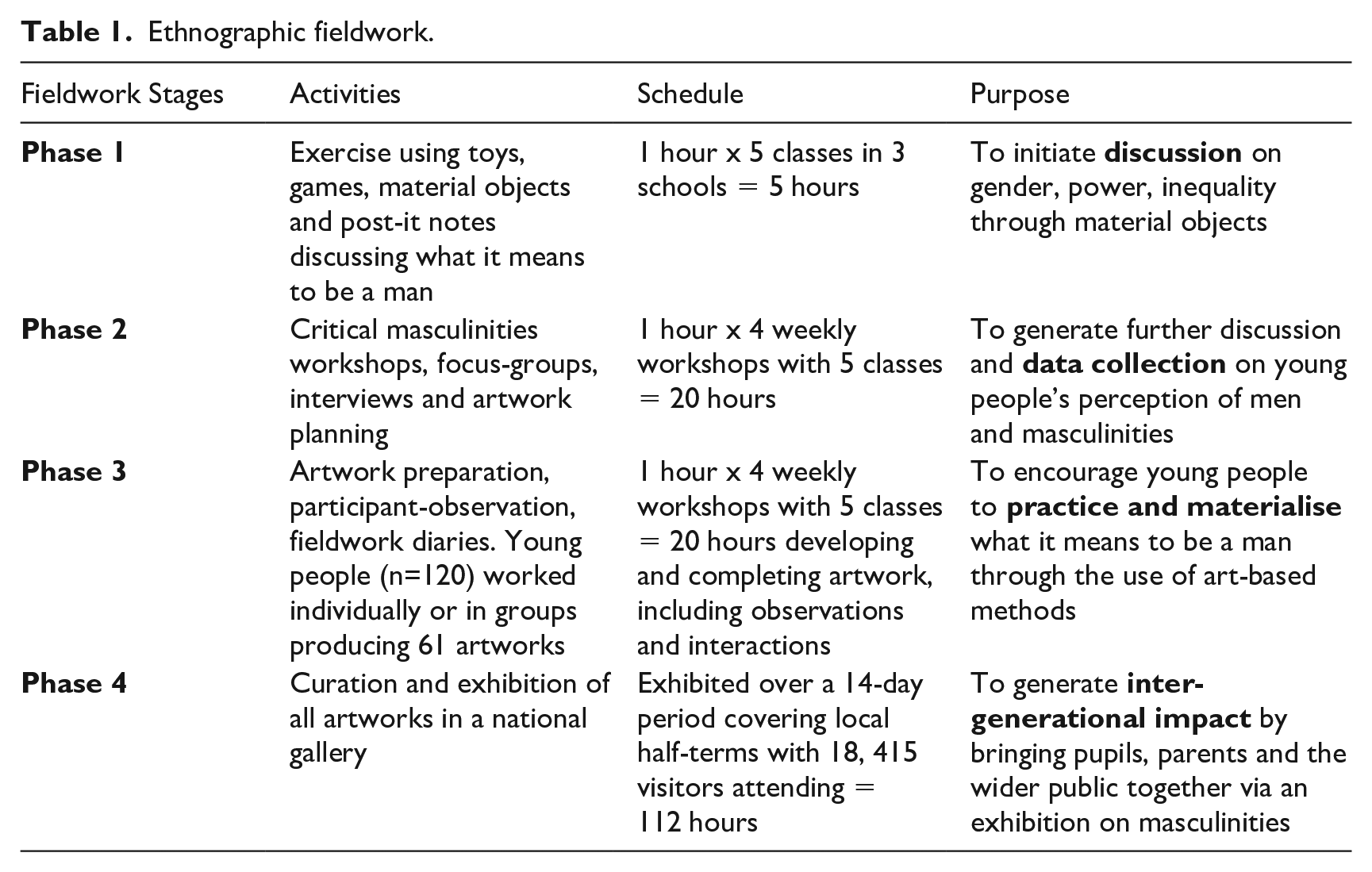
The research opened with an exercise where young people would extract symbolically gendered toys purposely concealed in a bag. Girls withdrew cars or trainsets to mild amusement, but when boys disclosed pink barbie dolls and unicorns the class descended into hilarity. This marked a starting point for subsequent critical masculinities workshop discussions. Four 1-hour weekly workshops with each class were accompanied by artwork, often conducted in small groups, exploring what it means to be a man. As reflected in children’s artworks, over time many developed imaginative and critical perspectives on masculinity, though some remained tethered to ideals of hegemonic masculinity. During workshops we routinely moved around the room observing, interacting, responding to discussion and making notes on how young people discussed masculinities using audio-recordings and fieldwork diaries. In keeping with article 12 of UNICEF United Convention Rights of the Child (2017), we recognise children as capable of forming their own views with rights to express them freely in matters affecting them. The research culminated in an exhibition of 61 pieces of artwork hosted in a national gallery bringing young people, schools, families and the public together. The interviews, diary observations and artwork were coded and analysed thematically. Table 1 summarises the fieldwork.
Ethnographic fieldwork.
Embodying masculinities: Work, sport and coastal leisure
Corroborating extant literature, local political economy is seen to validate some versions of masculinity and denigrate others. There is heavy emphasis in boys’ narratives upon ‘hard’ masculinity, sporting prowess and the ‘heroic’ aspects of masculine labour celebrated through ‘hard graft’, ‘breadwinning’, ‘risk’, and involvement in various sea-faring industries. For these young people, the idea of what it means to be a man is steeped in traditional notions of masculinity, embodied forms of muscular labour and a pervasive sense of patriarchal authority. A minority of boys engaged in affirming the gender order, underlining difference as they saw it and bringing gender power to bear on the social world around them. For example, one boy used charcoal to draw a large weapon and wrote, ‘My picture is about a rare weapon that makes you feel like a man when you get it’. Another insisted, ‘Boys are better at everything’ be it sport, video games or other activities. A further group drew a gay man who they described as a ‘psycho’. When we inquired why they drew a psychopath and how this represents masculinity, they admitted they ‘didn’t know’. Such representations invoke hegemonic masculinity through violence and the denigration of women and gay men (Connell, 1995; Messerschmidt, 2020). They indicate both the pervasiveness of hegemonic formations (Connell and Messerschmidt, 2005) and the role played by complicit masculinities in delineating those masculinities deemed ‘normative’ in Quarry Bay, from those that are not, and subsequently chastised.
Using fieldwork diaries, we observed a group of boys, who in a previous workshop had referred to the Portuguese footballer Ronaldo as ‘gay’, use the word ‘poof’ to refer to each other in derogatory fashion. Despite being told it was not a good word to use, they continued to deploy it to challenge authority and mark out abject forms of masculinity. Similarly, when we asked a class to identify their favourite piece of artwork, another group of boys directed us to an image entitled, ‘The art of manliness’. It showed a bare-chested man with clenched fists flexing his muscles, epitomising the notion of ‘hard’ masculinity. Sport, and the region’s favourite pastime football, is prominent in young men’s artwork. Football is allied to valorised forms of masculinity, that many young people hoped to emulate.
So, you’re going to draw . . . why football characters?
Craig: Because we’re both massive football fans and we love fortnight [a popular video game]. [. . .] Craig: I would basically say if you’re a footballer you’re a man, because you need to have strong legs and strong . . . Josh: . . . You need to be strong and speedy and fit. Craig: Strong arms and everything. You need to be quite strong and speedy. Okay. Craig: So, basically if you’re like, really strong and everything, you’re basically – I’m not saying people who aren’t that strong are not men – but like I’m just saying you need to be, kind of, strong to be a footballer. Okay. Josh: Not all the time, you might just need a little bit of muscle, and you also need to be fit so you can run a lot.
Okay. Why strength and be fast? Why does that mean, ‘what it means to be a man’?
Craig: Because the ball can be quite hard. Josh: And then if someone tries to do a bad challenge you might be able to get past them. Craig: Like, if someone tries to leg tackle you, you need strong legs, so it doesn’t break your legs, basically. Okay. Josh: And then if you can chip it over them and jump over their legs. (Lakeside)
For these young men having a football contract is synonymous with masculine pride, ‘If you’re a footballer you’re a man’. Muscular strength, speed and athleticism are integral to honing a socially validated masculinity derived through physical prowess.
Gender demarcation features in the artwork of Oscar, Lee and Ru, who worked as a group creating a vibrant felt-tip picture of a man and woman (Figure 1). The man is shown wearing a Nike sports top and shorts, surrounded by green dollar bills. Opposite is a blonde-haired woman, dressed in a crop-top tee-shirt with a large heart on it, holding a handbag in one hand and a mobile phone in the other. She is surrounded not by money, but by red and purple love hearts. The captions depicting the man proclaim he is ‘stronger’, ‘faster’, ‘richer’ with ‘short hair’ and ‘more handsome’. The prose forms an index for hegemonic masculinity underscored by ideas of wealth, strength and vigour; demarcating him superior to women. The portrait infers a masculine breadwinner and producer, with the woman as ornamental consumer. Here, women are judged on appearance, described as ‘nicer’, with ‘longer hair’ and wearing ‘cuter clothes’.
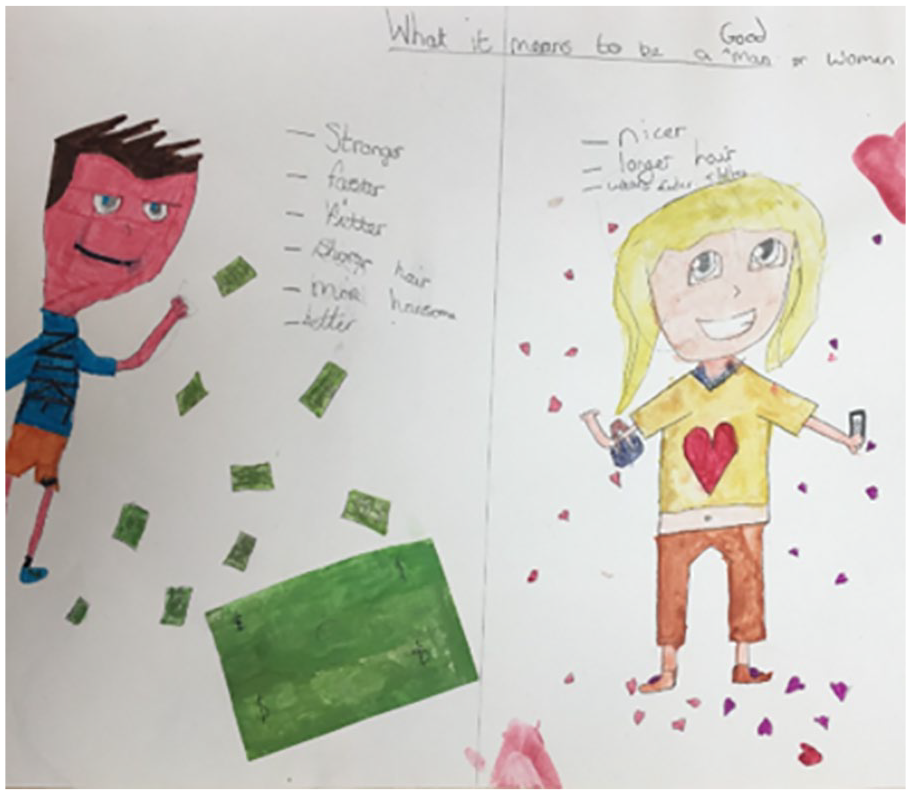
Money-making masculinities: ‘stronger, faster, fitter, better’.
Hegemonic masculinity not only works to produce gender binaries but legitimates inequalities and consolidates the gender regime (Connell, 1995). However, it did not go unchallenged. When asked why the group viewed boys as ‘stronger’ and ‘faster’ an interesting discussion unravelled, knitting together ideas of masculinity and sport on one hand, and unpicking them on the other. Here, Lee, Oscar, Ru and Rex discuss the merits of men and women’s soccer and why it is so popular for Quarry Bay boys.
Lee: Because boys are more active than girls because they [girls] just do their nails and stuff. Oscar: Not all of them. Ru: I mean a lot of boys play football now and again and tennis and stuff, so they work [hard] . . . Oscar: I know, but girls have a football league. Ru: But girls don’t play football now. Oscar: Yes, they do. Rex: No, they don’t. They’re not playing in the FIFA World Cup now. Oscar: Well, they might have a girl’s World Cup.
They do have a women’s World Cup [. . .] The England football team? They did better than the men’s English football team in the last World Cup.
Oscar: Yes, I think so. Ru: But the girls [England team] are better, I think because the girls’ team have it a bit easier than the men’s team. Because they [the men’s team] have to face Ronaldo and Messi and stuff in the World Cup, but the girls just have to run around a bit and have a bit of sport. It’s harder to get past . . . Oscar: But there might be a really good girl footballer. . . Ru: No, but the girls are easier to [get past]. (Brockley Park)
Within this vignette some familiar stereotypes abound, denoting how ‘boys are more active than girls’, who it is suggested, ‘just do their nails and stuff’. Even where evidence that women play professional sports is presented there is a tendency to consign this as ‘easier’, where ‘girls just have to run around a bit’. As the conversation continued, gender stereotypes were erected and dismantled in the spatial arena of sport. Oscar questioned how others could really know that there were no good women footballers if they hadn’t watched women’s football. Ru responded dismissively, ‘I’ve watched girl’s football before, but that was when I was bored’. The verbal jousting continued, before we decided to bring the conversation to a close.
Where do you guys think that you learnt those ideas – about men being stronger, faster and stuff?
Oscar: Encyclopaedia. Lee: I learnt like being stronger, faster, fitter off the football when I’m watching it.
This was one of many ethnographic interactions involving football and its elevated place in the region – fusing together sport, local masculinity and working-class identity.
Many young people signalled how ideas of masculinity were culturally embedded through local political economy. Quarry Bay students drew upon the coastal landscape and maritime industries to locate perceptions of masculinity. Luka, Landon and Haydon sketched a colourful picture of a fishing-trawler declaring: ‘Fishing is a man thing because they risk their lives for other people to get fish and food. They get hurt to help others’. Riverview [exhibit caption]
The production of ‘heroic’ masculinity is configured through primal associations with hunting and gathering, ‘fish and food’. A selfless, careless sense of masculinity is evoked, where men are said to risk their lives for others, and on occasion ‘get hurt’. Through tropes of heroic labour connections are made with Quarry Bay’s now depleted maritime industries where valorised masculine occupational identities are forged. In a study of men’s leisure and pollution in Teesside, Evers (2023: 11) also found magnet fishermen ‘celebrated past industrial accomplishments . . . that “made them who they are”’.
The enactment of masculinity through sea-faring activities, sport and leisure is a recurring motif. For example, one artwork showed a man swimming out to sea to rescue someone who was drowning and shouting for help. Popular pastimes on the nearby beaches of Quarry Bay include kitesurfing, bodysurfing and rowing. How these pursuits become ‘masculinised’ is further illustrated through our ethnographic diaries.
A group of students are doing a ‘water’ themed piece of art. I spoke to them about preparing their words for the exhibition. I asked them why they chose to do this piece and what it says about being a man. They say, ‘Well men surf because it is a man thing, like more men do it’. I say, ‘But women surf’. They say, ‘But surfing is more of a man thing . . . women don’t really surf. Men want to get strong and show off their six packs’. The boy then lifts his top up and hits his stomach and the other boys laugh. [Fieldwork diary PDRA, 5 July 2018, Riverview]
This chest-thumping bodily display of masculinity designates surfing as ‘a man thing’, based on bodily physique. For Connell (1995: 110) there is something ‘frenzied and showy’ in displays of ‘protest masculinity’. The gendering of work and leisure is a recurrent theme interwoven through accounts where football, deep-sea fishing and surfing are embodied as masculine activities for the ‘working through’ and ‘working out’ of post-industrial transformations (Gibbs et al., 2022). This is evident in the conflicted feelings of male surfers in Teesside, who enjoyed surfing amidst industry, despite acknowledging the waters were chemically polluted (Evers, 2023: 13). Throughout we have seen how ideas of masculinity are enacted in place and through local political economy. Invariably they are signalled in corporeal displays of breadwinning, strength, speed, risk and bravery. This anatomy of labour delineates ‘hard’ masculine labour from ‘effeminate’ service-sector work and the menial roles attributed to women (Figure 2).
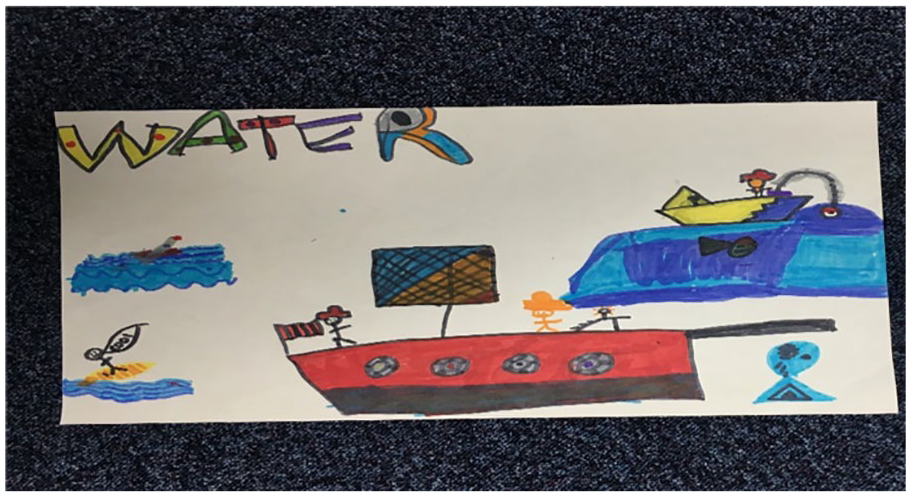
‘Heroic‘ coastal labour and leisure.
Towards feminist political economies of care: ‘Regendering’ and ‘degendering’ care
Having explored the ‘doing’ of post-industrial masculinities, this section considers how masculinities might be undone, or done differently. A framework of ‘feminist political economies of care’ (FPEC) is utilised, recognising the material structures and local context through which care operates, and the ensuing inequalities produced. For Tronto (1993: 4) care is ‘a species activity’, a ‘life-sustaining web’ that relies upon reciprocity and mutual interests, though remains hierarchical. In considering FPEC, it is instructive to draw upon Gibson-Graham’s (2008) ‘diverse economies’ framework. Their deconstruction of a normative neoliberal masculine economy is used to illuminate hidden, peripheral and otherwise invisible labour transactions, ‘part of bringing new economies into being’ (Gibson-Graham, 2008: 4). This post-structuralist interpretation recognises the economy as ‘a contested unit of analysis’ (Narayan and Rosenman, 2022: 393), taking multiple forms, where austerity and recession may particularly impact upon working-class women, ethnic minorities and those with disabilities (Hall, 2019). The importance of using FPEC to uncouple binaries is seen where Held (2005) remarks, ‘Care is both value and practice’. Consequently, McDowell (2004) argues for an ethics of care that is equally balanced at home and work, concluding, ‘the labour market and households are part of an interconnected system’ (p. 151). Here, care underpins the ability of global capitalist processes to prosper (England, 2010; Hall, 2019; Nayak, 2023; Warren, 2022).
A recent development connecting FPEC to men, is scholarship on caring masculinities. For Elliott (2016: 241) this entails the ‘rejection of domination and the integration of values of care, such as positive emotion, interdependence, and relationality’. To date this work includes conceptual framings (Elliott, 2016; Hunter et al., 2017), policy review (Hearn, 2018; Scambor et al., 2014) but little empirical research (cf. Bonner-Thompson and Nayak, 2022; Hanlon, 2012). Central to work on caring masculinities and FPEC is enabling possibilities for care to be ‘revalued’, in a move towards a ‘Careful World’ (Ruby and Scholz, 2018). This is notable as care is routinely constructed as beyond the boundaries of masculinity (Connell and Messerschmidt, 2005; Hearn, 2018), and surplus to the economy. A ‘diverse economies’ framework (Gibson-Graham, 2008) manoeuvres away from singular conceptions of ‘the economy’, potentially disclosing low- and unpaid care work, the bodily and emotional labour of caregiving, and care as an invisible currency underpinning our ecosystem (Fisher and Tronto, 1990).
If there remains a paucity of research on recipients of care (England and Dyck, 2014), accounts from young people are even more sparse. Researching care from their perspective illuminates the partial and uneven nature of care in young lives; the lines of power and gender inequalities that figure in caregiving; the distinction between material and emotional care and the different values this carries. Furthermore, the novelty of youth care accounts reveals the contours and grooves through which caregiving is ‘gendered’, ‘regendered’ and potentially, ‘degendered’. In what follows the analysis demonstrates how FPEC – of which caring masculinities is an emerging strand – can perform the type of ontological reframing Gibson-Graham (2008) outline, through a rewriting of economies (Narayan and Rosenman, 2022) in ways that have emancipatory potential. Research on geographies of care indicate that caring is replete with problems and potential (Bonner-Thompson and Nayak, 2022; England, 2010; Held, 2005; Tronto, 1993). The following sub-sections demonstrate this duality by exploring the ‘regendering’ of care (Boyer et al., 2017), where men’s caregiving can become an extension of patriarchal power; before turning to its ‘degendering’ (Connell, 1995: 232), where caregiving unfolds new possibilities for men and masculinities, as feminist scholars propose (Elliott, 2016; Fisher and Tronto, 1990; McDowell, 2004).
Regendering care
According to The Children’s Society (n.d) there are over 800,000 young carers in the UK, looking after a family member who is ill, mentally unwell, disabled or struggling with addition. In poorer regions in the global south, it is commonplace for children to work or take care of younger siblings (Cockburn, 2005; McLean, 2021). In our workshops it further became apparent that some young people had difficult family relationships, experiencing limited care from adults. This meant some had to engage in a high level of self-care or seek care from elsewhere. Participants juxtaposed ‘good men’ with ‘bad men’, characterising ‘bad men’ as those who drank, smoked, did drugs and didn’t care about others. When young people discussed attributes of what makes a ‘good man’, Adam opined, ‘I wish my dad was like this’. On further questioning, he wanted his dad to spend time with him, play with him, emotionally take care of him and buy him ice-cream, adding, ‘But he’s always too busy’. Finn admitted his dad was no longer around, and his mum would never get up before 12pm, leaving him to visit a cousin’s house for breakfast. When young people listed characteristics of care, Leon conceded, ‘To be honest my dad isn’t a good man’.
Though occasionally troubling, young people’s care accounts extend feminist geographies of care in important ways by illuminating further inequalities (England, 2010; Fisher and Tronto, 1990; Hall, 2019). What young people most desire from men is to feel cared for, and for men to demonstrate this through words, deeds and caring activities. For example, Luca and Aaron sketched comic-strip portraits of multiple masculinities with Luca remarking, the ‘Most important one would be a caring dad and happy dad’. Landon and Sadik explore the potential of caring masculinities through their artwork, displaying different family portraits: Landon: And a dad going to put a plaster on . . . Sadik: Yes. Landon: . . . his kid’s knee. Sadik: And this one, this man is helping this kid to cross [the road] Landon: No, he’s actually helping. . . it’s his kid and he’s working with him. [. . .]
Okay. So, I’ve got a question. Why does this show what it means to be a man?
Landon: By him taking care of people.
Taking care of people?
[General agreement]
Okay. Why have you done a girl with a baby?
Sadik: So, it shows . . . so, like everybody could be a thing. Like a person that takes care of someone, because this is the man . . . That’s his baby, that’s hers, well they’re both. . . There’s the dad, there’s the mother. She’s taking care of the little baby but he’s taking care of the bigger boy.
Okay. Why can’t the man take care of the baby?
[pause] Landon: Because then –
Because men take care of babies.
Landon: Yes, because she wants. . . She trusts more in herself to take care of the baby. (Riverview)
It is evident that Landon and Sadik understand that men can demonstrate care through medical aid or escorting children safely across roads. This is noteworthy where, ‘fathers as a social group can still be thought of as existing outside of everyday gendered carescapes’ (Barker, 2011: 418). However, the parameters of care shrink when women are assigned the role of baby care, based on assumptions of nurturing, or that men are more suited to different tasks (Hanlon, 2012). Here, the ‘degendering’ and ‘regendering’ of care is in operation, indicative of both the potential and challenges of caring masculinities as a new economic ontology.
The gendered division of care is further reinforced through ‘heroic’ pictures of lifesaving. David describes his picture showing an aeroplane and male crew helping a disabled passenger.
David: It’s somebody helping say. . . Like the crew’s going to be helping a disabled person out of a burning aircraft.
Right, okay. Why did you decide to do that?
David: Because I was. . . because say if they tripped, a woman would have high heels and picking them up, their weight would hurt their feet on the carpet. Whereas a man you have shoes where, first of all . . . no, second of all, you wouldn’t wobble [due to high heels] when trying to help.
Okay. But not all women wear heels and women would be able to help someone out if they can. A lot of women help people.
(Riverview)
In this illustration it is men who risk their lives and help others. These ideas, while demonstrating masculine care, only serve to consolidate hegemonic masculinity equating it with strength, and men as ‘lifesavers’ charged with rescuing others. Millie and Ava also understood men’s care through acts of rescue, describing their accomplished pictorial design.
Ava: The man is caring and helping for the sick and homeless trapped puppy that is hurt. The man decides to take the dog home and to take it to the vets to care and help for the little dog. The dog was in an incident where someone had been cutting down the trees not realising there was a dog there and the man came along and saw this sick puppy that needed help and the man helped the little dog. This shows the man is caring and respectful for other things, that also shows he is warm-hearted.
Great. Why did you decide to do [that]? What were you trying to show about what this means to be a man?
Ava: It means that they need to be caring and helpful . . . Millie: . . . and it isn’t just with animals, it needs to be with human beings as well. Ava: And because someone could just walk past the dog, and not do anything. So, this shows this man is . . . Millie: . . .kind and helpful. . . Ava: . . .caring and has a warm heart. (Riverview)
Throughout this sub-section, masculine care is frequently reduced to one-off, ‘saviour activity’. This is a by-product of the more familiar heroic occupational identities identified previously. In this case, men are viewed as strong – helping women, children, the disabled and animals that might otherwise come to harm. This creates a particular care dynamic centred around hegemonic masculinity, presenting men as powerful, and the recipients of care as vulnerable. Rather than dismantle the gender order, such care accounts may serve to consolidate it, performing the activity of ‘regendering’ care and bolstering hegemonic masculinity. Despite this, the above passage does signal the values of ‘care and respect’ and being ‘warm-hearted’. This is important in a region where Northeast England reported the highest rate of domestic abuse in England and Wales during 2018–2019 (ONS, 2019), indicating a need for caring masculinities. To develop more progressive care tendencies the following sub-section investigates how men’s caregiving can be advanced through FPEC that yield transformative potential.
Degendering care
Feminist scholars argue for a ‘feminist theory of care’ (Fisher and Tronto, 1990) or ‘feminist ethic of care’ (Cockburn, 2005; Held, 2005; McDowell, 2004), as care relations are a fundamental axis upon which the sexual division of labour is produced and stabilised in society (Hunter et al., 2017; Tronto, 1993). The pandemic and other ‘crises’, may offer a means for reorientating the ‘power-geometries’ of care. Warren (2022) documents the significant upturn in men taking on part-time work in the UK in a period of prolonged recession and austerity, arguing unsettled times can create circumstances for ‘undoing’ gender roles. Boyer et al. (2017) further speculate men may play more of a role in the domestic arena, due to a fragile and fragmented recessionary labour market, revealing a ‘capacity for austerity to sharpen, fuzz or refract’ (Hall, 2019: 783) everyday carescapes.
The global pandemic has reinvigorated a need for FPEC, to the extent it is gaining traction in the workplace – care for frontline workers, the importance of workplace wellbeing, support for staff with underlying health conditions and policies for homeworking. The gendered separation of the masculine world of work from feminised domestic spaces of care are then ‘troubled’, offering opportunities for critical intervention into rethinking and ‘degendering’ care. Connell (1995) suggests, ‘The degendering strategy applies not only at the level of culture and institutions, but also at the level of the body’ (p. 232). The pandemic has meant many men have shared child-care more equitably, engaged in home schooling, conducted routine domestic tasks, with some households relocating to rural areas to achieve better work-life balance. Such examples of everyday care can unsettle and ‘degender’ care where policies on paternity leave, homeworking and support for childcare are influential (Boyer et al., 2017; Brandth and Kvande, 2018; Hearn, 2018; Nayak, 2023). In this way, caring masculinities and FPEC have implications for gender transformation, where care equality has the potential to challenge, refigure and transform masculinities (Elliott, 2016; Hearn, 2018; Hunter et al., 2017).
Opportunities to ‘degender’ care manifested in Erin, Liv and Drew’s artwork: Erin: It’s like a picture of another man helping the man. Liv: Like, the main man is crying but the man . . . Erin: . . . The other man’s helping him.
That’s really nice. Is that because it’s all right for men to cry?
All: Yes [general agreement] (Brockley Park)
The ‘degendering’ of care recognises mutual relations and forms of interdependency where men support one another. Men’s unspoken vulnerabilities and a need for care, is brokered in the following discussion, focussed on the development of an artwork.
I like this one where he’s [the man’s] asking for help.
Polly: Yes. So, because it’s the man’s always helping the women, sometimes they feel like – Holly: Have the courage to ask someone! Polly: Sometimes they just want to act like they know it all . . . Holly: . . . When they really . . . Chloe: . . . Yes! When they don’t know what they’re struggling with, and then you ask someone for help. Holly: But they’re too scared. (Brockley Park)
In this vignette, young people critique the outward performance of masculinity as emotionally restrained, controlled and self-sufficient. They recognise men struggle with issues, seldom articulate them, and rarely ask for help. To do so would admit to vulnerability and the need for emotional care and countenance. Although many young people identified caring as the attribute they most desired from men, girls were at the forefront of engaging with this emotional aspect of care. In a provocative twist they offered critiques of traditional masculinities, noting how men lack ‘courage’ to ask for help, being ‘too scared’ of making themselves appear vulnerable. Phoebe explains: My dad just recently broke his arm . . . He’s very independent and he’s not really used to asking for help . . . So, my mum’s telling him, ‘No, you need help!’. (Lakeside)
Young people’s care accounts not only challenge masculine norms of invincibility but ‘degender’ care, through identifying emotional labour, interdependencies and intimacies. These possibilities are showcased in Amanda’s collage of an ‘Emotional Warrior’, comprising feathers, crape-paper, textiles and coloured tissues.
My picture represents two meanings. That men have feelings as well as women, and can cry, rather than [be] told, ‘they shouldn’t cry’. My other reason is that they should fight for these feelings, and fight for others too. Brockley Park [exhibit caption]
The ‘Emotional Warrior’ deploys FPEC to transgress ideas of hegemonic masculinity in favour of caring masculinities. It shows a caring figure, who displays emotion, wants to support the right for men to have feelings, and is unabashed with his unique self-presentation. The Emotional Warrior indicates men have feelings where demonstrating care is empowering. The Warrior steadfastly gazes back at the viewer and is unafraid to express vulnerability iterating, ‘Not everyone’s perfect’. This degendering process is made more potent when we learn the Warrior will protect boys who wish to wear ‘dresses and skirts . . . make-up and jewellery’ (see Nayak and Bonner-Thompson, 2022). Significantly his care radiates outwards to others and challenges locally valorised, hegemonic masculinity. This has implications for labour market opportunities as Lyra explains, ‘Boys don’t have to be muscly, they can just have like, normal arms. They don’t have to be a digger [construction worker], they could be a baker or something’. In these excerpts the ‘power-geometries’ of care are recast. Instead of men routinely helping women, children, animals or the disabled, men must undertake self-care, help other men, or proliferate care through LGBTQ+ support and other social care activities.
Concluding remarks
The study traces the ‘oblique’ relationship between local political economy, place and gender, extending current literature on post-industrial masculinities and youth transitions (Figure 3). Here, a ‘breadwinner’ identity, sport and maritime economies figure prominently in young people’s local productions of masculinity. Although younger generations did not experience the shipbuilding era directly, the residue of the past permeates the present, coming to inform ideas and values around ‘hard graft’, ‘hard’ masculinity and what it means to be a man. The implications are that care is regarded as menial, residual, effeminate labour. Consequently, it may mean only certain, often declining occupations, are deemed acceptable for young men transitioning into employment in de-industrial locations (Evers, 2023; McDowell, 2003; Nixon, 2009; Walkerdine and Jimenez, 2012). To displace this tendency the concept of FPEC is deployed, offering new ontologies pertaining to work, care and human value.
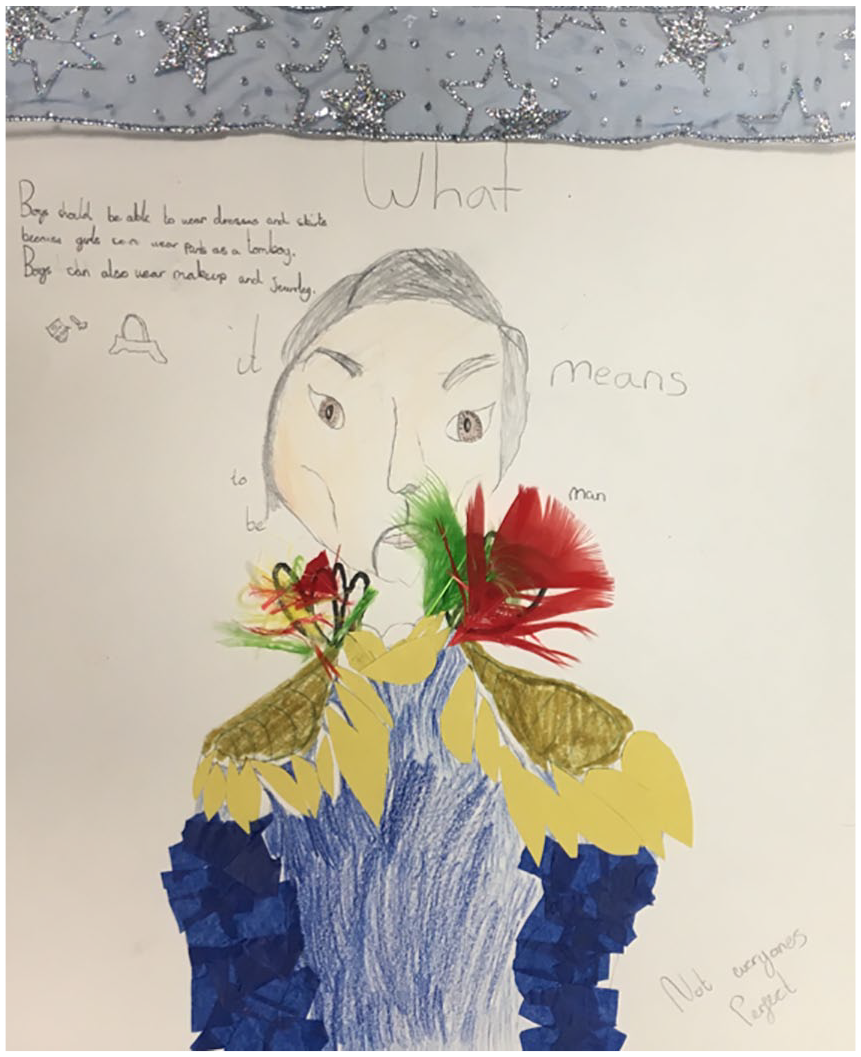
‘Emotional warrior‘: masculinities, care and emotions.
Young people are active agents, shedding light on care inequalities that elaborate and extend feminist geographies of care (England, 2010; Hall, 2019; McDowell, 2004). They provide critical insight on caring masculinities (Elliott, 2016; Hearn, 2018; Hunter et al., 2017), a sub-field Ruby and Scholz (2018) note reflects a dearth of empirical research. Such novel ‘care accounts’ (Raw and McKie, 2020) emphasise the importance of men’s caregiving and disclose the uneven dissemination of care in young lives (Bonner-Thompson and Nayak, 2022). Despite the ‘regendering’ of care in portraits of extended patriarchy and power that evoke hegemonic masculinity, young people could distill how men’s care can deconstruct, dismantle and ‘degender’ caregiving. This signals possibilities for a restructured gender regime more befitting of flexible, service-based, de-industrial economies. Youth care accounts situate the challenges and possibilities of care as a ‘new economic ontology’ (Gibson-Graham, 2008: 3). Making legible FPEC is key to this practice, which may be elucidated at points of crisis – post-industrial, post-conflict, global pandemics or the prevailing cost-of-living crisis (Boyer et al., 2017; McLean, 2021; Narayan and Rosenman, 2022; Warren, 2022).
In these instances, there is ample evidence to suggest that men can take on caring roles (Hunter et al., 2017; McLean, 2021; Roberts, 2013) where caring masculinities is not an oxymoron. At its most potent, such opportunities may lead to ‘an abolition of gender hierarchies’ (Connell and Messerschmidt, 2005: 882) and the ‘reworking’ of masculinities across intersecting local-global scales (Nayak, 2023). Rethinking care along the lines of ‘diverse economies’ opens-up possibilities for other work, and ‘other worlds’ (Gibson-Graham, 2008). Unchaining masculinities from the heavy weight of the industrial past, and its foreshadowing of ‘heroic’ labour, ‘risky’ leisure and patriarchal dominance, may enable more ‘Careful Worlds’ to transpire (Ruby and Scholz, 2018). It is hoped that further research might utilise FPEC as a flexible framework to ‘trouble’ gender, work and care as seemingly sedimented ontologies. In doing so, such approaches may inspire youth transitions that traverse beyond ‘shameful work’ (Walkerdine and Jimenez, 2012), ‘fiddly jobs’ (MacDonald, 1994), ‘protest’ (Connell, 1995), ‘convicted’ (Maguire, 2021) or ‘redundant masculinities’ (McDowell, 2003).
Footnotes
Acknowledgements
For the purpose of open access, the author has applied a Creative Commons Attribution (CC BY) licence to any Author Accepted Manuscript version arising from this submission. I would like to thank Carl Bonner-Thompson who was the postdoctoral research associate employed on the project, Tracy Bell at Barnardo’s who really helped open doors for us, the Tyne and Wear Great North Museums, staff at the three schools and of course the fantastic young people who inspired us. I would also like to acknowledge the editors of Environment and Planning A and the 3 reviewers for their encouraging and insightful comments. Any errors are the responsibility of the author.
Declaration of conflicting interests
The author(s) declared no potential conflicts of interest with respect to the research, authorship, and/or publication of this article.
Funding
The author(s) disclosed receipt of the following financial support for the research, authorship, and/or publication of this article: The research was supported by the Economic Social Science Research Council [ES/M500513/1, Newcastle University].
