




Abstract
Toronto has for 70 years been one of the fastest growing city-regions in North America, and over the last two decades has seen booming high-rise intensification. A distinctive land value capture (LVC) system and practice has emerged. This paper traces the contested evolution of Toronto LVC since 1946, including recent major changes to the rules, and makes three main contributions: First is the suggestion that at its core, LVC is an attempt to purposefully alter the distribution of the costs and benefits of urban property development between public and private actors, and should be considered a key metric to evaluate the social equity of property development processes. Second, conjunctural analysis has recently emerged as an approach to reading the intersection of political, economic, social, and ideological processes that come together to produce historical changes in specific cases. I argue that Historical Institutionalism (HI) is a valuable complement to the conjunctural analysis approach in its focus on the genesis of and contestation over specific sets of institutions. HI provides a set of midlevel conceptual frameworks and research methods to identify major institutions, the actors involved, and institutional change mechanisms, processes, and patterns. I bring together two hitherto separate traditions of thought about conjunctures, that arising from Gramsci through Stuart Hall, and that developed in HI, arguing that HI brings analytical clarity to the comparative analysis of conjunctures. Third, the Toronto case is revealing of processes of institutional change, mechanisms supporting path dependence, and the urban impacts of globally hegemonic ideological conjunctures.
Land value capture and contestation over urban institutions
The sets of institutions regulating capital investment in urban property are increasingly important today, as urban property development has become one of the world’s largest industries, cities struggle to finance growing infrastructure demands, and municipal governments are potentially key actors in attempts to achieve more sustainable cities and better living environments. A major question is how to finance, maintain, and improve urban infrastructure systems to enable zero-carbon transitions and make cities less vulnerable to climate change. One answer has long been that as public planning decisions and publicly financed urban infrastructure can contribute to increased property values, a share of any increase should be taxed to help pay for shared infrastructure (Ingram and Hong, 2012; Parker, 1965; Ratcliffe, 1976). Debates about such “land value capture” (LVC) have become more pressing as demands for and costs of necessary infrastructure grow and other sources of revenue have shrunk (Campbell et al., 2000; Crook et al., 2016; Shih and Shieh, 2020; Wolf-Powers, 2010). A major challenge is to achieve LVC in practice, as suggested by the British case where repeated attempts to tax such “betterment” during the 20th century were repealed (Booth, 2012; Cullingworth, 1981; Ratcliffe, 1976).
There is great variety in existing approaches to LVC. These include not only the impact fees, tax increment finance, and special assessments common in the U.S. (Ingram and Hong, 2012; Kim, 2020; Wolf-Powers, 2010) and “planning gain” in the U.K. (Campbell et al., 2000; Crook et al., 2016), but also approaches practiced elsewhere in the world including Land Readjustment (Doebele, 1982; Muñoz Gielen and Mualam, 2019; Sorensen, 1999), density bonuses in return for cash, public space, or affordable housing (Moore, 2013), “urban operations” in Sao Paulo, Brazil where density increase permits are auctioned to pay for infrastructure investment in defined areas (Friendly, 2017; Sandroni, 2011), the “property state” approach of Singapore (Haila, 2016), and density permit sales in Tehran (Karampour, 2021; Madanipour, 2011). These all represent attempts to link permits for urban intensification to contributions (financial or in-kind) to local infrastructure and services, but their approach and legal basis vary enormously. The rate of value-capture globally is also extremely varied, from places like Japan where most new developments contribute nothing to shared infrastructure (Sorensen, 2001), to places like the Netherlands where all of the land value uplift of rural to urban land development was long captured by municipal governments that bought land at agricultural values and sold or leased plots to developers to pay for all infrastructure, including sites for parks and affordable housing (Faludi and Valk, 1994; Monk and Crook, 2016). This diversity of approaches and of rates is theoretically significant. Why is there such great variation both in LVC methods and in the scale of revenue generated? What factors shape the capacity of jurisdictions to debate, develop, and implement LVC?
This paper makes three main contributions: First is the suggestion that at its core, LVC is an attempt to purposefully alter the distribution of the costs and benefits of urban property development between public and private actors in the interest of social equity. This usually involves either taxing a share of land value increase and/or requiring developers to make contributions (in cash or in kind) to the costs of the public infrastructure that makes their development possible. The extent to which each jurisdiction succeeds or fails in this endeavor is suggested as a key metric to evaluate urban governance and the social equity of property development processes. If private capital investment in urban property fails to contribute its fair share to the municipal infrastructure that makes urban development possible, but instead imposes uncompensated costs on its neighbors, and/or extracts unearned profit from development, it is socially unjust (see Fainstein, 2012). In Ontario it has long been argued that “growth should pay for growth” (Found, 2019; Sancton, 2021), as those buying new residential property are on average wealthier than the residents of the city as a whole, so development that contributes nothing to the costs of growth-related infrastructure means that lower-income residents will be subsidizing either the housing costs of the new residents or the profits of land developers and land owners, or both. The claim here is that institutions regulating capital investment in urban property represent important “rules of the game” of contemporary capitalism, and LVC systems should be understood as attempts to change the distribution of the costs and benefits of urban development between actors, between public and private sectors, and between generations, have important social equity implications, and are therefore contested.
Second, conjunctural analysis has recently seen renewed attention as an approach to urban analysis (Inch and Shepherd, 2019; Leitner and Sheppard, 2020; Peck, 2017a, 2017b; Ward, 2021). Originating in the work of Gramsci, and prominently deployed by Stuart Hall in his analysis of the shift to neoliberal ideological hegemony in 1980s Britain, conjunctural analysis attempts to read the intersection of political, economic, social, and ideological processes that come together to produce particular historical changes (Peck, 2017a). As Leitner and Sheppard (2020: 492) argue “Conjunctural analysis has prioritised understanding the dialectical relationship between the general and the particular.” The contribution here is on the “particular” side of the “general-particular” divide, suggesting that to understand how general forces and hegemonic ideas impact urban governance one important focus should be on the analysis of particular processes of institutional contestation and change at the local scale. Historical institutionalism (HI) has over the last three decades developed a robust set of midlevel theoretical concepts and research methods for longitudinal analysis of institutional change that is compatible with and complements conjunctural analysis. I argue that one focus should be on formal institutions and their patterns and mechanisms of change, both during critical junctures of institutional genesis and during ensuing reactive sequences of contestation over those institutions, and that HI has developed useful approaches for research and comparison of institutional change processes between jurisdictions. Critical juncture analysis in this way helps to explain the processes through which political actors take advantage of conjunctural crises to further particular institutional changes.
Third, this paper develops a historical institutionalist (HI) analysis of LVC institutions in Toronto Ontario, focusing on the formal institutions regulating urban property development and value-capture, and their evolution in contested historical processes. In recent decades Toronto has seen a boom of development and intensification (Filion et al., 2020; Grisdale and Walks, 2022), mostly in the form of high-rise condominiums in central areas (Lehrer and Wieditz, 2009; Rosen and Walks, 2015). There is a growing research literature on the politics of development control and density bonusing in Toronto (Biggar and Siemiatycki, 2023; Lehrer and Pantalone, 2018; Moore, 2013), its role in the production of affordable housing (Mah, 2022), and the social equity implications of density bonuses (Biggar and Friendly, 2023; Friendly, 2020). Contestation over the regulation of property development in Ontario has long been intense (Leffers, 2018; Lorimer and Jacobs, 1970; Spurr, 1976), and as shown below.
In part as a result of the design of the first planning legislation in 1946, value-capture became central to the practice of city-building in Toronto, representing a major share of investment in urban infrastructure. As discussed in section 3, over the 10 years from 2009 to 2018 the City of Toronto collected over C$490 million (about US$386 million at current exchange rates) in developer payments for “Section 37” density up-zonings and C$2.29 billion in development charges (similar to impact fees) levied on new development to pay for infrastructure. Over the last century questions of the public/private division of the costs and benefits of urban property development have been continuously and vigorously contested, through the courts, planning tribunals, the legislature, and in the public arena, with active debates over both LVC principles and practices. LVC is again at the center of political debate today, with major new provincial legislation every year from 2018 to 2023 including revisions to hundreds of separate laws intended primarily to reduce LVC revenues and eliminate “red tape” to support increased housing supply. Many jurisdictions have neither the legal authority to implement LVC, nor meaningful opportunities for democratic debate about it, but in the Toronto case this issue has been at the center of planning and municipal finance debates. From the early 20th century until today major political questions in Ontario have been: Who pays for urban growth? How much? Where is the dividing line between public and private responsibility? How does this impact the cost of new housing? What is “fair”? The Toronto case is revealing of processes of institutional change, mechanisms supporting path dependence, patterns of political contestation, and the ways that globally hegemonic ideological currents are translated into political and policy processes at the local level.
The next section suggests that historical institutionalist approaches to the analysis of critical junctures offer valuable conceptual frameworks and research methods for the longitudinal analysis of institutional change that are compatible with and add value to the conjunctural analysis project outlined by Peck and others. The third section outlines the historical process of contestation over LVC in Toronto that took the form of critical junctures followed by reactive sequences that continue until the present. A concluding discussion draws out the insights offered by this approach for understanding conjunctures, path dependence, land value capture, and institutional change in the regulation of urban property.
Conjunctural analysis, critical junctures, and institutional change processes
This paper brings together two strands of “conjunctural analysis” that have so far not been in dialogue with each other, that in critical urban and cultural studies, and that in political science and HI. I suggest that the latter offers significant value-added to the former in its focus on historical processes of institutional development and change, and the development of a robust set of conceptual frameworks and research methods for their analysis.
Conjunctural analysis in critical urban studies is an emerging conceptual framework, based in part on Gramsci’s work, particularly as developed in the work of Stuart Hall who suggested that conjunctural crises arise “when a number of forces and contradictions, which are at work in different key practices and sites in a social formation, come together or ‘con-join’ in the same moment and political space” (Hall, 2011: 705). Peck helped initiate a new engagement with conjunctural analysis in critical urban studies with his Transatlantic City papers (Peck, 2017a, 2017b), which suggested that “a conjunctural analysis must – perhaps above all – be attentive to issues of contextual, positional and situational specificity, resisting the temptation to read off global trends from particular circumstances” (Peck, 2017a: 10), and that conjunctural analysis requires “the production (and restless revision) of midlevel theoretical formulations appropriate for interrogation across multiple cases and sites, along with reflexive interpretations of the interplay between grounded circumstances, mediating conditions and contingent effects on the one hand, and their enabling conditions of existence, operational parameters and connective circuits on the other.” (Peck, 2017a: 9). Peck offered few details, however, of research method in those papers, instead providing an in-depth example with his examination of the decline of Atlantic City.
Inch and Shepherd (2019) contribute a valuable review of Hall’s approach to conjunctural analysis and apply it to analysis of planning as an arena of contestation over shifting planning and housing ideologies. They argue that “conjunctural analysis seeks to bring into analytical purview the intersection of multiple processes that coalesce at a particular historical moment to produce a distinctive ‘conjuncture’ – or combination of processes – inscribed with particular crisis tendencies and political potentialities” and use it to analyze shifting conceptions of planning during the current UK housing crisis (Inch and Shepherd, 2019: 609). Leitner and Sheppard (2020) suggest that “conjunctural analysis has prioritised understanding the dialectical relationship between the general and the particular, but requires spatialisation before its historical inclinations can be extended” (p. 492). That spatialization is achieved with a focus on land assetization and financialization in Jakarta and Bangalore, and what they describe as “Inter-scalar Chains of Rentiership” (Leitner and Sheppard, 2020). Leitner and Sheppard’s approach points to the centrality of land development processes in the current conjuncture, but says nothing about specific institutional change processes. As with Peck, and Inch and Shepherd, conjunctural analysis is deployed for analysis of the impacts of hegemonic economic/ideological change on local processes.
The suggestion here is that while recent conjunctural analysis in critical urban studies identifies important questions about the ways in which global ideological and political currents impact urban change, HI has long been developing a robust set of revisable mid-level theoretical formulations, conceptual frameworks, and research methods for the study of conjunctures and critical junctures as processes of major institutional change (Berins Collier and Collier, 1991; Capoccia, 2015; Capoccia and Kelemen, 2007; Pierson, 2004; Soifer, 2012; Sorensen, 2023). Although Hall (2016) draws a distinction between them, suggesting that conjunctures are more limited in scope than critical junctures, most HI researchers see both conjunctures and critical junctures as times when a confluence of events produces heightened potential for change of major social institutions. Mahoney uses the terms interchangeably, and diagrammed a “conjuncture with enduring consequences” as an intersection of two sequences that led to institutional change and a new developmental pathway (Mahoney, 2000: 529). The claim here is that HI concepts and methods for the study of critical junctures can help add analytical clarity to the analysis of conjunctures, and will be particularly valuable for comparative studies of the outcomes of conjunctures in different jurisdictions.
Capoccia and Kelemen (2007: 348) define critical junctures as “relatively short periods of time during which there is a substantially heightened probability that agents’ choices will affect the outcome of interest.” Critical junctures are closely related to the idea of path dependence, because major social institutions are usually relatively hard to change, especially those that are subject to self-reinforcing “positive feedback” effects (Mahoney, 2000; Pierson, 2000; Sorensen, 2015). As Mahoney argues, “Critical Junctures are choice points when a particular option is adopted from among two or more alternatives. These junctures are ‘critical’ because once an option is selected, it becomes progressively more difficult to return to the initial point when multiple alternatives were still available” (Mahoney, 2001: 6–7). Hall (2016: 41) suggests that conjunctures of significant institutional change are relatively rare because “major institutional changes are likely to require exceptional circumstances, because change of this magnitude depends on coalitions that are especially difficult to build,” and usually require “multiple conjunctural causation” to succeed (Hall, 2016: 40), a framing very similar to that of Stuart Hall.
There are many ways to define institutions. North suggested that institutions are “the rules of the game in a society or, more formally, are the humanly devised constraints that shape human interaction” (North, 1990: 3). Planning institutions have been defined as the “collectively enforced rules and expectations with respect to the creation, management, and use of urban space and property” (Sorensen, 2015: 20). Historical institutionalism frames institutions as unequally distributive, produced by and constitutive of unequal power relations, and contested (Mahoney and Thelen, 2010; Pierson, 2015). In the study of cities it makes sense to focus on the formal rules regulating land development, especially those that change the distribution of the costs and benefits of development between actors, including LVC, as those rules have powerful impacts on land values and development profits, and are often politically contentious.
The critical juncture research method is based on a conception of major institutional change as a sequence. First a crisis or other confluence of events creates the “permissive conditions” (Soifer, 2012) that allow a greater openness to institutional change, then a critical juncture occurs in which relevant actors take advantage of this opportunity to fight for change, and a choice is made between two or more possibilities. This is often followed by a reactive sequence of contestation during which the choices made are contested or refined, followed eventually by a period of relatively more stability, as shown in Figure 1. Berins Collier and Collier (1991) developed this sequence analysis as a comparative method in which similar (synchronic or diachronic) critical junctures were identified in a set of cases and in which different antecedent and productive conditions led to different outcomes.
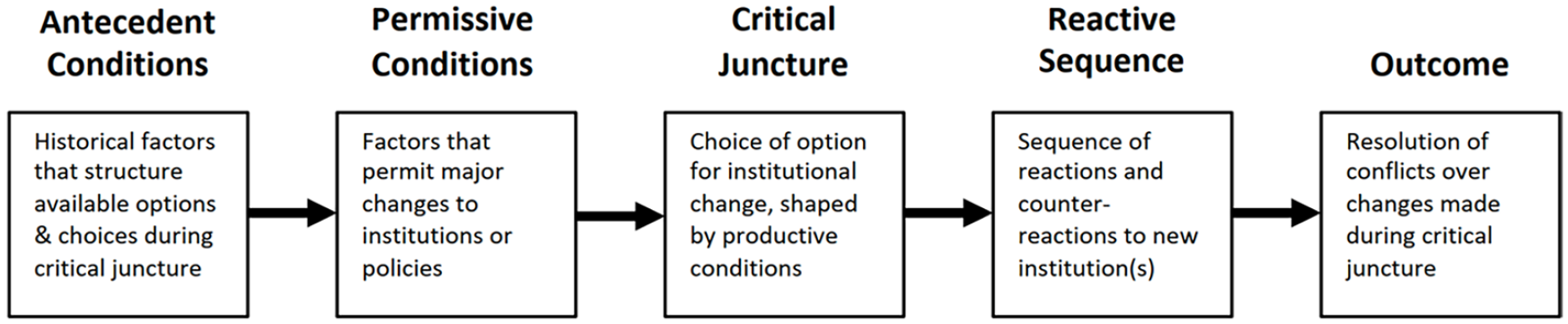
Critical Juncture sequence.
According to Soifer “Permissive conditions can be defined as those factors or conditions that change the underlying context to increase the causal power of agency or contingency and thus the prospects for divergence” (Soifer, 2012: 1574 italics in original), and productive conditions are “the aspects of a critical juncture that shape the initial outcomes that diverge across cases” (Soifer, 2012: 1575 italics in original). Research must identify antecedent conditions, including existing institutions, shared norms about what change is appropriate and possible, institutional capacity and bias, and the relative power and influence of interested actors. Productive conditions that shape the specific outcomes of the critical juncture include engaged actors, existing political and legal structures, available mechanisms for institutional change, ideological and economic conditions, and the timing and sequencing of events (Grzymala-Busse, 2011; Soifer, 2012). Soifer (2012) suggests that both permissive conditions and productive conditions are necessary, and by themselves each are insufficient for a critical juncture to produce meaningful change. And that we should understand differing outcomes as produced both by differing antecedent conditions prior to the critical juncture, and differing productive conditions during the critical juncture and reactive sequence.
Sorensen (2023) argues that urban governance institutions are particularly prone to critical junctures because: they are usually located in multi-level governance systems where senior governments can trigger major institutional change through legislation and subordinate local governments sometimes create new lasting institutions in response; because urban disasters sometimes prompt the development of new institutions; and because urban socio-technical systems face a constant stream of new challenges and crises that prompt institutional innovation, some of which lead to major institutional changes.
In a contribution that is useful here, Fligstein and McAdam (2011) define a “Strategic Action Field” (SAF) as a “meso-level social order where actors (who can be individual or collective) interact with knowledge of one another under a set of common understandings about the purposes of the field, the relationships in the field (including who has power and why), and the field’s rules” (p. 3). HI assumes that institutions are the product of competition among interested actors, and that those who gain advantages from an existing institution are most likely to seek to resist changes that weaken their advantage and those disadvantaged by the institution are most likely to seek change (Mahoney and Thelen, 2010).
The suggestion here is that while hegemonic global ideological currents and conjunctures are important, their impacts on urban change on the ground is mediated through local institutions and the ways in which those are applied and contested in battles over specific sets of institutions, as in the case of LVC in Toronto. HI adds value here through the close analysis of political contestation over specific land value capture institutions, for which the HI conceptual framework and research method is particularly well suited.
The case is presented as a historical narrative of a long-term process of institutional development of Ontario and Toronto planning, land development regulation, and infrastructure finance systems using process-tracing methods and reactive sequence analysis (see Bengtsson and Ruonavaara, 2017; Falleti and Mahoney, 2015). Historical narratives are particularly valuable for the analysis of long-run sequences of institutional change (Büthe, 2002). The historical narrative here documents all significant changes to formal planning law and practice regulating land development, value capture, and infrastructure finance since the passage of Ontario’s first modern planning law in 1946, identifying permissive and productive conditions of two and possibly three critical junctures of major legislative change and associated reactive sequences of incremental change, as well as the relevant actors, debates, and institutional change mechanisms. The historical narrative presented here is based on an exhaustive review of secondary literature and primary documents including Ontario parliamentary debates and City of Toronto reports, condensed here because of space limits. In addition, two sets of detailed financial data were assembled on Toronto’s LVC revenues and on Section 37 benefits from amalgamation in 1998–2020. Eleven interviews were undertaken in Fall 2022 and Winter 2023 with City of Toronto planners, city councilors, and planning consultants, indicated as Personal Interview (PI).
The contentious evolution of land value capture in Ontario
The Toronto area is the largest city-region in Canada and has been one of the fastest-growing urban regions in North America since the 1950s. In 1951 the Census Metropolitan Area population was 1.1 million, and in 2021 the population of the Toronto CMA was 6.2 million, amounting to growth of 5 million in seven decades (Statistics Canada, 2021). Toronto is the capital of the province of Ontario, and in Canada provinces are relatively powerful constitutionally, with authority over a wide range of issues including health care, environment and resources, education, and municipal affairs. Municipal governments in Canada are considered to be “creatures of the province” and have little legal autonomy. Provinces can and often do unilaterally alter planning legislation, municipal boundaries, municipal taxation powers, and mandated municipal services (Frisken, 2007; Taylor, 2019). The focus here is on the Ontario and Toronto institutions for land value capture from property development processes.
Critical Juncture 1, the creation of Ontario’s first modern planning law
A fundamental critical juncture in Toronto planning history was the passage of Ontario’s Planning Act 1946 by the Ontario legislature (Hulchanski, 1981; Sorensen and Hess, 2015; White, 2016b). Three main “permissive” factors encouraged the passage of this law, Ontario’s first to meaningfully regulate private property development. First is the fact that until the 1940s Ontario still had weak planning and development regulations, and expectations for a boom of housing development after the war increased pressure to strengthen them. Second was the pressing issue of financing the infrastructure necessary for growing urban areas, and third was the major shift of the socio-political environment during the war, that saw greatly increased public and political support for interventionist government policy and planning.
Prior to 1946 Ontario municipalities enjoyed only rudimentary planning powers, including building standards and fire regulation laws passed in the 19th century (Fischler, 2007), and the 1917 Planning and Development Act, which permitted cities to review and comment on subdivision plans but granted no powers to require any changes to proposed plans or financial contributions for public infrastructure, or even legal authority for comprehensive land use zoning (Hulchanski, 1982: 32). Despite intensive lobbying for greater planning and regulatory powers, and the submission to the government of draft legislation modeled on Britain’s 1909 Housing and Town Planning Act (including a betterment tax provision) by Thomas Adams in 1916, the government declined to adopt it (Hulchanski, 1982), instead passing the weak 1917 Act which was in place for almost 30 years until 1946.
Financing growth-related infrastructure was a second major issue. Until 1912 the City of Toronto regularly annexed its suburbs and extended water supply, sewers, and services such as police and fire protection and schools to them. But after the annexation of North Toronto in 1912 triggered a major increase in property taxes and political controversy, the city adopted a formal policy of rejecting further annexations in 1914 (Harris, 1996; Hulchanski, 1982). Five small new suburban municipalities were incorporated over the next decade, adding to the existing seven, and these all borrowed heavily in the 1920s to build infrastructure and schools despite their limited tax bases. During the Great Depression 10 of these 12 suburban governments were unable to service their debts, and the province was forced to bail them out (Frisken, 2007: 56; Harris, 1996; Taylor, 2019). The question of how to pay for suburban growth-related infrastructure became pressing again in the 1940s, as Toronto had seen significant population growth during the war, but little housing had been built since the start of the depression in 1930, and a postwar construction boom was widely anticipated.
The third factor was the significant shift in attitudes during the war toward acceptance of greater government economic intervention. Extremely limited public relief efforts in response to the hardships of the great depression, followed by successful state planning of the booming wartime economy, had undermined adherence to laissez-faire economic doctrines (Hulchanski, 1981: 257). In January 1943 the federal government established the Advisory Committee on Reconstruction that included a Subcommittee on Housing and Community Planning chaired by C.A.Curtis. The Subcommittee’s final report reviewed existing planning systems in Canada and recommended that to ensure an adequate housing program every Canadian town and city be required to complete a master plan, that subdivision approval systems be established, and that land subdividers should pay the costs of building streets and sewers (Curtis, 1944; Gordon, 2018). These recommendations reiterated proposals dating to before World War 1.
Public opinion had also clearly shifted, as suggested by the fact that in the Ontario election of 1943 the ruling Liberal Party was crushed, reduced from 81 to 15 seats, while the Communist Party won two seats, (their first ever in Ontario), the social democratic Co-operative Commonwealth Federation (CCF) won 34 seats, and the Conservative Party won 38, forming a minority government (Hulchanski, 1981).
Although all parties had promised new town planning legislation, nothing was passed before the minority government was defeated and forced to call a new election in early 1945. During that election campaign promises were again made to pass new planning legislation, the Liberals and CCF made detailed legislative proposals, and the City of Toronto also published an ambitious draft planning law. The newly rebranded “Progressive Conservative Party” won a majority of seats in the 1945 election, and in 1946 passed a new Planning Act, the first to grant local governments meaningful powers to regulate land development, including land-use zoning. A majority meant that the government would not face the electorate for at least another 4 years, and they passed a much more limited planning law than any of the proposals discussed during the election (Hulchanski, 1981). This new planning system was clearly the product of a critical juncture. It was the first law to grant municipal governments meaningful powers to regulate land subdivision and urban development, something that had long been rejected by Ontario governments. This meant a major limitation to property rights, as subdivision control and zoning powers gave local governments significant regulatory and negotiating powers, as shown next. This major change to the important social institution of landed property was contingent, as there were several detailed proposals for new planning laws, yet the government chose none of them and approved an entirely new approach that no-one expected. Important details were left ambiguous and contributed to the reactive sequence of contestation that continues until the present.
Significantly, the current discretionary system of subdivision approval emerged in large part because the 1946 Act was ambiguous in its details. The government granted subdivision approval powers to local governments, but rejected proposals that subdividers be required to build or pay for municipal services such as water supply, sewers, and paved streets as had been recommended by the Curtis Report and promised by other parties (Hulchanski, 1981: 336). Although all official plans, subdivision plans, and zoning plans required approval by the provincial Minister of Planning and Development, in practice the ministry deferred to local governments, promising it “would intervene directly in local affairs only as a last resort” (Taylor, 2019: 99). Taylor (2019) argues convincingly that municipal discretion in approving subdivision plans was real: “between 1954 and 1957, only 42 per cent of 116,000 proposed residential lots were approved” (p. 111). Their primary goal was to ensure contiguous development to allow efficient water and sewer servicing, but local governments were clearly not shy about rejecting subdivision plans. This gave small suburban municipalities significant bargaining power with developers.
Another important factor in the development of the Toronto planning system was the creation of the Municipality of Metropolitan Toronto as an upper tier of regional government with the 13 existing local governments remaining in place in a two-tier system (Frisken, 2007; Rose, 1972). A major priority in establishing Metro was to ensure sustainable finance for suburban infrastructure to prevent a recurrence of the fiscal debacle of the 1930s. This was achieved by leveraging the City of Toronto’s large tax base and strong credit rating, requiring subdivision developers to provide all infrastructure within their developments, charging lot levies for off-site infrastructure, and ensuring sufficiently dense development to generate adequate property tax revenue (Found, 2019; Sorensen and Hess, 2015; White, 2016a, 2016b). Although lot levies (per-lot charges to pay for offsite infrastructure such as sewage treatment plants) were not mentioned in the 1946 Planning Act, local governments were able to leverage their subdivision approval powers to demand them. Increasing numbers of court challenges to lot levies in the 1950s, and appeals against them to the Ontario Municipal Board (OMB) persuaded the Progressive Conservative government to amend the Planning Act in 1959 to clarify municipal legal authority to demand them, and to retroactively affirm the legality of all subdivision agreements already negotiated (Frisken, 2007: 79; Ontario, 1959; Tomalty and Skaburskis, 1997). This system prevailed for the next three decades until the passage of the Development Changes Act of 1989.
Critical Juncture 2, the Development Charges Act 1989
Lot levies again became a source of conflict in the 1970s, as a boom in suburban development led to increasing reliance on them for local finance, and newly created upper-tier regional governments surrounding Toronto also started to collect them, resulting in a near doubling of charges (Slack and Bird, 1991: 1294). The development industry organized to actively lobby against these increasing charges, arguing that local governments were taking advantage of this system to keep property taxes artificially low (Bailey, 1990). Increasing numbers of court cases and OMB appeals challenging these exactions again motivated a revision to the Planning Act in 1983.
The 1983 Planning Act revision passed by the Progressive Conservatives introduced Section 36 (now called Section 37) that allowed the negotiation of higher densities than permitted by existing zoning in return for specified local contributions by developers. Such density bonus agreements became widely used only after 2000, and even then primarily by the City of Toronto, as discussed below. The 1983 law failed to clarify the use of lot levies—now referred to as Development Charges (DCs)—and significant conflict, court challenges, OMB appeals, and lobbying continued. The Association of Municipalities of Ontario (AMO) actively lobbied in favor of DCs, and presented draft legislation to the government (Slimmon, 1993; Tomalty and Skaburskis, 2003: 147). The developers, represented by the Urban Development Institute (UDI) and the Ontario Home Builders Association (OHBA) were adamantly opposed to DCs. The Ministry convened a working group to try to work out a compromise, but the parties could not agree, and the province published a report outlining the conflicting interpretations (Ontario Ministry of Treasury and Economics, 1988).
A Liberal minority government passed the Development Charges Act of 1989 to provide clear statutory authority for municipal governments to demand DCs, while making them more widely applicable. The DC Act empowered municipalities to require property developers to pay for capital costs associated with growth and specified what costs could be included, including both hard and soft services. DCs were linked to building permits (instead of subdivision plans), broadening the range of developments they applied to (Tomalty and Skaburskis, 2003). The law specified methods to calculate charges based on uniform parameters like number of dwelling units, or square meters of non-residential floor space, and school boards could now levy DCs on new residential development to pay for new school buildings (Slimmon, 1993; Tomalty and Skaburskis, 2003: 147). The 1989 DC Act was the first legislation focused on DCs, some 40 years after lot levies were first used, and created a new method for calculating them that has continued until the present. For LVC in Ontario this was a second critical juncture, ending a long period of contention and incremental change, initiating a completely new legislative framework and approach to calculating DCs, and a new reactive sequence of contestation emerged, focused on the provisions of the DC Act and its implementation in each municipality.
In 1995 a Progressive Conservative majority Ontario government was elected on a platform advocating smaller government, less taxes, less red tape, and more privatization (Keil, 2002), which in 1997 passed a revision to the DC Act limiting DCs to hard infrastructure and for the first time listing services not allowed funding with DCs, and requiring existing taxpayers to cover at least 10% of the costs of any new facilities (Amborski, 2011: 23). Also in 1997 this government abolished Metropolitan Toronto and its remaining six lower-tier municipalities and amalgamated them into a new City of Toronto. They also made deep cuts to provincial transfers to local governments for housing, public transport, and infrastructure, in what was called “Local Services Realignment,” costing Toronto between $163 million and $275 million annually, precipitating a financial crisis over the next decade (Horak, 2013: 14).
This combination of Amalgamation, revisions to the DC Act, and cuts to provincial transfers led to a major political realignment in Toronto, a budget crisis, and a new approach to land value capture among other changes (Horak, 2013; Keil, 2002). Briefly, severe budget pressures combined with an accelerating boom of new development to persuade Toronto city council to start charging DCs to pay for growth-related infrastructure and to make more use of S37 density bonuses. Toronto first approved a policy to collect DCs in January of 2001, even though neighboring suburban jurisdictions (including some of the lower-tier suburban municipalities within Metro) had been actively using them since before the first DC law was passed in 1987 (Slack and Bird, 1991; Slimmon, 1993). In 2000 annual new housing starts in Toronto had passed 10,000 per year and this increased to over 20,000 housing starts in 2020. A steady increase in DC rates per unit combined with the boom of housing construction meant that Toronto’s annual DC revenues increased from zero in 2001 to almost $700 million in 2020 as shown in Figure 2.
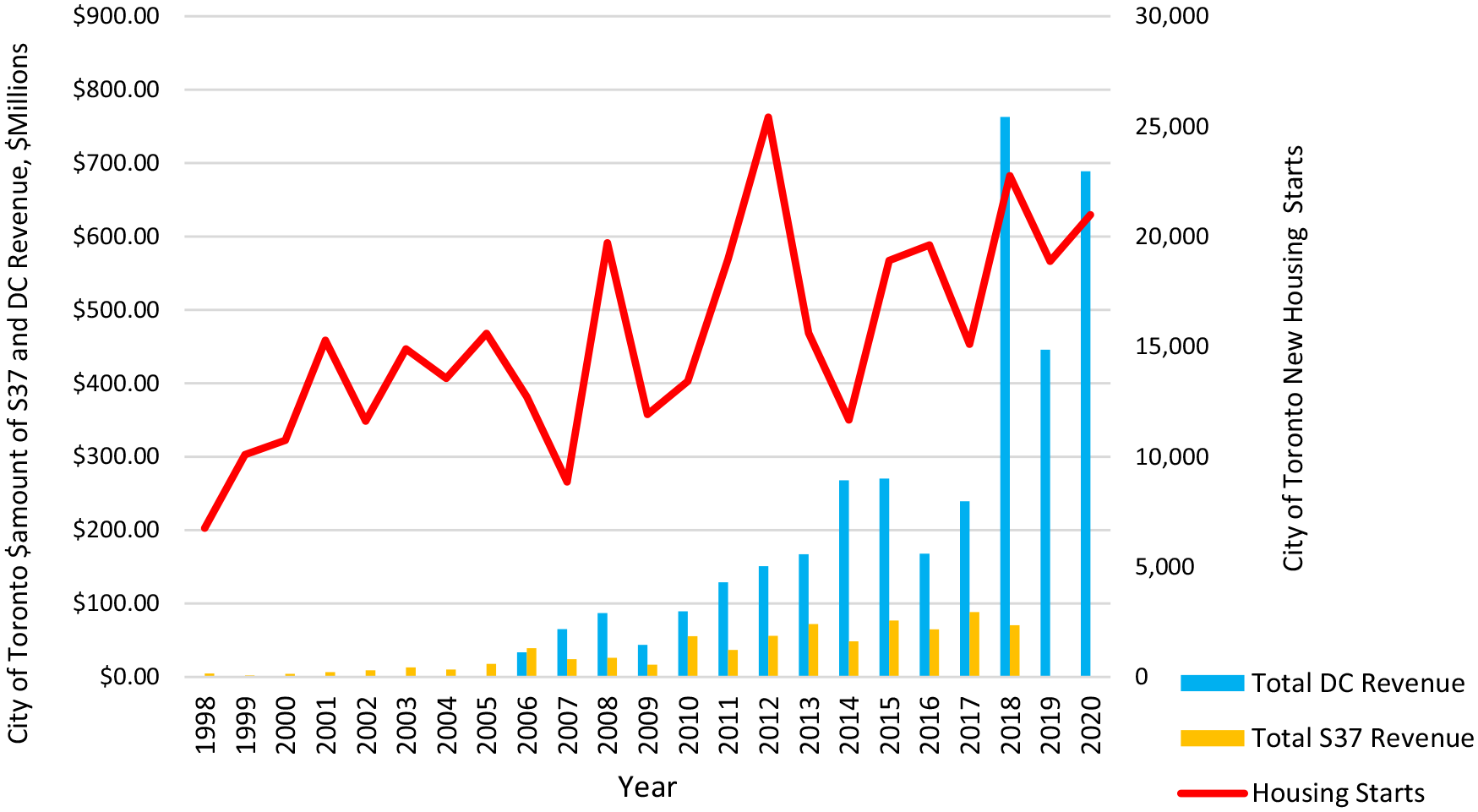
Toronto Section 37 revenue, DC revenue, and housing starts 1998–2020.
At the same time, the city significantly increased its use of S37 density bonus agreements after amalgamation, as also shown in Figure 2. In 2000, seventeen S37 density bonus agreements yielded $4.3 million in cash benefits and an unknown value of “in-kind” benefits such as land, affordable housing units, daycare spaces, and other benefits such as infrastructure. In 2018, 43 agreements yielded a total of $70.44 million in cash, plus “in-kind” benefits estimated to be worth about 29% of the total cash amount (CCity of Toronto et al., 2018: 8). Between 1998 and August 2018 City of Toronto planners negotiated 697 agreements, worth $744 million in cash revenues (City of Toronto City Planning Division, 2018).
Amalgamation was clearly a critical juncture for Toronto governance, but as far as land value capture institutions are concerned, the 1997 DC Act revision passed in the same legislative session represented incremental change, adjusting the amounts and conditions of DCs but leaving the basic structure of the Act intact, in what is best understood as part of a reactive sequence of contestation following the 1989 critical juncture that created the DC system. Toronto’s financial crisis did trigger a much more ambitious approach to collecting LVC, aided by the boom of development, but this was all within the existing institutional frameworks. A change of practice but not of the formal institutions enabling that approach.
The Toronto development boom was supported by “smart growth” policies enacted by the Liberal provincial government first elected in 2003, including a new greenbelt surrounding the Toronto region and provincial mandates for intensification of existing urban areas (Filion, 2007; Ontario Ministry of Public Infrastructure Renewal, 2006). The goal was to shift new development from low-density suburbs at the outer edge of the region to high-density infill development in existing built-up areas. The Liberal government did not, however, make major changes to either the DC Act or S37 policies and laws before it was defeated by the Progressive Conservative party in the election of 2018.
The new majority Progressive Conservative government moved quickly to implement their platform emphasizing smaller government and deregulation to encourage more affordable suburban housing supply. A primary goal of recent legislative change has been to reduce the amount of revenue generated by the S37 density bonus system, DCs, and S42 parkland dedication policies, and to reduce “red tape” in order to increase housing supply and affordability. In June 2019 the government passed Bill 108, the “More Homes, More Choice Act, 2019,” an omnibus bill that revised 13 laws including the Planning Act and the DC Act, and which promised to address the ongoing housing affordability crisis by limiting DCs and replacing S37 agreements with a limited “Community Benefits Charge” (Association of Municipal Managers Clerks and Treasurers of Ontario, 2019; Dentons, 2019). Bill 108 was vigorously opposed by the City of Toronto, which argued that in a tight housing market lower DCs would simply allow higher profits for developers, and that “Bill 108 undermines the City’s ability to ensure that ‘growth pays for growth’ through substantive amendments to Sections 37 and 42 of the Planning Act, and the Development Charges Act” (City of Toronto City Manager and Chief Planner and Executive Director, 2019: 2). There was such widespread opposition to Bill 108 even in municipalities with Progressive Conservative elected representatives (Gray, 2019) that in the summer of 2020 the government passed Bill 197, the “COVID-19 Economic Recovery Act, 2020” (another “omnibus” bill amending dozens of laws), and walked back several of the proposed changes included in Bill 108 that were not yet in force, including changes to the DC Act.
Further legislative changes were introduced as Bill 23 in October 2022. This bill made extensive changes to the DC Act and Planning Act to further reduce revenue from municipal growth financing tools. A recent City of Toronto report showed that Bill 23 would reduce revenues from all growth financing tools to about 28% of what they would have been if the system in place before 2018 had continued (City of Toronto, 2022). Next was Bill 97, the “Helping Homebuyers, Protecting Tenants Act 2023,” which was introduced on April 6 and became law on June 8, 2023. Bill 97 made changes to seven provincial laws, including the Building Code Act 1992, the City of Toronto Act, 2006, The Development Charges Act 1997, the Ministry of Municipal Affairs and Housing Act 1990, the Municipal Act 2001, the Planning Act 1990, and the Residential Tenancies Act 2006. These changes increase the powers of provincial ministers to unilaterally change planning policies through vehicles such as “Provincial Policy Statements.”
It is too soon to know the full consequences or how durable these changes will be, so it makes sense to be cautious in labeling this a third critical juncture, but it is hard to imagine that this will not ultimately be interpreted that way, as sweeping and fundamental changes have been made to Ontario’s environmental and planning laws including those for LVC.
Continued battles over these institutions, including major lobbying efforts by the development industry and by municipalities, debate in the media, and repeated legislative change especially over the last 5 years show that approaches to land value capture are still intensely contested in Ontario, and that a primary object of such contestation is to change the rules of the game as embodied in provincial planning and land value capture legislation.
Discussion and conclusions
The claim here is that HI critical juncture analysis of contestation over urban institutions such as land value capture provides a valuable complement to the conjunctural analysis approach suggested by Peck and elaborated by Inch and Shepherd. Conjunctural analysis provides insights into the impacts of global socio-economic change and hegemonic ideologies on discourses, politics and policies. HI provides a set of midlevel conceptual frameworks focused on contestation over specific sets of institutions, identification of major institutions of interest, the actors involved in contestation, available institutional change mechanisms, processes, and patterns of change. HI also offers a research method designed for comparative analysis of diverse cases.
HI assumes that major social institutions tend to be contested and that sometimes major institutional change takes place in critical juncture/reactive sequence processes. This pattern is common for new legislative systems created in response to crises, as in the case of many modern planning laws that first created municipal planning powers to regulate private land development in the first half of the 20th century (Sorensen, 2018, 2023). As shown above, Toronto experienced just such a critical juncture/reactive sequence process, with important consequences for subsequent patterns of institutional development. The specific permissive/productive conditions of the 1946 critical juncture led a conservative government to pass a planning law that allowed municipalities to use subdivision agreements to negotiate infrastructure contributions and lot levies, a practice that quickly spread and was eventually formalized because it generated so many court challenges and appeals. Contestation continued as the region grew, leading to the passage of the DC Act in 1989 that created a new, more expansive approach to calculating and collecting DCs, and triggering a new reactive sequence of contestation focused on that Act, with significant revisions in 1997 and over the last 5 years. For Toronto the central issue the 1946 Act left ambiguous—about what share of the costs of urbanization should be borne by property developers and what share by property taxes, user fees, and provincial subsidies—is still at the center of debates today.
This case is also revealing about path dependence in cities and planning, a pattern more often assumed than it is explained. In most cases path dependence is not a matter of “lock-in,” as for many important institutions contestation is continuous and incremental change constant, but within a developmental pathway representing a relatively constrained range of options. A common pattern is for critical junctures to establish: the basic parameters and terrain of debate and contestation over the institutions created; which institutions are the subject of political contestation and which not; the overall rules of the game defining mechanisms of institutional change; and degrees of ambiguity and freedom in interpretation of the rules. This defines a developmental pathway of bounded contestation within which each reactive sequence plays out. Incremental processes can, however, produce meaningful institutional change, such as the spread of lot levies in the 1950s, and increased S37 and DCs in Toronto during the last two decades.
In Fligstein and MacAdam’s terms, the 1946 Planning Act established a “Strategic Action Field” and its rules of engagement. As the newly established planning system developed and professionalized, there was a growing set of actors willing and able to advocate for their goals but of necessity working within the existing rules of the game. Conflict over LVC institutions has repeatedly involved attempts to change what interested actors saw as the shortcomings of the latest revision to the rules, generating a clear developmental pathway and reactive sequence of contestation, all within the framework of the planning system established in 1946. Even the radical changes of the last few years work to change the amounts, timing, and names of LVC instruments, while leaving in place the basic structure of (much reduced) density bonuses and development charges.
The Toronto case underlines how locally specific and contingent LVC institutions and practices can be, especially in comparative perspective. For example, in Vancouver a quite different system of Community Benefits Agreements developed in which the city routinely captures 70% of the land value uplift produced by rezoning based on planners’ analysis of developers’ own proforma financial data (Moore, 2013: 11). Toronto planners interviewed were aware of and envious of the Vancouver system, but claimed both that it was impossible in Toronto to require developers to provide their proforma, and that their own negotiating target was between 10% and 15% of uplift (PI), an amount now set at a maximum of 4% by recent legislation. It seems likely that Toronto’s rate was already too low, and the accelerating boom of construction over the last two decades suggests that the industry was profitable even with increasing S37 and DCs. Whether reductions in LVC will serve to reduce housing prices or increase development profits and land values is a question for future research.
The Toronto LVC institutions examined here, and LVC institutions more generally, are important because they shift the distribution of the costs and benefits of urban development between actors, and because it attempts such shifts in the direction of greater social equity. The fact that these institutions have been intensely and continually contested in Toronto is evidence that they are substantively important, and that they do, in some measure, shift the distribution of the costs and benefits of intensification between actors.
It is suggestive that each of the critical junctures of planning and municipal finance institutions identified here, that in 1946, the passage of the DC Act in 1989, and the recent legislative changes, all involved global housing crises. The wartime/postwar crisis was discussed above, the second half of the 1980s saw a global bubble of real estate investment and intense housing price inflation in Toronto and elsewhere, and the last two decades have seen yet another global housing affordability crisis, exacerbated by the pandemic after 2020. These each represent conjunctures of multiple forces that heightened contestation over basic urban institutions, yet while the first two helped enhance Toronto’s powers for LVC, the most recent one reduced them. A housing crisis contributed to “permissive conditions” in each case, but differing “productive conditions” determined the outcome. Between each of these events incremental changes and contestation over practice continued. The claim here is that longitudinal analysis of conflict over specific institutions such as LVC is essential in interpreting the meaning and outcomes of specific conjunctures.
This analysis helps explain why there is such great variation both in approach to and success at LVC in different jurisdictions. Clearly this is a product in part of different legal frameworks regulating what legal powers are available. But those were shaped by historical processes of institutional development, in which contingent processes of institutional change produced different planning systems. The timing of major institutional change in relation to other factors, and the specific combination of permissive and productive factors in each case led to differing choices, capacities, sets of engaged actors, and developmental pathways. These processes generate the terrain of institutional contestation within which actors of all sorts engage successive battles over the “rules of the game,” some of which are triggered by the larger ideological and socio-economic conjunctures studied by conjunctural analysis. Critical juncture analysis in this way provides a valuable complement to conjunctural analysis, particularly that which seeks to compare urban planning and governance processes and outcomes in different places.
Footnotes
Declaration of conflicting interests
The author declared no potential conflicts of interest with respect to the research, authorship, and/or publication of this article.
Funding
The author disclosed receipt of the following financial support for the research, authorship, and/or publication of this article: I would like to acknowledge the organizers of the research collaboration on LVC that led to this paper and this special issue Mi Shi and Kathe Newman, the support of the Social Sciences and Humanities Research Council for the grant SSHRC Insight (Grant Number 435-2016-1234) that enabled the research, my research assistants Arqam Shafiq and Edison Gao, and the journal editors and anonymous referees for their valuable feedback and comments.
