




Abstract
This article examines how and why values are created and contested in the process of development, using an example of development-induced displacement and resettlement in Mozambique. It pays particular attention to the social-material effects of compensation, provided as cash, resettlement housing, replacement land, and basic infrastructure. Drawing from field research on an urban resettlement project of the Limpopo National Park in Massingir district, the article shows that the compensation leads to commodification of livelihoods by reducing the original, largely social and cultural meaning of the livelihood to predominantly an economic one. This is because the provided housing and land for cultivation are standardised and infrastructure incurs cash payments and new labour arrangements. At the same time, the study elucidates processes by which experiencing displacement and resettlement – and cash and in-kind compensation given in this process and commodification that ensued – led the resettled people to reshape their livelihoods in such a way as to re-establish the familiar houses and organise a collective. Outcomes of this process are ambivalent, as they may accelerate uneven development. Yet, the article expounds that recognising this ambivalence at least opens space for deliberations about addressing the contested values of development.
Introduction
This article examines values created and contested in the process of development and associated displacement and resettlement. Materialised in modern infrastructure projects that require land acquisitions, development has oftentimes justified the displacement of portions of the greater public from project areas (Otsuki, 2019). This process creates economic value, which is expected to eventually ‘trickle down’ to all the citizens (Koenig, 2001). One of the ways to distribute the economic value of development-induced displacement is compensation for displaced populations. Despite recurring criticisms spanning decades (Cernea, 2008; Menezes, 1991; Shi and Shang, 2020), cash compensation continues to be the ‘main preference’ for development project sponsors and investors (Rowan, 2017); this is followed by in-kind compensation such as resettlement housing, replacement land, and basic infrastructure. In addition, so-called benefit-sharing mechanisms are becoming increasingly popular among governments and investors as well as researchers which position displaced people as ‘shareholders’ of development projects (Shi and Shang, 2020). An underlying assumption that permeates the compensation and benefit-sharing is that they will enable the displaced people to improve their livelihoods economically after displacement and resettlement (Cernea and Maldonado, 2018).
This article examines what the assumption of livelihoods improvement through economic means actually does to everyday lives and livelihoods of the displaced people. As seen widely in the case of large-scale displacement induced by hydropower dam construction in China, compensation and benefit-sharing associated with displacement and resettlement are usually framed as an opportunity to industrialise and modernise rural areas and promote urbanisation (Rogers and Xue, 2015; Wilmsen, 2017). As Gomersall (2021: 150) argues, compensation constitutes a tool for ‘national governments and transnational development agencies such as the World Bank…[to]… pursue broad scale capitalist development’, and is used to commodify resettled people's livelihoods in resettlement frontiers. The commodification of livelihoods leads people to reduce the original, largely social and cultural meaning of the livelihood to predominantly an economic one because the provided housing and land for cultivation are usually standardised according to the designs by external experts and provided infrastructure incurs cash payments and new labour arrangements.
At the same time, people experience the commodification in everyday lives between and after ‘displacement and relocation’ (Beier et al., 2021). As Sayer (2011) argues, in everyday lives, people come to recognise the ‘values-in-use’, which are contingent and changeable as their social and material conditions change, and yet vitally important for people to rework and reshape development designed and imposed according to the logics of experts. Experiencing displacement and resettlement – and cash and in-kind compensation given in this process and commodification that ensued – might lead the displaced people to reshape their livelihoods in such a way as to re-establish the familiar houses and organise a collective that counters the assumption of economic livelihood improvements through compensation and benefit-sharing. This article shows that, by looking into lived experiences of displacement and resettlement, we might be able to recover many facets of livelihoods, which are not always compensable or translated into exchangeable economic value and yet enable people to continually produce social and cultural values in their changing everyday lives.
In the field of development sociology and anthropology, the question of how we, researchers, understand people's experiences of planned development is a classic one. Scholars have made inquiries into different bodies of knowledge that change over time to reframe development as centred on actors’ experiences rather than on the teleological ideal of modernisation and economic development (e.g. Bicker et al., 2002; Hobart, 1993; Long and Long, 1992). This reframing urgently needs to be resituated in recent studies on development-induced displacement and resettlement, as it reminds us that modern spatial ordering has been largely underpinned by the logic of capitalist development and the creation of national economy (Mitchell, 2002), which accompanied historical erasure of indigenous presence, knowledge and practice (Cowen, 2020; Porter, 2020). Meanwhile, we are also aware that the distinction between indigenous and non-indigenous bodies of knowledge has been blurred over time; in the process of post-colonial nation-building and various development interventions, the expert-driven modernity project has long been internalised in people's lives, even in remote and peripheral regions (Li, 2007). Commodification had already taken place on various land and forest frontiers, as neoliberal market-led development promoted ‘governance through enterprising individuals’ who were left to cope with the pressures of investment and monetary transactions for their everyday survival (Gomersall, 2021: 152). Compensation and benefit-sharing through development-induced displacement and resettlement presumably accelerate this internalisation that considers economic values to be central in development. Yet, by experiencing the compensation, displaced people could become reflexive and express the needs of alternative valuations of livelihoods to survive and thrive on their displacement and resettlement (as implied in a case of Thailand in Singto et al. (2022)).
The question is: How can such contingent social, cultural and material productions of values be analytically embedded in the studies and potentially policies of development? In order to explore possible answers to this question, I turn to a case study of a resettlement village in the district of Massingir in southwestern Mozambique. I was interested to learn why people displaced from the transnational eco-tourism development project of the Limpopo National Park created in 2001 were still struggling with their resettlement after nearly two decades of negotiations with the Park administration. The contestations arising in this case are well studied and solutions are sought after (e.g. Otsuki, 2023), and yet, the new contestations seem to keep on emerging. I have observed this recurring emergence of contestations through field visits and interviews with park administration and displaced people in 2015, 2018 to 2019 and 2021. I noticed that the contestations had something to do with the fact that, in the process of relocation and negotiations about compensation and benefit-sharing, the resettlement village declared itself an urban resettlement where its leader chose to take advantage of moving a group of his followers from the park's forest area into the city of Massingir and negotiating for compensation associated with urban resettlement. This urbanisation justified the commodification of livelihoods of the displaced people who were dominantly farmers and cattle herders before the displacement. After resettlement, the people searched for more urban livelihoods such as construction works and casual labouring in neighbouring South Africa. At the same time, experiencing the commodification of livelihoods was leading people to create their own associations to renegotiate the values of their livelihoods and to re-engage with (illegal) hunting and poaching. This means that the contestations are not only about displacement and resettlement per se but they are rooted in the different values generated through commodification and urbanisation of livelihoods. Following Foucault, this entire process of commodification and its appropriation by displaced people can be interpreted as successful development governance ‘by enterprising individuals’ produced in deepened neoliberalism (Gomersall, 2021). Yet, the case study shows the importance of recognising that displaced people are agents who lead the valuation of their livelihoods and therefore the contestations keep on emerging. Drawing from this study, I conclude by discussing how values of livelihoods are produced differently by different actors over time, and understanding this process helps us to find a new longitudinal approach to address contested values of development.
Values associated with development, displacement and resettlement
Economic value of livelihoods
In order to explore values produced and contested in the process of development, displacement and resettlement, I first turn to the concept of livelihood as used in the history of international development because it often played an instrumental role in the calculation of cash and in-kind compensation and the potential benefit to promote ‘livelihood improvements’ for displaced people (Cernea and Maldonado, 2018). Historically, displacement has often been a part of modern spatial ordering, particularly in the process of post-World War and post-colonial nation state reconstruction and development (Esteva, 1992). It became contentious during the 1960s when large-scale infrastructure development such as hydropower dam construction started displacing a large number of people. Cultural anthropologists began highlighting the importance of safeguarding displaced indigenous people's livelihoods and cultural practices during the 1970s (Colson, 1989). The World Bank – the main financier of large-scale infrastructure projects – published the first international guideline for involuntary resettlement in 1980 and outlined possible measures against the impoverishment of displaced people such as the provision of compensation. Although the guideline had gone through several revisions, the risk and reconstruction model that the Bank's anthropologists Cernea and McDowell (2000) proposed stayed influential (World Bank, 2004). This model concretely introduced the concept of livelihood, to be reconstructed and improved for displaced people, after the cash and in-kind compensation were provided.
Originally used to clarifying cultural differences between households in the allocation of time, power and gender relations, social reproduction activities, affective experiences, and the spiritual beliefs and indigenous knowledge (Ekins and Max-Neef, 1992; Hart, 1986; Wallman, 1984), the concept of livelihood was mainstreamed in development policies and practices in general in the 1990s. This mainstreaming involved the definition of a livelihood to be a set of assets shared within a household and between its individual members. In practice, development experts began to assess the conditions of planned development interventions by evaluating a household livelihood in terms of ‘capital assets’ such as human, financial, physical, natural and social capitals from which a ‘poor’ household can draw on to develop their lives (Carney, 1998; Serrat, 2008). Scholars have criticised the capitalisation of livelihoods, as it made the ‘poor’ managers of their livelihoods while development experts turned a blind eye to the structural production of poverty and thus depoliticised development (Harriss, 2002). More importantly, turning livelihoods into solely a set of capital assets facilitates commodification of livelihoods by reducing the original, largely social and cultural meaning of the livelihood to predominantly an economic one. This has also led some displacement scholars to point out that the capitalisation of livelihoods has failed to incorporate ‘many facets of life not easily fitting into’ the standardised benefits for the displaced (Smyth and Vanclay, 2017: 69). Facing criticism, major development cooperation agencies stopped using the concept of livelihood in the early 2000s in their policies, although it remained part of the essential vocabulary on promoting reconstruction and improving displaced people's lives in the case of displacement and resettlement (Smyth and Vanclay, 2017).
Meanwhile, the importance of restoring the original, largely cultural meaning of livelihoods in displacement contexts has received little attention in spite of its potential usefulness for the re-evaluation of multifaceted impacts that widespread land acquisition has generated over the past decades, especially in the context of urbanisation and infrastructure development (Zoomers and Otsuki, 2017). In particular, during the late 2000s, top-down creations of new African cities led to property development that accompanied land enclosures with foreign investments flowing into new settlement construction (Watson, 2014). The global climate agenda also began to displace communities, as it justified the infrastructure development for building resilient cities and communities (Shannon, 2021). Expert and investor-driven development plans and infrastructural designs started to proliferate, overwriting indigenous and local knowledge and cultural practice that sustained everyday urban lives and livelihoods. In this context, commodification of livelihoods quietly proceeded along with urbanisation and infrastructure frontier expansion, which often led to displacement and resettlement of urban communities.
Commodification and revaluation of livelihoods
Thinking critically about the process of commodification of livelihoods, Arce (2003: 206) reminds us of the imperative to understand the livelihood implications of development as experienced in ‘the “real context” in which people live’, and how different sets of knowledge shape the reconstruction and resettlement process after top-down planned development interventions are implemented and displacement ensues (see also Arce and Long, 2000). The real context here implies where ‘we find contests over social value including the co-existence of several, seemingly incompatible, interpretations of … value within the same set of social relations or institutions’ (Arce, 2003: 206). For example, within a household or a community, individuals are not always economically productive members who will manage their risks and diversify sources of income and capitals but are instead corporeal beings who experience the same development intervention differently (Graeber, 2001). By looking into individual lived experiences of displacement and resettlement, we might be able to recover many facets of livelihoods, which are not always compensable or translated into exchangeable economic value and yet enable people to continually produce social and cultural values in their changing everyday lives.
In other words, looking into lived experiences means that we need to reconceptualise individuals as agents who shape and value livelihoods in the ways they aspire within certain dispositions and institutional frameworks (such as within their household or community). Livelihoods are not only a set of activities that produce and exchange commodities or assets that facilitate individuals to capitalise on what they possess, but as a part of ‘heterogeneous’ sets of opportunity, which are not always correlated with income, commodities and capital assets that the poor possess (Nussbaum, 2011). Individual capabilities to act upon the opportunity are further influenced by collective experiences of commodification, and this relationship between individual and collective experiences give spaces for people and experts alike to reflect on social and cultural values of livelihoods other than the economic value.
The problem is that, so far, compensation – and long-term shared benefits if implemented – is typically comprised of the replacement cost determined through the capital asset valuation of livelihoods which includes land, housing and access to infrastructure, as well as common natural resources such as fruit trees or wild medicinal plants that become inaccessible as a result of development projects. 1 Project promoters who offer and negotiate displacement compensation usually fail to address much more diverse livelihood values including high mobility and infrastructural services in urban contexts (Koenig, 2018; Beier et al., 2021), or ‘invisible losses’ such as severed cultural and spiritual attachments to a particular environment including graves and religious sites (Gomersall, 2021; Witter and Satterfield, 2014). The process of determining compensation aiming to reconstruct and improve livelihoods thus involves the selection of particular things that constitute just one part of people's livelihoods which can be commodified, so that things are ‘turned into’ or ‘seen as a commodity’, that can be ‘for sale’ or at least, exchangeable (Hall, 2022).
At the same time, as people experience this selective process towards commodification of their livelihoods, they may also start producing values associated with the opportunity that this commodification brings, as ‘an increase of present meaning’, apart from the growth of monetary outputs, benefits or asset improvements (Dewey as quoted in Stanfield and Stanfield, 1995: 210). If value ‘is the… [present]… meaning or importance society ascribes to an object’ (Graeber, 2001: 39), living in a concrete house could lead people to reflect on what living in this house means to the continuity of their life and to recognise possibilities of living differently, especially when they feel uncomfortable in the new house. Or, as Sayer (2011: 144) put it: people come to recognise the ‘values-in-use’, which ‘may be more important than their espoused ideas in guiding what they do’, as they experience new values that their society ascribes to their livelihoods more broadly. In this process, people may start to revaluate their livelihoods within their everyday life context and contest the imposed values of development.
In other words, as corporeal individuals have the capacity to reflect on their lived experiences and attach subjective meaning to them (Archer, 2007; Otsuki, 2016), it is inevitable that the values attached to development will change over time throughout displacement and resettlement. And, as ‘every human experience produces values’ (Dewey as quoted in Smith, 1922: 347), the values do not only increase or decrease but they contradict and mutate as they are used (Turner, 1990). In order to further analyse how the changeable values unfold after development-induced displacement and resettlement, I now turn to the case study of Makavene-Tihovene, a resettlement village built at the centre of the district of Massingir in Mozambique in 2013.
Case study: Urban resettlement in Massingir, Mozambique
Research design
The case study of Makavene-Tihovene constructed below draws from a set of field research activities in four resettlement villages that were created between 2008 and 2015 to accommodate nearly 500 households displaced from the Limpopo National Park (LNP). Makavene-Tihovene was one of the two resettlement villages established in 2013, after Makavene split into two. I have designed research on Makavene-Tihovene for this article in such a way as to show how economic values attached to livelihoods improvements became contested as the resettled villagers started to experience standardised housing, urban infrastructure and needs to earn more cash than before. In order to understand the lived experiences after resettlement, I visited and interacted with people in Makavene-Tihovene in November 2015, in June and November 2018, and February to March and July to August 2019. I also conducted follow-up telephone interviews in April 2021 with the leader of Makavene-Tihovene. The research design was in fact motivated by the first field research in 2015, conducted with an international non-governmental organisation (NGO) called ActionAid. The NGO engaged in advocacy for communities expressing their grievances against large-scale land acquisitions. In the beginning, ActionAid representatives explained that Makavene-Tihovene was an urban resettlement, which is relatively better-off than other rural counterparts including its sister village of Makavene-Banga, since it is close to the city and thus has better accesses to basic infrastructure. However, as I talked with people, and especially with women in the resettlement, it became clear that residents were not at all satisfied with the resettlement's housing and especially water infrastructure that broke soon after resettlement in 2013; the infrastructure remained in disrepair when I visited at the end of 2015. As 2015 to 2016 was a severe drought year for Mozambique, people seriously suffered from the lack of water, especially as the urban resettlement was far from the Elephant River where women could fetch water. Lack of rain also affected the farming from which people eked out their meagre incomes.
After hearing their grievances, I became aware that the official narrative about urbanisation would be generally beneficial for the resettled communities needed to be critically examined. Therefore, I asked the local civil society organisation, Massingir Platform of Forum of NGOs (PLADISMA), to assist with the follow-up field research in resettlement villages from 2018 onwards. First, I participated in various meetings and discussions between a range of actors including: PLADISMA; the Ecumenical Committee for Development (CEDES), which is a national civil society organisation active in Massingir; Massingir District government; the Ministry of Land, Environment, and Rural Development (MITADER), which oversees resettlement projects across Mozambique; park administration and its resettlement officers and all the leaders and elders of the resettled communities. Subsequently, I interviewed a total of 22 resettled women and men in Makavene-Tihovene over a period between June 2018 and August 2019 in order to grasp the gap between livelihood improvements presupposed in the process of displacement and urban resettlement, and the values people started to attach to their livelihoods after experiencing commodification. In what follows, I reconstruct the process by which this gap became apparent.
Background: Mozambique, the resettlement frontier
Before detailing the displaced people's experiences in Makavene-Tihovene, I first outline why Mozambique is an interesting place to observe experiences of displacement and resettlement. Mozambique is one of the poorest countries in the world, with over 60% of its population living under the international poverty line (World Bank, 2021). Since its independence from Portugal in 1975, it has suffered two consecutive wars, the last of which ended in 1992. Once socialist, the country liberalised its economy by accepting the structural adjustment programme of the international financial institutions in 1986. As it attracted foreign investors in order to open agribusinesses and exploit minerals and other natural resources – most recently natural gas – the country became a donor darling in the 2000s. Mozambique was recognised as one of the ‘fastest growing frontier markets’ in Africa (Kirshner and Power, 2015), but these investment projects displaced small farmers, the most significant segment of the population in the country. From 2010 to 2020, very conservative estimates hold that the country displaced 20,000 people from 50 development projects (Wetela, 2018). 2
Mozambique has attracted scholarly attention to its resettlement track record primarily because the country has relatively progressive legal frameworks for displacement and resettlement caused by ‘economic activities’, most notably national legislation on resettlement revised in 2012. Public consultations are obligatory for investors and resettlement proponents, and legislation obliges them to complete environmental and social impact assessments in order to issue business licenses. Since 2016, MITADER holds the bi-annual National Resettlement Conference where resettlement proponents, government officials, businesses, consultants and bankers, as well as civil society and advocacy activists and researchers are invited to discuss the ways the country's resettlement is taking place. In the 2018 conference, MITADER's resettlement director was quoted as saying, ‘The forced displacement and resettlement cannot be a “completely peaceful process”, as it inevitably causes “a wound”’ (Wiegink, 2020: 3), showing that the government is aware of contestation and therefore tries to address the wound of displacement through ‘a process of inclusive, secure, resilient and sustainable resettlement’ (Por Um Processo de Reassentamento Inclusivo, Seguro, Reseiliente, e Ssutentável as the 2018 conference banner showed).
This developmental attitude towards displacement and resettlement makes Mozambique a country where a new modern built environment emerges both within cities and in peripheral regions where foreign investments flow in and start large-scale development projects that induce land acquisitions and forced displacement. One major sector that represents such a development model is a tourism project combined with an agenda for nature conservation.
Development of Massingir – envisioned through resettlement
The LNP was created in 2001 by the Mozambican Government with investments from the South African Peace Parks Foundation, as a part of the Great Limpopo Transfrontier Park, which consisted of South Africa's Kruger National Park and Zimbabwe's Gonarezhou Park (Great Limpopo Transfrontier Park, 2019). Massingir District surrendered 60% of its territory to LNP, and agreed to host most of the 7000 park residents (1500 households) 3 who were to be displaced from the park. The decision was based on the expectation that the district would benefit from projected tourism revenues to compensate for its ‘poor agroecological conditions’, which was said to have been keeping its population in extreme poverty and in constant need of migrating to bordering South Africa (Ministry of State District, 2005: 4).
Massingir's population – including those in today's LNP – mainly engages in small, family-based farming, cattle herding, and fishing in the Elephant River. Before LNP was created, the men also regularly hunted wildlife for subsistence consumption. LNP announced the removal of people from the park in 2003, with financial support from the German Development Bank for resettlement village construction, mainly in Massingir. The main rationale for displacement and resettlement was to prevent human–wildlife conflict. As the LNP hardly had any wildlife as a result of civil war, the transference of wildlife took place from the adjacent Kruger National Park, the major safari tourist destination in southern Africa, in order to repopulate LNP with elephants and lions. As it was illegal for farmers to kill wildlife in order to protect farms or lives, the people themselves started to negotiate the conditions of resettlement, even though their ‘willingness’ to negotiate was forced due to the wildlife transfer without much consultation (Milgroom and Spierenburg, 2008; Witter, 2013). Nevertheless, people were at least consulted about where they hoped to resettle and what kind of compensation would be fair in exchange for abandoning their livelihoods in the park.
The first displacement and resettlement took place in 2008. A small community of 18 households called Nanguene agreed to resettle in a forested area of Massingir and near the river, as a part of the bigger Chinangane community. In 2013, the 165-household community of Makavene agreed to resettle in two locations. Just like Nanguene, the majority of the community (112 at the time) resettled in a forested area, in order to stay in a rural context where the continuity of livelihood activities around farming and cattle grazing could be expected. Meanwhile, 52 households of this community, headed by a leader who was a cattle trader rather than a farmer, decided to become an urban resettlement by resettling in an area near the city centre of Massingir.
Urban resettlement is an official category in Mozambican legislation under which, in addition to the standardised resettlement houses, beneficiaries are expected to obtain reduced or no replacement land in exchange for cash compensation and access to basic infrastructure such as potable water and electricity. Proximity to the city centre also implied that the secondary school was nearby, and easy access to main asphalt roads would facilitate mobilities and businesses. According to the leader of Makavene-Tihovene: Since I was young, I mainly worked as a cattle trader – I moved cattle from the park to Maputo and sold them in the city (i.e. the capital city of Mozambique, about 300 km away from Massingir). When the park told us to leave… [from Makavene in the park], I said: I will leave if I can live in the city. I didn’t want to go to Banga, it's very far… and others agreed and we asked for this zone. Now we will become the seventh district of Massingir city.
4
Lived experiences of commodification
For the resettlement village construction, the park administration contracted the National Institute of Disaster Management (INGC), which specialises in temporary, emergency resettlement housing in flood-prone areas in Mozambique. In LNP's earlier resettlement villages, it built standardised square concrete houses (casas de alvenaria) with corrugated zinc roofs and a plastic gutter attached to a separate water tank to harvest rainwater (Figure 1). The INGC built these houses in places where it rained heavily. However, Massingir was increasingly prone to drought and occasional wind, and the infrastructure attached to the concrete houses soon became useless as the roofs were blown away and the plastic gutters cracked while the water tanks remained empty.
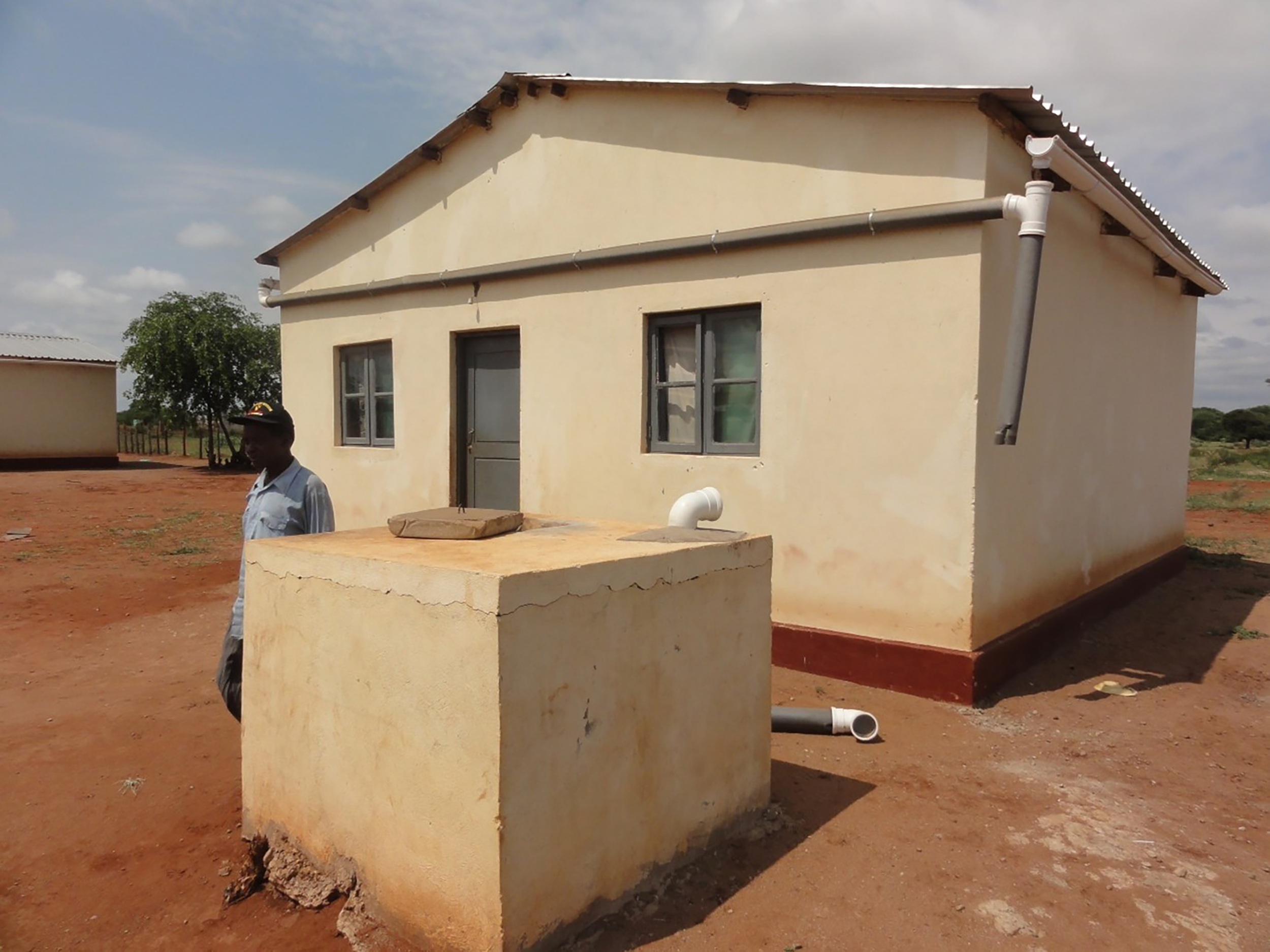
Type II resettlement housing with a broken water infrastructure (photo by the author, 2015).
While the administration claimed that a fair amount of resources was used to build these houses and infrastructure, the condition of the houses made people sceptical about this claim. According to a woman who closely collaborated with the local NGO PLADISMA: …INGC was not for building houses for resettlements. They build houses for emergency. So, for those who are happy to be alive. But those who are in the park who are leaving ‘voluntarily’? … INGC used their policies of building emergency houses – and they ‘ate’ money… [instead of building the houses with better concrete]. We all know that the flats at Bilene Beach were built with that money! We saw trucks … [stealing the cement for the houses] – the network of big people, they pass checks in the name of the state, and then the money goes back to them!
7
According to the ex-LNP official who was in charge of resettlement at the time of Makavene's displacement in 2013, resettlement village design was based on a collective villagisation model where modern, square houses were clustered into limited space. 8 This villagisation model was not unfamiliar to people, since under the socialist regime in the early 1980s, Mozambique promoted collective villagisation throughout the country to modernise and urbanise rural areas (Friedmann, 1980). Being loyal to the ruling regime throughout its history, Gaza Province where Massingir is located had widely accepted this villagisation programme, and the villages in the LNP were also clustered to some extent (José, 2017). At the same time, the previous villagisation programme let people self-build houses with locally available materials (Yanez Casal, 1996). Therefore, there was no contestation around the materials used. However, in the current resettlement village of Makavene-Tihovene, resident suspect that the big politicians embezzled money to ‘mix cheap sand’ that makes ‘bad’ concrete (according to the same woman above).
Yet, the concrete houses – casas de alvenaria – remain a symbol of teleological development based on widely shared aspirations for people in southern African rural areas who had lived in mud huts (Ferguson, 2006). In order to counter the decay of their badly constructed houses, people began to adjust their household and livelihoods in the new situation.
In Makavene-Tihovene, two different types of these concrete houses had been built: type I has a living room and one sleeping room while type II has a living room and two bedrooms. Each household received one house. However, if people could design and self-build the houses, most would build multiple huts within a compound because people in this region are ethnic Shangaans, and many are polygamous. It is a common practice for husbands to build one house per wife and her children. Even if polygamy is not practiced, many households have more children than the concrete house with one living room and a couple of bedrooms can accommodate. In addition, a Shangaan adult male is supposed to have his own separate house (with the potential to build various houses), yet LNP administration did not provide houses for unmarried adult men and women. This forced young men to leave the resettlement altogether, accelerating outmigration to South Africa.
Against this background, at least two different types of action could be observed. One is that people started to build their huts and storage huts using wood and other materials they were familiar with, within the limited compound of the allocated houses. Since Makavene-Tihovene is in the city and far from the forest, they started to reconnect with the old members of Makavene in Banga, which started to sell wood to their ex-community members. An elder of Makavene-Banga explained this process: We are brothers and sisters so we have to help each other… and as I have the truck, I can bring around the wood and charcoal to help with selling… but these …[concrete] … houses can be enlarged too! We just need to know how to do it.
9
Since 2016, when we made the barulho, I created an association Kurula… this means a ‘calm person’ because I am a calm person. Not noisy (barulhento)! I get cement and money from the park to repair broken houses in Massingir Velho [another resettlement village built in 2015]. We are now an association of construction workers. I refuse to work at Elevo [a construction company that entered Massingir around the same time to build new resettlement houses]. I am the boss and decide the price of the work.
10
In 2019, the leader was also negotiating with the park to acquire money and use cement to build a graveyard at the old Makavene site within the park. In this process, he seemed to have considered the park, which caused displacement and provided compensation, as the business partner, while seeking ways to become autonomous and incorporate their knowledge on customising their houses. Others also followed to be trained in the construction business and further pursued livelihood reconstruction through small-scale farming. In other words, experiencing displacement and resettlement – and cash and in-kind compensation given in this process and commodification that ensued – led the people to reshape their livelihoods in such a way as to re-establish the familiar houses and organise a collective.
Meanwhile, after waiting for 5 years, Makavene-Tihovene was connected to Massingir's water and electricity grids. However, this involved costs, and so people needed cash to fully utilise infrastructural services. The promised benefit-sharing arrangement was not materialised as the park's tourism was meagre and the livelihood reconstruction, let alone improvement, stalled, even after almost two decades of the park tourism operation. Makavene-Tihovene's leader thus negotiated with the neighbouring community, which eventually agreed to concede a collective farm near the Elephant River in exchange for an irrigation water pump. The leader thus obtained three water pumps: one for the neighbouring community and two for the collective farm obtained from this community. When operations commenced and water was pumped from the river in 2020, the farmers realised that the pumps incurred fuel costs. Transporting the harvest by truck also required fuel.
Consequently, and apart from the construction work available in the resettlement villages, men went to work as seasonal labourers on orange plantations in South Africa while women worked as day labourers on farms nearly 10 km away for a few dollars a day. When they could afford fuel and electricity, they contributed to the associations they created for the collective farm to use irrigation. Commodification further proceeded in this process, as those who could contribute to farming sold their harvest, earned cash, enlarged or added houses, bought vehicles for transport businesses and sent children to secondary or even tertiary education in Maputo.
Revaluation of livelihoods and ambivalent outcomes
The commodification generally observed through resettlement in Makavene-Tihovene expanded an inequality between those who could afford infrastructural services for their livelihoods and those who could not. This inequality further led people to attach meaning to different livelihoods and revalue them. In Massingir, one consequence of this process was observed in the rise of commercial rhino poaching in Kruger Park, which became the biggest cash earning activity in the region (Lunstrum and Givá, 2020). Everyone knows who the kingpin is (and who is wanted in South Africa), or who the poachers are because they live in much larger concrete houses than others, or sometimes, if they were displaced, fortify their resettlement houses with extra walls. However, people do not denounce them since they are a part of the large Shangaan community where hunting was originally a way of life 11 and, more importantly, because the practice could also be seen as an act of defiance against the imposed conservation and tourism development which had led to displacement (Witter, 2021).
In other words, the experiences of displacement and resettlement by the Makavene-Tihovene people indicate that commodification steadily took place within the process of livelihood reconstruction and improvement, with the use of and negotiation about compensation and the benefits derived from resettlement. Through the experience of commodification, people could recognise the differences between livelihoods shaped around the provided materials as well as the livelihoods stemming from Shangaan cultural practices. For the displaced, urban resettlement has made them realise that cash is needed to modify and repair houses and to use infrastructural services. Then, they actively used this opportunity to establish autonomy and create associations to undertake the construction housing businesses and irrigated collective farming.
Likewise, activities like poaching as a hunting variation regained traction because it manifests as defiance and local knowledge on ‘how things are done here’. 12 In the negotiations over the compensation before displacement, no one officially assessed the Shangaan cultural value associated with their housing nor their livelihood activities, let alone hunting, because they were implicitly assumed to be backward or undesirable in the teleological pursuit of development and conservation. After experiencing actual resettlement and the associated commodification, people contested the economic value generated in this process and translated it into value-in-use in their community such as additional houses with local materials or associations that enable people to collectively repair these houses and practice farming.
This entire process of commodification and its appropriation by displaced people can be interpreted as successful development governance ‘by enterprising individuals’ produced in deepened neoliberalism (Gomersall, 2021). At the same time, this interpretation overlooks the ways the displaced people shape their local agency to resist the imposition of subjectivity as consumers, beneficiaries or customers of development projects (Bertone et al., 2022). They continually act upon displaced situations by revaluing their cultural practices and knowledge within their everyday, changeable contexts. Ultimately, new negotiations between those who implement the development that displaces and those who are displaced should be about how to build a common ground of development in the continuum of modernisation, commodification, and valuation and revaluation of livelihoods, as experienced by various ‘enterprising individuals’ who find themselves in autonomously shaping new forms of development.
Conclusions
The objectives of this article have been twofold. First, it challenges the ways that development prioritises the production of economic value, with a particular focus on compensation and commodification that ensues in the process of development-induced displacement and resettlement. Mozambique is used as a case of a country where large-scale development projects are promoted while the majority of the population live below the internationally recognised poverty line. The poor are easily displaced while they supposedly benefit from the economic value that the development and displacement produce. This assumption is problematic, because it overlooks ways that this economic value is contested, when it is materialised as cash and in-kind compensation and how the contestation needs to be understood as an expression of creating new values that are different from the economic value.
Consequently, the article has exposed how the displaced people experience commodification of livelihoods and revaluate their indigenous and cultural values attached to their livelihoods. Whilst the literature problematises commodification as a driver of uneven capitalist development (Hall, 2022), this article has argued that experiencing commodification could be further understood as a process by which people contest particular subjectivity imposed by development experts on them and reshape their ways of doing things. Drawing from the case of the urban resettlement of Makavene-Tihovene in Massingir, this article has shown that, as displaced people experience commodified livelihoods to some extent, they also reflect on such lived experiences and start to renegotiate the opportunity into reformed or additional houses, infrastructure to add value to their livelihoods, or associations that enable alternative and autonomous forms of development.
In this sense, displaced people are neither passive victims nor beneficiaries who merely receive compensation as the economic value of development. They are reflecting agents who are willing to achieve individual and collective development by producing their values of development, which continually increase the present meaning attached to their livelihoods. These values can be changeable and contingent as their everyday lives naturally unfold over time, in relation to the social and material conditions that change over time. If the poaching or environmental concerns become problematised, or inequalities widen in this process, new negotiations and deliberations should take place to establish a common ground for revaluing livelihoods that are ‘desirable’ for all actors involved at every possible point in time (Hickman et al., 2011, see also Lake, 2017). Such deliberations currently do not consistently take place since ‘a long-term perspective’ and focus are largely lacking in scholarly and policy discussions on development-induced displacement and resettlement (Beier et al., 2021). Whilst the case study of Makavene-Tihovene presented in this article builds on relatively short-term field research, this article points to the fact that values are naturally contested in development and we need to be attentive to these value contestations to keep on envisioning the quality life for all, as development projects continue to displace large numbers of people globally.
Footnotes
Acknowledgements
I thank Salvatore Chivite, Cidalia Bombe and João Ngoca for assisting with the research and all the people who interacted with me in the research process in Massingir and LNP. I also thank Mi Shih and Kathe Newman for inviting me to participate in a symposium to discuss this article; and Andre Sorensen for providing comments on an earlier version of this article. Ton Markus of Utrecht University's Cartography Department kindly and swiftly made  .
.
Declaration of conflicting interests
The author(s) declared no potential conflicts of interest with respect to the research, authorship, and/or publication of this article.
Funding
The author(s) disclosed receipt of the following financial support for the research, authorship, and/or publication of this article: This work was supported by the Toyota Foundation (grant number D17-R-0498).