




Abstract
The urban transition is generally imagined as a large-scale permanent migration of people from villages to cities. The formation of new cities is also theorized as occurring through the migration of people. However, recent scholarship implies that parts of India may be witnessing an urbanization process that depends on natural population growth rather than in-migration. This claim carries significant implications for urban theory, but it has never been tested empirically. This article addresses that gap by examining migration patterns in India alongside urbanization—measured in terms of densification of population and built-up area and an economic transition away from agriculture. I find that certain parts of the country, notably the eastern Indo-Gangetic Plain, are exhibiting all the trends constitutive of urbanization even as they experience negative net migration—a phenomenon I term “urbanization from within.” My analysis also highlights that these same regions see high rates of temporary out-migration—suggesting that human mobilities may play a role in the in situ urbanization of rural settlements, but not in the ways that foundational urban and development theories would predict. I discuss the inequalities of India's economic transition and its spatial regime of social welfare as possible causal underpinnings of the trends I observe. The article's findings suggest that urban social scientists should reevaluate long-held assumptions about the relationship between urbanization and migration in the context of 21st-century urban transitions.
Introduction
In both the scholarly and popular imagination, the urbanization process involves a mass migration from villages to cities—the “depopulation of rural areas” (Davis and Golden, 1954: 10). However, analyses of urbanization patterns in India have yielded some claims that undermine the assumption that permanent migration underlies all urbanization processes. In their theory of “subaltern urbanization,” Mukhopadhyay et al. (2020) argue that India's urban transition is driven by “morphing places” rather than “moving people”—implying that some rural settlements are becoming urban towns without witnessing an influx of migrants from elsewhere. However, analysis so far has only shown that India's pattern of urbanization is diffuse, with significant growth at the bottom of the urban hierarchy through in situ urbanization—that is, rural settlements becoming urban (Pradhan, 2013). Whether new urban settlements are growing by attracting migrants from elsewhere, or through their own internal population growth, is an unresolved empirical question.
The idea that in situ urbanization can unfold without in-migration carries major implications for how we understand the urban transition, the pull of cities, and the nature of physical and economic change in human settlements. In this article, therefore, I confront the question directly. Are parts of India urbanizing—in the conventional sense of becoming dense, populous, and economically complex—without experiencing net in-migration? Not only has this question never been directly addressed in the literature on India's urban transition; it has never been studied empirically in any scholarship on in situ urbanization or rural-to-urban transformation, despite the wealth of writing on the subject (Balakrishnan, 2019a; Gururani, 2020; McGee, 1991; Mukhopadhyay et al., 2020; Potts, 2018; van Duijne et al., 2023; Zhu, 2004). My analysis addresses this gap, relying on a combination of government and satellite-based datasets to juxtapose urbanization and migration patterns.
I demonstrate that indeed, many places in India that see little to no permanent in-migration—and in fact are net senders of migrants—are nevertheless experiencing urbanization, defined as the growth and densification of population and built-up area and the advent of a nonagricultural economy. 1 Instead, their physical, economic, and demographic change is propelled by natural population growth. I call this process “urbanization from within.” However, I also find that other kinds of migration are likely facilitating the urban transformation of these locations, notably temporary out-migration for work purposes. In this sense, “morphing places” and “moving people” appear linked in India's urban transition, but not in the ways that conventional urban theory would predict: human mobilities are interacting with natural population growth to seed the creation of urban towns in migrant origins.
This phenomenon implies that urban scholars may need to reconsider the relationship between migration and urbanization, which is largely understood through reference to urban transitions in the historical Global North. Demographers have established that Europe's rapid urbanization could not have occurred without mass migration to cities; small populations and high mortality rates at the time meant that dense concentrations of people could only form through migration (De Vries, 2013; Dyson, 2011). Urbanization from within may represent a phenomenon unique to 21st-century urban transitions in particular countries of the Global South. In this sense, it is relevant to the broader introspections underway in urban studies, as scholars question the degree to which empirical and theoretical claims advanced by studying urbanization in the Global North are applicable to the contemporary urban South (Fox and Goodfellow, 2021; Randolph and Storper, 2022; Robinson and Roy, 2016; Scott and Storper, 2015).
The stakes of this issue extend further—beyond establishing empirical difference between historical urban transitions and the contemporary one occurring in India. In addition to viewing migration as the immediate demographic cause of urbanization, urban theories from economics to sociology credit migration with some of the urban transition's most important consequences: productivity growth, specialization, and a transformation of traditional social relations. Urban economics and economic geography view labor migration as inherently bound up with the agglomeration benefits that underlie urban growth and change—facilitating the labor market matching that, in turn, aids specialization and productivity growth. In sociology, the migrations that bring people to cities are linked to the formation of new subcultures, identities, and affinity groups. Urbanization from within may, therefore, have social and economic consequences that differ from those produced by urbanization through massive population transfers. This represents a critical area of inquiry for urban scholars, planners, and policymakers; while this article does not answer these questions conclusively, it seeks to motivate deeper research aimed at addressing them.
The structure of this article is as follows. I review literatures that address the role of migration in urbanization processes, circular rural–urban mobilities, and in situ urbanization, with attention to both global and theoretical literature as well as empirical work from India. Next, I detail my use of multiple data sources—a global satellite-based dataset measuring concentrations of population and built-up area and two Indian government datasets—to construct variables related to urbanization and migration. In the findings section, I show that some places in India, clustered in the eastern Indo-Gangetic Plain, are urbanizing through the force of internal population growth. In the discussion, I propose several hypotheses to interpret the causal underpinnings of this phenomenon, which contradicts long-held assumptions about migration and the urban transition. The last section concludes by discussing major research directions for furthering knowledge on urbanization from within, particularly its consequences for inclusive economic development.
Migration and the foundations of urbanization theory
Migration lies at the heart of explanations for urbanization. In his theory of the mobility transition, Zelinsky (1971) views rural–urban migration as the connective tissue linking the demographic and urban transitions. He argues that as societies enter a demographic transition—with rapid population growth enabled by falling mortality rates—they witness increasing rates of internal migration, with population movements favoring urban areas and therefore driving the advent of a largely urban society. Rees et al. (2017) offer a more formal model for this foundational Zelinsky precept, representing the urban transition as permanent population movement from low- to high-density regions. Indeed, large-scale permanent migration to urban areas has been observed in much of the world, both in the historical urban transitions of the Global North and in more recent urban transitions in the Global South (Jedwab et al., 2017).
Therefore, a central aim of urbanization theory is to account for why people move to cities. The dominant explanations have come from economics, which refers to structural transformations in the economy that drive people away from rural areas and pull them toward cities—an “urban pull” and “rural push” (Alvarez-Cuadrado and Poschke, 2011). Mechanization reduces the need for human labor in agriculture (Caselli and Coleman II, 2001; Gollin et al., 2002; Matsuyama, 1992; Schultz, 1953), just as declining mortality, itself a product of technological advancements, rapidly expands the supply of labor and constrains the availability of cultivable land (De Vries, 1990; Dyson, 2011). Meanwhile, improvements in production technologies and reduction in transport costs enhance regional specialization and expand inter-regional trade and nonagricultural activities, generating labor demand in cities (Bairoch, 1988). This spatial imbalance in the demand for labor produces a large rural–urban wage gap that fuels rural–urban migration (Harris and Todaro, 1970; Lewis, 1954). During the urban transition, migration becomes self-reinforcing because as cities grow in size, they reap greater benefits from agglomeration—the returns to specialization and scale that are enabled by density (Duranton and Puga, 2003; Jacobs, 1969; Krugman, 1991; Marshall, 1890)—in turn enlarging the rural–urban wage gap even further.
In canonical urban theories, migration is more than simply the demographic means by which cities form. It is viewed as a key force driving economic and social transformation. According to urban economics, migrants get access to agglomeration benefits by moving to cities, finding a better match for their skills and better learning opportunities (De La Roca and Puga, 2017; Glaeser, 1999; Long, 2005). Migration enables economic specialization and the clustering of particular industries through a dynamic sorting process of firms and labor (Storper, 2013). Migration also feeds agglomeration economies by expanding the size of cities, resulting in thicker labor markets (Krugman, 1993).
Classical texts of urban sociology similarly foreground migration. Wirth (1938) named social heterogeneity, facilitated through migration, as a definitional component of urbanism, and Mumford (1925) attributed the process of development in Europe and the United States to successive waves of human migration. Sociologists have conventionally viewed rural–urban migration as underlying a process in which the importance of primary associations (traditional family and kinship ties) erodes in favor of secondary associations (membership in affinity groups, unions, political organizations, and subcultures; Fischer, 1975; Perlman, 1979; Wirth, 1938). In this sense, migration to cities has been considered central to “modernization” (Durkheim, 1893).
Circular mobilities and barriers to permanent migration
Scholars, especially those from demography, sociology, and development studies, have sought to nuance this basic story, often with reference to recent and contemporary urban transitions in the Global South. They argue that population pressures (Fox, 2012), conflict (Fay and Opal, 1999), climate change (Henderson et al., 2017), and an “urban bias” in policymaking (Lipton, 1977) can all drive rural–urban migration regardless of broader structural transformation in the economy. Economists have questioned their own assumptions that rural–urban wage gaps, induced by urban productivity growth, are the deterministic factor in shaping migration behavior. Stark (1991) argued that factors like income uncertainty and information asymmetries influence migration behavior, and that migration does not reflect atomistic individual decisions but rather a resource-allocation problem for households.
Scholars have also complicated earlier models of rural–urban movement, which define migration as a permanent relocation from origin to destination. Particularly in the contemporary Global South, they highlight the prevalence of short-term, seasonal, temporary, and return migration—all of which indicate patterns of circulation rather than unidirectional transfer (Cooke et al., 2018). Urban theorists have noted that these circular mobilities often result from barriers to permanent migration (Kundu and Saraswati, 2012; Sheller and Urry, 2006), but also that they enable rural–urban migrants to maintain persistent ties to their places of origin (Sheppard, 2014).
These theoretical innovations in migration and mobility studies have been informed by empirical work in India. Regarding the question of why people do (or do not) move to cities, scholarship in India has discovered multiple factors that dull the incentive to permanently migrate to urban areas, despite the country's large rural–urban wage gaps. These include informal caste-based networks that shield rural households from economic shocks and reduce distress migration (Munshi and Rosenzweig, 2016); barriers to accessing social welfare programs outside one's place of origin (Kone et al., 2018); and exclusionary political cultures and labor markets in big cities (Kundu and Saraswati, 2012; Mukhopadhyay and Naik, 2018).
The shift toward recognizing multiple forms of mobility also finds resonance in India. Researchers there call the constant flow of temporary migrants between urban and rural areas “circulatory urbanism” (Srivastava and Echanove, 2013) and estimate that there may be as many as 100 million circular migrants (Deshingkar and Akter, 2009). Only recently have scholars considered that circulatory population movements into and out of cities might be producing (urban) transformations in rural places (Iyer, 2017; van Duijne et al., 2023). Moreover, existing scholarship generally neglects the fact that barriers to permanent rural-urban migration, such as those identified in India, may lead to the persistence of rural settlements or indeed their attainment of urban population densities.
In situ urbanization
While urbanization theories are heavily weighted toward explaining the dynamics of rural–urban migration, a smaller literature does engage with the question of how new urban settlements form out of existing rural ones—a process generally referred to as in situ urbanization. Urban economics is the only discipline that has proposed a general theory of the population dynamics involved in this process. Through modeling urban systems, these theories claim that new towns are born when firms find it profitable to leave an existing city and start a new one—that is, when the congestion costs of density begin to outweigh its agglomeration benefits for certain economic activities (Fujita et al., 1999; Henderson, 1974). Relocated firms then “hire small amounts of capital and labor away from the initial city” (Henderson, 1974: 653)—in other words, they create a new migration destination. Thus, in the economic explanation for the birth of new cities, migration remains the central demographic mechanism.
Outside of urban economics, an empirical literature also investigates the dynamics of in situ urbanization. Much of this work has been led by scholars of the Indian context. Over two decades ago, Mohammad Qadeer (2000) highlighted that many agricultural regions of India had attained urban population densities, coining the term “ruralopolis.” More recently, van Duijne et al (2023) refer to “injected urbanism” in the Indian countryside, where migrant remittances fuel new non-farm activities, and Mukhopadhyay et al (2020) describe a diffuse pattern of urbanization as “subaltern” and “alternative.” Pradhan (2013) shows that thousands of villages in India have recently been reclassified as urban towns based on their growing populations and changing economies. Both Balakrishnan (2019b), who utilizes the concept of “shareholder cities,” and Gururani (2020), in her work on “agrarian urbanism,” describe how caste and land relations are structuring rural-to-urban transformations on the outskirts of large metropolitan areas. This work has emerged in dialogue with other scholarship in the Global South, which has similarly studied the political economy, spatial organization, and administrative classification of urbanizing rural settlements (McGee, 1991; Potts, 2018; Zhu, 2004).
Despite its richness, none of this empirical work on rural-to-urban transformation has confronted the foundational claim from urban systems theory that the formation of new urban settlements relies on migration. The only exception is Moriconi-Ebrard et al. (2016), who suggest that new agglomerations may be forming in West Africa exclusively through natural population growth, though they do not test this hypothesis. 2 In summary, the role of demography in in situ urbanization—that is, to what degree it is driven by migration versus natural population growth—has been neglected in scholarship.
Data and Methods
Examining patterns of urbanization and migration in India presents considerable methodological challenges. To address these, I draw on multiple data sets for my analysis. In this section, I discuss my sources and approaches to measurement, as well as the limitations of my strategy and how they are addressed.
I use two data sources to measure the urbanization process in India, defined as the densification of population and built-up area alongside a transition away from agriculture. First, the Global Human Settlements (GHS) database, developed by the European Commission, defines human settlements based on a combination of satellite data and national population statistics. GHS classifies each square kilometer of land area in the world into one of six categories based on the population density and built-up area within and surrounding it. I utilize two of these categories—“urban center” and “dense urban cluster”—which are clusters of contiguous grid cells where each cell has a density of at least 1500 inhabitants/km2 or is at least 50% built-up, and which host a total cluster population of at least 50,000 inhabitants (urban center) or 5000 inhabitants (dense urban cluster). 3 To simplify the analysis, I combine these two categories to create a binary variable such that every grid cell is designated as either part of a “dense agglomeration” (DA) or not. Combined with GHS population data, I use this DA variable to measure the population in DAs at three points in time (see Table 1).
Variables, definitions, source.
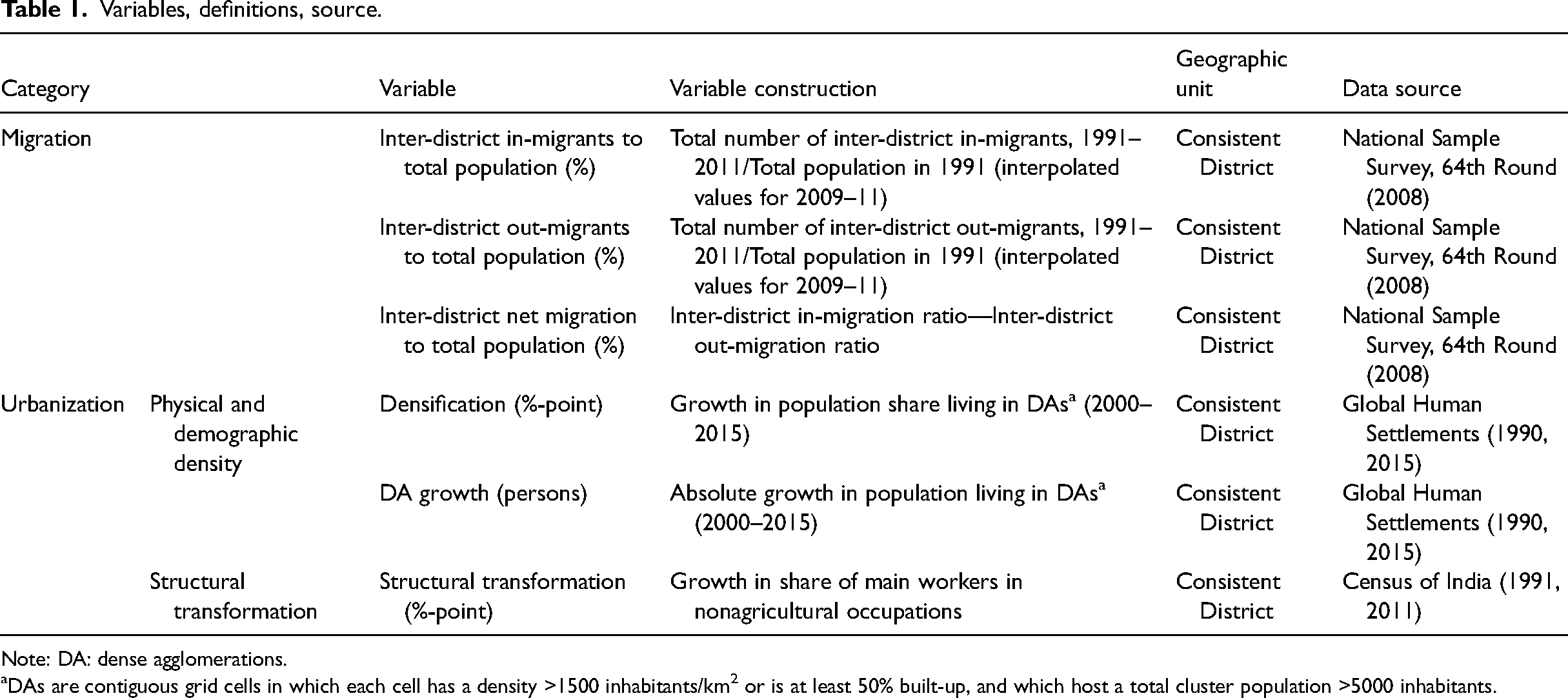
Note: DA: dense agglomerations.
DAs are contiguous grid cells in which each cell has a density >1500 inhabitants/km2 or is at least 50% built-up, and which host a total cluster population >5000 inhabitants.
The GHS does not include economic criteria in its classification, making it a measure of physical and demographic densification more than a measure of urbanization, which implies economic change (see Potts, 2018). Therefore, I also utilize data from the Indian Census to categorize workers into agricultural and nonagricultural occupations. I use these data to measure growth in the share of workers primarily engaged in nonagricultural activities.
The benefit of analyzing urbanization through these two constitutive measures—densification and structural transformation—rather than using the Indian government’s definition of “urban,” is that the latter is applied using administrative boundaries for settlements. 4 Empirical work in India has shown that this presents an unreliable portrait of urbanization patterns, given that actual agglomerations rarely follow these boundaries. As a result, populations spatially and functionally integrated into dense, nonagricultural agglomerations are often classified as “rural” simply because the small administrative units in which they live are peripheral and fail to qualify as “urban” on their own (van Duijne, 2019). The Indian government’s definition presents other issues as well; for example, it considers only male employment in its economic criterion.
To estimate net migration flows, I use the 64th Round of the National Sample Survey (NSS), conducted in 2008, which contains more detailed migration information than any other government survey. These data enable estimation of permanent in-migration, permanent out-migration, and seasonal migration (those who spent 1–6 months working outside their main place of residence in the past year). 5 The main reason for using migration estimates from the NSS rather than population data from the decennial Census of India is that the latter releases data only on in-migration and thus cannot be used to track net flows. To understand migration’s role in the demography of urbanization, it is essential to analyze both in- and out-migration.
For both urbanization and migration measures, I use the district as my geographic unit of analysis, constructing share variables for the purpose of analyzing data at the district level (see Table 1). Boundaries of Indian districts, which are roughly the size of counties in the United States, change over time through subdivision, presenting a challenge to historical analysis. To solve this issue, I recombine districts that were subdivided during the two-decade period of analysis so that all units of analysis have consistent spatial boundaries in the three observed time periods. Through recombination, I arrive at 399 consistent districts for my analysis—hereafter referred to as simply “districts.” 6 This approach of analyzing urbanization at the district scale is similar to that of Chauvin et al. (2017); however, because they rely on India’s administrative definition of “urban,” whose limitations I described above, I consider my method an improvement on this previous work.
The rationale for using the district as the unit of analysis, rather than the settlement or population agglomeration, is that migration data are not available at more fine-grained scales. The risk in this approach is that what appears to be urbanization without in-migration may, in fact, be urbanization through local, intra-district population movements. However, I develop a robustness check—using intra-district migration data from NSS to calculate the maximum possible contribution of in-migration to the growth of DAs—and show the impossibility of local migration driving the identified urbanization trends.
My analysis focuses on the two decades following the liberalization of India’s economy in 1991, which was a major moment of social, economic, and political transition. I examine migration and nonfarm employment growth in the period of 1991–2011 and densification in the period of 1990–2015, given the years for which GHS data are available. 7
The urbanizing “ruralopolis”
The data demonstrate that certain regions in India are densifying and developing nonagricultural economies even as they see more out- than in-migration—that is, urbanizing from within. This pattern is heavily concentrated in the eastern Indo-Gangetic Plain, notably the states of Bihar and West Bengal, and the ring of lowland areas that encircle Bangladesh—among the poorest and most densely populated regions in India. Their population and settlement patterns inspired Qadeer's (2000) term, “ruralopolis,” as a descriptor for high-density agrarian regions—except that in recent decades they have become increasingly, and in some cases principally, non-agricultural. The maps in Figure 1 demonstrate this confluence of structural transformation, growth in DAs, and negative net migration.
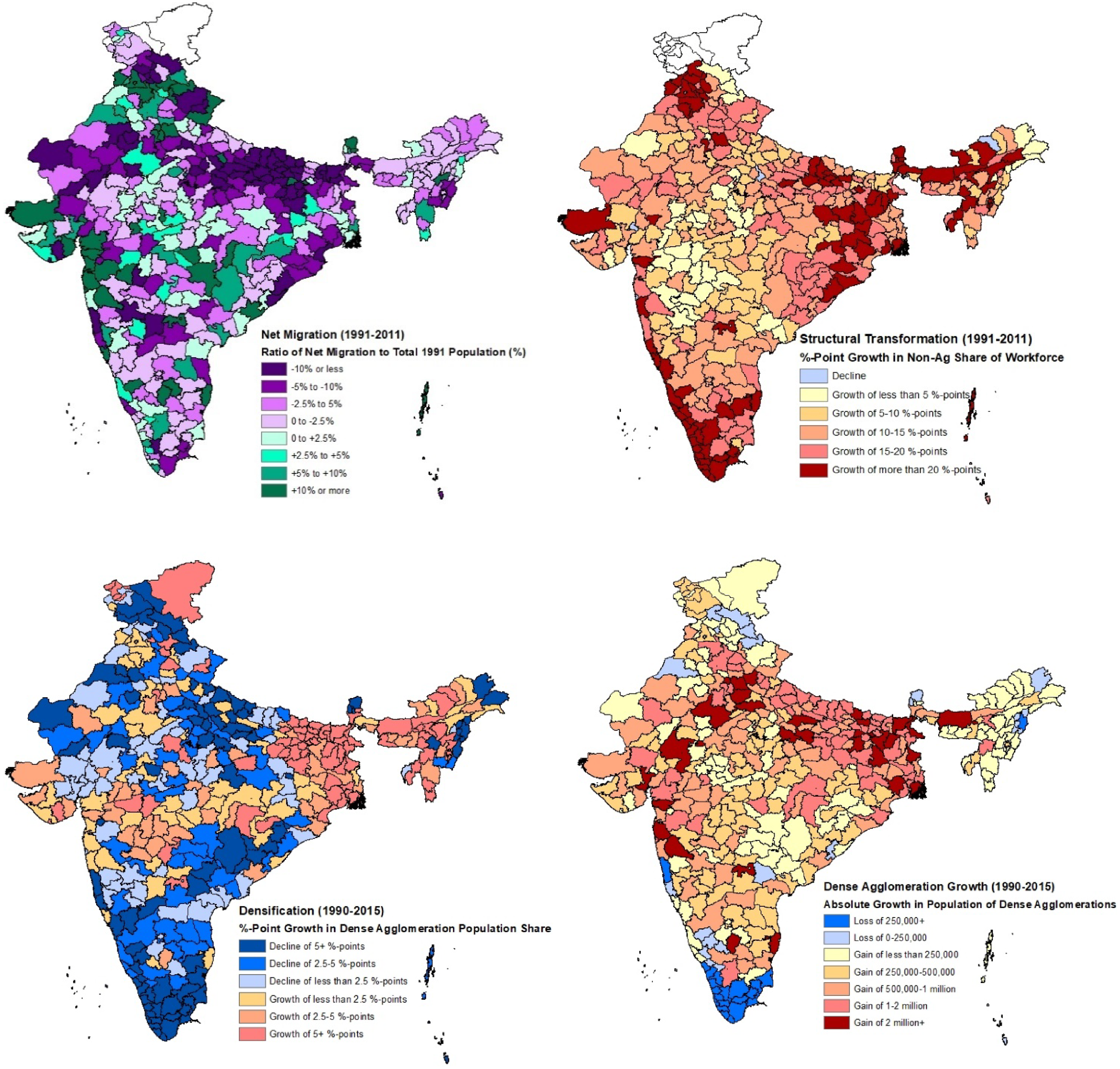
Net migration, structural transformation, and densification across consistent districts. Sources: National Sample Survey, Global Human Settlements, Census of India.
A typical case is Maldah district in West Bengal, squeezed between Bihar and Bangladesh and situated along the Ganges River. Maldah has been densely populated for many centuries thanks to the productive agriculture of the Ganges floodplain, but its economy is changing rapidly. The share of workers engaged in nonagricultural occupations almost doubled in the 20 years between 1991 and 2011, and now accounts for roughly half the workforce. Nearly two-thirds of Maldah's population lives in DAs, a share that grew by 9 percentage-points between 1990 and 2015. Yet during the 1990s and 2000s, Maldah lost about five times more people to out-migration than it gained through in-migration (5% and 1%, respectively, of its 1991 population). Nonetheless, during the 25-year period between 1990 and 2015, the population in Maldah's DAs grew by 1.1 million, owing to natural population increase.
The type of urban transition unfolding in places like Maldah is not the only kind of urbanization happening in India. The peripheries of large metropolitan areas are witnessing a more conventional form, fed by permanent in-migration. For example, in Rangareddy, a suburban district encircling Hyderabad, net migration alone expanded the population by 33% over the 1991–2011 period—occurring in tandem with densification and structural transformation. A similar transition has occurred in the Gurgaon-Mewat district and Bulandshahr-Gautam Buddha Nagar-Ghaziabad district, which both include exploding satellite cities of Delhi. 8
However, my analysis suggests that in India, metropolitan peripheries like Rangareddy and Gurgaon may be less significant to new urbanization processes than nonmetropolitan places like Maldah. Table 2 summarizes key indicators in districts experiencing the swiftest urbanization—defined as those in the top quartile in both nonagricultural employment share growth and DA population share growth. Only seven of the 29 districts in this group experienced significant positive net migration; collectively, these seven districts saw the populations within their DAs expand by 9.2 million people over the 1990–2015 period. Meanwhile, in the 22 districts experiencing urbanization with negative or near-zero rates of net migration, DAs grew by over 24 million people. 9 This suggests that more people live in locations urbanizing from within than in locations urbanizing through major influxes of permanent in-migrants.
Consistent districts of rapid urbanization.
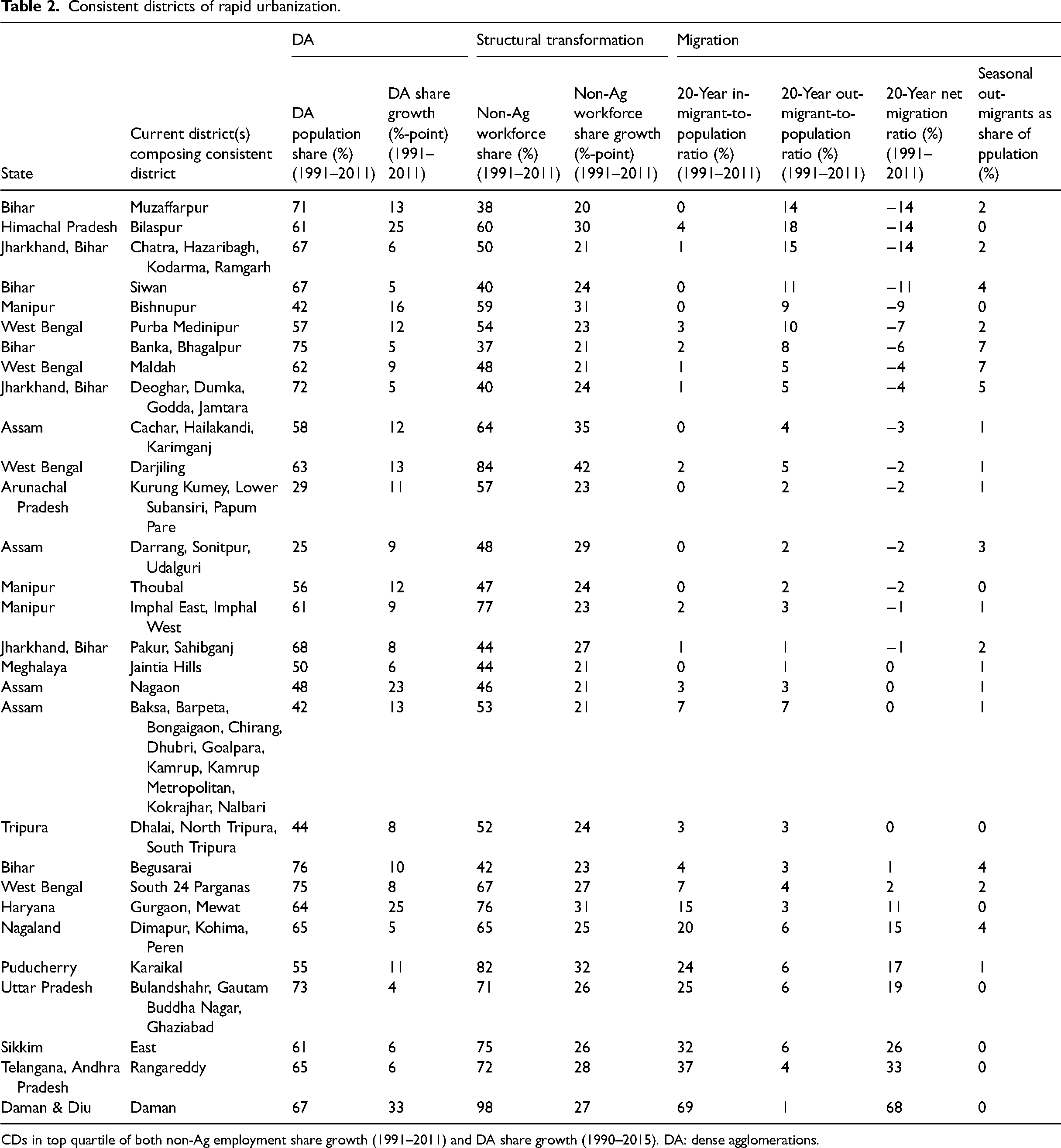
CDs in top quartile of both non-Ag employment share growth (1991–2011) and DA share growth (1990–2015). DA: dense agglomerations.
As noted above, my measurement of these patterns at the district scale leaves open the possibility that places like Maldah are urbanizing through the internal reorganization of population, that is, short-distance migrations within their boundaries. However, I can reject this hypothesis by estimating the maximum possible contribution of all migration—both intra-district and inter-district—to the growth of DAs. The combined estimate of all inter-district in-migration (into Maldah from other districts) and intra-Maldah migration over the 1991–2011 period is 114,118, against the figure for total growth in DAs, that is, 1.1 million. Thus, even in the unlikely scenario that all intra-Maldah migration was from non-DA to DA locations, all migrants into Maldah from other districts were destined for DAs, and none of the out-migration from Maldah was from DAs, net migration to these DAs would equate to only about 10% of their growth. 10 This clearly indicates that the key vehicle of urbanization is neither inter-regional nor intra-regional migration but instead a form of rural-to-urban transformation where populations grow in place.
While declining fertility could ultimately slow down urbanization from within, natural population increase is still far from its endpoint in the places I have identified. Of the 22 districts experiencing urbanization from within, only three have total fertility rates (TFR) at or below replacement level. Most will see fertility well above replacement until the middle of the 21st century; if rates of TFR change in the 2001–2011 period persist into the future, the median number of years it will take for a district in this group to reach replacement-level fertility is 38. 11 This raises the prospect of urbanization driven by natural increase persisting for several decades in these locations.
While natural population growth, rather than in-migration, is the demographic vehicle of urbanization in most newly urbanizing locations in India, closer examination of mobility patterns in these districts (Table 2) suggests an alternative relationship between urbanization and migration. Rates of seasonal out-migration, defined as working for 1–6 continuous months per year outside one's place of residence, are significantly above average in these places. According to NSS estimates, 2.5% of the population migrates seasonally out of districts experiencing urbanization from within, 12 as compared to 1.4% of the country's total population.
Temporary mobilities, such as seasonal migration, are likely related to the urbanization of these once-rural locations, in two senses. First, because temporary migrants do not change their place of residence, this form of migration (unlike permanent out-migration) does not act as a demographic drain on origin locations, helping to sustain their natural population growth. Second, temporary migration effectively expands the territorial scale of a given settlement's labor market; households can draw income from a more diverse range of locations than if workers labored only locally. As van Duijne et al (2023) show in their recent article, this enables a local economic transition away from agriculture by enhancing local demand for nonfarm goods and services. In addition, while these districts do not have a higher rate of permanent out-migration than the average district in India (a population-weighted average of about 7% and 8%, respectively, over the period of analysis), the states in which they are located are major recipients of remittances from internal migrants (Tumbe, 2018); these remittance flows are further fuel for their nonfarm economies. 13
Causal underpinnings: Metropolitan inequality, uneven spatial regimes of social insurance, or historical demography?
Why is rural population growth fueling in situ urbanization in the countryside, as opposed to propelling faster out-migration? The conditions of “urban pull” and “rural push” in India appear ripe for a much larger exodus to cities. Dense parts of the countryside face extraordinary pressure on the supply of cultivable land, 14 the vagaries of climate change are making agricultural livelihoods increasingly precarious (Berchoux et al., 2019), and the rural–urban wage gap is over 25% after correcting for cost-of-living differences (Munshi and Rosenzweig, 2016). Yet permanent rural–urban migration is not occurring on the scale that standard urbanization theory would predict. Instead, population persistence and growth, combined with local economic change, is urbanizing the “ruralopolis.”
Investigating the causal underpinnings of this paradox is the next step in a research agenda around urbanization from within. The fundamental question to be addressed is: Why are so few people permanently migrating out of areas like Maldah, opting instead for temporary out-migration? The literature reviewed above offers several hypotheses, which I detail in this section as a foundation for future research.
First, it may be that the nature of India's structural transformation—which “leapfrogged” manufacturing, transitioning from an agriculture- to services-based economy—has not created enough of the types of jobs that would enable, and motivate, migrants to permanently relocate to cities. In contrast to urban transitions driven by manufacturing—whether in Europe, the Americas, or East Asia—economic growth in India's cities since 1991 has relied primarily on modern services such as information technology, apart from a few manufacturing hubs located in western and southern states. 15 Because these sectors require more specialized skills and employ fewer workers than labor-intensive manufacturing, the major metropolitan areas where they are located host highly polarized labor markets: a salaried professional class alongside a large working class laboring in (mostly informal) retail, hospitality, and personal services (Azam, 2012). Work opportunities in the latter segment of the labor market are generally precarious, contingent, and temporary. When earnings in casual urban employment are compared to rural wages, the incentive to migrate looks much weaker than when examining average wages across locations (Mukhopadhyay and Naik, 2018). This “missing middle” labor market structure is a contemporary challenge throughout the world (Goos & Manning, 2007), even in countries at lower income levels (Rodrik, 2016), yet in India it coincides with, rather than follows, the urban transition. Therefore, it may be that urbanization patterns in India diverge from the expectations of conventional urban theory because there is greater incentive to migrate temporarily than permanently for most rural people, sustaining both the demographic growth and economic viability of migrants’ places of origin.
Another factor that may be at play is the political culture of large Indian cities. Cities like Delhi and Mumbai have become somewhat hostile to the poor, most especially poor migrants, through an emphasis on world-class city-making (Ghertner, 2015), which often involves “sanitization” (Kundu and Saraswati, 2012) through demolition and eviction in informal settlements (Bhan, 2009; Ghertner, 2014). Nativist movements directly seek to limit the influx of migrants from other states or reserve jobs for locals (Tumbe, 2018)—part of a broader pattern of regional identity politics (Nielsen and Bedi, 2017). For example, the government of Haryana, a state adjacent to New Delhi that hosts many multinational corporations, recently passed a law that forces private companies to reserve 75% of low- and middle-salaried jobs for locals (Das, 2020). Thus, the political environment may discourage migrants from establishing permanent homes in large cities and cause them to view metropolitan areas as little more than a place for occasional temporary employment.
Finally, a third factor that may explain circular as opposed to permanent out-migration is the spatial regime of formal and informal social welfare in India, which makes rural origins the anchors of the country's safety net. While India has seen an explosion in rights-based entitlements in recent decades, most of these programs are targeted only to rural areas or otherwise tied to one's place of permanent residence. For example, the Mahatma Gandhi National Rural Employment Guarantee program, which entitles rural households to 100 days of paid work per year on public works projects, has no equivalent in urban areas. 16 These location-bound programs dull the incentive to leave rural origins and limit the distance migrants are willing to travel (Kone et al., 2018; Morten, 2019). On top of formal social insurance in rural areas, households also benefit from informal caste-based networks for borrowing during times of economic distress, which has also been shown to reduce the need to migrate out of rural areas (Munshi and Rosenzweig, 2016).
Aside from these three factors, which all may act to dull the benefits of permanent rural–urban migration, the role of historical demography must be considered. The locations experiencing urbanization from within are heavily concentrated in the Indo-Gangetic Plain, a region that has hosted high population densities for millennia due to intensive agricultural practices supported by one of the most extensive fluvial plains in the world. By 1951, before the period of most rapid demographic growth in the state, Bihar already hosted 221 people per square kilometer, about double that of India as a whole (Prasad, 1956). If population density is already high at the onset of a demographic transition, conditions are ripe for in situ urbanization driven by natural increase—at least in the absence of a massive out-migrant exodus.
Conclusion: Implications for research on urbanization and development
This article has shown that some parts of India are urbanizing through natural population increase rather than in-migration. I have proposed that “morphing places” and “moving people” are nevertheless linked in this process—not in the conventional sense of in-migration creating demographic density, but instead because these areas see high levels of temporary out-migration that indirectly enables their urbanization. This form of urbanization has been largely overlooked in existing scholarship. More broadly, the trends I have described in India signal the potential for a more expansive, comparative investigation of the relationship between migration and urbanization.
This article speaks to wider debates in urban theory. While I do not follow Brenner and Schmid's (2014) call to dispense with a settlement-level understanding of the urban, my findings and arguments align with many of the claims advanced in their “planetary urbanization” thesis: that we must question “inherited conceptions of ‘the’ city as a singular, generic settlement type;” that contemporary urbanization is “variegated, uneven, volatile, contradictory;” and that “our understanding of emergent urban transformations currently remains severely underdeveloped” (Brenner, 2018: 573–574). My findings also help to substantiate claims from many scholars that urban transitions in the Global South are following historically specific trajectories rather than mimicking the urbanization experience of the Global North (Caldeira, 2017; Lawhon and Truelove, 2020; Randolph and Storper, 2022; Robinson, 2006; Roy, 2009; Sheppard, 2014), even as they show that fundamental forces, such as demography, continue to drive urban transitions across time and space. Urbanization from within might be interpreted as a specific expression of what Fox and Goodfellow call “late urbanization”—that is, urban transitions occurring under the unique demographic, technological, and governance conditions of the 21st century.
To further contribute to these theoretical debates, future research must address several empirical questions about urbanization from within. The first necessary step is to tease out the relevance and magnitude of the potential causes of urbanization from within that I hypothesize—labor market polarization, anti-migrant politics in metropolitan areas, social insurance tied to rural origins, and historical demography. Qualitative case studies in settlements urbanizing from within would help to interrogate the importance of these factors and may yield insight into variables I have not considered here. Formal econometric methods would also be useful in determining the relative significance of different factors and contributing to generalizable explanations for urbanization from within.
In addition to investigating the causes of urbanization from within, another question for future research is whether this phenomenon is unfolding elsewhere. If urbanization from within results from the factors I have hypothesized in the previous section, then other parts of the Global South that face similar structural conditions, notably Sub-Saharan Africa, may be witnessing similar urbanization patterns. Indeed, research by the Africapolis project on in situ urbanization indicates the likelihood of urbanization from within in West Africa (Moriconi-Ebrard et al., 2016). Fox (2017) also highlights that “rural transformation” has been an underappreciated driver of urbanization in the region.
Beyond the questions of its causes and geographic scope, future research must examine the consequences of urbanization from within. Many lines of inquiry—from sociological, anthropological, political science, or other disciplinary perspectives—could be fruitfully developed in studying these consequences. Through the lens of economic development, a key question is whether the locations identified in India, aside from becoming nonagricultural, exhibit increasing specialization, spatial clustering of sectors, and increasing returns to scale with growing size and density. If these “morphing places” do not enjoy the economic benefits of urbanization, then this would imply a weakening—in the worst-case scenario, an inversion—of the relationship between urbanization and economic development. Alternatively, if agglomeration benefits are evidenced in locations like Maldah, this could motivate reexamination of an enduring precept in urban and development economics, that labor migration is a crucial precondition of urban productivity growth. Or, more conservatively, temporary forms of migration might enable the learning and specialization associated with permanent migration, but to the benefit of origin economies—similar to the skills transfers sometimes found in research on international return migration.
The answers to these questions have direct relevance for policy and planning. If urbanizing locations of impoverished regions like the eastern Indo-Gangetic Plain are growing richer through their urbanization, then policy action could prioritize investments in local public goods to promote this economic growth and ensure it is sustainable and equitable. On the other hand, if these communities are experiencing the costs of urbanization (such as congestion and pollution) without its benefits, this may exacerbate interregional inequalities and necessitate a different type of policy response, aimed at unlocking barriers to permanent out-migration. In this sense, a deeper understanding of local economic change in India's “morphing places” is crucial to ensuring that India's urban transition enhances opportunities for those in its chronically underdeveloped regions.
Footnotes
Declaration of conflicting interests
The author(s) declared no potential conflicts of interest with respect to the research, authorship, and/or publication of this article.
Funding
The author(s) received no financial support for the research, authorship, and/or publication of this article.
