




Abstract
The benefits of community-based, grassroots food practices, such as community gardens or kitchens, are widely acknowledged. However, they have also been shown to support neoliberal and exclusionary dynamics. This paper examines this contradiction on the ground by unpacking the processes and mechanisms through which these initiatives reproduce, reinforce or challenge social inequities and injustices in the city. It suggests the concept of community food space to look at the articulation of practices and intentions within these groups, and highlight emancipatory practices situated around food rather than simply about food. The paper draws upon an ongoing militant ethnography into community food spaces in Berlin, Germany. Exploring the complex and diverse landscape of Berlin food activism, it illuminates the ways in which food may be used to perpetuate unjust social configurations or, on the contrary, to advance social justice at both local and structural levels.
Introduction
From urban agriculture to guerrilla gardening, community kitchens to food co-operatives, recent years have seen a plethora of grassroots, community-led food initiatives emerge around the world. Providing alternatives to conventional food cultivation, preparation, distribution and consumption, these everyday, micro-political and place-based activities are increasingly recognised as having a transformative potential within and beyond the food system. A broad body of work documents how they contribute to food security and justice (Milbourne, 2012; Schmelzkopf, 1995), public health (Bellows et al., 2003; Wakefield et al., 2007), community development (Beckie and Bogdan, 2010; Ghose and Pettygrove, 2014) and environmental sustainability (Viljoen, 2005). Celebrated as sites of resistance to the unjust and unsustainable corporate food system (Murdoch et al., 2000; Tregear, 2011), they are also seen as bastions of anti-capitalism (Feenstra, 2002; Wilson, 2013), and forms of urban commons (Eizenberg, 2012; Ginn and Ascensão, 2018). However, more critical voices have contested this narrative, arguing that community food efforts are not necessarily conducive to a more just or sustainable society (Allen et al., 2003). Studies have in particular revealed the contradictions and limitations of alternative food networks (AFNs), and shown how they contribute to neoliberalism (Argüelles et al., 2017; Busa and Garder, 2015; Guthman, 2008b; Pudup, 2008; Rosol, 2012), exclusionary dynamics (Alkon and Agyeman, 2011; Guthman, 2008a;Ramírez, 2015), and gentrification processes (Anguelovski, 2015; Dooling, 2009).
The aim of this paper is not to favour one analysis over the other, but to contribute to efforts to transcend dichotomous accounts of grassroots food initiatives (McClintock, 2014; McClintock et al., 2021; Moragues-Faus, 2017; Tornaghi and Certomà, 2018). Although conflicting, I argue that both views are correct and that community food initiatives may simultaneously contribute to exclusionary dynamics and neoliberal subjectivities, and to emancipatory politics and transformative change. This dualism raises however a major question, seldom investigated not as a dilemma to analytically solve but as a reality to account for on the ground – how can the same practices have such divergent social and spatial outcomes? To answer this question, it is necessary to move beyond classic approaches of practices and outcomes to look instead at how they relate to the intentions and motivations behind them. Examining the relation between the intent driving grassroots food efforts and their – more or less successful – implementation on the ground by different groups in different contexts is key to understanding the kind of spaces they produce, who participates in such spaces, what values inform them, and how they affect urban space and communities. The relationship between intention and practice is not a straightforward one and even well-intentioned activities have been shown to support broader socio-political inequalities (Guthman, 2008a). What I suggest is therefore not to neglect one for another, but to look at the dynamic articulation – and disjuncture – of intentions and practices within these groups, that is, to simultaneously ask what they intend to create and how they put it in practice.
Despite sharing major characteristics, community food efforts are heterogeneous and fragmented, and a closer look reveals not only a great diversity of practices, but a range of various, sometimes discordant, objectives and goals – in particular, as they relate to food. Developing alternatives to the conventional food system may be central to their political agenda, but it can also be a secondary objective. Community-supported agriculture (CSA), for instance, works to re-localise food production and consumption, and challenge the corporate system's market-logic. By contrast, many community gardens do not see food production as an end in itself, but seek to rehabilitate neglected urban spaces, green neighbourhoods or empower local communities. The same practices may also be deployed for different purposes. Cooking with rescued food is a way to raise awareness around food waste and reform individual lifestyles towards sustainability for Slow Food's ‘disco soup’ events, but it is used to reach broader, systemic goals – combatting poverty or challenging capitalism – for freegan groups. The same action, informed by different values and purposes, can therefore have divergent outcomes.
This paper aims to explore the transformative potential of community food initiatives and unpack the mechanisms and processes through which they either reproduce, exacerbate, or challenge power relations and unjust social configurations. I seek to understand the articulation of intentions and practices within these spaces by looking at their strategies and politics, and how these are implemented on the ground. I will in particular examine the discrepancies between their proclaimed intentions and the actually existing realities of grassroots food initiatives. I do so in a critical yet constructive way, not only exposing how these initiatives contribute to neoliberal rationalities and exclusionary dynamics, but also documenting more diverse voices of transformation. This latter aspect, less investigated by the critical literature on AFNs and community-based economies (CBEs), examines attempts to address the effects and causes of social inequity in urban space, and how these goals are achieved. By assessing how groups use food to improve living conditions within and beyond their communities, and dismantle the structural roots of inequity, this paper illuminates practices that can inspire other politics in other places. Understanding how social justice may be implemented on the ground is indeed key to achieving more just and equitable socio-ecological systems.
While the concept of AFN is commonly used in the literature, I propose the notion of community food space (CFS) to refer to this constellation of bottom-up practices that challenge corporate models of food production and consumption. This concept, I argue, better captures the diversity of strategies and politics informing these groups. Originally – and still predominantly – used within a North American and European context (Goodman and Goodman, 2009), the notion of AFN places the development of alternatives to the conventional food system as central to these initiatives’ agenda. The more comprehensive notion of CFS does not imply such focus. Food can be as much an end goal as a means to achieve broader, localised or systemic, purposes. CFSs therefore encompass a more diverse range of collective practices which, at one point in their trajectory, use food to create new forms of social and economic relationships and identities. This notion enables to decentre not only food from these initiatives’ aims, but also the ambiguous, relative notion of ‘alternative’ (Holloway et al., 2007; Wilson, 2013) and the many divergent understandings of ‘alterity’ (Blumberg et al., 2020; Rosol, 2020), thereby highlighting the complexity and particularity of such spaces. Compared to previous attempts to shift the focus from the notion of ‘alternative’ in the study of food activism to other perspectives, such as that of food ‘citizenship’ (Renting et al., 2012) or food ‘democracy’ (Davies et al., 2019), the concept of CFS helps consider practices that go beyond changing the food system itself and instead attempt to implement new social, political, economic, and environmental configurations more broadly.
By moving away from attempts to categorise food systems and practices, the notion of CFS focuses on these activities’ spatial politics and the direction taken by their politics. Despite the notion of ‘community’ being criticised for its polysemic, ambiguous and post-political character (Pudup, 2008; Aiken, 2017) and for being often misleadingly confused with that of diversity (Véron, 2023a), I use it here to denote the process of being, doing and becoming together in a common space through practical action that is characteristic of these initiatives. Rather than a reified, homogeneous object, community should here be understood as fluid, tentative bonds of solidarity that align and realign differently around different purposes (Kumar and Aiken, 2021). Beyond static analytical frameworks and dichotomies, the notion of CFS considers grassroots food initiatives as spaces in the making and emphasises the dynamics of political practices and relationships that emerge at the intersection of multiple, place-based identities (Véron, 2023b). By doing so, the concept of CFSs opens up possibilities beyond Eurocentric conceptualisations of what alternatives to conventional food systems might entail and, more broadly, what activism in connection with food implies, thereby widening the theoretical and empirical ground of study.
The remainder of this paper is divided into four main sections. First, I examine how the literature on AFNs and CBEs situates community food initiatives within processes of social change and reproduction. Second, I outline the research design. Third, I assess the mechanisms through which CFSs work for or against the political status quo and contribute to social (in)equity and (in)justice. I finally discuss their actual and potential contributions to socio-environmental change.
Community food spaces: spaces of resistance or flagships of neoliberalism?
Community-based initiatives have emerged in the last two decades as a way to inspire new socio-ecological configurations, lower carbon emissions and fossil fuel dependency, question the capitalist logic of unlimited growth, and serve local communities. AFNs have displayed the added objectives of challenging the profit-orientated, industrial food system, re-localising food production, alleviating food insecurity and ensuring food justice. A broad, quickly expanding scholarship has documented how these initiatives transform our economic system and bring about socio-environmental change. CBEs are recognised as facilitating local community development (Ghose and Pettygrove, 2014), enhancing social interactions (Conill et al., 2012), advancing social cohesion (Middlemiss and Parrish, 2010) and combatting poverty (Walker, 2008). Although modest and quotidian (Horton and Kraftl, 2009), this ‘quiet’ activism (Smith and Jehlička, 2013) encourages civic participation through accessible lifestyle and everyday action, thereby extending the horizon of social engagement in the here and now (Chatterton and Pickerill, 2010; Neilson and Paxton, 2006) and opening up new politics of possibilities (Gibson-Graham, 2006). ‘Microcosms of hope’ (Bailey et al., 2010: 595), CBEs may not necessarily closely align to any systemic change per se but, as a setting for people to share ideas, competences and experiences, they nonetheless contribute to broader social change (Kneafsey et al., 2017) and ‘decolonize the social imaginary’ (Kallis and March, 2015). By providing alternative economic models and practices to the dominant food system as well as non-capitalist or post-capitalist forms of socialisation (Rosol, 2020), they represent ‘spaces of possibility for alternatives to mainstream, neoliberal economics’ (Feola and Him, 2016:1). While embryonic and imperfect, they have the potential to enhance urban food democracy (Davies et al., 2019) and embody urban commons in the making (Eizenberg, 2012; Ginn and Ascensão, 2018).
Ironically, it is precisely where they are most praised that CBEs and AFNs are also most criticised. Critical scholars have pointed at community-led initiatives for performing a post-political function (Aiken, 2017) and assuming that concentrating on small-scale, achievable and consensual actions could have a transformative impact (Brown et al., 2012; Chatterton and Cutler, 2008). By targeting symptoms where more radical forms of change are necessary, CBEs fail to challenge the power relations responsible for socio-environmental problems, and the structural roots of inequity and injustice – ensuring only that ‘nothing really changes’ (Cook and Swyngedouw, 2012: 1973). Because they prioritise harmony and conciliation over contestation and oppositional politics as a basis for community outreach, sustainability-led CBEs such as Transition Towns fail to have a political impact (Kenis and Mathijs, 2014). By rejecting typical ‘activist’ engagement in favour of individualised, lifestyle actions, they serve rather than threaten the neoliberal agenda (Blühdorn, 2017). Particularly detrimental to political contestation is the substitution of collective action by individual purchasing practices and consumer conversion strategies (DuPuis and Goodman, 2005; Johnston et al., 2009). Activists are replaced by citizen-consumers, who lack both awareness and concern for the environmental and social justice implications of their action (Busa and Garder, 2015). Despite their progressive objectives, CBEs appear to be the flanking agents of neoliberal forms and spaces of governance (Pudup, 2008). By encouraging citizen participation and self-help through unpaid voluntary work to respond to socio-environmental issues, they outsource public social services to civil society (Rosol, 2012). AFNs in particular have been shown to reproduce neoliberal mentalities through the promotion of consumer choice, localism, entrepreneurialism and self-improvement (Guthman, 2008b). Rather than spaces of transformative change, they increasingly seem to depoliticise socio-environmental struggles and weaken the emancipatory potential of food.
Despite encouraging community development to compensate for the withdrawal of social protection services, this neoliberalisation is not conducive to community cohesion and empowerment. In a landscape scarred by local authority cutbacks and restructures, grassroots food initiatives often work against each other rather than in cooperation (St Clair et al., 2020). By providing services and rights only to those able or willing to engage in volunteer activities (Alkon and Agyeman, 2011), CBEs perpetuate patterns of exclusion and forms of ‘privileged citizenship’ (Argüelles et al., 2017). Predominantly attracting white, middle-class and educated individuals, these initiatives conflate the notion of community with that of inclusivity (Aiken, 2017; Lyson, 2014; Smith, 2011). By disregarding the needs and interests of communities located outside their closer network, they naturalise social inequities and reproduce unequal access to environmental goods and benefits (Argüelles et al., 2017). Scholars have in particular documented the exclusionary dynamics at work within AFNs and demonstrated their inability to serve communities of colour (Allen, 2010; Hoover, 2013; Ramírez, 2015). AFNs’ incapacity to integrate lower income and racialized residents, together with their paternalistic – if not colonialist – visions (Guthman, 2008a; Slocum, 2007), suggests a failure of both distributional and procedural justice (Tornaghi, 2014), which results in the further marginalisation of underprivileged residents through uneven urban development and (eco)gentrification (Anguelovski, 2015; Dooling, 2009).
My paper contributes to this literature by illuminating practices of social change and reproduction within CFSs. Critical analyses of CFSs should however not lead to overlook their emancipatory potential. Gibson-Graham (2008: 613) has warned of obscuring ‘marginalized, hidden and alternative economies’ by portraying neoliberal capitalism as a totalising force. This paper seeks to go beyond the dichotomy that characterises the scholarship on community-based initiatives, as they relate to food or other socio-environmental components. I will examine these contradictory tendencies by scrutinising, not only the movements’ practices and outcomes, but their dynamic articulation with the groups’ intentions and strategies of change. By analysing the broader politics at work within CFSs, I illuminate the mechanisms through which food may be used to reproduce neoliberal, unjust social patterns, or, on the contrary, advance social justice.
Community food spaces in Berlin
Contextualising grassroots food activism within processes of urban change
This paper builds upon research among CFSs in Berlin, Germany. Since the fall of the Berlin Wall, the German capital has undergone an unparalleled urban transformation, marked by neoliberalisation, rapid gentrification and changes in the social composition of its population. With the collapse of the GDR in 1989 and the 2001 financial crisis, an entrepreneurial strategy for the reunified city, followed by a fierce austerity track within a context of intra-urban competition and place-marketing, has driven urban neoliberalisation processes (Lebuhn, 2015). Affordable, vacant residential buildings in need of renovation have attracted real estate developers. Between 1991 and the end of the 2010s, more than 50% of the city's housing stock was sold to private investors (Holm, 2013). This privatisation and property boom fuelled a speculative bubble (Bernt, 2012) and has put increasing pressure on rental and sale prices ever since. Unlike most Western capitals, gentrification in Berlin did not begin until the mid-1990s or early 2000s but has since developed a similar trajectory (Siemer and Matthews-Hunter, 2018). With the growth of the ‘creative city’ narrative, former working-class neighbourhoods such as Prenzlauer Berg or Neukölln, long considered places of ‘urban decline’ threatened with ‘ghettoisation’, now embody Berlin's new ‘hype’ (Huning and Schuster, 2015). The rapid expansion of the creative industries over the last decade has attracted large numbers of young, middle-class and educated foreigners from the Global North (Schroeder, 2020). Replacing the traditional migrations of low-income populations from Turkey or political refugees from ex-Yugoslavia in areas such as Kreuzberg or Neukölln, they contribute to the changing demographic composition of the neighbourhoods – a trend exacerbated by the conversion of long-term rentals into short-term tourist rentals and an increasingly competition for affordable housing (Siemer and Matthews-Hunter, 2018).
While grassroots resistance to urban privatisation dates back from the early 1970s in West Berlin, with the squatter movement reclaiming access to housing and experimenting with new forms of non-capitalist, collective life (Häberlen and Smith, 2014), the reunification process was accompanied by a new wave of squatting (Holm and Kuhn, 2011). The violent opposition of the German government and the decrease in urban land available marked the decline of the movement and led to a number of evictions (Azozomox and Kuhn, 2018; Karge, 2018), but its legacy is still visible in Berlin today. In West Berlin, many community gardens arose out of the counter-cultural squatter movement that opposed urban renewal policies of the 1970s and 1980s (Rosol, 2018). Former squats have been turned into autonomous housing projects (Hausprojekte), whose political and public character continue to challenge the neoliberalisation and commodification of urban space (Jaureguiberry-Mondion, 2022). Encompassing a diversity of projects, they often include a Volxküche 1 (commonly abbreviated as VoKü), that is a ‘people's kitchen’. Displaying a radical, autonomous left political self-identity, these places emphasise horizontal decision-making and anarchist principles (Agten, 2019). Also known as Küchen für alle (‘kitchens for all’), they offer mostly vegetarian or vegan meals, often cooked by inhabitants or volunteers from salvaged food, and distributed on a pay-as-you-feel basis.
The early 2010s marked the start of a new wave of urban activism in Berlin, based on do-it-yourself and do-it-together activities (Baier et al., 2013; Karge, 2018). A renewed interest in the urban commons has inspired grassroots experiments with new forms of ownership, consumption and cooperation such as repair cafés, fab labs or free shops. Influenced by international grassroots community projects such as Transition Towns or Incredible Edible, projects around sustainable living, local ecological resilience and community change have emerged in Berlin. Food has been an important part of this process, which has taken a diversity of forms and displayed various objectives. Those range from offering alternatives to conventional food chains through farmers’ markets or CSA to de-commodifying the food system via collective models of land purchasing and cooperativist principles (Rosol, 2020), or even managing food as urban commons through gleaning, public fridges and decentralised food-sharing platforms (Morrow, 2019). By combining alternative economic practices, claims over urban politics and broader concerns around ecological resilience and climate change, these projects contribute to reshaping the landscape of urban activism in Berlin. As I will show however, they are not without ambiguities and limitations.
Methodology
This paper builds on an ongoing militant ethnography started in 2019 within eight CFSs in Berlin (Table 1). A form of militant research, militant ethnography implies ‘the process of gradually identifying and becoming fixated on a contradiction, inconsistency or paradox within an overtly politicised milieu, and then striving to understand and contribute to the collective surpassing of this paradox’ (Russell, 2015: 223). Based on active participant observation, my research is characterised by the blurring of the lines traditionally separating observation, participation and analysis, and imbued with the attempt to contribute to the critical transformation of the activist movements I am embedded in. I have sought to respond to the needs expressed by these groups and helped with meetings, working sessions, volunteer management, campaigns, and by photographing, gardening, rescuing food, cooking, as well as making scientific literature accessible. Based on an inherently reflexive process and a constant awareness that knowledge is situated, this association does not blind me to the limitations and contradictions of these communities and of my own positionality. This positionality has been essential to make visible the complexity of places, interactions and relations at work within CFSs.
Description of community food spaces analysed.
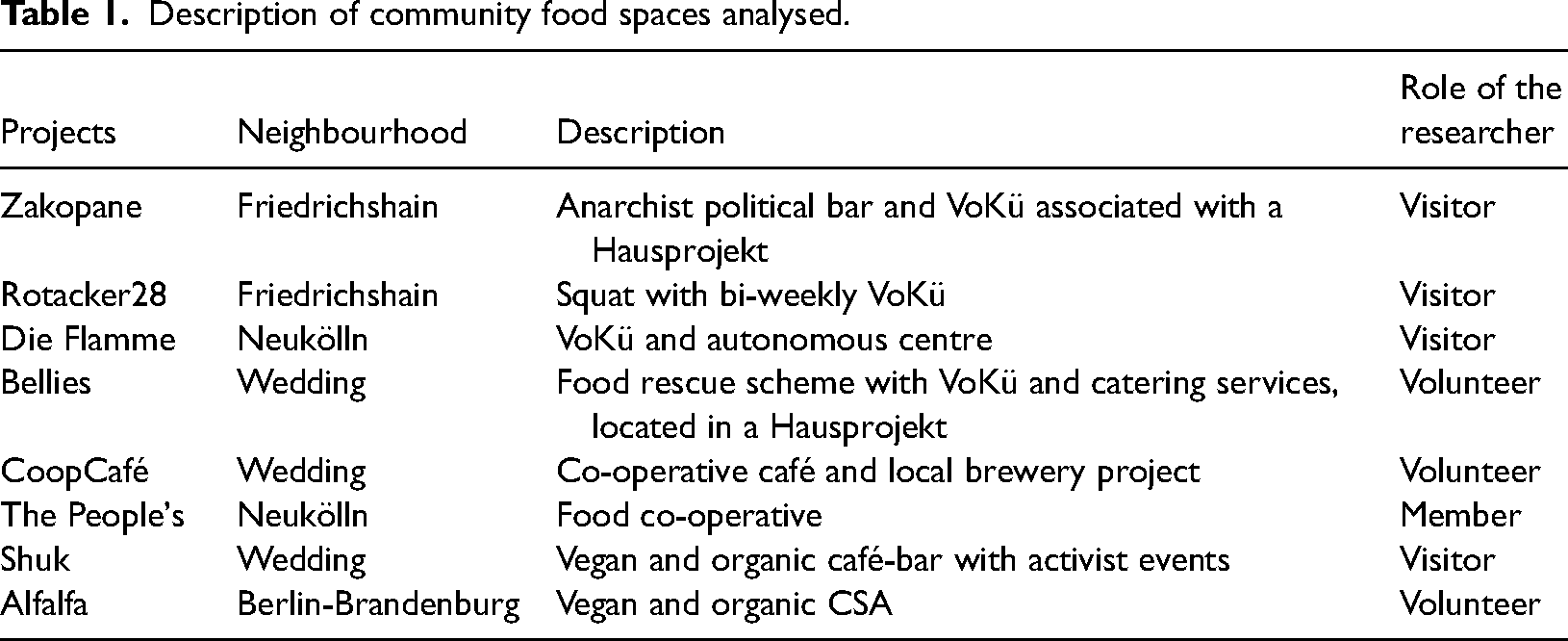
This work has been supported by 26 in-depth interviews and two focus groups with CFSs activists and participants, document analysis, and innumerable informal conversations and interactions documented in a research diary. These methods have been complemented by photographic data gathering and the making of a documentary feature film. 2 Research data have been anonymised, and pseudonyms given to initiatives and participants.
Initiatives were selected following several criteria. They had to: (1) make food central to their activities or to one aspect of their activities; (2) be initiated and managed by communities (not by private actors or public bodies); (3) aim to serve local communities; (4) have social justice objectives. The case-studies have also been selected based on their location in the city, with priority given to those located in racially and socially mixed neighbourhoods affected by gentrification following different temporal scales: (1) Neukölln, a south-east, gentrifying neighbourhood formerly located in West Berlin, and home to large concentrations of Turkish and Arab communities. (2) Friedrichshain, a former working-class, now rapidly gentrifying district also formerly part of East Berlin, renowned for its tradition of radical left politics. (3) Wedding, a north-west, historically working-class, and disadvantaged neighbourhood, with half its population of migrant origin, 3 and at risk of gentrification (Siemer and Matthews-Hunter, 2018).
The first case-study focuses on VoKüs (‘people's kitchens’) located in Hausprojekte or more informal settings and squats. This is the case of three of the studied VoKüs, Zakopane and Rotacker28, located in Friedrichshain, and Die Flamme in Neukölln, with Rotacker28 being evicted in the Autumn 2020. I have also included a new form of community kitchen, Bellies. Founded in 2015, it collects food discarded by supermarkets to use for cooking events in a Hausprojekt in Wedding, or to be donated to Fair-teilers (a pun on the English adjective fair and the German word Verteiler, ‘distributor’), that is, public fridges and charitable organisations. Until the pandemic, Bellies was proposing a bimonthly ‘community dinner’, which has not resumed since.
The second case-study concerns a more diverse range of co-operative, for-profit initiatives. The People's is a recently opened member-owned food co-operative in Neukölln, where customers work 3 h per month in exchange for a share of the project. The second initiative, CoopCafé, is a co-operative café and brewery project in Wedding, which officially opened in September 2021. The third initiative studied, Shuk, self-identifies as ‘a café-bar by and for the community’ in Wedding, which offers vegan, mostly organic, and local food, and organises activist events. The last initiative, Alfalfa, is a vegan and organic CSA based in Brandenburg, but which distributes its boxes to Berlin and has a small permaculture garden in Neukölln.
From visitor to volunteer or member, my positionality and degree of involvement have varied depending on the studied initiatives, the restrictions imposed by the Covid-19 pandemic and the projects’ own trajectory (most VoKüs and cafés temporarily closed in 2020, Rotacker28 was permanently terminated during the course of the research, Shuk very recently changed owners and direction, and Bellies’ activities have been drastically diminished since the pandemic). In some initiatives where traditional distrust of institutions prevails, such as the anarchist VoKüs, informal one-to-one or group conversations about the research were preferred to more formal interviews. These differences in access and relationships to the projects, as well as their own specificities, have affected the research design and execution, and the materials generated. While recognising these potential limits, my subjective observations and varied experiences are also what constitutes the embodied nature of militant ethnography and have allowed me more depth of exploration than might have possible without my own familiarity with the studied topic.
Aims, strategies and tactics of change in CFSs
This section explores the broader politics of CFSs and the methods used to achieve them. I have elsewhere examined issues of diversity, privilege and power in CFSs, and exposed the complex and dual character of the Berlin food activist scene with, on the one hand, a recent and rising tide of sustainability- and consumer-orientated initiatives led by outsiders and, on the other hand, a set of older, more locally rooted and highly politicised projects (Véron, 2023a). Together, they embody the variegated and shifting politics of socio-ecological change, simultaneously home to exclusionary practices and power relationships, and a site where unjust social patterns are challenged and new social imaginaries advanced. I examine here three dimensions that shape the way in which CFSs work for or against the political status quo and contribute to social (in)equity and (in)justice: the movement goals and relationship with activism; its strategies and tactics, in particular through the place attributed to food within this repertoire of goals and actions; the place given to social justice and its articulation with claims and practices of environmental sustainability.
Movement goals
Although political, social and environmental goals are generally among CFSs’ main rhetoric calls, how those objectives are in effect pursued and challenge existing power structures can be questioned. Rather than projects of resistance to the conventional food system, several grassroots food initiatives seem rather to be dominated by a market focus on products and consumption. However, my findings reveal tensions in the way action is framed and boundaries of engagement defined.
Many projects exhibit an ambiguous relationship with politics and activism, simultaneously displaying clear political aims and rejecting partisan politics. The People's, a ‘democratically governed supermarket’ led by white middle-class practitioners, offers a particularly telling example of this twofold narrative. I will therefore analyse this case in detail to illustrate the tension that characterises many CFSs, constantly torn between embracing and rejecting activism. Often positioning itself as the first co-operative supermarket in Germany, it strangely keeps quiet about the long political tradition of consumer co-operatives in the country and abroad. Dating back from the 19th century, consumer co-operatives were often initiated by and for working classes in close ties with local socialist and communist parties. This explains why they were prevalent in East Germany, with the famous Konsum co-operative spread throughout the GDR. Rather than claiming this legacy, the People's directly refers to two non-German initiatives: the Park Slope Food Coop (PSFC) in New York, and La Louve in Paris (itself a close replica of the PSFC). However, while the PSFC emerged in the 1970s on a strong anti-capitalist political line, The People's leaders recognise that they are ‘much less politicised’ and more ‘in line with a lot of projects that have been launched in Europe following La Louve, [which itself is] not very politicised’. The co-operative's manifesto yet leaves no doubt as to its broader political goals. By calling for ‘system change now’, it makes the connection between the ‘bottom-up transformation of the food system’ and the need to dismantle structural oppressions, that is ‘racism, sexism, homophobia, fascism, imperialism or other forms of violence’. The economic and social pressures restricting access to organic food are seen as factors of social exclusion, and the coop's vision is clearly expressed – a ‘sustainable and socially just system’, which can only be achieved by ‘freeing [ourselves] from traditional market structures’ and ‘addressing social justice and environmental protection together’. By making explicit political connections with La Via Campesina's ‘right to food sovereignty’, the rhetoric of localness also goes beyond local food movements’ usual rhetoric of virtue. Rather than an empty signifier, the local is here charged with potentially political, power-laden implications. While recognising that changes may have to be gradual and require compromise, this text clearly frames The People's as a radical project of structural social, economic and environmental change.
However, there seems to be a disjuncture between these political aspirations and how the group's political identity is shaped on the ground. Rather than grand ambitions and overtly political ideals, my interviews reveal a more pragmatic and reformist orientation, as reported by Augustine, a founder: Dr Pogo and Robin Hood [other Berlin coops] are clearly activists. They are rejecting the current system, they want something new. We’re not totally in that logic, we’re less about rejecting something and more about taking what exists and reshaping it to make it fairer, more adapted to what we want. This is a difference with other projects, the fact that we are not in this logic of rejection.
Three main areas of friction between the political ideals and pragmatic goals of CFSs account for these diminished expectations: the desire to materially build the project in the short-term regardless of the compromises made on long-term, ideal aspirations; the ambition to reach out to a broader audience and turn potentially repelling radical claims and confrontational actions into an accessible set of practices that resonate widely; and different sensibilities between members, explained by the heterogeneous set of reasons for joining CFSs in the first place. These complex identities explain the participants’ difficulty to frame their political engagement: Originally, we are not activists […] In terms of communication or in public, we are not politicised. We’re very open. We are not militant, we don't use terms like “anti-capitalism” or terms about diets. […] But in practice, we are quite politicised. This is not necessarily easy to show: it's in the way we are organised, the way we try to redefine group work, cooperation… We are still very shy because we are not sure of what we will be able to do, so we are careful. In a certain way, we are very militant and very activist because we try to reverse a lot of things without necessarily realising it. But it's not going to be declared on our website, to be written in big letters: “We want to revolutionise organisations and the way we work together”. But in reality, this is what we are trying to do, and on certain points we are making progress. So we don't present ourselves as activists at all.
This activist self-critique is a double-edge sword. On the one hand, it illustrates how social movement actors may resist the identity of activism (Bobel, 2007) and attempt to turn it into accessible actions that engage with a broader audience. Such discourses and practices are part of an attempt to make the initiatives more inclusive and appeal to diverse populations. The same rationale explains why The People's decided not to have a vegetarian or vegan only assortment of products on offer, as such a move could be coded as radical or white middle-class, and potentially restrict participation. This led to intense internal debates, with leading members actively supporting the sale of meat for inclusivity reasons, as explained by Sophia, an early member: ‘It was paradoxical: a vegan for years, I found myself defending the sale of animal products, and even conventional meat!’. On the other hand, by opting for pragmatic goals rather than questioning wider political and economic structures, and by rejecting confrontational forms of activism, this rhetoric also reflects the increasing depoliticisation of local food movements. Several CFSs eschew discussions about their political role and impact at both local and structural levels, and decouple their action from wider questions of social transformation. Rather than opening up local, sustainable food systems to a wide variety of participants, they may well fall short of achieving any socio-environmental change. However, there are signs that this depoliticisation is contested from within, as appears in the way Em, a project leader, reasserts its political ambition: One important thing is emphasising the social aspect as much as the environmental aspect. But it can't be just talk. It has to mean we are involving and including people from different backgrounds. And not only making space, but having the facilitation of those conversations. The standard of behaviour, what's OK and what's not, how and if we are meeting the needs of the community, have to be very clear. It requires constant communication and constant checking in. We don't communicate enough about that. Because there is this fear of being too political or activist But this is an activist project! […] If you are not doing something actively against something, then you are actually part of the problem.
This conversation attests of The People's ambiguous political position. Structured as a horizontal, self-managed co-operative organisation, it is also a for-profit business with implicit hierarchies and an entrepreneurial ethics. This ambivalence is also reflected by its attempt to build a wide support base by speaking to different sensibilities, likely to be attracted as much by the coop's radical ethos as by its reformist pragmatism. This politics of speaking from both sides may however result in disappointment and frustration, as voiced by Sophia shortly before the co-operative opened: I am absolutely gutted. When I first heard of the project, I was starry-eyed. I’ve become so disillusioned. This has nothing to do with the project I initially wanted to support. If we’re going to open a hipster supermarket with sustainable, fancy products only, sorry, I’m not in.
This dilution of political ideals also indicates the potential evolution of radical projects and the trade-offs seen as necessary to implement them. Initially driven by politics of transformative change, they are often caught up by a more pragmatic ethics of management, reflective of their leaders’ cultural and economic capital. In that respect, it is not surprising that most members of The People's executive board come from the business sector. Priority is here given to building a viable project over distant, uncompromising ideals. The influence of this reformist business model also appears in the way CFSs frame most of their strategies and tactics.
Strategies and tactics of change
Whether CFSs contribute to emancipatory politics disengaged from capitalism or to social inequities under neoliberal configurations also depends on the way they seek to respond to their broader goals. How social change is framed tends to be restricted both in scope and in practice. Too often are social and environmental problems addressed by individualist consumption agendas which, rather than tackling the root causes of current food system challenges and inequities, reflect the commodification process that has reshaped food activism over the last decades (Busa and Garder, 2015; Guthman, 2008b). These increasing individualisation and commodification are perceptible in the way participants conceptualise activism, as exemplified by Josephine, a CoopCafé founder: At CoopCafé, we are activists through consumption, through membership. That's ultimately the model […] People are ready to give their time and a little money at the beginning to participate in something. And that can be a very militant thing. […] The codes of activism are changing. Nowadays there is a big need for activism because people want to change things, but not with the codes that were used before. […] Everyone is becoming a bit of an activist, but it's less visible or less exaggerated. It's not necessarily by having signs and big slogans that you are militant.
Despite touting their transformative potential, many CFSs rely heavily on individual action and consumer conversion, thereby narrowing down the contours of political action and imaginaries of change. In this vision, everyone is ‘a bit of an activist’ because they can use their purchasing power to support social or environmental causes. Yet, rather than enacting emancipatory political projects, ethical purchasing practices downplay the role of structural inequalities in socio-environmental issues and, even worse, contribute to the conditions that feed these problems. Instead of fighting structural factors of exclusion, they reproduce race- and class-based privileges and disparities (not everyone can vote with their wallet), and obscure the root causes of such disparities (among other, neoliberal consumerism and the market economy).
Notwithstanding the increasing popularity of individualistic framings of engagement, a closer analysis of the landscape of food activism in Berlin reveals a tension between these neoliberal low-impact self-disciplining models of participation and more emancipatory political projects. Several initiatives reject this ethics of consumption to address instead the root causes of the food system's inequities. This is the case of radical VoKüs, which, rather than being consumer-orientated, openly engage in a culture of resistance targeting collective, structural change. Die Flamme, a political centre founded by the autonomous movement in the 1980s, engages in classic anarchist rhetoric. Its manifesto calls for the ‘abolition of capitalism’ and the contestation of ‘the state and the nation’, and expresses support to ‘all emancipatory struggles against patriarchy, capitalism and racism as well as [a rejection of] all forms of exploitation and oppression’. Here as in Zakopane, a former squat founded in 1990 and turned into a Hausprojekt, walls are covered with posters dedicated to Rojava fighters and to murdered anarchists or targeting capitalism and market forces. In addition to their triweekly VoKü, Zakopane organises political discussions, information tables and a Saturday Solibrunch (‘solidarity brunch’) where the funds collected are donated to prisoners or refugees.
Most telling of the tension between these openly political initiatives, which draw from the legacy of the 80s and 90s autonomous movement, and Berlin newer, quieter, consumption-based initiatives, are the shifting politics of food waste. Most Berlin VoKü reclaim and cook with food discarded by local supermarkets. Despite this similar activity, the meanings attached to that food reveal different political practices and horizons. For locally rooted, older and openly political VoKü such as Zakopane, Rotacker28 or Die Flamme, the rescue and redistribution of discarded food in public space is seen as a challenge to capitalism and social exclusion. It is a way to denounce the capitalist logic of overproduction and bypass the existing distribution system. It is also a practical means of showing solidarity with impoverished communities and supporting autonomous, self-managed spaces and ways of living. This is therefore a highly political action of contestation and a form of prefigurative politics that draws the contours of a more just social and economic system. More recent initiatives, by contrast, do not display such political aims. Anti-waste is here substituted to anti-capitalism as the main driver of action. Rather than political and economic institutions, individual behaviours and lifestyles are the main target, as illustrated by the way Bellies, a food rescue scheme, introduce themselves on their Facebook page: We want to help to reduce food waste by turning surplus fruit and veg into delicious delicatessen and healthy meals that are provided to the community. Also we bring people together and share the joy of cooking and eating together […] to raise awareness towards the massive problems of global food waste and ways to tackle it.
Cooking with discarded food is here seen as a practical means to impart participants the value of food and change consumer practices towards more sustainability. Bellies’ cooking events are meant to educate people to throw away less food. Whether such activities challenge the economic status quo yet remains to be seen. By offering supermarkets an outlet for their surplus and a way to cut costs on waste sorting and treatment, they may even accommodate capitalism and provide it with the added seal of greenwashing. Sienna, who worked at the head of the project for three years and left it shortly before I interviewed her, recognises the problem inherent to this consumer-based activism: We overestimate or over-responsibilise individuals. We target individuals in areas where we should rather aim at the higher level. […] We are just putting a small plaster on a huge, infected wound.
Amy, a long-time volunteer, similarly voices how defeated she feels each time she sees the amount of bread discarded every day and realises that supermarkets do nothing to change their practices: ‘Baking and baking despite knowing they won't sell it before the end of the day… We’re just putting the ambulance at the bottom of the cliff!’. This disillusionment and feeling of powerlessness participated in Sienna's decision to leave Bellies. Admitting to go through an ‘existential activist crisis’, she explains that her belief in small-scale, lifestyle change is wavering: It takes a lot of time and energy to try to do all these small green actions. Wouldn't we be better off putting this time and energy into large-scale political actions?
As individualistic actions increasingly dominate the landscape of food activism, they weaken its radical possibilities as a project of resistance. This is indicative of an increasing tendency within CFSs to see the way we produce, distribute or consume food, rather than broader social injustices around food, as a movement end-goal. By focusing on symptoms rather than causes of food insecurity or injustice, many CFSs fail to address the social and racial inequities at the root of these problems, thereby deliberately restricting their transformative potential. By contrast, when food is used, not as an end but as a means to advance broader politics, it becomes a powerful tool of tackling privilege and power relationships within the food system and beyond. This is the case of more radical forms of VoKüs in Berlin, where rescuing and sharing food are a means to combat capitalism and poverty, and to combine individual energies and solidarities within a community of shared social struggles. This shows that, rather than being limited to small-scale and single-issue action, food activism can help develop more fundamental imaginaries of change. These imaginaries, I argue, are the basis for envisioning collective responses to socio-environmental problems towards a more just and sustainable society.
Social justice and environmental sustainability
Community food initiatives follow a threefold goal of environmental sustainability, economic viability and social justice (Allen, 2010). Behind this apparent identity of engagement, there are considerable discrepancies among CFSs in the emphasis given to each of these objectives. There is in particular a broader tension, if not an incompatibility, between the aim of achieving social justice and that of enhancing environmental sustainability. Rather than building bridges between these goals, Berlin's food activism reveals a binary landscape of engagement with, on the one hand, projects focused on environmental sustainability and, on the other, projects focused on social justice.
Unsurprisingly, where environmental sustainability is prioritised over social objectives, CFSs obscure and reproduce forms of exclusion, privilege and injustice by leaving unquestioned the issue of the inequitable distribution of environmental benefits or injustices between communities. Rather than making the connection between environmentalism and dynamics of exclusion and power, and addressing, for instance, inequities of resources or access to environmental goods, they exhibit a restrictive understanding of environmental sustainability. Sustainability goals are pursued through promoting sustainable attitudes and habits, local and organic food, or fighting against food waste. These are all dimensions that, as I have shown elsewhere, reproduce white middle-class privilege (Véron, 2023a). Instead of being included in a broader struggle for environmental justice, social justice issues are considered an added objective, disconnected from the initiatives’ environmental goals. This dichotomy appears blatantly in a meeting between leading members of CoopCafé dedicated to the ideological model to pursue, with two main models in competition – the ‘Circular Economy CoopCafé’, focused on sustainable production and consumption, and the ‘Fair Transition CoopCafé’, seeking to develop a just food system and targeting marginalised populations. Louise, responsible for research and development, presented the two models – reserving slightly more time to the first one – before members voiced their opinion: Louise: “We need to find a trade-off between our environmental and social impacts. Some might be converging and some not. […] Most of the time the social benefits are left behind.” Sarah: “It's an illusion to think that we can focus both on having sustainable products and inclusivity. It might work in the long term, but we need to have one priority first I’d personally feel that the project would be taking a direction against my personal values if the first model was to be chosen. It would mean building a project for us, educated privileged people.” Leonie: “We need to be strong in order to include marginalised populations […] To be financially efficient in the beginning, we need these white privileged people. We are trying to build a community here! At the moment it's too expensive to include everyone […] There are two steps: 1) building our network and creating the café, and being strong, 2) then we can have the means to integrate marginalised people.” Jen: “This idea that, if the social impact isn't our priority it will be left aside, is confirmed by our experience. We started this project a year ago and look at the group […] We should have put more attention to it earlier, and now that it's been brought out, I want to take the opportunity to make it a priority, something we give attention to. We can also be sustainable and environmentally conscious, but we need to focus on being inclusive.” Josephine: “I’m afraid that we are trying to do much more than we are supposed to do […] I don't feel so comfortable adding another target group, and this additional stuff. It is repeating what we already want to do but just making it more complicated.”
This conversation reveals the tension between environmental and social objectives, and their perceived incompatibility. Rather than addressing environmental and social issues as structurally connected, and articulating objectives and strategies to tackle them together, members see them as independent, competing issues. For some members, the group's lack of diversity is indicative of how the primacy of environmental objectives has led to the failure of social goals – something that is not denied by others but further attests of the difficulty to ‘add’ social objectives to their already full strategic agenda. By downplaying the role of structural inequities and the need for systemic change in environmental problems, such an imaginary further depoliticises the discourse of sustainability and narrows down the repertoire of action on environmental issues.
CFSs failure to tackle social objectives is usually justified by structural constraints, in particular their lack of financial, human and temporal resources. As repeatedly mentioned by members, there is either not enough money or not enough time – often both – to address issues of social justice. Many CFSs aim to be more inclusive but, as mentioned by Em, ‘it's already hard to have the project surviving […] because there are so many practicals and so much work, and there are only three of us full time’. Fighting exclusionary dynamics within the group is seen as an added burden that is likely to slow the project's progress, as argued by Augustine: It takes a lot of time and energy. That's the difficulty. It means that potentially the project will be affected because it takes more time. This conflicts with what society […] and capitalism expect from a project – to be efficient, fast and set up in three seconds. But if you want to implement all these beautiful things that you promote, inclusiveness, cooperation, it takes a lot of time, and nothing can be done quickly […] Just including people takes time! [laughs]
As seen during the CoopCafé meeting, many members express the idea that the first years of a project should be dedicated to making it economically viable. Only when this objective is achieved can social justice objectives be pursued. This imaginary also reveals how CFSs reduce social justice issues to issues of inclusivity – themselves reduced to a matter of affordability. Most projects see internal financial stability as a means to ensure ‘lower prices and the accessibility of good food’. According to Eva, volunteer at Alfalfa, such stability would give the CSA the opportunity ‘to include as many people as possible, to pay our workers better salaries, and make the boxes cheaper’. Until then, such objectives will deliberately be postponed, prices will remain high, work dependent on volunteerism or precarious positions – and exclusionary dynamics likely to persist.
By contrast, several food projects in Berlin exhibit stronger social justice objectives – often accompanied by an implicit rejection of behavioural strategies of environmental sustainability. Even when radical VoKüs may have a positive environmental impact, such as when rescuing food, they never use environmentalism to motivate their action. The way veganism is articulated attests of this politics. Most sustainability-led CFSs subtly encourage meatless meals or plant-based alternatives to reduce carbon emissions and fight climate change. To Julie, the idea is to educate in a ‘fun’, supportive manner rather than ‘falling into a guilt-ridden narrative’. Conversely, while most VoKüs are by default vegan, this politics is never justified on environmental grounds. Rather, core principles of non-violence, social justice and, interestingly, inclusivity explain this choice. Radical VoKü regard plant-based meals as more inclusive since they accommodate more diverse dietary requirements and cultural backgrounds. Hannah, a long-term Rotacker28 resident explains that ‘not everyone in the house is vegan, but our meals and VoKü are vegan so that everyone can feel welcome’. The reasons for this choice are usually not publicly promoted, and veganism is never considered a healthy and more sustainable diet that VoKüs want to push on individuals. Rather than engaged in a colonialist rhetoric of ‘good food’ (Slocum, 2007), it is simply a means to engage with a broader range of participants.
However, even radical projects prioritising social justice over environmental sustainability display limitations in the way they tackle social justice objectives. While the latter are not restricted to issues of diversity and inclusivity but pursued in a much broader sense, a dichotomy between distributional and procedural models of justice can be observed. Distributional justice considers how social benefits and burdens are distributed across communities, while procedural justice emphasises the way various groups are represented and involved in decision-making. Berlin radical VoKüs follow a distributional understanding of social justice, with injustice mostly regarded as socio-economic. Fighting economic exploitation, exclusion and destitution, they attempt to alleviate the effect of uneven urban development and gentrification, and materially attend vulnerable groups through food and shelter. The bottom-up occupation of disused buildings serves to reappropriate urban space against real estate pressure and threats of privatisation and reclaim the right to the city. By offering a community-managed space meeting local needs and free from enclosure and surveillance, Berlin VoKüs ensure vulnerable populations a better access to the city. While they regularly invite racially marginalised communities to cook or facilitate events, they are most successful in materially and symbolically providing access and resources to socio-economically underprivileged groups. By offering meals based on a pay-as-you-feel basis, organising free political and cultural events, and providing a zu verschenken (‘give away’) corner where people can get second-hand items for free, they connect the production of urban space to their political claims. Nevertheless, despite displaying a variety of social and economic backgrounds, VoKü participants remain predominantly white – attesting of a relative failure to encompass a procedural understanding of social justice.
In contrast, projects such as Shuk focus on cultural processes of domination, misrecognition, and disrespect, following procedural justice. A café co-funded by two Berlin and Marrakech natives, later joined by three other women, two of whom being Black, Shuk is meant as a platform for marginalised communities and individuals. As argued by a founder, ‘We wanted to create an inclusive, participatory space, which reflects our values and struggles, and provides a platform for marginalised voices: Black and Muslim women, queer and trans people, indigenous communities, refugees…’. Displaying awareness of intersectional issues, they give priority to people of colour, women and LGBTQIA + individuals in their recruitment process and their events. Led by the desire to facilitate wider public participation in the definition of their strategies and politics, they seek to make marginalised communities’ claims visible and heard. Marginalised groups are offered a safe space where they can symbolically be represented and culturally acknowledged. Despite organising free evening activist and intersectional events that draw a diverse crowd, Shuk is however also a co-working space where you pay by the hour, and which attracts a population of mostly international freelancers during the day. Emily, unemployed and in a precarious situation, explains the limits of this approach: In the evenings it's a normal pricing system and you can get a cheap beer, but during daytime it's too expensive for me […] Even if they reach diverse people at night, it's weird that those people cannot go there to have a cup of coffee during the day, they have to go somewhere else.
This dichotomy shows the difficulty CFSs have in articulating the different dimensions of social justice. Despite their success in responding to their social justice objectives, the partial nature of these objectives places an inherent limit to their emancipatory potential. One can only hope that such initiatives might join their efforts to create the necessary conditions for a radical remaking of grassroots food politics.
Conclusion
In this paper, I have assessed the participation of CFSs in wider processes of social change and reproduction. By unpacking the dynamic articulation of intentions and practices in place, I have demonstrated that the projects’ broader politics plays a major role in advancing or, on the contrary, hindering social justice at both a local and structural level. While exposing the mechanisms through which these initiatives contribute to neoliberalism, this paper illuminates more emancipatory projects that are often obscured by projects benefitting from more resources and visibility and explores novel ways of developing transformative food politics. Focusing on the relationship between practices and politics behind grassroots food initiatives also enables to include for consideration spaces and projects overlooked by the scholarship on AFNs. Through the exploration of initiatives that do not place alternative food production, distribution or consumption practices as central to their agenda but rather use food to advance wider political goals, the concept of community food space helps expend the conceptual and empirical contours of food activism. By acknowledging the importance of projects situated around food rather than simply about food, it enables to suggest practices and activities that go beyond single-issue forms of activism and instead work to promote socio-environmental justice, community participation and social cohesion.
Although this paper focuses on a particular place and my aim is not to generalise the observations made in this local context, its findings resonate with global debates about the reproduction of neoliberal subjectivities and the development of emancipatory political projects within community-based initiatives. Revealing the complex and diverse landscape of (more than) food activism, it brings to light alternative models and practical steps in which local food leaders and activists may advance post-capitalist, more socially just food politics:
This implies rejecting the increasing dilution of food activism's political impetus and considering instead CFSs’ political role and impact at both local and systemic levels. This can be initiated, for instance, through articulating the promotion of local food to food sovereignty on the ground. A good example of such practice is the development of alternative co-operative models of agricultural land purchasing, such as the Ökonauten project analysed by Rosol (2020), a non-capitalist, jointly owned cooperative in Berlin-Brandenburg that seeks to de-commodify means of production and property. Rather than simply promoting alternative food products or distribution networks, CFSs should tackle the root causes of food insecurity and injustice, such as poverty, unemployment, lack of affordable housing, access to healthcare or systemic racism and discrimination. Several refugee food projects have recently emerged in Berlin, such as Open Kitchen or Sharehaus Refugio, offering refugees professional cooking training to help them find jobs or organising social events around food to bring together locals and newcomers. This implies reconsidering the place attributed to food within CFSs’ repertoire of goals and actions. When food is used not as an end, but as a means to advance broader politics, CFSs have the potential to enact social and political transformations both within and beyond the food system. For projects such as Food not Bombs, sharing free vegan meals cooked out of surplus is not just a way to fight food waste but a means to protest war, hunger and poverty, and inspire broader social and environmental change. Rather than seeing them as incompatible, there is a need for CFSs to articulate environmental problems with social processes, and re-politicise the environmental struggle through a more radical, structurally transformative agenda. This can be done through challenging environmental injustices and racism in the food system, such as the exposure of low-income farmworkers of colour to toxic chemicals or inadequate access to healthy food for marginalised populations.
These proposals should not be understood as an end in themselves, but rather as starting points towards practices, spaces and imaginaries that have the potential to challenge the dominant political and economic paradigm. Beyond local food activists, scholars have a lot to contribute to these debates. I here reflect on the insights offered by the study of food activism in Berlin and outline some potentials for further research on CFSs worldwide.
First, there is a need to broaden the scope of research and decentre the development of alternative modes of food production and consumption in the study of food activism. This implies considering movements and spaces whose aim may not be to transform conventional food chains, but which encompass a wider range of activities located around food rather than strictly about food. Such a perspective would help explore the multiple ways in which food can be used to rethink politics, social connections, economic relations and spatial practices beyond the food system and bring about socio-ecological transformations.
Second, such examination would also require examining the connections between CFSs and other, non-food related, community-based initiatives, and explore their participation in broader networks of spaces and practices committed to socio-ecological transformations. Research in Berlin shows that CFSs work in close connection with many other grassroots, micro-political and prefigurative initiatives, rooted in urban space and everyday concerns, such as repair cafés, free shops or housing cooperatives. While these activities have mostly been examined by separate bodies of work, each focusing on one particular aspect (such as AFNs, urban agriculture or community energy) or privileging one perspective over others (such as food justice, post-capitalism or autonomous geographies), a more comprehensive network analysis would allow to capture the full breadth of this microcosm of social, political, economic and environmental change and assess their transformative impact more broadly.
Finally, there is a need for scholars to move beyond theorising and engage more closely with local activists to better understand collectively how CFSs may, or may not, reproduce or reinforce social inequities and injustices in the city. Exploring how communities are using food to dismantle unjust social structures and envision new forms of cooperation and solidarity provides a powerful role for researchers to illuminate the variegated paths towards a more hopeful and more socio-ecologically just world.
Footnotes
Declaration of conflicting interests
The author(s) declared no potential conflicts of interest with respect to the research, authorship, and/or publication of this article.
Funding
The author(s) disclosed receipt of the following financial support for the research, authorship, and/or publication of this article: This research was supported by a Leverhulme Trust fellowship (ECF-2018-631) and by a Marie Skłodowska-Curie fellowship (101025100).
