




Abstract
Collaboration between organizations is generally seen as a pre-requisite for dealing with complex problems, but such efforts appear to be inherently difficult and often disappoint expectations regarding their problem-solving capacity. In this article we add to the existing literature by taking a systemic, landscape perspective on collaborative success and failure. Using a case study of urban regeneration in the Dutch Randstad conurbation, we show that when practitioners aim to collaborate on an inter-organizational level (between organizations), they also need to collaborate productively on intra-organizational (between teams) and supra-organizational (between coalitions) levels. We investigate the tense relationships within and among these levels, and highlight what happens in-between, thereby picturing a bigger collaborative landscape. Drawing on interviews and participant observation we reveal horizontal and vertical practices of “in-betweening” within and between each level. These practices are a promising way to overcome difficulties that may surface on the inter-organizational level but are influenced by the two other levels. Understanding and synchronizing collaborations on all three levels is presented as an effective way to increase the problem-solving capacity of inter-organizational collaboration.
Keywords
Introduction
A lot of ideas and solutions were collected by many organizations in the roundtable coalition. The participants had the courage to introduce new instruments, like the development fund. But I must say that I am worried about the aftercare and embedding of the results. I have tried to embed the new instruments into another coalition, but that led to problems, because our department is working on a new environmental law. I had not realized that this generated a completely new discussion.
This quotation hints that there might be more explaining factors to the success and failure of inter-organizational collaboration than the obvious factors. Academics and practitioners see collaboration between organizations as conditional for dealing with complex problems (Cropper et al., 2008; Emerson et al., 2012). Therefore governmental, business, non-profit, and civic actors often join forces to increase their problem-solving capacity (Gray, 2008). We define “problem-solving capacity” as the ability of multiple actors to bring together their resources and ways of thinking and working to deal with a complex problem, and “collaboration” as two or more actors working together on a specific problem to achieve better results than they could when working alone (Amsler and O’Leary, 2017; De Jong, 2016; Wanna, 2008). Powell and Soppe (2015) state that the various forms of inter-organizational collaboration (in this article referred to as a “coalition”) have grown rapidly in recent years and that the inter-organizational network is increasingly a relevant unit of production and locus of innovation. Actors, however, experience disincentives, as collaborating in such coalitions is inherently difficult (Huxham and Vangen, 2005; Ospina and Saz-Carranza, 2010). In analyzing these challenges, scholars have focused on many topics at the inter-organizational level, including trust (Bachmann and Zaheer, 2008), structure and design (De Man, 2013), power (Huxham and Beech, 2008), psychodynamics (Schruijer and Vansina, 2008), decision-making (Raïffa et al., 2002), management (Ospina and Saz-Carranza, 2010), governance (Ansell and Gash, 2008), leadership (Connelly, 2007), and consensus-building (Susskind et al., 1999). What remains underexplored are internal and contextual dynamics influencing inter-organizational collaboration.
This article contributes to the body of scholarship by using an expansive landscape perspective on inter-organizational collaboration. As the opening quotation suggests, problem-solving capacity is not only determined by factors on the inter-organizational level but it is also fueled or limited by dynamics originating on other levels. Practitioners seem to be surprised by the interrelatedness of these levels and struggle to embed the solutions produced by a coalition into their own organization and other coalitions. The aim of this article is to increase our understanding of collaboration on the
A landscape perspective on inter-organizational collaboration.
Organization theory has mainly treated intra-organizational collaboration and inter-organizational collaboration as separate schools of thought. Most studies focus on one level at a time (Reay and Hinings, 2009), though a few studies explore the relation between two levels (Holmqvist, 2003; Schruijer, 2020). Studies of the supra-organizational level are limited, and research exploring the interconnectedness of all three levels is even more scarce. Lawrence et al. (2002) and Ospina and Saz-Carranza (2010) show that collaborations can strengthen innovations when they are embedded in other inter-organizational relationships. Yet, less is known about how to achieve integrated strategies across levels (Thomas and Littlewood, 2010). Our object of research is the landscape as a whole, meaning the interactions both within and between the three levels. We address this research question: How is the problem-solving capacity of inter-organizational collaboration affected by collaborations on the intra-organizational and supra-organizational level, and which efforts are productive in synchronizing the levels? The conceptual framework laid out in this article emerged from going back and forth between the existing literature and our empirical study of urban regeneration in the Dutch Randstad. While explanations focused on one level might be initially compelling, they do not in the end fully illuminate either the successes or failures of inter-organizational collaboration. What is needed, instead, is a landscape perspective that encompasses all three levels and reflects the actual complexity of reality (Joosse and Teisman, 2021).
Conceptualizing the landscape perspective
Some scholars have made attempts to study organizations in a broader context to determine the collaborative effectivity for an organization. In the field of organizational development, Emery and Trist (1965) developed four models of organizational environments that vary in their degree of dynamics and the required adaptability of an organization. In the business literature, the concept of “ecosystems” has become popular, first defined by Moore (1993) as a network of organizations and individuals that is larger, more diverse, and more fluid than a traditional set of bilateral partnerships. In the field of public administration, Jessop (1997) and Kooiman (1993) offer the concept of “metagovernance” to describe how public organizations seek to exercise some control over decentralized decision-making by combining governance styles to achieve the best possible outcome from the viewpoint of those responsible for public sector performance (Sørensen and Torfing, 2009). Another similar concept is that of “fitness landscapes,” which articulates how an actor's ability to get closer to a goal depends on their position relative to other actors (Marks et al., 2019).
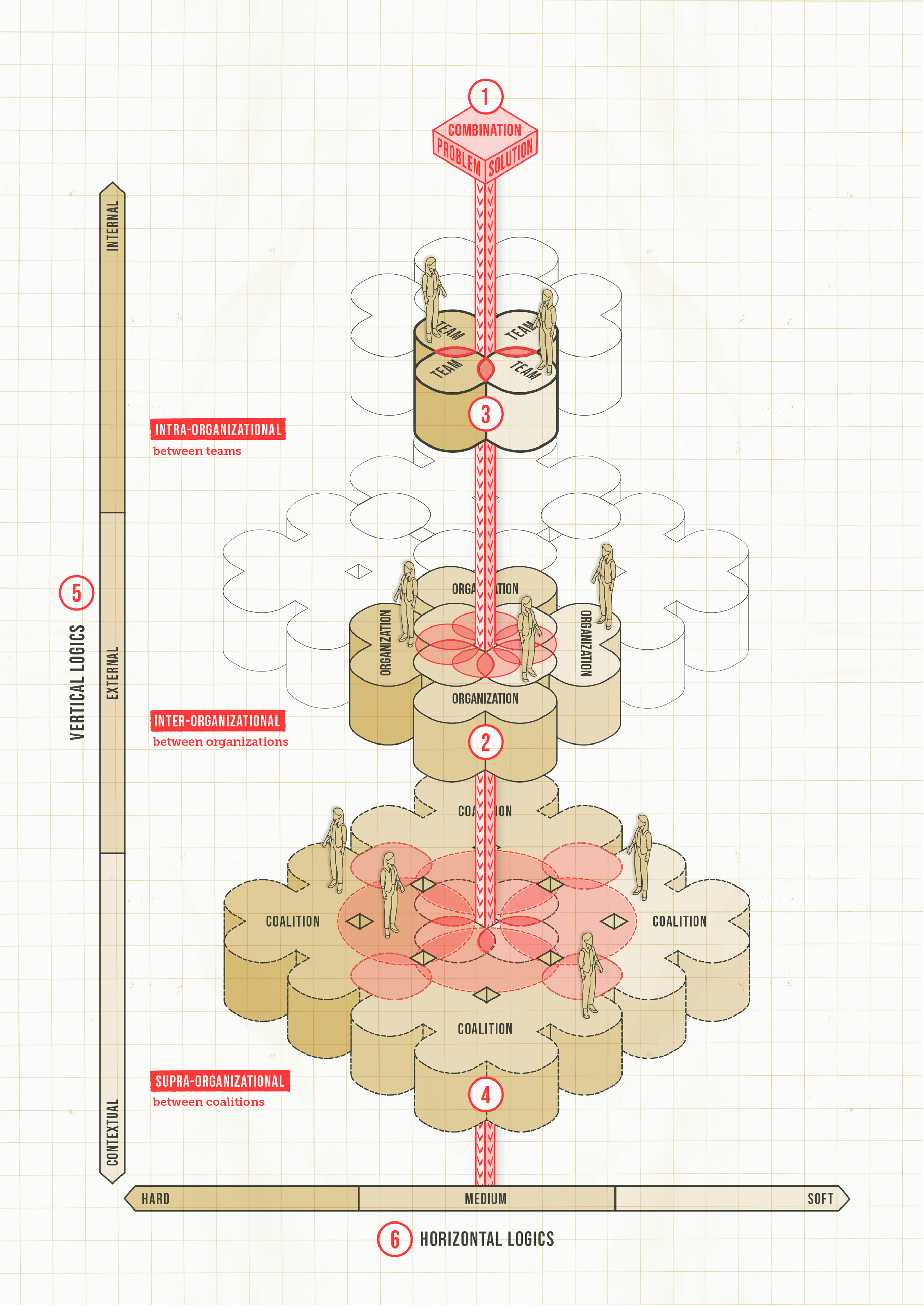
These concepts endeavor to describe the interrelatedness of separate actors on the inter-organizational level. We, however, don't take one actor, but the problem-solving capacity as the starting point for configuring the landscape. We position the three organizational levels (#2, #3 and #4 in Figure 1) around a rod representing problem-solution combinations (#1 in Figure 1), as a telescope highlighting parts of the landscape. We lay out this landscape along two axes with different logics. Logics explain actors’ ways of thinking and working (Vermeulen, 2012), and they are socially constructed, historical patterns of assumptions, values, beliefs, and rules that direct actions (Thornton and Ocasio, 1999). Bridging different logics increases both the added value and the difficulty of collaboration (Schruijer and Vansina, 2008). In this section we describe the vertical axis (#5 in Figure 1) in terms of internal, external, and contextual logics that correspond to the intra-organizational level (between teams within one organization), the inter-organizational level (between organizations), and the supra-organizational level (between coalitions). Then we describe the horizontal axis (#6 in Figure 1) in terms of hard, medium, and soft logics that correspond to the degree of formal collaboration on each of the levels. These logics are explanatory variables to the difficulties practitioners encounter when trying to embed the results of inter-organizational collaboration, as illustrated in the opening quotation.
Powell and Soppe (2015) state that innovation is likely to occur at the intersections of collaborations, but that when and how this occurs is undertheorized. To fill in this gap, we explore a landscape that comprises the relationships between collaborations on all three levels around a certain problem. The landscape is socially constructed and therefore interpreted differently by different actors (Holmqvist, 2003): When problem-solution combinations change, the actors’ perception of the landscape changes. It is marked by the rise and fall of teams, organizations, and coalitions, and by the type of emerging logics. Established (formal) logics can make certain types of collaborations to a problem the default, which can complicate the interaction with collaborations having other (informal) logics (Alter and Hage, 1993). The growing involvement of organizations in an intricate latticework of collaborations blurs the boundaries of teams, organizations, and coalitions, making it difficult to know where one ends and another begins (Powell and Soppe, 2015). Scholars perceive boundaries as the markers of differences leading to discontinuity in action or interaction (Williams, 2002). These boundaries are experienced differently depending on one's position in the landscape.
Three levels defined by vertical logics
Coalitions consist of organizations (#2 in Figure 1) that in turn consist of teams (#3 in Figure 1) that may have different bases of experiences or may learn differently from the same experiences (Crossan et al., 1999). Generating input from and embedding output in the “home organizations” is therefore no simple feat. Mena et al. (2009) find that inter-organizational relationships have higher levels of collaboration than intra-organizational relationships. In line with Holmqvist (2003), who writes that “one cannot understand intra-organizational learning without understanding inter-organizational learning, and vice versa,” we stress the need to cross-fertilize these two levels (p. 96). Furthermore, if we consider inter-organizational coalitions necessary for dealing with complex problems, and given that there are a growing number and variety of coalitions (Innes et al., 2007; Powell and Soppe, 2015), it is imperative that we study the interaction of diverse coalitions around a specific problem on a third, “supra-organizational level” (#4 in Figure 1). Likewise, Lawrence et al. (2002) warn that when organizations do not invest in connecting with other coalitions, they miss opportunities to effect more fundamental change.
The three levels can be considered as systems in systems (Cilliers, 1998). The functioning of each system is guided by interactions and dynamics in a landscape, and can be understood by simultaneously studying the collaborations, levels, and landscape (Boonstra, 2015). Each level has its own (vertical) logic. Intra-organizational collaboration is defined by internal logics, the set of rules that organizations apply—deliberately or not—to their aims, work, and identity. According to institutional theorists these logics produce a coherent and stable setting that is clear about tasks, mandates, and management methods (Seo and Creed, 2002). Actions in this institutionalized setting can become unquestioned, as rooted patterns of behavior (Scott, 2008). Herold (2017) shows how this prevents civil servants from going beyond organizational boundaries, as that it takes courage to alter internal logics. They seem to stimulate a system that maintains itself by invoking absolute responses: either blend in or step out. Inter-organizational collaboration, in contrast, is characterized by external logics. This confrontation of different institutional arrangements may be referred to as “institutional pluralism” (Kraatz and Block, 2008), “institutional complexity” (Vermeulen, 2012), or even an “institutional void” (Hajer, 2003). Multiple logics may exist next to each other, because it transcends the authority of one organization, like playing chess on multiple boards. Roles, rules, and responsibilities are not set out beforehand; instead, they have to be discussed and figured out together. External logics require a broader perspective, vocabulary, and repertoire to bridge the often conflicting ways of thinking and working (Williams, 2002).
The supra-organizational level is characterized by contextual logics, in which predictability is low and uncertainty high due to remote or blurred cause-effect relations. Everything could be connected to everything with many possible combinations in a constant state of becoming (Boonstra, 2015). It represents the widest scope of collaboration, one that is not easily grasped but instead requires investigation and exploration of relationships that might have indirect yields. Contextual logics produce strong dynamics around the problem at hand and therefore demand a strong adaptability. Internal logics require dealing with set frames and uniformity, external logics require dealing with conflict and diversity, and contextual logics require dealing with uncertainty and multiplicity. As a consequence, on every level the complex problem is defined and interpreted differently. Inconsistencies and tensions between logics can be a ground for failure, but also for institutional change provided they are productively related (Seo and Creed, 2002). According to Vermeulen (2012), how organizations respond to contextual and external logics depends on their internal logics. Synchronizing the levels is a mutual struggle of co-evolution (Van Meerkerk, 2014). When all levels are synchronizing, a window of opportunity for (embedding) new solutions opens that increases the problem-solving capacity (Padgett and Powell, 2012; Powell and Soppe, 2015). The unit of renewal is the team, organization, coalition, and landscape. Renewal is further incentivized by horizontal logics on the same level that represent the different formalities behind the collaborative process.
Collaborations on each level defined by horizontal logics
The variety of collaborations has grown over the past decades (Haughton et al., 2013), as more informal and experimental collaborations have emerged alongside more formal and institutional collaborations (De Jong, 2016; Innes et al., 2007; Powell and Soppe, 2015). This variety exists at each level and is characterized by contrasting horizontal logics (#5 in Figure 1). While studies of the variety of collaborations and their corresponding logics are scarce (Hysing, 2009; Thomas and Littlewood, 2010), some scholars have drawn attention to innovative and bureaucratic settings and their capacity to govern. In transition studies the term “niche” is used to refer to spaces where innovations can grow that may influence existing regimes to change (Raven, 2006). In the planning literature, the term “soft space” refers to informal governance arrangements (Allmendinger et al., 2014), in contrast to “hard spaces,” which are organized around fixed, legally defined boundaries and administrative processes. While in earlier publications soft and hard spaces were presented as a dichotomy (Allmendinger and Haughton 2010), recent literature examines “hardening” and “softening” over time (Allmendinger et al., 2014) and on hybrid forms (Zimmerbauer and Paasi, 2019). We use “hard” and “soft” to characterize the different logics of collaborations, and add a “medium” category to capture those collaborations shaped by both soft and hard logics (see #6 in Figure 1).
The horizontal soft and hard logics correspond to the distinction made by several authors about modes of governance, which opposes formal, hierarchical, or institutional modes to informal, horizontal, or improvisational modes (Hysing, 2009). According to Morand (1995), formal interaction orders are based on routinized interaction, procedural fairness, and detachment (here referred to as “hard logics”) (p. 843). Informal interaction orders are based on a free flow of information, creativity, and affective involvement (“soft logics”). Collaborations with softer and harder logics can be present at each of the three levels (see the color gradation in Figure 1). It is however the common assumption that hard(er) logics are merely situated on the intra-organizational level and soft(er) logics on the inter-organizational and supra-organizational level (Allmendinger et al., 2014; Holmqvist, 2003). We align with Innes et al. (2007) who observe that formality and informality co-exist in agencies to varying degrees, but that the value of informality is often officially ignored in organizations. Next to this, Alter and Hage (1993) show that not only individual organizations institutionalize: inter-organizational activity is affected in a similar fashion, resulting in more routinized and formal collaborations. Likewise, Zimmerbauer and Paasi (2019) give examples of soft spaces “hardening” and becoming institutionalized. This, however, does not imply that all inter-organizational collaborations start out soft; they can also start according to hard logics and over time soften, become medium, or stay hard.
Practitioners and academics often consider a high degree of complexity to be a reason for choosing soft(er) logics (Healey, 2006; Innes et al., 2007). Yet, Zuidema (2011) argues that complexity is a reason for choosing an increased plurality of types of collaborations and that hard(er) logics can act as a foundation for soft(er) logics. Both logics are assumed to be more effective when they consecutively and simultaneously co-exist (Innes, et al., 2007; Raven, 2006; Reay and Hinings, 2009). Van Meerkerk (2014) and Powell and Soppe (2015) argue that the presence of multiple contrasting types of collaborations is a reality as well as an opportunity to enhance problem-solving capacity. Collaborative landscapes that are dominated by either soft or hard logics have a limited problem-solving capacity. Nonetheless, confronting harder and softer logics raises tensions that complicate collaboration, for example, between “being in control versus letting go,” “regulating versus disrupting,” “predefining versus becoming,” and “exploiting versus exploring.” We here define “tensions” as the uneasy relationship felt on boundaries where contrasting, yet interrelated, logics are brought into proximity through reflection or interaction (Lewis and Smith, 2014). According to Jay (2012), individuals commonly react by (un)consciously avoiding and preventing these tensions. Increasing problem-solving capacity, however, requires dealing more productively with the inherent tensions between logics within and across levels, as the next section, which is based on our qualitative research in the Netherlands, will show.
Interrelated levels of collaboration in urban regeneration
To draw a picture of a collaborative landscape, we present a case of inter-organizational collaboration. We chose a case study method to be able to comprehensively investigate contextual factors in an iterative way (Yin, 2014). Our case began in 2014, when the Dutch Ministry of the Interior and Kingdom Relations and the province of South Holland agreed that new housing construction in the urban areas of the southern Randstad (around Rotterdam and The Hague) had stagnated. They concurred that densification was necessary to balance the need for houses and safeguard green spaces. Urban densification, however, generates other issues related to transportation, parking, energy efficiency, building costs, regulations, and dispersed ownership of land and real estate. The ministry and province invited one hundred actors, ranging from municipalities, housing corporations, and research institutions to real-estate investors and developers, to join a roundtable coalition in order to increase mutual understanding of the housing problem, and to detect and overcome obstacles in achieving urban regeneration.
Data for the study was collected between 2014 (when the housing market was in crisis) and 2017 (when the housing market started to become overheated). In 2022, the housing problem became even more urgent, which makes lessons relevant for the current approach. The first author was involved in the case as a consultant, serving as an “expert evaluator” of the interactions among the involved organizations. This involvement allowed the first author to conduct an in-depth case study, using a qualitative and interpretative research methodology (Flyvbjerg, 2006). We studied the practical judgments and interpretations (Shove et al., 2012) professionals gave about their work within and between the levels. Primary data was collected and interpreted in four ways.
We conducted 25 interviews with respondents who participated in the various collaborations. We formulated the research questions together with the initiators and facilitators of the roundtable coalition and translated these to a topic list for the interviews that functioned as a preliminary framework of analysis. After each interview, reports were made and checked by the respondents. We analyzed documents, newsletters, and reports, studying the terms used, and how the results, relationships, and difficulties were communicated. We engaged in participant observation of events in 2016 and 2017, observing the language used, the culture of collaboration, and relationships among actors, levels, and collaborations. We organized six reflective meetings with participants on the research outcomes, the lessons learned, and the recommendations for future collaborations. In these meetings we tested our analysis of the data.
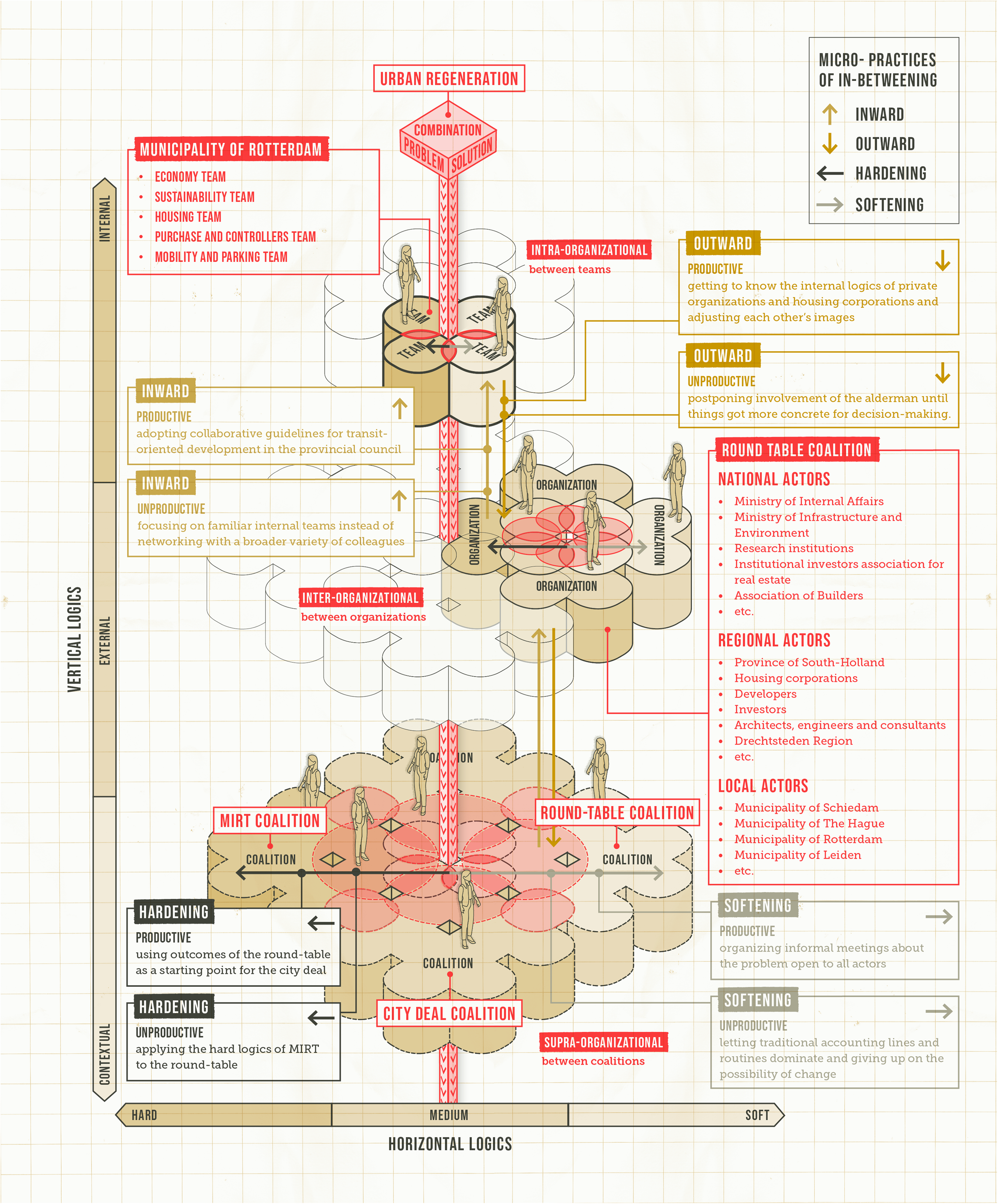
We reconstructed the collaborative landscape and, based on an event-sequence analysis (Spekkink and Boons, 2016), we presented participants with a timeline of 45 events that occurred on the different levels. Each participant helped to complete the view with their piece of the puzzle and identified which events were important from their perspective. We analyzed the interviews and found different similar interpretations of the collaborative process; we grouped these together and composed five narratives that expressed these distinct interpretations. We evaluated the efforts they missed and the efforts that were actually performed to relate the levels. Finally, we compiled and tested a dictionary of common terms that were differently used depending on participants’ locations in the landscape. The participants proved to be aware of the difficulties of inter-organizational collaboration, and much effort was invested in the collaboration of the roundtable coalition. However, the coalition's impact on solving the housing problem was less than expected. What they seemed to overlook was the effect of the intra-organizational and supra-organizational levels on the inter-organizational level. The practitioners experienced difficulty finding internal commitments for furthering and implementing the solutions produced by the roundtable coalition. At the same time, several other coalitions at the supra-organizational level worked on neighboring and partly overlapping problems that influenced the work of the roundtable coalition. The case encompasses all three levels, and at each level softer and harder logics were present (Figure 2).
The collaborative landscape around urban regeneration.
Roundtable coalition on the inter-organizational level
Two managers at the Ministry of the Interior and Kingdom Relations and the province of South Holland, who were in favor of “roundtable coalitions,” acted as initiators, and each offered a facilitator to guide the collaborative process. Actors were brought together around themes, such as the impact of sustainable urbanization on housing costs or the possibilities of temporary zoning. For each “table,” an independent chairperson was appointed with the support of a civil servant from one of the public organizations involved (public supporter). The chairpersons received a list of possible participants with diverse backgrounds and were asked to invite other participants from their network. People were allowed to also invite themselves to the table. The process was open to everyone who wanted to join, if they (1) had something to contribute to solving the problem, (2) were able to organize themselves, and (3) were prepared to reflect on their own agenda and interests. These emergent playing rules were the facilitators’ way to deal with external logics and institutional plurality on the inter-organizational level. Initially mainly interbranch organizations joined, but later the individual member organizations came to the table themselves. From September until December 2014, four large common meetings were organized around five tables. In 2015, the facilitator from the province of South Holland left for maternity leave and during her replacement the approach tended to be organized more loosely, involving around 12 tables on diverse themes. Each table was expected to deliver a concrete recommendation, without a format being specified in advance. Consequently, each table had its own style and pace of working.
The participants assessed the logics of this coalition as soft, because of its evolving approach, informal arrangements, openness to new participants, and the difficulty in measuring its more indirect outcomes. One indirect outcome, for example, was that the image of the province of South Holland was strengthened as a connecting intermediary organization. A participant from a real-estate investors’ association assessed the softer logics: At a certain moment we were asked by a director of a housing corporation to join. He knew that we are a very active organization. I hesitated but said “yes.” And then I arrived in a chaotic setting with all sorts of enthusiasts. At first it gave me an awkward feeling. I wondered who was participating in what role. It seemed to be mainly people that put themselves forward, sometimes volunteering and sometimes paid. This is not how we are used to work. It was a mix of discussions, working groups, and cross-connections. And in the midst of this multiplicity I thought: “We are going to do our own thing” and we made a ‘reversed bid book’ to show what institutional investors do and want.
In the reflection meetings, the facilitators explained that they had to actively manage and stimulate diversity, resulting in tough conversations. Differences were acknowledged as both crucial for increasing problem-solving capacity and a complicating factor. To be able to deal with the differences in logics, actors had to invest in understanding each other's internal logics and to find a way to combine these. A participant from a housing corporation described this challenge: This project has helped a lot to adjust the images of the private organizations and housing corporations. Housing corporations are obliged to follow many regulations that constrain us to build new houses, we therefore mainly invest in our existing stock of houses. Usually, we don’t have the time to explain the way our world and our systems work to each other, but in this collaborative format we did. A good result of this exchange is that we now have a combined database for social and private houses.
Initiators and facilitators assumed that they had sufficient overview of the landscape. Still they experienced it as precarious and could not identify the perceptions of other organizations properly. Nor could they forecast the actual impact of the actions of different organizations on handling the housing problem. As already shown in the opening quotation of this article, a participant from the Ministry of Infrastructure and Environment hinted at the interrelatedness of other levels. She tried to embed the new instruments of the roundtable coalition into another coalition, but that led to problems, because different teams in her home organization were working on a new Environmental law. She had to deal with unexpected perspectives emerging on the supra-organizational level and with established frames and discussions on the intra-organizational level. We noticed that every respondent added a piece of the puzzle to constitute the landscape beyond the inter-organizational level. For all respondents the collaborative landscape as a whole was experienced as beyond any one actor's control.
The interrelatedness of the intra-organizational level
Despite the fruitful results of the roundtable coalition, overall problem-solving capacity developed less than desired. Intra-organizational dynamics appeared to influence how results from the coalition were embedded. The following quotations show that some teams, like the one dedicated to strategy, were more associated with the outside (focused on the satisfaction of external target groups), while the legal team was focused on the inside (complying with internal policies, protocols, and rules). This makes it difficult to align internal frameworks with external needs. The teams had opposing interests, different knowledge bases, and managers with different management styles, and they were judged on different criteria. Organizations that had been assumed to speak with one voice were fragmented in practice, as we see in the words of a participant from the Ministry of Infrastructure and Environment: I am the lead of the national internal spatial team. When everyone is present, there are thirty of us. I still want to organize a session on the housing theme. We hardly discuss substantial themes and our meetups are infrequent. What are our national ambitions? Why do we collaborate? A common goal and sharp role definition are lacking. I need to get things straight with my constituency. I need to know what the issues and interests are, for example, of the water team of our ministry. My face is now often associated with the national government. As if I can represent all those interests. Recently, I asked more precisely what they expect from my role. My management of expectations is better now.
Several coalition participants clearly sought ways to understand and relate the inter-organizational and intra-organizational levels in multiple ways, because they needed legitimization and embedding of their efforts and investments. Those focused externally seemed to be called upon for more explanations than those focused internally. Legitimacy was aimed for through involving government representatives at key moments or by referring to internal formal documents in joint publications and meetings. Embedding the output of the coalition in national, regional, and local governments simultaneously turned out to be a challenge. The soft logics of the roundtable coalition easily became jeopardized by harder internal logics at the intra-organizational level. The (local) participants felt that their collaborative deliverables had to be useful to their individual city councils, but also felt these were only perceived as relevant when they fit the self-interest of their own organization. This can be interpreted as a defensive mechanism caused by the internal logics at the intra-organizational level. Coalition participants struggled to combine these two interests, to find the appropriate language that would encompass both, and to translate collaborative results into organizational follow-up actions. A public supporter from the municipality of Rotterdam shared his understanding of the situation: In my opinion “soft results” are crucial. However, my alderman loves everything to be concrete. It was difficult for me to give him feedback on the roundtable coalition. Sometimes I presented something in our team meeting, but not often, because I was detached, and this theme deviated from their agenda. At times I matched up colleagues that were linked to the housing problem, but no idea if that led to something. (
Participants emphasized that attending to the intra-organizational level was crucial for sufficient problem-solving capacity. Incorporating this level, however, requires perseverance and an extensive investment in time and effort. Along with the practitioners at the roundtable, many others in their home organizations must take responsibility for embedding inter-organizational outcomes in the intra-organizational actions. Quite often participants experienced the intra-organizational and inter-organizational levels as communicating vessels, and found it challenging that capacities and task orientations were internally oriented: I found it hard to get the time to immerse myself in, for example, a possible housing location in Gouda. That does not fit my formal task and job description. I experienced working in the roundtable coalition as an add on. It felt like I could only invest in it when all other tasks were done, while I also felt that I could have been of more value there. (
Participants struggled to connect to the right colleagues in their own and in other organizations. The extensive “missionary work,” as they called it, to convince others of the urgency of the problem, made them reluctant to keep internal colleagues updated and asking them for input over and over again, which often made it a one-off activity between the inter-organizational and intra-organizational levels without follow up. Misunderstandings, sectoral instead of integral solutions, less deliberate decisions, and delays were common. But, when they found ways to synchronize the intra-organizational and inter-organizational levels, they were surprised by the impact of their efforts: It is actually a huge success that the Provincial Council decided to largely adopt our guideline for transit-oriented development as a starting point for all conversations with the municipalities about inner-city plans. The examples that we collected [through the roundtable] also led to an accepted motion in The Hague's municipal council to evaluate their parking policy and start a pilot program to build in higher density with fewer parking places. (
The interrelatedness of the supra-organizational level
The roundtable coalition we studied was not unique. Many more coalitions from the same and other organizations were searching for solutions to inner-city housing development. These coalitions approached the problem from different geographic or thematic angles: the National Program Rotterdam South focused on urgent problems in a part of Rotterdam, the Zuidvleugel Agency focused on urban development in the southern part of the Randstad, and the Watertorenberaad aimed to solve managerial issues of area development on the national level, as well as the multi-annual program on infrastructure and spatial development (abbreviated as MIRT). Furthermore, there were coalitions around housing deals, city deals, and regional deals, as well as the Urban Transformation Program for knowledge exchange on this theme. The supra-organizational level of the collaborative landscape was therefore a complex set of coalitions. To illustrate the effect of the supra-organizational level and increase our understanding of the interrelatedness of the roundtable coalition, we highlight the MIRT coalition and a City Deal coalition. Some regarded the roundtable coalition as a way for the MIRT coalition to broaden the strong infrastructural scope and collaborate in more informal ways, and some perceived the City Deal coalition as a concrete elaboration of the roundtable coalition.
MIRT is a formal program, begun about 25 years ago, among governmental organizations to make decisions on investments in major infrastructural and spatial projects. An annual MIRT project book is used to present plans to the Dutch parliament as part of the national budget. MIRT projects are based on regional strategic agendas and have a fixed sequence of steps in their development. Decisions about the course and financing of the projects are made once or twice a year in a multilevel governmental gathering for each region. In the southern part of the Randstad, all involved ministers, deputies, and aldermen come together in gatherings that are carefully prepared by civil servants from relevant public organizations and are directed by the Ministry of Infrastructure and Environment. All the respondents perceived MIRT as a collaboration with hard logics, because of its formal authoritative arrangements, institutionalized rules, and hierarchy of actors.
In 2015, three ministries presented an “Urban Agenda” to strengthen economic growth, innovation, and livability in Dutch cities (Ministry of the Interior and Kingdom Relations and Zuidvleugel, 2015). This Urban Agenda is carried out through “City Deals” on urgent themes. The deals consist of agreements between public, private, and social organizations on how to solve concrete urban problems and also involve learning from novel ways of collaborating. As increasing urban housing became more urgent, one such deal was “City Deal: Building and Transforming Inner-cities.” In the beginning of 2016, this City Deal was signed by 17 organizations in the southern Randstad (City Deal, 2016), and featured 7 municipalities working on full transparency in real-estate interests and investments in pilot areas. This collaboration was guided by a combination of harder and softer logics with at least an attempt to act as equal partners. The organizations committed to common goals, and each organization's contribution to these goals was explicitly stated.
The MIRT, the roundtable, and the City Deal coalition co-existed on the supra-organizational level. The same organizations sent representatives to all three coalitions, but their roles differed. However, most participants signaled that they were often unaware of the range of coalitions, let alone how these coalitions were interrelated. One participant lamented: It was only after several sessions that I understood there is MIRT. I had the impression that it was mainly a search for money, but I had no idea what was going on there. (
The participants longed to have an overview of coalitions, their interrelationships, and their contribution to urban regeneration: This whole process was so complex with so many issues and actors. I think we have missed out on a lot of potential, by not making enough linkages. (
The whole landscape defined their playing field, and it was difficult to get a view on its entirety. A participant from the housing corporation emphasized the need for job rotation to increase understanding of each other's institutional context and to get a better picture of the landscape. They gradually understood that the roundtable had a different logic than the well-rehearsed MIRT. The history of the landscape around national spatial problems was marked by harder logics, which made it difficult to legitimize coalitions with softer logics. The participants found the co-existence of multiple coalitions with harder and softer logics challenging, as it resulted in role confusion and uncertainty about their positions. Often they were unaware of underlying tensions. But in reflective conversations they were able to identify several tensions. For initiators, the most pressing tension was how to protect a coalition with soft logics in order to stay innovative, while also connecting to other coalitions to spread innovation. They often chose a strategy of separation; for example, the regional initiator chose to protect the roundtable against the hardness of MIRT: I didn’t want to bother one energetic coalition with the rules and regulations of the other. (
This frustrated some participants. The absence of a connecting strategy prevented synchronized actions, as noted by a chairperson: In my opinion we were finally doing something really valuable, but after June 2015 everything was focused on the City Deals instead of our roundtables and experiments. I didn’t get feedback from the administrative gathering of MIRT and we were not involved in the selection of the cases for the City Deal. The different parts seemed to work at cross purposes. (
In this collaborative landscape, imagining how to make coalitions work in tandem and how to adapt the pace and planning of multiple coalitions seemed to be too hard. Likewise, a participant from the Ministry of Infrastructure and Environment was disappointed by the abstract way the output of the roundtables were presented in the MIRT coalition, which, according to her, prevented a genuine conversation on urban densification issues and therefore had less of an impact on the administrative level of MIRT. She missed the translation of good examples to the world of administrators in the MIRT coalition. A participant from the municipality of The Hague chose to bypass the hard MIRT coalition and to present the outcomes of their table at a different venue. They expected a rote “we have taken note of it” type of reaction, but were still disappointed that they got no formal reaction to their advisory product. Embedding “soft outcomes” across coalitions turned out to be anything but self-evident. A limiting factor for relating the supra-organizational level to the other levels was the use of different delegations: the spatial planning and mobility teams were involved in MIRT and the housing teams in the roundtable coalition. Correspondingly, the director from the Ministry of Infrastructure and Environment involved in MIRT chose not to become involved in the roundtable, but felt the downside: If I would have chosen to interfere in the roundtable, I felt it would inevitably lead to a traditional role for me that would not benefit the issue. So I chose not to interfere, but the consequence of not being part of it is that I now have no control over the embeddedness and next steps. (
Because of the different horizontal logics the participants experienced tensions. MIRT focused on monitoring the multi-annual program and the roundtable on creating energy and movement with unforeseen results. This demonstrated the tension between making sharp and pre-defined decisions common in MIRT and taking small emergent steps as part of a new approach to unravel the complexity employed in the roundtable. We noticed that participants in the MIRT coalition were unfamiliar, and uncomfortable, with the roundtable logic and vice versa. It was difficult to mutually appreciate the value of these coalitions and to stimulate collaboration, as this initiator's comment makes clear: MIRT is truly horrible. Sometimes there are as many as thirty civil servants around one table to prepare the administrative gathering. All the speeches are ratified beforehand. My minister experienced it as a puppet show. (
One of the chairpersons observed that the dismissal of such formal ways of working made it harder to forge connections: Because of the separations between the coalitions and the fact that we didn’t develop an integral perspective on urban regeneration there were no moments of integration. You have to have the guts to let the chairpersons [of the roundtable] sit down at the table of MIRT to present the main findings. I would have taken responsibility for that. We certainly would have lost energy if we had to comply with the structure and formats of MIRT, but there are other ways to connect. (
In retrospect he did not want to choose either the hard or soft logic, as they often tended to do, and was searching for creative combinations. He realized that both were needed to increase problem-solving capacity. However, participants also revealed how working in MIRT made people fall back into their usual habits. The director of the Ministry of Infrastructure and Environment explained how difficult it was to soften this coalition and to stimulate spillover effects: I wanted to break out of the culture of routine and formality in MIRT. But it sometimes felt useless to try. Good work is still measured by how well meetings are prepared, which is constraining personal engagement. All our ambitions to work differently are inhibited by the fact that we control the money, and then our traditional accounting lines become dominant again, which makes it harder to collaborate. (
This illustrates how the internal logics of one organization influenced the external and contextual logics on the other two levels. The initiator from the Ministry of the Interior and Kingdom Relations involved in the roundtable coalition on the inter-organizational level tried to connect with the MIRT coalition on the supra-organizational level. He too was blocked by dynamics on the intra-organizational level of his organization resulting in a mutual exclusion of both levels: I wondered what could I have done differently? The label of MIRT and the renewal of MIRT was not recognized in my own organization. It was “not invented here.” (
There were a few participants, mainly those not committed to one of the tables, who consciously tried to increase the tension between levels and collaborations, for example by addressing taboo housing locations. This was difficult to discuss in collaborations with harder logics, given administrators’ fear that the locations’ status would become irreversible once they were put on a map. However, according to the originators of the idea, it resulted in creative dialogs and concrete solutions: We were criticized: How could we examine this so precisely? How did we get the data and how did we dare to name exact locations? We did name a few delicate places. Some municipalities even called the province to complain. However most municipalities were positive. Up till then no one had the guts to name numbers. (
Correspondingly, a participant from the builders’ association found his work had a deeper and more sustained impact when the three coalitions were related: To prevent fragmentation, we [the roundtable] have to be part of MIRT, and we have a strong relationship with the City Deal as well. We use each other's products. That interchange gives my effort an added value and functions as a multiplier of my work. I have no doubt that my dedication was worth it. (
A chairperson likewise stressed the relationships between the roundtable and MIRT, because the connection made it easier for him to informally contact administrators and civil servants from the national level.
By actively relating the coalitions, the roundtable on its turn helped start the City Deal process: The signing of the deal was in my last working week at the end of March in 2016. We called everyone. They could commit to the deal or just pledge their support. They all chose to do the first. The initial collaboration [in the roundtable] created the relationships and engagement that we can now draw upon in subsequent engagements. (
Discussion: Practices of in-betweening
Our case study found that respondents often were unaware of the interrelatedness within and between levels. They had blind spots in their understanding of the landscape (some did not know MIRT existed or were familiar with only their own housing team). Moreover, we found that collaborative landscapes have a history and memory. The national spatial issue landscape, presented in this study, had been dominated by harder logics and sharply sliced boundaries in the past. It was less receptive to collaborations with softer logics and diffused boundaries like the roundtable coalition. According to Bateson (1972), a “frame” forces the viewer to focus on what is occurring inside and it distracts the viewer from what is outside it. In our case study, the participants’ frame determined the way they looked and what they saw. Some participants, dedicated to hard logics, indeed focused on internal processes. Others focused on the inter-organizational or supra-organizational level, but lost sight of the intra-organizational level. Operating on the intra-organizational and supra-organizational levels was experienced as challenging and time-consuming. But focusing only on the inter-organizational level was less effective. The respondents acknowledged that all levels contributed to the impact of inter-organizational collaboration. In line with Ospina and Saz-Carranza (2010), we can state that the work within and between levels should be done concurrently rather than sequentially in order to be effective. Each level contributes to problem-solving capacity, but the interplay within and between levels is crucial.
The landscape was beset with tensions caused by conflicting horizontal and vertical logics. The initiators and facilitators had a sufficient overview of the collaborative landscape, but still struggled in working within and between levels. Casting “the new” and soft as a means to disqualify and replace “the old” and hard, often encourages practitioners to react defensively, possibly sidestepping collaborations with hard logics like MIRT. Most participants tended to avoid tensions between divergent logics and maintain a distance between them, which is considered as a normal reflex (Thomas and Littlewood, 2010), and often forced them to make either/or decisions instead of both/and decisions (Lewis and Smith, 2014). The facilitators, researchers, and freelancers—not tied to internal logics and interests or inclined to sacrifice them for problem-solving—were the ones who dared to address tensions (like mapping concrete locations for housing). This contributed to the landscape's capacity for change (Reay and Hinings, 2009; Seo and Creed, 2002). In line with Rauws and De Jong (2019) we concur that tensions are multilayered: a tension felt on one level has roots in and consequences for all three levels. Thus, dealing with a tension requires recognition, discussion, and intervention on all three levels. We call this acting on and between levels “in-betweening.” Actions do not take place inside or outside boundaries, but on the edge. In-betweening is enacted through micro-practices, what Hajer (1995) describes as “the essential discursive cement that creates communicative networks among actors with different or at best overlapping perceptions and understandings” (p. 63). Such practices determine how the landscape as a whole functions, helping to create a firm fabric for the landscape, and increasing problem-solving capacity. Together the micro-practices of in-betweening have transformative power, even if they are not easy to perform well.
Analyzing the participants’ in-betweening, we discern four types of micro-practices: inward and outward on the vertical axis, and softening and hardening practices on the horizontal axis (Figure 2). In-betweening was sometimes productive and other times unproductive in enhancing problem-solving capacity. Sometimes the practitioners performed the practices and other times they became aware of possible or missing practices in retrospect. Inward practices helped translate the contextual and external logics to home organizations and teams (from the supra-organizational to the inter-organizational or intra-organizational levels). One productive practice involved adopting the collaborative guidelines for transit-oriented development in the provincial council. Less productive was the reliance on familiar internal teams and the reluctance to network with a broader variety of colleagues. Outward practices helped to align the interests and aims of one's team or organization with those of other organizations and coalitions (from the intra-organizational to the inter-organizational or supra-organizational levels). Taking time to get to know the internal logics of the private investors and housing corporations, and then adjusting the images of each other's organizations, were perceived as productive. Less so was the decision to postpone the alderman's involvement until plans became more concrete. Hardening practices help to embed, legitimize, and institutionalize informal collaborations on the same level. Using the outcomes of the roundtable coalition as a starting point for the City Deal coalition was considered productive; applying the logics of the MIRT coalition to the roundtable coalition was unanimously considered unproductive. Softening practices are helpful in stimulating creativity and innovation, and in making collaborations agile. Organizing informal meetings about the problem open to all actors was productive, while letting established routines and accounting lines dominate turned out to be unproductive. These four types of in-betweening generated intermediary languages, frames, and approaches within and between the levels, and increased the problem-solving capacity of inter-organizational collaboration.
Conclusions on in-betweening and navigating the collaborative landscape
Our contribution to inter-organizational collaboration theory lies in the multilevel landscape in which inter-organizational collaboration is embedded. Participants in inter-organizational collaboration not only have to build coalitions with all inherent challenges these pose. They also have to organize co-evolution using internal collaborative processes intra-organizationally, as well as building relationships with other existing and emerging coalitions supra-organizationally. Synchronizing actions at all three levels are both necessary and challenging. The interrelatedness of collaborations within and between levels must, in our opinion, become a part of contemporary theories on collaboration. We found that the less conspicuous but meaningful practices of in-betweening can stimulate horizontal and vertical relationships throughout the collaborative landscape. This in-betweening can bridge the often-conflicting logics within and between levels by making tensions productive and with this enhance problem-solving capacity.
Based on the previous sections we can identify four conditions for productive micro-practices of in-betweening. First, participants must have an overview of the collaborative landscape, which was not completely the fact in our case and depended on the actor and stage of the collaboration. Second, the different collaborations on the three levels have to be appreciated for their complementary strengths. In our case the MIRT coalition and the roundtable coalition were not always mutually appreciated. Roundtable participants called MIRT a “circus” because of all the involved representatives, extensive procedures, and political rituals. Participants in MIRT called the roundtable coalition a “circus” because of the multiplicity of groups and tables that all did their own thing. Third, participants must be able to deal with tensions, otherwise they easily fall back into unproductive practices of in-betweening. A final condition is the presence of skillful practitioners who work in-between, catalyzing and synchronizing interaction between levels and collaborations, and acting as a bridge for others. These “in-betweeners” go beyond single levels and logics, and create intermediary frames, languages, and approaches that increase problem-solving capacity. Working in-between requires moving back and forth, between the inner and outer parts of the landscape and between the harder and softer sides of it.
In-betweening also implies that practitioners must perform different roles in co-existing collaborations and therefore must be able to choose appropriate roles and switch between them. When navigating the collaborative landscape is about the best fit between the problem, the landscape and the type of collaboration and role chosen for, further research is needed to discern archetypes of collaboration and corresponding roles. Do practitioners consciously choose a specific type of collaboration? And if so, what are the criteria they use? Another promising line of future research might be the required skills of in-betweeners to navigate the landscape and the conditions needed in their own organization to be able to perform well. How do they cross the boundaries between logics, how can they exploit tensions to solve problems creatively and what support do they need to function under pressure? Would different profiles of in-betweeners require different conditions? While in-betweening is often not identified as a formal and accepted practice, we find that it contributes to the effectiveness of inter-organizational collaboration that co-evolves with intra-organizational and supra-organizational collaboration.
Footnotes
Acknowledgements
Many thanks to the anonymous referees, the editor, Hans Vermaak, Bas Waterhout, Merlijn van Hulst, Pim Nijssen, Hendrik Wagenaar, Maarten Hoorn, Rianne Warsen, and Joshua Cohen for their constructive comments on earlier versions. We also like to thank the respondents, the province of South Holland (Annemarie Hatzman and Gemma Smid-Marsman) and the Ministry of the Interior and Kingdom Relations (Dino van Dal) of The Netherlands for giving their valuable insight into their collaborative work.
Declaration of conflicting interests
The author(s) declared no potential conflicts of interest with respect to the research, authorship, and/or publication of this article.
Funding
The author(s) disclosed receipt of the following financial support for the research, authorship, and/or publication of this article: This work was supported by the Ministry of the Interior and Kingdom Relations, Ministry for Infrastructure and Water Management and the province of South Holland.