




Abstract
This paper examines the territorial development reforms in the federal state of Bavaria, Germany between 2008 and 2018 in light of the rise of austerity policies, introducing the concept of ‘austere federalism’ as a new state spatial process in the aftermath of the global financial crisis. Methodologically, the paper draws on the historical-materialist policy analysis and identifies three processes – municipalisation, competitisation, and responsibilisation – as key elements of a new hegemonic project. Our findings suggest that the years following the crisis saw a paradigm shift in spatial planning taking place, characterised by a carrot-and-stick policy of planning deregulation and austerity discipline. Rather than diminishing disparities, however, this shift runs the risk of exacerbating spatial inequality.
Introduction
On the eve of the Eurozone crisis in December 2009, the Bavarian State Government decided to seek an extensive restructuring of the state's spatial planning under the principles of ‘deregulation, liberalisation and – as far as possible – municipalisation’ (Bavarian State Government, 2009). As Germany is a federally organised nation-state, the federal and state levels cooperate in the legislative process, which means that the national and subnational levels (Länder) coordinate which regulations are to be implemented at the respective level. Spatial planning is one of those policy fields that are almost entirely shaped at the subnational level – while spatial planning on the national level can be understood as a non-directly effective state apparatus (Mießner, 2017). The result for Bavaria was a series of legislative initiatives, reforms, and structural adjustments of spatial planning policies. A prominent example is the introduction of the principle of equivalent living and working conditions in the Federal State of Bavaria's constitution. This took place through a referendum in the course of the 2013 regional elections, which resulted in 89.6% support for the amendment to Article 3. In this referendum, barely fewer votes were cast (88.6%) in favour of introducing a debt brake in the Bavarian constitution (State Election Commissioner, 2013). This constitutional amendment anticipated the political debate on future territorial development policy in Bavaria: While the principle of equivalent living conditions would evoke political demands for spatial justice, they would also face calls for an austerity-driven restructuring in spatial planning underpinned by the new constraints on public expenditures.
The debt brake, understood as the prohibition of structural debt, is generally interpreted as the most striking indicator of the emergence of austerity as a crisis resolution strategy (Blyth, 2013) that marks the transition to a consolidation state (Streeck, 2014) or austerity state (Jessop, 2018). While a rich body of literature has analysed the effects of austerity policies on different scales (Kitson et al., 2011; Peck et al., 2013; Petzold, 2018), in this paper we aim to trace the evolutionary processes of the austerity policy shift in territorial development policy.
In conceptual terms, we build upon Brenner's (2004) notion of a state spatial process that deals analytically with political fractures surrounding the spatial policy. This approach is rooted in Jessop's strategic-relational state theory (1990, 2000) which argues that different state projects accompanied the mode of regulation of Fordism and post-Fordism. Accordingly, in the context of the nation-state, demand-oriented economic policy with its strong reliance on the welfare state tools was transformed more supply-oriented economic policy marked by a rigid labour market and social policy. Along the same lines, Brenner (2004: 260) describes the transition from spatial Keynesianism to a rescaled competition state regime. However, it must be asked whether the aforementioned change in the state project towards an austerity state also anticipated a change within the state apparatus. The analysis of Southern European territorial governance in the aftermath of the financial crisis by Tulumello et al. (2020) reinforces this question. Similar to Peck's (2012, 2014) findings on austerity urbanism, Tulumello et al. argue that the planning reforms of the post-crisis years were characterised by a reduction in regulatory powers and an increase in localism.
Against this background, in this paper we argue that this new state project was accompanied by a transformation in the spatial policy. More generally, we identify a new relationship between state and space defined by the prioritisation of a balanced state budget and the reduction of state debt. In the context of German federalism, Brenner's notion of state spatial policy designates the corresponding state apparatus of territorial development. We therefore apply the concept of state spatial process as a theoretical frame for the analysis of state spatiality, paying particular attention to Peck's notion of austere federalism (Peck, 2012: 632). This notion has been introduced to describe fiscal decentralisation processes that characterise spatial policies following the Eurozone crisis, requiring subordinate scale levels to implement austerity-driven cuts and/or carry out additional tasks.
The paper proceeds as follows: The next section provides conceptual reflections, taking strategic-relational state theory and the concept of the state spatial process as starting points in an attempt to conceptualise organisational forms of spatial policy with particular reference to an era of austerity. From the strategic-relational state theory to the state spatial process section first introduces our methodological approach and then turns to the results of our analysis in which we highlight three restructuring processes in spatial policy in Bavaria: the municipalisation of the state's development, the competitisation through which the competition between municipalities has been accelerated, and an augmented transfer of responsibilities to the municipalities that manifests itself in an increasingly authoritarian and disciplinarian relationship across administrative levels. The conclusion section emphasises the value of ‘austere federalism’ as the concept capturing the state spatial process of the austerity state.
From strategic-relational state theory to the state spatial process
As already indicated, our analysis takes Brenner's well-established concept of the state spatial process as point of departure. This concept has its roots in a Gramscian understanding of the state, and more precisely in the distinction between a ‘narrower’ and an ‘integral’ concept of the state. While the narrower concept of the state primarily describes the state apparatuses and thus the administrative function of the state, the state in the integral sense also encompasses the realm of civil society. According to this distinction, hegemony in the integral state is a prerequisite for a state project, to which the state apparatuses are oriented (Brenner, 2004: 89ff.)
Brenner (2004) provides the concept of the state spatial process to explain the transformation of state spatiality.
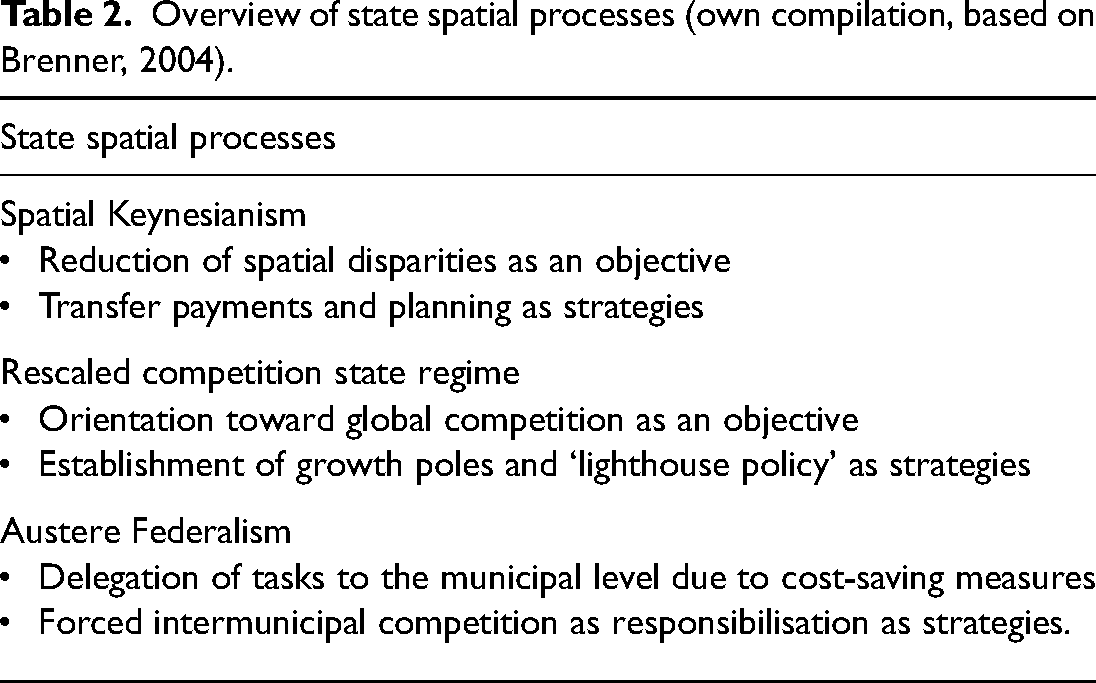
In spatial Keynesianism, spatial policy was intended to achieve the most centralised and consistent form of organising a territory. State action works through transfer activities and the expansion of infrastructure to attain equality between expanding urban regions and less developed rural and peripheral regions. This occurs structurally through the state's regulative authority, which was reflected in a comprehensive configuration of social infrastructure as a spatial embodiment of the welfare state principle.
In contrast to this, the rescaled competition state regime offers site-specific programmes that seek to enhance local and global competitiveness, often by championing ambitious infrastructure projects in cities and metropolitan regions. This coincides with a transfer of regulatory capacity from the state level to sub-national and local contexts. With respect to scale, this represents a decentralisation of responsibility under the spatial policy.
Austere federalism, our preferred name for the current state spatial project, refers to Peck's (2012, 2014) work on urban levels and multi-scale interdependencies. At its core, Peck's concept of urban austerity distinguishes seven dynamics. While some of these refer specifically to the city level (e.g. the downsizing of public-sector workforces; Peck, 2012, 648), others go beyond the local level and can help us understand the restructuring processes of the state's spatial policy apparatus more widely. For the rest of the paper, we make explicit use of three of these features, namely:
Municipalisation: Building on research on the tactical use of different scapes to foster particular policies (Smith, 1992; Swyngedouw, 2000), the term ‘municipalisation’ describes the scalar outcome of austere federalism. Regarding the reforms in Bavarian territorial development, it represents a negative form of federal redistribution by transferring the fiscal burdens of adjustment from higher scale levels to lower ones. In other words, local authorities are allocated new tasks without receiving adequate resources. Instead, they are granted new freedoms to pursue independent development. Peck (2012: 631) describes this as a process of devolved risk, arguing that this shift of higher-level uncertainties and risks passes external effects down to the municipal level. The capacity to bear the ensuing costs is unequally divided across the municipalities, however, with the result that new disparities emerge between cities and towns. While there are some local authorities who can seise the opportunity of municipalisation for harnessing new development potential, others are unable to cope with the new tasks and thus fall behind.
Competitisation: The term goes back to the broad body of work on the competition state as well as on the growing significance of competitiveness as a principle in state affairs (Hirsch, 1995, Sum, 2009). Here, the core idea is that similar to the manner in which private companies compete for market share, administrative units on various scale levels compete for company relocations, jobs, and tax revenues. State actors are therefore increasingly forced to act as entrepreneurs and to create the most favourable location-related conditions they can in order to succeed in this competition. At the municipal level, this refers to various location factors, especially local tax assessment rates. Peck (2012: 649) labels this situation as ‘tournament financing’ – the increased penetration of the logic of competition in the financing of state and quasi-state allocation systems. The accompanying new relationship is described below under the term ‘responsibilisation’.
Responsibilisation: Generally associated with a neo-Foucauldian analysis of neo-liberal governmentality, the term responsibilisation describes the forced accountability of atomised units as ‘active agent[s] in the fabrication of their own existence’ (Rose, 1996: 59). We apply this term in the context of territorial development to characterise the usage of local autonomy to discipline the municipalities, which leads to a widening of disparities between municipalities with high and low budgets. Responsibilisation primarily occurs in the aforementioned competition structure in which cities and towns compete with one another by offering a positive investment climate in the location competition. There are differences in organisational capacity, however, between high-income and low-income municipalities. While prosperous municipalities achieve competitiveness, cities and towns with more limited means face responsibility for debt reduction through conditional assistance programmes. These municipalities meet their responsibility by consolidating their budget through severe austerity programmes to receive assistance services. This corresponds with Peck's (2012, 648) observation of risk-shifting rationalities at the expense of local levels in the context of urban austerity. The result of this scaling of responsibilities for economic growth and social development is the creation of new dependencies. Confronted with the need to regularly submit project and funding applications, municipalities are compelled to participate in ever newer and more extensive market-oriented initiatives geared toward cost savings.
These three characteristics of austere federalism show the effects of austerity policies on the system of spatial planning: cutback policies through task delegation, forced competition and the establishment of disciplinary mechanisms in their spatial manifestation. However, it is unclear which specific spatial policy processes lead to this new state spatial process. The following section speaks to this gap by analysing the reforms in Bavarian spatial policy following the eurozone crisis.
Bavarian spatial policy under austerity-driven auspices
In our empirical analysis, we apply the concept of Historical Materialist Policy Analysis (HMPA). This approach was originally developed by the research group Staatsprojekt Europa (2014) and can be understood as part of Critical Policy Studies, with which it shares the same emancipatory interests (Brand et al., 2021: 4). For HMPA, a detailed understanding of strategies and social conflicts in the production of state rule is key. For this reason, competing hegemonic projects – in the sense of the contested character of political processes – become the focus of attention. HMPA provides answers to the questions ‘how to concretely conceive, structure and operationalise empirical investigations of struggles concerning the making and contestation of hegemony? How to investigate especially strategies in this context? And […] how to take the complex interplay of discursive and extra-discursive factors at play adequately into account?’ (Caterina, 2018: 2). As Brand et al. (2021) explain, HMPA retreats from existing hegemonic structures as the object of analysis and turn towards the evolutionary processes in the constitution of hegemony. As a result, the attention focuses on the shifting and reconstituting social power relationships (Kannankulam and Georgi, 2014: 60). HMPA works out its research design through the conceptualisation of hegemony projects. This should be understood as political positions that do not (yet) occupy a hegemonic position. At any given moment, various hegemony projects wrestle within the integral state in an attempt to become a hegemonic project (Caterina, 2018: 216), with participating actors seeking to turn their particular interests into general interests.
Building upon this argument, we employ HMPA to assess whether a restructuring of Bavarian spatial policy – and an accompanying new state spatial process – took place between 2008 and 2018. More precisely, we distinguish three levels of investigation as per HMPA (Brand, 2013; Caterina, 2018; Kannankulam and Georgi, 2014). (1) The contextual analysis focuses on the specific and wider historical context in which the analyses of Bavarian spatial policy took place. (2) The analysis of the actors introduces the competing hegemony projects in the period under investigation and describes how these selectively recur. (3) In the process analysis, the emergence of austere federalism as a hegemonic project is illuminated, and the strategies that assisted in the implementation of the project are presented.
Empirically, we analysed parliamentary debates on spatial policy between 2008 and 2018. These debates include discussions in the plenary and committees of the Bavarian State Parliament regarding the new state planning law (BayLPlG 2012), the state's development programmes (LEPs) of 2013 and 2018, the constitutional amendment on equivalent living conditions and the government's statement given by the Minister of Finance and Heimat (both occurring in 2013) as well as the parliamentary debate about the work of the Equivalent Living Conditions Inquiry Commission in Bavaria (2015–2018).
Our analysis in this paper includes both qualitative and quantitative evaluations. The contextual analysis includes, amongst others, an evaluation and cartographic depiction of tax trade revenues at the municipal level to shed light on existing socio-economic disparities in Bavaria. The actor and process analyses are based on a Critical Discourse Analysis (CDA), which allows us to highlight (a) the divergent understanding of the constitutional principle of equal living conditions between the hegemonic projects and (b) the manifestation of the respective political visions in the reform projects. The CDA is based on the minutes of spatial planning debates of the Bavarian Parliament and its committees between 2008 and 2018.
Contextual analysis
The goal of the contextual analysis is to highlight the specific historical situation in which the actors in a political conflict relate to a hegemonic position. Due to the dynamic design of HMPA, the contextual analysis cannot simply present the structural conditions at the start of the research period. Instead, an altered context leads the actors to reformulate their hegemony projects, to adapt to changes in priorities and to readjust their own positions within the process. Accordingly, the contextual analysis deals with changing structures throughout the research period. Kannankulam and Georgi (2014: 63) identify three aspects they believe require special consideration in the contextual analysis: First, contextual analysis aims to identify the specific problems to which societal and political forces react in different ways. Second, it locates these problems within their wider historical context; and third, it illuminates the central historical and material conditions that have led to the problems at the centre of the conflict being researched.
In view of the shift of material conditions, the contextual analysis here distinguishes two phases of Bavarian spatial policy politics that can be understood, in the words of Peck and Tickell (2002), as ‘roll-back’ and ‘roll-out’ phases of neo-liberalism. In the first phase from 2008 to 2013, the Bavarian government sought to redesign the state's spatial policy ‘from scratch’ and in accordance with the principles of deregulation, liberalisation, and municipalisation (Bavarian State Government, 2009). This decision is couched in the Bavarian government's broader deregulation efforts that preceded the reforms to spatial policy. The administrative reform known as Verwaltung 21 [Administration 21] illustrates such efforts, going into effect in 2005 and heralding an administrative reorientation according to the principles of new public management. With this reform, the Bavarian government sought an adjustment of the state apparatus, intending to target stronger competition between the public and private sectors. Furthermore, economic growth was to be encouraged by cutting bureaucratic red tape and accelerating permit procedures (Heindl and Böhme, 2013). In short, the ‘roll-back’ phase saw the state government pursuing the political goals of liberalisation, privatisation, and deregulation.
In the second phase from 2013 to 2018, the context changed when European Union (EU) member states responded to the eurozone crisis by pursuing budgetary consolidation as a crisis management strategy. The legal enforcement of this austerity-driven primacy was executed at different scale levels by capping new net indebtedness in the state budget. In Bavaria, a debt brake was amended to the constitution through a referendum held on 15 September 2013. With the increased significance of austerity-driven objectives following the crisis years, new forms of state action can be seen in neo-liberalism that indicate that neo-liberalism's roll-out phase was carried out under austerity-driven auspices. For spatial policy, this development resulted in a new austerity target that then-Finance Minister Markus Söder, who was in charge of the policy field of spatial policy, succinctly captured under the slogan ‘Activate, not subsidise’ (Aktivieren statt Alimentieren; Bavarian State Parliament, 2014b: 2133).
The central historical and material conditions to which the hegemony projects relate in both phases emerge from the gain in competence at the state level with respect to spatial policy. Through the reform of federalism, spatial policy became the object of competing pieces of legislation. Accordingly, the BayLPlG of 2012 replaced spatial policy law as a full-fledged law. The BayLPlG contained both equivalent living conditions and working conditions as part of its key objective (Article 5). In the following year, the key objective was elevated to a constitutional principle (Article 3, Part 2 of the Bavarian constitution).
This norm stands in contradiction to the existing socio-economic and demographic disparities across municipalities in the Federal State of Bavaria. Figure 1 shows trade tax revenues at the municipal level. Trade tax revenues represent municipalities’ most important ‘in-house’ revenue source since the municipalities themselves determine the corresponding assessment rates while the revenues (except for the trade tax allocation in the context of municipal revenue sharing) flow entirely to the local authority. To this extent, trade tax revenues would suggest which organisational capacities a community has available to it with respect to its voluntary services. Between Bavarian municipalities, we find a large variation, especially between the prosperous metropolitan regions of Munich and Nuremberg on the one hand and Bavaria's northern and eastern municipalities on the other. The contradiction between the political goal of equivalent living conditions and the existing disparities across Bavarian municipalities represents the main point of reference for the hegemony projects relating to the politics surrounding the spatial policy.
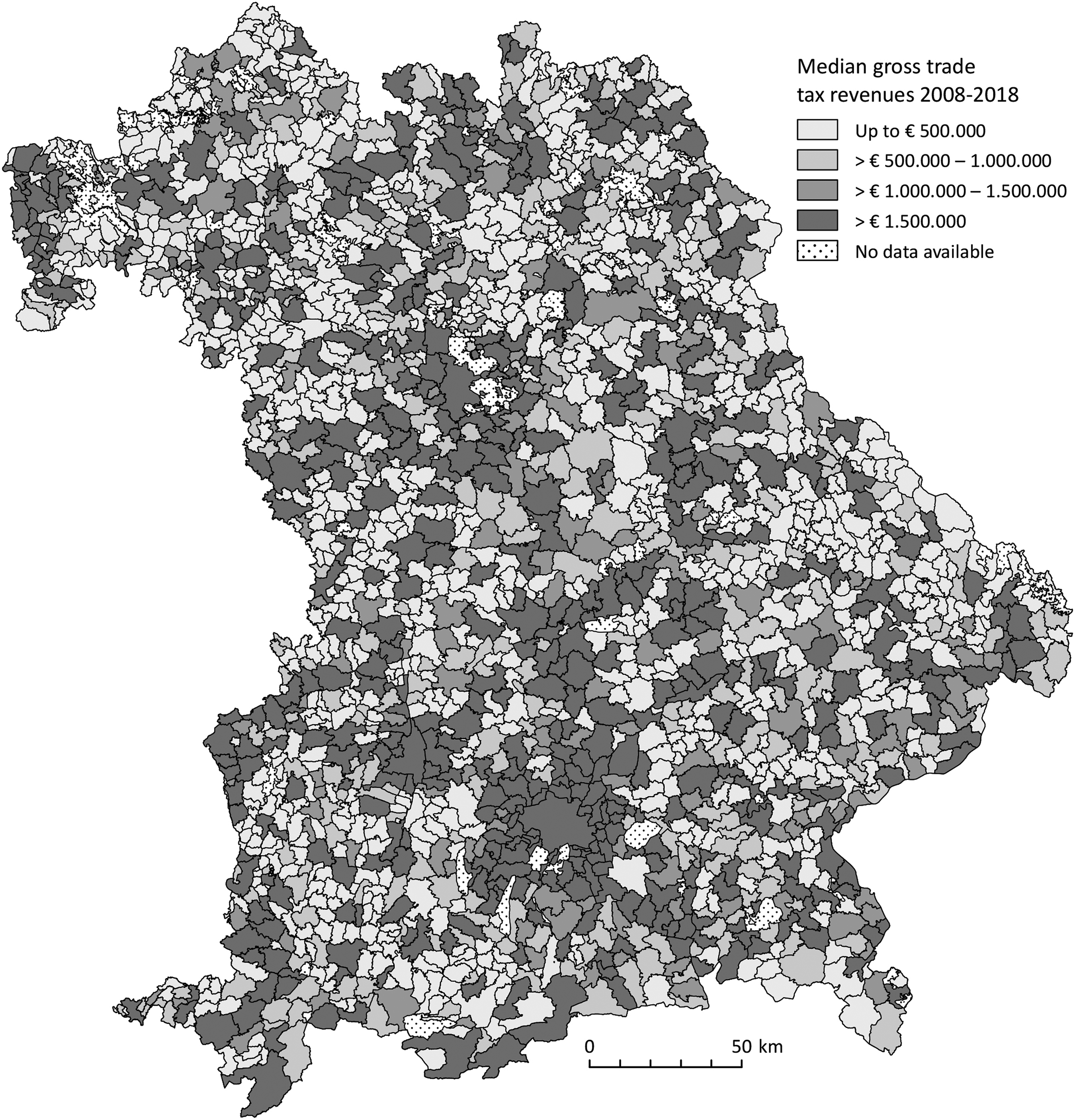
Median gross tax revenues in Bavarian municipalities, 2008–2018.
Analysis of the actors
The analysis of the actors aims ‘to analyse the conflicting actors within and as part of this historical situation’ (Kannankulam and Georgi, 2014: 63) with a view to identifying the hegemonic projects in Bavarian territorial development. Put differently, we seek to identify the constellations of actors and forces. This occurs by means of hegemony projects that refer recursively to the historical situation presented in the contextual analysis and to the main problems and questions at the centre of the conflict (Caterina, 2018: 6). In the specific case, the analysis of the actors examines which hegemony projects compete for predominance over interpretation and which adjustments they made against the backdrop of the focus on austerity following the crisis years. The specific responses allow the socio-economic disparities across the individual parts of the state to be identified.
To this end, CDA is focusing on the debate on the constitutional principle of equal living conditions. As already mentioned, this principle was enshrined in the Bavarian constitution in 2013 based on a referendum. To gain definitional clarity, an Enquête Commission was subsequently set up by the state parliament, composed of an equal number of members of parliament and representatives from business and civil society. From the debates on the work of the Enquête Commission, which was effective from 2014 to 2018., we can distil two hegemony projects: The progressive hegemony project frames the uneven development of different regions in the Federal State of Bavaria as a crucial issue. From a material understanding of the term ‘equivalent living conditions’, it makes out faulty politics surrounding spatial policy to be the cause of the problem, which not only reproduces but at times even aggravates socio-economic inequality in the Federal State of Bavaria. The fundamental aim of the progressive hegemony project lies in achieving fair levels of opportunity across regions. In doing so, it follows a model of spatial justice, based on a concept that was developed by scientific members of the Enquête Commission and which builds on the components of distributive, procedural, generational and opportunity justice (Koppers et al., 2018). Accordingly, it argues that the politics of spatial policy should develop a stronger state funding policy. The primary actors of the progressive hegemony project at the parliamentary level are the social-democratic parliamentary group (SPD), some members of the Green Party parliamentary group and the Free Voters parliamentary group, together with experts associated with workers and universities.
The conservative hegemony project takes its name from the policy goal to achieve the development of the Federal State of Bavaria through the dismantling of bureaucracy, deregulation, and liberalisation. In this view, state development equals economic growth. To achieve this goal, market-oriented policies of competition and contention are the discursive weapons of choice by the hegemony project. In view of the uneven development of sections of the state, the conservative hegemony project demands an ‘acceleration’ of rural areas instead of a ‘slowing’ of the central hubs so as not to jeopardise Bavaria's economic success. As a result, the state planning bureaucracy is considered the fundamental problem, restricting the municipalities by imposing too many limitations on their development. Lastly, the conservative hegemony project relies on both the state's development to generate equal opportunities across the municipalities as well as the principle of subsidiarity between the Federal State of Bavaria and the municipalities. The hegemony project is driven by austere notions of territorial development, for instance, a downward delegation of tasks and duties and an intensified competitive situation between the municipalities. The main actors in the conservative hegemony project are, first and foremost, the state government representatives, especially the state ministry entrusted with spatial policy. This project is represented in the legislature by the conservative (CSU) and liberal (FDP) party as well as experts from business and labour associations.
Process analysis
The process analysis combines the analyses of context and actors and reconstructs the dynamic process through which a hegemonic project was established (see Kannankulam and Georgi, 2014: 67). This reveals that the conservative hegemony project was carried out by means of three distinct political projects that constituted the central factors of austere federalism (see Dudek, 2021). In this chapter, we reconstruct the strategies that helped the conservative hegemony project carry out these projects.
Municipalisation
The origins of the Federal State of Bavaria's pursuit of a municipalisation policy can be found in a cabinet decision of 2 December 2009 in which the principles of deregulation, liberalisation and municipalisation were elevated to a key spatial policy objective. The implementation of this goal occurred with the 2013 reform of the state planning act (BayLPlG) in 2012 and the state development programme (LEP) in 2013 and 2018.
In the new state planning law, tendencies toward municipalisation are initially evidenced by the weakened effectiveness of state planning. According to the new state planning law of 2012, regulations in the state development programme are possible only where the specialised planning competence of other departments (for example, traffic management by the State Ministry for Transport) is unaffected by the process. The result is a loss of the cross-departmental, coordinating nature of state planning in matters concerning spatial development, constraining individual specialised departments to take future political actions relevant to spatial policy. Thus, while the first phase was characterised by a roll-back through the deregulation of spatial policy and the concomitant weakening of the regulatory powers on the state level, a scalar and top-down delegation of responsibilities followed. Local authorities in Bavaria opened up new opportunities to attract businesses by easing requirements in the LEPs of 2013 and 2018. Consequently, it now became possible to welcome businesses without restricting them to commercial zones if these had been laid out as inter-municipal commercial areas or located along superhighways or rail lines.
These municipalisation processes emerged hand in hand with the narrative describing local actors as ‘on-site state developers’ (Bavarian State Parliament, 2017: 10297). Accordingly, the territorial development in Bavaria largely results from the un/successful location policy of the individual municipalities. In this way, municipalities achieve economic growth by creating jobs and a positive business environment within the boundaries of the community. To support this process, the Federal State of Bavaria encourages community actions by removing superordinate state planning coordinating structures that are understood as creating a regulatory barrier to local development potential. Indeed, the conservative hegemony project makes its case by reinforcing the idea of communal empowerment ‘We need to give mayors and commissioners within the localities greater opportunity to help themselves. In this process, attracting businesses and jobs is the most important issue’ (Bavarian State Parliament, 2014b: 2129). This deregulation contrasts with the previous funding policy, which is now framed by State Minister Söder as technocratic and dissociated from reality: ‘We want to give mayors greater opportunity to act independently. They […] were elected by the people, and they need to have the opportunity to operate independently within the state’ (Bavarian State Parliament, 2014a: 4920). Mocking the governments’ bill as a neo-liberal fantasy, the progressive hegemony project countered such positioning urging to keep mandatory planning in place. Such calls, however, were dismissed by the state government as centralist arrogance towards the capabilities and requirements of the local level.
As a process, municipalisation represents a response to the specific material and historical situation identified in the contextual analysis. It is hence to be understood as the scalar consequence of state austerity. In this way, the shift of responsibility to the municipal level is not accompanied by a transfer of services to those made responsible for the state's development as in spatial Keynesianism or through targeted project financing as occurs in the rescaled competition state regime. Rather, the Federal State of Bavaria empowers local authorities through deregulation by linking it to autonomous action.
Competitisation
Deregulation of state planning in the form of dismantling specialised coordination of spatial policy spurred competition among Bavaria's cities and towns for the location of businesses, the desired outcome of which was supposed to create a positive impulse in Bavaria for both local economic growth as well as state development. The most obvious example of this is the tax competition among the municipalities. Since companies substantially focus on fiscal advantages in selecting a site, municipalities can increase their attractiveness for incoming capital by lowering municipal fees and tax assessment rates.
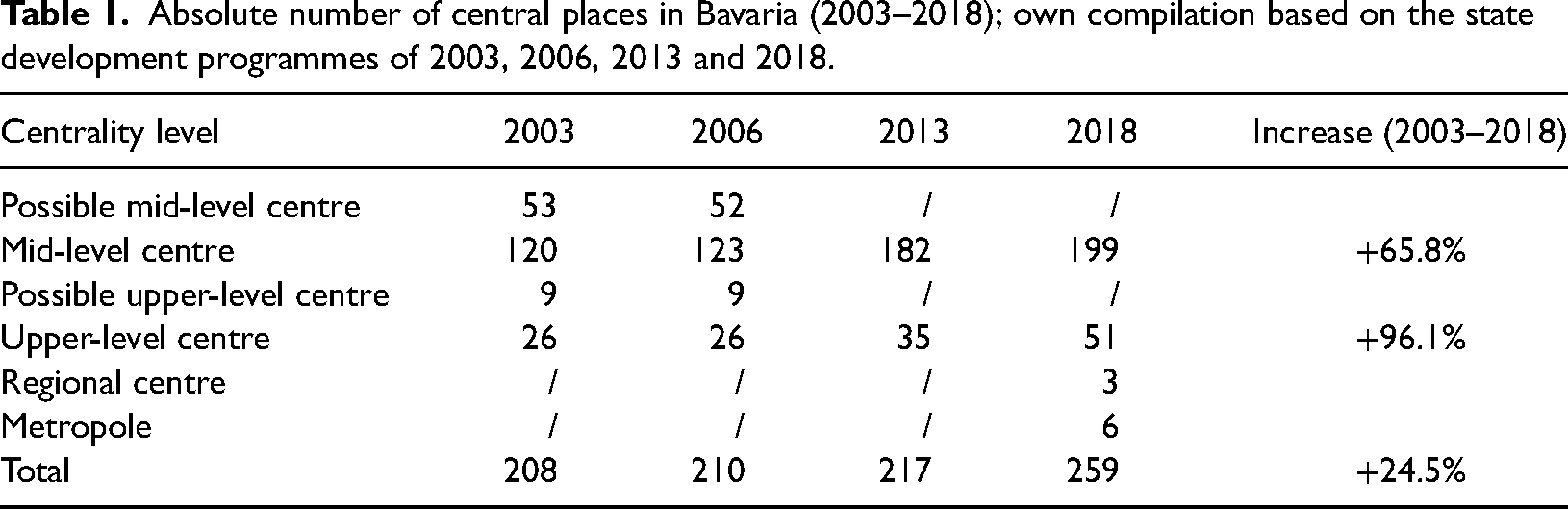
Absolute number of central places in Bavaria (2003–2018); own compilation based on the state development programmes of 2003, 2006, 2013 and 2018.
Another way in which municipalities can attractively position themselves is through soft location factors, which are tied to the central place system. In the German context, the attractiveness of the location is closely linked to the central places theory of geographer Walter Christaller (1933), whose concepts, despite academic criticism of their theoretical premises, still play a decisive role in planning practice. At the most basic level, the central places theory holds that the allocation of administrative and utility services is tied to the respective central place level. It then follows that municipalities compete to move to higher levels within the central place system.
For almost 40 years, the central place system in the Federal State of Bavaria was marked by continuity, which came to an end only with the LEP in 2013. Table 1 shows the arrangement of central-local levels in Bavaria over the four most recent LEPs, yielding three insights:
A large number of central-local level upgrades took place. The most striking features of this chart are the larger numbers of mid-level centres in 2013 and upper-level centres in 2018, each of which increased by nearly one-half. There was an elimination of central-local levels below the upper-centre centrality level (possible mid-level centre, possible upper-level centre) and an analogous reintroduction of centrality levels above the upper-level centres (regional centre, metropole). In general, the number of municipalities defined as central-local by the LEPs of 2013 and 2018 increased significantly, from 208 to 259.
Overview of state spatial processes (own compilation, based on Brenner, 2004).
A study of centrality requirements within the Bavarian central place system following the updating of the 2013 LEP indicated that only 38.8% of the listed central locations met their centrality requirements (Bartholomae and Schoenberg, 2013), suggesting that the central place system in Bavaria has lost significant binding force. Through the upgrading of municipalities and the creation of new, still higher levels of centrality in the 2013 and 2018 LEPs, the central place system opened up the opportunity for cities and towns to welcome businesses and facilities that had previously been restricted to a smaller number of more populous municipalities. Predictably, this gives rise to an intensified competitive situation among municipalities, with cities and towns attempting to position themselves favourably ‘on their own’ in order to get ahead in the inter-municipal competition to attract businesses and residents offering a link to a supply market that corresponds to a central-local level.
The strategy of promoting competitiveness can be well understood from the discursive struggle surrounding the 2013 adoption of the constitutional principle of equivalent living and working conditions across the state. The progressive hegemony project grounds itself in the constitutional mission as it demands fair opportunity across all municipalities – in other words, the same basic competitive conditions, which must first and foremost be created by the state. In contrast, the conservative hegemony project gives rise to the demand for equal opportunity – that is, the same conditions of access for municipalities of varying levels of competitiveness. This corresponds to the basic neo-classical position according to which the creation of equal opportunity through competition is the state's most important politico-economic duty.
As a result, the political task of the conservative hegemony project is to promote opportunities for rural municipalities to become competitive. For rural spaces, corresponding possibilities must be opened up to compete with conurbations – State Minister Söder phrased this as a goal to promote ‘acceleration in the state’ (Bavarian State Parliament, 2017: 10297). The equal opportunity of the municipalities contrasts in this way with a material inequality that has both positive and negative feedback effects for each municipality. On this account, the differences between the hegemony projects become strikingly clear. While the progressive hegemony project considers the material inequality of municipalities in its argumentation and calls for a differentiated funding policy on the basis of the dimensions of spatial justice, the conservative hegemony project aims at the free competition for business settlements and growth between municipalities. For inter-municipal competition to exist, the municipalities have a limited number of possible actions available to them in order to advance their goals of attracting businesses and growing the population. In neo-liberalism under austerity-driven auspices, therefore, competition as a political project not only becomes a strategy to unshackle subordinate authorities but rather acts as a directive that sees the primary function of sovereign state action in stoic budget consolidation rather than in implementing an equality-seeking policy.
The forced competition between municipalities in Bavarian spatial policy leads to a shift in municipal financing: Instead of compensatory spatial planning policies, competitive procedures are implemented at the local level. Peck refers to this development as ‘financial competition’ – that is, the increased ‘penetration of the logic of competition in the financing of state and quasi-state allocation systems’ (Peck, 2012: 649). This runs the risk that the disparities across municipalities in the Federal State of Bavaria will increase since their room to manoeuvre either expands or contracts depending on the level of their success.
Responsibilisation
The delegation of responsibilities to the municipalities can be seen not only in the increasing inter-municipal competition but also in the enhanced position occupied by municipal revenue sharing in the discourse over spatial policy. This compensation mechanism occurs by means of participation by cities and towns in the taxation system, which involves funds from revenue tax, corporate income tax and VAT as well as the business tax levy. The scope of the taxation system is therefore dependent on tax revenues and thus indirectly on the economic situation.
Since the spatial policy was allocated to the Bavarian Finance Ministry following the 2013 state elections, we observe a framing of municipal revenue sharing as state policy to fund the municipalities. Indeed, municipal revenue sharing became, alongside a number of ministerial flagship initiatives, a pillar of the Ministry's ‘homeland strategy’ (Bavarian State Parliament, 2015: 4908). The widening scope of the taxation system based on the favourable economic situation and the accompanying increase in disbursements to the cities and towns was therefore described in the narrative of the conservative hegemony project as a ‘clear commitment to support the municipalities’ (MP Hacker, Bavarian State Parliament, 2013: 12167) and a ‘highly important element in the on-site reinforcement of initiatives’ (State Minister Söder, Bavarian State Parliament, 2014b: 2128).
Since 2012, moreover, structurally weak municipalities have had an opportunity to be awarded assistance services in the form of stabilisation aid. In contrast to ordinary revenue sharing, however, this financial support from the taxation system is conditional on key allocations and comes with obligations including the preparation of a budget consolidation plan through which the municipality pledges, among other commitments, to achieve savings in public services and maintain at least average tax assessment rates.
In this way, the municipality is required to limit maintenance and renewal of ‘permanent capacity’ to essential disbursements and is thus restricted ‘to unavoidable and needed investments in the areas of obligatory tasks and profitable activities’. Over and above this level, any investments in the voluntary area of municipal tasks are ‘to be subject to a critical examination and are to be reasonably reduced to the level necessary at the location’ (State Ministry of Finance, State Development and Homeland, not dated). Well-known examples of such investments include municipal facilities in the form of swimming pools and libraries.
Besides the reduction in disbursements, the local authority is further obligated to accelerate efforts to expand municipal revenue options. These include charging fees that cover the cost of water supply and waste disposal as well as those collected by cost-calculating entities, starting with parking metres and museums. Beyond the increase in fees, the municipality is also obliged to raise the assessment rates of property taxes (land and business taxes) to at least the average charged across the state. Placing responsibility on the municipalities through assistance payments therefore represents the flipside of the competition. Municipalities that lack competitiveness based on their budgetary situations and cannot contribute to the state's development are seen by the Federal State of Bavaria as failing to meet their responsibility. At the same time, however, unconditional transfer payments by the state undermine the principle of competition. As a result, the community is required to prove its reliability by showing a willingness to consolidate its budget.
Again, the conservative hegemony project's goal of generating growth under the auspices of austerity policy can be seen here. Municipalities are now responsible for local development and are selectively sanctioned with conditional aid in the social sector. The progressive hegemony project's demand for a debt relief fund, on the other hand, fell on deaf ears. This shows that the European debt crisis had a strong impact on the public perception of municipal debt, reducing the political discussion to the question of how to design austerity policies rather than whether to implement them at all. With respect to the state spatial process of austere federalism, we detect in the shift of responsibilities the disciplinary effect of the Federal State of Bavaria with respect to the municipalities by means of its delegation of responsibility, resulting from municipalisation and competitisation. In this way, the core of the enabling process is the increased significance of the municipal economy in general and specifically of municipal revenues. Figure 1 indicates that the resulting competition between businesses and residents follows a selective pattern. For municipalities that emerge victorious in the competition, such an enabling policy thus leads to a stronger municipal capacity for action that grows stronger on its own through additional business relocations and the influx of new residents. Meanwhile, for those struggling to keep up, the same effect can be observed – but with other portents. Such municipalities are required to prove their responsibility by showing a willingness to consolidate their budgets. This takes place through the previously cited examples of austerity-driven cuts that a community must undertake in order to receive funds for stabilisation aid. This results in the loss of the municipality's attractiveness for external capital, causing the community to lose further ground in the inter-municipal competition. Such developments hardly square with the logic of growth that predominates in Bavarian state development.
In sum, the analysis of Bavarian territorial development policy confirms the findings of Peck (2012) and Tulumello et al. (2020). The restructuring of state space in the wake of the global financial and economic crisis was accompanied by a dismantling of regulations and the downward delegation of tasks. Moreover, this restructuring entailed politically induced intensification of competition at the local level. In line with the neoliberal paradigm, the generation of growth is attributed to the knowledge brand of competitiveness (Sum, 2009) and disregards aspects of welfare and regional balance. In the light of these massive shifts within the planning structure, we conclude that we are dealing with a new state spatial process of austere federalism. This new formation leads to an institutionalisation of austerity in territorial development through the processes of municipalisation, competitisation and responsibilisation (see also Table 2).
Conclusion
In this paper, we shed light on the consequences of austerity-driven statehood for spatial policy, presenting the German Federal State of Bavaria as a case study. Leveraging insights from HMPA, we demonstrate that the territorial development reforms followed austere notions, reflecting the selectivity of state crisis resolution strategies in the wake of the global financial crisis. Three processes came to the fore as central drivers of austere federalism. First, municipalisation, by which more and more territorial development tasks were delegated from the state level to the level of the municipalities. Second, competitisation, by which comprehensive planning processes gave way to a competition-enabling structure across municipalities and regions. Third, responsibilisation, by which municipalities were increasingly subject to fiscal disciplining.
The rescaling in the form of municipalisation and accelerated competition are both reflected in the state spatial process of rescaled competition state regimes. In both processes, we diagnose an intensification of austere federalism. In such a policy, the rescaling described by Brenner (2004) largely relates to the altered role of metropolises. This consists on the one hand in profiling within the global location competition but on the other hand in structuring the roles of the cities within metropolitan regions around cooperation and funding. Consequently, a shift also takes place in the structure of competition. Instead of global competition in which individual metropolises participate as growth centres, we observe a spectrum of municipalities competing with one another for new residents and capital.
Compared to the rescaled competition state regime, the responsibilisation imposed by the state spatial process through austere federalism characterises that process in a way that describes the disciplinarian and increasingly authoritarian effect the state has on its municipalities. Stabilisation assistance programs are a case in point, compelling municipalities with limited means to take steps to consolidate their budgets with negative ramifications for the attractiveness of the economic location. In effect, the state government is abetting the risk of intensifying disparities. This prioritisation of disciplinary austerity-driven policy over the goal of positive municipal development resembles the financial rescue packages provided by the EU and IWF during the Greek government debt crisis, illustrating the problematic economic consequences of austerity-driven financial policy.
Our results make a strong case for the value of ‘austere federalism’ as the concept capturing the state spatial process of the austerity state. The state spatial process is defined by cutbacks in disbursements and the delegation of duties to subordinate administrative levels with the aim of achieving economic growth and reducing debts. As the austere restructuring of the state in the aftermath of the global financial crisis of 2007–2009 was evident in many countries, further research on Territorial Development Policy in other (sub-)national contexts required to identify the varying effects of imposed austerity on different (trans-)national planning cultures.
However, given the global polycrisis of the present, the question arises whether this austerity policy has a future. With Gramsci, one can ask whether the observed restructuring processes cannot rather be understood as an interregnum – i.e. as a transitional epoch of crisis – in which ‘the old dies and the new cannot come into the world’. This would make the austerity state a ‘morbid symptom’ (Gramsci, 1971: 275) of the dying state project. Moreover, the COVID-19 pandemic, the second economic crisis of global dimensions within a little more than 10 years, reveals the vulnerability of a territorial development approach that is predominantly based on a strategy of developing economic growth and a top-down delegation of spatial policy responsibilities. This perception is reinforced by rising inflation in Europe in the wake of the Ukraine war. In view of the current debates over a resilient reorientation in spatial policy and against the background of the constitutional principle of equivalent of living conditions, political action must be directed toward emancipating spatial policy from the cyclical crises of capitalism.
Footnotes
Acknowledgements
We like to thank the participants of the Rauischholzhausen Symposium on Economic Geography 2019 as well as Jürgen Oßenbrügge, Sören Becker, and Tobias Klinge for helpful remarks on earlier versions of this paper. Of course, the authors remain solely responsible for the contents of the paper.
Declaration of conflicting interests
The authors declared no potential conflicts of interest with respect to the research, authorship, and/or publication of this article.
Funding
The authors received no financial support for the research, authorship, and/or publication of this article.
