




Abstract
Multiple theories of the same phenomenon abound in many interdisciplinary research areas, but it is often unclear how the theories relate, and there are no clear guidelines for dealing with this plurality. The history of research on spatial industrial clustering is a case in point. We identify a number of solutions to the problem of multiple theoretical accounts proposed in this literature. We label them definitional, taxonomic, integrative, and multi-perspectival. We then offer the erotetic solution as an indispensable complement to any attempt at resolving the multiple-theories problem. It accounts for theoretical plurality in terms of different explanation-seeking questions different theories aim to address. We analyse three prominent explanations in the recent history of research on spatial industrial clustering and show how the erotetic approach can contribute to foster interdisciplinary dialogue.
Introduction
Many social scientific disciplines are grappling with the problem that a plurality of theoretical approaches coexist and it is often unclear how they relate. What is worse, there are no established principles for dealing with such plurality. This problem is particularly strongly felt in economic geography where the different theoretical approaches often have their origins in other disciplines and represent different methodological preferences, ontological commitments, theoretical traditions, or geographical and linguistic variations (e.g. Barnes, 2019; Barnes and Sheppard, 2010; Boschma and Frenken, 2006; Hassink et al., 2019a, 2019b; McDermott, 2012; Peck, 2012a; van Meeteren, 2019). Some regard such theoretical and methodological diversity as an asset (e.g. Barnes and Sheppard, 2010; Martin 2021; Martin and Sunley, 2001; van Oort, 2011; Wood and Roberts, 2011), albeit within limits (e.g. Peck, 2012a: 123); others see it as a problem in need of a solution (e.g. Hassink and Gong, 2017; Hassink et al., 2019a). Diversity is unavoidable, but whereas some theories are genuinely rival, others are complementary and subsumable into more general theoretical frameworks, yet others are complementary but incommensurable. Participants and commentators in a debate often make judgements of such issues, sometimes based on unarticulated intuitions about explanatory relevance and fueled by disciplinary feuds (e.g. Amin and Thrift, 2000; Martin and Sunley, 1996; Peck, 2012a, 2012b), or by making comparisons between the various characteristics of approaches (e.g. Boschma and Frenken, 2006).
In this paper, we focus on the challenge posed by a variety of theories that are purportedly about the same phenomenon but it is not clear what should be done about it. We refer to it as the multiple-theories problem (MTP for short). We propose that interdisciplinary relations are best served by generating understanding on how different theories relate. We argue that accurate judgments about how different theories relate depend on identifying their explanatory scope, that is, what aspect of the phenomenon they explain and by appeal to what explanatory factors. To make our case, we address the MTP in the case of different explanations of the phenomenon of spatial industrial clustering. The previously vast academic interest in the clustering phenomenon may have waned over the last decade, but the phenomenon persists, and the concept endures (Lazzeretti et al., 2014; Sedita et al., 2020). This area of inquiry is characterized by the co-existence of different approaches developed in different disciplines. In the debate on those approaches, prominent scholars have argued for the impossibility of interdisciplinary dialogue (e.g. Krugman 2011), whereas others have remained more optimistic and suggested ways of dealing with the MTP (e.g. Benneworth and Henry, 2004; Capello, 2009; Martin and Sunley, 2003). Some such solutions aim at reducing the plurality, others accept it, some even endorse it. Existing solutions, however, either fail to recognize the impossibility of bringing together the diverse theoretical approaches into one overarching theory, or when they do recognize the impediment for integration that diversity poses, it remains unclear how to move the debate forward. We offer a complementary solution, which we label erotetic because of its focus on explanation-seeking questions. It is a solution to the MTP in that it reveals when theories of the same phenomenon answer different questions. In doing so, it assists in moving the debate forward. What were often considered competing theories of the same phenomenon, on closer inspection address different explanatory questions about it and should be assessed against the background of those questions. This approach has two benefits. First, by properly delimiting the explanatory scope of a theory, the erotetic approach yields well-grounded judgments of rivalry and complementarity. Second, certain kinds of questions and answers are likely to only arise in the context of a perspective, the constellation of theoretical, methodological and ontological commitments and practices practitioners within a discipline or approach are used to and identify with. Hence, identifying the diversity of explanatory questions opens up new opportunities for interaction across different theoretical approaches to the same issue. What is more, the erotetic approach to the MTP provides a middle ground between forms of pluralism that trade on incommensurability (e.g. Krugman, 2011: 3; Peck, 2012a) and, at the other end of the spectrum, the commitment to the possibility of arriving at an integrated theory of the phenomenon (e.g. Capello, 2009).
The paper continues as follows. Section “The multiple-theories problem in spatial clustering research” elaborates on the context of the discussion in identifying some of the solutions advanced in the literature to clarify the relations between multiple approaches to clustering. Section “The erotetic solution: what explains what?” justifies the use of the contrastive theory of explanation in the analysis of inter-theoretical and interdisciplinary relations. Section “Three explanatory projects” reconstructs the selected theories in contrastive terms and concludes that they explain different aspects of the clustering phenomenon. Section “Solutions to the multiple-theories problem revisited” shows how the contrastive analysis complements existing solutions to the MTP and discusses how progress can be made. Section “Conclusions” draws together the implications of our analysis for theorising spatial industrial clusters, and for inter-theoretical and interdisciplinary relations in general.
The multiple-theories problem in spatial clustering research
Spatial clustering research
Over the years the plurality of approaches to clustering has generated heated discussions and debates. The different theories have often been seen as giving different explanations of the same phenomenon. In Malmberg and Maskell’s (2002: 432) view: The more theoretically oriented part of the literature of agglomeration […] aims at explaining the existence of spatial clustering by identifying and analyzing those permanent advantages that may accrue to firms located close to other similar and related firms, rather than being located in isolation. [emphasis added]
This could be read as saying that the theoretically oriented literature offers answers to the same question about the same phenomenon (“the existence of spatial clustering”). This conclusion would be too hasty. Some of the most influential theories were actually concerned with different aspects of the phenomenon and asked different questions about it (e.g. Oinas and Marchionni, 2010).
In the remainder of the paper, we analyze three prominent theories of spatial industrial clustering put forward by Paul Krugman, Michael Porter, and Annalee Saxenian, respectively. They have been identified amongst the top founders of cluster research as they ranked high amongst the most cited authors, and Krugman (1991), Porter (1998) and Saxenian (1994) were the most cited works (Lazzeretti et al., 2014: 30). As contributions that formed the initial core in the evolutionary trajectory of clustering research (Sedita et al., 2020), they retain their importance to this day even if the field has grown theoretically more complex. These theories are markedly different in many respects, originating as they do from different disciplinary traditions. Yet they share a common ground: they aim to explain spatial clustering by appeal to the mechanisms or causes responsible for it. 1
The core of our argument relates less to the cases analyzed and more to the general question of how to deal with situations in which different theories aim to explain a complex social phenomenon. Spatial clustering research exemplifies some of the difficult issues related to interdisciplinarity in social science – a widely promoted practice still poorly understood. Similar difficulties arise within the same discipline, especially if it is internally fragmented and embodies different theoretical and methodological approaches adapted from other disciplines, as is the case in economic geography (e.g. Barnes and Sheppard, 2010; Larner, 2012; Peck, 2012a).
Earlier attempts at resolving the multiple-theories problem
Scholars have held different attitudes and come to different conclusions about the plurality of theories of spatial clustering. For example, Schoenberger (2001) describes how the research tradition of economists differs from that of economic geographers: … the commitment to methodological individualism and the search for determinate relationships among economic variables precisely exclude the social, the geographical, the historical, which many of us think is where the real history lies. […] This is a very particular approach to abstraction […] [I]t makes a whole range of questions unanswerable (Schoenberger (2001: 378).
Krugman (2011: 3) admits that geographers and economists ask different kinds of questions but concludes more emphatically that “no fruitful exchange between the two [disciplines] is expected because of the use of different methodologies” (Krugman, 2011: 1). Others have adopted more nuanced, optimistic attitudes.
We identify four proposals for addressing the MTP in spatial clustering research and label them as (a) definitional, (b) taxonomic, (d) integrative, (e) multi-perspectival. We call them solutions, although some do not as such constitute attempts at resolving the plurality of theoretical approaches, but rather at explaining the sources of the MTP and how to approach it. None of them is a decisive solution nor are they mutually exclusive; they can be complementary. In characterizing each solution, we refer to particular authors but similar ideas can be found in other contributions to the debate.
First, the definitional solution identifies the source of the MTP in the lack of clarity about what a cluster is. According to Martin and Sunley (2003), the proliferation of approaches makes the concept chaotic, encompassing what are in fact different types of clusters, possibly on different spatial scales, and often emerging as consequences of different processes. The authors propose conceptual clarification to counteract the conceptual chaos, enabling the research community to identify a “cluster as a cluster”. Accordingly, the suggestion is to develop a clear definition of the object of analysis on which theorists should agree and it is thus possible to distinguish the empirically adequate from the inadequate.
Second, the taxonomic solution is built on the observation, also attributable to Martin and Sunley (2003), that clusters represent different sub-types and different theories correspond to these types. The source of the problem is that different theories single out mechanisms behind different types of clusters. Gordon and McCann (2000), for example, argue that theoretical models emerging from different disciplines correspond to different ideal type agglomerations. In a similar vein, Phelps and Ozawa (2003) identify different types of clusters in distinct historical periods. They show that they are distinct along different analytical dimensions, that the conditions under which they have formed differ, and that similar theoretical toolkits therefore do not serve to explain them. The taxonomic solution is like the definitional solution in that it identifies the source of the problem in the presence of different real-world entities, all of which are identified as clusters. Where it differs is in proposing the construal of a typology of clusters rather than seeking to solve the problem by conceptual clarification. These two solutions are compatible: it is possible to conceptually clarify the concept of cluster and at the same time identify and define different sub-types.
The third approach calls for theoretical integration. Capello (2009), for example, advocates an integrative solution, arguing that “the different approaches to agglomeration economies should be seen as complements rather than as substitutes; they should merge into a ‘multi-dimensional approach’” (Capello, 2009: 157). As she explains, each theory identifies as explanatory factors different agglomeration advantages that “are the result of an intertwined set of socio-economic, geographic and industrial conditions that, once they are all present, display the highest intensity in agglomeration advantages” (Capello, 2009: 157). The integrative solution focuses only on the possibility of “adding up” explanatory factors from different theories 2 .
Finally, Benneworth and Henry (2004) propose a multiperspectival solution: it is not integration but the co-existence of different approaches that adds value. The differences between the approaches constitute a resource rather than a liability in terms of possible cross-fertilization. In their view, although the theories cannot be unified, they represent multiple perspectives that should be seen as if in dialogue (Benneworth and Henry, 2004: 1011); together they enhance understanding of clusters. As the authors put it, “[b]y adopting a multiperspectival approach, cluster analyses are explicitly and ‘inescapably partial, provisional, and incomplete. Refusing any vantage-point that purports to take the world at a glance, they are more modest in the claims they can, and want to, make’” (Whatmore, 2002: 7; quoted in Benneworth and Henry, 2004: 1020; our emphasis).
A variant of the latter position, engaged pluralism (Barnes and Sheppard, 2010), takes diversity to be a precondition for scientific progress: without genuine interaction and the willingness to confront one's perspective with others, diversity only leads to insularity. 3 We will argue that an important step towards communicating across theoretical and methodological divides is the recognition that different perspectives to the same phenomenon are likely to give rise to different kinds of questions and answers.
The erotetic solution: What explains what?
A frequently overlooked source of the MTP is that even when different theories are purportedly about the same phenomenon, they might be asking different questions about it. According to the erotetic solution, addressing the MTP requires clarifying the explanatory questions each theory asks. Erotetics refers to the study of the logic of questions, and we use the term here to underscore the emphasis that distinguishes this solution from others. The erotetic solution is not rival to those reviewed above but an essential ingredient in any attempt to address the MTP. It thus complements other solutions. It works as a way of addressing the plurality of theories as it entails that a single theory is not capable of addressing every question about a phenomenon. It also works as a diagnostic tool to ascertain the scope of the different theories. To appreciate how it works in both these capacities, we start by elaborating on its grounding in the contrastive theory of explanation.
According to the contrastive account of explanation, inherent in all explanation-seeking questions is an (implicit or explicit) contrast between the fact to be explained and one or more alternative outcomes (see, e.g. Barnes, 1994; Garfinkel, 1981; Lipton, 1990, 2004; Woodward, 2003; Ylikoski, 2007; for applications in social science see, e.g. Day, 2004; Kincaid, 2006; Lawson, 2003; Lichterman and Reed, 2015; Tsang and Ellsaesser, 2011). To indicate the power of the contrastive formulation of questions, Garfinkel (1981: 22) describes an exchange between a priest and Willie Sutton, a bank robber. The priest asks Willie why he robbed banks. Willie replies: “Because that's where the money is”. The priest was baffled because his question was “why did you rob banks rather than living an honest life?” Willie Sutton instead answered the question, “why did you rob banks rather than robbing other places?”. The priest and Willie Sutton had different implicit contrasts in mind, and the common ground of their communication was lost Hence, a plain explanation-seeking question such as “why did you rob banks?” may be ambiguous. Insofar as different questions about spatial clustering concern different aspects of the same phenomenon in need of explanation, different kinds of explanatory factors will be relevant. 4 In the anecdote, Willie's answer is not wrong, but merely an answer to a different question compared to what the priest was asking. In such a case, the challenge is not to choose which one is the correct explanation of the same phenomenon of Willie robbing banks, but rather to acknowledge that there are indeed different explanatory projects at hand.
Thus, the first step in articulating explanation-seeking questions is the observation that a single explanation explains only particular aspects of it. The second is the identification of the explicit or implicit contrast which further clarifies what aspect of the phenomenon is explained. Explananda have the implicit form of “why P rather than Q”, where “P” is the phenomenon to be explained (e.g. the existence of spatial clusters) and “Q” is an alternative, or a set of alternatives (e.g. spatial dispersion). As in the Willie Sutton example, the contrast determines different explanation-seeking questions.
In the philosophical literature, the contrastive theory concerns the nature of explanation. It is typically applied to explanations of singular events: why an event took place as opposed to some alternative (as in the exchange between Willie Sutton and the priest). We find it also helpful when analysing theoretical explanations and carrying out inter-theoretic comparisons. Clearly social scientific theories are more complex entities than the questions and answers between the priest and Willie Sutton. Nevertheless, theories too are by their very nature only partial and incomplete representations of their target phenomena; the only accurate and complete representation of a phenomenon is the phenomenon itself. The phenomena that scientific theories aim to explain are complex and multifaceted: different aspects of them are typically attributable to different explanatory factors. Therefore, scientific theories are bound to focus on a subset of the multitude of causal factors and hence to explain only one or a few aspects of phenomena (Mäki, 1992, 2004). What aspects are singled out for explanation and what kind of factors are deemed most explanatory depend on scientists’ methodological, ontological, and epistemological commitments as well as pragmatic interests (Longino, 2013). These kinds of elements make up a perspective from which scientists look at the phenomenon. That scientific explanations are built from a perspective constitutes an important difference from the Willie Sutton vignette. Social scientific theories may explain different aspects of the same phenomenon and thereby potentially complement one other, even if it is not always easy to tell how their explanations relate.
Contrastive analysis may help resolve potential disagreements concerning whether the set of explanatory factors picked out by one theory is more important, relevant, or essential compared to those picked out in another. Achieving clarity in this regard is not as straightforward as it might seem because proponents and critics tend to assume that the explanatory power of theories is more extensive than it in fact is (Ylikoski, 2007). Yet, the aim of the contrastive account is not to reveal what a theorist intends to explain, but rather to identify what a given theory can actually explain in the light of what factors and mechanisms are identified as doing the explaining (Ylikoski, 2007).
Judgments of explanatory scope are particularly arduous in interdisciplinary settings due to the lack of familiarity with other worldviews, with discipline-specific jargon, and with unarticulated assumptions shared by specific scientific communities. Furthermore, the discussion tends to revolve around the appropriateness of scientific worldviews, methodological commitments, and theoretical or practical purposes. Debating these issues is not without merit. Nevertheless, diversity need not be an insurmountable obstacle in interdisciplinary cross-fertilization. On this we agree with Benneworth and Henry: interdisciplinary comparisons are possible and the key to fruitful cross-fertilization lies in the recognition that theories are modest in the claims they make. The erotetic solution offers a way of articulating and making those claims explicit.
We apply the erotetic toolkit to address the following questions about the chosen theories on clustering: (i) What questions about spatial clusters do they ask? (ii) Are the explanations rival or complementary? (iii) How can progress be made in understanding a complex multifaceted phenomenon as spatial clustering? Answering question (i) helps us answer question (ii) because we take the same contrastively specified explanandum to be a necessary condition for rivalry. When theories are rival, only one can be correct, either because of fundamental ontological incompatibility or because only one applies to the particular phenomenon. Complementarity occurs when theories are compatible, that is, when their claims about the phenomenon are not in contradiction, and the truth of one does not exclude that of the others. 5 Complementarity is not sufficient for theoretical integration or unification, however. We might not know how different aspects a theory explains relate to another, or we might not even be able to make global comparisons about theories that embed different methodologies. The theories can nevertheless be said to complement one another as different perspectives to the same phenomenon. Once question (ii) about rivalry versus complementarity is answered, it is possible to consider question (iii), ways forward.
Acknowledging the multifacetedness of phenomena and conceiving explanations as answers to questions about different aspects of them helps counter claims of incommensurability, which inhibit seeing the benefits of engaging with other perspectives. Therefore, the erotetic approach is an essential tool at the hand of the engaged pluralist Barnes and Sheppard (2010) envisaged. First, it operationalizes the concept of perspective in terms of different contrastive questions. Second, it underscores an important role for engagement: insofar as within a perspective certain questions and ways of answering hardly arise, engaging with other perspectives reveals aspects that might otherwise remain hidden. Meaningful interactions across even incommensurable perspectives and their practice-languages are possible through various strategies: communicating with “ambassadors” representing other perspectives; communicating around boundary objects in “trading zones” (Galison, 1997); using boundary languages; adopting a multi-disciplinary model coordinating the outcomes of self-contained communities; using other disciplines as consultants without knowing of their methods or concepts (see Collins, 2016: 256).
Three explanatory projects
Our case study comprises three influential theories that a) are well-known and widely cited; b) originate in different fields (economics/Krugman; strategic management/Porter; regional economic development/Saxenian); c) deploy different methods (Saxenian offers a compelling comparative case study, whereas Krugman and Porter develop theoretical arguments, the former rendered in the form of formal modeling, the latter in the form of discursive theorizing); and d) focus on different types of explanatory factors.
As mentioned, the challenge in identifying the explanatory scope of a theory is to go beyond what the theorist intended or may have intended and determine what the theory in question can actually explain, given the explanantia. Our aim, therefore, is to reconstruct the three theoretical approaches by identifying their explanantia and corresponding contrastive explananda. Given that our concern is not with the issue of which theories are better supported by the data, we consider the explanations as potential rather than actual. Our focus is on the core features of the theories for the purpose of applying the contrastive approach. This level of abstraction suffices for the comparison.
Krugman's explanation of clustering
The aim of geographical economics is to account for spatial agglomeration and dispersion as they occur on different spatial scales 6 . The focus is on economic mechanisms that rely on the trade-off between the increasing returns and costs of mobility (Brakman et al., 2001; Fujita and Thisse, 2000; Fujita et al., 1999; Krugman, 1991). Geographical economics has been referred to as a unified theory of spatial agglomeration: it “is able to show that the same mechanisms are at work at different levels of spatial aggregation” (Brakman et al., 2001: 323). Commentators have remarked on this unifying aspect of the theory (e.g. Asheim et al., 2006: 7; see also Martin, 2011: 56), leading in some cases to accusations of economics imperialism (for a review, see Mäki and Marchionni, 2011). Clearly, if the theory purported or was understood as aiming to offer a complete unified account of every aspect of spatial agglomeration, other theories would necessarily be rival, encompassed within it, or otherwise dealing with a different kind of phenomenon. But in fact, geographical economics has a more specific explanandum: it explains why economic activities cluster rather than disperse. To arrive at this formulation, we examine the structure of the relevant models.
The distribution of economic activity between two or more regions in the general equilibrium models of geographical economics depends on the balance between centripetal and centrifugal forces. Agglomeration arises when the centripetal forces are strong enough to offset the centrifugal forces – otherwise firms end up being equally distributed among locations. Backward and forward linkages among firms (see Krugman and Venables, 1996), and between firms and workers/consumers (cf. Krugman, 1991) are the centripetal forces that generate pecuniary externalities that are transmitted through the market via price effects (Scitovsky, 1954) as follows. In order to save on transportation and other trading costs, producers of intermediate goods locate where the market for their products is larger, and producers of final goods locate where their suppliers are (Fujita and Krugman, 2004). Similarly, workers and producers derive mutual benefits from co-location: producers tend to locate where markets are larger to save on the costs of transporting marketable goods, and workers are attracted by the concentration of employers offering higher wages. These mechanisms trigger circular causation. Opposing centrifugal forces counteract the centripetal push: firms that locate in a region with a large number of firms face more competition and higher input costs. With the cost of transporting goods within a certain range, centripetal forces are stronger than centrifugal forces: firms cluster and once clustered they have no incentive to relocate.
The models typically assume that regions are identical. This assumption allows geographical economists to isolate the working of input-output linkages among firms and between firms and workers in bringing about agglomeration. Abstracting from what is particular and specific to certain locations leaves geographical economics without the resources to explain contrastive questions such as why clustering occurs in particular places rather than others (cf. Martin, 1999), or why some clusters are more successful than others. It is assumed that the particular places in which industries cluster depend on historical accidents (Krugman, 1991). Firms and workers are explicitly modeled as optimizing agents, and a cluster is an unintended product of the optimizing location decisions of individual firms and workers. It follows that there are no alternative spatial arrangements that could arise in the models as a consequence of the working of the mechanism. The models therefore include two alternatives: the agents (firms and workers) end up concentrated in one location or distributed across two or more locations. The models then identify the conditions under which either agglomeration or dispersal is a stable equilibrium. Accordingly, the geographical-economics agglomeration mechanism can potentially account for why economic activities agglomerate rather than disperse. As a complete theory of the existence of clusters, it would be significantly limited. Real world firms cluster for other reasons, too (as explained by other theories). Because of its exclusive focus on certain kinds of economic mechanisms, it can explain a limited aspect of the clustering phenomenon (see also Marchionni, 2006).
To summarize, the general form of the geographical-economics explanation is as follows
(CM = Contrastive explananduM; S = explananS):
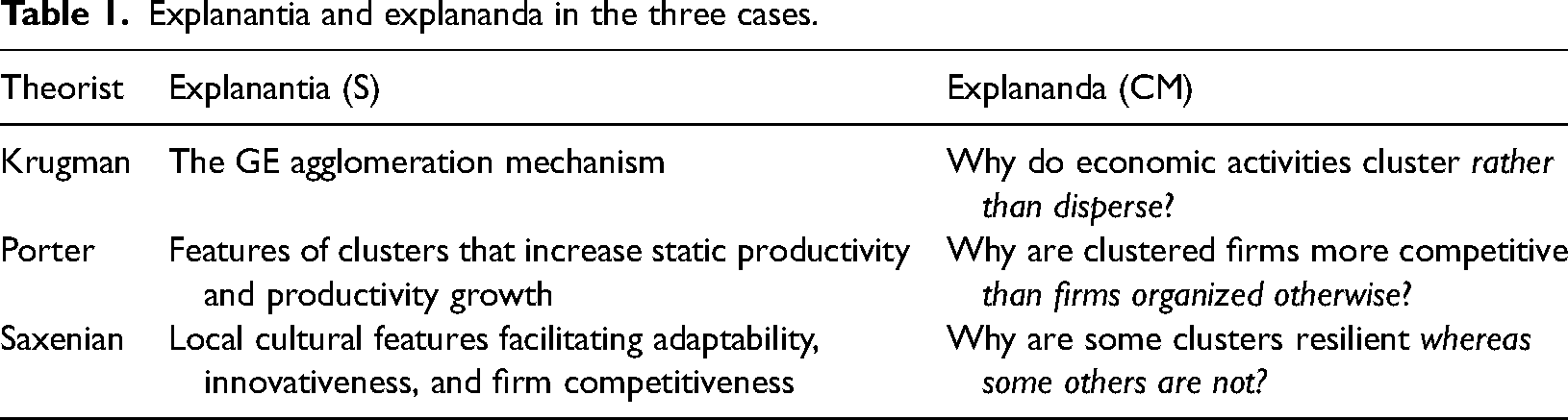
[CMGE] Why do economic activities cluster rather than disperse? [SGE] The GE agglomeration mechanism
The basic model of geographical economics has been extended and the field presents a variety of models, but this analysis suffices for our arguments.
Porter's explanation of firm competitiveness
As path-breaking and highly cited author (Lazzeretti et al., 2014: 27–28; Sedita et al., 2020: 572–573), Porter's contribution to cluster research cannot be overlooked. He observed that “most past theories address aspects of clusters or clusters of a particular type” (Porter, 1998: 208). His theory addressed all types and aspects of clusters as he aimed for a unified account (Porter, 1998: 208) suggesting that the same factors explain clustering on different spatial scales (Porter, 2000: 254, 257). As in the case of geographical economics, Porter's model represents an attempt to provide a unified account of spatial clustering as it occurs on various spatial scales. He integrated his theory of clusters into his broader theory of competition and competitive advantage (1998: 198). Four interrelated elements in clusters (“diamond”; Porter, 1998: 213, 2000: 258) affect competitiveness: factor (input) conditions; demand conditions; firm strategy and rivalry; and related and supporting industries (Porter, 1990).
According to Porter, “[l]ocation affects competitive advantage through this influence on firm productivity and especially on productivity growth” (Porter, 2000: 256). “Firms located within a cluster are more likely to attain competitive advantage” (Porter, 2000: 257). Hence, even though Porter connected his work to writings on the existence of clusters and cluster theory (see Porter, 1998: 206–208), his own theory concerned firm competitiveness. We therefore formulate the contrastive explanandum of his theory as follows: Why are clustered firms more competitive than firms organized otherwise? We explain the reasons for this formulation below.
Porter (2000: 259–265) introduced four types of explanantia. First, the features of clusters that increase (static) productivity include proximity, face-to-face contact, close and ongoing relationships, and insider access to information. These features enable access to specialized inputs, information, institutions, and public goods; facilitate complementarities between cluster participants; improve within-firm incentives; and facilitate the measurement of performance of in-house activities. Second, clusters enhance the capacity of firms to innovate and thus increase productivity because both rivals and demanding customers nearby prompt them to innovate and they can flexibly combine different capabilities in clusters. Third, given the easier access to information about opportunities, together with lower barriers to and lower perceived risks of entry, clusters stimulate new business formation and attract firms from elsewhere. Increased rivalry strengthens (surviving) clustered firms. Fourth, social relationships within clusters facilitate interaction so that the potential in the other explanantia is realized, thereby excluding outsiders and strengthening the competitiveness of insiders (cf. Porter, 1990: 129).
The competitive advantage of firms (cf. Porter, 1985) translates into the competitiveness of higher levels of aggregation. The reason why this cannot be taken as an explanation for the emergence and persistence of clusters (i.e. their existence) is that there is no explicit discussion of the mechanism that links the locational choices with the advantages such choices (potentially) confer on firms: Why do firms cluster? Is it an explicit attempt to reap the benefits? Or is it that finding themselves in a cluster ensures their competitive advantage and hence the persistence of the cluster? Porter's theory did not address these issues, which confirms the fact that it did not have the explanatory resources to explain the existence of clusters.
The second element of the explanandum is contrastive. Porter's explanantia all imply that things are or work out better when firms are clustered. What is the implicit contrast? Porter explicitly recognized clustering as an alternative to a variety of other arrangements including vertical integration, formal alliances with outside entities, sourcing inputs from distant locations, outsourcing, dispersal, and isolation (Porter, 1998: 214–225, cf. Porter, 2000). He did not develop the idea but, if broken down, the different explanantia would account for different contrastive explananda incorporating these contrasts. Analyzing the more specific contrasts would be an interesting (and lengthier) exercise but it is not critical for our present purposes. Our strategy here is to identify all the explanantia that Porter listed as jointly accounting for one overall contrastive explanandum. In sum:
[CMP] Why are clustered firms more competitive than firms organized otherwise? [SP] Because of features of clusters that lead to increased productivity and productivity growth
In hinting at the many possible (implicit) contrastive explananda, and a large set of explanatory factors Porter seemed to aspire to comprehensiveness. Regardless of its unifying aspirations, however, the theory obviously leaves additional questions about clusters unanswered. How are the different explanantia related?
7
Are existing clusters the result of firms’ conscious, rational, choices to boost their own competitiveness? Why are some clusters resilient while others are not?
Saxenian's explanation of cluster resilience
Saxenian’s (1994) renowned study compares the histories of two leading high-tech regions in the United States: the environs of Route 128 on the East coast and Silicon Valley on the West coast. Saxenian's book has been found “path-breaking” in regional science (Waldorf, 2004: 62), and it has been cited across disciplines. Saxenian's account is based on the contrast between two high-tech clusters in the same nation, with similar characteristics in having “stood out as symbols of economic and technological success” in the U.S. (Florida and Kenney, 1990: 98). By the 1970s they were regarded as the world's leading centres of innovation in electronics (Saxenian, 1994: 1), but these regions went through severe downturns in the 1980s due to intensified international competition. Silicon Valley was able to regain its former vitality by the early 1990s, but Route 128 remained in trouble. They faced the same competitive situation but their fates diverged as they struggled to recover.
In our interpretation, Saxenian sought an answer to the question of why Silicon Valley remained resilient – that is, persistent regardless of disruptive events (cf. Pettit, 2001) – after the downturn whereas Route 128 did not. We formulate the explanandum of Saxenian's narrative as follows: Why was Silicon Valley resilient whereas Route 128 was not?
The answer lies in what is present in the history of Silicon Valley but absent in the history of Route 128: the culture of the country's Western frontier; the openness, flexibility and informality within the firms; the collectively learning technological community in the region's young firms. This explanans can be derived from Saxenian's detailed narrative of the two regions that elaborates on the features of their environments on different levels of analysis. Her research design “allows her to […] isolate the effects of regional cultures and institutions as the key set of variables” (MacKinnon et al., 2002: 298) that explain the differences in economic success. The characteristics of the respective regional cultures (East Coast puritanism vs. the “Wild West”) had given rise to very different organizational cultures (closedness, rigidity and hierarchy around Route 128 vs. openness, flexibility and informality in Silicon Valley), and industrial cultures (co-located autarkic corporations around Route 128 vs. a collectively learning entrepreneurial community in Silicon Valley) (cf. Oinas, 1995: 202–203). Silicon Valley's cultural features induced adaptability, innovativeness, and continued competitive success in an increasing number of firms. The “localized accumulation of technical knowledge enhanced the viability of start-ups and reinforced a shared technical culture” (Saxenian, 1994: 37). The fate of Route 128 was to suffer from organizational rigidity, a lack of innovation and decreasing competitiveness among its large autarkic firms.
This is an explanation of a particular contrastive fact: Silicon Valley firms regained their competitive success whereas those in Route 128 blundered. Beyond the particular cases it can be generalized as a theoretical explanation of a general contrastive fact, obtained as follows. Silicon Valley and Route 128 are representatives of clusters that have undergone changes in their competitive environments. As such representatives, they function as models of the general case, investigated to enhance understanding of the more general phenomenon of cluster resilience (cf. Gerring, 2004). We derive the following theoretical explanation from our reconstruction of Saxenian's narrative:
[CMSax] Why are some clusters resilient whereas some others are not? [SSax] Because of the historical evolution of local cultural features that allow for adaptability and innovativeness, leading to increased competitiveness of firms.
Solutions to the multiple-theories problem revisited
If Krugman's, Porter's and Saxenian's explanations are taken at face value, that is, without further qualification, they may appear as rival accounts of clusters among which we should choose the best (e.g. more empirically adequate). However, our analysis demonstrates that the three theories explain different aspects of the clustering phenomenon. Table 1 summarizes their explanantia and explananda.
Explanantia and explananda in the three cases.
Identifying the limited aspect of the phenomenon that each theory addresses is an essential but not sufficient step in resolving the MTP. After all, differences in the questions asked do not exhaust the differences between theories. Once we recognize that there are different questions being asked, it still remains to be seen how to move forward: can the theories be integrated and how? Should they be integrated? If not, how do they relate? To answer these questions, let us review the earlier solutions to the MTP identified in Section “The multiple-theories problem in spatial clustering research” vis-à-vis the erotetic solution.
Recall that for the definitional solution the way forward is more conceptual clarity about the phenomenon being explained. Clusters, as a target of analysis, should be defined in broad enough terms, acceptable to all theorists across disciplines as a phenomenon that can be identified as such “as one sees it” (Markusen, 1999). This serves as a minimal condition of inter-theoretic communication about the target phenomenon and what aspect of the phenomenon different theories explain. There is a caveat, however. Even upon agreement on a definition, representatives of different disciplines or approaches focus on different aspects of the phenomenon, due to their conceptual frameworks and disciplinary traditions. Beyond an explicitly stated definition, different disciplines or approaches maintain more implicit definitions, embedded in practices of inquiry and seldom spelled out explicitly. These practices include the various cognitive interests pursued and questions asked about the phenomenon – differences that cannot be captured only in terms of different definitions of what a cluster is. Scholars are immersed within the cultures of research approaches including many tacit elements (cf. Collins, 2016). Geographical economics “saw” the agglomeration aspect of clusters; Porter picked prosperous co-located, competing and collaborating firms and their associated organisations; and Saxenian focused on innovative agents, their networks, and cultural practices. For a single definition to serve the interdisciplinary scholarly community, it should encompass these and other features as aspects of the phenomenon, and understand how they relate. Thus, in our reinterpretation, considering the definitional solution serves to underline the possibility that the theories differ in how they define their object of study. Even agreement upon a definition would be a partial solution, however. The erotetic solution complements by elucidating why more than one theory is needed to answer diverse questions about (aspects of) any duly defined phenomenon.
The taxonomic solution holds that different mechanisms account for different types of clusters. The erotetic solution complements the taxonomic solution by clarifying that any single type of cluster can be examined from different perspectives and therefore different mechanisms can explain different aspects of each type. Once a suitable typology of clusters has been developed, it is possible to analyse whether explanations of different aspects of clusters fit all clusters, or types thereof.
According to the integration solution, the different explanantia could be merged into a multidimensional approach. This presupposes that when theories are compared, only explanantia count and no attention needs to be paid to whether they have the same explanandum. As we show above, this assumption does not hold, as the different explanantia address different explanatory questions and, therefore, a simple integration solution in Capello's terms is not possible. In an integrative effort, the challenge would be that of detailing how the different explananda relate such as how the competitiveness of clustered firms and their resilience are connected in an explanation of a given aspect of clustering. Although it might seem appealing to think of connecting theoretical explanations as if they were pieces of a jigsaw puzzle, this is often not feasible. The puzzle analogy is in fact misleading. First, building an encompassing theory that seeks to account for several different aspects of the same phenomenon will also involve selecting what to focus on and what to leave in the background. In other words, it will carve the phenomenon by zooming out on some of the details. van Meeteren (2019: 186) has a similar insight against inter-paradigmatic integration: “every inclusion in a paradigm implies exclusion of other viewpoints”. Second, the different separate explanations need not fit neatly as pieces of the same puzzle. Insofar as they result from different perspectives, they may distort, exaggerate, or zoom in in different ways. Hence, a more appropriate analogy – still only an analogy – might be a collection of photographs of the same object from different angles and distances, and with different resolutions, even with different types of apparatuses, such that they cannot be placed neatly next to each other to form the whole picture (cf. Giere, 2006; Massimi, 2018). In such cases, integration is not only unfeasible but also undesirable: if all bought into a shared theoretical and methodological approach the benefit of dialogue and possible cross-fertilization across perspectives would be lost Therefore, different approaches with corresponding theoretical arguments, underlying assumptions, and methodological commitments need to be appreciated as doing what they can do in an academic division of labour.
This brings us to the multiperspectival solution. The identification of the different explanatory questions and answers constitutes the analytical basis on which to determine how the different perspectives “overlap” (see Benneworth and Henry, 2004: 1016). This requires, first, that the elements of contrastively specified explananda can be positioned in relation to each other. Then, it becomes possible to consider whether the different explanations contest or complement one another. Revealing and explaining previously unrecognized aspects of clusters from multiple perspectives may inspire, for instance, refinement of the concepts used and/or a search for productive complementarities.
Building the tenets of engaged pluralism into multiperspectivalism accentuates the role of the erotetic approach as a tool towards making progress. Inter-theoretical engagement is facilitated when precise explanations are distilled, differences specified, and complementarities sought. For example, while Porter's overall explanation concerns the role of clusters in firm competitiveness, Saxenian explained how the competitiveness of clustered firms contributes to cluster resilience. Both Saxenian and Porter offer explanations of firm competitiveness by socio-cultural factors, but Saxenian's narrative informed about how culture influenced the innovativeness and competitiveness of firms, which contributed to cluster revival, thereby adding an explanatory step about cluster resilience. It remains an open question whether some of Porter's more specific explanations concern cluster resilience. Similarly, we could ask how Porter's and Krugman's explanations could explain developments in the (theoretically constructed) Silicon Valley and the Route 128 types of clusters. This does not mean that one theory would subsume another, or that differences would disappear. But questions or empirical facts that arise within a perspective can and should be brought to bear on the other perspectives. Challenges from outside a perspective constitute an important driver of explanatory progress. This is an important insight for intra-disciplinary debates in a sub-discipline like economic geography that values its culture of openness to extra-disciplinary influences.
Conclusions
Disciplinary traditions or approaches are characterised by types of questions about selected phenomena and answers that rely on one's theoretical and methodological commitments, which delimit background assumptions and thereby often facilitate zooming in on a set of explanatory factors, while ignoring others. Different questions often require or favour different modes of data collection and ways of analysing it. Such traditions get established over time and members of the traditions are used to and identify with them.
Even though differences in methods and methodological commitments have been taken as matters that disconnect scholarly communities across disciplines, this does not need to be the case. Methodological commitments may be tied to the task at hand in giving answers to limited questions, but they can nevertheless be of service in the division of cognitive labour between disciplines or approaches. Just as investigations into the working of a mechanism may be undertaken in isolation in laboratory conditions, theories also purport to understand the effect of one or a few mechanisms in isolation. This is not meant to imply that such mechanisms function undisturbed in the real world. Determining how they interact with other mechanisms requires further research, both theoretical and empirical. So, the observation that different theories address different questions is not a sufficient ground to expect pieces in a puzzle to be joined effortlessly. But neither does it mean that cross-fertilization and dialogue across disciplinary boundaries and theoretical perspectives premised on different ontological and epistemological assumptions is impossible or undesirable.
In this paper, we showed how different theories of the same phenomenon address different explanation-seeking questions about it. They are answered by picking out different factors or mechanisms, while leaving out others. Recognizing that the theories are not necessarily rival, but potentially complementary perspectives to the same phenomenon suggests ways in which interdisciplinary progress can be made. In the case of explaining spatial industrial clusters, the kind of progress was never towards the one complete theory of spatial clustering but the piecemeal, perspective bound filling in of explanatory gaps. For example, theoretical and empirical research could be devoted to investigating how questions concerning the existence and resilience of clusters relate to questions about the competitiveness of their firms vis-à-vis alternative spatial arrangements. These have often tended to be conflated on the implicit assumption that the existence of certain economic arrangements testifies to their competitiveness (see Oinas and Marchionni, 2010). Similarly, unravelling the more precise explanandum for Porter's self-identified contrast “dispersal” would help to determine whether, after all, Porter and Krugman shared some explanatory common ground. Alternatively, we may ask if and how the different kinds of explanatory mechanisms influence each other in different clusters. The heyday of research on clusters seems to have passed, but many of these types of challenges have remained unexplored and unresolved. In such situations, the contrastive approach is an essential tool to move forward with the MTP.
Footnotes
Acknowledgements
The authors would like to thank Trevor Barnes, Uskali Mäki, and two anonymous reviewers for comments on earlier versions of the manuscript.
Declaration of conflicting interests
The author(s) declared no potential conflicts of interest with respect to the research, authorship, and/or publication of this article.
Funding
This work was supported by the Academy of Finland (grant number 117695 and grant number 138835).
