




Abstract
In this paper I explore the ways that academic sustainability writing engages with economic systems and consider the performative effects of these modes of engagement. Using capitalist realism and capitalocentrism, I define three mechanisms by which non-capitalist futures are foreclosed: 1) Actively Recreating Capitalism – where industries like advertising actively seek to recreate and reinforce capitalist values. 2) Capitalism Unseen – where capitalism is perceived as natural and synonymous with all economic forms. 3) Making a Monolith of Capitalism, where anti-capitalist writers focus so much on capitalism that they make it appear undefeatable. Examining the frequency of different terms used by academic sustainability writers when talking about economic systems, and looking at two different uses of the term ‘capital’ I argue that academic sustainability writers engage with and are influenced by these mechanisms in different ways. Currently, there is a substantive body of academic sustainability writing that contributes to Capitalism Unseen. However, there are also strands of work that emphasis discontinuity and change within economic systems. I argue that such work provides a model for escaping Capitalism Unseen and avoiding Making a Monolith of Capitalism.
Writing our way to sustainable economies?
My academic work is motivated by a desire to understand and change ‘the economy’. My early exposure to ‘the economy’ was as a barrier to change. The economy was something that constrained society, culture and politics (Gibson-Graham et al., 2016). It was the measuring stick by which the feasibility of change should be judged, and a reason to stop action on environmental issues. An academic career offered a way to ‘avoid being deceived by economists’ (Robinson, 1955).
In my efforts to learn about the economy I came to believe that there was no such object. Rather there are many economies (Gibson-Graham, 2006). For me, ‘the economy’ now describes any collection of activities that take in energy and materials in order to produce the material and social goods of life (Mair, 2020). Within this broad landscape, there are many possible economies. The economy that is so often used to shut down the possibility of change is really a neoliberal capitalist economy: a system of production and distribution predicated on private property, the accumulation of wealth by individuals and a dependence on and privileging of markets (Mair, 2020; Wood, 2002). Other economic forms based on different logics and balances of state, commons, and household production are perfectly possible (Gibson-Graham et al., 2013; Raworth, 2017).
Today my academic writing is an attempt to contribute to the destabilisation of capitalist hegemony. In this I find myself on one side of the polarisation identified by Bacevic (2020). As capitalism confronts covid and climate change, Bacevic argues that knowledge production is increasingly split:
between forms of thinking that are fundamentally oriented towards the preservation of the current capitalist order (even if through modification), and those that are oriented towards replacing it.
I understand my writing as sitting within a body of work I will call ‘academic sustainability writing’. Academic sustainability writing encompasses the outputs from a range of disciplines. The disciplines involved roughly conform to those that Allenby (2006: 29) identifies as ‘efforts to integrate environmental considerations into heretofore non-environmental academic discourses and communities; take a ‘systems view’ of the world in doing so’ and that became institutionalised during and after the 1990s. Ecological Economics and Industrial Ecology are two key early (1990s) examples, while a more recent development is the Circular Economy community.
In this paper I examine the rhetoric that academic sustainability writing uses to represent economic systems and how effective these representations might be at destabilising capitalism. To this end I use ‘capitalist realism’ and ‘capitalocentrism’ to analyse depictions of economic systems within academic sustainability writing. Capitalist realism and capitalocentrism are terms that seek to explain the cultural phenomena wherein all social and economic relations are viewed through lens of capitalism. Both are associated with efforts to imagine and build postcapitalist societies (Fisher, 2020; Gibson-Graham, 2006). Consequently, both terms are concerned with the performative nature of cultural objects (including academic writing) and speak to different ways in which writing can illuminate new economic possibilities after capitalism.
Capitalist realism rose to prominence in the writing of the cultural theorist Fisher (2009) who uses it to describe the temporal phenomena of a culture that has forgotten that capitalism is a historically specific system of production. As a result of this forgetting, cultural objects depict capitalist social relations as natural and universal, making it difficult, if not impossible, to imagine a world after capitalism. Capitalocentrism, coined by feminist geographers Gibson-Graham (2006) and closely associated with the Diverse and Alternative Economies literatures, similarly highlights the ways that capitalist social relations have become hegemonic over time, but places more emphasis on the way that this hegemony serves to hide the diversity of economic practice over space as well as time (McKinnon et al., 2018). For those writing in the ‘Diverse Economies’ tradition, it is possible to observe alternative relationships existing within, alongside and against capitalist relationships today (Fisher, 2020; Gibson-Graham, 2006).
The rest of this paper is structured as follows. First, I map academic sustainability writing, using examples from Ecological Economics, Industrial Ecology and Circular Economy to illustrate its ontological commitments (see the section Mapping academic sustainability writing). I then outline capitalist realism and capitalocentrism, proposing that they provide three mechanisms by which non-capitalist futures are rendered unimaginable: 1) Active Capitalist Recreation, 2) Capitalism Unseen, 3) Making a Monolith of Capitalism (see the section Capitalist realism and capitalocentrism). In the section Talking about economic systems in academic sustainability writing, these mechanisms are used to explore depictions of economic systems within academic sustainability writing. First I look at the relative frequency of different terminology used to describe economic systems and then dig deeper into the use of language and metaphors by examining two different uses of the term ‘capital’ within academic sustainability writing. The section Causes and effects of different ways of talking about economic systems concludes by drawing out the performative effects of different modes of engagement. I argue that we see some streams of academic sustainability writing that reinforce capitalism and others that provide possible routes to post-capitalist futures.
Mapping academic sustainability writing
the common picture of cultural evolution as eternal progress started to give way to a picture of industrial economic growth as a process that potentially implied the ultimate devastation of human life. This must be considered as a basic change in worldview, and it took hold of a wide range of intellectuals across many disciplines. (Fischer-Kowalski and Hüttler, 1998: 70)
The first ontological commitment of academic sustainability writing is a view of the world as a set of systems. This reflects the intellectual roots of the disciplines in Systems Ecology and System Dynamics (Røpke, 2004; Velenturf and Purnell, 2021). The view of the world as systems comes through strongly in the way authors discuss their sub-disciplines. For instance, Allenby (2006: 33) defines Industrial Ecology as: ‘a systems-based, multidisciplinary discourse that seeks to understand emergent behaviour of complex integrated human/natural systems’; Costanza (1989: 1) writes that ‘Ecological Economics addresses the relationships between ecosystems and economic systems’ and Skene (2022: 30) writes that ‘the circular economy … must be integrated within the Earth system, in terms of both the social and environmental contexts’. We also see the systems view in the visual languages of the disciplines. Figure 1, for instance, is a visual depiction of the Ecological Economics concept of the economy as an open system embedded within the broader earth system.
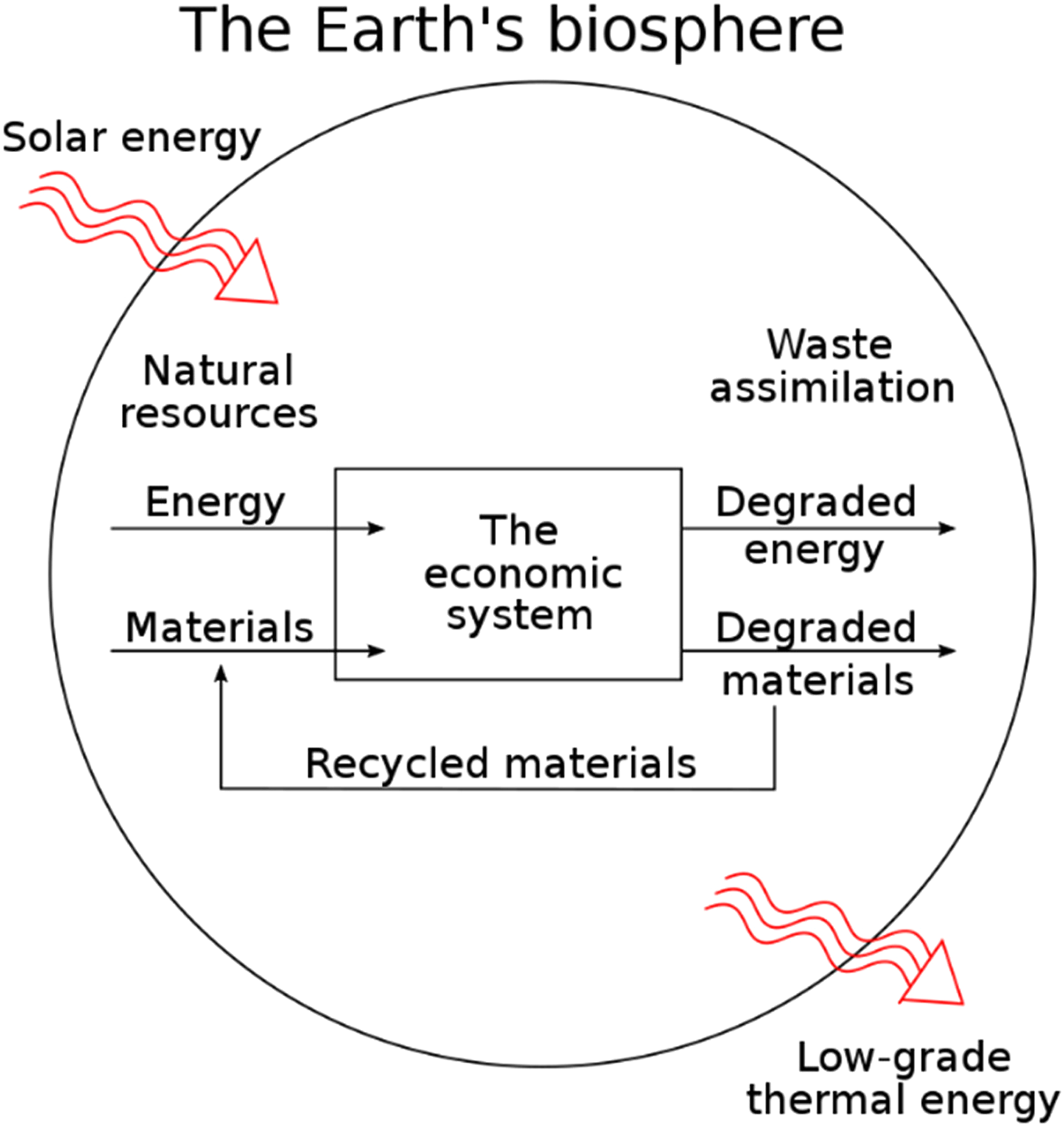
The economy as an open system embedded within the earth system. Taken from: Https://commons.wikimedia.org/wiki/File:Diagram_of_natural_resource_flows-en.svg CC0 1.0 Universal (CC01.0) Public Domain Dedication.
The second ontological commitment of academic sustainability writing is that changes in the social and economic systems are necessary to resolve the crises caused by interactions between environmental and socio-economic systems. As Druckman and Clift (2015: xii) put it in their reflection on 25 years of Industrial Ecology research:
the key concern behind the rise of industrial ecology is the acceptance that the way human activities are using, and using up, the planet's resources cannot continue unchecked: we (i.e. human society and our economy) must change to become sustainable. Part of industrial ecology is concerned with analysing economic systems to identify where unsustainability originates, but … this necessarily leads to suggestions on how the system should be changed.
Finally, ‘sustainability’ is a common concept and language across academic sustainability writing. The concepts of ‘sustainability’ and ‘sustainable development’ also trace their intellectual roots to systems ecology and critiques of growth associated with the environmentalist movements of the global north in the 1960s (Velenturf and Purnell, 2021). Within academic sustainability writing, ‘sustainability’ is chosen as the word for the desired end state, after the crises of systems have been solved. Good examples of this are found in the journal descriptions of the journal of Circular Economy and Sustainability (affiliated to the International Society for Circular Economy) and the journal Ecological Economics (affiliated to the International Society for Ecological Economics) which respectively write that: ‘circular economy is necessary today to promote the goals of sustainable development’ (Springer, 2022) and ‘Ecological Economics… promotes human well-being, sustainability, and justice’ (Elsevier, 2022).
I have outlined academic sustainability writing as the written outputs from a variety of academic disciplines with a shared intellectual and cultural history. These outputs share a common ontology grounded in systems thinking, which views the world as a set of linked systems. They are also committed to an analysis that current relationships between environmental and socio-economic systems are ‘unsustainable’ but can be transformed to contribute to ‘sustainability’. Before we turn our focus to the ways that the socio-economic systems are conceptualised and written about by academic sustainability writers, let us look at the two concepts that will guide this discussion: capitalist realism and capitalocentrism.
Capitalist Realism and Capitalocentrism
Capitalist realism and capitalocentrism share a diagnosis that dominant cultural depictions of economic relationships act to shut down the possibility of non-capitalist economic futures. In recent decades, coinciding with the fall of actually existing socialist economies and the rise of neoliberalism: capitalism assumed discursive dominance, becoming the only present form of economy and all that could be imagined as existing in the proximate future (Gibson-Graham, 2006: 53)
Actively recreating capitalism
Sociologist Schudson (1984) describes capitalist realism as an active recreation of capitalist social reality through the advertising industry. In his usage, capitalist realism is a riff on the political-artistic doctrine of socialist realism that was imposed by Stalin in May 1932. Socialist realism imposed strict rules on the political content and aesthetics of art in the Soviet Union. Socialist realism was an elaborate state propaganda intended to sell the story of progress and utopia under Communist rule (Dobrenko, 2011). For Schudson, similar dynamics are at play under capitalism via the advertising industry. Schudson argues that advertising is an artistic medium that intentionally creates and reinforce the ideals of capitalism. Where socialist realism used artistic practice to idealise producers, this ‘capitalist realism’ describes the way that advertising idealises the consumer (Gibbons, 2005). Like socialist realism, advertising uses a blend of reality and fiction to construct a symbolic language. But under capitalist realism it is capitalist ideas and values that are recreated (Schudson, 1984).
Capitalism unseen
Capitalism Unseen describes the way that in mainstream culture, capitalism has shifted from being perceived as a socially constructed and historically specific set of social relations to an objective ‘thing’ that exists outside our social reality and beyond our control. This shift to hegemonic dominance is a foundational position for writers who engage with both capitalist realism and capitalocentrism. Mckinnon et al., (2018) argue that most colloquial discussions of ‘the economy’ refer to it as ‘an ontological fact’ – something that is part of reality outside of historically or socially specific contexts. We also see this in Fisher’s (2009) usage of capitalist realism. Fisher (2009: 17) writes that capitalist realism is a social project that has: successfully installed a ‘business ontology’ in which it is
The economy feels like an organism. I mean a giant blob or mass that feels like it has its own consciousness.
Making a monolith of capitalism
If mainstream culture no longer sees capitalism, a central argument of capitalocentrism is that some left-wing cultures have given capitalism so central a place in their analyses that it has come to seem insurmountable. Capitalocentrism draws on feminist analyses of phallocentrism (McKinnon et al., 2018). In left wing academic theorizing and writing, capital, like the phallus, is the master term: everything is defined in reference to capital. Researchers look at changing economic practices and find the ways that they reinforce capitalism (Gibson-Graham, 2014). As a result, writing that intends to be ‘anti-capitalist’ ends up reinforcing capitalism. By defining in everything in terms of how it is subsumed by or subservient to capitalism, capitalocentric writing creates another channel through which change comes to seem impossible. Not because capitalism is undesirable (as in active recreations of capitalism), nor because it is hidden (as in discourses that make capitalism invisible), rather in capitalocentric writing capitalism looms so large and so powerful that ‘a conception of possibility is constrained’ (Gibson-Graham, 2014: S149).
Talking about economic systems in academic sustainability writing
As a living community with many component disciplines, academic sustainability writing has different ways of talking about economic systems. To explore these engagements I look at the extent to which we can identify difference within academic sustainability writing – does it contribute to Capitalism Unseen, by talking about ‘the economy’? Does it project capitalism and capitalist dynamics into all areas of life, Making a Monolith of Capitalism? Does it identify multiple forms of economy (as Gibson-Graham argue is a path out of capitalocentrism)? To begin to map this I look at the frequency with which different terms are used to discuss economic systems in samples of academic sustainability writing, then I turn to an in-depth analysis of the term ‘capital’.
Frequency of different terms used to name economic systems in academic sustainability writing
Figure 2 shows a high-level overview of the use of different terms in a sample of academic sustainability writing. The sample is made up of all papers indexed by Google Scholar up to 06/06/2022 in the journals Ecological Economics, the Journal of Industrial Ecology, and Circular Economy and Sustainability. This gives a total of 15,006 papers. Eight search terms (Figure 2) were chosen to reflect different ways that writers might engage with economic systems viewed through the lenses of Capitalism Unseen and Making a Monolith of Capitalism. For the full methodology, please see Appendix A.
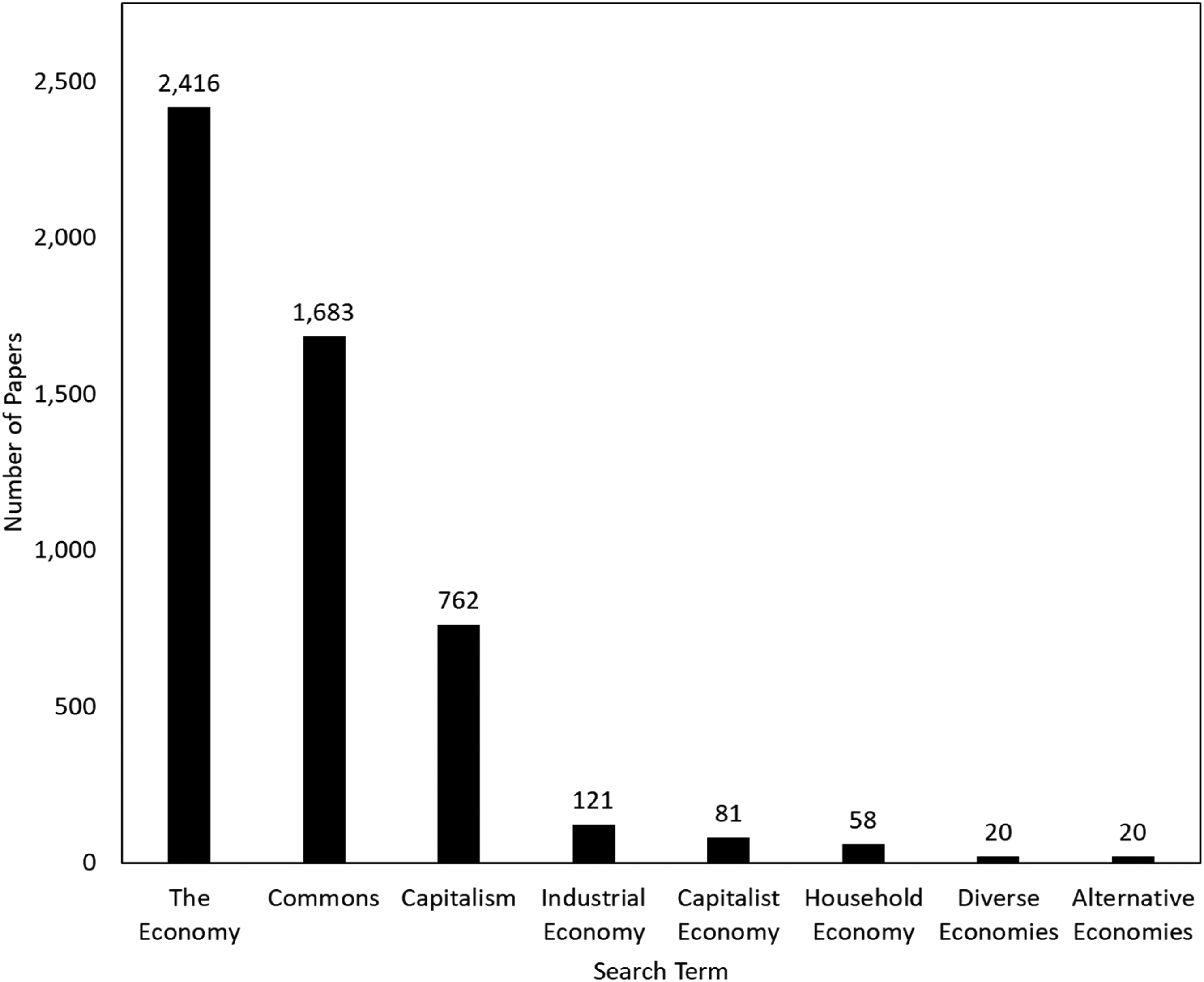
Relative frequency of papers in the journals ‘Ecological Economics’, ‘The Journal of Industrial Ecology’, and ‘Circular Economy and Sustainability’. Note that ‘The Economy’ does not include papers that include any of the other search terms. See Appendix A for full methodology.
Figure 2 shows that ‘The Economy’ 2 occurs most frequently. This term was chosen for its links to a view of the world that flattens differences between economic systems (Gibson-Graham, 2006; McKinnon et al., 2018) and its prominence suggests that substantial segments of academic sustainability writing contribute to Capitalism Unseen.
There are also streams of writing that differentiate economic systems. The second most common term in Figure 2 is ‘commons’, then ‘capitalism’, ‘industrial economy’, ‘capitalist economy’ and ‘household economy’. These terms were chosen to identify writing that names specific parts or forms of economic systems and in this way (at least implicitly) draws boundaries around them. It is possible that at least some of those identifying capitalism contribute to Making a Monolith of Capitalism. Though the extent to which this can be analysed at this high level is very limited. Only a very small number of papers (40) use the language of ‘diverse’ and ‘alternative’ economies associated with Gibson-Graham’s (2006) efforts to construct a language that overcomes capitalocentrism and avoids Making a Monolith of Capitalism.
Talking about capital
Because capital occupies a central role in economic theory, it also plays an important role in discussions of economic transformation in academic sustainability writing, but what is capital? Within economics, capital is always understood as some part of a production process, but this is as far as the consensus goes. Writers variously claim that capital originally meant purely physical inputs to production (Daly, 2020) and that it originally meant purely monetary inputs to production (Hodgson, 2014). Overviews of capital theory in economics commonly discuss a ‘dual’ character, the idea that capital has both physically and socially determined qualities, noting that different theorists place different emphasis on each ‘side’ of the duality (Endres and Harper, 2020; O’Sullivan, 2017; Schumpeter, 1954). The physical side consists of material elements that enter production (factories, tools etc.). The socially determined side consists of profits, and the social organisation of production and wealth. The balance of which of these sides dominates, and how they relate to one another leaves us with a highly contested and malleable term.
Different interpretations of ‘capital’ are used to tell different stories about economic systems (Hart and Sperling, 1987). Different stories highlight and conceal different things about economic production. Here I dive into two different ways that ‘capital’ is interpreted by different factions within academic sustainability writing. The first, more dominant, faction emphasises capital as a fundamentally physical concept. This story flattens the differences between different economic systems: the problem of sustainability becomes a problem of ‘the economy’. In this way physical conceptions of capital represent an example of Capitalism Unseen. The second story (less common within academic sustainability writing) is one that conceptualises capital as a principally social concept. This story highlights differences between capitalist systems of production and other economic systems. Consequently, it sets capitalist dynamics in historically and spatially specific contexts. In this way it is a useful alternative to Capitalism Unseen, while its focus on discontinuity offers a way to avoid Making a Monolith of Capitalism.
Stories built on physical capital
Physical conceptions of capital predominate in sustainability writing and tend to tell a story of economic production that highlights continuity of process. For instance, Herman Daly (2020: 2), argues that: ‘Capital’ in its original non-monetary sense is a physical stock or fund that yields a flow of useful goods or services over time.
The herd is the capital stock, the annual increase in the herd is the flow of useful goods or “natural income” yielded by the capital stock.
unsustainable encroachment of the economy on the ecosystem…From the empty world we are historically accustomed to natural capital existing in abundance as a free good. As the scale of the human economy has grown into the finite biosphere natural capital has become scarce.
The continuity in stories of physical capital is supported by a focus on physical service provision as the key analytical aspect of capital. For example, Daly (2020: 2) writes that services from capital stock can be understood in ‘in physical not monetary terms, quite independent of prices and exchange’. The idea that capital does not need to be understood in terms of the social relations of exchange or profit is common across academic sustainability writing. Reviewing the Green Economy literature D’Amato and Korhonen (2021: 7) observe that:
Natural capital is seen as fruitful assets, benefiting various societal actors, from individuals to organizations.
manufactured capital: i.e. material goods and fixed assets…includes… equipment (both “productive” and appliances used by “consumers”).
caring (stewardship) … the economic concept of value added is replaced by the objective of value preservation.
The stories of social capital
Social conceptions of capital are less common in academic sustainability writing but can be found, particularly in work influenced by Marxist economics. For example, Pirgmaier (2021: 7) argues that:
Capital is a form of value; it is self-valorizing value or the self-expansion of value… In simple terms: capitalism is a mode of production for profit. Part of the surplus value is re-invested to maintain production over time. The result is the reproduction of capital on an expanded scale.
Social conceptions of capital emphasise discontinuity, focusing our attention on the ways that economic production changes over time and space. For instance, social conceptions of capital argue that the same physical good may be capital in one place but not in another. Outside academic sustainability writing we see this in Robinson (1953: 83) who argues that the definition of capital is that it must be part of the process of monetary exchange:
The capital goods in existence at a moment of time are all the goods in existence at that moment. It is not all the things in existence. It includes neither a rubbish heap nor Mont Blanc. The characteristic by which ‘goods’ are specified is that they have value, that is purchasing power over each other.
in country Alpha an empty petrol tin is not a “good,” whereas in Gamma where old tins are a source of valuable industrial raw material, it is. (Robinson, 1953: 2)
The history of US capitalism shows that the productive role of capital is determined not only by the amount of capital invested but also by how that capital is used. Moreover, since the utilisation of capital is shaped by the organisation of the process through which goods and services are produced, an analysis of the productivity of capital requires an understanding of the characteristics of that organisation.
Causes and effects of different ways of talking about economic systems
Both the frequent use of ‘the economy’ (Figure 2) and the physical conception of capital, suggest that Capitalism Unseen is major part of academic sustainability writing. When academic sustainability writers use physical stories of capital or the language of ‘the economy’ our
3
writing emphasises continuity across economic history and production systems today. In this way we turn the specific relationship that exists between capitalism and the environment into a more general and abstract relationship (Pirgmaier and Steinberger, 2019). This is well illustrated with another quote from Daly (1968: 397, emphasis added): physical capital is essentially matter that is capable of trapping energy and channelling it to
By using theories of capital that support an abstract view of production in the form of one long continuous ‘human economy’ academic sustainability writing is contributing to Capitalism Unseen. By backgrounding the historically specific dynamics of capitalism, this mode of sustainability writing hides and obscures the existence of the capitalist model. In this way, we deprive our readers of a place in which they may find a challenge to dominant capitalist values and logics. Such writing not only does not contain alternatives to capitalism, it acts as though there are none at all. In this way the work of industries like advertising who are Actively Recreating Capitalism is propped up by the Capitalism Unseen that operates within some segments of academic sustainability writing.
It is not surprising that some academic sustainability writing should be blind to capitalism. Capitalism Unseen describes a widespread societal condition that Fisher calls a ‘pervasive fog’ and Active Capitalist Realism describes a well-funded and systematic campaign to produce pro-capitalist cultural objects. There is no reason to believe academic culture should be immune to such cultural forces. As the field of Science and Technology makes clear, scientists and researchers are embedded in wider society and as such we are susceptible to the same dynamics (Bacevic, 2019). The specific problem of how political economy shapes our analyses and roles we play in re-creating damaging practices of capitalism is increasingly recognised in disciplines engaging with sustainability. For example, design theorist Boehnert (2018) argues that designers are shaped by capitalist political economy in ways that limits their ability to contribute to sustainability transformations.
Not all academic sustainability writing contributes to Capitalism Unseen. For instance, there is a substantial body of work on the commons evidenced in Figure 2. Reading from capitalocentrism, this body of work can be seen as presenting possibility and diversity within economic systems. In identifying and elaborating on forms of economies that operate under their own logics and laws it may open a space for greater imagination about economic futures (Gibson-Graham, 2006). This is also possible for the small number of papers that engage with and identify ‘household’, ‘diverse’ and ‘alternative’ economies.
Those papers that engage with capitalism as an analytical term and those writers that use social conceptions of capital can be read as reactions to Actively Recreating Capitalism and Capitalism Unseen. Use of the term ‘capitalism’ can be a mild form of critique – an attempt to make capitalism visible and to remind readers that the social relations that govern ‘the economy’ today are not those that have always governed it (Pirgmaier and Steinberger, 2019). Such work is needed, but it is insufficient. Critique has flourished under neoliberal capitalism, and will not bring it down on its own (Bacevic, 2019). It is not enough to simply name capitalism, but it is a necessary starting point.
Capitalocentrism warns us against reacting too strongly to Capitalism Unseen. If all our analyses do is critique capitalism, centering it and defining all other possibilities in terms of their relationship to it they risk Making a Monolith of Capitalism. But this is not inevitable – in emphasizing discontinuity and change, social conceptions of capital leave space to point to capitalism as a specific economic object and to offer a different way to analyse and write about economic transformation. Walking the line between Capitalism Unseen and Making a Monolith of Capitalism lies in focussing not on capitalism itself, but on the spatial and temporal limits of capitalism. In this way we can emphasise the discontinuity and difference. We see this in the stories of social capital. Analyses that use social conceptions of capital must identify capitalism but also go beyond this identifying and naming alternative forces and logics of production.
To this end, academic sustainability writing could usefully engage more frequently with historical, post-capitalist, and alternative economies writing. Historical analysis provides a useful starting point for analysis of alternatives to capitalism. Silvia Federici’s (2014) Caliban and the Witch, and Ellen Meiksins Wood’s (2002) The Origins of Capitalism, both explore the development of capitalism out of non-capitalist societies. In doing so they point to other ways of living that can provide inspiration for new post-capitalist models of sustainable societies. Federici's work is especially useful as it discusses in detail the demands of social movements who opposed capitalist developments in medieval Europe. In her account we find demands for more communal forms of living outside of both encroaching market rationalities and feudal hierarchies. We have seen that very few papers in academic sustainability writing engage with the diverse or alternative economies writing in the post-capitalist tradition. This work defines the economy as the way we transform resources in order to provision our societies (Mair, 2020). Within this broad definition, there are many ways we provision ourselves (Gibson-Graham et al., 2013). Post-capitalist writing can help sustainability writers to rediscover the multitude of different provisioning systems and so to write in ways that help us see beyond capitalism today.
Supplemental Material
sj-docx-1-epn-10.1177_0308518X221114138 - Supplemental material for Writing our way to sustainable economies? How academic sustainability writing engages with capitalism
Supplemental material, sj-docx-1-epn-10.1177_0308518X221114138 for Writing our way to sustainable economies? How academic sustainability writing engages with capitalism by Simon Mair in Environment and Planning A: Economy and Space
Footnotes
Acknowledgements
This paper benefitted from numerous conversations. In particular I would like to thank Elke Pirgmaier, Kate Burningham and Tim Jackson, for pushing me to engage with Marx, and members of the Centre for Environment and Sustainability at the University of Surrey where an early version of this paper was presented. I would also like to thank the reviewers and editor, for their useful comments, which greatly improved the paper.
Declaration of conflicting interests
The author(s) declared no potential conflicts of interest with respect to the research, authorship and/or publication of this article.
Funding
The author(s) disclosed receipt of the following financial support for the research, authorship and/or publication of this article: This work was supported by the Economic and Social Research Council-funded Centre for the Understanding of Sustainable Prosperity (grant number ES/M010163/1).

Supplemental material
Supplemental material for this article is available online.
Notes
References
Supplementary Material
Please find the following supplemental material available below.
For Open Access articles published under a Creative Commons License, all supplemental material carries the same license as the article it is associated with.
For non-Open Access articles published, all supplemental material carries a non-exclusive license, and permission requests for re-use of supplemental material or any part of supplemental material shall be sent directly to the copyright owner as specified in the copyright notice associated with the article.

