




Abstract
Power couples, defined as pairs of highly educated partners, tend to cluster in cities to take advantage of more developed labor markets, better jobs, and higher wages. This research examines to what extent being a partner in a power couple brings additional wage income benefits. We examine what the effects of power couple partnering is on wage income. Furthermore, we examine how the results are affected by gender and place of residence. To determine this, the research uses detailed Swedish micro data on power couples 23–39 years of age over the period 2007–2016. Our analysis finds positive and significant results from being in a power couple on wage income after controlling for individual, workplace, and geographical characteristics. This is the case for both men and women in power couple households without children, but for women only when children are present. For power couples in denser urban areas, we find a positive effect for men in power couples with or without children. We suggest this effect is due to a more equal “balance of power” between partners in highly educated power couples located in bigger cities, where norms and values may favor a relatively greater sharing of household duties between men and women, and where men face a different competitive situation in the labor market.
Introduction
Power couples, defined as pairs of highly educated partners, tend to cluster in cities. Beginning with the seminal work of Costa and Kahn (2000) who examined the connection of power couples and cities, it has been argued that they do so to take advantage of more developed labor markets, better jobs, and higher wages. This paper examines to what extent being a partner in a power couple brings additional economic benefits in the form of wage income and whether these benefits differ for men and women in power couples. It examines the wage income effects of being in a power couple while controlling for a range of individual, workplace, and geographical factors. We define power couples as couples in which both partners are highly educated, with at least a three-year university degree.
Our research is informed by the construct of the marriage premium, which is well documented in the literature (see Ahituv and Lerman, 2007; Killewald and Gough, 2013; Richardson, 2000). Various studies find evidence of higher wages earned by married males and in particular white males (see Chun and Lee, 2001; Korenman and Neumark, 1991; Loh, 1996; Ludwig and Brüderl, 2018; Pollmann-Schult, 2011). We extend the existing body of literature on power couples by examining the presence of the marriage premium more specifically for highly educated individuals in Sweden and if this potential marriage premium is a function of a partner's education level. Our research is further informed by the construct of knowledge spillovers and their effects on economic growth (Audretsch and Feldman, 1996; Grillitsch and Nilsson, 2017; Henderson, 2007). We surmise that the same kinds of knowledge spillovers that have been documented within companies and geographic regions are also likely present within a relationship. At the same time, the conditions in the labor market may differ between women and men (Compton and Pollak, 2007; Rapoport and Rapoport, 1969). The opportunity to invest in a career can look different, for example, depending on the division of household chores, especially after having children. Additionally, there may be a geographic dimension to existing research by examining whether the potential marriage premium depends on an individual's place of residence.
Our research seeks to deepen the understanding of power couples by examining the wage effects from being in a power couple as a function of gender and geography. In light of previous research and theory, we focus the analysis on three primary research questions: (a) to what extent do economic gains accrue to the individual partners in power couples, (b) to what extent do these economic gains differ between male and female partners in power couples, and (c) to what extent do geographic factors affect these differences, in other words, are there differences in the economic gains to members of power couples who are located either inside or outside of cities.
To answer our key research questions, we use detailed micro data from Sweden for highly educated power couples 23–39 years of age over the period 2007–2016. Employing a Heckman selection model, we examine the effects of power couple partnering on wage income while controlling for the selection bias of whether a person is likely to partner. We employ a measure of population density at the municipal level to capture the degree of urbanity in Swedish municipalities (approximately the size of an American county) where the power couple resides. Every municipality consists of both dense localities (Swe: tätort) and its surroundings. A dense locality is defined as an urban space based on its population density and built environment. If the municipality is located in a metropolitan area, a larger share of the geographical area will consist of dense localities. In general, the larger share of the municipal area that consists of dense localities, the greater the population density. We therefore use population density to capture the degree of urbanity in a region. Regions with higher levels of population density are referred to as “cities.”
Our analysis finds positive and significant results from being in a power couple on wage income after controlling for individual, workplace, and geographic characteristics. This is the case for both women and men in power couple households without children, but for women only when children are present. Furthermore, regions with higher population densities tend to have an additional positive impact on the wage level for power couples, beyond a general wage premium given in larger labor markets.
The remainder of the paper is organized as follows. The next section reviews the literature on power couples. The third section outlines our data, variables, and methodology. The fourth section details the results of our analysis. The concluding section summarizes our key findings and discusses their relevance to the research literature and for future research.
Concepts and theory
There is a large body of research on dual-career households (a sub-group of dual-earner households). One of the first studies of dual-career households by Rapoport and Rapoport (1969) defined them simply as when both husband and wife pursue careers, that is, jobs that require long-term commitment. The term “power couple” was later introduced by Costa and Kahn (2000) who defined it as couples where both partners have a college degree. They found that as of 1990, 50% of power couples lived in large US metropolitan areas, which they attributed to the better availability of jobs in these metros. Furthermore, Cooke (2011) found that dual-degree households were over-represented in the 20 largest US metros, which had 52% of all dual-degree couples but only 46% of the total population.
Edlund (2005) suggests that a gender asymmetry in the marriage market may explain why there are more power couples in large cities. Based on biological factors, men tend to seek out women who are fecund and therefore tend to highly value youth. Women, on the other hand, seek financial security to secure a better future for their offspring (also see Buss, 1994; Wright, 1994). This motivates men to discount the earning capacity of their female partners in favor of youth and fertility, while women are more likely to partner with men who earn more money. Women, according to Edlund (2005), are thus drawn to large cities because they offer a larger pool of higher-earning male partners. This sorting process results in an over-representation of higher-earning men and even more so of women in cities, while lower-paid men are over-represented in rural areas. Edlund (2005) further suggests that more educated and skilled women also move to cities even if they are not interested in marriage, as larger cities offer more highly qualified jobs.
Our research is also informed by the extensive literature on “assortative mating” where individuals seek our partners of similar educational and economic status (Lewis and Oppenheimer, 2000; Mare, 1991; Qian, 1998; Schwartz and Mare, 2005; Shafer and Qian, 2010). Various studies in this line of research find a larger concentration of more highly educated people in larger metro areas. Metros with high initial shares of the highly educated also have continued to increase their shares of the educated over time (Berry and Glaeser, 2005). Chudnovskaya (2021) provides evidence that highly educated women in Sweden with higher income and occupational prestige tend to partner with men in the same social and economic group. For men, the pattern looks different, and social and economic factors do not have the same effect on the probability of whom one enters a relationship with. These patterns may be explained by social norms that can discourage women from partnering with men in lower socio-economic groups, but also that highly educated women feel a greater social distance with men who are less educated. An alternative is for an increasing proportion to simply remain unmarried. Schwartz and Mare (2005) show how the probability of remaining unmarried has increased over time and in particular at the ends of the educational distribution.
Similarly, power couples in Sweden tend to migrate to larger labor market areas. For example, among dual university-graduate households in Sweden between the ages of 22 and 33, approximately 27% lived in Stockholm, with another 23% in the two next largest cities, Gothenburg and Malmo (Nilsson, 2000). In comparison, among all households in the same age group, only 17% resided in Stockholm. Finnish power couples have also been found to have higher probabilities to reside in metros than their lesser educated counterparts (Jauhiainen, 2008).
In a study of the United States, Simon (2019) finds full-power couples (where both partners have higher educational degrees) are more likely to move to larger cities than male partial-power couples (where only the male partner has the higher education), while female partial-power couples were more likely than low-power couples. However, in comparison to singles, power couples have a modestly higher tendency to migrate out of the cities while their power single counterparts are relatively more likely to move to large cities (Gautier et al., 2010). Compton and Pollak (2007) find the migration patterns of power couples to be determined by the husband's education profile, with full-power couple migration following similar patterns to part-power couples where only the husband has a university degree.
These findings on the migration patterns of power couples reinforce a larger body of family migration studies that identifies the male partner's education as the key determinant of family migration, with the female partner's education level being far less significant (see Axelsson and Westerlund, 1998; Compton and Pollak, 2007; Swain and Garasky, 2007; Tenn, 2010). In Sweden, for example, among couples, the odds of migration to a larger metro area are higher for men with higher education in comparison to their lesser educated counterparts than the odds are for highly educated women and their lesser educated counterparts (Brandén, 2013).
Such residential location decisions appear to be shaped by a variety of perceived gains in the labor market. In particular, where power couples choose to reside may be linked to productivity gains from knowledge spillovers due to the concentration of highly educated and skilled individuals. Several empirical studies have found that wages are higher in metros with higher levels of education and skills due to knowledge spillovers (Glaeser and Mare, 2001; Glaeser and Saiz, 2003; Rauch, 1993; Rosenthal and Strange, 2008). Due to concentration in metro areas, individuals can learn from each other when industries are clustered as well as specialize in particular types of labor, which increases productivity.
Other research has found that increases in human capital, as measured by education level, result in gains in productivity, as measured by wages. Rauch (1993) estimates that a one-year increase in a US metro's average education level results in a 2.8% gain in total factor productivity. Similarly, Echeverri-Carroll and Ayala (2011) estimate an approximate 2% increase in average individual hourly wages for the doubling of human capital density in metropolitan areas. Simon (2019) finds consistent evidence that both men and women in full power couples are more likely to be employed in high-skilled occupations in large cities and that it is less likely that highly educated wives have to sacrifice their career for those of their husbands’.
Residential location decisions may also reflect preferences for non-monetary benefits such as culture, particularly regarding attitudes toward parenting. In a power couple, choosing suitable locations that ease the pursuit of career while balancing family can be a factor. Choosing places where contemporary parenting is more accepted and fostered may allow both partners to pursue careers. Related to this is what has been termed “gender ideology.” Research has found that women's participation in paid labor is positively related to an egalitarian gender orientation among partners (Bolzendahl and Myers, 2004; Huber and Spitze, 1981). Women and men who have higher education and income tend to have more egalitarian gender views (Crompton and Lyonette, 2005; Lackey, 1989). This egalitarian perspective is also reflected in the probability of sharing parental leave more equally between the sexes. One reason may be that a higher education often leads to a higher income, which, in turn, makes it easier to stay at home with children for a longer period. However, a higher income also means a higher alternative cost during parental leave. In addition, this is a group that is often more career-oriented. The fact that highly educated fathers still take a larger share of parental leave days than low-educated men is often explained by norms and attitudes (Duvander and Johansson, 2014; Duvander and Viklund, 2020; Geisler and Kreyenfeld, 2011).
There is some evidence that gender ideologies, relations, and practices may vary by location. Haandrikman et al. (2021) examine the geographical variation of how family responsibilities in Swedish households are distributed, via a so-called gender contract. Even in a relatively equitable country like Sweden, the highest degree of equality is found in metropolitan areas and other urban areas, while a more traditional distribution is more common in rural areas, where the male is the breadwinner who takes parental leave to a lesser extent. Cross-national studies have found that countries that have both more opportunities in the labor force for women and more gender-egalitarian societies influence the gender ideology of men and women (see, e.g. Iversen and Rosenbluth, 2006; Knudsen and Waerness, 2008). Haddad and Lam (1988) show male immigrants to Toronto, Canada participated in more domestic activities compared to prior to their immigration due to new socio-economic and socio-cultural realities in the city that they adopt.
Furthermore, contemporary gender contracts involving a more equal distribution of domestic activities may reflect the urbanization of dual-earning power couples with their diversity of family structures and higher levels of education (Hardesty and Bokemeier, 1989; Kamo, 1988; Stefansen and Aarseth, 2011). In contrast, more traditional gender contracts, with the male partner as main financial provider, is relatively more prevalent in rural contexts (Brandth and Haugen, 2005; Cloke, 2005). Creighton et al. (2015) find evidence for such differences in parenting practices among large urban versus smaller urban and rural places in Canada. Their study finds that fathers in large urban settings use a more “gender neutral” approach to parenting, while both small urban- and rural-based fathers aligned with more traditional gendered roles.
Variables, data, and methods
Our analysis was designed with these theories, findings, and questions in mind. As noted earlier, our research examines the economic effects from being in a power couple as a function of gender and geography. Figure 1 outlines the structure of our analysis. All data is micro data from Statistics Sweden's Microdata-ON-line-Access (MONA). The data is not a sample but includes all individuals in Sweden. Our data set covers the years 2007 to 2016. As per Costa and Kahn (2000), we select women in the age group 23–37 and men in the age group 25–39. We track partners based on marriage or cohabiting partners with shared/common children. This definition is a consequence of the available information from Statistics Sweden. For individuals who live together without being married and/or without children, the statistics do not show whether it is a relationship or, for example, two students who choose to share housing. Our data limitation means that we can assume that those who share a home in the vast majority of cases are a part of a relationship. We only include individuals who have a university degree and examine if (a) they are in a cohabitation relationship and (b) if the partner holds a university degree. The analysis is cross-sectional with controls for other individual, workplace, and geographical characteristics, as well as for year, and the data is constructed as an unbalanced panel where individuals enter and exit the data based on, for example, changes in age, immigration or emigration, or achieved educational degree.
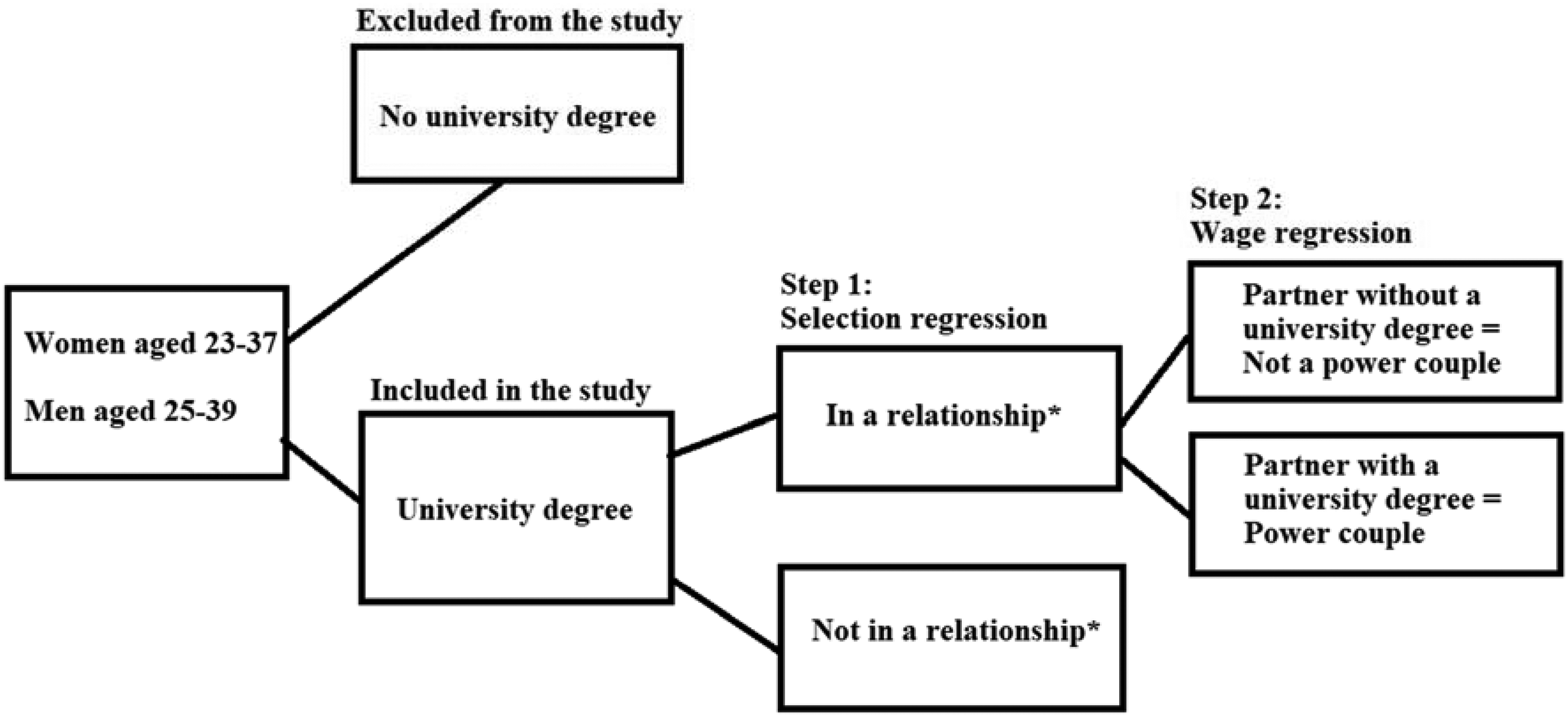
Individuals included in the study. *Relationship defined as per married or cohabits with a partner with whom they share children.
Dependent variables
Our analysis is structured around two dependent variables.
Partner or not: This variable takes on the value 1 if the individual in the selected age group is married or cohabits with a partner with whom they share children; otherwise, the value is 0. This implies that a person who lives with someone else but where the household does not include children will take on the value 0. This is the dependent variable in step 1 in the regression analysis (the selection regression). Building on Schwartz and Mare (2005), highly educated individuals are among the least likely to remain unmarried. We control for a possible selection bias in our studied group of those who do not live in a married relation or in a household with children.
Wage income: This is the total wage income from employment and/or self-employment, in other words earned income. Statistics Sweden's data contains information on all income from some form of paid work, regardless of whether the individual has been employed by another employer or received a wage pay from one's own company. As the data cannot distinguish the number of hours worked per week, but both full-time and part-time employees are included. Wage income, used in its logged form, is the dependent variable in step 2 in the Heckman regression analysis.
Independent variables
Our analysis also includes a range of individual, workplace, and geographic characteristics.
In a power couple: This is a dummy variable that takes on the value 1 if the individual belongs to a power couple, in which both partners have a university of exam of three years or more. The value 0 indicates that the individual is highly educated but partnered with someone with a lower educational degree.
Other individual characteristics: We control for a number of individual characteristics that can be expected to relate to the individual's wage level such as gender (man = 1), foreign born (yes = 1), education (where 1 = PhD degree), number of children (age 0–3, age 4–10, and age 11–18), employment status (employed or not, self-employed, or not), industry of employment, and occupational skill level ( = 1 if high skilled occupation).
Workplace characteristics: We control for the share of highly educated in the workplace.
Geographic characteristics: We control for the share of highly educated in the nearby residential neighborhood (demographic statistical areas—DeSo), which is defined by Statistics Sweden based on common characteristics such as household income, type of housing, and demographic profiles, and in the municipality (which is approximately equivalent to a US county). Sweden has 5984 DeSO defined by Statistics Sweden. The division considers the geographical conditions so that the boundaries, as far as possible, follow, for example, streets, watercourses, and railways. The purpose of DeSO is to produce one nationwide classification of neighborhoods for statistical follow-up of socio-economic segregation. This classification of neighborhoods is constant over time, which facilitates longitudinal analysis. We also control for municipal density, since earlier work suggests that power couples are over-represented in urban areas.
Our panel is unbalanced given that some number of individuals will enter or leave our selected age group and that some will immigrate or emigrate during these years. When an individual leaves Sweden, he or she will no longer be included in our data. We track every individual in the selected age groups and determine whether he or she is in a power-couple relationship, and if so, what the individual's wage income is while controlling for individual, workplace, and geographic characteristics.
To estimate whether there may be a positive relation between being in a power couple and the individual's wage income, we use a two-stage Heckman estimation 1 (Heckman, 1979). We examine (a) the likelihood of being in a partnership (married without children or in a household with two adults and at least one child), and (b) the individual wage income. We use a Heckman estimation to control for selection bias, given that the characteristics related to wage income levels may depend on the selection of individuals who are in a partnership. For example, single people may have more time to invest in their careers, which could have a positive effect on their wages. In step 1, we use a probit selection regression to estimate the likelihood of being in a relationship based on individual, workplace, and regional characteristics. We include individual variables such as age, gender, and educational background and variables for workplace and residential characteristics. For robustness checks, we also run step 2 of the regression analysis as an OLS.
To orient the analysis, Table 1 summarizes the descriptive data for the key variables in our analysis.
Variables description.
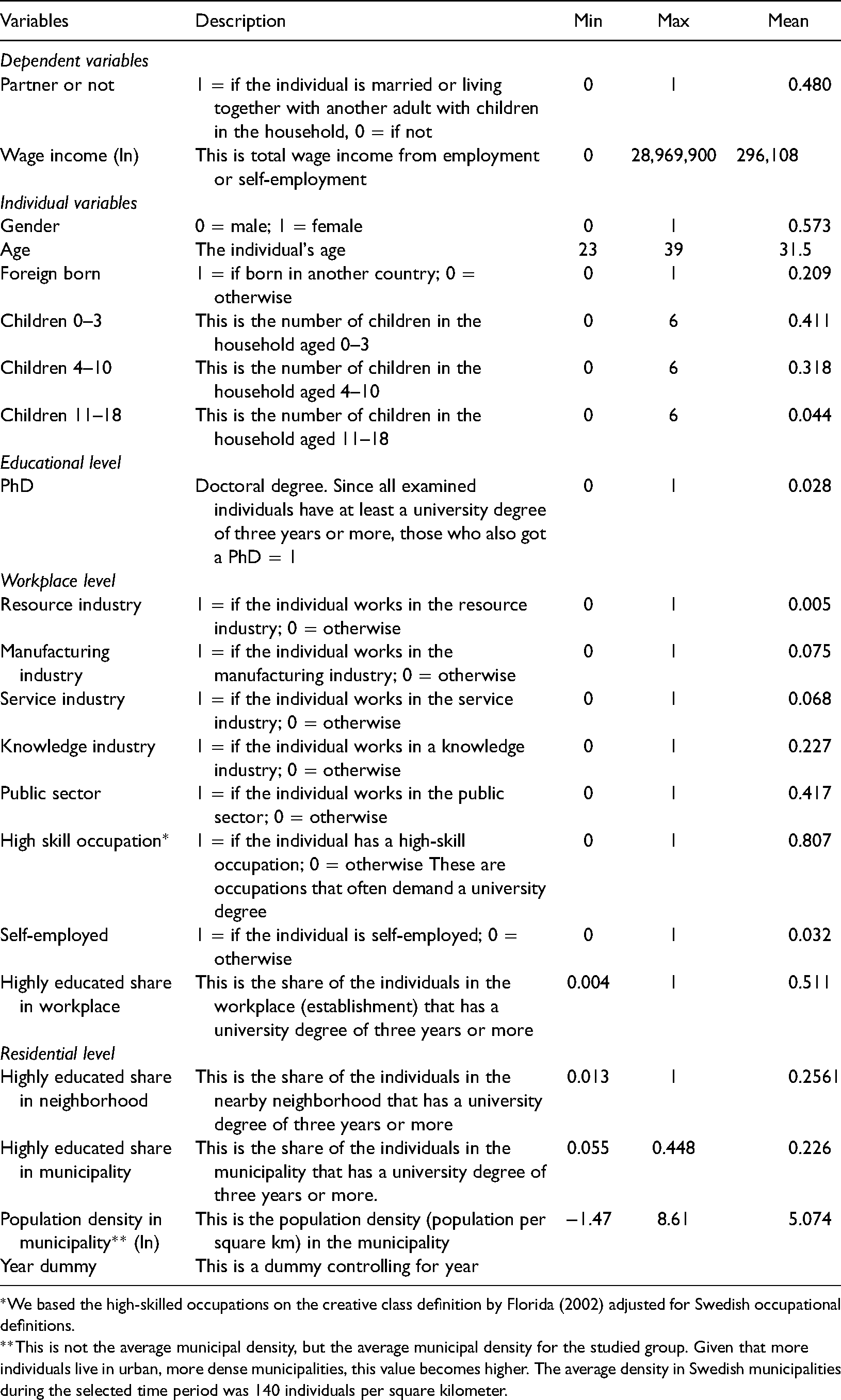
*We based the high-skilled occupations on the creative class definition by Florida (2002) adjusted for Swedish occupational definitions.
**This is not the average municipal density, but the average municipal density for the studied group. Given that more individuals live in urban, more dense municipalities, this value becomes higher. The average density in Swedish municipalities during the selected time period was 140 individuals per square kilometer.
Findings
We start by summarizing the percentage of individuals in the studied age group with university degrees in each annual data set for the years 2007–2016, then (a) the share of all couples with at least one partner with a university degree and (b) the share of power couples with both partners with university degrees (Table 2).
Types of power couples.
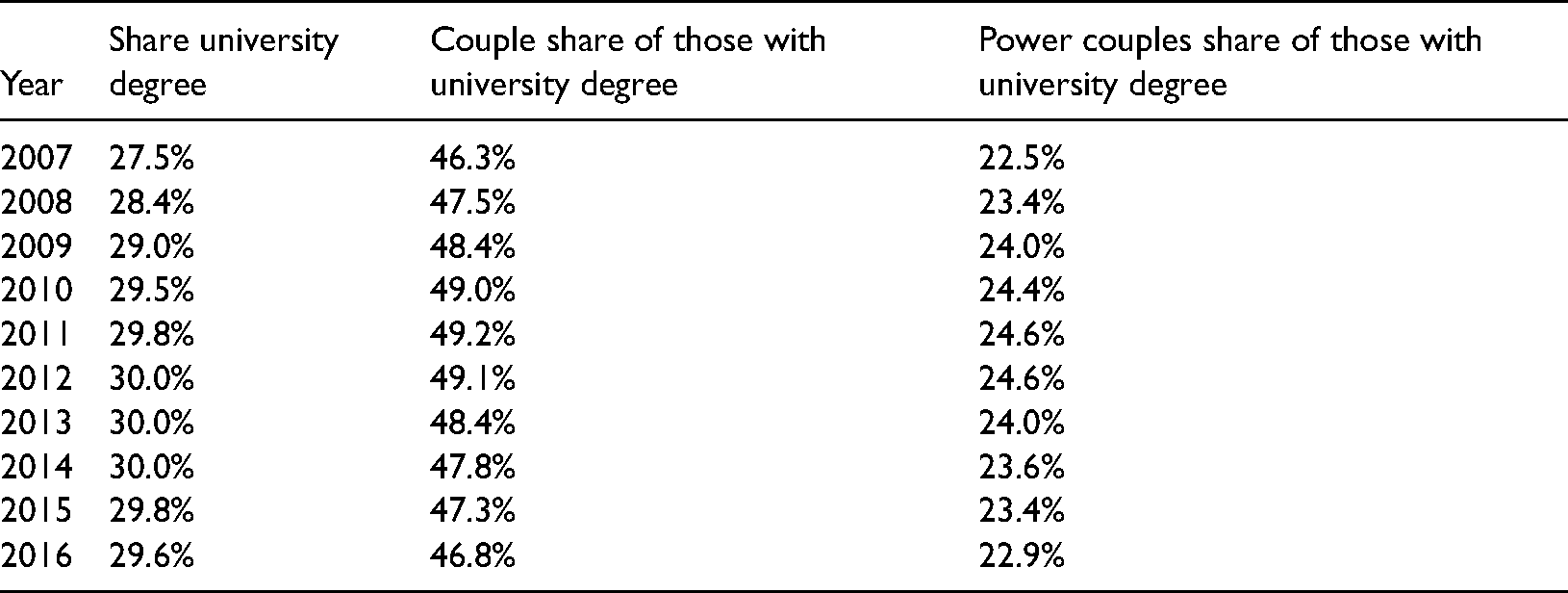
Column 1 shows the share of the individuals in the studied age group with a university degree. Column 2 shows that couples of any mix of higher education account for roughly half of all university educated individuals in the studied age group. Column 3 shows that power couples where both partners have higher education account for about half of all couples with a university degree, thus about a quarter of all individuals with a university degree.
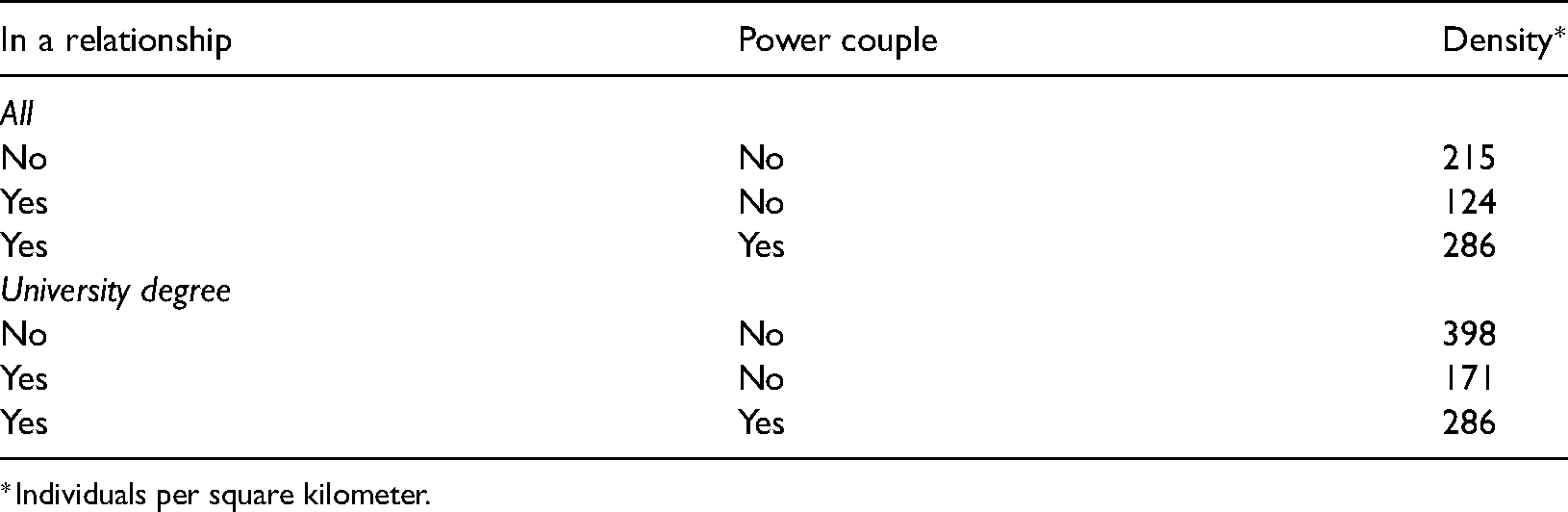
Table 3 looks at the connection between power couples and population density. Since the share of power couples varies slightly over the studied time period, we look at the average values for 2007–2016.
Density and power couples.
*Individuals per square kilometer.
As Table 3 shows, power couples tend to live in higher density places (286). That said, highly educated singles (not in a relationship) tend to live in places with the highest density (398). Singles may be drawn to cities because of their labor markets, wages, and the prevalence of other singles. Still, power couples tend to live in areas with higher population density than single people without a university degree (286 vs 215).
Table 4 examines the wages of individuals in power couples versus individuals in other groups. Singles (not in a relationship) with or without a university degree have lower wages than their counterparts in a relationship. However, this may be a function of age, since younger people with less work experience (and thus lower wages) are more likely to not yet be in a relationship. Two individuals in a power-couple relationship each have significantly higher wage income than singles or couples without university degrees. This is to be expected since individuals with a university degree tend to earn more on average. In short, highly educated individuals in power couples out-earn all others.
Wages and power couples.
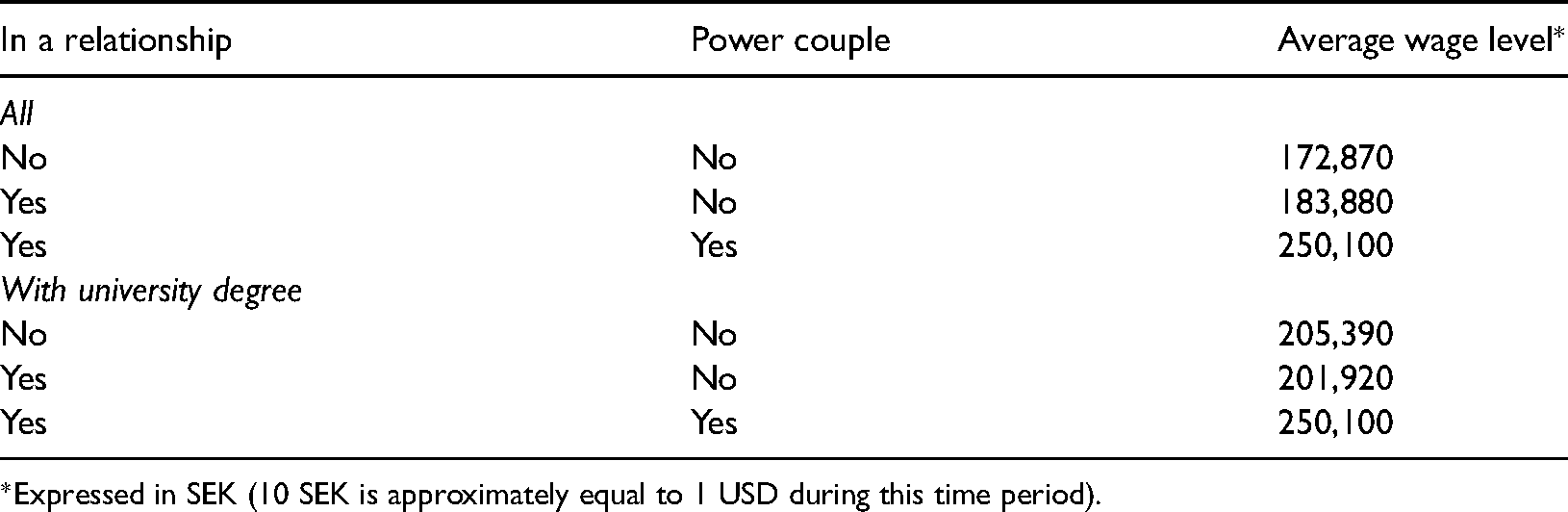
*Expressed in SEK (10 SEK is approximately equal to 1 USD during this time period).
Regression analysis findings
The differences in wages cited earlier may be a result of other characteristics among individuals associated with where they live, their industry, or occupation. We use a regression analysis to distinguish which relevant factors, if any, might be at play. We employ a two-stage sample selection model where step 1 estimates the probability of being in a relationship to start with, while step 2 estimates the wage level. In step 2, we focus on the various coefficients for the power couple variable; in other words, if the individual is in a power couple relationship, does each factor add positively to the wage level? We select only individuals with a university degree since it is a prerequisite that at least one of the two has a university degree to have the potential to be a part of a power couple.
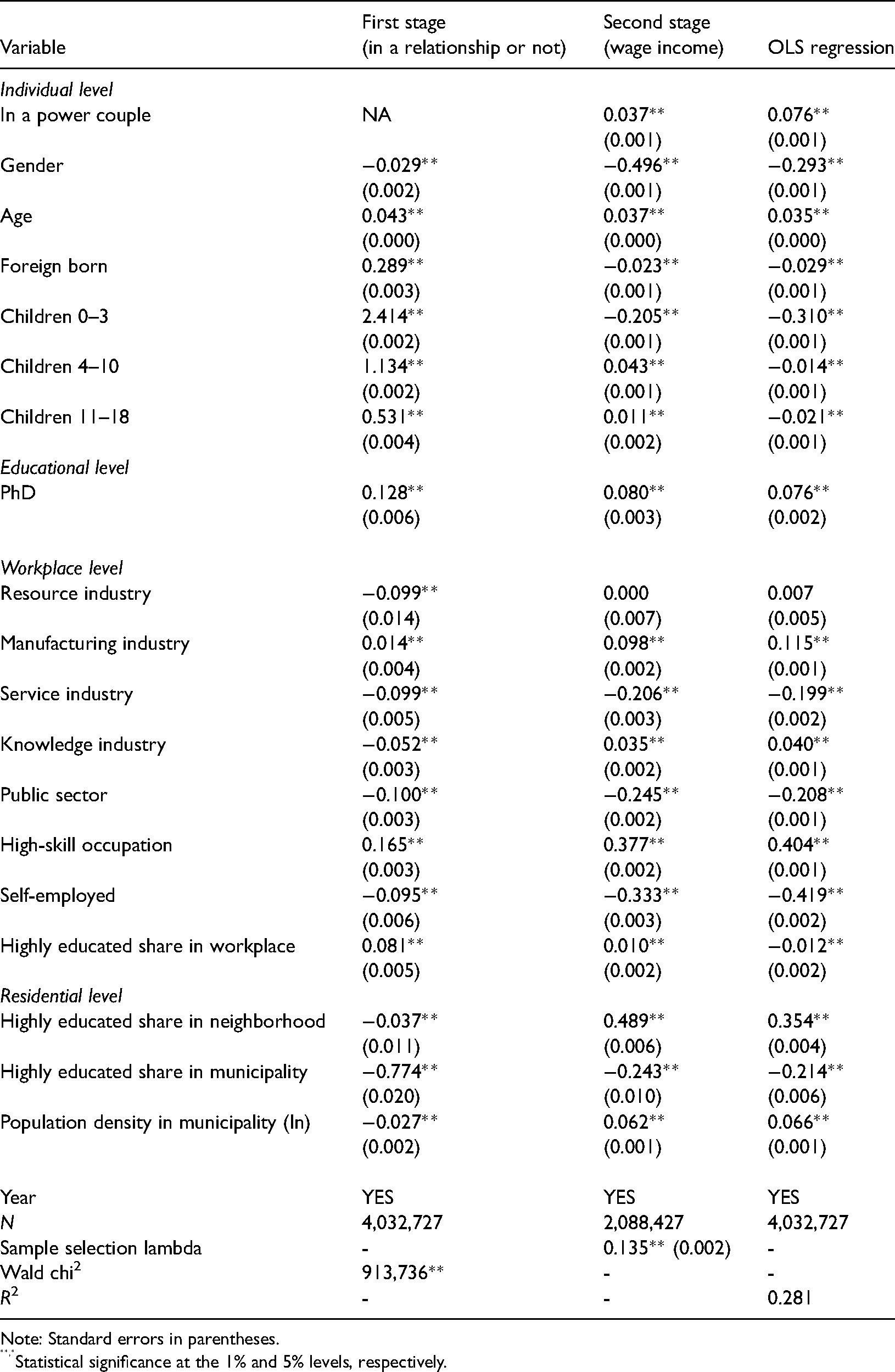
Table 5 summarizes the results for all university educated individuals in our selected age group. Column 1 illustrates the likelihood of being in a relationship for individuals with a university degree. Column 2 shows the results for wage income, given that the individual is in a relationship. Column 3 is a robustness check, showing the results for an OLS for wage income without a selection bias correction.
Regression results for those with a university degree.
Note: Standard errors in parentheses.
Statistical significance at the 1% and 5% levels, respectively.
As per column 1, we note that older individuals in our given age group are more likely to be in a relationship. The same is true for individuals with children, regardless of the age of the children. Men are less likely than women to be in a relationship, as the variable for gender is negative and significant. Foreign-born individuals are more likely to be in a relationship. Individuals in high-skilled occupations in a workplace with a larger share of highly educated are more likely to be in a relationship. The same is true for individuals working in the manufacturing industry. Those working in service or resource industries, the public sector, or are self-employed are less likely to be in a relationship. We also find a negative result if the individual works in a knowledge industry. Individuals living in a neighborhood where a larger share of the population is highly educated are more likely to be in a relationship. This is also the case if the individual lives in a municipality with a higher population density.
We find a positive and significant result for the power couple variable in both the Heckman and the OLS regressions. Belonging to a power couple is positively and significantly related to a higher wage income when we control for individual, workplace, and geographic characteristics. While the strength of this relationship is somewhat weaker after correcting for the selection bias in the Heckman regression, it is still stronger than the variable for the share of highly educated in the workplace. Thus, being a power couple is positively related to wage income, even after we control for selection bias as well as other individual, workplace, or geographic characteristics.
The control variables in the wage income regression show expected results. The better educated, the higher the wage income. Age is positively related to wage income and men earn more than women. Being foreign born is negatively related to wage income and so is having young children (aged 0–3 years). Having a high-skilled occupation is positively related, while being self-employed is negatively related to wage income. At the residential level, we find positive results for the share of highly educated in the neighborhood as well as for population density.
We now turn to the results for gender. The findings thus far confirm that wages are higher for those who are members of a power couple, but we now look at whether that varies by gender. We re-run the same regressions, but we split the sample based on gender. Table 6 illustrates the results for the power couple variables after controlling for individual, workplace, and geographical characteristics.
Regression results for power couples by gender (controlling for individual, workplace, and geographic characteristics).

Note: Standard errors in parentheses.
Statistical significance at the 1% and 5% levels, respectively.
Starting with the regression analysis for women, we consistently find positive and significant results between being in a power couple and wage income. This suggests that women tend to benefit from being in a power couple. The results are different for men. The OLS regression finds being in a power couple is positively associated with men's wages, but the Heckman regression finds a negative and significant association. Taken together, these results suggest that women may benefit more from being in a power couple than men.
These findings may seem somewhat counterintuitive. One might think that men would benefit more equally from being in a power couple. However, it is well established that men in general tend to do a relatively lower share of household duties and/ or child-raising activities and are thus able to devote more time to work. However, this logic may differ for highly educated power couples in which the men may seek to share household duties on a relatively more equal basis (Crompton and Lyonette, 2005; Lackey, 1989). Highly educated women have made considerable investments in their education and careers and may seek out highly educated male partners who share their values and expectations of equality. Highly educated males may equally orient their search for highly educated female partners with this equitable share of household duties in mind. They may be willing to tradeoff greater household duties to attract a more highly educated partner who contributes more to household income, thus creating power couples.
The results change, however, when we consider power couples without children. As Table 7 shows, we now find a positive coefficient from being in a power couple for men. In power couples without children, men as well as women benefit from being in a power couple. The logic for this may be that men in power couples are able to benefit before children but are then willing take on more household and child-raising duties once children enter the picture. In Sweden, this approach to household equality may be related to the country's extensive policy for parental leave which enables leave time to be split between both parents. In 2016, 72.4% of parental leave days were used by the mother, and 27.6% by the father. More highly educated couples are more likely to share the parental leave days more equally (Social Insurance Office, 2019).
Power couple variable coefficient for couples without children (Heckman step 2 for wage income), controlling for individual, workplace, and geographical characteristics (Heckman step 2 for wage income).
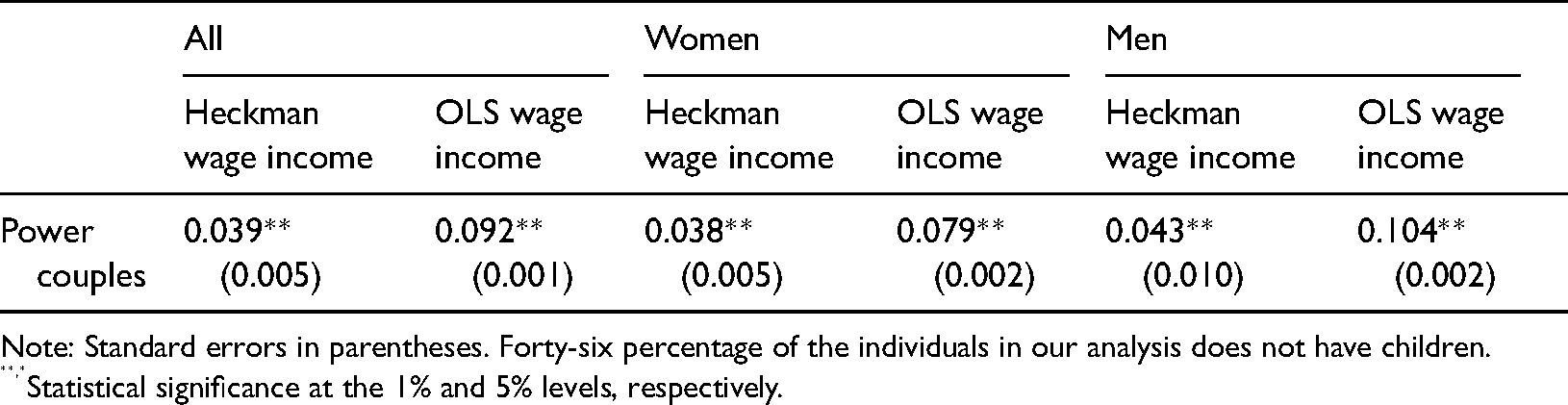
Note: Standard errors in parentheses. Forty-six percentage of the individuals in our analysis does not have children.
Statistical significance at the 1% and 5% levels, respectively.
Power couples in cities
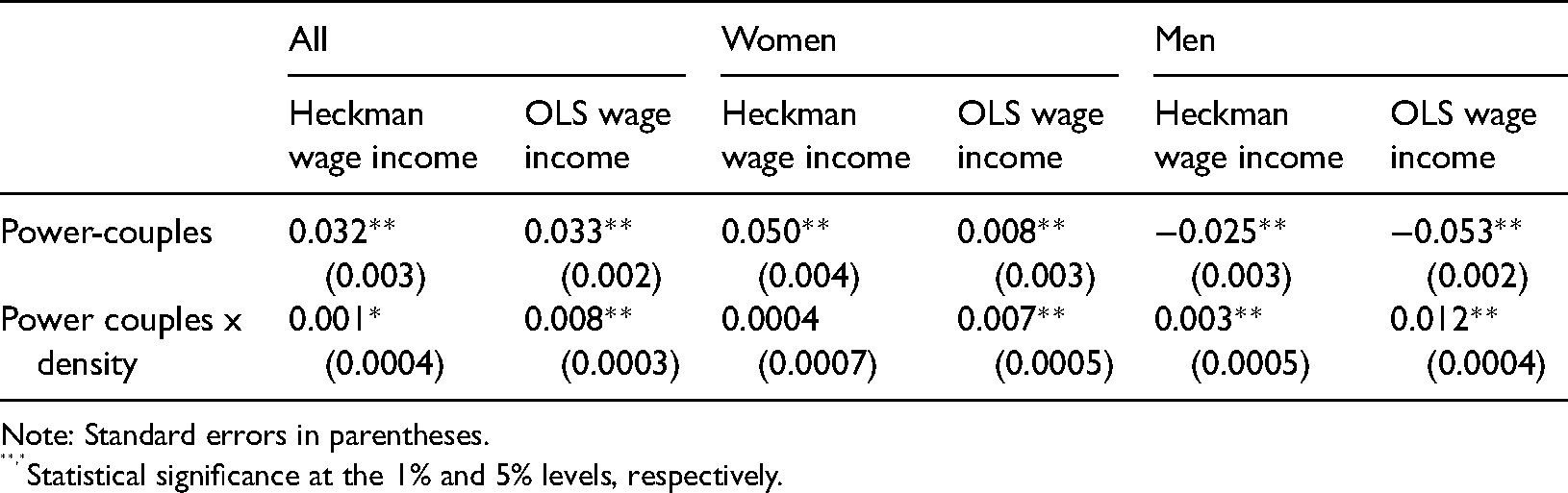
We now turn to our analysis of power couples and cities. We have already seen from the literature that power couples are over-represented in larger, denser places. We are particularly interested in the role of population density on the observed differences for wage income for power couples overall and for women and men individually who are members of power couples. To get at this, we run the same regressions, adding an interaction variable for power couples combined with population density. Table 8 summarizes the key results, with fuller results listed in the Appendix.
Results for power couples and density (controlling for individual, workplace, and geographical characteristics).
Note: Standard errors in parentheses.
Statistical significance at the 1% and 5% levels, respectively.
As before, we find a positive and significant power couple association for women but a negative association for men. However, we find an additional positive and weakly significant effect for the interaction variable (power couples x density). Furthermore, this effect is positive for men and insignificant for women. While the latter group still has a positive effect from being in a power couple—regardless of the degree of density—the negative effect from being in a power couple for men is partly offset in bigger cities. This result may reflect the fact that highly educated women in general benefits financially from partnering with a highly educated man. It may imply a more equal sharing of household duties and childcare as suggested by prior research (e.g. Duvander and Johansson, 2014; Duvander and Viklund, 2020). This would be true regardless of geography. For men, the situation is slightly different. For them, it may be a cost to split the domestic work equally, since that makes them less competitive compared to men in more traditional relationships, where the female may be less educated and take on a larger share of the work. In bigger cities sharing equally would be more of a norm (Haandrikman et al., 2021), and thus, the expectations from employers would be that also the man takes parental leave and stays at home with sick children. Therefore, men in power couples in cities would lose less financially from such a relationship when they reside in bigger cities. In more rural areas, the norm might be that women are expected to take on more of the domestic work, while men are less expected to stay at home with children.
The structure of the marriage market may also help to shape these results. As described by Edlund (2005), Chudnovskaya (2021), and Schwartz and Mare (2005), women are more likely to partner with someone of equal or higher levels of education and income. The alternative may be to not be in a relationship at all. However, for highly educated men, the alternative is more likely to partner with a woman of lower educational status, who would have less to lose financially from staying at home and taking on a relatively larger share of the domestic work and childcare. The power couple women in our study thereby are more likely to “compete” with single women in the labor market, while the power-couple men compete with other highly educated men who have more support when it comes to household work. However, since we find more power couples in cities, the competition in the labor market more likely consists of other men in similar situations.
Therefore, the members of power couples in bigger, denser cities view themselves and each other as more equal partners. Such cities tend to have values and norms that encourage women to pursue their careers, while also having greater equity between highly educated men and women in terms of a more equal sharing of household duties. Such norms reflecting greater gender equity are particularly the case in Sweden and other Scandinavian countries. However, there would be an additional effect based on the competitive situation in the labor market and this would differ between men and women.
To further examine whether the power couple effect is picking up unobserved productivity, we estimate how the variable is affected if we eliminate variables in the regression that should have a positive relation with wage income in the earnings equation. More productive individuals may tend to sort into more educated workplaces and neighborhoods. They are also more likely to hold a high-skill occupation. We therefore follow the strategy by Andersson et al. (2014) and eliminate the variables (a) High-Skilled Occupation, (b) Highly Educated Share in Workplace, and (c) Highly Educated Share in neighborhoods. When we exclude Highly Educated Share in Workplace, as well as Highly Educated Share in Neighborhoods, the coefficients remain robust. 2
Discussion and conclusion
Our research has examined the connection between power couples, wages, and cities using unique and comprehensive micro data for Sweden. Our results find that being in a power couple in and of itself yields higher wage income. This is partly in line with Greenwood et al. (2014) who find that highly educated partnerships decrease household inequality, and Simon (2019) who find that households where both are highly educated, and who lives in cities, are more likely to both have high-skilled jobs. This also supports other research which finds power couples to be more likely to move or reside in large urban metro areas where premiums on education and better job matching are available, leading to higher incomes (Compton and Pollak, 2007; Costa and Kahn, 2000; Nilsson, 2000).
An interesting and counterintuitive finding comes when we break out the individual wage effects of being in a power couple for women and men. Women see higher wages from being in a power couple, but men do not. This could stem from the results of Simon (2019) that high-skilled couples are more likely to both have high-skilled jobs and that the college-educated wives are not sacrificing their careers for those of their husbands'.
Our finding here may reflect that Sweden is a country where men and women in power couples tend to more evenly share household and child-raising duties compared to other countries such as the United States. However, similarly in the Swedish context, non-market work has been found to be negative on earnings and in particular women with children (Magnusson, 2010; Matteazzi and Scherer, 2021). Highly educated women have made significant investments in their education and careers and may seek out men who are willing to take on more of these duties. More highly educated men may develop values that reflect a commitment to greater gender equity, and thus, they too may seek out partners who expect more equal sharing and are able to contribute more to overall household income.
Interestingly, the results change for power couples without children. Being in a childless power couple now has a positive effect on men's wages as well. However, it may be the case that these results demonstrate that men are more willing to sacrifice their career and wages and take on more household duties after children enter the picture. Potentially, a more balanced share of family responsibilities among power couples is assisted through the family support polices in Sweden, in particular those that promote paternity leave. It is unclear whether the negative effect of males’ earnings would exist in other countries.
Perhaps, our most interesting finding is that cities have an additional effect on the connection between power couples and wages. When we interact the variable for power couples with density, we find that density reduces the magnitude of the negative effect for men such that it becomes positive. In other words, men in power couples are economically better-off in bigger, denser cities. This may be due to the more progressive, gender-neutral values of larger denser cities, compared to smaller places where more traditional gender norms are likely to be more prevalent. This finding is supportive of prior research which finds power couples to be more likely to migrate to large labor markets compared to other couples (Mariotti et al., 2015; Tano et al., 2018). With both partners in a power couple faring better in larger cities, this may further encourage highly educated to remain or move between larger cities thereby making it even more challenging to recruit highly educated to smaller cities.
It is possible that these results reflect the relatively unique context of Sweden which has among the world's most generous family support policies and where norms and attitudes are among the most progressive when it comes to equity between genders. However, this, in turn, suggests that such policies for greater family support and more generous paternal leave affect the general norms and values in favor of a relatively greater sharing of family duties between men and women. This, in turn, could have positive economic benefits for partners and families and may be worth expanding in the United States and other countries or by city, county, or regional governments in those countries. This is an important and fruitful question for future research. We hope our study encourages more research on the connections between power couples, gender, and cities in other countries and contexts more generally.
Footnotes
Declaration of conflicting interests
The author(s) declared no potential conflicts of interest with respect to the research, authorship, and/or publication of this article.
Funding
The author(s) received no financial support for the research, authorship, and/or publication of this article.
