




Abstract
This article explores the connections between planning and land rent through a case study of density bonusing in Toronto, known as ‘Section 37’ – a form of land value capture. Density bonusing facilitates speculative bidding on future rents by private developers seeking ‘highest and best’ land uses – or efficient land uses – yet has implications related to equity when the unearned increment is extracted to recover value and invest in public goods. We situate land value capture within debates on the unearned income derived from land development in cities. We view the case of density bonusing through the lens of discretionary planning systems operating through flexible mechanisms. Specifically, we consider the direct role of planners towards balancing private interests with public goods in the face of shifting market and political contexts. The findings show that securing public goods from private land development through the unearned increment lacks consistency and predictability when the flexibility exercised by development actors drives planning decision-making. We conclude with a discussion on the implications for discretionary planning and land value capture in market-intensive, neoliberal environments.
Introduction
In recent years, there has been growing interest by scholars and planners to understand how the principles of land value capture (LVC) play out in policy and planning practice as a means for cities to recover value to finance public goods resulting from rezoning actions (Wolf-Powers, 2012). Meanwhile, the politics of land use planning surrounding the concessions and remit of developer contributions is often shown to undermine the legitimacy and viability of planning instruments, such as in the case of Toronto. In 2012, the former Mayor of Toronto Rob Ford, following the approval of greater density, characterized the taking of developer contributions by city councillors to fund public amenities as a ‘shakedown.’ Three years later, Mayor John Tory called for reforming the planning policies for density bonusing in light of city councillor Mark Grimes botching a negotiation with a developer. The city's integrity commissioner, Valerie Jepson, found that the councillor agreed with the developer to reduce their total public benefit contribution by $100k. The investigation further found that Grimes had exercised ‘improper use of influence’ by appearing in promotional videos for the developer and seeking fundraising donations from them. As noted by Jepson, these actions undermined public trust in planning decision-making and appeared unfavourably on councillors, who in their dealings with developers ‘exercise significant authority and influence over the planning process’ (Lancaster, 2016). Following these events, in 2018, a city auditor report called out city planners to properly enforce the realization of negotiated developer deals, citing issues of transparency, accountability, and oversight in the planning process, issues which have persisted in the Section 37 regime for decades.
Taking these issues as a starting point, this article analyses density bonusing as a financial and policy instrument shaping site-specific property development in Toronto. Recently, Toronto has experienced rapid growth and residential high-rise development at an unprecedented scale, leading North American cities in total active construction cranes in 2019 (O’Neil, 2019 in Biggar and Siemiatycki, 2020b). Underpinning this trajectory are strong market forces driving financialization processes (Charney, 2001), including low interest rates, foreign direct investment, ownership of new condominium housing stock, and competitive speculation on a small land supply (Filion et al., 2015). The growing use of density bonusing is indicative of reliance on the private sector to build predominantly market housing, providing the necessary incentives for property developers to contribute to public infrastructure. Such an orientation has prompted Rosen and Walks (2015: 306) to suggest that bonusing ‘is an important but under acknowledged aspect of neoliberalization of public policy in Toronto.’ Our research is situated within these debates, drawing attention to the development-led aspects of planning processes tied to density bonusing, emphasizing its ascent over the past 40 years from a development control to development enabling policy.
Density bonusing – known as ‘Section 37’ – is a form of LVC used in Toronto since the 1970s (Moore, 2016; Friendly, 2020). LVC refers to the public sector recovery of part or all of the land value increments – known as the ‘unearned increment’ – generated by actions other than the landowners,’ including public investments in infrastructure or administrative changes in land use planning, policy, and regulations. Making use of this unearned increment – referring to rising land values due to public decisions or the economy – the community may benefit through the provision of community benefits (Alterman, 2012). In Toronto, Section 37 of Ontario's Planning Act grants developers exceptions from planning rules to increase height and density in exchange for providing a range of community benefits including parkland improvements, affordable housing, and public art, negotiated between city councillors and developers. Beyond density bonusing, which does not function as a direct revenue stream, Toronto's capital investment in public infrastructure is secured through fixed revenue streams, including development charges, property taxes, commercial business levies, provincial tax transfer payments, and federal excise taxes such as the gas tax (City of Toronto, 2007; Côté, 2009). As will be discussed, the rise of unearned increment using density bonusing was precipitated by key government planning policy decisions to facilitate investment and increases in commercial and residential building supply.
The idea of density bonusing resonates with debates on land rent, dating to works by David Ricardo and other classical 19th-century economists. As Haila (2016) suggests, the history of land rent adapted to emerging social problems of the time, including poverty, taxes, speculation, and high land prices. In the United Kingdom, as wealth came to be derived from industrialization rather than agriculture, there was a broad concern that landowners would profit from the land they owned. This provided a motivation to return some profit to the state, presented as a ‘panacea’ to solve social problems (Booth, 2012). Drawing on Ricardo's work on economic rents, John Stuart Mill (2001[1848]) called for taxing what later became known as the unearned increment.
This debate also proceeded in the United States, where Henry George argued that land value increases should accrue to society as the collectivity had created the value from land use. Thus, the unearned increment created socially does not belong to the property owner, and should be reallocated to benefit society (Kohn, 2016). George (2009[1881]: 378) argued that the public capturing of land values represented ‘the taking by the community, for the use of the community, of that value which is the creation of the community.’ Based on the labour theory of value, the idea implies that the landowner has not produced its worth through labour, suggesting that collective activities create value from the use of land. These profits constituted a pure rent, imposing an unfair burden on those whose activities gave it value (Fainstein, 2012). For Sayer (2020: 4), while the unearned income derives from controlling an existing asset, those receiving income from it do so as a reflection of power ‘based on unequal ownership and control of key assets.’ This form of asset-based unearned income is known as rentier income, based on power rather than a contribution of income as a financial investment. While capital gains from property are often viewed as legitimate sources to be shared with society, who benefits is also important – wealthy property investors, or public sector workers whose pensions are linked to property development. Ultimately, these ideas related to land rent converge on a similar idea of property relations: that a portion of privately owned value belongs to society, and some of this value should be shared (Kohn, 2016).
Financialization of urban development can be understood as a broad structural transformation of economies in which profits accrue primarily through financial channels, rather than trade and commodity production (Aalbers, 2015; Arrighi, 1994; Epstein, 2005; Krippner, 2005). 1 Importantly, density bonusing is relevant to broader debates on urban financialization, but is not defined by it. Like other scholars, we view density bonusing as a planning practice of LVC where planners leverage the property market to fund public goods (Shih and Shieh, 2020). That said, LVC instruments are not created equally in their effectiveness to mediate the market. They may prove to be uneven when they ultimately fail to recover sufficient public value from the market as a consequence of government intervention in property markets, with incentives for property developers (Fainstein, 2016). Indeed, considerable literature shows that profound inequalities are produced by financialization processes (Halbert and Attuyer, 2016; Hyde, 2020; Soederberg and Walks, 2018; Theodore et al., 2011; Walks, 2014), viewed through uneven development as a trademark of real estate development under capitalism. Fainstein (2016) underlines the inequalities produced through property investment based on financialization, neoliberal ideology, globalization, and state-sponsored social welfare programs. These processes function at several scales through interactions between financialization and the planning system, including the site-specific scale of property development (Bryson et al., 2017).
In this article, we make three contributions to debates on land rent, LVC, and flexibility. First, building upon and extending existing work viewing LVC in relation to financialization processes around the world (Chen, 2020; Klink and Stroher, 2017; Margalit and Alfasi, 2016; Savini and Aalbers, 2016), we highlight connections between planning and land rent. Indeed, the idea of unequal property rights in contemporary neoliberalism (Sayer, 2020) provides a viewpoint for debates on the unearned income derived from land development in cities, particularly at the scale of the built environment and negotiation processes between city governments and private property developers. Yet how to capture the unearned increment and calculate an appropriate value remains a persistent challenge for planners who relegate development economics and promote equity-based policy objectives, often at all costs. Second, we view density bonusing through the lens of flexibility, providing considerable insight into discussions about who benefits from discretionary planning systems operating through flexible mechanisms, and whether density bonusing is used for public goods or dominated by market interests. Despite connections between entrepreneurial forms of planning and flexibility (Margalit and Alfasi, 2016), this relationship is underdeveloped within current debates. Finally, drawing on ideas of flexibility in planning, we explore the notion of ‘guided’ flexibility through accountability mechanisms, providing a context for planners to establish conditions and limits for development (Tasan-Kok, 2008). In this article, we show that realizing the unearned increment from private land development is not easily operational in planning systems without the statutory authority to impose such conditions. In discretionary planning systems where decisions about public benefits are negotiated rather than predetermined, the flexibility exercised by development actors plays a key role in shaping planning processes and decision-making. The latitude provided to planners in this system may facilitate a win-win solution from new and dense development where planners influence the type and value of public benefits in a responsive manner. However, in a negotiated system where the negotiating acumen of individual planners is a major factor in what value and type of benefit are actually achieved, development outcomes for communities are highly variable and may facilitate uneven development. Moreover, LVC processes present a means to understand the constraints and opportunities on governments based on the cyclicity of real estate markets to capture and create wealth for cities and neigbourhoods.
This article is organized as follows. First, we outline the methodology used for this research. Next, we situate the case of density bonusing within the literature on flexibility and development control, distinguishing between two planning traditions – development-led and plan-led systems, with implications for who benefits from such instruments. We then analyse Toronto's experience with density bonusing, emphasizing the relationship between discretion and flexibility in the planning process through three facets. First, we show how guided flexibility has been used to ensure equitable outcomes. Second, the use of flexibility is one way to balance public and private goals. Finally, discretion in planning influences the application of flexibility in everyday decisions of land development. We conclude, focusing on rent-seeking behaviour within debates on advancing equitable development in market-intensive, neoliberal contexts.
Methodology
For this research, a single case study method was chosen to gather insight into the historical and current dynamics of density bonusing policy and practice in Toronto, which is appropriate when there are unclear boundaries between the phenomenon and the context under study (Yin, 2014). Case studies may help to understand real-life situations for phenomena unfolding in practice, and are appropriate for deep explorations of discretion and flexibility in planning in contexts where outcomes rely on the culmination of individual decisions over predetermined conditions (Booth, 1996). This approach is further substantiated by studies using case studies to explore variable decision-making processes in planning, whereby explanatory variables cannot be controlled, or to address what happened based on a series of actions (David, 2019; Moore, 2016; Biggar & Siemiatycki, 2020a) In choosing a case study approach, we asked how density bonusing was used as a planning instrument to secure public benefits in the development approvals process over a period of four decades; in particular, whether the use of the instrument was considered by planning and development actors to be an application of LVC in practice, or if it resembled a different planning phenomenon altogether. Toronto was chosen given its early use of density bonusing, its largely discretionary approach, and the politically charged nature of the process (Friendly, 2020). Consistent with Flyvbjerg’s (2006: 223) view that case studies provide ‘context-dependent knowledge,’ the research provides results unique to Toronto's context, and the basis for exploratory observations of LVC practice in planning contexts beyond Toronto.
To answer our research question, data were collected in Toronto between 2015 and 2018, including 63 semi-structured interviews with planners, policy staff, developers, council staff, city councillors, and community groups (see Supplemental Material), and analysis of policy and planning documents (provincial and local level plans, acts, guidelines and protocol) from the mid-1970s and on. Interviewees were selected using expert purposive sampling to reach a specific group of respondents. These interviewees were asked about their experience interpreting, negotiating, and applying density bonusing, the role of flexibility and discretion among development actors in such transactions, LVC, the role of the public interest and policy goals for density bonusing, and the effects of market pressures on decision-making processes. Interviews were transcribed and analysed using narrative analysis to focus on the story itself (Riessman, 2008), and classified by theme to identify recurring patterns of meaning. Case studies support narrative analysis as they may generate interpretations of the phenomenon from the interviewees’ perspectives (Flyvbjerg, 2006).
Seeing LVC through the lens of flexibility
While debates on land rent provide scope to understand the issue of public interests in land (Fainstein, 2012), our focus situates these debates in the everyday decision-making processes of planning and urban development to tease out their application and connection to LVC. We explore density bonusing and the allowance of flexibility it provides to understand who benefits from discretionary planning systems, and whether development-led planning processes provide sufficient opportunities to secure public goods from site-specific development projects.
Debates on development control – planning focused on regulating land uses and the built environment – consider the appropriate balance between flexibility and certainty in planning. This distinction between flexibility and certainty refers to how different planning systems ‘allow for and resist freedom of manoeuvre in decision-making’ (Booth, 1996: 2; Tewdwr-Jones, 1999). Two distinct schools of development control – discretionary and regulatory – relate to fundamentally different conceptions of the role of law, administration, and regulation (Booth, 1996). In discretionary planning systems typical of the UK and Commonwealth countries such as Canada, common law legal systems are founded upon case law precedent and pragmatism (Booth, 2007; Cullingworth, 2002). Discretionary systems are based on making choices between courses of action, and are commended for their flexibility to ensure plans and policy can adapt to changing circumstances within increasing complex and diverse systems (Tasan-Kok, 2008). For the common law tradition, complex, multidimensional problems, such as those in planning, require discretionary freedom for planning to operate effectively (Jowell, 1973, cited in Booth, 2007). By contrast, continental European legal traditions are based on regulation through the rule of law, in which ‘land-use plans acquired a statutory character’ (Muñoz Gielen and Tasan-Kok, 2010: 1100). 2 In such conditions, development must conform to conditions prescribed through plans.
The distinction between flexibility and certainty has been linked to a broad contrast between development-led and plan-led systems, based on the legal and administrative systems in which planning operates (Nadin and Stead, 2008). In development-led systems, state administrations are open to discretion, and legally binding land use rules are approved following negotiations over a development agreement. In plan-led systems, rule of law prevails and zoning decisions are legally binding prior to the developers’ role in the process (Valtonen et al., 2017). Development-led systems theoretically lead to more flexibility, while plan-led systems are more rigid, providing for more certainty, although considerable research shows this distinction is not clear-cut (Moroni, 2007; Muñoz Gielen and Tasan-Kok, 2010). Despite this broad dichotomy, the recognition that variations between the two are the norm, including tensions playing out between elected members of a planning committee and officials, and the fact that structural factors also guide actions. Although we refer to these two broad systems, we understand the tensions resulting from variations within these systems.
Based on these two distinct planning systems, understanding the flexibility and discretion inherent in development-led systems is essential to make sense of the role of public interests in land (Biggar and Siemiatycki, 2020a). In planning literature, flexibility is defined as the room for change in zoning prescriptions during the planning process. Thus, plans should provide for some certainty to ensure planning policy goals are met, while providing flexibility for the development to adapt to changing circumstances (Muñoz Gielen and Tasan-Kok, 2010). Moreover, flexibility leads to more certainty in a world in flux by accepting uncertainty (Faludi, 1987). Without knowing where and when development is needed, uncertainty should preserve some room for manoeuvre for the moment when a decision is taken (Booth, 1996). However, discretion does not necessarily lead to boundless flexibility, given that planners must adhere to existing regulatory procedures, plans, and policies when rationalizing decisions. Thus, planners mediate between the rules and structure of a planning system while leveraging flexibility to shape decisions.
What is important for this case is that discretionary, flexible systems may create unevenness due to power inequities inherent to planning systems. For Healey (1992), the planning system's limitations are tied to its discretionary flexibility, opening the possibility for domination by those with the power to define the terms of discretion. Furthermore, without accountability mechanisms, there is a risk that flexibility and discretion become arbitrary (Booth, 1996). According to Moroni (2007: 153), Flexible planning is unpredictable and unstable in an immediate sense. Each case is judged ‘on its merits’ (with the planning authorities free to decide what exactly these ‘merits’ are when they chance upon them, and free to bargain with the developer in order to extract whatever concession they find desirable at the time) in a way that cannot be predicted in advance, not even in a general sense. Moreover, it is quite impossible to guarantee equality of treatment for all: case-by-case decisions often and inevitably involve treating similar cases in a different manner.
Given such a context, how can consistency and fairness be ensured within discretionary systems? Tasan-Kok (2008) suggests that an approach based on ‘guided flexibility’ can provide fairness in planning by providing the correct instruments and approaches to link the public interest with private sector resources. Guided flexibility entails setting accountability mechanisms to provide a context in which planners adhere to the enforcement of existing regulatory frameworks while allowing the possibility to adapt to changing circumstances. Tasan-Kok (2008) unpacks this concept through a normative framework for flexibility. First, positive flexibility suggests the ability of planning actors to manoeuvre in an environment of constraint with ease and simplicity to achieve planning goals. In this approach, ‘planning should move away from rigidity and become more open, enabling, and sustainable’ (Tasan-Kok, 2008: 188). Second, negative flexibility leads to developers having the upper hand, steering flexibility to benefit them disproportionately, disrupting the balance between public and private goals. Thus, planning on a project-by-project basis may create conditions where flexibility results in facilitating the same development scheme without addressing local needs – that is, lifting zoning restrictions to allow for greater density (van Wessel et al., 2015). In some circumstances, flexibility could be negative for planners who may otherwise use it to realize diversity, multiculturalism, and heterogeneity as positive aspects of thriving urban environments.
To understand ‘guided flexibility’ in practice, van Wessel et al. (2015) argue that research must address the institutional context where tensions play out. This would account for the legislative frameworks planners must operationalize in using flexibility mechanisms, such as LVC tools. Even so, the question of fairness is not easily addressed. The case-by-case nature of decisions in discretionary systems may lead to development actors being treated unfairly. For Booth (2007), the common law tradition is paradoxical as it both favours discretionary decision-making in the public interest, and emphasizes individual rights and responsibilities. This paradox informs the merits upon which individual planning cases are judged, guiding planners and government actors’ abilities to balance public and private interests.
As this discussion shows, applying a flexibility lens within property relations provides a vantage point to conceptualize development more holistically. In discretionary systems of case-by-case development, the balance of public and private goals may vary and may not be reduced to efficiency – highest and best use – but also to equity: how development addresses social disadvantage and contributes to broader life quality (Fainstein, 2012). Indeed, Fainstein (2012) links classical economic arguments for taxing pure rent such as David Ricardo with the right to the city (Lefebvre, 1996), and Rawls’ (1971) argument for justice. Drawing on George's view that urban land belongs to all inhabitants rather than those with ownership rights, Fainstein (2012) shows that the benefits of urban land ownership should flow to all city users to remedy disadvantages, illustrating that land issues contribute to equity.
Overall, the application of discretionary decision-making in planning is where notions of the public interest plays out, influenced by power, and the legal and administrative dynamics of planning systems. This discussion suggests, first, that viewing such debates through ideas of development control provides a forum to rethink the role of public interests in land. Second, broad distinctions between development- and plan-led systems are not clear-cut binaries, but require exploring the nuances involved in terms of whose interests – public or private – are acted upon in development agreements. Using the lens of flexibility as a scaffold, the next section describes how LVC and development-led planning have taken shape in Toronto.
Density bonusing in the Canadian and Ontario planning contexts
In Canada, apart from Quebec, development control follows an English-style discretionary system (Cullingworth, 2002). Canada's legal system is based on case law precedents, meaning that plans are made by local planning bodies assuming that it is unlikely to know a priori the circumstance of future land use matters. In other words, the system assumes the unpredictability of future development details. Canada's legal system is distinct insofar as individual property rights are not constitutionally protected (Smit and Valiante, 2015). Moreover, the Province of Ontario is unique to other provinces due to the existence of the Ontario Municipal Board (OMB) – a third-party arbitrator created by the Province between the local municipality and the courts to settle land use disputes (Lehrer and Pantalone, 2018). Planning in Ontario must therefore be consistent with provincial guidelines to implement policies locally (MMAH, 2014), under threat that decisions may be overturned by the OMB, now called the Local Planning Appeal Tribunal, or a city councillor.
Likewise, Ontario's legislation governing municipalities (Municipal Act, 2001) and Toronto specifically (City of Toronto Act, 2006), provides broad discretion for cities to respond to local needs. For Toronto, this combined legislation affords discretionary oversight to matters of public interest. As Makuch and Schuman (2015: 310) note, the legal expansion of municipal influence gives municipalities ‘nearly total discretion in exercising their powers within provincial jurisdiction.’ For example, municipalities can pass by-laws governing their own administrative processes, and the authorizing power of by-laws may be delegated to municipal staff, officials, and agencies. Moreover, Ontario's Planning Act legally authorizes municipalities discretion to set conditions on all development, including by-laws, placing interim limits on new building permits. These powers were born out of planning reforms of the late 1970s, calling for the Province's near total withdrawal from municipal planning, reflected in the 1983 Planning Act (Razin, 2018). Thus, official, secondary and lower-level plans provide land use direction regarding built form and the public realm. Moreover, Toronto's legislative flexibility permits developers to build beyond existing zoning prescriptions by requesting a zoning amendment. Mechanisms such as site-specific rezoning applications permit the City of Toronto control over development associated with complex building projects.
In Toronto, development-led planning largely characterizes the city's history, particularly downtown, following a continuous pattern of rezoning specific sites to accommodate new commercial development (Cook, 1980). 3 In the next section, we show that the site-specific, case-by-case nature of planning in Toronto compounds the system's complexity. Over time, planners’ room to manoeuvre and adapt policies to the circumstances of a given site institutionalized a ‘culture of wide planning power’ in Ontario (Smit and Valiante, 2015: 7), shown through the case of density bonusing. The planning frameworks in Toronto garner opportunities for planners and city councillors to use discretion with few procedural checks and balances, a key foundation enabling density bonusing to proliferate as a site for municipal power games.
Density bonusing emerged in Toronto in the mid-1970s as a way for the City of Toronto to secure public concessions, such as housing, from private development. The earliest mention of density bonusing dates to Toronto's 1976 Central Area Plan, referring to the permission of greater density as ‘exchanges’ of commercial zoning permissions for social housing (Millward, 1987). Since the 1970s, Ontario municipalities have had the power to retain obsolete zoning by-laws. In such a discretionary system, this created a development climate facilitating developers to bargain with municipalities for development permits (Cullingworth, 1978). Legislatively, Ontario municipalities can set conditions on development projects, including withholding permits, but do not have statutory power to impose zoning requirements for height and density beyond what one is entitled to as-of-right or the minimum. 4 Toronto's approach to density bonusing was informed by New York City, which applied incentive zoning to promote public realm investment, such as plazas surrounding private development (Kayden, 1991).
The first Section 37 contribution – then known as Section 36 – was allocated in 1988 to the construction of the Canadian Broadcasting Centre, the headquarters of Canada's national public broadcaster. In this period, additional density permissions often yielded affordable housing in downtown Toronto. As one planner noted, the 1980s era of community benefit deals was a watershed moment (personal communication [PI], 13 July 2015), what Fulford (1995) characterized as a ‘bonus era.’ Indeed, there was a balanced relationship between the City and the development community, and an understanding that development could remain profitable while giving back by contributing to public policy goals for development (PI, 12 August 2015). In these years, density bonuses primarily funded social housing, cultural facilities, and workplace child care centres (City of Toronto, 1987). This early use of density bonusing suggests that it was conceived as a market correction tool to protect land for public uses, in exchange for enabling developers’ market gains through additional height and density. Having explored how LVC ideas emerged in Toronto, in the next section we explore how planners have used guided flexibility to advocate or achieve equitable opportunities in urban development.
Guided flexibility to achieve equitable opportunities from property development
Toronto's 1980s bonus era was characterized by considerable ambition by planners to achieve tangible social goals through private development (Fulford, 1995). There was a view that planners had the flexibility to manoeuvre without higher-level policy constraint, nor local level interference by city councillors. In these years, the Province's growth management regime, including development control, was being rewritten, and density bonusing policies were nascent. Planners used their influence in the development context through density bonusing, considered as a viable instrument to implement equitable housing distribution for low-income needs (Millward, 1987). Equity concerns were thus a focus for planners in their policy considerations for density bonusing. Policy reports suggest that at the time, planners recommended that density bonusing supplement, rather than substitute, for other government funding sources. Thus, density bonusing was suggested above and beyond regular revenue streams such as the property tax. Background reports also questioned how a particular service or facility to be promoted by the city council would be determined, in what way, and where. Planners were therefore intentional about ensuring that the City would receive fair compensation from the public action of rezoning (City of Toronto, 1987; Leonhardt, 1988).
In these years, planners weighed the merits of introducing policy changes to gain greater control and predictability over development, to operationalize the idea of ‘sharing the wealth’ to achieve equity from new development (Friendly, 2020). To instill certainty, planners considered replacing density bonusing with linkage fees and inclusionary zoning, by specifying the number of affordable housing units to meet social housing objectives through a ‘sharing the wealth’ logic (City of Toronto, 1990). According to the City of Toronto (1990: 509), At issue in the debate over whether to bonus or to levy are divergent public and private expectations about the extent to which the public is entitled to share in the wealth that has been generated through the collective land development process.
The debates leading up to the City's 1991 Official Plan showed that planners strongly considered ground rules to guide the securing of public benefits from private development, rather than for the private development process to determine public benefits through negotiation. Despite numerous calls to avoid a development-led model, a negotiated process transpired as the prevailing approach. By formalizing density bonusing legislatively, planners wanted to ensure the process would treat developers fairly for each negotiation (City of Toronto, 1987; Leonhardt, 1988). While the City intended to integrate the unearned increment into policy to enable sharing the wealth through a dedicated levy, a sophisticated model to calculate the percentage and value to be secured publicly was never achieved. From a policy and legal standpoint, the City was unable to convince the development industry or municipal lawyers that providing an unearned increment should be conditional in approving development.
Given the wide latitude in Ontario's discretionary planning system (Smit and Valiante, 2015), the mid-1980s to the early 1990s reflected considerable discretion in Toronto. Interviews with planners suggest an intention to use flexibility to create a strategic approach to density bonusing through guided flexibility, including transparency about the value sought, and accountability over existing planning policies. These policy and regulatory debates occurred within a context of considerable residential development in downtown Toronto, whereby planners attempted to put people first in development decisions. This context facilitated planners’ aspirations to leverage flexibility within the planning system for social aims. Downtown development was considered a place for new housing suited to different income groups, mixed with recreational and cultural amenities, as the planning system became assertive in claiming development models catering to residential needs (Filion, 2020). By applying guided flexibility through social values, greater control, and mechanisms of accountability and transparency over density bonusing, planners of the time worked to operationalize equitable outcomes through a ‘sharing the wealth’ logic. However, this guided flexibility was not created equal, exposing the limits of a negotiated system. In the next section, we explore the use of flexibility within density bonusing to balance public and private interests.
Using flexibility to balance public goals and private actions
Overall, Toronto planners’ use of flexibility in density bonusing to achieve social goals like housing was enabled by the loosening of zoning restrictions, the practice of planning negotiation, a booming economy, and a compliant private development sector. A normative framework of guided flexibility frames Toronto's dynamics of flexibility, which has been used to balance public and private interests, ensuring equilibrium between flexibility and certainty in the development process. Flexibility can be understood empirically through our analysis of density bonusing, showing how development actors have balanced tensions between public and private interests, as well as flexibility and certainty. The case-by-case nature of density bonusing negotiations suggests that each development project is complex, where flexibility is achieved by realizing planning goals rather than conflict. Likewise, flexibility is inherently process-driven, centred on the task of negotiation.
Negotiating for density was part of the planning culture of the 1990s, focusing on commercial development in Toronto's central downtown core. Density bonusing has worked best when markets are booming. Following the market crash of the late 1990s, Toronto witnessed a slowdown of commercial office development (Fulford, 1995). According to one former planning director, this resulted in a decline in the total funds captured by the City from Section 37 contributions (PI, 13 July 2015). While developers were reluctant to give more in their Section 37 contributions, planners acquiesced in their negotiations to accept less compensation. The economic recession of the late 1980s and early 1990s and a slowing of private development thus exposed Section 37's fragility. Accordingly, developers failed to meet the City of Toronto's bonusing requirements of 100% of the additional land value, while fewer applications by developers indicated a general slowing of activity. Like achieving consistency in securing social housing, without the statutory power to impose financial LVC conditions through density bonusing, recovering and distributing bonusing value between the city and developers was a challenge.
Given this context, planners were forced to shift from a development control approach to one based on stimulating growth. This change combined stimulating private investment with planning visions of growth and diversification of use stemming from Toronto's Central Area Plan (Filion, 2020). As a former City of Toronto Director of Zoning noted, Planning as we knew it ceased in the 1990s. We became an approvals [development] agency. We are designed that way. Their [directors] sole purpose is to pump out applications. This is where the effect of the market comes in. But, we have become almost completely devoted to that. Beyond the Official Plan, there was no true planning being done (PI, 13/8/2015).
By ‘true planning,’ the Director referred to comprehensive, long-range planning, which could anticipate land use and population needs. The outcome of these changes was a weakening of density bonusing practices, both in terms of the planners’ abilities to negotiate consistent amounts, and the training of new planners with negotiation skills to bring in sufficient value for the City. These practices indicate an inextricable link between the real estate market and the utility of density bonusing to create a positive impact within a declining growth market.
In the 1980s and early 1990s, Toronto's political-economic conditions regarding infrastructure provision mirrored those of other North American cities, which began offloading requirements for hard off-site infrastructure to the private sector (Sagalyn, 1997). Many cities, including Toronto, extended these provisions to institutional infrastructure requirements to address affordable housing shortages and other social needs, such as schools, libraries, and child care centres (Altshuler and Gomez-Ibanez, 2000). Amidst this shift, interviews with Toronto planners illustrate a concern with setting unwanted precedents for a government role in funding and building infrastructure, such as housing. In supporting the use of private sector contributions like density bonusing, City and Provincial staff raised concerns about the danger of density bonusing becoming a fixed revenue stream, rather than a substitute for public expenditures. Indeed, an analysis of policy documents reveals considerable concern with creating a public perception of ‘letting government off the hook’ by enabling private sector involvement through density bonusing (Leonhardt, 1988; Millward, 1987). This fear focused on promoting a development-led model assuming sufficient revenue for local infrastructure, otherwise provided publicly.
Our research shows that the ability of planning actors to wield positive flexibility in a discretionary system has been influenced both by the availability of resources, and the capacity of a planning department to demonstrate a need for funds from density bonusing. For some planners, declining staff resources resulted in the planning department's limited capacity to provide neigbhourhood studies to match funds from density bonusing with community needs (PI, 20 September 2015). Without planners’ capacity to balance public and private objectives, a pattern emerged in which councillors took control of determining benefits, while developers had more latitude to wield influence over the benefits to be negotiated. Thus, stated policy objectives for density bonusing were perceived as preferences rather than binding conditions. According to some planners, by the early 1990s, developers gained the upper hand in negotiations. As the City of Toronto's former Planning Director noted, ‘We became complacent in our approach to Section 37, and the skills that are required of planners to negotiate with developers atrophied’ (PI, 17 July 2015). This power imbalance between planners and developers informed future development precedents, reflecting the negative flexibility associated with discretionary planning systems where development precedents – rather than policy – result from planning decisions. This translated into an environment in which developers came to expect that they could provide fewer Section 37 funds than the full market value of the density. 5 As Toronto's growth pattern shifted in the late 1990s to residential condominium development in the downtown and surrounding neighbourhoods, density bonusing policy widened to include physical realm objectives such as streetscape enhancements. In the next section, we focus on how discretion in planning influences the application of flexibility in everyday land development decisions.
Optimizing public value in a market-driven environment
While density bonusing can be contextualized as an LVC practice using guided flexibility initially with equity-based principles, analysing the planning system since the 1980s shows a shift to market-supportive outcomes. A key institutional change marked this shift from a plan-led to a development-led approach in Toronto's downtown and growth-designated areas. The planning system has thus come to facilitate rather than control private investment and building interests. Planning reforms of the early 1980s loosened the Province's control of local planning matters by delegating part of the land and development control process to municipalities, facilitating a timely and responsive planning process (Cullingworth, 2017).
Since the early 1990s, density bonusing is indicative of development-led planning (Friendly, 2020), which in the right circumstances evolves into a practice in which planning depends on the resources of private development to inform the public interest As the City of Toronto's former Director of Zoning noted, ‘planners essentially wait for a development to come along and wonder what they’re going to get. The discussion about community needs does not occur upfront’ (PI, 6 September 2016). Given a dearth of information about community needs, according to a senior policy planner, ‘we end up relying on the developer's interpretation of community need[s] based on their own study they are obligated to do under the development review process’ (PI, 25 July 2016). A development-led system therefore promotes a gap between community needs, and broader public visions and goals. Toronto, in particular the city's downtown, is consistent with global trends in land use planning, where the prominence of neighbourhood and comprehensive planning gave way to zoning-led, site-by-site planning focusing on speed and efficiency. In this context, density bonusing is characterized by what Margalit and Alfasi (2016: 1970) call ‘flexibility tools’ supportive of the ‘planning deal’ removed from the priorities of a master or secondary plan, typically dominant in a plan-led development model. Thus, guided flexibility means that rational-comprehensive planning, where a policy moves from inception to implementation, is relegated to ad-hoc decisions based on development interests rather than related to planning. As a result, density bonusing functions as a flexibility tool facilitating speculative market pressures, distorting height and density expectations of the future highest and best use for a particular site.
Without focusing on equity as a policy approach, density bonusing is unlikely to achieve socially oriented goals. In the absence of an explicit equity approach, little evidence suggests that ‘sharing the wealth’ applies to the City of Toronto's intention for density bonusing, as in previous policy iterations. Indeed, when viewing the material and spatial distribution of community benefits derived from density bonusing, signs of an equity rationale are few (Biggar Siemiatycki, 2020b). Since 2000, planning agreements demonstrate that density bonusing predominantly focuses on investments in roads and streetscapes rather than social infrastructure like affordable housing (Friendly, 2020; Moore, 2013). Indeed, Moore’s (2016) study of Section 37 shows that half of all benefits fit into the category ‘desirable visual amenities,’ including roads, streetscapes, public art, and parks, ‘which a Councillor's constituents can see and remember’ (Hanff, 2016: 16). While such funds could be used for affordable housing, they are used for art and park space, likely boosting developers’ property values. As a sole source, Section 37 generates little revenue to fund local infrastructure relative to permanent revenue streams like the property tax. However, contributions count significantly towards the City's capital plan to fund community facility projects such as libraries. Between 2016 and 2019, the city secured upwards of $90 million to fund 150 community facility projects (e.g. childcare, libraries, recreation centres) towards the City of Toronto's 10-year capital plan (City of Toronto, 2019). But austerity within municipal budgets leave some councillors with few additional options than Section 37 to fund local projects (Biggar & Siemiatycki, 2020b). Since 2012, property tax increases have been kept at or below inflation and population growth, with the city relying on reserve funds, fluctuating land transfer taxes and user fees towards already underfunded services and infrastructures (Block and Macdonald, 2019). In an era of neoliberalism, replacing fixed revenue sources with Section 37 funds demonstrates questionable practices of municipal finance; bonusing revenue is therefore tied to the vagarities of the market, not a fixed and predictable publicly controlled source of revenue.
Spatially, as Figure 1 shows, these benefits are unequally generated between the city's downtown and key growth nodes (the darker shaded areas), and the inner suburbs where less development occurs (the lighter shaded areas). Indeed, Hulchanski’s (2010) classification of Toronto areas shows spatial disparities between the downtown core and the city's northeastern and northwestern edges. Rosen and Walks (2015: 304) further reiterate this disparity, noting that: Condominium development is increasingly sought out for the public benefits that have become increasingly dependent on it, providing a direct link between the rise of condoism and the neoliberalization of city policy, and this has further exacerbated the spatial dichotomy between those neighborhoods that are experiencing condominium development and those that are not.
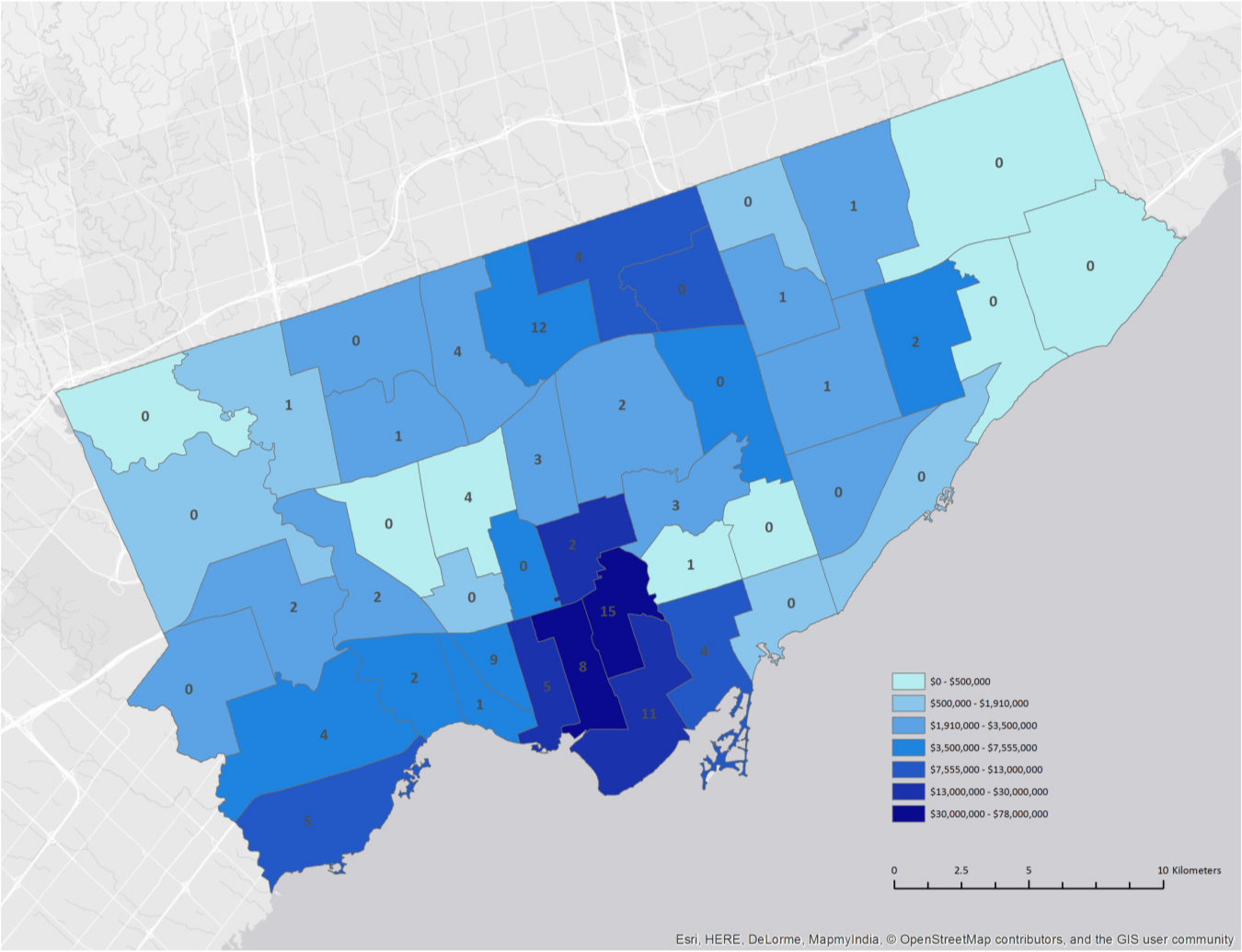
The distribution of Section 37 benefits by Toronto city ward, 1998–2015 (Friendly, 2020).
This suggests that density bonusing has become a proxy for disparities between development-rich areas and the rest of the city, prompting local groups to advocate for an equitable distribution of benefits so that resource-poor areas gain from the wealth generated by a booming real estate sector (Friendly, 2020). In the conclusion, we reflect on uneven development, highlighting the role of rent-seeking behaviour as a key component under neoliberalism.
Conclusion: Reflections on uneven development under neoliberalism
In October 2016, when the United Nations convened for the Habitat III conference, the concept of public value capture surfaced as a popular and necessary approach to finance the equitable growth of cities, yet without clarity about workable strategies. During a press conference, then UN-Habitat Executive Director Joan Clos pressed journalists ‘to explain how urban planning and urban design increases property values in the process of urbanization’ (Flint, 2016). The lack of explanation or playbook for value capture emerging from Habitat III is consistent with observations in the literature, showing that municipal officials and planners struggle to operationalize LVC (Booth, 2012). Given the widespread use of LVC around the world alongside the many questions about workable strategies, our article explores Toronto's use of one LVC instrument known as density bonusing, showing that public benefits provided through private development projects did not follow a consistent policy rationale, but instead were directed by planner's actions to mediate private market forces through the lens of discretionary development control. This article explores density bonusing as a form of LVC, demonstrating how planners and government actors in Toronto restrict the rentiership of the private development industry by, in some cases, extracting public value from rezoning actions. In part, planners exercise their agency to finance public goods rather than accept the ‘highest and best use’ principle for development outcomes the market is willing to support. We show that planning decision-making present a key standpoint to view the everyday transactional dynamics of how and where a level of public value is secured from private development, and the tensions between flexibility and certainty facilitated by policy, statutory frameworks, and the local political-economic environment. Using the lens of flexibility to assess planning actions in contemporary urban development (Muñoz Gielen and Tasan-Kok, 2010), our findings suggest that flexibility exercised through density bonusing does not allow for consistency in public benefits to result in equitable outcomes. Without codified policies and legislative power to impose planners’ social goals for density bonusing, outcomes are vulnerable to developer preferences and the changing interests of city councillors. In certain circumstances, guided flexibility confronts the limitations of discretionary planning systems. Therefore, decisions are merit-based, potentially arbitrary, and influenced by select actors.
The organizational context in which government actors use flexibility in their everyday work is a key environment to understand flexibility beyond normative understandings (van Wessel et al., 2015). Looking at Toronto's planning context over time, flexibility allowed planners to negotiate social infrastructure such as affordable housing from commercial development to achieve a semblance of the ‘sharing the wealth’ approach, ensuring the downtown was liveable for all. Our research suggests that this approach has achieved some success. In planners’ minds, the objective of development was to distribute material gains in land value to those most affected by rising land values – low-income earners. Planners thus carefully examined the gains and losses from urban redevelopment, aspiring to a model of concentrated growth with equity that considered affordable housing a ‘desirable amenity’ to house residents close to the downtown core. These advances were informed by the political and planning context in which density bonusing evolved, including a booming economy, enabling the policy to proliferate. In this context, our research shows how flexibility characterized by discretionary planning has changed over time. Thus, a change in planning values, accepted standards of practice, and institutional capacity influence how government actors manoeuvre and negotiate deals, including the extent to which the City captures significant regulatory takings through LVC (Alterman, 2012). Our findings are consistent with Booth’s (2012) critique of operationalizing LVC in planning: while planners and municipal officials often adhere to the idea of capturing public value from private development, how to determine the appropriate pricing of land values and formalize this value often evades decision makers. In Toronto, an ad-hoc approach to determining value continues, alongside an avoidance of estimating the true costs of the unearned increment. Despite their best efforts, planners and government have yet to sufficiently answer the question posed 30 years ago: ‘At issue in the debate[…]the extent to which the public is entitled to share in the wealth that has been generated through the collective land development process’ (City of Toronto, 1990: 509).
The literature documents how planning decisions impacting the built environment are made within policy, statutory, and political parameters (Tasan-Kok, 2008). Toronto's regulatory planning framework enables planners to exert power through rezonings (Smit and Valiante, 2015), resonating with conceptions of discretionary planning where flexible decision-making (Booth, 1996) enables actors to use discretion to achieve development outcomes. The practice of density bonusing illustrates how actors use discretion to judge the merits of a development project, and the locus through which public and private actions are mediated. In the right circumstances, the application of land rent ideals and equity principles on a given development site may transpire, but site-specific planning concentrates on public value where private development wealth is generated. These policy and market shifts led to changes in Section 37 outcomes over time, reflecting physical over social infrastructure investments and benefits remaining localized, thus benefiting fewer city users.
Flexibility in planning ensures that plans and policy can adapt to changing circumstances within increasingly complex and diverse systems. But when private actors play a role in shaping public needs without public plans – as is sometimes the case in Toronto – the development control function of planning is severely weakened. In studying discretionary planning and its links to land rent in LVC processes, case-by-case decisions often become one-off investments, or integrated into broader, long-term plans. For example, a developer who is a political advocate, has a capacity for negotiation and cooperation, and is receptive, may prioritize equity in one project. Likewise, a less savvy councillor or inexperienced planner may lose out in maximizing LVC, while oversight by a councillor may create a loophole for a developer to withdraw their contribution. The polarizing nature of these processes demonstrates how flexibility may create either win-win scenarios or a zero-sum game, where the City's public benefit gain is negligible to the developer's profit loss.
The Toronto experience with density bonusing reaffirms that the rent-seeking behaviour of a property developer would be to maximize their asset to its highest and best use potential, providing opportunities for developers to increase future property values. Likewise, flexibility in planning creates room for planners and political actors to cooperate with developers to balance economic gain and equity, which may create a greater scale of public benefit to improve life quality for the socially disadvantaged (Fainstein, 2012). Ultimately, the way discretion is leveraged by these actors shapes the likelihood that this balance will be achieved. The individual actions and context-specific particularities thus are significant factors in driving the planning processes towards socially based outcomes.
Reflecting on LVC, land rent, and equity within Toronto's discretionary planning system raises two critical questions for other North American and global cities navigating this planning paradigm. First, how can elected officials be accountable when planning deals either evade policy intentions and decision makers, or are abused by powerful development actors? Second, what recourse do cities have within flexible systems when such agreements for public infrastructure needs are not implemented? The research findings raise the question of whether a more rigid regulatory system adhering to statutory concessions would garner a greater level of accountability and transparent implementation. While beyond the scope of this article, this topic is ripe for future comparative research along these lines. Moreover, whether and how to allow greater public involvement in such processes remains a challenge within LVC processes, particularly in Toronto where there is no statutory obligation to consult the public beyond the technical aspects of rezoning development application (e.g. on decisions regarding community benefits), although Baxamusa (2008) provides some suggestions for deliberative empowerment models within this context. Still, Toronto's density bonusing system is indicative of broader developments in urban development and neoliberal planning. As in the UK, in Toronto, the shift to a development-led approach emphasizes responsiveness, flexibility, and efficiency, rather than strictly land use plans guiding development outcomes (Lord and Tewdwr-Jones, 2014). However, as has been shown in other jurisdictions like Ireland, in neoliberal environments, a development-led paradigm may result in regressive outcomes when community benefits agreed to in negotiations are reallocated or not implemented (Fox-Rogers and Murphy, 2015).
Lastly, this paper underscores how incentive-based planning instruments, despite their imperfect and uneven application, have become integral to the redistributive challenge and opportunity to recover value and invest in public goods in the built environment. Viewing debates on LVC and density bonusing through the lens of unequal property rights in contemporary neoliberalism (Sayer, 2020) thus provides an avenue to understand the outcomes of these urban development processes at different spatial scales. Understanding the unearned income within such approaches through rentiership – based on power rather than contribution – therefore foregrounds a broad discussion about the equity dimension of such processes. As cities worldwide vie to derive public value from land development, this article provides key insights into the challenges of planning to balance public interests with market-driven urban development.
Supplemental Material
sj-docx-1-epn-10.1177_0308518X221087243 - Supplemental material for Balancing equity-based goals with market-driven forces in land development: The case of density bonusing in Toronto
Supplemental material, sj-docx-1-epn-10.1177_0308518X221087243 for Balancing equity-based goals with market-driven forces in land development: The case of density bonusing in Toronto by Jeffrey Biggar and Abigail Friendly in Environment and Planning A: Economy and Space
Footnotes
Declaration of conflicting interests
The author(s) declared no potential conflicts of interest with respect to the research, authorship, and/or publication of this article.
Funding
The author(s) received no financial support for the research, authorship, and/or publication of this article.

Supplemental material
Supplemental material for this article is available online.
Notes
References
Supplementary Material
Please find the following supplemental material available below.
For Open Access articles published under a Creative Commons License, all supplemental material carries the same license as the article it is associated with.
For non-Open Access articles published, all supplemental material carries a non-exclusive license, and permission requests for re-use of supplemental material or any part of supplemental material shall be sent directly to the copyright owner as specified in the copyright notice associated with the article.
