




Abstract
The heterogenous literature on the ‘new state capitalism’ has provoked considerable academic and popular interest in recent years, but also critique regarding how to analytically bolster the concept and enhance empirical understanding. This paper responds to Alami and Dixon’s (2020a, 2020b) call for a fresh interrogation of the new state capitalism through an examination of the governance of the City of London. As the largest exporter of financial services in the world, the City plays a crucial role in the reproduction of financial capitalism. However, one major deficiency in debates on the political governance of the City surrounds the role of sub-state institutions. Remarkably, with limited exceptions, we know comparatively little about the main municipal authority: the City of London Corporation. As a local governing body, it conducts all the ordinary work of a public authority. But the Corporation also has many peculiar features which distinguish it from other public institutions, including vigorous support of financial services through planning law, lobbying and other promotion. This paper argues that thinking on the new state capitalism offers a vehicle for dissecting how the Corporation operates in the service of transnational financial interests. By unpacking how the Corporation is tied into a web of relations with private finance and other historically developed networks of power, the discussion problematises two macro themes on the new state capitalism: the spatial complexity of multi-scalar state governance and the temporal fluidity of legacies of the past interpenetrating with the present definition of ‘now’.
As the largest net exporter of financial services in the world, the United Kingdom (UK) plays a crucial role in the reproduction of global capitalism. Across a range of major financial markets, such as foreign exchange trading, cross border bank lending and the trading of international bonds, the UK retains a leading share of such activity, along with providing a supporting ecosystem of related professional services and infrastructure (TheCityUK, 2020a). The City of London (commonly referred to as ‘the City’ or by its moniker, ‘the Square Mile’) has historically been the locus for these practices and remains the primary central business district in London. Understanding the institutional governance of this global financial hub has been a preoccupation of scholars within different fields, including political economy, geography and history. Among significant enquiries, authors have explored dimensions of the City's transnational role in finance, from its historical fortunes since the early outset of capitalism to its domestic impact on the socio-economic fabric of Britain (Michie and Williamson, 2004; Kynaston, 2011; Talani, 2012; Palan, 2015; Norfield, 2016; James and Quaglia, 2020).
When proposing analytical models of governance of the City, theorists have been drawn to a so-called ‘core institutional nexus’ in rulemaking and elite social relations between private financial firms, the Bank of England and the Treasury (Ingham, 1984: 9). While such ties remain credible to the present, one major deficiency in this wider literature concerns how it accounts for the contribution of sub-state institutions in the configuration of financial power. Remarkably, we know comparatively little about the main municipal authority with significant capacity to shape financial governance: the City of London Corporation (referred to here as the Corporation) (exceptions include Pryke, 1991; Kaika, 2010; Green, 2018). As a local governing body, it conducts all the ordinary work of a public authority in the UK political system, such as issuing taxes for income generation which is, in turn, spent on a variety of services. But the Corporation has many peculiar features which distinguish it from other state institutions. For instance, it has maintained its own system of government since the late Anglo-Saxon period (a Court of Alderman is recorded in 1032); its own Lord Mayor separate from the comparatively recent office of Mayor of London; and its own police force independent from the Metropolitan Police. As I will explain, the Corporation is also a vigorous supporter of financial and professional services through planning law, lobbying and other promotional efforts. In the process, therefore, we can say that the divide between ‘the public’ and ‘the private’ often appears to dissolve and become difficult to sustain.
This paper argues that thinking on the new state capitalism offers a vehicle for dissecting how the Corporation operates in the service of transnational financial interests. In the context of the UK political economy, in the absence of any serious national strategy of redistribution, the City consolidates its power like a city state where financial elites dominate, often to the expense of other geographies and industries (Erturk et al., 2011; Christensen et al., 2016). In particular, the argument directly responds to Alami and Dixon’s (2020a, 2020b) call for a fresh interrogation of the ‘new state capitalism’ by problematising two macro concerns debated in the literature. First, in respect to where the capitalist state can be territorially located, it examines the Corporation's property portfolio and planning policy within its jurisdiction, along with how it makes extraterritorial claims of authority beyond London. A particular spotlight is on how the organisation evolved from a strongly English, elite social milieu, with a bias towards heritage concerns for the build environment, to one that is more international, modernist and keen to meet the precise commercial demands of business. Although executive agencies of the British state certainly exert policy influence on the City, I suggest explaining this story is necessary because the Corporation is vital for authorising and promoting the essential infrastructural needs of firms.
Second, the paper explores the question of temporality raised by the new state capitalism literature, suggesting that the Corporation resists neat temporal categories. With claims of legal authority that can be traced to the Magna Carta (1215), it is in some respects an unusual agency for consideration under such debates. The extraordinary capacity of the Corporation to survive over nine centuries has involved countless episodes of negotiation, reinvention and stubborn opposition (Robson, 1948; Barron, 2004; Doolittle, 2010; Kynaston, 2011). With this in mind, in one conventional sense of defining the ‘novelty’ of the new state capitalism, I demarcate the period from the 1980s to the present – at the onset of the ‘Big Bang’ regulation of financial services in the UK – as an important way for capturing how the Corporation became more professionalised in its advocacy for finance. 1 But in another sense, via illustrating how the Corporation has offered itself as an organiser for networks of elites, I argue that the body conjures up ‘multiple temporalities’ as a way to reproduce its power. Unpicking these practices reveals a puzzling institution which displays, at one and the same, the trappings of a feudal community and a brand-conscious modern entity.
The subsequent argument is divided into three core sections. First, I contextualise the discussion through a brief outline of major themes in the literature on the new state capitalism, identifying the aforementioned issues around space and time. Second, I introduce and explain the City and some of the major ways in which its institutional management has been conceived, isolating the problematic lack of attention to the Corporation within such debates. In the third and larger empirical section, which is founded upon primary data collection among other sources, I dissect how the Corporation can be examined with the aid of the concept of the new state capitalism. The paper concludes with some summary points on the major themes debated.
Problematising the new state capitalism
The expanding literature on the new state capitalism has provoked considerable academic, policy-related and media interest in recent years, but also criticisms regarding how to analytically bolster the notion and improve empirical understanding and dialogue. Questions of space, time and power inevitably lace through these discussions. Such macro themes are particularly pertinent for uncovering the political economy of international finance and its institutional management, the main empirical focus of this article. As a springboard towards the examination of the City of London, the discussion here sets out the case for problematising debates on the new state capitalism via two issues addressed by Alami and Dixon (2020a, 2020b): (1) the question of where the capitalist state can be territorially located; and (2) concerns related to historical periodisation.
When debating how the spatial configuration of the new state capitalism has tended to be depicted, Alami and Dixon (2020a) raise two common imaginaries. The first conceptualisation finds writers reactivating and, at times, often glorifying a Western-privileged dichotomy. In this framing, the West is the crucible of authentic, capitalist entrepreneurship and liberal rulemaking while, by contrast, the non-West is the ‘negative other’, rife with unfair state intervention in a culture of corruption. This depiction – which has expressions ranging from openly racist language to more subtle cues – has been widely problematised in political economy and geography literatures, combined with long-standing critiques in postcolonial analysis (Wolf, 1982; Anievas and Nişancıoğlu, 2015; Alami and Dixon, 2020b; Hobson 2020). In this article, I show some of these modernist biases in how the City of London continues to present itself to the world. But the argument is more strongly focused on contesting the second spatial imaginary of the new state capitalism discourse articulated by Alami and Dixon (2020a): how a bounded sense of the nation-state, led by an executive, tends to predominate as the main methodological focus. While this may serve some heuristic purpose, I concur with others who argue that capitalism is always dependent upon, and reconfigures, multiple scales of governance to further its accumulation processes, from the local to the transnational (Brenner et al., 2010; Jessop, 2002, 2011). Recognising this complexity is, in turn, the first step to plotting how the ‘actually existing state’ in the new state capitalism should never be construed as a monolith or even a particularly coherent actor, but is perhaps better defined as a ‘bureaucratic field’: a space of forces and struggles over the control of prized resources, involving multiple types of agents who wield different forms of power (Bourdieu, 1994, 2014). In particular, I am interested in the relations between the local, the national and the transnational in this space, including how claims of extraterritoriality stretch ‘the state’, as conventionally viewed, beyond its normal jurisdiction.
The second theme tackled by this article is the difficult issue of temporality. As Alami and Dixon (2020a: 86) rightly argue, in a discourse where writers have a predilection towards declaring ‘novelty’, ‘return’ and ‘reinvention’, one needs to scrutinise what is new within the new state capitalism? All sorts of structural, institutional and personal interdependencies between commerce and government have long existed, from mercantilist owners in seventeenth century England to the ‘robber baron’ industrialists of the 19th century United States, to name but two eras. In other words, enquiries that display historical amnesia or impose artificial temporal boundaries do not enlighten our understanding of activities that such literature claims to explain (Koselleck, 2002; Toohey, 2003). My argument considers this temporal dimension in two ways. In one conventional use of periodisation, I am interested in how the policy environment in the UK from the 1980s, defined by Thatcherism and other external capitalist factors, enabled the growth of finance and a reconfiguration of the build environment (Plender and Wallace, 1985; Reid, 1988; Martin and Crash, 2016). In a different sense, I explore the category of temporality through a more cultural political economy lens by illustrating how some of the deep histories of the City are invoked and echo in contemporary practices. In reference to the focus on the Corporation, this line of argument suggests how the lived experience of some policymaking fuses together the ancient and the modern in ways that complicate any articulation of neat temporal divides. In other words, this analysis encourages writers on the new state capitalism to excavate and plot different ‘temporal layers’ that have alternative origins, lengths and speeds, yet are often found together in the same present or ‘now time’ (Koselleck, 2002, 2004).
The City of London and its institutional management
The City has historically been among the largest financial centres in the world, from its facilitation of early capitalism in the 17th century, to its role within the British empire from the 19th century and, onwards, to its post-imperial, international reconfiguring over the past 70 years (Ingham, 1984; Kynaston, 2002, 2011; Cassis, 2010). 2 According to one major contemporary ranking, London is second to New York City as the leading financial geography, with strengths in banking; insurance; asset management; fintech; as well as related professional services, such as law, accountancy and management consulting (Z/Yen, 2021). When compared to other countries, the UK is the largest net exporter of financial services, with a financial services trade surplus of $80.6 bn in 2020 (The City of London Corporation, 2022). As will be explored in the case of the Corporation, these business activities have historically benefited from sympathetic government and regulatory policy, although such linkages and perceptions have been damaged by the fallout from Brexit (Thompson, 2017; James and Quaglia, 2020). Elsewhere, the City benefits from the wider socio-cultural quality of life of London, including its entertainment services and educational provisions, which help to attract and retain relevant workers. An additional factor giving the City a competitive advantage concerns its material infrastructures. Although not widely appreciated, the historic position of London as a hub for submarine communications cable networks continues to enhance profit-making capabilities at City firms. For instance, as part of infrastructural investment in the City since the 1980s, the development of fibre-optic cables provided greater bandwidth capacity for the emerging digital economy, particularly for connections to the US and Europe (Eichengreen et al., 2016).
Within relevant political economy, geography and history literature, understanding the spatial governance and socio-economic impacts of the City has been a reoccurring theme (Michie and Williamson, 2004; Kaika, 2010; Kynaston, 2011; Talani, 2012; Palan, 2015; Norfield, 2016). Among prominent enquiries, writers have examined the City's international role in financial capitalism and its domestic influence on the British economy, often in tension with manufacturing industry and working class interests. In British party political analysis, although social shifts have taken place, these discussions have corresponded with how the Conservative Party has tended to support finance in comparison to the Labour Party's alliance with manufacturing. Thus, the City is an important object of analysis because of its historical dominance over other UK sectors and regions, to the extent that a large financial industry can be viewed as a ‘resource curse’ rather than a blessing (Christensen et al., 2016; Shaxson, 2018). As a territory, the Square Mile is analogous to a city state in the sense that, similar to the ability of early modern Genoa or Venice to position themselves at the intersection of goods trading, the City, by its central timezone location, is a financial entrepôt for multiple forms of financial trading (Erturk et al., 2011). The City is, of course, under the sovereign authority of the UK state and yet, by virtue of its capacity to carve out ‘juridical enclaves’ (Palan, 2003: 19) and host transnational capital, operates in a socio-economic space which is often far removed from the British economy. 3 Thus, the City exists in both an ‘onshore’ and ‘offshore’ sense: the principle of territorial organisation is not replaced, but it overlaid with a ‘nonterritorial social space’ of material flows and identities (Palan, 2003: 189).
When exploring the political management of the City, Geoffrey Ingham’s (1984) work has been particularly influential in pointing towards what he argues is a ‘core institutional nexus’ in rulemaking between private financial companies, the Bank of England and the Treasury (Ingham, 1984: 9). In Ingham's structurally informed, sociological analysis, the Bank and the Treasury are independent centres of power in the City, but at the same time closely bound together with private firms in institutional and elite social class networks (including lineages to public schools, Oxbridge and family ties). Nearly 40 years later, this framework still contains a lot of merit, but is also in need of obvious revision to account for the major economic and social restructuring of the City and finance more broadly (along similar lines on the need to revise Ingham's model, see James and Quaglia, 2020).
One major problem in this wider literature on the political economy of the City concerns how it accounts for the role of sub-state institutions in the remaking of financial politics. Remarkably, within both scholarly and mainstream debates on finance, we know comparatively little about the main municipal authority with significant capacity to shape financial governance: the City of London Corporation. 4 As noted, the Corporation is the local governing body and conducts all the ordinary work of a public authority in the UK. 5 But the organisation also has many peculiar features which distinguish itself from other public institutions, including the promotion of financial and professional services which extend far beyond its geographical jurisdiction. In most studies on London and UK finance it tends to pass under the radar. For example, in the final volume of Kynaston’s (2002) classic study on the City, the Corporation features only fleetingly, most notably on the 1980s planning law. In Tony Travers’ The Politics of London, the Corporation is referenced as ‘the most remarkable business-based organization involved in London governance’ (Travers, 2004: 150), but explaining how precisely it works is absent. More recent research on the City and its institutional mechanisms has contained some interest in the organisation, including its lobbying capacity and the promotion of a ‘social value of finance’ narrative following the global financial crisis (Engelen et al., 2011; Baker and Wigan, 2017). Elsewhere, in more popular writing, Nicolas Shaxon has been intrigued by the Corporation, including its ‘endless arcane traditions’ and penchant for secrecy (Shaxson, 2018: 259; see also Shaxson, 2012). Nonetheless, a more rigorous dissection of the powers and functions of the Corporation is still lacking.
There are some exceptions to this dominant tendency. Closest to my aim of projecting a sharper spotlight on the politics of the Corporation, Jeremy Green has persuasively argued that the institution plays a ‘networking and market-making’ role for UK financial interests by ‘stitching together private and public actors’ (Green, 2018: 297). As he explains via the development of Chinese Renminbi trading in London from 2010 to 2015, the Corporation's outlook is at once municipal and public, as well as global and private. For instance, when faced with tensions between the UK and China in 2012 which jeopardised the expansion of Renminbi trading, the organisation – which offers itself to others as ‘above’ party politics – oscillated between being a government actor and a commercial lobbying association as a way to calm political waters (Green, 2018). As I will argue later in this paper, such chameleon-like behaviour is not exceptional to this particular episode but is observable throughout the history of the Corporation. In responding directly to Green’s (2018) call for further research on the Corporation in the context of the historical evolution of the City, my argument here is also distinctive in providing some foundational analysis of its major material and symbolic assets, a platform I suggest is needed to better grasp specific political struggles.
A final mini cluster of research which has touched upon the Corporation can be found in economic geography. Here, writers have combined historical context, political economy and spatial analysis to offer telling insights into how the City has evolved in relation to macro changes, such as the deregulation of securities markets from the 1980s. There has been a particular interest in the struggle between the old and the new, in respect to both working cultures and urban planning visions. The City has evolved from a strongly English, male, elite social milieu, rooted around heritage concerns for the build environment, to one that is more international, socially diverse and keen to meet the precise commercial demands of finance and other related sectors (Pryke, 1991; Jacobs, 1994, 1996). In this context, the Corporation has been closely bound up with wider spatial power relations when approving or denying development initiatives in the City. Kaika’s (2010) study on how the City reinvented and rebranded itself through iconic skyscrapers and related imagery is particularly pertinent to my research agenda here. Rather than accept the glitzy, promotional literature on the City, she argues that such monuments to neoliberal financial capitalism grew in reaction to an institutional challenge at the Corporation in the 1980s and 1990s. By the early 2000s, the Corporation had reconceived itself as an outward-facing institution, open to transnational elites, but the process of reaching this point was by no means inevitable (Kaika, 2010).
There is much within Kaika’s (2010) account that I take as inspiration, both in respect to the time period she investigates and the analytics deployed. However, in this paper, I also seek to address not only the 1980s as a major episode at the Corporation, but also how the organisation reproduces both old legitimation techniques and newer methods of lobbying. My objective is to not only update and enrich our appreciation for the politics of survival at the Corporation, but to identify how the concept of the new state capitalism can enhance our understanding for how this body plays a crucial role in the reproduction of UK-based financial capitalism. In sum, I argue here that the Corporation has been wrongly neglected as a distinctive player in the institutional architecture of the City. Such limited coverage is inconsistent with the actual impact of the organisation in respect to major planning powers, political influence, economic resources and forms of culture which is deployed to direct the growth of the City in the context of financial capitalism. As will be made clear, I do not seek to overemphasize the powers of the Corporation, nor to hermetically abstract it from its heterogeneous web of social relations. 6 Rather, the initial aim now is to explore in more detail how the Corporation tries to reproduce, steer and deploy different forms of power and, ultimately, how we can grasp the relations between such forms.
The City of London Corporation and the new state capitalism
In this main empirical section, I explore how we can think about the Corporation in relation to the idea of the new state capitalism. The argument is divided into two themes: (1) the close ties between the institution and the socio-economic world of finance, including a particular spotlight on important politics in the 1980s and 1990s; and (2) the capacity of the Corporation to organise different networks of power. Both these themes are, of course, interconnected in actual reality but are heuristically separated here to aid comprehension. The research is founded upon three sets of sources. First, 20 interviews were conducted with past and current representatives of the Corporation, along with other City consultants and observers aware of the organisation (including private firms and the non-profit sector). Second, some official Corporation institutional records and other documents were accessed at the Guildhall Library, the main reference centre which archives Corporation material in the City of London. Third, the existing secondary literature, where relevant, was incorporated into the analysis.
The Corporation-private finance nexus
The Corporation's relationship to private finance can be understood in terms of both its own asset holdings and how it enables new business activity within its jurisdiction. One of the most interesting features of the organisation is what is called City's Cash, a private account which is one of three funds enabling the Corporation to pay for its work. 7 City's Cash features properties, land, bequests and transfers that have accumulated since the fifteenth century. 8 When compared to other local authorities in the UK political system, this source of economic capital is highly unusual in terms of its longevity and wealth. It allows the organisation to fund a variety of activities which serve its own existential interests but, in doing so, fuses the Corporation's interests into the wider defence of global financial capitalism. As the institution repeatedly underscores, the City as a ‘vibrant and thriving’ centre for financial services is a core strategic aim (City of London Corporation, 2018). What makes the concept of the new state capitalism relevant here is not only the interweaving of an ostensibly local (public) authority with global private accumulation processes but also, as I will explain, how such work became more expansive and professionalised over the neoliberal period.
What is the composition of the City's Cash estate? In 2019, the total value of City's Cash fixed assets was £3.195 billion, which included £1.975 billion in investment properties and £753 million in non-property investment handled by external fund managers (a process overseen by the Corporation's Financial Investment Board) (City of London Corporation, 2019). According to one official survey, the fund consists of 251,000 m2 of building stock, 43.4% of the entire Corporation portfolio (City of London Corporation, 2013). 9 This includes its core City holdings, which features the markets of Billingsgate and Smithfield; prized office space in major locations in the City; and educational buildings (such as the City of London School). 10 Outside the City, the Corporation also owns property in London's West End on Tottenham Court Road and the Conduit Mead estate in Mayfair (New London Architecture, 2013). Most of this property portfolio is freehold and is valued at £249 million (City of London Corporation, 2019). 11 In short, due to its own role as a significant property investor in the City, the Corporation is inevitably interested in a healthy commercial office market. As clarified in interviews with representatives who have served at the Corporation, a prosperous City will tend to lead to elevated property prices which will benefit the organisation through urban agglomeration effects. 12 The organisation justifies the spending of City's Cash as not only benefiting the growth of financial services in London but providing national benefits, such as tax revenue for the UK Treasury and employment opportunities across other UK centres (for instance, see TheCityUK, 2021).
The Corporation's enthusiasm for promoting global financial services also involves its pivotal public role as a planning authority. As the key institution holding planning powers in the City, the Corporation is legally authorised to produce regular local plans which advance strategic priorities and values on future development within its territory. 13 Local plans are particularly important as they are often the starting point for deciding whether planning applications should be approved. It is worth underscoring that the contemporary neoliberalised zeal for new office developments, including iconic skyscrapers, grew in reaction to an uncertain institutional crisis at the Corporation during the 1980s and 1990s (Jacobs, 1994; Kaika, 2010). A crucial moment came in 1984 when a Draft Local Plan was published under the direction of then Chief Architect Stuart Murphy. Informed by a vision for the City based around heritage, the Plan proposed expanding conservation areas and limiting the potential for the enlargement of any building to no more than 20% (Corporation of London, 1984). 14 In the subsequent consultation period, the criticism to this Plan was swift and at times stinging, including from financial firms (such as Barclays and Credit Suisse First Boston); the property industry (for instance, Land Securities and Savills); and the wider policy community (including the Bank of England and the Centre for Policy Studies) (Corporation of London, 1985). Such players argued that the future of the City was threatened by an overly cautious Corporation approach which did not adequately grasp the precise infrastructural demands of financial companies in the context of changes to the business of the City and global finance. 15
The resulting fallout from the Draft Local Plan generated an internal power struggle at the Corporation which was, in turn, reflective of wider social tensions in the City between the old and the new. In 1985, Michael Cassidy assumed the position of Chair of the Planning and Communications Committee and hired Peter Wynne Rees as City Planning Officer (1985–2014). 16 In the context of the ‘Big Bang’ regulatory reforms initiated by Margaret Thatcher's government (1983–1987), these two figures reached out to City businesses to understand their concerns, paving the way for a revised and approved Local Plan in 1986 (Corporation of London, 1986). 17 Conservation issues would remain part of the Corporation's raison d’etre as a planning body, but in the new Local Plan did not dominate to the extent that Murphy had proposed (Pryke, 1991; Kaika, 2010; Taylor, 2019). Rather, influenced by US corporate trends, large banks wanted flexible, open trading floors which enabled a panoramic view of their teams, rather than separate offices; along with capacity to install the latest computers. In the 1980s, such buildings in the City were either hard to find or easily reconfigure into such designs while, at the same time, office demand was rising again by the end of the decade (Coakley, 1994). 18 Thus, from late-1980s, the Corporation approved many projects which had these specifications, ultimately developing a cluster of tall buildings in the eastern sector of the City. 19 Figure 1 shows how City office stock grew significantly from the late-1980s to the early 1990s, before a further rise from 2000. At the same time, employment in the City increased from 154,000 in 1977 to 273,000 in 2006 (Hendershott et al., 2010). 20 All this pressure to meet the needs of the financial industry was given added momentum by the threat posed by Canary Wharf, a rival location which greatly unnerved the Corporation when it began attracting major City tenants, such as Barclays and JP Morgan. 21
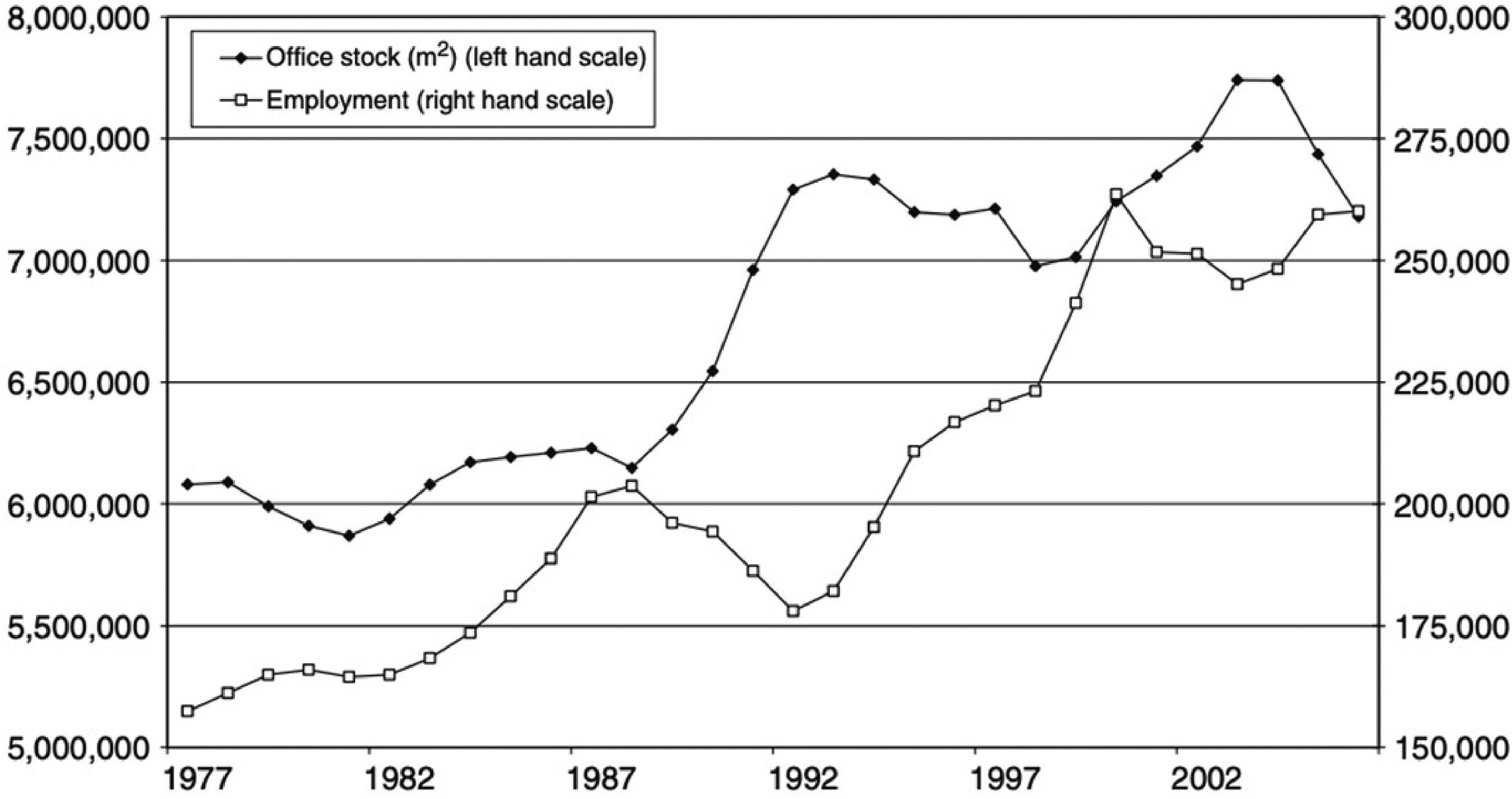
Office stock (m2), and financial and business service employment in the City of London, 1977–2007 (Source: Hendershott et al., 2010: 87).
Nonetheless, despite the drift of some business to Canary Wharf, the City remained a very competitive location into the 2000s as the Corporation became a more outward-facing body, fully open to transnational capitalism (Z/Yen, 2005; Kaika, 2010). The concept of the new state capitalism, when applied to this theme of my argument, helps to furnish us with a sense of the close ties of interdependence between the Corporation and the social worlds of finance and property whereby the distinctions between the local, the national and the transnational can often fuse together. We see how the executive, such as with the Big Bang reforms, launched a new agenda for the City, but it necessitated the Corporation, allied with planners and investors, to change the built environment to fulfil such policy and corporate ambition. The coherence of this relationship between different scales of governance should not be overstressed: at first, the Corporation stumbled and looked insular and irrelevant, before assuming a handmaiden role that continues to this day.
The Corporation as an organiser of networks of power
The Corporation is involved in the reproduction of a wide range of social relations which, once again, belie its appearance as a humble local authority. As hinted at by Green (2010: 297), and already discussed in the example of its post-1986 activism, the organisation often plays a ‘networking and market-making’ role for UK financial interests by bringing together a range of government and private sector players. This activity is visible in the Corporation's lobbying and promotional work where it views itself as a hosting organiser, broker, or sponsor of different agendas, obviously within the City but also more widely in the UK and globally. I suggest here that such seemingly mundane activity – in the form of event management, producing research and marketing literature, and conducting influencing work behind the scenes – should not be underestimated in how we grasp the new state capitalism.
The issue of how ‘the City’ mobilises and orchestrates its manifold, and often competing, interest groups for greater gain is a long-standing concern, one which has arguably become more difficult since the 1980s when the enclosed ‘English club’ feel transcended into a less deferential, more socially diverse, professional hub (Kynaston, 2002; Martin, 2017). Thus, the category of ‘the City’, particularly when referenced in the media, often conceals more than it reveals. The label tends to present a degree of structural coherence when the reality is often a collection of different sectors and social spaces (such as banks, insurance, fintech, law etc.), each with varying degrees of connection to each other and whatever is defined by the Corporation or other actors as ‘the interests of the City’ (see also Talani, 2012). This picture is made even more complicated when considering the role of the City in relationship to other domains of elite power in British life, such as schools, religion, the military and the monarchy.
I argue that the Corporation has played a significant role in trying to deal with this collective action problem, in the process making itself useful to commercial interests and other constituents. This mobilisation effort can be considered in two ways, reflecting old practices and newer techniques. In reference to the former, the home of the Lord Mayor, the eighteenth-century, Grade I listed Mansion House, opposite the Bank of England, plays host to a range of events which enable the Corporation to offer itself as a kind of social capital trading room for elites. For instance, major annual banquets include the Merchants and Bankers Banquet, where the Chancellor of the Exchequer and the Governor of the Bank of England speak; the City Banquet, where the Chair of the Financial Services Authority speaks; and the London Government Banquet, where the Mayor of London speaks (Stuttard, 2008). The grandest event is the Lord Mayor's Banquet in the company of the Prime Minister, which has taken place annually since 1501 at the Guildhall, the administrative centre of the Corporation. Describing the Corporation's wining and dining as ‘antiquated’, ‘pompous’ or ‘secretive’ is, in one sense, apt.
22
The ceremonial trappings of the medieval City – from the gilded mace to the elaborate regal costumes – are alive at such events (Hanawalt, 2017). Yet such remarks also distract us from how the Corporation plays complex political games when it defines itself, à la the wider phenomenon of Wimbledonisation, as being a mere host for others, attentive to ‘putting on a good show’. For instance, despite wanting to distance itself from messy party politics, Conservative governments have often viewed the luxurious surroundings of the Egyptian Hall, the main reception room at Mansion House, as a space to impress visitors and win favours, including with foreign attendees.
23
An independent governance review of the Corporation identified this convening function as a major power of the organisation: The City has an extraordinary ability to bring the prominent and powerful together. This is for a number of reasons: perceived mutual benefit; the making of connections; the gathering of intelligence. But this convening power is lifted to another plane by the grandeur and pageantry which it is able to deploy. The Royal Commission of 1854 spoke of ‘decent hospitality and splendour’ and this remains an important element in the City’s ability to convene and impress
By reproducing itself in these forms, the Corporation tries to justify hierarchy and its ‘selective tradition’ of politics, as well as to assimilate newcomers into the broader socio-economic order of the City (Williams, 1973). 24 Yet, while these activities continue to be organised, and no doubt stir a feeling of privileged entitlement within those who are most impressed, in the more international, post-Big Bang London such practices are arguably less effective. 25 Subsequently, since the mid-2000s, the Corporation has recognised that alternative methods of influence are needed for mobilising the City and preserving the perceived legitimacy of the Corporation. As one internal review summarised the situation: ‘The Corporation's history and tradition are a strength, but it is now essential and urgent to balance this with a more forward-looking image, energy and ethos’ (Review by Sir Simon Fraser and Flint Global, 2016: 7).
To that end, different illustrations of the Corporation's contemporary networking and brand management can be raised. 26 Among key positions, the Lord Mayor serves as an ambassador promoting the City and, at least prior to the COVID-19 pandemic, conducted extensive overseas travel. 27 The Chair of the Policy and Resources Committee, a chief executive-type role, also actively engages with politicians, regulators, businesses and other opinion makers. The Corporation defines itself as a key actor representing financial services in relation to the UK Parliament, EU agendas (it established an office in Brussels in 2004), as well as other major markets (a centre in Mumbai was opened in 2006, followed by Beijing and Shanghai in 2010).
But the organisation has also gone further to establish and fund TheCityUK, a dedicated lobby group which defends financial services across the country, not only within the City. The idea for the body arose in 2010 to provide a ‘rationalization of existing City promotional activities’ (Baker and Wigan, 2017: 192), provoked by an anxiety that there was no City-wide ‘independent body that is permanent, practitioner-led, politically neutral, strategic and cross-sectoral’, to quote a major government and industry report advocating for the formation of such an institution (HM Treasury, 2009: 14). Although legally separate from the Corporation, the Guildhall has been influential in shaping the agenda and personnel of TheCityUK, as well as promoting its research and events, leading one insider to claim that the two entities are ‘inextricably linked’ (Boleat, 2014: 8). On finances, at the launch of TheCityUK, the Corporation was the largest funder, providing £750,000, and has continued to transfer an annual grant of £500,000, which includes subsiding its office rent (Boleat, 2014; TheCityUK, 2020b). Indeed, there are current aims to deepen collaboration, such as developing partnerships with HM Treasury via the Financial Services Skills Commission and expanding the International Regulatory Strategy Group, a forum which brings together political actors, regulators and businesses to enhance the competitiveness of capital markets (TheCityUK, 2020b). Overall, the effectiveness of TheCityUK can be debated but, at the very least, it has tended to augment the Corporation's influence, providing it with statistical ammunition and arguments for its policy battles, and further universalising its interests, particularly to other UK cities (for a critique of the data compiled by TheCityUK to promote the narrative of the ‘indispensability’ of the City to the UK economy, see Christensen et al. (2016)).
Exploring how the Corporation connects different networks of power helps to again shed light on the notion of the new state capitalism. But the methods the organisation deploys – both very old and contemporary – problematise how we conceive of temporal divisions; that is, when applied to this case, what is distinctive about the new state capitalism? I have already discussed how we can draw a historical break from the mid-1980s in reference to the Corporation's increasing commitment to the neoliberal, Thatcherite turn in financial policymaking. Such changes dovetail with how many state agencies became enveloped with the rhetoric of competitiveness (Eagleton-Pierce, 2016). But I would also argue that it is better to characterise the Corporation as justifying itself through multiple temporalities: from ancient liberties and medieval ceremonies to recasting itself as a modern, brand-conscious outfit. Koselleck's notion of ‘temporal layers’ (Koselleck, 2002, 2004) is interesting to consider here. Traditions originating in the past, such as the City banquet, are refurnished and ‘lived’ in ‘the now’, in the process exploiting a rich galaxy of historical symbols and rituals of power. The evoking of this temporal layer is homologous to how other ancient British institutions operate, such as the monarchy, the Houses of Parliament, or the colleges of Oxford and Cambridge. Yet the Corporation cannot live within this temporality alone. The organisation also needs to display a temporal vision similar to the many private financial firms in its vicinity; that is, a professionalised, future-orientated gaze on where new sources of value could be obtained and how the City could claim such capital for itself. Thus, when viewing the totality of its activities to chart such fields of power, the Corporation often reappears as a strange hybrid: feudal, yet modern; public, yet private; domestic, yet international; visible, yet secret. These tensions give the organisation a chameleon-like quality worthy of further study.
Conclusion
Through utilising the case of the Corporation, we can return to the core themes on the new state capitalism outlined in the first section. On the spatial question of where to locate the capitalist state, I have argued that the Corporation has been overlooked as an important municipal authority in the multi-scalar governance of UK services, as well as global finance more broadly. The organisation is territorially bound to the City as its legal jurisdiction yet has also nurtured extraterritorial forms of influence for itself, such as the long-standing diplomatic travel of key officials and the founding of the TheCityUK lobby group. Executive agencies of the British state, such as HM Treasury and the Bank of England, have substantial rulemaking power to regulate the financial sector in the City. But I have suggested here that the Corporation plays a distinctive role in anticipating, amplifying and seeking to resolve the functional demands of business and is able, by virtue of its local geography, to keep itself informed of the concerns of City players. The argument has placed an emphasis on the political economy of urban infrastructure because, as the struggle over the 1980s Local Plan demonstrated, the episode reconfigured the planning objectives of the Corporation to the needs of internationally orientated developers, investors and owners. Without this change, the City would have probably lost much more business to Canary Wharf and elsewhere. Thus, when we dissect the Corporation in the UK context, capitalist interests, both domestic and foreign, enter into a struggle to shape a wider ‘bureaucratic field’ of different agencies and forms of state (Bourdieu, 1994, 2016). This article has, therefore, responded to Green’s (2018) call for further study on the Corporation within the existing matrix of public and private institutions shaping the City. Building upon the argument here, future research could further unpick these ties of interdependence across multiple scales of governance, as well as explore how the Corporation has responded to the particular challenges of Brexit and COVID-19.
In turn, this links to the temporal dimension on how the case of the Corporation problematises our historical understanding of the new state capitalism. The organisation is clearly an unusual animal: with roots in Anglo-Saxon England, the Corporation claims rights and privileges since 1067 following its first Royal Charter (Corporation of London, 1950). As many have noted, this is ‘a remarkably long period of continuous evolution, even in Britain, with its ancient Monarchy and Parliament’ (Travers, 2013). But it is how the institution reproduces its selective tradition of history for contemporary capitalist purposes which are equally interesting. The Corporation's ‘sociosymbolic alchemy’ of groupmaking – offering itself as a meeting space for a range of elites – ‘calls our attention to the panoply of techniques of symbolic aggregation and instruments of claims-making’ (Wacquant, 2013: 275, 276). Thus, for the organisation, the defence of global financial capitalism is bound up with a variety of practices of legitimation, some of which echo the feudal social form. In reprising Williams (1977) again, my point here is that the imprint of the residual temporal layer can be underappreciated, in the sense that the Corporation is sometimes dismissed as a ‘quaint relic’ of the past Rather, ‘[i]t is in the incorporation of the actively residual – by reinterpretation, dilution, projection, discriminating inclusion and exclusion – that the work of the selective tradition is especially evident’ (Williams, 1977: 123). Other empirical accounts of the new state capitalism may feature examples of sharper historical breaks where we can demarcate what is genuinely novel, but my argument here has tried to probe some of the peculiar temporalities associated with capitalism and how a key state institution is part of a polyrhythmic drama of tensions between past, present and future.
Footnotes
Acknowledgements
Previous versions of this article were presented at different venues, including: the Accumulating Capital: Strategies of Profit and Dispossessive Policies Conference at the Université Paris-Dauphine, June 2019; the Society for the Advancement of Socio-Economics (SASE) 31st Annual Meeting, The New School, New York City, June 2019; the Intersections of Finance and Society Conference, City University of London, December 2019; the Political Studies Association Annual International Conference (online), March 2021; the Society for the Advancement of Socio-Economics (SASE) 32nd Annual Meeting (online), July 2021; the Political Economy Seminar Series, SOAS University of London, October 2021; and the Rethinking Economic Policy: Crisis, Change and Continuity in the UK and Beyond Workshop, hosted by the Sheffield Political Economy Research Institute (SPERI) and the Political Studies Association British and Comparative Political Economy Group (online), November 2021. In particular, I wish to thank the very productive exchanges I have had with a number of people at these gatherings, including, but not limited to: Marlène Benquet, Craig Berry, Théo Bourgeron, Adam Dixon, Sarah El-Kazaz, Jeremy Green, Andrew Hindmoor, Scott James, Kerem Nisancioglu, Ronen Palan, Thomas Piketty and Amin Samman. I am very thankful for the time taken by the interview subjects, the conversations of which greatly aided my understanding. Revisions to the article would not have been possible without the additional childcare support provided by the wonderful Agnes Bathoula. Finally, I am grateful to the reviewers and editors of EPA: Economy and Space for their supportive and constructive comments. These debts notwithstanding, I remain responsible for the content and for any mistakes I may have made.
Declaration of conflicting interests
The author declared no potential conflicts of interest with respect to the research, authorship, and/or publication of this article.
Funding
The author received no financial support for the research, authorship and/or publication of this article.