




Abstract
Research engaged in the comparison and analysis of different forms of capitalism has been a significant growth area of political economy scholarship in the 21st century. Yet this scholarship, referred to in the article as the Comparative Capitalisms literatures, has struggled to respond to the challenges posed by post-2007 developments in and across the global political economy. This article engages with the critique offered by a number of critical-geographical interventions: the variegated impacts and experiences of conditions of crisis highlight the fact that questions of variety and unevenness necessitate a considerably more holistic methodological approach to comparison than a singular ‘national state as container’ focus would allow for. While important, these ‘variegated capitalism’ interventions have not said enough about comparison as an intrinsically political research practice. Building on the work of especially Juliet Hooker, Reecia Orzeck and Heloise Weber, the article makes the case for (i) being explicit about what is analytically and politically at stake in the act of comparing, and (ii) putting analytical and political concerns on an equal footing. It further argues that a broadly conceived critical political economy approach, discussed in the final section, is best-placed to make the most of the potential of such an understanding of comparison. This makes it possible to deploy research strategies that juxtapose different constellations of crises, conflicts and contradictions in order to articulate critiques of capitalism and/or focus on social and political struggles taking place in, against and potentially beyond the ‘cases’ being considered.
Introduction
Research engaged in the comparison and analysis of different forms of capitalism has been a significant growth area of political economy scholarship in the 21st century. This was an important discussion in the 19th and 20th centuries – think of writers such as Marx, List, Gerschenkron, Shonfield – yet the end of the Cold War catalyzed renewed interest. There were four reasons (see also Bruff, 2021): (i) the collapse of a ‘socialist’ alternative to capitalism led to a shift from contrasting different economic systems to examining within-capitalist diversities; (ii) the increasing global prominence of countries previously understood as ‘developing’ or ‘less developed’ meant that this was a potentially dynamic field in empirical terms; (iii) the emergence of the notion of ‘globalization’ created opportunities for scholars interested in the existence and persistence of capitalist diversity to invest in an alternative and contrary research agenda; and (iv) concurrent to all of this, there was the emergence of ‘new institutionalism’ research programmes across a range of social science disciplines. Out of these four factors there emerged the common denominator that ‘the basis for different “types”, “models” or “varieties” of capitalism are nationally specific institutions. They play a critical role in the evolution of national capitalisms, too, be it successful adjustment to new economic realities or failure to adapt through inertia’ (Bruff, 2011: 483). Numerous significant works were published, especially in the 2000s, that reflected the emergence and consolidation of what has been known by a few different terms, but for this paper will be referred to as the Comparative Capitalisms (CC) literatures (e.g. Hall and Soskice, 2001; Scharpf and Schmidt, 2000; Streeck and Thelen, 2005).
Several contributions in the early 2010s argued that post-2007 developments in the global political economy posed significant challenges for CC scholarship, and for two main reasons (see Brenner et al., 2010; Bruff and Horn, 2012; Coates, 2015). Firstly, the focus on institutional arrangements and public policies as the basis for studying and comparing different forms of capitalism meant that CC analysis moved quickly to responses to conditions of crisis rather than ask whether these conditions indicated that capitalism, rather than varieties of, ought to become more central to the research agenda. And secondly, the variegated impacts and experiences of these conditions of crisis meant that questions of variety and unevenness necessitated a considerably more holistic methodological approach to comparison than a singular ‘national state as container’ focus would allow for.
This article takes the second critique as its entry point, so as to enquire into what is at stake – analytically and politically – when comparing capitalisms. The issue of what it means to compare has been the subject of numerous critical-geographical interventions revolving around the notion of ‘variegated capitalism’ (e.g., Brenner et al., 2010; Jessop, 2014; Zhang and Peck, 2016). This has had a significant influence on what could be understood as critical CC scholarship (for instance, the essays in Ebenau et al., 2015) while also contributing to discussions in other, related lines of enquiry (see Cahill et al., 2018; Robinson, 2016). Undoubtedly, these interventions have helped produce a more sophisticated and enriching research agenda for comparing capitalisms, yet the politics of comparison has remained relatively unaddressed. More has been written on understanding comparison as a dynamic, ongoing process and on what can be considered possible units of analysis, than on the inherently political nature of comparison and the implications of this for our research endeavours. To put it pithily, the analytics of comparison has been the priority; the politics of comparison has been secondary.
This is somewhat surprising, given the inevitable fact that all researchers have to make practical (and thus political) decisions about what to focus on – and, by definition, what not to focus on – in their work. As such, this article draws on contributions on the politics of comparison not associated with debates about comparing capitalisms (notably Hooker, 2017; Weber, 2007), in order to make the case for (i) being explicit about what is analytically and politically at stake in the act of comparing, and (ii) putting analytical and political concerns on an equal footing. Particular focus is placed here on Juliet Hooker’s advocacy of hemispheric juxtaposition as an alternative to the comparative method and Heloise Weber’s argument that social and political struggles must be central to any understanding of the ‘cases’ we study. In doing so, the article follows Reecia Orzeck’s calls for greater attention to be paid to ‘[h]ow certain questions become worthy of academic inquiry … [cannot be explored] without a more capacious understanding of “politics”’ (Orzeck, 2012: 1464), and, more specifically, to how ‘geographical imaginaries are lenses through which a complex and highly interconnected world, of which we only experience parts, is rendered legible and intelligible’ (Orzeck, 2014: 348). Political-geographical imaginaries are intrinsic to comparison; the question is therefore about how they are articulated and deployed.
The article’s final section argues that a broadly conceived critical political economy approach is best-placed to make the most of this understanding of the politics of comparison. This makes it possible to deploy research strategies that juxtapose different constellations of crises, conflicts and contradictions in order to articulate critiques of capitalism and/or focus on social and political struggles taking place in, against and potentially beyond the ‘cases’ being considered. More specifically, it enables us to acknowledge that if the ‘cases’ being considered are always in the process of (re)constitution and thus never ‘finished’ or ‘complete’, then capitalism always contains the possibilities and the practices of transformation. This demands ongoing reflexivity on the part of the researcher, because other juxtapositional research strategies to our own, in combination with the always-evolving nature of any ‘cases’ we study, will emphasize different, or bring forth new, resonances and discontinuities in and across the ‘cases’. Ultimately, it also entails a normative orientation towards a range of post-capitalist possibilities, in contrast to the social democratic impulses underpinning CC research and the even-handed explorations of alternatives within and beyond capitalism in critical-geographical scholarship.
The relevance and implications of the article thus stretch beyond what I discuss below, especially the argument that comparison is an intrinsically political research practice. Initially, the article contextualizes the emergence and consolidation of CC scholarship, and its partial reinvigoration with the recent development of the ‘growth models’ perspective. This is followed by an engagement with the critical-geographical interventions, which in turn paves the way for a discussion of the politics of comparison and particularly the insights of Hooker and Weber. The final main section focuses on the aforementioned critical political economy approach, while also explicitly placing it side-by-side with the CC literatures and the critical-geographical interventions. The conclusion then considers three key questions regarding future work on comparing capitalisms.
The self-reinforcing limitations of the comparative capitalisms research agenda
As noted above, a key catalyst for the emergence of CC scholarship was the notion of ‘globalization’ (see also Bruff, 2021). As the academic buzz-word of the 1990s, discussions revolved around three key issues: (i) the degree to which the world economy was becoming increasingly global in character and scope, principally via financial markets and transnational corporations; (ii) whether these developments made it more difficult for autonomous national development strategies to be pursued, because of the growing importance of ‘external/global’ factors; (iii) in consequence of (i) and (ii), whether non-neoliberal development strategies were viable any more. These debates were dominated by empirical rebuttal and counter-rebuttal regarding, for example, trade volumes, foreign direct investment, taxation levels, and so on. Yet, as Colin Hay (2000: 512) argued, there was more to it than this: The identification of common pressures (inputs), then, is insufficient to ensure convergent tendencies (as many of the globalists assume) since such preferences are likely: (1) to impinge on domestic economies in rather different ways; (2) to challenge or reinforce distinctive national ‘models’ and practices to different degrees and in often divergent ways; (3) to be understood and interpreted differently in different national/regional contexts; and (4) to be responded to differently, even where common understandings are reached, since different states have different strategic capacities for implementing responses.
The CC literatures have always been broader and more diverse than just the narrow and reductive form of institutionalism embodied in the VoC framework. Even in the 2000s, there were notable arguments for – in contrast to VoC – a greater emphasis on institutional change, a larger number of analytical categories than just Liberal Market Economy/Coordinated Market Economy (LME/CME), and recognition of the institutional diversity that exists within national capitalisms (see Crouch, 2005; Deeg and Jackson, 2007; Lane and Wood, 2009; Streeck and Thelen, 2005). These publications inspired a second generation of ‘post-VoC’ CC research to emerge afterwards (see Bruff et al., 2015 for a summary). Yet, with the exception of Uwe Becker (2009), these contributions followed VoC in framing their approach almost entirely in terms of analytical model-building rather than with regard to the politics of such model-building: for example, what factors and processes actually constitute the ‘model’ and thus the basis for comparing.
This heavy focus on the analytics of comparing capitalisms has helped mask the fact that the CC field emerged not just to explore comparatively whether non-neoliberal national development strategies were viable any more, but to situate this exploration as a means of supporting and informing such strategies. Even in its most rationalist and ‘scientific’ guise, VoC, the binary categorization of LMEs and CMEs positioned the latter as much more likely to realize a social democratic development strategy. Thus, underpinning a wide range of CC contributions regarding (for example) typologization, continuity and change, and institutional orders was a clear normative orientation to the politics of Western European-style social democracy at the national scale (Coates, 2015). Yet this was so marginal to the same contributions that it was frequently absent, despite the focus on formal, national institutions and policies, the sceptical view of the ‘globalization’ thesis, and the initial heavy emphasis on Western European (i.e. capitalist pre-1989) case studies making it highly likely that this orientation formed an essential part of the research agenda. CC scholarship has been in a de facto state of denial about this, as indicated by one of the reviewers of the present article’s first submission, whose comments advocated a sharp distinction between ‘bias’ and ‘science’.
An important consequence was the field’s inability to respond effectively to the post-2007 conditions of global crisis, transformative change, and societal and political conflict. While no research design can ever hope to take all possible factors, units of analysis, processes and sources into account (especially when comparing), CC literatures tended to move swiftly from acknowledgement of conditions of crisis to in-depth study of typologized, formal, national-institutional responses to these conditions (Bruff and Ebenau, 2014). For example, the aforementioned calls for greater complexity, such as ‘within-national’ diversities, to be incorporated into the analytical models were revealed, by way of the analyses which followed in the wake of the Great Recession, to proceed on an additive and formalistic basis. This meant that so-called sub-national varieties of capitalism were important only because of how they were a bit-part of the national whole, rather than suggesting a different way of thinking about capitalist diversity – and thus of comparison – through an acknowledgement of the articulations and power relationships between different scales. Moreover, the national whole was still understood in terms of formal politico-institutional contexts rather than anything more holistic.
In recent years, there has been a partial reinvigoration of the research agenda in the form of the ‘growth models’ perspective (Baccaro and Pontusson, 2016). As with VoC in the 2000s it is not the only CC game currently in town, but it is proving to be highly influential. It has been explicitly positioned as central to what has been termed the third generation of CC research (Johnston and Regan, 2018), and underpins a number of notable contributions (e.g. Amable et al., 2019; Baccaro and Howell, 2017; Bohle, 2018). The framework is defined by an attempt to account for commonalities as well as diversities when comparing different national capitalisms through a study of the components of aggregate demand. This, it is argued, allows for a greater focus on services and household debt on the one hand, and on exports and macroeconomic dynamics on the other, compared to earlier CC research. Moreover, struggles over distributional outcomes (i.e. socio-economic inequality) are understood as a key factor in the interaction between these different components rather than a mere outcome of this interaction.
On the surface, this meets the two lines of critique mentioned in the introduction: conditions of crisis and conflict are internal to the conceptual framework rather than an external event, and disaggregating the political economy into different components indicates a broader methodological outlook. While the second line of critique is the focus of this article, it is worth mentioning that it is debatable whether the first line has been adequately responded to. For example, the framework resembles – usually without citation – a plethora of regulationist contributions on growth models but, crucially, minus their critical view of capitalism (a notable omission being the work of Joachim Becker and Johannes Jäger (2012; see also Joachim Becker et al., 2015)). This indicates an inward-looking research agenda, as shown by the repeated references to VoC in the ‘growth model’ contributions. It also demonstrates the inability of the agenda to move beyond responses to conditions of cisis to explore the conditions of crisis themselves, meaning that (for example) it is ill-equipped to understand and analyze the global tumult catalyzed by the COVID-19 pandemic.
Regarding the second line of critique, the variegated impacts and experiences of conditions of crisis after 2007 showed, beyond any doubt, that questions of variety and unevenness necessitated a considerably more inclusive methodological approach than a singular ‘national state as container’ focus would allow for. Yet the framework has remained true to its genesis in CC scholarship by simply adding more factors into the ‘national’ mix. Moreover, it continues with the well-established practice of failing to discuss in detail the (inescapably political) reasons for selecting the factors and processes it deems as constitutive of the national ‘units’ that it then compares. Going back two decades, Peter Hall and Soskice merely asserted the five spheres which they considered constitutive of all national capitalisms; the same applies to today’s ‘growth model’ contributions. Once again, the normative orientation to social democracy has been silently doing its work in helping to constitute a research agenda almost wholly oriented in its articulation and presentation towards the analytics of comparison.
In summation, the emergence of the ‘growth models’ perspective was an attempt to overcome the shortcomings of the CC research agenda, but this attempt has remained bound by the self-reinforcing limitations of the agenda: the analytics of comparison is unnecessarily limited to national containers, and the politics of comparison is ever-present but frequently invisible and unaccounted for. It is therefore incumbent upon us to consider how alternative research agendas could enable us to move towards a more appropriate basis for comparing capitalisms, in analytical and political terms. I now consider the critical-geographical interventions on the question of capitalist variegation, which have been at the forefront of methodological critiques of CC scholarship.
Critical-geographical interventions and the analytics of comparison
These interventions have tended to focus on VoC at the expense of some of the other forms taken by CC scholarship, but they have been of lasting importance due to their wider implications for the endeavour of comparing capitalisms (e.g. Brenner et al., 2010; Jessop, 2014; Peck and Theodore, 2007). The reason is that they highlight the fundamental problem for the CC literatures: to be interested in capitalist diversity while almost always taking the national scale as the methodological basis for exploring, observing and analyzing such diversity, is to limit what can be achieved. For example, Peck and Zhang (2013: 359) comment on the terminological distinction between ‘variegated’ and ‘varieties of’ capitalism: Variegated capitalism approaches work with the following methodological sensibilities: first, they embrace multiscalar rather than monoscalar forms of analysis; second, they place more emphasis on contradiction and disjuncture than on nationally scaled institutional coherence; third, they utilize relational perspectives, emphasizing the mutual interdependencies between ‘local’ economies over endogenous logics and separatist treatments; fourth, they explore cross-cutting and connective processes, such as neoliberalization, not only as carriers of convergence tendencies but in the context of combined and uneven development and fifth, they endeavor to reach into more-than-capitalist worlds while at the same time confronting the ecological dominance of neoliberal globalism.
These and other commentaries have frequently been instructive, liberating research on comparing capitalisms from the methodological and analytical constraints immanent to CC scholarship. Space is opened up for greater emphasis to be placed on the politics rather than merely the analytics of comparison, which in turn permits a more open acknowledgement of the normative orientations that animate the research agenda. In contrast, Coates (2015: 18) reminds us that the 1990s and 2000s were the period which became known as the so-called ‘Great Moderation’, ‘in which a whole slew of academic and political leaders could persuade themselves and others that the basic contradictions between capital and labour had been permanently transcended.’ In other words, CC research has been within capitalism in two senses: (i) the observation that the end of the Cold War had provided for the first historical opportunity for capitalism to fully establish itself globally; (ii) the normative orientations do not reach beyond capitalism. The unavoidable (social democratic) consequence has been that: CC scholarship promotes a worldview which sanitises periods of crisis, assumes that economic development is a positive-sum game for all parts of society, seeks at best merely to ameliorate the profound inequalities that are characteristic of capitalism, contains an ingrained bias against labour (both as the source of wealth in capitalism and also as a social and political actor), upholds a formalist view of power which is by default gendered and racialised, and sees the move to a post-capitalist world as neither necessary nor desirable. (Bruff and Ebenau, 2014: 12). Relational comparisons are called for, above and beyond the static comparison of geographically distinct cases, to include research sites both connected and divided by common modes and processes of integration, and to prioritize research strategies that span or cross-cut modes of integration, highlighting their boundaries, conflicts, intersections, mutual tolerances, and overflows, both within spatially delimited research sites and between them. The search for more humane and sustainable ways of living could be facilitated by the trenchant critique and denaturalization of current conditions, in tandem with creative explorations of the political economy of alternatives.
As with my discussion of CC scholarship, there is significant diversity within and across the critical-geographical interventions; but also as with that discussion, clear commonalities can be identified. For instance, Bob Jessop (2014, 2015) utilizes the same ‘variegated capitalism’ term as Jamie Peck and invokes the ‘national container’ critique as well, but he is ultimately more interested in accounting for the ways in which the world market is constituted in and through the mutual interactions and couplings of different fractal zones. These are still, in several respects, methodological points, albeit with less emphasis on comparative research strategies per se than in Peck’s work. Yet, while this enables Jessop to say more about particular patterns of capitalist variegation, he shares with Peck and others a focus on analytics relative to politics. In this sense, the critical-geographical interventions remain inside the CC universe, operating creatively within rather than breaking free of it – something which can also be observed in the tendency to study and compare ‘cases’ in institutional terms, albeit more holistically than is possible in CC scholarship.
It ought to be stressed that, in several respects, the next section seeks to develop further the progress that has already been made by the critical-geographical contributions. For instance, there is not a politics-free core to the interventions or to their critiques of CC scholarship, or indeed to more widely known and analogous comparativist discussions of, for instance, the extended case method and incorporated comparison (Burawoy, 1998; McMichael, 1990). At the same time, comparison as a research endeavour – which, as I argue in the next section, extends to the constitution of even a single ‘case’ – is political in only a secondary sense. Being more explicit about the irreducibly political nature of the methodological decisions that we make has significant consequences for how we practise our craft. The next section discusses the politics of comparison in detail, before the final section outlines how a broadly conceived critical political economy approach makes the most of the potential of such an understanding of comparison.
The act of comparing: Practice, method, politics
In the words of Susan Stanford Friedman (2011: 755), ‘why not compare?’ (original emphasis). How would it be possible to observe, in any meaningful way, difference without comparison – literal or figurative – playing a key role in this thought process? Indeed, how do we examine a single ‘case’ without, somewhere along the way, thinking about this case in relation to other cases? This is the same for researchers as it is for anyone else: our ‘immersion in more or less, and differently, carpentered environments shapes [our] epistemic imagination and relation to the world’ (Hamati-Ataya, 2018: 20). Our own biographies indicate how rooted we can be in certain spaces and places, plus in the forms of knowledge we have been socialized into over the course of our existence. Hence knowledge production, and thus comparison, is intrinsic to all forms of human social practice because ‘the only “philosophy” is history in action, that is, life itself’ (Gramsci, 1971: 357). However, it also means that which philosophies, which knowledges, and which comparisons predominate is a crucial political question. The potential for certain forms of knowledge, based upon certain forms of comparison, to acquire the aura of granite-like, objective existence at the expense of dissenting and/or newer knowledges and comparisons is considerable (cf. Gramsci, 1971: 404).
This leads us onto potentially tricky terrain, for recent, important interventions have argued that, while we all compare when formulating thoughts and notions about the world, the comparative method as deployed in research is replete with immanent problems and limitations. As argued powerfully by Juliet Hooker (2017: 11–12), comparison: constructs the racial, national, and cultural differences it purports to analyze … has been used to rank different units of analysis … helps produce the very national (or regional) characteristics that are its supposed object of study … assumes, or constructs, an illusion of coherence and distinctness of the units being compared … It thus tends to overlook moments of exchange or overlap … Most centrally, however, there is also often an implied evaluative aspect of comparison, whereby it becomes an exercise in ranking. By definition juxtaposition places two disparate objects side by side, and it is by being viewed simultaneously that the viewer’s understanding of each object is transformed … [a relation] is revealed that would not be apparent if they were staged separately or sequentially … I view juxtaposition as a historical-interpretive approach that seeks to situate the resonances and/or discontinuities.
The term ‘politics of comparison’ is most famously associated with the historian Ann Stoler (2001), who argued for two fundamental shifts in how the notion of comparison should be understood. Firstly, overcome the entrenched assumption that comparison is conducted between national states, whose constitution and existence have been socio-historically produced rather than somehow pre-social and thus natural. Secondly, and in consequence, direct the comparative endeavour away from (without ignoring) the practices of national states and towards (without overly emphasizing) ‘specific exchanges, interactions, and connections that cut across national borders’ (Stoler, 2001: 847). A focus on the legacies and practices of colonialism underpins these two points, for we must ‘acknowledge colonial state projects without writing histories shaped only by state-bound archival production, state legal preoccupations, and realized state projects’ (Stoler, 2001). Stoler thus urges ‘attention to practices of colonial comparison by colonial governments themselves’ to be paid (Stoler, 2001: 831), a move which facilitates the recalibration of comparison not as a methodological problem but instead as a historical object (Stoler, 2001: 862). For instance, decisions over what and how to compare have informed and sustained colonial state projects across a range of sites.
This speaks to critical-geographical remarks on the inherently political nature of comparison. For example, Gillian Hart’s influential commentaries on relational comparison are clear regarding: the imperative for attending to the simultaneously analytical, methodological and political stakes of how we formulate and use comparative strategies. For me, political stakes are front and center, and determine my analytical and methodological moves. Political stakes are especially important since much of what travels under the banner of ‘comparison’ tends to be deeply retrograde … [Yet] comparison can operate as a means of critical engagement as well as a tool of oppression. (Hart, 2018: 372) academic research is, in its entirety, an unavoidably political endeavour – the extent to which what topics we investigate, what questions we ask, and what count as valid answers are all shaped by the concerns and biases of the time and place in which we work; by the prevailing conditions of knowledge production in that time and place; by the state of our disciplines; and by our subject positions.
One key plank of the critique of formal comparison dovetails with Hooker’s criticisms. For instance, Weber (2007: 564) argues that ‘[t]he fallacy of the assumption of a unified conception of political development underpinning the idea of national development was embedded within an analytical framework of nation-states (as ontologically prior), which prevented substantive inquiry into the relationship between development and inequality organized in a global space.’ This means that ‘substantive social and political relations that reach beyond or through the boundaries are eviscerated, both in historical and contemporary contexts’ (Weber, 2015: 930) – and in policy and research contexts, too (Weber, 2006). With these comments Weber draws in particular on McMichael’s (1990) discussion of ‘incorporated comparison’, which is considered instructive in terms of challenging the national/international binary, ‘but it does not in and of itself foreground a reading of such relations in a normative sense. While this may have merit, it would be enriched if analyses of such relations were approached from the perspective of social struggles’ (Weber, 2007: 566).
Hence the significance of the term formal comparative method. This is deployed to capture and thus critique dominant modes of comparison, while also holding onto the possibility that more appropriate modes of comparison, minus the formalism, are feasible. Therefore, formal comparison is, by default and on its own terms, limited in what it can achieve: ‘[t]o eschew critical historical analysis based on substantive relations in favour of formal analysis is to miss the sources of social and political change.’ (Weber, 2015: 930). For Weber, then, a normative reading of social and political relations that reach beyond or through national boundaries is simultaneously a challenge to methodological nationalism and an understanding of comparison that insists on the significance of social and political struggles ‘which have been constitutive of social and political life’ (Weber, 2007: 561).
Weber thus extends Hooker’s more spatially-inflected work on how ‘units’ of analysis are constituted and juxtaposed, towards an explicit acknowledgement of the substantive basis for how the research endeavour could proceed. To be clear, Hooker has often discussed social and political struggles and how they constitute rather than merely express ‘units’ of analysis (Hooker, 2009, 2016), more recently with explicit reference to the hemispheric vantage point (Hooker, 2020; see also Bowen et al., 2017). Additionally, Hooker’s remarks on hemispheric juxtaposition are more fully developed than Weber’s briefer comments on a social-relational alternative to formal comparativism. As such, it is my contention that these two scholars not only complement each other but their work can also be placed in dialogue, making it possible for their arguments to be utilized with regard to the politics of comparing capitalisms. This is the task of the next section, where I outline the political-geographical imaginaries of comparing capitalisms across the two approaches already considered – CC and critical-geographical – plus (in greater depth) the broadly conceived critical political economy approach that this article advocates. The aim is to show that it is critical political economy which both centres the politics of comparison and is best-placed to make the most of the potential of such an understanding of comparison.
A critical political economy approach to comparing capitalisms
Table 1 summarizes the fundamentals of the approaches set out in this article – Comparative Capitalisms, critical geography, and critical political economy. The first two have been covered in greater depth up to now, and are discussed here more concisely than is the case for critical political economy. The table deliberately places ‘politics of comparison’ in the middle of the five substantive rows, because it is the means by which the first two and final two rows are to be understood. In other words, the position adopted on the politics of comparison – even if implicitly – has equivalent stances regarding rows 1–2 and 4–5, and to a significant degree helps produce such stances. This is because, returning to the Orzeck quotations cited in the introduction, our political-geographical imaginaries make legible and intelligible the research endeavour of comparing capitalisms.
Political-geographical imaginaries of comparing capitalisms.
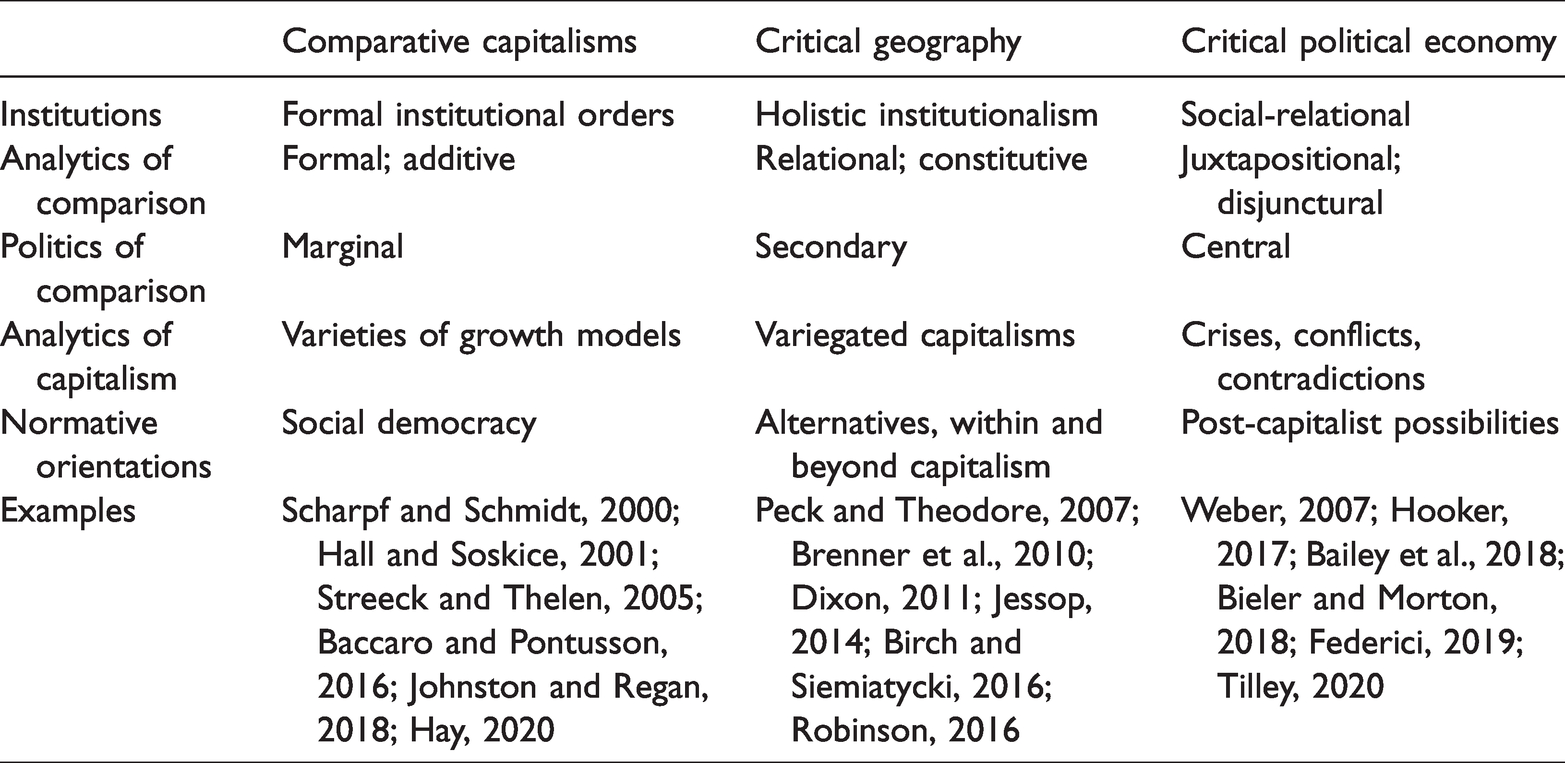
Turning first to the CC literatures, the politics of comparison is so marginal that it is often entirely absent from the discussion. As noted earlier, the shift towards the ‘growth models’ framework has made this more visible by virtue of its inclusion of distributional conflicts in the analysis. Yet this is significant almost entirely in terms of how it contributes to the heuristic exercise of model-building rather than in and of itself (see Baccaro and Pontusson, 2016: 195–202; Hay, 2020). This leads to a conceptualization of institutions that is heavily focused on formal institutional orders. In line with the ‘new institutionalist’ turn, institutions are understood to comprise of more and less formal rules and conventions; yet the informal only acquire significance when hardwired into obligatory form (cf. Streeck and Thelen, 2005). As a result, the comparisons offered by CC scholars are formal and additive in character, collating discrete national cases without enquiring into how either the cases themselves or the comparative research agenda are constituted. The marginal role for the politics of comparison means that differences between various CC contributions are of degree rather than of kind. This self-reinforcing internalism is reflected in how proponents of the VoC framework have managed to participate enthusiastically in debates about varieties of growth models (e.g. Hall, 2018), and in the inability to comprehend a normative orientation beyond some form of Western European-style social democratic capitalism.
Regarding the critical-geographical interventions, the politics of comparison is often visible in the contributions, albeit in a secondary way. The discussions spend more time on the analytics of comparison rather than the constitution of comparative strategies in a more fundamental sense. To be clear, this is considered in the contributions; more that the centre of gravity is elsewhere. As a result, the holistic understanding of institutions is considerably richer, more inclusive and more reflexive than in the CC literatures, with the aforementioned ‘national container’ critique being a clear dividing line. However, while this leads to an acknowledgement of the need to be explicit on how the cases chosen for analysis were constituted (see Zhang and Peck, 2016 on the multiple ‘models’ of capitalism that comprise the Chinese ‘model’), less is said about the social-relational constitution of the institutions studied in these comparative analyses. The same applies for the specific decisions made when choosing what and how to compare. In consequence, the critical-geographical interventions are clear on the need to consider capitalism as systemically variegated and thus always-already in various states of mutation into potentially novel forms; the same goes for the corresponding emphasis on the normative orientation towards the exploration of alternatives within and beyond capitalism, including future alternatives that we have yet to encounter. Yet, as I now discuss, we can and and should go further.
Turning to the broadly conceived critical political economy approach advocated by this article, the politics of comparison has been outlined in the previous section. The implications for the other four rows in the table will now be considered. On institutions, the social-relational approach advocated by Weber enables us to understand institutions by way of denying that they are ‘a set of objective, universal, “things” separate from the societies they are part of: rather, they are the materialization of unequal relations of power … that have significant effects on how these societies evolve.’ (Bruff and Wöhl, 2016: 96). Therefore, the study of institutions, and institutional power, does not force one to adopt an institutionalist perspective (either formal (CC) or holistic (critical geography)). This instead enables us to conceptualize institutions as part of and not separate from the societies in which they sit, which also means that social struggles help constitute the form and function of institutions – and thus shape the responses of those institutions to such struggles (Bailey et al., 2018).
In consequence, the analytics of comparison shift from the formalism of the CC literatures, and develop further the relational-constitutive emphasis of the critical-geographical interventions, to embrace a messier and more politically attuned understanding of knowledge production. There are countless ways in which different cases could be juxtaposed, and indeed many means by which we could enquire into how the cases themselves are constituted (e.g. the inter-scalar constitutions of the cases). Moreover, social and political struggles are a perpetual, endemic feature of capitalist societies, across a range of scales and sites. Their presence exceeds the ability of any research project to account for all of them – especially projects that are interested in comparison, but even when one is exploring the social-relational constitutions of a single ‘case’. In consequence, Hooker’s proposal of hemispheric juxtaposition, and Weber’s emphasis on social and political struggles in and beyond institutions across different ‘cases’, necessarily bring forth the question of researcher choice. Jennifer Mason (2011: 80) argues: if we want to create flashes of insight we need researchers to be active and imaginative agents … when they ask themselves how they can get hold of some pivotal, incisive, crucial or vital things … They need to make inventive and even ingenious decisions about which might be particularly compelling lines of enquiry and this cannot be done with deductive reasoning and following predefined methodological procedures alone.
Therefore, according a central role to the politics of comparison leads us to a disjunctural analytics of comparison. This explicitly acknowledges that the analyses we offer of our ‘cases’ are always open to challenge: by other juxtapositional research strategies, and via the evolution or transformation of the cases themselves. It also speaks to the analytics of capitalism. Instead of privileging the notion of models or indeed of variegation in an institutionally theorized sense (a la the CC and critical-geographical approaches), the forefronting of crises, conflicts and contradictions enables us to highlight the systemically unstable nature of capitalism and additionally that at least some of those instabilities are actively generated by social and political struggles in and beyond institutions. Hence, the particular constellation of crises, conflicts and contradictions in the given ‘case’ will inevitably be different to constellations one finds elsewhere. However, this is not a problem, for distinctive constellations can still produce particular resonances and discontinuities of interest for juxtapositional study and analysis.
More normatively, in the same way that a ‘case’ is always in the process of (re)constitution, meaning that the ‘case’ is never ‘finished’ or ‘complete’, capitalism always contains the possibilities, and thus the practices, of transformation. Such practices are not necessarily emancipatory – think of the impact of radical Right populism – and we should always be aware of this. Yet as Bruff and Tansel (2019: 238) argue, ‘by becoming more attuned to how inequalities of power are produced and reproduced in capitalist societies, we are able to consider more fully how other worlds can be made possible’. Hence critical political economy’s normative orientation is towards a range of post-capitalist possibilities that are pluralistically embodied in emancipatory social and political struggles always-already taking place within capitalism (cf. Bruff and Tansel, 2019: 241–42). In consequence, the politics of comparison can, on the one hand, deploy juxtapositional research strategies in order to articulate critiques of capitalism; on the other, it can focus on social and political struggles taking place in, against and potentially beyond the cases being studied. Of course, it can do both in the same analysis.
Unavoidably, the prominence given in this article to the politics of comparison makes it impossible to go into detail about the ways in which the example texts in row 6 of Table 1 represent the three approaches discussed in this article. Nevertheless, it is possible to confirm that I have chosen texts which together represent the diversity of contributions immanent to these approaches, and I will now outline briefly the critical political economy texts. Hooker and Weber have already been discussed; the other texts do not cite them, but can be understood as complementary because of how they consider multiple within- and cross-country sites and ‘cases’ – for instance, their utilization of broader vantage points for analysis that Hooker (hemispherically) and Weber (globally) practise in their own work. The Bailey et al. and Federici monographs emphasize the constitutive significance of social and political struggles for how the ‘cases’ are to be understood and interpreted – within Europe for the former (over austerity and neoliberalism), and cross-continental for the latter (over land and new enclosures) – and also articulate a post-capitalist normative orientation rooted in the possibilities for autonomous spaces and modes of organizing. The social-reproductive underpinnings of these publications are also present in Bieler and Morton’s wide-ranging text, which especially in the concluding chapter situates examples of ruptures in and beyond capitalism within the conditionings of uneven and combined development on a global scale. Bieler and Morton explicitly address the intertwining of struggles and the conditionings of such struggles, whereas Tilley’s article offers a methodologically radical break from notions such as ‘states and markets’ that are frequently couched in discrete, containered and apolitical terms. This builds on an earlier, path-breaking critique of the CC literatures (Tilley, 2015) to explicitly position the plantation and the mine as ‘key [conditioning] sites of colonial capitalism’ (Tilley, 2020: 14).
In keeping with Orzeck’s understanding of research as inherently political, the choices of the texts, across the three columns, are my own political decisions. For instance, each set of examples contains at least one primarily methodological text (e.g. Hay, 2020) and at least one ‘state of the art’ text (e.g. Brenner et al., 2010), although even here these selections were not pre-ordained. It is inevitable that another researcher interested in these themes, or even tasked with selecting texts for this table, would come up with different lists. Possible critical political economy examples in addition to Hooker and Weber would include Sarah Marie Hall’s (2019) advocacy of ethnography as a political method informed, in her analysis of everyday austerity, by critical feminist praxis; Tansel’s (2019) rewiring of understandings of authoritarian resiliences in the Middle East; Selwyn’s (2016) overview of labour-centred development across multiple sites; and Strauss’ (2020) explorations of racial capitalism as racial/ized capitalisms. Yet this is not a problem: as Hooker (2017: 15) argues, ‘[r]ather than a problem of faulty selection … the differences between the traditions and thinkers juxtaposed … are a feature of the methodological approach. Juxtaposition enables reading thinkers and traditions that are viewed as disparate alongside each other.’ This will be particularly apparent when viewing some of the CC and critical political economy texts alongside each other, but is also immanent to all three sets of texts in Table 1.
Therefore, in lieu of a more conventional conclusion, I will now discuss three key questions that the foregoing discussion raises for future work on comparing capitalisms.
Conclusion
The first question concerns the role played by Comparative Capitalisms scholarship in debates about comparing capitalisms. CC contributions were highly significant for revitalizing and also expanding research communities interested in these themes, which is acknowledged by critics of this research agenda (e.g. Ebenau et al., 2015; Peck and Theodore, 2007). At the same time, the tentative openings in this field during the 2000s towards dissident and alternative forms of institutionalism (e.g. Uwe Becker, 2009) and thus potentially towards the critical-geographical interventions considered in this article, has been lost in the process of the agenda’s (re)consolidation around the ‘growth models’ perspective. The exclusion of extant scholarship already working on growth models from a position that is critical of capitalism – some of which, such as Joachim Becker and Johannes Jäger’s work, is in line with a critical political economy approach – is also noteworthy. Therefore, CC literatures should now be understood as marginal to the further development of the endeavour of comparing capitalisms, with, at most, some descriptive empirical material being of continued relevance. Earlier attempts to engage productively with these literatures from a more critical perspective (e.g. Peck and Theodore, 2007), or which followed a path of immanent critique (e.g. Ebenau et al., 2015), are important for telling the story of how we reached this point, but are now of less relevance when looking ahead to future debates and discussions (something that my students were quicker to grasp than me (Bruff, 2021)).
The second concerns the inherently political nature of the act of comparison. It is impossible for humans to avoid comparing when thinking about the world, and, further, political-geographical imaginaries are intrinsic to comparison. However, the shadow cast over many discussions of comparison by notions of ‘most similar/most different’ research designs means that alternative constructions, such as the extended case method, are, to an extent, operating within this universe because they seek to respond to such notions. The power of Juliet Hooker’s and Heloise Weber’s arguments is that they demand we start somewhere else, creating our own epistemological and methodological ecology and associated vernaculars, through more inventive and more effective understandings of comparison. This does not entail an ‘anything goes’ approach, but instead promotes an open-ended, creative honesty about the role of the researcher in the (re)production of the acts of comparison. With reference to Reecia Orzeck’s arguments, comparison thus ought to be understood as an intrinsically political research practice. It is hence hoped that this article is of relevance, and has implications, for discussions and debates beyond what I have addressed in the preceding pages.
The third concerns the normative orientations of our research endeavours, which are ever-present even if – as in the case of CC research – they are often written out of the published contributions. This does not imply a simplistic one-way street from conception of comparison through to normative orientations, and nor is the research agenda merely an instrumentalization of the scholar’s already-existing worldviews. Nevertheless, certain tendencies will come to characterize the comparison-worldview connection: for instance, the methodological openness of the critical-geographical interventions dovetailing with their even-handed explorations of alternatives within and beyond capitalism. While laudable in many respects, this article is instead in affinity with Orzeck’s (2012: 1465) conclusion: While radical geographers try to produce knowledge that we hope will be helpful to particular (often marginalized) groups, the ultimate goal for many of us – both those of us who produce research oriented toward the needs of particular groups and those of us engaged in more apparently general research – is the transformation of the world on everyone’s behalf: from a place where knowledge is an accumulation strategy for the few into one where both the means and fruits of knowledge production are, finally, truly public.
Footnotes
Acknowledgements
The article could not have been written without the constant playing of two outstanding musical trilogies: No Image-Optimist-Why Aren’t You Laughing? by Gold, and Pain Cleanses Every Doubt-Converging Sins-The Inextricable Wandering by Ultha. Moreover, it can be read in tandem with  . An earlier, differently framed version of the paper was presented at the 2019 European Sociological Association conference in Manchester, UK. Thanks to those who commented at that event, and I am grateful, too, for feedback from Andreas Bieler, Nagore Calvo Mendizabal, Mark Coles, Andrew Eggleston, Stephanie Gillibrand, Tom Haines-Doran, Chris Hesketh, Rasmus Hovedskov Hansen, Aliki Koutlou, Julia Lux, Nadim Mirshak, Anna Murphy, Alexander Riley, Daniel Silver, Burak Tansel and Angela Wigger. Previous conversations on these themes with Mila Budeva, Matthias Ebenau and Caroline Gusman Agnelli were valuable. A conversation with Inanna Hamati-Ataya gave me the impetus to revise the ESA conference paper; in a different way, Owen Worth proved to be a similar catalyst. Madelaine Moore and Kathryn Starnes provided excellent feedback on a draft of the original submission to EPA, while Mònica Clua-Losada and Aleksandra Piletic encouraged me to be more expansive on the question of ‘politics’. I am indebted to Victoria Basham for pushing me to write about these themes, and to Reecia Orzeck for helpful advice regarding the article’s aims and scope. Finally, I received several useful comments and questions after presenting the ‘methods’ part of the argument at the (online) June 2020 conference organized by the Critical Political Economy Research Network. Many thanks to the EPA editors for managing this process so clearly and effectively, and to the reviewers for their comments.
Declaration of conflicting interests
The author declared no potential conflicts of interest with respect to the research, authorship and/or publication of this article.
Funding
The author received no financial support for the research, authorship and/or publication of this article.