




Abstract
While the entrepreneurialisation of local administrations is widely acknowledged, the extent and format of institutional and organisational structures that accompany market-oriented ideological shifts and transitions in urban governance often remain unnoticed. This article provides an original theoretical argument and frame of analysis to forensically study the underlying infrastructures of entrepreneurial governance systems. We argue that complex institutional and organisational arrangements in market-oriented urban development can be comprehended through fragmented governance architectures, a conceptual perspective that we borrowed from governance studies and operationalised in relation to property development. We illustrate the application of the framework by examining entrepreneurial transformations in Amsterdam’s residential property production. Based on rich empirical evidence, including discourse analysis, policy analysis and in-depth interviews with key policy and property industry actors, we illuminate divergent public-sector regulation of market activities, intra-organisational discrepancies, and fuzzy narratives in policy interventions which are tied to specific spatial interventions mushrooming in the city. Uncoordinated and sometimes contradictory institutional ties link public and private actors in these property production processes, forming a complex and chaotic landscape of regulations, actors, and relations. This fragmentation, we posit, warrants recognition as it lies at the heart of scattered investments in the urban built environment.
Introduction
Scholarly work on entrepreneurial urban governance discusses the increasing collaboration between public and private actors, mainly for the benefit of the private sector and particularly the property industry (Brenner, 2009; Harvey, 1989; Mazzucato, 2011). Existing literature highlights the complexities and dysfunctionalities of entrepreneurial, market-oriented, privatized and contractualised urban governance (Aalbers, 2020; Gordon and Travers, 2010), and its spatial consequences for cities. Moreover, the emerging forms, mixed qualities and effects of urban entrepreneurialism are explored through discussions on municipal entrepreneurialism, new urban managerialism, urban diplomacy and urban speculation (He, 2020; Phelps and Miao, 2020; Thompson et al., 2020; Wu, 2020). Meanwhile, political and urban scholars have framed the connected growth of involved actors in urban development and their weak integration in governance systems as organisational and political fragmentation (Le Galès, 2002; Taşan-Kok, 2010). Nonetheless, it remains difficult to understand what is fragmenting and how: the extent and format of institutional and organisational structures that accompany market-oriented ideological shifts and transitions in urban governance often remain unnoticed and empirically understudied.
How can we better grasp and systematically analyse the institutional and organisational structures that accompany transformations leading to entrepreneurial urban governance systems? To this end, we propose an original thesis and argue that entrepreneurial urban governance requires, and ultimately creates, fragmented governance architectures that accommodate complex institutional and organisational arrangements in market-oriented urban development. 1 We utilise a definition of fragmentation that refers to the actions of actors and organisations as being influenced by the “proliferation, specialization and diversification of institutions, actor-constellations, norms and discourses active in an issue-area” (Pattberg et al., 2014: 5). In this sense, fragmented governance architectures point to the underlying infrastructures of governance, alluding not only to the active participation of a wide range of actors with different political positions, interests, and goals, but also to the various regulations and narratives that shape their interaction. These infrastructures help to create an organisational capacity that enables establishing a core set of norms, meanings, and values for governance systems (Bok, 2019).
Empirically, we reveal how the fragmented governance architecture of Amsterdam goes hand in hand with residential property production as an entrepreneurial political project. Existing studies on Amsterdam’s governance transformation are limited to sectoral analyses of regulation, market, or policy dynamics (Bartels, 2020; Hochstenbach and Ronald, 2020; Savini et al., 2016). In contrast, we operationalise our more comprehensive approach by analysing i) the way property industry activity is regulated by the public sector; ii) the way public administrative structures relate to property market activity; and iii) the way policy interventions and tools are narrated in regulations affecting residential property production. On the basis of a rich variety of qualitative methods including discourse analysis, policy analysis, and in-depth interviews with key policy and property industry actors, we forensically study changes in the underlying organisational and institutional structures of Amsterdam’s property development.
Terhorst et al. (2001) described Amsterdam’s governance system as ‘consolidated’ because of its orderly (and hierarchical) structure. The city’s governance has also been praised for being ‘egalitarian’ and ‘just’ (Fainstein, 1997, 2014), balancing market dynamics through the delivery of welfare services. However, national regulatory changes have consistently altered state-market relations in Dutch urban development (Taşan-Kok et al., 2019). Meanwhile, the strong welfarist focus on affordable housing provision gave way to an entrepreneurial model heavily intertwined with property market dynamics (Boelhouwer, 2020; Hoekstra, 2017). Today, we can characterise Amsterdam’s governance system as fragmented: Uncoordinated, and at times contradictory, institutional ties link the local administrations and property industry actors in residential property production processes, forming a complex and chaotic landscape of regulations, actors, and relations.
While the national government loosened its regulatory framework to make more room for private market activities, housing shortages across the Netherlands turned residential property production into a highly politicised issue. Correspondingly, in recent years various government layers and agencies began to produce more guidelines, visions, and ambitions to push forward their own agendas based on their constituencies. The result is a complex regulatory environment expressing divergent attitudes toward property market activity, intra-organisational discrepancies within Amsterdam’s local administration up to the level of individuals engaging with property development, and the circulation of fuzzy policy narratives on property industry actors. Combined, these factors create the underlying infrastructure that allows an increasingly entrepreneurial governance system to roll out at the local level. Without strong and consistent public-sector leadership, this fragmentation is likely to increase.
The paper first elaborates on the concept of fragmented governance architectures as a novel perspective to analyse entrepreneurial transitions. Then, after presenting the research approach and methodology, we apply the framework to our Amsterdam case study. There, we show that organisational and institutional transformations are not structured systematically but concretised in residential property development projects throughout the city. This does not mean that the governance system of the city is completely out of control. Even though urban governance systems may still contain powerful organisations, institutions, and interest groups, the governance infrastructure that links the public sector to the property industry may be still complexifying. Finally, we discuss our empirical findings and conclude that fragmented governance architectures warrant recognition as they lie at the heart of scattered investments in the urban built environment.
Understanding entrepreneurial urban governance through fragmented governance architectures
Entrepreneurial governance refers to the model of managing cities under a neoliberal political economic ideology, which brings market and public-sector actors closer to one another. Growing numbers of actors and organisations, ranging from private companies to communities and individuals, are partaking in planning processes, which has seen governance perspectives prominently enter the spatial planning field (Schmitt and Wiechmann, 2018). The politics and finance of entrepreneurial governance as well as the spatial outcomes of this form of governance in terms of piecemeal, dispersed, or fragmented urban development projects have been discussed at length (Beswick and Penny, 2018; Hall and Hubbard, 1998; Harvey, 1989; Ward and Jonas, 2004). Property development has direct implications for the morphology of urban space as projects mushroom in the city. Growth through uncoordinated and complex institutional relations diminishes the possibilities of interlinking these spatial interventions with the wider built environment surrounding them (Pessoa et al., 2016; Özogul, 2019; Salet and Majoor, 2005). Fragmentation is also the subject of recent discussions in relation to the political economy of land, land speculation, and value capture mechanisms (Catney and Henneberry, 2019; Karaman et al., 2020; Noring, 2019). It is also discussed in relation to the financialisation of the built environment (Aalbers, 2020, 2019; August and Walks, 2018; Bryson et al., 2017; Teresa, 2016; Ward, 2019). All of these issues lead to scattered property development projects in the urban space.
Structural and administrative consequences of this form of governance, however, are only covered in a limited number of discussions outside of the public or local administration literature (Lauermann, 2018; Pike et al., 2019; Taşan-Kok, 2010). Due to the involvement of various institutional bodies, policy networks, and community organisations, and the potential of missing connections between various policy domains, fragmentation can be perceived as an essential characteristic of governance. In a dynamic policy environment where the number of interactions between institutions and governance actors increases, it is difficult to control new forms of public action (Le Galès, 1998). In fact, several public administration scholars perceive fragmentation as an institutional coordination problem, especially within the framework of welfare state transformations (Bonoli and Champion, 2015; Champion and Bonoli, 2011). They see entrepreneurial political agendas as structured by powerful interest groups that are increasingly framing public policies in less hierarchical and less organized settings (Lascoumes and Le Galès, 2007). Moreover, as institutions and policy instruments shape or constrain the interactions and behaviours of actors and organisations (Powell and DiMaggio, 2012), they are also important to understand the power relations associated with them.
To explore the interplay between institutions and organisations in entrepreneurial urban governance in more detail, we bring neo-institutionalism into the picture, which enables us to focus on the relations between institutional characteristics and political agency (March and Olsen, 2006). North (1994) provides a robust viewpoint to differentiate institutions and organisations: He argues that organisations are the players and institutions are the rules of the game. In his view, institutions contain formal rules and informal constraints, which define “the opportunity set, and therefore the kind of organisations that will come into existence” (North, 1994: 190). Furthermore, as Pierre (1999) states, institutions shape or constrain the political behaviour of actors (organisations) through overarching systems of values, traditions, norms, and practice. Regulations in particular are important mechanisms of governance (Le Galès, 1998). Not only do these neo-institutional understandings define the fundamentals of institutional change in a capitalist economic model by linking actors (organisations) to the regulatory framework (institutions). They also help us disentangle the entrepreneurialisation of governance by drawing attention to the intertwined institutional and organisational dynamics that go hand in hand with increasing private-sector involvement in urban development.
While organisational and institutional fragmentation have been recognised as characteristics of entrepreneurial governance, they are not easy to systematically unpack. Given the lack of suitable frameworks in the wider planning and urban studies fields, we turned to a conceptual framework that is used in governance studies when explaining large-scale administrative bodies such as the European Union, or administrative complexities such as human rights regulation: fragmented governance architectures (Biermann and Kim, 2020; Biermann et al., 2009; Pattberg et al., 2014). Governance architectures refer to the fundamental institutional characteristics of a meta-level form of governance, focusing on governance arrangements in relation to a specific issue area. Within that issue area, institutions and organisations can differ in terms of their character, subject matter, objectives, constituencies, and spatial scope (Zelli, 2011). They can be either synergetic or conflictual, and when combined create a patchwork of policy domains (Zelli, 2011). The more rapidly the number of institutions and organisations increases, the more diverse and specialised institutions and organisations become. This means that more diverse actor networks, policy discourses, and narratives circulate in the patchwork of policy domains, creating the higher degree of fragmentation of the governance architectures (Pattberg et al., 2014).
In the scholarly literature on urban governance, the politics of entrepreneurialism or pro-growth agendas are mainly covered in reference to hybrid, neoliberal governance formulations (Pierre, 1999; Taşan-Kok et al., 2020). However, the underlying infrastructures of these formulations, which are equally important for defining the future of spatial development, are largely untouched. To fill this gap, analysing entrepreneurial urban governance through fragmented governance architectures illuminates how entrepreneurial governance agendas facilitate scattered policy interventions and investments in the city. In a growth- and market-oriented setting, governance systems become more complex; public-sector actors are not – as commonly perceived – opposed to the private sector but actively shape property markets and interact with property industry actors (Adams and Tiesdell, 2012). This can lead to what Buitelaar et al. (2014) describe as ‘institutional contradictions’ where diverse and multifaceted regulations shape, stimulate, and regulate the property industry actors’ actions, which in turn diminish direct and consistent links between policies, policy narratives, and organisational set-ups (Adams and Tiesdell, 2012).
Therefore, our understanding of governance architectures linked to the issue area of property development refers to: the regulations aiming to regulate divergent state-market relations; the organisational structures aiming to co-ordinate inter- and intra-organisational discrepancies; and the policy narratives related to the involvement of market actors in residential property production. In terms of the interplay between entrepreneurial urban governance and fragmented governance architectures, following our threefold operationalisation allows us to uncover the complex institutional and organisational processes that are ultimately responsible for shaping the actors and relations that are creating the urban built environment.
Methodology
We set out to explore the governance architecture of residential property production in the City of Amsterdam, specifically looking at the public sector. First, taking an inductive approach, we compiled a database of all public-sector regulations affecting residential developments in the city. Following Guy and Henneberry (2000: 5), we see property development as “a complex process which entails the orchestration of finance, materials, labour and expertise by many actors within a wider, social, economic and political environment.” Thus, the 69 policies, laws, decrees, and governmental visions that we assembled, and that were valid at least until May 2019, covered the planning, finance, concept, and construction stages of the development process. We categorised all regulations by year of issue and scope (municipal, regional, provincial, national, and European), and then systematically analysed their relationship to market activity following a framework of Adams and Tiesdell (2012) (see Table 1). Second, we conducted in-depth interviews with 24 public and private property market actors 2 on the fragmented nature of property development in Amsterdam. Interviews lasted between 45 and 90 minutes, and interviewees were promised strict anonymity. Therefore, only limited information on their sector and area of operation is given in the analysis. Interviews with strategic advisors, municipal planners and project managers focused on the policy context of property development, internal dynamics, and collaboration within the different clusters and divisions of the City of Amsterdam, as well as perceptions of the City’s general relationship with property industry actors. Interviews with private-sector actors focused on the influence of public-sector regulations on their investment decisions, as well as the relevance of the perceived attitude of the City of Amsterdam toward the property industry.
Categorisation of regulations in relation to market activity.
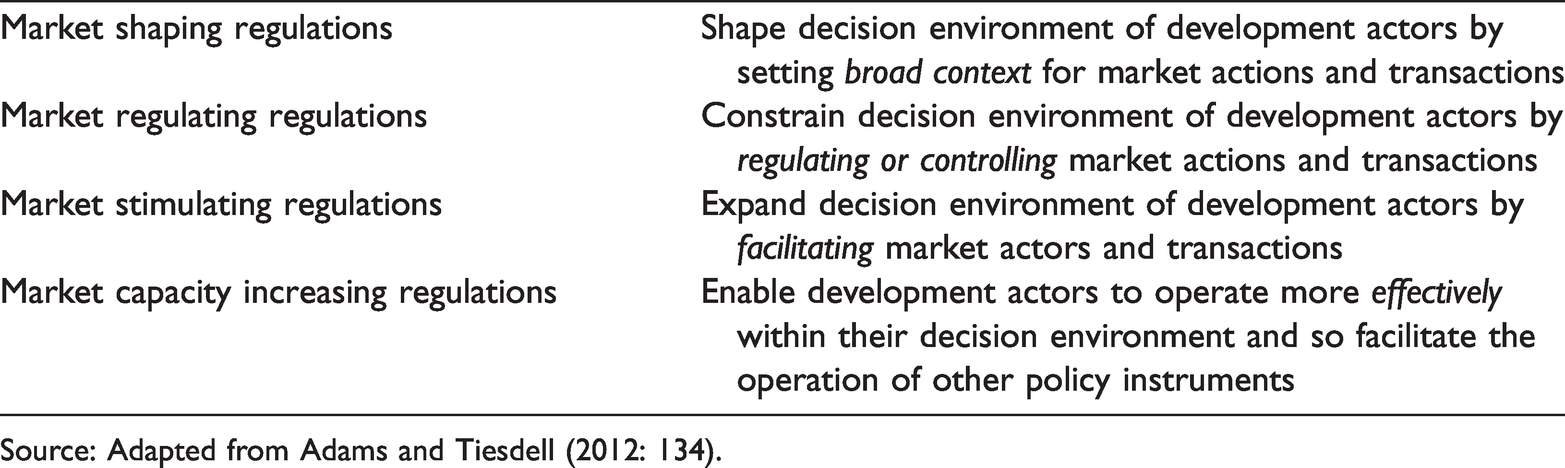
Source: Adapted from Adams and Tiesdell (2012: 134).
Third, we selected 15 policy documents from our collection 3 for an in-depth analysis based on their administrative agency level and their relevance to the perception of the property industry. Policy documents were systematically screened for references to, and descriptions of, private-sector actors and their role in spatial development. After comparing diverse framings of the property industry in the written documents, we returned to our interview transcripts to compare narrative framings. In fact, we consistently moved between the regulatory analysis, interview data, and narrative analysis in order to critically reflect on and verify our own observations. As standalone analyses, all three focus areas would be open to methodological biases; combined, our extensive empirical material allowed us to formulate solid arguments on fragmentation in Amsterdam.
Amsterdam’s fragmented governance architecture of residential property production
Like many global metropoles nowadays, Amsterdam is a city under construction. Residential property development projects mushroom all over the city. Between 2012 and 2019 alone, 1326 housing plans were either completed, under construction, or at a stage where principle or investment decisions have been taken (City of Amsterdam, 2019a; Figure 1). The inadequate supply has been perpetuated by demographic changes and Amsterdam’s attractiveness as a city to live, work, and study in, coupled with the City’s financial situation after the 2008 financial crisis that nearly halted housing production. The city’s housing market reported the highest price changes in the Eurozone in 2017, with annual rates over 15% (Nijskens et al., 2019). Furthermore, compared to average disposable annual incomes of residents in 2018, housing in Amsterdam is the most expensive in Europe, according to credit rating agency Moody’s (Het Financieele Dagblad, 2019). Amsterdam also experienced the country’s highest rent increase for several years running (Statistics Netherlands, 2019).
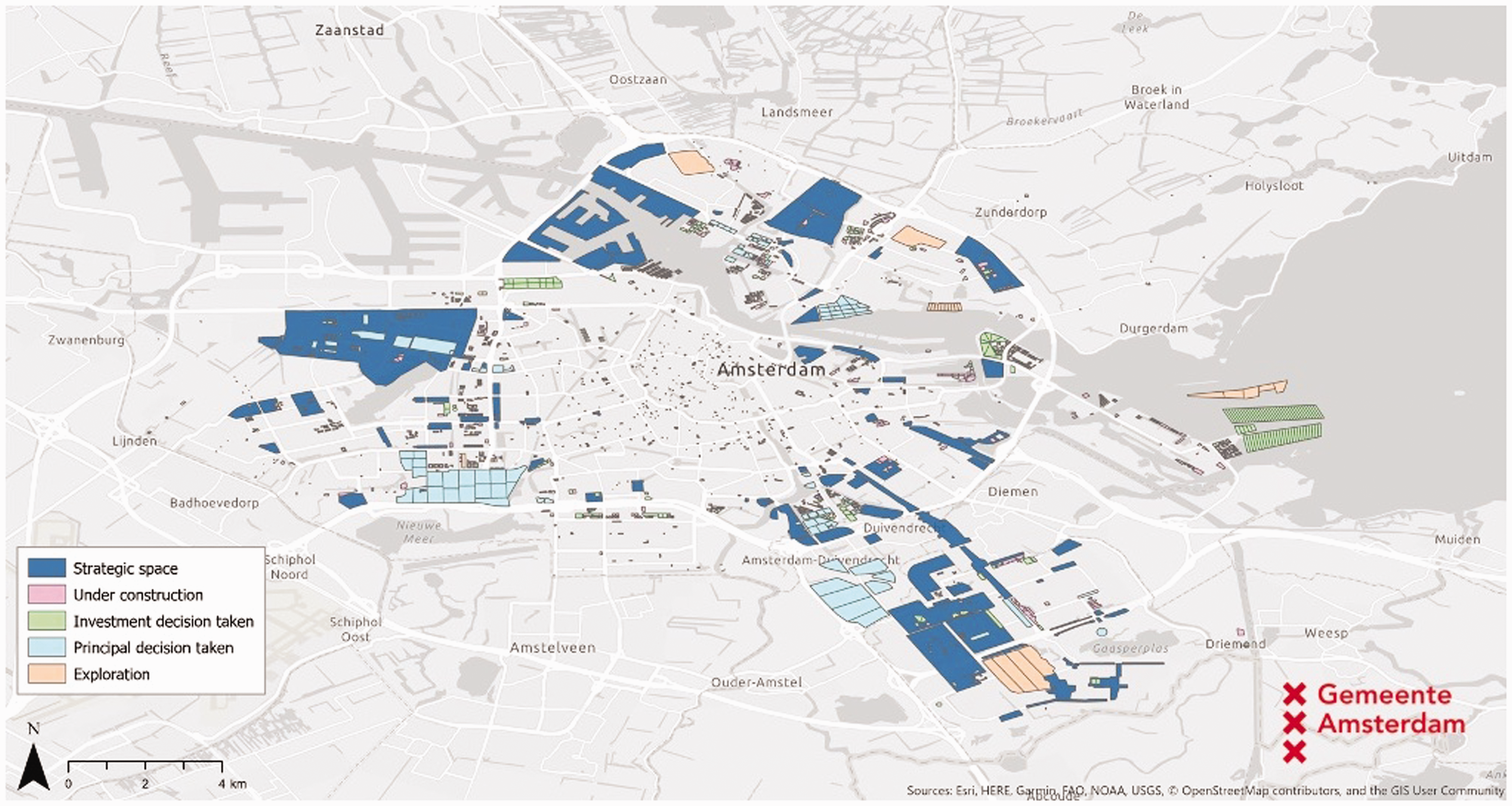
Amsterdam’s Housing Plans 2012–2019. Created based on data from City of Amsterdam (2019b).
The map of Amsterdam’s housing plans provides an indication of the underlying institutional and organisational complexity of residential property production, considering that in each coloured area, different sets of actors (organisations) interact based on unique sets of regulations (institutions). Madden and Marcuse (2016: 119) once commented that housing policy is “an artificially clear picture of what the state actually does in myriad uncoordinated and at times contradictory ways”. Studying Amsterdam's regulatory framework of residential property production, we discern a structure behind a seemingly uncoordinated and contradictory array of regulations. Based on our analysis, production of residential production in the city is regulated through four policy domains, to use Biermann et al.’s (2009) terminology: embedding social housing provision in market mechanisms; co-ordinating market housing production; regulating the financial mechanisms of housing production; and finally, ensuring spatial quality of the built environment (see Figure 2).
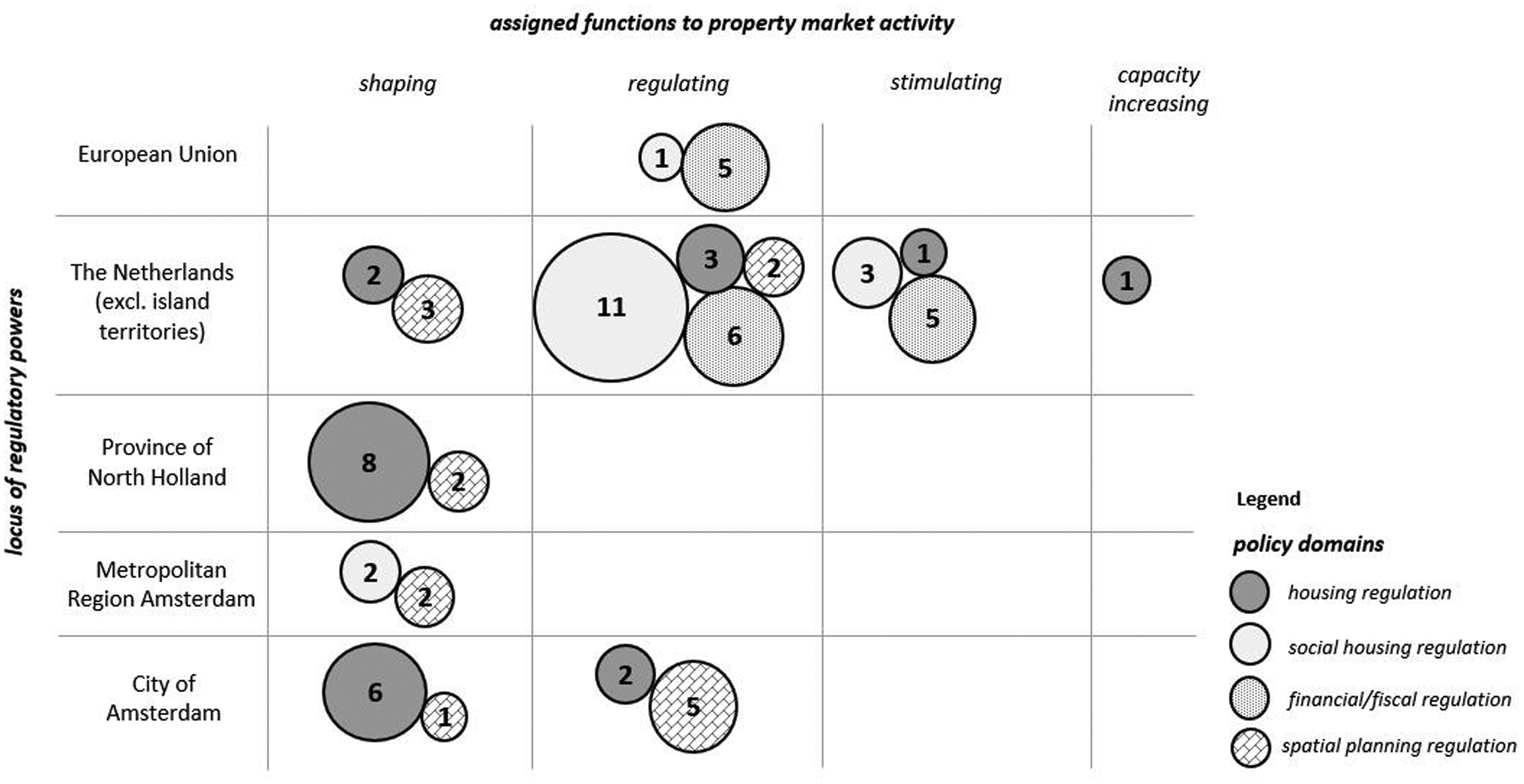
Locus of regulatory powers by function and policy domain.Source: Authors’ own analysis.
In the following systematic analysis we illuminate how the regulations in our database do not assign a coherent function to the market. Furthermore, we reveal how this regulatory complexity is accentuated by intra-organisational discrepancies within the local administration, in terms of the attitudes and relationships that public servants display in relation to property industry actors. And finally, we expose how both the analysed regulations and interviewees utilise multiple and fuzzy narratives to form an additional layer of fragmentation.
Divergent public sector regulation of market activities
Amsterdam’s residential property production is affected by a range of public-sector regulations that span the thematic areas of housing (23), social housing provision (15), finance and taxes (16), and spatial planning (15). Most tie directly into the spatial makeup of the city by stipulating where, how, and what type of residential properties can be built. Others, especially fiscal regulations governing mortgages, taxes, and investment vehicles, impact the type of organisations involved in these processes. Placing the regulations in our database in the framework of Adams and Tiesdell (2012), we observed multiple attempts to shape, regulate, stimulate, and increase capacity in the market (Figure 2). Policies to influence market activities are operationalised through divergent regulatory activities that assign diverse functions to the market and create contradicting regulations across diverse scales of governance, creating complexities, inconsistencies, and uncertainty.
A regulating function was assigned to financial/fiscal and social housing regulations (31 in total). These stipulate the procedures and requirements constraining the decision-making environment of market actors, including non-negotiable calculations and tax requirements. A shaping function was assigned to regulations primarily concerning housing (26 in total). For example, the Amsterdam Housing Agenda 2025 (2017) and the Regional Agreements about New Urban Developments in North Holland (2017) all set the wider context for market transactions. While inevitably encouraging private activity, we separated them from the regulations categorised as predominantly stimulating market activity (10). Examples are the national Tax Exemption from the Landlord Levy (2017), which is a subsidy that applies to residential property under the social housing threshold in selected urban renewal schemes, or the national Foreign Investor Scheme (2016) that provides temporary residence permits to individuals who invest a minimum of €12,50,000 in the Dutch economy and specifically mentions the option of investing in housing to “satisfy regional and municipal needs.” Interestingly, and conflicting with Adams and Tiesdell’s definition of stimulating the market through financial mechanisms, the fiscal regulations target regulation of the housing market predominantly through taxation or banking, not by stimulating financial gains. Capacity-increasing regulations (2) were rare. Enhancing the capacity of market actors to contribute to policy delivery or to negotiate successfully would not seem to be a regulation target. The absence of capacity-increasing regulations, aside from a policy note on the creation of a national Contact Point for Real Estate Funds (2001), can be explained by our focus on official policy in written documents. Various public-sector interviewees engaged in a range of activities, from consultation sessions to training courses, in order to improve public-private collaboration that were not going smoothly (Intvw07; Intvw08; Intvw11). These activities were not addressed in the written documents.
A closer look at the wording of the regulations and the transcriptions of our interviews drew attention to various regulatory contradictions across different scales of governance. Most of the financial/fiscal and social housing regulations that we classified as ‘regulating’ were enacted at the national level, whereas the City’s regulating powers lie mainly in spatial planning (Figure 2). For example, while the City of Amsterdam pools efforts to control residential investments (Intvw02), the national government actively promotes housing in the Netherlands as an investment opportunity at international real estate fairs. According to one local spatial planner, the national government “pushed the door wide open”, making it hard for Amsterdam’s administration to block foreign investors “such as Blackstone who just buy up big blocks of housing” (Intvw03). Whereas local planners are thereby better positioned to steer the production of new housing, they are not able to directly intervene when investors buy up existing units.
Furthermore, the policy environment creates complexities, inconsistencies and uncertainty for residential property developers whose projects may not neatly fit into electoral cycles. Newly elected governments at all levels tend to put forward their own policies and strategies, especially regarding the politicised issue of housing. Changes in the restrictions and demands that the public sector imposes on the private sector produce not only a dynamic policy environment but, as several private-sector interviewees pointed out, uncertainty too. They lamented that as housing becomes increasingly politicised, any ensuing drastic changes might contradict earlier regulations, allowing politicians to justify their actions to their own constituencies. As a private investor and developer operating in the Amsterdam market remarked, it is always “dubious” when politicians, elected for a four-year term, want to receive credit for their newly implemented policies, while the actual numbers of housing production are much more likely to follow market cycles (Intvw22).
Regulatory complexity inevitably leads to conflicts, playing into the Dutch consensus-seeking approach (Intvw01; Intvw03). Many property industry actors and their industry network organisations are involved in policy development processes and lobby at different government levels. Thus, private-sector viewpoints are already considered when new regulations are drafted. However, several cases reveal some flexibility in the regulation of market activity. A prime example is the 40–40-20 rule, imposed after the 2018 local elections, that requires a 40–40-20 ratio of social, mid-income, 4 and market-rate housing in new development projects. Private actors disagreed with the stipulations concerning the cap on rent increases, citing the high land prices (Intvw20; Intvw22). Long discussions, including side-by-side calculations, with experts from the City administration and private companies, resulted in re-negotiation of the details of the regulation (Intvw03).
Regulations are almost never clear-cut. Exploring the fundamental relationship of housing, social housing, financial/fiscal, and spatial planning regulations to market activity in light of the locus of regulatory powers and negotiation practices reveals a fragmented policy landscape. It might fit Biermann et al.’s (2009) definition of ‘conflictive fragmentation’ in governance architectures. The emerging picture is one of conflicting institutions, multiple and un-related decision-making procedures, and various actor coalitions that may advance these conflicts. The analysed regulations provide the foundation for the city’s governance architecture. While one could assume that the characteristic consensus-seeking approach would lead to a coherent public-sector relationship to market activity, the contrary appears to be the case. This so-called ‘Polder Model’ creates room for manoeuvre and concessions in various residential development projects (Intvw05; Intvw14), wiggle-room that is further accentuated by intra-organisational discrepancies within the City of Amsterdam.
Intra-organisational discrepancies
The City of Amsterdam employs around 15,000 civil servants and an additional 4,000 external consultants, adding to the complexity of its governance architecture. The interplay of co-ordination efforts, opposing and shifting political ambitions, and numerous development projects seeks to strike a balance in this dynamic context. We focus on the intra-organisational discrepancies within the local administration that are likely to contribute to fragmentation: administrative divisions set up their own policy directions and are not always collaborating; and even within divisions, differences in management style lead to multifaceted relationships between public officials and property industry actors.
To begin with, residential property production at the local level involves multiple administrative divisions. The City’s Land & Development division is responsible for tenders, land lease arrangements, and contracts with private-sector parties. The Planning & Sustainability division is in charge of zoning plans and wider spatial planning visions. Meanwhile, the Housing division creates citywide housing policies. Furthermore, the emphasis on project-driven development is reflected in the remit of the City’s Project Management Office (PMO), which provides municipality-wide expertise across projects, process, and programme management (Özoğul, 2019). Internally the PMO hires specialists from several divisions to form interdisciplinary project teams. These include planners, urban designers, as well as land lease and legal experts who draw up contracts to manage the numerous land development projects throughout the city (Intvw09; Intvw 12). Even though efforts are made to bridge divisional discrepancies and encourage collaboration within the City, the involvement of so many public-sector actors causes inconsistencies (Intvw02).
Furthermore, the local administration is bound to the municipal council and municipal executive, which consists of the mayor and alderpersons, and subject to budgetary constraints. For example, during the 2008 economic crisis, local politicians did not follow the unified expert advice formulated by representatives of different divisions to continue with housing production (Intvw03). Although aware of the repercussions of reducing housing production despite demographic growth (Intvw15), local planners and project managers working on area development had no other option but to follow the decision-makers and put most plans on hold. Additionally, conflicting actions of the City were frequently ascribed to the personal and political priorities of individual alderpersons. They have their own priorities, which they discuss with experts in the respected fields (Intvw01; Intvw02). Public- and private-sector interviewees agreed that the ‘“problem of this local government is that it does not have one voice” (Intvw01) and that “in the end, it always comes down to the person who is sitting at the other side of the table” (Intvw20).
The changing policy environment and changing market dynamics also demanded ‘“style flexibility”, as Intvw11 described it, from public sector actors interacting with private development actors. Intvw10, for instance, reflected that, “We have an internal problem basically. It's like a mismatch between policy and how policy works in real life”. This flexibility, however, was not necessarily appreciated by either public- or private-sector interviewees. From the public-sector point of view, Intvw02 revealed how documents and master plans became very abstract, containing changeable visions valid only for a short period of time, and admitted that it is at times useful to read older policy documents that are more directive. Private-sector interviewees also expressed a wish for more guidance and leadership (Intvw15; Intvw19; Intvw22), even stating that the ideological orientation of those with political power does not matter as long as concrete and stable directions are given (Intvw22). “This fragmentation”, using the term before it was introduced in the interview, Intvw17 explained, “This fragmentation is connected to regulatory chaos and lack of direction from the national government.” While generally conveying an attitude of not being very much influenced by politics, it became clear that private interviewees closely observed political developments. As Intvw21, for example, clarified, if the political conditions do not fit, they just let areas or properties sit for several years until the conditions are better.
Thus, even though the City of Amsterdam represents a sophisticated administration, there are fundamental intra-organisational discrepancies when it comes to residential property production. These are the result of dynamic policymaking and policy-implementing environments, as well as various political priorities and practices. In this context, individual agency, attitudes, and objectives are elevated and become more important in shaping development processes, as firm guidelines loosen and strong leadership from all administrative levels disappears. The consequences of the resulting patchwork of initiatives” (Intvw23) are felt by public and private residential property market actors alike. As we argue in the next section, those consequences gain legitimacy through ‘fuzzy policy narratives’.
Fuzzy policy narratives
Opinion on property industry actors in both written policy documents and conducted interviews was mixed, and even conflicting. Overall, public policy narratives have become more market-friendly, though opinion is mixed on the public sector’s role in dealing with market actors and housing provision, the role of property industry actors, and the role of policy instrumentation. Three sets of narratives emerged in our analysis: narratives on the changing role of the public sector; on the perception of property industry actors; and on the role of political agendas.
The first set points towards a shift in the role of the public sector from housing provision to residential property production. Earlier documents such as the national Housing Act (1991) were predominantly framed around ‘public housing provision’. In the early 2000s, however, advisory documents submitted to the Dutch government started to frame the social housing stock as an ‘asset’. Some bore evocative titles: ‘Hurrying and Slowing Down in Urban Restructuring’ (2002) by the former advisory body for the Ministry of Housing, Spatial Planning and the Environment; and ‘Giving Space, Taking Space’ (2006) by the Council for the Environment and Infrastructure (the current strategic advisory board for the Dutch government in matters relating to the physical environment and infrastructure).
In response to the economic downturn precipitated by the 2008 crisis, the Netherlands passed a Crisis and Recovery Act (2010). Its aim was to encourage and accelerate building projects, marking a strong shift in policy narrative from ‘responsibilities’ to ‘procedures’ that facilitate public-sector planning and permit procedures and thus accelerate private-sector activity and investments. A new Environment and Planning Act (Omgevingswet), expected in 2021, will adopt the same ‘enabling’ attitude, notably by reducing the weight of bureaucracy and easing the initiation of projects. Interestingly, several of our interviewees stated that the City of Amsterdam has adopted a more restrictive and controlling attitude, particularly towards affordable housing. However, policy narratives at sub-national levels all indicate a clear shift towards market-orientation; for instance, the Monitor Area Agenda 2015 for the provinces of North Holland, Utrecht and Flevoland (Monitor Gebiedsagenda, 2015: 8, 12) calls for ‘new investment strategies and financial models’ to make market parties feel ‘invited’ so that they ‘invest’.
The second set of narratives that we identified presents property industry actors either as public-sector allies or as threats to the public interest. Amsterdam’s Housing Development Plan 2018–2025 (2018: 19), for instance, names certain Dutch institutional investors (Amvest, Vesteda, Bouwinvest, and Syntrus Achmea) but also underlines the importance of foreign investors, announcing that ‘prospects for revenues are good’. Furthermore, the plan states that ‘in dealing with the private sector, it is not a good idea for the municipality to insist that all of the objectives for its housing development plans are non-negotiable’ (Housing Development Plan 2018–2025, 2018: 20). Other influential policy actors, such as a national institute for strategic policy analysis of the environment, describe the property industry either as being ‘on the same side as the public sector’ or giving leeway to the property industry as a risk that could ‘slow down development’ (Buitelaar et al., 2008: 15, 20, 82). A more ‘market-friendly’ attitude is expressed at the regional (Randstad) scale, where an ‘internationally accessible business climate’ is deemed necessary so that market parties should feel ‘invited’ (Monitor Gebiedsagenda, 2015: 8, 12).
Thirdly, adding to the fuzziness of policy narratives, opinion is mixed regarding political agendas. Several interviewees (Intvw06; Intvw12; Intvw10) sensed a gap between the professional planning norms that define the legal aspects of spatial development (like zoning decisions) and political agendas in terms of their aims, numerical targets, and implementation. It is hard for alderpersons to see the big picture; as Intvw02 noted, “they have a very hectic agenda, and they don’t have an overview of what they aim politically”. Public officials of the City of Amsterdam criticised alderpersons for lacking overarching goals and long-term perspectives. Political pressure pushes narratives on “numerical targets” at the expense of principles and rules that frame the provision of housing (Intvw1; Intvw16). Furthermore, Intvw20 explained that politicians are “looking at all kinds of crazy solutions to enhance the production. But in the last half year there were only 3,000 new building permits in Amsterdam, which is extremely low. Just because he [the alderperson] hates investors.”
Combined, the examples show how fuzzy narratives tie into chaotic policy agendas. The examples highlight conflicting views and inconsistencies that are a result of, and contribute to, the fragmented relations that public-sector regulations and actors have with the residential market in Amsterdam. Interestingly, the need to ‘co-ordinate the activities and investment strategies of various parties’ is recognised at the City level (Structuurvisie Amsterdam 2040, 2011: 160).
Discussion and conclusion
Entrepreneurial urban governance is often treated as a given, without querying the underlying process of neoliberal transformation As we argued above, entrepreneurial urban governance requires flexibly designed fragmented governance architectures to accommodate the multi-actor policy interventions linked to property market activity. Our analytical perspective, borrowed from Bierman et al. (2009) but operationalised in relation to property development, provides entrepreneurial urban governance scholarship with a means to detect the institutional and organisational structures that accompany transformations leading to entrepreneurial urban governance systems. Cities adapt entrepreneurial policy agendas in different ways, reflecting the regulatory, organisational, and political traditions of the wider governance context. However, the divergent public sector regulations of market activity, intra-organisational discrepancies and fuzzy policy narratives affecting Amsterdam’s property development, are emblematic of the fragmentation of urban governance systems elsewhere. Fragmentation allowed neoliberal ideologies to take hold even in Amsterdam, a city once said to be consolidated in its governance. Internationally, Amsterdam is known for its extensive public administration and large-scale control over development, thanks to public land ownership.
Our empirical analysis illustrates how Amsterdam’s ‘peculiar mixture of neoliberal and state-led institutions and regulation regimes’ (Engelen and Musterd, 2010: 702) operates on a practical level. We showed how regulations provide the basis for fragmented governance architectures in the various ways they regulate state-market relations. We discussed how administrative divisions set up their own policy directions, alderpersons have their own priorities, and individual public servants different management styles, all leading to multifaceted relationships between public officials and property industry actors. And we explained how fuzzy policy narratives reflect this fragmentation. Even though entrepreneurial governance arrangements in Amsterdam are not new, we see that the degree of fragmentation has intensified since the 2008 financial crisis with the subsequent de-regulation, particularly at the national level, and – once the repercussions were felt in Amsterdam – with various attempts to re-regulate residential property production at the local level.
Project-oriented residential development has become the norm, even in Amsterdam. Despite citywide policies and the close-knit relations between sets of actors, project-specific outcomes may deviate from overarching regulatory frameworks. Although our research did not cover the spatial consequences of institutional fragmentation, we can observe the consequences in Amsterdam, where space is limited due to its historical and water-oriented morphology. This form of property-led development is conducive to scattered spatial development which is planned through incremental, usually unco-ordinated and complex institutional relations. This form of physical development is manifest as a patchwork: different areas have been developed without being connected to each other in the spatial structure (Pessoa et al., 2016).
The fragmentation of Amsterdam’s governance architecture is a consequence of the entrepreneurialisation of urban governance, shifting away from housing provision to residential property production. But it is also a precondition for this structural transformation. It is the result of, and further enhances, unco-ordinated institutional ties linking public and private residential property market actors. Therefore, we concur with Mallach’s (2014: 771) call for more research “to explicate the complex relationship among local markets, public policies, and investor behaviour to provide the intellectual foundation for a new generation of housing and urban policies to reflect the new realities.”
Our approach is critical of the fragmentation of governance architectures. But we recognise that it may have some positive effects, as the increased flexibility to accommodate new actors may enable new groups to participate. Although the field appears messy, as nobody is really able to follow what is happening in cities at once, fragmented governance architectures may also enable new forms of city building (co-operatives, co-production, etc) which were not previously easily implemented due to the rigid governance networks. A good example of this ‘enabling’ policy environment that fragmented governance architectures support is the creation of a new Environment and Planning Act (Omgevingswet) in the Netherlands. Within this framework, new research is needed to look deeper into the dynamics of entrepreneurial governance through divergent actor structures and mismatches of policy objectives, professional principles, and political agendas within the public sector, rather than single-mindedly blaming the private-sector actors and their greedy, profit-oriented actions for the ongoing housing crises in metropolitan cities like Amsterdam.
Many new ideas have emerged about how the public sector should act in this entrepreneurial governance model. Some scholarly literature suggests that governments be reimagined as ‘creative agents’ as ‘the state has not just fixed markets, but actively created them’ (Mazzucato, 2011). Some popular liberal media outlets, such as The Economist (16 January 2020), advocate for ‘flexible planning systems’ and ‘financial regulation to turn housing into a force for social and economic stability’, raising expectations for new entrepreneurial governance approaches. Although we cannot foresee the shape of state, market, and citizen relations after the 2020 coronavirus outbreak, governance architectures might make a sharp turn to enable more welfarist public-sector interventions.
Supplemental Material
sj-pdf-1-epn-10.1177_0308518X21996351 - Supplemental material for Fragmented governance architectures underlying residential property production in Amsterdam
Supplemental material, sj-pdf-1-epn-10.1177_0308518X21996351 for Fragmented governance architectures underlying residential property production in Amsterdam by Tuna Taşan-Kok and Sara Özogul in Environment and Planning A: Economy and Space
Footnotes
Acknowledgements
The authors would like to thank Mike Raco for his suggestions on the earlier version of the article, as well as the anonymous reviewers for their fruitful and engaged comments.
Declaration of conflicting interests
The author(s) declared no potential conflicts of interest with respect to the research, authorship, and/or publication of this article.
Funding
The research was conducted within the framework of the WHIG Project (‘What is Governed in Cities: Residential Investment Landscapes and the Governance and Regulation of Housing Production’) and has received funding from the Open Research Area for the Social Sciences (ORA) under grant agreement no. 464.18.113.

Notes
References
Supplementary Material
Please find the following supplemental material available below.
For Open Access articles published under a Creative Commons License, all supplemental material carries the same license as the article it is associated with.
For non-Open Access articles published, all supplemental material carries a non-exclusive license, and permission requests for re-use of supplemental material or any part of supplemental material shall be sent directly to the copyright owner as specified in the copyright notice associated with the article.
