




Abstract
On the world stage, Australian cities have been punching above their weight in global indexes of housing prices, sparking heated debates about the causes of and remedies for, sustained house price inflation. This paper examines the evidence base underpinning such debates, and the policy claims made by key commentators and stakeholders. With reference to the wider context of Australia’s housing market over a 20 year period, as well as an in depth analysis of a research paper by Australia’s central Reserve Bank, we show how economic theories commonly position land use planning as a primary driver of new supply constraints but overlook other explanations for housing market behavior. In doing so, we offer an alternative understanding of urban housing markets and land use planning interventions as a basis for more effective policy intervention in Australian and other world cities.
Keywords
Introduction
Australia’s housing market is amongst the most expensive in the world, reaching seventh on the price to income measure by 2018 after nearly three decades of uninterrupted economic growth (IMF, 2018a). Benefitting property owners at the expense of first home buyers and renters, concerns about high house prices came to dominate the national conversation for the first two decades of the new millennium. As in other nations characterised by high housing markets and rising affordability pressures, much of this debate has related to the role of land use planning as a supply side constraint. This paper examines this argument in the Australian context, focusing in particular on the nature of analysis used to diagnose Australia’s affordability crisis and the narrow policy ‘fixes’ which have been promulgated by key commentators and stakeholders. As a case study, we draw on an influential research paper prepared by the nation’s central bank – the Reserve Bank of Australia (RBA), which seeks to estimate the regulatory ‘tax’ imposed by land use regulation or ‘zoning’ by comparing the difference between average and marginal land costs in the nation’s major urban housing markets (Kendall and Tulip, 2018). Applying an economic method for modelling the burden of urban regulation on residential housing markets (developed by US economists Edward Glaeser and Joseph Gyourko in 2003), the RBA paper is an example of how global networks of experts and policy ideas can come to influence national policy discourse despite questionable assumptions and data. Our analysis of the Australian case provides another example of how land use planning is increasingly ‘scapegoated’ (Gunder, 2016) within the political construction of urban and housing problems (Murphy, 2014). Pre-occupied with the role of planning as a perceived cause of housing market failure, such narratives divert attention from the wider range of policy solutions needed to truly address the housing supply and affordability problems besetting major cities in Australia and in many other parts of the world.
We present our analysis in three parts. First, we offer a short review of the vast and eclectic literature on planning and housing markets, distinguishing between studies which examine relationships between urban planning and housing markets using data on land use regulation versus attempts to derive regulatory effects via modelling. We also refer to the small but growing number of studies which highlight how economic ‘evidence’ is applied to urban problems and mobilised within policy discourse. Secondly, we turn to the Australian case, where an escalating housing affordability crisis has been positioned by influential actors within government and beyond as a product of restrictive land use planning constraints. Third, we present the RBA paper as a key example, examining the data, methodology, assumptions, and reliability of findings. Rather than discovering a regulatory ‘tax’, we conclude that the RBA paper primarily measures locational values as priced by the market, which would exist even if these cities had no land use regulation. The final part of the paper suggests that better policy outcomes will require a multi-disciplinary approach to housing markets that go beyond simple static economic analysis.
Understanding relationships between urban planning and the housing market
Research on relationships between urban planning and housing markets emerged in the 1970s, with planners and economists both pointing to potential for regulatory constraints on the use of land to impact on new housing supply. Sir Peter Hall, writing about urban containment policies in England, observed beneficial outcomes for rural land but unintended effects on property prices (Hall, 1974); while in the United States (US), scholars began to examine the impacts of municipal zoning on the cost of housing (Stull, 1975). The research literature that has emerged since this time can be grouped loosely between studies based on actual data on planning system ‘constraints’ – for instance, surveys of local zoning controls (Lewis and Marantz, 2019); and studies which seek to model land use regulation and effects (Brueckner, 1990; Glaeser et al., 2005). A third category seeks to explain the political economy of local land use controls (why local home-owners might ‘vote’ in favour of land use restrictions (Fischel, 2004; McDonald and McMillen, 2004), or development interests advocate against them); and the ways in which particular interests or ideological positions seek to influence the wider planning and housing policy debate (Murphy, 2014; Murphy et al., 2014).
Differences in local land use regulation, and implications for housing supply and prices
A series of studies have developed deep datasets of planning regulations applying to US cities (Gyourko et al., 2008; Levine, 1999; Pendall, 2006), highlighting the effects of ‘exclusionary’ controls on the quantity and price of new homes. Not all regulations have the same effect, however. Drawing on a detailed survey of land use controls applying to 50 of the largest metropolitan in the US, Pendall (2006) distinguishes between controls that are designed to accommodate new growth (for instance, by allowing higher densities near transport and central areas) versus measures which simply operate to constrain land release and housing development opportunities.
Another body of work considers the effects of costs and charges for infrastructure or other requirements, on the quantity and price of new homes (Been, 2005; Burge and Ihlanfeldt, 2006; Mathur et al., 2004). Overall, it appears that costly or unpredictable fees and charges can depress new development or lead to more expensive (and less affordable) residential projects; but that frameworks for infrastructure contributions can also enable new housing supply which would not otherwise be able to proceed (Mathur et al., 2004).
Others have looked at the impact of regulatory uncertainty and delay on the investment decisions and behaviour of residential developers. For instance, in the context of England, builders have been shown to favour some regions where the perceived likelihood of planning approval for projects was greater than others (Monk, Pearce et al., 1996), with potential flow on implications for total supply and affordability. However, the economic behaviour of development actors is complex; it has equally been shown that builders in Britain ‘pace’ the timing of their projects to maximise profit, rather than to maximise their output to satisfy market demand (Adams et al., 2009; Murphy, 2020).
Overall, the majority of this work highlights relationships between urban regulation (however measured) and house prices. This effect may relate to supply constraint controls on residential land release or housing density, or regulatory deterrents to new development. Alternatively, price effects where echoing differences in local regulation could also imply a premium for neighbourhods which have benefitted from more or better planning (Ihlanfeldt, 2009). This possibility is rarely contemplated within a literature, dominated by economists, who seem determined to prove the negative impacts of planning on housing, and by extension, the wider economy (Hincks et al., 2013).
In any case, there are significant problems with studies based on measures of regulatory difference. First, it is hard to disentangle whether local regulations respond to, or cause growth pressures, without time-series data (Gyourko and Molloy, 2015: 1293). Similarly, separating regulation (eg. land use zones) from the geographic constraints which underpin such zoning designations (eg. steep slope, wetland areas, waterways and foreshores) is very difficult, with many studies misunderstanding that a primary function of land use controls is to disseminate clear information about development potential and limits. Local regulations are also a problematic variable for house prices, because of their endogeneity. These points are made by Saiz (2010), who explores the role of geographic determinants on the elasticity of local housing supply for major U.S. metropolitan areas. Combining detailed geospatial data with the Wharton Residential Urban Land Regulation Index (Gyourko et al., 2008) as well as estimates of housing supply elasticities, Saiz shows that restrictive regulation coincides with physical geographic constraints; with the latter impacting on housing supply in larger metropolitan areas when they reach a threshold of population growth pressure (Saiz, 2010).
Similarly, Davidoff (2016) emphasises the relationship between regulation and endogenous factors underpinning local housing markets, including regional economic productivity, or population growth. Noting that there is little need for restrictive land use regulation in areas not experiencing growth, he draws attention to the role of demand – underpinned by natural amenity (such as coastal landscapes, with sensitive foreshores, and steep terrain; all likely to be reflected in land use regulations); which in turn attracts higher income earners, reinforcing productivity growth (Davidoff, 2016). Reviewing U.S data on housing supply elasticities, regulatory constraints, and house prices, Davidoff concludes that: most of the differences across metropolitan areas in the volatility of home prices between 1980 and 2014 that seems attributable to supply constraints is explained away by a small number of demographic, productivity, and regional measures (p. 198).
Modelling land use regulation and effects
Accepting these difficulties a series of studies have attempted to measure regulatory effects using indirect methods. One of the most influential methods for its simplicity was first demonstrated by Glaeser and Gyourko (2003), who equate the difference between sales prices and marginal costs with the level of regulation in U.S. housing markets. The approach, while critiqued for misunderstanding the nature of housing construction (O’Flaherty, 2003) has been emulated in studies of housing markets both in North America (Cheung et al., 2009; Sunding and Swoboda, 2010), and by industry economists in New Zealand (Lees, 2017) and Australia (Kendall and Tulip, 2018). The appeal in the Glaser and Gyourko approach, is that it avoids the need to understand intricacies of local regulation, while still presenting a plausible explanation for price difference. For instance, in a latter paper, the authors use the method to explain high housing costs in Manhattan – and other expensive housing markets (Glaeser et al., 2005).
The problem is that Manhattan is also highly constrained by natural geography (being an island) as well as by its dense built fabric. Some of this is acknowledged by the authors, who apply a higher construction cost estimate for tall buildings. But they ignore the types of feedback loops later described by Saiz (2010) and others, whereby geographical and regulatory restrictions are over-represented in metropolitan areas which are also high in natural amenity and in turn attract higher skilled workers who need higher wages to afford higher housing process in cities where supply is inherently constrained (Davidoff, 2016; Saiz, 2010). It is worth noting that economic studies have continued to explore potential relationships between urban regulation and housing, with a new body of research emerging to consider macro-economic impacts of supply constraints. Dubbed the ‘housing as opportunity theory’ by Rodriguez-Pose and Storper (2020), the approach suggests that planning restrictions on new housing supply dampen migration into prosperous regions, depressing access to metropolitan labour markets. According to this argument, fewer restrictions on housing supply in prosperous regions would alter the inter-regional spatial distribution of population of all skill levels, so prosperous metropolitan areas would become bigger, more productive and more socially inclusive. For example, Hsieh and Moretti (2019) argue that constraints on housing supply in the most productive US cities effectively limit the number of workers who have access to such high productivity, lowering aggregate output and welfare of workers in all US cities. They suggest these constraints lowered aggregate US growth by more than 36% from 1964 to 2009. Similar studies have been undertaken by Ganong and Shoag (2017).
Glaeser and Gyourko (2018) provide a detailed discussion of these housing as opportunity studies. They also use a measure of “permitting intensity” – the number of new dwellings permitted by planning authorities in a year compared to the stock of existing dwellings, as a way of comparing the performance of different US metropolitan housing markets. Of these, Atlanta Georgia and its wider metropolitan region have been identified as areas with high permitting intensity and thus responsive housing supply – consistent with a region that is seen to support housing and economic opportunities. Houston, Texas, has also been identified as an area with high economic growth as well as responsive housing supply (Saiz, 2010).
This housing as opportunity theory has been challenged by Rodriguez-Pose and Storper (2020: 243) who conclude: Households consider not only the average cost of housing when contemplating mobility, but, first and foremost, the type of jobs available given their skills. In today’s environment, less-skilled domestic workers avoid big, expensive cities not simply because of high average housing prices there. They could secure some type of housing in these vast metropolitan markets, as most external migrants do. Nevertheless, the declining urban wage premium for internal less-skilled migrants, combined with uncertainty about the future of their income, as well as their likely high commute times and subjective status downgrading (such as having to co-locate with immigrant groups whom they consider to be of lower social status than themselves), shape their decisions not to move to prosperous cities. There is no realistic housing supply expansion in prosperous metropolitan areas that could address the employment and residential utility requirements of less-skilled domestic workers and enable them to move to prosperous regions in any great numbers.
How economic ‘evidence’ is mobilised in policy discourse
Lastly, it is important to recognise the wider political context within which particular arguments about urban policy and regulation are mobilised. In Australia as in many nations this context has been strongly oriented towards neoliberal ideas, which emphasise ‘market’ responses to policy problems, eased by deregulation and welfare reform. That house prices grew steadily from the mid 1990s, was regarded in this context to be evidence of supply side constraints created by restrictive planning system constraints. ‘Scapegoated’ for housing market failure (Gunder, 2016), within this paradigm, land use planning rules and processes are cast as impediments to market efficiency: this justification as to why a policy, such as the provision of affordable housing, is being impeded, by the identified “villainous” agency of planning, actually helps in sustaining the popular belief that the fantasy promised, such as affordable housing for all, will eventually be fulfilled, once this scapegoat is appropriately dealt with. But, of course, the latter never somehow occurs, since planning actually performs a necessary and important regulatory function and, … the actual impediments to policy success are generally more fundamental and have little correlation with planning agency. (Gunder, 2016: 22) A more compliant scapegoat for neoliberal ideologues and scaremongers could scarcely be imagined, so naturally like all bullies they keep coming back (Allmendinger and Haughton, 2014:30) Building small numbers of subsidized housing units is likely to have a trivial impact on average housing prices (given any reasonable demand elasticity), even if well targeted toward deserving poor households. However, reducing the implied zoning tax on new construction could well have a massive impact on housing prices. (Glaeser and Gyourko, 2003: 35)
Of course, not all local land use regulations are benign. ‘Exclusionary’ single family zones, seen to protect property values by excluding diverse housing types and by extension diverse social groups, are ubiquitous in suburban America (McDonald and McMillen, 2004), and have been a key focus for reform (Pendall, 2000, 2006). In recent years a vocal “Yes In My Backyard” (YIMBY) movement has emerged in the US to challenge the restrictiveness of local residential zones (Been et al., 2019), consistent with wider environmental arguments for higher density and mixed use developments around public transport. Such initiatives have been pervasive in Australia, where ensuring higher density and mixed use land use zones around public transport routes and employment centres has been a feature of metropolitan planning since the 1990s, and where controls applying to lower density areas typically support a variety of housing types and neighbourhood activities (Gilbert and Gurran, 2018).
In summary, there is a diverse literature on the relationships between urban planning and the housing market. Empirical attempts to quantify the impacts of regulation on new housing supply and affordability often suffer from data and measurement problems, and or rely heavily on theoretical modelling which simplify or misrepresent relationships between urban regulations, housing development, and the market. This is not to say that local planning regulations are always benign and never interrupt housing development, sometimes with socially exclusionary effects. However, it is overreach to interpret all competitive housing markets – particularly those in jobs and amenity rich cities – as expensive because of regulatory constraint. Further, it is disingenuous to ignore the ‘politics of housing policy’ which seizes on ‘evidence’ of planning constraint to reinforce ideological arguments favouring ‘free markets’ as an alternative to government support for affordable housing supply.
We now turn to a closer exploration of these arguments and ‘evidence’ as they have played out in Australia.
Analysing the Australian housing market
Since 1970, Australia’s median real house price has almost quadrupled while real wages have only doubled (Yates, 2017). The sharpest increase in dwelling prices has been since the late 1990s. This resulted in a doubling of the Australia-wide dwelling price to income ratio to a present value of around six to seven. Increases in both housing prices and rents have been greatest in Sydney (see Figure 1).
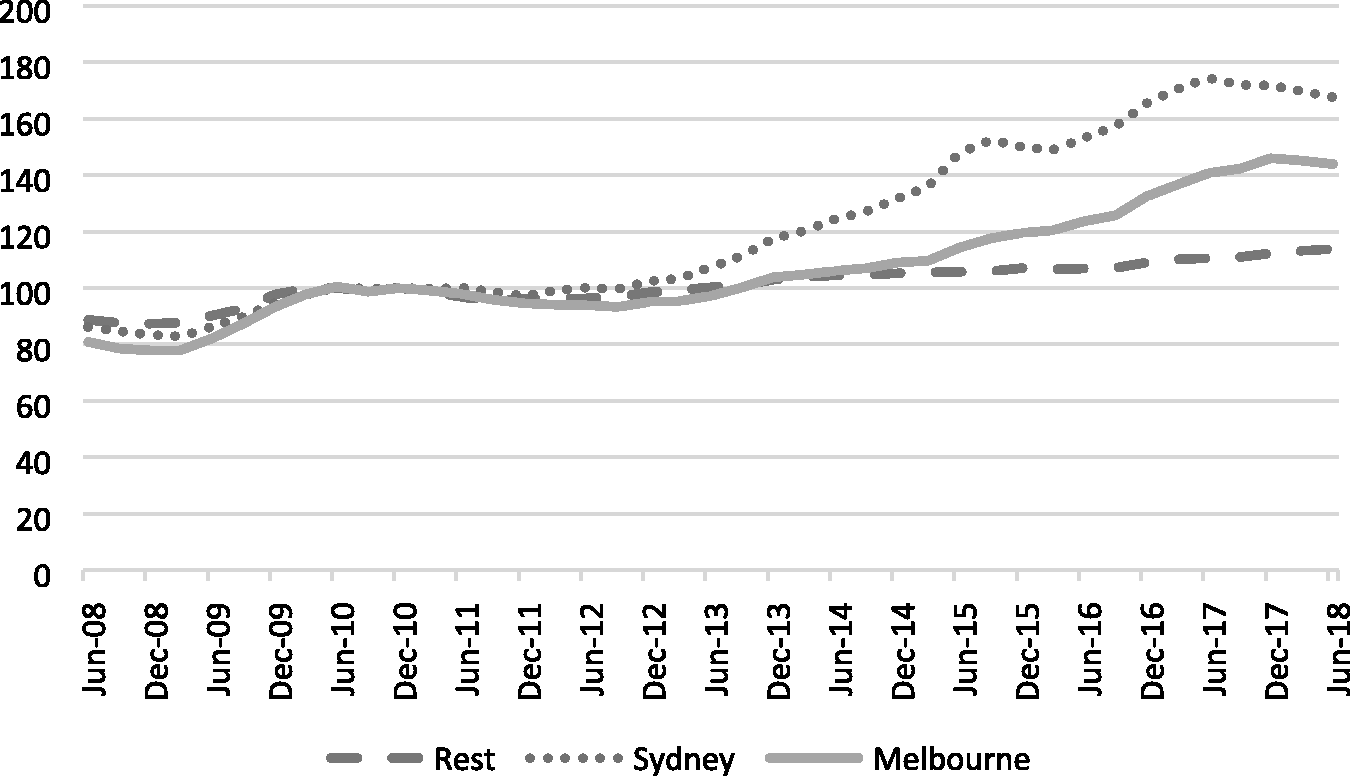
Index of Australian Capital City Housing Prices.
Australia's rapid growth in house prices has been accompanied by multiple reports by government, industry, and non-government sectors, dating from a seminal report on barriers to first home ownership by the independent, but publicly funded, Productivity Commission (2004). Collectively this work purports to diagnose causes and solutions to the ‘problem’ – largely framed in terms of declining access to first home ownership, and or inadequate rates of new housing production (National Housing Supply Council, 2009; Parliament of Australia, 2008, 2015; Productivity Commission, 2004).
Unsurprisingly, the property industry’s position; as articulated in numerous commissioned ‘studies’ and reports to government is simply that the problem is artificially created by land use regulations, fees and charges (Property Council of Australia, 2006). In 2017, the largest property lobby group in Australia, the Property Council, argued that differential house prices in the major cities reflect planning system impediments: So why is the average home in Melbourne just $566,000, but $785,000 in Sydney? The answer is supply. Put simply, Melbourne has been far better in planning for and delivering new housing than Sydney for nearly two decades. (Property Council of Australia, 2017:1 2) Study after study tells us, as indeed Deputy Reserve Bank Governor Phil Lowe did this week, that it is restrictions on supply, planning restrictions, restricted land supply, [and] inadequate transport infrastructure which drives up prices. Why is housing more affordable in Brisbane than in Sydney? Well, developers tell me it is because it takes about a third of the time to get a DA.
2
Sydney already faced a housing shortage when the boom began, reflecting zoning restrictions aiming to limit city growth
3
IMF (2018b: 31) Australian cities have not built enough housing to meet the needs of Australia’s growing population. Affordability – both to buy and to rent – will only get a lot better if governments permit more homes to be built. (p68)
How accurate are these claims about the role of planning in inflating house prices through the restriction of supply in Australia?
This political pressure for increasing housing supply in the market has had a significant impact on the nature of planning systems in Australia. Unlike the USA planning systems described by Glaeser and Guyrorko (2003) which are dominated by local governments, state governments have the major say on land use regulation, with local government plans requiring approval by the respective state government to become law. Further, since the turn of the new millennium, the states have increasingly assigned themselves powers to directly intervene in local zoning and major land use decisions (Ruming et al., 2014).
In the face of constant lobbying from powerful developer interests, and important interventions by central government agencies, interested in the extra economic activity that an increasing population can generate as well as an increasing tax base, there has been almost constant reform to Australian land use planning systems since the turn of the century. Such reforms, designed to speed up land supply and overcome local impediments to growth (Gurran and Phibbs, 2013), imply that Australian planning systems sit at the lightly regulated end of any index of land use regulation (Gyourko et al., 2008). For example, since 2005 New South Wales (NSW),the most populous State, has made it easier for developers to bypass local zoning controls if proposing major residential schemes, installed expert panels to replace political determination processes and extended ‘as of right’ entitlements to many classes of housing development (Macdonald, 2018). These reforms have been sweeping, with ‘as of right’ code-based certification applying to over 40% of development by 2016, up from 2% in 2007 (NSW Government, 2008, 2017).
In the year ending September 2018 Sydney, Australia’s largest city and the capital of NSW, recorded 44,000 dwelling completions, equivalent to about 3% of the city’s total housing stock (NSW Department of Planning, 2019). These data suggest that the planning system can respond to dwelling demand and has become increasingly responsive over the past two decades. This is the key issue – not whether land use regulations exist since every modern economy has some sort of land use regulation – but to what extent regulation dampens new housing supply by limiting the number of potential dwellings in a city.
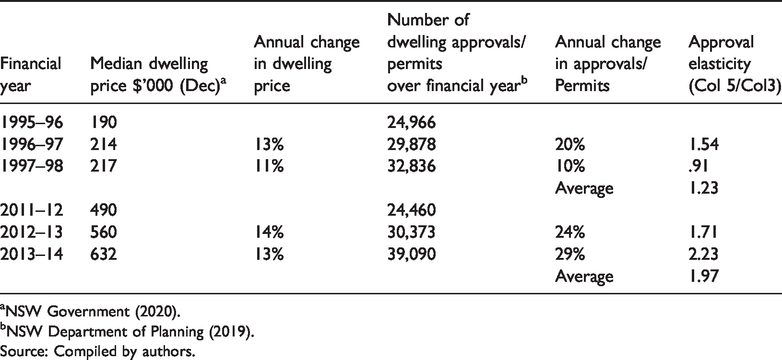
As shown in Table 1, planning regulation in Sydney does not appear to have dampened new housing supply. The table compares two periods in Sydney where there were two consecutive years of house price increases over 10 percent. The first was 1996 and 1997 before the major round of planning reforms, and the second was 2012–2013 after significant planning reform had occurred. The approval elasticity for the first period averaged 1.23; compared with 1.97 for the second period. In other words, in the first period a 10% increase in price led to a 12.3% increase in dwelling approvals, followed by an even higher 19.7% increase in approvals in the second period.
Changes in approval elasticities over time, Sydney, Australia.
NSW Department of Planning (2019).
Source: Compiled by authors.
Similar improvements over time can be seen in the measure of “permitting intensity”; or the number of new dwellings permitted by planning authorities in a year compared to the stock of existing dwellings. As noted, this measure has been used to compare the performance of different US metropolitan housing markets (Glaeser and Gyourko, 2018), with Atlanta, Georgia, and Houston, Texas, known for responsive housing supply. Yet the permitting intensity in Sydney has exceeded that seen in both these cities over the last decade (Table 2). If these two U.S. cities can be said to have responsive housing supply, unrestricted by planning regulation, then the same must be said about Sydney.
Permitting intensity, Sydney, Houston and Atlanta 2010–2017.
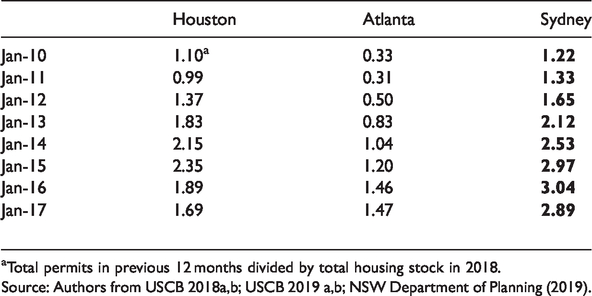
Total permits in previous 12 months divided by total housing stock in 2018.
Source: Authors from USCB 2018a,b; USCB 2019 a,b; NSW Department of Planning (2019).
Ironically, Sydney’s growth in new housing supply, has led to new concerns about the Sydney market, described by some as oversupplied with high vacancy rates in the rental market putting downward pressure on rents for several years (Stapledon, 2020). In fact, although there has been a growing shortage of rental accommodation that is affordable and available for lower income groups in Sydney, (Hulse, Reynolds et al., 2019) the NSW Government’s rent monitor (NSW Government, 2020) reports that nominal rents have not increased since June 2015. This reflects the fact that new housing supply has contributed to overall growth in the private rental sector, serving middle income households unable to enter home ownership. However, the availability of lower priced rental accommodation has not improved.
With affordability problems persisting, and a determined resistance to address demand side drivers – such as Australia’s generous tax incentives for property investment – there has been sustained interest in quantifying the perceived ‘supply’ constraints imposed by planning. In this context, two economists from Australia’s Central Bank (the RBA) applied the Glaeser and Gyourko (2003) method to four Australian cities in order to estimate what they called ‘the zoning’ effect. They came up with the extraordinary finding that the ‘cost’ of planning was nearly half a million dollars for Sydney house buyers: excluding the effect of zoning, the marginal Sydney house buyer could have been supplied with an average house for $671 000 – it would have cost $395 000 to build the structure and landowners (existing or potential) would have been prepared to forego the land for $277 000. Instead, buyers needed to pay $1.16 million. The extra $489 000 reflects administrative restrictions. That is, zoning restrictions raised prices 73 per cent above the cost of supply (Kendall and Tulip, 2018: 1).
The next section examines the method used by Kendall and Tulip to estimate this ‘zoning effect’, highlighting the influence of the Glaeser and Gyourko (2003) model on Australian housing policy discourse, despite its questionable assumptions and absence of data on Australian land use regulation. Our analysis suggests the approach fundamentally misunderstands the operation of urban land markets, making the findings from this study and its predecessors unreliable.
Examining Australia’s ‘zoning effect’
The RBA method carefully copied the approach by Glaeser and Gyourko (2003) in estimating the ‘zoning effect’ of separate dwelling. The authors use housing transaction data for each of Australia’s major cities to establish the median sales prices for separate houses in Australia in 2016. For example, in the case of Sydney, Australia’s largest city, the median is $AU1.16 million dollars and the median house is located on a lot which is 673 square metres. The authors use a hedonic regression model to estimate that house purchasers pay $411 for one additional square metre of land. The difference between the cost of the dwelling – which they estimate by taking the average cost from three alternative methods - and the median selling price is taken to be the cost of the land, which in the case of Sydney is $765, 000. The authors then calculate the average cost per square metre of land (765,000/673) and then subtract the marginal cost of land to generate the ‘zoning effect’. In the case of Sydney, this was calculated at $489, 000. (673* (1137–411)). The RBA authors use the following rationale for calling this difference the zoning effect: The difference between the average (or market) price and the marginal (or physical) value of land represents an arbitrage opportunity. In the absence of zoning, an investor could purchase properties where the marginal value of land is lower than the average value, subdivide them to create multiple smaller properties, and make a profit. (Kendall and Tulip, 2018: 1) The neoclassical approach suggests that land should be valued the same using either methodology. After all, if a homeowner does not value the land on his plot very much, he would subdivide and sell it to someone else. (Glaeser and Gyourko, 2003: 23)
Why the difference between average and marginal cost is not a exclusively a land use regulation or zoning effect
The key assumption in both the RBA paper and the original method by Glaeser and Gyourko is that without land use regulation the average cost of land would equal the marginal cost. Or in other words the average price paid for land (per square metre) would equal the cost for an additional one square metre.
However, what the RBA authors have measured by estimating the difference between average and marginal costs is not solely the cost of land use regulation but rather a phenomenon which is a characteristic of many urban land markets, and which would exist in markets with no land use regulation.
Locating a dwelling on a piece of land provides both a dwelling to live in, as well as access to a bundle of goods and services in the locality. These might include access to a train station, beaches, cultural facilities, a short commute to work, status, sea breezes, shops, a view from the front room, a park and good schools. Such amenities are typically understood to impact on the locational value of land. Locational values are known to be enhanced by natural amenities such as green areas, (e.g. Conway et al., 2010; Hoshino and Kuriyana, 2010); proximity to beaches (e.g. Pompe and Rinehart, 1995), and water views (e.g. Benson et al., 2000), good public transport (e.g. Kim and Lahr, 2014; McMillen and McDonald, 2004) retail and services (e.g. Glaeser et al., 2001); central employment opportunities (e.g. Abelson et al., 2013) or good schools (e.g. Davidoff and Leigh, 2008). In some areas of a city this locational value is clearly very high. This is evident in large variations in the value of land with similar physical attributes at different locations across the city. For example, Albouy et al. (2018), have estimated that land values in central areas are estimated to be 21 times higher than values ten miles away in “superstar” US cities, and four times higher in an “average” US city.
When an additional square metre is added onto the size of a backyard, there is no additional locational value. 4 So unless the owner has a use for their backyard space to which a very high value can be assigned, the marginal price of land will always be less than the average cost of land. This is because the average cost of land includes the locational value of land and the marginal cost does not. This gap between average and marginal costs will be smaller in parts of the city where the locational values are lower.
We could add the location value from all the lots for an area or even lots for a whole city and name it the location premium. It is possible to suggest sone ways that the location premium will vary over time and between cities:
It is likely that the location premium would increase over time in cities where congestion become worse It is likely that the location premium will be bigger for larger cities than smaller cities, especially where the larger cities have congestion problems. It is likely to be larger in cities where positive amenities (eg CBDs, beaches, water views etc) are spread unevenly through the city
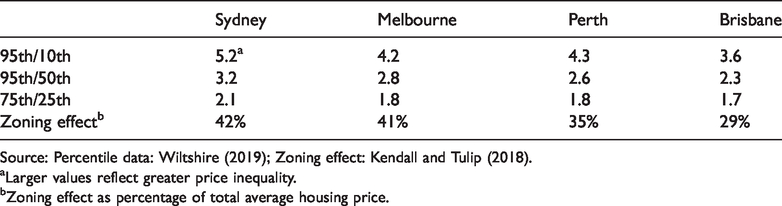
One proxy for the size of the location premium in a particular city is to simply measure the size of the price inequality in a city’s housing market. Wiltshire (2019) has undertaken this task using 2018 price data for several Australian cities. He suggests that the inequality in prices is driven by geography, size, congestion, and job dispersion. Table 3 shows the ratio of property price percentiles in the four Australian cities covered by the RBA analysis, with Sydney on the left of the table being the most unequal and Brisbane being the most equal. It is interesting to note that the size of the zoning effect for the four Australian cities, closely matches the ranking of estimates of price inequality provided by Wiltshire. Moreover, Sydney which is the largest city with the most significant congestion (BITRE, nd) and the most unequal distribution of jobs and beaches, has the largest zoning effect.
Ratio of property price percentiles for selected Australian capital cities, 2018 and the RBA’s estimate of the zoning effect.
Source: Percentile data: Wiltshire (2019); Zoning effect: Kendall and Tulip (2018).
Larger values reflect greater price inequality.
Zoning effect as percentage of total average housing price.
The existence of this locational premium is not a sufficient condition to reject the RBA conclusion, since the RBA authors would claim that without land use regulation, these differences in values would be removed as a result of arbitrage. Normally in markets if there were differences in marginal and average costs and the commodity could be transferred, divided and reassembled, arbitrage across the market would be expected to eliminate the difference. However, there is a substantial body of real estate literature the that suggests that this locational difference will remain in land markets because of particular characteristics of these markets (see for example, Asabere and Colwell, 1985; Brownstone and DeVany, 1991; Kowalski and Colwell, 1986; Colwell and Sirmans, 1978, 1980). Note that this literature was well established before the original paper by Glaeser and Gyourko (2003) was published.
The position of this literature is well summarized by Colwell and Sirmans (1980: 141) who state: The price of urban land is chronically non linear in the sense that land sells for different unit prices at different parcel sizes. That this condition is chronic means that these price differences are not transitory but persist over time and thus should be found across urban regions. In general, if the price of a commodity is nonlinear and the commodity may be transferred, divided, and reassembled, arbitrage across bundle sizes would be expected to eliminate the nonlinearity unless transaction costs make the arbitrage unprofitable. Unit price differentials do not necessarily indicate that the opportunity exists for profiting from purchasing at one bundle size and selling at another. Thus, these price differentials may exist in equilibrium … The transactions costs of assembling land and subdividing land and the subsequent development. These costs can be substantially increased when multiple small land parcels need to be assembled because of the price premia extracted by holdouts Some small land parcels cannot be combined with other parcels to make a developable site because they might not be contiguous with other developable parcels or the cost of moving the public capital between the two parcels (eg a road or a sewage line) would make land assembly infeasible. Colwell and Sirmans (1993) suggest in these cases the value of these parcels would be zero.
If you accept the proposition that in the equilibrium position in the land market, marginal and average values will not be equal, what the RBA has measured is a mixture of the zoning effect and the location premium. If this is the case the difference between the marginal cost and the average price of land will be highest in high land value areas where the location premium is highest. This is exactly what the RBA authors have found. What the authors describe as increases in the zoning effect in high value areas (Kendall and Tulip, 2018: 17) might be more accurately called the location premium.
The data used to estimate the marginal price of land
In calculating the physical costs of land, the RBA study used all observed sales of separate houses in Australian cities in a given year. However, to measure the effect of land use regulation separately from the location premium, only transactions where land use regulation impede the ability to construct a new dwelling would be included. This is because on many lots in Australia cities, land use regulation is not the factor that is restricting additional housing supply but rather the nature of the allotment and the location of the existing dwelling. As described above, in many of these lots the effective value of their “marginal land” to a housing developer is zero.
Figure 2 describes three types of residential lot where the development value of “marginal land” is zero and hence the difference in value between the average and marginal value is not a zoning effect but likely to be a location premium effect:-
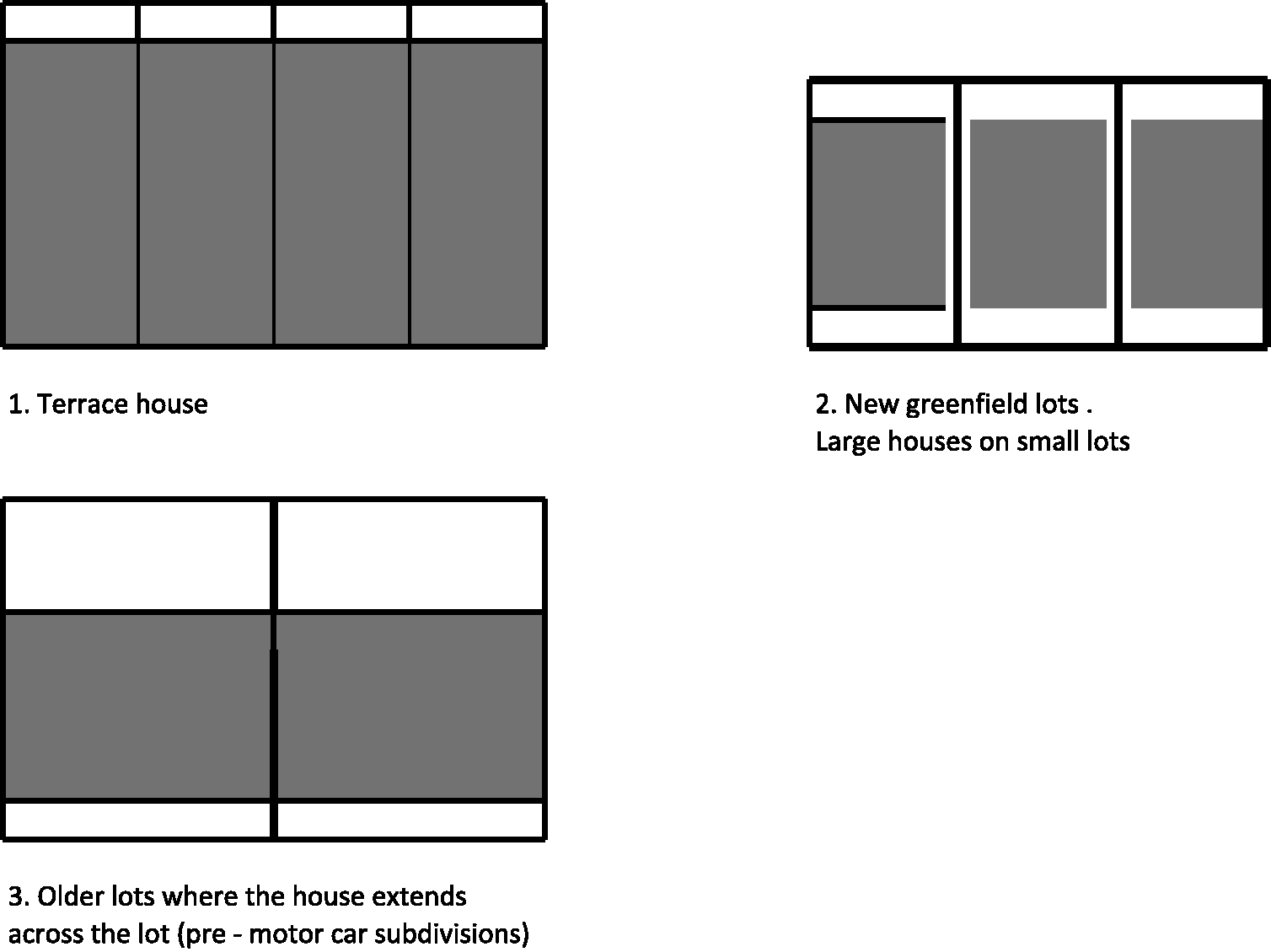
Three lot typologies where the development value of marginal land would be zero.
In many inner city areas, terrace houses occupy large proportions of their total site area and it is not physically possible to construct additional dwellings out of backyards because the backyards are too small.
A similar situation occurs in new release areas of Australian cities – where large houses occupy almost the total area of small lots. In the four cities which the RBA examined in their study, these lots would have been a significant proportion of the total 2016 transactions;
In many older areas of the city, where dwellings were erected before the widespread use of the private motor car, dwellings occupy the total width of the lot.
In other cases, the constraint might be the slope of the land or the presence of particular physical conditions in the soil/geology that prevent the construction of a house. It is likely that only a minority of sales transactions in any year would involve properties where it would be possible to say that an additional dwelling could be constructed on the lot or adjoining lots even with no land use regulation. To examine this issue in more detail, a pilot study was undertaken in a small Australian capital city, Hobart. Over a 12 month period (January to December 2019), the separate dwellings for sale were inspected at monthly intervals using air-photo data available from a real estate site (www.real estate.com.au). Less than 5% of properties for sale could accommodate an additional dwelling of 70 sq metres and be subdivided for sale (ignoring any constraints imposed by land use regulation) It was obvious from the air-photos that in many instances that the subdivision of original lots had already occurred, suggesting that in older cities there is likely to be a larger difference between marginal and average costs
O’Flaherty (2003) addresses this issue and says that even when there are no zoning constraints the lumpy nature of house construction – (dwellings need large parcels of vacant land) - means that average will not equal marginal costs in situations where it not physically possible to construct a house. He suggests that: The restriction to single-family detached houses further reduces the possibilities for using very small pieces of land. This means that small pieces of unused land are not going to be very valuable. (O’Flaherty, 2003: 42)
In summary, the Glaeser and Gyourko method is likely to be an unreliable measure of the zoning effect because of these confounding issues. However, to be fair to the original authors, they concede that the method does have some data issues. Gyourko and Molloy (2015: 1296) caution that: Given the difficulty in measuring land prices and the dependence of this approach on certain assumptions, it seems wise to conclude that local regulatory restrictions are binding and economically important only when the estimated “regulatory tax” is large.9
Some of the issues with the RBA method could be overcome if a different approach was used in selecting lots for inclusion in the analysis. In order to select which sales transactions to include, the “with and without rule” would need to be applied, only including transactions where under current land use regulations an additional dwelling could not be produced, but without land use regulation an additional dwelling would be possible.
This task requires GIS skills not econometrics as well as an understanding of land use regulation. The RBA method, which used all the dwelling transactions in each city conflates the zoning effect with the location premium. Examining each lot using a GIS approach would be a time intensive piece of research. One simple alternative method to provide a more reliable view of the zoning effect might be to only examine sales data for large corner lots where clearly there is enough land to build an additional dwelling. This method would be particularly useful for comparing the regulatory “density” of the land use regulation system operating in different cities. The general approach used by the RBA to measure the difference in the average and marginal costs could provide an estimate the of the costs of land use regulation for this subset of annual sales.
Changes in the RBA zoning effect over time
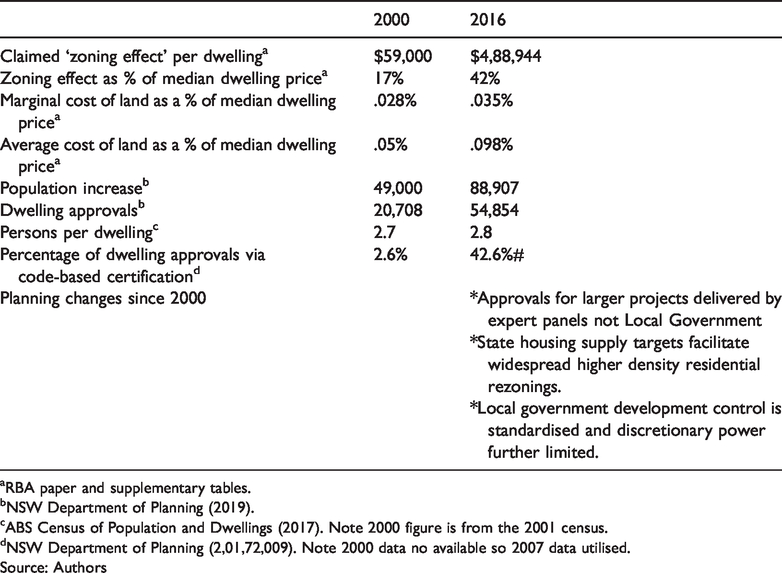
The RBA paper describes a sharp increase in the land use planning effect over time (eg in Sydney it increased from 59 k in 2000 to 489 k in 2016). However, as described above, the reform to Australian planning systems has been so extensive in the last twenty years, this outcome is hard to understand. One indication of land use regulation not being a binding constraint on development was the 1,00,000 dwelling approvals (or about 3 years supply) which had not yet commenced construction at the end of 2018, after the 2011–2016 boom in construction in Sydney (NSW Department of Planning, 2020). Many of these approvals were awaiting a pre-sale of a dwelling so that the developer could obtain finance for their development.
Table 4 tests the argument for Sydney that the restrictions generated by land use regulation have increased over time using two time periods – 2016 and 2000. It is clear that housing demand built up considerably in the year up to 2016, and interest rates have declined since 2000. However, there are a range of other issues that would act to reduce demand, most notably the increase in household size. There was also a major change in dwelling approval processes over this same period with over 40 percent of dwellings in 2016 not requiring any formal planning approval but rather using a code-based certification process which is provided by the private sector (as well as Government). Whilst some small increase in the land use planning effect might be feasible, a 250% increase seems a strange result. Table 4 suggests that whatever the difference between marginal and average costs are measuring, the change over time is not all about land use regulation. 5 If the authors had known more about planning, perhaps they would have been more circumspect about their initial findings and looked for other reasons why the so-called zoning effect increased over time. For example, two possible explanations lie in changing nature of backyards in Australia and increases in road congestion on the back of significant increases in population in Australian cities over the period.
The claimed ‘zoning effect’ in Sydney 2000 and 2016.
RBA paper and supplementary tables.
NSW Department of Planning (2019).
ABS Census of Population and Dwellings (2017). Note 2000 figure is from the 2001 census.
NSW Department of Planning (2,01,72,009). Note 2000 data no available so 2007 data utilised.
Source: Authors
First, backyards in Australia have been shrinking as lot sizes get smaller and dwelling sizes get larger. The dwelling size of a detached house rose from 218 sq metres in 1999 to 230 sq metres in 2016 (Commsec, 2018) while an industry group, the HIA, estimate that lot sizes have shrunk by about 30 percent since 1991 (Walker and Scott, 2020). One of the societal changes is that time pressures have built up the time and costs of maintaining a large backyard have made them less popular. This is likely to have put downward pressure on the marginal cost of land over time leading to a larger “zoning” effect.
Second, as mentioned above, as cities increase in size and traffic congestion increases, the location premium is likely to increase, again inflating the so-called zoning effect. For example, the Australian Government’s main transport research unit (BITRE, 2015) estimates that the average unit costs of congestion for Australian metropolitan areas increased by a little over 40 percent between 2000 and 2015. This increase in congestion would have increased the location premium and hence the average land costs would have increased.
It is interesting to note that when you examine the average and marginal land costs generated by the RBA study for the four cities, the marginal cost of land as a proportion of the selling price has been reasonably stable and the average cost of land as a proportion of the selling price has increased significantly (see Table 4). This would suggest that the increases in the difference between the average cost and marginal cost over time could have been generated by changes in the location premium.
Conclusion
Australian policy makers and market analysts appear to have made little progress in understanding the dynamics of the housing system, or how to improve affordability outcomes for households in the future. The level of analysis is often limited, and there is little understanding of how the operation of different elements of the Australian housing system translates into higher prices. In many cases an important element of this discourse includes scapegoating the planning system.
The role of simplistic economic ideas in fueling Australia’s housing policy mistakes is significant. The belief of many economists in market outcomes, their lack of understanding about housing system processes, especially the role of land, and an almost religious concern with planning as a contributor to house price inflation, has hindered their ability to see how housing markets are actually working and what potential policy levers are available to change housing market trajectories. What is even more concerning is the use of unreliable economic models to support claimed positions and the lack of robust review to test the veracity of these models and their underlying assumptions. The literature review reveals that many of the economic methods which are used to describe the cost of land use regulation are indirect methods that have received little close scrutiny. The Glaeser and Gyourko (2003) method to describe the cost of zoning is a case in point. When the RBA authors used this method to describe the Australian zoning effect, there was little critical analysis of the paper, particularly in the financial media and the findings were used by many commentators to provide further criticisms of planning. However, when examined more closely the method has a clear conceptual weakness that it is measuring both a zoning effect as well as a locational effect. When the RBA results are examined over time their reliability as measures of the zoning effect are also dubious.
The case study of the RBA analysis of Australian markets is a key exemplar of the need for an interdisciplinary approach to understanding the operation of urban housing markets and the problems that arise from an overly narrow approach to housing market analysis. This interdisciplinary approach would need to include urban planners who could help identify real versus imagined supply bottlenecks in land-use regulation.
The focus on the 'evils' of planning as a supply bottleneck in Australia and other countries has shut out the possibilities for policy action on broader causes of house price inflation and affordability pressures. In Australia as in other nations these have been the demand side drivers of residential investment such as financial deregulation (plus historically low interest rates) and taxation policy (favouring property investment), which have led to the hyper-commodification of housing (Madden and Marcuse, 2016). Unfortunately, this simplistic approach to housing markets, which has so effectively influenced public policy has won the round, condemning younger generations and low-income renters to the losing position.
Footnotes
Declaration of conflicting interests
The author(s) declared no potential conflicts of interest with respect to the research, authorship, and/or publication of this article.
Funding
The author(s) received no financial support for the research, authorship, and/or publication of this article.
